
×
Request Free Sample ×

Kindly complete the form below to receive a free sample of this Report

* Please use a valid business email

Leading companies partner with us for data-driven Insights

clients tt-cursor
Hero Background
English
Chinese
French
Japanese
Korean
German
Spanish

Off The Road Tire Market Share

ID: MRFR/AT/3594-CR
139 Pages
Swapnil Palwe
October 2020

Off the Road Tire Market Research Report Information By Vehicle Type (Mining, Agricultural Vehicle, Construction and Industrial Equipment and Others), Construction Type (Radial, Bias and Belted Bias), Distribution Channel (Aftermarket and OEM) and Region - Industry Outlook & Forecast to 2035

Share:
Download PDF ×

We do not share your information with anyone. However, we may send you emails based on your report interest from time to time. You may contact us at any time to opt-out.

Off The Road Tire Market Infographic
Purchase Options

Market Share

Off The Road Tire Market Share Analysis

The OTR tire market is a dynamic industry that serves various industries, including the mining, construction agriculture and forestry. In this very competitive arena, it is the market share positioning strategies that determine how companies operating in such environment will fare. A popular way is differentiation in which organizations concentrate on making custom and unique OTR tire solutions catering to the specific needs of various sectors. These firms strive to gain market share and loyal clientele by providing a wide variety of products that differ in tread patterns, compounds, as well as their dimensions. Another main strategy in the OTR tire market is cost leadership. Some firms pursue economies of scale by investing in efficient manufacturing processes and technologies that help to reduce costs. This makes it possible to present competitive prices for the OTR tires which attracts cost-conscious consumers and gains an impressive market share. Cost leadership does not necessarily imply the absence of quality and successful companies often make sure to strike a balance between affordability in product performance, that meets industry standards. Innovation also contributes significantly to market share positioning in the OTR tire industry. Companies that spend money on research and development, resulting in innovative tire technologies including modern tread patterns reinforced compounds are ensured a competitive position. By remaining proactive for the technological development, these enterprises attract customers searching for high-performance OTR tires that increase efficiency and minimize downtime in harsh environments. Distribution and availability are significant parts of the positioning strategies for market share in OTR tire markets. In this manner, companies systematically create distribution systems and coalitions so that their products can be accessible to customers in various regions. Accessibility becomes a significant competitive advantage especially in markets with high demand for OTR, tires. Correct timing of delivery and a stable supply chain ensure customer satisfaction, which leads to brand loyalty as well as market domination. Brand image and business ratios are both critically important in OTR tire market. Companies that focus on creating a brand based on constant quality variations and customer satisfaction manage to obtain the largest market share. Positive word-of-mouth, testimonials, and reviews play a role in the creation of overall brand perceptions that affect purchasing decisions. Also, timely customer service that resolves queries by giving technical support and helping with warranty claims makes the whole process of customers’ interaction brighter. Strategic partnerships and collaborations also appear as viable market share positioning strategies in the OTR tire industry.


Author
Swapnil Palwe
Team Lead - Research

With a technical background as Bachelor's in Mechanical Engineering, with MBA in Operations Management , Swapnil has 6+ years of experience in market research, consulting and analytics with the tasks of data mining, analysis, and project execution. He is the POC for our clients, for their consulting projects running under the Automotive/A&D domain. Swapnil has worked on major projects in verticals such as Aerospace & Defense, Automotive and many other domain projects. He has worked on projects for fortune 500 companies' syndicate and consulting projects along with several government projects.

Leave a Comment

FAQs

What is the projected market valuation of the Off The Road Tire Market by 2035?

<p>The Off The Road Tire Market is projected to reach a valuation of 18.8 USD Billion by 2035.</p>

What was the market valuation of the Off The Road Tire Market in 2024?

<p>The market valuation of the Off The Road Tire Market was 7.4 USD Billion in 2024.</p>

What is the expected CAGR for the Off The Road Tire Market during the forecast period 2025 - 2035?

<p>The expected CAGR for the Off The Road Tire Market during the forecast period 2025 - 2035 is 8.92%.</p>

Which companies are considered key players in the Off The Road Tire Market?

<p>Key players in the Off The Road Tire Market include Michelin, Bridgestone, Goodyear, Continental, Trelleborg, BKT, Yokohama, Pirelli, and Sumitomo.</p>

What segment of the Off The Road Tire Market had the highest valuation in 2024?

<p>In 2024, the Mining segment had the highest valuation at 5.0 USD Billion.</p>

How does the Heavy Load segment perform in terms of market valuation?

The Heavy Load segment is projected to grow from 2.96 USD Billion in 2024 to 7.4 USD Billion by 2035.

What is the market valuation for Radial Tires in the Off The Road Tire Market?

The market valuation for Radial Tires was 2.96 USD Billion in 2024 and is expected to reach 7.36 USD Billion by 2035.

Which tread pattern segment is expected to show significant growth?

The Lug Tread segment is expected to grow from 2.96 USD Billion in 2024 to 7.42 USD Billion by 2035.

What is the projected valuation for the Agriculture segment by 2035?

The Agriculture segment is projected to reach a valuation of 3.0 USD Billion by 2035.

How does the performance of the Industrial segment compare to other segments?

The Industrial segment is expected to grow from 1.0 USD Billion in 2024 to 2.5 USD Billion by 2035, indicating moderate growth compared to others.

Market Summary

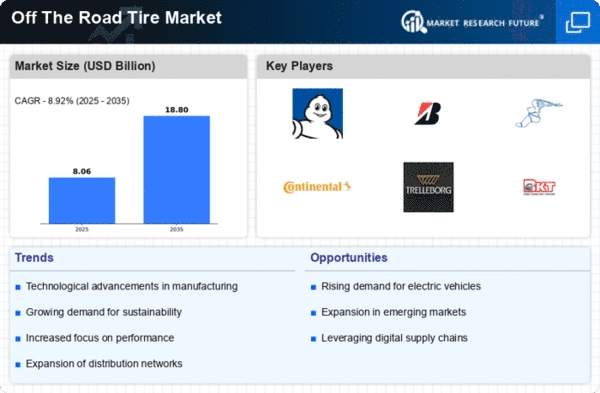
As per MRFR analysis, the Off The Road Tire Market Size was estimated at 7.4 USD Billion in 2024. The Off The Road Tire industry is projected to grow from 8.0 USD Billion in 2025 to 18.8 USD Billion by 2035, exhibiting a compound annual growth rate (CAGR) of 8.92% during the forecast period 2025 - 2035.

Key Market Trends & Highlights

The Off The Road Tire Market is experiencing robust growth driven by technological advancements and increasing demand across various sectors.

  • Technological advancements are enhancing tire performance and durability, particularly in the construction segment. Sustainability initiatives are gaining traction, influencing manufacturers to adopt eco-friendly practices in tire production. Customization and specialization are becoming prevalent, catering to the unique needs of heavy equipment and agricultural machinery. The increasing demand from the construction sector and expansion of mining activities are key drivers propelling market growth.

Market Size & Forecast

2024 Market Size 7.4 (USD Billion)
2035 Market Size 18.8 (USD Billion)
CAGR (2025 - 2035) 8.92%
Largest Regional Market Share in 2024 North America

Major Players

Michelin (FR), <a href="https://www.bridgestone.com/products/off_the_road/">Bridgestone</a> (JP), Goodyear (US), Continental (DE), Trelleborg (SE), BKT (IN), Yokohama (JP), <a href="https://www.pirelli.com/tyres/en-ww/car/catalogue/suv-tyres">Pirelli</a> (IT), Sumitomo (JP)

Market Trends

The Off The Road Tire Market is currently experiencing a dynamic evolution, driven by various factors that influence demand and supply. The increasing need for heavy machinery in construction, mining, and agricultural sectors appears to be a primary catalyst for growth. As industries expand, the requirement for durable and high-performance tires becomes more pronounced. Additionally, advancements in tire technology, such as improved tread designs and materials, seem to enhance the performance and longevity of off-road tires, thereby attracting more consumers. Furthermore, environmental considerations are prompting manufacturers to innovate, focusing on sustainable materials and production processes. This shift not only addresses regulatory pressures but also aligns with the growing consumer preference for eco-friendly products. In parallel, the competitive landscape of the Off The Road Tire Market is intensifying, with numerous players striving to capture market share. Companies are increasingly investing in research and development to create specialized tires that cater to specific applications, such as mining or agriculture. This trend indicates a move towards customization, where tires are designed to meet the unique demands of different terrains and machinery. Moreover, the rise of e-commerce platforms is transforming distribution channels, allowing manufacturers to reach a broader audience. As the market continues to evolve, stakeholders must remain vigilant to adapt to changing consumer preferences and technological advancements.

Technological Advancements

The Off The Road Tire Market is witnessing a surge in technological innovations, which enhance tire performance and durability. Manufacturers are focusing on developing advanced materials and tread patterns that improve traction and reduce wear. This trend indicates a commitment to meeting the rigorous demands of off-road applications, thereby attracting a wider customer base.

Sustainability Initiatives

There is a growing emphasis on sustainability within the Off The Road Tire Market, as companies strive to adopt eco-friendly practices. This includes the use of sustainable materials in tire production and the implementation of recycling programs. Such initiatives not only comply with environmental regulations but also resonate with consumers who prioritize green products.

Customization and Specialization

The trend towards customization is becoming increasingly prominent in the Off The Road Tire Market. Manufacturers are tailoring products to meet the specific needs of various industries, such as agriculture and construction. This specialization allows for enhanced performance in diverse terrains, thereby improving customer satisfaction and loyalty.

Off The Road Tire Market Market Drivers

Rising Demand from Construction Sector

The Global Off the Road Tire Market Industry experiences a robust demand surge primarily driven by the construction sector. As urbanization accelerates globally, the need for heavy machinery in construction projects increases. In 2024, the market is projected to reach 25 USD Billion, reflecting the industry's response to heightened infrastructure development. This growth is further supported by government initiatives aimed at enhancing public infrastructure, which necessitate the use of off-road vehicles equipped with specialized tires. Consequently, the construction industry's expansion significantly contributes to the overall growth trajectory of the Global Off the Road Tire Market Industry.

Market Segment Insights

By Application: Construction (Largest) vs. Agriculture (Fastest-Growing)

<p>The Off The Road Tire Market is significantly influenced by the construction and agriculture sectors. Construction tires command the largest share in this segment, driven by increased infrastructure development and urbanization across regions. Meanwhile, the agriculture segment is gaining traction, reflecting the growing demand for efficient tire solutions that cater to modern farming practices. Growth trends indicate that while construction maintains dominance, agriculture is poised to outpace other segments, fueled by advancements in agricultural machinery and a focus on sustainable practices. Regions investing in large-scale agriculture are particularly catalyzing this upward trajectory, making agricultural OTR tires pivotal in adapting to market needs.</p>

<p>Construction: Dominant vs. Agriculture: Emerging</p>

<p>In the Off The Road Tire Market, the construction segment stands out as the dominant player, attributed to the consistent demand for heavy-duty vehicles capable of supporting construction activities. High-performance tires designed for rough terrains enhance operational efficiency, making them indispensable in construction projects. Conversely, the agriculture segment, though emerging, is exhibiting rapid growth, driven by innovations in farming equipment and heightened emphasis on productivity. Emerging agricultural OTR tires are designed to provide better traction and durability in diverse conditions, addressing the increasing needs of modern agriculture. As farmers adopt advanced machinery, the demand for specialized tires that can withstand varied agricultural practices is expected to rise, establishing agriculture as a key area for growth in this market.</p>

By End Use: Heavy Equipment (Largest) vs. Mining Vehicles (Fastest-Growing)

<p>In the Off The Road Tire Market, the 'End Use' segment showcases a diverse distribution among heavy equipment, material handling, transportation, mining vehicles, and agricultural vehicles. Heavy equipment dominates the market, reflecting the high demand for robust tires in construction and industrial applications. Conversely, mining vehicles represent the fastest-growing segment, driven by the increasing demand for mining operations that require specialized tires for rugged terrains.</p>

<p>Heavy Equipment (Dominant) vs. Mining Vehicles (Emerging)</p>

<p>Heavy equipment is integral to construction and industrial sectors, known for its durability and performance under heavy loads. This segment benefits from consistent demand, as infrastructure projects and industrial activities lead to sustained market interest. On the other hand, mining vehicles are emerging rapidly due to the booming mining sector and innovations in tire technology that enhance performance in extreme conditions. As mining operations expand globally, the need for specialized tires designed for severe environments drives growth, positioning mining vehicles as a key segment in the evolving landscape of the Off The Road Tire Market.</p>

By Tire Type: Radial Tires (Largest) vs. Bias Tires (Fastest-Growing)

<p>The Off The Road Tire Market is primarily dominated by radial tires, which account for a significant portion of the market share due to their superior durability and performance on varied terrains. Bias tires, on the other hand, are experiencing increasing popularity among specific user demographics, leading to their rapid growth in market presence. While radial tires offer advantages such as improved handling and fuel efficiency, bias tires are appreciated for their cost-effectiveness and reliability in certain applications. With the expansion of construction and mining activities worldwide, the demand for off the road tires has surged. This growth is driven by the need for high-performance tires that can withstand extreme conditions. As equipment manufacturers push for more rugged designs, solid and pneumatic tires also see interest, particularly in reduced maintenance needs and enhanced safety features. Bias tires, with their growing traction in sectors like agriculture, are anticipated to continue their impressive growth trajectory, leveraging operational cost advantages and adaptability to various machinery.</p>

<p>Radial Tires (Dominant) vs. Bias Tires (Emerging)</p>

<p>Radial tires have cemented their position as the dominant choice in the Off The Road Tire Market due to their advanced construction and superior load-carrying capabilities. Their fabric layers, oriented radially, provide better bead stiffness, leading to increased traction and lower rolling resistance. This results in longer tire life and enhanced fuel efficiency, making them ideal for heavy-duty applications in mining and construction. Conversely, bias tires are emerging as a popular alternative given their sturdiness and cost-effectiveness. While they may not match the performance metrics of radial tires, bias tires are favored for their durability in certain environments and lower purchase costs, appealing to budget-conscious consumers. This contrasting characteristic enhances their presence, particularly in sectors where the cost of operation is a critical concern.</p>

By Load Capacity: Heavy Load (Largest) vs. Extra Heavy Load (Fastest-Growing)

<p>The Off The Road Tire Market exhibits a varied landscape when it comes to load capacity segments. Heavy Load tires currently capture the majority of the market share, valued for their strength and durability in demanding conditions typical of construction and mining applications. Conversely, Extra Heavy Load tires are gaining traction due to their ability to support even larger machinery and vehicles, catering to evolving industry requirements and advancements in equipment weight capacity.</p>

<p>Heavy Load (Dominant) vs. Extra Heavy Load (Emerging)</p>

<p>Heavy Load tires represent a well-established segment, favored for applications in construction and industrial sectors where durability and load support are paramount. Their robust design allows for reliable performance under significant stress, making them essential for heavy machinery. In contrast, Extra Heavy Load tires are an emerging category, reflecting the industry's shift towards larger equipment and vehicles that require specialized tire solutions. These tires offer superior load-bearing capabilities and are increasingly in demand due to their enhanced safety and performance features, positioning them as a vital option for businesses seeking to optimize their operational efficiency.</p>

By Tread Pattern: Lug Tread (Largest) vs. Block Tread (Fastest-Growing)

<p>In the Off The Road Tire Market, the segment distribution reveals that lug tread patterns hold the largest market share due to their robust design and superior traction, making them a preferred choice for construction and mining applications. Block tread patterns are emerging as the fastest-growing segment, driven by their versatility across various terrains and their increasing adoption in agricultural machinery. Growth trends in this segment are primarily influenced by the rising demand for high-performance tires that can withstand rugged conditions. Innovations in tread design and materials are contributing to enhanced durability and traction, appealing to both construction and agricultural sectors. The expanding off-road vehicle market is expected to further propel this segment until the end of the forecast period.</p>

<p>Lug Tread (Dominant) vs. Block Tread (Emerging)</p>

<p>Lug tread patterns are known for their deep, aggressive tread design, providing exceptional grip and traction on uneven surfaces, making them ideal for heavy-duty applications in industries like construction and mining. Their dominance is attributed to their ability to perform in harsh conditions, ensuring safety and efficiency for operators. Conversely, block tread patterns are gaining popularity as an emerging choice, especially in agricultural applications, due to their adaptability and balanced performance across various terrains. Their design minimizes soil disruption while providing adequate traction, appealing to environmentally conscious end-users. This shift towards block treads symbolizes a growing trend where versatility and eco-friendliness are becoming significant factors in tire selection.</p>

Get more detailed insights about Off the Road Tire Market Research Report - Global Forecast till 2035

Regional Insights

North America : Market Leader in OTR Tires

North America is poised to maintain its leadership in the Off The Road (OTR) tire market, holding a significant market share of 3.0 in 2025. The growth is driven by robust demand from the construction and mining sectors, alongside increasing investments in infrastructure. Regulatory support for sustainable practices is also a catalyst, encouraging manufacturers to innovate and meet environmental standards. The U.S. stands out as the leading country, with major players like Goodyear and Michelin driving competition. The presence of established companies ensures a diverse product range, catering to various applications. The competitive landscape is characterized by strategic partnerships and technological advancements, positioning North America as a hub for OTR tire innovation.

Europe : Emerging Market with Growth Potential

Europe's Off The Road tire market is on a growth trajectory, with a market size of 2.0 in 2025. The region benefits from increasing construction activities and a shift towards eco-friendly tire solutions. Regulatory frameworks promoting sustainability and safety standards are pivotal in shaping market dynamics, driving demand for high-performance tires. Leading countries like Germany and France are at the forefront, with key players such as Continental and Michelin enhancing their market presence. The competitive landscape is marked by innovation and collaboration among manufacturers, ensuring a steady supply of advanced tire technologies. The focus on reducing carbon footprints is also influencing product development, making Europe a significant player in the OTR tire market.

Asia-Pacific : Rapid Growth in Emerging Economies

The Asia-Pacific region is witnessing a surge in the Off The Road tire market, projected to reach a size of 1.8 in 2025. This growth is fueled by rapid industrialization and urbanization, particularly in countries like China and India. The demand for OTR tires is increasing due to expanding mining and construction activities, supported by government initiatives aimed at infrastructure development. China leads the market, with significant contributions from local manufacturers like BKT and Yokohama. The competitive landscape is evolving, with both domestic and international players vying for market share. The region's focus on enhancing production capabilities and technological advancements is expected to further boost the OTR tire market, making it a key area for investment and growth.

Middle East and Africa : Emerging Market with Untapped Potential

The Middle East and Africa region is gradually emerging in the Off The Road tire market, with a size of 0.6 in 2025. The growth is primarily driven by increasing investments in mining and construction sectors, alongside a growing demand for agricultural machinery. Regulatory initiatives aimed at improving infrastructure are also contributing to market expansion. Countries like South Africa and the UAE are leading the charge, with a mix of local and international players like Trelleborg and Bridgestone establishing a foothold. The competitive landscape is characterized by a focus on quality and durability, as manufacturers adapt to the unique challenges of the region. As infrastructure projects ramp up, the OTR tire market in this region is expected to gain momentum, presenting opportunities for growth.

Key Players and Competitive Insights

The Off The Road Tire Market is characterized by a dynamic competitive landscape, driven by increasing demand for heavy machinery in construction, mining, and agricultural sectors. Key players such as Michelin (FR), Bridgestone (JP), and Goodyear (US) are strategically positioned to leverage innovation and sustainability initiatives. Michelin (FR) focuses on enhancing tire performance through advanced materials and eco-friendly production processes, while Bridgestone (JP) emphasizes digital transformation and smart tire technologies. Goodyear (US) is actively pursuing partnerships to expand its product offerings and improve supply chain efficiencies, collectively shaping a competitive environment that prioritizes technological advancement and sustainability. In terms of business tactics, companies are increasingly localizing manufacturing to reduce costs and enhance responsiveness to regional market demands. Supply chain optimization remains a critical focus, particularly in light of global disruptions. The market structure appears moderately fragmented, with several key players exerting significant influence. This fragmentation allows for niche players to emerge, yet the collective strength of major companies like Continental (DE) and Trelleborg (SE) ensures a competitive balance that drives innovation and market growth. In November 2025, Michelin (FR) announced the launch of its new line of sustainable tires designed specifically for off-road applications, utilizing recycled materials. This strategic move not only aligns with global sustainability trends but also positions Michelin as a leader in eco-friendly tire solutions, potentially attracting environmentally conscious consumers and businesses. The introduction of these tires could enhance Michelin's market share and reinforce its commitment to reducing carbon footprints in the tire industry. In October 2025, Bridgestone (JP) unveiled its latest smart tire technology, which integrates IoT capabilities to monitor tire performance in real-time. This innovation is significant as it enhances operational efficiency for fleet operators, allowing for predictive maintenance and reduced downtime. Bridgestone's focus on digital solutions may provide a competitive edge, particularly in sectors where operational efficiency is paramount. In September 2025, Goodyear (US) entered a strategic partnership with a leading agricultural equipment manufacturer to co-develop specialized tires for farming machinery. This collaboration is indicative of Goodyear's strategy to diversify its product offerings and cater to specific industry needs. By aligning with key players in the agricultural sector, Goodyear could enhance its market presence and drive sales growth in a niche segment. As of December 2025, current competitive trends in the Off The Road Tire Market are increasingly defined by digitalization, sustainability, and the integration of AI technologies. Strategic alliances are becoming more prevalent, enabling companies to pool resources and expertise to innovate more effectively. The competitive differentiation is likely to evolve from traditional price-based competition towards a focus on innovation, technology, and supply chain reliability, suggesting a transformative shift in how companies position themselves in the market.

Key Companies in the Off The Road Tire Market include

Industry Developments

Bridgestone Corporation, a well-known company in Japan, launched Battlax Adventurecross AX41 in the year 2019. This was introduced in the market for off-road driving motorcycles. This implementation of the strategy will expand their product portfolio which in turn will increase the volume share of off the road tires during the forecast period.

Future Outlook

Off The Road Tire Market Future Outlook

The Off The Road Tire Market is projected to grow at an 8.92% CAGR from 2025 to 2035, driven by increasing demand in construction, mining, and agriculture sectors.

New opportunities lie in:

  • <p>Development of smart tire technology for real-time monitoring Expansion into emerging markets with tailored product offerings Partnerships with OEMs for integrated tire solutions</p>

By 2035, the market is expected to achieve robust growth, positioning itself as a leader in the tire industry.

Market Segmentation

Off The Road Tire Market End Use Outlook

  • Heavy Equipment
  • Material Handling
  • Transportation
  • Mining Vehicles
  • Agricultural Machinery

Off The Road Tire Market Tire Type Outlook

  • Radial
  • Bias
  • Solid
  • Pneumatic

Off The Road Tire Market Application Outlook

  • Construction
  • Mining
  • Agriculture
  • Industrial
  • Forestry

Off The Road Tire Market Load Capacity Outlook

  • Standard Load
  • Extra Load
  • Heavy Load
  • Super Heavy Load

Off The Road Tire Market Tread Pattern Outlook

  • Lug
  • Block
  • Rib
  • Flat

Report Scope

MARKET SIZE 2024 7.4(USD Billion)
MARKET SIZE 2025 8.0(USD Billion)
MARKET SIZE 2035 18.8(USD Billion)
COMPOUND ANNUAL GROWTH RATE (CAGR) 8.92% (2025 - 2035)
REPORT COVERAGE Revenue Forecast, Competitive Landscape, Growth Factors, and Trends
BASE YEAR 2024
Market Forecast Period 2025 - 2035
Historical Data 2019 - 2024
Market Forecast Units USD Billion
Key Companies Profiled Michelin (FR), Bridgestone (JP), Goodyear (US), Continental (DE), Trelleborg (SE), BKT (IN), Yokohama (JP), Pirelli (IT), Sumitomo (JP)
Segments Covered Application, End Use, Tire Type, Load Capacity, Tread Pattern
Key Market Opportunities Adoption of advanced materials enhances durability and performance in the Off The Road Tire Market.
Key Market Dynamics Rising demand for sustainable materials drives innovation in Off The Road Tire manufacturing and design.
Countries Covered North America, Europe, APAC, South America, MEA

FAQs

What is the projected market valuation of the Off The Road Tire Market by 2035?

<p>The Off The Road Tire Market is projected to reach a valuation of 18.8 USD Billion by 2035.</p>

What was the market valuation of the Off The Road Tire Market in 2024?

<p>The market valuation of the Off The Road Tire Market was 7.4 USD Billion in 2024.</p>

What is the expected CAGR for the Off The Road Tire Market during the forecast period 2025 - 2035?

<p>The expected CAGR for the Off The Road Tire Market during the forecast period 2025 - 2035 is 8.92%.</p>

Which companies are considered key players in the Off The Road Tire Market?

<p>Key players in the Off The Road Tire Market include Michelin, Bridgestone, Goodyear, Continental, Trelleborg, BKT, Yokohama, Pirelli, and Sumitomo.</p>

What segment of the Off The Road Tire Market had the highest valuation in 2024?

<p>In 2024, the Mining segment had the highest valuation at 5.0 USD Billion.</p>

How does the Heavy Load segment perform in terms of market valuation?

The Heavy Load segment is projected to grow from 2.96 USD Billion in 2024 to 7.4 USD Billion by 2035.

What is the market valuation for Radial Tires in the Off The Road Tire Market?

The market valuation for Radial Tires was 2.96 USD Billion in 2024 and is expected to reach 7.36 USD Billion by 2035.

Which tread pattern segment is expected to show significant growth?

The Lug Tread segment is expected to grow from 2.96 USD Billion in 2024 to 7.42 USD Billion by 2035.

What is the projected valuation for the Agriculture segment by 2035?

The Agriculture segment is projected to reach a valuation of 3.0 USD Billion by 2035.

How does the performance of the Industrial segment compare to other segments?

The Industrial segment is expected to grow from 1.0 USD Billion in 2024 to 2.5 USD Billion by 2035, indicating moderate growth compared to others.

  1. SECTION I: EXECUTIVE SUMMARY AND KEY HIGHLIGHTS
    1. | 1.1 EXECUTIVE SUMMARY
    2. | | 1.1.1 Market Overview
    3. | | 1.1.2 Key Findings
    4. | | 1.1.3 Market Segmentation
    5. | | 1.1.4 Competitive Landscape
    6. | | 1.1.5 Challenges and Opportunities
    7. | | 1.1.6 Future Outlook
  2. SECTION II: SCOPING, METHODOLOGY AND MARKET STRUCTURE
    1. | 2.1 MARKET INTRODUCTION
    2. | | 2.1.1 Definition
    3. | | 2.1.2 Scope of the study
    4. | | | 2.1.2.1 Research Objective
    5. | | | 2.1.2.2 Assumption
    6. | | | 2.1.2.3 Limitations
    7. | 2.2 RESEARCH METHODOLOGY
    8. | | 2.2.1 Overview
    9. | | 2.2.2 Data Mining
    10. | | 2.2.3 Secondary Research
    11. | | 2.2.4 Primary Research
    12. | | | 2.2.4.1 Primary Interviews and Information Gathering Process
    13. | | | 2.2.4.2 Breakdown of Primary Respondents
    14. | | 2.2.5 Forecasting Model
    15. | | 2.2.6 Market Size Estimation
    16. | | | 2.2.6.1 Bottom-Up Approach
    17. | | | 2.2.6.2 Top-Down Approach
    18. | | 2.2.7 Data Triangulation
    19. | | 2.2.8 Validation
  3. SECTION III: QUALITATIVE ANALYSIS
    1. | 3.1 MARKET DYNAMICS
    2. | | 3.1.1 Overview
    3. | | 3.1.2 Drivers
    4. | | 3.1.3 Restraints
    5. | | 3.1.4 Opportunities
    6. | 3.2 MARKET FACTOR ANALYSIS
    7. | | 3.2.1 Value chain Analysis
    8. | | 3.2.2 Porter's Five Forces Analysis
    9. | | | 3.2.2.1 Bargaining Power of Suppliers
    10. | | | 3.2.2.2 Bargaining Power of Buyers
    11. | | | 3.2.2.3 Threat of New Entrants
    12. | | | 3.2.2.4 Threat of Substitutes
    13. | | | 3.2.2.5 Intensity of Rivalry
    14. | | 3.2.3 COVID-19 Impact Analysis
    15. | | | 3.2.3.1 Market Impact Analysis
    16. | | | 3.2.3.2 Regional Impact
    17. | | | 3.2.3.3 Opportunity and Threat Analysis
  4. SECTION IV: QUANTITATIVE ANALYSIS
    1. | 4.1 Automobile, BY Application (USD Billion)
    2. | | 4.1.1 Construction
    3. | | 4.1.2 Mining
    4. | | 4.1.3 Agriculture
    5. | | 4.1.4 Industrial
    6. | | 4.1.5 Forestry
    7. | 4.2 Automobile, BY End Use (USD Billion)
    8. | | 4.2.1 Heavy Equipment
    9. | | 4.2.2 Material Handling
    10. | | 4.2.3 Transportation
    11. | | 4.2.4 Mining Vehicles
    12. | | 4.2.5 Agricultural Vehicles
    13. | 4.3 Automobile, BY Tire Type (USD Billion)
    14. | | 4.3.1 Radial Tires
    15. | | 4.3.2 Bias Tires
    16. | | 4.3.3 Solid Tires
    17. | | 4.3.4 Pneumatic Tires
    18. | | 4.3.5 Non-Pneumatic Tires
    19. | 4.4 Automobile, BY Load Capacity (USD Billion)
    20. | | 4.4.1 Light Load
    21. | | 4.4.2 Medium Load
    22. | | 4.4.3 Heavy Load
    23. | | 4.4.4 Extra Heavy Load
    24. | 4.5 Automobile, BY Tread Pattern (USD Billion)
    25. | | 4.5.1 Lug Tread
    26. | | 4.5.2 Block Tread
    27. | | 4.5.3 Rib Tread
    28. | | 4.5.4 Flat Tread
    29. | 4.6 Automobile, BY Region (USD Billion)
    30. | | 4.6.1 North America
    31. | | | 4.6.1.1 US
    32. | | | 4.6.1.2 Canada
    33. | | 4.6.2 Europe
    34. | | | 4.6.2.1 Germany
    35. | | | 4.6.2.2 UK
    36. | | | 4.6.2.3 France
    37. | | | 4.6.2.4 Russia
    38. | | | 4.6.2.5 Italy
    39. | | | 4.6.2.6 Spain
    40. | | | 4.6.2.7 Rest of Europe
    41. | | 4.6.3 APAC
    42. | | | 4.6.3.1 China
    43. | | | 4.6.3.2 India
    44. | | | 4.6.3.3 Japan
    45. | | | 4.6.3.4 South Korea
    46. | | | 4.6.3.5 Malaysia
    47. | | | 4.6.3.6 Thailand
    48. | | | 4.6.3.7 Indonesia
    49. | | | 4.6.3.8 Rest of APAC
    50. | | 4.6.4 South America
    51. | | | 4.6.4.1 Brazil
    52. | | | 4.6.4.2 Mexico
    53. | | | 4.6.4.3 Argentina
    54. | | | 4.6.4.4 Rest of South America
    55. | | 4.6.5 MEA
    56. | | | 4.6.5.1 GCC Countries
    57. | | | 4.6.5.2 South Africa
    58. | | | 4.6.5.3 Rest of MEA
  5. SECTION V: COMPETITIVE ANALYSIS
    1. | 5.1 Competitive Landscape
    2. | | 5.1.1 Overview
    3. | | 5.1.2 Competitive Analysis
    4. | | 5.1.3 Market share Analysis
    5. | | 5.1.4 Major Growth Strategy in the Automobile
    6. | | 5.1.5 Competitive Benchmarking
    7. | | 5.1.6 Leading Players in Terms of Number of Developments in the Automobile
    8. | | 5.1.7 Key developments and growth strategies
    9. | | | 5.1.7.1 New Product Launch/Service Deployment
    10. | | | 5.1.7.2 Merger & Acquisitions
    11. | | | 5.1.7.3 Joint Ventures
    12. | | 5.1.8 Major Players Financial Matrix
    13. | | | 5.1.8.1 Sales and Operating Income
    14. | | | 5.1.8.2 Major Players R&D Expenditure. 2023
    15. | 5.2 Company Profiles
    16. | | 5.2.1 Michelin (FR)
    17. | | | 5.2.1.1 Financial Overview
    18. | | | 5.2.1.2 Products Offered
    19. | | | 5.2.1.3 Key Developments
    20. | | | 5.2.1.4 SWOT Analysis
    21. | | | 5.2.1.5 Key Strategies
    22. | | 5.2.2 Bridgestone (JP)
    23. | | | 5.2.2.1 Financial Overview
    24. | | | 5.2.2.2 Products Offered
    25. | | | 5.2.2.3 Key Developments
    26. | | | 5.2.2.4 SWOT Analysis
    27. | | | 5.2.2.5 Key Strategies
    28. | | 5.2.3 Goodyear (US)
    29. | | | 5.2.3.1 Financial Overview
    30. | | | 5.2.3.2 Products Offered
    31. | | | 5.2.3.3 Key Developments
    32. | | | 5.2.3.4 SWOT Analysis
    33. | | | 5.2.3.5 Key Strategies
    34. | | 5.2.4 Continental (DE)
    35. | | | 5.2.4.1 Financial Overview
    36. | | | 5.2.4.2 Products Offered
    37. | | | 5.2.4.3 Key Developments
    38. | | | 5.2.4.4 SWOT Analysis
    39. | | | 5.2.4.5 Key Strategies
    40. | | 5.2.5 Trelleborg (SE)
    41. | | | 5.2.5.1 Financial Overview
    42. | | | 5.2.5.2 Products Offered
    43. | | | 5.2.5.3 Key Developments
    44. | | | 5.2.5.4 SWOT Analysis
    45. | | | 5.2.5.5 Key Strategies
    46. | | 5.2.6 BKT (IN)
    47. | | | 5.2.6.1 Financial Overview
    48. | | | 5.2.6.2 Products Offered
    49. | | | 5.2.6.3 Key Developments
    50. | | | 5.2.6.4 SWOT Analysis
    51. | | | 5.2.6.5 Key Strategies
    52. | | 5.2.7 Yokohama (JP)
    53. | | | 5.2.7.1 Financial Overview
    54. | | | 5.2.7.2 Products Offered
    55. | | | 5.2.7.3 Key Developments
    56. | | | 5.2.7.4 SWOT Analysis
    57. | | | 5.2.7.5 Key Strategies
    58. | | 5.2.8 Pirelli (IT)
    59. | | | 5.2.8.1 Financial Overview
    60. | | | 5.2.8.2 Products Offered
    61. | | | 5.2.8.3 Key Developments
    62. | | | 5.2.8.4 SWOT Analysis
    63. | | | 5.2.8.5 Key Strategies
    64. | | 5.2.9 Sumitomo (JP)
    65. | | | 5.2.9.1 Financial Overview
    66. | | | 5.2.9.2 Products Offered
    67. | | | 5.2.9.3 Key Developments
    68. | | | 5.2.9.4 SWOT Analysis
    69. | | | 5.2.9.5 Key Strategies
    70. | 5.3 Appendix
    71. | | 5.3.1 References
    72. | | 5.3.2 Related Reports
  6. LIST OF FIGURES
    1. | 6.1 MARKET SYNOPSIS
    2. | 6.2 NORTH AMERICA MARKET ANALYSIS
    3. | 6.3 US MARKET ANALYSIS BY APPLICATION
    4. | 6.4 US MARKET ANALYSIS BY END USE
    5. | 6.5 US MARKET ANALYSIS BY TIRE TYPE
    6. | 6.6 US MARKET ANALYSIS BY LOAD CAPACITY
    7. | 6.7 US MARKET ANALYSIS BY TREAD PATTERN
    8. | 6.8 CANADA MARKET ANALYSIS BY APPLICATION
    9. | 6.9 CANADA MARKET ANALYSIS BY END USE
    10. | 6.10 CANADA MARKET ANALYSIS BY TIRE TYPE
    11. | 6.11 CANADA MARKET ANALYSIS BY LOAD CAPACITY
    12. | 6.12 CANADA MARKET ANALYSIS BY TREAD PATTERN
    13. | 6.13 EUROPE MARKET ANALYSIS
    14. | 6.14 GERMANY MARKET ANALYSIS BY APPLICATION
    15. | 6.15 GERMANY MARKET ANALYSIS BY END USE
    16. | 6.16 GERMANY MARKET ANALYSIS BY TIRE TYPE
    17. | 6.17 GERMANY MARKET ANALYSIS BY LOAD CAPACITY
    18. | 6.18 GERMANY MARKET ANALYSIS BY TREAD PATTERN
    19. | 6.19 UK MARKET ANALYSIS BY APPLICATION
    20. | 6.20 UK MARKET ANALYSIS BY END USE
    21. | 6.21 UK MARKET ANALYSIS BY TIRE TYPE
    22. | 6.22 UK MARKET ANALYSIS BY LOAD CAPACITY
    23. | 6.23 UK MARKET ANALYSIS BY TREAD PATTERN
    24. | 6.24 FRANCE MARKET ANALYSIS BY APPLICATION
    25. | 6.25 FRANCE MARKET ANALYSIS BY END USE
    26. | 6.26 FRANCE MARKET ANALYSIS BY TIRE TYPE
    27. | 6.27 FRANCE MARKET ANALYSIS BY LOAD CAPACITY
    28. | 6.28 FRANCE MARKET ANALYSIS BY TREAD PATTERN
    29. | 6.29 RUSSIA MARKET ANALYSIS BY APPLICATION
    30. | 6.30 RUSSIA MARKET ANALYSIS BY END USE
    31. | 6.31 RUSSIA MARKET ANALYSIS BY TIRE TYPE
    32. | 6.32 RUSSIA MARKET ANALYSIS BY LOAD CAPACITY
    33. | 6.33 RUSSIA MARKET ANALYSIS BY TREAD PATTERN
    34. | 6.34 ITALY MARKET ANALYSIS BY APPLICATION
    35. | 6.35 ITALY MARKET ANALYSIS BY END USE
    36. | 6.36 ITALY MARKET ANALYSIS BY TIRE TYPE
    37. | 6.37 ITALY MARKET ANALYSIS BY LOAD CAPACITY
    38. | 6.38 ITALY MARKET ANALYSIS BY TREAD PATTERN
    39. | 6.39 SPAIN MARKET ANALYSIS BY APPLICATION
    40. | 6.40 SPAIN MARKET ANALYSIS BY END USE
    41. | 6.41 SPAIN MARKET ANALYSIS BY TIRE TYPE
    42. | 6.42 SPAIN MARKET ANALYSIS BY LOAD CAPACITY
    43. | 6.43 SPAIN MARKET ANALYSIS BY TREAD PATTERN
    44. | 6.44 REST OF EUROPE MARKET ANALYSIS BY APPLICATION
    45. | 6.45 REST OF EUROPE MARKET ANALYSIS BY END USE
    46. | 6.46 REST OF EUROPE MARKET ANALYSIS BY TIRE TYPE
    47. | 6.47 REST OF EUROPE MARKET ANALYSIS BY LOAD CAPACITY
    48. | 6.48 REST OF EUROPE MARKET ANALYSIS BY TREAD PATTERN
    49. | 6.49 APAC MARKET ANALYSIS
    50. | 6.50 CHINA MARKET ANALYSIS BY APPLICATION
    51. | 6.51 CHINA MARKET ANALYSIS BY END USE
    52. | 6.52 CHINA MARKET ANALYSIS BY TIRE TYPE
    53. | 6.53 CHINA MARKET ANALYSIS BY LOAD CAPACITY
    54. | 6.54 CHINA MARKET ANALYSIS BY TREAD PATTERN
    55. | 6.55 INDIA MARKET ANALYSIS BY APPLICATION
    56. | 6.56 INDIA MARKET ANALYSIS BY END USE
    57. | 6.57 INDIA MARKET ANALYSIS BY TIRE TYPE
    58. | 6.58 INDIA MARKET ANALYSIS BY LOAD CAPACITY
    59. | 6.59 INDIA MARKET ANALYSIS BY TREAD PATTERN
    60. | 6.60 JAPAN MARKET ANALYSIS BY APPLICATION
    61. | 6.61 JAPAN MARKET ANALYSIS BY END USE
    62. | 6.62 JAPAN MARKET ANALYSIS BY TIRE TYPE
    63. | 6.63 JAPAN MARKET ANALYSIS BY LOAD CAPACITY
    64. | 6.64 JAPAN MARKET ANALYSIS BY TREAD PATTERN
    65. | 6.65 SOUTH KOREA MARKET ANALYSIS BY APPLICATION
    66. | 6.66 SOUTH KOREA MARKET ANALYSIS BY END USE
    67. | 6.67 SOUTH KOREA MARKET ANALYSIS BY TIRE TYPE
    68. | 6.68 SOUTH KOREA MARKET ANALYSIS BY LOAD CAPACITY
    69. | 6.69 SOUTH KOREA MARKET ANALYSIS BY TREAD PATTERN
    70. | 6.70 MALAYSIA MARKET ANALYSIS BY APPLICATION
    71. | 6.71 MALAYSIA MARKET ANALYSIS BY END USE
    72. | 6.72 MALAYSIA MARKET ANALYSIS BY TIRE TYPE
    73. | 6.73 MALAYSIA MARKET ANALYSIS BY LOAD CAPACITY
    74. | 6.74 MALAYSIA MARKET ANALYSIS BY TREAD PATTERN
    75. | 6.75 THAILAND MARKET ANALYSIS BY APPLICATION
    76. | 6.76 THAILAND MARKET ANALYSIS BY END USE
    77. | 6.77 THAILAND MARKET ANALYSIS BY TIRE TYPE
    78. | 6.78 THAILAND MARKET ANALYSIS BY LOAD CAPACITY
    79. | 6.79 THAILAND MARKET ANALYSIS BY TREAD PATTERN
    80. | 6.80 INDONESIA MARKET ANALYSIS BY APPLICATION
    81. | 6.81 INDONESIA MARKET ANALYSIS BY END USE
    82. | 6.82 INDONESIA MARKET ANALYSIS BY TIRE TYPE
    83. | 6.83 INDONESIA MARKET ANALYSIS BY LOAD CAPACITY
    84. | 6.84 INDONESIA MARKET ANALYSIS BY TREAD PATTERN
    85. | 6.85 REST OF APAC MARKET ANALYSIS BY APPLICATION
    86. | 6.86 REST OF APAC MARKET ANALYSIS BY END USE
    87. | 6.87 REST OF APAC MARKET ANALYSIS BY TIRE TYPE
    88. | 6.88 REST OF APAC MARKET ANALYSIS BY LOAD CAPACITY
    89. | 6.89 REST OF APAC MARKET ANALYSIS BY TREAD PATTERN
    90. | 6.90 SOUTH AMERICA MARKET ANALYSIS
    91. | 6.91 BRAZIL MARKET ANALYSIS BY APPLICATION
    92. | 6.92 BRAZIL MARKET ANALYSIS BY END USE
    93. | 6.93 BRAZIL MARKET ANALYSIS BY TIRE TYPE
    94. | 6.94 BRAZIL MARKET ANALYSIS BY LOAD CAPACITY
    95. | 6.95 BRAZIL MARKET ANALYSIS BY TREAD PATTERN
    96. | 6.96 MEXICO MARKET ANALYSIS BY APPLICATION
    97. | 6.97 MEXICO MARKET ANALYSIS BY END USE
    98. | 6.98 MEXICO MARKET ANALYSIS BY TIRE TYPE
    99. | 6.99 MEXICO MARKET ANALYSIS BY LOAD CAPACITY
    100. | 6.100 MEXICO MARKET ANALYSIS BY TREAD PATTERN
    101. | 6.101 ARGENTINA MARKET ANALYSIS BY APPLICATION
    102. | 6.102 ARGENTINA MARKET ANALYSIS BY END USE
    103. | 6.103 ARGENTINA MARKET ANALYSIS BY TIRE TYPE
    104. | 6.104 ARGENTINA MARKET ANALYSIS BY LOAD CAPACITY
    105. | 6.105 ARGENTINA MARKET ANALYSIS BY TREAD PATTERN
    106. | 6.106 REST OF SOUTH AMERICA MARKET ANALYSIS BY APPLICATION
    107. | 6.107 REST OF SOUTH AMERICA MARKET ANALYSIS BY END USE
    108. | 6.108 REST OF SOUTH AMERICA MARKET ANALYSIS BY TIRE TYPE
    109. | 6.109 REST OF SOUTH AMERICA MARKET ANALYSIS BY LOAD CAPACITY
    110. | 6.110 REST OF SOUTH AMERICA MARKET ANALYSIS BY TREAD PATTERN
    111. | 6.111 MEA MARKET ANALYSIS
    112. | 6.112 GCC COUNTRIES MARKET ANALYSIS BY APPLICATION
    113. | 6.113 GCC COUNTRIES MARKET ANALYSIS BY END USE
    114. | 6.114 GCC COUNTRIES MARKET ANALYSIS BY TIRE TYPE
    115. | 6.115 GCC COUNTRIES MARKET ANALYSIS BY LOAD CAPACITY
    116. | 6.116 GCC COUNTRIES MARKET ANALYSIS BY TREAD PATTERN
    117. | 6.117 SOUTH AFRICA MARKET ANALYSIS BY APPLICATION
    118. | 6.118 SOUTH AFRICA MARKET ANALYSIS BY END USE
    119. | 6.119 SOUTH AFRICA MARKET ANALYSIS BY TIRE TYPE
    120. | 6.120 SOUTH AFRICA MARKET ANALYSIS BY LOAD CAPACITY
    121. | 6.121 SOUTH AFRICA MARKET ANALYSIS BY TREAD PATTERN
    122. | 6.122 REST OF MEA MARKET ANALYSIS BY APPLICATION
    123. | 6.123 REST OF MEA MARKET ANALYSIS BY END USE
    124. | 6.124 REST OF MEA MARKET ANALYSIS BY TIRE TYPE
    125. | 6.125 REST OF MEA MARKET ANALYSIS BY LOAD CAPACITY
    126. | 6.126 REST OF MEA MARKET ANALYSIS BY TREAD PATTERN
    127. | 6.127 KEY BUYING CRITERIA OF AUTOMOBILE
    128. | 6.128 RESEARCH PROCESS OF MRFR
    129. | 6.129 DRO ANALYSIS OF AUTOMOBILE
    130. | 6.130 DRIVERS IMPACT ANALYSIS: AUTOMOBILE
    131. | 6.131 RESTRAINTS IMPACT ANALYSIS: AUTOMOBILE
    132. | 6.132 SUPPLY / VALUE CHAIN: AUTOMOBILE
    133. | 6.133 AUTOMOBILE, BY APPLICATION, 2024 (% SHARE)
    134. | 6.134 AUTOMOBILE, BY APPLICATION, 2024 TO 2035 (USD Billion)
    135. | 6.135 AUTOMOBILE, BY END USE, 2024 (% SHARE)
    136. | 6.136 AUTOMOBILE, BY END USE, 2024 TO 2035 (USD Billion)
    137. | 6.137 AUTOMOBILE, BY TIRE TYPE, 2024 (% SHARE)
    138. | 6.138 AUTOMOBILE, BY TIRE TYPE, 2024 TO 2035 (USD Billion)
    139. | 6.139 AUTOMOBILE, BY LOAD CAPACITY, 2024 (% SHARE)
    140. | 6.140 AUTOMOBILE, BY LOAD CAPACITY, 2024 TO 2035 (USD Billion)
    141. | 6.141 AUTOMOBILE, BY TREAD PATTERN, 2024 (% SHARE)
    142. | 6.142 AUTOMOBILE, BY TREAD PATTERN, 2024 TO 2035 (USD Billion)
    143. | 6.143 BENCHMARKING OF MAJOR COMPETITORS
  7. LIST OF TABLES
    1. | 7.1 LIST OF ASSUMPTIONS
    2. | | 7.1.1
    3. | 7.2 North America MARKET SIZE ESTIMATES; FORECAST
    4. | | 7.2.1 BY APPLICATION, 2025-2035 (USD Billion)
    5. | | 7.2.2 BY END USE, 2025-2035 (USD Billion)
    6. | | 7.2.3 BY TIRE TYPE, 2025-2035 (USD Billion)
    7. | | 7.2.4 BY LOAD CAPACITY, 2025-2035 (USD Billion)
    8. | | 7.2.5 BY TREAD PATTERN, 2025-2035 (USD Billion)
    9. | 7.3 US MARKET SIZE ESTIMATES; FORECAST
    10. | | 7.3.1 BY APPLICATION, 2025-2035 (USD Billion)
    11. | | 7.3.2 BY END USE, 2025-2035 (USD Billion)
    12. | | 7.3.3 BY TIRE TYPE, 2025-2035 (USD Billion)
    13. | | 7.3.4 BY LOAD CAPACITY, 2025-2035 (USD Billion)
    14. | | 7.3.5 BY TREAD PATTERN, 2025-2035 (USD Billion)
    15. | 7.4 Canada MARKET SIZE ESTIMATES; FORECAST
    16. | | 7.4.1 BY APPLICATION, 2025-2035 (USD Billion)
    17. | | 7.4.2 BY END USE, 2025-2035 (USD Billion)
    18. | | 7.4.3 BY TIRE TYPE, 2025-2035 (USD Billion)
    19. | | 7.4.4 BY LOAD CAPACITY, 2025-2035 (USD Billion)
    20. | | 7.4.5 BY TREAD PATTERN, 2025-2035 (USD Billion)
    21. | 7.5 Europe MARKET SIZE ESTIMATES; FORECAST
    22. | | 7.5.1 BY APPLICATION, 2025-2035 (USD Billion)
    23. | | 7.5.2 BY END USE, 2025-2035 (USD Billion)
    24. | | 7.5.3 BY TIRE TYPE, 2025-2035 (USD Billion)
    25. | | 7.5.4 BY LOAD CAPACITY, 2025-2035 (USD Billion)
    26. | | 7.5.5 BY TREAD PATTERN, 2025-2035 (USD Billion)
    27. | 7.6 Germany MARKET SIZE ESTIMATES; FORECAST
    28. | | 7.6.1 BY APPLICATION, 2025-2035 (USD Billion)
    29. | | 7.6.2 BY END USE, 2025-2035 (USD Billion)
    30. | | 7.6.3 BY TIRE TYPE, 2025-2035 (USD Billion)
    31. | | 7.6.4 BY LOAD CAPACITY, 2025-2035 (USD Billion)
    32. | | 7.6.5 BY TREAD PATTERN, 2025-2035 (USD Billion)
    33. | 7.7 UK MARKET SIZE ESTIMATES; FORECAST
    34. | | 7.7.1 BY APPLICATION, 2025-2035 (USD Billion)
    35. | | 7.7.2 BY END USE, 2025-2035 (USD Billion)
    36. | | 7.7.3 BY TIRE TYPE, 2025-2035 (USD Billion)
    37. | | 7.7.4 BY LOAD CAPACITY, 2025-2035 (USD Billion)
    38. | | 7.7.5 BY TREAD PATTERN, 2025-2035 (USD Billion)
    39. | 7.8 France MARKET SIZE ESTIMATES; FORECAST
    40. | | 7.8.1 BY APPLICATION, 2025-2035 (USD Billion)
    41. | | 7.8.2 BY END USE, 2025-2035 (USD Billion)
    42. | | 7.8.3 BY TIRE TYPE, 2025-2035 (USD Billion)
    43. | | 7.8.4 BY LOAD CAPACITY, 2025-2035 (USD Billion)
    44. | | 7.8.5 BY TREAD PATTERN, 2025-2035 (USD Billion)
    45. | 7.9 Russia MARKET SIZE ESTIMATES; FORECAST
    46. | | 7.9.1 BY APPLICATION, 2025-2035 (USD Billion)
    47. | | 7.9.2 BY END USE, 2025-2035 (USD Billion)
    48. | | 7.9.3 BY TIRE TYPE, 2025-2035 (USD Billion)
    49. | | 7.9.4 BY LOAD CAPACITY, 2025-2035 (USD Billion)
    50. | | 7.9.5 BY TREAD PATTERN, 2025-2035 (USD Billion)
    51. | 7.10 Italy MARKET SIZE ESTIMATES; FORECAST
    52. | | 7.10.1 BY APPLICATION, 2025-2035 (USD Billion)
    53. | | 7.10.2 BY END USE, 2025-2035 (USD Billion)
    54. | | 7.10.3 BY TIRE TYPE, 2025-2035 (USD Billion)
    55. | | 7.10.4 BY LOAD CAPACITY, 2025-2035 (USD Billion)
    56. | | 7.10.5 BY TREAD PATTERN, 2025-2035 (USD Billion)
    57. | 7.11 Spain MARKET SIZE ESTIMATES; FORECAST
    58. | | 7.11.1 BY APPLICATION, 2025-2035 (USD Billion)
    59. | | 7.11.2 BY END USE, 2025-2035 (USD Billion)
    60. | | 7.11.3 BY TIRE TYPE, 2025-2035 (USD Billion)
    61. | | 7.11.4 BY LOAD CAPACITY, 2025-2035 (USD Billion)
    62. | | 7.11.5 BY TREAD PATTERN, 2025-2035 (USD Billion)
    63. | 7.12 Rest of Europe MARKET SIZE ESTIMATES; FORECAST
    64. | | 7.12.1 BY APPLICATION, 2025-2035 (USD Billion)
    65. | | 7.12.2 BY END USE, 2025-2035 (USD Billion)
    66. | | 7.12.3 BY TIRE TYPE, 2025-2035 (USD Billion)
    67. | | 7.12.4 BY LOAD CAPACITY, 2025-2035 (USD Billion)
    68. | | 7.12.5 BY TREAD PATTERN, 2025-2035 (USD Billion)
    69. | 7.13 APAC MARKET SIZE ESTIMATES; FORECAST
    70. | | 7.13.1 BY APPLICATION, 2025-2035 (USD Billion)
    71. | | 7.13.2 BY END USE, 2025-2035 (USD Billion)
    72. | | 7.13.3 BY TIRE TYPE, 2025-2035 (USD Billion)
    73. | | 7.13.4 BY LOAD CAPACITY, 2025-2035 (USD Billion)
    74. | | 7.13.5 BY TREAD PATTERN, 2025-2035 (USD Billion)
    75. | 7.14 China MARKET SIZE ESTIMATES; FORECAST
    76. | | 7.14.1 BY APPLICATION, 2025-2035 (USD Billion)
    77. | | 7.14.2 BY END USE, 2025-2035 (USD Billion)
    78. | | 7.14.3 BY TIRE TYPE, 2025-2035 (USD Billion)
    79. | | 7.14.4 BY LOAD CAPACITY, 2025-2035 (USD Billion)
    80. | | 7.14.5 BY TREAD PATTERN, 2025-2035 (USD Billion)
    81. | 7.15 India MARKET SIZE ESTIMATES; FORECAST
    82. | | 7.15.1 BY APPLICATION, 2025-2035 (USD Billion)
    83. | | 7.15.2 BY END USE, 2025-2035 (USD Billion)
    84. | | 7.15.3 BY TIRE TYPE, 2025-2035 (USD Billion)
    85. | | 7.15.4 BY LOAD CAPACITY, 2025-2035 (USD Billion)
    86. | | 7.15.5 BY TREAD PATTERN, 2025-2035 (USD Billion)
    87. | 7.16 Japan MARKET SIZE ESTIMATES; FORECAST
    88. | | 7.16.1 BY APPLICATION, 2025-2035 (USD Billion)
    89. | | 7.16.2 BY END USE, 2025-2035 (USD Billion)
    90. | | 7.16.3 BY TIRE TYPE, 2025-2035 (USD Billion)
    91. | | 7.16.4 BY LOAD CAPACITY, 2025-2035 (USD Billion)
    92. | | 7.16.5 BY TREAD PATTERN, 2025-2035 (USD Billion)
    93. | 7.17 South Korea MARKET SIZE ESTIMATES; FORECAST
    94. | | 7.17.1 BY APPLICATION, 2025-2035 (USD Billion)
    95. | | 7.17.2 BY END USE, 2025-2035 (USD Billion)
    96. | | 7.17.3 BY TIRE TYPE, 2025-2035 (USD Billion)
    97. | | 7.17.4 BY LOAD CAPACITY, 2025-2035 (USD Billion)
    98. | | 7.17.5 BY TREAD PATTERN, 2025-2035 (USD Billion)
    99. | 7.18 Malaysia MARKET SIZE ESTIMATES; FORECAST
    100. | | 7.18.1 BY APPLICATION, 2025-2035 (USD Billion)
    101. | | 7.18.2 BY END USE, 2025-2035 (USD Billion)
    102. | | 7.18.3 BY TIRE TYPE, 2025-2035 (USD Billion)
    103. | | 7.18.4 BY LOAD CAPACITY, 2025-2035 (USD Billion)
    104. | | 7.18.5 BY TREAD PATTERN, 2025-2035 (USD Billion)
    105. | 7.19 Thailand MARKET SIZE ESTIMATES; FORECAST
    106. | | 7.19.1 BY APPLICATION, 2025-2035 (USD Billion)
    107. | | 7.19.2 BY END USE, 2025-2035 (USD Billion)
    108. | | 7.19.3 BY TIRE TYPE, 2025-2035 (USD Billion)
    109. | | 7.19.4 BY LOAD CAPACITY, 2025-2035 (USD Billion)
    110. | | 7.19.5 BY TREAD PATTERN, 2025-2035 (USD Billion)
    111. | 7.20 Indonesia MARKET SIZE ESTIMATES; FORECAST
    112. | | 7.20.1 BY APPLICATION, 2025-2035 (USD Billion)
    113. | | 7.20.2 BY END USE, 2025-2035 (USD Billion)
    114. | | 7.20.3 BY TIRE TYPE, 2025-2035 (USD Billion)
    115. | | 7.20.4 BY LOAD CAPACITY, 2025-2035 (USD Billion)
    116. | | 7.20.5 BY TREAD PATTERN, 2025-2035 (USD Billion)
    117. | 7.21 Rest of APAC MARKET SIZE ESTIMATES; FORECAST
    118. | | 7.21.1 BY APPLICATION, 2025-2035 (USD Billion)
    119. | | 7.21.2 BY END USE, 2025-2035 (USD Billion)
    120. | | 7.21.3 BY TIRE TYPE, 2025-2035 (USD Billion)
    121. | | 7.21.4 BY LOAD CAPACITY, 2025-2035 (USD Billion)
    122. | | 7.21.5 BY TREAD PATTERN, 2025-2035 (USD Billion)
    123. | 7.22 South America MARKET SIZE ESTIMATES; FORECAST
    124. | | 7.22.1 BY APPLICATION, 2025-2035 (USD Billion)
    125. | | 7.22.2 BY END USE, 2025-2035 (USD Billion)
    126. | | 7.22.3 BY TIRE TYPE, 2025-2035 (USD Billion)
    127. | | 7.22.4 BY LOAD CAPACITY, 2025-2035 (USD Billion)
    128. | | 7.22.5 BY TREAD PATTERN, 2025-2035 (USD Billion)
    129. | 7.23 Brazil MARKET SIZE ESTIMATES; FORECAST
    130. | | 7.23.1 BY APPLICATION, 2025-2035 (USD Billion)
    131. | | 7.23.2 BY END USE, 2025-2035 (USD Billion)
    132. | | 7.23.3 BY TIRE TYPE, 2025-2035 (USD Billion)
    133. | | 7.23.4 BY LOAD CAPACITY, 2025-2035 (USD Billion)
    134. | | 7.23.5 BY TREAD PATTERN, 2025-2035 (USD Billion)
    135. | 7.24 Mexico MARKET SIZE ESTIMATES; FORECAST
    136. | | 7.24.1 BY APPLICATION, 2025-2035 (USD Billion)
    137. | | 7.24.2 BY END USE, 2025-2035 (USD Billion)
    138. | | 7.24.3 BY TIRE TYPE, 2025-2035 (USD Billion)
    139. | | 7.24.4 BY LOAD CAPACITY, 2025-2035 (USD Billion)
    140. | | 7.24.5 BY TREAD PATTERN, 2025-2035 (USD Billion)
    141. | 7.25 Argentina MARKET SIZE ESTIMATES; FORECAST
    142. | | 7.25.1 BY APPLICATION, 2025-2035 (USD Billion)
    143. | | 7.25.2 BY END USE, 2025-2035 (USD Billion)
    144. | | 7.25.3 BY TIRE TYPE, 2025-2035 (USD Billion)
    145. | | 7.25.4 BY LOAD CAPACITY, 2025-2035 (USD Billion)
    146. | | 7.25.5 BY TREAD PATTERN, 2025-2035 (USD Billion)
    147. | 7.26 Rest of South America MARKET SIZE ESTIMATES; FORECAST
    148. | | 7.26.1 BY APPLICATION, 2025-2035 (USD Billion)
    149. | | 7.26.2 BY END USE, 2025-2035 (USD Billion)
    150. | | 7.26.3 BY TIRE TYPE, 2025-2035 (USD Billion)
    151. | | 7.26.4 BY LOAD CAPACITY, 2025-2035 (USD Billion)
    152. | | 7.26.5 BY TREAD PATTERN, 2025-2035 (USD Billion)
    153. | 7.27 MEA MARKET SIZE ESTIMATES; FORECAST
    154. | | 7.27.1 BY APPLICATION, 2025-2035 (USD Billion)
    155. | | 7.27.2 BY END USE, 2025-2035 (USD Billion)
    156. | | 7.27.3 BY TIRE TYPE, 2025-2035 (USD Billion)
    157. | | 7.27.4 BY LOAD CAPACITY, 2025-2035 (USD Billion)
    158. | | 7.27.5 BY TREAD PATTERN, 2025-2035 (USD Billion)
    159. | 7.28 GCC Countries MARKET SIZE ESTIMATES; FORECAST
    160. | | 7.28.1 BY APPLICATION, 2025-2035 (USD Billion)
    161. | | 7.28.2 BY END USE, 2025-2035 (USD Billion)
    162. | | 7.28.3 BY TIRE TYPE, 2025-2035 (USD Billion)
    163. | | 7.28.4 BY LOAD CAPACITY, 2025-2035 (USD Billion)
    164. | | 7.28.5 BY TREAD PATTERN, 2025-2035 (USD Billion)
    165. | 7.29 South Africa MARKET SIZE ESTIMATES; FORECAST
    166. | | 7.29.1 BY APPLICATION, 2025-2035 (USD Billion)
    167. | | 7.29.2 BY END USE, 2025-2035 (USD Billion)
    168. | | 7.29.3 BY TIRE TYPE, 2025-2035 (USD Billion)
    169. | | 7.29.4 BY LOAD CAPACITY, 2025-2035 (USD Billion)
    170. | | 7.29.5 BY TREAD PATTERN, 2025-2035 (USD Billion)
    171. | 7.30 Rest of MEA MARKET SIZE ESTIMATES; FORECAST
    172. | | 7.30.1 BY APPLICATION, 2025-2035 (USD Billion)
    173. | | 7.30.2 BY END USE, 2025-2035 (USD Billion)
    174. | | 7.30.3 BY TIRE TYPE, 2025-2035 (USD Billion)
    175. | | 7.30.4 BY LOAD CAPACITY, 2025-2035 (USD Billion)
    176. | | 7.30.5 BY TREAD PATTERN, 2025-2035 (USD Billion)
    177. | 7.31 PRODUCT LAUNCH/PRODUCT DEVELOPMENT/APPROVAL
    178. | | 7.31.1
    179. | 7.32 ACQUISITION/PARTNERSHIP
    180. | | 7.32.1

Automobile Market Segmentation

Automobile By Application (USD Billion, 2025-2035)

  • Construction
  • Mining
  • Agriculture
  • Industrial
  • Forestry

Automobile By End Use (USD Billion, 2025-2035)

  • Heavy Equipment
  • Material Handling
  • Transportation
  • Mining Vehicles
  • Agricultural Vehicles

Automobile By Tire Type (USD Billion, 2025-2035)

  • Radial Tires
  • Bias Tires
  • Solid Tires
  • Pneumatic Tires
  • Non-Pneumatic Tires

Automobile By Load Capacity (USD Billion, 2025-2035)

  • Light Load
  • Medium Load
  • Heavy Load
  • Extra Heavy Load

Automobile By Tread Pattern (USD Billion, 2025-2035)

  • Lug Tread
  • Block Tread
  • Rib Tread
  • Flat Tread
Infographic

Free Sample Request

Kindly complete the form below to receive a free sample of this Report

Get Free Sample

Customer Strories

Compare Licence

×
Features License Type
Single User Multiuser License Enterprise User
Price $4,950 $5,950 $7,250
Maximum User Access Limit 1 User Upto 10 Users Unrestricted Access Throughout the Organization
Free Customization
Direct Access to Analyst
Deliverable Format
Platform Access
Discount on Next Purchase 10% 15% 15%
Printable Versions