Request Free Sample ×

Kindly complete the form below to receive a free sample of this Report

* Please use a valid business email

Leading companies partner with us for data-driven Insights

clients tt-cursor
Hero Background
English
Chinese
French
Japanese
Korean
German
Spanish

Nutraceutical Excipients Market Size

ID: MRFR/Pharma/4639-CR
200 Pages
Rahul Gotadki
July 2025

Nutraceutical Excipients Market Research Report: Size, Share, Trend Analysis By Functionality (Binders, Fillers, Lubricants, Disintegrants), By Source (Natural, Synthetic, Semi-Synthetic), By Formulation Type (Tablets, Capsules, Powders, Liquids), By End Use Industry (Pharmaceuticals, Food Beverages, Cosmetics) and By Region (North America, Europe, South America, Asia Pacific, Middle East and Africa) - Growth Outlook & Industry Forecast 2025 To 2035

Share:
Download PDF ×

We do not share your information with anyone. However, we may send you emails based on your report interest from time to time. You may contact us at any time to opt-out.

Nutraceutical Excipients Market Infographic
Purchase Options

Nutraceutical Excipients Size

Nutraceutical Excipients Market Growth Projections and Opportunities

The Nutraceutical Excipients Market Size, valued at USD 3.7 Billion in 2022, is poised for substantial growth, with projections indicating an increase to USD 6.74 Billion by 2032. This represents a compound annual growth rate (CAGR) of 6.90% during the forecast period spanning from 2023 to 2032. Nutraceutical excipients refer to inactive substances strategically formulated alongside the active ingredient (API) of a medication. These substances play a crucial role in bulking up formulations that contain potent active ingredients. Nutraceutical excipients find applications in the development of pharmaceutical-grade and standardized dietary supplements.

The comprehensive scope of the global nutraceutical excipient market study encompasses aspects such as market size estimation, growth dynamics, driving factors, and an analysis of market variables associated with nutraceutical excipients. The market is meticulously segmented based on function, form, application, type, and region.

Nutraceutical excipients, as inert components in formulations, contribute significantly to the overall efficacy and stability of pharmaceutical and dietary supplement products. They serve multiple functions, including enhancing the stability of active ingredients, facilitating the manufacturing process, ensuring proper disintegration and absorption of the product, and improving the overall sensory attributes of the formulation.

The various functions of nutraceutical excipients include binders, diluents, disintegrants, flavoring agents, colorants, and coating agents, among others. Each function addresses specific requirements in the formulation process, contributing to the overall quality and effectiveness of the end product.

The different forms of nutraceutical excipients include dry and liquid forms, offering versatility in application and catering to diverse manufacturing processes. Dry excipients, such as powders and granules, are commonly used for solid dosage forms, while liquid excipients find applications in the preparation of syrups, suspensions, and emulsions.

The nutraceutical excipient market's application span is broad and encompasses pharmaceuticals, dietary supplements, and others. The pharmaceutical sector relies on nutraceutical excipients for the development of various formulations, while the dietary supplement industry leverages these excipients to enhance the palatability and functionality of products.

The market's segmentation by type categorizes nutraceutical excipients based on the specific characteristics they impart to formulations. This includes fillers and diluents, binders, disintegrants, coating agents, flavoring agents, colorants, and lubricants, among others. Each type fulfills a unique role in the formulation process, contributing to the overall success of the product.

Regionally, the market is geographically segmented into key areas, allowing for a comprehensive analysis of regional trends and market dynamics. This segmentation provides valuable insights into the varying demands, preferences, and regulatory landscapes influencing the nutraceutical excipient market across different regions.
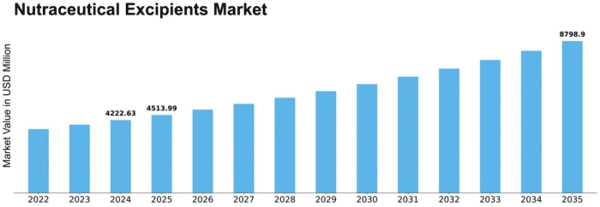
Nutraceutical Excipients Market Size Graph
Author
Author Profile
Rahul Gotadki
Research Manager

He holds an experience of about 9+ years in Market Research and Business Consulting, working under the spectrum of Life Sciences and Healthcare domains. Rahul conceptualizes and implements a scalable business strategy and provides strategic leadership to the clients. His expertise lies in market estimation, competitive intelligence, pipeline analysis, customer assessment, etc.

Leave a Comment

FAQs

What is the current valuation of the Nutraceutical Excipients Market?

<p>The Nutraceutical Excipients Market was valued at 4222.63 USD Million in 2024.</p>

What is the projected market size for the Nutraceutical Excipients Market by 2035?

<p>The market is expected to reach 8798.9 USD Million by 2035.</p>

What is the expected CAGR for the Nutraceutical Excipients Market during the forecast period?

<p>The expected CAGR for the Nutraceutical Excipients Market from 2025 to 2035 is 6.9%.</p>

Which companies are considered key players in the Nutraceutical Excipients Market?

<p>Key players include DuPont, BASF, Evonik Industries, FMC Corporation, and Ashland Global Holdings.</p>

What are the primary applications of Nutraceutical Excipients?

<p>The primary applications include Dietary Supplements, Functional Foods, Pharmaceuticals, and Cosmetics.</p>

How do the revenues of different formulation types compare in the Nutraceutical Excipients Market?

<p>In 2024, revenues for Tablets were 1000.0 USD Million, while Capsules generated 800.0 USD Million.</p>

What are the revenue projections for the Dietary Supplements segment by 2035?

<p>The Dietary Supplements segment is projected to reach 2670.0 USD Million by 2035.</p>

What types of sources are utilized in the Nutraceutical Excipients Market?

<p>Sources include Natural, Synthetic, and Semi-Synthetic, with Natural projected to reach 2700.0 USD Million by 2035.</p>

What functionalities do Nutraceutical Excipients serve in products?

<p>They serve various functionalities, including Emulsifying Agents, Thickening Agents, and Flavoring Agents.</p>

What is the revenue outlook for the Coating Agents segment by 2035?

<p>The Coating Agents segment is expected to grow to 891.39 USD Million by 2035.</p>

Market Summary

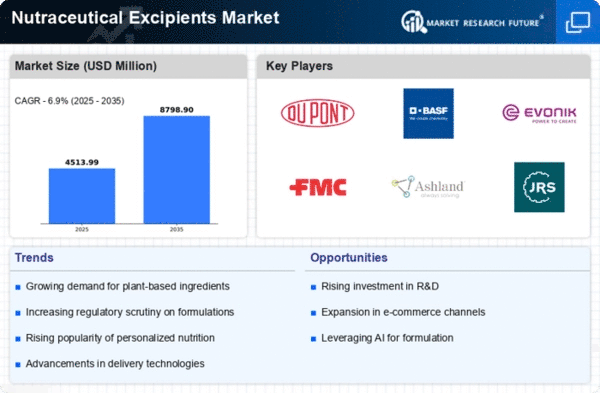
According to MRFR analysis, the Nutraceutical Excipients Market Size was valued at USD 4,222.63 Million in 2024. The market is projected to grow from USD 4,514.08 Million in 2025 to USD 8,798.9 Million by 2035, registering a CAGR of 6.9% during the forecast 2025–2035. North America led the market with over 50.04% share, generating around USD 2113.2 million in revenue. 
 
The Nutraceutical Excipients Market is expanding due to rising demand for dietary supplements and functional foods, increasing health awareness, and growing focus on preventive healthcare. Key trends include development of multifunctional and plant-based excipients, clean-label formulations, and advanced delivery technologies to enhance bioavailability, stability, and consumer acceptance of nutraceutical products. 
 
According to the World Health Organization, noncommunicable diseases account for nearly 74% of global deaths, increasing demand for preventive nutrition and nutraceutical products.

Key Market Trends & Highlights

The Nutraceutical Excipients Market is poised for substantial growth driven by evolving consumer preferences and technological advancements.

  • The market is witnessing a notable rise in clean label products, reflecting consumer demand for transparency and quality. Technological advancements in excipients are enhancing product formulation, particularly in the dietary supplements segment. Regulatory changes are shaping compliance standards, particularly in North America, the largest market for nutraceutical excipients. The increasing demand for nutraceuticals and rising health consciousness among consumers are key drivers propelling market growth, especially in the functional foods segment.

Market Size & Forecast

2024 Market Size 4222.63 (USD Million)
2035 Market Size 8798.9 (USD Million)
CAGR (2025 - 2035) 6.9%
Largest Regional Market Share in 2024 North America

Major Players

Companies such as DuPont (US), BASF (DE), Evonik Industries (DE), <a href="https://ag.fmc.com/in/en/products">FMC Corporation</a> (US), Ashland Global Holdings (US), JRS Pharma (DE), Mingtai Chemical (CN), HPM Global (US), Kraton Corporation (US) are some of the major participants in the Global Nutraceutical Excipients Market.

Market Trends

The Nutraceutical Excipients Market is currently experiencing a notable transformation, driven by the increasing demand for health-oriented products. This shift is largely influenced by consumer awareness regarding the benefits of dietary supplements and functional foods. As individuals become more health-conscious, the need for effective excipients that enhance the bioavailability and stability of nutraceutical formulations appears to be growing. Manufacturers are thus focusing on developing innovative excipients that not only improve product performance but also align with clean label trends, which emphasize transparency and natural ingredients.

Moreover, the Nutraceutical Excipients Market is likely to witness advancements in technology that facilitate the development of multifunctional excipients. These innovations may enhance the efficiency of nutraceutical products, catering to diverse consumer preferences. Additionally, regulatory frameworks are evolving, which could impact the formulation and use of excipients in nutraceuticals. As the market continues to expand, stakeholders must remain vigilant to adapt to these changes, ensuring compliance while meeting consumer expectations for quality and efficacy. This dynamic environment suggests a promising future for the Nutraceutical Excipients Market, characterized by continuous growth and innovation.

Rise of Clean Label Products

There is a growing trend towards clean label products within the Nutraceutical Excipients Market. Consumers increasingly prefer products that are transparent in their ingredient sourcing and formulation. This shift encourages manufacturers to utilize excipients that are natural and free from synthetic additives, thereby enhancing consumer trust and product appeal.

According to UNICEF and World Health Organization, there is a growing global focus on healthier diets and transparency, with WHO highlighting that over 40% of adults worldwide are overweight, driving demand for clean, functional, and clearly labeled nutritional products. This trend is further supported by Food and Agriculture Organization initiatives promoting natural and minimally processed food ingredients.

Technological Advancements in Excipients

Technological innovations are playing a crucial role in the Nutraceutical Excipients Market. The development of multifunctional excipients that can serve multiple purposes, such as improving solubility and stability, is becoming more prevalent. These advancements may lead to more efficient formulations, catering to the evolving needs of consumers.

According to UNICEF and World Health Organization, there is a growing global focus on healthier diets and transparency, with WHO highlighting that over 40% of adults worldwide are overweight, driving demand for clean, functional, and clearly labeled nutritional products. This trend is further supported by Food and Agriculture Organization initiatives promoting natural and minimally processed food ingredients.

Regulatory Changes and Compliance

The Nutraceutical Excipients Market is also influenced by evolving regulatory frameworks. As governments and health organizations update guidelines regarding the use of excipients in nutraceuticals, manufacturers must adapt to ensure compliance. This trend may drive the demand for excipients that meet stringent safety and efficacy standards.

According to the World Health Organization, more than 75% of countries have established national regulatory frameworks for dietary supplements and food safety, reflecting increased oversight of nutraceutical ingredients and excipients. Additionally, organizations such as the European Centre for Disease Prevention and Control and Food and Agriculture Organization continue strengthening food safety and compliance systems, encouraging the adoption of high-quality, safe excipients.

Nutraceutical Excipients Market Market Drivers

Rising Health Consciousness

The increasing awareness of health and wellness among consumers is a primary driver for the Global Nutraceutical Excipients Market Industry. As individuals become more health-conscious, there is a growing demand for dietary supplements and functional foods that enhance health.
This trend is reflected in the projected market value of 2.58 USD Billion in 2024, indicating a robust interest in nutraceutical products. Consumers are actively seeking natural ingredients and formulations that support their health goals, which in turn drives the need for effective excipients that enhance the bioavailability and stability of these products.

Expansion of E-commerce Platforms

The rapid expansion of e-commerce platforms is transforming the Global Nutraceutical Excipients Market Industry. Online retailing provides consumers with greater access to a diverse range of nutraceutical products, facilitating informed purchasing decisions. This trend is particularly relevant as consumers increasingly seek convenience and variety in their health products.
The growth of e-commerce is expected to drive the market further, as it allows for the introduction of innovative excipients that cater to online consumers. As the market continues to evolve, the integration of digital platforms is likely to enhance the visibility and accessibility of nutraceutical excipients.

Regulatory Support for Nutraceuticals

Supportive regulatory frameworks are fostering growth in the Global Nutraceutical Excipients Market Industry. Governments worldwide are increasingly recognizing the importance of nutraceuticals in public health, leading to the establishment of guidelines that promote their safe use.
This regulatory backing encourages manufacturers to invest in research and development, ultimately expanding the range of available excipients. As the market evolves, the anticipated compound annual growth rate of 5.19% from 2025 to 2035 suggests a favorable environment for the growth of nutraceutical excipients, driven by enhanced product safety and efficacy.

Growing Demand for Plant-Based Excipients

The shift towards plant-based ingredients is reshaping the Global Nutraceutical Excipients Market Industry. Consumers are increasingly favoring products that align with their values regarding sustainability and health. This trend is evident in the rising demand for plant-derived excipients, which are perceived as safer and more natural alternatives to synthetic options.
As the market adapts to these preferences, manufacturers are likely to innovate and develop new plant-based excipients that meet consumer expectations. This shift not only supports market growth but also aligns with broader trends in the food and beverage industry towards cleaner labels and transparency.

Technological Advancements in Formulation

Technological innovations in the formulation of nutraceuticals are significantly influencing the Global Nutraceutical Excipients Market Industry. Advances in encapsulation techniques, for example, allow for improved delivery systems that enhance the effectiveness of active ingredients.
This evolution in formulation technology is expected to contribute to the market's growth, with a projected increase to 4.5 USD Billion by 2035. Such advancements not only improve product efficacy but also cater to consumer preferences for convenience and ease of use, thereby expanding the market for excipients that facilitate these innovations.

Market Segment Insights

By Application: Fillers (Largest) vs. Disintegrants (Fastest-Growing)

In the Nutraceutical Excipients Market, the application segment is diverse, encompassing various functionalities critical for product formulation. Among these, fillers hold the largest market share, playing a pivotal role in the bulk and consistency of formulations. Disintegrants, however, are rapidly gaining traction, reflecting an uptick in consumer demand for efficient delivery systems of nutraceuticals, emphasizing their importance in capsule and tablet formulations. Growth in this segment is driven by increasing health awareness and a preference for dietary supplements, which has propelled the demand for excipients like fillers and disintegrants. Moreover, innovations in excipient technology are enhancing the formulation efficiency and product performance, further supporting the growth of this sector. The competition among various excipient types is intensifying, with fillers maintaining dominance while disintegrants present significant growth opportunities for manufacturers.

Fillers (Dominant) vs. Disintegrants (Emerging)

Fillers are critical excipients in the nutraceutical space, primarily serving to increase the volume of formulations, providing a necessary density and texture that consumers expect. Commonly used fillers include lactose, microcrystalline cellulose, and starch derivatives, all prized for their functional characteristics. They maintain a dominant position due to their essential role in ensuring consistent formulation and product stability. On the other hand, disintegrants are emerging as a vital component in the nutraceutical market, facilitating effective dissolution and bioavailability of active ingredients. The growing trend towards personalized nutrition and the development of quick-dissolve forms are driving their increasing usage. This rivalry presents a dynamic landscape where fillers remain crucial while disintegrants are rapidly adapting to meet evolving consumer preferences.

By End Use: Dietary Supplements (Largest) vs. Functional Foods (Fastest-Growing)

The Nutraceutical Excipients Market is significantly shaped by its end-use applications, with <a href="https://www.marketresearchfuture.com/reports/dietary-supplements-market-1134">dietary supplements</a> commanding the largest share in the segment. This dominance is attributed to the rising health consciousness among consumers and increased focus on preventive healthcare. Furthermore, the dietary supplement segment has seen an upsurge due to the growing trend of self-medication and lifestyle changes that favor organic and natural products. On the other hand, functional foods represent the fastest-growing segment within the nutraceutical excipients market, driven by a shift towards healthier eating habits. As consumers integrate functional foods into their diets, the demand for excipients that enhance bioavailability, stability, and performance of these products continues to rise. The continuous innovation in product formulations to meet consumer needs accelerates this growth trend.

Dietary Supplements (Dominant) vs. Functional Foods (Emerging)

Dietary supplements hold a dominant position in the Nutraceutical Excipients Market, leveraging strong consumer demand for vitamins, minerals, and herbal products designed for health maintenance. These products are characterized by their emphasis on quality, efficacy, and natural ingredients, catering to a health-aware demographic. Meanwhile, functional foods are marked as an emerging segment, capturing attention with their potential health benefits beyond basic nutrition. Innovations in this space focus on integrating probiotics, prebiotics, and fortification with essential nutrients, appealing to consumers seeking enhanced dietary solutions. As awareness of the benefits of functional foods grows, their market potential is rapidly expanding, driven by research-backed efficacy and changing consumer lifestyles.

By Formulation Type: Tablets (Largest) vs. Powders (Fastest-Growing)

In the Nutraceutical Excipients Market, tablets hold the largest share due to their long-standing popularity for delivering nutritional supplements effectively. This formulation type benefits from stability, dosage accuracy, and ease of production, contributing to its widespread acceptance. Capsules follow, providing advantages like easier swallowing and better bioavailability, while powders and liquids are significant for their flexibility and quick absorption, respectively. The growth trends indicate a noticeable shift towards powders, which are becoming the fastest-growing segment. This can be attributed to increasing consumer demand for convenient, easy-to-mix nutritional solutions that suit modern lifestyles. Concurrently, rising health awareness and preference for personalized nutrition options are accelerating the adoption of liquid formulations, creating a dynamic landscape in the nutraceutical excipients sector.

Tablets (Dominant) vs. Powders (Emerging)

Tablets are the dominant formulation type in the Nutraceutical Excipients Market, characterized by their robustness and widespread acceptance among consumers. They offer the advantage of precise dosage and longer shelf life, making them preferred by manufacturers and consumers alike. Their established supply chains and broad application across various health segments further solidify their market position. On the other hand, powders are rapidly emerging due to their versatility and ease of formulation into various products, catering to the growing trend for health supplements that align with active lifestyles. As personalization in nutrition gains traction, powders are becoming more popular, offering diverse flavoring options and customizable dosages, appealing especially to younger, health-conscious consumers.

By Source: Natural (Largest) vs. Synthetic (Fastest-Growing)

In the Nutraceutical Excipients Market, the source segment is primarily dominated by natural excipients, which capture a significant portion of market share due to their favorable perception among health-conscious consumers. Natural excipients, derived from plant and animal sources, are increasingly preferred for their safety and efficacy, reflecting a broader trend towards clean-label products. In contrast, synthetic excipients have entered the market with innovative formulations, appealing particularly to manufacturers seeking cost-effective solutions, which positions them as a rapidly growing alternative to natural offerings.

Natural (Dominant) vs. Synthetic (Emerging)

Natural excipients are characterized by their derived nature from plant or animal sources, providing a variety of functionalities such as binding, coating, and stabilizing in nutraceutical formulations. Their dominance in the market stems from a rising consumer demand for organic and non-synthetic products, aligning with wellness trends and regulatory support for clean-label items. Conversely, synthetic excipients, while facing scrutiny regarding their origins, are emerging due to their versatility and cost-effectiveness. They are being embraced in the market for their stable and predictable properties, which cater to the expanding needs of the nutraceutical industry.

By Functionality: Emulsifying Agents (Largest) vs. Preservatives (Fastest-Growing)

In the Nutraceutical Excipients Market, the functionality segment showcases a diverse distribution across various agent types, with emulsifying agents being the largest contributor to market share. These agents effectively facilitate the mixing of ingredients, playing a crucial role in the consistency and stability of nutraceutical products. In contrast, preservatives, though comparatively smaller in market share, have emerged as a vital category, reflecting increasing consumer demand for longer shelf-life products without compromising on quality and safety. The growth trends within this segment are significantly influenced by changing consumer preferences towards health and wellness products. The rise in demand for clean label products has propelled emulsifying agents into the spotlight, as they are essential for enhancing the texture and taste of nutraceuticals. Simultaneously, preservatives are witnessing rapid growth due to their ability to prevent spoilage and extend product longevity, driven by the burgeoning health food market and the need for convenience in dietary supplements.

Emulsifying Agents (Dominant) vs. Flavoring Agents (Emerging)

Emulsifying agents have solidified their position as the dominant force in the Nutraceutical Excipients Market. They are essential for creating stable emulsions, which are crucial for the efficacy and appeal of various nutraceutical products. These agents enhance bioavailability and ensure proper consistency, making nutraceuticals more palatable to consumers. In contrast, flavoring agents are emerging as a notable category within the market, driven by the increasing consumer preference for taste in health supplements. As mild and pleasant flavors gain traction in the industry, flavoring agents are rapidly becoming indispensable, enabling manufacturers to cater to diverse taste profiles while maintaining the functional integrity of the products. Together, these segments play vital roles in shaping consumer experiences in the nutraceutical domain.

Get more detailed insights about Nutraceutical Excipients Market Research Report – Forecast to 2035

Regional Insights

North America : Market Leader in Nutraceuticals

North America leads in the Nutraceutical Excipients Market Size, accounting for over 50.04% of the global revenue in 2024. The region's growth is driven by increasing health consciousness, a rising aging population, and stringent regulatory frameworks that promote product safety and efficacy. The demand for clean-label products and natural ingredients is also on the rise, further propelling market expansion.

The United States and Canada are the primary contributors to this market, with key players like DuPont, FMC Corporation, and Ashland Global Holdings leading the charge. The competitive landscape is characterized by innovation and strategic partnerships, as companies invest in R&D to develop advanced excipients. The presence of established firms and a robust supply chain infrastructure further solidify North America's position as a market leader.

Europe : Emerging Market Dynamics

Europe is witnessing a notable shift in the Nutraceutical Excipients Market, with a market size of €1267.58M in 2024. The region's growth is fueled by increasing consumer awareness regarding health and wellness, alongside regulatory support for nutraceutical products. The European Food Safety Authority (EFSA) has been instrumental in establishing guidelines that enhance product credibility, thereby boosting market demand.

Germany, France, and the UK are the leading countries in this sector, hosting major players like BASF and Evonik Industries. The competitive landscape is marked by a focus on sustainability and innovation, with companies investing in eco-friendly excipients. The presence of a well-established pharmaceutical industry also supports the growth of nutraceuticals, creating a synergistic effect in the market.

Asia-Pacific : Rapid Growth Potential

Asia-Pacific is emerging as a significant player in the Nutraceutical Excipients Market, with a market size of $683.79M in 2024. The region's growth is driven by increasing disposable incomes, urbanization, and a growing awareness of health benefits associated with nutraceuticals. Regulatory bodies are also becoming more supportive, facilitating market entry for innovative products and enhancing consumer trust.

China and India are at the forefront of this growth, with a rising number of local and international players entering the market. Companies like Mingtai Chemical and HPM Global are expanding their footprint, focusing on product diversification and quality enhancement. The competitive landscape is dynamic, with a mix of established firms and startups driving innovation and market penetration.

Middle East and Africa : Emerging Market Opportunities

The Middle East and Africa (MEA) region is gradually establishing itself in the Nutraceutical Excipients Market, with a market size of $158.11M in 2024. The growth is primarily driven by increasing health awareness and a shift towards preventive healthcare. Regulatory frameworks are evolving, with governments recognizing the importance of nutraceuticals in public health, which is expected to catalyze market growth.

Countries like South Africa and the UAE are leading the charge, with a growing number of local manufacturers and international companies exploring opportunities in the region. The competitive landscape is characterized by a focus on product innovation and strategic collaborations, as firms aim to meet the diverse needs of consumers. The presence of key players is gradually increasing, contributing to a more robust market environment.

Key Players and Competitive Insights

The Nutraceutical Excipients Market is currently characterized by a dynamic competitive landscape, driven by increasing consumer demand for health and wellness products. Key players are actively engaging in strategic initiatives to enhance their market presence and operational efficiency. For instance, DuPont (US) has been focusing on innovation in plant-based excipients, which aligns with the growing trend towards natural ingredients. Similarly, BASF (DE) is investing in sustainable production methods, reflecting a broader industry shift towards environmentally friendly practices. 
 
These strategies not only bolster their competitive positioning but also contribute to a more sustainable market environment.In terms of business tactics, companies are increasingly localizing manufacturing to reduce lead times and optimize supply chains. This approach appears to be particularly effective in a moderately fragmented market, where the collective influence of key players like Evonik Industries (DE) and FMC Corporation (US) is notable. By streamlining operations and enhancing responsiveness to market demands, these companies are better positioned to capture emerging opportunities.
In November Evonik Industries (DE) announced a partnership with a leading nutraceutical firm to develop innovative excipients tailored for specific health applications. This collaboration is expected to leverage Evonik's expertise in polymer chemistry, potentially leading to the introduction of novel products that meet the evolving needs of consumers. Such strategic alliances are indicative of a trend towards co-creation in product development, which may enhance competitive differentiation.
 
In October FMC Corporation (US) launched a new line of excipients designed for enhanced bioavailability in dietary supplements. This product introduction is significant as it addresses a critical consumer demand for more effective nutraceuticals. By focusing on bioavailability, FMC is likely to strengthen its market position and appeal to health-conscious consumers seeking superior product efficacy.Moreover, in September 2025, Ashland Global Holdings (US) expanded its manufacturing capabilities in Asia, aiming to cater to the growing demand in that region. This strategic move not only enhances Ashland's operational footprint but also positions the company to better serve local markets, thereby increasing its competitive edge.
 
As of December the competitive trends in the Nutraceutical Excipients Market are increasingly defined by digitalization, sustainability, and the integration of AI technologies. Strategic alliances are becoming more prevalent, facilitating innovation and enhancing product offerings. Looking ahead, it is anticipated that competitive differentiation will evolve, with a shift from price-based competition to a focus on innovation, technology, and supply chain reliability. This transition underscores the importance of agility and responsiveness in a rapidly changing market landscape.

Key Companies in the Nutraceutical Excipients Market include

Industry Developments

The Nutraceutical Excipients Market has seen notable developments recently, characterized by a growing focus on the integration of innovative technologies to enhance product efficacy and safety. Companies such as Roquette Freres and Cargill are expanding their product lines, creating excipients from natural sources in response to consumer demand for clean-label products. In terms of market dynamics, Ashland and BASF are investing significantly in Research and Development to improve excipient performance and bioavailability.In May 2023, Evonik & Safic‑Alcan formed distribution partnership for nutraceuticals across Europe, Turkey, and Egypt.  In January 2023, BASF & Cargill expanded their enzyme‑feed collaboration into the US market.

Evonik Industries has also been expanding its capabilities through strategic partnerships and acquisitions to enhance its portfolio of excipients for dietary applications. Market valuation has been positively influenced by the increasing demand for health supplements, driven by global health trends and aging populations. Over the last couple of years, the market has demonstrated robust growth, with a CAGR projected to increase as consumer awareness around nutrition and supplementation rises, resulting in an expansion of the product offerings from key players like JRS Pharma and Archer Daniels Midland.

Future Outlook

Nutraceutical Excipients Market Future Outlook

The Nutraceutical Excipients Market size is projected to reach USD 8,798.9 Million by 2035, growing at a CAGR of 6.9%.

New opportunities lie in:

  • <p>Development of plant-based excipients for clean-label products. Investment in advanced manufacturing technologies for efficiency. Expansion into emerging markets with tailored product offerings.</p>

By 2035, the Nutraceutical Excipients Market is expected to achieve robust growth and diversification.

Market Segmentation

Nutraceutical Excipients Market Source Outlook

  • Natural
  • Synthetic
  • Semi-Synthetic

Nutraceutical Excipients Market End Use Outlook

  • Dietary Supplements
  • Functional Foods
  • Pharmaceuticals
  • Cosmetics

Nutraceutical Excipients Market Application Outlook

  • Binders
  • Fillers
  • Disintegrants
  • Coating Agents
  • Stabilizers

Nutraceutical Excipients Market Functionality Outlook

  • Emulsifying Agents
  • Thickening Agents
  • Preservatives
  • Flavoring Agents

Nutraceutical Excipients Market Formulation Type Outlook

  • Tablets
  • Capsules
  • Powders
  • Liquids

Report Scope

MARKET SIZE 2024 4222.63(USD Million)
MARKET SIZE 2025 4514.08(USD Million)
MARKET SIZE 2035 8798.9(USD Million)
COMPOUND ANNUAL GROWTH RATE (CAGR) 6.9% (2025 - 2035)
REPORT COVERAGE Revenue Forecast, Competitive Landscape, Growth Factors, and Trends
BASE YEAR 2024
Market Forecast Period 2025 - 2035
Historical Data 2019 - 2024
Market Forecast Units USD Million
Key Companies Profiled DuPont (US), BASF (DE), Evonik Industries (DE), FMC Corporation (US), Ashland Global Holdings (US), JRS Pharma (DE), Mingtai Chemical (CN), HPM Global (US), Kraton Corporation (US)
Segments Covered Application, End Use, Formulation Type, Source, Functionality
Key Market Opportunities Growing demand for plant-based excipients in the Nutraceutical Excipients Market presents significant opportunities.
Key Market Dynamics Rising consumer demand for clean-label products drives innovation in nutraceutical excipients and formulation technologies.
Countries Covered North America, Europe, APAC, South America, MEA

FAQs

What is the current valuation of the Nutraceutical Excipients Market?

<p>The Nutraceutical Excipients Market was valued at 4222.63 USD Million in 2024.</p>

What is the projected market size for the Nutraceutical Excipients Market by 2035?

<p>The market is expected to reach 8798.9 USD Million by 2035.</p>

What is the expected CAGR for the Nutraceutical Excipients Market during the forecast period?

<p>The expected CAGR for the Nutraceutical Excipients Market from 2025 to 2035 is 6.9%.</p>

Which companies are considered key players in the Nutraceutical Excipients Market?

<p>Key players include DuPont, BASF, Evonik Industries, FMC Corporation, and Ashland Global Holdings.</p>

What are the primary applications of Nutraceutical Excipients?

<p>The primary applications include Dietary Supplements, Functional Foods, Pharmaceuticals, and Cosmetics.</p>

How do the revenues of different formulation types compare in the Nutraceutical Excipients Market?

<p>In 2024, revenues for Tablets were 1000.0 USD Million, while Capsules generated 800.0 USD Million.</p>

What are the revenue projections for the Dietary Supplements segment by 2035?

<p>The Dietary Supplements segment is projected to reach 2670.0 USD Million by 2035.</p>

What types of sources are utilized in the Nutraceutical Excipients Market?

<p>Sources include Natural, Synthetic, and Semi-Synthetic, with Natural projected to reach 2700.0 USD Million by 2035.</p>

What functionalities do Nutraceutical Excipients serve in products?

<p>They serve various functionalities, including Emulsifying Agents, Thickening Agents, and Flavoring Agents.</p>

What is the revenue outlook for the Coating Agents segment by 2035?

<p>The Coating Agents segment is expected to grow to 891.39 USD Million by 2035.</p>

  1. SECTION I: EXECUTIVE SUMMARY AND KEY HIGHLIGHTS |
    1. EXECUTIVE SUMMARY | |
      1. Market Overview | |
      2. Key Findings | |
      3. Market Segmentation | |
      4. Competitive Landscape | |
      5. Challenges and Opportunities | |
      6. Future Outlook 2
  2. SECTION II: SCOPING, METHODOLOGY AND MARKET STRUCTURE |
    1. MARKET INTRODUCTION | |
      1. Definition | |
      2. Scope of the study | | |
    2. RESEARCH METHODOLOGY | |
      1. Overview | |
      2. Data Mining | |
      3. Secondary Research | |
      4. Primary Research | | |
      5. Forecasting Model | |
      6. Market Size Estimation | | |
      7. Data Triangulation | |
      8. Validation 3
  3. SECTION III: QUALITATIVE ANALYSIS |
    1. MARKET DYNAMICS | |
      1. Overview | |
      2. Drivers | |
      3. Restraints | |
      4. Opportunities |
    2. MARKET FACTOR ANALYSIS | |
      1. Value chain Analysis | |
      2. Porter's Five Forces Analysis | | |
      3. COVID-19 Impact Analysis | | |
  4. SECTION IV: QUANTITATIVE ANALYSIS |
    1. Healthcare, BY Application (USD Million) | |
      1. Binders | |
      2. Fillers | |
      3. Disintegrants | |
      4. Coating Agents | |
      5. Stabilizers |
    2. Healthcare, BY End Use (USD Million) | |
      1. Dietary Supplements | |
      2. Functional Foods | |
      3. Pharmaceuticals | |
      4. Cosmetics |
    3. Healthcare, BY Formulation Type (USD Million) | |
      1. Tablets | |
      2. Capsules | |
      3. Powders | |
      4. Liquids |
    4. Healthcare, BY Source (USD Million) | |
      1. Natural | |
      2. Synthetic | |
      3. Semi-Synthetic |
    5. Healthcare, BY Functionality (USD Million) | |
      1. Emulsifying Agents | |
      2. Thickening Agents | |
      3. Preservatives | |
      4. Flavoring Agents |
    6. Healthcare, BY Region (USD Million) | |
      1. North America | | |
      2. Europe | | |
      3. APAC | | |
      4. South America | | |
      5. MEA | | |
  5. SECTION V: COMPETITIVE ANALYSIS |
    1. Competitive Landscape | |
      1. Overview | |
      2. Competitive Analysis | |
      3. Market share Analysis | |
      4. Major Growth Strategy in the Healthcare | |
      5. Competitive Benchmarking | |
      6. Leading Players in Terms of Number of Developments in the Healthcare | |
      7. Key developments and growth strategies | | |
      8. Major Players Financial Matrix | | |
    2. Company Profiles | |
      1. DuPont (US) | | |
      2. BASF (DE) | | |
      3. Evonik Industries (DE) | | |
      4. FMC Corporation (US) | | |
      5. Ashland Global Holdings (US) | | |
      6. JRS Pharma (DE) | | |
      7. Mingtai Chemical (CN) | | |
      8. HPM Global (US) | | |
      9. Kerry Group (IE) | | |
    3. Appendix | |
      1. References | |
      2. Related Reports 6 LIST OF FIGURES |
    4. MARKET SYNOPSIS |
    5. NORTH AMERICA MARKET ANALYSIS |
    6. US MARKET ANALYSIS BY APPLICATION |
    7. US MARKET ANALYSIS BY END USE |
    8. US MARKET ANALYSIS BY FORMULATION TYPE |
    9. US MARKET ANALYSIS BY SOURCE |
    10. US MARKET ANALYSIS BY FUNCTIONALITY |
    11. CANADA MARKET ANALYSIS BY APPLICATION |
    12. CANADA MARKET ANALYSIS BY END USE |
    13. CANADA MARKET ANALYSIS BY FORMULATION TYPE |
    14. CANADA MARKET ANALYSIS BY SOURCE |
    15. CANADA MARKET ANALYSIS BY FUNCTIONALITY |
    16. EUROPE MARKET ANALYSIS |
    17. GERMANY MARKET ANALYSIS BY APPLICATION |
    18. GERMANY MARKET ANALYSIS BY END USE |
    19. GERMANY MARKET ANALYSIS BY FORMULATION TYPE |
    20. GERMANY MARKET ANALYSIS BY SOURCE |
    21. GERMANY MARKET ANALYSIS BY FUNCTIONALITY |
    22. UK MARKET ANALYSIS BY APPLICATION |
    23. UK MARKET ANALYSIS BY END USE |
    24. UK MARKET ANALYSIS BY FORMULATION TYPE |
    25. UK MARKET ANALYSIS BY SOURCE |
    26. UK MARKET ANALYSIS BY FUNCTIONALITY |
    27. FRANCE MARKET ANALYSIS BY APPLICATION |
    28. FRANCE MARKET ANALYSIS BY END USE |
    29. FRANCE MARKET ANALYSIS BY FORMULATION TYPE |
    30. FRANCE MARKET ANALYSIS BY SOURCE |
    31. FRANCE MARKET ANALYSIS BY FUNCTIONALITY |
    32. RUSSIA MARKET ANALYSIS BY APPLICATION |
    33. RUSSIA MARKET ANALYSIS BY END USE |
    34. RUSSIA MARKET ANALYSIS BY FORMULATION TYPE |
    35. RUSSIA MARKET ANALYSIS BY SOURCE |
    36. RUSSIA MARKET ANALYSIS BY FUNCTIONALITY |
    37. ITALY MARKET ANALYSIS BY APPLICATION |
    38. ITALY MARKET ANALYSIS BY END USE |
    39. ITALY MARKET ANALYSIS BY FORMULATION TYPE |
    40. ITALY MARKET ANALYSIS BY SOURCE |
    41. ITALY MARKET ANALYSIS BY FUNCTIONALITY |
    42. SPAIN MARKET ANALYSIS BY APPLICATION |
    43. SPAIN MARKET ANALYSIS BY END USE |
    44. SPAIN MARKET ANALYSIS BY FORMULATION TYPE |
    45. SPAIN MARKET ANALYSIS BY SOURCE |
    46. SPAIN MARKET ANALYSIS BY FUNCTIONALITY |
    47. REST OF EUROPE MARKET ANALYSIS BY APPLICATION |
    48. REST OF EUROPE MARKET ANALYSIS BY END USE |
    49. REST OF EUROPE MARKET ANALYSIS BY FORMULATION TYPE |
    50. REST OF EUROPE MARKET ANALYSIS BY SOURCE |
    51. REST OF EUROPE MARKET ANALYSIS BY FUNCTIONALITY |
    52. APAC MARKET ANALYSIS |
    53. CHINA MARKET ANALYSIS BY APPLICATION |
    54. CHINA MARKET ANALYSIS BY END USE |
    55. CHINA MARKET ANALYSIS BY FORMULATION TYPE |
    56. CHINA MARKET ANALYSIS BY SOURCE |
    57. CHINA MARKET ANALYSIS BY FUNCTIONALITY |
    58. INDIA MARKET ANALYSIS BY APPLICATION |
    59. INDIA MARKET ANALYSIS BY END USE |
    60. INDIA MARKET ANALYSIS BY FORMULATION TYPE |
    61. INDIA MARKET ANALYSIS BY SOURCE |
    62. INDIA MARKET ANALYSIS BY FUNCTIONALITY |
    63. JAPAN MARKET ANALYSIS BY APPLICATION |
    64. JAPAN MARKET ANALYSIS BY END USE |
    65. JAPAN MARKET ANALYSIS BY FORMULATION TYPE |
    66. JAPAN MARKET ANALYSIS BY SOURCE |
    67. JAPAN MARKET ANALYSIS BY FUNCTIONALITY |
    68. SOUTH KOREA MARKET ANALYSIS BY APPLICATION |
    69. SOUTH KOREA MARKET ANALYSIS BY END USE |
    70. SOUTH KOREA MARKET ANALYSIS BY FORMULATION TYPE |
    71. SOUTH KOREA MARKET ANALYSIS BY SOURCE |
    72. SOUTH KOREA MARKET ANALYSIS BY FUNCTIONALITY |
    73. MALAYSIA MARKET ANALYSIS BY APPLICATION |
    74. MALAYSIA MARKET ANALYSIS BY END USE |
    75. MALAYSIA MARKET ANALYSIS BY FORMULATION TYPE |
    76. MALAYSIA MARKET ANALYSIS BY SOURCE |
    77. MALAYSIA MARKET ANALYSIS BY FUNCTIONALITY |
    78. THAILAND MARKET ANALYSIS BY APPLICATION |
    79. THAILAND MARKET ANALYSIS BY END USE |
    80. THAILAND MARKET ANALYSIS BY FORMULATION TYPE |
    81. THAILAND MARKET ANALYSIS BY SOURCE |
    82. THAILAND MARKET ANALYSIS BY FUNCTIONALITY |
    83. INDONESIA MARKET ANALYSIS BY APPLICATION |
    84. INDONESIA MARKET ANALYSIS BY END USE |
    85. INDONESIA MARKET ANALYSIS BY FORMULATION TYPE |
    86. INDONESIA MARKET ANALYSIS BY SOURCE |
    87. INDONESIA MARKET ANALYSIS BY FUNCTIONALITY |
    88. REST OF APAC MARKET ANALYSIS BY APPLICATION |
    89. REST OF APAC MARKET ANALYSIS BY END USE |
    90. REST OF APAC MARKET ANALYSIS BY FORMULATION TYPE |
    91. REST OF APAC MARKET ANALYSIS BY SOURCE |
    92. REST OF APAC MARKET ANALYSIS BY FUNCTIONALITY |
    93. SOUTH AMERICA MARKET ANALYSIS |
    94. BRAZIL MARKET ANALYSIS BY APPLICATION |
    95. BRAZIL MARKET ANALYSIS BY END USE |
    96. BRAZIL MARKET ANALYSIS BY FORMULATION TYPE |
    97. BRAZIL MARKET ANALYSIS BY SOURCE |
    98. BRAZIL MARKET ANALYSIS BY FUNCTIONALITY |
    99. MEXICO MARKET ANALYSIS BY APPLICATION |
    100. MEXICO MARKET ANALYSIS BY END USE |
    101. MEXICO MARKET ANALYSIS BY FORMULATION TYPE |
    102. MEXICO MARKET ANALYSIS BY SOURCE |
    103. MEXICO MARKET ANALYSIS BY FUNCTIONALITY |
    104. ARGENTINA MARKET ANALYSIS BY APPLICATION |
    105. ARGENTINA MARKET ANALYSIS BY END USE |
    106. ARGENTINA MARKET ANALYSIS BY FORMULATION TYPE |
    107. ARGENTINA MARKET ANALYSIS BY SOURCE |
    108. ARGENTINA MARKET ANALYSIS BY FUNCTIONALITY |
    109. REST OF SOUTH AMERICA MARKET ANALYSIS BY APPLICATION |
    110. REST OF SOUTH AMERICA MARKET ANALYSIS BY END USE |
    111. REST OF SOUTH AMERICA MARKET ANALYSIS BY FORMULATION TYPE |
    112. REST OF SOUTH AMERICA MARKET ANALYSIS BY SOURCE |
    113. REST OF SOUTH AMERICA MARKET ANALYSIS BY FUNCTIONALITY |
    114. MEA MARKET ANALYSIS |
    115. GCC COUNTRIES MARKET ANALYSIS BY APPLICATION |
    116. GCC COUNTRIES MARKET ANALYSIS BY END USE |
    117. GCC COUNTRIES MARKET ANALYSIS BY FORMULATION TYPE |
    118. GCC COUNTRIES MARKET ANALYSIS BY SOURCE |
    119. GCC COUNTRIES MARKET ANALYSIS BY FUNCTIONALITY |
    120. SOUTH AFRICA MARKET ANALYSIS BY APPLICATION |
    121. SOUTH AFRICA MARKET ANALYSIS BY END USE |
    122. SOUTH AFRICA MARKET ANALYSIS BY FORMULATION TYPE |
    123. SOUTH AFRICA MARKET ANALYSIS BY SOURCE |
    124. SOUTH AFRICA MARKET ANALYSIS BY FUNCTIONALITY |
    125. REST OF MEA MARKET ANALYSIS BY APPLICATION |
    126. REST OF MEA MARKET ANALYSIS BY END USE |
    127. REST OF MEA MARKET ANALYSIS BY FORMULATION TYPE |
    128. REST OF MEA MARKET ANALYSIS BY SOURCE |
    129. REST OF MEA MARKET ANALYSIS BY FUNCTIONALITY |
    130. KEY BUYING CRITERIA OF HEALTHCARE |
    131. RESEARCH PROCESS OF MRFR |
    132. DRO ANALYSIS OF HEALTHCARE |
    133. DRIVERS IMPACT ANALYSIS: HEALTHCARE |
    134. RESTRAINTS IMPACT ANALYSIS: HEALTHCARE |
    135. SUPPLY / VALUE CHAIN: HEALTHCARE |
    136. HEALTHCARE, BY APPLICATION, 2024 (% SHARE) |
    137. HEALTHCARE, BY APPLICATION, 2024 TO 2035 (USD Million) |
    138. HEALTHCARE, BY END USE, 2024 (% SHARE) |
    139. HEALTHCARE, BY END USE, 2024 TO 2035 (USD Million) |
    140. HEALTHCARE, BY FORMULATION TYPE, 2024 (% SHARE) |
    141. HEALTHCARE, BY FORMULATION TYPE, 2024 TO 2035 (USD Million) |
    142. HEALTHCARE, BY SOURCE, 2024 (% SHARE) |
    143. HEALTHCARE, BY SOURCE, 2024 TO 2035 (USD Million) |
    144. HEALTHCARE, BY FUNCTIONALITY, 2024 (% SHARE) |
    145. HEALTHCARE, BY FUNCTIONALITY, 2024 TO 2035 (USD Million) |
    146. BENCHMARKING OF MAJOR COMPETITORS 7 LIST OF TABLES |
    147. LIST OF ASSUMPTIONS | |
      1. |
    148. North America MARKET SIZE ESTIMATES; FORECAST | |
      1. BY APPLICATION, 2025-2035 (USD Million) | |
      2. BY END USE, 2025-2035 (USD Million) | |
      3. BY FORMULATION TYPE, 2025-2035 (USD Million) | |
      4. BY SOURCE, 2025-2035 (USD Million) | |
      5. BY FUNCTIONALITY, 2025-2035 (USD Million) |
    149. US MARKET SIZE ESTIMATES; FORECAST | |
      1. BY APPLICATION, 2025-2035 (USD Million) | |
      2. BY END USE, 2025-2035 (USD Million) | |
      3. BY FORMULATION TYPE, 2025-2035 (USD Million) | |
      4. BY SOURCE, 2025-2035 (USD Million) | |
      5. BY FUNCTIONALITY, 2025-2035 (USD Million) |
    150. Canada MARKET SIZE ESTIMATES; FORECAST | |
      1. BY APPLICATION, 2025-2035 (USD Million) | |
      2. BY END USE, 2025-2035 (USD Million) | |
      3. BY FORMULATION TYPE, 2025-2035 (USD Million) | |
      4. BY SOURCE, 2025-2035 (USD Million) | |
      5. BY FUNCTIONALITY, 2025-2035 (USD Million) |
    151. Europe MARKET SIZE ESTIMATES; FORECAST | |
      1. BY APPLICATION, 2025-2035 (USD Million) | |
      2. BY END USE, 2025-2035 (USD Million) | |
      3. BY FORMULATION TYPE, 2025-2035 (USD Million) | |
      4. BY SOURCE, 2025-2035 (USD Million) | |
      5. BY FUNCTIONALITY, 2025-2035 (USD Million) |
    152. Germany MARKET SIZE ESTIMATES; FORECAST | |
      1. BY APPLICATION, 2025-2035 (USD Million) | |
      2. BY END USE, 2025-2035 (USD Million) | |
      3. BY FORMULATION TYPE, 2025-2035 (USD Million) | |
      4. BY SOURCE, 2025-2035 (USD Million) | |
      5. BY FUNCTIONALITY, 2025-2035 (USD Million) |
    153. UK MARKET SIZE ESTIMATES; FORECAST | |
      1. BY APPLICATION, 2025-2035 (USD Million) | |
      2. BY END USE, 2025-2035 (USD Million) | |
      3. BY FORMULATION TYPE, 2025-2035 (USD Million) | |
      4. BY SOURCE, 2025-2035 (USD Million) | |
      5. BY FUNCTIONALITY, 2025-2035 (USD Million) |
    154. France MARKET SIZE ESTIMATES; FORECAST | |
      1. BY APPLICATION, 2025-2035 (USD Million) | |
      2. BY END USE, 2025-2035 (USD Million) | |
      3. BY FORMULATION TYPE, 2025-2035 (USD Million) | |
      4. BY SOURCE, 2025-2035 (USD Million) | |
      5. BY FUNCTIONALITY, 2025-2035 (USD Million) |
    155. Russia MARKET SIZE ESTIMATES; FORECAST | |
      1. BY APPLICATION, 2025-2035 (USD Million) | |
      2. BY END USE, 2025-2035 (USD Million) | |
      3. BY FORMULATION TYPE, 2025-2035 (USD Million) | |
      4. BY SOURCE, 2025-2035 (USD Million) | |
      5. BY FUNCTIONALITY, 2025-2035 (USD Million) |
    156. Italy MARKET SIZE ESTIMATES; FORECAST | |
      1. BY APPLICATION, 2025-2035 (USD Million) | |
      2. BY END USE, 2025-2035 (USD Million) | |
      3. BY FORMULATION TYPE, 2025-2035 (USD Million) | |
      4. BY SOURCE, 2025-2035 (USD Million) | |
      5. BY FUNCTIONALITY, 2025-2035 (USD Million) |
    157. Spain MARKET SIZE ESTIMATES; FORECAST | |
      1. BY APPLICATION, 2025-2035 (USD Million) | |
      2. BY END USE, 2025-2035 (USD Million) | |
      3. BY FORMULATION TYPE, 2025-2035 (USD Million) | |
      4. BY SOURCE, 2025-2035 (USD Million) | |
      5. BY FUNCTIONALITY, 2025-2035 (USD Million) |
    158. Rest of Europe MARKET SIZE ESTIMATES; FORECAST | |
      1. BY APPLICATION, 2025-2035 (USD Million) | |
      2. BY END USE, 2025-2035 (USD Million) | |
      3. BY FORMULATION TYPE, 2025-2035 (USD Million) | |
      4. BY SOURCE, 2025-2035 (USD Million) | |
      5. BY FUNCTIONALITY, 2025-2035 (USD Million) |
    159. APAC MARKET SIZE ESTIMATES; FORECAST | |
      1. BY APPLICATION, 2025-2035 (USD Million) | |
      2. BY END USE, 2025-2035 (USD Million) | |
      3. BY FORMULATION TYPE, 2025-2035 (USD Million) | |
      4. BY SOURCE, 2025-2035 (USD Million) | |
      5. BY FUNCTIONALITY, 2025-2035 (USD Million) |
    160. China MARKET SIZE ESTIMATES; FORECAST | |
      1. BY APPLICATION, 2025-2035 (USD Million) | |
      2. BY END USE, 2025-2035 (USD Million) | |
      3. BY FORMULATION TYPE, 2025-2035 (USD Million) | |
      4. BY SOURCE, 2025-2035 (USD Million) | |
      5. BY FUNCTIONALITY, 2025-2035 (USD Million) |
    161. India MARKET SIZE ESTIMATES; FORECAST | |
      1. BY APPLICATION, 2025-2035 (USD Million) | |
      2. BY END USE, 2025-2035 (USD Million) | |
      3. BY FORMULATION TYPE, 2025-2035 (USD Million) | |
      4. BY SOURCE, 2025-2035 (USD Million) | |
      5. BY FUNCTIONALITY, 2025-2035 (USD Million) |
    162. Japan MARKET SIZE ESTIMATES; FORECAST | |
      1. BY APPLICATION, 2025-2035 (USD Million) | |
      2. BY END USE, 2025-2035 (USD Million) | |
      3. BY FORMULATION TYPE, 2025-2035 (USD Million) | |
      4. BY SOURCE, 2025-2035 (USD Million) | |
      5. BY FUNCTIONALITY, 2025-2035 (USD Million) |
    163. South Korea MARKET SIZE ESTIMATES; FORECAST | |
      1. BY APPLICATION, 2025-2035 (USD Million) | |
      2. BY END USE, 2025-2035 (USD Million) | |
      3. BY FORMULATION TYPE, 2025-2035 (USD Million) | |
      4. BY SOURCE, 2025-2035 (USD Million) | |
      5. BY FUNCTIONALITY, 2025-2035 (USD Million) |
    164. Malaysia MARKET SIZE ESTIMATES; FORECAST | |
      1. BY APPLICATION, 2025-2035 (USD Million) | |
      2. BY END USE, 2025-2035 (USD Million) | |
      3. BY FORMULATION TYPE, 2025-2035 (USD Million) | |
      4. BY SOURCE, 2025-2035 (USD Million) | |
      5. BY FUNCTIONALITY, 2025-2035 (USD Million) |
    165. Thailand MARKET SIZE ESTIMATES; FORECAST | |
      1. BY APPLICATION, 2025-2035 (USD Million) | |
      2. BY END USE, 2025-2035 (USD Million) | |
      3. BY FORMULATION TYPE, 2025-2035 (USD Million) | |
      4. BY SOURCE, 2025-2035 (USD Million) | |
      5. BY FUNCTIONALITY, 2025-2035 (USD Million) |
    166. Indonesia MARKET SIZE ESTIMATES; FORECAST | |
      1. BY APPLICATION, 2025-2035 (USD Million) | |
      2. BY END USE, 2025-2035 (USD Million) | |
      3. BY FORMULATION TYPE, 2025-2035 (USD Million) | |
      4. BY SOURCE, 2025-2035 (USD Million) | |
      5. BY FUNCTIONALITY, 2025-2035 (USD Million) |
    167. Rest of APAC MARKET SIZE ESTIMATES; FORECAST | |
      1. BY APPLICATION, 2025-2035 (USD Million) | |
      2. BY END USE, 2025-2035 (USD Million) | |
      3. BY FORMULATION TYPE, 2025-2035 (USD Million) | |
      4. BY SOURCE, 2025-2035 (USD Million) | |
      5. BY FUNCTIONALITY, 2025-2035 (USD Million) |
    168. South America MARKET SIZE ESTIMATES; FORECAST | |
      1. BY APPLICATION, 2025-2035 (USD Million) | |
      2. BY END USE, 2025-2035 (USD Million) | |
      3. BY FORMULATION TYPE, 2025-2035 (USD Million) | |
      4. BY SOURCE, 2025-2035 (USD Million) | |
      5. BY FUNCTIONALITY, 2025-2035 (USD Million) |
    169. Brazil MARKET SIZE ESTIMATES; FORECAST | |
      1. BY APPLICATION, 2025-2035 (USD Million) | |
      2. BY END USE, 2025-2035 (USD Million) | |
      3. BY FORMULATION TYPE, 2025-2035 (USD Million) | |
      4. BY SOURCE, 2025-2035 (USD Million) | |
      5. BY FUNCTIONALITY, 2025-2035 (USD Million) |
    170. Mexico MARKET SIZE ESTIMATES; FORECAST | |
      1. BY APPLICATION, 2025-2035 (USD Million) | |
      2. BY END USE, 2025-2035 (USD Million) | |
      3. BY FORMULATION TYPE, 2025-2035 (USD Million) | |
      4. BY SOURCE, 2025-2035 (USD Million) | |
      5. BY FUNCTIONALITY, 2025-2035 (USD Million) |
    171. Argentina MARKET SIZE ESTIMATES; FORECAST | |
      1. BY APPLICATION, 2025-2035 (USD Million) | |
      2. BY END USE, 2025-2035 (USD Million) | |
      3. BY FORMULATION TYPE, 2025-2035 (USD Million) | |
      4. BY SOURCE, 2025-2035 (USD Million) | |
      5. BY FUNCTIONALITY, 2025-2035 (USD Million) |
    172. Rest of South America MARKET SIZE ESTIMATES; FORECAST | |
      1. BY APPLICATION, 2025-2035 (USD Million) | |
      2. BY END USE, 2025-2035 (USD Million) | |
      3. BY FORMULATION TYPE, 2025-2035 (USD Million) | |
      4. BY SOURCE, 2025-2035 (USD Million) | |
      5. BY FUNCTIONALITY, 2025-2035 (USD Million) |
    173. MEA MARKET SIZE ESTIMATES; FORECAST | |
      1. BY APPLICATION, 2025-2035 (USD Million) | |
      2. BY END USE, 2025-2035 (USD Million) | |
      3. BY FORMULATION TYPE, 2025-2035 (USD Million) | |
      4. BY SOURCE, 2025-2035 (USD Million) | |
      5. BY FUNCTIONALITY, 2025-2035 (USD Million) |
    174. GCC Countries MARKET SIZE ESTIMATES; FORECAST | |
      1. BY APPLICATION, 2025-2035 (USD Million) | |
      2. BY END USE, 2025-2035 (USD Million) | |
      3. BY FORMULATION TYPE, 2025-2035 (USD Million) | |
      4. BY SOURCE, 2025-2035 (USD Million) | |
      5. BY FUNCTIONALITY, 2025-2035 (USD Million) |
    175. South Africa MARKET SIZE ESTIMATES; FORECAST | |
      1. BY APPLICATION, 2025-2035 (USD Million) | |
      2. BY END USE, 2025-2035 (USD Million) | |
      3. BY FORMULATION TYPE, 2025-2035 (USD Million) | |
      4. BY SOURCE, 2025-2035 (USD Million) | |
      5. BY FUNCTIONALITY, 2025-2035 (USD Million) |
    176. Rest of MEA MARKET SIZE ESTIMATES; FORECAST | |
      1. BY APPLICATION, 2025-2035 (USD Million) | |
      2. BY END USE, 2025-2035 (USD Million) | |
      3. BY FORMULATION TYPE, 2025-2035 (USD Million) | |
      4. BY SOURCE, 2025-2035 (USD Million) | |
      5. BY FUNCTIONALITY, 2025-2035 (USD Million) |
    177. PRODUCT LAUNCH/PRODUCT DEVELOPMENT/APPROVAL | |
      1. |
    178. ACQUISITION/PARTNERSHIP | |

Healthcare Market Segmentation

Healthcare By Application (USD Million, 2025-2035)

  • Binders
  • Fillers
  • Disintegrants
  • Coating Agents
  • Stabilizers

Healthcare By End Use (USD Million, 2025-2035)

  • Dietary Supplements
  • Functional Foods
  • Pharmaceuticals
  • Cosmetics

Healthcare By Formulation Type (USD Million, 2025-2035)

  • Tablets
  • Capsules
  • Powders
  • Liquids

Healthcare By Source (USD Million, 2025-2035)

  • Natural
  • Synthetic
  • Semi-Synthetic

Healthcare By Functionality (USD Million, 2025-2035)

  • Emulsifying Agents
  • Thickening Agents
  • Preservatives
  • Flavoring Agents
Infographic

Free Sample Request

Kindly complete the form below to receive a free sample of this Report

Get Free Sample

Customer Strories

Compare Licence

×
Features License Type
Single User Multiuser License Enterprise User
Price $4,950 $5,950 $7,250
Maximum User Access Limit 1 User Upto 10 Users Unrestricted Access Throughout the Organization
Free Customization
Direct Access to Analyst
Deliverable Format
Platform Access
Discount on Next Purchase 10% 15% 15%
Printable Versions