Nurse Call Systems Market (2026 - 2035)

ID: MRFR/HC/4176-CR 200 Pages Vikita Thakur Last Updated: September 15, 2026
Nurse Call Systems Market Research Report: Size, Share, Trend Analysis By Types (Wired Nurse Call System, Wireless Nurse Call System, Hybrid Nurse Call System), By Component (Call Buttons, Control Panel, Software, Display Units, Communication Devices), By End Use (Hospitals, Nursing Homes, Assisted Living Facilities, Home Healthcare), By Technology (Visual Display Technology, Audio Communication Technology, Mobile Application Integration, Patient-Centered Technology) and By Regional (North America, Europe, South America, Asia Pacific, Middle East and Africa) - Growth Outlook & Industry Forecast 2025 To 2035
Nurse Call Systems Market
Market Size
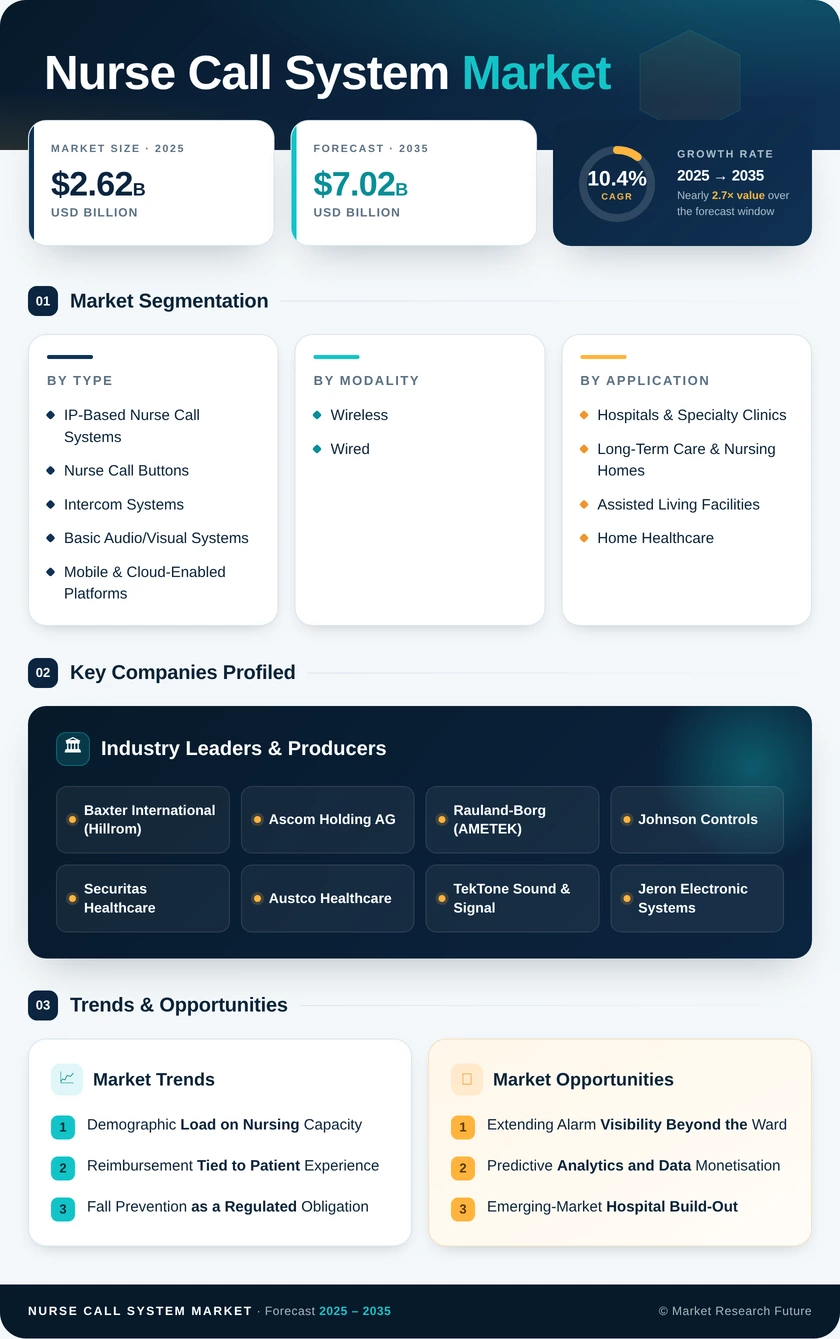
Forecast Period2026-2035
CAGR (2026-2035)10.4%
2025 Market SizeUSD 2.62 Billion
2035 Market SizeUSD 7.02 Billion
Key Players
Baxter International
Ascom Holding AG
Rauland-Borg
Johnson Controls
Securitas Healthcare
Austco Healthcare
Opportunities
  • Extending Alarm Visibility Beyond the Ward
  • Predictive Analytics and Data Monetisation
  • Emerging-Market Hospital Build-Out
  1. 1 Market Overview |
    1. 1.1 Study Assumptions & Market Definition |
    2. 1.2 Scope of the Study |
    3. 1.3 Research Methodology
  2. 2 Market Summary & Key Report Takeaways |
    1. 2.1 By Product |
    2. 2.2 By Sector |
    3. 2.3 By Region
  3. 3 Market Size & Forecast (2021–2035) |
    1. 3.1 Historical Market Size (2021–2024) |
    2. 3.2 Base Year Assessment (2025) |
    3. 3.3 Current & Forecast Market Size (2026–2035) |
    4. 3.4 Year-over-Year Growth Analysis
  4. 4 Driver Impact Analysis |
    1. 4.1 Demographic Load on Nursing Capacity |
    2. 4.2 Reimbursement Tied to Patient Experience |
    3. 4.3 Fall Prevention as a Regulated Obligation |
    4. 4.4 Procurement Shifting to Subscription
  5. 5 Restraints Impact Analysis |
    1. 5.1 Retrofit Economics in Ageing Estates |
    2. 5.2 Integration Friction with Clinical IT |
    3. 5.3 Security Obligations Raising the Bar
  6. 6 Market Opportunity Analysis |
    1. 6.1 Extending Alarm Visibility Beyond the Ward |
    2. 6.2 Predictive Analytics and Data Monetisation |
    3. 6.3 Emerging-Market Hospital Build-Out |
    4. 6.4 Real-Time Location Convergence |
    5. 6.5 Interoperability-First Platform Strategies |
    6. 6.6 Industry Value Chain Analysis |
    7. 6.7 Porter's Five Forces Analysis
  7. 7 Regional Analysis |
    1. 7.1 North America | |
      1. 7.1.1 US | |
      2. 7.1.2 Canada | |
      3. 7.1.3 Mexico |
    2. 7.2 Europe | |
      1. 7.2.1 Germany | |
      2. 7.2.2 UK | |
      3. 7.2.3 France | |
      4. 7.2.4 Italy | |
      5. 7.2.5 Spain | |
      6. 7.2.6 Nordic Countries | |
      7. 7.2.7 Russia | |
      8. 7.2.8 Rest of Europe |
    3. 7.3 Asia-Pacific | |
      1. 7.3.1 China | |
      2. 7.3.2 India | |
      3. 7.3.3 Japan | |
      4. 7.3.4 South Korea | |
      5. 7.3.5 ASEAN | |
      6. 7.3.6 Rest of Asia-Pacific |
    4. 7.4 South America | |
      1. 7.4.1 Brazil | |
      2. 7.4.2 Argentina | |
      3. 7.4.3 Rest of South America |
    5. 7.5 Middle East & Africa | |
      1. 7.5.1 Saudi Arabia | |
      2. 7.5.2 UAE | |
      3. 7.5.3 South Africa | |
      4. 7.5.4 Egypt | |
      5. 7.5.5 Rest of Middle East & Africa
  8. 8 Future Outlook (2026–2035) |
    1. 8.1 Ambient Intelligence Replaces the Button |
    2. 8.2 Platform Economics and Recurring Revenue |
    3. 8.3 Convergence with Clinical Communication Suites |
    4. 8.4 Sustainability and Estate Lifecycle Reporting
  9. 9 Market Segmentation Analysis |
    1. 9.1 By Product | |
      1. 9.1.1 Nurse Call Buttons | |
      2. 9.1.2 Intercom Systems | |
      3. 9.1.3 Basic Audio/Visual Systems | |
      4. 9.1.4 IP-Based Nurse Call Systems | |
      5. 9.1.5 Mobile & Cloud-Enabled Platforms | |
      6. 9.1.6 Others |
    2. 9.2 By Modality | |
      1. 9.2.1 Wired | |
      2. 9.2.2 Wireless |
    3. 9.3 By Application | |
      1. 9.3.1 Emergency Alarms | |
      2. 9.3.2 Workflow & Staff Optimisation | |
      3. 9.3.3 Fall Detection & Prevention | |
      4. 9.3.4 Wanderer Control |
    4. 9.4 By End User | |
      1. 9.4.1 Hospitals & Specialty Clinics | |
      2. 9.4.2 Long-Term Care & Nursing Homes | |
      3. 9.4.3 Assisted Living Facilities | |
      4. 9.4.4 Home Healthcare
  10. 10 Competitive Landscape |
    1. 10.1 Market Concentration Analysis (2026) |
    2. 10.2 Competitive Benchmarking Matrix |
    3. 10.3 Company Profiles | |
      1. 10.3.1 Baxter International (Hillrom) | |
      2. 10.3.2 Ascom Holding AG | |
      3. 10.3.3 Rauland-Borg (AMETEK) | |
      4. 10.3.4 Johnson Controls | |
      5. 10.3.5 Securitas Healthcare | |
      6. 10.3.6 Austco Healthcare | |
      7. 10.3.7 TekTone Sound & Signal | |
      8. 10.3.8 Jeron Electronic Systems | |
      9. 10.3.9 Schrack Seconet AG | |
      10. 10.3.10 Cornell Communications | |
      11. 10.3.11 West-Com Nurse Call Systems
  11. 11 Recent News & Developments
  12. 12 Report Scope & Methodology |
    1. 12.1 Study Period & Base Year |
    2. 12.2 Data Sources & Citations |
    3. 12.3 Abbreviations
  13. 13 Detailed Sources and Citations
  14. 14 Frequently Asked Questions
  15. 15 LIST OF TABLES |
  16. TABLE 1 Global Nurse Call System Market Size & Forecast, by Revenue (USD Billion), 2021–2035 |
  17. TABLE 2 Global Nurse Call System Market – Year-over-Year Growth Analysis, 2021–2035 |
  18. TABLE 3 Driver Impact Analysis Matrix, 2026–2035 |
  19. TABLE 4 Restraint Impact Analysis Matrix, 2026–2035 |
  20. TABLE 5 Global Nurse Call System Market Size, by Region, 2021–2035 (USD Billion) |
  21. TABLE 6 North America Nurse Call System Market Size, by Country, 2021–2035 (USD Billion) |
  22. TABLE 7 Europe Nurse Call System Market Size, by Country, 2021–2035 (USD Billion) |
  23. TABLE 8 Asia-Pacific Nurse Call System Market Size, by Country, 2021–2035 (USD Billion) |
  24. TABLE 9 South America Nurse Call System Market Size, by Country, 2021–2035 (USD Billion) |
  25. TABLE 10 Middle East & Africa Nurse Call System Market Size, by Country, 2021–2035 (USD Billion) |
  26. TABLE 11 Global Nurse Call System Market Size, by Product, 2021–2035 (USD Billion) |
  27. TABLE 12 Global Nurse Call System Market Size, by Modality, 2021–2035 (USD Billion) |
  28. TABLE 13 Global Nurse Call System Market Size, by Application, 2021–2035 (USD Billion) |
  29. TABLE 14 Global Nurse Call System Market Size, by End User, 2021–2035 (USD Billion) |
  30. TABLE 15 North America Nurse Call System Market Size, by Product and End User, 2021–2035 (USD Billion) |
  31. TABLE 16 Europe Nurse Call System Market Size, by Product and Application, 2021–2035 (USD Billion) |
  32. TABLE 17 Asia-Pacific Nurse Call System Market Size, by Modality and End User, 2021–2035 (USD Billion) |
  33. TABLE 18 South America Nurse Call System Market Size, by Application, 2021–2035 (USD Billion) |
  34. TABLE 19 Middle East & Africa Nurse Call System Market Size, by Product, 2021–2035 (USD Billion) |
  35. TABLE 20 Competitive Benchmarking Matrix – Global Nurse Call System Market, 2026 |
  36. TABLE 21 Company Profiles – Key Players, Global Nurse Call System Market |
  37. TABLE 22 Recent Developments & Strategic Announcements, 2023–2025 |
  38. TABLE 23 Report Scope & Methodology Summary |
  39. TABLE 24 Detailed Sources and Citations Index
  40. 16 LIST OF FIGURES |
  41. FIGURE 1 Global Nurse Call System Market – Market Dynamics Snapshot (Drivers, Restraints, Opportunities) |
  42. FIGURE 2 Industry Value Chain Analysis – Component Suppliers to Clinical End Users |
  43. FIGURE 3 Porter's Five Forces Analysis |
  44. FIGURE 4 Global Market Size Trend Line, 2021–2035 (USD Billion) |
  45. FIGURE 5 Year-over-Year Growth Rate Curve, 2022–2035 (%) |
  46. FIGURE 6 Market Share by Product, 2025 vs 2035 (%) |
  47. FIGURE 7 Market Share by Modality, 2025 vs 2035 (%) |
  48. FIGURE 8 Market Share by Application, 2025 (%) |
  49. FIGURE 9 Market Share by End User, 2025 (%) |
  50. FIGURE 10 Regional Revenue Share Distribution, 2025 (%) |
  51. FIGURE 11 Regional CAGR Comparison, 2026–2035 (%) |
  52. FIGURE 12 North America Country-Level Share Breakdown, 2025 (%) |
  53. FIGURE 13 Asia-Pacific Country-Level Growth Comparison, 2026–2035 (%) |
  54. FIGURE 14 Competitive Landscape – Revenue Share Positioning Map, 2026 |
  55. FIGURE 15 Vendor Strategic Positioning Quadrant – Scale vs Interoperability |
  56. FIGURE 16 Technology Adoption S-Curve – Analog to IP to Ambient Sensing

Segmentation Quick Reference

DimensionSub-SegmentsDominant SegmentFastest Growing Segment
By ProductNurse Call Buttons; Intercom Systems; Basic Audio/Visual Systems; IP-Based Nurse Call Systems; Mobile & Cloud-Enabled Platforms; OthersIP-Based Nurse Call SystemsMobile & Cloud-Enabled Platforms
By ModalityWired; WirelessWirelessWireless
By ApplicationEmergency Alarms; Workflow & Staff Optimisation; Fall Detection & Prevention; Wanderer ControlWorkflow & Staff OptimisationFall Detection & Prevention
By End UserHospitals & Specialty Clinics; Long-Term Care & Nursing Homes; Assisted Living Facilities; Home HealthcareHospitals & Specialty ClinicsHome Healthcare
By RegionNorth America; Europe; Asia-Pacific; South America; Middle East & AfricaNorth AmericaAsia-Pacific


Market Segmentation Overview

By Product

Sub-SegmentKey Trend
Nurse Call ButtonsSteady replacement demand; increasingly sold as endpoints within larger IP estates
Intercom SystemsTwo-way triage retained in acute wards to reduce unnecessary nurse trips
Basic Audio/Visual SystemsDeclining share as budget facilities leapfrog directly to wireless overlays
IP-Based Nurse Call SystemsNetwork convergence collapses separate cable plants into one managed backbone
Mobile & Cloud-Enabled PlatformsSubscription pricing clears operating-budget approval faster than capital projects
OthersOEM and specialty applications including behavioural health and paediatric units


Product mix is migrating decisively toward network-native architectures. Vendors that cannot present a credible IP roadmap are being excluded at the technical evaluation stage, while cloud-enabled entrants compete on deployment speed rather than installed base.

By Modality

Sub-SegmentKey Trend
WiredRetained in intensive care and theatres where deterministic reliability is specified
WirelessDominant in retrofit projects; avoids ward closures and structural cabling costs


Modality choice is driven by building age more than clinical preference. Facilities constructed before 2000 overwhelmingly select radio-based overlays, while greenfield tertiary hospitals in Asia and the Gulf specify structured wiring from the outset.

By Application

Sub-SegmentKey Trend
Emergency AlarmsRegulatory baseline function; minimal differentiation between vendors
Workflow & Staff OptimisationQuantifiable payback through reduced non-clinical nurse movement
Fall Detection & PreventionSensor fusion and passive detection displacing pendant-dependent models
Wanderer ControlGrowing with dementia prevalence in long-term care and assisted living


Application value is shifting from alerting to interpreting. Buyers now evaluate how intelligently a platform suppresses, prioritises, and escalates, because raw alarm volume actively harms clinical response quality.

By End User

Sub-SegmentKey Trend
Hospitals & Specialty ClinicsAccreditation and reimbursement linkage sustain premium specification
Long-Term Care & Nursing HomesMinimum care-minute mandates drive documented response evidence
Assisted Living FacilitiesRising resident acuity pushes upgrades toward clinical-grade platforms
Home HealthcareCellular-backed devices extend supervision to dispersed patient populations


End-user demand is broadening beyond the hospital campus. Home and assisted living deployments carry lower revenue per site but far higher unit volume, and they favour vendors whose commercial model already supports recurring per-patient billing.

By Region

Sub-SegmentKey Trend
North AmericaRetrofit-led; alarm-safety compliance and hospital-at-home programmes
EuropeEstate digitisation funding paired with strict in-region data hosting requirements
Asia-PacificGreenfield construction bypasses analog generation entirely
South AmericaPrivate hospital chains lead discretionary technology investment
Middle East & AfricaGulf mega-projects bundle nurse call with location and building systems


Regional strategy diverges sharply by installed base. Mature markets reward integration depth and security credentials; emerging markets reward delivery capability and competitive pricing on complete new-build packages.




Download PDF ×

We do not share your information with anyone. However, we may send you emails based on your report interest from time to time. You may contact us at any time to opt-out.