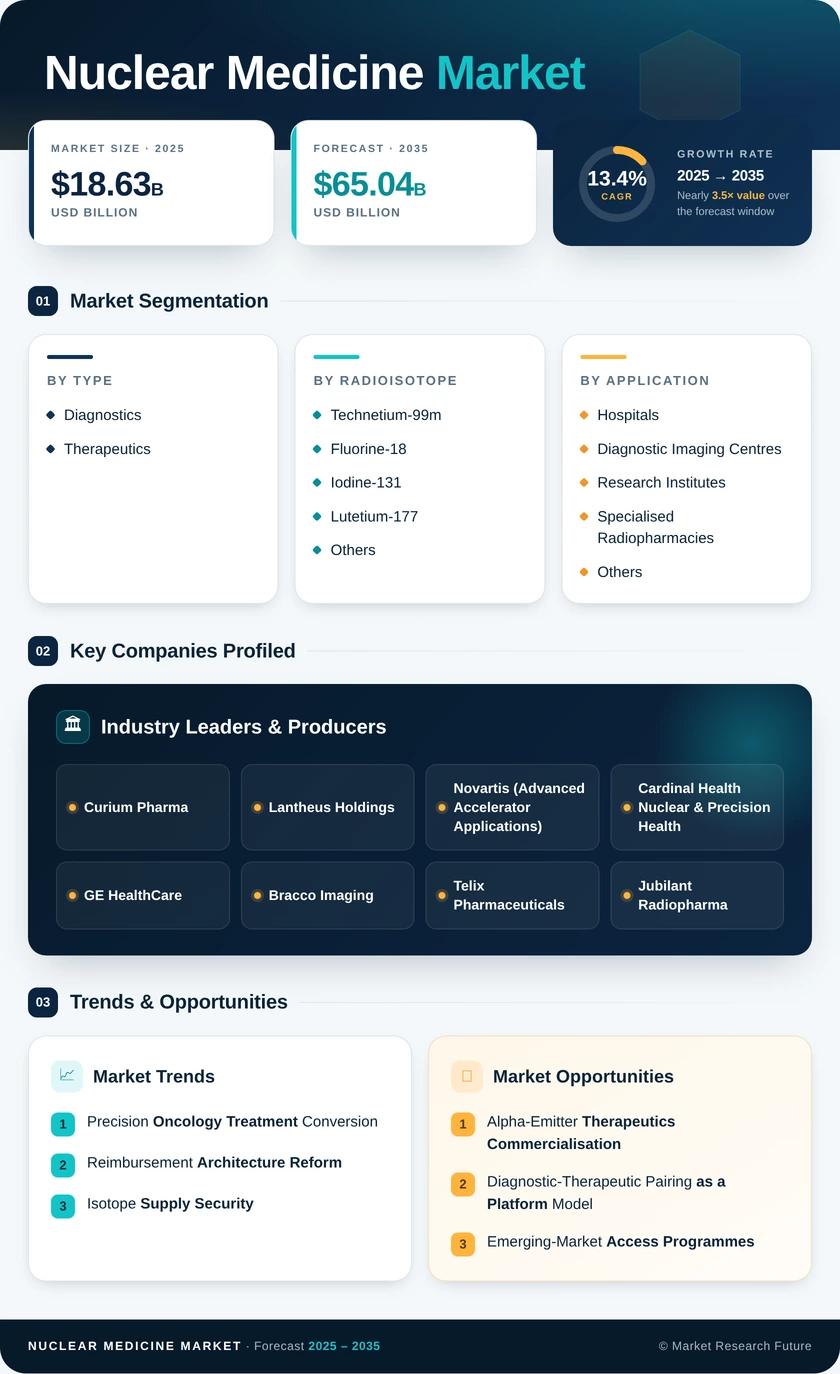
Segmentation Quick Reference
| Dimension | Sub-Segments | Dominant Segment | Fastest Growing Segment |
| By Product Type | Diagnostics, Therapeutics | Diagnostics | Therapeutics |
| By Radioisotope | Technetium-99m, Fluorine-18, Iodine-131, Lutetium-177, Others | Technetium-99m | Lutetium-177 |
| By Application | Oncology, Cardiology, Neurology, Thyroid, Others | Oncology | Neurology |
| By End User | Hospitals, Diagnostic Imaging Centres, Research Institutes, Specialised Radiopharmacies, Others | Hospitals | Specialised Radiopharmacies |
| By Geography | North America, Europe, Asia-Pacific, South America, Middle East & Africa | North America | Asia-Pacific |
Market Segmentation Overview
By Product Type
| Sub-Segment | Key Trend |
| Diagnostics | Volume growth steady; digital detector upgrades and AI reporting compress cost per scan |
| Therapeutics | Value growth accelerating; label expansions convert systemic-therapy budgets into isotope spend |
Diagnostics remain the volume engine and will keep expanding in absolute terms, but the revenue centre of gravity is migrating toward therapeutics. Suppliers with both halves of a paired offering capture the full patient journey rather than a single encounter.
By Radioisotope
| Sub-Segment | Key Trend |
| Technetium-99m | Non-reactor production reduces outage exposure; share erodes slowly to PET substitution |
| Fluorine-18 | Distribution radius drives site economics; neurological tracers broaden the use base |
| Iodine-131 | Stable thyroid demand; limited growth headroom in mature markets |
| Lutetium-177 | Irradiation slot contracting extends five to seven years as therapy demand scales |
| Others | Actinium-225 and lead-212 supply expansion unlocks alpha therapy pipelines |
Supply architecture, not clinical preference, determines which isotopes scale. Producers investing in accelerator capacity today are effectively buying share for the 2030s.
By Application
| Sub-Segment | Key Trend |
| Oncology | Paired diagnostic-therapeutic protocols multiply encounters per patient |
| Cardiology | PET perfusion agents substitute into higher-volume centres |
| Neurology | Anti-amyloid therapy eligibility makes confirmatory imaging mandatory |
| Thyroid | Mature protocols; growth tracks population and access rather than innovation |
| Others | Infection and inflammation imaging emerging from research settings |
Oncology sets the headline, yet neurology carries the steepest slope because a drug approval converted an optional scan into a treatment prerequisite.
By End User
| Sub-Segment | Key Trend |
| Hospitals | Shielded therapy suites and licensing depth preserve structural advantage |
| Diagnostic Imaging Centres | Throughput economics favour high-referral urban catchments |
| Research Institutes | Trial imaging demand rises with pipeline density |
| Specialised Radiopharmacies | Outsourced compounding relieves hospital capital and staffing pressure |
| Others | Mobile and ambulatory settings expand access in underserved geographies |
Hospitals hold the therapeutic franchise for regulatory reasons that will not change quickly. The interesting shift is upstream, where centralised dose preparation is quietly becoming the sector's most reliable recurring-revenue layer.


 Noah Malgeri
Co-Founder

 Peter Groot koerkamp
Account and Business Manager

 Younghwan Choi
Senior Retail Manager

 Mark Irwin
Management Consultant

 Akif Moroglu
Strategy & Business Development Director

 Guilherme Gomes Martins
Product Management Director

 Joseph Aguayo
Sales Operations & Pricing Manager

 La Terria Dodd
Program Support Specialist

 Rob Kooiker
Group Product Manager HVAC & Fire Protection GMA