Request Free Sample ×

Kindly complete the form below to receive a free sample of this Report

* Please use a valid business email

Leading companies partner with us for data-driven Insights

clients tt-cursor
Hero Background
English
Chinese
French
Japanese
Korean
German
Spanish

North America Fresh Herbs Market Size

ID: MRFR/FnB/11081-HCR
128 Pages
Snehal Singh
Last Updated: April 06, 2026

North America Fresh Herbs Market Size, Share, Industry Trend & Analysis Research Report Information By Applications (Foodservice and Food Retail), By Types (Basil, Chives, Coriander, Parsley, Mint, Salicornia and Others) –and North America Forecast Till 2035

Share:
Download PDF ×

We do not share your information with anyone. However, we may send you emails based on your report interest from time to time. You may contact us at any time to opt-out.

North America Fresh Herbs Market Infographic
Purchase Options

North America Fresh Herbs Size

North America Fresh Herbs Market Growth Projections and Opportunities

The North American fresh herbs market is influenced by several key factors that shape its growth, trends, and consumer demand. One significant factor is the increasing awareness of healthy eating and the culinary trend towards fresh, flavorful ingredients. As consumers become more health-conscious and seek out ways to enhance the taste and nutritional value of their meals, there is a growing demand for fresh herbs. These aromatic plants not only add depth and complexity to dishes but also offer various health benefits, such as vitamins, minerals, and antioxidants, driving their popularity in the North American market.

Changing dietary preferences and culinary habits also play a crucial role in driving the North American fresh herbs market. With the rise of diverse cuisines and global food trends, there is a growing appreciation for ethnic flavors and ingredients. Fresh herbs feature prominently in many international cuisines, from Italian basil to Thai basil, cilantro in Mexican dishes, and parsley in Middle Eastern cuisine. As consumers seek to replicate authentic flavors at home or experiment with new recipes, the demand for a wide variety of fresh herbs continues to increase, fueling market growth.

The influence of convenience and accessibility is another significant market factor in North America. While fresh herbs were once primarily available in specialty stores or farmers' markets, they have now become more mainstream, with supermarkets and grocery stores expanding their selection of fresh produce, including herbs. Additionally, the availability of pre-packaged, washed, and pre-chopped herbs caters to consumers looking for convenience and time-saving options in meal preparation. This increased accessibility ensures that fresh herbs are readily available to a broader audience of consumers, driving market demand and consumption.

Consumer preferences for organic and locally sourced products also impact the North American fresh herbs market. As consumers become more environmentally conscious and concerned about food safety, there is a growing demand for organic and locally grown herbs. Organic certification ensures that herbs are grown without synthetic pesticides, fertilizers, or genetically modified organisms (GMOs), appealing to consumers seeking healthier and more sustainable food options. Likewise, locally sourced herbs offer freshness, traceability, and support for local farmers, resonating with consumers' desires for transparency and community connection in their food choices.

Marketing and branding strategies play a crucial role in shaping consumer perceptions and driving demand in the North American fresh herbs market. Companies invest in creative packaging, branding, and promotional campaigns to differentiate their products and attract consumers' attention. Eye-catching packaging, informative labeling, and certifications such as USDA Organic or Non-GMO Project Verified help communicate the quality, freshness, and sustainability of fresh herbs to consumers. Moreover, engaging consumers through social media, cooking demonstrations, and recipe inspiration fosters brand loyalty and encourages repeat purchases.

Government regulations and food safety standards also influence the North American fresh herbs market. Regulatory bodies such as the Food and Drug Administration (FDA) and the Department of Agriculture (USDA) set guidelines for the production, handling, and labeling of fresh herbs to ensure food safety and consumer protection. Compliance with these regulations is essential for herb producers and distributors to maintain product quality, safety, and consumer trust. Additionally, adherence to Good Agricultural Practices (GAP) and food safety certifications further demonstrate a commitment to quality and food safety, enhancing consumer confidence in fresh herb products.

Competitive dynamics and market trends drive innovation and product differentiation in the North American fresh herbs market. With an increasing number of players entering the market, competition is intensifying, leading to a greater variety of herb offerings and packaging formats. Companies differentiate themselves by offering specialty herbs, unique blends, or value-added products such as herb-infused oils or sauces, catering to diverse consumer preferences and culinary trends. Innovation in sustainable packaging, hydroponic cultivation, and vertical farming further contributes to product differentiation and market competitiveness.

Consumer behavior and preferences continue to evolve, shaping the dynamics of the North American fresh herbs market. While some consumers prioritize convenience and accessibility, others prioritize quality, flavor, and sustainability in their herb purchases. Understanding these preferences and market trends is essential for herb producers and retailers to develop targeted marketing strategies, product offerings, and distribution channels that resonate with their target audience. Consumer education initiatives highlighting the culinary uses, health benefits, and sustainability practices of fresh herbs help increase awareness and drive demand in the North American market.

North America Fresh Herbs Market Size Graph
Author
Author Profile
Snehal Singh
Manager - Research

High acumen in analyzing complex macro & micro markets with more than 6 years of work experience in the field of market research. By implementing her analytical skills in forecasting and estimation into market research reports, she has expertise in Packaging, Construction, and Equipment domains. She handles a team size of 20-25 resources and ensures smooth running of the projects, associated marketing activities, and client servicing.

Leave a Comment

FAQs

What was the overall market valuation of the fresh herbs market in 2024?

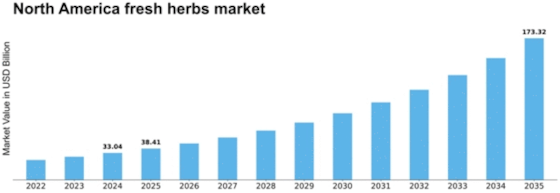
<p>The overall market valuation was $33.04 Billion in 2024.</p>

What is the projected market valuation for the fresh herbs market by 2035?

<p>The projected valuation for 2035 is $173.32 Billion.</p>

What is the expected CAGR for the fresh herbs market during the forecast period 2025 - 2035?

<p>The expected CAGR for the market during the forecast period 2025 - 2035 is 16.26%.</p>

Which type of fresh herb segment had the highest valuation in 2024?

<p>In 2024, the Parsley segment had the highest valuation at $6.0 Billion.</p>

What is the valuation range for the Basil segment in the fresh herbs market?

<p>The valuation range for the Basil segment is between $5.0 Billion and $25.0 Billion.</p>

How does the valuation of organic fresh herbs compare to conventional herbs?

<p>In 2024, the valuation for organic fresh herbs was $12.61 Billion, compared to $20.43 Billion for conventional herbs.</p>

Who are the key players in the fresh herbs market?

<p>Key players include McCormick & Company, Dole Food Company, and Fresh Herbs Company, among others.</p>

What is the valuation range for the Chives segment in the fresh herbs market?

<p>The valuation range for the Chives segment is between $3.0 Billion and $15.0 Billion.</p>

What segment is expected to grow the most in the fresh herbs market?

<p>The Others segment, with a valuation range of $11.04 Billion to $63.32 Billion, appears to have substantial growth potential.</p>

What is the valuation range for the Mint segment in the fresh herbs market?

<p>The valuation range for the Mint segment is between $4.0 Billion and $20.0 Billion.</p>

Market Summary

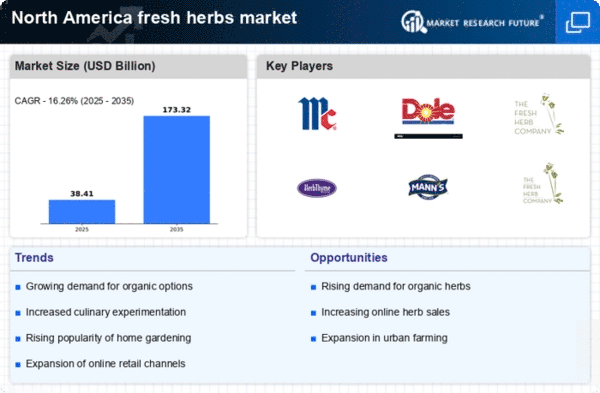
As per Market Research Future analysis, the North America fresh herbs market Size was estimated at 33.04 USD Billion in 2024. The North America fresh herbs market is projected to grow from 38.41 USD Billion in 2025 to 173.32 USD Billion by 2035, exhibiting a compound annual growth rate (CAGR) of 16.2% during the forecast period 2025 - 2035

Key Market Trends & Highlights

The North America fresh herbs market is experiencing robust growth driven by evolving consumer preferences and innovative trends.

  • The demand for organic fresh herbs is surging, particularly in the US, which remains the largest market.
  • Home gardening and urban farming initiatives are gaining traction, especially in Canada, the fastest-growing region.
  • E-commerce platforms are increasingly becoming popular for purchasing fresh herbs, reflecting a shift in consumer buying behavior.
  • Rising health consciousness and culinary trends are major drivers, as consumers seek sustainable and convenient options.

Market Size & Forecast

2024 Market Size 33.04 (USD Billion)
2035 Market Size 173.32 (USD Billion)
CAGR (2025 - 2035) 16.26%

Major Players

McCormick & Company (US), Dole Food Company (US), Fresh Herbs Company (US), Herb Thyme Farms (US), Mann's Fresh Vegetables (US), The Fresh Herb Company (US), Pine Tree Farms (US), Greenhouse Herb Company (US)

Market Trends

The fresh herbs market in North America is currently experiencing a notable transformation, driven by evolving consumer preferences and an increasing focus on health and wellness. As individuals become more health-conscious, there is a growing demand for fresh, organic, and locally sourced herbs. This shift is reflected in the rising popularity of culinary herbs, which are not only used for flavor enhancement but also for their potential health benefits. Retailers are responding to this trend by expanding their offerings, ensuring that consumers have access to a diverse range of fresh herbs. Furthermore, the trend towards home gardening and urban farming is gaining traction, as more people seek to cultivate their own herbs, thereby fostering a deeper connection with food and sustainability. In addition to changing consumer habits, the fresh herbs market is also influenced by advancements in agricultural practices and distribution methods. Innovations in hydroponics and vertical farming are enabling producers to grow herbs in urban settings, reducing transportation costs and ensuring fresher products. This is particularly relevant in densely populated areas where access to fresh produce can be limited. Moreover, the rise of e-commerce platforms has made it easier for consumers to purchase fresh herbs online, further expanding market reach. As these trends continue to evolve, the fresh herbs market is poised for growth, reflecting a broader movement towards healthier eating and sustainable practices.

Increased Demand for Organic Products

There is a noticeable shift towards organic fresh herbs, as consumers prioritize health and sustainability. This trend is likely driven by a growing awareness of the benefits associated with organic farming practices, which often result in higher quality and more flavorful herbs. Retailers are adapting by increasing their organic offerings, catering to this demand.

Home Gardening and Urban Farming

The trend of home gardening is gaining momentum, with many individuals opting to grow their own fresh herbs. This movement not only promotes self-sufficiency but also encourages a connection to food sources. Urban farming initiatives are also on the rise, providing fresh herbs to local communities and reducing the carbon footprint associated with transportation.

E-commerce Growth in Fresh Produce

The expansion of e-commerce platforms is transforming how consumers access fresh herbs. Online shopping offers convenience and a wider selection, allowing consumers to purchase herbs directly from producers. This trend is likely to continue, as more people embrace digital shopping for their fresh produce needs.

North America Fresh Herbs Market Market Drivers

Rising Health Consciousness

The fresh herbs market in North America is experiencing a notable surge due to increasing health consciousness among consumers. As individuals become more aware of the health benefits associated with fresh herbs, such as their antioxidant properties and potential to enhance overall well-being, demand is likely to rise. According to recent data, the consumption of fresh herbs has increased by approximately 15% over the past five years, reflecting a shift towards healthier eating habits. This trend is further supported by the growing popularity of plant-based diets, which often incorporate fresh herbs for flavor and nutrition. Consequently, the fresh herbs market is poised for growth as consumers prioritize natural ingredients in their meals.

Culinary Trends and Innovation

The fresh herbs market is significantly influenced by evolving culinary trends and innovations in North America. Chefs and home cooks alike are increasingly experimenting with diverse flavors, leading to a heightened interest in fresh herbs as essential ingredients. The rise of gourmet cooking and the popularity of ethnic cuisines have contributed to a 20% increase in the use of fresh herbs in recipes over the last few years. Additionally, the introduction of new herb varieties and blends in the market has further stimulated consumer interest. As culinary creativity continues to flourish, the fresh herbs market is likely to benefit from sustained demand driven by innovative cooking practices.

Sustainability and Local Sourcing

Sustainability has become a pivotal driver in the fresh herbs market in North America. Consumers are increasingly seeking locally sourced products, which not only support local economies but also reduce the carbon footprint associated with transportation. This trend is reflected in the growing number of farmers' markets and community-supported agriculture (CSA) programs that emphasize fresh herbs. Recent statistics indicate that locally sourced fresh herbs have seen a 25% increase in sales, as consumers prioritize sustainability in their purchasing decisions. As awareness of environmental issues continues to rise, the fresh herbs market is likely to see further growth in demand for sustainably sourced products.

Convenience and Ready-to-Use Products

The fresh herbs market is also being driven by the demand for convenience and ready-to-use products. Busy lifestyles have led consumers to seek out pre-packaged fresh herbs that require minimal preparation. This trend is evident in the increasing availability of fresh herb kits and pre-washed, ready-to-use options in grocery stores. Recent data suggests that sales of pre-packaged fresh herbs have grown by approximately 30% in the last two years, indicating a shift towards convenience-oriented purchasing behavior. As consumers continue to prioritize time-saving solutions in their cooking routines, the fresh herbs market is likely to expand further in this segment.

Increased Interest in Culinary Education

The fresh herbs market is benefiting from a growing interest in culinary education across North America. As more individuals enroll in cooking classes and culinary schools, there is a heightened awareness of the importance of fresh herbs in enhancing flavors and presentation. This educational trend has led to an increase in the use of fresh herbs in home cooking, with many consumers eager to replicate restaurant-quality dishes. Recent surveys indicate that approximately 40% of cooking class participants report using fresh herbs more frequently after their training. As culinary education continues to gain traction, the fresh herbs market is likely to see sustained growth driven by informed consumers.

Market Segment Insights

By Type: Basil (Largest) vs. Chives (Fastest-Growing)

In the fresh herbs market, Basil holds the largest market share due to its widespread culinary use and popularity amongst consumers. It has established itself as a staple herb in various cuisines, leading to a significant portion of the overall market. Chives, while having a smaller share, are rapidly gaining traction among consumers looking for milder flavor profiles and unique culinary applications. The diverse applications of both herbs contribute to their strong presence in the market. The growth trends for fresh herbs are influenced by increasing consumer awareness towards healthy eating and the rise of gourmet cooking at home. As more people embrace herbal infusions in cooking, demand for chives is expected to escalate, marking it as the fastest-growing segment. Innovations in farming practices and sustainability are also driving interest in fresh herbs and their applications in various culinary and wellness sectors.

Basil: Dominant vs. Chives: Emerging

Basil is recognized as the dominant player in the fresh herbs segment, renowned for its robust flavor and versatility in numerous dishes ranging from Italian pasta to Thai cuisines. Its vibrant green leaves and aromatic quality make it a favorite among consumers and chefs alike. On the other hand, Chives are emerging as a popular choice for those who lean towards mild flavors, offering a delicate onion-like taste that complements many dishes. The increasing trend of home gardening and culinary experimentation among consumers is positioning chives as a key player in the market. With their ease of cultivation and growing popularity, both basil and chives are set to play significant roles in shaping consumer preferences.

By Category: Conventional (Largest) vs. Organic (Fastest-Growing)

In the North America fresh herbs market, the Conventional segment holds a significant share, dominating consumer preferences due to its wide availability and lower price points. This segment's robust supply chain and consistency in quality have made it a staple in grocery stores and restaurants, ensuring a steady demand among various consumer groups. In contrast, the Organic segment, while smaller in current market share, is experiencing rapid growth as more consumers become health-conscious and seek out products they perceive as environmentally sustainable and free from synthetic additives. Growth trends indicate a noticeable shift towards organic options, driven by increasing awareness of health benefits and the rising popularity of clean eating. Retailers are expanding their organic product lines to meet consumer demand, resulting in innovative marketing approaches that highlight the premium qualities of organic herbs. As dietary preferences evolve, the pressure on producers will likely increase to diversify their offerings, enhancing the competitive landscape between Conventional and Organic herbs.

Conventional: Dominant vs. Organic: Emerging

The Conventional segment of the fresh herbs market is characterized by its established supply chains, extensive distribution networks, and affordability, making it an accessible choice for many households and <a href="https://www.marketresearchfuture.com/reports/food-service-market-11595" target="_blank">food service</a> businesses. In contrast, the Organic segment is becoming increasingly prominent, appealing to a niche market that values sustainability and health. Organic herbs are often perceived as fresher and more flavorful, which can command higher prices. This segment's growth is propelled by shifts in consumer behavior, with a marked preference for locally sourced and sustainably grown products. Meanwhile, the Conventional segment continues to thrive as a reliable option, balancing quality and cost-effectiveness, thus maintaining its dominant position in the market.

Get more detailed insights about North America Fresh Herbs Market Research Report— Forecast till 2035

Regional Insights

US : Thriving Demand and Innovation

Key markets include California, Florida, and Texas, where urban centers like Los Angeles and Miami drive demand. The competitive landscape features major players such as McCormick & Company and Dole Food Company, which dominate the market with innovative product offerings. Local dynamics favor fresh herbs in culinary applications, particularly in restaurants and home kitchens. The business environment is supported by a robust supply chain and increasing consumer awareness of the benefits of fresh herbs.

Canada : Growing Interest in Local Produce

Key markets include Ontario and British Columbia, particularly in cities like Toronto and Vancouver, where demand for fresh herbs is on the rise. The competitive landscape is characterized by local producers and smaller companies, with players like Herb Thyme Farms gaining traction. The business environment is favorable, with increasing consumer interest in health and wellness, leading to a growing market for fresh herbs in both retail and food service sectors.

Key Players and Competitive Insights

The fresh herbs market in North America is characterized by a dynamic competitive landscape, driven by increasing consumer demand for fresh, organic, and locally sourced products. Key players are actively engaging in strategies that emphasize innovation, sustainability, and regional expansion. For instance, McCormick & Company (US) has positioned itself as a leader through its commitment to quality and flavor, focusing on product innovation and sustainability initiatives. Similarly, Dole Food Company (US) is leveraging its extensive distribution network to enhance its fresh herb offerings, while Fresh Herbs Company (US) emphasizes local sourcing to cater to health-conscious consumers. Collectively, these strategies contribute to a moderately fragmented market, where competition is intensifying as companies seek to differentiate themselves through quality and sustainability.In terms of business tactics, companies are increasingly localizing manufacturing and optimizing supply chains to meet the growing demand for fresh herbs. This approach not only reduces transportation costs but also enhances product freshness, which is a critical factor for consumers. The competitive structure of the market remains moderately fragmented, with several key players influencing market dynamics. The collective actions of these companies indicate a trend towards greater collaboration and strategic partnerships, which may further reshape the competitive landscape.

In October McCormick & Company (US) announced a partnership with a local farm network to enhance its supply chain for fresh herbs. This strategic move is significant as it allows McCormick to ensure a consistent supply of high-quality herbs while supporting local agriculture. Such initiatives not only bolster the company's sustainability credentials but also resonate with consumers who prioritize local sourcing.

In September Dole Food Company (US) launched a new line of organic fresh herbs, targeting the growing segment of health-conscious consumers. This product line aims to capitalize on the increasing trend towards organic produce, reflecting Dole's commitment to meeting consumer preferences. The introduction of organic options is likely to enhance Dole's market share and strengthen its position in the competitive landscape.

In August Fresh Herbs Company (US) expanded its distribution channels by partnering with major grocery chains across the region. This strategic expansion is crucial as it increases the company's market reach and accessibility to consumers. By enhancing its distribution network, Fresh Herbs Company is poised to capture a larger share of the market, particularly among consumers seeking convenient access to fresh herbs.

As of November current trends in the fresh herbs market indicate a strong emphasis on digitalization, sustainability, and the integration of AI technologies in supply chain management. Strategic alliances are becoming increasingly important, as companies recognize the value of collaboration in enhancing operational efficiency and market reach. Looking ahead, competitive differentiation is likely to evolve, shifting from price-based competition to a focus on innovation, technology, and supply chain reliability. This transition suggests that companies that prioritize these aspects will be better positioned to thrive in an increasingly competitive environment.

Key Companies in the North America Fresh Herbs Market include

Industry Developments

Future Outlook

North America Fresh Herbs Market Future Outlook

The fresh herbs market is projected to grow at a 16.26% CAGR from 2025 to 2035, driven by increasing consumer demand for organic products and culinary trends.

New opportunities lie in:

  • Expansion of e-commerce platforms for fresh herb sales.
  • Development of vertical farming systems for year-round production.
  • Partnerships with restaurants for exclusive herb supply contracts.

By 2035, the fresh herbs market is expected to achieve substantial growth and innovation.

Market Segmentation

North America Fresh Herbs Market Type Outlook

  • Basil
  • Chives
  • Coriander
  • Parsley
  • Mint
  • Others

North America Fresh Herbs Market Category Outlook

  • Conventional
  • Organic

Report Scope

MARKET SIZE 2024 33.04(USD Billion)
MARKET SIZE 2025 38.41(USD Billion)
MARKET SIZE 2035 173.32(USD Billion)
COMPOUND ANNUAL GROWTH RATE (CAGR) 16.26% (2025 - 2035)
REPORT COVERAGE Revenue Forecast, Competitive Landscape, Growth Factors, and Trends
BASE YEAR 2024
Market Forecast Period 2025 - 2035
Historical Data 2019 - 2024
Market Forecast Units USD Billion
Key Companies Profiled McCormick & Company (US), Dole Food Company (US), Fresh Herbs Company (US), Herb Thyme Farms (US), Mann's Fresh Vegetables (US), The Fresh Herb Company (US), Pine Tree Farms (US), Greenhouse Herb Company (US)
Segments Covered Type, Category
Key Market Opportunities Growing consumer demand for organic and locally sourced fresh herbs presents significant market opportunities.
Key Market Dynamics Rising consumer demand for organic fresh herbs drives market growth and influences supply chain dynamics in North America.
Countries Covered US, Canada

FAQs

What was the overall market valuation of the fresh herbs market in 2024?

<p>The overall market valuation was $33.04 Billion in 2024.</p>

What is the projected market valuation for the fresh herbs market by 2035?

<p>The projected valuation for 2035 is $173.32 Billion.</p>

What is the expected CAGR for the fresh herbs market during the forecast period 2025 - 2035?

<p>The expected CAGR for the market during the forecast period 2025 - 2035 is 16.26%.</p>

Which type of fresh herb segment had the highest valuation in 2024?

<p>In 2024, the Parsley segment had the highest valuation at $6.0 Billion.</p>

What is the valuation range for the Basil segment in the fresh herbs market?

<p>The valuation range for the Basil segment is between $5.0 Billion and $25.0 Billion.</p>

How does the valuation of organic fresh herbs compare to conventional herbs?

<p>In 2024, the valuation for organic fresh herbs was $12.61 Billion, compared to $20.43 Billion for conventional herbs.</p>

Who are the key players in the fresh herbs market?

<p>Key players include McCormick & Company, Dole Food Company, and Fresh Herbs Company, among others.</p>

What is the valuation range for the Chives segment in the fresh herbs market?

<p>The valuation range for the Chives segment is between $3.0 Billion and $15.0 Billion.</p>

What segment is expected to grow the most in the fresh herbs market?

<p>The Others segment, with a valuation range of $11.04 Billion to $63.32 Billion, appears to have substantial growth potential.</p>

What is the valuation range for the Mint segment in the fresh herbs market?

<p>The valuation range for the Mint segment is between $4.0 Billion and $20.0 Billion.</p>

  1. SECTION I: EXECUTIVE SUMMARY AND KEY HIGHLIGHTS
    1. | 1.1 EXECUTIVE SUMMARY
    2. | | 1.1.1 Market Overview
    3. | | 1.1.2 Key Findings
    4. | | 1.1.3 Market Segmentation
    5. | | 1.1.4 Competitive Landscape
    6. | | 1.1.5 Challenges and Opportunities
    7. | | 1.1.6 Future Outlook
  2. SECTION II: SCOPING, METHODOLOGY AND MARKET STRUCTURE
    1. | 2.1 MARKET INTRODUCTION
    2. | | 2.1.1 Definition
    3. | | 2.1.2 Scope of the study
    4. | | | 2.1.2.1 Research Objective
    5. | | | 2.1.2.2 Assumption
    6. | | | 2.1.2.3 Limitations
    7. | 2.2 RESEARCH METHODOLOGY
    8. | | 2.2.1 Overview
    9. | | 2.2.2 Data Mining
    10. | | 2.2.3 Secondary Research
    11. | | 2.2.4 Primary Research
    12. | | | 2.2.4.1 Primary Interviews and Information Gathering Process
    13. | | | 2.2.4.2 Breakdown of Primary Respondents
    14. | | 2.2.5 Forecasting Model
    15. | | 2.2.6 Market Size Estimation
    16. | | | 2.2.6.1 Bottom-Up Approach
    17. | | | 2.2.6.2 Top-Down Approach
    18. | | 2.2.7 Data Triangulation
    19. | | 2.2.8 Validation
  3. SECTION III: QUALITATIVE ANALYSIS
    1. | 3.1 MARKET DYNAMICS
    2. | | 3.1.1 Overview
    3. | | 3.1.2 Drivers
    4. | | 3.1.3 Restraints
    5. | | 3.1.4 Opportunities
    6. | 3.2 MARKET FACTOR ANALYSIS
    7. | | 3.2.1 Value chain Analysis
    8. | | 3.2.2 Porter's Five Forces Analysis
    9. | | | 3.2.2.1 Bargaining Power of Suppliers
    10. | | | 3.2.2.2 Bargaining Power of Buyers
    11. | | | 3.2.2.3 Threat of New Entrants
    12. | | | 3.2.2.4 Threat of Substitutes
    13. | | | 3.2.2.5 Intensity of Rivalry
    14. | | 3.2.3 COVID-19 Impact Analysis
    15. | | | 3.2.3.1 Market Impact Analysis
    16. | | | 3.2.3.2 Regional Impact
    17. | | | 3.2.3.3 Opportunity and Threat Analysis
  4. SECTION IV: QUANTITATIVE ANALYSIS
    1. | 4.1 Security, Access Control and Robotics, BY Type (USD Billion)
    2. | | 4.1.1 Basil
    3. | | 4.1.2 Chives
    4. | | 4.1.3 Coriander
    5. | | 4.1.4 Parsley
    6. | | 4.1.5 Mint
    7. | | 4.1.6 Others
    8. | 4.2 Security, Access Control and Robotics, BY Category (USD Billion)
    9. | | 4.2.1 Conventional
    10. | | 4.2.2 Organic
  5. SECTION V: COMPETITIVE ANALYSIS
    1. | 5.1 Competitive Landscape
    2. | | 5.1.1 Overview
    3. | | 5.1.2 Competitive Analysis
    4. | | 5.1.3 Market share Analysis
    5. | | 5.1.4 Major Growth Strategy in the Security, Access Control and Robotics
    6. | | 5.1.5 Competitive Benchmarking
    7. | | 5.1.6 Leading Players in Terms of Number of Developments in the Security, Access Control and Robotics
    8. | | 5.1.7 Key developments and growth strategies
    9. | | | 5.1.7.1 New Product Launch/Service Deployment
    10. | | | 5.1.7.2 Merger & Acquisitions
    11. | | | 5.1.7.3 Joint Ventures
    12. | | 5.1.8 Major Players Financial Matrix
    13. | | | 5.1.8.1 Sales and Operating Income
    14. | | | 5.1.8.2 Major Players R&D Expenditure. 2023
    15. | 5.2 Company Profiles
    16. | | 5.2.1 McCormick & Company (US)
    17. | | | 5.2.1.1 Financial Overview
    18. | | | 5.2.1.2 Products Offered
    19. | | | 5.2.1.3 Key Developments
    20. | | | 5.2.1.4 SWOT Analysis
    21. | | | 5.2.1.5 Key Strategies
    22. | | 5.2.2 Dole Food Company (US)
    23. | | | 5.2.2.1 Financial Overview
    24. | | | 5.2.2.2 Products Offered
    25. | | | 5.2.2.3 Key Developments
    26. | | | 5.2.2.4 SWOT Analysis
    27. | | | 5.2.2.5 Key Strategies
    28. | | 5.2.3 Fresh Herbs Company (US)
    29. | | | 5.2.3.1 Financial Overview
    30. | | | 5.2.3.2 Products Offered
    31. | | | 5.2.3.3 Key Developments
    32. | | | 5.2.3.4 SWOT Analysis
    33. | | | 5.2.3.5 Key Strategies
    34. | | 5.2.4 Herb Thyme Farms (US)
    35. | | | 5.2.4.1 Financial Overview
    36. | | | 5.2.4.2 Products Offered
    37. | | | 5.2.4.3 Key Developments
    38. | | | 5.2.4.4 SWOT Analysis
    39. | | | 5.2.4.5 Key Strategies
    40. | | 5.2.5 Mann's Fresh Vegetables (US)
    41. | | | 5.2.5.1 Financial Overview
    42. | | | 5.2.5.2 Products Offered
    43. | | | 5.2.5.3 Key Developments
    44. | | | 5.2.5.4 SWOT Analysis
    45. | | | 5.2.5.5 Key Strategies
    46. | | 5.2.6 The Fresh Herb Company (US)
    47. | | | 5.2.6.1 Financial Overview
    48. | | | 5.2.6.2 Products Offered
    49. | | | 5.2.6.3 Key Developments
    50. | | | 5.2.6.4 SWOT Analysis
    51. | | | 5.2.6.5 Key Strategies
    52. | | 5.2.7 Pine Tree Farms (US)
    53. | | | 5.2.7.1 Financial Overview
    54. | | | 5.2.7.2 Products Offered
    55. | | | 5.2.7.3 Key Developments
    56. | | | 5.2.7.4 SWOT Analysis
    57. | | | 5.2.7.5 Key Strategies
    58. | | 5.2.8 Greenhouse Herb Company (US)
    59. | | | 5.2.8.1 Financial Overview
    60. | | | 5.2.8.2 Products Offered
    61. | | | 5.2.8.3 Key Developments
    62. | | | 5.2.8.4 SWOT Analysis
    63. | | | 5.2.8.5 Key Strategies
    64. | 5.3 Appendix
    65. | | 5.3.1 References
    66. | | 5.3.2 Related Reports
  6. LIST OF FIGURES
    1. | 6.1 MARKET SYNOPSIS
    2. | 6.2 NORTH AMERICA MARKET ANALYSIS BY TYPE
    3. | 6.3 NORTH AMERICA MARKET ANALYSIS BY CATEGORY
    4. | 6.4 KEY BUYING CRITERIA OF SECURITY, ACCESS CONTROL AND ROBOTICS
    5. | 6.5 RESEARCH PROCESS OF MRFR
    6. | 6.6 DRO ANALYSIS OF SECURITY, ACCESS CONTROL AND ROBOTICS
    7. | 6.7 DRIVERS IMPACT ANALYSIS: SECURITY, ACCESS CONTROL AND ROBOTICS
    8. | 6.8 RESTRAINTS IMPACT ANALYSIS: SECURITY, ACCESS CONTROL AND ROBOTICS
    9. | 6.9 SUPPLY / VALUE CHAIN: SECURITY, ACCESS CONTROL AND ROBOTICS
    10. | 6.10 SECURITY, ACCESS CONTROL AND ROBOTICS, BY TYPE, 2024 (% SHARE)
    11. | 6.11 SECURITY, ACCESS CONTROL AND ROBOTICS, BY TYPE, 2024 TO 2035 (USD Billion)
    12. | 6.12 SECURITY, ACCESS CONTROL AND ROBOTICS, BY CATEGORY, 2024 (% SHARE)
    13. | 6.13 SECURITY, ACCESS CONTROL AND ROBOTICS, BY CATEGORY, 2024 TO 2035 (USD Billion)
    14. | 6.14 BENCHMARKING OF MAJOR COMPETITORS
  7. LIST OF TABLES
    1. | 7.1 LIST OF ASSUMPTIONS
    2. | | 7.1.1
    3. | 7.2 North America MARKET SIZE ESTIMATES; FORECAST
    4. | | 7.2.1 BY TYPE, 2025-2035 (USD Billion)
    5. | | 7.2.2 BY CATEGORY, 2025-2035 (USD Billion)
    6. | 7.3 PRODUCT LAUNCH/PRODUCT DEVELOPMENT/APPROVAL
    7. | | 7.3.1
    8. | 7.4 ACQUISITION/PARTNERSHIP
    9. | | 7.4.1

North America Security, Access Control and Robotics Market Segmentation

Security, Access Control and Robotics By Type (USD Billion, 2025-2035)

  • Basil
  • Chives
  • Coriander
  • Parsley
  • Mint
  • Others

Security, Access Control and Robotics By Category (USD Billion, 2025-2035)

  • Conventional
  • Organic
Infographic

Free Sample Request

Kindly complete the form below to receive a free sample of this Report

Get Free Sample

Customer Strories

Compare Licence

×
Features License Type
Single User Multiuser License Enterprise User
Price $4,950 $5,950 $7,250
Maximum User Access Limit 1 User Upto 10 Users Unrestricted Access Throughout the Organization
Free Customization
Direct Access to Analyst
Deliverable Format
Platform Access
Discount on Next Purchase 10% 15% 15%
Printable Versions