
×
Hero Background
English
Chinese
French
Japanese
Korean
German
Spanish

North America 3D Printing Construction Market Size

ID: MRFR/PCM/11017-HCR
128 Pages
Snehal Singh
October 2025

North America 3D Printing Construction Market Research Report Information By Construction Method (Extrusion and Powder Bonding), By Material Type (Concrete, Metal, Composite, and Others (Foam, Plastic, Gypsum, Geopolymer)), By End-Use Sector (Building and Infrastructure) –and North America Market Forecast Till 2035.

Share:
Download PDF ×

We do not share your information with anyone. However, we may send you emails based on your report interest from time to time. You may contact us at any time to opt-out.

North America 3D Printing Construction Market Infographic
Purchase Options

North America 3d Printing Construction Size

North America 3D Printing Construction Market Growth Projections and Opportunities

The market landscape of North American 3D printing construction is experiencing remarkable growth driven by the fusion of market factors that are shaping the industry's landscape. One of the reasons for this growth is that several construction requirements globally are increasingly being met by using three-dimensional (3D) printing technology. The value of the North American 3D Printing Construction Market Size was USD 0.68 Billion in 2022. The sector is anticipated to grow from $1.05 billion in 2023 to $32.923 billion by 2032 at a CAGR of 46.60%. This burgeoning industry can be traced back to increased support for sustainable and cost-effective constructions, which are typical markets. Additionally, North American demand has surged as more developers seek ways to construct more environmentally friendly and affordable structures. In line with environmental concerns, major stakeholders in the building industry are searching for new strategies for reducing waste, energy consumption, and environmental footprint as a whole. These objectives can be met by embracing three-dimensional print construction methods because, most frequently, such may comprise recycled materials while also assuring exact resource allocation. Government initiatives related to three-dimensional print construction have been influencing the dynamics in these markets in North America; several local governments have issued edicts indicating their interest in promoting this technology. These benefits include faster project completion, reduced labor costs, and enhanced sustainability. Therefore, there has been a rising flow of funding towards research activities intended for improving three-dimensional print technologies within the industry. Moreover, these supportive policies and investments create an enabling environment for future market expansion activities. The material science behind 3D printing relates to some fundamental scientific principles; thus, it remains one of those things that will remain relevant despite any changes in technology. Another factor influencing the North American 3D printing construction market is the increased collaboration between construction companies and 3D printing technology providers. As this technology becomes more mature, builders have realized that it is important to work with specialists from the additive manufacturing industry to integrate additive techniques better into their processes. Customer awareness and acceptance are vital factors shaping the North American 3D printing construction market. With more achievements and case studies of successful projects on such constructions emerging, confidence in it grows among prospects. This growing awareness increases demand for 3D printed solutions, hence creating a positive feedback loop that stimulates growth.

North America 3D Printing Construction Market Size Graph
Author
Snehal Singh
Assistant Manager - Research

High acumen in analyzing complex macro & micro markets with more than 6 years of work experience in the field of market research. By implementing her analytical skills in forecasting and estimation into market research reports, she has expertise in Packaging, Construction, and Equipment domains. She handles a team size of 20-25 resources and ensures smooth running of the projects, associated marketing activities, and client servicing.

Leave a Comment

FAQs

What is the current valuation of the North America 3D Printing Construction Market?

As of 2024, the market valuation was 1.539 USD Billion.

What is the projected market size for the North America 3D Printing Construction Market by 2035?

The market is projected to reach 103.48 USD Billion by 2035.

What is the expected CAGR for the North America 3D Printing Construction Market during the forecast period?

The expected CAGR for the market from 2025 to 2035 is 46.6%.

Which construction methods dominate the North America 3D Printing Construction Market?

Extrusion and Powder Bonding are the primary construction methods, valued at 0.923 USD Billion and 0.616 USD Billion, respectively.

What types of materials are primarily used in 3D printing construction?

Concrete, Metal, Composite, and other materials like Foam and Plastic are utilized, with Concrete leading at 0.8 USD Billion.

Market Summary

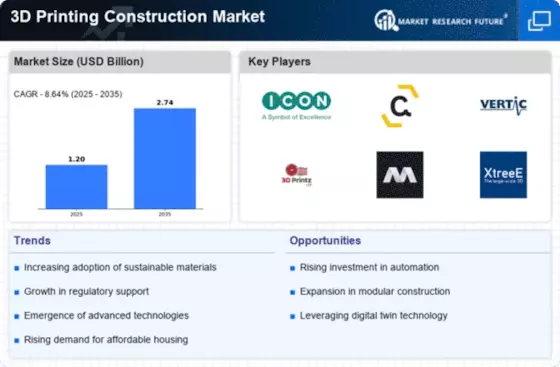
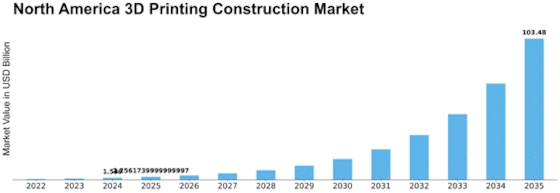
As per MRFR analysis, the North America 3D Printing Construction Market was estimated at 1.539 USD Billion in 2024. The 3D printing construction industry is projected to grow from 2.257 USD Billion in 2025 to 103.48 USD Billion by 2035, exhibiting a compound annual growth rate (CAGR) of 46.6 during the forecast period 2025 - 2035.

Key Market Trends & Highlights

The North America 3D Printing Construction Market is poised for growth driven by sustainability and technological advancements.

  • The market is increasingly oriented towards sustainability, reflecting a broader global trend.
  • Technological advancements are enhancing the capabilities and applications of 3D printing in construction.
  • Collaborative ecosystems are emerging, fostering partnerships between various stakeholders in the industry.
  • Key drivers such as sustainability initiatives and cost efficiency are propelling market growth, particularly in the concrete and extrusion segments.

Market Size & Forecast

2024 Market Size 1.539 (USD Billion)
2035 Market Size 103.48 (USD Billion)
CAGR (2025 - 2035) 46.6%
Largest Regional Market Share in 2024 North America

Major Players

<p>ICON (US), Apis Cor (US), Vertico (US), 3D Printlife (US), Mighty Buildings (US), XtreeE (US), Cazza Construction Technologies (US), Sika AG (CH)</p>

Market Trends

The North America 3D Printing Construction Market is currently experiencing a transformative phase, characterized by the integration of advanced technologies and innovative materials. This sector appears to be gaining traction as stakeholders recognize the potential for enhanced efficiency and reduced waste in construction processes. The adoption of 3D printing techniques seems to offer a viable solution to some of the longstanding challenges faced by the construction industry, such as labor shortages and escalating costs. Furthermore, the emphasis on sustainability and eco-friendly practices is likely to drive further interest in this market, as companies seek to align with environmental regulations and consumer preferences. In addition, the collaboration between technology firms and construction companies appears to be fostering a conducive environment for research and development. This synergy may lead to the emergence of new applications and methodologies that could redefine traditional construction practices. As the North America 3D Printing Construction Market continues to evolve, it is essential for industry participants to remain agile and responsive to changing market dynamics. The ongoing exploration of materials, techniques, and regulatory frameworks suggests a promising future for this innovative sector, potentially reshaping the landscape of construction in the region.

Sustainability Focus

The emphasis on sustainable practices within the North America 3D Printing Construction Market is becoming increasingly pronounced. Stakeholders are exploring eco-friendly materials and methods that minimize environmental impact, aligning with broader societal trends towards sustainability.

Technological Advancements

Rapid advancements in technology are significantly influencing the North America 3D Printing Construction Market. Innovations in software, hardware, and materials are enhancing the capabilities of 3D printing, enabling more complex and efficient construction solutions.

Collaborative Ecosystems

The formation of collaborative ecosystems among technology providers, construction firms, and research institutions is emerging as a key trend. This collaboration is likely to accelerate innovation and facilitate the development of new applications within the North America 3D Printing Construction Market.

North America 3D Printing Construction Market Market Drivers

Cost Efficiency

Cost efficiency remains a pivotal driver in the North America 3D Printing Construction Market. The traditional construction methods often entail high labor and material costs, which can be mitigated through 3D printing technologies. By automating the construction process, companies can significantly reduce labor expenses and time, leading to overall project cost savings. Reports suggest that 3D printing can lower construction costs by approximately 30% compared to conventional methods. This financial advantage is particularly appealing in a competitive market where profit margins are often tight. As more firms recognize the potential for cost reduction, the North America 3D Printing Construction Market is poised for growth, attracting investments and innovations that further enhance its economic viability.

Regulatory Support

Regulatory support is increasingly shaping the North America 3D Printing Construction Market. Governments are recognizing the potential of 3D printing to revolutionize construction practices and are implementing policies that encourage its adoption. This includes streamlining building codes and regulations to accommodate 3D printed structures, which can facilitate faster project approvals. Moreover, public funding and grants for research and development in 3D printing technologies are becoming more common, providing financial incentives for companies to invest in this area. As regulatory frameworks evolve to support innovative construction methods, the North America 3D Printing Construction Market is likely to experience accelerated growth, attracting new players and fostering collaboration among existing firms.

Sustainability Initiatives

The North America 3D Printing Construction Market is increasingly driven by sustainability initiatives. As environmental concerns gain prominence, construction companies are adopting 3D printing technologies to reduce waste and energy consumption. This method allows for the use of eco-friendly materials, which can significantly lower the carbon footprint of construction projects. In fact, studies indicate that 3D printing can reduce material waste by up to 60%, making it an attractive option for environmentally conscious builders. Furthermore, the ability to create complex structures with minimal resources aligns with the growing demand for sustainable building practices. As regulations around sustainability tighten, the North America 3D Printing Construction Market is likely to see a surge in adoption as companies strive to meet these new standards.

Technological Advancements

Technological advancements are a key driver in the North America 3D Printing Construction Market. Innovations in materials, software, and printing techniques are continuously evolving, enabling more efficient and versatile construction solutions. For instance, the development of advanced concrete mixtures and composite materials has expanded the capabilities of 3D printing, allowing for stronger and more durable structures. Additionally, improvements in printing speed and precision are making it feasible to construct larger and more complex buildings. The integration of Building Information Modeling (BIM) with 3D printing technology is also enhancing project planning and execution. As these technologies mature, they are likely to attract more stakeholders to the North America 3D Printing Construction Market, fostering a competitive landscape that encourages further innovation.

Skilled Workforce Development

The development of a skilled workforce is a crucial driver for the North America 3D Printing Construction Market. As the industry evolves, there is a growing need for professionals who are proficient in 3D printing technologies and their applications in construction. Educational institutions and training programs are increasingly focusing on equipping students with the necessary skills to thrive in this emerging field. This focus on workforce development is essential, as it ensures that companies have access to talent capable of leveraging 3D printing for innovative construction solutions. Furthermore, partnerships between educational institutions and industry players are fostering a collaborative environment that enhances knowledge transfer and skill acquisition. As the workforce becomes more adept in 3D printing technologies, the North America 3D Printing Construction Market is expected to expand, driven by a knowledgeable and skilled labor pool.

Market Segment Insights

By Construction Method: Extrusion (Largest) vs. Powder Bonding (Fastest-Growing)

<p>In the North America 3D Printing Construction Market, the segmentation by construction method reveals that extrusion is currently the largest segment, significantly contributing to the overall growth of the market. This method utilizes a multi-axis robotic system to shape materials into desired forms, making it popular among many construction firms. Conversely, powder bonding, while smaller in market share, is recognized for its innovative approach in integrating advanced materials, quickly gaining momentum as an alternative method.</p>

<p>Construction Method: Extrusion (Dominant) vs. Powder Bonding (Emerging)</p>

<p>Extrusion is known for its efficiency and ability to produce complex shapes, making it the dominant method in the North America 3D Printing Construction Market. This method leverages thermoplastic materials and is extensively used in creating building components, fostering a substantial share of the market. On the other hand, powder bonding is emerging, attracting attention due to its potential for high precision and adaptability to varied materials. As construction demands evolve, this method promises rapid advancements, appealing to firms aiming for innovation and sustainability within urban developments.</p>

By Material Type: Concrete (Largest) vs. Metal (Fastest-Growing)

<p>In the North America 3D Printing Construction Market, the material type segment displays diverse dynamics, with concrete holding the largest market share. Concrete's widespread availability, cost-effectiveness, and versatility make it the preferred choice for 3D printing applications in the construction sector. Metal, notably in the form of alloys, is gradually gaining traction, particularly for structural applications requiring enhanced strength and durability, thus positioning itself as the fastest-growing segment in the market.</p>

<p>Concrete (Dominant) vs. Metal (Emerging)</p>

<p>Concrete is the dominant material in the North American 3D Printing Construction Market due to its established performance, regulatory approvals, and ability to be printed in various forms and structures. It allows architects and builders to implement complex designs with ease. Conversely, metal is an emerging player, recognized for its high strength-to-weight ratio, which allows for innovative construction solutions. The increased interest in lightweight yet durable materials has spurred investment and research into 3D printing with metal, which may revolutionize construction processes and open pathways to new architectural possibilities.</p>

By End-Use Sector: Building (Largest) vs. Infrastructure (Fastest-Growing)

<p>In the North America 3D Printing Construction Market, the Building segment holds the largest share, driven by increasing demand for customized and efficient construction solutions. This segment benefits from the rising trend of sustainable building practices, where 3D printing offers cost-effective and eco-friendly alternatives to traditional methods. The Infrastructure segment, while smaller currently, is experiencing rapid growth as municipalities and private sectors increasingly adopt 3D printing technologies for the construction of bridges, roadways, and utilities, seeking enhanced durability and lower costs.</p>

<p>End-Use Sector: Building (Dominant) vs. Infrastructure (Emerging)</p>

<p>The Building segment stands out as the dominant player in the North America 3D Printing Construction Market. It encompasses residential, commercial, and industrial constructions, leveraging 3D printing's ability to offer bespoke architectural solutions while minimizing waste. This segment's established presence is fueled by rising consumer preferences for tailor-made living spaces and rapid urbanization. Conversely, the Infrastructure segment is emerging as a significant contender, capitalizing on technological advancements that enable quick and efficient construction of essential facilities. Challenges like limited budgets and emerging sustainability regulations are propelling this sector's growth, as 3D printing becomes a viable option for updating and maintaining aging infrastructure.</p>

Get more detailed insights about North America 3D Printing Construction Market Research Report - Forecast by 2035

Regional Insights

North America : Innovation and Growth Hub

The North American 3D printing construction market is experiencing significant growth, driven by technological advancements and increasing demand for sustainable building solutions. The U.S. holds the largest market share at approximately 70%, followed by Canada at around 20%. Regulatory support for innovative construction methods and sustainability initiatives further catalyzes this growth, making the region a leader in 3D printing technology. Key players such as ICON, Apis Cor, and Mighty Buildings are at the forefront of this transformation, leveraging advanced materials and techniques to enhance construction efficiency. The competitive landscape is characterized by a mix of established firms and startups, all vying for market share in a rapidly evolving industry. The presence of strong research institutions and government support fosters an environment ripe for innovation, ensuring North America remains a pivotal player in the global market.

Europe : Emerging Market with Potential

Europe is witnessing a burgeoning interest in 3D printing construction, driven by sustainability goals and innovative building practices. The region is characterized by a diverse regulatory landscape that encourages experimentation and adoption of new technologies. Germany and the Netherlands are the largest markets, holding approximately 30% and 25% market shares, respectively. The European Union's commitment to green building initiatives is a significant catalyst for growth in this sector. Leading countries are investing heavily in research and development, with companies like Sika AG and Vertico leading the charge. The competitive landscape is marked by collaboration between startups and established firms, fostering innovation. As regulations evolve to support 3D printing, Europe is poised to become a key player in The North America 3D Printing Construction Market, leveraging its technological expertise and commitment to sustainability.

Asia-Pacific : Rapidly Growing Market

The Asia-Pacific region is rapidly emerging as a significant player in the 3D printing construction market, driven by urbanization and a growing demand for affordable housing. Countries like China and Japan are leading the charge, with China holding approximately 40% of the market share, followed by Japan at around 15%. Government initiatives aimed at modernizing construction practices and enhancing efficiency are key growth drivers in this region. The competitive landscape is diverse, with numerous startups and established companies vying for market share. Key players are increasingly focusing on local partnerships to enhance their market presence. The region's unique challenges, such as labor shortages and environmental concerns, are pushing companies to adopt innovative solutions, making Asia-Pacific a hotbed for 3D printing advancements in construction.

Middle East and Africa : Emerging Opportunities Ahead

The Middle East and Africa region is beginning to explore the potential of 3D printing in construction, driven by a need for rapid urban development and innovative building solutions. The UAE is leading the market, holding approximately 25% of the share, with significant investments in smart city initiatives and sustainable construction practices. Regulatory frameworks are gradually evolving to support these innovations, creating a conducive environment for growth. Countries in this region are increasingly recognizing the benefits of 3D printing, with several pilot projects underway. The competitive landscape is still developing, with a mix of local and international players entering the market. As awareness grows and regulations become more supportive, the Middle East and Africa are poised to capitalize on the opportunities presented by 3D printing technology in construction.

Key Players and Competitive Insights

Leading market players are investing heavily in research and development in order to expand their product lines, which will help the 3D printing construction market, grow even more. Market participants are also undertaking a variety of strategic activities to expand their footprint, with important market developments including new product launches, contractual agreements, mergers and acquisitions, higher investments, and collaboration with other organizations. To expand and survive in a more competitive and rising market climate, 3D printing construction industry must offer cost-effective items.

Key Companies in the North America 3D Printing Construction Market market include

Industry Developments

Future Outlook

North America 3D Printing Construction Market Future Outlook

<p>The North America 3D Printing Construction Market is poised for growth at 46.6% CAGR from 2024 to 2035, driven by technological advancements, sustainability initiatives, and cost efficiencies.</p>

New opportunities lie in:

  • <p>Development of modular 3D printed housing solutions</p>
  • <p>Integration of AI for optimized construction processes</p>
  • <p>Expansion of material recycling technologies in 3D printing</p>

<p>By 2035, the market is expected to achieve substantial growth, solidifying its role in the construction industry.</p>

Market Segmentation

North America 3D Printing Construction Market Material Type Outlook

  • Concrete
  • Metal
  • Composite
  • Others (Foam, Plastic, Gypsum, Geopolymer)

North America 3D Printing Construction Market End-Use Sector Outlook

  • Building
  • Infrastructure

North America 3D Printing Construction Market Construction Method Outlook

  • Extrusion
  • Powder Bonding

Report Scope

MARKET SIZE 20241.539(USD Billion)
MARKET SIZE 20252.257(USD Billion)
MARKET SIZE 2035103.48(USD Billion)
COMPOUND ANNUAL GROWTH RATE (CAGR)46.6% (2024 - 2035)
REPORT COVERAGERevenue Forecast, Competitive Landscape, Growth Factors, and Trends
BASE YEAR2024
Market Forecast Period2025 - 2035
Historical Data2019 - 2024
Market Forecast UnitsUSD Billion
Key Companies ProfiledMarket analysis in progress
Segments CoveredMarket segmentation analysis in progress
Key Market OpportunitiesIntegration of sustainable materials in the North America 3D Printing Construction Market enhances eco-friendly building practices.
Key Market DynamicsTechnological advancements and regulatory support drive growth in North America's 3D printing construction sector.
Countries CoveredNorth America, Europe, APAC, South America, MEA

FAQs

What is the current valuation of the North America 3D Printing Construction Market?

As of 2024, the market valuation was 1.539 USD Billion.

What is the projected market size for the North America 3D Printing Construction Market by 2035?

The market is projected to reach 103.48 USD Billion by 2035.

What is the expected CAGR for the North America 3D Printing Construction Market during the forecast period?

The expected CAGR for the market from 2025 to 2035 is 46.6%.

Which construction methods dominate the North America 3D Printing Construction Market?

Extrusion and Powder Bonding are the primary construction methods, valued at 0.923 USD Billion and 0.616 USD Billion, respectively.

What types of materials are primarily used in 3D printing construction?

Concrete, Metal, Composite, and other materials like Foam and Plastic are utilized, with Concrete leading at 0.8 USD Billion.

  1. SECTION I: EXECUTIVE SUMMARY AND KEY HIGHLIGHTS
    1. EXECUTIVE SUMMARY
      1. Market Overview
      2. Key Findings
      3. Market Segmentation
      4. Competitive Landscape
      5. Challenges and Opportunities
      6. Future Outlook
  2. SECTION II: SCOPING, METHODOLOGY AND MARKET STRUCTURE
    1. MARKET INTRODUCTION
      1. Definition
      2. Scope of the study
    2. RESEARCH METHODOLOGY
      1. Overview
      2. Data Mining
      3. Secondary Research
      4. Primary Research
      5. Forecasting Model
      6. Market Size Estimation
      7. Data Triangulation
      8. Validation
  3. SECTION III: QUALITATIVE ANALYSIS
    1. MARKET DYNAMICS
      1. Overview
      2. Drivers
      3. Restraints
      4. Opportunities
    2. MARKET FACTOR ANALYSIS
      1. Value chain Analysis
      2. Porter's Five Forces Analysis
      3. COVID-19 Impact Analysis
  4. SECTION IV: QUANTITATIVE ANALYSIS
    1. Packaging & Transport, BY Construction Method (USD Billion)
      1. Extrusion
      2. Powder Bonding
    2. Packaging & Transport, BY Material Type (USD Billion)
      1. Concrete
      2. Metal
      3. Composite
      4. Others (Foam, Plastic, Gypsum, Geopolymer)
    3. Packaging & Transport, BY End-Use Sector (USD Billion)
      1. Building
      2. Infrastructure
    4. Packaging & Transport, BY Region (USD Billion)
      1. North America
      2. Europe
      3. APAC
      4. South America
      5. MEA
  5. SECTION V: COMPETITIVE ANALYSIS
    1. Competitive Landscape
      1. Overview
      2. Competitive Analysis
      3. Market share Analysis
      4. Major Growth Strategy in the Packaging & Transport
      5. Competitive Benchmarking
      6. Leading Players in Terms of Number of Developments in the Packaging & Transport
      7. Key developments and growth strategies
      8. Major Players Financial Matrix
    2. Company Profiles
      1. ICON (US)
      2. Apis Cor (US)
      3. Vertico (US)
      4. 3D Printlife (US)
      5. Mighty Buildings (US)
      6. XtreeE (US)
      7. Cazza Construction Technologies (US)
      8. Sika AG (CH)
    3. Appendix
      1. References
      2. Related Reports
  6. LIST OF FIGURES
    1. MARKET SYNOPSIS
    2. NORTH AMERICA MARKET ANALYSIS
    3. US MARKET ANALYSIS BY CONSTRUCTION METHOD
    4. US MARKET ANALYSIS BY MATERIAL TYPE
    5. US MARKET ANALYSIS BY END-USE SECTOR
    6. CANADA MARKET ANALYSIS BY CONSTRUCTION METHOD
    7. CANADA MARKET ANALYSIS BY MATERIAL TYPE
    8. CANADA MARKET ANALYSIS BY END-USE SECTOR
    9. EUROPE MARKET ANALYSIS
    10. GERMANY MARKET ANALYSIS BY CONSTRUCTION METHOD
    11. GERMANY MARKET ANALYSIS BY MATERIAL TYPE
    12. GERMANY MARKET ANALYSIS BY END-USE SECTOR
    13. UK MARKET ANALYSIS BY CONSTRUCTION METHOD
    14. UK MARKET ANALYSIS BY MATERIAL TYPE
    15. UK MARKET ANALYSIS BY END-USE SECTOR
    16. FRANCE MARKET ANALYSIS BY CONSTRUCTION METHOD
    17. FRANCE MARKET ANALYSIS BY MATERIAL TYPE
    18. FRANCE MARKET ANALYSIS BY END-USE SECTOR
    19. RUSSIA MARKET ANALYSIS BY CONSTRUCTION METHOD
    20. RUSSIA MARKET ANALYSIS BY MATERIAL TYPE
    21. RUSSIA MARKET ANALYSIS BY END-USE SECTOR
    22. ITALY MARKET ANALYSIS BY CONSTRUCTION METHOD
    23. ITALY MARKET ANALYSIS BY MATERIAL TYPE
    24. ITALY MARKET ANALYSIS BY END-USE SECTOR
    25. SPAIN MARKET ANALYSIS BY CONSTRUCTION METHOD
    26. SPAIN MARKET ANALYSIS BY MATERIAL TYPE
    27. SPAIN MARKET ANALYSIS BY END-USE SECTOR
    28. REST OF EUROPE MARKET ANALYSIS BY CONSTRUCTION METHOD
    29. REST OF EUROPE MARKET ANALYSIS BY MATERIAL TYPE
    30. REST OF EUROPE MARKET ANALYSIS BY END-USE SECTOR
    31. APAC MARKET ANALYSIS
    32. CHINA MARKET ANALYSIS BY CONSTRUCTION METHOD
    33. CHINA MARKET ANALYSIS BY MATERIAL TYPE
    34. CHINA MARKET ANALYSIS BY END-USE SECTOR
    35. INDIA MARKET ANALYSIS BY CONSTRUCTION METHOD
    36. INDIA MARKET ANALYSIS BY MATERIAL TYPE
    37. INDIA MARKET ANALYSIS BY END-USE SECTOR
    38. JAPAN MARKET ANALYSIS BY CONSTRUCTION METHOD
    39. JAPAN MARKET ANALYSIS BY MATERIAL TYPE
    40. JAPAN MARKET ANALYSIS BY END-USE SECTOR
    41. SOUTH KOREA MARKET ANALYSIS BY CONSTRUCTION METHOD
    42. SOUTH KOREA MARKET ANALYSIS BY MATERIAL TYPE
    43. SOUTH KOREA MARKET ANALYSIS BY END-USE SECTOR
    44. MALAYSIA MARKET ANALYSIS BY CONSTRUCTION METHOD
    45. MALAYSIA MARKET ANALYSIS BY MATERIAL TYPE
    46. MALAYSIA MARKET ANALYSIS BY END-USE SECTOR
    47. THAILAND MARKET ANALYSIS BY CONSTRUCTION METHOD
    48. THAILAND MARKET ANALYSIS BY MATERIAL TYPE
    49. THAILAND MARKET ANALYSIS BY END-USE SECTOR
    50. INDONESIA MARKET ANALYSIS BY CONSTRUCTION METHOD
    51. INDONESIA MARKET ANALYSIS BY MATERIAL TYPE
    52. INDONESIA MARKET ANALYSIS BY END-USE SECTOR
    53. REST OF APAC MARKET ANALYSIS BY CONSTRUCTION METHOD
    54. REST OF APAC MARKET ANALYSIS BY MATERIAL TYPE
    55. REST OF APAC MARKET ANALYSIS BY END-USE SECTOR
    56. SOUTH AMERICA MARKET ANALYSIS
    57. BRAZIL MARKET ANALYSIS BY CONSTRUCTION METHOD
    58. BRAZIL MARKET ANALYSIS BY MATERIAL TYPE
    59. BRAZIL MARKET ANALYSIS BY END-USE SECTOR
    60. MEXICO MARKET ANALYSIS BY CONSTRUCTION METHOD
    61. MEXICO MARKET ANALYSIS BY MATERIAL TYPE
    62. MEXICO MARKET ANALYSIS BY END-USE SECTOR
    63. ARGENTINA MARKET ANALYSIS BY CONSTRUCTION METHOD
    64. ARGENTINA MARKET ANALYSIS BY MATERIAL TYPE
    65. ARGENTINA MARKET ANALYSIS BY END-USE SECTOR
    66. REST OF SOUTH AMERICA MARKET ANALYSIS BY CONSTRUCTION METHOD
    67. REST OF SOUTH AMERICA MARKET ANALYSIS BY MATERIAL TYPE
    68. REST OF SOUTH AMERICA MARKET ANALYSIS BY END-USE SECTOR
    69. MEA MARKET ANALYSIS
    70. GCC COUNTRIES MARKET ANALYSIS BY CONSTRUCTION METHOD
    71. GCC COUNTRIES MARKET ANALYSIS BY MATERIAL TYPE
    72. GCC COUNTRIES MARKET ANALYSIS BY END-USE SECTOR
    73. SOUTH AFRICA MARKET ANALYSIS BY CONSTRUCTION METHOD
    74. SOUTH AFRICA MARKET ANALYSIS BY MATERIAL TYPE
    75. SOUTH AFRICA MARKET ANALYSIS BY END-USE SECTOR
    76. REST OF MEA MARKET ANALYSIS BY CONSTRUCTION METHOD
    77. REST OF MEA MARKET ANALYSIS BY MATERIAL TYPE
    78. REST OF MEA MARKET ANALYSIS BY END-USE SECTOR
    79. KEY BUYING CRITERIA OF PACKAGING & TRANSPORT
    80. RESEARCH PROCESS OF MRFR
    81. DRO ANALYSIS OF PACKAGING & TRANSPORT
    82. DRIVERS IMPACT ANALYSIS: PACKAGING & TRANSPORT
    83. RESTRAINTS IMPACT ANALYSIS: PACKAGING & TRANSPORT
    84. SUPPLY / VALUE CHAIN: PACKAGING & TRANSPORT
    85. PACKAGING & TRANSPORT, BY CONSTRUCTION METHOD, 2024 (% SHARE)
    86. PACKAGING & TRANSPORT, BY CONSTRUCTION METHOD, 2024 TO 2035 (USD Billion)
    87. PACKAGING & TRANSPORT, BY MATERIAL TYPE, 2024 (% SHARE)
    88. PACKAGING & TRANSPORT, BY MATERIAL TYPE, 2024 TO 2035 (USD Billion)
    89. PACKAGING & TRANSPORT, BY END-USE SECTOR, 2024 (% SHARE)
    90. PACKAGING & TRANSPORT, BY END-USE SECTOR, 2024 TO 2035 (USD Billion)
    91. BENCHMARKING OF MAJOR COMPETITORS
  7. LIST OF TABLES
    1. LIST OF ASSUMPTIONS
    2. North America MARKET SIZE ESTIMATES; FORECAST
      1. BY CONSTRUCTION METHOD, 2025-2035 (USD Billion)
      2. BY MATERIAL TYPE, 2025-2035 (USD Billion)
      3. BY END-USE SECTOR, 2025-2035 (USD Billion)
    3. US MARKET SIZE ESTIMATES; FORECAST
      1. BY CONSTRUCTION METHOD, 2025-2035 (USD Billion)
      2. BY MATERIAL TYPE, 2025-2035 (USD Billion)
      3. BY END-USE SECTOR, 2025-2035 (USD Billion)
    4. Canada MARKET SIZE ESTIMATES; FORECAST
      1. BY CONSTRUCTION METHOD, 2025-2035 (USD Billion)
      2. BY MATERIAL TYPE, 2025-2035 (USD Billion)
      3. BY END-USE SECTOR, 2025-2035 (USD Billion)
    5. Europe MARKET SIZE ESTIMATES; FORECAST
      1. BY CONSTRUCTION METHOD, 2025-2035 (USD Billion)
      2. BY MATERIAL TYPE, 2025-2035 (USD Billion)
      3. BY END-USE SECTOR, 2025-2035 (USD Billion)
    6. Germany MARKET SIZE ESTIMATES; FORECAST
      1. BY CONSTRUCTION METHOD, 2025-2035 (USD Billion)
      2. BY MATERIAL TYPE, 2025-2035 (USD Billion)
      3. BY END-USE SECTOR, 2025-2035 (USD Billion)
    7. UK MARKET SIZE ESTIMATES; FORECAST
      1. BY CONSTRUCTION METHOD, 2025-2035 (USD Billion)
      2. BY MATERIAL TYPE, 2025-2035 (USD Billion)
      3. BY END-USE SECTOR, 2025-2035 (USD Billion)
    8. France MARKET SIZE ESTIMATES; FORECAST
      1. BY CONSTRUCTION METHOD, 2025-2035 (USD Billion)
      2. BY MATERIAL TYPE, 2025-2035 (USD Billion)
      3. BY END-USE SECTOR, 2025-2035 (USD Billion)
    9. Russia MARKET SIZE ESTIMATES; FORECAST
      1. BY CONSTRUCTION METHOD, 2025-2035 (USD Billion)
      2. BY MATERIAL TYPE, 2025-2035 (USD Billion)
      3. BY END-USE SECTOR, 2025-2035 (USD Billion)
    10. Italy MARKET SIZE ESTIMATES; FORECAST
      1. BY CONSTRUCTION METHOD, 2025-2035 (USD Billion)
      2. BY MATERIAL TYPE, 2025-2035 (USD Billion)
      3. BY END-USE SECTOR, 2025-2035 (USD Billion)
    11. Spain MARKET SIZE ESTIMATES; FORECAST
      1. BY CONSTRUCTION METHOD, 2025-2035 (USD Billion)
      2. BY MATERIAL TYPE, 2025-2035 (USD Billion)
      3. BY END-USE SECTOR, 2025-2035 (USD Billion)
    12. Rest of Europe MARKET SIZE ESTIMATES; FORECAST
      1. BY CONSTRUCTION METHOD, 2025-2035 (USD Billion)
      2. BY MATERIAL TYPE, 2025-2035 (USD Billion)
      3. BY END-USE SECTOR, 2025-2035 (USD Billion)
    13. APAC MARKET SIZE ESTIMATES; FORECAST
      1. BY CONSTRUCTION METHOD, 2025-2035 (USD Billion)
      2. BY MATERIAL TYPE, 2025-2035 (USD Billion)
      3. BY END-USE SECTOR, 2025-2035 (USD Billion)
    14. China MARKET SIZE ESTIMATES; FORECAST
      1. BY CONSTRUCTION METHOD, 2025-2035 (USD Billion)
      2. BY MATERIAL TYPE, 2025-2035 (USD Billion)
      3. BY END-USE SECTOR, 2025-2035 (USD Billion)
    15. India MARKET SIZE ESTIMATES; FORECAST
      1. BY CONSTRUCTION METHOD, 2025-2035 (USD Billion)
      2. BY MATERIAL TYPE, 2025-2035 (USD Billion)
      3. BY END-USE SECTOR, 2025-2035 (USD Billion)
    16. Japan MARKET SIZE ESTIMATES; FORECAST
      1. BY CONSTRUCTION METHOD, 2025-2035 (USD Billion)
      2. BY MATERIAL TYPE, 2025-2035 (USD Billion)
      3. BY END-USE SECTOR, 2025-2035 (USD Billion)
    17. South Korea MARKET SIZE ESTIMATES; FORECAST
      1. BY CONSTRUCTION METHOD, 2025-2035 (USD Billion)
      2. BY MATERIAL TYPE, 2025-2035 (USD Billion)
      3. BY END-USE SECTOR, 2025-2035 (USD Billion)
    18. Malaysia MARKET SIZE ESTIMATES; FORECAST
      1. BY CONSTRUCTION METHOD, 2025-2035 (USD Billion)
      2. BY MATERIAL TYPE, 2025-2035 (USD Billion)
      3. BY END-USE SECTOR, 2025-2035 (USD Billion)
    19. Thailand MARKET SIZE ESTIMATES; FORECAST
      1. BY CONSTRUCTION METHOD, 2025-2035 (USD Billion)
      2. BY MATERIAL TYPE, 2025-2035 (USD Billion)
      3. BY END-USE SECTOR, 2025-2035 (USD Billion)
    20. Indonesia MARKET SIZE ESTIMATES; FORECAST
      1. BY CONSTRUCTION METHOD, 2025-2035 (USD Billion)
      2. BY MATERIAL TYPE, 2025-2035 (USD Billion)
      3. BY END-USE SECTOR, 2025-2035 (USD Billion)
    21. Rest of APAC MARKET SIZE ESTIMATES; FORECAST
      1. BY CONSTRUCTION METHOD, 2025-2035 (USD Billion)
      2. BY MATERIAL TYPE, 2025-2035 (USD Billion)
      3. BY END-USE SECTOR, 2025-2035 (USD Billion)
    22. South America MARKET SIZE ESTIMATES; FORECAST
      1. BY CONSTRUCTION METHOD, 2025-2035 (USD Billion)
      2. BY MATERIAL TYPE, 2025-2035 (USD Billion)
      3. BY END-USE SECTOR, 2025-2035 (USD Billion)
    23. Brazil MARKET SIZE ESTIMATES; FORECAST
      1. BY CONSTRUCTION METHOD, 2025-2035 (USD Billion)
      2. BY MATERIAL TYPE, 2025-2035 (USD Billion)
      3. BY END-USE SECTOR, 2025-2035 (USD Billion)
    24. Mexico MARKET SIZE ESTIMATES; FORECAST
      1. BY CONSTRUCTION METHOD, 2025-2035 (USD Billion)
      2. BY MATERIAL TYPE, 2025-2035 (USD Billion)
      3. BY END-USE SECTOR, 2025-2035 (USD Billion)
    25. Argentina MARKET SIZE ESTIMATES; FORECAST
      1. BY CONSTRUCTION METHOD, 2025-2035 (USD Billion)
      2. BY MATERIAL TYPE, 2025-2035 (USD Billion)
      3. BY END-USE SECTOR, 2025-2035 (USD Billion)
    26. Rest of South America MARKET SIZE ESTIMATES; FORECAST
      1. BY CONSTRUCTION METHOD, 2025-2035 (USD Billion)
      2. BY MATERIAL TYPE, 2025-2035 (USD Billion)
      3. BY END-USE SECTOR, 2025-2035 (USD Billion)
    27. MEA MARKET SIZE ESTIMATES; FORECAST
      1. BY CONSTRUCTION METHOD, 2025-2035 (USD Billion)
      2. BY MATERIAL TYPE, 2025-2035 (USD Billion)
      3. BY END-USE SECTOR, 2025-2035 (USD Billion)
    28. GCC Countries MARKET SIZE ESTIMATES; FORECAST
      1. BY CONSTRUCTION METHOD, 2025-2035 (USD Billion)
      2. BY MATERIAL TYPE, 2025-2035 (USD Billion)
      3. BY END-USE SECTOR, 2025-2035 (USD Billion)
    29. South Africa MARKET SIZE ESTIMATES; FORECAST
      1. BY CONSTRUCTION METHOD, 2025-2035 (USD Billion)
      2. BY MATERIAL TYPE, 2025-2035 (USD Billion)
      3. BY END-USE SECTOR, 2025-2035 (USD Billion)
    30. Rest of MEA MARKET SIZE ESTIMATES; FORECAST
      1. BY CONSTRUCTION METHOD, 2025-2035 (USD Billion)
      2. BY MATERIAL TYPE, 2025-2035 (USD Billion)
      3. BY END-USE SECTOR, 2025-2035 (USD Billion)
    31. PRODUCT LAUNCH/PRODUCT DEVELOPMENT/APPROVAL
    32. ACQUISITION/PARTNERSHIP

North America 3D Printing Construction Market Segmentation

Market Segmentation Overview

  • Detailed segmentation data will be available in the full report
  • Comprehensive analysis by multiple parameters
  • Regional and country-level breakdowns
  • Market size forecasts by segment
Infographic

Free Sample Request

Kindly complete the form below to receive a free sample of this Report

Get Free Sample

Customer Strories

Compare Licence

×
Features License Type
Single User Multiuser License Enterprise User
Price $4,950 $5,950 $7,250
Maximum User Access Limit 1 User Upto 10 Users Unrestricted Access Throughout the Organization
Free Customization
Direct Access to Analyst
Deliverable Format
Platform Access
Discount on Next Purchase 10% 15% 15%
Printable Versions