Request Free Sample ×

Kindly complete the form below to receive a free sample of this Report

* Please use a valid business email

Leading companies partner with us for data-driven Insights

clients tt-cursor
Hero Background
English
Chinese
French
Japanese
Korean
German
Spanish

North America 3D Printing Construction Market Analysis

ID: MRFR/PCM/11017-HCR
128 Pages
Snehal Singh
Last Updated: April 06, 2026

North America 3D Printing Construction Market Research Report Information By Construction Method (Extrusion and Powder Bonding), By Material Type (Concrete, Metal, Composite, and Others (Foam, Plastic, Gypsum, Geopolymer)), By End-Use Sector (Building and Infrastructure) –and North America Market Forecast Till 2035.

Share:
Download PDF ×

We do not share your information with anyone. However, we may send you emails based on your report interest from time to time. You may contact us at any time to opt-out.

North America 3D Printing Construction Market Infographic
Purchase Options

Market Analysis

In-depth Analysis of North America 3D Printing Construction Market Industry Landscape

The North American 3D printing construction industry has been changing due to a number of factors that define its current dynamics. The use of 3D technology in the building sector has become another driver behind recent changes in this area. Furthermore, there is an increasing consciousness about sustainable building practices taking place across North America that impacts these dynamics. For instance, eco-friendly materials found in construction can be used in 3D printing, cutting down on waste products and conforming to local policies that promote environmental conservation. This has created a need for more sustainable and resource-efficient building processes, which are demanded by 3D printing solutions. Besides, the North American 3D printing construction industry is characterized by technological advancements and continuous R&D activity. Innovations in 3D printing materials, techniques, and equipment are propelling the market further by giving construction companies and developers numerous options. At the same time, government initiatives coupled with supportive regulatory frameworks define market dynamics decisively. For example, there has been growing recognition among different governmental bodies within North America about how this technology can be used to address housing problems, improve infrastructure, or even boost economic growth. Henceforth, there is an increased investment in various public-private partnerships meant to foster an enabling environment for 3D printing in construction. The changing preferences and requirements of key players in the construction industry also determine market dynamics. Builders, architects, and end users now want faster project delivery periods as well as cost-effective methods of building that support design flexibility. Challenges are also part of these dynamics. Despite its many benefits, inadequate regulations built around it, unscalability challenges, or even a lack of skilled workforce have hindered the successful adoption of 3D printing into architectural works within this continent. Consequently, any attempts at avoiding possible actions will help ensure that the market continues growing positively through such measures.

Author
Author Profile
Snehal Singh
Manager - Research

High acumen in analyzing complex macro & micro markets with more than 6 years of work experience in the field of market research. By implementing her analytical skills in forecasting and estimation into market research reports, she has expertise in Packaging, Construction, and Equipment domains. She handles a team size of 20-25 resources and ensures smooth running of the projects, associated marketing activities, and client servicing.

Leave a Comment

FAQs

What is the current valuation of the North America 3D Printing Construction Market?

<p>As of 2024, the market valuation stands at 1.1 USD Billion.</p>

What is the projected market size for the North America 3D Printing Construction Market by 2035?

<p>The market is expected to reach a valuation of 2.74 USD Billion by 2035.</p>

What is the expected CAGR for the North America 3D Printing Construction Market during the forecast period?

<p>The anticipated CAGR for the market from 2025 to 2035 is 8.64%.</p>

Which segments are included in the North America 3D Printing Construction Market?

<p>The market segments include Residential Construction, Commercial Construction, Infrastructure Development, and Industrial Construction.</p>

What are the projected valuations for the Residential Construction segment by 2035?

<p>The Residential Construction segment is projected to grow from 0.44 USD Billion to 0.99 USD Billion by 2035.</p>

Which technologies are driving the North America 3D Printing Construction Market?

<p>Key technologies include Fused Deposition Modeling, Stereolithography, Selective Laser Sintering, and Binder Jetting.</p>

What is the expected growth for the Concrete material type in the market?

<p>The Concrete material type is projected to increase from 0.55 USD Billion to 0.95 USD Billion by 2035.</p>

Who are the key players in the North America 3D Printing Construction Market?

<p>Prominent players include ICON, Apis Cor, Vertico, 3D Printz, Mighty Buildings, XtreeE, COBOD International, and Sika AG.</p>

What is the projected valuation for the Infrastructure Development segment by 2035?

<p>The Infrastructure Development segment is expected to grow from 0.22 USD Billion to 0.54 USD Billion by 2035.</p>

What are the anticipated trends in the North America 3D Printing Construction Market?

<p>Trends suggest a shift towards increased adoption of advanced materials and technologies, enhancing efficiency and sustainability.</p>

Market Summary

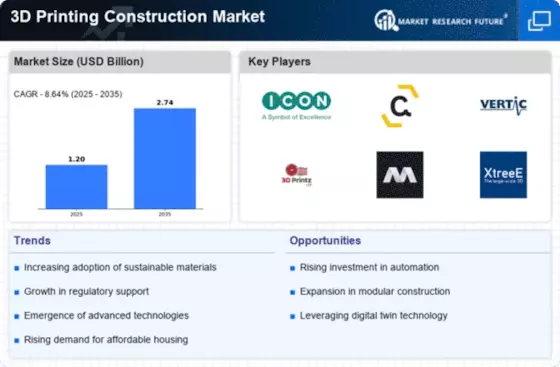
As per analysis, the North America 3D Printing Construction Market is projected to grow from USD 1.21 Billion in 2025 to USD 2.74 Billion by 2035, exhibiting a compound annual growth rate (CAGR) of 8.64% during the forecast period (2025 - 2035).

Key Market Trends & Highlights

The North America 3D Printing Construction Market is poised for substantial growth driven by sustainability and technological advancements.

  • The market is increasingly oriented towards sustainability, reflecting a broader trend in construction practices.
  • Technological integration is enhancing efficiency and precision in both residential and commercial construction sectors.
  • The US remains the largest market, while Canada is emerging as the fastest-growing region in 3D printing construction.
  • Key drivers include sustainability initiatives and regulatory support, which are shaping market dynamics.

Market Size & Forecast

2024 Market Size 1.1 (USD Billion)
2035 Market Size 2.74 (USD Billion)
CAGR (2025 - 2035) 8.64%

Major Players

<p>ICON (US), Apis Cor (US), Vertico (US), 3D Printz (US), Mighty Buildings (US), XtreeE (US), COBOD International (DK), Sika AG (CH)</p>

Market Trends

The North America 3D Printing Construction Market is currently experiencing a transformative phase, driven by advancements in technology and increasing demand for innovative building solutions. This market appears to be characterized by a growing interest in sustainable construction practices, as stakeholders seek to minimize waste and reduce environmental impact. The integration of 3D printing technology into construction processes seems to offer a viable alternative to traditional methods, potentially leading to faster project completion times and cost savings. Furthermore, the collaboration between technology firms and construction companies indicates a trend towards more efficient workflows and enhanced project management capabilities. In addition, regulatory frameworks in North America are evolving to accommodate the unique aspects of 3D printing in construction. This shift may facilitate the adoption of new materials and techniques, thereby fostering innovation within the sector. As the market matures, it is likely that educational initiatives will emerge to equip the workforce with the necessary skills to navigate this changing landscape. Overall, the North America 3D Printing Construction Market appears poised for growth, with numerous opportunities for stakeholders to capitalize on emerging trends and technologies.

Sustainability Focus

The North America 3D Printing Construction Market is increasingly emphasizing sustainable practices. Stakeholders are exploring eco-friendly materials and methods that reduce waste and energy consumption. This trend aligns with broader environmental goals, as the construction industry seeks to minimize its carbon footprint.

Technological Integration

There is a notable trend towards the integration of advanced technologies within the North America 3D Printing Construction Market. Innovations such as artificial intelligence and machine learning are being utilized to enhance design processes and improve project efficiency, indicating a shift towards more automated and precise construction methods.

Regulatory Adaptation

Regulatory bodies in North America are adapting to the unique challenges posed by 3D printing in construction. This trend suggests a growing recognition of the need for updated guidelines that support innovation while ensuring safety and compliance within the industry.

North America 3D Printing Construction Market Market Drivers

Cost Efficiency

Cost efficiency is a prominent driver in the North America 3D Printing Construction Market. The ability to reduce labor costs and material waste makes 3D printing an attractive option for construction firms. In 2025, it is estimated that projects utilizing 3D printing can save up to 30% in overall costs compared to traditional construction methods. This financial advantage is particularly appealing in a competitive market where profit margins are often tight. Additionally, the speed of construction using 3D printing can lead to quicker project completions, further enhancing cost savings. As more companies recognize these benefits, the North America 3D Printing Construction Market is likely to expand, with increased adoption of 3D printing technologies across various sectors.

Regulatory Support

Regulatory support is a crucial driver for the North America 3D Printing Construction Market. Governments are increasingly recognizing the potential of 3D printing to address housing shortages and improve construction efficiency. In 2025, several states have implemented policies that encourage the use of 3D printing in residential and commercial projects. For example, building codes are being updated to accommodate 3D-printed structures, which facilitates faster approvals and reduces bureaucratic hurdles. This supportive regulatory environment is likely to attract more companies to invest in 3D printing technologies, thereby expanding the market. As regulations evolve, the North America 3D Printing Construction Market may witness a significant increase in the number of projects utilizing this innovative construction method.

Sustainability Initiatives

The North America 3D Printing Construction Market is increasingly driven by sustainability initiatives. As environmental concerns gain prominence, construction companies are adopting 3D printing technologies to reduce waste and energy consumption. This method allows for the use of eco-friendly materials, which aligns with the growing demand for sustainable building practices. In 2025, it was reported that 60% of construction firms in North America are prioritizing sustainability in their projects. The ability to create structures with minimal material waste not only lowers costs but also meets regulatory requirements for green building certifications. Consequently, the North America 3D Printing Construction Market is likely to see a surge in projects that emphasize sustainable practices, potentially leading to a more environmentally conscious construction landscape.

Technological Advancements

Technological advancements play a pivotal role in shaping the North America 3D Printing Construction Market. Innovations in materials science and printing techniques have enhanced the capabilities of 3D printing, allowing for more complex and durable structures. For instance, the introduction of high-performance concrete and bio-based materials has expanded the range of applications for 3D printing in construction. In 2025, the market is projected to grow at a compound annual growth rate of 25%, driven by these technological improvements. Furthermore, the integration of artificial intelligence and machine learning in design processes is streamlining workflows and reducing project timelines. As these technologies continue to evolve, the North America 3D Printing Construction Market is expected to experience significant growth, attracting investments and fostering innovation.

Market Demand for Customization

The demand for customization is a significant driver in the North America 3D Printing Construction Market. Clients increasingly seek unique designs and tailored solutions that traditional construction methods may struggle to provide. 3D printing allows for a high degree of customization, enabling architects and builders to create bespoke structures that meet specific client needs. In 2025, it is projected that 40% of new construction projects will incorporate 3D printing to achieve customized designs. This trend is particularly evident in residential construction, where homeowners desire personalized features. As the market continues to evolve, the North America 3D Printing Construction Market is expected to grow, driven by the increasing demand for innovative and customized building solutions.

Market Segment Insights

By Application: Residential Construction (Largest) vs. Commercial Construction (Fastest-Growing)

<p>In the North America <a href="https://www.marketresearchfuture.com/reports/3d-printing-construction-market-65800" target="_blank" title="3d printing construction">3D Printing Construction</a> Market, the application segment is led predominantly by Residential Construction, which holds the largest market share. It reflects a significant demand for innovative housing solutions that leverage the benefits of 3D printing technology, such as reduced construction time and costs. Commercial Construction follows, capturing attention with its rapid growth due to increasing investments in building modern commercial infrastructures using 3D printing techniques.</p>

<p>Residential Construction (Dominant) vs. Commercial Construction (Emerging)</p>

<p>Residential Construction in North America is characterized by its established market presence, dominated by the need for efficient, affordable housing solutions. As urbanization increases, the application of 3D printing technologies here is primarily driven by cost reduction and enhanced design flexibility. Meanwhile, Commercial Construction, while emerging and rapidly growing, emphasizes innovation in constructing office spaces, retail environments, and other commercial buildings. The adaptation of 3D printing in this sector is spurred by a demand for sustainable practices and quick turnaround times, appealing to developers seeking modern construction methods.</p>

By Technology: Fused Deposition Modeling (Largest) vs. Stereolithography (Fastest-Growing)

<p>In the North America 3D Printing Construction Market, Fused Deposition Modeling (FDM) holds the largest share among technology segments, primarily due to its cost-effectiveness and wide industry's applicability. FDM's ability to produce intricately designed structures with robust mechanical properties makes it a go-to technology for many construction projects. Meanwhile, Stereolithography (SLA), while smaller in share compared to FDM, is rapidly gaining traction and is expected to outpace other technologies due to its high precision and quality finish, which are critical in architectural applications. Growth in the North America 3D Printing Construction Market is significantly driven by technological advancements and increased adoption of sustainable practices. The demand for customization and rapid prototyping is also pushing the boundaries of FDM technology. Meanwhile, the rise in adoption of SLA technology is propelled by its ability to produce complex geometries with ease and its applications in producing high-detail models, appealing to architects and builders alike.</p>

<p>Technology: Fused Deposition Modeling (Dominant) vs. Stereolithography (Emerging)</p>

<p>Fused Deposition Modeling (FDM) remains the dominant technology in the North America 3D Printing Construction Market, primarily due to its versatility and widespread accessibility in various construction projects. It utilizes thermoplastic materials, which are known for their durability and ease of use, making FDM suitable for producing structural components. In contrast, Stereolithography (SLA) is emerging as a powerful alternative, characterized by its capability to produce complex and detailed models with superior surface finishes. While FDM focuses on functionality and structural integrity, SLA is appreciated for its precision, making it ideal for prototypes that require high detail before full-scale production.</p>

By Material Type: Concrete (Largest) vs. Plastic (Fastest-Growing)

<p>In the North America 3D Printing Construction Market, the material type segment showcases a diverse distribution of market share. Concrete dominates this sector due to its conventional usage in construction projects, providing strength and durability. While Concrete holds the largest share, Plastic is rapidly gaining traction as an innovative alternative, appealing to modern construction methods that emphasize sustainability and design flexibility. As environmental concerns grow, the attractiveness of 3D printing technology using Plastic becomes increasingly significant.</p>

<p>Material Type: Concrete (Dominant) vs. Plastic (Emerging)</p>

<p>Concrete remains the dominant material in the North American 3D printing construction sector, revered for its robustness and accessibility. Its long history of use in traditional construction translates into a high level of acceptance among contractors and builders. Conversely, Plastic is emerging as a strong competitor, driven by its lightweight nature and versatility. The shift toward using Plastic in 3D printing construction is propelled by advancements in materials technology, allowing for enhanced customization and reduced waste in the construction process. As sustainability priorities rise, Plastic is perfectly positioned to disrupt the conventional dynamics of the industry.</p>

By End Use: Building Components (Largest) vs. Prototyping (Fastest-Growing)

<p>In the North America 3D Printing Construction Market, the distribution of market share among different segments reveals that Building Components holds the largest share. Structural Elements and Architectural Models also contribute significantly, but they trail behind the dominance of Building Components. Prototyping, while smaller in share, is rapidly evolving and is gaining traction due to the increasing demand for innovative and efficient construction solutions. The growth trends in this segment are propelled by advancements in 3D printing technology and a rising interest in sustainable construction practices. Prototyping is becoming the fastest-growing category, driven by the need for quick and efficient design iterations that meet specific project requirements. Overall, the market is shifting towards more adaptable approaches, emphasizing the importance of integrating 3D printing in construction processes.</p>

<p>Building Components (Dominant) vs. Prototyping (Emerging)</p>

<p>Building Components represent a dominant force within the North America 3D Printing Construction Market, characterized by their wide range of applications in various construction stages. This segment includes items such as walls, roofs, and facades, which are integral to creating sustainable and efficient buildings. With the ability to reduce waste and shorten construction timelines, Building Components have become essential for builders looking to innovate. On the other hand, Prototyping is an emerging segment that is swiftly gaining recognition for its ability to streamline the design process. By allowing for rapid visualization of projects, it enables architects and builders to explore multiple design options quickly and effectively. This aspect of adaptability in prototyping attracts new entrants into the market, contributing to its rapid growth.</p>

Get more detailed insights about North America 3D Printing Construction Market Research Report - Forecast by 2035

Regional Insights

US : Innovative Solutions for Construction Growth

Key markets include states like Texas, California, and Florida, where urbanization and housing shortages drive demand. The competitive landscape features major players like ICON, Apis Cor, and Mighty Buildings, all innovating in the sector. Local dynamics are influenced by a favorable business environment and collaboration between tech firms and construction companies. Applications span residential, commercial, and infrastructure projects, showcasing the versatility of 3D printing in construction.

Canada : Sustainable Building Practices on the Rise

Key markets include Ontario and British Columbia, where urbanization and environmental concerns are prominent. The competitive landscape features players like Vertico and 3D Printz, who are pioneering local innovations. The business environment is characterized by supportive government policies and a growing interest in sustainable construction methods. Applications are primarily in residential and commercial sectors, reflecting a shift towards greener building solutions.

Key Players and Competitive Insights

The 3D Printing Construction Market is currently characterized by a dynamic competitive landscape, driven by technological advancements and increasing demand for sustainable building solutions. Key players such as ICON (US), Apis Cor (US), and Mighty Buildings (US) are at the forefront, each adopting distinct strategies to enhance their market positioning. ICON (US) focuses on innovation through its advanced construction technologies, aiming to reduce costs and construction time. Apis Cor (US) emphasizes regional expansion, having recently established partnerships to broaden its operational footprint. Meanwhile, Mighty Buildings (US) is leveraging digital transformation to streamline its production processes, thereby enhancing efficiency and product quality. Collectively, these strategies contribute to a moderately fragmented market structure, where competition is intensifying as companies seek to differentiate themselves through technological prowess and operational excellence.

In terms of business tactics, companies are increasingly localizing manufacturing to mitigate supply chain disruptions and optimize logistics. This approach not only reduces costs but also enhances responsiveness to local market demands. The competitive structure of the market remains moderately fragmented, with several key players exerting influence through innovative practices and strategic collaborations. The collective efforts of these companies are shaping a landscape where agility and adaptability are paramount, allowing them to respond effectively to evolving consumer preferences and regulatory requirements.

In December 2025, ICON (US) announced a strategic partnership with a leading materials science company to develop new sustainable building materials tailored for 3D printing applications. This collaboration is poised to enhance ICON's product offerings, enabling the company to meet the growing demand for eco-friendly construction solutions. The strategic importance of this move lies in its potential to position ICON as a leader in sustainable construction, aligning with global trends towards environmental responsibility.

In November 2025, Apis Cor (US) successfully completed a pilot project in collaboration with a municipal government, showcasing its ability to construct affordable housing using 3D printing technology. This initiative not only demonstrates the feasibility of large-scale 3D printing in urban settings but also highlights Apis Cor's commitment to addressing housing shortages. The significance of this project is underscored by its potential to attract further investments and partnerships, thereby solidifying Apis Cor's market presence.

In October 2025, Mighty Buildings (US) unveiled a new line of 3D-printed homes that incorporate smart technology for energy efficiency. This launch reflects the company's focus on integrating advanced technologies into its construction processes, catering to the increasing consumer demand for smart homes. The strategic importance of this development lies in its ability to differentiate Mighty Buildings in a competitive market, appealing to environmentally conscious consumers seeking innovative housing solutions.

As of January 2026, current competitive trends in the 3D Printing Construction Market are increasingly defined by digitalization, sustainability, and the integration of artificial intelligence (AI) into construction processes. Strategic alliances are becoming more prevalent, as companies recognize the value of collaboration in enhancing their technological capabilities and market reach. Looking ahead, competitive differentiation is likely to evolve from traditional price-based competition towards a focus on innovation, technological advancement, and supply chain reliability. This shift underscores the importance of adaptability and forward-thinking strategies in navigating the complexities of the modern construction landscape.

Key Companies in the North America 3D Printing Construction Market include

Industry Developments

Future Outlook

North America 3D Printing Construction Market Future Outlook

The North America 3D Printing Construction Market is projected to grow at an 8.64% CAGR from 2025 to 2035, driven by technological advancements, sustainability initiatives, and cost efficiency.

New opportunities lie in:

  • Development of modular 3D printed housing solutions
  • Integration of AI for optimized construction processes
  • Expansion of material recycling technologies in 3D printing

By 2035, the market is expected to be a leader in innovative construction solutions.

Market Segmentation

North America 3D Printing Construction Market End Use Outlook

  • Building Components
  • Structural Elements
  • Architectural Models
  • Prototyping

North America 3D Printing Construction Market Technology Outlook

  • Fused Deposition Modeling
  • Stereolithography
  • Selective Laser Sintering
  • Binder Jetting

North America 3D Printing Construction Market Application Outlook

  • Residential Construction
  • Commercial Construction
  • Infrastructure Development
  • Industrial Construction

North America 3D Printing Construction Market Material Type Outlook

  • Concrete
  • Plastic
  • Metal
  • Composite

Report Scope

MARKET SIZE 2024 1.1(USD Billion)
MARKET SIZE 2025 1.21(USD Billion)
MARKET SIZE 2035 2.74(USD Billion)
COMPOUND ANNUAL GROWTH RATE (CAGR) 8.64% (2024 - 2035)
REPORT COVERAGE Revenue Forecast, Competitive Landscape, Growth Factors, and Trends
BASE YEAR 2024
Market Forecast Period 2025 - 2035
Historical Data 2019 - 2024
Market Forecast Units USD Billion
Key Companies Profiled ICON (US), Apis Cor (US), Vertico (US), 3D Printz (US), Mighty Buildings (US), XtreeE (US), COBOD International (DK), Sika AG (CH)
Segments Covered Application, Technology, Material Type, End Use
Key Market Opportunities Integration of sustainable materials in the North America 3D Printing Construction Market enhances eco-friendly building practices.
Key Market Dynamics Technological advancements and regulatory support drive growth in North America's 3D Printing Construction Market.
Countries Covered US, Canada

FAQs

What is the current valuation of the North America 3D Printing Construction Market?

<p>As of 2024, the market valuation stands at 1.1 USD Billion.</p>

What is the projected market size for the North America 3D Printing Construction Market by 2035?

<p>The market is expected to reach a valuation of 2.74 USD Billion by 2035.</p>

What is the expected CAGR for the North America 3D Printing Construction Market during the forecast period?

<p>The anticipated CAGR for the market from 2025 to 2035 is 8.64%.</p>

Which segments are included in the North America 3D Printing Construction Market?

<p>The market segments include Residential Construction, Commercial Construction, Infrastructure Development, and Industrial Construction.</p>

What are the projected valuations for the Residential Construction segment by 2035?

<p>The Residential Construction segment is projected to grow from 0.44 USD Billion to 0.99 USD Billion by 2035.</p>

Which technologies are driving the North America 3D Printing Construction Market?

<p>Key technologies include Fused Deposition Modeling, Stereolithography, Selective Laser Sintering, and Binder Jetting.</p>

What is the expected growth for the Concrete material type in the market?

<p>The Concrete material type is projected to increase from 0.55 USD Billion to 0.95 USD Billion by 2035.</p>

Who are the key players in the North America 3D Printing Construction Market?

<p>Prominent players include ICON, Apis Cor, Vertico, 3D Printz, Mighty Buildings, XtreeE, COBOD International, and Sika AG.</p>

What is the projected valuation for the Infrastructure Development segment by 2035?

<p>The Infrastructure Development segment is expected to grow from 0.22 USD Billion to 0.54 USD Billion by 2035.</p>

What are the anticipated trends in the North America 3D Printing Construction Market?

<p>Trends suggest a shift towards increased adoption of advanced materials and technologies, enhancing efficiency and sustainability.</p>

  1. SECTION I: EXECUTIVE SUMMARY AND KEY HIGHLIGHTS
    1. | 1.1 EXECUTIVE SUMMARY
    2. | | 1.1.1 Market Overview
    3. | | 1.1.2 Key Findings
    4. | | 1.1.3 Market Segmentation
    5. | | 1.1.4 Competitive Landscape
    6. | | 1.1.5 Challenges and Opportunities
    7. | | 1.1.6 Future Outlook
  2. SECTION II: SCOPING, METHODOLOGY AND MARKET STRUCTURE
    1. | 2.1 MARKET INTRODUCTION
    2. | | 2.1.1 Definition
    3. | | 2.1.2 Scope of the study
    4. | | | 2.1.2.1 Research Objective
    5. | | | 2.1.2.2 Assumption
    6. | | | 2.1.2.3 Limitations
    7. | 2.2 RESEARCH METHODOLOGY
    8. | | 2.2.1 Overview
    9. | | 2.2.2 Data Mining
    10. | | 2.2.3 Secondary Research
    11. | | 2.2.4 Primary Research
    12. | | | 2.2.4.1 Primary Interviews and Information Gathering Process
    13. | | | 2.2.4.2 Breakdown of Primary Respondents
    14. | | 2.2.5 Forecasting Model
    15. | | 2.2.6 Market Size Estimation
    16. | | | 2.2.6.1 Bottom-Up Approach
    17. | | | 2.2.6.2 Top-Down Approach
    18. | | 2.2.7 Data Triangulation
    19. | | 2.2.8 Validation
  3. SECTION III: QUALITATIVE ANALYSIS
    1. | 3.1 MARKET DYNAMICS
    2. | | 3.1.1 Overview
    3. | | 3.1.2 Drivers
    4. | | 3.1.3 Restraints
    5. | | 3.1.4 Opportunities
    6. | 3.2 MARKET FACTOR ANALYSIS
    7. | | 3.2.1 Value chain Analysis
    8. | | 3.2.2 Porter's Five Forces Analysis
    9. | | | 3.2.2.1 Bargaining Power of Suppliers
    10. | | | 3.2.2.2 Bargaining Power of Buyers
    11. | | | 3.2.2.3 Threat of New Entrants
    12. | | | 3.2.2.4 Threat of Substitutes
    13. | | | 3.2.2.5 Intensity of Rivalry
    14. | | 3.2.3 COVID-19 Impact Analysis
    15. | | | 3.2.3.1 Market Impact Analysis
    16. | | | 3.2.3.2 Regional Impact
    17. | | | 3.2.3.3 Opportunity and Threat Analysis
  4. SECTION IV: QUANTITATIVE ANALYSIS
    1. | 4.1 Packaging & Transport, BY Application (USD Billion)
    2. | | 4.1.1 Residential Construction
    3. | | 4.1.2 Commercial Construction
    4. | | 4.1.3 Infrastructure Development
    5. | | 4.1.4 Industrial Construction
    6. | 4.2 Packaging & Transport, BY Technology (USD Billion)
    7. | | 4.2.1 Fused Deposition Modeling
    8. | | 4.2.2 Stereolithography
    9. | | 4.2.3 Selective Laser Sintering
    10. | | 4.2.4 Binder Jetting
    11. | 4.3 Packaging & Transport, BY Material Type (USD Billion)
    12. | | 4.3.1 Concrete
    13. | | 4.3.2 Plastic
    14. | | 4.3.3 Metal
    15. | | 4.3.4 Composite
    16. | 4.4 Packaging & Transport, BY End Use (USD Billion)
    17. | | 4.4.1 Building Components
    18. | | 4.4.2 Structural Elements
    19. | | 4.4.3 Architectural Models
    20. | | 4.4.4 Prototyping
  5. SECTION V: COMPETITIVE ANALYSIS
    1. | 5.1 Competitive Landscape
    2. | | 5.1.1 Overview
    3. | | 5.1.2 Competitive Analysis
    4. | | 5.1.3 Market share Analysis
    5. | | 5.1.4 Major Growth Strategy in the Packaging & Transport
    6. | | 5.1.5 Competitive Benchmarking
    7. | | 5.1.6 Leading Players in Terms of Number of Developments in the Packaging & Transport
    8. | | 5.1.7 Key developments and growth strategies
    9. | | | 5.1.7.1 New Product Launch/Service Deployment
    10. | | | 5.1.7.2 Merger & Acquisitions
    11. | | | 5.1.7.3 Joint Ventures
    12. | | 5.1.8 Major Players Financial Matrix
    13. | | | 5.1.8.1 Sales and Operating Income
    14. | | | 5.1.8.2 Major Players R&D Expenditure. 2023
    15. | 5.2 Company Profiles
    16. | | 5.2.1 ICON (US)
    17. | | | 5.2.1.1 Financial Overview
    18. | | | 5.2.1.2 Products Offered
    19. | | | 5.2.1.3 Key Developments
    20. | | | 5.2.1.4 SWOT Analysis
    21. | | | 5.2.1.5 Key Strategies
    22. | | 5.2.2 Apis Cor (US)
    23. | | | 5.2.2.1 Financial Overview
    24. | | | 5.2.2.2 Products Offered
    25. | | | 5.2.2.3 Key Developments
    26. | | | 5.2.2.4 SWOT Analysis
    27. | | | 5.2.2.5 Key Strategies
    28. | | 5.2.3 Vertico (US)
    29. | | | 5.2.3.1 Financial Overview
    30. | | | 5.2.3.2 Products Offered
    31. | | | 5.2.3.3 Key Developments
    32. | | | 5.2.3.4 SWOT Analysis
    33. | | | 5.2.3.5 Key Strategies
    34. | | 5.2.4 3D Printz (US)
    35. | | | 5.2.4.1 Financial Overview
    36. | | | 5.2.4.2 Products Offered
    37. | | | 5.2.4.3 Key Developments
    38. | | | 5.2.4.4 SWOT Analysis
    39. | | | 5.2.4.5 Key Strategies
    40. | | 5.2.5 Mighty Buildings (US)
    41. | | | 5.2.5.1 Financial Overview
    42. | | | 5.2.5.2 Products Offered
    43. | | | 5.2.5.3 Key Developments
    44. | | | 5.2.5.4 SWOT Analysis
    45. | | | 5.2.5.5 Key Strategies
    46. | | 5.2.6 XtreeE (US)
    47. | | | 5.2.6.1 Financial Overview
    48. | | | 5.2.6.2 Products Offered
    49. | | | 5.2.6.3 Key Developments
    50. | | | 5.2.6.4 SWOT Analysis
    51. | | | 5.2.6.5 Key Strategies
    52. | | 5.2.7 COBOD International (DK)
    53. | | | 5.2.7.1 Financial Overview
    54. | | | 5.2.7.2 Products Offered
    55. | | | 5.2.7.3 Key Developments
    56. | | | 5.2.7.4 SWOT Analysis
    57. | | | 5.2.7.5 Key Strategies
    58. | | 5.2.8 Sika AG (CH)
    59. | | | 5.2.8.1 Financial Overview
    60. | | | 5.2.8.2 Products Offered
    61. | | | 5.2.8.3 Key Developments
    62. | | | 5.2.8.4 SWOT Analysis
    63. | | | 5.2.8.5 Key Strategies
    64. | 5.3 Appendix
    65. | | 5.3.1 References
    66. | | 5.3.2 Related Reports
  6. LIST OF FIGURES
    1. | 6.1 MARKET SYNOPSIS
    2. | 6.2 NORTH AMERICA MARKET ANALYSIS BY APPLICATION
    3. | 6.3 NORTH AMERICA MARKET ANALYSIS BY TECHNOLOGY
    4. | 6.4 NORTH AMERICA MARKET ANALYSIS BY MATERIAL TYPE
    5. | 6.5 NORTH AMERICA MARKET ANALYSIS BY END USE
    6. | 6.6 KEY BUYING CRITERIA OF PACKAGING & TRANSPORT
    7. | 6.7 RESEARCH PROCESS OF MRFR
    8. | 6.8 DRO ANALYSIS OF PACKAGING & TRANSPORT
    9. | 6.9 DRIVERS IMPACT ANALYSIS: PACKAGING & TRANSPORT
    10. | 6.10 RESTRAINTS IMPACT ANALYSIS: PACKAGING & TRANSPORT
    11. | 6.11 SUPPLY / VALUE CHAIN: PACKAGING & TRANSPORT
    12. | 6.12 PACKAGING & TRANSPORT, BY APPLICATION, 2024 (% SHARE)
    13. | 6.13 PACKAGING & TRANSPORT, BY APPLICATION, 2024 TO 2035 (USD Billion)
    14. | 6.14 PACKAGING & TRANSPORT, BY TECHNOLOGY, 2024 (% SHARE)
    15. | 6.15 PACKAGING & TRANSPORT, BY TECHNOLOGY, 2024 TO 2035 (USD Billion)
    16. | 6.16 PACKAGING & TRANSPORT, BY MATERIAL TYPE, 2024 (% SHARE)
    17. | 6.17 PACKAGING & TRANSPORT, BY MATERIAL TYPE, 2024 TO 2035 (USD Billion)
    18. | 6.18 PACKAGING & TRANSPORT, BY END USE, 2024 (% SHARE)
    19. | 6.19 PACKAGING & TRANSPORT, BY END USE, 2024 TO 2035 (USD Billion)
    20. | 6.20 BENCHMARKING OF MAJOR COMPETITORS
  7. LIST OF TABLES
    1. | 7.1 LIST OF ASSUMPTIONS
    2. | | 7.1.1
    3. | 7.2 North America MARKET SIZE ESTIMATES; FORECAST
    4. | | 7.2.1 BY APPLICATION, 2026-2035 (USD Billion)
    5. | | 7.2.2 BY TECHNOLOGY, 2026-2035 (USD Billion)
    6. | | 7.2.3 BY MATERIAL TYPE, 2026-2035 (USD Billion)
    7. | | 7.2.4 BY END USE, 2026-2035 (USD Billion)
    8. | 7.3 PRODUCT LAUNCH/PRODUCT DEVELOPMENT/APPROVAL
    9. | | 7.3.1
    10. | 7.4 ACQUISITION/PARTNERSHIP
    11. | | 7.4.1

North America Packaging & Transport Market Segmentation

Packaging & Transport By Application (USD Billion, 2026-2035)

  • Residential Construction
  • Commercial Construction
  • Infrastructure Development
  • Industrial Construction

Packaging & Transport By Technology (USD Billion, 2026-2035)

  • Fused Deposition Modeling
  • Stereolithography
  • Selective Laser Sintering
  • Binder Jetting

Packaging & Transport By Material Type (USD Billion, 2026-2035)

  • Concrete
  • Plastic
  • Metal
  • Composite

Packaging & Transport By End Use (USD Billion, 2026-2035)

  • Building Components
  • Structural Elements
  • Architectural Models
  • Prototyping
Infographic

Free Sample Request

Kindly complete the form below to receive a free sample of this Report

Get Free Sample

Customer Strories

Compare Licence

×
Features License Type
Single User Multiuser License Enterprise User
Price $4,950 $5,950 $7,250
Maximum User Access Limit 1 User Upto 10 Users Unrestricted Access Throughout the Organization
Free Customization
Direct Access to Analyst
Deliverable Format
Platform Access
Discount on Next Purchase 10% 15% 15%
Printable Versions