Request Free Sample ×

Kindly complete the form below to receive a free sample of this Report

* Please use a valid business email

Leading companies partner with us for data-driven Insights

clients tt-cursor
Hero Background
English
Chinese
French
Japanese
Korean
German
Spanish

Non Fuel Grade Alcohol Market Analysis

ID: MRFR/CnM/6290-CR
128 Pages
Chitranshi Jaiswal
February 2024

Non-Fuel Grade Alcohol Market Research Report Information By Type (Food Grade, Pharmaceutical Grade, Lab Grade, Industrial Grade and Others), By Application (Food & Beverages , Pharmaceuticals, Cosmetics & Personal Care, Chemical Solvent and Others) and By Region -Global Forecast to 2035

Share:
Download PDF ×

We do not share your information with anyone. However, we may send you emails based on your report interest from time to time. You may contact us at any time to opt-out.

Non Fuel Grade Alcohol Market Infographic
Purchase Options

Market Analysis

In-depth Analysis of Non Fuel Grade Alcohol Market Industry Landscape

The pharmaceutical sector is experiencing rapid expansion due to increasing healthcare expenses, a rise in the prevalence of diseases, and heightened public awareness of health concerns. Ethanol is utilized in some medications as a solvent for dispersing the active component, and herbal medicines use it as an extraction solvent. Its bactericidal and fungicidal properties make ethanol an effective antimicrobial preservative.

Pharmaceutical-grade non-fuel alcohol, known for its excellent antiseptic properties, is extensively employed in the pharmaceutical industry. Doctors use it as a sanitizer for handwashing, sterilizing the patient's skin before surgery or injections, and as a solvent in drug processing and medical wipes. The demand for pharmaceutical-grade non-fuel alcohol has surged, especially for producing hand sanitizers to control the spread of the novel coronavirus.

During pandemics, the World Health Organization recommends regular use of disinfectants and sanitizers to prevent viral contamination. Governments and health authorities conducted global public awareness campaigns on proper sanitization practices, leading to a sharp increase in demand for ethanol-containing sanitizers and disinfectants. The medicinal-grade ethanol faced global shortages due to overwhelming demand and supply imbalances, prompting ethanol factories to increase production.

The personal care industry is flourishing with a focus on better lifestyles, increased emphasis on self-care, and higher disposable incomes. Non-fuel grade alcohol is a key component in various pharmaceutical and personal care items, including sanitizers, wipes, aesthetics, medicines, lotions, perfumes, deodorants, and shampoos. Ethanol serves as a versatile solvent in household cleaning products, deodorants, lacquers, varnishes, and many other organic compounds.

The rising disposable income of the middle class and individuals' aspirations for a well-groomed lifestyle contribute to the demand for cosmetic items. Dehydrated alcohol is commonly used in cosmetic and beauty products, acting as an astringent to cleanse the skin and a preservative in lotions. The Indian Brand Equity Foundation estimates substantial growth in the beauty, cosmetics, and grooming industry, from $6.5 billion in 2016 to an anticipated $20 billion by 2025.

In summary, the expanding pharmaceutical and personal care industries, coupled with the increased use of non-fuel grade alcohol in their products, are expected to create opportunities for the non-fuel grade alcohol market in the forecast period.

Author
Author Profile
Chitranshi Jaiswal
Team Lead - Research

Chitranshi is a Team Leader in the Chemicals & Materials (CnM) and Energy & Power (EnP) domains, with 6+ years of experience in market research. She leads and mentors teams to deliver cross-domain projects that equip clients with actionable insights and growth strategies. She is skilled in market estimation, forecasting, competitive benchmarking, and both primary & secondary research, enabling her to turn complex data into decision-ready insights. An engineer and MBA professional, she combines technical expertise with strategic acumen to solve dynamic market challenges. Chitranshi has successfully managed projects that support market entry, investment planning, and competitive positioning, while building strong client relationships. Certified in Advanced Excel & Power BI she leverages data-driven approaches to ensure accuracy, clarity, and impactful outcomes.

Leave a Comment

FAQs

What is the projected market valuation of the Non Fuel Grade Alcohol Market by 2035?

<p>The projected market valuation for the Non Fuel Grade Alcohol Market is 37,222.23 USD Million by 2035.</p>

What was the overall market valuation of the Non Fuel Grade Alcohol Market in 2024?

<p>The overall market valuation of the Non Fuel Grade Alcohol Market was 20,650.65 USD Million in 2024.</p>

What is the expected CAGR for the Non Fuel Grade Alcohol Market during the forecast period 2025 - 2035?

<p>The expected CAGR for the Non Fuel Grade Alcohol Market during the forecast period 2025 - 2035 is 5.5%.</p>

Which companies are considered key players in the Non Fuel Grade Alcohol Market?

<p>Key players in the Non Fuel Grade Alcohol Market include BASF SE, Dow Inc., Eastman Chemical Company, and others.</p>

What are the main applications of Non Fuel Grade Alcohol?

<p>Main applications of Non Fuel Grade Alcohol include Pharmaceuticals, Cosmetics, Food and Beverage, and Industrial Solvents.</p>

How much was the valuation for the Food and Beverage segment in 2024?

<p>The valuation for the Food and Beverage segment was 6,200.97 USD Million in 2024.</p>

What is the projected valuation for the Pharmaceuticals segment by 2035?

The projected valuation for the Pharmaceuticals segment is 7,400.0 USD Million by 2035.

What types of Non Fuel Grade Alcohol are included in the market analysis?

Types of Non Fuel Grade Alcohol include Ethanol, Isopropanol, Methanol, and Butanol.

What is the expected valuation for the Technical Grade segment by 2035?

The expected valuation for the Technical Grade segment is 13,222.23 USD Million by 2035.

What is the market valuation for Synthetic Non Fuel Grade Alcohol in 2024?

The market valuation for Synthetic Non Fuel Grade Alcohol was 12,390.39 USD Million in 2024.

Market Summary

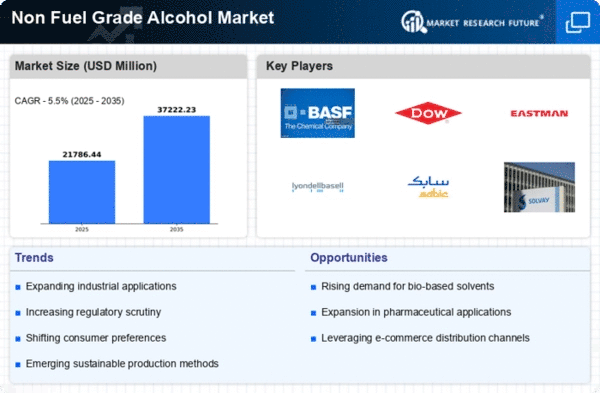
As per MRFR analysis, the Non Fuel Grade Alcohol Market Size was estimated at 20650.65 USD Million in 2024. The Non Fuel Grade Alcohol industry is projected to grow from 21786.85 in 2025 to 37222.23 by 2035, exhibiting a compound annual growth rate (CAGR) of 5.5% during the forecast period 2025 - 2035.

Key Market Trends & Highlights

The Non Fuel Grade Alcohol Market is experiencing robust growth driven by sustainability and diverse applications.

  • Asia-Pacific remains the largest market for non fuel grade alcohol, driven by increasing demand across various industries. Asia-Pacific is identified as the fastest-growing region, reflecting a surge in consumer interest and industrial applications. The pharmaceutical industry represents the largest segment, while the cosmetics sector is rapidly expanding due to evolving consumer preferences. Key market drivers include rising demand for eco-friendly products and regulatory support for biofuels, which are shaping industry dynamics.

Market Size & Forecast

2024 Market Size 20650.65 (USD Million)
2035 Market Size 37222.23 (USD Million)
CAGR (2025 - 2035) 5.5%
Largest Regional Market Share in 2024 North America

Major Players

BASF SE (DE), Dow Inc. (US), Eastman Chemical Company (US), LyondellBasell Industries N.V. (NL), SABIC (SA), Solvay S.A. (BE), Mitsubishi Chemical Corporation (JP), AkzoNobel N.V. (NL), Huntsman Corporation (US)

Market Trends

The Non Fuel Grade Alcohol Market is currently experiencing a dynamic evolution, driven by various factors that influence consumer preferences and industrial applications. This sector encompasses a wide range of products, including ethanol and isopropanol, which are utilized in pharmaceuticals, cosmetics, and food industries. The increasing demand for natural and organic products appears to be shaping the market landscape, as consumers gravitate towards alcohols derived from renewable sources. Furthermore, regulatory frameworks are evolving, potentially impacting production methods and distribution channels, which may lead to shifts in market dynamics. In addition, the Non Fuel Grade Alcohol Market is likely to witness innovations in production technologies, enhancing efficiency and sustainability. Companies are exploring advanced fermentation processes and biotechnological methods to optimize yield and reduce environmental impact. This trend suggests a growing emphasis on eco-friendly practices, which could resonate well with environmentally conscious consumers. As the market continues to adapt to these changes, stakeholders must remain vigilant to emerging trends and consumer demands to maintain competitive advantage.

Sustainability Initiatives

The Non Fuel Grade Alcohol Market is increasingly focusing on sustainability initiatives. Companies are adopting eco-friendly practices in production, such as utilizing renewable resources and minimizing waste. This shift not only aligns with consumer preferences for green products but also addresses regulatory pressures for environmentally responsible manufacturing.

Technological Advancements

Technological advancements are playing a crucial role in the Non Fuel Grade Alcohol Market. Innovations in fermentation and distillation processes are enhancing production efficiency and product quality. These developments may lead to cost reductions and improved supply chain management, thereby benefiting manufacturers and consumers alike.

Diverse Applications

The applications of non fuel grade alcohols are expanding across various industries. Beyond traditional uses in pharmaceuticals and cosmetics, there is a growing interest in food and beverage applications. This diversification indicates a potential for market growth as new sectors adopt these alcohols for their unique properties.

Non Fuel Grade Alcohol Market Market Drivers

Market Growth Projections

The Global Non-Fuel Grade Alcohol Market Industry is poised for substantial growth, with projections indicating a market value of 20.6 USD Billion in 2024 and an anticipated increase to 36.5 USD Billion by 2035. This growth trajectory suggests a compound annual growth rate of 5.32% from 2025 to 2035, driven by various factors including rising consumer demand, technological advancements, and regulatory support. The market's expansion reflects broader trends in sustainability and health consciousness, positioning non-fuel grade alcohol as a vital component in multiple industries.

Regulatory Support for Biofuels

The Global Non-Fuel Grade Alcohol Market Industry benefits from favorable regulatory frameworks that promote the use of biofuels and renewable resources. Governments worldwide are implementing policies that encourage the production and consumption of bio-based alcohols, which are often derived from agricultural feedstocks. This regulatory support not only enhances the market's sustainability profile but also drives innovation in production technologies. As countries aim to reduce carbon emissions, the shift towards bio-based non-fuel grade alcohol could lead to increased investments and market expansion, aligning with global sustainability goals.

Growth in Food and Beverage Sector

The Global Non-Fuel Grade Alcohol Market Industry is significantly influenced by the expansion of the food and beverage sector. Non-fuel grade alcohol is widely used as a preservative and flavoring agent in various food products, including sauces, dressings, and alcoholic beverages. The increasing trend of craft brewing and distilling has further propelled the demand for high-quality ethanol. As the food and beverage industry continues to grow, projected to reach 36.5 USD Billion by 2035, the reliance on non-fuel grade alcohol is likely to increase, thereby enhancing the market's overall growth prospects.

Increased Awareness of Health Benefits

The Global Non-Fuel Grade Alcohol Market Industry is witnessing a surge in consumer awareness regarding the health benefits associated with certain types of alcohol, particularly in the context of low-alcohol and non-alcoholic beverages. This trend is driven by a growing emphasis on health and wellness, with consumers seeking alternatives that offer enjoyment without compromising their health. As the market for low-alcohol beverages expands, the demand for non-fuel grade alcohol is likely to rise, reflecting a shift in consumer preferences towards healthier lifestyle choices.

Rising Demand for Personal Care Products

The Global Non-Fuel Grade Alcohol Market Industry experiences a notable increase in demand for personal care products, which often utilize non-fuel grade alcohol as a key ingredient. This trend is driven by consumer preferences for natural and organic formulations, leading to a surge in the use of ethanol in cosmetics and skincare. For instance, the global market for personal care products is projected to reach approximately 20.6 USD Billion in 2024, with non-fuel grade alcohol playing a pivotal role in formulations. This shift towards cleaner beauty products suggests a sustained growth trajectory for the industry, as consumers increasingly prioritize health and wellness.

Technological Advancements in Production

Technological innovations in the production of non-fuel grade alcohol are reshaping the Global Non-Fuel Grade Alcohol Market Industry. Advances in fermentation processes and distillation techniques have improved efficiency and reduced costs, making it more feasible for manufacturers to produce high-quality alcohol at scale. These innovations are particularly relevant as the market anticipates a compound annual growth rate of 5.32% from 2025 to 2035. Enhanced production capabilities not only meet rising consumer demand but also contribute to the overall competitiveness of the industry in the global marketplace.

Market Segment Insights

By Application: Pharmaceuticals (Largest) vs. Cosmetics (Fastest-Growing)

In the Non Fuel Grade Alcohol Market, the application segment demonstrates significant diversity, with Pharmaceuticals leading in market share due to the essential role of alcohol in drug formulations and medications. This sector remains paramount for its expansive use in product formulations, driving consistent demand. Conversely, the Cosmetics segment is witnessing rapid growth, fueled by increasing consumer demand for premium skincare and cosmetic products where alcohol serves as a key ingredient for formulation stability and preservation.<br>Pharmaceutical production in Germany increased by 5.1% in 2025, supporting rising demand for pharmaceutical-grade alcohol in drug formulation and manufacturing processes

Pharmaceuticals: Dominant vs. Cosmetics: Emerging

The Pharmaceuticals application remains a dominant force in the Non Fuel Grade Alcohol Market, primarily due to the indispensable role of alcohols in various medicinal products. This segment benefits from rigorous regulatory support and extensive research that leads to innovative applications, sustaining its market position. On the other hand, the Cosmetics segment, while currently emerging, is rapidly advancing thanks to trends favoring organic and natural ingredients in beauty products. Alcohols are increasingly favored in cosmetics for their antibacterial properties and ability to enhance the texture and effectiveness of products, making this segment a vibrant area of growth as consumers seek high-quality personal care solutions.

By End Use: Household (Largest) vs. Commercial (Fastest-Growing)

In the Non Fuel Grade Alcohol Market, the 'End Use' segment showcases distinct distribution among its values. The Household segment holds the largest share, driven largely by consumer preferences for personal care products and household cleaners that utilize non fuel grade alcohol. On the other hand, the Commercial segment is gaining traction, reflecting an increasing demand from various industries utilizing alcohol for sanitization and disinfection purposes. The market distribution clearly highlights the significance of household applications while recognizing the rapid growth potential within commercial avenues.

Household (Dominant) vs. Commercial (Emerging)

The Household segment stands as a dominant player in the Non Fuel Grade Alcohol Market, characterized by its extensive application in cleaning products, personal care items, and home remedies. Consumers' focus on hygiene and well-being has propelled this segment to a leading position among end uses. Conversely, the Commercial segment is emerging rapidly, spurred by heightened awareness of cleanliness in public spaces and workplaces. Industries are increasingly opting for non fuel grade alcohol for disinfection, driving its demand across sectors such as healthcare, hospitality, and food services. This shift not only showcases the adaptability of non fuel grade alcohol but also illustrates the evolving consumer and business preferences towards maintaining sanitary environments.

By Type: Ethanol (Largest) vs. Isopropanol (Fastest-Growing)

In the Non Fuel Grade Alcohol Market, the segment values display a diverse distribution with Ethanol holding a significant market share due to its extensive use in various applications ranging from pharmaceuticals to cosmetics. Methanol and Butanol follow in the rank, serving as key industrial intermediates. Isopropanol, although smaller in share compared to Ethanol, is witnessing substantial growth due to its increasing demand in cleaning and sanitization products. <br> <br>Chemical industry output grew by approximately 3.5% in 2025, directly supporting demand for non-fuel grade alcohol across industrial, laboratory, and specialty-grade applications.

Ethanol (Dominant) vs. Isopropanol (Emerging)

Ethanol remains the dominant player in the Non Fuel Grade Alcohol Market, primarily used in applications such as beverages, pharmaceuticals, and personal care products. Its versatility and regulatory acceptance bolster its market position. In contrast, Isopropanol is rapidly emerging, driven by heightened demand in disinfectants and sanitizers, particularly in the wake of global health concerns. As industries shift towards more sustainable and effective cleaning solutions, Isopropanol is expected to gain market traction, fostering further innovation and application diversification.

By Purity Level: Food Grade (Largest) vs. Pharmaceutical Grade (Fastest-Growing)

The Non Fuel Grade Alcohol Market is characterized by a diverse range of purity levels, each catering to unique sectors. The Food Grade segment holds the largest market share, driven by its extensive use in food preservation and beverage production. On the other hand, the Pharmaceutical Grade alcohol is gaining traction, reflecting the growing demand in the healthcare and pharmaceutical industries. Other segments like Technical, Industrial, and Cosmetic Grades are also significant, yet they hold comparatively smaller shares in this market landscape.

Food Grade: The Dominant Player vs. Pharmaceutical Grade: The Emerging Force

Food Grade alcohol is predominantly utilized in the food and beverage industry for various applications including flavoring, preservation, and manufacturing processes, making it the dominant player in the Non Fuel Grade Alcohol Market. The stringent quality standards and safety regulations further enhance its prominence. Conversely, Pharmaceutical Grade alcohol is emerging rapidly due to an increasing demand for sanitizing products and medical applications fueled by the global health scenario. This segment is characterized by higher purity levels and compliance with strict regulatory norms, thereby securing a significant position in the market.

By Source: Synthetic (Largest) vs. Natural (Fastest-Growing)

In the Non Fuel Grade Alcohol Market, the source segment is primarily divided into two categories: synthetic and natural. Synthetic alcohol dominates the market, holding a sizable share due to its widespread use in industrial applications and consistent supply chains. Natural alcohol, while smaller in market share, is progressively carving out its niche, driven by the growing consumer preference for organic and sustainably sourced products, particularly in the cosmetic and food sectors.

Synthetic (Dominant) vs. Natural (Emerging)

Synthetic alcohols are derived from petrochemical processes, providing a reliable and cost-effective source for many industries, including chemical manufacturing and pharmaceuticals. Their consistency and scalability in production make them the dominant force in the Non Fuel Grade Alcohol Market. Conversely, natural alcohols, sourced from renewable agricultural products, are gaining traction due to increasing consumer awareness about health and sustainability. They are particularly favored in the beverage and personal care industries, reflecting a shift towards greener products. The demand for naturally derived alcohols is expected to rise, heralding a transformative trend as eco-conscious consumers drive market growth.

Get more detailed insights about Non-Fuel Grade Alcohol Market Research Report — Global Forecast till 2035

Regional Insights

North America : Market Leader in Non Fuel Grade Alcohol

North America is poised to maintain its leadership in the Non Fuel Grade Alcohol market, holding a significant market share of 10390.39 million. The region's growth is driven by increasing demand in various sectors, including pharmaceuticals and personal care, alongside favorable regulatory frameworks that promote sustainable practices. The rise in bio-based alcohol production is also a key catalyst for market expansion. The United States stands as the largest contributor, with major players like BASF SE, Dow Inc., and Eastman Chemical Company leading the competitive landscape. The presence of advanced manufacturing facilities and robust R&D initiatives further strengthens the market. As companies focus on innovation and sustainability, North America is expected to continue attracting investments, solidifying its market position.

Europe : Emerging Market with Growth Potential

Europe is witnessing a notable surge in the Non Fuel Grade Alcohol market, with a market size of 6178.65 million. The region benefits from stringent regulations promoting the use of bio-based products, which is driving demand across various industries, including cosmetics and food. The European Union's commitment to sustainability and reducing carbon footprints is a significant regulatory catalyst for market growth. Leading countries such as Germany, France, and the UK are at the forefront of this market, with key players like LyondellBasell Industries and Solvay S.A. actively participating. The competitive landscape is characterized by innovation and collaboration among companies to develop eco-friendly products. As the market evolves, Europe is expected to enhance its position as a hub for sustainable alcohol production.

Asia-Pacific : Rapid Growth in Emerging Markets

Asia-Pacific is emerging as a significant player in the Non Fuel Grade Alcohol market, with a market size of 3678.13 million. The region's growth is fueled by increasing industrialization and urbanization, leading to higher demand in sectors such as automotive and pharmaceuticals. Additionally, supportive government policies aimed at promoting renewable resources are acting as catalysts for market expansion. Countries like China, Japan, and India are leading the charge, with major companies such as Mitsubishi Chemical Corporation and AkzoNobel N.V. establishing a strong presence. The competitive landscape is marked by rapid innovation and investment in production technologies. As the region continues to develop, it is expected to play a crucial role in The Non Fuel Grade Alcohol. Industrial output in China grew by 4.5% in 2025, driving strong consumption of non-fuel grade alcohol across chemical, cosmetics, and manufacturing industries

Middle East and Africa : Niche Market with Growth Opportunities

The Middle East and Africa region, while currently holding a smaller market size of 403.48 million in the Non Fuel Grade Alcohol sector, presents unique growth opportunities. The increasing demand for industrial applications and the rise of local manufacturing capabilities are driving market interest. Additionally, regulatory frameworks are gradually evolving to support the use of bio-based alcohols, which could further stimulate growth in the coming years. Countries like South Africa and the UAE are emerging as key players in this market, with local companies beginning to invest in production facilities. The competitive landscape is still developing, but the presence of international players is expected to enhance market dynamics. As the region focuses on diversifying its economy, the Non Fuel Grade Alcohol market is likely to gain traction.

Key Players and Competitive Insights

The Non Fuel Grade Alcohol Market is characterized by a dynamic competitive landscape, driven by increasing demand for bio-based products and stringent regulations on traditional solvents. Key players such as BASF SE (DE), Dow Inc. (US), and Eastman Chemical Company (US) are strategically positioned to leverage innovation and sustainability in their operations. BASF SE (DE) focuses on developing bio-based alcohols, which aligns with global sustainability trends, while Dow Inc. (US) emphasizes digital transformation to enhance operational efficiency. Eastman Chemical Company (US) is actively pursuing partnerships to expand its product portfolio, thereby shaping a competitive environment that prioritizes eco-friendly solutions and technological advancements.In terms of business tactics, companies are increasingly localizing manufacturing to reduce supply chain vulnerabilities and optimize logistics. The market structure appears moderately fragmented, with several players vying for market share. However, the collective influence of major companies like LyondellBasell Industries N.V. (NL) and SABIC (SA) is notable, as they engage in strategic collaborations to enhance their market presence and operational capabilities.
In November LyondellBasell Industries N.V. (NL) announced a joint venture with a leading renewable energy firm to produce sustainable alcohols from biomass. This strategic move is significant as it not only diversifies LyondellBasell's product offerings but also positions the company as a leader in the transition towards greener alternatives, potentially capturing a larger market share in the eco-conscious segment.
In October SABIC (SA) unveiled a new line of bio-based alcohols aimed at the cosmetics and personal care industries. This initiative reflects SABIC's commitment to sustainability and innovation, as it seeks to meet the growing consumer demand for environmentally friendly products. The introduction of this product line is likely to enhance SABIC's competitive edge in a market increasingly focused on sustainable solutions.
In September Eastman Chemical Company (US) expanded its partnership with a major technology firm to integrate AI-driven analytics into its production processes. This strategic action is poised to improve operational efficiency and product quality, thereby reinforcing Eastman's position in the market. The integration of advanced technologies may also facilitate quicker responses to market demands, enhancing customer satisfaction.
As of December the competitive trends in the Non Fuel Grade Alcohol Market are increasingly defined by digitalization, sustainability, and the integration of AI technologies. Strategic alliances are becoming pivotal in shaping the landscape, as companies collaborate to enhance their capabilities and market reach. Looking ahead, competitive differentiation is likely to evolve from traditional price-based competition to a focus on innovation, technological advancements, and supply chain reliability, reflecting a broader shift towards sustainable practices and consumer-centric solutions.

Key Companies in the Non Fuel Grade Alcohol Market include

Industry Developments

January 2023: Cargill has been named the winner in the 2023 BIG Innovation Awards presented by the Business Intelligence Group.

September 2022: CropEnergies acquires stake in Dutch biobased chemicals start-up Syclus: CropEnergies AG, Mannheim, Germany, has acquired a stake in the Dutch. start-up for biobased chemicals Syclus BV, Maastricht. CropEnergies purchases 50 percent of the company's share capital. The investment volume amounts to EUR 1.8 million.

October 2021: Pannonia Bio Wins Icheme Global Energy Award 2021: team of Pannonia Bio engineers and experts were named winners of the IChemE Energy Award 2021 for their success with the project “Decarbonizing biorefineries to produce greener bioethanol”. These awards are organized by the Institution of Chemical Engineers, a group that exists to advance chemical engineering’s contribution for the benefit of society.

Future Outlook

Non Fuel Grade Alcohol Market Future Outlook

The Non Fuel Grade Alcohol Market is projected to grow at a 5.5% CAGR from 2025 to 2035, driven by increasing demand in pharmaceuticals, cosmetics, and food industries.

New opportunities lie in:

  • <p>Expansion into emerging markets with tailored product offerings. Development of eco-friendly production processes to attract sustainability-focused consumers. Investment in advanced distribution networks to enhance market reach and efficiency.</p>

By 2035, the Non Fuel Grade Alcohol Market is expected to achieve robust growth and diversification.

Market Segmentation

Non Fuel Grade Alcohol Market Type Outlook

  • Ethanol
  • Methanol
  • Isopropanol
  • Butanol
  • Propylene Glycol

Non Fuel Grade Alcohol Market End Use Outlook

  • Food Industry
  • Beverage Industry
  • Cosmetic Industry
  • Pharmaceutical Industry
  • Chemical Industry

Non Fuel Grade Alcohol Market Application Outlook

  • Pharmaceuticals
  • Cosmetics
  • Food and Beverage
  • Industrial Solvents
  • Personal Care

Non Fuel Grade Alcohol Market Purity Level Outlook

  • Technical Grade
  • Industrial Grade
  • Food Grade
  • Pharmaceutical Grade
  • Cosmetic Grade

Non Fuel Grade Alcohol Market Distribution Channel Outlook

  • Direct Sales
  • Online Sales
  • Retail Sales
  • Wholesale Distribution
  • Specialty Stores

Report Scope

MARKET SIZE 2024 20650.65(USD Million)
MARKET SIZE 2025 21786.85(USD Million)
MARKET SIZE 2035 37222.23(USD Million)
COMPOUND ANNUAL GROWTH RATE (CAGR) 5.5% (2025 - 2035)
REPORT COVERAGE Revenue Forecast, Competitive Landscape, Growth Factors, and Trends
BASE YEAR 2024
Market Forecast Period 2025 - 2035
Historical Data 2019 - 2024
Market Forecast Units USD Million
Key Companies Profiled BASF SE (DE), Dow Inc. (US), Eastman Chemical Company (US), LyondellBasell Industries N.V. (NL), SABIC (SA), Solvay S.A. (BE), Mitsubishi Chemical Corporation (JP), AkzoNobel N.V. (NL), Huntsman Corporation (US)
Segments Covered Application, End Use, Type, Purity Level, Distribution Channel
Key Market Opportunities Growing demand for sustainable and bio-based products in the Non Fuel Grade Alcohol Market presents significant opportunities.
Key Market Dynamics Rising consumer demand for sustainable products drives innovation in the Non Fuel Grade Alcohol Market.
Countries Covered North America, Europe, APAC, South America, MEA

FAQs

What is the projected market valuation of the Non Fuel Grade Alcohol Market by 2035?

<p>The projected market valuation for the Non Fuel Grade Alcohol Market is 37,222.23 USD Million by 2035.</p>

What was the overall market valuation of the Non Fuel Grade Alcohol Market in 2024?

<p>The overall market valuation of the Non Fuel Grade Alcohol Market was 20,650.65 USD Million in 2024.</p>

What is the expected CAGR for the Non Fuel Grade Alcohol Market during the forecast period 2025 - 2035?

<p>The expected CAGR for the Non Fuel Grade Alcohol Market during the forecast period 2025 - 2035 is 5.5%.</p>

Which companies are considered key players in the Non Fuel Grade Alcohol Market?

<p>Key players in the Non Fuel Grade Alcohol Market include BASF SE, Dow Inc., Eastman Chemical Company, and others.</p>

What are the main applications of Non Fuel Grade Alcohol?

<p>Main applications of Non Fuel Grade Alcohol include Pharmaceuticals, Cosmetics, Food and Beverage, and Industrial Solvents.</p>

How much was the valuation for the Food and Beverage segment in 2024?

<p>The valuation for the Food and Beverage segment was 6,200.97 USD Million in 2024.</p>

What is the projected valuation for the Pharmaceuticals segment by 2035?

The projected valuation for the Pharmaceuticals segment is 7,400.0 USD Million by 2035.

What types of Non Fuel Grade Alcohol are included in the market analysis?

Types of Non Fuel Grade Alcohol include Ethanol, Isopropanol, Methanol, and Butanol.

What is the expected valuation for the Technical Grade segment by 2035?

The expected valuation for the Technical Grade segment is 13,222.23 USD Million by 2035.

What is the market valuation for Synthetic Non Fuel Grade Alcohol in 2024?

The market valuation for Synthetic Non Fuel Grade Alcohol was 12,390.39 USD Million in 2024.

  1. SECTION I: EXECUTIVE SUMMARY AND KEY HIGHLIGHTS |
    1. EXECUTIVE SUMMARY | |
      1. Market Overview | |
      2. Key Findings | |
      3. Market Segmentation | |
      4. Competitive Landscape | |
      5. Challenges and Opportunities | |
      6. Future Outlook 2
  2. SECTION II: SCOPING, METHODOLOGY AND MARKET STRUCTURE |
    1. MARKET INTRODUCTION | |
      1. Definition | |
      2. Scope of the study | | |
    2. RESEARCH METHODOLOGY | |
      1. Overview | |
      2. Data Mining | |
      3. Secondary Research | |
      4. Primary Research | | |
      5. Forecasting Model | |
      6. Market Size Estimation | | |
      7. Data Triangulation | |
      8. Validation 3
  3. SECTION III: QUALITATIVE ANALYSIS |
    1. MARKET DYNAMICS | |
      1. Overview | |
      2. Drivers | |
      3. Restraints | |
      4. Opportunities |
    2. MARKET FACTOR ANALYSIS | |
      1. Value chain Analysis | |
      2. Porter's Five Forces Analysis | | |
      3. COVID-19 Impact Analysis | | |
  4. SECTION IV: QUANTITATIVE ANALYSIS |
    1. Chemicals and Materials, BY Application (USD Million) | |
      1. Pharmaceuticals | |
      2. Cosmetics | |
      3. Food and Beverage | |
      4. Industrial Solvents | |
      5. Personal Care |
    2. Chemicals and Materials, BY End Use (USD Million) | |
      1. Household | |
      2. Commercial | |
      3. Industrial | |
      4. Research and Development |
    3. Chemicals and Materials, BY Type (USD Million) | |
      1. Ethanol | |
      2. Isopropanol | |
      3. Methanol | |
      4. Butanol |
    4. Chemicals and Materials, BY Purity Level (USD Million) | |
      1. Food Grade | |
      2. Pharmaceutical Grade | |
      3. Technical Grade |
    5. Chemicals and Materials, BY Source (USD Million) | |
      1. Synthetic | |
      2. Natural |
    6. Chemicals and Materials, BY Region (USD Million) | |
      1. North America | | |
      2. Europe | | |
      3. APAC | | |
      4. South America | | |
      5. MEA | | |
  5. SECTION V: COMPETITIVE ANALYSIS |
    1. Competitive Landscape | |
      1. Overview | |
      2. Competitive Analysis | |
      3. Market share Analysis | |
      4. Major Growth Strategy in the Chemicals and Materials | |
      5. Competitive Benchmarking | |
      6. Leading Players in Terms of Number of Developments in the Chemicals and Materials | |
      7. Key developments and growth strategies | | |
      8. Major Players Financial Matrix | | |
    2. Company Profiles | |
      1. BASF SE (DE) | | |
      2. Dow Inc. (US) | | |
      3. Eastman Chemical Company (US) | | |
      4. LyondellBasell Industries N.V. (NL) | | |
      5. SABIC (SA) | | |
      6. Solvay S.A. (BE) | | |
      7. Mitsubishi Chemical Corporation (JP) | | |
      8. AkzoNobel N.V. (NL) | | |
      9. Huntsman Corporation (US) | | |
    3. Appendix | |
      1. References | |
      2. Related Reports 6 LIST OF FIGURES |
    4. MARKET SYNOPSIS |
    5. NORTH AMERICA MARKET ANALYSIS |
    6. US MARKET ANALYSIS BY APPLICATION |
    7. US MARKET ANALYSIS BY END USE |
    8. US MARKET ANALYSIS BY TYPE |
    9. US MARKET ANALYSIS BY PURITY LEVEL |
    10. US MARKET ANALYSIS BY SOURCE |
    11. CANADA MARKET ANALYSIS BY APPLICATION |
    12. CANADA MARKET ANALYSIS BY END USE |
    13. CANADA MARKET ANALYSIS BY TYPE |
    14. CANADA MARKET ANALYSIS BY PURITY LEVEL |
    15. CANADA MARKET ANALYSIS BY SOURCE |
    16. EUROPE MARKET ANALYSIS |
    17. GERMANY MARKET ANALYSIS BY APPLICATION |
    18. GERMANY MARKET ANALYSIS BY END USE |
    19. GERMANY MARKET ANALYSIS BY TYPE |
    20. GERMANY MARKET ANALYSIS BY PURITY LEVEL |
    21. GERMANY MARKET ANALYSIS BY SOURCE |
    22. UK MARKET ANALYSIS BY APPLICATION |
    23. UK MARKET ANALYSIS BY END USE |
    24. UK MARKET ANALYSIS BY TYPE |
    25. UK MARKET ANALYSIS BY PURITY LEVEL |
    26. UK MARKET ANALYSIS BY SOURCE |
    27. FRANCE MARKET ANALYSIS BY APPLICATION |
    28. FRANCE MARKET ANALYSIS BY END USE |
    29. FRANCE MARKET ANALYSIS BY TYPE |
    30. FRANCE MARKET ANALYSIS BY PURITY LEVEL |
    31. FRANCE MARKET ANALYSIS BY SOURCE |
    32. RUSSIA MARKET ANALYSIS BY APPLICATION |
    33. RUSSIA MARKET ANALYSIS BY END USE |
    34. RUSSIA MARKET ANALYSIS BY TYPE |
    35. RUSSIA MARKET ANALYSIS BY PURITY LEVEL |
    36. RUSSIA MARKET ANALYSIS BY SOURCE |
    37. ITALY MARKET ANALYSIS BY APPLICATION |
    38. ITALY MARKET ANALYSIS BY END USE |
    39. ITALY MARKET ANALYSIS BY TYPE |
    40. ITALY MARKET ANALYSIS BY PURITY LEVEL |
    41. ITALY MARKET ANALYSIS BY SOURCE |
    42. SPAIN MARKET ANALYSIS BY APPLICATION |
    43. SPAIN MARKET ANALYSIS BY END USE |
    44. SPAIN MARKET ANALYSIS BY TYPE |
    45. SPAIN MARKET ANALYSIS BY PURITY LEVEL |
    46. SPAIN MARKET ANALYSIS BY SOURCE |
    47. REST OF EUROPE MARKET ANALYSIS BY APPLICATION |
    48. REST OF EUROPE MARKET ANALYSIS BY END USE |
    49. REST OF EUROPE MARKET ANALYSIS BY TYPE |
    50. REST OF EUROPE MARKET ANALYSIS BY PURITY LEVEL |
    51. REST OF EUROPE MARKET ANALYSIS BY SOURCE |
    52. APAC MARKET ANALYSIS |
    53. CHINA MARKET ANALYSIS BY APPLICATION |
    54. CHINA MARKET ANALYSIS BY END USE |
    55. CHINA MARKET ANALYSIS BY TYPE |
    56. CHINA MARKET ANALYSIS BY PURITY LEVEL |
    57. CHINA MARKET ANALYSIS BY SOURCE |
    58. INDIA MARKET ANALYSIS BY APPLICATION |
    59. INDIA MARKET ANALYSIS BY END USE |
    60. INDIA MARKET ANALYSIS BY TYPE |
    61. INDIA MARKET ANALYSIS BY PURITY LEVEL |
    62. INDIA MARKET ANALYSIS BY SOURCE |
    63. JAPAN MARKET ANALYSIS BY APPLICATION |
    64. JAPAN MARKET ANALYSIS BY END USE |
    65. JAPAN MARKET ANALYSIS BY TYPE |
    66. JAPAN MARKET ANALYSIS BY PURITY LEVEL |
    67. JAPAN MARKET ANALYSIS BY SOURCE |
    68. SOUTH KOREA MARKET ANALYSIS BY APPLICATION |
    69. SOUTH KOREA MARKET ANALYSIS BY END USE |
    70. SOUTH KOREA MARKET ANALYSIS BY TYPE |
    71. SOUTH KOREA MARKET ANALYSIS BY PURITY LEVEL |
    72. SOUTH KOREA MARKET ANALYSIS BY SOURCE |
    73. MALAYSIA MARKET ANALYSIS BY APPLICATION |
    74. MALAYSIA MARKET ANALYSIS BY END USE |
    75. MALAYSIA MARKET ANALYSIS BY TYPE |
    76. MALAYSIA MARKET ANALYSIS BY PURITY LEVEL |
    77. MALAYSIA MARKET ANALYSIS BY SOURCE |
    78. THAILAND MARKET ANALYSIS BY APPLICATION |
    79. THAILAND MARKET ANALYSIS BY END USE |
    80. THAILAND MARKET ANALYSIS BY TYPE |
    81. THAILAND MARKET ANALYSIS BY PURITY LEVEL |
    82. THAILAND MARKET ANALYSIS BY SOURCE |
    83. INDONESIA MARKET ANALYSIS BY APPLICATION |
    84. INDONESIA MARKET ANALYSIS BY END USE |
    85. INDONESIA MARKET ANALYSIS BY TYPE |
    86. INDONESIA MARKET ANALYSIS BY PURITY LEVEL |
    87. INDONESIA MARKET ANALYSIS BY SOURCE |
    88. REST OF APAC MARKET ANALYSIS BY APPLICATION |
    89. REST OF APAC MARKET ANALYSIS BY END USE |
    90. REST OF APAC MARKET ANALYSIS BY TYPE |
    91. REST OF APAC MARKET ANALYSIS BY PURITY LEVEL |
    92. REST OF APAC MARKET ANALYSIS BY SOURCE |
    93. SOUTH AMERICA MARKET ANALYSIS |
    94. BRAZIL MARKET ANALYSIS BY APPLICATION |
    95. BRAZIL MARKET ANALYSIS BY END USE |
    96. BRAZIL MARKET ANALYSIS BY TYPE |
    97. BRAZIL MARKET ANALYSIS BY PURITY LEVEL |
    98. BRAZIL MARKET ANALYSIS BY SOURCE |
    99. MEXICO MARKET ANALYSIS BY APPLICATION |
    100. MEXICO MARKET ANALYSIS BY END USE |
    101. MEXICO MARKET ANALYSIS BY TYPE |
    102. MEXICO MARKET ANALYSIS BY PURITY LEVEL |
    103. MEXICO MARKET ANALYSIS BY SOURCE |
    104. ARGENTINA MARKET ANALYSIS BY APPLICATION |
    105. ARGENTINA MARKET ANALYSIS BY END USE |
    106. ARGENTINA MARKET ANALYSIS BY TYPE |
    107. ARGENTINA MARKET ANALYSIS BY PURITY LEVEL |
    108. ARGENTINA MARKET ANALYSIS BY SOURCE |
    109. REST OF SOUTH AMERICA MARKET ANALYSIS BY APPLICATION |
    110. REST OF SOUTH AMERICA MARKET ANALYSIS BY END USE |
    111. REST OF SOUTH AMERICA MARKET ANALYSIS BY TYPE |
    112. REST OF SOUTH AMERICA MARKET ANALYSIS BY PURITY LEVEL |
    113. REST OF SOUTH AMERICA MARKET ANALYSIS BY SOURCE |
    114. MEA MARKET ANALYSIS |
    115. GCC COUNTRIES MARKET ANALYSIS BY APPLICATION |
    116. GCC COUNTRIES MARKET ANALYSIS BY END USE |
    117. GCC COUNTRIES MARKET ANALYSIS BY TYPE |
    118. GCC COUNTRIES MARKET ANALYSIS BY PURITY LEVEL |
    119. GCC COUNTRIES MARKET ANALYSIS BY SOURCE |
    120. SOUTH AFRICA MARKET ANALYSIS BY APPLICATION |
    121. SOUTH AFRICA MARKET ANALYSIS BY END USE |
    122. SOUTH AFRICA MARKET ANALYSIS BY TYPE |
    123. SOUTH AFRICA MARKET ANALYSIS BY PURITY LEVEL |
    124. SOUTH AFRICA MARKET ANALYSIS BY SOURCE |
    125. REST OF MEA MARKET ANALYSIS BY APPLICATION |
    126. REST OF MEA MARKET ANALYSIS BY END USE |
    127. REST OF MEA MARKET ANALYSIS BY TYPE |
    128. REST OF MEA MARKET ANALYSIS BY PURITY LEVEL |
    129. REST OF MEA MARKET ANALYSIS BY SOURCE |
    130. KEY BUYING CRITERIA OF CHEMICALS AND MATERIALS |
    131. RESEARCH PROCESS OF MRFR |
    132. DRO ANALYSIS OF CHEMICALS AND MATERIALS |
    133. DRIVERS IMPACT ANALYSIS: CHEMICALS AND MATERIALS |
    134. RESTRAINTS IMPACT ANALYSIS: CHEMICALS AND MATERIALS |
    135. SUPPLY / VALUE CHAIN: CHEMICALS AND MATERIALS |
    136. CHEMICALS AND MATERIALS, BY APPLICATION, 2024 (% SHARE) |
    137. CHEMICALS AND MATERIALS, BY APPLICATION, 2024 TO 2035 (USD Million) |
    138. CHEMICALS AND MATERIALS, BY END USE, 2024 (% SHARE) |
    139. CHEMICALS AND MATERIALS, BY END USE, 2024 TO 2035 (USD Million) |
    140. CHEMICALS AND MATERIALS, BY TYPE, 2024 (% SHARE) |
    141. CHEMICALS AND MATERIALS, BY TYPE, 2024 TO 2035 (USD Million) |
    142. CHEMICALS AND MATERIALS, BY PURITY LEVEL, 2024 (% SHARE) |
    143. CHEMICALS AND MATERIALS, BY PURITY LEVEL, 2024 TO 2035 (USD Million) |
    144. CHEMICALS AND MATERIALS, BY SOURCE, 2024 (% SHARE) |
    145. CHEMICALS AND MATERIALS, BY SOURCE, 2024 TO 2035 (USD Million) |
    146. BENCHMARKING OF MAJOR COMPETITORS 7 LIST OF TABLES |
    147. LIST OF ASSUMPTIONS | |
      1. |
    148. North America MARKET SIZE ESTIMATES; FORECAST | |
      1. BY APPLICATION, 2025-2035 (USD Million) | |
      2. BY END USE, 2025-2035 (USD Million) | |
      3. BY TYPE, 2025-2035 (USD Million) | |
      4. BY PURITY LEVEL, 2025-2035 (USD Million) | |
      5. BY SOURCE, 2025-2035 (USD Million) |
    149. US MARKET SIZE ESTIMATES; FORECAST | |
      1. BY APPLICATION, 2025-2035 (USD Million) | |
      2. BY END USE, 2025-2035 (USD Million) | |
      3. BY TYPE, 2025-2035 (USD Million) | |
      4. BY PURITY LEVEL, 2025-2035 (USD Million) | |
      5. BY SOURCE, 2025-2035 (USD Million) |
    150. Canada MARKET SIZE ESTIMATES; FORECAST | |
      1. BY APPLICATION, 2025-2035 (USD Million) | |
      2. BY END USE, 2025-2035 (USD Million) | |
      3. BY TYPE, 2025-2035 (USD Million) | |
      4. BY PURITY LEVEL, 2025-2035 (USD Million) | |
      5. BY SOURCE, 2025-2035 (USD Million) |
    151. Europe MARKET SIZE ESTIMATES; FORECAST | |
      1. BY APPLICATION, 2025-2035 (USD Million) | |
      2. BY END USE, 2025-2035 (USD Million) | |
      3. BY TYPE, 2025-2035 (USD Million) | |
      4. BY PURITY LEVEL, 2025-2035 (USD Million) | |
      5. BY SOURCE, 2025-2035 (USD Million) |
    152. Germany MARKET SIZE ESTIMATES; FORECAST | |
      1. BY APPLICATION, 2025-2035 (USD Million) | |
      2. BY END USE, 2025-2035 (USD Million) | |
      3. BY TYPE, 2025-2035 (USD Million) | |
      4. BY PURITY LEVEL, 2025-2035 (USD Million) | |
      5. BY SOURCE, 2025-2035 (USD Million) |
    153. UK MARKET SIZE ESTIMATES; FORECAST | |
      1. BY APPLICATION, 2025-2035 (USD Million) | |
      2. BY END USE, 2025-2035 (USD Million) | |
      3. BY TYPE, 2025-2035 (USD Million) | |
      4. BY PURITY LEVEL, 2025-2035 (USD Million) | |
      5. BY SOURCE, 2025-2035 (USD Million) |
    154. France MARKET SIZE ESTIMATES; FORECAST | |
      1. BY APPLICATION, 2025-2035 (USD Million) | |
      2. BY END USE, 2025-2035 (USD Million) | |
      3. BY TYPE, 2025-2035 (USD Million) | |
      4. BY PURITY LEVEL, 2025-2035 (USD Million) | |
      5. BY SOURCE, 2025-2035 (USD Million) |
    155. Russia MARKET SIZE ESTIMATES; FORECAST | |
      1. BY APPLICATION, 2025-2035 (USD Million) | |
      2. BY END USE, 2025-2035 (USD Million) | |
      3. BY TYPE, 2025-2035 (USD Million) | |
      4. BY PURITY LEVEL, 2025-2035 (USD Million) | |
      5. BY SOURCE, 2025-2035 (USD Million) |
    156. Italy MARKET SIZE ESTIMATES; FORECAST | |
      1. BY APPLICATION, 2025-2035 (USD Million) | |
      2. BY END USE, 2025-2035 (USD Million) | |
      3. BY TYPE, 2025-2035 (USD Million) | |
      4. BY PURITY LEVEL, 2025-2035 (USD Million) | |
      5. BY SOURCE, 2025-2035 (USD Million) |
    157. Spain MARKET SIZE ESTIMATES; FORECAST | |
      1. BY APPLICATION, 2025-2035 (USD Million) | |
      2. BY END USE, 2025-2035 (USD Million) | |
      3. BY TYPE, 2025-2035 (USD Million) | |
      4. BY PURITY LEVEL, 2025-2035 (USD Million) | |
      5. BY SOURCE, 2025-2035 (USD Million) |
    158. Rest of Europe MARKET SIZE ESTIMATES; FORECAST | |
      1. BY APPLICATION, 2025-2035 (USD Million) | |
      2. BY END USE, 2025-2035 (USD Million) | |
      3. BY TYPE, 2025-2035 (USD Million) | |
      4. BY PURITY LEVEL, 2025-2035 (USD Million) | |
      5. BY SOURCE, 2025-2035 (USD Million) |
    159. APAC MARKET SIZE ESTIMATES; FORECAST | |
      1. BY APPLICATION, 2025-2035 (USD Million) | |
      2. BY END USE, 2025-2035 (USD Million) | |
      3. BY TYPE, 2025-2035 (USD Million) | |
      4. BY PURITY LEVEL, 2025-2035 (USD Million) | |
      5. BY SOURCE, 2025-2035 (USD Million) |
    160. China MARKET SIZE ESTIMATES; FORECAST | |
      1. BY APPLICATION, 2025-2035 (USD Million) | |
      2. BY END USE, 2025-2035 (USD Million) | |
      3. BY TYPE, 2025-2035 (USD Million) | |
      4. BY PURITY LEVEL, 2025-2035 (USD Million) | |
      5. BY SOURCE, 2025-2035 (USD Million) |
    161. India MARKET SIZE ESTIMATES; FORECAST | |
      1. BY APPLICATION, 2025-2035 (USD Million) | |
      2. BY END USE, 2025-2035 (USD Million) | |
      3. BY TYPE, 2025-2035 (USD Million) | |
      4. BY PURITY LEVEL, 2025-2035 (USD Million) | |
      5. BY SOURCE, 2025-2035 (USD Million) |
    162. Japan MARKET SIZE ESTIMATES; FORECAST | |
      1. BY APPLICATION, 2025-2035 (USD Million) | |
      2. BY END USE, 2025-2035 (USD Million) | |
      3. BY TYPE, 2025-2035 (USD Million) | |
      4. BY PURITY LEVEL, 2025-2035 (USD Million) | |
      5. BY SOURCE, 2025-2035 (USD Million) |
    163. South Korea MARKET SIZE ESTIMATES; FORECAST | |
      1. BY APPLICATION, 2025-2035 (USD Million) | |
      2. BY END USE, 2025-2035 (USD Million) | |
      3. BY TYPE, 2025-2035 (USD Million) | |
      4. BY PURITY LEVEL, 2025-2035 (USD Million) | |
      5. BY SOURCE, 2025-2035 (USD Million) |
    164. Malaysia MARKET SIZE ESTIMATES; FORECAST | |
      1. BY APPLICATION, 2025-2035 (USD Million) | |
      2. BY END USE, 2025-2035 (USD Million) | |
      3. BY TYPE, 2025-2035 (USD Million) | |
      4. BY PURITY LEVEL, 2025-2035 (USD Million) | |
      5. BY SOURCE, 2025-2035 (USD Million) |
    165. Thailand MARKET SIZE ESTIMATES; FORECAST | |
      1. BY APPLICATION, 2025-2035 (USD Million) | |
      2. BY END USE, 2025-2035 (USD Million) | |
      3. BY TYPE, 2025-2035 (USD Million) | |
      4. BY PURITY LEVEL, 2025-2035 (USD Million) | |
      5. BY SOURCE, 2025-2035 (USD Million) |
    166. Indonesia MARKET SIZE ESTIMATES; FORECAST | |
      1. BY APPLICATION, 2025-2035 (USD Million) | |
      2. BY END USE, 2025-2035 (USD Million) | |
      3. BY TYPE, 2025-2035 (USD Million) | |
      4. BY PURITY LEVEL, 2025-2035 (USD Million) | |
      5. BY SOURCE, 2025-2035 (USD Million) |
    167. Rest of APAC MARKET SIZE ESTIMATES; FORECAST | |
      1. BY APPLICATION, 2025-2035 (USD Million) | |
      2. BY END USE, 2025-2035 (USD Million) | |
      3. BY TYPE, 2025-2035 (USD Million) | |
      4. BY PURITY LEVEL, 2025-2035 (USD Million) | |
      5. BY SOURCE, 2025-2035 (USD Million) |
    168. South America MARKET SIZE ESTIMATES; FORECAST | |
      1. BY APPLICATION, 2025-2035 (USD Million) | |
      2. BY END USE, 2025-2035 (USD Million) | |
      3. BY TYPE, 2025-2035 (USD Million) | |
      4. BY PURITY LEVEL, 2025-2035 (USD Million) | |
      5. BY SOURCE, 2025-2035 (USD Million) |
    169. Brazil MARKET SIZE ESTIMATES; FORECAST | |
      1. BY APPLICATION, 2025-2035 (USD Million) | |
      2. BY END USE, 2025-2035 (USD Million) | |
      3. BY TYPE, 2025-2035 (USD Million) | |
      4. BY PURITY LEVEL, 2025-2035 (USD Million) | |
      5. BY SOURCE, 2025-2035 (USD Million) |
    170. Mexico MARKET SIZE ESTIMATES; FORECAST | |
      1. BY APPLICATION, 2025-2035 (USD Million) | |
      2. BY END USE, 2025-2035 (USD Million) | |
      3. BY TYPE, 2025-2035 (USD Million) | |
      4. BY PURITY LEVEL, 2025-2035 (USD Million) | |
      5. BY SOURCE, 2025-2035 (USD Million) |
    171. Argentina MARKET SIZE ESTIMATES; FORECAST | |
      1. BY APPLICATION, 2025-2035 (USD Million) | |
      2. BY END USE, 2025-2035 (USD Million) | |
      3. BY TYPE, 2025-2035 (USD Million) | |
      4. BY PURITY LEVEL, 2025-2035 (USD Million) | |
      5. BY SOURCE, 2025-2035 (USD Million) |
    172. Rest of South America MARKET SIZE ESTIMATES; FORECAST | |
      1. BY APPLICATION, 2025-2035 (USD Million) | |
      2. BY END USE, 2025-2035 (USD Million) | |
      3. BY TYPE, 2025-2035 (USD Million) | |
      4. BY PURITY LEVEL, 2025-2035 (USD Million) | |
      5. BY SOURCE, 2025-2035 (USD Million) |
    173. MEA MARKET SIZE ESTIMATES; FORECAST | |
      1. BY APPLICATION, 2025-2035 (USD Million) | |
      2. BY END USE, 2025-2035 (USD Million) | |
      3. BY TYPE, 2025-2035 (USD Million) | |
      4. BY PURITY LEVEL, 2025-2035 (USD Million) | |
      5. BY SOURCE, 2025-2035 (USD Million) |
    174. GCC Countries MARKET SIZE ESTIMATES; FORECAST | |
      1. BY APPLICATION, 2025-2035 (USD Million) | |
      2. BY END USE, 2025-2035 (USD Million) | |
      3. BY TYPE, 2025-2035 (USD Million) | |
      4. BY PURITY LEVEL, 2025-2035 (USD Million) | |
      5. BY SOURCE, 2025-2035 (USD Million) |
    175. South Africa MARKET SIZE ESTIMATES; FORECAST | |
      1. BY APPLICATION, 2025-2035 (USD Million) | |
      2. BY END USE, 2025-2035 (USD Million) | |
      3. BY TYPE, 2025-2035 (USD Million) | |
      4. BY PURITY LEVEL, 2025-2035 (USD Million) | |
      5. BY SOURCE, 2025-2035 (USD Million) |
    176. Rest of MEA MARKET SIZE ESTIMATES; FORECAST | |
      1. BY APPLICATION, 2025-2035 (USD Million) | |
      2. BY END USE, 2025-2035 (USD Million) | |
      3. BY TYPE, 2025-2035 (USD Million) | |
      4. BY PURITY LEVEL, 2025-2035 (USD Million) | |
      5. BY SOURCE, 2025-2035 (USD Million) |
    177. PRODUCT LAUNCH/PRODUCT DEVELOPMENT/APPROVAL | |
      1. |
    178. ACQUISITION/PARTNERSHIP | |

Chemicals and Materials Market Segmentation

Chemicals and Materials By Application (USD Million, 2025-2035)

  • Pharmaceuticals
  • Cosmetics
  • Food and Beverage
  • Industrial Solvents
  • Personal Care

Chemicals and Materials By End Use (USD Million, 2025-2035)

  • Household
  • Commercial
  • Industrial
  • Research and Development

Chemicals and Materials By Type (USD Million, 2025-2035)

  • Ethanol
  • Isopropanol
  • Methanol
  • Butanol

Chemicals and Materials By Purity Level (USD Million, 2025-2035)

  • Food Grade
  • Pharmaceutical Grade
  • Technical Grade

Chemicals and Materials By Source (USD Million, 2025-2035)

  • Synthetic
  • Natural
Infographic

Free Sample Request

Kindly complete the form below to receive a free sample of this Report

Get Free Sample

Customer Strories

Compare Licence

×
Features License Type
Single User Multiuser License Enterprise User
Price $4,950 $5,950 $7,250
Maximum User Access Limit 1 User Upto 10 Users Unrestricted Access Throughout the Organization
Free Customization
Direct Access to Analyst
Deliverable Format
Platform Access
Discount on Next Purchase 10% 15% 15%
Printable Versions