×
Hero Background
English
Chinese
French
Japanese
Korean
German
Spanish

Non Fuel Grade Alcohol Market Share

ID: MRFR/CnM/6290-CR
128 Pages
Chitranshi Jaiswal
February 2024

Non-Fuel Grade Alcohol Market Research Report Information By Type (Food Grade, Pharmaceutical Grade, Lab Grade, Industrial Grade and Others), By Application (Food & Beverages , Pharmaceuticals, Cosmetics & Personal Care, Chemical Solvent and Others) and By Region -Global Forecast to 2035

Share:
Download PDF ×

We do not share your information with anyone. However, we may send you emails based on your report interest from time to time. You may contact us at any time to opt-out.

Non Fuel Grade Alcohol Market Infographic
Purchase Options

Market Share

Non Fuel Grade Alcohol Market Share Analysis

The goal is to thoroughly examine the global Non-Fuel Grade Alcohol market over the next six years, focusing on various segments. This involves a detailed analysis of the market structure and a projection of its future. Factors influencing market growth will be investigated to gain insights into key drivers and challenges.

The analysis will employ tools such as supply chain analysis and Porter’s five forces analysis to comprehensively understand the dynamics at play in the global Non-Fuel Grade Alcohol market. By delving into historical and forecasted revenues for market segments and sub-segments across key regions and countries, a comprehensive overview of the market's financial landscape will be provided.

The study will extend to country-level analysis, aiming to capture the current market size and prospects within specific nations. To enhance precision, a segment-level analysis will be conducted, considering types, applications, and regions.

To stay current with industry developments, the study will track and analyze competitive activities such as expansions, new product launches, and research and development initiatives within the global Non-Fuel Grade Alcohol market. This will help stakeholders stay informed about emerging trends, innovations, and potential disruptions, fostering a comprehensive understanding of the market's evolving dynamics. Overall, this research aims to provide a holistic perspective on the global Non-Fuel Grade Alcohol market, assisting industry participants in making informed decisions and navigating the market landscape effectively.

This comprehensive analysis of the global Non-Fuel Grade Alcohol market seeks to offer a holistic understanding of its structure, trends, and future outlook over the next six years. Beyond mere market projections, the study aims to uncover the underlying factors influencing the market's growth trajectory. By employing tools such as supply chain analysis and Porter’s five forces analysis, the research endeavors to unveil the intricate dynamics that shape the Non-Fuel Grade Alcohol market. A key focus is on providing historical and forecasted revenues for different market segments, considering both regional and country-specific contexts. The exploration extends to country-level analysis, aiming to capture the nuanced market landscapes within specific nations. Additionally, a segment-level analysis for types, applications, and regions will enhance the granularity of insights. Strategic profiling of key players will shed light on their core competencies, contributing to a comprehensive understanding of the competitive landscape. The study also keeps a vigilant eye on industry developments, tracking expansions, new product launches, and research and development initiatives, ensuring stakeholders are well-informed about the latest trends and innovations in the global Non-Fuel Grade Alcohol market.

Author
Chitranshi Jaiswal
Research Analyst Level I

In her 3 years of experience in the market research field, she has handled critical cross-domain projects. She has an in-depth knowledge of market estimation & analysis, problem-solving, primary as well as secondary research, and team management.She holds an engineering degree and is an MBA professional from a well-known university, capable of evaluating the market and competitive conditions. An exceptional strategist with excellent communication skills and a passion for delivering cutting-edge & practical insights for the market. Proficient in multi-tasking, and can successfully deal with competing demands, while maintaining complete confidentiality. Generated business through active client and project development, networking, and high-quality responses. Her knowledge and skills have helped in making solid business decisions, securing funding from investors, and avoiding business failures.

Leave a Comment

FAQs

How much is the Non-Fuel Grade Alcohol Market?

US$ 19747.03 Mn

What is the growth rate of the Non-Fuel Grade Alcohol Market?

5.50%

Which region held the largest market share in the Non-Fuel Grade Alcohol Market?

Europe

Who are the key players in the Non-Fuel Grade Alcohol Market?

Archer-Daniels-Midland Company (US), Cargill Incorporated (US), Sasol (South Africa), Merck KGaA (Germany), CropEnergies AG (Germany), LyondellBasell Industries NV (Netherlands), Pannonia Bio (Hungary), Wilmar Sugar Pty Ltd. (Singapore), Godavari Biorefineries Ltd (India), Solvay (Belgium)

Which Type had the largest market share in the Non-Fuel Grade Alcohol Market?

Food Grade

Which Application had the largest market share in the Non-Fuel Grade Alcohol Market?

Food & Beverages

Market Summary

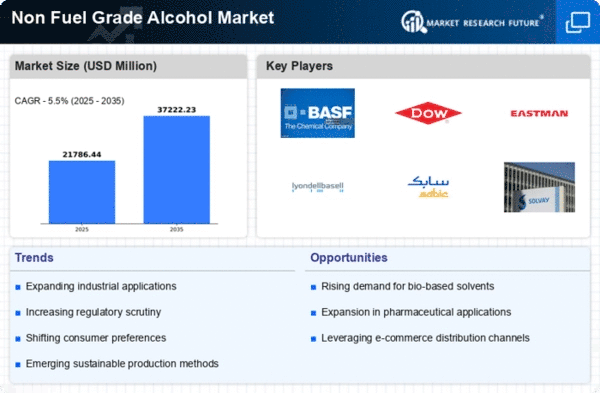
As per MRFR analysis, the Non Fuel Grade Alcohol Market Size was estimated at 20650.65 USD Million in 2024. The Non Fuel Grade Alcohol industry is projected to grow from 21786.85 USD Million in 2025 to 37222.23 USD Million by 2035, exhibiting a compound annual growth rate (CAGR) of 5.5 during the forecast period 2025 - 2035.

Key Market Trends & Highlights

The Non Fuel Grade Alcohol Market is experiencing robust growth driven by sustainability and technological advancements.

  • North America remains the largest market for non fuel grade alcohol, driven by diverse applications across various industries.
  • Asia-Pacific is identified as the fastest-growing region, reflecting increasing demand for personal care and cosmetic products.
  • The pharmaceutical segment continues to dominate the market, while the cosmetics segment is witnessing rapid growth due to changing consumer preferences.
  • Key market drivers include the rising demand for personal care products and the expansion of the food and beverage sector.

Market Size & Forecast

2024 Market Size 20650.65 (USD Million)
2035 Market Size 37222.23 (USD Million)
CAGR (2025 - 2035) 5.5%
Largest Regional Market Share in 2024 North America

Major Players

<p>BASF SE (DE), Dow Inc. (US), Eastman Chemical Company (US), LyondellBasell Industries N.V. (NL), SABIC (SA), Solvay S.A. (BE), Mitsubishi Chemical Corporation (JP), AkzoNobel N.V. (NL), Huntsman Corporation (US)</p>

Market Trends

The Non Fuel Grade Alcohol Market is currently experiencing a dynamic evolution, driven by various factors that influence consumer preferences and industrial applications. This sector encompasses a wide range of products, including ethanol and isopropanol, which are utilized in diverse industries such as pharmaceuticals, cosmetics, and food processing. The growing demand for eco-friendly and sustainable alternatives is prompting manufacturers to innovate and adapt their offerings, thereby reshaping the competitive landscape. Furthermore, regulatory frameworks are becoming increasingly stringent, compelling producers to ensure compliance with safety and quality standards, which may impact production processes and costs. In addition, the Non Fuel Grade Alcohol Market is witnessing a shift towards bio-based alcohols, as consumers and businesses alike seek greener solutions. This trend is likely to foster collaboration between agricultural sectors and chemical manufacturers, potentially leading to advancements in production techniques. As the market continues to evolve, stakeholders must remain vigilant to emerging trends and consumer demands, which could dictate future growth trajectories and investment opportunities. Overall, the Non Fuel Grade Alcohol Market appears poised for continued expansion, driven by innovation and a commitment to sustainability.

Sustainability Initiatives

The Non Fuel Grade Alcohol Market is increasingly influenced by sustainability initiatives, as consumers and businesses prioritize eco-friendly products. This trend encourages manufacturers to explore renewable sources for alcohol production, potentially leading to a rise in bio-based alternatives. Such initiatives not only align with consumer preferences but also comply with evolving regulatory standards.

Technological Advancements

Technological advancements are playing a crucial role in the Non Fuel Grade Alcohol Market, as innovations in production processes enhance efficiency and reduce costs. These developments may include improved fermentation techniques and the utilization of alternative feedstocks, which could lead to higher yields and lower environmental impact.

Regulatory Compliance

Regulatory compliance is becoming increasingly critical within the Non Fuel Grade Alcohol Market. Stricter safety and quality standards are prompting manufacturers to invest in quality assurance measures. This trend may result in enhanced product safety and consumer trust, ultimately shaping market dynamics.

Non Fuel Grade Alcohol Market Market Drivers

Market Growth Projections

The Global Non-Fuel Grade Alcohol Market Industry is poised for substantial growth, with projections indicating a market value of 20.6 USD Billion in 2024 and an anticipated increase to 36.5 USD Billion by 2035. This growth trajectory suggests a compound annual growth rate of 5.32% from 2025 to 2035, driven by various factors including rising consumer demand, technological advancements, and regulatory support. The market's expansion reflects broader trends in sustainability and health consciousness, positioning non-fuel grade alcohol as a vital component in multiple industries.

Regulatory Support for Biofuels

The Global Non-Fuel Grade Alcohol Market Industry benefits from favorable regulatory frameworks that promote the use of biofuels and renewable resources. Governments worldwide are implementing policies that encourage the production and consumption of bio-based alcohols, which are often derived from agricultural feedstocks. This regulatory support not only enhances the market's sustainability profile but also drives innovation in production technologies. As countries aim to reduce carbon emissions, the shift towards bio-based non-fuel grade alcohol could lead to increased investments and market expansion, aligning with global sustainability goals.

Growth in Food and Beverage Sector

The Global Non-Fuel Grade Alcohol Market Industry is significantly influenced by the expansion of the food and beverage sector. Non-fuel grade alcohol is widely used as a preservative and flavoring agent in various food products, including sauces, dressings, and alcoholic beverages. The increasing trend of craft brewing and distilling has further propelled the demand for high-quality ethanol. As the food and beverage industry continues to grow, projected to reach 36.5 USD Billion by 2035, the reliance on non-fuel grade alcohol is likely to increase, thereby enhancing the market's overall growth prospects.

Increased Awareness of Health Benefits

The Global Non-Fuel Grade Alcohol Market Industry is witnessing a surge in consumer awareness regarding the health benefits associated with certain types of alcohol, particularly in the context of low-alcohol and non-alcoholic beverages. This trend is driven by a growing emphasis on health and wellness, with consumers seeking alternatives that offer enjoyment without compromising their health. As the market for low-alcohol beverages expands, the demand for non-fuel grade alcohol is likely to rise, reflecting a shift in consumer preferences towards healthier lifestyle choices.

Rising Demand for Personal Care Products

The Global Non-Fuel Grade Alcohol Market Industry experiences a notable increase in demand for personal care products, which often utilize non-fuel grade alcohol as a key ingredient. This trend is driven by consumer preferences for natural and organic formulations, leading to a surge in the use of ethanol in cosmetics and skincare. For instance, the global market for personal care products is projected to reach approximately 20.6 USD Billion in 2024, with non-fuel grade alcohol playing a pivotal role in formulations. This shift towards cleaner beauty products suggests a sustained growth trajectory for the industry, as consumers increasingly prioritize health and wellness.

Technological Advancements in Production

Technological innovations in the production of non-fuel grade alcohol are reshaping the Global Non-Fuel Grade Alcohol Market Industry. Advances in fermentation processes and distillation techniques have improved efficiency and reduced costs, making it more feasible for manufacturers to produce high-quality alcohol at scale. These innovations are particularly relevant as the market anticipates a compound annual growth rate of 5.32% from 2025 to 2035. Enhanced production capabilities not only meet rising consumer demand but also contribute to the overall competitiveness of the industry in the global marketplace.

Market Segment Insights

By Application: Pharmaceuticals (Largest) vs. Cosmetics (Fastest-Growing)

<p>The Non Fuel Grade Alcohol Market exhibits varied market share distribution among its application segments, with Pharmaceuticals holding the largest share. This segment is primarily driven by the increasing demand for alcohol-based solutions in the healthcare sector, including sanitizers, disinfectants, and pharmaceuticals. In contrast, the Cosmetics segment is experiencing rapid growth due to rising consumer awareness regarding personal care and hygiene products, which incorporate alcohol in formulations to enhance efficacy and preservation. The driving factors behind the growth within this segment are multifaceted. The increasing emphasis on health and wellness has led to higher consumption of pharmaceutical products, which utilize non fuel grade alcohols as solvents or preservatives. Additionally, the cosmetics segment is anticipated to grow as innovative formulations and product offerings emerge, catering to a more discerning consumer base seeking quality and safety in their personal care products.</p>

<p>Pharmaceuticals: Dominant vs. Cosmetics: Emerging</p>

<p>Pharmaceuticals represent a dominant force within the Non Fuel Grade Alcohol Market, positioned as a key player driven by the healthcare industry's stringent requirements for quality and safety. This sector utilizes non fuel grade alcohols extensively for the production of various medical formulations, sanitizers, and antiseptics. Meanwhile, the Cosmetics segment is emerging rapidly, fueled by consumer trends favoring products that prioritize health, cleanliness, and effectiveness. Modern consumers are increasingly inclined toward cosmetic products that are effective yet safe, thus driving innovation in formulations that include non fuel grade alcohols. Companies are responding with a range of alcohol-infused cosmetic items designed to meet consumer needs while adhering to safety standards, positioning this segment for substantial growth.</p>

By End Use: Household (Largest) vs. Commercial (Fastest-Growing)

<p>In the Non Fuel Grade Alcohol Market, the 'End Use' segment showcases distinct distribution among its values. The Household segment holds the largest share, driven largely by consumer preferences for personal care products and household cleaners that utilize non fuel grade alcohol. On the other hand, the Commercial segment is gaining traction, reflecting an increasing demand from various industries utilizing alcohol for sanitization and disinfection purposes. The market distribution clearly highlights the significance of household applications while recognizing the rapid growth potential within commercial avenues.</p>

<p>Household (Dominant) vs. Commercial (Emerging)</p>

<p>The Household segment stands as a dominant player in the Non Fuel Grade Alcohol Market, characterized by its extensive application in cleaning products, personal care items, and home remedies. Consumers' focus on hygiene and well-being has propelled this segment to a leading position among end uses. Conversely, the Commercial segment is emerging rapidly, spurred by heightened awareness of cleanliness in public spaces and workplaces. Industries are increasingly opting for non fuel grade alcohol for disinfection, driving its demand across sectors such as healthcare, hospitality, and food services. This shift not only showcases the adaptability of non fuel grade alcohol but also illustrates the evolving consumer and business preferences towards maintaining sanitary environments.</p>

By Type: Ethanol (Largest) vs. Isopropanol (Fastest-Growing)

<p>In the Non Fuel Grade Alcohol Market, ethanol holds the largest market share, driven by its extensive use in various industries, including food and beverages, pharmaceuticals, and cosmetics. Isopropanol follows as a significant contender, particularly appreciated for its effectiveness as a solvent and disinfectant, particularly in healthcare settings. Methanol and butanol make up the remaining segments, with methanol used in chemical synthesis and butanol finding applications in personal care products and coatings.</p>

<p>Ethanol (Dominant) vs. Isopropanol (Emerging)</p>

<p>Ethanol is the dominant force in the Non Fuel Grade Alcohol Market, known for its versatility and broad applications. Its ability to act as a solvent, preservative, and base in numerous formulations positions it as a staple in many industries. Conversely, isopropanol is emerging rapidly due to its rising use in cleaning products and sanitizers, especially in response to increased health and hygiene awareness. While ethanol’s established market presence and regulatory support give it a robust standing, isopropanol's growth is spurred by innovation and changing consumer preferences, indicating a dynamic shift within the segment.</p>

By Purity Level: Food Grade (Largest) vs. Pharmaceutical Grade (Fastest-Growing)

<p>In the Non-Fuel Grade Alcohol Market, the Food Grade segment holds a significant share due to its widespread use in food and beverage applications. This segment benefits from stringent regulations that ensure quality and purity, which consumers and manufacturers alike prioritize. Meanwhile, the Pharmaceutical Grade segment, while smaller in market share, is experiencing rapid growth as demand increases for medical applications that require high-quality alcohol formulations, including sanitizers and solvents. The growth in the Pharmaceutical Grade segment can be attributed to the expanding pharmaceutical industry and heightened hygiene awareness in the wake of global health events. Innovations in formulations and the rising investment in research and development further propel this segment’s expansion. Overall, the increasing applications of non-fuel grade alcohol across industries illustrate a dynamic market landscape favoring both stability and growth in different purity levels.</p>

<p>Food Grade (Dominant) vs. Technical Grade (Emerging)</p>

<p>The Food Grade segment stands as the dominant player in the Non-Fuel Grade Alcohol Market, primarily owing to its essential role in food and beverage production. Its formulations are tailored to meet strict safety and quality standards, making it a reliable choice for producers. On the other hand, the Technical Grade segment is emerging as a key player, driven by its diverse applications in industrial processes. While not designed for consumption, it serves various sectors such as chemical manufacturing and cosmetics. The growing trend of sustainability and eco-friendly production methods is likely to enhance the appeal of technical grade alcohols as companies seek innovative solutions for cleaner processes.</p>

By Source: Synthetic (Largest) vs. Natural (Fastest-Growing)

<p>In the Non Fuel Grade Alcohol Market, the source segment is primarily divided into two categories: synthetic and natural. Synthetic alcohol dominates the market, holding a sizable share due to its widespread use in industrial applications and consistent supply chains. Natural alcohol, while smaller in market share, is progressively carving out its niche, driven by the growing consumer preference for organic and sustainably sourced products, particularly in the cosmetic and food sectors.</p>

<p>Synthetic (Dominant) vs. Natural (Emerging)</p>

<p>Synthetic alcohols are derived from petrochemical processes, providing a reliable and cost-effective source for many industries, including chemical manufacturing and pharmaceuticals. Their consistency and scalability in production make them the dominant force in the Non Fuel Grade Alcohol Market. Conversely, natural alcohols, sourced from renewable agricultural products, are gaining traction due to increasing consumer awareness about health and sustainability. They are particularly favored in the beverage and personal care industries, reflecting a shift towards greener products. The demand for naturally derived alcohols is expected to rise, heralding a transformative trend as eco-conscious consumers drive market growth.</p>

Get more detailed insights about Non-Fuel Grade Alcohol Market Research Report — Global Forecast till 2035

Regional Insights

North America : Market Leader in Non Fuel Grade Alcohol

North America is poised to maintain its leadership in the Non Fuel Grade Alcohol market, holding a significant market share of 10390.39 million. The region's growth is driven by increasing demand in various sectors, including pharmaceuticals and personal care, alongside favorable regulatory frameworks that promote sustainable practices. The shift towards bio-based products is also a key catalyst for market expansion. The United States stands as the largest contributor, with major players like BASF SE, Dow Inc., and Eastman Chemical Company leading the competitive landscape. The presence of advanced manufacturing facilities and robust R&D initiatives further strengthens the market. As companies innovate to meet consumer demands, North America is expected to continue its dominance in the global market.

Europe : Emerging Market with Growth Potential

Europe is witnessing a notable surge in the Non Fuel Grade Alcohol market, with a market size of 6178.65 million. The region benefits from stringent regulations that encourage the use of eco-friendly products, driving demand across various industries. The European Union's commitment to sustainability and green chemistry is a significant growth driver, fostering innovation and investment in this sector. Leading countries such as Germany, France, and the UK are at the forefront of this market, supported by key players like LyondellBasell Industries N.V. and SABIC. The competitive landscape is characterized by a mix of established companies and emerging startups, all vying for market share. As the region continues to prioritize sustainability, the Non Fuel Grade Alcohol market is expected to thrive.

Asia-Pacific : Rapid Growth in Emerging Economies

Asia-Pacific is rapidly emerging as a significant player in the Non Fuel Grade Alcohol market, with a market size of 3580.13 million. The region's growth is fueled by increasing industrialization, urbanization, and rising consumer awareness regarding sustainable products. Countries like China and India are leading this growth, supported by favorable government policies that encourage the use of bio-based chemicals. The competitive landscape is evolving, with both local and international players, including Mitsubishi Chemical Corporation and AkzoNobel N.V., striving to capture market share. As demand for non-fuel grade alcohols rises in sectors such as cosmetics and food processing, Asia-Pacific is set to become a key market in the coming years, driven by innovation and investment.

Middle East and Africa : Emerging Market with Unique Challenges

The Middle East and Africa region is gradually developing its Non Fuel Grade Alcohol market, currently valued at 501.48 million. The growth is primarily driven by increasing industrial activities and a shift towards sustainable practices. However, challenges such as regulatory hurdles and limited infrastructure can impede rapid growth. Governments are beginning to recognize the potential of this market, leading to gradual policy changes that support its development. Countries like South Africa and the UAE are emerging as key players in this market, with local companies and international firms exploring opportunities. The presence of major players like Huntsman Corporation indicates a growing interest in the region. As investments in infrastructure and technology improve, the Non Fuel Grade Alcohol market in the Middle East and Africa is expected to expand significantly.

Key Players and Competitive Insights

The Non Fuel Grade Alcohol Market is characterized by a dynamic competitive landscape, driven by increasing demand for bio-based products and stringent regulations on fossil fuels. Key players such as BASF SE (Germany), Dow Inc. (US), and Eastman Chemical Company (US) are strategically positioned to leverage innovation and sustainability in their operations. BASF SE (Germany) focuses on expanding its portfolio of bio-based alcohols, which aligns with global sustainability trends. Meanwhile, Dow Inc. (US) emphasizes digital transformation and supply chain optimization to enhance operational efficiency and reduce costs. Eastman Chemical Company (US) is actively pursuing partnerships to bolster its product offerings and market reach, indicating a collective shift towards collaboration in the industry.

The market structure appears moderately fragmented, with several players vying for market share. Key business tactics include localizing manufacturing to reduce transportation costs and enhance responsiveness to regional demands. This strategy not only optimizes supply chains but also allows companies to adapt to local market conditions more effectively. The influence of major players is significant, as their strategic initiatives often set benchmarks for smaller competitors, thereby shaping the overall competitive environment.

In November 2025, BASF SE (Germany) announced the launch of a new line of bio-based alcohols derived from renewable resources, which is expected to enhance its market position significantly. This strategic move underscores the company's commitment to sustainability and innovation, potentially attracting environmentally conscious consumers and businesses alike. The introduction of these products may also serve to differentiate BASF from competitors who are slower to adapt to the growing demand for sustainable alternatives.

In October 2025, Dow Inc. (US) unveiled a comprehensive digital strategy aimed at integrating AI and machine learning into its production processes. This initiative is likely to streamline operations and improve product quality, thereby enhancing customer satisfaction. By investing in advanced technologies, Dow positions itself as a leader in operational excellence, which could provide a competitive edge in a market that increasingly values efficiency and innovation.

In September 2025, Eastman Chemical Company (US) entered into a strategic partnership with a leading renewable energy firm to co-develop sustainable alcohol products. This collaboration is indicative of a broader trend towards strategic alliances in the industry, as companies seek to pool resources and expertise to accelerate product development. Such partnerships may not only enhance product offerings but also expand market access, allowing Eastman to capitalize on emerging opportunities in the sustainable sector.

As of December 2025, the Non Fuel Grade Alcohol Market is witnessing trends that emphasize digitalization, sustainability, and technological integration. The competitive landscape is increasingly shaped by strategic alliances, which facilitate innovation and resource sharing among key players. Moving forward, differentiation is likely to evolve from traditional price-based competition to a focus on innovation, technology, and supply chain reliability. Companies that can effectively leverage these trends will likely secure a competitive advantage in this rapidly changing market.

Key Companies in the Non Fuel Grade Alcohol Market market include

Industry Developments

January 2023: Cargill has been named the winner in the 2023 BIG Innovation Awards presented by the Business Intelligence Group.

September 2022: CropEnergies acquires stake in Dutch biobased chemicals start-up Syclus: CropEnergies AG, Mannheim, Germany, has acquired a stake in the Dutch. start-up for biobased chemicals Syclus BV, Maastricht. CropEnergies purchases 50 percent of the company's share capital. The investment volume amounts to EUR 1.8 million.

October 2021: Pannonia Bio Wins Icheme Global Energy Award 2021: team of Pannonia Bio engineers and experts were named winners of the IChemE Energy Award 2021 for their success with the project “Decarbonizing biorefineries to produce greener bioethanol”. These awards are organized by the Institution of Chemical Engineers, a group that exists to advance chemical engineering’s contribution for the benefit of society.

Future Outlook

Non Fuel Grade Alcohol Market Future Outlook

<p>The Non Fuel Grade Alcohol Market is projected to grow at a 5.5% CAGR from 2024 to 2035, driven by increasing demand in pharmaceuticals, cosmetics, and food industries.</p>

New opportunities lie in:

  • <p>Expansion into emerging markets with tailored product offerings.</p>
  • <p>Development of eco-friendly production processes to attract sustainability-focused consumers.</p>
  • <p>Investment in advanced distribution networks to enhance market reach and efficiency.</p>

<p>By 2035, the Non Fuel Grade Alcohol Market is expected to achieve robust growth and diversification.</p>

Market Segmentation

Non Fuel Grade Alcohol Market Type Outlook

  • Ethanol
  • Isopropanol
  • Methanol
  • Butanol

Non Fuel Grade Alcohol Market Source Outlook

  • Synthetic
  • Natural

Non Fuel Grade Alcohol Market End Use Outlook

  • Household
  • Commercial
  • Industrial
  • Research and Development

Non Fuel Grade Alcohol Market Application Outlook

  • Pharmaceuticals
  • Cosmetics
  • Food and Beverage
  • Industrial Solvents
  • Personal Care

Non Fuel Grade Alcohol Market Purity Level Outlook

  • Food Grade
  • Pharmaceutical Grade
  • Technical Grade

Report Scope

MARKET SIZE 202420650.65(USD Million)
MARKET SIZE 202521786.85(USD Million)
MARKET SIZE 203537222.23(USD Million)
COMPOUND ANNUAL GROWTH RATE (CAGR)5.5% (2024 - 2035)
REPORT COVERAGERevenue Forecast, Competitive Landscape, Growth Factors, and Trends
BASE YEAR2024
Market Forecast Period2025 - 2035
Historical Data2019 - 2024
Market Forecast UnitsUSD Million
Key Companies ProfiledBASF SE (DE), Dow Inc. (US), Eastman Chemical Company (US), LyondellBasell Industries N.V. (NL), SABIC (SA), Solvay S.A. (BE), Mitsubishi Chemical Corporation (JP), AkzoNobel N.V. (NL), Huntsman Corporation (US)
Segments CoveredApplication, End Use, Type, Purity Level, Source
Key Market OpportunitiesGrowing demand for sustainable and bio-based products in the Non Fuel Grade Alcohol Market presents significant opportunities.
Key Market DynamicsRising consumer demand for sustainable products drives innovation in the Non Fuel Grade Alcohol Market.
Countries CoveredNorth America, Europe, APAC, South America, MEA

FAQs

How much is the Non-Fuel Grade Alcohol Market?

US$ 19747.03 Mn

What is the growth rate of the Non-Fuel Grade Alcohol Market?

5.50%

Which region held the largest market share in the Non-Fuel Grade Alcohol Market?

Europe

Who are the key players in the Non-Fuel Grade Alcohol Market?

Archer-Daniels-Midland Company (US), Cargill Incorporated (US), Sasol (South Africa), Merck KGaA (Germany), CropEnergies AG (Germany), LyondellBasell Industries NV (Netherlands), Pannonia Bio (Hungary), Wilmar Sugar Pty Ltd. (Singapore), Godavari Biorefineries Ltd (India), Solvay (Belgium)

Which Type had the largest market share in the Non-Fuel Grade Alcohol Market?

Food Grade

Which Application had the largest market share in the Non-Fuel Grade Alcohol Market?

Food &amp; Beverages

  1. EXECUTIVE SUMMARY
  2. GLOBAL NON-FUEL
  3. GRADE ALCOHOL MARKET, BY type
  4. GLOBAL NON-FUEL GRADE ALCOHOL MARKET, BY Application
  5. GLOBAL NON-FUEL
  6. GRADE ALCOHOL MARKET analysis, BY Region
  7. MARKET INTRODUCTION
    1. DEFINITION
    2. Scope of the Study
    3. MARKET STRUCTURE
  8. RESEARCH METHODOLOGY
    1. RESEARCH PROCESS
    2. PRIMARY RESEARCH
    3. SECONDARY RESEARCH
    4. MARKET SIZE ESTIMATION
    5. FORECAST MODEL
    6. List of Assumptions
  9. market dynamics
    1. introduction
    2. Drivers
      1. Increasing use of Non-Fuel Grade Alcohol in
    3. food & beverages industry
    4. restraints
      1. raw material prices hampering the market growth
    5. opportunities
      1. Rising Demand in the Pharmaceuticals
    6. and Personal Care Industries
    7. cHALLENGES
      1. adverse effects of non-fuel grade alcohol
  10. MARKET FACTOR ANALYSIS
    1. SUPPLY CHAIN ANALYSIS
      1. Raw Materials Suppliers
      2. NON-FUEL GRADE ALCOHOL Manufacturers
      3. Distribution Channels
      4. Application
    2. PORTER’S FIVE
      1. Threat of Substitutes
      2. Bargaining Power of Buyers
      3. Intensity of Rivalry
    3. FORCES MODEL
    4. Threat of New Entrants
    5. Bargaining Power of Suppliers
    6. Pricing analysis by Region, USD/Ton, 2019-2021
    7. Impact of Covid-19
      1. Impact on Supply Chain on Global Non-Fuel Grade
    8. on the global market for Non-Fuel Grade Alcohol
    9. Alcohol Market
  11. GLOBAL NON-FUEL GRADE ALCOHOL MARKET, BY TYPE
    1. OVERVIEW
      1. NON-FUEL GRADE ALCOHOL: MARKET ESTIMATES &
      2. NON-FUEL GRADE ALCOHOL: MARKET ESTIMATES & FORECAST BY TYPE,
    2. FORECAST BY TYPE, 2019–2030
    3. Food Grade
    4. FOOD GRADE: MARKET ESTIMATES & FORECAST BY region,2019–2030
    5. Pharmaceutical Grade
      1. PHARMACEUTICAL
    6. GRADE: MARKET ESTIMATES & FORECAST BY region,2019–2030
    7. Lab Grade
      1. LAB GRADE: MARKET ESTIMATES
    8. & FORECAST BY region,2019–2030
    9. Industrial Grade
      1. Industrial Grade: MARKET ESTIMATES & FORECAST
    10. BY region,2019–2030
    11. OTHERS
      1. OTHERS: MARKET ESTIMATES & FORECAST BY region,2019–2030
  12. GLOBAL NON-FUEL GRADE
  13. ALCOHOL MARKET, BY APPLICATION
    1. OVERVIEW
      1. NON-FUEL GRADE ALCOHOL: MARKET ESTIMATES & FORECAST BY APPLICATION,
    2. NON-FUEL GRADE ALCOHOL: MARKET ESTIMATES & FORECAST BY APPLICATION, 2019–2030
    3. FOOD & BEVERAGES
    4. PHARMACEUTICALS
      1. PHARMACEUTICALS:
    5. MARKET ESTIMATES & FORECAST BY region,2019–2030
    6. COSMETICS & PERSONAL CARE
    7. CHEMICAL SOLVENT
    8. others
  14. global NON-FUEL GRADE
    1. ALCOHOL MARKET by type in application
    2. OVERVIEW
      1. NON-FUEL GRADE ALCOHOL: MARKET ESTIMATES & FORECAST
      2. NON-FUEL GRADE ALCOHOL: MARKET ESTIMATES & FORECAST BY type
    3. BY type in APPLICATION, 2019-2030
    4. in APPLICATION, 2019–2030
  15. GLOBAL NON-FUEL GRADE ALCOHOL MARKET, BY REGION
    1. OVERVIEW
    2. NORTH AMERICA
      1. US
      2. canada
    3. europe
      1. germany
      2. france
      3. Italy
      4. Spain and Portugal
      5. UK and Ireland
      6. Austria and Switzerland
      7. Benelux
      8. Nordics (Sweden, Norway, Denmark)
      9. central and eastern
      10. GCC Countries
      11. South Africa
      12. Rest of Middle East & Africa
    4. europe
    5. southern Europe
    6. asia-pacific
    7. China
    8. India
    9. Japan
    10. South Korea
    11. Rest of Asia-Pacific
    12. Latin America
    13. Brazil
    14. Mexico
    15. Argentina
    16. Rest of Latin America
    17. Middle East & Africa
  16. COMPETITIVE LANDSCAPE
    1. introduction
    2. Global Market Strategy Analysis
    3. COMPETITIVE BENCHMARKING
    4. KEY DEVELOPMENTS
      1. COMPANY OVERVIEW
      2. FINANCIAL OVERVIEW
      3. PRODUCTS OFFERed
      4. KEY DEVELOPMENTS
      5. SWOT ANALYSIS
      6. KEY STRATEGIES
    5. and GROWTH STRATEGIES
    6. RECOGNITION
    7. Acquisition
    8. COMPANY PROFILES
    9. Archer Daniels Midland Company
    10. Cargill, Incorporated
      1. COMPANY OVERVIEW
      2. FINANCIAL OVERVIEW
      3. PRODUCTS OFFERed
      4. KEY DEVELOPMENTS
      5. SWOT ANALYSIS
      6. KEY STRATEGIES
    11. Sasol
      1. COMPANY OVERVIEW
      2. FINANCIAL OVERVIEW
      3. PRODUCTS OFFERed
      4. KEY DEVELOPMENTS
      5. SWOT ANALYSIS
      6. KEY STRATEGIES
    12. Merck KGaA
      1. COMPANY OVERVIEW
      2. FINANCIAL OVERVIEW
      3. PRODUCTS OFFERed
      4. KEY DEVELOPMENTS
      5. SWOT ANALYSIS
      6. KEY STRATEGIES
    13. CropEnergies AG
      1. COMPANY OVERVIEW
      2. FINANCIAL OVERVIEW
      3. PRODUCTS OFFERed
      4. KEY DEVELOPMENTS
      5. SWOT ANALYSIS
      6. KEY STRATEGIES
    14. LyondellBasell Industries Holdings BV
      1. COMPANY OVERVIEW
      2. FINANCIAL OVERVIEW
      3. PRODUCTS OFFERed
      4. KEY DEVELOPMENTS
      5. SWOT ANALYSIS
      6. KEY STRATEGIES
    15. Pannonia Bio
      1. COMPANY OVERVIEW
      2. FINANCIAL OVERVIEW
      3. PRODUCTS OFFERed
      4. KEY DEVELOPMENTS
      5. SWOT ANALYSIS
      6. KEY STRATEGIES
    16. Wilmar Sugar Pty
    17. Ltd.
    18. COMPANY OVERVIEW
    19. FINANCIAL OVERVIEW
    20. PRODUCTS OFFERed
    21. KEY DEVELOPMENTS
  17. SWOT ANALYSIS
    1. KEY STRATEGIES
    2. Godavari Biorefineries Ltd
  18. COMPANY OVERVIEW
  19. FINANCIAL OVERVIEW
  20. PRODUCTS OFFERed
  21. KEY DEVELOPMENTS
  22. SWOT ANALYSIS
  23. KEY STRATEGIES
    1. Solvay
      1. COMPANY OVERVIEW
      2. FINANCIAL OVERVIEW
      3. PRODUCTS OFFERed
      4. KEY DEVELOPMENTS
      5. SWOT ANALYSIS
      6. KEY STRATEGIES
  24. APPENDIX
    1. REFERENCES
    2. RELATED REPORTS
  25. LIST OF TABLES
  26. LIST OF ASSUMPTIONS
  27. NON-FUEL GRADE ALCOHOL MARKET ESTIMATES &
    1. FORECAST, BY TYPE, 2019–2030 (USD MILLION)
  28. NON-FUEL GRADE ALCOHOL MARKET ESTIMATES &
    1. FORECAST, BY TYPE, 2019–2030 (KILOTONS)
  29. FOOD GRADE MARKET ESTIMATES & FORECAST,
    1. BY REGION, 2019–2030 (USD MILLION)
  30. FOOD GRADE MARKET ESTIMATES & FORECAST, BY REGION,
  31. PHARMACEUTICAL GRADE MARKET ESTIMATES & FORECAST, BY REGION,
  32. PHARMACEUTICAL GRADE MARKET ESTIMATES & FORECAST, BY REGION,
  33. LAB GRADE MARKET ESTIMATES & FORECAST, BY REGION, 2019–2030
    1. (USD MILLION)
    2. TABLE
  34. LAB GRADE MARKET ESTIMATES & FORECAST, BY REGION, 2019–2030 (KILOTONS)
  35. INDUSTRIAL GRADE
  36. MARKET ESTIMATES & FORECAST, BY REGION, 2019–2030 (USD MILLION)
  37. INDUSTRIAL GRADE
  38. MARKET ESTIMATES & FORECAST, BY REGION, 2019–2030 (KILOTONS)
  39. OTHERS MARKET
    1. ESTIMATES & FORECAST, BY REGION, 2019–2030 (USD MILLION)
  40. OTHERS MARKET ESTIMATES
    1. & FORECAST, BY REGION, 2019–2030 (KILOTONS)
  41. NON-FUEL GRADE ALCOHOL MARKET ESTIMATES
    1. & FORECAST, BY APPLICATION, 2019–2030 (USD MILLION)
  42. NON-FUEL GRADE ALCOHOL
  43. MARKET ESTIMATES & FORECAST, BY APPLICATION, 2019–2030 (KILOTONS)
  44. FOOD & BEVERAGES
  45. MARKET ESTIMATES & FORECAST, BY REGION, 2019–2030 (USD MILLION)
  46. FOOD & BEVERAGES
  47. MARKET ESTIMATES & FORECAST, BY REGION, 2019–2030 (KILOTONS)
  48. PHARMACEUTICALS
  49. MARKET ESTIMATES & FORECAST, BY REGION, 2019–2030 (USD MILLION)
  50. PHARMACEUTICALS
  51. MARKET ESTIMATES & FORECAST, BY REGION, 2019–2030 (KILOTONS)
  52. COSMETICS &
  53. PERSONAL CARE MARKET ESTIMATES & FORECAST, BY REGION, 2019–2030 (USD MILLION)
  54. COSMETICS &
  55. PERSONAL CARE MARKET ESTIMATES & FORECAST, BY REGION, 2019–2030 (KILOTONS)
  56. CHEMICAL SOLVENT
  57. MARKET ESTIMATES & FORECAST, BY REGION, 2019–2030 (USD MILLION)
  58. CHEMICAL SOLVENT
  59. MARKET ESTIMATES & FORECAST, BY REGION, 2019–2030 (KILOTONS)
  60. OTHERS MARKET
    1. ESTIMATES & FORECAST, BY REGION, 2019–2030 (USD MILLION)
  61. OTHERS MARKET ESTIMATES
    1. & FORECAST, BY REGION, 2019–2030 (KILOTONS)
  62. NON-FUEL GRADE ALCOHOL MARKET ESTIMATES
    1. & FORECAST, BY TYPE IN APPLICATION, 2019–2030 (USD MILLION)
  63. NON-FUEL GRADE
  64. ALCOHOL MARKET ESTIMATES & FORECAST, BY TYPE IN APPLICATION, 2019–2030
    1. (KILOTONS)
    2. TABLE
  65. GLOBAL NON-FUEL GRADE ALCOHOL MARKET, BY REGION, 2019–2030 (USD MILLION)
  66. GLOBAL NON-FUEL
  67. GRADE ALCOHOL MARKET, BY REGION, 2019–2030 (KILOTONS)
  68. NORTH AMERICA: NON-FUEL GRADE ALCOHOL MARKET,
    1. BY COUNTRY, 2019–2030 (USD MILLION)
  69. NORTH AMERICA: NON-FUEL GRADE ALCOHOL MARKET,
    1. BY COUNTRY, 2019–2030 (KILOTONS)
  70. NORTH AMERICA: NON-FUEL GRADE ALCOHOL MARKET, BY
    1. TYPE, 2019–2030 (USD MILLION)
  71. NORTH AMERICA: NON-FUEL GRADE ALCOHOL MARKET, BY
    1. TYPE, 2019–2030 (KILOTONS)
  72. NORTH AMERICA: NON-FUEL GRADE ALCOHOL MARKET, BY APPLICATION,
  73. NORTH AMERICA: NON-FUEL GRADE ALCOHOL MARKET, BY APPLICATION,
  74. NORTH AMERICA: NON-FUEL GRADE ALCOHOL MARKET, BY TYPE IN APPLICATION,
  75. NORTH AMERICA: NON-FUEL GRADE ALCOHOL MARKET, BY TYPE IN APPLICATION,
  76. US: NON-FUEL GRADE ALCOHOL MARKET, BY TYPE, 2019–2030
    1. (USD MILLION)
    2. TABLE
  77. US: NON-FUEL GRADE ALCOHOL MARKET, BY TYPE, 2019–2030 (KILOTONS)
  78. US: NON-FUEL
  79. GRADE ALCOHOL MARKET, BY APPLICATION, 2019–2030 (USD MILLION)
  80. US: NON-FUEL GRADE ALCOHOL
  81. MARKET, BY APPLICATION, 2019–2030 (KILOTONS)
  82. US: NON-FUEL GRADE ALCOHOL MARKET, BY TYPE
    1. IN APPLICATION, 2019–2030 (USD MILLION)
  83. US: NON-FUEL GRADE ALCOHOL MARKET, BY TYPE
    1. IN APPLICATION, 2019–2030 (KILOTONS
  84. CANADA: NON-FUEL GRADE ALCOHOL MARKET, BY
    1. TYPE, 2019–2030 (USD MILLION)
  85. CANADA: NON-FUEL GRADE ALCOHOL MARKET, BY TYPE,
  86. CANADA:: NON-FUEL GRADE ALCOHOL MARKET, BY APPLICATION, 2019–2030
    1. (USD MILLION)
    2. TABLE
  87. CANADA: NON-FUEL GRADE ALCOHOL MARKET, BY APPLICATION, 2019–2030 (KILOTONS)
  88. CANADA: NON-FUEL
  89. GRADE ALCOHOL MARKET, BY TYPE IN APPLICATION, 2019–2030 (USD MILLION)
  90. CANADA: NON-FUEL
  91. GRADE ALCOHOL MARKET, BY TYPE IN APPLICATION, 2019–2030 (KILOTONS
  92. EUROPE: NON-FUEL
  93. GRADE ALCOHOL MARKET, BY COUNTRY, 2019–2030 (USD MILLION)
  94. EUROPE: NON-FUEL GRADE
  95. ALCOHOL MARKET, BY COUNTRY, 2019–2030 (KILOTONS)
  96. EUROPE: NON-FUEL GRADE ALCOHOL MARKET, BY
    1. TYPE, 2019–2030 (USD MILLION)
  97. EUROPE: NON-FUEL GRADE ALCOHOL MARKET, BY TYPE,
  98. EUROPE: NON-FUEL GRADE ALCOHOL MARKET, BY APPLICATION, 2019–2030
    1. (USD MILLION)
    2. TABLE
  99. EUROPE: NON-FUEL GRADE ALCOHOL MARKET, BY APPLICATION, 2019–2030 (KILOTONS)
  100. EUROPE: NON-FUEL
  101. GRADE ALCOHOL MARKET, BY TYPE IN APPLICATION, 2019–2030 (USD MILLION)
  102. EUROPE: NON-FUEL
  103. GRADE ALCOHOL MARKET, BY TYPE IN APPLICATION, 2019–2030 (KILOTONS
  104. GERMANY: NON-FUEL
  105. GRADE ALCOHOL MARKET, BY TYPE, 2019–2030 (USD MILLION)
  106. GERMANY: NON-FUEL GRADE ALCOHOL MARKET,
    1. BY TYPE, 2019–2030 (KILOTONS)
  107. GERMANY: NON-FUEL GRADE ALCOHOL MARKET, BY APPLICATION,
  108. GERMANY: NON-FUEL GRADE ALCOHOL MARKET, BY APPLICATION, 2019–2030
    1. (KILOTONS)
    2. TABLE
  109. GERMANY: NON-FUEL GRADE ALCOHOL MARKET, BY TYPE IN APPLICATION, 2019–2030
    1. (USD MILLION)
    2. TABLE
  110. GERMANY: NON-FUEL GRADE ALCOHOL MARKET, BY TYPE IN APPLICATION, 2019–2030
    1. (KILOTONS
    2. TABLE
  111. FRANCE: NON-FUEL GRADE ALCOHOL MARKET, BY TYPE, 2019–2030 (USD MILLION)
  112. FRANCE: NON-FUEL
  113. GRADE ALCOHOL MARKET, BY TYPE, 2019–2030 (KILOTONS)
  114. FRANCE: NON-FUEL GRADE ALCOHOL MARKET, BY
    1. APPLICATION, 2019–2030 (USD MILLION)
  115. FRANCE: NON-FUEL GRADE ALCOHOL MARKET, BY
    1. APPLICATION, 2019–2030 (KILOTONS)
  116. FRANCE: NON-FUEL GRADE ALCOHOL MARKET, BY TYPE
    1. IN APPLICATION, 2019–2030 (USD MILLION)
  117. FRANCE: NON-FUEL GRADE ALCOHOL MARKET, BY
    1. TYPE IN APPLICATION, 2019–2030 (KILOTONS
  118. ITALY: NON-FUEL GRADE ALCOHOL MARKET, BY
    1. TYPE, 2019–2030 (USD MILLION)
  119. ITALY: NON-FUEL GRADE ALCOHOL MARKET, BY TYPE,
  120. ITALY: NON-FUEL GRADE ALCOHOL MARKET, BY APPLICATION, 2019–2030
    1. (USD MILLION)
    2. TABLE
  121. ITALY: NON-FUEL GRADE ALCOHOL MARKET, BY APPLICATION, 2019–2030 (KILOTONS)
  122. ITALY: NON-FUEL
  123. GRADE ALCOHOL MARKET, BY TYPE IN APPLICATION, 2019–2030 (USD MILLION)
  124. ITALY: NON-FUEL
  125. GRADE ALCOHOL MARKET, BY TYPE IN APPLICATION, 2019–2030 (KILOTONS
  126. SPAIN AND PORTUGAL:
  127. NON-FUEL GRADE ALCOHOL MARKET, BY TYPE, 2019–2030 (USD MILLION)
  128. SPAIN AND PORTUGAL:
  129. NON-FUEL GRADE ALCOHOL MARKET, BY TYPE, 2019–2030 (KILOTONS)
  130. SPAIN AND PORTUGAL:
  131. NON-FUEL GRADE ALCOHOL MARKET, BY APPLICATION, 2019–2030 (USD MILLION)
  132. SPAIN AND PORTUGAL:
  133. NON-FUEL GRADE ALCOHOL MARKET, BY APPLICATION, 2019–2030 (KILOTONS)
  134. SPAIN AND PORTUGAL:
  135. NON-FUEL GRADE ALCOHOL MARKET, BY TYPE IN APPLICATION, 2019–2030 (USD MILLION)
  136. SPAIN AND PORTUGAL:
  137. NON-FUEL GRADE ALCOHOL MARKET, BY TYPE IN APPLICATION, 2019–2030 (KILOTONS
  138. UK AND IRELAND:
  139. NON-FUEL GRADE ALCOHOL MARKET, BY TYPE, 2019–2030 (USD MILLION)
  140. UK AND IRELAND:
  141. NON-FUEL GRADE ALCOHOL MARKET, BY TYPE, 2019–2030 (KILOTONS)
  142. UK AND IRELAND: NON-FUEL
  143. GRADE ALCOHOL MARKET, BY APPLICATION, 2019–2030 (USD MILLION)
  144. UK AND IRELAND: NON-FUEL
  145. GRADE ALCOHOL MARKET, BY APPLICATION, 2019–2030 (KILOTONS)
  146. UK AND IRELAND: NON-FUEL
  147. GRADE ALCOHOL MARKET, BY TYPE IN APPLICATION, 2019–2030 (USD MILLION)
  148. UK AND IRELAND:
  149. NON-FUEL GRADE ALCOHOL MARKET, BY TYPE IN APPLICATION, 2019–2030 (KILOTONS
  150. AUSTRIA AND
  151. SWITZERLAND: NON-FUEL GRADE ALCOHOL MARKET, BY TYPE, 2019–2030 (USD MILLION)
  152. AUSTRIA AND
  153. SWITZERLAND: NON-FUEL GRADE ALCOHOL MARKET, BY TYPE, 2019–2030 (KILOTONS)
  154. AUSTRIA AND
    1. SWITZERLANDNON-FUEL GRADE ALCOHOL MARKET, BY

Non-Fuel Grade Alcohol Market Segmentation

Market Segmentation Overview

  • Detailed segmentation data will be available in the full report
  • Comprehensive analysis by multiple parameters
  • Regional and country-level breakdowns
  • Market size forecasts by segment
Infographic

Free Sample Request

Kindly complete the form below to receive a free sample of this Report

Get Free Sample

Customer Strories

Compare Licence

×
Features License Type
Single User Multiuser License Enterprise User
Price $4,950 $5,950 $7,250
Maximum User Access Limit 1 User Upto 10 Users Unrestricted Access Throughout the Organization
Free Customization
Direct Access to Analyst
Deliverable Format
Platform Access
Discount on Next Purchase 10% 15% 15%
Printable Versions