×
Hero Background
English
Chinese
French
Japanese
Korean
German
Spanish

Next Generation Computing Market Share

ID: MRFR/ICT/10696-CR
128 Pages
Shubham Munde
March 2024

Next Generation Computing Market Research Report Information By Computing Type (Cloud Computing, High-Performance Computing, Edge Computing, Energy Efficiency Computing, Memory-Driven Computing, Neuromorphic computing, Optical Computing, Quantum Computing, Approximate and Probabilistic Computing, and Others), By Component (Hardware, Software, and Services), By Deployment Type (Cloud and On-Premises), By Organization Size (Large Enterprises and SME), By End-Use (IT & Telecom, BFSI, Retail, Healthcare, Aerospace & Defense,, Manufacturi... read more

Share:
Download PDF ×

We do not share your information with anyone. However, we may send you emails based on your report interest from time to time. You may contact us at any time to opt-out.

Next Generation Computing Market Infographic
Purchase Options

Market Share

Next Generation Computing Market Share Analysis

In the dynamic landscape of the Next Generation Computing market, companies employ various market share positioning strategies to gain a competitive edge and establish their presence. One prevalent approach is differentiation, where companies focus on offering unique features or capabilities to distinguish themselves from competitors. By emphasizing innovation and cutting-edge technology, these companies attract customers seeking advanced solutions tailored to their specific needs. For instance, a company might develop proprietary software algorithms or incorporate state-of-the-art hardware components to set their products apart in terms of performance and functionality.

Another strategy is cost leadership, wherein companies aim to become the most cost-efficient provider within the market segment. By optimizing production processes, streamlining supply chains, and minimizing overhead costs, these companies can offer competitive pricing while maintaining profitability. This approach appeals to budget-conscious customers looking for affordable yet reliable solutions. Additionally, economies of scale play a crucial role in cost leadership, allowing companies to spread fixed costs across a larger output volume, further driving down per-unit costs.

Market segmentation is also a key strategy employed by companies in the Next Generation Computing market. Rather than targeting the entire market with a generic offering, companies identify specific customer segments with distinct needs and preferences. By tailoring products and marketing messages to address the unique requirements of each segment, companies can effectively penetrate niche markets and capture a larger share of the overall market. For example, a company might develop specialized computing solutions for industries such as healthcare, finance, or automotive, catering to the specific computational demands and regulatory requirements of each sector.

Collaboration and partnerships are increasingly common strategies in the Next Generation Computing market, allowing companies to leverage each other's strengths and resources to mutual benefit. By forming strategic alliances with complementary businesses or technology providers, companies can access new markets, expand their product portfolios, and enhance their competitive position. Collaborative ventures may involve joint research and development efforts, co-marketing initiatives, or integration of products and services to deliver comprehensive solutions to customers.

Furthermore, vertical integration is a strategic approach adopted by some companies in the Next Generation Computing market to strengthen their position along the value chain. By acquiring or establishing control over suppliers, distributors, or complementary businesses, companies can reduce dependency on external partners, improve supply chain efficiency, and capture a larger portion of the value created within the industry. Vertical integration offers companies greater control over quality, pricing, and distribution channels, allowing them to better align their offerings with market demand and customer preferences.


Author
Shubham Munde
Research Analyst Level II

With a technical background in information technology & semiconductors, Shubham has 4.5+ years of experience in market research and analytics with the tasks of data mining, analysis, and project execution. He is the POC for our clients, for their consulting projects running under the ICT/Semiconductor domain. Shubham holds a Bachelor’s in Information and Technology and a Master of Business Administration (MBA). Shubham has executed over 150 research projects for our clients under the brand name Market Research Future in the last 2 years. His core skill is building the research respondent relation for gathering the primary information from industry and market estimation for niche markets. He is having expertise in conducting secondary & primary research, market estimations, market projections, competitive analysis, analysing current market trends and market dynamics, deep-dive analysis on market scenarios, consumer behaviour, technological impact analysis, consulting, analytics, etc. He has worked on fortune 500 companies' syndicate and consulting projects along with several government projects. He has worked on the projects of top tech brands such as IBM, Google, Microsoft, AWS, Meta, Oracle, Cisco Systems, Samsung, Accenture, VMware, Schneider Electric, Dell, HP, Ericsson, and so many others. He has worked on Metaverse, Web 3.0, Zero-Trust security, cyber-security, blockchain, quantum computing, robotics, 5G technology, High-Performance computing, data centers, AI, automation, IT equipment, sensors, semiconductors, consumer electronics and so many tech domain projects.

Leave a Comment

FAQs

What is the projected market valuation for the Next Generation Computing Market in 2035?

The projected market valuation for the Next Generation Computing Market in 2035 is approximately 4145305.32 USD Million.

What was the overall market valuation for the Next Generation Computing Market in 2024?

The overall market valuation for the Next Generation Computing Market in 2024 was 756743.95 USD Million.

What is the expected CAGR for the Next Generation Computing Market during the forecast period 2025 - 2035?

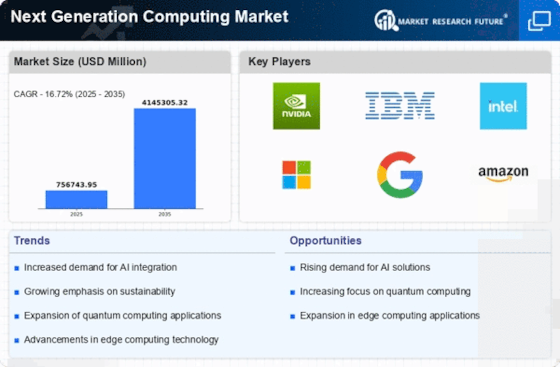
The expected CAGR for the Next Generation Computing Market during the forecast period 2025 - 2035 is 16.72%.

Which companies are considered key players in the Next Generation Computing Market?

Key players in the Next Generation Computing Market include NVIDIA, IBM, Intel, Microsoft, Google, Amazon, Oracle, Alibaba, and Samsung.

Market Summary

As per MRFR analysis, the Next Generation Computing Market Size was estimated at 756743.95 USD Million in 2024. The Next Generation Computing industry is projected to grow from 883273.3 USD Million in 2025 to 4145305.32 USD Million by 2035, exhibiting a compound annual growth rate (CAGR) of 16.72 during the forecast period 2025 - 2035.

Key Market Trends & Highlights

The Next Generation Computing Market is poised for transformative growth driven by technological advancements and increasing demand.

  • Quantum computing advancements are reshaping computational capabilities, particularly in North America. Artificial intelligence integration is becoming ubiquitous across various sectors, enhancing operational efficiencies. Edge computing expansion is facilitating real-time data processing, especially in the Asia-Pacific region. The rising demand for high-performance computing and the emergence of quantum computing are key drivers of market growth.

Market Size & Forecast

2024 Market Size 756743.95 (USD Million)
2035 Market Size 4145305.32 (USD Million)
CAGR (2025 - 2035) 16.72%
Largest Regional Market Share in 2024 North America

Major Players

<p>NVIDIA (US), IBM (US), Intel (US), Microsoft (US), Google (US), Amazon (US), Oracle (US), Alibaba (CN), Samsung (KR)</p>

Market Trends

The Next Generation Computing Market is currently experiencing a transformative phase characterized by rapid advancements in technology and increasing demand for innovative solutions. This market encompasses a wide array of technologies, including quantum computing, artificial intelligence, and edge computing, which are reshaping the landscape of computing capabilities. As organizations seek to enhance efficiency and drive digital transformation, the integration of these advanced technologies is becoming paramount. The ongoing evolution in hardware and software is likely to facilitate unprecedented levels of performance and scalability, thereby attracting significant investment and interest from various sectors. Moreover, the Next Generation Computing Market appears to be influenced by a growing emphasis on sustainability and energy efficiency. Companies are increasingly prioritizing eco-friendly practices, which may lead to the development of greener computing solutions. This shift not only addresses environmental concerns but also aligns with the broader corporate responsibility initiatives that many organizations are adopting. As the market continues to evolve, it is essential to monitor these trends closely, as they could shape the future of computing in profound ways.

Quantum Computing Advancements

The Next Generation Computing Market is witnessing notable progress in quantum computing technologies. These advancements promise to revolutionize problem-solving capabilities across various industries, enabling complex computations that were previously unattainable. As research institutions and private enterprises invest in this field, the potential applications range from cryptography to drug discovery, suggesting a paradigm shift in computational power.

Artificial Intelligence Integration

Artificial intelligence is becoming increasingly integrated into computing systems, enhancing their functionality and efficiency. This trend indicates a movement towards more intelligent systems capable of learning and adapting to user needs. The incorporation of AI into various applications may lead to improved decision-making processes and automation, thereby transforming traditional computing paradigms.

Edge Computing Expansion

The expansion of edge computing is reshaping the Next Generation Computing Market by bringing data processing closer to the source of data generation. This trend appears to address latency issues and bandwidth constraints, facilitating real-time data analysis and decision-making. As more devices become interconnected, the demand for edge computing solutions is likely to grow, further driving innovation in this sector.

Next Generation Computing Market Market Drivers

Rising Cybersecurity Concerns

Rising cybersecurity concerns are becoming a crucial driver in the Next Generation Computing Market. As digital transformation accelerates, organizations face heightened risks of cyber threats and data breaches. This has led to an increased focus on developing robust cybersecurity measures that can protect sensitive information and maintain operational integrity. The cybersecurity market is projected to exceed 300 billion dollars by 2024, underscoring the urgency for advanced security solutions. In response, the Next Generation Computing Market is likely to see the integration of advanced security protocols and technologies, such as AI-driven threat detection and blockchain-based security frameworks. This emphasis on cybersecurity is essential for fostering trust and ensuring the safe adoption of next-generation computing technologies.

Emergence of Quantum Computing

The Next Generation Computing Market is on the brink of a transformative shift with the emergence of quantum computing. This technology promises to revolutionize problem-solving capabilities, particularly in fields such as cryptography, materials science, and complex system modeling. Quantum computers leverage the principles of quantum mechanics to perform calculations at unprecedented speeds, potentially solving problems that are currently intractable for classical computers. As investments in quantum research and development continue to rise, the market is expected to witness substantial growth. Industry analysts suggest that the quantum computing market could reach 10 billion dollars by 2027, reflecting the increasing interest and potential applications of this groundbreaking technology. The integration of quantum computing into existing infrastructures may redefine the competitive landscape within the Next Generation Computing Market.

Expansion of Edge Computing Solutions

The expansion of edge computing solutions is significantly influencing the Next Generation Computing Market. As the Internet of Things (IoT) continues to proliferate, the need for processing data closer to the source has become increasingly apparent. Edge computing reduces latency and bandwidth usage, enabling real-time data processing and analysis. This shift is particularly relevant in sectors such as manufacturing, healthcare, and smart cities, where timely data insights are critical. The edge computing market is anticipated to grow to approximately 15 billion dollars by 2025, reflecting the increasing reliance on decentralized computing architectures. This trend is likely to drive innovation within the Next Generation Computing Market, as companies seek to develop more efficient and responsive computing solutions.

Increased Demand for High-Performance Computing

The Next Generation Computing Market is experiencing a surge in demand for high-performance computing (HPC) solutions. This demand is driven by the need for advanced data processing capabilities across various sectors, including finance, healthcare, and scientific research. As organizations increasingly rely on data analytics and simulations, the market for HPC is projected to grow significantly. According to recent estimates, the HPC market is expected to reach a valuation of over 50 billion dollars by 2026. This growth is indicative of the broader trend towards more powerful computing solutions that can handle complex tasks efficiently. Consequently, the Next Generation Computing Market is likely to see a proliferation of HPC technologies, which may include enhanced processors, memory architectures, and software solutions designed to optimize performance.

Artificial Intelligence and Machine Learning Integration

The integration of artificial intelligence (AI) and machine learning (ML) technologies is a pivotal driver in the Next Generation Computing Market. Organizations are increasingly adopting AI and ML to enhance operational efficiency, improve decision-making, and drive innovation. The market for AI in computing is projected to grow at a compound annual growth rate (CAGR) of over 40%, indicating a robust demand for intelligent computing solutions. This integration allows for the development of smarter applications that can learn from data and adapt to changing conditions. As AI and ML continue to evolve, they are likely to play a crucial role in shaping the future of the Next Generation Computing Market, leading to the creation of more sophisticated and autonomous systems.

Market Segment Insights

By Type: Cloud Computing (Largest) vs. Quantum Computing (Fastest-Growing)

<p>In the Next Generation Computing Market, Cloud Computing has emerged as the largest segment, driven by the increasing demand for scalable resources and flexible access to computing power. Following closely, High-Performance Computing and Edge Computing are also significant contributors, catering to specific industry needs such as real-time analytics and processing large datasets. Other segments like Neuromorphic and Optical Computing, while smaller in market share, are beginning to carve out niches in specialized applications. The growth trends within this market reflect the accelerating adoption of advanced technologies. The surge in <a href="https://www.marketresearchfuture.com/reports/cloud-computing-market-1013">Cloud Computing</a> is fueled by businesses shifting to digital operations, while Quantum Computing is rapidly gaining traction due to its potential to solve complex problems that traditional computing cannot. Factors such as AI integration and data-intensive applications are critical in driving these segments forward, promoting innovation and new use cases across industries.</p>

<p>Computing Type: Cloud Computing (Dominant) vs. Quantum Computing (Emerging)</p>

<p>Cloud Computing stands out as the dominant force in the Next Generation Computing Market, offering flexibility, scalability, and cost-efficiency to businesses across various sectors. It provides on-demand access to a shared pool of configurable computing resources, which allows organizations to dynamically scale their operations according to need. In contrast, Quantum Computing represents the emerging frontier in this space, with its unique ability to perform calculations at unprecedented speeds, leveraging quantum bits for enhanced processing capabilities. While still in the early adoption stage, Quantum Computing is poised to revolutionize industries such as cryptography, materials science, and complex system simulation. Together, these segment values illustrate a compelling evolution in computing technology, where established solutions adapt to modern demands while new paradigms open doors to innovative possibilities.</p>

By Component: Hardware (Largest) vs. Services (Fastest-Growing)

<p>The Next Generation Computing Market is primarily segmented into three core components: Hardware, Software, and Services, with Hardware commanding the largest market share. This dominance is attributed to continuous advancements in computing power and the proliferation of high-performance computing devices that cater to demanding applications. On the other hand, Services are witnessing rapid expansion due to the growing adoption of cloud computing and managed service solutions that offer flexibility and scalability to businesses.</p>

<p>Hardware (Dominant) vs. Services (Emerging)</p>

<p>Hardware remains the dominant segment in the Next Generation Computing Market, as it encompasses essential components such as processors, memory, and storage solutions tailored for advanced computing needs. Major players focus on enhancing performance and energy efficiency to meet evolving demands. In contrast, Services are emerging as a pivotal segment, driven by the increasing reliance on cloud-based solutions and <a href="https://www.marketresearchfuture.com/reports/managed-services-market-2424">IT managed services</a> that allow companies to optimize their operations. This shift towards Service-oriented models highlights a demand for expertise in implementation and maintenance, making it a crucial aspect of the market growth.</p>

By Deployment Type: Cloud (Largest) vs. On-Premises (Fastest-Growing)

<p>In the Next Generation Computing Market, the deployment type of solutions showcases a clear market share distribution between Cloud and On-Premises segments. Cloud deployment holds the largest share due to its scalability, flexibility, and accessibility benefits that cater to a wide range of enterprises. Organizations increasingly prefer cloud-based services for their cost-effectiveness and minimal infrastructure management requirements, solidifying their dominance in the market. On the other hand, On-Premises deployments are witnessing a surge in popularity as businesses seek enhanced security and control over their data, thus gradually increasing their market presence.</p>

<p>Deployment Type: Cloud (Dominant) vs. On-Premises (Emerging)</p>

<p>The Cloud deployment segment presents itself as the dominant force in the Next Generation Computing Market, characterized by its extensive adoption across various industries. Organizations capitalize on the advantages of cloud solutions such as reduced operational costs, rapid deployment, and the ease of accessing computing resources anytime, anywhere. Conversely, On-Premises solutions are emerging as a vital segment, driven by concerns over data security, compliance, and control. Organizations, particularly in regulated sectors, are increasingly investing in on-premises infrastructure to meet stringent data protection requirements. This blend of deployment type preferences reflects a market dynamic wherein businesses choose the deployment that best aligns with their operational goals while navigating the challenges of digital transformation.</p>

By Organization Size: Large Enterprises (Largest) vs. SME (Fastest-Growing)

<p>In the Next Generation Computing Market, the distribution of market share among different organization sizes reveals a clear dominance by large enterprises. These organizations leverage advanced computing technologies at a scale that allows them to optimize operations, drive innovation, and enhance productivity. With significant investments in infrastructure, large enterprises are able to implement next-generation solutions more effectively, contributing to their substantial share in the market.</p>

<p>Organization Size: Large Enterprises (Dominant) vs. SME (Emerging)</p>

<p>Large enterprises stand as the dominant force in the Next Generation Computing Market, characterized by their extensive resources, skilled workforce, and ability to adopt cutting-edge technologies swiftly. They explore a range of solutions from artificial intelligence to cloud computing, thus fostering an ecosystem ripe for innovation. In contrast, small to medium enterprises (SMEs) are emerging rapidly as a significant player, driven by the affordability and accessibility of next-generation computing solutions. While they may operate on a smaller scale, their agile nature allows them to swiftly adapt and implement new technologies, thus capturing the attention of technology providers eager to tap into this growing segment.</p>

By End-Use: IT & Telecom (Largest) vs. Healthcare (Fastest-Growing)

<p>In the Next Generation Computing Market, the 'End-Use' segment showcases varying market shares across diverse industries. <a href="https://www.marketresearchfuture.com/reports/telecom-it-market-26552">IT &amp; Telecom</a> is the largest sector, leveraging advanced computing to enhance connectivity and service delivery, while Healthcare stands out as the fastest-growing segment, driven by the urgent need for digital transformation and improved patient outcomes. Other significant sectors include BFSI, Retail, and Manufacturing, each contributing to a robust landscape where technology is reshaping traditional practices.</p>

<p>IT &amp; Telecom: Dominant vs. Healthcare: Emerging</p>

<p>IT &amp; Telecom has established itself as the dominant end-use sector in the Next Generation Computing Market, characterized by a high demand for cloud computing, artificial intelligence, and big data analytics. This sector continuously evolves to meet the needs of both consumers and enterprises, emphasizing seamless connectivity and innovation. On the other hand, Healthcare is emerging rapidly, fueled by the integration of next-generation computing technologies to enable telemedicine, electronic health records, and data analytics for personalized medicine. This shift not only enhances operational efficiencies but significantly improves patient care, positioning Healthcare as a critical area of growth.</p>

Get more detailed insights about Next Generation Computing Market Research Report—Global Forecast till 2035

Regional Insights

North America : Innovation and Leadership Hub

North America is the largest market for Next Generation Computing Market, holding approximately 45% of the global share. The region benefits from robust investments in R&D, a strong tech ecosystem, and favorable government policies that promote innovation. The demand for advanced computing solutions is driven by sectors such as healthcare, finance, and education, which are increasingly adopting AI and cloud technologies. The United States leads the market, with key players like NVIDIA, IBM, and Microsoft driving advancements. The competitive landscape is characterized by rapid technological developments and strategic partnerships. The presence of major tech firms fosters a vibrant startup ecosystem, further enhancing the region's market position.

Europe : Emerging Tech Powerhouse

Europe is witnessing significant growth in the Next Generation Computing Market, accounting for about 30% of the global share. The region's growth is fueled by increasing digital transformation initiatives and government support for technology adoption. Regulatory frameworks, such as the EU's Digital Single Market strategy, are catalyzing investments in advanced computing technologies, particularly in AI and quantum computing. Leading countries include Germany, France, and the UK, which are home to numerous tech startups and established firms. The competitive landscape is marked by collaboration between academia and industry, fostering innovation. Key players like SAP and Siemens are actively contributing to the market, enhancing Europe's position in the global tech arena.

Asia-Pacific : Rapid Growth and Adoption

Asia-Pacific is rapidly emerging as a significant player in the Next Generation Computing Market, holding around 20% of the global share. The region's growth is driven by increasing investments in technology infrastructure, a burgeoning startup ecosystem, and rising demand for cloud computing and AI solutions. Countries like China and India are at the forefront, supported by government initiatives that promote digital transformation and innovation. China is the largest market in the region, with major companies like Alibaba and Samsung leading the charge. The competitive landscape is dynamic, with a mix of established firms and innovative startups. The region's focus on research and development is fostering advancements in computing technologies, positioning Asia-Pacific as a key player in the global market.

Middle East and Africa : Emerging Tech Landscape

The Middle East and Africa are gradually developing their Next Generation Computing Market, currently holding about 5% of the global share. The growth is driven by increasing investments in technology infrastructure and a rising demand for digital solutions across various sectors. Governments in the region are implementing initiatives to enhance digital capabilities, which is expected to boost market growth in the coming years. Countries like South Africa and the UAE are leading the charge, with a growing number of tech startups and investments from global players. The competitive landscape is evolving, with local firms collaborating with international companies to enhance their technological capabilities. This collaboration is crucial for the region's advancement in The Next Generation Computing Market.

Key Players and Competitive Insights

The Next Generation Computing Market is characterized by rapid technological advancements and a competitive landscape that is increasingly shaped by innovation and strategic partnerships. Key players such as NVIDIA (US), IBM (US), and Google (US) are at the forefront, leveraging their strengths in artificial intelligence, cloud computing, and high-performance computing to drive growth. NVIDIA (US) focuses on enhancing its GPU capabilities, which are critical for AI and machine learning applications, while IBM (US) emphasizes quantum computing and hybrid cloud solutions. Google (US) continues to invest heavily in its cloud infrastructure and AI-driven services, indicating a strong commitment to maintaining its competitive edge in this dynamic market.

The market structure appears moderately fragmented, with a mix of established giants and emerging players. Companies are adopting various business tactics, such as localizing manufacturing and optimizing supply chains, to enhance operational efficiency and responsiveness to market demands. This collective influence of key players fosters a competitive environment where innovation and strategic positioning are paramount, allowing companies to differentiate themselves in a crowded marketplace.

In September 2025, NVIDIA (US) announced a strategic partnership with a leading automotive manufacturer to develop AI-driven autonomous vehicle technologies. This collaboration is poised to enhance NVIDIA's presence in the automotive sector, showcasing its commitment to expanding the applications of its GPU technology beyond traditional computing. The partnership not only reinforces NVIDIA's leadership in AI but also aligns with the growing demand for smart transportation solutions.

In August 2025, IBM (US) unveiled its latest quantum computing system, which promises to significantly increase computational power for complex problem-solving. This launch is a critical step in IBM's strategy to position itself as a leader in quantum technology, potentially revolutionizing industries such as pharmaceuticals and finance. The implications of this advancement could be profound, as it may enable breakthroughs that were previously unattainable with classical computing methods.

In July 2025, Google (US) expanded its cloud services by introducing a new suite of AI tools aimed at enhancing data analytics capabilities for businesses. This move reflects Google's ongoing strategy to integrate AI into its cloud offerings, thereby attracting a broader customer base. By enhancing its service portfolio, Google not only strengthens its competitive position but also addresses the increasing demand for data-driven decision-making in various sectors.

As of October 2025, the competitive trends in the Next Generation Computing Market are increasingly defined by digitalization, sustainability, and the integration of AI technologies. Strategic alliances are becoming more prevalent, as companies recognize the value of collaboration in driving innovation and addressing complex challenges. Looking ahead, competitive differentiation is likely to evolve from traditional price-based competition to a focus on technological innovation, reliability in supply chains, and the ability to deliver sustainable solutions. This shift underscores the importance of agility and foresight in navigating the future landscape of the Next Generation Computing Market.

Key Companies in the Next Generation Computing Market market include

Industry Developments

  • In March 2023, Intel's Habana Labs has launched second-generation Al processors for training and inferencing. In March 2022, Amphenol Corporation has expanded its SURLOK Plus Series to include 8 mm and 10.3 mm right-angle connectors, with a voltage range of 1500 VDC to meet energy storage and high-power connection and transfer requirements.
  • In September 2023, Microsoft unveiled new generative AI features across Windows, Edge, Bing and Microsoft 365. It also debuted two new laptops. Powering all these will be the redesigned Microsoft Copilot, a unified AI assistant to help people navigate across apps, operating systems and devices.

Future Outlook

Next Generation Computing Market Future Outlook

<p>The Next Generation Computing Market is projected to grow at a 16.72% CAGR from 2024 to 2035, driven by advancements in AI, quantum computing, and edge technologies.</p>

New opportunities lie in:

  • <p>Development of AI-driven cloud computing solutions</p><p>Expansion of quantum computing services for enterprises</p><p>Integration of edge computing in IoT applications</p>

<p>By 2035, the market is expected to be robust, driven by innovation and diverse applications.</p>

Market Segmentation

Next Generation Computing Market Type Outlook

  • Cloud Computing
  • High-Performance Computing
  • Edge Computing
  • Energy Efficiency Computing
  • Memory-Driven Computing
  • Neuromorphic computing
  • Optical Computing
  • Quantum Computing
  • Approximate and Probabilistic Computing
  • Others

Next Generation Computing Market End-Use Outlook

  • IT & Telecom
  • BFSI
  • Retail
  • Healthcare
  • Aerospace & Defense
  • Manufacturing
  • Energy & Utilities
  • Media & Entertainment
  • Automotive & Transportation
  • Other End-Use

Next Generation Computing Market Component Outlook

  • Hardware
  • Software
  • Services

Next Generation Computing Market Deployment Type Outlook

  • Cloud
  • On-Premises

Next Generation Computing Market Organization Size Outlook

  • Large Enterprises
  • SME

Report Scope

MARKET SIZE 2024756743.95(USD Million)
MARKET SIZE 2025883273.3(USD Million)
MARKET SIZE 20354145305.32(USD Million)
COMPOUND ANNUAL GROWTH RATE (CAGR)16.72% (2024 - 2035)
REPORT COVERAGERevenue Forecast, Competitive Landscape, Growth Factors, and Trends
BASE YEAR2024
Market Forecast Period2025 - 2035
Historical Data2019 - 2024
Market Forecast UnitsUSD Million
Key Companies ProfiledMarket analysis in progress
Segments CoveredMarket segmentation analysis in progress
Key Market OpportunitiesIntegration of artificial intelligence and quantum computing to enhance processing capabilities in the Next Generation Computing Market.
Key Market DynamicsTechnological disruptions drive innovation and competition in the Next Generation Computing Market, reshaping consumer expectations and industry standards.
Countries CoveredNorth America, Europe, APAC, South America, MEA

FAQs

What is the projected market valuation for the Next Generation Computing Market in 2035?

The projected market valuation for the Next Generation Computing Market in 2035 is approximately 4145305.32 USD Million.

What was the overall market valuation for the Next Generation Computing Market in 2024?

The overall market valuation for the Next Generation Computing Market in 2024 was 756743.95 USD Million.

What is the expected CAGR for the Next Generation Computing Market during the forecast period 2025 - 2035?

The expected CAGR for the Next Generation Computing Market during the forecast period 2025 - 2035 is 16.72%.

Which companies are considered key players in the Next Generation Computing Market?

Key players in the Next Generation Computing Market include NVIDIA, IBM, Intel, Microsoft, Google, Amazon, Oracle, Alibaba, and Samsung.

  1. SECTION I: EXECUTIVE SUMMARY AND KEY HIGHLIGHTS
    1. EXECUTIVE SUMMARY
      1. Market Overview
      2. Key Findings
      3. Market Segmentation
      4. Competitive Landscape
      5. Challenges and Opportunities
      6. Future Outlook
  2. SECTION II: SCOPING, METHODOLOGY AND MARKET STRUCTURE
    1. MARKET INTRODUCTION
      1. Definition
      2. Scope of the study
    2. RESEARCH METHODOLOGY
      1. Overview
      2. Data Mining
      3. Secondary Research
      4. Primary Research
      5. Forecasting Model
      6. Market Size Estimation
      7. Data Triangulation
      8. Validation
  3. SECTION III: QUALITATIVE ANALYSIS
    1. MARKET DYNAMICS
      1. Overview
      2. Drivers
      3. Restraints
      4. Opportunities
    2. MARKET FACTOR ANALYSIS
      1. Value chain Analysis
      2. Porter's Five Forces Analysis
      3. COVID-19 Impact Analysis
  4. SECTION IV: QUANTITATIVE ANALYSIS
    1. Information and Communications Technology, BY Type (USD Million)
      1. Cloud Computing
      2. High-Performance Computing
      3. Edge Computing
      4. Energy Efficiency Computing
      5. Memory-Driven Computing
      6. Neuromorphic computing
      7. Optical Computing
      8. Quantum Computing
      9. Approximate and Probabilistic Computing
      10. Others
    2. Information and Communications Technology, BY Component (USD Million)
      1. Hardware
      2. Software
      3. Services
    3. Information and Communications Technology, BY Deployment Type (USD Million)
      1. Cloud
      2. On-Premises
    4. Information and Communications Technology, BY Organization Size (USD Million)
      1. Large Enterprises
      2. SME
    5. Information and Communications Technology, BY End-Use (USD Million)
      1. IT & Telecom
      2. BFSI
      3. Retail
      4. Healthcare
      5. Aerospace & Defense
      6. Manufacturing
      7. Energy & Utilities
      8. Media & Entertainment
      9. Automotive & Transportation
      10. Other End-Use
    6. Information and Communications Technology, BY Region (USD Million)
      1. North America
      2. Europe
      3. APAC
      4. South America
      5. MEA
  5. SECTION V: COMPETITIVE ANALYSIS
    1. Competitive Landscape
      1. Overview
      2. Competitive Analysis
      3. Market share Analysis
      4. Major Growth Strategy in the Information and Communications Technology
      5. Competitive Benchmarking
      6. Leading Players in Terms of Number of Developments in the Information and Communications Technology
      7. Key developments and growth strategies
      8. Major Players Financial Matrix
    2. Company Profiles
      1. NVIDIA (US)
      2. IBM (US)
      3. Intel (US)
      4. Microsoft (US)
      5. Google (US)
      6. Amazon (US)
      7. Oracle (US)
      8. Alibaba (CN)
      9. Samsung (KR)
    3. Appendix
      1. References
      2. Related Reports
  6. LIST OF FIGURES
    1. MARKET SYNOPSIS
    2. NORTH AMERICA MARKET ANALYSIS
    3. US MARKET ANALYSIS BY TYPE
    4. US MARKET ANALYSIS BY COMPONENT
    5. US MARKET ANALYSIS BY DEPLOYMENT TYPE
    6. US MARKET ANALYSIS BY ORGANIZATION SIZE
    7. US MARKET ANALYSIS BY END-USE
    8. CANADA MARKET ANALYSIS BY TYPE
    9. CANADA MARKET ANALYSIS BY COMPONENT
    10. CANADA MARKET ANALYSIS BY DEPLOYMENT TYPE
    11. CANADA MARKET ANALYSIS BY ORGANIZATION SIZE
    12. CANADA MARKET ANALYSIS BY END-USE
    13. EUROPE MARKET ANALYSIS
    14. GERMANY MARKET ANALYSIS BY TYPE
    15. GERMANY MARKET ANALYSIS BY COMPONENT
    16. GERMANY MARKET ANALYSIS BY DEPLOYMENT TYPE
    17. GERMANY MARKET ANALYSIS BY ORGANIZATION SIZE
    18. GERMANY MARKET ANALYSIS BY END-USE
    19. UK MARKET ANALYSIS BY TYPE
    20. UK MARKET ANALYSIS BY COMPONENT
    21. UK MARKET ANALYSIS BY DEPLOYMENT TYPE
    22. UK MARKET ANALYSIS BY ORGANIZATION SIZE
    23. UK MARKET ANALYSIS BY END-USE
    24. FRANCE MARKET ANALYSIS BY TYPE
    25. FRANCE MARKET ANALYSIS BY COMPONENT
    26. FRANCE MARKET ANALYSIS BY DEPLOYMENT TYPE
    27. FRANCE MARKET ANALYSIS BY ORGANIZATION SIZE
    28. FRANCE MARKET ANALYSIS BY END-USE
    29. RUSSIA MARKET ANALYSIS BY TYPE
    30. RUSSIA MARKET ANALYSIS BY COMPONENT
    31. RUSSIA MARKET ANALYSIS BY DEPLOYMENT TYPE
    32. RUSSIA MARKET ANALYSIS BY ORGANIZATION SIZE
    33. RUSSIA MARKET ANALYSIS BY END-USE
    34. ITALY MARKET ANALYSIS BY TYPE
    35. ITALY MARKET ANALYSIS BY COMPONENT
    36. ITALY MARKET ANALYSIS BY DEPLOYMENT TYPE
    37. ITALY MARKET ANALYSIS BY ORGANIZATION SIZE
    38. ITALY MARKET ANALYSIS BY END-USE
    39. SPAIN MARKET ANALYSIS BY TYPE
    40. SPAIN MARKET ANALYSIS BY COMPONENT
    41. SPAIN MARKET ANALYSIS BY DEPLOYMENT TYPE
    42. SPAIN MARKET ANALYSIS BY ORGANIZATION SIZE
    43. SPAIN MARKET ANALYSIS BY END-USE
    44. REST OF EUROPE MARKET ANALYSIS BY TYPE
    45. REST OF EUROPE MARKET ANALYSIS BY COMPONENT
    46. REST OF EUROPE MARKET ANALYSIS BY DEPLOYMENT TYPE
    47. REST OF EUROPE MARKET ANALYSIS BY ORGANIZATION SIZE
    48. REST OF EUROPE MARKET ANALYSIS BY END-USE
    49. APAC MARKET ANALYSIS
    50. CHINA MARKET ANALYSIS BY TYPE
    51. CHINA MARKET ANALYSIS BY COMPONENT
    52. CHINA MARKET ANALYSIS BY DEPLOYMENT TYPE
    53. CHINA MARKET ANALYSIS BY ORGANIZATION SIZE
    54. CHINA MARKET ANALYSIS BY END-USE
    55. INDIA MARKET ANALYSIS BY TYPE
    56. INDIA MARKET ANALYSIS BY COMPONENT
    57. INDIA MARKET ANALYSIS BY DEPLOYMENT TYPE
    58. INDIA MARKET ANALYSIS BY ORGANIZATION SIZE
    59. INDIA MARKET ANALYSIS BY END-USE
    60. JAPAN MARKET ANALYSIS BY TYPE
    61. JAPAN MARKET ANALYSIS BY COMPONENT
    62. JAPAN MARKET ANALYSIS BY DEPLOYMENT TYPE
    63. JAPAN MARKET ANALYSIS BY ORGANIZATION SIZE
    64. JAPAN MARKET ANALYSIS BY END-USE
    65. SOUTH KOREA MARKET ANALYSIS BY TYPE
    66. SOUTH KOREA MARKET ANALYSIS BY COMPONENT
    67. SOUTH KOREA MARKET ANALYSIS BY DEPLOYMENT TYPE
    68. SOUTH KOREA MARKET ANALYSIS BY ORGANIZATION SIZE
    69. SOUTH KOREA MARKET ANALYSIS BY END-USE
    70. MALAYSIA MARKET ANALYSIS BY TYPE
    71. MALAYSIA MARKET ANALYSIS BY COMPONENT
    72. MALAYSIA MARKET ANALYSIS BY DEPLOYMENT TYPE
    73. MALAYSIA MARKET ANALYSIS BY ORGANIZATION SIZE
    74. MALAYSIA MARKET ANALYSIS BY END-USE
    75. THAILAND MARKET ANALYSIS BY TYPE
    76. THAILAND MARKET ANALYSIS BY COMPONENT
    77. THAILAND MARKET ANALYSIS BY DEPLOYMENT TYPE
    78. THAILAND MARKET ANALYSIS BY ORGANIZATION SIZE
    79. THAILAND MARKET ANALYSIS BY END-USE
    80. INDONESIA MARKET ANALYSIS BY TYPE
    81. INDONESIA MARKET ANALYSIS BY COMPONENT
    82. INDONESIA MARKET ANALYSIS BY DEPLOYMENT TYPE
    83. INDONESIA MARKET ANALYSIS BY ORGANIZATION SIZE
    84. INDONESIA MARKET ANALYSIS BY END-USE
    85. REST OF APAC MARKET ANALYSIS BY TYPE
    86. REST OF APAC MARKET ANALYSIS BY COMPONENT
    87. REST OF APAC MARKET ANALYSIS BY DEPLOYMENT TYPE
    88. REST OF APAC MARKET ANALYSIS BY ORGANIZATION SIZE
    89. REST OF APAC MARKET ANALYSIS BY END-USE
    90. SOUTH AMERICA MARKET ANALYSIS
    91. BRAZIL MARKET ANALYSIS BY TYPE
    92. BRAZIL MARKET ANALYSIS BY COMPONENT
    93. BRAZIL MARKET ANALYSIS BY DEPLOYMENT TYPE
    94. BRAZIL MARKET ANALYSIS BY ORGANIZATION SIZE
    95. BRAZIL MARKET ANALYSIS BY END-USE
    96. MEXICO MARKET ANALYSIS BY TYPE
    97. MEXICO MARKET ANALYSIS BY COMPONENT
    98. MEXICO MARKET ANALYSIS BY DEPLOYMENT TYPE
    99. MEXICO MARKET ANALYSIS BY ORGANIZATION SIZE
    100. MEXICO MARKET ANALYSIS BY END-USE
    101. ARGENTINA MARKET ANALYSIS BY TYPE
    102. ARGENTINA MARKET ANALYSIS BY COMPONENT
    103. ARGENTINA MARKET ANALYSIS BY DEPLOYMENT TYPE
    104. ARGENTINA MARKET ANALYSIS BY ORGANIZATION SIZE
    105. ARGENTINA MARKET ANALYSIS BY END-USE
    106. REST OF SOUTH AMERICA MARKET ANALYSIS BY TYPE
    107. REST OF SOUTH AMERICA MARKET ANALYSIS BY COMPONENT
    108. REST OF SOUTH AMERICA MARKET ANALYSIS BY DEPLOYMENT TYPE
    109. REST OF SOUTH AMERICA MARKET ANALYSIS BY ORGANIZATION SIZE
    110. REST OF SOUTH AMERICA MARKET ANALYSIS BY END-USE
    111. MEA MARKET ANALYSIS
    112. GCC COUNTRIES MARKET ANALYSIS BY TYPE
    113. GCC COUNTRIES MARKET ANALYSIS BY COMPONENT
    114. GCC COUNTRIES MARKET ANALYSIS BY DEPLOYMENT TYPE
    115. GCC COUNTRIES MARKET ANALYSIS BY ORGANIZATION SIZE
    116. GCC COUNTRIES MARKET ANALYSIS BY END-USE
    117. SOUTH AFRICA MARKET ANALYSIS BY TYPE
    118. SOUTH AFRICA MARKET ANALYSIS BY COMPONENT
    119. SOUTH AFRICA MARKET ANALYSIS BY DEPLOYMENT TYPE
    120. SOUTH AFRICA MARKET ANALYSIS BY ORGANIZATION SIZE
    121. SOUTH AFRICA MARKET ANALYSIS BY END-USE
    122. REST OF MEA MARKET ANALYSIS BY TYPE
    123. REST OF MEA MARKET ANALYSIS BY COMPONENT
    124. REST OF MEA MARKET ANALYSIS BY DEPLOYMENT TYPE
    125. REST OF MEA MARKET ANALYSIS BY ORGANIZATION SIZE
    126. REST OF MEA MARKET ANALYSIS BY END-USE
    127. KEY BUYING CRITERIA OF INFORMATION AND COMMUNICATIONS TECHNOLOGY
    128. RESEARCH PROCESS OF MRFR
    129. DRO ANALYSIS OF INFORMATION AND COMMUNICATIONS TECHNOLOGY
    130. DRIVERS IMPACT ANALYSIS: INFORMATION AND COMMUNICATIONS TECHNOLOGY
    131. RESTRAINTS IMPACT ANALYSIS: INFORMATION AND COMMUNICATIONS TECHNOLOGY
    132. SUPPLY / VALUE CHAIN: INFORMATION AND COMMUNICATIONS TECHNOLOGY
    133. INFORMATION AND COMMUNICATIONS TECHNOLOGY, BY TYPE, 2024 (% SHARE)
    134. INFORMATION AND COMMUNICATIONS TECHNOLOGY, BY TYPE, 2024 TO 2035 (USD Million)
    135. INFORMATION AND COMMUNICATIONS TECHNOLOGY, BY COMPONENT, 2024 (% SHARE)
    136. INFORMATION AND COMMUNICATIONS TECHNOLOGY, BY COMPONENT, 2024 TO 2035 (USD Million)
    137. INFORMATION AND COMMUNICATIONS TECHNOLOGY, BY DEPLOYMENT TYPE, 2024 (% SHARE)
    138. INFORMATION AND COMMUNICATIONS TECHNOLOGY, BY DEPLOYMENT TYPE, 2024 TO 2035 (USD Million)
    139. INFORMATION AND COMMUNICATIONS TECHNOLOGY, BY ORGANIZATION SIZE, 2024 (% SHARE)
    140. INFORMATION AND COMMUNICATIONS TECHNOLOGY, BY ORGANIZATION SIZE, 2024 TO 2035 (USD Million)
    141. INFORMATION AND COMMUNICATIONS TECHNOLOGY, BY END-USE, 2024 (% SHARE)
    142. INFORMATION AND COMMUNICATIONS TECHNOLOGY, BY END-USE, 2024 TO 2035 (USD Million)
    143. BENCHMARKING OF MAJOR COMPETITORS
  7. LIST OF TABLES
    1. LIST OF ASSUMPTIONS
    2. North America MARKET SIZE ESTIMATES; FORECAST
      1. BY TYPE, 2025-2035 (USD Million)
      2. BY COMPONENT, 2025-2035 (USD Million)
      3. BY DEPLOYMENT TYPE, 2025-2035 (USD Million)
      4. BY ORGANIZATION SIZE, 2025-2035 (USD Million)
      5. BY END-USE, 2025-2035 (USD Million)
    3. US MARKET SIZE ESTIMATES; FORECAST
      1. BY TYPE, 2025-2035 (USD Million)
      2. BY COMPONENT, 2025-2035 (USD Million)
      3. BY DEPLOYMENT TYPE, 2025-2035 (USD Million)
      4. BY ORGANIZATION SIZE, 2025-2035 (USD Million)
      5. BY END-USE, 2025-2035 (USD Million)
    4. Canada MARKET SIZE ESTIMATES; FORECAST
      1. BY TYPE, 2025-2035 (USD Million)
      2. BY COMPONENT, 2025-2035 (USD Million)
      3. BY DEPLOYMENT TYPE, 2025-2035 (USD Million)
      4. BY ORGANIZATION SIZE, 2025-2035 (USD Million)
      5. BY END-USE, 2025-2035 (USD Million)
    5. Europe MARKET SIZE ESTIMATES; FORECAST
      1. BY TYPE, 2025-2035 (USD Million)
      2. BY COMPONENT, 2025-2035 (USD Million)
      3. BY DEPLOYMENT TYPE, 2025-2035 (USD Million)
      4. BY ORGANIZATION SIZE, 2025-2035 (USD Million)
      5. BY END-USE, 2025-2035 (USD Million)
    6. Germany MARKET SIZE ESTIMATES; FORECAST
      1. BY TYPE, 2025-2035 (USD Million)
      2. BY COMPONENT, 2025-2035 (USD Million)
      3. BY DEPLOYMENT TYPE, 2025-2035 (USD Million)
      4. BY ORGANIZATION SIZE, 2025-2035 (USD Million)
      5. BY END-USE, 2025-2035 (USD Million)
    7. UK MARKET SIZE ESTIMATES; FORECAST
      1. BY TYPE, 2025-2035 (USD Million)
      2. BY COMPONENT, 2025-2035 (USD Million)
      3. BY DEPLOYMENT TYPE, 2025-2035 (USD Million)
      4. BY ORGANIZATION SIZE, 2025-2035 (USD Million)
      5. BY END-USE, 2025-2035 (USD Million)
    8. France MARKET SIZE ESTIMATES; FORECAST
      1. BY TYPE, 2025-2035 (USD Million)
      2. BY COMPONENT, 2025-2035 (USD Million)
      3. BY DEPLOYMENT TYPE, 2025-2035 (USD Million)
      4. BY ORGANIZATION SIZE, 2025-2035 (USD Million)
      5. BY END-USE, 2025-2035 (USD Million)
    9. Russia MARKET SIZE ESTIMATES; FORECAST
      1. BY TYPE, 2025-2035 (USD Million)
      2. BY COMPONENT, 2025-2035 (USD Million)
      3. BY DEPLOYMENT TYPE, 2025-2035 (USD Million)
      4. BY ORGANIZATION SIZE, 2025-2035 (USD Million)
      5. BY END-USE, 2025-2035 (USD Million)
    10. Italy MARKET SIZE ESTIMATES; FORECAST
      1. BY TYPE, 2025-2035 (USD Million)
      2. BY COMPONENT, 2025-2035 (USD Million)
      3. BY DEPLOYMENT TYPE, 2025-2035 (USD Million)
      4. BY ORGANIZATION SIZE, 2025-2035 (USD Million)
      5. BY END-USE, 2025-2035 (USD Million)
    11. Spain MARKET SIZE ESTIMATES; FORECAST
      1. BY TYPE, 2025-2035 (USD Million)
      2. BY COMPONENT, 2025-2035 (USD Million)
      3. BY DEPLOYMENT TYPE, 2025-2035 (USD Million)
      4. BY ORGANIZATION SIZE, 2025-2035 (USD Million)
      5. BY END-USE, 2025-2035 (USD Million)
    12. Rest of Europe MARKET SIZE ESTIMATES; FORECAST
      1. BY TYPE, 2025-2035 (USD Million)
      2. BY COMPONENT, 2025-2035 (USD Million)
      3. BY DEPLOYMENT TYPE, 2025-2035 (USD Million)
      4. BY ORGANIZATION SIZE, 2025-2035 (USD Million)
      5. BY END-USE, 2025-2035 (USD Million)
    13. APAC MARKET SIZE ESTIMATES; FORECAST
      1. BY TYPE, 2025-2035 (USD Million)
      2. BY COMPONENT, 2025-2035 (USD Million)
      3. BY DEPLOYMENT TYPE, 2025-2035 (USD Million)
      4. BY ORGANIZATION SIZE, 2025-2035 (USD Million)
      5. BY END-USE, 2025-2035 (USD Million)
    14. China MARKET SIZE ESTIMATES; FORECAST
      1. BY TYPE, 2025-2035 (USD Million)
      2. BY COMPONENT, 2025-2035 (USD Million)
      3. BY DEPLOYMENT TYPE, 2025-2035 (USD Million)
      4. BY ORGANIZATION SIZE, 2025-2035 (USD Million)
      5. BY END-USE, 2025-2035 (USD Million)
    15. India MARKET SIZE ESTIMATES; FORECAST
      1. BY TYPE, 2025-2035 (USD Million)
      2. BY COMPONENT, 2025-2035 (USD Million)
      3. BY DEPLOYMENT TYPE, 2025-2035 (USD Million)
      4. BY ORGANIZATION SIZE, 2025-2035 (USD Million)
      5. BY END-USE, 2025-2035 (USD Million)
    16. Japan MARKET SIZE ESTIMATES; FORECAST
      1. BY TYPE, 2025-2035 (USD Million)
      2. BY COMPONENT, 2025-2035 (USD Million)
      3. BY DEPLOYMENT TYPE, 2025-2035 (USD Million)
      4. BY ORGANIZATION SIZE, 2025-2035 (USD Million)
      5. BY END-USE, 2025-2035 (USD Million)
    17. South Korea MARKET SIZE ESTIMATES; FORECAST
      1. BY TYPE, 2025-2035 (USD Million)
      2. BY COMPONENT, 2025-2035 (USD Million)
      3. BY DEPLOYMENT TYPE, 2025-2035 (USD Million)
      4. BY ORGANIZATION SIZE, 2025-2035 (USD Million)
      5. BY END-USE, 2025-2035 (USD Million)
    18. Malaysia MARKET SIZE ESTIMATES; FORECAST
      1. BY TYPE, 2025-2035 (USD Million)
      2. BY COMPONENT, 2025-2035 (USD Million)
      3. BY DEPLOYMENT TYPE, 2025-2035 (USD Million)
      4. BY ORGANIZATION SIZE, 2025-2035 (USD Million)
      5. BY END-USE, 2025-2035 (USD Million)
    19. Thailand MARKET SIZE ESTIMATES; FORECAST
      1. BY TYPE, 2025-2035 (USD Million)
      2. BY COMPONENT, 2025-2035 (USD Million)
      3. BY DEPLOYMENT TYPE, 2025-2035 (USD Million)
      4. BY ORGANIZATION SIZE, 2025-2035 (USD Million)
      5. BY END-USE, 2025-2035 (USD Million)
    20. Indonesia MARKET SIZE ESTIMATES; FORECAST
      1. BY TYPE, 2025-2035 (USD Million)
      2. BY COMPONENT, 2025-2035 (USD Million)
      3. BY DEPLOYMENT TYPE, 2025-2035 (USD Million)
      4. BY ORGANIZATION SIZE, 2025-2035 (USD Million)
      5. BY END-USE, 2025-2035 (USD Million)
    21. Rest of APAC MARKET SIZE ESTIMATES; FORECAST
      1. BY TYPE, 2025-2035 (USD Million)
      2. BY COMPONENT, 2025-2035 (USD Million)
      3. BY DEPLOYMENT TYPE, 2025-2035 (USD Million)
      4. BY ORGANIZATION SIZE, 2025-2035 (USD Million)
      5. BY END-USE, 2025-2035 (USD Million)
    22. South America MARKET SIZE ESTIMATES; FORECAST
      1. BY TYPE, 2025-2035 (USD Million)
      2. BY COMPONENT, 2025-2035 (USD Million)
      3. BY DEPLOYMENT TYPE, 2025-2035 (USD Million)
      4. BY ORGANIZATION SIZE, 2025-2035 (USD Million)
      5. BY END-USE, 2025-2035 (USD Million)
    23. Brazil MARKET SIZE ESTIMATES; FORECAST
      1. BY TYPE, 2025-2035 (USD Million)
      2. BY COMPONENT, 2025-2035 (USD Million)
      3. BY DEPLOYMENT TYPE, 2025-2035 (USD Million)
      4. BY ORGANIZATION SIZE, 2025-2035 (USD Million)
      5. BY END-USE, 2025-2035 (USD Million)
    24. Mexico MARKET SIZE ESTIMATES; FORECAST
      1. BY TYPE, 2025-2035 (USD Million)
      2. BY COMPONENT, 2025-2035 (USD Million)
      3. BY DEPLOYMENT TYPE, 2025-2035 (USD Million)
      4. BY ORGANIZATION SIZE, 2025-2035 (USD Million)
      5. BY END-USE, 2025-2035 (USD Million)
    25. Argentina MARKET SIZE ESTIMATES; FORECAST
      1. BY TYPE, 2025-2035 (USD Million)
      2. BY COMPONENT, 2025-2035 (USD Million)
      3. BY DEPLOYMENT TYPE, 2025-2035 (USD Million)
      4. BY ORGANIZATION SIZE, 2025-2035 (USD Million)
      5. BY END-USE, 2025-2035 (USD Million)
    26. Rest of South America MARKET SIZE ESTIMATES; FORECAST
      1. BY TYPE, 2025-2035 (USD Million)
      2. BY COMPONENT, 2025-2035 (USD Million)
      3. BY DEPLOYMENT TYPE, 2025-2035 (USD Million)
      4. BY ORGANIZATION SIZE, 2025-2035 (USD Million)
      5. BY END-USE, 2025-2035 (USD Million)
    27. MEA MARKET SIZE ESTIMATES; FORECAST
      1. BY TYPE, 2025-2035 (USD Million)
      2. BY COMPONENT, 2025-2035 (USD Million)
      3. BY DEPLOYMENT TYPE, 2025-2035 (USD Million)
      4. BY ORGANIZATION SIZE, 2025-2035 (USD Million)
      5. BY END-USE, 2025-2035 (USD Million)
    28. GCC Countries MARKET SIZE ESTIMATES; FORECAST
      1. BY TYPE, 2025-2035 (USD Million)
      2. BY COMPONENT, 2025-2035 (USD Million)
      3. BY DEPLOYMENT TYPE, 2025-2035 (USD Million)
      4. BY ORGANIZATION SIZE, 2025-2035 (USD Million)
      5. BY END-USE, 2025-2035 (USD Million)
    29. South Africa MARKET SIZE ESTIMATES; FORECAST
      1. BY TYPE, 2025-2035 (USD Million)
      2. BY COMPONENT, 2025-2035 (USD Million)
      3. BY DEPLOYMENT TYPE, 2025-2035 (USD Million)
      4. BY ORGANIZATION SIZE, 2025-2035 (USD Million)
      5. BY END-USE, 2025-2035 (USD Million)
    30. Rest of MEA MARKET SIZE ESTIMATES; FORECAST
      1. BY TYPE, 2025-2035 (USD Million)
      2. BY COMPONENT, 2025-2035 (USD Million)
      3. BY DEPLOYMENT TYPE, 2025-2035 (USD Million)
      4. BY ORGANIZATION SIZE, 2025-2035 (USD Million)
      5. BY END-USE, 2025-2035 (USD Million)
    31. PRODUCT LAUNCH/PRODUCT DEVELOPMENT/APPROVAL
    32. ACQUISITION/PARTNERSHIP

Next Generation Computing Market Segmentation

Global Next Generation Computing Type Outlook (USD Million, 2018-2032)

  • Cloud Computing
  • High-Performance Computing
  • Edge Computing
  • Energy Efficiency Computing
  • Memory-Driven Computing
  • Neuromorphic computing
  • Optical Computing
  • Quantum Computing
  • Approximate and Probabilistic Computing
  • Others

Next Generation Computing Component Outlook (USD Million, 2018-2032)

  • Hardware
  • Software
  • Services

Next Generation Computing Deployment Type Outlook(USD Million, 2018-2032)

  • Cloud
  • On-Premises

Next Generation Computing Organization Size Outlook(USD Million, 2018-2032)

  • Large Enterprises
  • SME

Next Generation Computing Deployment Type Outlook(USD Million, 2018-2032)

  • IT & Telecom
  • BFSI
  • Retail
  • Healthcare
  • Aerospace & Defense
  • Manufacturing
  • Energy & Utilities
  • Media & Entertainment
  • Automotive & Transportation
  • Other End-Use
Infographic

Free Sample Request

Kindly complete the form below to receive a free sample of this Report

Get Free Sample

Customer Strories

Compare Licence

×
Features License Type
Single User Multiuser License Enterprise User
Price $4,950 $5,950 $7,250
Maximum User Access Limit 1 User Upto 10 Users Unrestricted Access Throughout the Organization
Free Customization
Direct Access to Analyst
Deliverable Format
Platform Access
Discount on Next Purchase 10% 15% 15%
Printable Versions