Request Free Sample ×

Kindly complete the form below to receive a free sample of this Report

* Please use a valid business email

Leading companies partner with us for data-driven Insights

clients tt-cursor
Hero Background
English
Chinese
French
Japanese
Korean
German
Spanish

Neurostimulation Devices Market Trends

ID: MRFR/MED/1663-HCR
200 Pages
Satyendra Maurya
March 2026

Neurostimulation Devices Market Research Report: Size, Share, Trend Analysis By Applications (Chronic Pain Management, Movement Disorder Treatment, Depression Treatment, Epilepsy Management), By Product Type (Spinal Cord Stimulators, Deep Brain Stimulators, Transcranial Magnetic Stimulators, Vagus Nerve Stimulators), By End Users (Hospitals, Specialty Clinics, Home Care Settings), By Technology (Electrical Stimulation, Magnetic Stimulation, Chemical Stimulation) and By Regional (North America, Europe, South America, Asia Pacific, Middle East and Africa) - Growth Outlook & Industry Forecast Till 2035

Share:
Download PDF ×

We do not share your information with anyone. However, we may send you emails based on your report interest from time to time. You may contact us at any time to opt-out.

Neurostimulation Devices Market Infographic
Purchase Options

Market Trends

Key Emerging Trends in the Neurostimulation Devices Market

Neurostimulation devices sales are on the rise because more and more people have nerve illnesses. Neurostimulation therapy is getting more important as more people get epilepsy, movement disorders, and pain that won't go away. Tech for neuromodulation is always getting better, so the market is rising. Recently, improvements in neurostimulation technology have made therapy more successful and flexible. Better electrode designs, more accurate shooting, and more setting choices are some of these technologies. It's becoming more than just managing constant pain. There are more and more neural and mental conditions, like addiction, depression, and obsessive-compulsive disorder (OCD), that may benefit from neurostimulation devices. This opens up new therapy paths. Neurostimulation gadgets are getting smaller and can connect to the internet wirelessly. Wireless setting choices and smaller, less obvious devices make it easier for patients to be comfortable and use the devices. A lot of people are interested in closed-loop or adaptable neurostimulation devices. These systems can change the stimulation settings based on real-time bodily feedback. This makes treatment more specific and dynamic, which improves the results of therapy. Many more people are using non-invasive neuromodulation methods like tDCS and transcranial magnetic stimulation (TMS). These methods offer different choices for people who might want to avoid surgery, which increases the market reach. Neurorehabilitation is one area where neurostimulation devices are being used. It is possible to speed up muscle healing, make retraining after nerve accidents easier, and improve total functional results in physical therapy patients using electrical stimulation devices. Adding artificial intelligence to neurostimulation devices is becoming more popular. AI programs look at information about patients, find the best stimulation settings, and give information about how well treatments are working. This helps make neuromodulation therapies smarter and more flexible. The market is changing because of technologies like portable neuromodulation and patient-centered design. Wearable technology, like neuromodulation equipment, makes it possible to do treatment all the time and on the go. These devices offer an easy-to-use way of neurostimulation. Stimulating the peripheral nerve system is becoming more common. Doctors now have more ways to treat a wide range of neural diseases and pain problems thanks to new improvements in peripheral nerve stimulation devices. These include spinal cord stimulation and peripheral nerve stimulation. Problems with payment are still present in the market for neurostimulation products. When it comes to patients, different payment processes and the need for clear standards can make neurostimulation treatment harder to get. This, in turn, changes the way the market works.


Author
Author Profile
Satyendra Maurya
Research Analyst

An accomplished research analyst with high proficiency in market forecasting, data visualization, competitive benchmarking, and others. He holds a pronounced track record in research and consulting projects for sectors such as life sciences, medical devices, and healthcare IT. His capabilities in qualitative and quantitative analysis have resulted in positive client outcomes. Working on niche market trends, opportunities, sales, and forecasted value is part of his skill set.

Leave a Comment

FAQs

What is the projected market valuation of the Neurostimulation Devices Market by 2035?

<p>The Neurostimulation Devices Market is projected to reach a valuation of 15.8 USD Billion by 2035.</p>

What was the market valuation of the Neurostimulation Devices Market in 2024?

<p>In 2024, the Neurostimulation Devices Market was valued at 8.3 USD Billion.</p>

What is the expected CAGR for the Neurostimulation Devices Market during the forecast period 2025 - 2035?

<p>The expected CAGR for the Neurostimulation Devices Market during the forecast period 2025 - 2035 is 6.03%.</p>

Which application segment is expected to show the highest growth in the Neurostimulation Devices Market?

<p>The Chronic Pain Management segment is expected to grow from 2.5 USD Billion in 2024 to 4.5 USD Billion by 2035.</p>

What are the key product types in the Neurostimulation Devices Market?

<p>Key product types include Spinal Cord Stimulators, Deep Brain Stimulators, Transcranial Magnetic Stimulators, and Vagus Nerve Stimulators.</p>

Which end user segment is projected to dominate the Neurostimulation Devices Market?

<p>Hospitals are projected to dominate the Neurostimulation Devices Market, growing from 3.5 USD Billion in 2024 to 6.5 USD Billion by 2035.</p>

Who are the leading companies in the Neurostimulation Devices Market?

<p>Leading companies in the Neurostimulation Devices Market include Medtronic, Boston Scientific, Abbott, and NeuroPace.</p>

What is the expected growth for the Vagus Nerve Stimulators segment by 2035?

<p>The Vagus Nerve Stimulators segment is expected to grow from 2.3 USD Billion in 2024 to 5.3 USD Billion by 2035.</p>

How does the market for Magnetic Stimulation technology compare to Electrical Stimulation technology?

<p>The market for Electrical Stimulation technology is expected to grow from 3.5 USD Billion in 2024 to 6.5 USD Billion by 2035, while Magnetic Stimulation technology is projected to grow from 2.5 USD Billion to 4.5 USD Billion.</p>

What trends are influencing the Neurostimulation Devices Market?

<p>Trends influencing the Neurostimulation Devices Market include advancements in technology and increasing demand for effective treatment options for chronic conditions.</p>

Market Summary

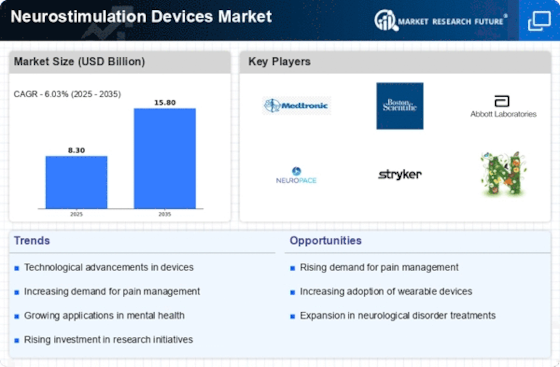
As per Market Research Future analysis, the Neurostimulation Devices Market Size was estimated at 8.3 USD Billion in 2024. The Neurostimulation Devices industry is projected to grow from 8.8 USD Billion in 2025 to 15.8 USD Billion by 2035, exhibiting a compound annual growth rate (CAGR) of 6.03% during the forecast period 2026 - 2035

Key Market Trends & Highlights

The Neurostimulation Devices Market is experiencing robust growth driven by technological advancements and increasing demand for personalized treatment options.

  • Technological advancements are enhancing the efficacy and safety of neurostimulation devices, leading to broader adoption. North America remains the largest market, while the Asia-Pacific region is emerging as the fastest-growing area for neurostimulation technologies. Chronic pain management is the largest segment, whereas movement disorder treatment is witnessing the fastest growth in demand. Rising prevalence of neurological disorders and increasing investment in healthcare infrastructure are key drivers propelling market expansion.

Market Size & Forecast

2024 Market Size 8.3 (USD Billion)
2035 Market Size 15.8 (USD Billion)
CAGR (2025 - 2035) 6.03%
Largest Regional Market Share in 2024 North America

Major Players

Medtronic (US), Boston Scientific (US), Abbott (US), NeuroPace (US), Stryker (US), Nuvectra (US), Cerecor (US), ElectroCore (US), Hua Medicine (CN), Zynex (US)

Market Trends

The Neurostimulation Devices Market is currently experiencing a transformative phase, driven by advancements in technology and an increasing understanding of neurological disorders. The integration of innovative materials and miniaturized components is enhancing device efficacy and patient comfort. Furthermore, the growing prevalence of chronic pain conditions and neurological disorders is propelling demand for these devices, as healthcare providers seek effective treatment options. Regulatory bodies are also playing a crucial role in shaping the neuromodulation market, ensuring that products meet safety and efficacy standards, which in turn fosters consumer confidence. In addition, the Neurostimulation Devices Market is witnessing a shift towards personalized medicine, where treatments are tailored to individual patient needs. This trend is supported by ongoing research and development efforts aimed at creating more targeted therapies. The rise of telemedicine and remote monitoring technologies is further influencing the neuromodulation market, allowing for better patient management and follow-up care. As the industry evolves, collaboration between manufacturers, healthcare professionals, and regulatory agencies will be essential to navigate challenges and seize opportunities for growth.

Technological Advancements

Recent innovations in neurostimulation technology are enhancing device performance and patient outcomes. These advancements include improved battery life, wireless connectivity, and sophisticated algorithms that allow for more precise stimulation. Such developments are likely to attract a broader patient base and encourage healthcare providers to adopt these solutions.

Personalized Treatment Approaches

The trend towards personalized medicine is becoming increasingly prominent within the Neurostimulation Devices Market. Tailoring treatments to individual patient profiles may lead to improved efficacy and satisfaction. This approach is supported by ongoing research that seeks to understand the unique responses of patients to various neurostimulation therapies.

Integration of Telehealth Solutions

The incorporation of telehealth technologies into neurostimulation practices is reshaping patient care. Remote monitoring and virtual consultations facilitate ongoing management of conditions, allowing for timely adjustments to treatment plans. This integration not only enhances patient engagement but also streamlines healthcare delivery.

Neurostimulation Devices Market Market Drivers

Rising Prevalence of Neurological Disorders

The increasing incidence of neurological disorders such as epilepsy, Parkinson's disease, and chronic pain conditions is a primary driver of the Neurostimulation Devices Market. According to recent estimates, approximately 1 in 6 individuals worldwide will experience a neurological disorder at some point in their lives. This growing patient population necessitates innovative treatment options, leading to heightened demand for neurostimulation devices. As healthcare providers seek effective solutions to manage these conditions, the market for neurostimulation devices is projected to expand significantly. The rise in awareness regarding the benefits of neurostimulation therapies further propels market growth, as patients and healthcare professionals alike recognize the potential for improved quality of life through these advanced technologies.

Regulatory Support and Reimbursement Policies

Regulatory support and favorable reimbursement policies are pivotal drivers of the Neurostimulation Devices Market. Governments and regulatory bodies are increasingly recognizing the therapeutic potential of neurostimulation devices, leading to streamlined approval processes for new technologies. This regulatory environment fosters innovation and encourages manufacturers to invest in research and development. Furthermore, the establishment of reimbursement frameworks for neurostimulation therapies enhances their accessibility to patients. As insurance coverage for these devices expands, more individuals are likely to seek neurostimulation treatments, thereby driving market growth. The alignment of regulatory support with reimbursement policies creates a conducive environment for the proliferation of neurostimulation devices, ultimately benefiting patients and healthcare providers alike.

Technological Innovations in Neurostimulation

Technological advancements play a crucial role in shaping the Neurostimulation Devices Market. Innovations such as closed-loop systems, which provide real-time feedback and adjust stimulation based on patient needs, are gaining traction. Additionally, the development of miniaturized devices and wireless technologies enhances patient comfort and compliance. The market is witnessing a surge in research and development activities, with companies investing heavily in creating next-generation neurostimulation devices. This focus on innovation is expected to drive market growth, as more effective and user-friendly devices become available. Furthermore, the integration of artificial intelligence and machine learning into neurostimulation technologies may lead to personalized treatment options, further expanding the market's potential.

Increasing Investment in Healthcare Infrastructure

The growing investment in healthcare infrastructure is a significant driver of the Neurostimulation Devices Market. Governments and private entities are allocating substantial resources to enhance healthcare facilities and improve access to advanced medical technologies. This trend is particularly evident in emerging economies, where the demand for innovative treatment options is rising. As healthcare systems evolve, the integration of neurostimulation devices into standard treatment protocols becomes more feasible. Market data indicates that the healthcare sector is expected to witness a compound annual growth rate of over 7% in the coming years, which will likely facilitate the adoption of neurostimulation devices. Enhanced healthcare infrastructure not only supports the distribution of these devices but also fosters research and development initiatives, further propelling market growth.

Growing Awareness and Acceptance of Neurostimulation Therapies

The increasing awareness and acceptance of neurostimulation therapies among patients and healthcare providers significantly influence the Neurostimulation Devices Market. Educational initiatives and advocacy programs are helping to demystify neurostimulation technologies, leading to greater patient engagement in treatment decisions. As more individuals become informed about the benefits and efficacy of neurostimulation devices, the demand for these therapies is expected to rise. Market Research Future indicates that patient satisfaction rates with neurostimulation therapies are high, which further encourages adoption. Additionally, healthcare professionals are increasingly recognizing the value of these devices in managing chronic conditions, contributing to a more favorable perception of neurostimulation therapies within the medical community.

Market Segment Insights

By Application: Chronic Pain Management (Largest) vs. Movement Disorder Treatment (Fastest-Growing)

In the Neurostimulation Devices Market, Chronic Pain Management leads the application segment, holding the largest market share due to the high prevalence of chronic pain conditions and an increasing focus on effective pain relief methods. Movement Disorder Treatment, while smaller in share, is growing rapidly as advancements in neurostimulation technology and increased awareness around movement disorders like Parkinson's disease drive demand for innovative therapies.

Chronic Pain Management (Dominant) vs. Movement Disorder Treatment (Emerging)

Chronic Pain Management remains the dominant application in the Neurostimulation Devices Market due to its established efficacy and growing patient base seeking relief from conditions such as back pain and neuropathic pain. In contrast, Movement Disorder Treatment is identified as an emerging segment, fueled by continuous technological innovations and research into neurostimulation techniques. This segment is witnessing a surge in clinical applications supported by a growing understanding of the neurological mechanisms involved in movement disorders. Additionally, regulatory approvals and patient advocacy are enhancing market penetration for movement disorder treatments, making them increasingly viable alternatives to traditional therapies.

By Product Type: Spinal Cord Stimulators (Largest) vs. Deep Brain Stimulators (Fastest-Growing)

In the Neurostimulation Devices Market, Spinal Cord Stimulators dominate the share, utilized widely for managing chronic pain and neurological disorders. Their established efficacy and long-standing presence have solidified their position. Deep Brain Stimulators, however, are emerging rapidly, gaining traction in the treatment of neurodegenerative disorders such as Parkinson's disease and dystonia, signaling a shift towards more advanced neuromodulation treatments.

Spinal Cord Stimulators (Dominant) vs. Deep Brain Stimulators (Emerging)

Spinal Cord Stimulators represent the cornerstone of neurostimulation technology, primarily designed for pain management and improving quality of life for patients with intractable pain. Their dominance is attributed to a broad range of applications and patient acceptance. Conversely, Deep Brain Stimulators are emerging as a revolutionary treatment for movement disorders and certain psychiatric conditions, thanks to ongoing advancements in technology. Their ability to deliver targeted electrical impulses to specific brain regions opens new avenues for treating complex disorders, thus propelling their rapid growth in the neuromodulation market.

By End User: Hospitals (Largest) vs. Specialty Clinics (Fastest-Growing)

In the Neurostimulation Devices Market, hospitals hold the largest share among the end users, primarily due to their extensive infrastructure and resources that facilitate the usage of advanced neurostimulation devices. The integration of these devices in surgical procedures, pain management, and rehabilitation therapies significantly enhances patient outcomes, driving hospitals to be the predominant end-user segment. Specialty clinics, while currently a smaller segment, are rapidly gaining traction in the market, particularly in regions where outpatient procedures are increasing. Their focused offerings and expertise in neurostimulation techniques are positioning them as critical players in the industry.

Hospitals (Dominant) vs. Specialty Clinics (Emerging)

Hospitals are characterized by their comprehensive range of services and ability to adopt cutting-edge neurostimulation technologies, making them a dominant force, which shapes the neuromodulation market size. Their holistic approach to patient care allows for the integration of neurostimulation devices across various medical specialties, particularly in pain management, mental health, and neurology. On the other hand, specialty clinics are emerging as important players in the neurostimulation landscape, thanks to their targeted approaches and specialized knowledge. These clinics often provide personalized care and innovative treatment options, thus attracting a growing patient base seeking alternative therapies. As healthcare systems evolve, both segments are expected to continue playing significant roles, with hospitals leading in volume and specialty clinics excelling in specialized applications.

By Technology: Electrical Stimulation (Largest) vs. Magnetic Stimulation (Fastest-Growing)

In the Neurostimulation Devices Market, the Electrical Stimulation segment dominates, holding the largest market share among the three technologies. This segment benefits from widespread use in various therapeutic applications, particularly for conditions such as chronic pain and neurological disorders. The technology's effectiveness is well-established, leading to strong adoption rates in clinical settings. Conversely, the Magnetic Stimulation segment is rapidly gaining traction and is regarded as the fastest-growing sector within this market. Its non-invasive nature and the advent of advanced technologies like Transcranial Magnetic Stimulation (TMS) have propelled its acceptance among healthcare providers. Increased awareness of mental health disorders and the efficacy of magnetic stimulation treatments are key drivers of this segment's growth.

Technology: Electrical Stimulation (Dominant) vs. Magnetic Stimulation (Emerging)

Electrical Stimulation stands as the dominant technology in the Neurostimulation Devices Market, leveraging its well-established methodologies and broad clinical applications to treat various conditions effectively. This segment operates through established techniques such as Transcutaneous Electrical Nerve Stimulation (TENS) and spinal cord stimulators, which are favored for their proven efficacy in pain management and rehabilitation. In contrast, Magnetic Stimulation is emerging swiftly, characterized by its non-invasive approach and novel applications in treating mental health issues such as depression. The evolving landscape of this technology, driven by innovations like repetitive TMS, showcases its potential to capture an increasing share of the market as healthcare providers explore more patient-preferred treatment options.

Get more detailed insights about Neurostimulation Devices Market Research Report- Forecast To 2035

Regional Insights

North America : Innovation and Market Leadership

North America is the largest market for neurostimulation devices, holding approximately 45% of the global share. The region benefits from advanced healthcare infrastructure, high prevalence of neurological disorders, and significant investments in R&D. Regulatory support from agencies like the FDA further catalyzes market growth, ensuring rapid approval of innovative devices. The increasing adoption of minimally invasive procedures is also driving demand, making it a key player in the neurostimulation landscape. The United States leads the North American market, with major companies like Medtronic, Boston Scientific, and Abbott dominating the competitive landscape. These firms are continuously innovating, focusing on developing advanced neurostimulation technologies. The presence of a robust healthcare system and a growing aging population further enhances market potential. Additionally, collaborations and partnerships among key players are expected to foster growth and expand product offerings.

Europe : Emerging Market with Growth Potential

Europe is the second-largest market for neurostimulation devices, accounting for approximately 30% of the global market share. The region is witnessing a surge in demand driven by an increasing prevalence of chronic pain and neurological disorders. Regulatory bodies like the European Medicines Agency (EMA) are actively promoting innovative therapies, which is expected to enhance market growth. The rising focus on patient-centric healthcare solutions is also a significant driver in this region. Leading countries in Europe include Germany, France, and the UK, where key players such as Medtronic and Boston Scientific are expanding their presence. The competitive landscape is characterized by a mix of established companies and emerging startups, fostering innovation. Collaborations between healthcare providers and device manufacturers are becoming more common, enhancing the development and distribution of neurostimulation devices across the region.

Asia-Pacific : Rapidly Growing Market Segment

Asia-Pacific is rapidly emerging as a significant market for neurostimulation devices, holding approximately 20% of the global share. The region's growth is driven by rising healthcare expenditures, increasing awareness of neurostimulation therapies, and a growing aging population. Countries like China and India are witnessing a surge in demand for advanced medical technologies, supported by favorable government initiatives and investments in healthcare infrastructure. China is the leading market in the region, with a growing number of local manufacturers entering the neurostimulation space. The competitive landscape is evolving, with both multinational corporations and domestic players vying for market share. The presence of key players like Hua Medicine and Nuvectra is expected to drive innovation and expand product offerings, catering to the diverse needs of patients in the region.

Middle East and Africa : Untapped Market with Potential

The Middle East and Africa represent an untapped market for neurostimulation devices, accounting for approximately 5% of the global share. The region is experiencing gradual growth driven by increasing healthcare investments and a rising prevalence of neurological disorders. Governments are focusing on improving healthcare infrastructure, which is expected to create opportunities for neurostimulation device manufacturers. The demand for advanced medical technologies is on the rise, supported by a growing awareness of treatment options. Countries like South Africa and the UAE are leading the market in this region, with a mix of local and international players. The competitive landscape is characterized by emerging companies and established firms looking to expand their footprint. Collaborations with healthcare providers and investments in research are expected to enhance the availability of neurostimulation devices, catering to the unique needs of patients in the region.

Key Players and Competitive Insights

The Neurostimulation Devices Market is characterized by intense competition, fueled by rapid advancements in technology, increasing prevalence of neurological disorders, and rising consumer awareness regarding the benefits of neurostimulation therapies. The market comprises various key players that focus on developing innovative devices designed to enhance quality of life for patients suffering from chronic pain, epilepsy, depression, and other neurological conditions.
Neuromodulation companies within this market are continually engaging in strategic partnerships, mergers, and acquisitions to expand their product offerings, enhance their research capabilities, and achieve greater geographical reach. The competitive landscape is dynamic, driven not only by technological innovations but also by regulatory challenges and changing healthcare policies across different regions. Companies are increasingly adopting strategies such as clinical trials, product launches, and marketing campaigns to establish a solid foothold in this growing market.Nuvectra has emerged as a significant player in the Neurostimulation Devices Market, known for its commitment to innovative technology and patient-centric solutions.
The company’s neurostimulation devices effectively target patients suffering from conditions such as chronic pain and epilepsy, thus enhancing their quality of life through advancements in neurotechnology.
Nuvectra's strengths lie in its unique approach to device design and development, which prioritizes user experience and improved outcomes. Its distinct offerings and specialized focus contribute to a growing presence in key global markets where the demand for effective neurostimulation therapies is rising rapidly. The company’s ability to engage in strategic collaborations with healthcare providers and research institutions further amplifies its impact in this competitive landscape, positioning Nuvectra uniquely to capitalize on market opportunities.Cereset presents a distinctive angle within the Neurostimulation Devices Market by focusing on brainwave optimization and therapy.
The company’s core services revolve around non-invasive brain wave monitoring and stimulation technology, which aims to enhance cognitive function and mental wellness. Key products offered by Cereset include advanced neurostimulation devices and personalized treatment regimens tailored to individual patient needs, reflecting a commitment to holistic health solutions.
The company's strengths lie in its innovative approach to neuroscience and the ability to leverage research partnerships for continuous product development. Cereset also engages in strategic mergers and acquisitions to broaden its technological capabilities and expand its market presence globally. Through collaborations with rehabilitation centers and healthcare providers, Cereset is expanding its footprint, thereby increasing access to its neurostimulation therapies and reinforcing its competitive edge in the global marketplace.

Key Companies in the Neurostimulation Devices Market include

Industry Developments

The Neurostimulation Devices Market has seen multiple developments recently, particularly with innovations in technologies and products by key players. Axonics has gained considerable traction in the sacral neuromodulation (SNM) segment. In March 2024, the company obtained CE Mark approval for its Axonics R20 rechargeable SNM system in Europe. In January 2024, Medtronic received FDA approval for its Percept™ RC neurostimulator, which integrates BrainSense™ technology, enabling real-time neural activity tracking for more personalized deep brain stimulation (DBS) therapy.

Market valuations have surged, with neuromodulation companies like Stimwave experiencing increased interest from investors, reflecting a broader trend towards non-invasive treatment options. Additionally, NeuroSigma received attention for its non-invasive neuromodulation devices that treat epilepsy, marking a significant step forward in the clinical landscape. Over the past 2-3 years, there has been a marked increase in market focus on neurostimulation solutions, emphasized by enhanced regulatory support and favorable reimbursement policies across various regions globally.

Future Outlook

Neurostimulation Devices Market Future Outlook

The Neurostimulation Devices Market is projected to grow at a 6.03% CAGR from 2025 to 2035, driven by technological advancements, increasing prevalence of neurological disorders, and rising healthcare expenditure.

New opportunities lie in:

  • <p>Development of portable neurostimulation devices for home use</p>
  • <p> </p>
  • <p>Expansion into emerging markets with tailored product offerings</p>
  • <p>Partnerships with healthcare providers for integrated treatment solutions</p>

By 2035, the Neurostimulation Devices Market is expected to achieve substantial growth and innovation.

Market Segmentation

Neurostimulation Devices Market End User Outlook

  • Hospitals
  • Specialty Clinics
  • Home Care Settings

Neurostimulation Devices Market Technology Outlook

  • Electrical Stimulation
  • Magnetic Stimulation
  • Chemical Stimulation

Neurostimulation Devices Market Application Outlook

  • Chronic Pain Management
  • Movement Disorder Treatment
  • Depression Treatment
  • Epilepsy Management

Neurostimulation Devices Market Product Type Outlook

  • Spinal Cord Stimulators
  • Deep Brain Stimulators
  • Transcranial Magnetic Stimulators
  • Vagus Nerve Stimulators

Report Scope

MARKET SIZE 2024 8.3(USD Billion)
MARKET SIZE 2025 8.8(USD Billion)
MARKET SIZE 2035 15.8(USD Billion)
COMPOUND ANNUAL GROWTH RATE (CAGR) 6.03% (2025 - 2035)
REPORT COVERAGE Revenue Forecast, Competitive Landscape, Growth Factors, and Trends
BASE YEAR 2024
Market Forecast Period 2026 - 2035
Historical Data 2019 - 2024
Market Forecast Units USD Billion
Key Companies Profiled Medtronic (US), Boston Scientific (US), Abbott (US), NeuroPace (US), Stryker (US), Nuvectra (US), Cerecor (US), ElectroCore (US), Hua Medicine (CN), Zynex (US)
Segments Covered Applications, Product Type, End Users, Technology, Regional
Key Market Opportunities Advancements in wireless neurostimulation technologies enhance patient accessibility and treatment personalization in the Neurostimulation Devices Market.
Key Market Dynamics Technological advancements and regulatory changes drive innovation and competition in the Neurostimulation Devices Market.
Countries Covered North America, Europe, APAC, South America, MEA

FAQs

What is the projected market valuation of the Neurostimulation Devices Market by 2035?

<p>The Neurostimulation Devices Market is projected to reach a valuation of 15.8 USD Billion by 2035.</p>

What was the market valuation of the Neurostimulation Devices Market in 2024?

<p>In 2024, the Neurostimulation Devices Market was valued at 8.3 USD Billion.</p>

What is the expected CAGR for the Neurostimulation Devices Market during the forecast period 2025 - 2035?

<p>The expected CAGR for the Neurostimulation Devices Market during the forecast period 2025 - 2035 is 6.03%.</p>

Which application segment is expected to show the highest growth in the Neurostimulation Devices Market?

<p>The Chronic Pain Management segment is expected to grow from 2.5 USD Billion in 2024 to 4.5 USD Billion by 2035.</p>

What are the key product types in the Neurostimulation Devices Market?

<p>Key product types include Spinal Cord Stimulators, Deep Brain Stimulators, Transcranial Magnetic Stimulators, and Vagus Nerve Stimulators.</p>

Which end user segment is projected to dominate the Neurostimulation Devices Market?

<p>Hospitals are projected to dominate the Neurostimulation Devices Market, growing from 3.5 USD Billion in 2024 to 6.5 USD Billion by 2035.</p>

Who are the leading companies in the Neurostimulation Devices Market?

<p>Leading companies in the Neurostimulation Devices Market include Medtronic, Boston Scientific, Abbott, and NeuroPace.</p>

What is the expected growth for the Vagus Nerve Stimulators segment by 2035?

<p>The Vagus Nerve Stimulators segment is expected to grow from 2.3 USD Billion in 2024 to 5.3 USD Billion by 2035.</p>

How does the market for Magnetic Stimulation technology compare to Electrical Stimulation technology?

<p>The market for Electrical Stimulation technology is expected to grow from 3.5 USD Billion in 2024 to 6.5 USD Billion by 2035, while Magnetic Stimulation technology is projected to grow from 2.5 USD Billion to 4.5 USD Billion.</p>

What trends are influencing the Neurostimulation Devices Market?

<p>Trends influencing the Neurostimulation Devices Market include advancements in technology and increasing demand for effective treatment options for chronic conditions.</p>

  1. SECTION I: EXECUTIVE SUMMARY AND KEY HIGHLIGHTS
    1. | 1.1 EXECUTIVE SUMMARY
    2. | | 1.1.1 Market Overview
    3. | | 1.1.2 Key Findings
    4. | | 1.1.3 Market Segmentation
    5. | | 1.1.4 Competitive Landscape
    6. | | 1.1.5 Challenges and Opportunities
    7. | | 1.1.6 Future Outlook
  2. SECTION II: SCOPING, METHODOLOGY AND MARKET STRUCTURE
    1. | 2.1 MARKET INTRODUCTION
    2. | | 2.1.1 Definition
    3. | | 2.1.2 Scope of the study
    4. | | | 2.1.2.1 Research Objective
    5. | | | 2.1.2.2 Assumption
    6. | | | 2.1.2.3 Limitations
    7. | 2.2 RESEARCH METHODOLOGY
    8. | | 2.2.1 Overview
    9. | | 2.2.2 Data Mining
    10. | | 2.2.3 Secondary Research
    11. | | 2.2.4 Primary Research
    12. | | | 2.2.4.1 Primary Interviews and Information Gathering Process
    13. | | | 2.2.4.2 Breakdown of Primary Respondents
    14. | | 2.2.5 Forecasting Model
    15. | | 2.2.6 Market Size Estimation
    16. | | | 2.2.6.1 Bottom-Up Approach
    17. | | | 2.2.6.2 Top-Down Approach
    18. | | 2.2.7 Data Triangulation
    19. | | 2.2.8 Validation
  3. SECTION III: QUALITATIVE ANALYSIS
    1. | 3.1 MARKET DYNAMICS
    2. | | 3.1.1 Overview
    3. | | 3.1.2 Drivers
    4. | | 3.1.3 Restraints
    5. | | 3.1.4 Opportunities
    6. | 3.2 MARKET FACTOR ANALYSIS
    7. | | 3.2.1 Value chain Analysis
    8. | | 3.2.2 Porter's Five Forces Analysis
    9. | | | 3.2.2.1 Bargaining Power of Suppliers
    10. | | | 3.2.2.2 Bargaining Power of Buyers
    11. | | | 3.2.2.3 Threat of New Entrants
    12. | | | 3.2.2.4 Threat of Substitutes
    13. | | | 3.2.2.5 Intensity of Rivalry
    14. | | 3.2.3 COVID-19 Impact Analysis
    15. | | | 3.2.3.1 Market Impact Analysis
    16. | | | 3.2.3.2 Regional Impact
    17. | | | 3.2.3.3 Opportunity and Threat Analysis
  4. SECTION IV: QUANTITATIVE ANALYSIS
    1. | 4.1 Healthcare, BY Application (USD Billion)
    2. | | 4.1.1 Chronic Pain Management
    3. | | 4.1.2 Movement Disorder Treatment
    4. | | 4.1.3 Depression Treatment
    5. | | 4.1.4 Epilepsy Management
    6. | 4.2 Healthcare, BY Product Type (USD Billion)
    7. | | 4.2.1 Spinal Cord Stimulators
    8. | | 4.2.2 Deep Brain Stimulators
    9. | | 4.2.3 Transcranial Magnetic Stimulators
    10. | | 4.2.4 Vagus Nerve Stimulators
    11. | 4.3 Healthcare, BY End User (USD Billion)
    12. | | 4.3.1 Hospitals
    13. | | 4.3.2 Specialty Clinics
    14. | | 4.3.3 Home Care Settings
    15. | 4.4 Healthcare, BY Technology (USD Billion)
    16. | | 4.4.1 Electrical Stimulation
    17. | | 4.4.2 Magnetic Stimulation
    18. | | 4.4.3 Chemical Stimulation
    19. | 4.5 Healthcare, BY Region (USD Billion)
    20. | | 4.5.1 North America
    21. | | | 4.5.1.1 US
    22. | | | 4.5.1.2 Canada
    23. | | 4.5.2 Europe
    24. | | | 4.5.2.1 Germany
    25. | | | 4.5.2.2 UK
    26. | | | 4.5.2.3 France
    27. | | | 4.5.2.4 Russia
    28. | | | 4.5.2.5 Italy
    29. | | | 4.5.2.6 Spain
    30. | | | 4.5.2.7 Rest of Europe
    31. | | 4.5.3 APAC
    32. | | | 4.5.3.1 China
    33. | | | 4.5.3.2 India
    34. | | | 4.5.3.3 Japan
    35. | | | 4.5.3.4 South Korea
    36. | | | 4.5.3.5 Malaysia
    37. | | | 4.5.3.6 Thailand
    38. | | | 4.5.3.7 Indonesia
    39. | | | 4.5.3.8 Rest of APAC
    40. | | 4.5.4 South America
    41. | | | 4.5.4.1 Brazil
    42. | | | 4.5.4.2 Mexico
    43. | | | 4.5.4.3 Argentina
    44. | | | 4.5.4.4 Rest of South America
    45. | | 4.5.5 MEA
    46. | | | 4.5.5.1 GCC Countries
    47. | | | 4.5.5.2 South Africa
    48. | | | 4.5.5.3 Rest of MEA
  5. SECTION V: COMPETITIVE ANALYSIS
    1. | 5.1 Competitive Landscape
    2. | | 5.1.1 Overview
    3. | | 5.1.2 Competitive Analysis
    4. | | 5.1.3 Market share Analysis
    5. | | 5.1.4 Major Growth Strategy in the Healthcare
    6. | | 5.1.5 Competitive Benchmarking
    7. | | 5.1.6 Leading Players in Terms of Number of Developments in the Healthcare
    8. | | 5.1.7 Key developments and growth strategies
    9. | | | 5.1.7.1 New Product Launch/Service Deployment
    10. | | | 5.1.7.2 Merger & Acquisitions
    11. | | | 5.1.7.3 Joint Ventures
    12. | | 5.1.8 Major Players Financial Matrix
    13. | | | 5.1.8.1 Sales and Operating Income
    14. | | | 5.1.8.2 Major Players R&D Expenditure. 2023
    15. | 5.2 Company Profiles
    16. | | 5.2.1 Medtronic (US)
    17. | | | 5.2.1.1 Financial Overview
    18. | | | 5.2.1.2 Products Offered
    19. | | | 5.2.1.3 Key Developments
    20. | | | 5.2.1.4 SWOT Analysis
    21. | | | 5.2.1.5 Key Strategies
    22. | | 5.2.2 Boston Scientific (US)
    23. | | | 5.2.2.1 Financial Overview
    24. | | | 5.2.2.2 Products Offered
    25. | | | 5.2.2.3 Key Developments
    26. | | | 5.2.2.4 SWOT Analysis
    27. | | | 5.2.2.5 Key Strategies
    28. | | 5.2.3 Abbott (US)
    29. | | | 5.2.3.1 Financial Overview
    30. | | | 5.2.3.2 Products Offered
    31. | | | 5.2.3.3 Key Developments
    32. | | | 5.2.3.4 SWOT Analysis
    33. | | | 5.2.3.5 Key Strategies
    34. | | 5.2.4 NeuroPace (US)
    35. | | | 5.2.4.1 Financial Overview
    36. | | | 5.2.4.2 Products Offered
    37. | | | 5.2.4.3 Key Developments
    38. | | | 5.2.4.4 SWOT Analysis
    39. | | | 5.2.4.5 Key Strategies
    40. | | 5.2.5 Stryker (US)
    41. | | | 5.2.5.1 Financial Overview
    42. | | | 5.2.5.2 Products Offered
    43. | | | 5.2.5.3 Key Developments
    44. | | | 5.2.5.4 SWOT Analysis
    45. | | | 5.2.5.5 Key Strategies
    46. | | 5.2.6 Nuvectra (US)
    47. | | | 5.2.6.1 Financial Overview
    48. | | | 5.2.6.2 Products Offered
    49. | | | 5.2.6.3 Key Developments
    50. | | | 5.2.6.4 SWOT Analysis
    51. | | | 5.2.6.5 Key Strategies
    52. | | 5.2.7 Cerecor (US)
    53. | | | 5.2.7.1 Financial Overview
    54. | | | 5.2.7.2 Products Offered
    55. | | | 5.2.7.3 Key Developments
    56. | | | 5.2.7.4 SWOT Analysis
    57. | | | 5.2.7.5 Key Strategies
    58. | | 5.2.8 ElectroCore (US)
    59. | | | 5.2.8.1 Financial Overview
    60. | | | 5.2.8.2 Products Offered
    61. | | | 5.2.8.3 Key Developments
    62. | | | 5.2.8.4 SWOT Analysis
    63. | | | 5.2.8.5 Key Strategies
    64. | | 5.2.9 Hua Medicine (CN)
    65. | | | 5.2.9.1 Financial Overview
    66. | | | 5.2.9.2 Products Offered
    67. | | | 5.2.9.3 Key Developments
    68. | | | 5.2.9.4 SWOT Analysis
    69. | | | 5.2.9.5 Key Strategies
    70. | | 5.2.10 Zynex (US)
    71. | | | 5.2.10.1 Financial Overview
    72. | | | 5.2.10.2 Products Offered
    73. | | | 5.2.10.3 Key Developments
    74. | | | 5.2.10.4 SWOT Analysis
    75. | | | 5.2.10.5 Key Strategies
    76. | 5.3 Appendix
    77. | | 5.3.1 References
    78. | | 5.3.2 Related Reports
  6. LIST OF FIGURES
    1. | 6.1 MARKET SYNOPSIS
    2. | 6.2 NORTH AMERICA MARKET ANALYSIS
    3. | 6.3 US MARKET ANALYSIS BY APPLICATION
    4. | 6.4 US MARKET ANALYSIS BY PRODUCT TYPE
    5. | 6.5 US MARKET ANALYSIS BY END USER
    6. | 6.6 US MARKET ANALYSIS BY TECHNOLOGY
    7. | 6.7 CANADA MARKET ANALYSIS BY APPLICATION
    8. | 6.8 CANADA MARKET ANALYSIS BY PRODUCT TYPE
    9. | 6.9 CANADA MARKET ANALYSIS BY END USER
    10. | 6.10 CANADA MARKET ANALYSIS BY TECHNOLOGY
    11. | 6.11 EUROPE MARKET ANALYSIS
    12. | 6.12 GERMANY MARKET ANALYSIS BY APPLICATION
    13. | 6.13 GERMANY MARKET ANALYSIS BY PRODUCT TYPE
    14. | 6.14 GERMANY MARKET ANALYSIS BY END USER
    15. | 6.15 GERMANY MARKET ANALYSIS BY TECHNOLOGY
    16. | 6.16 UK MARKET ANALYSIS BY APPLICATION
    17. | 6.17 UK MARKET ANALYSIS BY PRODUCT TYPE
    18. | 6.18 UK MARKET ANALYSIS BY END USER
    19. | 6.19 UK MARKET ANALYSIS BY TECHNOLOGY
    20. | 6.20 FRANCE MARKET ANALYSIS BY APPLICATION
    21. | 6.21 FRANCE MARKET ANALYSIS BY PRODUCT TYPE
    22. | 6.22 FRANCE MARKET ANALYSIS BY END USER
    23. | 6.23 FRANCE MARKET ANALYSIS BY TECHNOLOGY
    24. | 6.24 RUSSIA MARKET ANALYSIS BY APPLICATION
    25. | 6.25 RUSSIA MARKET ANALYSIS BY PRODUCT TYPE
    26. | 6.26 RUSSIA MARKET ANALYSIS BY END USER
    27. | 6.27 RUSSIA MARKET ANALYSIS BY TECHNOLOGY
    28. | 6.28 ITALY MARKET ANALYSIS BY APPLICATION
    29. | 6.29 ITALY MARKET ANALYSIS BY PRODUCT TYPE
    30. | 6.30 ITALY MARKET ANALYSIS BY END USER
    31. | 6.31 ITALY MARKET ANALYSIS BY TECHNOLOGY
    32. | 6.32 SPAIN MARKET ANALYSIS BY APPLICATION
    33. | 6.33 SPAIN MARKET ANALYSIS BY PRODUCT TYPE
    34. | 6.34 SPAIN MARKET ANALYSIS BY END USER
    35. | 6.35 SPAIN MARKET ANALYSIS BY TECHNOLOGY
    36. | 6.36 REST OF EUROPE MARKET ANALYSIS BY APPLICATION
    37. | 6.37 REST OF EUROPE MARKET ANALYSIS BY PRODUCT TYPE
    38. | 6.38 REST OF EUROPE MARKET ANALYSIS BY END USER
    39. | 6.39 REST OF EUROPE MARKET ANALYSIS BY TECHNOLOGY
    40. | 6.40 APAC MARKET ANALYSIS
    41. | 6.41 CHINA MARKET ANALYSIS BY APPLICATION
    42. | 6.42 CHINA MARKET ANALYSIS BY PRODUCT TYPE
    43. | 6.43 CHINA MARKET ANALYSIS BY END USER
    44. | 6.44 CHINA MARKET ANALYSIS BY TECHNOLOGY
    45. | 6.45 INDIA MARKET ANALYSIS BY APPLICATION
    46. | 6.46 INDIA MARKET ANALYSIS BY PRODUCT TYPE
    47. | 6.47 INDIA MARKET ANALYSIS BY END USER
    48. | 6.48 INDIA MARKET ANALYSIS BY TECHNOLOGY
    49. | 6.49 JAPAN MARKET ANALYSIS BY APPLICATION
    50. | 6.50 JAPAN MARKET ANALYSIS BY PRODUCT TYPE
    51. | 6.51 JAPAN MARKET ANALYSIS BY END USER
    52. | 6.52 JAPAN MARKET ANALYSIS BY TECHNOLOGY
    53. | 6.53 SOUTH KOREA MARKET ANALYSIS BY APPLICATION
    54. | 6.54 SOUTH KOREA MARKET ANALYSIS BY PRODUCT TYPE
    55. | 6.55 SOUTH KOREA MARKET ANALYSIS BY END USER
    56. | 6.56 SOUTH KOREA MARKET ANALYSIS BY TECHNOLOGY
    57. | 6.57 MALAYSIA MARKET ANALYSIS BY APPLICATION
    58. | 6.58 MALAYSIA MARKET ANALYSIS BY PRODUCT TYPE
    59. | 6.59 MALAYSIA MARKET ANALYSIS BY END USER
    60. | 6.60 MALAYSIA MARKET ANALYSIS BY TECHNOLOGY
    61. | 6.61 THAILAND MARKET ANALYSIS BY APPLICATION
    62. | 6.62 THAILAND MARKET ANALYSIS BY PRODUCT TYPE
    63. | 6.63 THAILAND MARKET ANALYSIS BY END USER
    64. | 6.64 THAILAND MARKET ANALYSIS BY TECHNOLOGY
    65. | 6.65 INDONESIA MARKET ANALYSIS BY APPLICATION
    66. | 6.66 INDONESIA MARKET ANALYSIS BY PRODUCT TYPE
    67. | 6.67 INDONESIA MARKET ANALYSIS BY END USER
    68. | 6.68 INDONESIA MARKET ANALYSIS BY TECHNOLOGY
    69. | 6.69 REST OF APAC MARKET ANALYSIS BY APPLICATION
    70. | 6.70 REST OF APAC MARKET ANALYSIS BY PRODUCT TYPE
    71. | 6.71 REST OF APAC MARKET ANALYSIS BY END USER
    72. | 6.72 REST OF APAC MARKET ANALYSIS BY TECHNOLOGY
    73. | 6.73 SOUTH AMERICA MARKET ANALYSIS
    74. | 6.74 BRAZIL MARKET ANALYSIS BY APPLICATION
    75. | 6.75 BRAZIL MARKET ANALYSIS BY PRODUCT TYPE
    76. | 6.76 BRAZIL MARKET ANALYSIS BY END USER
    77. | 6.77 BRAZIL MARKET ANALYSIS BY TECHNOLOGY
    78. | 6.78 MEXICO MARKET ANALYSIS BY APPLICATION
    79. | 6.79 MEXICO MARKET ANALYSIS BY PRODUCT TYPE
    80. | 6.80 MEXICO MARKET ANALYSIS BY END USER
    81. | 6.81 MEXICO MARKET ANALYSIS BY TECHNOLOGY
    82. | 6.82 ARGENTINA MARKET ANALYSIS BY APPLICATION
    83. | 6.83 ARGENTINA MARKET ANALYSIS BY PRODUCT TYPE
    84. | 6.84 ARGENTINA MARKET ANALYSIS BY END USER
    85. | 6.85 ARGENTINA MARKET ANALYSIS BY TECHNOLOGY
    86. | 6.86 REST OF SOUTH AMERICA MARKET ANALYSIS BY APPLICATION
    87. | 6.87 REST OF SOUTH AMERICA MARKET ANALYSIS BY PRODUCT TYPE
    88. | 6.88 REST OF SOUTH AMERICA MARKET ANALYSIS BY END USER
    89. | 6.89 REST OF SOUTH AMERICA MARKET ANALYSIS BY TECHNOLOGY
    90. | 6.90 MEA MARKET ANALYSIS
    91. | 6.91 GCC COUNTRIES MARKET ANALYSIS BY APPLICATION
    92. | 6.92 GCC COUNTRIES MARKET ANALYSIS BY PRODUCT TYPE
    93. | 6.93 GCC COUNTRIES MARKET ANALYSIS BY END USER
    94. | 6.94 GCC COUNTRIES MARKET ANALYSIS BY TECHNOLOGY
    95. | 6.95 SOUTH AFRICA MARKET ANALYSIS BY APPLICATION
    96. | 6.96 SOUTH AFRICA MARKET ANALYSIS BY PRODUCT TYPE
    97. | 6.97 SOUTH AFRICA MARKET ANALYSIS BY END USER
    98. | 6.98 SOUTH AFRICA MARKET ANALYSIS BY TECHNOLOGY
    99. | 6.99 REST OF MEA MARKET ANALYSIS BY APPLICATION
    100. | 6.100 REST OF MEA MARKET ANALYSIS BY PRODUCT TYPE
    101. | 6.101 REST OF MEA MARKET ANALYSIS BY END USER
    102. | 6.102 REST OF MEA MARKET ANALYSIS BY TECHNOLOGY
    103. | 6.103 KEY BUYING CRITERIA OF HEALTHCARE
    104. | 6.104 RESEARCH PROCESS OF MRFR
    105. | 6.105 DRO ANALYSIS OF HEALTHCARE
    106. | 6.106 DRIVERS IMPACT ANALYSIS: HEALTHCARE
    107. | 6.107 RESTRAINTS IMPACT ANALYSIS: HEALTHCARE
    108. | 6.108 SUPPLY / VALUE CHAIN: HEALTHCARE
    109. | 6.109 HEALTHCARE, BY APPLICATION, 2024 (% SHARE)
    110. | 6.110 HEALTHCARE, BY APPLICATION, 2024 TO 2035 (USD Billion)
    111. | 6.111 HEALTHCARE, BY PRODUCT TYPE, 2024 (% SHARE)
    112. | 6.112 HEALTHCARE, BY PRODUCT TYPE, 2024 TO 2035 (USD Billion)
    113. | 6.113 HEALTHCARE, BY END USER, 2024 (% SHARE)
    114. | 6.114 HEALTHCARE, BY END USER, 2024 TO 2035 (USD Billion)
    115. | 6.115 HEALTHCARE, BY TECHNOLOGY, 2024 (% SHARE)
    116. | 6.116 HEALTHCARE, BY TECHNOLOGY, 2024 TO 2035 (USD Billion)
    117. | 6.117 BENCHMARKING OF MAJOR COMPETITORS
  7. LIST OF TABLES
    1. | 7.1 LIST OF ASSUMPTIONS
    2. | | 7.1.1
    3. | 7.2 North America MARKET SIZE ESTIMATES; FORECAST
    4. | | 7.2.1 BY APPLICATION, 2025-2035 (USD Billion)
    5. | | 7.2.2 BY PRODUCT TYPE, 2025-2035 (USD Billion)
    6. | | 7.2.3 BY END USER, 2025-2035 (USD Billion)
    7. | | 7.2.4 BY TECHNOLOGY, 2025-2035 (USD Billion)
    8. | 7.3 US MARKET SIZE ESTIMATES; FORECAST
    9. | | 7.3.1 BY APPLICATION, 2025-2035 (USD Billion)
    10. | | 7.3.2 BY PRODUCT TYPE, 2025-2035 (USD Billion)
    11. | | 7.3.3 BY END USER, 2025-2035 (USD Billion)
    12. | | 7.3.4 BY TECHNOLOGY, 2025-2035 (USD Billion)
    13. | 7.4 Canada MARKET SIZE ESTIMATES; FORECAST
    14. | | 7.4.1 BY APPLICATION, 2025-2035 (USD Billion)
    15. | | 7.4.2 BY PRODUCT TYPE, 2025-2035 (USD Billion)
    16. | | 7.4.3 BY END USER, 2025-2035 (USD Billion)
    17. | | 7.4.4 BY TECHNOLOGY, 2025-2035 (USD Billion)
    18. | 7.5 Europe MARKET SIZE ESTIMATES; FORECAST
    19. | | 7.5.1 BY APPLICATION, 2025-2035 (USD Billion)
    20. | | 7.5.2 BY PRODUCT TYPE, 2025-2035 (USD Billion)
    21. | | 7.5.3 BY END USER, 2025-2035 (USD Billion)
    22. | | 7.5.4 BY TECHNOLOGY, 2025-2035 (USD Billion)
    23. | 7.6 Germany MARKET SIZE ESTIMATES; FORECAST
    24. | | 7.6.1 BY APPLICATION, 2025-2035 (USD Billion)
    25. | | 7.6.2 BY PRODUCT TYPE, 2025-2035 (USD Billion)
    26. | | 7.6.3 BY END USER, 2025-2035 (USD Billion)
    27. | | 7.6.4 BY TECHNOLOGY, 2025-2035 (USD Billion)
    28. | 7.7 UK MARKET SIZE ESTIMATES; FORECAST
    29. | | 7.7.1 BY APPLICATION, 2025-2035 (USD Billion)
    30. | | 7.7.2 BY PRODUCT TYPE, 2025-2035 (USD Billion)
    31. | | 7.7.3 BY END USER, 2025-2035 (USD Billion)
    32. | | 7.7.4 BY TECHNOLOGY, 2025-2035 (USD Billion)
    33. | 7.8 France MARKET SIZE ESTIMATES; FORECAST
    34. | | 7.8.1 BY APPLICATION, 2025-2035 (USD Billion)
    35. | | 7.8.2 BY PRODUCT TYPE, 2025-2035 (USD Billion)
    36. | | 7.8.3 BY END USER, 2025-2035 (USD Billion)
    37. | | 7.8.4 BY TECHNOLOGY, 2025-2035 (USD Billion)
    38. | 7.9 Russia MARKET SIZE ESTIMATES; FORECAST
    39. | | 7.9.1 BY APPLICATION, 2025-2035 (USD Billion)
    40. | | 7.9.2 BY PRODUCT TYPE, 2025-2035 (USD Billion)
    41. | | 7.9.3 BY END USER, 2025-2035 (USD Billion)
    42. | | 7.9.4 BY TECHNOLOGY, 2025-2035 (USD Billion)
    43. | 7.10 Italy MARKET SIZE ESTIMATES; FORECAST
    44. | | 7.10.1 BY APPLICATION, 2025-2035 (USD Billion)
    45. | | 7.10.2 BY PRODUCT TYPE, 2025-2035 (USD Billion)
    46. | | 7.10.3 BY END USER, 2025-2035 (USD Billion)
    47. | | 7.10.4 BY TECHNOLOGY, 2025-2035 (USD Billion)
    48. | 7.11 Spain MARKET SIZE ESTIMATES; FORECAST
    49. | | 7.11.1 BY APPLICATION, 2025-2035 (USD Billion)
    50. | | 7.11.2 BY PRODUCT TYPE, 2025-2035 (USD Billion)
    51. | | 7.11.3 BY END USER, 2025-2035 (USD Billion)
    52. | | 7.11.4 BY TECHNOLOGY, 2025-2035 (USD Billion)
    53. | 7.12 Rest of Europe MARKET SIZE ESTIMATES; FORECAST
    54. | | 7.12.1 BY APPLICATION, 2025-2035 (USD Billion)
    55. | | 7.12.2 BY PRODUCT TYPE, 2025-2035 (USD Billion)
    56. | | 7.12.3 BY END USER, 2025-2035 (USD Billion)
    57. | | 7.12.4 BY TECHNOLOGY, 2025-2035 (USD Billion)
    58. | 7.13 APAC MARKET SIZE ESTIMATES; FORECAST
    59. | | 7.13.1 BY APPLICATION, 2025-2035 (USD Billion)
    60. | | 7.13.2 BY PRODUCT TYPE, 2025-2035 (USD Billion)
    61. | | 7.13.3 BY END USER, 2025-2035 (USD Billion)
    62. | | 7.13.4 BY TECHNOLOGY, 2025-2035 (USD Billion)
    63. | 7.14 China MARKET SIZE ESTIMATES; FORECAST
    64. | | 7.14.1 BY APPLICATION, 2025-2035 (USD Billion)
    65. | | 7.14.2 BY PRODUCT TYPE, 2025-2035 (USD Billion)
    66. | | 7.14.3 BY END USER, 2025-2035 (USD Billion)
    67. | | 7.14.4 BY TECHNOLOGY, 2025-2035 (USD Billion)
    68. | 7.15 India MARKET SIZE ESTIMATES; FORECAST
    69. | | 7.15.1 BY APPLICATION, 2025-2035 (USD Billion)
    70. | | 7.15.2 BY PRODUCT TYPE, 2025-2035 (USD Billion)
    71. | | 7.15.3 BY END USER, 2025-2035 (USD Billion)
    72. | | 7.15.4 BY TECHNOLOGY, 2025-2035 (USD Billion)
    73. | 7.16 Japan MARKET SIZE ESTIMATES; FORECAST
    74. | | 7.16.1 BY APPLICATION, 2025-2035 (USD Billion)
    75. | | 7.16.2 BY PRODUCT TYPE, 2025-2035 (USD Billion)
    76. | | 7.16.3 BY END USER, 2025-2035 (USD Billion)
    77. | | 7.16.4 BY TECHNOLOGY, 2025-2035 (USD Billion)
    78. | 7.17 South Korea MARKET SIZE ESTIMATES; FORECAST
    79. | | 7.17.1 BY APPLICATION, 2025-2035 (USD Billion)
    80. | | 7.17.2 BY PRODUCT TYPE, 2025-2035 (USD Billion)
    81. | | 7.17.3 BY END USER, 2025-2035 (USD Billion)
    82. | | 7.17.4 BY TECHNOLOGY, 2025-2035 (USD Billion)
    83. | 7.18 Malaysia MARKET SIZE ESTIMATES; FORECAST
    84. | | 7.18.1 BY APPLICATION, 2025-2035 (USD Billion)
    85. | | 7.18.2 BY PRODUCT TYPE, 2025-2035 (USD Billion)
    86. | | 7.18.3 BY END USER, 2025-2035 (USD Billion)
    87. | | 7.18.4 BY TECHNOLOGY, 2025-2035 (USD Billion)
    88. | 7.19 Thailand MARKET SIZE ESTIMATES; FORECAST
    89. | | 7.19.1 BY APPLICATION, 2025-2035 (USD Billion)
    90. | | 7.19.2 BY PRODUCT TYPE, 2025-2035 (USD Billion)
    91. | | 7.19.3 BY END USER, 2025-2035 (USD Billion)
    92. | | 7.19.4 BY TECHNOLOGY, 2025-2035 (USD Billion)
    93. | 7.20 Indonesia MARKET SIZE ESTIMATES; FORECAST
    94. | | 7.20.1 BY APPLICATION, 2025-2035 (USD Billion)
    95. | | 7.20.2 BY PRODUCT TYPE, 2025-2035 (USD Billion)
    96. | | 7.20.3 BY END USER, 2025-2035 (USD Billion)
    97. | | 7.20.4 BY TECHNOLOGY, 2025-2035 (USD Billion)
    98. | 7.21 Rest of APAC MARKET SIZE ESTIMATES; FORECAST
    99. | | 7.21.1 BY APPLICATION, 2025-2035 (USD Billion)
    100. | | 7.21.2 BY PRODUCT TYPE, 2025-2035 (USD Billion)
    101. | | 7.21.3 BY END USER, 2025-2035 (USD Billion)
    102. | | 7.21.4 BY TECHNOLOGY, 2025-2035 (USD Billion)
    103. | 7.22 South America MARKET SIZE ESTIMATES; FORECAST
    104. | | 7.22.1 BY APPLICATION, 2025-2035 (USD Billion)
    105. | | 7.22.2 BY PRODUCT TYPE, 2025-2035 (USD Billion)
    106. | | 7.22.3 BY END USER, 2025-2035 (USD Billion)
    107. | | 7.22.4 BY TECHNOLOGY, 2025-2035 (USD Billion)
    108. | 7.23 Brazil MARKET SIZE ESTIMATES; FORECAST
    109. | | 7.23.1 BY APPLICATION, 2025-2035 (USD Billion)
    110. | | 7.23.2 BY PRODUCT TYPE, 2025-2035 (USD Billion)
    111. | | 7.23.3 BY END USER, 2025-2035 (USD Billion)
    112. | | 7.23.4 BY TECHNOLOGY, 2025-2035 (USD Billion)
    113. | 7.24 Mexico MARKET SIZE ESTIMATES; FORECAST
    114. | | 7.24.1 BY APPLICATION, 2025-2035 (USD Billion)
    115. | | 7.24.2 BY PRODUCT TYPE, 2025-2035 (USD Billion)
    116. | | 7.24.3 BY END USER, 2025-2035 (USD Billion)
    117. | | 7.24.4 BY TECHNOLOGY, 2025-2035 (USD Billion)
    118. | 7.25 Argentina MARKET SIZE ESTIMATES; FORECAST
    119. | | 7.25.1 BY APPLICATION, 2025-2035 (USD Billion)
    120. | | 7.25.2 BY PRODUCT TYPE, 2025-2035 (USD Billion)
    121. | | 7.25.3 BY END USER, 2025-2035 (USD Billion)
    122. | | 7.25.4 BY TECHNOLOGY, 2025-2035 (USD Billion)
    123. | 7.26 Rest of South America MARKET SIZE ESTIMATES; FORECAST
    124. | | 7.26.1 BY APPLICATION, 2025-2035 (USD Billion)
    125. | | 7.26.2 BY PRODUCT TYPE, 2025-2035 (USD Billion)
    126. | | 7.26.3 BY END USER, 2025-2035 (USD Billion)
    127. | | 7.26.4 BY TECHNOLOGY, 2025-2035 (USD Billion)
    128. | 7.27 MEA MARKET SIZE ESTIMATES; FORECAST
    129. | | 7.27.1 BY APPLICATION, 2025-2035 (USD Billion)
    130. | | 7.27.2 BY PRODUCT TYPE, 2025-2035 (USD Billion)
    131. | | 7.27.3 BY END USER, 2025-2035 (USD Billion)
    132. | | 7.27.4 BY TECHNOLOGY, 2025-2035 (USD Billion)
    133. | 7.28 GCC Countries MARKET SIZE ESTIMATES; FORECAST
    134. | | 7.28.1 BY APPLICATION, 2025-2035 (USD Billion)
    135. | | 7.28.2 BY PRODUCT TYPE, 2025-2035 (USD Billion)
    136. | | 7.28.3 BY END USER, 2025-2035 (USD Billion)
    137. | | 7.28.4 BY TECHNOLOGY, 2025-2035 (USD Billion)
    138. | 7.29 South Africa MARKET SIZE ESTIMATES; FORECAST
    139. | | 7.29.1 BY APPLICATION, 2025-2035 (USD Billion)
    140. | | 7.29.2 BY PRODUCT TYPE, 2025-2035 (USD Billion)
    141. | | 7.29.3 BY END USER, 2025-2035 (USD Billion)
    142. | | 7.29.4 BY TECHNOLOGY, 2025-2035 (USD Billion)
    143. | 7.30 Rest of MEA MARKET SIZE ESTIMATES; FORECAST
    144. | | 7.30.1 BY APPLICATION, 2025-2035 (USD Billion)
    145. | | 7.30.2 BY PRODUCT TYPE, 2025-2035 (USD Billion)
    146. | | 7.30.3 BY END USER, 2025-2035 (USD Billion)
    147. | | 7.30.4 BY TECHNOLOGY, 2025-2035 (USD Billion)
    148. | 7.31 PRODUCT LAUNCH/PRODUCT DEVELOPMENT/APPROVAL
    149. | | 7.31.1
    150. | 7.32 ACQUISITION/PARTNERSHIP
    151. | | 7.32.1

Healthcare Market Segmentation

Healthcare By Application (USD Billion, 2025-2035)

  • Chronic Pain Management
  • Movement Disorder Treatment
  • Depression Treatment
  • Epilepsy Management

Healthcare By Product Type (USD Billion, 2025-2035)

  • Spinal Cord Stimulators
  • Deep Brain Stimulators
  • Transcranial Magnetic Stimulators
  • Vagus Nerve Stimulators

Healthcare By End User (USD Billion, 2025-2035)

  • Hospitals
  • Specialty Clinics
  • Home Care Settings

Healthcare By Technology (USD Billion, 2025-2035)

  • Electrical Stimulation
  • Magnetic Stimulation
  • Chemical Stimulation
Infographic

Free Sample Request

Kindly complete the form below to receive a free sample of this Report

Get Free Sample

Customer Strories

Compare Licence

×
Features License Type
Single User Multiuser License Enterprise User
Price $4,950 $5,950 $7,250
Maximum User Access Limit 1 User Upto 10 Users Unrestricted Access Throughout the Organization
Free Customization
Direct Access to Analyst
Deliverable Format
Platform Access
Discount on Next Purchase 10% 15% 15%
Printable Versions