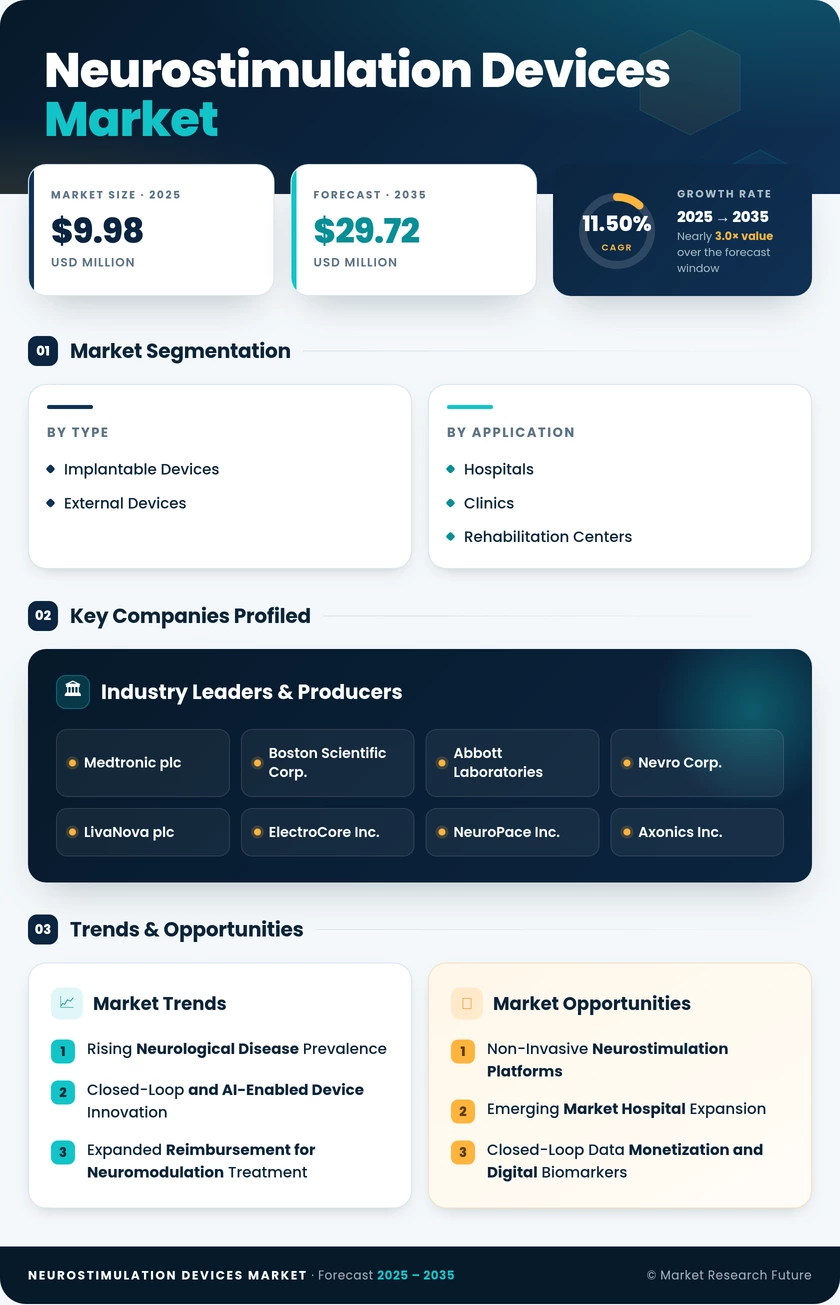
Neurostimulation Devices Market (2026 - 2035)

ID: MRFR/MED/1663-HCR
200 Pages
Satyendra Maurya
Last Updated: July 07, 2026
Neurostimulation Devices Market Research Report: Size, Share, Trend Analysis By Applications (Chronic Pain Management, Movement Disorder Treatment, Depression Treatment, Epilepsy Management), By Product Type (Spinal Cord Stimulators, Deep Brain Stimulators, Transcranial Magnetic Stimulators, Vagus Nerve Stimulators), By End Users (Hospitals, Specialty Clinics, Home Care Settings), By Technology (Electrical Stimulation, Magnetic Stimulation, Chemical Stimulation) and By Regional (North America, Europe, South America, Asia Pacific, Middle East and Africa) - Growth Outlook & Industry Forecast Till 2035
Neurostimulation Devices Market
Market Size
Forecast Period2026-2035
CAGR (2026-2035)11.50%
2025 Market SizeUSD 9.98 Billion
2035 Market SizeUSD 29.72 Billion
Key Players
Medtronic plc
Boston Scientific Corp.
Abbott Laboratories
Nevro Corp.
LivaNova plc
ElectroCore Inc.
Opportunities
  • Non-Invasive Neurostimulation Platforms
  • Emerging Market Hospital Expansion
  • Closed-Loop Data Monetization and Digital Biomarkers
  1. 1 Market Overview |
    1. 1.1 Study Assumptions & Market Definition |
    2. 1.2 Scope of the Study |
    3. 1.3 Research Methodology
  2. 2 Market Summary & Key Takeaways
  3. 3 Market Dynamics |
    1. 3.1 Market Drivers Analysis | |
      1. 3.1.1 Rising Neurological Disease Prevalence | |
      2. 3.1.2 Closed-Loop and AI-Enabled Device Innovation | |
      3. 3.1.3 Expanded Reimbursement for Neuromodulation Treatment | |
      4. 3.1.4 Growing Chronic Pain Burden | |
      5. 3.1.5 Regulatory Fast-Track Approvals | |
      6. 3.1.6 Hospital Infrastructure Expansion in Emerging Markets | |
      7. 3.1.7 Strategic M&A and Portfolio Consolidation |
    2. 3.2 Market Restraints Analysis | |
      1. 3.2.1 High Device and Procedural Costs | |
      2. 3.2.2 Surgical Risks and Specialist Shortages | |
      3. 3.2.3 MRI Compatibility Constraints | |
      4. 3.2.4 Limited Trained Neurosurgeon Workforce | |
      5. 3.2.5 Reimbursement Variability Across Geographies |
    3. 3.3 Market Opportunity Analysis | |
      1. 3.3.1 Non-Invasive Neurostimulation Platforms | |
      2. 3.3.2 Emerging Market Hospital Expansion | |
      3. 3.3.3 Closed-Loop Data Monetization and Digital Biomarkers | |
      4. 3.3.4 Psychiatric and Behavioral Health Indications | |
      5. 3.3.5 Miniaturized and Wireless Implantable Systems |
    4. 3.4 Industry Value Chain Analysis |
    5. 3.5 Porter's Five Forces Analysis
  4. 4 Global Neurostimulation Devices Market Size & Forecast (2021–2035) |
    1. 4.1 Historical Market Size (2021–2025) |
    2. 4.2 Current & Forecast Market Size (2026–2035) |
    3. 4.3 Market Size by Revenue (USD Billion) |
    4. 4.4 Year-over-Year Growth Analysis
  5. 5 Segmentation Analysis |
    1. 5.1 By Device Type | |
      1. 5.1.1 Implantable Devices | |
      2. 5.1.2 External Devices |
    2. 5.2 By Application | |
      1. 5.2.1 Parkinson's Disease | |
      2. 5.2.2 Epilepsy | |
      3. 5.2.3 Depression | |
      4. 5.2.4 Dystonia | |
      5. 5.2.5 Pain Management | |
      6. 5.2.6 Other Applications |
    3. 5.3 By End User | |
      1. 5.3.1 Hospitals | |
      2. 5.3.2 Clinics | |
      3. 5.3.3 Rehabilitation Centers
  6. 6 Regional Analysis |
    1. 6.1 North America | |
      1. 6.1.1 United States | |
      2. 6.1.2 Canada | |
      3. 6.1.3 Mexico |
    2. 6.2 Europe | |
      1. 6.2.1 Germany | |
      2. 6.2.2 United Kingdom | |
      3. 6.2.3 France | |
      4. 6.2.4 Italy | |
      5. 6.2.5 Spain | |
      6. 6.2.6 Nordic Countries | |
      7. 6.2.7 Russia | |
      8. 6.2.8 Rest of Europe |
    3. 6.3 Asia-Pacific | |
      1. 6.3.1 China | |
      2. 6.3.2 India | |
      3. 6.3.3 Japan | |
      4. 6.3.4 South Korea | |
      5. 6.3.5 ASEAN | |
      6. 6.3.6 Rest of Asia-Pacific |
    4. 6.4 South America | |
      1. 6.4.1 Brazil | |
      2. 6.4.2 Argentina | |
      3. 6.4.3 Rest of South America |
    5. 6.5 Middle East & Africa | |
      1. 6.5.1 Saudi Arabia | |
      2. 6.5.2 UAE | |
      3. 6.5.3 South Africa | |
      4. 6.5.4 Egypt | |
      5. 6.5.5 Rest of MEA
  7. 7 Competitive Landscape |
    1. 7.1 Market Share Analysis (2025) |
    2. 7.2 Competitive Benchmarking Matrix |
    3. 7.3 Company Profiles | |
      1. 7.3.1 Medtronic plc | |
      2. 7.3.2 Boston Scientific Corp. | |
      3. 7.3.3 Abbott Laboratories | |
      4. 7.3.4 Nevro Corp. | |
      5. 7.3.5 LivaNova plc | |
      6. 7.3.6 ElectroCore Inc. | |
      7. 7.3.7 NeuroPace Inc. | |
      8. 7.3.8 Axonics Inc. | |
      9. 7.3.9 Synapse Biomedical | |
      10. 7.3.10 Bioventus Inc.
  8. 8 Future Outlook & Strategic Recommendations (2026–2035) |
    1. 8.1 AI-Driven Adaptive Stimulation |
    2. 8.2 Platform Economics and Software-Defined Therapy |
    3. 8.3 Miniaturization and Bioelectronic Medicine Convergence |
    4. 8.4 ESG, Sustainability, and Health Equity
  9. 9 Recent Developments & News
  10. 10 Frequently Asked Questions (FAQs)
  11. 11 Report Scope & Methodology |
    1. 11.1 Study Period & Base Year |
    2. 11.2 Data Sources & Citations |
    3. 11.3 Abbreviations
  12. 12 LIST OF TABLES |
  13. TABLE 1 Global Neurostimulation Devices Market Size & Forecast, by Revenue (USD Billion), 2021–2035 |
  14. TABLE 2 Global Neurostimulation Devices Market – Year-over-Year Growth Analysis, 2021–2035 |
  15. TABLE 3 Driver Impact Analysis – Neurostimulation Devices Market |
  16. TABLE 4 Restraints Impact Analysis – Neurostimulation Devices Market |
  17. TABLE 5 Regional Market Summary – Neurostimulation Devices Market, 2025 |
  18. TABLE 6 North America Neurostimulation Devices Market, by Country, 2021–2035 |
  19. TABLE 7 Europe Neurostimulation Devices Market, by Country, 2021–2035 |
  20. TABLE 8 Asia-Pacific Neurostimulation Devices Market, by Country, 2021–2035 |
  21. TABLE 9 South America Neurostimulation Devices Market, by Country, 2021–2035 |
  22. TABLE 10 Middle East & Africa Neurostimulation Devices Market, by Country, 2021–2035 |
  23. TABLE 11 Neurostimulation Devices Market Size, by Device Type, 2021–2035 |
  24. TABLE 12 Neurostimulation Devices Market Size, by Application, 2021–2035 |
  25. TABLE 13 Neurostimulation Devices Market Size, by End User, 2021–2035 |
  26. TABLE 14 Competitive Benchmarking Matrix – Neurostimulation Devices Market, 2025 |
  27. TABLE 15 Company Profiles – Key Players, Neurostimulation Devices Market |
  28. TABLE 16 Recent Developments & Strategic Announcements, 2022–2024 |
  29. TABLE 17 Report Scope & Methodology Summary |
  30. TABLE 18 Detailed Sources and Citations
  31. 13 LIST OF FIGURES |
  32. FIGURE 1 Neurostimulation Devices Market Dynamics Overview (Drivers, Restraints, Opportunities) |
  33. FIGURE 2 Industry Value Chain — Neurostimulation Devices Market |
  34. FIGURE 3 Porter's Five Forces Analysis — Neurostimulation Devices Market |
  35. FIGURE 4 Global Neurostimulation Devices Market Size Trend, 2021–2035 (USD Billion) |
  36. FIGURE 5 Neurostimulation Devices Market Share, by Device Type, 2025 (%) |
  37. FIGURE 6 Neurostimulation Devices Market Share, by Application, 2025 (%) |
  38. FIGURE 7 Neurostimulation Devices Market Share, by End User, 2025 (%) |
  39. FIGURE 8 Neurostimulation Devices Market Share, by Region, 2025 (%) |
  40. FIGURE 9 North America Neurostimulation Devices Market Size, 2021–2035 (USD Billion) |
  41. FIGURE 10 Europe Neurostimulation Devices Market Size, 2021–2035 (USD Billion) |
  42. FIGURE 11 Asia-Pacific Neurostimulation Devices Market Size, 2021–2035 (USD Billion) |
  43. FIGURE 12 South America Neurostimulation Devices Market Size, 2021–2035 (USD Billion) |
  44. FIGURE 13 Middle East & Africa Neurostimulation Devices Market Size, 2021–2035 (USD Billion) |
  45. FIGURE 14 Competitive Landscape — Market Share of Top 5 Players, 2025

Segmentation Quick Reference

DimensionSub-SegmentsDominant SegmentFastest Growing Segment
By Device TypeImplantable Devices, External DevicesImplantable DevicesExternal Devices
By ApplicationParkinson's Disease, Epilepsy, Depression, Dystonia, Pain Management, Other ApplicationsPain ManagementDepression
By End UserHospitals, Clinics, Rehabilitation CentersHospitalsClinics
By RegionNorth America, Europe, Asia-Pacific, South America, Middle East & AfricaNorth AmericaAsia-Pacific


Market Segmentation Overview

By Device Type

Sub-SegmentKey Trend
Implantable DevicesShift toward rechargeable, MRI-compatible implantable pulse generator platforms with closed-loop sensing
External DevicesRapid adoption of non-invasive vagus nerve and transcranial stimulation for outpatient and home-use settings


Implantable devices continue to anchor the Neurostimulation Devices Market as deep brain stimulation and spinal cord stimulator therapy remain the standard of care for movement disorders and refractory chronic pain. External devices are gaining momentum through regulatory clearance of prescription-grade home-use platforms that expand the addressable patient pool beyond surgical candidates.

By Application

Sub-SegmentKey Trend
Parkinson's DiseaseClosed-loop deep brain stimulation with adaptive algorithms improves symptom control and battery longevity
EpilepsyResponsive neurostimulation (RNS) adoption expanding beyond drug-resistant focal epilepsy
DepressionBreakthrough therapy designations accelerating clinical trials for neuromodulation in treatment-resistant depression
DystoniaExpanding pediatric indications and bilateral globus pallidus internus targeting
Pain ManagementOpioid-alternative mandates driving spinal cord stimulator therapy and high-frequency chronic pain nerve stimulation
Other ApplicationsEmerging indications, including overactive bladder, tinnitus, and obesity-related vagus nerve stimulation


Pain management dominates application-level revenue as healthcare systems globally prioritize non-pharmacological pain therapies. Depression represents the fastest-growing application category, with multiple ongoing pivotal trials expected to generate regulatory approvals before 2028.

By End User

Sub-SegmentKey Trend
HospitalsPrimary setting for complex implantable pulse generator surgeries requiring inpatient monitoring
ClinicsGrowth driven by outpatient-compatible neuromodulation treatment devices and same-day procedures
Rehabilitation CentersExpanding role in post-surgical device programming and long-term chronic pain nerve stimulation management


Hospitals maintain the largest end-user share due to surgical complexity requirements, but clinics are rapidly closing the gap as device miniaturization and outpatient procedure protocols reduce the need for overnight stays.


 

Download PDF ×

We do not share your information with anyone. However, we may send you emails based on your report interest from time to time. You may contact us at any time to opt-out.