Request Free Sample ×

Kindly complete the form below to receive a free sample of this Report

* Please use a valid business email

Leading companies partner with us for data-driven Insights

clients tt-cursor
Hero Background
English
Chinese
French
Japanese
Korean
German
Spanish

Natural Polymer Market Analysis

ID: MRFR/CnM/1101-CR
256 Pages
Swapnil Palwe
July 2024

Natural polymers Market Research Report Information by Type (Cellulose Ether, Starch & Fermentation Polymers, Exudate & Vegetable Gums, and Others) By Application (Pharmaceuticals, Oilfield, Food & Beverages, Cosmetics & personal care products, Construction, Textiles, and Others) and By Region (North America, Europe, Asia-Pacific, South America, Middle East and Africa)-Global Forecast to 2035

Share:
Download PDF ×

We do not share your information with anyone. However, we may send you emails based on your report interest from time to time. You may contact us at any time to opt-out.

Natural Polymer Market Infographic
Purchase Options

Market Analysis

In-depth Analysis of Natural Polymer Market Industry Landscape

The Natural Polymer market is driven by dynamic forces, with applications in food & drinks, medicines, cosmetics, and packaging. Due to their biodegradability, low toxicity, and sustainability, natural polymers from plants and animals are desirable. Food and beverage demand drives market dynamics. Food formulations employ natural polymers like starch and gums as thickeners, stabilizers, and emulsifiers to suit customer demand for natural and clean-label goods.

The pharmaceutical business strongly impacts the Natural Polymer market. Cellulose, chitosan, and alginate are used in pharmaceutical formulations for drug administration, wound healing, and controlled release. Natural polymers are preferred over synthetic ones in the pharmaceutical industry because to their biocompatibility and biodegradability.

Regulatory and environmental factors shape the Natural Polymer market. Compliance with product safety, quality, and environmental standards affects manufacturers' decisions. The industry addresses environmental issues by using sustainable methods, procuring raw resources responsibly, and creating eco-friendly natural polymer formulas.

Natural Polymer market dynamics are influenced by cost efficiency. Industries want cost-effective solutions without compromising natural polymer quality and performance, and manufacturers want to combine manufacturing cost with product efficacy. Producers and end-users need this cost-conscious strategy to innovate and compete.

Natural Polymers markets are also affected by global economic forces. Economic factors affect consumer expenditure on food and pharmaceuticals, which impacts natural polymer use. The economy affects natural polymer demand in packaging, textiles, and personal care, affecting market growth.

New natural polymer sources, extraction techniques, and uses are discovered via research and development. These technical advances are essential for increasing applications, boosting natural polymer performance, and solving industry problems.

Cosmetics and personal care companies employ natural polymers, which affects market dynamics. Cosmetics use plant-derived gums and proteins for moisturizing, thickening, and film forming. Demand for natural and organic beauty and personal care products pushes the use of natural polymers in skincare and haircare products.

Industry collaborations and alliances complicate the Natural Polymer market. As the industry evolves, natural polymer producers, food and pharmaceutical firms, cosmetic manufacturers, and research institutes collaborate to share knowledge, innovate, and set quality standards. These alliances boost market competitiveness and enable enhanced natural polymer solution development.

Author
Author Profile
Swapnil Palwe
Team Lead - Research

With a technical background as Bachelor's in Mechanical Engineering, with MBA in Operations Management , Swapnil has 6+ years of experience in market research, consulting and analytics with the tasks of data mining, analysis, and project execution. He is the POC for our clients, for their consulting projects running under the Automotive/A&D domain. Swapnil has worked on major projects in verticals such as Aerospace & Defense, Automotive and many other domain projects. He has worked on projects for fortune 500 companies' syndicate and consulting projects along with several government projects.

Leave a Comment

FAQs

What is the current valuation of the Natural Polymers Market as of 2024?

<p>The Natural Polymers Market was valued at approximately 9874.91 USD Million in 2024.</p>

What is the projected market valuation for the Natural Polymers Market in 2035?

<p>The market is projected to reach approximately 19660.03 USD Million by 2035.</p>

What is the expected CAGR for the Natural Polymers Market during the forecast period 2025 - 2035?

<p>The expected CAGR for the Natural Polymers Market during the forecast period 2025 - 2035 is 6.46%.</p>

Which segments are included in the Natural Polymers Market by type?

<p>The market segments by type include Cellulose Ether, Starch & Fermentation Polymers, Exudate & Vegetable Gums, and Others.</p>

What were the valuations for Cellulose Ether in 2024 and its projected value in 2035?

<p>Cellulose Ether was valued at approximately 1974.98 USD Million in 2024 and is projected to reach about 3920.01 USD Million by 2035.</p>

How does the Food & Beverages application segment perform in the Natural Polymers Market?

<p>The Food & Beverages application segment was valued at around 2500.0 USD Million in 2024 and is expected to grow to approximately 5000.0 USD Million by 2035.</p>

Who are the key players in the Natural Polymers Market?

<p>Key players in the Natural Polymers Market include BASF SE, Dow Inc., DuPont de Nemours Inc., and Evonik Industries AG.</p>

What is the projected growth for the Oilfield application segment from 2024 to 2035?

<p>The Oilfield application segment was valued at approximately 1200.0 USD Million in 2024 and is projected to reach about 2400.0 USD Million by 2035.</p>

What are the projected values for Starch & Fermentation Polymers in 2024 and 2035?

<p>Starch & Fermentation Polymers had a valuation of approximately 2951.49 USD Million in 2024 and is expected to reach around 5800.0 USD Million by 2035.</p>

What is the significance of the Others segment in the Natural Polymers Market?

<p>The Others segment was valued at approximately 3973.46 USD Million in 2024 and is projected to grow to about 7920.01 USD Million by 2035.</p>

Market Summary

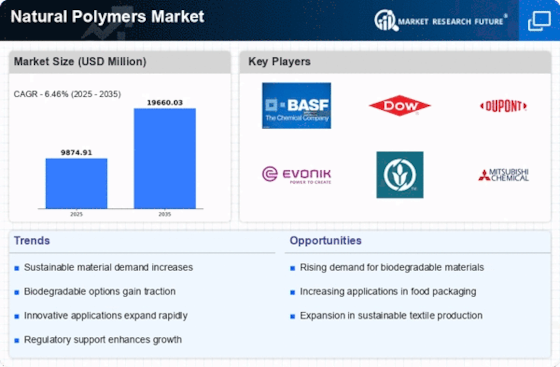
As per Market Research Future analysis, the Natural Polymers Market Size was estimated at 9874.91 USD Million in 2024. The Natural Polymers industry is projected to grow from USD 10512.83 Million in 2025 to USD 19660.03 Million by 2035, exhibiting a compound annual growth rate (CAGR) of 6.46% during the forecast period 2025 - 2035

Key Market Trends & Highlights

The Natural Polymers Market is experiencing robust growth driven by sustainability and health trends.

  • The market is increasingly oriented towards sustainability, reflecting a broader global emphasis on eco-friendly materials. Health-conscious products are gaining traction, particularly in the pharmaceuticals segment, which remains the largest in the market. Technological advancements are facilitating the development of innovative natural polymers, especially in the fast-growing starch and fermentation polymers segment. Key market drivers include sustainability initiatives and health and wellness trends, particularly prominent in North America and the Asia-Pacific region.

Market Size & Forecast

2024 Market Size 9874.91 (USD Million)
2035 Market Size 19660.03 (USD Million)
CAGR (2025 - 2035) 6.46%
Largest Regional Market Share in 2024 Asia Pacific

Major Players

<p>BASF SE (DE), Dow Inc. (US), DuPont de Nemours Inc. (US), Evonik Industries AG (DE), NatureWorks LLC (US), Mitsubishi Chemical Corporation (JP), FMC Corporation (US), Kraton Corporation (US), SABIC (SA)</p>

Market Trends

The Natural Polymers Market is currently experiencing a notable transformation, driven by increasing consumer awareness regarding sustainability and environmental impact. This shift is prompting industries to seek alternatives to synthetic materials, which are often associated with adverse ecological effects. As a result, natural polymers, derived from renewable resources, are gaining traction across various sectors, including packaging, textiles, and pharmaceuticals. The growing emphasis on biodegradable and eco-friendly products is likely to further propel the demand for natural polymers, as companies strive to align with consumer preferences and regulatory standards. Moreover, advancements in technology are enhancing the processing and application of these materials, making them more accessible and versatile for manufacturers. In addition to sustainability, the Natural Polymers Market is influenced by the rising trend of health consciousness among consumers. Natural polymers, such as those derived from plant sources, are increasingly recognized for their potential health benefits, particularly in food and personal care applications. This trend suggests a shift towards products that not only meet functional requirements but also contribute positively to consumer well-being. As the market evolves, it appears that innovation and adaptability will be crucial for stakeholders aiming to capitalize on the opportunities presented by this dynamic landscape. Overall, the Natural Polymers Market is poised for growth, driven by a confluence of environmental, health, and technological factors that are reshaping consumer expectations and industry practices.

Sustainability Focus

The Natural Polymers Market is witnessing a pronounced emphasis on sustainability, as consumers increasingly prefer eco-friendly products. This trend is compelling manufacturers to explore renewable resources, thereby reducing reliance on synthetic alternatives.

Health-Conscious Products

There is a growing inclination towards health-conscious offerings within the Natural Polymers Market. Products derived from natural sources are being favored for their perceived health benefits, particularly in food and personal care sectors.

Technological Advancements

Innovations in processing technologies are enhancing the functionality and application of natural polymers. These advancements are likely to improve product performance and expand the range of uses across various industries.

Natural Polymer Market Market Drivers

Regulatory Support

Regulatory frameworks promoting the use of natural materials are emerging as a significant driver for the Natural Polymers Market. Governments worldwide are implementing policies that encourage the adoption of biodegradable and sustainable materials in various applications, including packaging and textiles. These regulations are designed to mitigate environmental impacts and promote public health. For instance, initiatives aimed at reducing plastic usage are fostering a favorable environment for natural polymers, which are often seen as viable alternatives. Market data indicates that regions with stringent environmental regulations are experiencing accelerated growth in the natural polymers sector, with an expected increase in market share by 10% in the coming years. This regulatory support is likely to enhance the competitiveness of the Natural Polymers Market.

Technological Innovations

Technological advancements are playing a crucial role in shaping the Natural Polymers Market. Innovations in extraction and processing techniques are enhancing the efficiency and cost-effectiveness of natural polymer production. For instance, advancements in biopolymer synthesis are enabling the development of high-performance materials that meet diverse industrial requirements. The market is witnessing a surge in research and development activities, with investments aimed at improving the properties of natural polymers, such as their mechanical strength and thermal stability. This focus on innovation is expected to propel the Natural Polymers Market forward, with a projected growth rate of around 7% annually over the next few years. As industries adopt these new technologies, the versatility and applicability of natural polymers are likely to expand.

Health and Wellness Trends

The rising trend towards health and wellness is significantly influencing the Natural Polymers Market. Consumers are increasingly seeking products that are not only effective but also safe and derived from natural sources. This trend is particularly evident in the food and beverage sector, where natural polymers such as pectin and guar gum are utilized as thickening agents and stabilizers. Market analysis suggests that the demand for natural food additives is expected to grow, with projections indicating a market size increase of over 5 billion USD by 2027. This shift towards health-conscious products is prompting manufacturers to explore natural polymer solutions, thereby driving innovation and growth within the Natural Polymers Market.

Sustainability Initiatives

The increasing emphasis on sustainability appears to be a pivotal driver for the Natural Polymers Market. As consumers and businesses alike become more environmentally conscious, the demand for biodegradable and renewable materials is surging. Natural polymers, derived from renewable resources, offer an eco-friendly alternative to synthetic counterparts. This shift is reflected in market data, indicating that the natural polymers segment is projected to grow at a compound annual growth rate of approximately 8% over the next five years. Companies are investing in sustainable practices, which not only enhances their brand image but also aligns with regulatory frameworks aimed at reducing plastic waste. Consequently, the Natural Polymers Market is likely to witness a robust expansion as stakeholders prioritize sustainability in their product offerings.

Consumer Awareness and Education

The growing awareness and education regarding the benefits of natural products are driving the Natural Polymers Market. As consumers become more informed about the environmental and health advantages of natural polymers, their purchasing decisions are increasingly influenced by these factors. Educational campaigns and marketing strategies highlighting the advantages of natural polymers are contributing to a shift in consumer preferences. This trend is particularly evident in sectors such as cosmetics and personal care, where natural ingredients are gaining traction. Market Research Future indicates that the demand for natural personal care products is expected to rise significantly, potentially reaching a market value of 3 billion USD by 2026. This heightened consumer awareness is likely to propel the Natural Polymers Market, as manufacturers respond to the demand for more natural and sustainable options.

Market Segment Insights

By Type: Cellulose Ether (Largest) vs. Starch & Fermentation Polymers (Fastest-Growing)

<p>In the Natural Polymers Market, the segment distribution reveals a strong dominance of Cellulose Ether, showcasing its extensive application and versatility in various industries, from food to pharmaceuticals. In contrast, Starch & Fermentation Polymers have emerged as the fastest-growing segment, driven by increasing consumer demand for natural and biodegradable products. Their unique properties contribute significantly to diverse applications in food and packaging sectors, reflecting a shift towards sustainability. The growth trends indicate a robust future for both segments, with Cellulose Ether benefiting from innovations in formulations and expanding applications that cater to the growing health-conscious market. Meanwhile, Starch & Fermentation Polymers are gaining traction due to heightened regulatory support for natural ingredients and an increasing focus on sustainable practices, enabling them to capture a larger market share rapidly.</p>

<p>Cellulose Ether: Dominant vs. Starch & Fermentation Polymers: Emerging</p>

<p>Cellulose Ether is recognized as the dominant player in the Natural Polymers Market, driven by its exceptional thickening, gelling, and stabilizing properties, which are widely sought after in cosmetic and pharmaceutical formulations. Its ability to form film and enhance texture makes it an indispensable ingredient in various applications. On the other hand, Starch & Fermentation Polymers are emerging with strong growth potential, attributed to their natural origin and biodegradability, making them a preferred choice in the food industry for clean-label products. Their versatility in modification and application in bio-based films presents them as attractive alternatives to synthetic polymers, thus carving out a significant niche alongside the traditional dominance of Cellulose Ether.</p>

By Application: Pharmaceuticals (Largest) vs. Food & Beverages (Fastest-Growing)

<p>The Natural Polymers Market shows significant diversity across its applications. Pharmaceuticals emerge as the largest segment, commanding a major share due to the increasing use of natural polymers in drug formulations and delivery systems. Following closely, Food & Beverages are gaining traction as consumers demand natural and organic ingredients, leading to a growing utilization of natural polymers for thickening, gelling, and stabilizing food products. Other notable segments include Cosmetics, Construction, and Textiles, which also contribute to the market's overall diversity and growth.</p>

<p>Pharmaceuticals: Dominant vs. Food & Beverages: Emerging</p>

<p>Pharmaceuticals are recognized as a dominant force within the Natural Polymers Market, leveraging their biocompatibility and biodegradability for various medical applications such as drug delivery, tissue engineering, and wound healing. This segment benefits from the rigorous research and development in biopolymer formulations that enhance therapeutic efficacy. Conversely, Food & Beverages represent an emerging segment, driven by health-conscious consumers advocating for natural ingredients. The increasing demand for clean-label products has led to the incorporation of natural polymers like pectin, starch, and alginate in food processing to improve texture and shelf life. As awareness of health impacts continues to rise, these segments will likely expand their market shares further.</p>

Get more detailed insights about Natural Polymer Market Research Report – Forecast to 2035

Regional Insights

North America : Innovation and Sustainability Leader

North America is the largest market for natural polymers, holding approximately 40% of the global share. The region's growth is driven by increasing demand for sustainable materials, stringent environmental regulations, and advancements in biopolymer technology. The U.S. and Canada are at the forefront, with a strong focus on research and development, which is further supported by government initiatives promoting green chemistry and sustainable practices. The competitive landscape is characterized by major players such as BASF SE, Dow Inc., and DuPont de Nemours, which are investing heavily in innovation and expanding their product portfolios. The presence of these key players, along with a robust supply chain and increasing consumer awareness about eco-friendly products, positions North America as a leader in the natural polymers market. The region's commitment to sustainability is expected to drive further growth in the coming years.

Europe : Sustainable Innovation Hub

Europe is the second-largest market for natural polymers, accounting for approximately 30% of the global market share. The region's growth is fueled by stringent regulations aimed at reducing plastic waste and promoting biodegradable alternatives. The European Union's Green Deal and Circular Economy Action Plan are pivotal in driving demand for natural polymers, encouraging manufacturers to adopt sustainable practices and innovate in product development. Leading countries in this market include Germany, France, and the Netherlands, where companies like Evonik Industries and BASF are actively engaged in research and development. The competitive landscape is marked by a strong emphasis on sustainability, with many firms focusing on bio-based materials. The presence of regulatory frameworks and financial incentives further enhances the market's attractiveness, fostering a culture of innovation and collaboration among industry stakeholders.

Asia-Pacific : Emerging Market Potential

Asia-Pacific is witnessing rapid growth in the natural polymers market, holding approximately 25% of the global share. The region's expansion is driven by increasing industrialization, rising consumer awareness about sustainable products, and supportive government policies promoting green technologies. Countries like China and India are leading this growth, with significant investments in biopolymer production and applications across various industries, including packaging and textiles. The competitive landscape is evolving, with key players such as Mitsubishi Chemical Corporation and NatureWorks LLC establishing a strong presence. The region is characterized by a mix of established companies and emerging startups focusing on innovative solutions. As demand for eco-friendly materials continues to rise, Asia-Pacific is poised to become a significant player in The Natural Polymers, attracting investments and fostering technological advancements.

Middle East and Africa : Resource-Rich Frontier

The Middle East and Africa region is gradually emerging in the natural polymers market, currently holding about 5% of the global share. The growth is primarily driven by increasing investments in sustainable materials and a growing awareness of environmental issues. Countries like South Africa and the UAE are beginning to adopt natural polymers in various applications, supported by government initiatives aimed at promoting sustainability and reducing plastic waste. The competitive landscape is still developing, with local players and international companies exploring opportunities in this region. Key players are beginning to invest in research and development to cater to the unique needs of the market. As the region continues to focus on sustainability and innovation, the natural polymers market is expected to grow, presenting new opportunities for both local and global companies.

Key Players and Competitive Insights

Natural polymers Market is characterized by a high level of competition, with many players emerging for market share. The top 10 companies in the market account for a significant market share of Natural polymers Market. The competitive landscape of Natural polymers Market is dynamic, with companies constantly innovating and expanding their product offerings. Despite the challenges, there are several factors that are driving growth in the Natural Polymers Market. These include increasing global awareness and demand for sustainable and eco-friendly products.
The Natural Polymers Market is expected to witness significant growth in the coming years, owing to increasing consumer demand for sustainable and environmentally friendly products across various industries. The market is benefiting from the development of new technologies. The key players in the Natural polymers Market include Ashland, Cargill, Incorporated, Dow, Encore Natural Polymers, Borregaard, CP Kelco, Roquette Freres, Kuraray, Archer Daniels Midland, Ingredion and JRS Pharms. These companies compete based on product quality, innovation, price, customer service, and market share.
Companies also engage in various strategic initiatives, such as mergers and acquisitions, new product launches, partnerships, joint ventures, and expansions, to enhance their market position and expand their product portfolio. Companies are also focusing on developing new and innovative products that meet the specific needs of their customers. Companies will need to continue to innovate and expand their product offerings to remain competitive. For instance, on 16 September 2021, Cargill has announced the opening of its new, cutting-edge pectin production facility, located in Bebedouro, Brazil.
The plant, which represents a USD 150 million investment, significantly expands the company’s ability to meet growing global demand for label-friendly texturizing ingredient.
: Environment, social and governance (ESG) is embedded in Ashland’s strategy and operating plans. It is both an impetus and growth opportunity, turning the potential for change into action and driving real business growth.  Under its commitment to the Paris Climate Accord and Science Based Targets, and the United Nations Global Compact and Sustainable Development Goals, it is operating with greater transparency and aligning resources to help solve some of the world’s most complex challenges. Ashland’s conscious-to-cutting-edge innovation strategy includes increasing the speed and impact of new product innovations while embracing and integrating ESG in all that they do.
The company launched more than 30 new products in FY22, and 83 percent of its product portfolio is natural, nature-derived, biodegradable or sustainable in-use. Though smaller than some of its peers, Ashland’s targeted approach to its value chain and its agile business model mean it has a unique matrixed approach to how it impacts environmental, social and governance issues. This materiality assessment shows Ashland’s holistic approach to managing the needs of people, planet and profit.
Dow's strategy for Corporate Social Responsibility (CSR) integrates deeply into its overall sustainability ethos, extending beyond traditional community projects to encompass a holistic approach to responsible corporate citizenship and environmental stewardship. This commitment permeates every facet of Dow's business operations and presence in the sub-region, reflecting a dedication to sustainability principles.At Dow, CSR initiatives are strategically aligned with broader programmatic goals, emphasizing not just financial contributions but also leveraging resources, technology, and employee volunteerism to maximize positive impact.
This comprehensive approach underscores Dow's role as a leader in promoting a sustainable society, guided by ambitious goals set for 2025 and beyond. 

Key Companies in the Natural Polymer Market include

Industry Developments

August 2022: Ashland has announced a strategically significant expansion of its Viatel bioresorbable polymer manufacturing and research and development site at the National Science Park, home to a network of innovative organizations, in Mullingar, Ireland. 

August 2021: GC International Corporation Company Limited, a subsidiary of PTT Global Chemical Public Company Limited (GC) and Cargill Incorporated (Cargill), joint owners of NatureWorks LLC (NatureWorks), announced the construction of a new fully integrated biopolymer production facility in Thailand. This project supports sustainable development in Thailand, specifically, the Bio-Circular-Green (BCG) economy model, further driving economic growth, improving competitiveness and helping the country achieve its Sustainable Development Goals (SDGs). 

Future Outlook

Natural Polymer Market Future Outlook

The Natural Polymers Market is projected to grow at a 6.46% CAGR from 2025 to 2035, driven by increasing demand in packaging, healthcare, and sustainable materials.

New opportunities lie in:

  • Development of biodegradable packaging solutions for consumer goods.
  • Expansion into biopharmaceutical applications utilizing natural polymers.
  • Investment in R&D for innovative natural polymer composites.

By 2035, the Natural Polymers Market is expected to achieve substantial growth, reflecting evolving consumer preferences and technological advancements.

Market Segmentation

Natural Polymer Market Type Outlook

  • Cellulose Ether
  • Starch & Fermentation Polymers
  • Exudate & Vegetable Gums
  • Others

Natural Polymer Market Application Outlook

  • Pharmaceuticals
  • Oilfield
  • Food & Beverages
  • Cosmetics & Personal Care Products
  • Construction
  • Textiles
  • Others

Report Scope

MARKET SIZE 2024 9874.91(USD Million)
MARKET SIZE 2025 10512.83(USD Million)
MARKET SIZE 2035 19660.03(USD Million)
COMPOUND ANNUAL GROWTH RATE (CAGR) 6.46% (2025 - 2035)
REPORT COVERAGE Revenue Forecast, Competitive Landscape, Growth Factors, and Trends
BASE YEAR 2024
Market Forecast Period 2025 - 2035
Historical Data 2019 - 2024
Market Forecast Units USD Million
Key Companies Profiled BASF SE (DE), Dow Inc. (US), DuPont de Nemours Inc. (US), Evonik Industries AG (DE), NatureWorks LLC (US), Mitsubishi Chemical Corporation (JP), FMC Corporation (US), Kraton Corporation (US), SABIC (SA)
Segments Covered Type, Application, Region
Key Market Opportunities Growing demand for biodegradable materials drives innovation in the Natural Polymers Market.
Key Market Dynamics Rising demand for biodegradable materials drives innovation and competition in the natural polymers market.
Countries Covered North America, Europe, APAC, South America, MEA

FAQs

What is the current valuation of the Natural Polymers Market as of 2024?

<p>The Natural Polymers Market was valued at approximately 9874.91 USD Million in 2024.</p>

What is the projected market valuation for the Natural Polymers Market in 2035?

<p>The market is projected to reach approximately 19660.03 USD Million by 2035.</p>

What is the expected CAGR for the Natural Polymers Market during the forecast period 2025 - 2035?

<p>The expected CAGR for the Natural Polymers Market during the forecast period 2025 - 2035 is 6.46%.</p>

Which segments are included in the Natural Polymers Market by type?

<p>The market segments by type include Cellulose Ether, Starch & Fermentation Polymers, Exudate & Vegetable Gums, and Others.</p>

What were the valuations for Cellulose Ether in 2024 and its projected value in 2035?

<p>Cellulose Ether was valued at approximately 1974.98 USD Million in 2024 and is projected to reach about 3920.01 USD Million by 2035.</p>

How does the Food & Beverages application segment perform in the Natural Polymers Market?

<p>The Food & Beverages application segment was valued at around 2500.0 USD Million in 2024 and is expected to grow to approximately 5000.0 USD Million by 2035.</p>

Who are the key players in the Natural Polymers Market?

<p>Key players in the Natural Polymers Market include BASF SE, Dow Inc., DuPont de Nemours Inc., and Evonik Industries AG.</p>

What is the projected growth for the Oilfield application segment from 2024 to 2035?

<p>The Oilfield application segment was valued at approximately 1200.0 USD Million in 2024 and is projected to reach about 2400.0 USD Million by 2035.</p>

What are the projected values for Starch & Fermentation Polymers in 2024 and 2035?

<p>Starch & Fermentation Polymers had a valuation of approximately 2951.49 USD Million in 2024 and is expected to reach around 5800.0 USD Million by 2035.</p>

What is the significance of the Others segment in the Natural Polymers Market?

<p>The Others segment was valued at approximately 3973.46 USD Million in 2024 and is projected to grow to about 7920.01 USD Million by 2035.</p>

  1. SECTION I: EXECUTIVE SUMMARY AND KEY HIGHLIGHTS
    1. | 1.1 EXECUTIVE SUMMARY
    2. | | 1.1.1 Market Overview
    3. | | 1.1.2 Key Findings
    4. | | 1.1.3 Market Segmentation
    5. | | 1.1.4 Competitive Landscape
    6. | | 1.1.5 Challenges and Opportunities
    7. | | 1.1.6 Future Outlook
  2. SECTION II: SCOPING, METHODOLOGY AND MARKET STRUCTURE
    1. | 2.1 MARKET INTRODUCTION
    2. | | 2.1.1 Definition
    3. | | 2.1.2 Scope of the study
    4. | | | 2.1.2.1 Research Objective
    5. | | | 2.1.2.2 Assumption
    6. | | | 2.1.2.3 Limitations
    7. | 2.2 RESEARCH METHODOLOGY
    8. | | 2.2.1 Overview
    9. | | 2.2.2 Data Mining
    10. | | 2.2.3 Secondary Research
    11. | | 2.2.4 Primary Research
    12. | | | 2.2.4.1 Primary Interviews and Information Gathering Process
    13. | | | 2.2.4.2 Breakdown of Primary Respondents
    14. | | 2.2.5 Forecasting Model
    15. | | 2.2.6 Market Size Estimation
    16. | | | 2.2.6.1 Bottom-Up Approach
    17. | | | 2.2.6.2 Top-Down Approach
    18. | | 2.2.7 Data Triangulation
    19. | | 2.2.8 Validation
  3. SECTION III: QUALITATIVE ANALYSIS
    1. | 3.1 MARKET DYNAMICS
    2. | | 3.1.1 Overview
    3. | | 3.1.2 Drivers
    4. | | 3.1.3 Restraints
    5. | | 3.1.4 Opportunities
    6. | 3.2 MARKET FACTOR ANALYSIS
    7. | | 3.2.1 Value chain Analysis
    8. | | 3.2.2 Porter's Five Forces Analysis
    9. | | | 3.2.2.1 Bargaining Power of Suppliers
    10. | | | 3.2.2.2 Bargaining Power of Buyers
    11. | | | 3.2.2.3 Threat of New Entrants
    12. | | | 3.2.2.4 Threat of Substitutes
    13. | | | 3.2.2.5 Intensity of Rivalry
    14. | | 3.2.3 COVID-19 Impact Analysis
    15. | | | 3.2.3.1 Market Impact Analysis
    16. | | | 3.2.3.2 Regional Impact
    17. | | | 3.2.3.3 Opportunity and Threat Analysis
  4. SECTION IV: QUANTITATIVE ANALYSIS
    1. | 4.1 Chemicals and Materials, BY Type (USD Million)
    2. | | 4.1.1 Cellulose Ether
    3. | | 4.1.2 Starch & Fermentation Polymers
    4. | | 4.1.3 Exudate & Vegetable Gums
    5. | | 4.1.4 Others
    6. | 4.2 Chemicals and Materials, BY Application (USD Million)
    7. | | 4.2.1 Pharmaceuticals
    8. | | 4.2.2 Oilfield
    9. | | 4.2.3 Food & Beverages
    10. | | 4.2.4 Cosmetics & Personal Care Products
    11. | | 4.2.5 Construction
    12. | | 4.2.6 Textiles
    13. | | 4.2.7 Others
    14. | 4.3 Chemicals and Materials, BY Region (USD Million)
    15. | | 4.3.1 North America
    16. | | | 4.3.1.1 US
    17. | | | 4.3.1.2 Canada
    18. | | 4.3.2 Europe
    19. | | | 4.3.2.1 Germany
    20. | | | 4.3.2.2 UK
    21. | | | 4.3.2.3 France
    22. | | | 4.3.2.4 Russia
    23. | | | 4.3.2.5 Italy
    24. | | | 4.3.2.6 Spain
    25. | | | 4.3.2.7 Rest of Europe
    26. | | 4.3.3 APAC
    27. | | | 4.3.3.1 China
    28. | | | 4.3.3.2 India
    29. | | | 4.3.3.3 Japan
    30. | | | 4.3.3.4 South Korea
    31. | | | 4.3.3.5 Malaysia
    32. | | | 4.3.3.6 Thailand
    33. | | | 4.3.3.7 Indonesia
    34. | | | 4.3.3.8 Rest of APAC
    35. | | 4.3.4 South America
    36. | | | 4.3.4.1 Brazil
    37. | | | 4.3.4.2 Mexico
    38. | | | 4.3.4.3 Argentina
    39. | | | 4.3.4.4 Rest of South America
    40. | | 4.3.5 MEA
    41. | | | 4.3.5.1 GCC Countries
    42. | | | 4.3.5.2 South Africa
    43. | | | 4.3.5.3 Rest of MEA
  5. SECTION V: COMPETITIVE ANALYSIS
    1. | 5.1 Competitive Landscape
    2. | | 5.1.1 Overview
    3. | | 5.1.2 Competitive Analysis
    4. | | 5.1.3 Market share Analysis
    5. | | 5.1.4 Major Growth Strategy in the Chemicals and Materials
    6. | | 5.1.5 Competitive Benchmarking
    7. | | 5.1.6 Leading Players in Terms of Number of Developments in the Chemicals and Materials
    8. | | 5.1.7 Key developments and growth strategies
    9. | | | 5.1.7.1 New Product Launch/Service Deployment
    10. | | | 5.1.7.2 Merger & Acquisitions
    11. | | | 5.1.7.3 Joint Ventures
    12. | | 5.1.8 Major Players Financial Matrix
    13. | | | 5.1.8.1 Sales and Operating Income
    14. | | | 5.1.8.2 Major Players R&D Expenditure. 2023
    15. | 5.2 Company Profiles
    16. | | 5.2.1 BASF SE (DE)
    17. | | | 5.2.1.1 Financial Overview
    18. | | | 5.2.1.2 Products Offered
    19. | | | 5.2.1.3 Key Developments
    20. | | | 5.2.1.4 SWOT Analysis
    21. | | | 5.2.1.5 Key Strategies
    22. | | 5.2.2 Dow Inc. (US)
    23. | | | 5.2.2.1 Financial Overview
    24. | | | 5.2.2.2 Products Offered
    25. | | | 5.2.2.3 Key Developments
    26. | | | 5.2.2.4 SWOT Analysis
    27. | | | 5.2.2.5 Key Strategies
    28. | | 5.2.3 DuPont de Nemours Inc. (US)
    29. | | | 5.2.3.1 Financial Overview
    30. | | | 5.2.3.2 Products Offered
    31. | | | 5.2.3.3 Key Developments
    32. | | | 5.2.3.4 SWOT Analysis
    33. | | | 5.2.3.5 Key Strategies
    34. | | 5.2.4 Evonik Industries AG (DE)
    35. | | | 5.2.4.1 Financial Overview
    36. | | | 5.2.4.2 Products Offered
    37. | | | 5.2.4.3 Key Developments
    38. | | | 5.2.4.4 SWOT Analysis
    39. | | | 5.2.4.5 Key Strategies
    40. | | 5.2.5 NatureWorks LLC (US)
    41. | | | 5.2.5.1 Financial Overview
    42. | | | 5.2.5.2 Products Offered
    43. | | | 5.2.5.3 Key Developments
    44. | | | 5.2.5.4 SWOT Analysis
    45. | | | 5.2.5.5 Key Strategies
    46. | | 5.2.6 Mitsubishi Chemical Corporation (JP)
    47. | | | 5.2.6.1 Financial Overview
    48. | | | 5.2.6.2 Products Offered
    49. | | | 5.2.6.3 Key Developments
    50. | | | 5.2.6.4 SWOT Analysis
    51. | | | 5.2.6.5 Key Strategies
    52. | | 5.2.7 FMC Corporation (US)
    53. | | | 5.2.7.1 Financial Overview
    54. | | | 5.2.7.2 Products Offered
    55. | | | 5.2.7.3 Key Developments
    56. | | | 5.2.7.4 SWOT Analysis
    57. | | | 5.2.7.5 Key Strategies
    58. | | 5.2.8 Kraton Corporation (US)
    59. | | | 5.2.8.1 Financial Overview
    60. | | | 5.2.8.2 Products Offered
    61. | | | 5.2.8.3 Key Developments
    62. | | | 5.2.8.4 SWOT Analysis
    63. | | | 5.2.8.5 Key Strategies
    64. | | 5.2.9 SABIC (SA)
    65. | | | 5.2.9.1 Financial Overview
    66. | | | 5.2.9.2 Products Offered
    67. | | | 5.2.9.3 Key Developments
    68. | | | 5.2.9.4 SWOT Analysis
    69. | | | 5.2.9.5 Key Strategies
    70. | 5.3 Appendix
    71. | | 5.3.1 References
    72. | | 5.3.2 Related Reports
  6. LIST OF FIGURES
    1. | 6.1 MARKET SYNOPSIS
    2. | 6.2 NORTH AMERICA MARKET ANALYSIS
    3. | 6.3 US MARKET ANALYSIS BY TYPE
    4. | 6.4 US MARKET ANALYSIS BY APPLICATION
    5. | 6.5 CANADA MARKET ANALYSIS BY TYPE
    6. | 6.6 CANADA MARKET ANALYSIS BY APPLICATION
    7. | 6.7 EUROPE MARKET ANALYSIS
    8. | 6.8 GERMANY MARKET ANALYSIS BY TYPE
    9. | 6.9 GERMANY MARKET ANALYSIS BY APPLICATION
    10. | 6.10 UK MARKET ANALYSIS BY TYPE
    11. | 6.11 UK MARKET ANALYSIS BY APPLICATION
    12. | 6.12 FRANCE MARKET ANALYSIS BY TYPE
    13. | 6.13 FRANCE MARKET ANALYSIS BY APPLICATION
    14. | 6.14 RUSSIA MARKET ANALYSIS BY TYPE
    15. | 6.15 RUSSIA MARKET ANALYSIS BY APPLICATION
    16. | 6.16 ITALY MARKET ANALYSIS BY TYPE
    17. | 6.17 ITALY MARKET ANALYSIS BY APPLICATION
    18. | 6.18 SPAIN MARKET ANALYSIS BY TYPE
    19. | 6.19 SPAIN MARKET ANALYSIS BY APPLICATION
    20. | 6.20 REST OF EUROPE MARKET ANALYSIS BY TYPE
    21. | 6.21 REST OF EUROPE MARKET ANALYSIS BY APPLICATION
    22. | 6.22 APAC MARKET ANALYSIS
    23. | 6.23 CHINA MARKET ANALYSIS BY TYPE
    24. | 6.24 CHINA MARKET ANALYSIS BY APPLICATION
    25. | 6.25 INDIA MARKET ANALYSIS BY TYPE
    26. | 6.26 INDIA MARKET ANALYSIS BY APPLICATION
    27. | 6.27 JAPAN MARKET ANALYSIS BY TYPE
    28. | 6.28 JAPAN MARKET ANALYSIS BY APPLICATION
    29. | 6.29 SOUTH KOREA MARKET ANALYSIS BY TYPE
    30. | 6.30 SOUTH KOREA MARKET ANALYSIS BY APPLICATION
    31. | 6.31 MALAYSIA MARKET ANALYSIS BY TYPE
    32. | 6.32 MALAYSIA MARKET ANALYSIS BY APPLICATION
    33. | 6.33 THAILAND MARKET ANALYSIS BY TYPE
    34. | 6.34 THAILAND MARKET ANALYSIS BY APPLICATION
    35. | 6.35 INDONESIA MARKET ANALYSIS BY TYPE
    36. | 6.36 INDONESIA MARKET ANALYSIS BY APPLICATION
    37. | 6.37 REST OF APAC MARKET ANALYSIS BY TYPE
    38. | 6.38 REST OF APAC MARKET ANALYSIS BY APPLICATION
    39. | 6.39 SOUTH AMERICA MARKET ANALYSIS
    40. | 6.40 BRAZIL MARKET ANALYSIS BY TYPE
    41. | 6.41 BRAZIL MARKET ANALYSIS BY APPLICATION
    42. | 6.42 MEXICO MARKET ANALYSIS BY TYPE
    43. | 6.43 MEXICO MARKET ANALYSIS BY APPLICATION
    44. | 6.44 ARGENTINA MARKET ANALYSIS BY TYPE
    45. | 6.45 ARGENTINA MARKET ANALYSIS BY APPLICATION
    46. | 6.46 REST OF SOUTH AMERICA MARKET ANALYSIS BY TYPE
    47. | 6.47 REST OF SOUTH AMERICA MARKET ANALYSIS BY APPLICATION
    48. | 6.48 MEA MARKET ANALYSIS
    49. | 6.49 GCC COUNTRIES MARKET ANALYSIS BY TYPE
    50. | 6.50 GCC COUNTRIES MARKET ANALYSIS BY APPLICATION
    51. | 6.51 SOUTH AFRICA MARKET ANALYSIS BY TYPE
    52. | 6.52 SOUTH AFRICA MARKET ANALYSIS BY APPLICATION
    53. | 6.53 REST OF MEA MARKET ANALYSIS BY TYPE
    54. | 6.54 REST OF MEA MARKET ANALYSIS BY APPLICATION
    55. | 6.55 KEY BUYING CRITERIA OF CHEMICALS AND MATERIALS
    56. | 6.56 RESEARCH PROCESS OF MRFR
    57. | 6.57 DRO ANALYSIS OF CHEMICALS AND MATERIALS
    58. | 6.58 DRIVERS IMPACT ANALYSIS: CHEMICALS AND MATERIALS
    59. | 6.59 RESTRAINTS IMPACT ANALYSIS: CHEMICALS AND MATERIALS
    60. | 6.60 SUPPLY / VALUE CHAIN: CHEMICALS AND MATERIALS
    61. | 6.61 CHEMICALS AND MATERIALS, BY TYPE, 2024 (% SHARE)
    62. | 6.62 CHEMICALS AND MATERIALS, BY TYPE, 2024 TO 2035 (USD Million)
    63. | 6.63 CHEMICALS AND MATERIALS, BY APPLICATION, 2024 (% SHARE)
    64. | 6.64 CHEMICALS AND MATERIALS, BY APPLICATION, 2024 TO 2035 (USD Million)
    65. | 6.65 BENCHMARKING OF MAJOR COMPETITORS
  7. LIST OF TABLES
    1. | 7.1 LIST OF ASSUMPTIONS
    2. | | 7.1.1
    3. | 7.2 North America MARKET SIZE ESTIMATES; FORECAST
    4. | | 7.2.1 BY TYPE, 2025-2035 (USD Million)
    5. | | 7.2.2 BY APPLICATION, 2025-2035 (USD Million)
    6. | 7.3 US MARKET SIZE ESTIMATES; FORECAST
    7. | | 7.3.1 BY TYPE, 2025-2035 (USD Million)
    8. | | 7.3.2 BY APPLICATION, 2025-2035 (USD Million)
    9. | 7.4 Canada MARKET SIZE ESTIMATES; FORECAST
    10. | | 7.4.1 BY TYPE, 2025-2035 (USD Million)
    11. | | 7.4.2 BY APPLICATION, 2025-2035 (USD Million)
    12. | 7.5 Europe MARKET SIZE ESTIMATES; FORECAST
    13. | | 7.5.1 BY TYPE, 2025-2035 (USD Million)
    14. | | 7.5.2 BY APPLICATION, 2025-2035 (USD Million)
    15. | 7.6 Germany MARKET SIZE ESTIMATES; FORECAST
    16. | | 7.6.1 BY TYPE, 2025-2035 (USD Million)
    17. | | 7.6.2 BY APPLICATION, 2025-2035 (USD Million)
    18. | 7.7 UK MARKET SIZE ESTIMATES; FORECAST
    19. | | 7.7.1 BY TYPE, 2025-2035 (USD Million)
    20. | | 7.7.2 BY APPLICATION, 2025-2035 (USD Million)
    21. | 7.8 France MARKET SIZE ESTIMATES; FORECAST
    22. | | 7.8.1 BY TYPE, 2025-2035 (USD Million)
    23. | | 7.8.2 BY APPLICATION, 2025-2035 (USD Million)
    24. | 7.9 Russia MARKET SIZE ESTIMATES; FORECAST
    25. | | 7.9.1 BY TYPE, 2025-2035 (USD Million)
    26. | | 7.9.2 BY APPLICATION, 2025-2035 (USD Million)
    27. | 7.10 Italy MARKET SIZE ESTIMATES; FORECAST
    28. | | 7.10.1 BY TYPE, 2025-2035 (USD Million)
    29. | | 7.10.2 BY APPLICATION, 2025-2035 (USD Million)
    30. | 7.11 Spain MARKET SIZE ESTIMATES; FORECAST
    31. | | 7.11.1 BY TYPE, 2025-2035 (USD Million)
    32. | | 7.11.2 BY APPLICATION, 2025-2035 (USD Million)
    33. | 7.12 Rest of Europe MARKET SIZE ESTIMATES; FORECAST
    34. | | 7.12.1 BY TYPE, 2025-2035 (USD Million)
    35. | | 7.12.2 BY APPLICATION, 2025-2035 (USD Million)
    36. | 7.13 APAC MARKET SIZE ESTIMATES; FORECAST
    37. | | 7.13.1 BY TYPE, 2025-2035 (USD Million)
    38. | | 7.13.2 BY APPLICATION, 2025-2035 (USD Million)
    39. | 7.14 China MARKET SIZE ESTIMATES; FORECAST
    40. | | 7.14.1 BY TYPE, 2025-2035 (USD Million)
    41. | | 7.14.2 BY APPLICATION, 2025-2035 (USD Million)
    42. | 7.15 India MARKET SIZE ESTIMATES; FORECAST
    43. | | 7.15.1 BY TYPE, 2025-2035 (USD Million)
    44. | | 7.15.2 BY APPLICATION, 2025-2035 (USD Million)
    45. | 7.16 Japan MARKET SIZE ESTIMATES; FORECAST
    46. | | 7.16.1 BY TYPE, 2025-2035 (USD Million)
    47. | | 7.16.2 BY APPLICATION, 2025-2035 (USD Million)
    48. | 7.17 South Korea MARKET SIZE ESTIMATES; FORECAST
    49. | | 7.17.1 BY TYPE, 2025-2035 (USD Million)
    50. | | 7.17.2 BY APPLICATION, 2025-2035 (USD Million)
    51. | 7.18 Malaysia MARKET SIZE ESTIMATES; FORECAST
    52. | | 7.18.1 BY TYPE, 2025-2035 (USD Million)
    53. | | 7.18.2 BY APPLICATION, 2025-2035 (USD Million)
    54. | 7.19 Thailand MARKET SIZE ESTIMATES; FORECAST
    55. | | 7.19.1 BY TYPE, 2025-2035 (USD Million)
    56. | | 7.19.2 BY APPLICATION, 2025-2035 (USD Million)
    57. | 7.20 Indonesia MARKET SIZE ESTIMATES; FORECAST
    58. | | 7.20.1 BY TYPE, 2025-2035 (USD Million)
    59. | | 7.20.2 BY APPLICATION, 2025-2035 (USD Million)
    60. | 7.21 Rest of APAC MARKET SIZE ESTIMATES; FORECAST
    61. | | 7.21.1 BY TYPE, 2025-2035 (USD Million)
    62. | | 7.21.2 BY APPLICATION, 2025-2035 (USD Million)
    63. | 7.22 South America MARKET SIZE ESTIMATES; FORECAST
    64. | | 7.22.1 BY TYPE, 2025-2035 (USD Million)
    65. | | 7.22.2 BY APPLICATION, 2025-2035 (USD Million)
    66. | 7.23 Brazil MARKET SIZE ESTIMATES; FORECAST
    67. | | 7.23.1 BY TYPE, 2025-2035 (USD Million)
    68. | | 7.23.2 BY APPLICATION, 2025-2035 (USD Million)
    69. | 7.24 Mexico MARKET SIZE ESTIMATES; FORECAST
    70. | | 7.24.1 BY TYPE, 2025-2035 (USD Million)
    71. | | 7.24.2 BY APPLICATION, 2025-2035 (USD Million)
    72. | 7.25 Argentina MARKET SIZE ESTIMATES; FORECAST
    73. | | 7.25.1 BY TYPE, 2025-2035 (USD Million)
    74. | | 7.25.2 BY APPLICATION, 2025-2035 (USD Million)
    75. | 7.26 Rest of South America MARKET SIZE ESTIMATES; FORECAST
    76. | | 7.26.1 BY TYPE, 2025-2035 (USD Million)
    77. | | 7.26.2 BY APPLICATION, 2025-2035 (USD Million)
    78. | 7.27 MEA MARKET SIZE ESTIMATES; FORECAST
    79. | | 7.27.1 BY TYPE, 2025-2035 (USD Million)
    80. | | 7.27.2 BY APPLICATION, 2025-2035 (USD Million)
    81. | 7.28 GCC Countries MARKET SIZE ESTIMATES; FORECAST
    82. | | 7.28.1 BY TYPE, 2025-2035 (USD Million)
    83. | | 7.28.2 BY APPLICATION, 2025-2035 (USD Million)
    84. | 7.29 South Africa MARKET SIZE ESTIMATES; FORECAST
    85. | | 7.29.1 BY TYPE, 2025-2035 (USD Million)
    86. | | 7.29.2 BY APPLICATION, 2025-2035 (USD Million)
    87. | 7.30 Rest of MEA MARKET SIZE ESTIMATES; FORECAST
    88. | | 7.30.1 BY TYPE, 2025-2035 (USD Million)
    89. | | 7.30.2 BY APPLICATION, 2025-2035 (USD Million)
    90. | 7.31 PRODUCT LAUNCH/PRODUCT DEVELOPMENT/APPROVAL
    91. | | 7.31.1
    92. | 7.32 ACQUISITION/PARTNERSHIP
    93. | | 7.32.1

Chemicals and Materials Market Segmentation

Chemicals and Materials By Type (USD Million, 2025-2035)

  • Cellulose Ether
  • Starch & Fermentation Polymers
  • Exudate & Vegetable Gums
  • Others

Chemicals and Materials By Application (USD Million, 2025-2035)

  • Pharmaceuticals
  • Oilfield
  • Food & Beverages
  • Cosmetics & Personal Care Products
  • Construction
  • Textiles
  • Others
Infographic

Free Sample Request

Kindly complete the form below to receive a free sample of this Report

Get Free Sample

Customer Strories

Compare Licence

×
Features License Type
Single User Multiuser License Enterprise User
Price $4,950 $5,950 $7,250
Maximum User Access Limit 1 User Upto 10 Users Unrestricted Access Throughout the Organization
Free Customization
Direct Access to Analyst
Deliverable Format
Platform Access
Discount on Next Purchase 10% 15% 15%
Printable Versions