Request Free Sample ×

Kindly complete the form below to receive a free sample of this Report

* Please use a valid business email

Leading companies partner with us for data-driven Insights

clients tt-cursor
Hero Background
English
Chinese
French
Japanese
Korean
German
Spanish

Natural Immune Booster Market Trends

ID: MRFR/FnB/1891-HCR
100 Pages
Pradeep Nandi
April 2026

Natural Immune Booster Market Size, Share, Industry Trend & Analysis Research Report Information- by type (yeast extract, yeast beta and others), by application (beverages, dairy products, pharmaceuticals, bakery and processed foods and others) and by Region Forecast to 2035

Share:
Download PDF ×

We do not share your information with anyone. However, we may send you emails based on your report interest from time to time. You may contact us at any time to opt-out.

Natural Immune Booster Market Infographic
Purchase Options

Market Trends

Key Emerging Trends in the Natural Immune Booster Market

The change taking place in preference among health-conscious customers highlights some significant trends occurring in global herbal immunity boosting supplements market. One of such trends is the rising demand for botanicals and herbal immune boosters. This is because many clients would rather use natural products like elderberries, echinacea, turmeric and ginger among others which are traditionally used to support immunity. A case in point here is the growing interest in botanical medicine as well as plant-based wellness solutions, where people are seeking natural ways to protect themselves against diseases by increasing their immunity.

There is an increasing popularity of functional foods and beverages enhanced with immune-boosting ingredients that provide a convenient way for people to receive daily immune support. These types of products have become quite popular among the health conscious consumers such as fortified juices, probiotic-rich yogurts, and snacks that boost immunity. This shift towards holistic wellbeing means that food has become more than just something to eat since it can be used to enhance one’s immune system.

The contagious nature of the pandemic has heightened individuals’ interest in products that can enhance their immune systems. Demand has increased significantly thus leading to a recent trend in this market. As found in the forecast on natural immune booster market, demand during the anticipated period will remain strong for this industry. Such high levels of demand reveal greater awareness on part of consumers about building stronger defenses against infections threatening their bodies’ internal well-being

One notable development that demonstrates an increasing interest in holistic well-being is the integration of adaptogens into natural immune boosters. Adaptogenic ingredients like holy basil and ashwagandha are known for their stress-relief properties while they can also help to modulate how the human body responds to diseases. Consequently, there is a tendency towards immune support products with adaptogen benefits as consumers look for comprehensive wellness solutions that incorporate efficient stress management.

This trend has been seen in the natural immune booster market where marketing and communication adopt transparency. Clear information regarding product ingredients, sourcing practices and health claims are what consumers want from brands. Transparent brands that provide evidence-based information on their products’ efficacy build trust with customers, influencing what they buy and which companies they stick to.


Author
Author Profile
Pradeep Nandi
Senior Research Analyst

I have a bachelor's degree in mechanical engineering and an MBA. I have more than two years of expertise in the retail, food, and beverage, chemical, and material industries, and hence have developed a sound cross-domain expertise. A firm believer in lifelong learning and sharing of knowledge. Having a proclivity for hatching ideas and trying to absorb as much information as possible in a short amount of time. Introducing corporates to the data and insight, which enables them to move from probability to possibility, has been my key areas of interest. 

Leave a Comment

FAQs

What is the current valuation of the Natural Immune Booster Market?

<p>The market valuation reached 13.54 USD Billion in 2024.</p>

What is the projected market size for the Natural Immune Booster Market by 2035?

<p>The market is expected to grow to 27.43 USD Billion by 2035.</p>

What is the expected CAGR for the Natural Immune Booster Market during the forecast period 2025 - 2035?

<p>The market is anticipated to experience a CAGR of 6.59% from 2025 to 2035.</p>

Which segments are included in the Natural Immune Booster Market?

<p>The market segments include Nutritional Supplements, Functional Foods, Beverages, and Herbal Remedies.</p>

What are the projected values for the Nutritional Supplements segment by 2035?

The Nutritional Supplements segment is projected to reach 10.0 USD Billion by 2035.

How does the market perform in terms of distribution channels?

The Supermarket distribution channel is expected to grow to 8.0 USD Billion by 2035.

What are the leading companies in the Natural Immune Booster Market?

Key players include Herbalife, Amway, Nature's Way, and NOW Foods.

What is the expected growth for the Herbal Remedies segment by 2035?

The Herbal Remedies segment is projected to reach 6.43 USD Billion by 2035.

What formulation types are available in the Natural Immune Booster Market?

Available formulation types include Powder, Liquid, Capsules, and Tablets.

What is the projected value for the Plant-Based source segment by 2035?

The Plant-Based source segment is expected to reach 11.0 USD Billion by 2035.

Market Summary

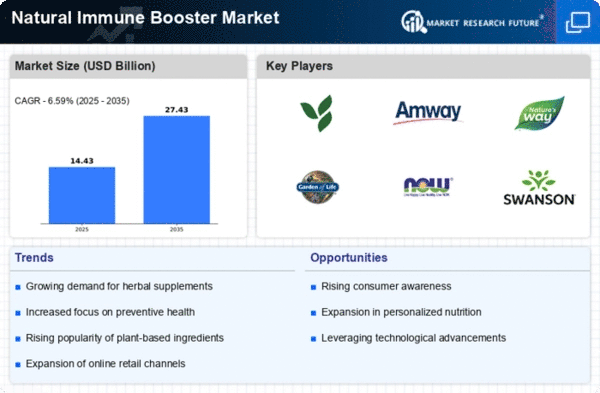
As per MRFR analysis, the Natural Immune Booster Market Size was estimated at 13.54 USD Billion in 2024. The Natural Immune Booster industry is projected to grow from 14.58 USD Billion in 2025 to 27.43 USD Billion by 2035, exhibiting a compound annual growth rate (CAGR) of 6.59% during the forecast period 2025 - 2035.

Key Market Trends & Highlights

The Natural Immune Booster Market is experiencing robust growth driven by consumer trends and innovative product offerings.

  • Consumer awareness regarding health and wellness is on the rise, significantly influencing purchasing decisions in the Natural Immune Booster Market.
  • North America remains the largest market, while the Asia-Pacific region is emerging as the fastest-growing area for natural immune boosters.
  • Nutritional supplements dominate the market, whereas herbal products are witnessing the fastest growth due to changing consumer preferences.
  • Key market drivers include rising health consciousness and a focus on preventive healthcare, which are shaping product development and consumer choices.

Market Size & Forecast

2024 Market Size 13.54 (USD Billion)
2035 Market Size 27.43 (USD Billion)
CAGR (2025 - 2035) 6.59%
Largest Regional Market Share in 2024 North America

Major Players

Herbalife (US), Amway (US), Nature's Way (US), Garden of Life (US), NOW Foods (US), Swanson Health Products (US), Solgar (US), NutraBlast (US), BioCare Copenhagen (DK)

Market Trends

The Natural Immune Booster Market is currently experiencing a notable evolution, driven by a growing awareness of health and wellness among consumers. Individuals are increasingly seeking natural alternatives to enhance their immune systems, leading to a surge in demand for products derived from herbs, vitamins, and other natural sources. This shift appears to be influenced by a broader trend towards holistic health, where consumers prioritize preventive measures over reactive treatments. As a result, manufacturers are innovating to create formulations that appeal to health-conscious individuals, emphasizing transparency and sustainability in their sourcing and production processes. Moreover, the market landscape is characterized by a diverse range of products, including supplements, functional foods, and beverages, all designed to support immune health. The rise of e-commerce platforms has further facilitated access to these products, allowing consumers to explore various options conveniently. This trend suggests that the Natural Immune Booster Market is not only expanding but also diversifying, as companies strive to meet the evolving preferences of their target audiences. The emphasis on quality, efficacy, and natural ingredients is likely to shape the future trajectory of this market, as consumers continue to seek reliable solutions for maintaining their health and well-being.

Increased Consumer Awareness

There is a growing recognition among consumers regarding the importance of immune health. This heightened awareness is prompting individuals to actively seek out natural products that can bolster their immune systems, leading to a shift in purchasing behavior.

Diverse Product Offerings

The Natural Immune Booster Market is witnessing an expansion in the variety of products available. From herbal supplements to fortified foods and beverages, consumers now have access to a wide array of options tailored to support immune function.

Sustainability and Ethical Sourcing

A notable trend within the market is the increasing emphasis on sustainability and ethical sourcing. Consumers are becoming more discerning about the origins of ingredients, favoring brands that prioritize environmentally friendly practices and transparent supply chains.

Natural Immune Booster Market Market Drivers

Market Growth Projections

The Global Natural Immune Booster Market Industry is projected to experience substantial growth over the coming years. With an estimated market value of 19.7 USD Billion in 2024, the industry is expected to reach 40.8 USD Billion by 2035. This growth trajectory indicates a compound annual growth rate of 6.86% from 2025 to 2035. Such projections highlight the increasing consumer demand for natural products that support immune health, driven by factors such as rising health consciousness and the prevalence of chronic diseases.

Growing Health Consciousness

The increasing awareness regarding health and wellness among consumers is a primary driver of the Global Natural Immune Booster Market Industry. Individuals are increasingly seeking natural alternatives to enhance their immune systems, leading to a surge in demand for products such as herbal supplements and functional foods. This trend is reflected in the market's projected growth, with an estimated value of 19.7 USD Billion in 2024. As consumers prioritize preventive health measures, the industry is likely to expand, catering to a demographic that values holistic health solutions.

Advancements in Nutritional Science

Recent advancements in nutritional science are shaping the Global Natural Immune Booster Market Industry by providing a deeper understanding of how various nutrients affect immune health. Research indicates that specific vitamins and minerals, such as vitamin C, vitamin D, and zinc, play crucial roles in immune function. This knowledge is driving the formulation of new products designed to enhance immune response. As a result, the market is poised for growth, with a projected compound annual growth rate of 6.86% from 2025 to 2035, reflecting the increasing consumer interest in scientifically-backed natural solutions.

E-commerce Growth and Accessibility

The rapid expansion of e-commerce platforms is transforming the Global Natural Immune Booster Market Industry by enhancing product accessibility for consumers. Online shopping allows individuals to explore a wide range of natural immune-boosting products from the comfort of their homes. This trend is particularly significant in regions where traditional retail options may be limited. As e-commerce continues to grow, it is expected to contribute to the market's overall expansion, facilitating a broader reach for manufacturers and increasing consumer engagement with natural health products.

Rising Incidence of Chronic Diseases

The escalating prevalence of chronic diseases globally is significantly influencing the Global Natural Immune Booster Market Industry. Conditions such as diabetes, cardiovascular diseases, and autoimmune disorders are prompting consumers to seek natural immune-boosting solutions. This shift towards preventive healthcare is expected to drive market growth, with projections indicating a market value of 40.8 USD Billion by 2035. As individuals become more proactive about their health, the demand for natural products that support immune function is likely to increase, fostering innovation and diversification within the industry.

Increased Focus on Preventive Healthcare

The shift towards preventive healthcare is a notable driver of the Global Natural Immune Booster Market Industry. Consumers are increasingly recognizing the importance of maintaining a robust immune system to prevent illness rather than solely relying on treatments. This proactive approach is reflected in the growing demand for natural immune boosters, which are perceived as safer and more holistic options. As this trend continues, the market is likely to experience sustained growth, aligning with the broader healthcare paradigm that emphasizes wellness and prevention.

Market Segment Insights

By Application: Nutritional Supplements (Largest) vs. Herbal Remedies (Fastest-Growing)

<p>In the Natural Immune Booster Market, the Application segment displays a diverse distribution among its core values. Nutritional Supplements hold a significant portion of the market due to their widespread acceptance and proven efficacy in enhancing immune function. Following closely are Functional Foods and Beverages, which are gaining traction as consumers look for convenient and health-focused options. Herbal Remedies, while currently smaller, are emerging as a popular choice for those seeking natural and holistic health solutions.</p>

<p>Nutrition: Nutritional Supplements (Dominant) vs. Herbal Remedies (Emerging)</p>

<p>Nutritional Supplements represent the dominant force in the Natural Immune Booster Market, characterized by a broad range of products aimed at various health needs. These supplements are often scientifically formulated with essential vitamins, minerals, and other nutrients crucial for boosting immunity. On the other hand, Herbal Remedies are the emerging segment, appealing to a growing demographic that favors natural ingredients over synthetic ones. This segment is experiencing rapid growth, spurred by increasing consumer awareness regarding holistic health practices and the effectiveness of traditional herbal formulations in enhancing overall wellness.</p>

By Formulation Type: Powder (Largest) vs. Liquid (Fastest-Growing)

<p>The Natural Immune Booster Market displays a diverse landscape of formulation types, with powder formulations taking a significant share. Powders are preferred for their convenience and versatility, appealing to consumers who value ease of use in various applications. Liquid formulations, while currently smaller in market share, are gaining traction among consumers seeking quick absorption and efficacy, driven by the trend towards functional beverages and easy-to-consume supplements. Growth trends indicate that while powder remains the dominant formulation, liquid formulations are emerging rapidly, especially among younger consumers and health-conscious individuals. This shift is fueled by increasing demand for on-the-go health solutions and innovations in flavoring that enhance taste, making liquids more appealing. The market reflects a broader trend towards convenience and holistic health, where consumers are looking for products that fit into their fast-paced lifestyles.</p>

<p>Powder (Dominant) vs. Liquid (Emerging)</p>

<p>In the formulation type segment of the Natural Immune Booster Market, powders are the dominant player, primarily due to their stability, ease of transport, and flexible usage options. They are often formulated for specific health benefits and can be easily mixed with various foods or beverages, making them attractive to a wide consumer base. On the other hand, liquid formulations are emerging as a popular choice, particularly among those who prioritize quick absorption of nutrients. They often come in ready-to-drink formats or concentrated forms that can be easily consumed. As awareness of health and wellness continues to grow, both segments are positioned to cater to diverse consumer needs, but powders currently hold a stronger market presence.</p>

By Source: Plant-Based (Largest) vs. Microbial (Fastest-Growing)

<p>The Natural Immune Booster Market is characterized by a diverse range of sources, with plant-based ingredients leading the market share. These products leverage the nutritional value and immune-boosting properties found in various botanicals, capturing the attention of health-conscious consumers. On the other hand, microbial sources, which include probiotics and fermented ingredients, are rapidly gaining traction as awareness of gut health and its connection to immunity continues to grow.</p>

<p>Plant-Based (Dominant) vs. Microbial (Emerging)</p>

<p>Plant-based natural immune boosters dominate the market due to their extensive application in dietary supplements and functional foods. They are widely perceived as safe and beneficial, appealing to consumers seeking natural solutions for health. Some examples include herbal extracts like elderberry and echinacea. Conversely, microbial sources represent an emerging market trend, fueled by increasing consumer interest in the gut microbiome's role in overall health. Products like probiotics are becoming indispensable, offering innovative solutions that align with rising wellness trends and demonstrating strong growth potential.</p>

By Distribution Channel: Online Retail (Largest) vs. Pharmacy (Fastest-Growing)

In the Natural Immune Booster Market, the distribution channels exhibit diverse dynamics. Online retail stands as the largest channel, leveraging the surge in e-commerce preferences among consumers seeking convenience and accessibility for their health products. Pharmacies follow closely, maintaining a solid market presence due to their integral role in health management and the growing awareness of immune health.

Online Retail (Dominant) vs. Pharmacy (Emerging)

Online retail serves as the dominant distribution channel in the Natural Immune Booster Market, driven by the increasing digital penetration and a shift among consumers towards purchasing health supplements online. This channel offers convenience and a wider selection, appealing to tech-savvy consumers. In contrast, pharmacies are emerging as a critical channel, rapidly adapting to trends in immune health due to their trusted status among consumers. They are focusing on stocking products that cater to heightened immune support awareness, thus quickly gaining traction in this niche.

By Consumer Age Group: Adults (Largest) vs. Children (Fastest-Growing)

The Natural Immune Booster Market demonstrates a diverse consumer age group segmentation, with adults commanding the largest share of the market. This demographic typically includes a wide range of individuals focused on enhancing their immune health through natural products. Children, while a smaller market segment, are now gaining attention as parents increasingly seek natural immune boosters for their younger ones, establishing a growing trend in this area. In recent years, the interest in natural immune boosters among children has surged, leading to the segment being identified as the fastest-growing. Factors such as rising health awareness, increased emphasis on preventive healthcare, and the growing availability of child-friendly formulations are driving this growth. As awareness of natural health products increases, the demand from this age group is likely to continue accelerating.

Adults (Dominant) vs. Children (Emerging)

Adults represent the dominant segment in the Natural Immune Booster Market, characterized by a proactive approach to health and wellness. This demographic typically includes health-conscious individuals who prioritize preventive measures against illnesses, particularly in the context of increasing health concerns. Adults are more likely to invest in comprehensive wellness regimes, including the use of natural immune boosters, driving their prominent market position. On the other hand, children are emerging as an increasingly significant segment. The drivers of this growth include parental concerns over childhood illnesses and a desire for natural solutions, fostering a favorable environment for products targeting this age group. Consequently, companies are focusing on creating appealing formulations specifically designed for children, such as gummies or flavored liquids, to drive sales growth.

Get more detailed insights about Natural Immune Booster Market Research Report - Forecast to 2035

Regional Insights

North America : Market Leader in Immune Boosters

North America leads the Natural Immune Booster market with a share of $6.77B in 2024, driven by increasing health awareness and a growing preference for natural products. Regulatory support for dietary supplements and a rise in preventive healthcare are key growth catalysts. The region's robust distribution channels and e-commerce platforms further enhance market accessibility, catering to a health-conscious consumer base. The U.S. is the primary market, hosting major players like Herbalife, Amway, and NOW Foods. The competitive landscape is characterized by innovation in product formulations and marketing strategies. Companies are increasingly focusing on organic and plant-based ingredients to meet consumer demand. The presence of established brands and a strong retail network solidify North America's position as a market leader.

Europe : Emerging Market with Growth Potential

Europe's Natural Immune Booster market is valued at $3.85B, reflecting a growing trend towards holistic health solutions. Factors such as an aging population, rising healthcare costs, and increased consumer awareness about immunity are driving demand. Regulatory frameworks in the EU support the use of natural ingredients, fostering innovation and product development in this sector. Leading countries include Germany, the UK, and France, where consumer preferences are shifting towards organic and sustainably sourced products. Key players like BioCare Copenhagen are capitalizing on this trend, enhancing their market presence through strategic partnerships and product diversification. The competitive landscape is vibrant, with a mix of established brands and emerging startups focusing on unique formulations.

Asia-Pacific : Rapid Growth in Health Awareness

The Asia-Pacific Natural Immune Booster market, valued at $2.9B, is experiencing rapid growth due to increasing health consciousness and rising disposable incomes. The region's diverse dietary habits and cultural practices are also contributing to the demand for natural health products. Regulatory bodies are gradually implementing guidelines to ensure product safety and efficacy, which is expected to further boost market growth. Countries like China, India, and Japan are leading the market, with a significant presence of local and international brands. Companies are focusing on traditional herbal ingredients and innovative formulations to cater to local preferences. The competitive landscape is evolving, with both established players and new entrants vying for market share, driven by the growing trend of preventive healthcare.

Middle East and Africa : Niche Market with Growth Opportunities

The Middle East & Africa Natural Immune Booster market is valued at $0.02B, representing a niche segment with significant growth opportunities. Factors such as increasing health awareness, rising lifestyle diseases, and a shift towards preventive healthcare are driving demand for natural immune boosters. Regulatory frameworks are gradually evolving to support the market, although challenges remain in terms of product availability and consumer education. Countries like South Africa and the UAE are at the forefront of this market, with a growing number of local and international brands entering the space. The competitive landscape is characterized by a mix of traditional remedies and modern formulations. Companies are focusing on educating consumers about the benefits of natural products, which is crucial for market expansion.

Key Players and Competitive Insights

The Natural Immune Booster Market is currently characterized by a dynamic competitive landscape, driven by increasing consumer awareness regarding health and wellness. Key players are actively engaging in strategies that emphasize innovation, product diversification, and regional expansion. For instance, Herbalife (US) has been focusing on enhancing its product line with natural ingredients, while Amway (US) is leveraging its extensive distribution network to penetrate emerging markets. These strategies collectively contribute to a moderately fragmented market structure, where the influence of major players is significant but not overwhelming, allowing for smaller entities to carve out niches.In terms of business tactics, companies are increasingly localizing manufacturing to reduce supply chain vulnerabilities and optimize costs. This approach not only enhances responsiveness to local market demands but also aligns with sustainability goals. The competitive structure remains moderately fragmented, with several key players like Nature's Way (US) and Garden of Life (US) contributing to a diverse array of offerings. Their collective influence shapes market dynamics, as they compete not only on product efficacy but also on brand loyalty and consumer trust.

In November Nature's Way (US) launched a new line of immune-boosting supplements that incorporate adaptogenic herbs, reflecting a growing trend towards holistic health solutions. This strategic move is significant as it positions the company to attract health-conscious consumers seeking natural alternatives. The introduction of these products may enhance Nature's Way's market share and reinforce its reputation as a leader in the natural supplement sector.Similarly, in October 2025, Garden of Life (US) announced a partnership with a leading organic farm to source high-quality ingredients for its immune support products. This collaboration underscores the importance of ingredient transparency and sustainability in consumer purchasing decisions. By ensuring that its products are made from organic, responsibly sourced materials, Garden of Life is likely to strengthen its brand loyalty and appeal to environmentally conscious consumers.Moreover, in September 2025, NOW Foods (US) expanded its product range by introducing a new line of vegan immune boosters, catering to the growing demand for plant-based supplements. This strategic expansion not only diversifies NOW Foods' offerings but also aligns with the increasing consumer shift towards veganism and plant-based diets. Such initiatives may enhance the company's competitive edge in a market that is progressively leaning towards natural and ethical consumption.

As of December the competitive trends in the Natural Immune Booster Market are increasingly defined by digitalization, sustainability, and the integration of AI technologies. Strategic alliances are becoming more prevalent, as companies recognize the value of collaboration in enhancing product offerings and market reach. Looking ahead, competitive differentiation is likely to evolve, with a pronounced shift from price-based competition to a focus on innovation, technological advancements, and supply chain reliability. This evolution suggests that companies that prioritize these aspects will be better positioned to thrive in an increasingly competitive environment.

Key Companies in the Natural Immune Booster Market include

Industry Developments

Several prominent businesses operating in the market have been conducting clinical trials to improve new and improved immune health products in the market setting.

AB Mauri, a well-known yeast maker from the United Kingdom, has made plans to establish a 1,100-crore unit in UP, India, to expand its business operations in the country.

Report Outlook

A detailed natural immune booster market forecast has been presented in the report to ascertain its future growth potential. Several strategic tools have been used to evaluate the market, including the variables that exist in it. The PESTLE analysis has helped to identify and examine the core elements that exist in the political, economic, social, technological, legal, and environmental settings of the natural immune booster Industry. An exhaustive SWOT analysis has been carried out, which has helped to identify factors such as strengths, weaknesses, opportunities, and threats.

The intensity of competition in the market has been assessed with the help of Porter’s Five Force model. Each of the market trends that have been taken into consideration in the report has the potential to mold the market performance and profitability.

Key Industrial Segments

By Type

Yeast extract

Yeast beta

Others

By Application

Beverages

Dairy products

Pharmaceuticals

Bakery and Processed food

Others

Future Outlook

Natural Immune Booster Market Future Outlook

The Natural Immune Booster Market is projected to grow at a 6.59% CAGR from 2025 to 2035, driven by increasing health awareness, demand for natural products, and technological advancements.

New opportunities lie in:

  • Development of personalized immune booster supplements
  • Expansion into emerging markets with tailored products
  • Integration of digital health platforms for consumer engagement

By 2035, the market is expected to be robust, reflecting strong growth and innovation.

Market Segmentation

Natural Immune Booster Market Source Outlook

  • Plant-based
  • Animal-based
  • Microbial
  • Synthetic

Natural Immune Booster Market Application Outlook

  • Nutritional Supplements
  • Functional Foods
  • Beverages
  • Herbal Products

Natural Immune Booster Market Formulation Outlook

  • Powder
  • Liquid
  • Capsule
  • Tablet

Natural Immune Booster Market Consumer Age Group Outlook

  • Children
  • Adults
  • Elderly

Natural Immune Booster Market Distribution Channel Outlook

  • Online Retail
  • Pharmacy
  • Supermarket
  • Health Food Store

Report Scope

MARKET SIZE 2024 13.54(USD Billion)
MARKET SIZE 2025 14.58(USD Billion)
MARKET SIZE 2035 27.43(USD Billion)
COMPOUND ANNUAL GROWTH RATE (CAGR) 6.59% (2025 - 2035)
REPORT COVERAGE Revenue Forecast, Competitive Landscape, Growth Factors, and Trends
BASE YEAR 2024
Market Forecast Period 2025 - 2035
Historical Data 2019 - 2024
Market Forecast Units USD Billion
Key Companies Profiled Herbalife (US), Amway (US), Nature's Way (US), Garden of Life (US), NOW Foods (US), Swanson Health Products (US), Solgar (US), NutraBlast (US), BioCare Copenhagen (DK)
Segments Covered Application, Formulation, Source, Distribution Channel, Consumer Age Group
Key Market Opportunities Growing consumer preference for plant-based supplements drives innovation in the Natural Immune Booster Market.
Key Market Dynamics Rising consumer preference for plant-based ingredients drives innovation and competition in the Natural Immune Booster Market.
Countries Covered North America, Europe, APAC, South America, MEA

FAQs

What is the current valuation of the Natural Immune Booster Market?

<p>The market valuation reached 13.54 USD Billion in 2024.</p>

What is the projected market size for the Natural Immune Booster Market by 2035?

<p>The market is expected to grow to 27.43 USD Billion by 2035.</p>

What is the expected CAGR for the Natural Immune Booster Market during the forecast period 2025 - 2035?

<p>The market is anticipated to experience a CAGR of 6.59% from 2025 to 2035.</p>

Which segments are included in the Natural Immune Booster Market?

<p>The market segments include Nutritional Supplements, Functional Foods, Beverages, and Herbal Remedies.</p>

What are the projected values for the Nutritional Supplements segment by 2035?

The Nutritional Supplements segment is projected to reach 10.0 USD Billion by 2035.

How does the market perform in terms of distribution channels?

The Supermarket distribution channel is expected to grow to 8.0 USD Billion by 2035.

What are the leading companies in the Natural Immune Booster Market?

Key players include Herbalife, Amway, Nature's Way, and NOW Foods.

What is the expected growth for the Herbal Remedies segment by 2035?

The Herbal Remedies segment is projected to reach 6.43 USD Billion by 2035.

What formulation types are available in the Natural Immune Booster Market?

Available formulation types include Powder, Liquid, Capsules, and Tablets.

What is the projected value for the Plant-Based source segment by 2035?

The Plant-Based source segment is expected to reach 11.0 USD Billion by 2035.

  1. SECTION I: EXECUTIVE SUMMARY AND KEY HIGHLIGHTS
    1. | 1.1 EXECUTIVE SUMMARY
    2. | | 1.1.1 Market Overview
    3. | | 1.1.2 Key Findings
    4. | | 1.1.3 Market Segmentation
    5. | | 1.1.4 Competitive Landscape
    6. | | 1.1.5 Challenges and Opportunities
    7. | | 1.1.6 Future Outlook
  2. SECTION II: SCOPING, METHODOLOGY AND MARKET STRUCTURE
    1. | 2.1 MARKET INTRODUCTION
    2. | | 2.1.1 Definition
    3. | | 2.1.2 Scope of the study
    4. | | | 2.1.2.1 Research Objective
    5. | | | 2.1.2.2 Assumption
    6. | | | 2.1.2.3 Limitations
    7. | 2.2 RESEARCH METHODOLOGY
    8. | | 2.2.1 Overview
    9. | | 2.2.2 Data Mining
    10. | | 2.2.3 Secondary Research
    11. | | 2.2.4 Primary Research
    12. | | | 2.2.4.1 Primary Interviews and Information Gathering Process
    13. | | | 2.2.4.2 Breakdown of Primary Respondents
    14. | | 2.2.5 Forecasting Model
    15. | | 2.2.6 Market Size Estimation
    16. | | | 2.2.6.1 Bottom-Up Approach
    17. | | | 2.2.6.2 Top-Down Approach
    18. | | 2.2.7 Data Triangulation
    19. | | 2.2.8 Validation
  3. SECTION III: QUALITATIVE ANALYSIS
    1. | 3.1 MARKET DYNAMICS
    2. | | 3.1.1 Overview
    3. | | 3.1.2 Drivers
    4. | | 3.1.3 Restraints
    5. | | 3.1.4 Opportunities
    6. | 3.2 MARKET FACTOR ANALYSIS
    7. | | 3.2.1 Value chain Analysis
    8. | | 3.2.2 Porter's Five Forces Analysis
    9. | | | 3.2.2.1 Bargaining Power of Suppliers
    10. | | | 3.2.2.2 Bargaining Power of Buyers
    11. | | | 3.2.2.3 Threat of New Entrants
    12. | | | 3.2.2.4 Threat of Substitutes
    13. | | | 3.2.2.5 Intensity of Rivalry
    14. | | 3.2.3 COVID-19 Impact Analysis
    15. | | | 3.2.3.1 Market Impact Analysis
    16. | | | 3.2.3.2 Regional Impact
    17. | | | 3.2.3.3 Opportunity and Threat Analysis
  4. SECTION IV: QUANTITATIVE ANALYSIS
    1. | 4.1 Food, Beverages & Nutrition, BY Application (USD Billion)
    2. | | 4.1.1 Nutritional Supplements
    3. | | 4.1.2 Functional Foods
    4. | | 4.1.3 Beverages
    5. | | 4.1.4 Herbal Remedies
    6. | 4.2 Food, Beverages & Nutrition, BY Formulation Type (USD Billion)
    7. | | 4.2.1 Powder
    8. | | 4.2.2 Liquid
    9. | | 4.2.3 Capsules
    10. | | 4.2.4 Tablets
    11. | 4.3 Food, Beverages & Nutrition, BY Source (USD Billion)
    12. | | 4.3.1 Plant-Based
    13. | | 4.3.2 Animal-Based
    14. | | 4.3.3 Microbial
    15. | 4.4 Food, Beverages & Nutrition, BY Distribution Channel (USD Billion)
    16. | | 4.4.1 Online Retail
    17. | | 4.4.2 Pharmacy
    18. | | 4.4.3 Supermarket
    19. | | 4.4.4 Health Food Store
    20. | 4.5 Food, Beverages & Nutrition, BY Region (USD Billion)
    21. | | 4.5.1 North America
    22. | | | 4.5.1.1 US
    23. | | | 4.5.1.2 Canada
    24. | | 4.5.2 Europe
    25. | | | 4.5.2.1 Germany
    26. | | | 4.5.2.2 UK
    27. | | | 4.5.2.3 France
    28. | | | 4.5.2.4 Russia
    29. | | | 4.5.2.5 Italy
    30. | | | 4.5.2.6 Spain
    31. | | | 4.5.2.7 Rest of Europe
    32. | | 4.5.3 APAC
    33. | | | 4.5.3.1 China
    34. | | | 4.5.3.2 India
    35. | | | 4.5.3.3 Japan
    36. | | | 4.5.3.4 South Korea
    37. | | | 4.5.3.5 Malaysia
    38. | | | 4.5.3.6 Thailand
    39. | | | 4.5.3.7 Indonesia
    40. | | | 4.5.3.8 Rest of APAC
    41. | | 4.5.4 South America
    42. | | | 4.5.4.1 Brazil
    43. | | | 4.5.4.2 Mexico
    44. | | | 4.5.4.3 Argentina
    45. | | | 4.5.4.4 Rest of South America
    46. | | 4.5.5 MEA
    47. | | | 4.5.5.1 GCC Countries
    48. | | | 4.5.5.2 South Africa
    49. | | | 4.5.5.3 Rest of MEA
  5. SECTION V: COMPETITIVE ANALYSIS
    1. | 5.1 Competitive Landscape
    2. | | 5.1.1 Overview
    3. | | 5.1.2 Competitive Analysis
    4. | | 5.1.3 Market share Analysis
    5. | | 5.1.4 Major Growth Strategy in the Food, Beverages & Nutrition
    6. | | 5.1.5 Competitive Benchmarking
    7. | | 5.1.6 Leading Players in Terms of Number of Developments in the Food, Beverages & Nutrition
    8. | | 5.1.7 Key developments and growth strategies
    9. | | | 5.1.7.1 New Product Launch/Service Deployment
    10. | | | 5.1.7.2 Merger & Acquisitions
    11. | | | 5.1.7.3 Joint Ventures
    12. | | 5.1.8 Major Players Financial Matrix
    13. | | | 5.1.8.1 Sales and Operating Income
    14. | | | 5.1.8.2 Major Players R&D Expenditure. 2023
    15. | 5.2 Company Profiles
    16. | | 5.2.1 Herbalife (US)
    17. | | | 5.2.1.1 Financial Overview
    18. | | | 5.2.1.2 Products Offered
    19. | | | 5.2.1.3 Key Developments
    20. | | | 5.2.1.4 SWOT Analysis
    21. | | | 5.2.1.5 Key Strategies
    22. | | 5.2.2 Amway (US)
    23. | | | 5.2.2.1 Financial Overview
    24. | | | 5.2.2.2 Products Offered
    25. | | | 5.2.2.3 Key Developments
    26. | | | 5.2.2.4 SWOT Analysis
    27. | | | 5.2.2.5 Key Strategies
    28. | | 5.2.3 Nature's Way (US)
    29. | | | 5.2.3.1 Financial Overview
    30. | | | 5.2.3.2 Products Offered
    31. | | | 5.2.3.3 Key Developments
    32. | | | 5.2.3.4 SWOT Analysis
    33. | | | 5.2.3.5 Key Strategies
    34. | | 5.2.4 NOW Foods (US)
    35. | | | 5.2.4.1 Financial Overview
    36. | | | 5.2.4.2 Products Offered
    37. | | | 5.2.4.3 Key Developments
    38. | | | 5.2.4.4 SWOT Analysis
    39. | | | 5.2.4.5 Key Strategies
    40. | | 5.2.5 Garden of Life (US)
    41. | | | 5.2.5.1 Financial Overview
    42. | | | 5.2.5.2 Products Offered
    43. | | | 5.2.5.3 Key Developments
    44. | | | 5.2.5.4 SWOT Analysis
    45. | | | 5.2.5.5 Key Strategies
    46. | | 5.2.6 Swanson Health Products (US)
    47. | | | 5.2.6.1 Financial Overview
    48. | | | 5.2.6.2 Products Offered
    49. | | | 5.2.6.3 Key Developments
    50. | | | 5.2.6.4 SWOT Analysis
    51. | | | 5.2.6.5 Key Strategies
    52. | | 5.2.7 Solgar (US)
    53. | | | 5.2.7.1 Financial Overview
    54. | | | 5.2.7.2 Products Offered
    55. | | | 5.2.7.3 Key Developments
    56. | | | 5.2.7.4 SWOT Analysis
    57. | | | 5.2.7.5 Key Strategies
    58. | | 5.2.8 NutraBlast (US)
    59. | | | 5.2.8.1 Financial Overview
    60. | | | 5.2.8.2 Products Offered
    61. | | | 5.2.8.3 Key Developments
    62. | | | 5.2.8.4 SWOT Analysis
    63. | | | 5.2.8.5 Key Strategies
    64. | | 5.2.9 New Chapter (US)
    65. | | | 5.2.9.1 Financial Overview
    66. | | | 5.2.9.2 Products Offered
    67. | | | 5.2.9.3 Key Developments
    68. | | | 5.2.9.4 SWOT Analysis
    69. | | | 5.2.9.5 Key Strategies
    70. | 5.3 Appendix
    71. | | 5.3.1 References
    72. | | 5.3.2 Related Reports
  6. LIST OF FIGURES
    1. | 6.1 MARKET SYNOPSIS
    2. | 6.2 NORTH AMERICA MARKET ANALYSIS
    3. | 6.3 US MARKET ANALYSIS BY APPLICATION
    4. | 6.4 US MARKET ANALYSIS BY FORMULATION TYPE
    5. | 6.5 US MARKET ANALYSIS BY SOURCE
    6. | 6.6 US MARKET ANALYSIS BY DISTRIBUTION CHANNEL
    7. | 6.7 CANADA MARKET ANALYSIS BY APPLICATION
    8. | 6.8 CANADA MARKET ANALYSIS BY FORMULATION TYPE
    9. | 6.9 CANADA MARKET ANALYSIS BY SOURCE
    10. | 6.10 CANADA MARKET ANALYSIS BY DISTRIBUTION CHANNEL
    11. | 6.11 EUROPE MARKET ANALYSIS
    12. | 6.12 GERMANY MARKET ANALYSIS BY APPLICATION
    13. | 6.13 GERMANY MARKET ANALYSIS BY FORMULATION TYPE
    14. | 6.14 GERMANY MARKET ANALYSIS BY SOURCE
    15. | 6.15 GERMANY MARKET ANALYSIS BY DISTRIBUTION CHANNEL
    16. | 6.16 UK MARKET ANALYSIS BY APPLICATION
    17. | 6.17 UK MARKET ANALYSIS BY FORMULATION TYPE
    18. | 6.18 UK MARKET ANALYSIS BY SOURCE
    19. | 6.19 UK MARKET ANALYSIS BY DISTRIBUTION CHANNEL
    20. | 6.20 FRANCE MARKET ANALYSIS BY APPLICATION
    21. | 6.21 FRANCE MARKET ANALYSIS BY FORMULATION TYPE
    22. | 6.22 FRANCE MARKET ANALYSIS BY SOURCE
    23. | 6.23 FRANCE MARKET ANALYSIS BY DISTRIBUTION CHANNEL
    24. | 6.24 RUSSIA MARKET ANALYSIS BY APPLICATION
    25. | 6.25 RUSSIA MARKET ANALYSIS BY FORMULATION TYPE
    26. | 6.26 RUSSIA MARKET ANALYSIS BY SOURCE
    27. | 6.27 RUSSIA MARKET ANALYSIS BY DISTRIBUTION CHANNEL
    28. | 6.28 ITALY MARKET ANALYSIS BY APPLICATION
    29. | 6.29 ITALY MARKET ANALYSIS BY FORMULATION TYPE
    30. | 6.30 ITALY MARKET ANALYSIS BY SOURCE
    31. | 6.31 ITALY MARKET ANALYSIS BY DISTRIBUTION CHANNEL
    32. | 6.32 SPAIN MARKET ANALYSIS BY APPLICATION
    33. | 6.33 SPAIN MARKET ANALYSIS BY FORMULATION TYPE
    34. | 6.34 SPAIN MARKET ANALYSIS BY SOURCE
    35. | 6.35 SPAIN MARKET ANALYSIS BY DISTRIBUTION CHANNEL
    36. | 6.36 REST OF EUROPE MARKET ANALYSIS BY APPLICATION
    37. | 6.37 REST OF EUROPE MARKET ANALYSIS BY FORMULATION TYPE
    38. | 6.38 REST OF EUROPE MARKET ANALYSIS BY SOURCE
    39. | 6.39 REST OF EUROPE MARKET ANALYSIS BY DISTRIBUTION CHANNEL
    40. | 6.40 APAC MARKET ANALYSIS
    41. | 6.41 CHINA MARKET ANALYSIS BY APPLICATION
    42. | 6.42 CHINA MARKET ANALYSIS BY FORMULATION TYPE
    43. | 6.43 CHINA MARKET ANALYSIS BY SOURCE
    44. | 6.44 CHINA MARKET ANALYSIS BY DISTRIBUTION CHANNEL
    45. | 6.45 INDIA MARKET ANALYSIS BY APPLICATION
    46. | 6.46 INDIA MARKET ANALYSIS BY FORMULATION TYPE
    47. | 6.47 INDIA MARKET ANALYSIS BY SOURCE
    48. | 6.48 INDIA MARKET ANALYSIS BY DISTRIBUTION CHANNEL
    49. | 6.49 JAPAN MARKET ANALYSIS BY APPLICATION
    50. | 6.50 JAPAN MARKET ANALYSIS BY FORMULATION TYPE
    51. | 6.51 JAPAN MARKET ANALYSIS BY SOURCE
    52. | 6.52 JAPAN MARKET ANALYSIS BY DISTRIBUTION CHANNEL
    53. | 6.53 SOUTH KOREA MARKET ANALYSIS BY APPLICATION
    54. | 6.54 SOUTH KOREA MARKET ANALYSIS BY FORMULATION TYPE
    55. | 6.55 SOUTH KOREA MARKET ANALYSIS BY SOURCE
    56. | 6.56 SOUTH KOREA MARKET ANALYSIS BY DISTRIBUTION CHANNEL
    57. | 6.57 MALAYSIA MARKET ANALYSIS BY APPLICATION
    58. | 6.58 MALAYSIA MARKET ANALYSIS BY FORMULATION TYPE
    59. | 6.59 MALAYSIA MARKET ANALYSIS BY SOURCE
    60. | 6.60 MALAYSIA MARKET ANALYSIS BY DISTRIBUTION CHANNEL
    61. | 6.61 THAILAND MARKET ANALYSIS BY APPLICATION
    62. | 6.62 THAILAND MARKET ANALYSIS BY FORMULATION TYPE
    63. | 6.63 THAILAND MARKET ANALYSIS BY SOURCE
    64. | 6.64 THAILAND MARKET ANALYSIS BY DISTRIBUTION CHANNEL
    65. | 6.65 INDONESIA MARKET ANALYSIS BY APPLICATION
    66. | 6.66 INDONESIA MARKET ANALYSIS BY FORMULATION TYPE
    67. | 6.67 INDONESIA MARKET ANALYSIS BY SOURCE
    68. | 6.68 INDONESIA MARKET ANALYSIS BY DISTRIBUTION CHANNEL
    69. | 6.69 REST OF APAC MARKET ANALYSIS BY APPLICATION
    70. | 6.70 REST OF APAC MARKET ANALYSIS BY FORMULATION TYPE
    71. | 6.71 REST OF APAC MARKET ANALYSIS BY SOURCE
    72. | 6.72 REST OF APAC MARKET ANALYSIS BY DISTRIBUTION CHANNEL
    73. | 6.73 SOUTH AMERICA MARKET ANALYSIS
    74. | 6.74 BRAZIL MARKET ANALYSIS BY APPLICATION
    75. | 6.75 BRAZIL MARKET ANALYSIS BY FORMULATION TYPE
    76. | 6.76 BRAZIL MARKET ANALYSIS BY SOURCE
    77. | 6.77 BRAZIL MARKET ANALYSIS BY DISTRIBUTION CHANNEL
    78. | 6.78 MEXICO MARKET ANALYSIS BY APPLICATION
    79. | 6.79 MEXICO MARKET ANALYSIS BY FORMULATION TYPE
    80. | 6.80 MEXICO MARKET ANALYSIS BY SOURCE
    81. | 6.81 MEXICO MARKET ANALYSIS BY DISTRIBUTION CHANNEL
    82. | 6.82 ARGENTINA MARKET ANALYSIS BY APPLICATION
    83. | 6.83 ARGENTINA MARKET ANALYSIS BY FORMULATION TYPE
    84. | 6.84 ARGENTINA MARKET ANALYSIS BY SOURCE
    85. | 6.85 ARGENTINA MARKET ANALYSIS BY DISTRIBUTION CHANNEL
    86. | 6.86 REST OF SOUTH AMERICA MARKET ANALYSIS BY APPLICATION
    87. | 6.87 REST OF SOUTH AMERICA MARKET ANALYSIS BY FORMULATION TYPE
    88. | 6.88 REST OF SOUTH AMERICA MARKET ANALYSIS BY SOURCE
    89. | 6.89 REST OF SOUTH AMERICA MARKET ANALYSIS BY DISTRIBUTION CHANNEL
    90. | 6.90 MEA MARKET ANALYSIS
    91. | 6.91 GCC COUNTRIES MARKET ANALYSIS BY APPLICATION
    92. | 6.92 GCC COUNTRIES MARKET ANALYSIS BY FORMULATION TYPE
    93. | 6.93 GCC COUNTRIES MARKET ANALYSIS BY SOURCE
    94. | 6.94 GCC COUNTRIES MARKET ANALYSIS BY DISTRIBUTION CHANNEL
    95. | 6.95 SOUTH AFRICA MARKET ANALYSIS BY APPLICATION
    96. | 6.96 SOUTH AFRICA MARKET ANALYSIS BY FORMULATION TYPE
    97. | 6.97 SOUTH AFRICA MARKET ANALYSIS BY SOURCE
    98. | 6.98 SOUTH AFRICA MARKET ANALYSIS BY DISTRIBUTION CHANNEL
    99. | 6.99 REST OF MEA MARKET ANALYSIS BY APPLICATION
    100. | 6.100 REST OF MEA MARKET ANALYSIS BY FORMULATION TYPE
    101. | 6.101 REST OF MEA MARKET ANALYSIS BY SOURCE
    102. | 6.102 REST OF MEA MARKET ANALYSIS BY DISTRIBUTION CHANNEL
    103. | 6.103 KEY BUYING CRITERIA OF FOOD, BEVERAGES & NUTRITION
    104. | 6.104 RESEARCH PROCESS OF MRFR
    105. | 6.105 DRO ANALYSIS OF FOOD, BEVERAGES & NUTRITION
    106. | 6.106 DRIVERS IMPACT ANALYSIS: FOOD, BEVERAGES & NUTRITION
    107. | 6.107 RESTRAINTS IMPACT ANALYSIS: FOOD, BEVERAGES & NUTRITION
    108. | 6.108 SUPPLY / VALUE CHAIN: FOOD, BEVERAGES & NUTRITION
    109. | 6.109 FOOD, BEVERAGES & NUTRITION, BY APPLICATION, 2024 (% SHARE)
    110. | 6.110 FOOD, BEVERAGES & NUTRITION, BY APPLICATION, 2024 TO 2035 (USD Billion)
    111. | 6.111 FOOD, BEVERAGES & NUTRITION, BY FORMULATION TYPE, 2024 (% SHARE)
    112. | 6.112 FOOD, BEVERAGES & NUTRITION, BY FORMULATION TYPE, 2024 TO 2035 (USD Billion)
    113. | 6.113 FOOD, BEVERAGES & NUTRITION, BY SOURCE, 2024 (% SHARE)
    114. | 6.114 FOOD, BEVERAGES & NUTRITION, BY SOURCE, 2024 TO 2035 (USD Billion)
    115. | 6.115 FOOD, BEVERAGES & NUTRITION, BY DISTRIBUTION CHANNEL, 2024 (% SHARE)
    116. | 6.116 FOOD, BEVERAGES & NUTRITION, BY DISTRIBUTION CHANNEL, 2024 TO 2035 (USD Billion)
    117. | 6.117 BENCHMARKING OF MAJOR COMPETITORS
  7. LIST OF TABLES
    1. | 7.1 LIST OF ASSUMPTIONS
    2. | | 7.1.1
    3. | 7.2 North America MARKET SIZE ESTIMATES; FORECAST
    4. | | 7.2.1 BY APPLICATION, 2025-2035 (USD Billion)
    5. | | 7.2.2 BY FORMULATION TYPE, 2025-2035 (USD Billion)
    6. | | 7.2.3 BY SOURCE, 2025-2035 (USD Billion)
    7. | | 7.2.4 BY DISTRIBUTION CHANNEL, 2025-2035 (USD Billion)
    8. | 7.3 US MARKET SIZE ESTIMATES; FORECAST
    9. | | 7.3.1 BY APPLICATION, 2025-2035 (USD Billion)
    10. | | 7.3.2 BY FORMULATION TYPE, 2025-2035 (USD Billion)
    11. | | 7.3.3 BY SOURCE, 2025-2035 (USD Billion)
    12. | | 7.3.4 BY DISTRIBUTION CHANNEL, 2025-2035 (USD Billion)
    13. | 7.4 Canada MARKET SIZE ESTIMATES; FORECAST
    14. | | 7.4.1 BY APPLICATION, 2025-2035 (USD Billion)
    15. | | 7.4.2 BY FORMULATION TYPE, 2025-2035 (USD Billion)
    16. | | 7.4.3 BY SOURCE, 2025-2035 (USD Billion)
    17. | | 7.4.4 BY DISTRIBUTION CHANNEL, 2025-2035 (USD Billion)
    18. | 7.5 Europe MARKET SIZE ESTIMATES; FORECAST
    19. | | 7.5.1 BY APPLICATION, 2025-2035 (USD Billion)
    20. | | 7.5.2 BY FORMULATION TYPE, 2025-2035 (USD Billion)
    21. | | 7.5.3 BY SOURCE, 2025-2035 (USD Billion)
    22. | | 7.5.4 BY DISTRIBUTION CHANNEL, 2025-2035 (USD Billion)
    23. | 7.6 Germany MARKET SIZE ESTIMATES; FORECAST
    24. | | 7.6.1 BY APPLICATION, 2025-2035 (USD Billion)
    25. | | 7.6.2 BY FORMULATION TYPE, 2025-2035 (USD Billion)
    26. | | 7.6.3 BY SOURCE, 2025-2035 (USD Billion)
    27. | | 7.6.4 BY DISTRIBUTION CHANNEL, 2025-2035 (USD Billion)
    28. | 7.7 UK MARKET SIZE ESTIMATES; FORECAST
    29. | | 7.7.1 BY APPLICATION, 2025-2035 (USD Billion)
    30. | | 7.7.2 BY FORMULATION TYPE, 2025-2035 (USD Billion)
    31. | | 7.7.3 BY SOURCE, 2025-2035 (USD Billion)
    32. | | 7.7.4 BY DISTRIBUTION CHANNEL, 2025-2035 (USD Billion)
    33. | 7.8 France MARKET SIZE ESTIMATES; FORECAST
    34. | | 7.8.1 BY APPLICATION, 2025-2035 (USD Billion)
    35. | | 7.8.2 BY FORMULATION TYPE, 2025-2035 (USD Billion)
    36. | | 7.8.3 BY SOURCE, 2025-2035 (USD Billion)
    37. | | 7.8.4 BY DISTRIBUTION CHANNEL, 2025-2035 (USD Billion)
    38. | 7.9 Russia MARKET SIZE ESTIMATES; FORECAST
    39. | | 7.9.1 BY APPLICATION, 2025-2035 (USD Billion)
    40. | | 7.9.2 BY FORMULATION TYPE, 2025-2035 (USD Billion)
    41. | | 7.9.3 BY SOURCE, 2025-2035 (USD Billion)
    42. | | 7.9.4 BY DISTRIBUTION CHANNEL, 2025-2035 (USD Billion)
    43. | 7.10 Italy MARKET SIZE ESTIMATES; FORECAST
    44. | | 7.10.1 BY APPLICATION, 2025-2035 (USD Billion)
    45. | | 7.10.2 BY FORMULATION TYPE, 2025-2035 (USD Billion)
    46. | | 7.10.3 BY SOURCE, 2025-2035 (USD Billion)
    47. | | 7.10.4 BY DISTRIBUTION CHANNEL, 2025-2035 (USD Billion)
    48. | 7.11 Spain MARKET SIZE ESTIMATES; FORECAST
    49. | | 7.11.1 BY APPLICATION, 2025-2035 (USD Billion)
    50. | | 7.11.2 BY FORMULATION TYPE, 2025-2035 (USD Billion)
    51. | | 7.11.3 BY SOURCE, 2025-2035 (USD Billion)
    52. | | 7.11.4 BY DISTRIBUTION CHANNEL, 2025-2035 (USD Billion)
    53. | 7.12 Rest of Europe MARKET SIZE ESTIMATES; FORECAST
    54. | | 7.12.1 BY APPLICATION, 2025-2035 (USD Billion)
    55. | | 7.12.2 BY FORMULATION TYPE, 2025-2035 (USD Billion)
    56. | | 7.12.3 BY SOURCE, 2025-2035 (USD Billion)
    57. | | 7.12.4 BY DISTRIBUTION CHANNEL, 2025-2035 (USD Billion)
    58. | 7.13 APAC MARKET SIZE ESTIMATES; FORECAST
    59. | | 7.13.1 BY APPLICATION, 2025-2035 (USD Billion)
    60. | | 7.13.2 BY FORMULATION TYPE, 2025-2035 (USD Billion)
    61. | | 7.13.3 BY SOURCE, 2025-2035 (USD Billion)
    62. | | 7.13.4 BY DISTRIBUTION CHANNEL, 2025-2035 (USD Billion)
    63. | 7.14 China MARKET SIZE ESTIMATES; FORECAST
    64. | | 7.14.1 BY APPLICATION, 2025-2035 (USD Billion)
    65. | | 7.14.2 BY FORMULATION TYPE, 2025-2035 (USD Billion)
    66. | | 7.14.3 BY SOURCE, 2025-2035 (USD Billion)
    67. | | 7.14.4 BY DISTRIBUTION CHANNEL, 2025-2035 (USD Billion)
    68. | 7.15 India MARKET SIZE ESTIMATES; FORECAST
    69. | | 7.15.1 BY APPLICATION, 2025-2035 (USD Billion)
    70. | | 7.15.2 BY FORMULATION TYPE, 2025-2035 (USD Billion)
    71. | | 7.15.3 BY SOURCE, 2025-2035 (USD Billion)
    72. | | 7.15.4 BY DISTRIBUTION CHANNEL, 2025-2035 (USD Billion)
    73. | 7.16 Japan MARKET SIZE ESTIMATES; FORECAST
    74. | | 7.16.1 BY APPLICATION, 2025-2035 (USD Billion)
    75. | | 7.16.2 BY FORMULATION TYPE, 2025-2035 (USD Billion)
    76. | | 7.16.3 BY SOURCE, 2025-2035 (USD Billion)
    77. | | 7.16.4 BY DISTRIBUTION CHANNEL, 2025-2035 (USD Billion)
    78. | 7.17 South Korea MARKET SIZE ESTIMATES; FORECAST
    79. | | 7.17.1 BY APPLICATION, 2025-2035 (USD Billion)
    80. | | 7.17.2 BY FORMULATION TYPE, 2025-2035 (USD Billion)
    81. | | 7.17.3 BY SOURCE, 2025-2035 (USD Billion)
    82. | | 7.17.4 BY DISTRIBUTION CHANNEL, 2025-2035 (USD Billion)
    83. | 7.18 Malaysia MARKET SIZE ESTIMATES; FORECAST
    84. | | 7.18.1 BY APPLICATION, 2025-2035 (USD Billion)
    85. | | 7.18.2 BY FORMULATION TYPE, 2025-2035 (USD Billion)
    86. | | 7.18.3 BY SOURCE, 2025-2035 (USD Billion)
    87. | | 7.18.4 BY DISTRIBUTION CHANNEL, 2025-2035 (USD Billion)
    88. | 7.19 Thailand MARKET SIZE ESTIMATES; FORECAST
    89. | | 7.19.1 BY APPLICATION, 2025-2035 (USD Billion)
    90. | | 7.19.2 BY FORMULATION TYPE, 2025-2035 (USD Billion)
    91. | | 7.19.3 BY SOURCE, 2025-2035 (USD Billion)
    92. | | 7.19.4 BY DISTRIBUTION CHANNEL, 2025-2035 (USD Billion)
    93. | 7.20 Indonesia MARKET SIZE ESTIMATES; FORECAST
    94. | | 7.20.1 BY APPLICATION, 2025-2035 (USD Billion)
    95. | | 7.20.2 BY FORMULATION TYPE, 2025-2035 (USD Billion)
    96. | | 7.20.3 BY SOURCE, 2025-2035 (USD Billion)
    97. | | 7.20.4 BY DISTRIBUTION CHANNEL, 2025-2035 (USD Billion)
    98. | 7.21 Rest of APAC MARKET SIZE ESTIMATES; FORECAST
    99. | | 7.21.1 BY APPLICATION, 2025-2035 (USD Billion)
    100. | | 7.21.2 BY FORMULATION TYPE, 2025-2035 (USD Billion)
    101. | | 7.21.3 BY SOURCE, 2025-2035 (USD Billion)
    102. | | 7.21.4 BY DISTRIBUTION CHANNEL, 2025-2035 (USD Billion)
    103. | 7.22 South America MARKET SIZE ESTIMATES; FORECAST
    104. | | 7.22.1 BY APPLICATION, 2025-2035 (USD Billion)
    105. | | 7.22.2 BY FORMULATION TYPE, 2025-2035 (USD Billion)
    106. | | 7.22.3 BY SOURCE, 2025-2035 (USD Billion)
    107. | | 7.22.4 BY DISTRIBUTION CHANNEL, 2025-2035 (USD Billion)
    108. | 7.23 Brazil MARKET SIZE ESTIMATES; FORECAST
    109. | | 7.23.1 BY APPLICATION, 2025-2035 (USD Billion)
    110. | | 7.23.2 BY FORMULATION TYPE, 2025-2035 (USD Billion)
    111. | | 7.23.3 BY SOURCE, 2025-2035 (USD Billion)
    112. | | 7.23.4 BY DISTRIBUTION CHANNEL, 2025-2035 (USD Billion)
    113. | 7.24 Mexico MARKET SIZE ESTIMATES; FORECAST
    114. | | 7.24.1 BY APPLICATION, 2025-2035 (USD Billion)
    115. | | 7.24.2 BY FORMULATION TYPE, 2025-2035 (USD Billion)
    116. | | 7.24.3 BY SOURCE, 2025-2035 (USD Billion)
    117. | | 7.24.4 BY DISTRIBUTION CHANNEL, 2025-2035 (USD Billion)
    118. | 7.25 Argentina MARKET SIZE ESTIMATES; FORECAST
    119. | | 7.25.1 BY APPLICATION, 2025-2035 (USD Billion)
    120. | | 7.25.2 BY FORMULATION TYPE, 2025-2035 (USD Billion)
    121. | | 7.25.3 BY SOURCE, 2025-2035 (USD Billion)
    122. | | 7.25.4 BY DISTRIBUTION CHANNEL, 2025-2035 (USD Billion)
    123. | 7.26 Rest of South America MARKET SIZE ESTIMATES; FORECAST
    124. | | 7.26.1 BY APPLICATION, 2025-2035 (USD Billion)
    125. | | 7.26.2 BY FORMULATION TYPE, 2025-2035 (USD Billion)
    126. | | 7.26.3 BY SOURCE, 2025-2035 (USD Billion)
    127. | | 7.26.4 BY DISTRIBUTION CHANNEL, 2025-2035 (USD Billion)
    128. | 7.27 MEA MARKET SIZE ESTIMATES; FORECAST
    129. | | 7.27.1 BY APPLICATION, 2025-2035 (USD Billion)
    130. | | 7.27.2 BY FORMULATION TYPE, 2025-2035 (USD Billion)
    131. | | 7.27.3 BY SOURCE, 2025-2035 (USD Billion)
    132. | | 7.27.4 BY DISTRIBUTION CHANNEL, 2025-2035 (USD Billion)
    133. | 7.28 GCC Countries MARKET SIZE ESTIMATES; FORECAST
    134. | | 7.28.1 BY APPLICATION, 2025-2035 (USD Billion)
    135. | | 7.28.2 BY FORMULATION TYPE, 2025-2035 (USD Billion)
    136. | | 7.28.3 BY SOURCE, 2025-2035 (USD Billion)
    137. | | 7.28.4 BY DISTRIBUTION CHANNEL, 2025-2035 (USD Billion)
    138. | 7.29 South Africa MARKET SIZE ESTIMATES; FORECAST
    139. | | 7.29.1 BY APPLICATION, 2025-2035 (USD Billion)
    140. | | 7.29.2 BY FORMULATION TYPE, 2025-2035 (USD Billion)
    141. | | 7.29.3 BY SOURCE, 2025-2035 (USD Billion)
    142. | | 7.29.4 BY DISTRIBUTION CHANNEL, 2025-2035 (USD Billion)
    143. | 7.30 Rest of MEA MARKET SIZE ESTIMATES; FORECAST
    144. | | 7.30.1 BY APPLICATION, 2025-2035 (USD Billion)
    145. | | 7.30.2 BY FORMULATION TYPE, 2025-2035 (USD Billion)
    146. | | 7.30.3 BY SOURCE, 2025-2035 (USD Billion)
    147. | | 7.30.4 BY DISTRIBUTION CHANNEL, 2025-2035 (USD Billion)
    148. | 7.31 PRODUCT LAUNCH/PRODUCT DEVELOPMENT/APPROVAL
    149. | | 7.31.1
    150. | 7.32 ACQUISITION/PARTNERSHIP
    151. | | 7.32.1

Food, Beverages & Nutrition Market Segmentation

Food, Beverages & Nutrition By Application (USD Billion, 2025-2035)

  • Nutritional Supplements
  • Functional Foods
  • Beverages
  • Herbal Remedies

Food, Beverages & Nutrition By Formulation Type (USD Billion, 2025-2035)

  • Powder
  • Liquid
  • Capsules
  • Tablets

Food, Beverages & Nutrition By Source (USD Billion, 2025-2035)

  • Plant-Based
  • Animal-Based
  • Microbial

Food, Beverages & Nutrition By Distribution Channel (USD Billion, 2025-2035)

  • Online Retail
  • Pharmacy
  • Supermarket
  • Health Food Store
Infographic

Free Sample Request

Kindly complete the form below to receive a free sample of this Report

Get Free Sample

Customer Strories

Compare Licence

×
Features License Type
Single User Multiuser License Enterprise User
Price $4,950 $5,950 $7,250
Maximum User Access Limit 1 User Upto 10 Users Unrestricted Access Throughout the Organization
Free Customization
Direct Access to Analyst
Deliverable Format
Platform Access
Discount on Next Purchase 10% 15% 15%
Printable Versions