Request Free Sample ×

Kindly complete the form below to receive a free sample of this Report

* Please use a valid business email

Leading companies partner with us for data-driven Insights

clients tt-cursor
Hero Background
English
Chinese
French
Japanese
Korean
German
Spanish

Natural Food Additives Market Trends

ID: MRFR/FnB/11071-HCR
128 Pages
Snehal Singh
Last Updated: April 06, 2026

Natural Food Additives Market Size, Share, Industry Trend & Analysis Research Report Information By Type (Preservatives, Bulk Sweeteners, Sugar Substitutes, Emulsifiers, Anti-caking Agents, Enzymes, Hydrocolloids, Food Flavors and Enhancers, Food Colorants, and Acidulants), By Application (Bakery and Confectionery, Dairy and Desserts, Beverages, Meat and Meat Products, Soups, Sauces, and Dressings and Other) And By Region (North America, Europe, Asia-Pacific, And Rest Of The World) – Forecast Till 2035.

Share:
Download PDF ×

We do not share your information with anyone. However, we may send you emails based on your report interest from time to time. You may contact us at any time to opt-out.

Natural Food Additives Market Infographic
Purchase Options

Market Trends

Key Emerging Trends in the Natural Food Additives Market

The market for natural food additives is undergoing dynamic changes due to shifting customer tastes, rising health and wellness consciousness, and an increase in the demand for clean label goods. The growing acceptance of plant-based and herbal natural food additives is a noteworthy development. The growing trend of consumers looking for natural substitutes for artificial additives has resulted in the use of plant-based components including spices, herbs, and botanical extracts. This tendency is consistent with the larger shift in consumer preferences towards clean eating, which emphasizes natural and healthful food consumption and favors items with identifiable and minimally processed components. Natural food additives are growing in popularity as a result of the rise in popularity of clean label products. More than ever, consumers are reading food labels carefully, which has increased demand for items devoid of artificial coloring, flavor enhancers, and preservatives. The market for natural food additives has grown overall as a result of manufacturers' decision to replace synthetic ingredients in a number of food and beverage items. In response, businesses are voicing the natural source of their additives in a clear and understandable manner, in line with the growing customer demand for food product transparency. With the increasing emphasis on health and wellbeing, functional natural food additives are becoming a big trend. Customers are searching for items with extra health advantages in addition to clean label alternatives. Antioxidants, vitamins, and minerals are examples of natural additives that are being added to food to boost immunity, enhance nutritional value, and improve general health. This trend represents a move away from traditional additives used only for flavor and shelf life, and toward a more comprehensive strategy that caters to the health-conscious lives of customers. The usage of natural food additives for taste enhancement is being impacted by the decrease in sugar and salt content in food items. Manufacturers are resorting to natural substitutes in order to preserve flavor without sacrificing health concerns as customers grow more health conscious about how much sugar and salt they consume. As alternatives to conventional sweeteners and sodium-based additives, natural sweeteners like stevia and monk fruit extract are becoming more and more popular, as are flavor enhancers made from herbs and spices. The market for natural food additives is being shaped by sustainability factors, which are a reflection of the increased desire for environmentally friendly methods. Producers are investigating organic and ethically produced materials, as well as ethically sourced natural additions. Furthermore, a more circular and sustainable approach is being promoted by the trend of extracting natural additives from food industry waste streams and by-products. The focus on sustainability corresponds with consumers who are ecologically aware and look for items that have a smaller environmental impact. Natural food additives with multiple uses are becoming more popular as businesses look to improve product compositions and streamline ingredient lists. Blends of natural additives with several functions, such antioxidants, taste enhancers, and preservatives, are being produced by manufacturers.


Author
Author Profile
Snehal Singh
Manager - Research

High acumen in analyzing complex macro & micro markets with more than 6 years of work experience in the field of market research. By implementing her analytical skills in forecasting and estimation into market research reports, she has expertise in Packaging, Construction, and Equipment domains. She handles a team size of 20-25 resources and ensures smooth running of the projects, associated marketing activities, and client servicing.

Leave a Comment

FAQs

What is the current valuation of the natural food additives market?

<p>The natural food additives market was valued at 10.5 USD Billion in 2024.</p>

What is the projected market size for natural food additives by 2035?

<p>The market is expected to reach 15.2 USD Billion by 2035.</p>

What is the expected CAGR for the natural food additives market during 2025 - 2035?

<p>The expected CAGR for the natural food additives market during 2025 - 2035 is 3.42%.</p>

Which companies are considered key players in the natural food additives market?

<p>Key players include DuPont, BASF, Cargill, Archer Daniels Midland, Kerry Group, Givaudan, Tate & Lyle, Chr. Hansen, and Naturex.</p>

How does the food preservation segment perform in the natural food additives market?

<p>The food preservation segment was valued at 2.1 USD Billion in 2024 and is projected to grow to 2.9 USD Billion by 2035.</p>

What is the valuation of the flavor enhancement segment in the natural food additives market?

<p>The flavor enhancement segment was valued at 3.0 USD Billion in 2024 and is expected to reach 4.0 USD Billion by 2035.</p>

What are the projected values for the coloring agent segment by 2035?

<p>The coloring agent segment is anticipated to grow from 1.5 USD Billion in 2024 to 2.0 USD Billion by 2035.</p>

What is the expected growth for the nutritional supplement segment in the natural food additives market?

<p>The nutritional supplement segment was valued at 2.0 USD Billion in 2024 and is projected to reach 2.8 USD Billion by 2035.</p>

How does the market for plant-based natural food additives compare to other sources?

<p>The plant-based segment was valued at 3.5 USD Billion in 2024 and is expected to grow to 5.0 USD Billion by 2035.</p>

What is the projected growth for the beverages segment in the natural food additives market?

<p>The beverages segment was valued at 2.1 USD Billion in 2024 and is projected to reach 3.0 USD Billion by 2035.</p>

Market Summary

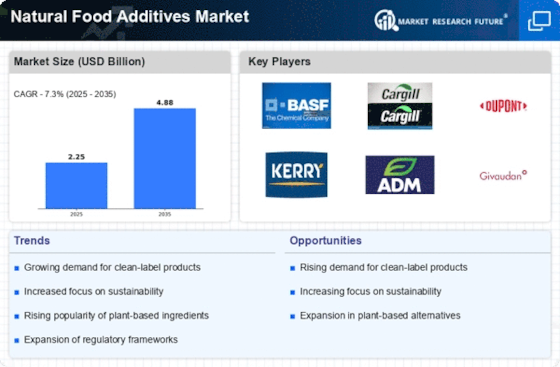
As per Market Research Future analysis, the Natural Food Additives Market Size was estimated at 2.25 USD Billion in 2024. The Natural Food Additives industry is projected to grow from 2.414 USD Billion in 2025 to 4.885 USD Billion by 2035, exhibiting a compound annual growth rate (CAGR) of 7.3% during the forecast period 2025 - 2035

Key Market Trends & Highlights

The Natural Food Additives Market is experiencing robust growth driven by evolving consumer preferences and technological advancements.

  • The Clean Label Movement continues to gain traction, influencing product formulations across various food categories.
  • Plant-based ingredients are increasingly favored, particularly in the Bakery and Confectionery segment, which remains the largest market.
  • E-commerce growth is reshaping distribution channels, especially in the Asia-Pacific region, which is the fastest-growing market.
  • Rising health consciousness and regulatory support for natural ingredients are key drivers propelling the market forward.

Market Size & Forecast

2024 Market Size 2.25 (USD Billion)
2035 Market Size 4.885 (USD Billion)
CAGR (2025 - 2035) 7.3%
Largest Regional Market Share in 2024 North America

Major Players

BASF SE (DE), Cargill, Incorporated (US), DuPont de Nemours, Inc. (US), Kerry Group plc (IE), Archer Daniels Midland Company (US), Givaudan SA (CH), Tate & Lyle PLC (GB), Sensient Technologies Corporation (US), Chr. Hansen Holding A/S (DK)

Market Trends

The Natural Food Additives Market is currently experiencing a notable transformation, driven by a growing consumer preference for clean label products and a heightened awareness of health and wellness. This shift is prompting manufacturers to explore natural alternatives to synthetic additives, which are often viewed with skepticism by health-conscious consumers. As a result, the market is witnessing an influx of plant-based ingredients, such as extracts from fruits, vegetables, and herbs, which are perceived as safer and more beneficial. Additionally, regulatory bodies are increasingly supportive of natural additives, further encouraging their adoption in various food products. Moreover, the rise of e-commerce platforms is reshaping the distribution landscape of the Natural Food Additives Market. Consumers are now more inclined to purchase food products online, leading to a surge in demand for natural additives that cater to diverse dietary preferences, including vegan, gluten-free, and organic options. This trend is likely to continue as consumers seek convenience and transparency in their food choices. Overall, the Natural Food Additives Market appears poised for sustained growth, driven by evolving consumer preferences and innovative product development.

Clean Label Movement

The Clean Label Movement is gaining momentum, as consumers increasingly demand transparency regarding food ingredients. This trend encourages manufacturers to utilize natural additives that are easily recognizable and derived from wholesome sources, thereby fostering trust and loyalty among health-conscious buyers.

Plant-Based Ingredients

There is a discernible shift towards plant-based ingredients within the Natural Food Additives Market. As consumers become more aware of the benefits of plant-derived substances, manufacturers are incorporating these elements into their products, enhancing both flavor and nutritional value.

E-Commerce Growth

The expansion of e-commerce is significantly impacting the Natural Food Additives Market. With more consumers opting for online shopping, there is a rising demand for natural additives that cater to specific dietary needs, thus providing opportunities for brands to reach a broader audience.

Natural Food Additives Market Market Drivers

Rising Health Consciousness

The increasing awareness of health and wellness among consumers appears to be a primary driver for the Natural Food Additives Market. As individuals become more informed about the implications of food additives on their health, there is a noticeable shift towards natural alternatives. This trend is reflected in market data, which indicates that the demand for natural food additives is projected to grow at a compound annual growth rate of approximately 6.5% over the next five years. Consumers are actively seeking products that are free from synthetic additives, which has led manufacturers to innovate and reformulate their offerings. This shift not only caters to health-conscious consumers but also aligns with regulatory trends favoring natural ingredients. Consequently, the Natural Food Additives Market is likely to experience sustained growth as more brands embrace this paradigm.

Innovation in Food Technology

Advancements in food technology are playing a crucial role in shaping the Natural Food Additives Market. Innovations in extraction and processing techniques are enabling the development of high-quality natural additives that meet consumer demands for flavor, color, and preservation. For instance, new methods for extracting natural colors from fruits and vegetables are gaining traction, providing alternatives to synthetic dyes. This technological progress is reflected in market trends, where the demand for natural colors is expected to rise significantly. As food manufacturers increasingly adopt these innovations, the Natural Food Additives Market is likely to expand, driven by the introduction of novel products that enhance the sensory attributes of food while adhering to natural standards. The intersection of technology and natural ingredients presents a promising avenue for growth.

Consumer Preference for Clean Labels

The clean label trend is significantly influencing the Natural Food Additives Market, as consumers increasingly seek transparency in food labeling. This movement emphasizes the importance of knowing what is in food products, leading to a preference for items with simple, recognizable ingredients. Market data suggests that products labeled as 'natural' or 'clean' are experiencing higher sales, as consumers associate these terms with health and quality. This shift is prompting manufacturers to reformulate their products, replacing artificial additives with natural alternatives to meet consumer expectations. As a result, the Natural Food Additives Market is likely to see a surge in demand for clean label products, reflecting a broader societal shift towards healthier eating habits and greater ingredient transparency.

Sustainability and Environmental Concerns

The growing emphasis on sustainability and environmental stewardship is emerging as a significant driver for the Natural Food Additives Market. Consumers are increasingly concerned about the ecological impact of their food choices, leading to a preference for products that are sustainably sourced and produced. This trend is supported by market data indicating that a substantial portion of consumers is willing to pay a premium for products that align with their values regarding sustainability. As a result, manufacturers are investing in sustainable practices and sourcing natural ingredients that minimize environmental impact. This shift not only meets consumer expectations but also positions companies favorably in a competitive market. The Natural Food Additives Market is thus likely to benefit from this alignment of consumer values with sustainable practices.

Regulatory Support for Natural Ingredients

Regulatory frameworks increasingly favoring natural ingredients are likely to bolster the Natural Food Additives Market. Governments and health organizations worldwide are promoting the use of natural additives over synthetic ones, which could lead to a more favorable environment for market growth. For instance, regulations that limit the use of artificial additives in food products are becoming more prevalent, compelling manufacturers to seek natural alternatives. This regulatory support is not only a response to consumer demand but also reflects a broader commitment to public health. As a result, the Natural Food Additives Market may witness an influx of new products that comply with these regulations, further enhancing market dynamics. The alignment of regulatory policies with consumer preferences suggests a promising trajectory for natural food additives.

Market Segment Insights

By Application: Flavor Enhancement (Largest) vs. Food Preservation (Fastest-Growing)

<p>The application segment of the natural food additives market is characterized by a diverse range of functions, among which flavor enhancement stands out as the largest contributor. It is widely adopted across various food products, providing a substantial market share. Following closely, food preservation is emerging as the fastest-growing segment, driven by consumers' increasing demand for longer shelf life without compromising on quality. As health consciousness grows, these applications are pivotal in ensuring consumers receive nutritious yet palatable options. In terms of growth trends, the demand for natural ingredients has skyrocketed, particularly in flavor enhancement and food preservation. Factors such as clean label trends and a preference for minimally processed foods are accelerating these segments. Moreover, advancements in extraction and formulation technologies are expanding the application of natural additives, particularly in preservation, thus catering to consumer expectations for healthy and natural products.</p>

<p>Flavor Enhancement (Dominant) vs. Nutritional Supplement (Emerging)</p>

<p>Flavor enhancement serves as the dominant force in the natural food additives market, primarily due to its widespread acceptance and application in diverse culinary ingredients. It improves taste profiles, thus ensuring consumer satisfaction and repurchase rates. In contrast, nutritional supplements are categorized as an emerging segment, gaining traction due to heightened health awareness among consumers. These supplements often incorporate vitamins, minerals, and other natural extracts aimed at improving health and wellness. The growth of this segment is fueled by the increasing prevalence of lifestyle diseases and the demand for functional foods. The competition among these segments is intensifying as companies innovate to provide multi-functional additives that satisfy both taste and nutritional demands.</p>

By Source: Plant-Based (Largest) vs. Microbial Fermentation (Fastest-Growing)

<p>In the natural food additives market, the source segment is characterized by diverse categories that include plant-based, animal-based, microbial fermentation, mineral-based, and synthetic additives. Currently, plant-based additives hold the largest share due to increasing consumer preference for clean-label products and natural ingredients. This trend is driven by a growing awareness of health benefits associated with plant-derived compounds and a shift towards sustainable dietary practices. Animal-based additives are less popular, while mineral-based and synthetic sources represent niche markets with limited growth potential. Growth trends for the source segment indicate a significant upward trajectory for microbial fermentation, marking it as the fastest-growing category. This is attributed to advancements in fermentation technology and increasing demand for probiotics and natural preservatives. The shift towards plant-based diets continues to bolster plant-based sources, while regulatory support for natural additives enhances their market appeal. Awareness of environmental sustainability drives interest in microbial solutions, further promoting this segment's rapid growth.</p>

<p>Plant-Based (Dominant) vs. Microbial Fermentation (Emerging)</p>

<p>The plant-based segment stands out as the dominant force in the natural food additives market, primarily due to the rising consumer inclination towards healthier and more sustainable food options. With a diverse range of applications, plant-based additives cater to various preferences, offering colors, flavors, and preservatives derived from fruits, vegetables, and herbs. The growing trend of clean-label products has further solidified the position of plant-based sources as consumer favorites. In contrast, microbial fermentation is emerging rapidly, presenting innovative solutions in the form of enzymes, probiotics, and flavor enhancers. This segment is gaining traction as it offers distinct advantages, including enhanced bioavailability and the ability to produce additives sustainably. Both segments are critical, yet their characteristics indicate varying levels of market maturity and growth potential.</p>

By End Use: Beverages (Largest) vs. Dairy Products (Fastest-Growing)

<p>In the natural food additives market, the end use segment is characterized by distinct preferences across various categories, with beverages commanding the largest share. This segment leverages natural additives for flavor enhancement, preservation, and color, making it a fundamental aspect of the industry. Dairy products follow closely, utilizing natural additives to improve texture, maintain shelf life, and enhance flavor. As consumer preference shifts toward healthier options, the adoption of natural food additives in these categories is increasing.</p>

<p>Beverages: Dominant vs. Dairy Products: Emerging</p>

<p>Beverages represent a dominant segment in the natural food additives market due to their extensive use of flavors, sweeteners, and color enhancers derived from natural sources. The growing trend towards clean-label products drives beverage manufacturers to incorporate natural additives, addressing consumer demands for transparency and health benefits. Conversely, dairy products are emerging rapidly, fueled by the rising trend of healthy eating and plant-based diets. The use of natural additives in dairy enhances nutritional value and product appeal, aligning with consumer preferences for natural ingredients. This dynamic shifts the balance of power within the market, with both segments continually evolving to meet market demands.</p>

Get more detailed insights about Natural Food Additives Market Research Report – Forecast till 2035

Regional Insights

North America : Innovation and Demand Surge

North America is the largest market for natural food additives, holding approximately 40% of the global market share. The region's growth is driven by increasing consumer demand for clean-label products, health consciousness, and stringent food safety regulations. The U.S. and Canada are the primary contributors, with a growing trend towards organic and natural ingredients, supported by favorable government policies promoting food safety and quality. The competitive landscape in North America is robust, featuring key players such as Cargill, DuPont, and BASF. These companies are investing in R&D to innovate and expand their product offerings. The presence of advanced manufacturing facilities and a strong distribution network further enhance market dynamics. Additionally, collaborations and partnerships among industry leaders are fostering growth and enhancing product availability across various sectors.

Europe : Regulatory Framework and Growth

Europe is the second-largest market for natural food additives, accounting for around 30% of the global share. The region's growth is propelled by increasing consumer awareness regarding health and wellness, alongside stringent regulations governing food safety and labeling. The European Union's regulations on food additives are pivotal, ensuring that only safe and approved substances are used in food products, thus driving demand for natural alternatives. Leading countries in Europe include Germany, France, and the UK, where the market is characterized by a strong presence of key players like Kerry Group and Givaudan. The competitive landscape is marked by innovation and sustainability, with companies focusing on developing natural solutions to meet consumer preferences. The region's emphasis on organic and non-GMO products further enhances its market position, making it a significant player in the global landscape.

Asia-Pacific : Rapid Growth and Adoption

Asia-Pacific is witnessing rapid growth in the natural food additives market, holding approximately 20% of the global share. The region's expansion is driven by increasing urbanization, rising disposable incomes, and a growing preference for natural and organic food products. Countries like China and India are leading this growth, supported by government initiatives promoting health and wellness in food consumption, alongside evolving consumer preferences towards clean-label products. The competitive landscape in Asia-Pacific is becoming increasingly dynamic, with key players such as Sensient Technologies and Chr. Hansen expanding their footprint. The market is characterized by a mix of local and international companies, fostering innovation and competition. Additionally, the rise of e-commerce platforms is enhancing product accessibility, further driving market growth in this region.

Middle East and Africa : Emerging Market with Potential

The Middle East and Africa region is gradually emerging in the natural food additives market, holding about 10% of the global share. The growth is primarily driven by increasing health awareness, changing dietary habits, and a rising demand for natural ingredients in food products. Countries like South Africa and the UAE are at the forefront, with government initiatives aimed at improving food safety standards and promoting healthier food options. The competitive landscape is evolving, with both local and international players vying for market share. Companies are focusing on product innovation and sustainability to cater to the growing consumer demand for natural additives. The region's diverse culinary traditions also present unique opportunities for the development of specialized natural food additives, enhancing its market potential.

Key Players and Competitive Insights

Leading market players are investing heavily in research and development in order to spread their product lines, which will help the Natural Food Additives Market grow even more. Market players are also undertaking a variety of strategic activities to spread their footprint, with important market developments including contractual agreements, new product launches, mergers and acquisitions, higher investments, and collaboration with other organizations. To spread and survive in a more competitive and rising market climate, the Natural Food Additives industry must offer cost-effective items.

Manufacturing locally to minimize the operational costs is one of the key business tactics used by the manufacturers in the Natural Food Additives industry to benefit the clients and increase the market sector. In recent years, the Natural Food Additives industry has offered some of the most significant advantages to the food industry. Major players in the Natural Food Additives Market, including ADM; Chr.

Hansen Holding A/S; Ingredion Incorporated; Novozymes A/S; Tate & Lyle Plc; DSM; Ajinomoto Co., Inc.; Cargill, Incorporated; BASF SE; Givaudan; International Flavors & Fragrances, Inc.; Biospringer; Palsgaard; Lonza; Sensient Technologies Corporation; Kerry; Corbion; Fooding Group Limited; DuPont; The Kraft Heinz Company, and others, are trying to increase market demand by investing in the research and development operations.

The Kerry Group is a food and ingredients company based in Tralee, County Kerry, Ireland. Kerry Group is a multinational food company that operates in the food and beverage, pharma, and biotech industries. It was founded in 1972 and has since grown into a major player in the food and ingredient sector. Kerry Group focuses on addressing consumer demands for healthier and more nutritious food options. It offers a range of products and solutions aimed at improving the nutritional content of food and beverages.

In March 2023, Kerry Group announced a partnership with DSM to develop new natural food additives for the food and beverage industry. Kerry Group is a leading producer of food ingredients and flavorings, and DSM is a leading producer of vitamins, minerals, and other nutrients. This will bring together the expertise of both companies to develop new and innovative natural food additives.

Tate & Lyle is a British-based multinational food and beverage ingredient supplier and manufacturer. Tate & Lyle specializes in the production and supply of a wide range of ingredients that improve the taste, texture, and nutritional content of food and beverages. Some of its core products include high-fructose corn syrup, modified food starch, and other specialty ingredients. The company places a strong focus on sustainability, including reducing its environmental impact and promoting ethical and responsible business practices.

In February  Tate & Lyle announced a partnership with SteviaFirst to develop new stevia-based sweeteners for the food and beverage industry.

Stevia is a natural sweetener that is low in the calories and has a low glycemic index. This will bring together the expertise of both the companies to develop new and innovative stevia-based sweeteners.

Key Companies in the Natural Food Additives Market include

Industry Developments

June 2023: IFF acquired Frutarom, a leading provider of natural flavorings, extracts, and other food additives. This acquisition strengthens IFF's position in the natural food additives market and gives it access to Frutarom's broad portfolio of products.

January 2023: Ingredion announced a partnership with Novozymes to develop new natural food additives for the food and beverage industry. Novozymes is a leading producer of enzymes. This will bring together the expertise of both the companies to develop new and innovative natural food additives.

March 2023: Cargill acquired Delacon, a leading provider of phytogenic feed additives. This acquisition strengthens Cargill's position in the animal nutrition market and gives it access to Delacon's expertise in phytogenic feed additives.

Future Outlook

Natural Food Additives Market Future Outlook

The Natural Food Additives Market is projected to grow at a 7.3% CAGR from 2025 to 2035, driven by increasing consumer demand for clean-label products and health-conscious choices.

New opportunities lie in:

  • Development of plant-based emulsifiers for food applications.
  • Expansion into emerging markets with tailored product lines.
  • Investment in sustainable sourcing and production technologies.

By 2035, the market is expected to solidify its position as a leader in the food industry.

Market Segmentation

Natural Food Additives Market Type Outlook

  • Preservatives
  • Bulk Sweeteners
  • Sugar Substitutes
  • Emulsifiers
  • Anti-caking Agents
  • Enzymes
  • Hydrocolloids
  • Food Flavors and Enhancers
  • Food Colorants
  • Acidulants

Natural Food Additives Market Application Outlook

  • Bakery and Confectionery
  • Dairy and Desserts
  • Beverages
  • Meat and Meat Products
  • Soups, Sauces, and Dressings
  • Others

Report Scope

MARKET SIZE 2024 2.25(USD Billion)
MARKET SIZE 2025 2.414(USD Billion)
MARKET SIZE 2035 4.885(USD Billion)
COMPOUND ANNUAL GROWTH RATE (CAGR) 7.3% (2025 - 2035)
REPORT COVERAGE Revenue Forecast, Competitive Landscape, Growth Factors, and Trends
BASE YEAR 2024
Market Forecast Period 2025 - 2035
Historical Data 2019 - 2024
Market Forecast Units USD Billion
Key Companies Profiled BASF SE (DE), Cargill, Incorporated (US), DuPont de Nemours, Inc. (US), Kerry Group plc (IE), Archer Daniels Midland Company (US), Givaudan SA (CH), Tate & Lyle PLC (GB), Sensient Technologies Corporation (US), Chr. Hansen Holding A/S (DK)
Segments Covered Type, Application, Region
Key Market Opportunities Growing consumer demand for clean-label products drives innovation in the Natural Food Additives Market.
Key Market Dynamics Rising consumer preference for clean-label products drives demand for natural food additives across various food sectors.
Countries Covered North America, Europe, APAC, South America, MEA

FAQs

What is the current valuation of the natural food additives market?

<p>The natural food additives market was valued at 10.5 USD Billion in 2024.</p>

What is the projected market size for natural food additives by 2035?

<p>The market is expected to reach 15.2 USD Billion by 2035.</p>

What is the expected CAGR for the natural food additives market during 2025 - 2035?

<p>The expected CAGR for the natural food additives market during 2025 - 2035 is 3.42%.</p>

Which companies are considered key players in the natural food additives market?

<p>Key players include DuPont, BASF, Cargill, Archer Daniels Midland, Kerry Group, Givaudan, Tate & Lyle, Chr. Hansen, and Naturex.</p>

How does the food preservation segment perform in the natural food additives market?

<p>The food preservation segment was valued at 2.1 USD Billion in 2024 and is projected to grow to 2.9 USD Billion by 2035.</p>

What is the valuation of the flavor enhancement segment in the natural food additives market?

<p>The flavor enhancement segment was valued at 3.0 USD Billion in 2024 and is expected to reach 4.0 USD Billion by 2035.</p>

What are the projected values for the coloring agent segment by 2035?

<p>The coloring agent segment is anticipated to grow from 1.5 USD Billion in 2024 to 2.0 USD Billion by 2035.</p>

What is the expected growth for the nutritional supplement segment in the natural food additives market?

<p>The nutritional supplement segment was valued at 2.0 USD Billion in 2024 and is projected to reach 2.8 USD Billion by 2035.</p>

How does the market for plant-based natural food additives compare to other sources?

<p>The plant-based segment was valued at 3.5 USD Billion in 2024 and is expected to grow to 5.0 USD Billion by 2035.</p>

What is the projected growth for the beverages segment in the natural food additives market?

<p>The beverages segment was valued at 2.1 USD Billion in 2024 and is projected to reach 3.0 USD Billion by 2035.</p>

  1. SECTION I: EXECUTIVE SUMMARY AND KEY HIGHLIGHTS
    1. | 1.1 EXECUTIVE SUMMARY
    2. | | 1.1.1 Market Overview
    3. | | 1.1.2 Key Findings
    4. | | 1.1.3 Market Segmentation
    5. | | 1.1.4 Competitive Landscape
    6. | | 1.1.5 Challenges and Opportunities
    7. | | 1.1.6 Future Outlook
  2. SECTION II: SCOPING, METHODOLOGY AND MARKET STRUCTURE
    1. | 2.1 MARKET INTRODUCTION
    2. | | 2.1.1 Definition
    3. | | 2.1.2 Scope of the study
    4. | | | 2.1.2.1 Research Objective
    5. | | | 2.1.2.2 Assumption
    6. | | | 2.1.2.3 Limitations
    7. | 2.2 RESEARCH METHODOLOGY
    8. | | 2.2.1 Overview
    9. | | 2.2.2 Data Mining
    10. | | 2.2.3 Secondary Research
    11. | | 2.2.4 Primary Research
    12. | | | 2.2.4.1 Primary Interviews and Information Gathering Process
    13. | | | 2.2.4.2 Breakdown of Primary Respondents
    14. | | 2.2.5 Forecasting Model
    15. | | 2.2.6 Market Size Estimation
    16. | | | 2.2.6.1 Bottom-Up Approach
    17. | | | 2.2.6.2 Top-Down Approach
    18. | | 2.2.7 Data Triangulation
    19. | | 2.2.8 Validation
  3. SECTION III: QUALITATIVE ANALYSIS
    1. | 3.1 MARKET DYNAMICS
    2. | | 3.1.1 Overview
    3. | | 3.1.2 Drivers
    4. | | 3.1.3 Restraints
    5. | | 3.1.4 Opportunities
    6. | 3.2 MARKET FACTOR ANALYSIS
    7. | | 3.2.1 Value chain Analysis
    8. | | 3.2.2 Porter's Five Forces Analysis
    9. | | | 3.2.2.1 Bargaining Power of Suppliers
    10. | | | 3.2.2.2 Bargaining Power of Buyers
    11. | | | 3.2.2.3 Threat of New Entrants
    12. | | | 3.2.2.4 Threat of Substitutes
    13. | | | 3.2.2.5 Intensity of Rivalry
    14. | | 3.2.3 COVID-19 Impact Analysis
    15. | | | 3.2.3.1 Market Impact Analysis
    16. | | | 3.2.3.2 Regional Impact
    17. | | | 3.2.3.3 Opportunity and Threat Analysis
  4. SECTION IV: QUANTITATIVE ANALYSIS
    1. | 4.1 Food, Beverages & Nutrition, BY Application (USD Billion)
    2. | | 4.1.1 Food Preservation
    3. | | 4.1.2 Flavor Enhancement
    4. | | 4.1.3 Coloring Agent
    5. | | 4.1.4 Nutritional Supplement
    6. | | 4.1.5 Texture Improvement
    7. | 4.2 Food, Beverages & Nutrition, BY Source (USD Billion)
    8. | | 4.2.1 Plant-Based
    9. | | 4.2.2 Animal-Based
    10. | | 4.2.3 Microbial Fermentation
    11. | | 4.2.4 Mineral-Based
    12. | | 4.2.5 Synthetic
    13. | 4.3 Food, Beverages & Nutrition, BY End Use (USD Billion)
    14. | | 4.3.1 Beverages
    15. | | 4.3.2 Bakery Products
    16. | | 4.3.3 Dairy Products
    17. | | 4.3.4 Confectionery
    18. | | 4.3.5 Meat Products
    19. | 4.4 Food, Beverages & Nutrition, BY Region (USD Billion)
    20. | | 4.4.1 North America
    21. | | | 4.4.1.1 US
    22. | | | 4.4.1.2 Canada
    23. | | 4.4.2 Europe
    24. | | | 4.4.2.1 Germany
    25. | | | 4.4.2.2 UK
    26. | | | 4.4.2.3 France
    27. | | | 4.4.2.4 Russia
    28. | | | 4.4.2.5 Italy
    29. | | | 4.4.2.6 Spain
    30. | | | 4.4.2.7 Rest of Europe
    31. | | 4.4.3 APAC
    32. | | | 4.4.3.1 China
    33. | | | 4.4.3.2 India
    34. | | | 4.4.3.3 Japan
    35. | | | 4.4.3.4 South Korea
    36. | | | 4.4.3.5 Malaysia
    37. | | | 4.4.3.6 Thailand
    38. | | | 4.4.3.7 Indonesia
    39. | | | 4.4.3.8 Rest of APAC
    40. | | 4.4.4 South America
    41. | | | 4.4.4.1 Brazil
    42. | | | 4.4.4.2 Mexico
    43. | | | 4.4.4.3 Argentina
    44. | | | 4.4.4.4 Rest of South America
    45. | | 4.4.5 MEA
    46. | | | 4.4.5.1 GCC Countries
    47. | | | 4.4.5.2 South Africa
    48. | | | 4.4.5.3 Rest of MEA
  5. SECTION V: COMPETITIVE ANALYSIS
    1. | 5.1 Competitive Landscape
    2. | | 5.1.1 Overview
    3. | | 5.1.2 Competitive Analysis
    4. | | 5.1.3 Market share Analysis
    5. | | 5.1.4 Major Growth Strategy in the Food, Beverages & Nutrition
    6. | | 5.1.5 Competitive Benchmarking
    7. | | 5.1.6 Leading Players in Terms of Number of Developments in the Food, Beverages & Nutrition
    8. | | 5.1.7 Key developments and growth strategies
    9. | | | 5.1.7.1 New Product Launch/Service Deployment
    10. | | | 5.1.7.2 Merger & Acquisitions
    11. | | | 5.1.7.3 Joint Ventures
    12. | | 5.1.8 Major Players Financial Matrix
    13. | | | 5.1.8.1 Sales and Operating Income
    14. | | | 5.1.8.2 Major Players R&D Expenditure. 2023
    15. | 5.2 Company Profiles
    16. | | 5.2.1 DuPont (US)
    17. | | | 5.2.1.1 Financial Overview
    18. | | | 5.2.1.2 Products Offered
    19. | | | 5.2.1.3 Key Developments
    20. | | | 5.2.1.4 SWOT Analysis
    21. | | | 5.2.1.5 Key Strategies
    22. | | 5.2.2 BASF (DE)
    23. | | | 5.2.2.1 Financial Overview
    24. | | | 5.2.2.2 Products Offered
    25. | | | 5.2.2.3 Key Developments
    26. | | | 5.2.2.4 SWOT Analysis
    27. | | | 5.2.2.5 Key Strategies
    28. | | 5.2.3 Cargill (US)
    29. | | | 5.2.3.1 Financial Overview
    30. | | | 5.2.3.2 Products Offered
    31. | | | 5.2.3.3 Key Developments
    32. | | | 5.2.3.4 SWOT Analysis
    33. | | | 5.2.3.5 Key Strategies
    34. | | 5.2.4 Archer Daniels Midland (US)
    35. | | | 5.2.4.1 Financial Overview
    36. | | | 5.2.4.2 Products Offered
    37. | | | 5.2.4.3 Key Developments
    38. | | | 5.2.4.4 SWOT Analysis
    39. | | | 5.2.4.5 Key Strategies
    40. | | 5.2.5 Kerry Group (IE)
    41. | | | 5.2.5.1 Financial Overview
    42. | | | 5.2.5.2 Products Offered
    43. | | | 5.2.5.3 Key Developments
    44. | | | 5.2.5.4 SWOT Analysis
    45. | | | 5.2.5.5 Key Strategies
    46. | | 5.2.6 Givaudan (CH)
    47. | | | 5.2.6.1 Financial Overview
    48. | | | 5.2.6.2 Products Offered
    49. | | | 5.2.6.3 Key Developments
    50. | | | 5.2.6.4 SWOT Analysis
    51. | | | 5.2.6.5 Key Strategies
    52. | | 5.2.7 Tate & Lyle (GB)
    53. | | | 5.2.7.1 Financial Overview
    54. | | | 5.2.7.2 Products Offered
    55. | | | 5.2.7.3 Key Developments
    56. | | | 5.2.7.4 SWOT Analysis
    57. | | | 5.2.7.5 Key Strategies
    58. | | 5.2.8 Chr. Hansen (DK)
    59. | | | 5.2.8.1 Financial Overview
    60. | | | 5.2.8.2 Products Offered
    61. | | | 5.2.8.3 Key Developments
    62. | | | 5.2.8.4 SWOT Analysis
    63. | | | 5.2.8.5 Key Strategies
    64. | | 5.2.9 Naturex (FR)
    65. | | | 5.2.9.1 Financial Overview
    66. | | | 5.2.9.2 Products Offered
    67. | | | 5.2.9.3 Key Developments
    68. | | | 5.2.9.4 SWOT Analysis
    69. | | | 5.2.9.5 Key Strategies
    70. | 5.3 Appendix
    71. | | 5.3.1 References
    72. | | 5.3.2 Related Reports
  6. LIST OF FIGURES
    1. | 6.1 MARKET SYNOPSIS
    2. | 6.2 NORTH AMERICA MARKET ANALYSIS
    3. | 6.3 US MARKET ANALYSIS BY APPLICATION
    4. | 6.4 US MARKET ANALYSIS BY SOURCE
    5. | 6.5 US MARKET ANALYSIS BY END USE
    6. | 6.6 CANADA MARKET ANALYSIS BY APPLICATION
    7. | 6.7 CANADA MARKET ANALYSIS BY SOURCE
    8. | 6.8 CANADA MARKET ANALYSIS BY END USE
    9. | 6.9 EUROPE MARKET ANALYSIS
    10. | 6.10 GERMANY MARKET ANALYSIS BY APPLICATION
    11. | 6.11 GERMANY MARKET ANALYSIS BY SOURCE
    12. | 6.12 GERMANY MARKET ANALYSIS BY END USE
    13. | 6.13 UK MARKET ANALYSIS BY APPLICATION
    14. | 6.14 UK MARKET ANALYSIS BY SOURCE
    15. | 6.15 UK MARKET ANALYSIS BY END USE
    16. | 6.16 FRANCE MARKET ANALYSIS BY APPLICATION
    17. | 6.17 FRANCE MARKET ANALYSIS BY SOURCE
    18. | 6.18 FRANCE MARKET ANALYSIS BY END USE
    19. | 6.19 RUSSIA MARKET ANALYSIS BY APPLICATION
    20. | 6.20 RUSSIA MARKET ANALYSIS BY SOURCE
    21. | 6.21 RUSSIA MARKET ANALYSIS BY END USE
    22. | 6.22 ITALY MARKET ANALYSIS BY APPLICATION
    23. | 6.23 ITALY MARKET ANALYSIS BY SOURCE
    24. | 6.24 ITALY MARKET ANALYSIS BY END USE
    25. | 6.25 SPAIN MARKET ANALYSIS BY APPLICATION
    26. | 6.26 SPAIN MARKET ANALYSIS BY SOURCE
    27. | 6.27 SPAIN MARKET ANALYSIS BY END USE
    28. | 6.28 REST OF EUROPE MARKET ANALYSIS BY APPLICATION
    29. | 6.29 REST OF EUROPE MARKET ANALYSIS BY SOURCE
    30. | 6.30 REST OF EUROPE MARKET ANALYSIS BY END USE
    31. | 6.31 APAC MARKET ANALYSIS
    32. | 6.32 CHINA MARKET ANALYSIS BY APPLICATION
    33. | 6.33 CHINA MARKET ANALYSIS BY SOURCE
    34. | 6.34 CHINA MARKET ANALYSIS BY END USE
    35. | 6.35 INDIA MARKET ANALYSIS BY APPLICATION
    36. | 6.36 INDIA MARKET ANALYSIS BY SOURCE
    37. | 6.37 INDIA MARKET ANALYSIS BY END USE
    38. | 6.38 JAPAN MARKET ANALYSIS BY APPLICATION
    39. | 6.39 JAPAN MARKET ANALYSIS BY SOURCE
    40. | 6.40 JAPAN MARKET ANALYSIS BY END USE
    41. | 6.41 SOUTH KOREA MARKET ANALYSIS BY APPLICATION
    42. | 6.42 SOUTH KOREA MARKET ANALYSIS BY SOURCE
    43. | 6.43 SOUTH KOREA MARKET ANALYSIS BY END USE
    44. | 6.44 MALAYSIA MARKET ANALYSIS BY APPLICATION
    45. | 6.45 MALAYSIA MARKET ANALYSIS BY SOURCE
    46. | 6.46 MALAYSIA MARKET ANALYSIS BY END USE
    47. | 6.47 THAILAND MARKET ANALYSIS BY APPLICATION
    48. | 6.48 THAILAND MARKET ANALYSIS BY SOURCE
    49. | 6.49 THAILAND MARKET ANALYSIS BY END USE
    50. | 6.50 INDONESIA MARKET ANALYSIS BY APPLICATION
    51. | 6.51 INDONESIA MARKET ANALYSIS BY SOURCE
    52. | 6.52 INDONESIA MARKET ANALYSIS BY END USE
    53. | 6.53 REST OF APAC MARKET ANALYSIS BY APPLICATION
    54. | 6.54 REST OF APAC MARKET ANALYSIS BY SOURCE
    55. | 6.55 REST OF APAC MARKET ANALYSIS BY END USE
    56. | 6.56 SOUTH AMERICA MARKET ANALYSIS
    57. | 6.57 BRAZIL MARKET ANALYSIS BY APPLICATION
    58. | 6.58 BRAZIL MARKET ANALYSIS BY SOURCE
    59. | 6.59 BRAZIL MARKET ANALYSIS BY END USE
    60. | 6.60 MEXICO MARKET ANALYSIS BY APPLICATION
    61. | 6.61 MEXICO MARKET ANALYSIS BY SOURCE
    62. | 6.62 MEXICO MARKET ANALYSIS BY END USE
    63. | 6.63 ARGENTINA MARKET ANALYSIS BY APPLICATION
    64. | 6.64 ARGENTINA MARKET ANALYSIS BY SOURCE
    65. | 6.65 ARGENTINA MARKET ANALYSIS BY END USE
    66. | 6.66 REST OF SOUTH AMERICA MARKET ANALYSIS BY APPLICATION
    67. | 6.67 REST OF SOUTH AMERICA MARKET ANALYSIS BY SOURCE
    68. | 6.68 REST OF SOUTH AMERICA MARKET ANALYSIS BY END USE
    69. | 6.69 MEA MARKET ANALYSIS
    70. | 6.70 GCC COUNTRIES MARKET ANALYSIS BY APPLICATION
    71. | 6.71 GCC COUNTRIES MARKET ANALYSIS BY SOURCE
    72. | 6.72 GCC COUNTRIES MARKET ANALYSIS BY END USE
    73. | 6.73 SOUTH AFRICA MARKET ANALYSIS BY APPLICATION
    74. | 6.74 SOUTH AFRICA MARKET ANALYSIS BY SOURCE
    75. | 6.75 SOUTH AFRICA MARKET ANALYSIS BY END USE
    76. | 6.76 REST OF MEA MARKET ANALYSIS BY APPLICATION
    77. | 6.77 REST OF MEA MARKET ANALYSIS BY SOURCE
    78. | 6.78 REST OF MEA MARKET ANALYSIS BY END USE
    79. | 6.79 KEY BUYING CRITERIA OF FOOD, BEVERAGES & NUTRITION
    80. | 6.80 RESEARCH PROCESS OF MRFR
    81. | 6.81 DRO ANALYSIS OF FOOD, BEVERAGES & NUTRITION
    82. | 6.82 DRIVERS IMPACT ANALYSIS: FOOD, BEVERAGES & NUTRITION
    83. | 6.83 RESTRAINTS IMPACT ANALYSIS: FOOD, BEVERAGES & NUTRITION
    84. | 6.84 SUPPLY / VALUE CHAIN: FOOD, BEVERAGES & NUTRITION
    85. | 6.85 FOOD, BEVERAGES & NUTRITION, BY APPLICATION, 2024 (% SHARE)
    86. | 6.86 FOOD, BEVERAGES & NUTRITION, BY APPLICATION, 2024 TO 2035 (USD Billion)
    87. | 6.87 FOOD, BEVERAGES & NUTRITION, BY SOURCE, 2024 (% SHARE)
    88. | 6.88 FOOD, BEVERAGES & NUTRITION, BY SOURCE, 2024 TO 2035 (USD Billion)
    89. | 6.89 FOOD, BEVERAGES & NUTRITION, BY END USE, 2024 (% SHARE)
    90. | 6.90 FOOD, BEVERAGES & NUTRITION, BY END USE, 2024 TO 2035 (USD Billion)
    91. | 6.91 BENCHMARKING OF MAJOR COMPETITORS
  7. LIST OF TABLES
    1. | 7.1 LIST OF ASSUMPTIONS
    2. | | 7.1.1
    3. | 7.2 North America MARKET SIZE ESTIMATES; FORECAST
    4. | | 7.2.1 BY APPLICATION, 2025-2035 (USD Billion)
    5. | | 7.2.2 BY SOURCE, 2025-2035 (USD Billion)
    6. | | 7.2.3 BY END USE, 2025-2035 (USD Billion)
    7. | 7.3 US MARKET SIZE ESTIMATES; FORECAST
    8. | | 7.3.1 BY APPLICATION, 2025-2035 (USD Billion)
    9. | | 7.3.2 BY SOURCE, 2025-2035 (USD Billion)
    10. | | 7.3.3 BY END USE, 2025-2035 (USD Billion)
    11. | 7.4 Canada MARKET SIZE ESTIMATES; FORECAST
    12. | | 7.4.1 BY APPLICATION, 2025-2035 (USD Billion)
    13. | | 7.4.2 BY SOURCE, 2025-2035 (USD Billion)
    14. | | 7.4.3 BY END USE, 2025-2035 (USD Billion)
    15. | 7.5 Europe MARKET SIZE ESTIMATES; FORECAST
    16. | | 7.5.1 BY APPLICATION, 2025-2035 (USD Billion)
    17. | | 7.5.2 BY SOURCE, 2025-2035 (USD Billion)
    18. | | 7.5.3 BY END USE, 2025-2035 (USD Billion)
    19. | 7.6 Germany MARKET SIZE ESTIMATES; FORECAST
    20. | | 7.6.1 BY APPLICATION, 2025-2035 (USD Billion)
    21. | | 7.6.2 BY SOURCE, 2025-2035 (USD Billion)
    22. | | 7.6.3 BY END USE, 2025-2035 (USD Billion)
    23. | 7.7 UK MARKET SIZE ESTIMATES; FORECAST
    24. | | 7.7.1 BY APPLICATION, 2025-2035 (USD Billion)
    25. | | 7.7.2 BY SOURCE, 2025-2035 (USD Billion)
    26. | | 7.7.3 BY END USE, 2025-2035 (USD Billion)
    27. | 7.8 France MARKET SIZE ESTIMATES; FORECAST
    28. | | 7.8.1 BY APPLICATION, 2025-2035 (USD Billion)
    29. | | 7.8.2 BY SOURCE, 2025-2035 (USD Billion)
    30. | | 7.8.3 BY END USE, 2025-2035 (USD Billion)
    31. | 7.9 Russia MARKET SIZE ESTIMATES; FORECAST
    32. | | 7.9.1 BY APPLICATION, 2025-2035 (USD Billion)
    33. | | 7.9.2 BY SOURCE, 2025-2035 (USD Billion)
    34. | | 7.9.3 BY END USE, 2025-2035 (USD Billion)
    35. | 7.10 Italy MARKET SIZE ESTIMATES; FORECAST
    36. | | 7.10.1 BY APPLICATION, 2025-2035 (USD Billion)
    37. | | 7.10.2 BY SOURCE, 2025-2035 (USD Billion)
    38. | | 7.10.3 BY END USE, 2025-2035 (USD Billion)
    39. | 7.11 Spain MARKET SIZE ESTIMATES; FORECAST
    40. | | 7.11.1 BY APPLICATION, 2025-2035 (USD Billion)
    41. | | 7.11.2 BY SOURCE, 2025-2035 (USD Billion)
    42. | | 7.11.3 BY END USE, 2025-2035 (USD Billion)
    43. | 7.12 Rest of Europe MARKET SIZE ESTIMATES; FORECAST
    44. | | 7.12.1 BY APPLICATION, 2025-2035 (USD Billion)
    45. | | 7.12.2 BY SOURCE, 2025-2035 (USD Billion)
    46. | | 7.12.3 BY END USE, 2025-2035 (USD Billion)
    47. | 7.13 APAC MARKET SIZE ESTIMATES; FORECAST
    48. | | 7.13.1 BY APPLICATION, 2025-2035 (USD Billion)
    49. | | 7.13.2 BY SOURCE, 2025-2035 (USD Billion)
    50. | | 7.13.3 BY END USE, 2025-2035 (USD Billion)
    51. | 7.14 China MARKET SIZE ESTIMATES; FORECAST
    52. | | 7.14.1 BY APPLICATION, 2025-2035 (USD Billion)
    53. | | 7.14.2 BY SOURCE, 2025-2035 (USD Billion)
    54. | | 7.14.3 BY END USE, 2025-2035 (USD Billion)
    55. | 7.15 India MARKET SIZE ESTIMATES; FORECAST
    56. | | 7.15.1 BY APPLICATION, 2025-2035 (USD Billion)
    57. | | 7.15.2 BY SOURCE, 2025-2035 (USD Billion)
    58. | | 7.15.3 BY END USE, 2025-2035 (USD Billion)
    59. | 7.16 Japan MARKET SIZE ESTIMATES; FORECAST
    60. | | 7.16.1 BY APPLICATION, 2025-2035 (USD Billion)
    61. | | 7.16.2 BY SOURCE, 2025-2035 (USD Billion)
    62. | | 7.16.3 BY END USE, 2025-2035 (USD Billion)
    63. | 7.17 South Korea MARKET SIZE ESTIMATES; FORECAST
    64. | | 7.17.1 BY APPLICATION, 2025-2035 (USD Billion)
    65. | | 7.17.2 BY SOURCE, 2025-2035 (USD Billion)
    66. | | 7.17.3 BY END USE, 2025-2035 (USD Billion)
    67. | 7.18 Malaysia MARKET SIZE ESTIMATES; FORECAST
    68. | | 7.18.1 BY APPLICATION, 2025-2035 (USD Billion)
    69. | | 7.18.2 BY SOURCE, 2025-2035 (USD Billion)
    70. | | 7.18.3 BY END USE, 2025-2035 (USD Billion)
    71. | 7.19 Thailand MARKET SIZE ESTIMATES; FORECAST
    72. | | 7.19.1 BY APPLICATION, 2025-2035 (USD Billion)
    73. | | 7.19.2 BY SOURCE, 2025-2035 (USD Billion)
    74. | | 7.19.3 BY END USE, 2025-2035 (USD Billion)
    75. | 7.20 Indonesia MARKET SIZE ESTIMATES; FORECAST
    76. | | 7.20.1 BY APPLICATION, 2025-2035 (USD Billion)
    77. | | 7.20.2 BY SOURCE, 2025-2035 (USD Billion)
    78. | | 7.20.3 BY END USE, 2025-2035 (USD Billion)
    79. | 7.21 Rest of APAC MARKET SIZE ESTIMATES; FORECAST
    80. | | 7.21.1 BY APPLICATION, 2025-2035 (USD Billion)
    81. | | 7.21.2 BY SOURCE, 2025-2035 (USD Billion)
    82. | | 7.21.3 BY END USE, 2025-2035 (USD Billion)
    83. | 7.22 South America MARKET SIZE ESTIMATES; FORECAST
    84. | | 7.22.1 BY APPLICATION, 2025-2035 (USD Billion)
    85. | | 7.22.2 BY SOURCE, 2025-2035 (USD Billion)
    86. | | 7.22.3 BY END USE, 2025-2035 (USD Billion)
    87. | 7.23 Brazil MARKET SIZE ESTIMATES; FORECAST
    88. | | 7.23.1 BY APPLICATION, 2025-2035 (USD Billion)
    89. | | 7.23.2 BY SOURCE, 2025-2035 (USD Billion)
    90. | | 7.23.3 BY END USE, 2025-2035 (USD Billion)
    91. | 7.24 Mexico MARKET SIZE ESTIMATES; FORECAST
    92. | | 7.24.1 BY APPLICATION, 2025-2035 (USD Billion)
    93. | | 7.24.2 BY SOURCE, 2025-2035 (USD Billion)
    94. | | 7.24.3 BY END USE, 2025-2035 (USD Billion)
    95. | 7.25 Argentina MARKET SIZE ESTIMATES; FORECAST
    96. | | 7.25.1 BY APPLICATION, 2025-2035 (USD Billion)
    97. | | 7.25.2 BY SOURCE, 2025-2035 (USD Billion)
    98. | | 7.25.3 BY END USE, 2025-2035 (USD Billion)
    99. | 7.26 Rest of South America MARKET SIZE ESTIMATES; FORECAST
    100. | | 7.26.1 BY APPLICATION, 2025-2035 (USD Billion)
    101. | | 7.26.2 BY SOURCE, 2025-2035 (USD Billion)
    102. | | 7.26.3 BY END USE, 2025-2035 (USD Billion)
    103. | 7.27 MEA MARKET SIZE ESTIMATES; FORECAST
    104. | | 7.27.1 BY APPLICATION, 2025-2035 (USD Billion)
    105. | | 7.27.2 BY SOURCE, 2025-2035 (USD Billion)
    106. | | 7.27.3 BY END USE, 2025-2035 (USD Billion)
    107. | 7.28 GCC Countries MARKET SIZE ESTIMATES; FORECAST
    108. | | 7.28.1 BY APPLICATION, 2025-2035 (USD Billion)
    109. | | 7.28.2 BY SOURCE, 2025-2035 (USD Billion)
    110. | | 7.28.3 BY END USE, 2025-2035 (USD Billion)
    111. | 7.29 South Africa MARKET SIZE ESTIMATES; FORECAST
    112. | | 7.29.1 BY APPLICATION, 2025-2035 (USD Billion)
    113. | | 7.29.2 BY SOURCE, 2025-2035 (USD Billion)
    114. | | 7.29.3 BY END USE, 2025-2035 (USD Billion)
    115. | 7.30 Rest of MEA MARKET SIZE ESTIMATES; FORECAST
    116. | | 7.30.1 BY APPLICATION, 2025-2035 (USD Billion)
    117. | | 7.30.2 BY SOURCE, 2025-2035 (USD Billion)
    118. | | 7.30.3 BY END USE, 2025-2035 (USD Billion)
    119. | 7.31 PRODUCT LAUNCH/PRODUCT DEVELOPMENT/APPROVAL
    120. | | 7.31.1
    121. | 7.32 ACQUISITION/PARTNERSHIP
    122. | | 7.32.1

Food, Beverages & Nutrition Market Segmentation

Food, Beverages & Nutrition By Application (USD Billion, 2025-2035)

  • Food Preservation
  • Flavor Enhancement
  • Coloring Agent
  • Nutritional Supplement
  • Texture Improvement

Food, Beverages & Nutrition By Source (USD Billion, 2025-2035)

  • Plant-Based
  • Animal-Based
  • Microbial Fermentation
  • Mineral-Based
  • Synthetic

Food, Beverages & Nutrition By End Use (USD Billion, 2025-2035)

  • Beverages
  • Bakery Products
  • Dairy Products
  • Confectionery
  • Meat Products
Infographic

Free Sample Request

Kindly complete the form below to receive a free sample of this Report

Get Free Sample

Customer Strories

Compare Licence

×
Features License Type
Single User Multiuser License Enterprise User
Price $4,950 $5,950 $7,250
Maximum User Access Limit 1 User Upto 10 Users Unrestricted Access Throughout the Organization
Free Customization
Direct Access to Analyst
Deliverable Format
Platform Access
Discount on Next Purchase 10% 15% 15%
Printable Versions