Rising Health Consciousness
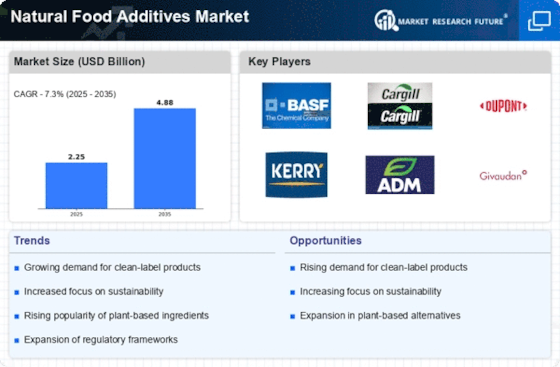
The increasing awareness of health and wellness among consumers appears to be a primary driver for the Natural Food Additives Market. As individuals become more informed about the implications of food additives on their health, there is a noticeable shift towards natural alternatives. This trend is reflected in market data, which indicates that the demand for natural food additives is projected to grow at a compound annual growth rate of approximately 6.5% over the next five years. Consumers are actively seeking products that are free from synthetic additives, which has led manufacturers to innovate and reformulate their offerings. This shift not only caters to health-conscious consumers but also aligns with regulatory trends favoring natural ingredients. Consequently, the Natural Food Additives Market is likely to experience sustained growth as more brands embrace this paradigm.
Innovation in Food Technology
Advancements in food technology are playing a crucial role in shaping the Natural Food Additives Market. Innovations in extraction and processing techniques are enabling the development of high-quality natural additives that meet consumer demands for flavor, color, and preservation. For instance, new methods for extracting natural colors from fruits and vegetables are gaining traction, providing alternatives to synthetic dyes. This technological progress is reflected in market trends, where the demand for natural colors is expected to rise significantly. As food manufacturers increasingly adopt these innovations, the Natural Food Additives Market is likely to expand, driven by the introduction of novel products that enhance the sensory attributes of food while adhering to natural standards. The intersection of technology and natural ingredients presents a promising avenue for growth.
Consumer Preference for Clean Labels
The clean label trend is significantly influencing the Natural Food Additives Market, as consumers increasingly seek transparency in food labeling. This movement emphasizes the importance of knowing what is in food products, leading to a preference for items with simple, recognizable ingredients. Market data suggests that products labeled as 'natural' or 'clean' are experiencing higher sales, as consumers associate these terms with health and quality. This shift is prompting manufacturers to reformulate their products, replacing artificial additives with natural alternatives to meet consumer expectations. As a result, the Natural Food Additives Market is likely to see a surge in demand for clean label products, reflecting a broader societal shift towards healthier eating habits and greater ingredient transparency.
Sustainability and Environmental Concerns
The growing emphasis on sustainability and environmental stewardship is emerging as a significant driver for the Natural Food Additives Market. Consumers are increasingly concerned about the ecological impact of their food choices, leading to a preference for products that are sustainably sourced and produced. This trend is supported by market data indicating that a substantial portion of consumers is willing to pay a premium for products that align with their values regarding sustainability. As a result, manufacturers are investing in sustainable practices and sourcing natural ingredients that minimize environmental impact. This shift not only meets consumer expectations but also positions companies favorably in a competitive market. The Natural Food Additives Market is thus likely to benefit from this alignment of consumer values with sustainable practices.
Regulatory Support for Natural Ingredients
Regulatory frameworks increasingly favoring natural ingredients are likely to bolster the Natural Food Additives Market. Governments and health organizations worldwide are promoting the use of natural additives over synthetic ones, which could lead to a more favorable environment for market growth. For instance, regulations that limit the use of artificial additives in food products are becoming more prevalent, compelling manufacturers to seek natural alternatives. This regulatory support is not only a response to consumer demand but also reflects a broader commitment to public health. As a result, the Natural Food Additives Market may witness an influx of new products that comply with these regulations, further enhancing market dynamics. The alignment of regulatory policies with consumer preferences suggests a promising trajectory for natural food additives.
























Leave a Comment