Nanomedicine Market (2026 - 2035)

ID: MRFR/HC/9348-CR 208 Pages Rahul Gotadki Last Updated: October 27, 2026
Nanomedicine Market Research Report: Size, Share, Trend Analysis By Applications (Drug Delivery, Diagnostic Imaging, Therapeutic Applications, Regenerative Medicine), By Types (Nanoparticles, Nanoshells, Nanorobots, Nanocapsules), By End-use (Pharmaceuticals, Biotechnology, Healthcare, Research Laboratories), By Technology (Targeted Drug Delivery, Nanocarriers, Nanotherapeutics, Nanodiagnostics), and By Regional (North America, Europe, South America, Asia Pacific, Middle East and Africa) - Growth Outlook & Industry Forecast 2025 To 2035
Nanomedicine Market
Market Size
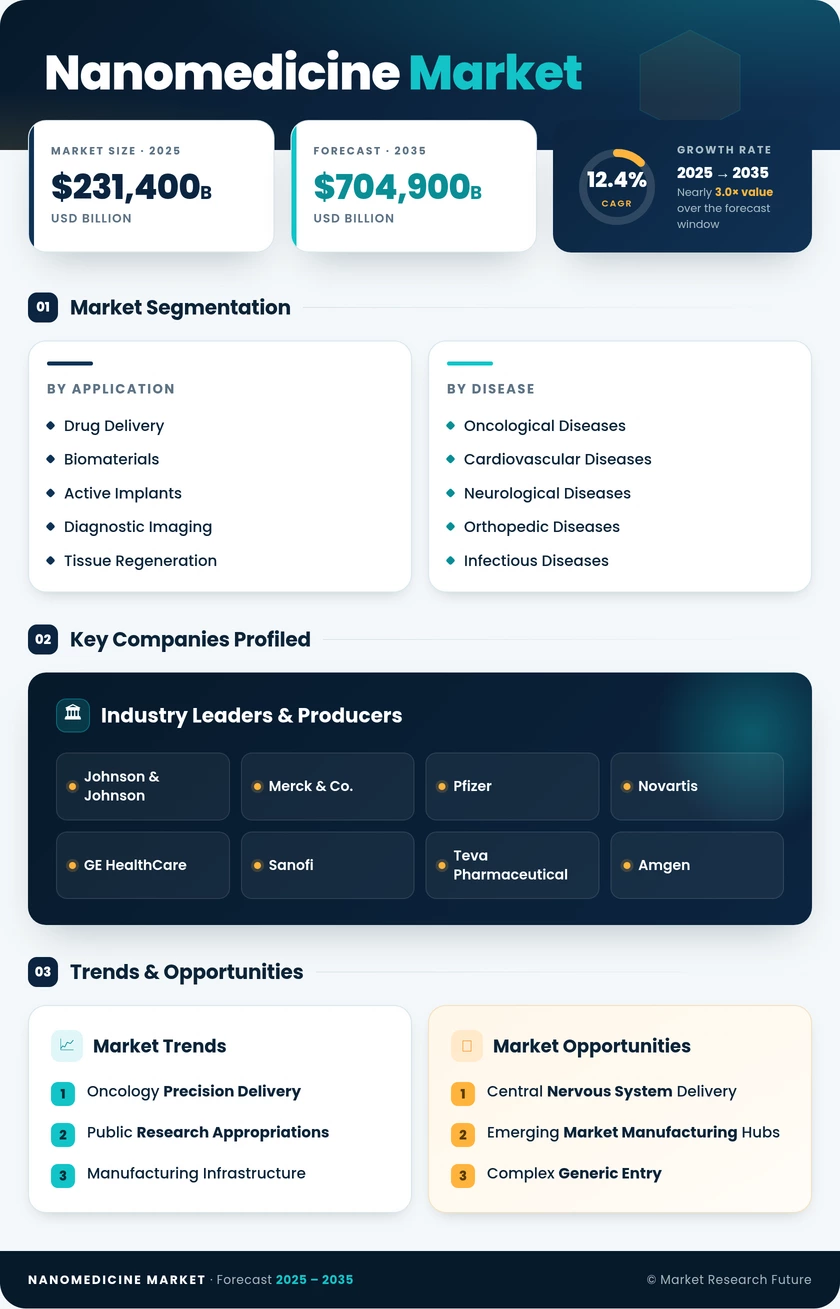
Forecast Period2026-2035
CAGR (2026-2035)12.40%
2025 Market SizeUSD 231,400 Million
2035 Market SizeUSD 704,900 Million
Key Players
Johnson & Johnson
Merck & Co.
Pfizer
Novartis
GE HealthCare
Sanofi
Opportunities
  • Central Nervous System Delivery
  • Emerging Market Manufacturing Hubs
  • Complex Generic Entry
  1. 1 Market Summary |
    1. 1.1 Study Assumptions & Market Definition |
    2. 1.2 Scope of the Study |
    3. 1.3 Research Methodology
  2. 2 Key Report Takeaways |
    1. 2.1 By Application |
    2. 2.2 By Disease |
    3. 2.3 By Geography
  3. 3 Market Size & Forecast (2021–2035) |
    1. 3.1 Historical Market Size (2021–2025) |
    2. 3.2 Current & Forecast Market Size (2026–2035) |
    3. 3.3 Year-over-Year Growth Analysis
  4. 4 Driver Impact Analysis |
    1. 4.1 Oncology Precision Delivery |
    2. 4.2 Public Research Appropriations |
    3. 4.3 Manufacturing Infrastructure |
    4. 4.4 Regulatory Predictability
  5. 5 Restraints Impact Analysis |
    1. 5.1 Reproducibility at Commercial Scale |
    2. 5.2 Cost and Payer Resistance |
    3. 5.3 Toxicology Overhang
  6. 6 Opportunities |
    1. 6.1 Central Nervous System Delivery |
    2. 6.2 Emerging Market Manufacturing Hubs |
    3. 6.3 Complex Generic Entry |
    4. 6.4 Theranostic Platform Licensing |
    5. 6.5 Diagnostic Imaging Agent Replacement
  7. 7 Regional Market Share & Country-Level Analysis |
    1. 7.1 North America | |
      1. 7.1.1 US | |
      2. 7.1.2 Canada | |
      3. 7.1.3 Mexico |
    2. 7.2 Europe | |
      1. 7.2.1 Germany | |
      2. 7.2.2 UK | |
      3. 7.2.3 France | |
      4. 7.2.4 Italy | |
      5. 7.2.5 Spain | |
      6. 7.2.6 Nordic Countries | |
      7. 7.2.7 Russia | |
      8. 7.2.8 Rest of Europe |
    3. 7.3 Asia-Pacific | |
      1. 7.3.1 China | |
      2. 7.3.2 India | |
      3. 7.3.3 Japan | |
      4. 7.3.4 South Korea | |
      5. 7.3.5 ASEAN | |
      6. 7.3.6 Rest of Asia-Pacific |
    4. 7.4 South America | |
      1. 7.4.1 Brazil | |
      2. 7.4.2 Argentina | |
      3. 7.4.3 Rest of South America |
    5. 7.5 Middle East & Africa | |
      1. 7.5.1 Saudi Arabia | |
      2. 7.5.2 UAE | |
      3. 7.5.3 South Africa | |
      4. 7.5.4 Egypt | |
      5. 7.5.5 Rest of MEA
  8. 8 Future Outlook (2026–2035) |
    1. 8.1 Computational Formulation Design |
    2. 8.2 Platform Economics and Licensing |
    3. 8.3 Decentralized and Point-of-Care Production |
    4. 8.4 Sustainability and Solvent Reduction
  9. 9 Market Segmentation Analysis |
    1. 9.1 By Application | |
      1. 9.1.1 Drug Delivery | |
      2. 9.1.2 Biomaterials | |
      3. 9.1.3 Active Implants | |
      4. 9.1.4 Diagnostic Imaging | |
      5. 9.1.5 Tissue Regeneration |
    2. 9.2 By Disease | |
      1. 9.2.1 Cardiovascular Diseases | |
      2. 9.2.2 Oncological Diseases | |
      3. 9.2.3 Neurological Diseases | |
      4. 9.2.4 Orthopedic Diseases | |
      5. 9.2.5 Infectious Diseases | |
      6. 9.2.6 Other Diseases
  10. 10 Competitive Landscape |
    1. 10.1 Market Concentration Analysis (2026) |
    2. 10.2 Competitive Benchmarking Matrix |
    3. 10.3 Company Profiles
  11. 11 Recent News & Developments
  12. 12 Report Scope & Methodology
  13. 13 Detailed Sources & Citations
  14. 14 Frequently Asked Questions
  15. 15 LIST OF TABLES |
  16. TABLE 1 Global Nanomedicine Market Size & Forecast, by Revenue (USD Million), 2021–2035 |
  17. TABLE 2 Global Nanomedicine Market – Year-over-Year Growth Analysis, 2021–2035 |
  18. TABLE 3 Driver Impact Analysis Matrix, 2026–2035 |
  19. TABLE 4 Restraint Impact Analysis Matrix, 2026–2035 |
  20. TABLE 5 Global Nanomedicine Market Size, by Region, 2021–2035 (USD Million) |
  21. TABLE 6 North America Nanomedicine Market Size, by Country, 2021–2035 (USD Million) |
  22. TABLE 7 Europe Nanomedicine Market Size, by Country, 2021–2035 (USD Million) |
  23. TABLE 8 Asia-Pacific Nanomedicine Market Size, by Country, 2021–2035 (USD Million) |
  24. TABLE 9 South America Nanomedicine Market Size, by Country, 2021–2035 (USD Million) |
  25. TABLE 10 Middle East & Africa Nanomedicine Market Size, by Country, 2021–2035 (USD Million) |
  26. TABLE 11 Global Nanomedicine Market Size, by Application, 2021–2035 (USD Million) |
  27. TABLE 12 Global Nanomedicine Market Size, by Disease, 2021–2035 (USD Million) |
  28. TABLE 13 North America Nanomedicine Market Size, by Application, 2021–2035 (USD Million) |
  29. TABLE 14 North America Nanomedicine Market Size, by Disease, 2021–2035 (USD Million) |
  30. TABLE 15 Europe Nanomedicine Market Size, by Application, 2021–2035 (USD Million) |
  31. TABLE 16 Europe Nanomedicine Market Size, by Disease, 2021–2035 (USD Million) |
  32. TABLE 17 Asia-Pacific Nanomedicine Market Size, by Application, 2021–2035 (USD Million) |
  33. TABLE 18 Asia-Pacific Nanomedicine Market Size, by Disease, 2021–2035 (USD Million) |
  34. TABLE 19 South America Nanomedicine Market Size, by Application, 2021–2035 (USD Million) |
  35. TABLE 20 Middle East & Africa Nanomedicine Market Size, by Application, 2021–2035 (USD Million) |
  36. TABLE 21 Competitive Benchmarking Matrix – Global Nanomedicine Market, 2026 |
  37. TABLE 22 Company Profiles – Key Players, Global Nanomedicine Market |
  38. TABLE 23 Recent Developments & Strategic Announcements, 2023–2025 |
  39. TABLE 24 Report Scope & Methodology Summary |
  40. TABLE 25 Detailed Sources & Citations Index
  41. 16 LIST OF FIGURES |
  42. FIGURE 1 Global Nanomedicine Market – Market Dynamics Overview |
  43. FIGURE 2 Industry Value Chain Analysis |
  44. FIGURE 3 Porter's Five Forces Analysis |
  45. FIGURE 4 Global Market Size Trend, 2021–2035 (USD Million) |
  46. FIGURE 5 Year-over-Year Growth Trajectory, 2022–2035 |
  47. FIGURE 6 Market Share by Application, 2026 vs 2035 |
  48. FIGURE 7 Market Share by Disease, 2026 vs 2035 |
  49. FIGURE 8 Regional Revenue Share Distribution, 2026 |
  50. FIGURE 9 Regional CAGR Comparison, 2026–2035 |
  51. FIGURE 10 North America Country-Level Share Breakdown |
  52. FIGURE 11 Asia-Pacific Country-Level Share Breakdown |
  53. FIGURE 12 Competitive Landscape – Revenue Share Positioning Map |
  54. FIGURE 13 Driver vs Restraint Impact Comparison |
  55. FIGURE 14 Opportunity Attractiveness Matrix

Segmentation Quick Reference

DimensionSub-SegmentsDominant SegmentFastest Growing Segment
By ApplicationDrug Delivery; Biomaterials; Active Implants; Diagnostic Imaging; Tissue RegenerationDrug DeliveryTissue Regeneration
By DiseaseCardiovascular Diseases; Oncological Diseases; Neurological Diseases; Orthopedic Diseases; Infectious Diseases; Other DiseasesOncological DiseasesInfectious Diseases
By GeographyNorth America; Europe; Asia-Pacific; South America; Middle East & AfricaNorth AmericaAsia-Pacific


Market Segmentation Overview

By Application

Sub-SegmentKey Trend
Drug DeliveryLiposomal and lipid carrier commercialization anchors the largest revenue pool
BiomaterialsNanostructured implant surfaces becoming standard in orthopedic hardware.
Active ImplantsSurface engineering improving neurostimulation electrode longevity.
Diagnostic ImagingIron-oxide agents positioned against gadolinium retention concerns
Tissue RegenerationNanofiber scaffolds advancing in cartilage and dermal repair.


Application economics diverge more than the shared taxonomy suggests. Delivery and imaging follow pharmaceutical approval cycles and pricing pressure; biomaterials and active implants follow device replacement cycles and procedure volumes. Tissue regeneration remains earliest-stage but attracts the highest proportional research funding.

By Disease

Sub-SegmentKey Trend
Cardiovascular DiseasesDrug-eluting stent coatings and thrombolytic carriers expanding
Oncological DiseasesTherapeutic index expansion sustaining premium pricing.
Neurological DiseasesBlood-brain barrier crossing platforms entering later-stage trials
Orthopedic DiseasesBone regeneration scaffolds gaining surgical adoption.
Infectious DiseasesReusable vaccine carrier platforms driving fastest growth
Other DiseasesOphthalmic and dermatological sustained-release formats emerging.


Disease-level demand reflects where nanoscale engineering solves a genuine delivery problem rather than where patient populations are largest. Oncology and infectious disease dominate because payload toxicity and antigen stability, respectively, are problems carriers demonstrably fix. Neurological applications carry the widest gap between demonstrated science and approved product.

By Region

Sub-SegmentKey Trend
North AmericaReimbursement depth sustaining premium-priced launches
EuropeHealth technology assessment tempering volume despite regulatory coherence
Asia-PacificDomestic approval acceleration and manufacturing localization
South AmericaPublic health system procurement expanding covered indications.
Middle East & AfricaLocalization mandates and specialty hospital construction


Geographic performance tracks research funding density and reimbursement willingness more than population. North America converts both into revenue efficiently. Asia-Pacific's advantage is manufacturing cost paired with regulatory reform, a combination that shifts where clinical material originates over the forecast decade.




Download PDF ×

We do not share your information with anyone. However, we may send you emails based on your report interest from time to time. You may contact us at any time to opt-out.