Request Free Sample ×

Kindly complete the form below to receive a free sample of this Report

* Please use a valid business email

Leading companies partner with us for data-driven Insights

clients tt-cursor
Hero Background
English
Chinese
French
Japanese
Korean
German
Spanish

Nanocellulose Market Share

ID: MRFR/CnM/3135-HCR
111 Pages
Chitranshi Jaiswal
Last Updated: April 06, 2026

Nanocellulose Market Research Report Information By Type (Micro fibrillated Cellulose, Cellulose Nanofibrils, Cellulose Nanocrystals, Bacterial Cellulose, and Others), Application (Cement & Composite Materials, Textiles & Nonwovens, Paper & Packaging, Food Products, Cosmetics & Toiletries, Filter Materials, and Others), And By Region (North America, Europe, Asia-Pacific, And Rest Of The World) – Market Forecast Till 2035

Share:
Download PDF ×

We do not share your information with anyone. However, we may send you emails based on your report interest from time to time. You may contact us at any time to opt-out.

Nanocellulose Market Infographic
Purchase Options

Market Share

Nanocellulose Market Share Analysis

Market positioning strategies for various players in the nanocellulose market, among which there are many ways through which they would fight for their competitive advantage. Nanocellulose, which has really small particles and derived from the plant origin, would be utilized in plenty of processes due to its exceptional features and diversified applications. Common brands of this approach are to develop the point of differences and focus on the unique selling point of the product as better way to emerge into the marketplace. Research funds and activity lead to improvements of Nanocellulose quality, functionality, and cost-effectiveness features. It gives them a chance to niche their market efforts and attract customer segments and have loyalty groups.

The development of cars and export of automobiles, the growth of cosmetics in world markets and the improvement of living conditions contribute to the increase in the market demand. Globally and nationally, crude oil is becoming more abundant, which give chance for the oil & gas industry to experience a significant growth in the Nanocellulose Market. Increasing purchasing power of the consumers and rapid urbanization changes will be a major factor to drive the consumption in developing countries over the forecast time frame.

The third point that I want to highlight is the role of pricing in the nanostechnology industry when it comes to positioning. Firms can adopt the cost leadership strategy, represented by a low price for nano-cellulose products in the face of other producers. From this perspective, that could be done by advanced production capacity or producing technique, economies of scale, or forming critical alliances. On the contrary, companies may have high-end pricing strategies, which implies that the goods are expensive and also luxury. This strategy is successfully combined with productivity aimed marketing initiatives in the process of establishing the association, as quality wins the customers who are eligible to pay more for nanocellulose solutions.

Collaboration and partnerships as well have pivotal role in evolvement of the market shere positioning of the nanocellulose industry. Research companies may create strategic partnerships with universities, research institutions, or other industry members in order to maximize upon the resource and expertise pools available for them altogether. Through joint ventures, leading to the creation of the best cutting edge technologies, we see the rise of innovation, and the market players becoming more competitive in the Nanocellulose market. Partnerships and joint ventures also contribute to the expansion of the market by providing more diverse channels to a fresh customer demographic and areas of the world.

The geographical expansion is an instrument some companies in the nano-cellulose sector use while sustaining their market share positioning. The necessity of nonpolluting and recyclable materials sets the tone for businesses and they competitively try to win in the most preferable markets. The knowledge of regional favourites, regulatory aspects and specific needs of the industry usually enables the businesses to develop nano-cellulose based products which meet diverse demands. This well grounded native marketing method is able to customize its services for customers, thereby staying abreast of the local dialectical variations and tendencies.


Author
Author Profile
Chitranshi Jaiswal
Team Lead - Research

Chitranshi is a Team Leader in the Chemicals & Materials (CnM) and Energy & Power (EnP) domains, with 6+ years of experience in market research. She leads and mentors teams to deliver cross-domain projects that equip clients with actionable insights and growth strategies. She is skilled in market estimation, forecasting, competitive benchmarking, and both primary & secondary research, enabling her to turn complex data into decision-ready insights. An engineer and MBA professional, she combines technical expertise with strategic acumen to solve dynamic market challenges. Chitranshi has successfully managed projects that support market entry, investment planning, and competitive positioning, while building strong client relationships. Certified in Advanced Excel & Power BI she leverages data-driven approaches to ensure accuracy, clarity, and impactful outcomes.

Leave a Comment

FAQs

What is the projected market valuation of the Nanocellulose Market by 2035?

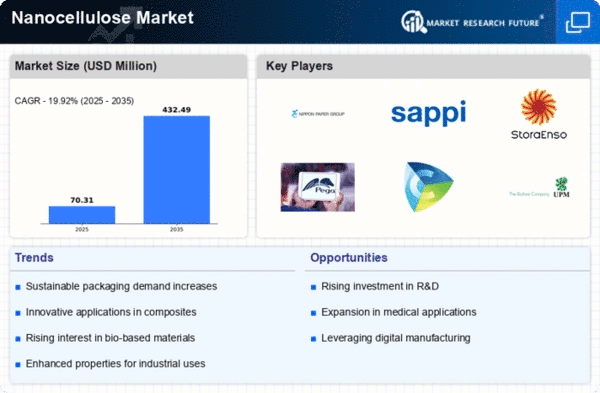
<p>The Nanocellulose Market is projected to reach a valuation of 432.49 USD Million by 2035.</p>

What was the market valuation of the Nanocellulose Market in 2024?

<p>In 2024, the overall market valuation of the Nanocellulose Market was 58.63 USD Million.</p>

What is the expected CAGR for the Nanocellulose Market during the forecast period 2025 - 2035?

<p>The expected CAGR for the Nanocellulose Market during the forecast period 2025 - 2035 is 19.92%.</p>

Which companies are considered key players in the Nanocellulose Market?

<p>Key players in the Nanocellulose Market include Nippon Paper Industries Co, Sappi Lanaken Mills, and Stora Enso Oyj, among others.</p>

What are the main applications of nanocellulose in various industries?

<p>Nanocellulose is primarily applied in Food and Beverage, Pharmaceuticals, Cosmetics, Paper and Packaging, and Composites.</p>

How does the valuation of the Paper and Packaging segment compare to others in the Nanocellulose Market?

<p>The Paper and Packaging segment had a valuation ranging from 20.0 to 150.0 USD Million, indicating a robust position within the market.</p>

What types of nanocellulose are currently recognized in the market?

The recognized types of nanocellulose include Nanofibrillated Cellulose, Nanocrystalline Cellulose, Bacterial Cellulose, and Cellulose Nanocrystals.

What is the significance of the Automotive end-use segment in the Nanocellulose Market?

The Automotive end-use segment is valued between 5.86 and 43.25 USD Million, reflecting its emerging role in the market.

Which processing methods are utilized in the production of nanocellulose?

The production of nanocellulose employs various processing methods, including Mechanical, Chemical, Biological, and Enzymatic Processing.

What sources are used for producing nanocellulose?

Nanocellulose is produced from sources such as Wood Pulp, Agricultural Residues, Recycled Paper, and Non-Wood Fibers.

Market Summary

As per MRFR analysis, the Nanocellulose Market Size was estimated at 0.62 USD Million in 2024. The Nanocellulose industry is projected to grow from 0.7 USD Million in 2025 to 4.1 USD Million by 2035, exhibiting a compound annual growth rate (CAGR) of 18.75% during the forecast period 2025 - 2035.

Key Market Trends & Highlights

The Nanocellulose Market is experiencing robust growth driven by sustainability and technological advancements.

  • North America remains the largest market for nanocellulose, reflecting a strong emphasis on sustainable materials. The Asia-Pacific region is identified as the fastest-growing market, indicating a rising interest in innovative applications. The paper segment continues to dominate the market, while the composites segment is rapidly gaining traction due to diverse applications. Sustainability initiatives and technological innovations are key drivers propelling the demand for nanocellulose in various industries.

Market Size & Forecast

2024 Market Size 0.62(USD Million)
2035 Market Size 4.1(USD Million)
CAGR (2025 - 2035) 18.75%
Largest Regional Market Share in 2024 North America

Major Players

Nippon Paper Industries Co (JP), Sappi Lanaken Mills (BE), Stora Enso Oyj (FI), American Process Inc (US), CelluForce (CA), UPM-Kymmene Corporation (FI), Borregaard ASA (NO), Green Science Alliance Co Ltd (JP), Tembec Inc (CA)

Market Trends

The Nanocellulose Market is currently experiencing a notable transformation, driven by increasing demand for sustainable materials across various industries. This biobased product, derived from cellulose, offers unique properties such as high strength-to-weight ratio, biodegradability, and versatility, making it an attractive alternative to conventional materials. Industries such as packaging, automotive, and construction are increasingly adopting nanocellulose due to its potential to enhance product performance while reducing environmental impact in the nanocellulose market. . Furthermore, ongoing research and development efforts highlighted in many nanocellulose market report studies are likely to expand its applications, thereby fostering growth in this sector. 

In addition to sustainability, the global nanocellulose market  is influenced by advancements in production technologies. Innovations in extraction and processing methods are enhancing the efficiency and cost-effectiveness of nanocellulose production. This evolution not only supports the scalability of nanocellulose but also encourages its integration into new applications, such as electronics and biomedical fields. As awareness of the benefits of nanocellulose continues to rise, it appears that the nanocellulose market size is poised for significant expansion in the coming years, driven by both consumer preferences and regulatory support for eco-friendly materials

Sustainability Focus

The emphasis on sustainable materials is reshaping the Nanocellulose Market. As industries seek eco-friendly alternatives, nanocellulose emerges as a viable option, appealing to manufacturers aiming to reduce their carbon footprint.

Technological Advancements

Innovations in production techniques are enhancing the efficiency of nanocellulose extraction and processing. These advancements are likely to lower costs and improve scalability, facilitating broader market penetration.

Diverse Applications

The versatility of nanocellulose is leading to its adoption across various sectors. From packaging to biomedical applications, the material's unique properties are driving interest and investment in new uses.

Nanocellulose Market Market Drivers

Market Growth Projections

The Global Nanocellulose Market Industry is projected to witness substantial growth over the coming years. With a market value of approximately 0.06 USD Billion in 2024, it is anticipated to reach 0.43 USD Billion by 2035. This growth trajectory is underpinned by a compound annual growth rate (CAGR) of 19.65% from 2025 to 2035. Such projections indicate a robust demand for nanocellulose across various sectors, driven by its unique properties and increasing applications. The market's expansion reflects a broader trend towards innovative materials that meet the evolving needs of industries and consumers alike.

Advancements in Nanotechnology

Technological advancements in nanotechnology are significantly influencing the Global Nanocellulose Market Industry. Innovations in production techniques and applications are enhancing the performance characteristics of nanocellulose, making it more appealing for various sectors, including packaging, biomedical, and electronics. These advancements facilitate the development of high-performance materials that can outperform conventional options. As a result, the market is poised for substantial growth, with a projected compound annual growth rate (CAGR) of 19.65% from 2025 to 2035. This growth trajectory underscores the transformative potential of nanotechnology in expanding the applications of nanocellulose.

Rising Demand for Sustainable Materials

The Global Nanocellulose Market Industry is experiencing a notable surge in demand for sustainable materials. As environmental concerns escalate, industries are increasingly seeking eco-friendly alternatives to traditional materials. Nanocellulose Market, derived from renewable sources, offers a biodegradable and non-toxic option that aligns with sustainability goals. In 2024, the market is valued at approximately 0.06 USD Billion, reflecting a growing recognition of its potential. This trend is likely to continue, as consumers and manufacturers alike prioritize sustainability, potentially propelling the market towards a projected value of 0.43 USD Billion by 2035.

Growing Applications in Various Industries

The versatility of nanocellulose is driving its adoption across multiple industries, thereby propelling the Global Nanocellulose Market Industry. Applications in sectors such as packaging, automotive, and construction are expanding, as nanocellulose offers unique properties like enhanced strength and lightweight characteristics. For instance, in packaging, nanocellulose is utilized to create biodegradable films that reduce plastic waste. This broad applicability is likely to sustain market growth, as industries increasingly recognize the benefits of incorporating nanocellulose into their products. The market's expansion is indicative of a broader trend towards innovative materials that meet diverse industrial needs.

Regulatory Support for Biodegradable Materials

Regulatory frameworks promoting biodegradable materials are significantly influencing the Global Nanocellulose Market Industry. Governments worldwide are implementing policies aimed at reducing plastic waste and encouraging the use of sustainable materials. This regulatory support is creating a favorable environment for the adoption of nanocellulose, as it aligns with global sustainability initiatives. As regulations become more stringent, industries are likely to shift towards biodegradable alternatives, further driving demand for nanocellulose. This trend is expected to contribute to the market's growth, reinforcing the importance of regulatory frameworks in shaping industry dynamics.

Increasing Investment in Research and Development

Investment in research and development is a critical driver for the Global Nanocellulose Market Industry. Governments and private entities are allocating significant resources to explore the diverse applications of nanocellulose, ranging from food packaging to drug delivery systems. This influx of funding is fostering innovation and accelerating the commercialization of nanocellulose-based products. As research progresses, new applications are likely to emerge, further expanding the market. The anticipated growth in R&D investment is expected to contribute to the market's expansion, aligning with the projected increase in market value from 0.06 USD Billion in 2024 to 0.43 USD Billion by 2035.

Market Segment Insights

By Application: Food and Beverage (Largest) vs. Pharmaceuticals (Fastest-Growing)

<p>The Nanocellulose Market is segmented into various applications, including Food and Beverage, Pharmaceuticals, Cosmetics, Paper and Packaging, and <a href="https://www.marketresearchfuture.com/reports/composites-market-5399" target="_blank" title="composites">Composites</a>. Among these, the Food and Beverage sector holds the largest share, primarily driven by the increasing demand for natural, sustainable, and functional food ingredients. This segment leverages nanocellulose's unique properties, such as emulsification and thickening, making it a preferred choice in product formulations. On the other hand, the Pharmaceuticals segment is recognized as the fastest-growing application area for nanocellulose. The increasing need for drug delivery systems and advanced therapeutics is fostering innovation and utilization of nanocellulose in pharmaceuticals. Its biocompatibility and versatility enhance its application in drug formulation, thereby significantly contributing to market growth in this domain.</p>

<p>Food and Beverage (Dominant) vs. Pharmaceuticals (Emerging)</p>

<p>The Food and Beverage application of nanocellulose is characterized by its widespread acceptance and integration into various products. With increasing consumer awareness regarding health and sustainability, food manufacturers are increasingly adopting nanocellulose for its functional benefits, such as improving texture and extending shelf-life without compromising on quality. In contrast, the Pharmaceuticals segment, though emerging, is rapidly gaining traction due to the rise in biopharmaceuticals and personalized medicine. Here, nanocellulose is used in drug formulations to enhance solubility and bioavailability, making it an appealing option for pharmaceutical developers aiming for innovative delivery methods. This shift in focus towards biocompatible materials positions the pharmaceuticals application as a key area for future growth.</p>

By Type: Nanofibrillated Cellulose (Largest) vs. Nanocrystalline Cellulose (Fastest-Growing)

In the Nanocellulose Market, the distribution of market share among the various types reveals that Nanofibrillated Cellulose holds the largest share due to its broad range of applications in industries such as packaging, pharmaceuticals, and food. Meanwhile, Nanocrystalline Cellulose is witnessing accelerated growth, driven by its increasing adoption in applications that require high strength-to-weight ratios and enhanced mechanical properties. This duality showcases a balanced market where one segment leads in share while another rapidly gains traction.

Nanofibrillated Cellulose (Dominant) vs. Nanocrystalline Cellulose (Emerging)

Nanofibrillated Cellulose (NFC) is dominant in the Nanocellulose Market, primarily because of its versatility in formulating advanced materials. Its unique characteristics, such as high surface area and excellent mechanical strength, make it suitable for various applications, including biodegradable composites and coatings. In contrast, Nanocrystalline Cellulose (NCC) is emerging rapidly, celebrated for its remarkable structural properties and reinforcing capabilities. NCC is increasingly preferred in high-tech applications, particularly in electronics and bioengineering. Together, they cater to a diverse array of sectors, providing innovative solutions that address sustainability and performance needs.

By End Use: Automotive (Largest) vs. Electronics (Fastest-Growing)

<p>In the Nanocellulose Market, the automotive segment holds the largest market share, dominated by the demand for lightweight materials that enhance fuel efficiency. This sector has embraced nanocellulose for its excellent tensile strength and biodegradable properties, positioning itself as a leader in sustainable automotive manufacturing. In contrast, the electronics segment, though smaller in terms of share, is rapidly gaining traction, driven by the need for innovative materials in flexible displays, batteries, and other electronic applications, showcasing a growing appetite for high-performance, eco-friendly alternatives.</p>

<p>Automotive: Dominant vs. Electronics: Emerging</p>

<p>The automotive sector is a dominant force in the nanocellulose market, as manufacturers are increasingly adopting sustainable materials to meet stringent environmental regulations. Nanocellulose provides enhanced mechanical properties that contribute to the production of lighter, stronger, and more fuel-efficient vehicles. Conversely, the electronics segment is classified as emerging, characterized by its swift adaptation of nanocellulose in the development of advanced technologies. With a focus on component miniaturization and sustainability, this segment is integrating nanocellulose in devices, fostering new opportunities in green electronics, which respond to consumer demands for eco-friendly gadgets.</p>

By Source: Wood Pulp (Largest) vs. Agricultural Residues (Fastest-Growing)

In the Nanocellulose Market, the primary source of nanocellulose production is wood pulp, commanding a significant share of the market. This is largely due to the abundant availability of wood resources, which enables efficient extraction processes. Following wood pulp, agricultural residues are gaining momentum as a sustainable alternative, driven by the need for more eco-friendly production methods. Recycled paper and non-wood fibers hold smaller shares but play crucial roles in niche applications and sustainability efforts.

Wood Pulp (Dominant) vs. Agricultural Residues (Emerging)

Wood pulp stands out as the dominant source for producing nanocellulose due to its widespread availability and established extraction technology. Its fibers are rich in cellulose, making them ideal for high-quality nanocellulose applications. Conversely, agricultural residues represent an emerging source with the potential for rapid growth in the nanocellulose market. These materials, often considered waste, provide a sustainable option for production, aligning with environmental goals and reducing reliance on wood resources. As technology advances, agricultural residues are expected to improve in yield and quality, positioning them as a viable alternative to traditional sources.

By Processing Method: Mechanical Processing (Largest) vs. Enzymatic Processing (Fastest-Growing)

<p>The nanocellulose market reveals a diverse distribution of processing methods, with mechanical processing leading in market share. This predominant method is widely utilized due to its simplicity and efficiency in producing nanofibers. Meanwhile, chemical processing holds a substantial share, allowing for tailored modification of cellulose properties. Biological processing is emerging but currently maintains a minor share, while enzymatic processing, though smaller, is gaining traction as a versatile and eco-friendly alternative. Growth in the nanocellulose segment is driven by increasing demand across industries such as packaging, pharmaceuticals, and biocomposites. Mechanical processing remains favored for its effectiveness, whereas enzymatic processing is rapidly evolving due to technological advancements and a shift towards sustainable practices. This trend reflects a growing consumer preference for environmentally-friendly materials that do not compromise performance.</p>

<p>Mechanical Processing (Dominant) vs. Enzymatic Processing (Emerging)</p>

<p>Mechanical processing is characterized by its straightforward approach to extracting nanocellulose, allowing for high yield and retention of cellulose's intrinsic properties. Its dominance in the market is attributed to the well-established equipment and processes necessary for production. In contrast, enzymatic processing, while still emerging, offers a unique advantage by utilizing biological catalysts to break down cellulose, resulting in lower energy consumption and minimized environmental impact. This process not only enhances the functional properties of nanocellulose but also aligns with the increasing global focus on sustainability. As industries emphasize green solutions, enzymatic processing is poised to capture a significant share of the market, appealing to eco-conscious consumers and enterprises.</p>

Get more detailed insights about Nanocellulose Market Research Report- Forecast to 2035

Regional Insights

North America : Market Leader in Nanocellulose

North America is poised to maintain its leadership in the nanocellulose market, holding a significant share of 30.0% as of 2024. The region's growth is driven by increasing demand for sustainable materials across various industries, including packaging, automotive, and construction. Regulatory support for green technologies and innovations further catalyzes market expansion, with a focus on reducing environmental impact and enhancing product performance. The competitive landscape in North America is robust, featuring key players such as American Process Inc, CelluForce, and Nippon Paper Industries. The U.S. and Canada are leading countries in this sector, with substantial investments in R&D and production capabilities. The presence of established companies and emerging startups fosters innovation, ensuring that North America remains at the forefront of nanocellulose advancements.

Europe : Emerging Market with Potential

Europe is witnessing a growing interest in nanocellulose, with a market share of 15.0% as of 2024. The region's growth is fueled by stringent environmental regulations and a strong push towards sustainable materials in various applications, including textiles, food packaging, and pharmaceuticals. European policies promoting circular economy practices are also significant drivers, encouraging the adoption of nanocellulose as a renewable resource. Leading countries in Europe include Finland, Belgium, and Norway, where companies like Stora Enso and Sappi Lanaken Mills are making strides in nanocellulose production. The competitive landscape is characterized by collaboration between academia and industry, fostering innovation. As Europe continues to prioritize sustainability, the nanocellulose market is expected to expand, supported by both established players and new entrants.

Asia-Pacific : Emerging Powerhouse in Nanocellulose

Asia-Pacific is emerging as a significant player in the nanocellulose market, holding a market share of 10.0% as of 2024. The region's growth is driven by increasing industrialization, rising demand for eco-friendly materials, and government initiatives promoting sustainable practices. Countries like Japan and China are at the forefront, investing in research and development to enhance nanocellulose applications in various sectors, including electronics and packaging. Japan, with companies like Green Science Alliance Co Ltd, is leading the charge in innovation, while China is rapidly expanding its production capabilities. The competitive landscape is evolving, with both established firms and startups vying for market share. As the region continues to embrace sustainability, the nanocellulose market is expected to grow, supported by technological advancements and increased consumer awareness.

Middle East and Africa : Resource-Rich Frontier

The Middle East and Africa region is gradually recognizing the potential of nanocellulose, with a market share of 3.63% as of 2024. The growth in this region is driven by increasing investments in sustainable technologies and a growing awareness of environmental issues. Governments are beginning to implement policies that encourage the use of renewable materials, which is expected to boost the nanocellulose market in the coming years. Countries like South Africa and the UAE are exploring nanocellulose applications in construction and packaging. The competitive landscape is still developing, with a mix of local and international players entering the market. As the region continues to invest in innovation and sustainability, the nanocellulose market is poised for growth, supported by emerging technologies and increased collaboration among stakeholders.

Key Players and Competitive Insights

The Nanocellulose Market is currently characterized by a dynamic competitive landscape, driven by increasing demand for sustainable materials across various industries, including packaging, automotive, and construction. Key players such as Nippon Paper Industries Co (Japan), Sappi Lanaken Mills (Belgium), and Stora Enso Oyj (Finland) are strategically positioning themselves through innovation and regional expansion. Nippon Paper Industries Co (Japan) focuses on enhancing its production capabilities, while Sappi Lanaken Mills (Belgium) emphasizes sustainable practices in its operations. Stora Enso Oyj (Finland) is actively pursuing partnerships to bolster its market presence, collectively shaping a competitive environment that prioritizes sustainability and technological advancement.In terms of business tactics, companies are increasingly localizing manufacturing to reduce supply chain vulnerabilities and optimize logistics. The market structure appears moderately fragmented, with several players vying for market share. However, the collective influence of major companies is significant, as they drive innovation and set industry standards. This competitive structure fosters an environment where collaboration and strategic alliances are essential for growth and market penetration.
In November CelluForce (Canada) announced a partnership with a leading packaging company to develop biodegradable packaging solutions utilizing nanocellulose. This strategic move underscores the growing trend towards sustainable packaging, positioning CelluForce as a key player in the eco-friendly materials sector. The collaboration is likely to enhance their product offerings and expand their market reach, aligning with global sustainability goals.
In October Borregaard ASA (Norway) launched a new line of nanocellulose products aimed at the construction industry, focusing on enhancing material strength and durability. This initiative reflects Borregaard's commitment to innovation and its strategic focus on diversifying its product portfolio. By targeting the construction sector, Borregaard is poised to capture a significant share of a rapidly growing market segment, potentially increasing its competitive edge.
In September UPM-Kymmene Corporation (Finland) unveiled a new production facility dedicated to the manufacturing of nanocellulose, aimed at meeting the rising demand in the automotive sector. This expansion not only signifies UPM's commitment to scaling its operations but also highlights the increasing integration of nanocellulose in high-performance applications. The facility is expected to enhance UPM's production capacity and reinforce its position as a leader in the nanocellulose market.
As of December current competitive trends indicate a strong emphasis on digitalization, sustainability, and the integration of AI technologies within the Nanocellulose Market. Strategic alliances are increasingly shaping the landscape, enabling companies to leverage shared resources and expertise. The shift from price-based competition to a focus on innovation, technology, and supply chain reliability is evident, suggesting that future competitive differentiation will hinge on the ability to deliver sustainable and technologically advanced solutions.

Key Companies in the Nanocellulose Market include

Industry Developments

In order to strengthen its presence in the industry, Nippon Paper Industries purchased Elopak ASA, a Norwegian firm that provides paper-based packing solutions in June 2021. FiberLean Technologies was purchased fully by the Werhahn KG in March 2021.

Research Council of Norway (NFR) funded a project that set out as an innovation and aimed to extract useful materials along with eliminating waste streams from industrial operations in October 2020, along with Borregaard.

The final approval of its first commercial Sunburst (CNC) unit was given to Sweetwater at the Sweetwoods project stationed in Tallinn, Estonia on March 2022.

Celluforce declared on the hand side the signing of a commercial contract with a cosmetics multinational for the exclusive supply CNC in the next 10 years alongside the introduction of new products throughout the contract in September, 2020. The plant expansion will be necessitated by demand such as from this contract. And as previously mentioned, the MNC would commercialize and commence more cosmetics made with CNC from the MNC at the international level later.

In February 2020 GranBio Technologies, which is a part of GranBio Group of Companies, announced the conclusion of a supply agreement with an Indian company Birla Carbon for the supply of biomass as a substitute for carbon black, which is a by-product of the petrol industry and is used in the tire & rubber industry.

In September 2023, the beauty giant Laneige made its way to Mexico. The skincare company built its presence in Mexico as a result of a partnership with the first beauty retailer in Mexico, Sephora. During that time, the company reports that the brand's presence in North America is still gaining an astonishing pace, saying that sales of Laneige in the region grew by 105% for the second quarter of the year 2023 in other reports.

In May 2022, Norske Skog ASA formally inaugurated the new biocomposite plant in Norske Skog Saugbrugs, Halden, which develops and commercializes the use of Norske Skog's nanocellulose product CEBINA. With this expansion, the company also reinforced its product portfolio.

Future Outlook

Nanocellulose Market Future Outlook

The Nanocellulose Market is projected to grow at a 18.75% CAGR from 2025 to 2035, driven by increasing demand in packaging, composites, and biomedical applications.

New opportunities lie in:

  • <p>Development of biodegradable nanocellulose-based packaging solutions. Investment in nanocellulose-enhanced composite materials for automotive applications. Creation of nanocellulose-based products for sustainable construction materials.</p>

By 2035, the Nanocellulose Market is expected to achieve substantial growth and innovation.

Market Segmentation

Nanocellulose Market Form Outlook

  • Powder
  • Gel
  • Suspension
  • Film

Nanocellulose Market Type Outlook

  • Nanofibrillated Cellulose
  • Nanocrystalline Cellulose
  • Bacterial Cellulose
  • Cellulose Nanocrystals

Nanocellulose Market Source Outlook

  • Wood Pulp
  • Agricultural Residues
  • Recycled Paper
  • Non-Wood Fibers

Nanocellulose Market End Use Outlook

  • Packaging
  • Construction
  • Automotive
  • Electronics
  • Medical

Nanocellulose Market Application Outlook

  • Paper
  • Composites
  • Food and Beverages
  • Pharmaceuticals
  • Cosmetics

Report Scope

MARKET SIZE 2024 0.62(USD Million)
MARKET SIZE 2025 0.7(USD Million)
MARKET SIZE 2035 4.1(USD Million)
COMPOUND ANNUAL GROWTH RATE (CAGR) 18.75% (2025 - 2035)
REPORT COVERAGE Revenue Forecast, Competitive Landscape, Growth Factors, and Trends
BASE YEAR 2024
Market Forecast Period 2025 - 2035
Historical Data 2019 - 2024
Market Forecast Units USD Million
Key Companies Profiled Nippon Paper Industries Co (JP), Sappi Lanaken Mills (BE), Stora Enso Oyj (FI), American Process Inc (US), CelluForce (CA), UPM-Kymmene Corporation (FI), Borregaard ASA (NO), Green Science Alliance Co Ltd (JP), Tembec Inc (CA)
Segments Covered Application, Type, End Use, Source, Form
Key Market Opportunities Growing demand for sustainable materials drives innovation in the Nanocellulose Market.
Key Market Dynamics Rising demand for sustainable materials drives innovation and competition in the nanocellulose market.
Countries Covered North America, Europe, APAC, South America, MEA

FAQs

What is the projected market valuation of the Nanocellulose Market by 2035?

<p>The Nanocellulose Market is projected to reach a valuation of 432.49 USD Million by 2035.</p>

What was the market valuation of the Nanocellulose Market in 2024?

<p>In 2024, the overall market valuation of the Nanocellulose Market was 58.63 USD Million.</p>

What is the expected CAGR for the Nanocellulose Market during the forecast period 2025 - 2035?

<p>The expected CAGR for the Nanocellulose Market during the forecast period 2025 - 2035 is 19.92%.</p>

Which companies are considered key players in the Nanocellulose Market?

<p>Key players in the Nanocellulose Market include Nippon Paper Industries Co, Sappi Lanaken Mills, and Stora Enso Oyj, among others.</p>

What are the main applications of nanocellulose in various industries?

<p>Nanocellulose is primarily applied in Food and Beverage, Pharmaceuticals, Cosmetics, Paper and Packaging, and Composites.</p>

How does the valuation of the Paper and Packaging segment compare to others in the Nanocellulose Market?

<p>The Paper and Packaging segment had a valuation ranging from 20.0 to 150.0 USD Million, indicating a robust position within the market.</p>

What types of nanocellulose are currently recognized in the market?

The recognized types of nanocellulose include Nanofibrillated Cellulose, Nanocrystalline Cellulose, Bacterial Cellulose, and Cellulose Nanocrystals.

What is the significance of the Automotive end-use segment in the Nanocellulose Market?

The Automotive end-use segment is valued between 5.86 and 43.25 USD Million, reflecting its emerging role in the market.

Which processing methods are utilized in the production of nanocellulose?

The production of nanocellulose employs various processing methods, including Mechanical, Chemical, Biological, and Enzymatic Processing.

What sources are used for producing nanocellulose?

Nanocellulose is produced from sources such as Wood Pulp, Agricultural Residues, Recycled Paper, and Non-Wood Fibers.

  1. SECTION I: EXECUTIVE SUMMARY AND KEY HIGHLIGHTS
    1. | 1.1 EXECUTIVE SUMMARY
    2. | | 1.1.1 Market Overview
    3. | | 1.1.2 Key Findings
    4. | | 1.1.3 Market Segmentation
    5. | | 1.1.4 Competitive Landscape
    6. | | 1.1.5 Challenges and Opportunities
    7. | | 1.1.6 Future Outlook
  2. SECTION II: SCOPING, METHODOLOGY AND MARKET STRUCTURE
    1. | 2.1 MARKET INTRODUCTION
    2. | | 2.1.1 Definition
    3. | | 2.1.2 Scope of the study
    4. | | | 2.1.2.1 Research Objective
    5. | | | 2.1.2.2 Assumption
    6. | | | 2.1.2.3 Limitations
    7. | 2.2 RESEARCH METHODOLOGY
    8. | | 2.2.1 Overview
    9. | | 2.2.2 Data Mining
    10. | | 2.2.3 Secondary Research
    11. | | 2.2.4 Primary Research
    12. | | | 2.2.4.1 Primary Interviews and Information Gathering Process
    13. | | | 2.2.4.2 Breakdown of Primary Respondents
    14. | | 2.2.5 Forecasting Model
    15. | | 2.2.6 Market Size Estimation
    16. | | | 2.2.6.1 Bottom-Up Approach
    17. | | | 2.2.6.2 Top-Down Approach
    18. | | 2.2.7 Data Triangulation
    19. | | 2.2.8 Validation
  3. SECTION III: QUALITATIVE ANALYSIS
    1. | 3.1 MARKET DYNAMICS
    2. | | 3.1.1 Overview
    3. | | 3.1.2 Drivers
    4. | | 3.1.3 Restraints
    5. | | 3.1.4 Opportunities
    6. | 3.2 MARKET FACTOR ANALYSIS
    7. | | 3.2.1 Value chain Analysis
    8. | | 3.2.2 Porter's Five Forces Analysis
    9. | | | 3.2.2.1 Bargaining Power of Suppliers
    10. | | | 3.2.2.2 Bargaining Power of Buyers
    11. | | | 3.2.2.3 Threat of New Entrants
    12. | | | 3.2.2.4 Threat of Substitutes
    13. | | | 3.2.2.5 Intensity of Rivalry
    14. | | 3.2.3 COVID-19 Impact Analysis
    15. | | | 3.2.3.1 Market Impact Analysis
    16. | | | 3.2.3.2 Regional Impact
    17. | | | 3.2.3.3 Opportunity and Threat Analysis
  4. SECTION IV: QUANTITATIVE ANALYSIS
    1. | 4.1 Chemicals and Materials, BY Application (USD Million)
    2. | | 4.1.1 Food and Beverage
    3. | | 4.1.2 Pharmaceuticals
    4. | | 4.1.3 Cosmetics
    5. | | 4.1.4 Paper and Packaging
    6. | | 4.1.5 Composites
    7. | 4.2 Chemicals and Materials, BY Type (USD Million)
    8. | | 4.2.1 Nanofibrillated Cellulose
    9. | | 4.2.2 Nanocrystalline Cellulose
    10. | | 4.2.3 Bacterial Cellulose
    11. | | 4.2.4 Cellulose Nanocrystals
    12. | 4.3 Chemicals and Materials, BY End Use (USD Million)
    13. | | 4.3.1 Automotive
    14. | | 4.3.2 Construction
    15. | | 4.3.3 Electronics
    16. | | 4.3.4 Medical Devices
    17. | | 4.3.5 Textiles
    18. | 4.4 Chemicals and Materials, BY Source (USD Million)
    19. | | 4.4.1 Wood Pulp
    20. | | 4.4.2 Agricultural Residues
    21. | | 4.4.3 Recycled Paper
    22. | | 4.4.4 Non-Wood Fibers
    23. | 4.5 Chemicals and Materials, BY Processing Method (USD Million)
    24. | | 4.5.1 Mechanical Processing
    25. | | 4.5.2 Chemical Processing
    26. | | 4.5.3 Biological Processing
    27. | | 4.5.4 Enzymatic Processing
    28. | 4.6 Chemicals and Materials, BY Region (USD Million)
    29. | | 4.6.1 North America
    30. | | | 4.6.1.1 US
    31. | | | 4.6.1.2 Canada
    32. | | 4.6.2 Europe
    33. | | | 4.6.2.1 Germany
    34. | | | 4.6.2.2 UK
    35. | | | 4.6.2.3 France
    36. | | | 4.6.2.4 Russia
    37. | | | 4.6.2.5 Italy
    38. | | | 4.6.2.6 Spain
    39. | | | 4.6.2.7 Rest of Europe
    40. | | 4.6.3 APAC
    41. | | | 4.6.3.1 China
    42. | | | 4.6.3.2 India
    43. | | | 4.6.3.3 Japan
    44. | | | 4.6.3.4 South Korea
    45. | | | 4.6.3.5 Malaysia
    46. | | | 4.6.3.6 Thailand
    47. | | | 4.6.3.7 Indonesia
    48. | | | 4.6.3.8 Rest of APAC
    49. | | 4.6.4 South America
    50. | | | 4.6.4.1 Brazil
    51. | | | 4.6.4.2 Mexico
    52. | | | 4.6.4.3 Argentina
    53. | | | 4.6.4.4 Rest of South America
    54. | | 4.6.5 MEA
    55. | | | 4.6.5.1 GCC Countries
    56. | | | 4.6.5.2 South Africa
    57. | | | 4.6.5.3 Rest of MEA
  5. SECTION V: COMPETITIVE ANALYSIS
    1. | 5.1 Competitive Landscape
    2. | | 5.1.1 Overview
    3. | | 5.1.2 Competitive Analysis
    4. | | 5.1.3 Market share Analysis
    5. | | 5.1.4 Major Growth Strategy in the Chemicals and Materials
    6. | | 5.1.5 Competitive Benchmarking
    7. | | 5.1.6 Leading Players in Terms of Number of Developments in the Chemicals and Materials
    8. | | 5.1.7 Key developments and growth strategies
    9. | | | 5.1.7.1 New Product Launch/Service Deployment
    10. | | | 5.1.7.2 Merger & Acquisitions
    11. | | | 5.1.7.3 Joint Ventures
    12. | | 5.1.8 Major Players Financial Matrix
    13. | | | 5.1.8.1 Sales and Operating Income
    14. | | | 5.1.8.2 Major Players R&D Expenditure. 2023
    15. | 5.2 Company Profiles
    16. | | 5.2.1 Nippon Paper Industries Co (JP)
    17. | | | 5.2.1.1 Financial Overview
    18. | | | 5.2.1.2 Products Offered
    19. | | | 5.2.1.3 Key Developments
    20. | | | 5.2.1.4 SWOT Analysis
    21. | | | 5.2.1.5 Key Strategies
    22. | | 5.2.2 Sappi Lanaken Mills (BE)
    23. | | | 5.2.2.1 Financial Overview
    24. | | | 5.2.2.2 Products Offered
    25. | | | 5.2.2.3 Key Developments
    26. | | | 5.2.2.4 SWOT Analysis
    27. | | | 5.2.2.5 Key Strategies
    28. | | 5.2.3 Stora Enso Oyj (FI)
    29. | | | 5.2.3.1 Financial Overview
    30. | | | 5.2.3.2 Products Offered
    31. | | | 5.2.3.3 Key Developments
    32. | | | 5.2.3.4 SWOT Analysis
    33. | | | 5.2.3.5 Key Strategies
    34. | | 5.2.4 American Process Inc (US)
    35. | | | 5.2.4.1 Financial Overview
    36. | | | 5.2.4.2 Products Offered
    37. | | | 5.2.4.3 Key Developments
    38. | | | 5.2.4.4 SWOT Analysis
    39. | | | 5.2.4.5 Key Strategies
    40. | | 5.2.5 CelluForce (CA)
    41. | | | 5.2.5.1 Financial Overview
    42. | | | 5.2.5.2 Products Offered
    43. | | | 5.2.5.3 Key Developments
    44. | | | 5.2.5.4 SWOT Analysis
    45. | | | 5.2.5.5 Key Strategies
    46. | | 5.2.6 UPM-Kymmene Corporation (FI)
    47. | | | 5.2.6.1 Financial Overview
    48. | | | 5.2.6.2 Products Offered
    49. | | | 5.2.6.3 Key Developments
    50. | | | 5.2.6.4 SWOT Analysis
    51. | | | 5.2.6.5 Key Strategies
    52. | | 5.2.7 Borregaard ASA (NO)
    53. | | | 5.2.7.1 Financial Overview
    54. | | | 5.2.7.2 Products Offered
    55. | | | 5.2.7.3 Key Developments
    56. | | | 5.2.7.4 SWOT Analysis
    57. | | | 5.2.7.5 Key Strategies
    58. | | 5.2.8 Green Science Alliance Co Ltd (JP)
    59. | | | 5.2.8.1 Financial Overview
    60. | | | 5.2.8.2 Products Offered
    61. | | | 5.2.8.3 Key Developments
    62. | | | 5.2.8.4 SWOT Analysis
    63. | | | 5.2.8.5 Key Strategies
    64. | | 5.2.9 Nanocellulose Solutions (US)
    65. | | | 5.2.9.1 Financial Overview
    66. | | | 5.2.9.2 Products Offered
    67. | | | 5.2.9.3 Key Developments
    68. | | | 5.2.9.4 SWOT Analysis
    69. | | | 5.2.9.5 Key Strategies
    70. | 5.3 Appendix
    71. | | 5.3.1 References
    72. | | 5.3.2 Related Reports
  6. LIST OF FIGURES
    1. | 6.1 MARKET SYNOPSIS
    2. | 6.2 NORTH AMERICA MARKET ANALYSIS
    3. | 6.3 US MARKET ANALYSIS BY APPLICATION
    4. | 6.4 US MARKET ANALYSIS BY TYPE
    5. | 6.5 US MARKET ANALYSIS BY END USE
    6. | 6.6 US MARKET ANALYSIS BY SOURCE
    7. | 6.7 US MARKET ANALYSIS BY PROCESSING METHOD
    8. | 6.8 CANADA MARKET ANALYSIS BY APPLICATION
    9. | 6.9 CANADA MARKET ANALYSIS BY TYPE
    10. | 6.10 CANADA MARKET ANALYSIS BY END USE
    11. | 6.11 CANADA MARKET ANALYSIS BY SOURCE
    12. | 6.12 CANADA MARKET ANALYSIS BY PROCESSING METHOD
    13. | 6.13 EUROPE MARKET ANALYSIS
    14. | 6.14 GERMANY MARKET ANALYSIS BY APPLICATION
    15. | 6.15 GERMANY MARKET ANALYSIS BY TYPE
    16. | 6.16 GERMANY MARKET ANALYSIS BY END USE
    17. | 6.17 GERMANY MARKET ANALYSIS BY SOURCE
    18. | 6.18 GERMANY MARKET ANALYSIS BY PROCESSING METHOD
    19. | 6.19 UK MARKET ANALYSIS BY APPLICATION
    20. | 6.20 UK MARKET ANALYSIS BY TYPE
    21. | 6.21 UK MARKET ANALYSIS BY END USE
    22. | 6.22 UK MARKET ANALYSIS BY SOURCE
    23. | 6.23 UK MARKET ANALYSIS BY PROCESSING METHOD
    24. | 6.24 FRANCE MARKET ANALYSIS BY APPLICATION
    25. | 6.25 FRANCE MARKET ANALYSIS BY TYPE
    26. | 6.26 FRANCE MARKET ANALYSIS BY END USE
    27. | 6.27 FRANCE MARKET ANALYSIS BY SOURCE
    28. | 6.28 FRANCE MARKET ANALYSIS BY PROCESSING METHOD
    29. | 6.29 RUSSIA MARKET ANALYSIS BY APPLICATION
    30. | 6.30 RUSSIA MARKET ANALYSIS BY TYPE
    31. | 6.31 RUSSIA MARKET ANALYSIS BY END USE
    32. | 6.32 RUSSIA MARKET ANALYSIS BY SOURCE
    33. | 6.33 RUSSIA MARKET ANALYSIS BY PROCESSING METHOD
    34. | 6.34 ITALY MARKET ANALYSIS BY APPLICATION
    35. | 6.35 ITALY MARKET ANALYSIS BY TYPE
    36. | 6.36 ITALY MARKET ANALYSIS BY END USE
    37. | 6.37 ITALY MARKET ANALYSIS BY SOURCE
    38. | 6.38 ITALY MARKET ANALYSIS BY PROCESSING METHOD
    39. | 6.39 SPAIN MARKET ANALYSIS BY APPLICATION
    40. | 6.40 SPAIN MARKET ANALYSIS BY TYPE
    41. | 6.41 SPAIN MARKET ANALYSIS BY END USE
    42. | 6.42 SPAIN MARKET ANALYSIS BY SOURCE
    43. | 6.43 SPAIN MARKET ANALYSIS BY PROCESSING METHOD
    44. | 6.44 REST OF EUROPE MARKET ANALYSIS BY APPLICATION
    45. | 6.45 REST OF EUROPE MARKET ANALYSIS BY TYPE
    46. | 6.46 REST OF EUROPE MARKET ANALYSIS BY END USE
    47. | 6.47 REST OF EUROPE MARKET ANALYSIS BY SOURCE
    48. | 6.48 REST OF EUROPE MARKET ANALYSIS BY PROCESSING METHOD
    49. | 6.49 APAC MARKET ANALYSIS
    50. | 6.50 CHINA MARKET ANALYSIS BY APPLICATION
    51. | 6.51 CHINA MARKET ANALYSIS BY TYPE
    52. | 6.52 CHINA MARKET ANALYSIS BY END USE
    53. | 6.53 CHINA MARKET ANALYSIS BY SOURCE
    54. | 6.54 CHINA MARKET ANALYSIS BY PROCESSING METHOD
    55. | 6.55 INDIA MARKET ANALYSIS BY APPLICATION
    56. | 6.56 INDIA MARKET ANALYSIS BY TYPE
    57. | 6.57 INDIA MARKET ANALYSIS BY END USE
    58. | 6.58 INDIA MARKET ANALYSIS BY SOURCE
    59. | 6.59 INDIA MARKET ANALYSIS BY PROCESSING METHOD
    60. | 6.60 JAPAN MARKET ANALYSIS BY APPLICATION
    61. | 6.61 JAPAN MARKET ANALYSIS BY TYPE
    62. | 6.62 JAPAN MARKET ANALYSIS BY END USE
    63. | 6.63 JAPAN MARKET ANALYSIS BY SOURCE
    64. | 6.64 JAPAN MARKET ANALYSIS BY PROCESSING METHOD
    65. | 6.65 SOUTH KOREA MARKET ANALYSIS BY APPLICATION
    66. | 6.66 SOUTH KOREA MARKET ANALYSIS BY TYPE
    67. | 6.67 SOUTH KOREA MARKET ANALYSIS BY END USE
    68. | 6.68 SOUTH KOREA MARKET ANALYSIS BY SOURCE
    69. | 6.69 SOUTH KOREA MARKET ANALYSIS BY PROCESSING METHOD
    70. | 6.70 MALAYSIA MARKET ANALYSIS BY APPLICATION
    71. | 6.71 MALAYSIA MARKET ANALYSIS BY TYPE
    72. | 6.72 MALAYSIA MARKET ANALYSIS BY END USE
    73. | 6.73 MALAYSIA MARKET ANALYSIS BY SOURCE
    74. | 6.74 MALAYSIA MARKET ANALYSIS BY PROCESSING METHOD
    75. | 6.75 THAILAND MARKET ANALYSIS BY APPLICATION
    76. | 6.76 THAILAND MARKET ANALYSIS BY TYPE
    77. | 6.77 THAILAND MARKET ANALYSIS BY END USE
    78. | 6.78 THAILAND MARKET ANALYSIS BY SOURCE
    79. | 6.79 THAILAND MARKET ANALYSIS BY PROCESSING METHOD
    80. | 6.80 INDONESIA MARKET ANALYSIS BY APPLICATION
    81. | 6.81 INDONESIA MARKET ANALYSIS BY TYPE
    82. | 6.82 INDONESIA MARKET ANALYSIS BY END USE
    83. | 6.83 INDONESIA MARKET ANALYSIS BY SOURCE
    84. | 6.84 INDONESIA MARKET ANALYSIS BY PROCESSING METHOD
    85. | 6.85 REST OF APAC MARKET ANALYSIS BY APPLICATION
    86. | 6.86 REST OF APAC MARKET ANALYSIS BY TYPE
    87. | 6.87 REST OF APAC MARKET ANALYSIS BY END USE
    88. | 6.88 REST OF APAC MARKET ANALYSIS BY SOURCE
    89. | 6.89 REST OF APAC MARKET ANALYSIS BY PROCESSING METHOD
    90. | 6.90 SOUTH AMERICA MARKET ANALYSIS
    91. | 6.91 BRAZIL MARKET ANALYSIS BY APPLICATION
    92. | 6.92 BRAZIL MARKET ANALYSIS BY TYPE
    93. | 6.93 BRAZIL MARKET ANALYSIS BY END USE
    94. | 6.94 BRAZIL MARKET ANALYSIS BY SOURCE
    95. | 6.95 BRAZIL MARKET ANALYSIS BY PROCESSING METHOD
    96. | 6.96 MEXICO MARKET ANALYSIS BY APPLICATION
    97. | 6.97 MEXICO MARKET ANALYSIS BY TYPE
    98. | 6.98 MEXICO MARKET ANALYSIS BY END USE
    99. | 6.99 MEXICO MARKET ANALYSIS BY SOURCE
    100. | 6.100 MEXICO MARKET ANALYSIS BY PROCESSING METHOD
    101. | 6.101 ARGENTINA MARKET ANALYSIS BY APPLICATION
    102. | 6.102 ARGENTINA MARKET ANALYSIS BY TYPE
    103. | 6.103 ARGENTINA MARKET ANALYSIS BY END USE
    104. | 6.104 ARGENTINA MARKET ANALYSIS BY SOURCE
    105. | 6.105 ARGENTINA MARKET ANALYSIS BY PROCESSING METHOD
    106. | 6.106 REST OF SOUTH AMERICA MARKET ANALYSIS BY APPLICATION
    107. | 6.107 REST OF SOUTH AMERICA MARKET ANALYSIS BY TYPE
    108. | 6.108 REST OF SOUTH AMERICA MARKET ANALYSIS BY END USE
    109. | 6.109 REST OF SOUTH AMERICA MARKET ANALYSIS BY SOURCE
    110. | 6.110 REST OF SOUTH AMERICA MARKET ANALYSIS BY PROCESSING METHOD
    111. | 6.111 MEA MARKET ANALYSIS
    112. | 6.112 GCC COUNTRIES MARKET ANALYSIS BY APPLICATION
    113. | 6.113 GCC COUNTRIES MARKET ANALYSIS BY TYPE
    114. | 6.114 GCC COUNTRIES MARKET ANALYSIS BY END USE
    115. | 6.115 GCC COUNTRIES MARKET ANALYSIS BY SOURCE
    116. | 6.116 GCC COUNTRIES MARKET ANALYSIS BY PROCESSING METHOD
    117. | 6.117 SOUTH AFRICA MARKET ANALYSIS BY APPLICATION
    118. | 6.118 SOUTH AFRICA MARKET ANALYSIS BY TYPE
    119. | 6.119 SOUTH AFRICA MARKET ANALYSIS BY END USE
    120. | 6.120 SOUTH AFRICA MARKET ANALYSIS BY SOURCE
    121. | 6.121 SOUTH AFRICA MARKET ANALYSIS BY PROCESSING METHOD
    122. | 6.122 REST OF MEA MARKET ANALYSIS BY APPLICATION
    123. | 6.123 REST OF MEA MARKET ANALYSIS BY TYPE
    124. | 6.124 REST OF MEA MARKET ANALYSIS BY END USE
    125. | 6.125 REST OF MEA MARKET ANALYSIS BY SOURCE
    126. | 6.126 REST OF MEA MARKET ANALYSIS BY PROCESSING METHOD
    127. | 6.127 KEY BUYING CRITERIA OF CHEMICALS AND MATERIALS
    128. | 6.128 RESEARCH PROCESS OF MRFR
    129. | 6.129 DRO ANALYSIS OF CHEMICALS AND MATERIALS
    130. | 6.130 DRIVERS IMPACT ANALYSIS: CHEMICALS AND MATERIALS
    131. | 6.131 RESTRAINTS IMPACT ANALYSIS: CHEMICALS AND MATERIALS
    132. | 6.132 SUPPLY / VALUE CHAIN: CHEMICALS AND MATERIALS
    133. | 6.133 CHEMICALS AND MATERIALS, BY APPLICATION, 2024 (% SHARE)
    134. | 6.134 CHEMICALS AND MATERIALS, BY APPLICATION, 2024 TO 2035 (USD Million)
    135. | 6.135 CHEMICALS AND MATERIALS, BY TYPE, 2024 (% SHARE)
    136. | 6.136 CHEMICALS AND MATERIALS, BY TYPE, 2024 TO 2035 (USD Million)
    137. | 6.137 CHEMICALS AND MATERIALS, BY END USE, 2024 (% SHARE)
    138. | 6.138 CHEMICALS AND MATERIALS, BY END USE, 2024 TO 2035 (USD Million)
    139. | 6.139 CHEMICALS AND MATERIALS, BY SOURCE, 2024 (% SHARE)
    140. | 6.140 CHEMICALS AND MATERIALS, BY SOURCE, 2024 TO 2035 (USD Million)
    141. | 6.141 CHEMICALS AND MATERIALS, BY PROCESSING METHOD, 2024 (% SHARE)
    142. | 6.142 CHEMICALS AND MATERIALS, BY PROCESSING METHOD, 2024 TO 2035 (USD Million)
    143. | 6.143 BENCHMARKING OF MAJOR COMPETITORS
  7. LIST OF TABLES
    1. | 7.1 LIST OF ASSUMPTIONS
    2. | | 7.1.1
    3. | 7.2 North America MARKET SIZE ESTIMATES; FORECAST
    4. | | 7.2.1 BY APPLICATION, 2025-2035 (USD Million)
    5. | | 7.2.2 BY TYPE, 2025-2035 (USD Million)
    6. | | 7.2.3 BY END USE, 2025-2035 (USD Million)
    7. | | 7.2.4 BY SOURCE, 2025-2035 (USD Million)
    8. | | 7.2.5 BY PROCESSING METHOD, 2025-2035 (USD Million)
    9. | 7.3 US MARKET SIZE ESTIMATES; FORECAST
    10. | | 7.3.1 BY APPLICATION, 2025-2035 (USD Million)
    11. | | 7.3.2 BY TYPE, 2025-2035 (USD Million)
    12. | | 7.3.3 BY END USE, 2025-2035 (USD Million)
    13. | | 7.3.4 BY SOURCE, 2025-2035 (USD Million)
    14. | | 7.3.5 BY PROCESSING METHOD, 2025-2035 (USD Million)
    15. | 7.4 Canada MARKET SIZE ESTIMATES; FORECAST
    16. | | 7.4.1 BY APPLICATION, 2025-2035 (USD Million)
    17. | | 7.4.2 BY TYPE, 2025-2035 (USD Million)
    18. | | 7.4.3 BY END USE, 2025-2035 (USD Million)
    19. | | 7.4.4 BY SOURCE, 2025-2035 (USD Million)
    20. | | 7.4.5 BY PROCESSING METHOD, 2025-2035 (USD Million)
    21. | 7.5 Europe MARKET SIZE ESTIMATES; FORECAST
    22. | | 7.5.1 BY APPLICATION, 2025-2035 (USD Million)
    23. | | 7.5.2 BY TYPE, 2025-2035 (USD Million)
    24. | | 7.5.3 BY END USE, 2025-2035 (USD Million)
    25. | | 7.5.4 BY SOURCE, 2025-2035 (USD Million)
    26. | | 7.5.5 BY PROCESSING METHOD, 2025-2035 (USD Million)
    27. | 7.6 Germany MARKET SIZE ESTIMATES; FORECAST
    28. | | 7.6.1 BY APPLICATION, 2025-2035 (USD Million)
    29. | | 7.6.2 BY TYPE, 2025-2035 (USD Million)
    30. | | 7.6.3 BY END USE, 2025-2035 (USD Million)
    31. | | 7.6.4 BY SOURCE, 2025-2035 (USD Million)
    32. | | 7.6.5 BY PROCESSING METHOD, 2025-2035 (USD Million)
    33. | 7.7 UK MARKET SIZE ESTIMATES; FORECAST
    34. | | 7.7.1 BY APPLICATION, 2025-2035 (USD Million)
    35. | | 7.7.2 BY TYPE, 2025-2035 (USD Million)
    36. | | 7.7.3 BY END USE, 2025-2035 (USD Million)
    37. | | 7.7.4 BY SOURCE, 2025-2035 (USD Million)
    38. | | 7.7.5 BY PROCESSING METHOD, 2025-2035 (USD Million)
    39. | 7.8 France MARKET SIZE ESTIMATES; FORECAST
    40. | | 7.8.1 BY APPLICATION, 2025-2035 (USD Million)
    41. | | 7.8.2 BY TYPE, 2025-2035 (USD Million)
    42. | | 7.8.3 BY END USE, 2025-2035 (USD Million)
    43. | | 7.8.4 BY SOURCE, 2025-2035 (USD Million)
    44. | | 7.8.5 BY PROCESSING METHOD, 2025-2035 (USD Million)
    45. | 7.9 Russia MARKET SIZE ESTIMATES; FORECAST
    46. | | 7.9.1 BY APPLICATION, 2025-2035 (USD Million)
    47. | | 7.9.2 BY TYPE, 2025-2035 (USD Million)
    48. | | 7.9.3 BY END USE, 2025-2035 (USD Million)
    49. | | 7.9.4 BY SOURCE, 2025-2035 (USD Million)
    50. | | 7.9.5 BY PROCESSING METHOD, 2025-2035 (USD Million)
    51. | 7.10 Italy MARKET SIZE ESTIMATES; FORECAST
    52. | | 7.10.1 BY APPLICATION, 2025-2035 (USD Million)
    53. | | 7.10.2 BY TYPE, 2025-2035 (USD Million)
    54. | | 7.10.3 BY END USE, 2025-2035 (USD Million)
    55. | | 7.10.4 BY SOURCE, 2025-2035 (USD Million)
    56. | | 7.10.5 BY PROCESSING METHOD, 2025-2035 (USD Million)
    57. | 7.11 Spain MARKET SIZE ESTIMATES; FORECAST
    58. | | 7.11.1 BY APPLICATION, 2025-2035 (USD Million)
    59. | | 7.11.2 BY TYPE, 2025-2035 (USD Million)
    60. | | 7.11.3 BY END USE, 2025-2035 (USD Million)
    61. | | 7.11.4 BY SOURCE, 2025-2035 (USD Million)
    62. | | 7.11.5 BY PROCESSING METHOD, 2025-2035 (USD Million)
    63. | 7.12 Rest of Europe MARKET SIZE ESTIMATES; FORECAST
    64. | | 7.12.1 BY APPLICATION, 2025-2035 (USD Million)
    65. | | 7.12.2 BY TYPE, 2025-2035 (USD Million)
    66. | | 7.12.3 BY END USE, 2025-2035 (USD Million)
    67. | | 7.12.4 BY SOURCE, 2025-2035 (USD Million)
    68. | | 7.12.5 BY PROCESSING METHOD, 2025-2035 (USD Million)
    69. | 7.13 APAC MARKET SIZE ESTIMATES; FORECAST
    70. | | 7.13.1 BY APPLICATION, 2025-2035 (USD Million)
    71. | | 7.13.2 BY TYPE, 2025-2035 (USD Million)
    72. | | 7.13.3 BY END USE, 2025-2035 (USD Million)
    73. | | 7.13.4 BY SOURCE, 2025-2035 (USD Million)
    74. | | 7.13.5 BY PROCESSING METHOD, 2025-2035 (USD Million)
    75. | 7.14 China MARKET SIZE ESTIMATES; FORECAST
    76. | | 7.14.1 BY APPLICATION, 2025-2035 (USD Million)
    77. | | 7.14.2 BY TYPE, 2025-2035 (USD Million)
    78. | | 7.14.3 BY END USE, 2025-2035 (USD Million)
    79. | | 7.14.4 BY SOURCE, 2025-2035 (USD Million)
    80. | | 7.14.5 BY PROCESSING METHOD, 2025-2035 (USD Million)
    81. | 7.15 India MARKET SIZE ESTIMATES; FORECAST
    82. | | 7.15.1 BY APPLICATION, 2025-2035 (USD Million)
    83. | | 7.15.2 BY TYPE, 2025-2035 (USD Million)
    84. | | 7.15.3 BY END USE, 2025-2035 (USD Million)
    85. | | 7.15.4 BY SOURCE, 2025-2035 (USD Million)
    86. | | 7.15.5 BY PROCESSING METHOD, 2025-2035 (USD Million)
    87. | 7.16 Japan MARKET SIZE ESTIMATES; FORECAST
    88. | | 7.16.1 BY APPLICATION, 2025-2035 (USD Million)
    89. | | 7.16.2 BY TYPE, 2025-2035 (USD Million)
    90. | | 7.16.3 BY END USE, 2025-2035 (USD Million)
    91. | | 7.16.4 BY SOURCE, 2025-2035 (USD Million)
    92. | | 7.16.5 BY PROCESSING METHOD, 2025-2035 (USD Million)
    93. | 7.17 South Korea MARKET SIZE ESTIMATES; FORECAST
    94. | | 7.17.1 BY APPLICATION, 2025-2035 (USD Million)
    95. | | 7.17.2 BY TYPE, 2025-2035 (USD Million)
    96. | | 7.17.3 BY END USE, 2025-2035 (USD Million)
    97. | | 7.17.4 BY SOURCE, 2025-2035 (USD Million)
    98. | | 7.17.5 BY PROCESSING METHOD, 2025-2035 (USD Million)
    99. | 7.18 Malaysia MARKET SIZE ESTIMATES; FORECAST
    100. | | 7.18.1 BY APPLICATION, 2025-2035 (USD Million)
    101. | | 7.18.2 BY TYPE, 2025-2035 (USD Million)
    102. | | 7.18.3 BY END USE, 2025-2035 (USD Million)
    103. | | 7.18.4 BY SOURCE, 2025-2035 (USD Million)
    104. | | 7.18.5 BY PROCESSING METHOD, 2025-2035 (USD Million)
    105. | 7.19 Thailand MARKET SIZE ESTIMATES; FORECAST
    106. | | 7.19.1 BY APPLICATION, 2025-2035 (USD Million)
    107. | | 7.19.2 BY TYPE, 2025-2035 (USD Million)
    108. | | 7.19.3 BY END USE, 2025-2035 (USD Million)
    109. | | 7.19.4 BY SOURCE, 2025-2035 (USD Million)
    110. | | 7.19.5 BY PROCESSING METHOD, 2025-2035 (USD Million)
    111. | 7.20 Indonesia MARKET SIZE ESTIMATES; FORECAST
    112. | | 7.20.1 BY APPLICATION, 2025-2035 (USD Million)
    113. | | 7.20.2 BY TYPE, 2025-2035 (USD Million)
    114. | | 7.20.3 BY END USE, 2025-2035 (USD Million)
    115. | | 7.20.4 BY SOURCE, 2025-2035 (USD Million)
    116. | | 7.20.5 BY PROCESSING METHOD, 2025-2035 (USD Million)
    117. | 7.21 Rest of APAC MARKET SIZE ESTIMATES; FORECAST
    118. | | 7.21.1 BY APPLICATION, 2025-2035 (USD Million)
    119. | | 7.21.2 BY TYPE, 2025-2035 (USD Million)
    120. | | 7.21.3 BY END USE, 2025-2035 (USD Million)
    121. | | 7.21.4 BY SOURCE, 2025-2035 (USD Million)
    122. | | 7.21.5 BY PROCESSING METHOD, 2025-2035 (USD Million)
    123. | 7.22 South America MARKET SIZE ESTIMATES; FORECAST
    124. | | 7.22.1 BY APPLICATION, 2025-2035 (USD Million)
    125. | | 7.22.2 BY TYPE, 2025-2035 (USD Million)
    126. | | 7.22.3 BY END USE, 2025-2035 (USD Million)
    127. | | 7.22.4 BY SOURCE, 2025-2035 (USD Million)
    128. | | 7.22.5 BY PROCESSING METHOD, 2025-2035 (USD Million)
    129. | 7.23 Brazil MARKET SIZE ESTIMATES; FORECAST
    130. | | 7.23.1 BY APPLICATION, 2025-2035 (USD Million)
    131. | | 7.23.2 BY TYPE, 2025-2035 (USD Million)
    132. | | 7.23.3 BY END USE, 2025-2035 (USD Million)
    133. | | 7.23.4 BY SOURCE, 2025-2035 (USD Million)
    134. | | 7.23.5 BY PROCESSING METHOD, 2025-2035 (USD Million)
    135. | 7.24 Mexico MARKET SIZE ESTIMATES; FORECAST
    136. | | 7.24.1 BY APPLICATION, 2025-2035 (USD Million)
    137. | | 7.24.2 BY TYPE, 2025-2035 (USD Million)
    138. | | 7.24.3 BY END USE, 2025-2035 (USD Million)
    139. | | 7.24.4 BY SOURCE, 2025-2035 (USD Million)
    140. | | 7.24.5 BY PROCESSING METHOD, 2025-2035 (USD Million)
    141. | 7.25 Argentina MARKET SIZE ESTIMATES; FORECAST
    142. | | 7.25.1 BY APPLICATION, 2025-2035 (USD Million)
    143. | | 7.25.2 BY TYPE, 2025-2035 (USD Million)
    144. | | 7.25.3 BY END USE, 2025-2035 (USD Million)
    145. | | 7.25.4 BY SOURCE, 2025-2035 (USD Million)
    146. | | 7.25.5 BY PROCESSING METHOD, 2025-2035 (USD Million)
    147. | 7.26 Rest of South America MARKET SIZE ESTIMATES; FORECAST
    148. | | 7.26.1 BY APPLICATION, 2025-2035 (USD Million)
    149. | | 7.26.2 BY TYPE, 2025-2035 (USD Million)
    150. | | 7.26.3 BY END USE, 2025-2035 (USD Million)
    151. | | 7.26.4 BY SOURCE, 2025-2035 (USD Million)
    152. | | 7.26.5 BY PROCESSING METHOD, 2025-2035 (USD Million)
    153. | 7.27 MEA MARKET SIZE ESTIMATES; FORECAST
    154. | | 7.27.1 BY APPLICATION, 2025-2035 (USD Million)
    155. | | 7.27.2 BY TYPE, 2025-2035 (USD Million)
    156. | | 7.27.3 BY END USE, 2025-2035 (USD Million)
    157. | | 7.27.4 BY SOURCE, 2025-2035 (USD Million)
    158. | | 7.27.5 BY PROCESSING METHOD, 2025-2035 (USD Million)
    159. | 7.28 GCC Countries MARKET SIZE ESTIMATES; FORECAST
    160. | | 7.28.1 BY APPLICATION, 2025-2035 (USD Million)
    161. | | 7.28.2 BY TYPE, 2025-2035 (USD Million)
    162. | | 7.28.3 BY END USE, 2025-2035 (USD Million)
    163. | | 7.28.4 BY SOURCE, 2025-2035 (USD Million)
    164. | | 7.28.5 BY PROCESSING METHOD, 2025-2035 (USD Million)
    165. | 7.29 South Africa MARKET SIZE ESTIMATES; FORECAST
    166. | | 7.29.1 BY APPLICATION, 2025-2035 (USD Million)
    167. | | 7.29.2 BY TYPE, 2025-2035 (USD Million)
    168. | | 7.29.3 BY END USE, 2025-2035 (USD Million)
    169. | | 7.29.4 BY SOURCE, 2025-2035 (USD Million)
    170. | | 7.29.5 BY PROCESSING METHOD, 2025-2035 (USD Million)
    171. | 7.30 Rest of MEA MARKET SIZE ESTIMATES; FORECAST
    172. | | 7.30.1 BY APPLICATION, 2025-2035 (USD Million)
    173. | | 7.30.2 BY TYPE, 2025-2035 (USD Million)
    174. | | 7.30.3 BY END USE, 2025-2035 (USD Million)
    175. | | 7.30.4 BY SOURCE, 2025-2035 (USD Million)
    176. | | 7.30.5 BY PROCESSING METHOD, 2025-2035 (USD Million)
    177. | 7.31 PRODUCT LAUNCH/PRODUCT DEVELOPMENT/APPROVAL
    178. | | 7.31.1
    179. | 7.32 ACQUISITION/PARTNERSHIP
    180. | | 7.32.1

Chemicals and Materials Market Segmentation

Chemicals and Materials By Application (USD Million, 2025-2035)

  • Food and Beverage
  • Pharmaceuticals
  • Cosmetics
  • Paper and Packaging
  • Composites

Chemicals and Materials By Type (USD Million, 2025-2035)

  • Nanofibrillated Cellulose
  • Nanocrystalline Cellulose
  • Bacterial Cellulose
  • Cellulose Nanocrystals

Chemicals and Materials By End Use (USD Million, 2025-2035)

  • Automotive
  • Construction
  • Electronics
  • Medical Devices
  • Textiles

Chemicals and Materials By Source (USD Million, 2025-2035)

  • Wood Pulp
  • Agricultural Residues
  • Recycled Paper
  • Non-Wood Fibers

Chemicals and Materials By Processing Method (USD Million, 2025-2035)

  • Mechanical Processing
  • Chemical Processing
  • Biological Processing
  • Enzymatic Processing
Infographic

Free Sample Request

Kindly complete the form below to receive a free sample of this Report

Get Free Sample

Customer Strories

Compare Licence

×
Features License Type
Single User Multiuser License Enterprise User
Price $4,950 $5,950 $7,250
Maximum User Access Limit 1 User Upto 10 Users Unrestricted Access Throughout the Organization
Free Customization
Direct Access to Analyst
Deliverable Format
Platform Access
Discount on Next Purchase 10% 15% 15%
Printable Versions