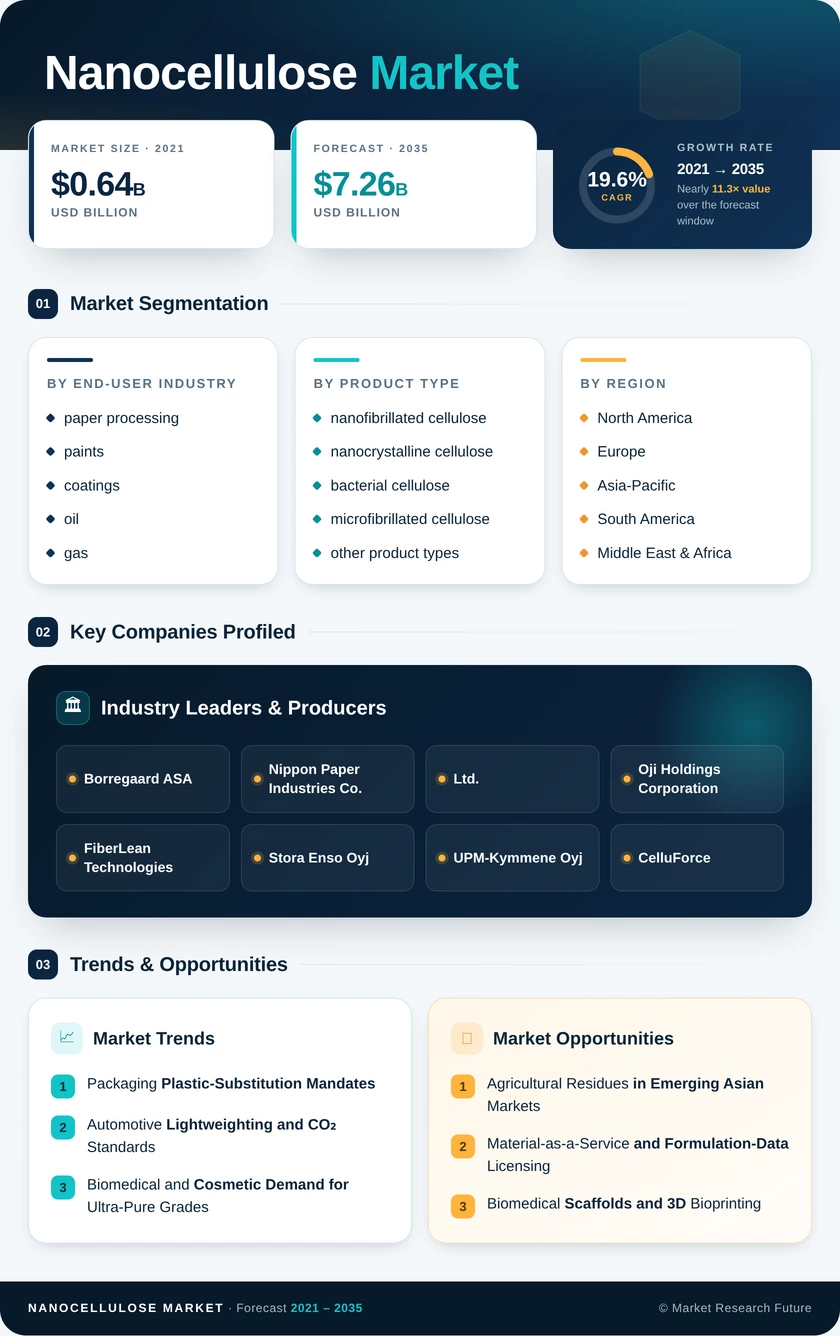
Segmentation Quick Reference
| Dimension | Sub-Segments | Dominant Segment | Fastest Growing Segment |
|---|
| By End-user Industry | paper processing; paints and coatings; oil and gas; food and beverage; composites; pharmaceutical and cosmetics; other end-user industries | composites (31.4% share) | pharmaceutical and cosmetics (23.2% CAGR) |
| By Product Type | nanofibrillated cellulose; nanocrystalline cellulose; bacterial cellulose; microfibrillated cellulose; other product types | nanofibrillated cellulose (38.5% share) | bacterial cellulose (33.0% CAGR) |
| By Region | North America; Europe; Asia-Pacific; South America; Middle East & Africa | North America (40.2% share) | Asia-Pacific (22.0% CAGR) |
Market Segmentation Overview
| Sub-Segment | Key Trend |
|---|
| paper processing | On-site fibrillation to restore strength in recycled board |
| paints and coatings | Replacement of synthetic thickeners for sag and settling control |
| oil and gas | Biodegradable fluid-loss additives for drilling muds |
| food and beverage | Stabilizers for plant-based dairy and oxygen-barrier pouches |
| composites | Lightweight reinforced polypropylene and fire-safe phenolic panels |
| Pharmaceutical and cosmetics | Injectable hydrogels and microplastic-free film formers |
| Other end-user industries | Packaging barrier films and textile finishes |
Composites lead with a 31.4% share because automakers and aerospace interior suppliers need lighter parts to meet CO₂ and fire-safety rules. Pharmaceutical and cosmetics grow fastest at a 23.2% CAGR, as the EU microplastics restriction forces reformulation and animal-free hydrogels gain traction in cell culture and wound care. Paper processing and paints and coatings remain cost-driven outlets where buyers compare performance directly against starch and synthetic thickeners.
| Sub-Segment | Key Trend |
|---|
| nanofibrillated cellulose | Lower-energy pretreatment expands paper and composite use |
| nanocrystalline cellulose | Optical films and high-stiffness reinforcement |
| bacterial cellulose | Fermentation scale-up for medical and cosmetic grades |
| microfibrillated cellulose | Cost-effective strength additive in packaging board |
| Other product types | Surface-modified and composite grades for electronics |
Nanofibrillated cellulose leads with a 38.5% share because pulp producers can make it on adapted refiners and homogenizers at mill scale. Bacterial cellulose grows fastest at a 33.0% CAGR, since its lignin-free, high-purity network commands premium prices in wound dressings and cosmetic masks that justify fermentation costs. Microfibrillated cellulose competes on price in board, while nanocrystalline cellulose targets stiffness and optical performance where purity matters more than cost.


 Noah Malgeri
Co-Founder

 Peter Groot koerkamp
Account and Business Manager

 Younghwan Choi
Senior Retail Manager

 Mark Irwin
Management Consultant

 Akif Moroglu
Strategy & Business Development Director

 Guilherme Gomes Martins
Product Management Director

 Joseph Aguayo
Sales Operations & Pricing Manager

 La Terria Dodd
Program Support Specialist

 Rob Kooiker
Group Product Manager HVAC & Fire Protection GMA