×
Hero Background
English
Chinese
French
Japanese
Korean
German
Spanish

Nanobody Market Analysis

ID: MRFR/HC/9539-CR
128 Pages
Rahul Gotadki
August 2023

Nanobody Market Research Report Information by Type (Mono-Specific, and Multi-Specific) by Application [Therapeutic (Cancer, Neurodegenerative Diseases, Infectious Diseases, and Others), Diagnostic (Detection Of Proteins and Microorganisms, Detection Of Small Molecules, and Imaging), Research] , by End User (Pharmaceutical & Biotechnology Companies, Research Laboratories, and Others), by Region (North America, Europe, Asia-Pacific, and Rest of the World) - Forecast till 2035

Share:
Download PDF ×

We do not share your information with anyone. However, we may send you emails based on your report interest from time to time. You may contact us at any time to opt-out.

Nanobody Market Infographic
Purchase Options

Market Analysis

In-depth Analysis of Nanobody Market Industry Landscape

In recent times, there has been a notable increase in efforts to develop therapies based on nanobodies. This involves research dedicated to identifying new targets for nanobody-based treatments and improving the production and delivery of nanobodies. An example of such progress is seen in the announcement made by ExeVir Bio in January 2023. This Belgium-based company secured a significant venture debt financing agreement of USD 26.5 Million with the European Investment Bank. This funding boost is intended to propel ExeVir’s lead asset, XVR012, into clinical trials for COVID-19. Additionally, governments in developed regions like Europe and North America are actively supporting nanobody-related research and development. Notably, entities such as the European Union and the Canadian Institutes of Health Research (CIHR) are providing funding for various research projects focused on advancing nanobody-based therapies.

As a key player in health research funding in Canada, CIHR allocates around USD 1 billion annually to support a wide range of research areas, including biopharmaceuticals and related technologies. This substantial investment underscores the government's commitment to fostering advancements in health research, potentially benefiting the development of nanobodies as well. Therefore, the increasing financial backing and support from both private entities and government agencies are driving the growth of the global nanobody market. These investments play a crucial role in enabling the development of new and innovative nanobody-based therapies.

The surge in research and development activities geared towards nanobody-based therapies is evident in the growing efforts to identify new treatment targets and enhance nanobody production and delivery. Funding agreements, such as the one secured by ExeVir Bio, showcase the financial support pouring into this field. Moreover, the active involvement of governments in developed regions further boosts the growth of the nanobody market. The backing from entities like the European Union and CIHR demonstrates a collective commitment to advancing nanobody-related research and development. This financial support is instrumental in driving innovation and propelling the development of novel nanobody-based therapies, ultimately contributing to the overall growth of the global nanobody market.

Author
Rahul Gotadki
Assistant Manager

He holds an experience of about 7+ years in Market Research and Business Consulting, working under the spectrum of Life Sciences and Healthcare domains. Rahul conceptualizes and implements a scalable business strategy and provides strategic leadership to the clients. His expertise lies in market estimation, competitive intelligence, pipeline analysis, customer assessment, etc. In addition to the above, his other responsibility includes strategic tracking of high growth markets & advising clients on the potential areas of focus they could direct their business initiatives

Leave a Comment

FAQs

What is the projected market valuation of the Nanobody Market by 2035?

The Nanobody Market is projected to reach a valuation of 4.398 USD Billion by 2035.

What was the market valuation of the Nanobody Market in 2024?

In 2024, the Nanobody Market had a valuation of 0.72 USD Billion.

What is the expected CAGR for the Nanobody Market during the forecast period 2025 - 2035?

The expected CAGR for the Nanobody Market during the forecast period 2025 - 2035 is 17.88%.

Which companies are considered key players in the Nanobody Market?

Key players in the Nanobody Market include Ablynx, Genmab, Boehringer Ingelheim, Eli Lilly and Company, Merck KGaA, Novartis, Sanofi, Amgen, and Pfizer.

What are the main application segments of the Nanobody Market?

The main application segments of the Nanobody Market are Therapeutic, Diagnostic, and Research.

What was the market size for the Therapeutic application segment in 2024?

In 2024, the market size for the Therapeutic application segment was 0.36 USD Billion.

How much is the Diagnostic application segment expected to grow by 2035?

The Diagnostic application segment is expected to grow to 1.319 USD Billion by 2035.

Market Summary

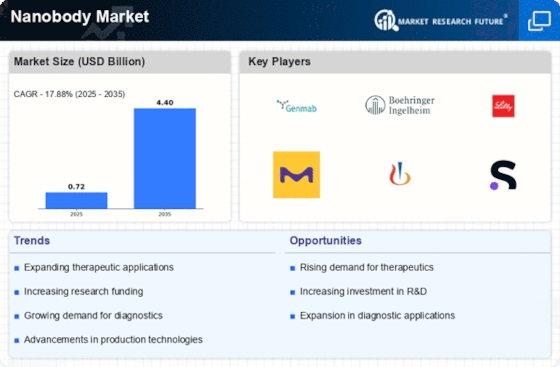
As per Market Research Future analysis, the Nanobody Market Size was estimated at 0.72 USD Billion in 2024. The Nanobody industry is projected to grow from USD 0.8488 Billion in 2025 to USD 4.398 Billion by 2035, exhibiting a compound annual growth rate (CAGR) of 17.88% during the forecast period 2025 - 2035

Key Market Trends & Highlights

The Nanobody Market is poised for substantial growth driven by innovations and increasing demand for targeted therapies.

  • The demand for targeted therapies is rising, particularly in North America, which remains the largest market for nanobodies.
  • Asia-Pacific is emerging as the fastest-growing region, reflecting a surge in interest for innovative biopharmaceutical solutions.
  • Mono-specific nanobodies dominate the market, while multi-specific variants are gaining traction due to their versatility.
  • Key market drivers include increasing investment in biopharmaceuticals and advancements in drug delivery systems, which are fueling growth across therapeutic and diagnostic segments.

Market Size & Forecast

2024 Market Size 0.72 (USD Billion)
2035 Market Size 4.398 (USD Billion)
CAGR (2025 - 2035) 17.88%
Largest Regional Market Share in 2024 North America

Major Players

<p>Ablynx (BE), Genmab (DK), Boehringer Ingelheim (DE), Eli Lilly and Company (US), Merck KGaA (DE), Novartis (CH), Sanofi (FR), Amgen (US), Pfizer (US)</p>

Market Trends

The Nanobody Market is currently experiencing a notable evolution, driven by advancements in biotechnology and increasing applications in various fields such as therapeutics, diagnostics, and research. These small, single-domain antibodies, derived from camelids, exhibit unique properties that enhance their utility in medical and scientific applications. The growing interest in personalized medicine and targeted therapies appears to be propelling the demand for nanobodies, as they offer advantages such as high specificity and reduced immunogenicity. Furthermore, the ability to engineer these molecules for various purposes suggests a promising future for their integration into innovative treatment modalities. In addition to therapeutic applications, the Nanobody Market is witnessing a surge in interest from the diagnostic sector. Their potential to serve as effective imaging agents and biosensors indicates a shift towards more precise and efficient diagnostic tools. As research continues to unveil new applications, the market landscape is likely to expand, attracting investments and fostering collaborations among key stakeholders. Overall, the Nanobody Market seems poised for growth, with a diverse range of applications that could redefine existing paradigms in healthcare and research.

Rising Demand for Targeted Therapies

The increasing focus on personalized medicine is driving the demand for targeted therapies, where nanobodies play a crucial role. Their ability to bind specifically to antigens allows for more effective treatment options, minimizing side effects and enhancing patient outcomes.

Expansion in Diagnostic Applications

Nanobodies are gaining traction in the diagnostic field due to their unique properties. Their potential use as imaging agents and biosensors suggests a shift towards more accurate and efficient diagnostic tools, which could revolutionize disease detection.

Innovations in Engineering and Production

Advancements in biotechnology are facilitating the engineering and production of nanobodies. This innovation may lead to the development of novel nanobody formats, enhancing their functionality and broadening their application scope across various sectors.

Nanobody Market Market Drivers

Regulatory Support for Biologics

The Nanobody Market is positively influenced by regulatory support for biologics, which includes nanobody-based therapies. Regulatory agencies are increasingly recognizing the unique advantages of biologics, leading to streamlined approval processes and incentives for research and development. This supportive regulatory environment encourages pharmaceutical companies to invest in nanobody technology, as it offers a pathway to bring innovative therapies to market more efficiently. As regulatory frameworks continue to evolve, the Nanobody Market is expected to benefit from increased product approvals and a broader range of therapeutic options for patients.

Advancements in Drug Delivery Systems

The Nanobody Market is benefiting from advancements in drug delivery systems that enhance the efficacy of nanobody-based therapies. Recent innovations in targeted delivery mechanisms, such as nanoparticles and liposomes, are being integrated with nanobody technology to improve therapeutic outcomes. For instance, studies indicate that combining nanobodies with advanced delivery systems can increase bioavailability and reduce off-target effects, which is crucial for patient safety. As the demand for more effective and safer drug delivery methods grows, the integration of nanobodies into these systems is expected to play a pivotal role in shaping the future of the Nanobody Market.

Rising Prevalence of Chronic Diseases

The Nanobody Market is witnessing growth due to the rising prevalence of chronic diseases, including cancer, autoimmune disorders, and infectious diseases. According to recent statistics, chronic diseases account for approximately 70% of all deaths worldwide, creating an urgent need for effective treatment options. Nanobodies, with their ability to specifically target disease markers, are emerging as promising candidates for therapeutic interventions. The increasing burden of chronic diseases is likely to drive demand for nanobody-based therapies, as healthcare providers seek innovative solutions to improve patient outcomes and reduce healthcare costs.

Growing Interest in Personalized Medicine

The Nanobody Market is aligned with the growing interest in personalized medicine, which emphasizes tailored treatment approaches based on individual patient profiles. Nanobodies, due to their high specificity and ability to be engineered for various targets, are well-suited for personalized therapeutic applications. The shift towards personalized medicine is driven by advancements in genomics and biotechnology, enabling healthcare providers to develop targeted therapies that improve treatment efficacy. As the demand for personalized treatment options rises, the Nanobody Market is likely to expand, offering innovative solutions that cater to the unique needs of patients.

Increasing Investment in Biopharmaceuticals

The Nanobody Market is experiencing a surge in investment as biopharmaceutical companies recognize the potential of nanobodies in therapeutic applications. With The Nanobody Market projected to reach over 500 billion USD by 2025, the demand for innovative therapies is driving research and development in nanobody technology. Investors are increasingly funding projects that focus on the unique properties of nanobodies, such as their small size and high specificity, which make them suitable for targeting complex diseases. This influx of capital is likely to accelerate the development of novel nanobody-based therapeutics, thereby expanding the market and enhancing treatment options for patients.

Market Segment Insights

Nanobody Market Type Insights

<p>The Nanobody Market segmentation, based on type, includes mono-specific and multi-specific. The mono-specific segment held the majority share in 2022 in the Nanobody Market revenue. This is due to the increasing prevalence of various types of cancer across the globe, the growing preference for personalized medicine, and the increase in investment and funding for clinical trials. Moreover, a monospecific nanobody is a protein or protein construct that contains at least one nanobody and is directed against a single Immuno-oncology target.</p>

<p>January 2023: Biocytogen (US) launched RenNano Mouse, a fully human heavy-chain antibody platform to accelerate nanobody drug discovery. The successful development of the RenNano platform expanded Biocytogen’s capabilities for antibody discovery and broadens the applications of our antibody library.</p>

Nanobody Market Application Insights

<p>The Nanobody Market segmentation is based on application that include therapeutic, diagnostic, and research. The therapeutic segment is further segmented into cancer, neurodegenerative diseases, infectious diseases, and others. Further, the diagnostic detection of protein and microorganisms, detection of small molecules, and imaging. The research segment has dominated the market in 2022 and the therapeutics segment is projected to be the fastest-growing segment during the forecast period, 2025-2035.</p>

<p>This is attributed to the increasing usage of nanobodies through pharmaceutical companies to research active drug molecules and the increasing prevalence of chronic diseases such as cancer, neurodegenerative diseases, infectious diseases, and joint-related diseases. For instance, as per the WHO, more than 55 million people across the globe have dementia, and more than 60% live in low- and middle-income countries (LMIC) as of March 2023.</p>

Get more detailed insights about Nanobody Market Research Report—Global Forecast till 2035

Regional Insights

North America : Leading Innovation and Research

North America is the largest market for nanobodies, holding approximately 45% of the global share, driven by advanced research facilities and significant investments in biotechnology. The region benefits from a robust regulatory framework that encourages innovation, particularly in the U.S. where the FDA has streamlined approval processes for novel therapeutics. The increasing prevalence of chronic diseases and the demand for targeted therapies further fuel market growth. The United States and Canada are the leading countries in this region, with major players like Eli Lilly, Amgen, and Pfizer headquartered in the U.S. The competitive landscape is characterized by a mix of established pharmaceutical giants and innovative biotech firms. Collaborations and partnerships are common, enhancing research capabilities and accelerating product development, ensuring North America remains at the forefront of nanobody advancements.

Europe : Emerging Regulatory Frameworks

Europe is the second-largest market for nanobodies, accounting for approximately 30% of the global market share. The region is witnessing significant growth due to increasing investments in biopharmaceutical research and development, alongside supportive regulatory frameworks from the European Medicines Agency (EMA). Countries like Germany and Switzerland are leading the charge, with a focus on innovative therapies that address unmet medical needs, particularly in oncology and autoimmune diseases. Germany, France, and Switzerland are key players in the European nanobody market, hosting major companies such as Boehringer Ingelheim and Novartis. The competitive landscape is marked by a strong emphasis on research collaborations and public-private partnerships, which enhance innovation. The presence of numerous biotech startups also contributes to a dynamic market environment, fostering rapid advancements in nanobody technology.

Asia-Pacific : Rapidly Growing Market Potential

Asia-Pacific is an emerging powerhouse in the nanobody market, currently holding about 20% of the global share. The region is characterized by rapid advancements in biotechnology and increasing investments from both public and private sectors. Countries like China and Japan are leading the way, driven by a growing demand for innovative therapeutics and supportive government initiatives aimed at enhancing healthcare infrastructure and research capabilities. China is becoming a significant player in the nanobody landscape, with numerous biotech firms entering the market. The competitive environment is evolving, with local companies collaborating with global firms to enhance their research and development capabilities. The presence of key players like Genmab and Sanofi further strengthens the market, as they explore new therapeutic applications for nanobodies in various disease areas, including cancer and infectious diseases.

Middle East and Africa : Untapped Market Potential

The Middle East and Africa (MEA) region is currently the smallest market for nanobodies, holding approximately 5% of the global share. However, the region presents significant growth potential due to increasing healthcare investments and a rising focus on biotechnology. Countries like South Africa and the UAE are beginning to establish themselves as emerging hubs for biopharmaceutical research, driven by government initiatives aimed at improving healthcare access and innovation. South Africa is leading the charge in the MEA region, with a growing number of biotech startups focusing on novel therapeutics. The competitive landscape is still developing, with local firms seeking partnerships with international companies to enhance their capabilities. As the region continues to invest in healthcare infrastructure and research, the nanobody market is expected to expand, offering new opportunities for both local and global players.

Key Players and Competitive Insights

The Nanobody Market is characterized by the presence of many global, regional, and local vendors. Developments in the healthcare industry and growing research and development make the nanobody market lucrative. To expand their reach and optimize their operational costs, the major players focus on obtaining regulatory authorizations from government agencies for their products and emphasize acquisitions and product launches to gain a substantial market share. The market comprises tier-1, tier-2, and local players. The tier-1 and tier-2 players have reach across the globe with diverse product portfolios.

Companies such as Sanofi (France), Merck KGaA (Germany), BIOCYTOGEN (US), and Proteintech Group, Inc (US) dominate the Nanobody Market due to product differentiation, financial stability, strategic developments, and diversified regional presence. The players are focused on investing in research and development. Furthermore, they adopt strategic growth initiatives, such as expansion, product launches, joint ventures, and partnerships, to strengthen their market position and capture a large customer base.

One of the primary business strategies adopted by manufacturers in the global nanobody industry to benefit clients and expand the nanobody market sector is to manufacture locally to reduce operating costs.

Merck KGaA (Germany) is a pharmaceutical company that offers a varied range of products subgrouped into three segments—healthcare, life sciences, and electronics. The company researches drugs in the areas of oncology and neurodegenerative as well as autoimmune and inflammatory diseases. The company is distributing its products in the following countries: China, India, Japan, Australia, Israel, United Arab Emirates, South Korea, Denmark, Italy, Netherlands, Spain, United Kingdom, Switzerland, Sweden, Argentina, Brazil, Canada, US, and New Zealand.

For instance, in October 2020, Merck KGaA (Germany) announced that it has entered into an out-licensing agreement with Novartis AG (Switzerland), for the development of M6495, an anti-ADAMTS5 Nanobody Market for the

potential treatment of Osteoarthritis (OA).

Also, Sanofi (France) is a multinational pharmaceutical company that manufactures pharmaceutical products. The company offers drugs, generic drugs, and food supplements and provides medical devices for cancer, cardiology, gynecology, and diabetes. Sanofi's research and development efforts are concentrated on developing combination drugs to improve the efficacy of treatments and on developing novel biologic formulations to create precision medicines. Sanofi serves customers in more than 100 countries worldwide and more than 75 manufacturing sites in 70 countries. The company has about 20 R&D facilities across Europe, Asia, and North America.

Key Companies in the Nanobody Market market include

Industry Developments

August 2020: Beroni Group (Australia) announced a collaboration agreement with Genscript Biotech Corporation (US) for the development of a medical solution utilizing nanobody technology for COVID-19, particularly in leading pseudovirus neutralization test, humanization, and affinity maturation of nanobodies with the impartial of increasing the antibody affinity to target the antigen by five to ten-fold.

May 2020: Sensei Biotherapeutics, Inc (US) announced the acquisition of Alvaxa Biosciences (US) a camelid antibody therapeutics company. As per the agreement Sensei acquired camelid nanobody libraries which is expertise in nanobody discovery. Through this acquisition, the company boosts its business growth in the nanobody market.

Future Outlook

Nanobody Market Future Outlook

<p>The Nanobody Market is projected to grow at a 17.88% CAGR from 2024 to 2035, driven by advancements in therapeutic applications, increased R&D investments, and rising demand for targeted therapies.</p>

New opportunities lie in:

  • <p>Development of nanobody-based diagnostics for early disease detection.</p>
  • <p>Partnerships with biotech firms for innovative therapeutic solutions.</p>
  • <p>Expansion into emerging markets with tailored nanobody products.</p>

<p>By 2035, the Nanobody Market is expected to achieve substantial growth, solidifying its position as a key player in biopharmaceuticals.</p>

Market Segmentation

Nanobody Market Type Outlook

  • Mono-Specific
  • Multi-Specific

Nanobody Market End User Outlook

  • Pharmaceutical & Biotechnology Companies
  • Research Laboratories
  • Others

Nanobody Market Application Outlook

  • Therapeutic
  • Diagnostic
  • Research

Report Scope

MARKET SIZE 20240.72(USD Billion)
MARKET SIZE 20250.8488(USD Billion)
MARKET SIZE 20354.398(USD Billion)
COMPOUND ANNUAL GROWTH RATE (CAGR)17.88% (2024 - 2035)
REPORT COVERAGERevenue Forecast, Competitive Landscape, Growth Factors, and Trends
BASE YEAR2024
Market Forecast Period2025 - 2035
Historical Data2019 - 2024
Market Forecast UnitsUSD Billion
Key Companies ProfiledAblynx (BE), Genmab (DK), Boehringer Ingelheim (DE), Eli Lilly and Company (US), Merck KGaA (DE), Novartis (CH), Sanofi (FR), Amgen (US), Pfizer (US)
Segments CoveredType, Application [Therapeutic, End User, Region
Key Market OpportunitiesAdvancements in therapeutic applications and diagnostics drive growth in the Nanobody Market.
Key Market DynamicsRising demand for targeted therapies drives innovation and competition in the Nanobody Market.
Countries CoveredNorth America, Europe, APAC, South America, MEA

FAQs

What is the projected market valuation of the Nanobody Market by 2035?

The Nanobody Market is projected to reach a valuation of 4.398 USD Billion by 2035.

What was the market valuation of the Nanobody Market in 2024?

In 2024, the Nanobody Market had a valuation of 0.72 USD Billion.

What is the expected CAGR for the Nanobody Market during the forecast period 2025 - 2035?

The expected CAGR for the Nanobody Market during the forecast period 2025 - 2035 is 17.88%.

Which companies are considered key players in the Nanobody Market?

Key players in the Nanobody Market include Ablynx, Genmab, Boehringer Ingelheim, Eli Lilly and Company, Merck KGaA, Novartis, Sanofi, Amgen, and Pfizer.

What are the main application segments of the Nanobody Market?

The main application segments of the Nanobody Market are Therapeutic, Diagnostic, and Research.

What was the market size for the Therapeutic application segment in 2024?

In 2024, the market size for the Therapeutic application segment was 0.36 USD Billion.

How much is the Diagnostic application segment expected to grow by 2035?

The Diagnostic application segment is expected to grow to 1.319 USD Billion by 2035.

  1. SECTION I: EXECUTIVE SUMMARY AND KEY HIGHLIGHTS
    1. EXECUTIVE SUMMARY
      1. Market Overview
      2. Key Findings
      3. Market Segmentation
      4. Competitive Landscape
      5. Challenges and Opportunities
      6. Future Outlook
  2. SECTION II: SCOPING, METHODOLOGY AND MARKET STRUCTURE
    1. MARKET INTRODUCTION
      1. Definition
      2. Scope of the study
    2. RESEARCH METHODOLOGY
      1. Overview
      2. Data Mining
      3. Secondary Research
      4. Primary Research
      5. Forecasting Model
      6. Market Size Estimation
      7. Data Triangulation
      8. Validation
  3. SECTION III: QUALITATIVE ANALYSIS
    1. MARKET DYNAMICS
      1. Overview
      2. Drivers
      3. Restraints
      4. Opportunities
    2. MARKET FACTOR ANALYSIS
      1. Value chain Analysis
      2. Porter's Five Forces Analysis
      3. COVID-19 Impact Analysis
  4. SECTION IV: QUANTITATIVE ANALYSIS
    1. Healthcare, BY Type (USD Billion)
      1. Mono-Specific
      2. Multi-Specific
    2. Healthcare, BY Application (USD Billion)
      1. Therapeutic
      2. Diagnostic
      3. Research
    3. Healthcare, BY End User (USD Billion)
      1. Pharmaceutical & Biotechnology Companies
      2. Research Laboratories
      3. Others
    4. Healthcare, BY Region (USD Billion)
      1. North America
      2. Europe
      3. APAC
      4. South America
      5. MEA
  5. SECTION V: COMPETITIVE ANALYSIS
    1. Competitive Landscape
      1. Overview
      2. Competitive Analysis
      3. Market share Analysis
      4. Major Growth Strategy in the Healthcare
      5. Competitive Benchmarking
      6. Leading Players in Terms of Number of Developments in the Healthcare
      7. Key developments and growth strategies
      8. Major Players Financial Matrix
    2. Company Profiles
      1. Ablynx (BE)
      2. Genmab (DK)
      3. Boehringer Ingelheim (DE)
      4. Eli Lilly and Company (US)
      5. Merck KGaA (DE)
      6. Novartis (CH)
      7. Sanofi (FR)
      8. Amgen (US)
      9. Pfizer (US)
    3. Appendix
      1. References
      2. Related Reports
  6. LIST OF FIGURES
    1. MARKET SYNOPSIS
    2. NORTH AMERICA MARKET ANALYSIS
    3. US MARKET ANALYSIS BY TYPE
    4. US MARKET ANALYSIS BY APPLICATION
    5. US MARKET ANALYSIS BY END USER
    6. CANADA MARKET ANALYSIS BY TYPE
    7. CANADA MARKET ANALYSIS BY APPLICATION
    8. CANADA MARKET ANALYSIS BY END USER
    9. EUROPE MARKET ANALYSIS
    10. GERMANY MARKET ANALYSIS BY TYPE
    11. GERMANY MARKET ANALYSIS BY APPLICATION
    12. GERMANY MARKET ANALYSIS BY END USER
    13. UK MARKET ANALYSIS BY TYPE
    14. UK MARKET ANALYSIS BY APPLICATION
    15. UK MARKET ANALYSIS BY END USER
    16. FRANCE MARKET ANALYSIS BY TYPE
    17. FRANCE MARKET ANALYSIS BY APPLICATION
    18. FRANCE MARKET ANALYSIS BY END USER
    19. RUSSIA MARKET ANALYSIS BY TYPE
    20. RUSSIA MARKET ANALYSIS BY APPLICATION
    21. RUSSIA MARKET ANALYSIS BY END USER
    22. ITALY MARKET ANALYSIS BY TYPE
    23. ITALY MARKET ANALYSIS BY APPLICATION
    24. ITALY MARKET ANALYSIS BY END USER
    25. SPAIN MARKET ANALYSIS BY TYPE
    26. SPAIN MARKET ANALYSIS BY APPLICATION
    27. SPAIN MARKET ANALYSIS BY END USER
    28. REST OF EUROPE MARKET ANALYSIS BY TYPE
    29. REST OF EUROPE MARKET ANALYSIS BY APPLICATION
    30. REST OF EUROPE MARKET ANALYSIS BY END USER
    31. APAC MARKET ANALYSIS
    32. CHINA MARKET ANALYSIS BY TYPE
    33. CHINA MARKET ANALYSIS BY APPLICATION
    34. CHINA MARKET ANALYSIS BY END USER
    35. INDIA MARKET ANALYSIS BY TYPE
    36. INDIA MARKET ANALYSIS BY APPLICATION
    37. INDIA MARKET ANALYSIS BY END USER
    38. JAPAN MARKET ANALYSIS BY TYPE
    39. JAPAN MARKET ANALYSIS BY APPLICATION
    40. JAPAN MARKET ANALYSIS BY END USER
    41. SOUTH KOREA MARKET ANALYSIS BY TYPE
    42. SOUTH KOREA MARKET ANALYSIS BY APPLICATION
    43. SOUTH KOREA MARKET ANALYSIS BY END USER
    44. MALAYSIA MARKET ANALYSIS BY TYPE
    45. MALAYSIA MARKET ANALYSIS BY APPLICATION
    46. MALAYSIA MARKET ANALYSIS BY END USER
    47. THAILAND MARKET ANALYSIS BY TYPE
    48. THAILAND MARKET ANALYSIS BY APPLICATION
    49. THAILAND MARKET ANALYSIS BY END USER
    50. INDONESIA MARKET ANALYSIS BY TYPE
    51. INDONESIA MARKET ANALYSIS BY APPLICATION
    52. INDONESIA MARKET ANALYSIS BY END USER
    53. REST OF APAC MARKET ANALYSIS BY TYPE
    54. REST OF APAC MARKET ANALYSIS BY APPLICATION
    55. REST OF APAC MARKET ANALYSIS BY END USER
    56. SOUTH AMERICA MARKET ANALYSIS
    57. BRAZIL MARKET ANALYSIS BY TYPE
    58. BRAZIL MARKET ANALYSIS BY APPLICATION
    59. BRAZIL MARKET ANALYSIS BY END USER
    60. MEXICO MARKET ANALYSIS BY TYPE
    61. MEXICO MARKET ANALYSIS BY APPLICATION
    62. MEXICO MARKET ANALYSIS BY END USER
    63. ARGENTINA MARKET ANALYSIS BY TYPE
    64. ARGENTINA MARKET ANALYSIS BY APPLICATION
    65. ARGENTINA MARKET ANALYSIS BY END USER
    66. REST OF SOUTH AMERICA MARKET ANALYSIS BY TYPE
    67. REST OF SOUTH AMERICA MARKET ANALYSIS BY APPLICATION
    68. REST OF SOUTH AMERICA MARKET ANALYSIS BY END USER
    69. MEA MARKET ANALYSIS
    70. GCC COUNTRIES MARKET ANALYSIS BY TYPE
    71. GCC COUNTRIES MARKET ANALYSIS BY APPLICATION
    72. GCC COUNTRIES MARKET ANALYSIS BY END USER
    73. SOUTH AFRICA MARKET ANALYSIS BY TYPE
    74. SOUTH AFRICA MARKET ANALYSIS BY APPLICATION
    75. SOUTH AFRICA MARKET ANALYSIS BY END USER
    76. REST OF MEA MARKET ANALYSIS BY TYPE
    77. REST OF MEA MARKET ANALYSIS BY APPLICATION
    78. REST OF MEA MARKET ANALYSIS BY END USER
    79. KEY BUYING CRITERIA OF HEALTHCARE
    80. RESEARCH PROCESS OF MRFR
    81. DRO ANALYSIS OF HEALTHCARE
    82. DRIVERS IMPACT ANALYSIS: HEALTHCARE
    83. RESTRAINTS IMPACT ANALYSIS: HEALTHCARE
    84. SUPPLY / VALUE CHAIN: HEALTHCARE
    85. HEALTHCARE, BY TYPE, 2024 (% SHARE)
    86. HEALTHCARE, BY TYPE, 2024 TO 2035 (USD Billion)
    87. HEALTHCARE, BY APPLICATION, 2024 (% SHARE)
    88. HEALTHCARE, BY APPLICATION, 2024 TO 2035 (USD Billion)
    89. HEALTHCARE, BY END USER, 2024 (% SHARE)
    90. HEALTHCARE, BY END USER, 2024 TO 2035 (USD Billion)
    91. BENCHMARKING OF MAJOR COMPETITORS
  7. LIST OF TABLES
    1. LIST OF ASSUMPTIONS
    2. North America MARKET SIZE ESTIMATES; FORECAST
      1. BY TYPE, 2025-2035 (USD Billion)
      2. BY APPLICATION, 2025-2035 (USD Billion)
      3. BY END USER, 2025-2035 (USD Billion)
    3. US MARKET SIZE ESTIMATES; FORECAST
      1. BY TYPE, 2025-2035 (USD Billion)
      2. BY APPLICATION, 2025-2035 (USD Billion)
      3. BY END USER, 2025-2035 (USD Billion)
    4. Canada MARKET SIZE ESTIMATES; FORECAST
      1. BY TYPE, 2025-2035 (USD Billion)
      2. BY APPLICATION, 2025-2035 (USD Billion)
      3. BY END USER, 2025-2035 (USD Billion)
    5. Europe MARKET SIZE ESTIMATES; FORECAST
      1. BY TYPE, 2025-2035 (USD Billion)
      2. BY APPLICATION, 2025-2035 (USD Billion)
      3. BY END USER, 2025-2035 (USD Billion)
    6. Germany MARKET SIZE ESTIMATES; FORECAST
      1. BY TYPE, 2025-2035 (USD Billion)
      2. BY APPLICATION, 2025-2035 (USD Billion)
      3. BY END USER, 2025-2035 (USD Billion)
    7. UK MARKET SIZE ESTIMATES; FORECAST
      1. BY TYPE, 2025-2035 (USD Billion)
      2. BY APPLICATION, 2025-2035 (USD Billion)
      3. BY END USER, 2025-2035 (USD Billion)
    8. France MARKET SIZE ESTIMATES; FORECAST
      1. BY TYPE, 2025-2035 (USD Billion)
      2. BY APPLICATION, 2025-2035 (USD Billion)
      3. BY END USER, 2025-2035 (USD Billion)
    9. Russia MARKET SIZE ESTIMATES; FORECAST
      1. BY TYPE, 2025-2035 (USD Billion)
      2. BY APPLICATION, 2025-2035 (USD Billion)
      3. BY END USER, 2025-2035 (USD Billion)
    10. Italy MARKET SIZE ESTIMATES; FORECAST
      1. BY TYPE, 2025-2035 (USD Billion)
      2. BY APPLICATION, 2025-2035 (USD Billion)
      3. BY END USER, 2025-2035 (USD Billion)
    11. Spain MARKET SIZE ESTIMATES; FORECAST
      1. BY TYPE, 2025-2035 (USD Billion)
      2. BY APPLICATION, 2025-2035 (USD Billion)
      3. BY END USER, 2025-2035 (USD Billion)
    12. Rest of Europe MARKET SIZE ESTIMATES; FORECAST
      1. BY TYPE, 2025-2035 (USD Billion)
      2. BY APPLICATION, 2025-2035 (USD Billion)
      3. BY END USER, 2025-2035 (USD Billion)
    13. APAC MARKET SIZE ESTIMATES; FORECAST
      1. BY TYPE, 2025-2035 (USD Billion)
      2. BY APPLICATION, 2025-2035 (USD Billion)
      3. BY END USER, 2025-2035 (USD Billion)
    14. China MARKET SIZE ESTIMATES; FORECAST
      1. BY TYPE, 2025-2035 (USD Billion)
      2. BY APPLICATION, 2025-2035 (USD Billion)
      3. BY END USER, 2025-2035 (USD Billion)
    15. India MARKET SIZE ESTIMATES; FORECAST
      1. BY TYPE, 2025-2035 (USD Billion)
      2. BY APPLICATION, 2025-2035 (USD Billion)
      3. BY END USER, 2025-2035 (USD Billion)
    16. Japan MARKET SIZE ESTIMATES; FORECAST
      1. BY TYPE, 2025-2035 (USD Billion)
      2. BY APPLICATION, 2025-2035 (USD Billion)
      3. BY END USER, 2025-2035 (USD Billion)
    17. South Korea MARKET SIZE ESTIMATES; FORECAST
      1. BY TYPE, 2025-2035 (USD Billion)
      2. BY APPLICATION, 2025-2035 (USD Billion)
      3. BY END USER, 2025-2035 (USD Billion)
    18. Malaysia MARKET SIZE ESTIMATES; FORECAST
      1. BY TYPE, 2025-2035 (USD Billion)
      2. BY APPLICATION, 2025-2035 (USD Billion)
      3. BY END USER, 2025-2035 (USD Billion)
    19. Thailand MARKET SIZE ESTIMATES; FORECAST
      1. BY TYPE, 2025-2035 (USD Billion)
      2. BY APPLICATION, 2025-2035 (USD Billion)
      3. BY END USER, 2025-2035 (USD Billion)
    20. Indonesia MARKET SIZE ESTIMATES; FORECAST
      1. BY TYPE, 2025-2035 (USD Billion)
      2. BY APPLICATION, 2025-2035 (USD Billion)
      3. BY END USER, 2025-2035 (USD Billion)
    21. Rest of APAC MARKET SIZE ESTIMATES; FORECAST
      1. BY TYPE, 2025-2035 (USD Billion)
      2. BY APPLICATION, 2025-2035 (USD Billion)
      3. BY END USER, 2025-2035 (USD Billion)
    22. South America MARKET SIZE ESTIMATES; FORECAST
      1. BY TYPE, 2025-2035 (USD Billion)
      2. BY APPLICATION, 2025-2035 (USD Billion)
      3. BY END USER, 2025-2035 (USD Billion)
    23. Brazil MARKET SIZE ESTIMATES; FORECAST
      1. BY TYPE, 2025-2035 (USD Billion)
      2. BY APPLICATION, 2025-2035 (USD Billion)
      3. BY END USER, 2025-2035 (USD Billion)
    24. Mexico MARKET SIZE ESTIMATES; FORECAST
      1. BY TYPE, 2025-2035 (USD Billion)
      2. BY APPLICATION, 2025-2035 (USD Billion)
      3. BY END USER, 2025-2035 (USD Billion)
    25. Argentina MARKET SIZE ESTIMATES; FORECAST
      1. BY TYPE, 2025-2035 (USD Billion)
      2. BY APPLICATION, 2025-2035 (USD Billion)
      3. BY END USER, 2025-2035 (USD Billion)
    26. Rest of South America MARKET SIZE ESTIMATES; FORECAST
      1. BY TYPE, 2025-2035 (USD Billion)
      2. BY APPLICATION, 2025-2035 (USD Billion)
      3. BY END USER, 2025-2035 (USD Billion)
    27. MEA MARKET SIZE ESTIMATES; FORECAST
      1. BY TYPE, 2025-2035 (USD Billion)
      2. BY APPLICATION, 2025-2035 (USD Billion)
      3. BY END USER, 2025-2035 (USD Billion)
    28. GCC Countries MARKET SIZE ESTIMATES; FORECAST
      1. BY TYPE, 2025-2035 (USD Billion)
      2. BY APPLICATION, 2025-2035 (USD Billion)
      3. BY END USER, 2025-2035 (USD Billion)
    29. South Africa MARKET SIZE ESTIMATES; FORECAST
      1. BY TYPE, 2025-2035 (USD Billion)
      2. BY APPLICATION, 2025-2035 (USD Billion)
      3. BY END USER, 2025-2035 (USD Billion)
    30. Rest of MEA MARKET SIZE ESTIMATES; FORECAST
      1. BY TYPE, 2025-2035 (USD Billion)
      2. BY APPLICATION, 2025-2035 (USD Billion)
      3. BY END USER, 2025-2035 (USD Billion)
    31. PRODUCT LAUNCH/PRODUCT DEVELOPMENT/APPROVAL
    32. ACQUISITION/PARTNERSHIP

Nanobody Market Segmentation

Nanobody Type Outlook (USD Billion, 2019-2032)

  • Mono-Specific
  • Multi-Specific

Nanobody Application Outlook (USD Billion, 2019-2032)

  • Therapeutic
    • Cancer
    • Neurodegenerative Diseases
    • Infectious Diseases
    • Others
  • Diagnostic
    • Detection Of Proteins and Microorganisms
    • Detection Of Small Molecules
    • Imaging
  • Research

Nanobody End User Outlook (USD Billion, 2019-2032)

  • Pharmaceutical & Biotechnology Companies
  • Research Laboratories
  • Others

Nanobody Regional Outlook (USD Billion, 2019-2032)

  • North America Outlook (USD Billion, 2019-2032)
    • North America Nanobody by Type
      • Mono-Specific
      • Multi-Specific
    • North America Nanobody by Application
      • Therapeutic
        • Cancer
        • Neurodegenerative Diseases
        • Infectious Diseases
        • Others
      • Diagnostic
        • Detection Of Proteins and Microorganisms
        • Detection Of Small Molecules
        • Imaging
      • Research
    • North America Nanobody by End User
      • Pharmaceutical & Biotechnology Companies
      • Research Laboratories
      • Others
    • US Outlook (USD Billion, 2019-2032)
    • US Nanobody by Type
      • Mono-Specific
      • Multi-Specific
    • US Nanobody by Application
      • Therapeutic
        • Cancer
        • Neurodegenerative Diseases
        • Infectious Diseases
        • Others
      • Diagnostic
        • Detection Of Proteins and Microorganisms
        • Detection Of Small Molecules
        • Imaging
      • Research
    • US Nanobody by End User
      • Pharmaceutical & Biotechnology Companies
      • Research Laboratories
      • Others
    • Canada Outlook (USD Billion, 2019-2032)
    • Canada Nanobody by Type
      • Mono-Specific
      • Multi-Specific
    • Canada Nanobody by Application
      • Therapeutic
        • Cancer
        • Neurodegenerative Diseases
        • Infectious Diseases
        • Others
      • Diagnostic
        • Detection Of Proteins and Microorganisms
        • Detection Of Small Molecules
        • Imaging
      • Research
    • Canada Nanobody by End User
      • Pharmaceutical & Biotechnology Companies
      • Research Laboratories
      • Others
    • Europe Outlook (USD Billion, 2019-2032)
      • Europe Nanobody by Type
        • Mono-Specific
        • Multi-Specific
      • Europe Nanobody by Application
        • Therapeutic
          • Cancer
          • Neurodegenerative Diseases
          • Infectious Diseases
          • Others
        • Diagnostic
          • Detection Of Proteins and Microorganisms
          • Detection Of Small Molecules
          • Imaging
        • Research
      • Europe Nanobody by End User
        • Pharmaceutical & Biotechnology Companies
        • Research Laboratories
        • Others
      • Germany Outlook (USD Billion, 2019-2032)
      • Germany Nanobody by Type
        • Mono-Specific
        • Multi-Specific
      • Germany Nanobody by Application
        • Therapeutic
          • Cancer
          • Neurodegenerative Diseases
          • Infectious Diseases
          • Others
        • Diagnostic
          • Detection Of Proteins and Microorganisms
          • Detection Of Small Molecules
          • Imaging
        • Research
      • Germany Nanobody by End User
        • Pharmaceutical & Biotechnology Companies
        • Research Laboratories
        • Others
      • France Outlook (USD Billion, 2019-2032)
      • France Nanobody by Type
        • Mono-Specific
        • Multi-Specific
      • France Nanobody by Application
        • Therapeutic
          • Cancer
          • Neurodegenerative Diseases
          • Infectious Diseases
          • Others
        • Diagnostic
          • Detection Of Proteins and Microorganisms
          • Detection Of Small Molecules
          • Imaging
        • Research
      • France Nanobody by End User
        • Pharmaceutical & Biotechnology Companies
        • Research Laboratories
        • Others
      • UK Outlook (USD Billion, 2019-2032)
      • UK Nanobody by Type
        • Mono-Specific
        • Multi-Specific
      • UK Nanobody by Application
        • Therapeutic
          • Cancer
          • Neurodegenerative Diseases
          • Infectious Diseases
          • Others
        • Diagnostic
          • Detection Of Proteins and Microorganisms
          • Detection Of Small Molecules
          • Imaging
        • Research
      • UK Nanobody by End User
        • Pharmaceutical & Biotechnology Companies
        • Research Laboratories
        • Others
      • Italy Outlook (USD Billion, 2019-2032)
      • Italy Nanobody by Type
        • Mono-Specific
        • Multi-Specific
      • Italy Nanobody by Application
        • Therapeutic
          • Cancer
          • Neurodegenerative Diseases
          • Infectious Diseases
          • Others
        • Diagnostic
          • Detection Of Proteins and Microorganisms
          • Detection Of Small Molecules
          • Imaging
        • Research
      • Italy Nanobody by End User
        • Pharmaceutical & Biotechnology Companies
        • Research Laboratories
        • Others
      • Spain Outlook (USD Billion, 2019-2032)
      • Spain Nanobody by Type
        • Mono-Specific
        • Multi-Specific
      • Spain Nanobody by Application
        • Therapeutic
          • Cancer
          • Neurodegenerative Diseases
          • Infectious Diseases
          • Others
        • Diagnostic
          • Detection Of Proteins and Microorganisms
          • Detection Of Small Molecules
          • Imaging
        • Research
      • Spain Nanobody by End User
        • Pharmaceutical & Biotechnology Companies
        • Research Laboratories
        • Others
      • Rest Of Europe Outlook (USD Billion, 2019-2032)
      • Rest of Europe Nanobody by Type
        • Mono-Specific
        • Multi-Specific
      • Rest of Europe Nanobody by Application
        • Therapeutic
          • Cancer
          • Neurodegenerative Diseases
          • Infectious Diseases
          • Others
        • Diagnostic
          • Detection Of Proteins and Microorganisms
          • Detection Of Small Molecules
          • Imaging
        • Research
      • Rest of Europe Nanobody by End User
        • Pharmaceutical & Biotechnology Companies
        • Research Laboratories
        • Others
      • Asia-Pacific Outlook (USD Billion, 2019-2032)
        • Asia-Pacific Nanobody by Type
          • Mono-Specific
          • Multi-Specific
        • Asia-Pacific Nanobody by Application
          • Therapeutic
            • Cancer
            • Neurodegenerative Diseases
            • Infectious Diseases
            • Others
          • Diagnostic
            • Detection Of Proteins and Microorganisms
            • Detection Of Small Molecules
            • Imaging
          • Research
        • Asia-Pacific Nanobody by End User
          • Pharmaceutical & Biotechnology Companies
          • Research Laboratories
          • Others
        • China Outlook (USD Billion, 2019-2032)
        • China Nanobody by Type
          • Mono-Specific
          • Multi-Specific
        • China Nanobody by Application
          • Therapeutic
            • Cancer
            • Neurodegenerative Diseases
            • Infectious Diseases
            • Others
          • Diagnostic
            • Detection Of Proteins and Microorganisms
            • Detection Of Small Molecules
            • Imaging
          • Research
        • China Nanobody by End User
          • Pharmaceutical & Biotechnology Companies
          • Research Laboratories
          • Others
        • Japan Outlook (USD Billion, 2019-2032)
        • Japan Nanobody by Type
          • Mono-Specific
          • Multi-Specific
        • Japan Nanobody by Application
          • Therapeutic
            • Cancer
            • Neurodegenerative Diseases
            • Infectious Diseases
            • Others
          • Diagnostic
            • Detection Of Proteins and Microorganisms
            • Detection Of Small Molecules
            • Imaging
          • Research
        • Japan Nanobody by End User
          • Pharmaceutical & Biotechnology Companies
          • Research Laboratories
          • Others
        • India Outlook (USD Billion, 2019-2032)
        • India Nanobody by Type
          • Mono-Specific
          • Multi-Specific
        • India Nanobody by Application
          • Therapeutic
            • Cancer
            • Neurodegenerative Diseases
            • Infectious Diseases
            • Others
          • Diagnostic
            • Detection Of Proteins and Microorganisms
            • Detection Of Small Molecules
            • Imaging
          • Research
        • India Nanobody by End User
          • Pharmaceutical & Biotechnology Companies
          • Research Laboratories
          • Others
        • Australia Outlook (USD Billion, 2019-2032)
        • Australia Nanobody by Type
          • Mono-Specific
          • Multi-Specific
        • Australia Nanobody by Application
          • Therapeutic
            • Cancer
            • Neurodegenerative Diseases
            • Infectious Diseases
            • Others
          • Diagnostic
            • Detection Of Proteins and Microorganisms
            • Detection Of Small Molecules
            • Imaging
          • Research
        • Australia Nanobody by End User
          • Pharmaceutical & Biotechnology Companies
          • Research Laboratories
          • Others
        • South Korea Outlook (USD Billion, 2019-2032)
        • South Korea Nanobody by Type
          • Mono-Specific
          • Multi-Specific
        • South Korea Nanobody by Application
          • Therapeutic
            • Cancer
            • Neurodegenerative Diseases
            • Infectious Diseases
            • Others
          • Diagnostic
            • Detection Of Proteins and Microorganisms
            • Detection Of Small Molecules
            • Imaging
          • Research
        • South Korea Nanobody by End User
          • Pharmaceutical & Biotechnology Companies
          • Research Laboratories
          • Others
        • Rest of Asia-Pacific Outlook (USD Billion, 2019-2032)
        • Rest of Asia-Pacific Nanobody by Type
          • Mono-Specific
          • Multi-Specific
        • Rest of Asia-Pacific Nanobody by Application
          • Therapeutic
            • Cancer
            • Neurodegenerative Diseases
            • Infectious Diseases
            • Others
          • Diagnostic
            • Detection Of Proteins and Microorganisms
            • Detection Of Small Molecules
            • Imaging
          • Research
        • Rest of Asia-Pacific Nanobody by End User
          • Pharmaceutical & Biotechnology Companies
          • Research Laboratories
          • Others
        • Rest of the World Outlook (USD Billion, 2019-2032)
          • Rest of the World Nanobody by Type
            • Mono-Specific
            • Multi-Specific
          • Rest of the World Nanobody by Application
            • Therapeutic
              • Cancer
              • Neurodegenerative Diseases
              • Infectious Diseases
              • Others
            • Diagnostic
              • Detection Of Proteins and Microorganisms
              • Detection Of Small Molecules
              • Imaging
            • Research
          • Rest of the World Nanobody by End User
            • Pharmaceutical & Biotechnology Companies
            • Research Laboratories
            • Others
          • Middle East Outlook (USD Billion, 2019-2032)
          • Middle East Nanobody by Type
            • Mono-Specific
            • Multi-Specific
          • Middle East Nanobody by Application
            • Therapeutic
              • Cancer
              • Neurodegenerative Diseases
              • Infectious Diseases
              • Others
            • Diagnostic
              • Detection Of Proteins and Microorganisms
              • Detection Of Small Molecules
              • Imaging
            • Research
          • Middle East Nanobody by End User
            • Pharmaceutical & Biotechnology Companies
            • Research Laboratories
            • Others
          • Africa Outlook (USD Billion, 2019-2032)
          • Africa Nanobody by Type
            • Mono-Specific
            • Multi-Specific
          • Africa Nanobody by Application
            • Therapeutic
              • Cancer
              • Neurodegenerative Diseases
              • Infectious Diseases
              • Others
            • Diagnostic
              • Detection Of Proteins and Microorganisms
              • Detection Of Small Molecules
              • Imaging
            • Research
          • Africa Nanobody by End User
            • Pharmaceutical & Biotechnology Companies
            • Research Laboratories
            • Others
          • Latin America Outlook (USD Billion, 2019-2032)
          • Latin America Nanobody by Type
            • Mono-Specific
            • Multi-Specific
          • Latin America Nanobody by Application
            • Therapeutic
              • Cancer
              • Neurodegenerative Diseases
              • Infectious Diseases
              • Others
            • Diagnostic
              • Detection Of Proteins and Microorganisms
              • Detection Of Small Molecules
              • Imaging
            • Research
          • Latin America Nanobody by End User
            • Pharmaceutical & Biotechnology Companies
            • Research Laboratories
            • Others
Infographic

Free Sample Request

Kindly complete the form below to receive a free sample of this Report

Get Free Sample

Customer Strories

Compare Licence

×
Features License Type
Single User Multiuser License Enterprise User
Price $4,950 $5,950 $7,250
Maximum User Access Limit 1 User Upto 10 Users Unrestricted Access Throughout the Organization
Free Customization
Direct Access to Analyst
Deliverable Format
Platform Access
Discount on Next Purchase 10% 15% 15%
Printable Versions