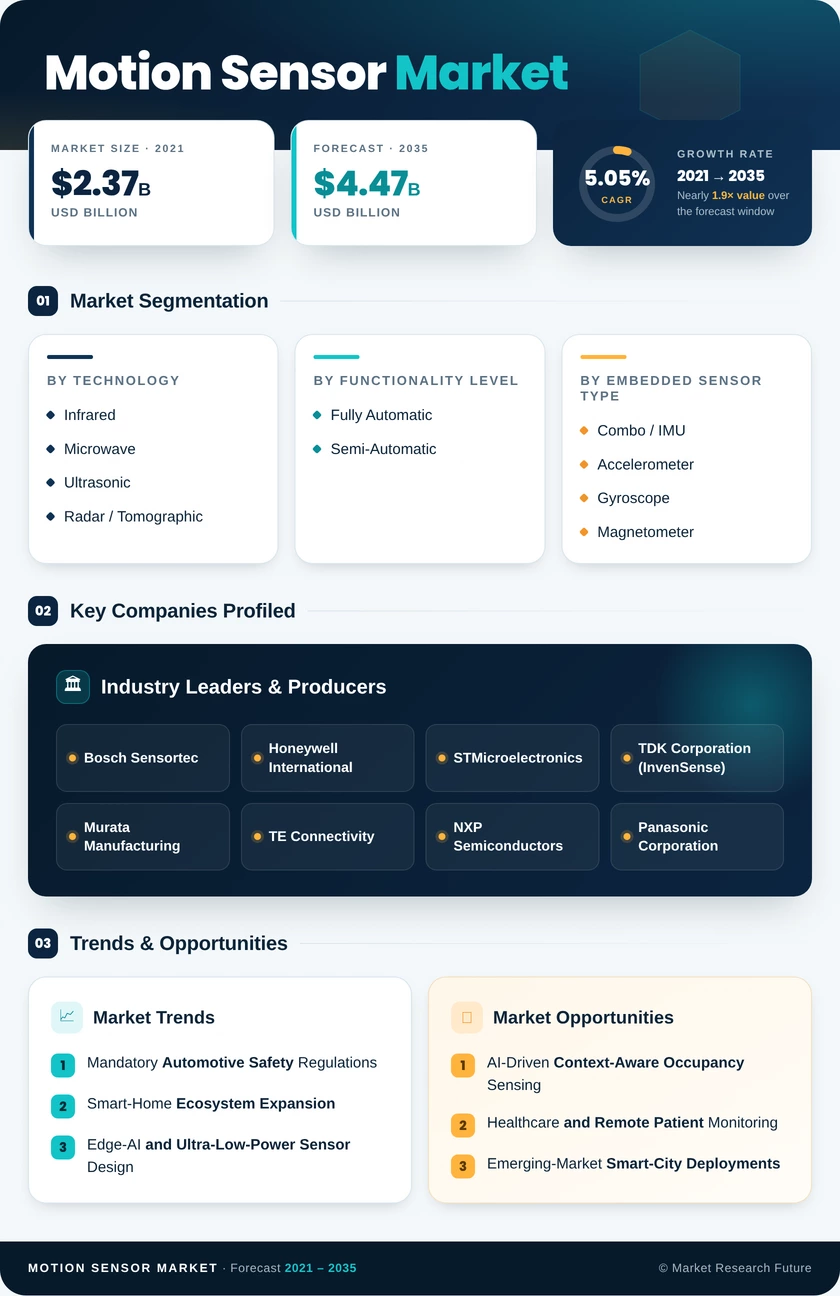
Motion Sensor Market (2026 - 2035)

ID: MRFR/SEM/1957-CR
275 Pages
Ankit Gupta
Last Updated: July 13, 2026
Motion Sensor Market Size, Share and Research Report By Technology (Infrared, Microwave, Ultrasonic, Radar / Tomographic), By Functionality Level (Fully Automatic, Semi-Automatic), By Embedded Sensor Type (Combo / IMU, Accelerometer, Gyroscope, Magnetometer), By Application (Consumer Electronics, Automotive & Transportation, Smart Home & Building Automation, Healthcare & Medical Devices, Lighting Control) and By Regional (North America, Europe, South America, Asia Pacific, Middle East and Africa) - Industry Forecast to 2035.
Motion Sensor Market
Market Size
Forecast Period2026-2035
CAGR (2026-2035)5.05%
2025 Market SizeUSD 2.74 Billion
2035 Market SizeUSD 4.47 Billion
Key Players
Bosch Sensortec
Honeywell International
STMicroelectronics
TDK Corporation
Murata Manufacturing
TE Connectivity
Opportunities
  • AI-Driven Context-Aware Occupancy Sensing
  • Healthcare and Remote Patient Monitoring
  • Emerging-Market Smart-City Deployments
  1. 1 Market Overview |
    1. 1.1 Study Assumptions & Market Definition |
    2. 1.2 Scope of the Study |
    3. 1.3 Research Methodology
  2. 2 Market Summary & Key Takeaways
  3. 3 Market Dynamics |
    1. 3.1 Market Drivers Analysis | |
      1. 3.1.1 Mandatory Automotive Safety Regulations | |
      2. 3.1.2 Smart-Home Ecosystem Expansion | |
      3. 3.1.3 Edge-AI and Ultra-Low-Power Sensor Design | |
      4. 3.1.4 Industrial Automation and Robotics Growth | |
      5. 3.1.5 Healthcare IoT and Remote Patient Monitoring | |
      6. 3.1.6 Smart-City Infrastructure Programs | |
      7. 3.1.7 LED Lighting Retrofit and Energy Codes |
    2. 3.2 Market Restraints Analysis | |
      1. 3.2.1 False Triggers and Environmental Interference | |
      2. 3.2.2 Semiconductor Supply-Chain Cyclicality | |
      3. 3.2.3 Privacy and Regulatory Pushback on Sensing | |
      4. 3.2.4 Price Erosion in Commoditized PIR Segments | |
      5. 3.2.5 Integration Complexity in Legacy Buildings |
    3. 3.3 Market Opportunity Analysis | |
      1. 3.3.1 AI-Driven Context-Aware Occupancy Sensing | |
      2. 3.3.2 Healthcare and Remote Patient Monitoring | |
      3. 3.3.3 Emerging-Market Smart-City Deployments | |
      4. 3.3.4 Sensor-as-a-Service and Data Monetization | |
      5. 3.3.5 Automotive Cabin-Sensing Mandates |
    4. 3.4 Industry Value Chain Analysis |
    5. 3.5 Porter's Five Forces Analysis
  4. 4 Global Motion Sensor Market Size & Forecast (2021–2035) |
    1. 4.1 Historical Market Size (2021–2025) |
    2. 4.2 Current & Forecast Market Size (2026–2035) |
    3. 4.3 Market Size by Revenue (USD Billion) |
    4. 4.4 Year-over-Year Growth Analysis
  5. 5 Segmentation Analysis |
    1. 5.1 By Technology | |
      1. 5.1.1 Infrared | |
      2. 5.1.2 Microwave | |
      3. 5.1.3 Ultrasonic | |
      4. 5.1.4 Radar / Tomographic |
    2. 5.2 By Functionality Level | |
      1. 5.2.1 Fully Automatic | |
      2. 5.2.2 Semi-Automatic |
    3. 5.3 By Embedded Sensor Type | |
      1. 5.3.1 Combo / IMU | |
      2. 5.3.2 Accelerometer | |
      3. 5.3.3 Gyroscope | |
      4. 5.3.4 Magnetometer |
    4. 5.4 By Application | |
      1. 5.4.1 Consumer Electronics | |
      2. 5.4.2 Automotive & Transportation | |
      3. 5.4.3 Smart Home & Building Automation | |
      4. 5.4.4 Healthcare & Medical Devices | |
      5. 5.4.5 Lighting Control
  6. 6 Regional Analysis |
    1. 6.1 North America | |
      1. 6.1.1 United States | |
      2. 6.1.2 Canada | |
      3. 6.1.3 Mexico |
    2. 6.2 Europe | |
      1. 6.2.1 Germany | |
      2. 6.2.2 United Kingdom | |
      3. 6.2.3 France | |
      4. 6.2.4 Italy | |
      5. 6.2.5 Spain | |
      6. 6.2.6 Nordic Countries | |
      7. 6.2.7 Russia | |
      8. 6.2.8 Rest of Europe |
    3. 6.3 Asia-Pacific | |
      1. 6.3.1 China | |
      2. 6.3.2 India | |
      3. 6.3.3 Japan | |
      4. 6.3.4 South Korea | |
      5. 6.3.5 ASEAN | |
      6. 6.3.6 Rest of Asia-Pacific |
    4. 6.4 South America | |
      1. 6.4.1 Brazil | |
      2. 6.4.2 Argentina | |
      3. 6.4.3 Rest of South America |
    5. 6.5 Middle East & Africa | |
      1. 6.5.1 Saudi Arabia | |
      2. 6.5.2 UAE | |
      3. 6.5.3 South Africa | |
      4. 6.5.4 Egypt | |
      5. 6.5.5 Rest of MEA
  7. 7 Competitive Landscape |
    1. 7.1 Market Share Analysis (2025) |
    2. 7.2 Competitive Benchmarking Matrix |
    3. 7.3 Company Profiles | |
      1. 7.3.1 Bosch Sensortec | |
      2. 7.3.2 Honeywell International | |
      3. 7.3.3 STMicroelectronics | |
      4. 7.3.4 TDK Corporation (InvenSense) | |
      5. 7.3.5 Murata Manufacturing | |
      6. 7.3.6 TE Connectivity | |
      7. 7.3.7 NXP Semiconductors | |
      8. 7.3.8 Panasonic Corporation | |
      9. 7.3.9 Microchip Technology | |
      10. 7.3.10 Analog Devices
  8. 8 Future Outlook & Strategic Recommendations (2026–2035) |
    1. 8.1 AI-Enabled Autonomous Sensing Ecosystems |
    2. 8.2 Platform Economics and Sensor-as-a-Service |
    3. 8.3 Electrification and Sustainable Building Codes |
    4. 8.4 Convergence of Sensing Modalities for Spatial Intelligence
  9. 9 Recent Developments & News
  10. 10 Frequently Asked Questions (FAQs)
  11. 11 Report Scope & Methodology |
    1. 11.1 Study Period & Base Year |
    2. 11.2 Data Sources & Citations |
    3. 11.3 Abbreviations
  12. 12 LIST OF TABLES |
  13. TABLE 1 Global Motion Sensor Market Size & Forecast, by Revenue (USD Billion), 2021–2035 |
  14. TABLE 2 Global Motion Sensor Market — Year-over-Year Growth Analysis, 2021–2035 |
  15. TABLE 3 Global Motion Sensor Market — Driver Impact Analysis |
  16. TABLE 4 Global Motion Sensor Market — Restraint Impact Analysis |
  17. TABLE 5 Global Motion Sensor Market Size, by Technology, 2021–2035 (USD Billion) |
  18. TABLE 6 Global Motion Sensor Market Size, by Functionality Level, 2021–2035 (USD Billion) |
  19. TABLE 7 Global Motion Sensor Market Size, by Embedded Sensor Type, 2021–2035 (USD Billion) |
  20. TABLE 8 Global Motion Sensor Market Size, by Application, 2021–2035 (USD Billion) |
  21. TABLE 9 Global Motion Sensor Market Size, by Region, 2021–2035 (USD Billion) |
  22. TABLE 10 North America Motion Sensor Market Size, by Country, 2021–2035 (USD Billion) |
  23. TABLE 11 Europe Motion Sensor Market Size, by Country, 2021–2035 (USD Billion) |
  24. TABLE 12 Asia-Pacific Motion Sensor Market Size, by Country, 2021–2035 (USD Billion) |
  25. TABLE 13 South America Motion Sensor Market Size, by Country, 2021–2035 (USD Billion) |
  26. TABLE 14 Middle East & Africa Motion Sensor Market Size, by Country, 2021–2035 (USD Billion) |
  27. TABLE 15 Competitive Benchmarking Matrix — Global Motion Sensor Market, 2025 |
  28. TABLE 16 Company Profiles — Key Players, Global Motion Sensor Market |
  29. TABLE 17 Recent Developments & Strategic Announcements, 2023–2025 |
  30. TABLE 18 Report Scope & Methodology Summary |
  31. TABLE 19 Detailed Sources and Citations
  32. 13 LIST OF FIGURES |
  33. FIGURE 1 Global Motion Sensor Market — Market Dynamics Overview |
  34. FIGURE 2 Global Motion Sensor Market — Industry Value Chain Analysis |
  35. FIGURE 3 Global Motion Sensor Market — Porter's Five Forces Analysis |
  36. FIGURE 4 Global Motion Sensor Market Size Trend (USD Billion), 2021–2035 |
  37. FIGURE 5 Global Motion Sensor Market Share, by Technology, 2025 |
  38. FIGURE 6 Global Motion Sensor Market Share, by Functionality Level, 2025 |
  39. FIGURE 7 Global Motion Sensor Market Share, by Embedded Sensor Type, 2025 |
  40. FIGURE 8 Global Motion Sensor Market Share, by Application, 2025 |
  41. FIGURE 9 Global Motion Sensor Market Share, by Region, 2025 |
  42. FIGURE 10 North America Motion Sensor Market Size, by Country, 2021–2035 |
  43. FIGURE 11 Europe Motion Sensor Market Size, by Country, 2021–2035 |
  44. FIGURE 12 Asia-Pacific Motion Sensor Market Size, by Country, 2021–2035 |
  45. FIGURE 13 South America Motion Sensor Market Size, by Country, 2021–2035 |
  46. FIGURE 14 Middle East & Africa Motion Sensor Market Size, by Country, 2021–2035 |
  47. FIGURE 15 Competitive Landscape — Market Share Analysis, 2025

SEGMENTATION QUICK REFERENCE

DimensionSub-SegmentsDominant SegmentFastest Growing Segment
TechnologyInfrared, Microwave, Ultrasonic, Radar / TomographicInfraredRadar / Tomographic
Functionality LevelFully Automatic, Semi-AutomaticFully AutomaticFully Automatic
Embedded Sensor TypeCombo / IMU, Accelerometer, Gyroscope, MagnetometerCombo / IMUAccelerometer
ApplicationConsumer Electronics, Automotive & Transportation, Smart Home & Building Automation, Healthcare & Medical Devices, Lighting ControlConsumer ElectronicsSmart Home & Building Automation
GeographyNorth America, Europe, Asia-Pacific, South America, Middle East & AfricaAsia-PacificMiddle East & Africa


MARKET SEGMENTATION OVERVIEW

By Technology

Sub-SegmentKey Trend
InfraredDominant due to low cost and mature deployment in security and lighting
MicrowavePreferred for through-wall detection and industrial perimeter applications
UltrasonicEstablished in automotive parking assist and short-range proximity sensing
Radar / TomographicFastest growing — millimeter-wave chipsets enable ADAS and smart-building use cases.


Infrared technology retains the largest share due to decades of deployment in residential and commercial environments, while radar and tomographic solutions are advancing rapidly as automotive safety mandates and smart-building specifications increasingly require through-material and long-range detection capabilities.

By Functionality Level

Sub-SegmentKey Trend
Fully AutomaticGrowing preference for autonomous, app-configured sensor systems
Semi-AutomaticRetains relevance in industrial settings requiring manual override


Fully automatic systems dominate as consumer and commercial buyers demand plug-and-play sensor solutions that self-calibrate and integrate with smart-home platforms without manual intervention.

By Embedded Sensor Type

Sub-SegmentKey Trend
Combo / IMUMulti-axis integration for smartphones, wearables, and automotive navigation
AccelerometerCore component in step-counting, vibration monitoring, and tilt sensing
GyroscopeEssential for optical image stabilization and drone flight control
MagnetometerSupports compass functionality and indoor-positioning augmentation


Combo/IMU modules lead the market as device manufacturers consolidate multiple sensing axes into single packages that reduce board space, power consumption, and bill-of-materials complexity.

By Application

Sub-SegmentKey Trend
Consumer ElectronicsDriven by smartphone refresh cycles and wearable proliferation
Automotive & TransportationExpanding through ADAS mandates and autonomous-vehicle development
Smart Home & Building AutomationFastest growing — occupancy sensing drives energy code compliance.
Healthcare & Medical DevicesEmerging demand from fall detection and remote patient monitoring
Lighting ControlSustained by commercial and municipal energy-efficiency retrofit programs


Consumer electronics absorb the largest revenue share, but smart-home and building-automation applications are growing at the fastest rate as regulatory requirements for occupancy-responsive energy management intensify across North America and Europe.


 

Download PDF ×

We do not share your information with anyone. However, we may send you emails based on your report interest from time to time. You may contact us at any time to opt-out.