
Request Free Sample ×

Kindly complete the form below to receive a free sample of this Report

* Please use a valid business email

Leading companies partner with us for data-driven Insights

clients tt-cursor
Hero Background
English
Chinese
French
Japanese
Korean
German
Spanish

Mobile Virtual Network Operator Market Analysis

ID: MRFR/ICT/0462-HCR
200 Pages
Aarti Dhapte
April 2026

Mobile Virtual Network Operator (MVNO) Market Size, Share and Research Report: By Business Model (Discount MVNO, Functional MVNO, Brand MVNO, Niche MVNO), By Service Type (Prepaid Services, Postpaid Services, Data-Only Services, Voice-Only Services), By Customer Segment (Individual Consumers, Small and Medium Enterprises, Large Enterprises, Government), By Network Infrastructure (Full MVNO, Light MVNO, Thin MVNO), and By Regional (North America, Europe, South America, Asia Pacific, Middle East and Africa) - Industry Forecast to 2035

Share:
Download PDF ×

We do not share your information with anyone. However, we may send you emails based on your report interest from time to time. You may contact us at any time to opt-out.

Mobile Virtual Network Operator Market Infographic
Purchase Options

Market Analysis

In-depth Analysis of Mobile Virtual Network Operator Market Industry Landscape

The Mobile Virtual Network Operator (MVNO) market is influenced by a variety of factors that collectively shape its growth and dynamics. One key factor is the increasing demand for flexible and customized mobile services. MVNOs, by leveraging existing telecom infrastructure, offer alternative mobile services with unique plans and features, catering to specific customer segments. As consumers seek personalized and cost-effective mobile solutions, the MVNO market responds by providing options beyond traditional carrier offerings.

Technological advancements contribute significantly to the evolution of the MVNO market. As mobile technologies advance, MVNOs leverage these innovations to enhance their services. The deployment of 5G networks, for example, opens up new possibilities for MVNOs to provide high-speed data services and support emerging technologies. The integration of advanced features and connectivity options helps MVNOs stay competitive in a rapidly evolving telecommunications landscape.

Regulatory considerations play a crucial role in shaping the MVNO market. Governments and regulatory bodies establish rules and guidelines governing the telecom industry, influencing the entry, operation, and partnerships of MVNOs. Regulatory frameworks that promote competition and innovation can foster a favorable environment for MVNOs, encouraging market growth. Additionally, regulatory changes can impact the terms of wholesale agreements between MVNOs and Mobile Network Operators (MNOs), affecting the overall competitiveness of MVNOs in the market.

Market competition is another significant factor influencing the MVNO landscape. With a diverse range of MVNOs operating globally, competition fosters innovation and service differentiation. MVNOs strive to carve out niches in the market by offering unique plans, value-added services, or targeting specific demographics. This diversity benefits consumers, as they have a wide array of choices for mobile services, driving MVNOs to continually enhance their offerings to stay relevant.

Economic conditions and consumer behavior also impact the MVNO market. During economic downturns, cost-conscious consumers may turn to MVNOs for more affordable mobile plans. The ability of MVNOs to provide budget-friendly options and flexibility in services becomes especially appealing in such scenarios. Additionally, changes in consumer preferences, such as a growing emphasis on data-centric plans or demand for more transparent pricing, shape the strategies of MVNOs in attracting and retaining customers.

Global trends and technological disruptions contribute to the dynamics of the MVNO market. The rise of Internet of Things (IoT) devices, connected cars, and other emerging technologies create new opportunities for MVNOs to offer specialized services. MVNOs can explore partnerships and collaborations to tap into these trends, expanding their service portfolios and addressing the evolving needs of businesses and consumers in the digital age.

Customer experience and satisfaction are critical factors driving the MVNO market. As consumers increasingly prioritize seamless service activation, transparent billing, and reliable network coverage, MVNOs must focus on providing a positive user experience. Enhanced customer service, simplified billing processes, and innovative offerings contribute to customer loyalty and retention, influencing the long-term success of MVNOs in a competitive market.


 

Author
Author Profile
Aarti Dhapte
AVP - Research

A consulting professional focused on helping businesses navigate complex markets through structured research and strategic insights. I partner with clients to solve high-impact business problems across market entry strategy, competitive intelligence, and opportunity assessment. Over the course of my experience, I have led and contributed to 100+ market research and consulting engagements, delivering insights across multiple industries and geographies, and supporting strategic decisions linked to $500M+ market opportunities. My core expertise lies in building robust market sizing, forecasting, and commercial models (top-down and bottom-up), alongside deep-dive competitive and industry analysis. I have played a key role in shaping go-to-market strategies, investment cases, and growth roadmaps, enabling clients to make confident, data-backed decisions in dynamic markets.

Leave a Comment

FAQs

What is the current valuation of the Mobile Virtual Network Operator (MVNO) Market?

<p>The overall market valuation was 60.26 USD Billion in 2024.</p>

What is the projected market size for the MVNO Market by 2035?

<p>The projected valuation for the MVNO Market is 89.96 USD Billion by 2035.</p>

What is the expected CAGR for the MVNO Market during the forecast period 2025 - 2035?

<p>The expected CAGR for the MVNO Market during the forecast period 2025 - 2035 is 3.71%.</p>

Which business model segment is expected to show the highest growth in the MVNO Market?

<p>The Functional MVNO segment is projected to grow from 20.0 to 30.0 USD Billion.</p>

What are the key service types in the MVNO Market and their valuations?

<p>Prepaid Services are valued between 20.0 and 30.0 USD Billion, while Postpaid Services range from 15.0 to 25.0 USD Billion.</p>

Who are the leading players in the MVNO Market?

<p>Key players in the MVNO Market include TracFone Wireless, Virgin Mobile, and Boost Mobile.</p>

What customer segments are driving the MVNO Market growth?

<p>Individual Consumers are leading with a valuation between 30.13 and 43.0 USD Billion.</p>

How does the network infrastructure segment contribute to the MVNO Market?

<p>The Light MVNO segment is expected to grow from 25.0 to 35.0 USD Billion, indicating strong infrastructure support.</p>

What is the valuation range for niche MVNOs in the market?

<p>Niche MVNOs are valued between 15.26 and 22.96 USD Billion.</p>

What trends are emerging in the MVNO Market regarding service types?

<p>Data-Only Services are projected to grow from 10.0 to 15.0 USD Billion, reflecting changing consumer preferences.</p>

Market Summary

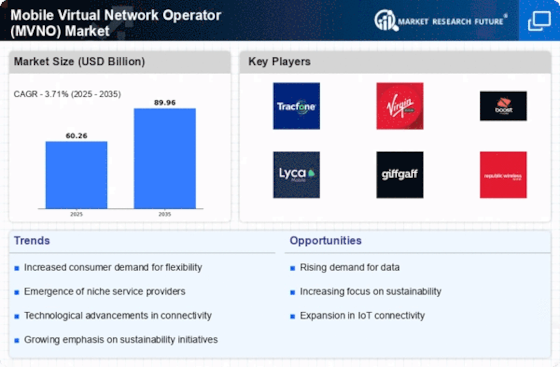
As per Market Research Future analysis, the Mobile Virtual Network Operator Market (MVNO) Market Size was estimated at 60.26 USD Billion in 2024. The MVNO industry is projected to grow from 62.5 USD Billion in 2025 to 89.96 USD Billion by 2035, exhibiting a compound annual growth rate (CAGR) of 3.71% during the forecast period 2025 - 2035

Key Market Trends & Highlights

The Mobile Virtual Network Operator Market (MVNO) market is experiencing a dynamic shift towards niche offerings and digital transformation.

  • North America remains the largest market for MVNOs, driven by a diverse range of service offerings. The Asia-Pacific region is emerging as the fastest-growing market, fueled by increasing smartphone penetration and digital services. Discount MVNOs dominate the market, while niche MVNOs are rapidly gaining traction among specific consumer segments. Cost-effective service offerings and rising consumer preference for flexible plans are key drivers propelling MVNO growth.

Market Size & Forecast

2024 Market Size 60.26 (USD Billion)
2035 Market Size 89.96 (USD Billion)
CAGR (2025 - 2035) 3.71%
Largest Regional Market Share in 2024 North America

Major Players

<a href="https://www.tracfone.com/home">TracFone Wireless (US)</a>, Virgin Mobile (GB), Boost Mobile (US), Lycamobile (GB), Giffgaff (GB), Republic Wireless (US), Ting (US), <a href="https://www.freedompop.com/">FreedomPop </a>(US), Koodo Mobile (CA)

Market Trends

The Mobile Virtual Network Operator Market (MVNO) Market is currently experiencing a dynamic evolution, driven by various factors that shape consumer preferences and technological advancements. As mobile connectivity becomes increasingly essential in daily life, MVNOs are capitalizing on the demand for flexible and cost-effective mobile services. This market segment appears to be diversifying, with new entrants offering niche services tailored to specific demographics, such as students or seniors. The competitive landscape is intensifying, as traditional mobile network operators (MNOs) seek to retain their customer base by enhancing their service offerings and pricing strategies. Moreover, the rise of digital platforms and e-commerce is influencing the MVNO Market, as consumers increasingly prefer online channels for purchasing mobile services. This shift suggests that MVNOs may need to invest in digital marketing and customer engagement strategies to remain relevant. Additionally, the integration of advanced technologies, such as artificial intelligence and machine learning, could enhance operational efficiencies and customer experiences. Overall, the Mobile Virtual Network Operator Market (MVNO) Market is poised for continued growth, with opportunities for innovation and differentiation in service delivery. A mobile virtual network operator (MVNO) provides mobile services without owning network infrastructure. The mobile virtual network operator (MVNO) market is expanding due to flexible pricing and niche services. Mobile virtual network operators are increasingly targeting niche customer segments and digital-first users. The mobile virtual network ecosystem enables service innovation without heavy infrastructure investment. The MVNO business model varies across discount, functional, brand, and niche operators.

Niche Market Focus

MVNOs are increasingly targeting specific consumer segments, such as young professionals or health-conscious individuals. This trend indicates a shift from broad service offerings to tailored solutions that meet the unique needs of distinct groups. By focusing on niche markets, MVNOs can differentiate themselves from traditional operators and create loyal customer bases. Each M V N O business model defines the level of control over network and billing operations. Each mobile virtual network operator type differs in infrastructure ownership and operational control. An MVNO mobile virtual operator typically focuses on pricing flexibility and niche customer groups. The list of mobile virtual network operators continues to expand across North America and Europe. Enhanced MVNO marketing support is helping operators acquire customers through digital channels. The AT&T MVNO business model emphasizes network quality and scalable wholesale partnerships.

Digital Transformation

The ongoing digital transformation is reshaping the Mobile Virtual Network Operator Market (MVNO) Market. As consumers gravitate towards online platforms for service acquisition, MVNOs are likely to enhance their digital presence. This trend may involve adopting advanced technologies to streamline operations and improve customer interactions. The Sprint MVNO billing platform supported large-scale prepaid subscriber management. The travel SIM MVNO market is expanding rapidly with the growth of international roaming demand. Partnerships with the largest mobile carriers in the world remain critical for MVNO success.

Sustainability Initiatives

There is a growing emphasis on sustainability within the MVNO Market. Operators are exploring eco-friendly practices, such as reducing carbon footprints and promoting responsible consumption. This trend suggests that consumers are increasingly valuing companies that prioritize environmental responsibility, potentially influencing their purchasing decisions. The AT&T M V N O business model supports both prepaid and postpaid MVNO partners. The Sprint MVNO business model historically focused on prepaid and private-label partnerships. Each Sprint MVNO partner benefited from nationwide network access and flexible wholesale terms. The Sprint MVNO private label strategy enabled retailers to launch branded mobile services.

Mobile Virtual Network Operator Market Market Drivers

Cost-Effective Service Offerings

The Mobile Virtual Network Operator Market (MVNO) Market is characterized by its ability to provide cost-effective service offerings. MVNOs typically operate with lower overhead costs compared to traditional mobile network operators, allowing them to pass on savings to consumers. This competitive pricing strategy attracts price-sensitive customers, particularly in emerging markets where affordability is paramount. As of 2025, MVNOs are estimated to capture a significant share of the mobile subscriber base, with projections indicating that they could account for over 20% of total mobile subscriptions. This trend suggests that the MVNO model is increasingly appealing to consumers seeking budget-friendly alternatives without compromising on service quality.

Regulatory Support for MVNO Growth

The Mobile Virtual Network Operator Market (MVNO) Market benefits from increasing regulatory support aimed at fostering competition and innovation. Many governments are recognizing the value of MVNOs in enhancing consumer choice and driving down prices in the telecommunications sector. Regulatory frameworks that promote fair access to network infrastructure are enabling new entrants to compete effectively with established players. As of October 2025, it is anticipated that favorable regulatory conditions will contribute to a 20% increase in the number of MVNOs entering the market, thereby enriching the competitive landscape and providing consumers with more options.

Increased Demand for Flexible Plans

The Mobile Virtual Network Operator Market (MVNO) Market is witnessing a surge in demand for flexible mobile plans. Consumers are increasingly favoring customizable options that allow them to tailor their mobile services according to their specific needs. This shift is particularly evident among younger demographics who prioritize flexibility over long-term contracts. MVNOs are well-positioned to capitalize on this trend by offering a variety of plans that cater to different usage patterns, such as pay-as-you-go or data-only options. As of 2025, it is anticipated that flexible plans will drive a substantial portion of MVNO growth, potentially leading to a 15% increase in subscriber numbers within the next year.

Rising Consumer Preference for Digital Services

The Mobile Virtual Network Operator Market (MVNO) Market is increasingly shaped by the rising consumer preference for digital services. As more individuals rely on mobile devices for various aspects of their lives, including communication, entertainment, and commerce, the demand for integrated digital solutions is growing. MVNOs are responding by offering bundled services that combine mobile connectivity with digital content and applications. This trend is expected to enhance customer loyalty and retention, as consumers gravitate towards providers that offer comprehensive digital experiences. By 2025, it is estimated that MVNOs focusing on digital service integration could see a 12% increase in their customer base, reflecting the importance of adapting to consumer preferences.

Technological Advancements in Network Infrastructure

The Mobile Virtual Network Operator Market (MVNO) Market is significantly influenced by technological advancements in network infrastructure. The evolution of 5G technology and improvements in network virtualization are enabling MVNOs to offer enhanced services without the need for extensive physical infrastructure. This technological shift allows MVNOs to operate more efficiently and provide high-speed data services that meet the growing consumer demand for connectivity. As of October 2025, it is projected that MVNOs leveraging advanced network technologies will experience a growth rate of approximately 10% annually, indicating a robust future for those who adapt to these innovations.

Market Segment Insights

By Business Model: Discount MVNO (Largest) vs. Niche MVNO (Fastest-Growing)

The Mobile Virtual Network Operator Market (MVNO) market is experiencing a robust distribution among various business models. Currently, the <a href="https://www.marketresearchfuture.com/reports/india-mobile-virtual-network-operator-market-57812">Discount MVNO segment </a>holds the largest share, attracting budget-conscious consumers seeking affordable mobile services. This segment is characterized by low-cost offerings and competitive pricing strategies, appealing to mass-market consumers. On the other hand, Niche MVNOs are emerging rapidly, catering to specialized customer needs or demographics. They are gradually capturing attention with unique propositions that large carriers often overlook.

Discount MVNO (Dominant) vs. Niche MVNO (Emerging)

Discount MVNOs operate by providing basic mobile services at reduced prices, leveraging wholesale agreements with network providers. This model is dominant due to its mass appeal and cost-effective solutions which attract a large volume of subscribers. In contrast, Niche MVNOs focus on specific customer segments, such as gamers or seniors, offering tailored services and<a href="https://www.marketresearchfuture.com/reports/community-banking-market-23687"> community-driven</a> experiences that foster loyalty. While Discount MVNOs thrive on scale, Niche MVNOs differentiate themselves by addressing unmet market needs, thereby establishing a dedicated customer base.

By Service Type: Prepaid Services (Largest) vs. Postpaid Services (Fastest-Growing)

The Mobile Virtual Network Operator Market (MVNO) market has a significant distribution of service types, with prepaid services holding the largest share. Prepaid services are widely favored among consumers for their flexibility and cost-effectiveness, attracting a large segment of cost-conscious users. In contrast, while postpaid services currently command a smaller market share, their growth trajectory is impressive as more customers across various demographics lean towards bundled offerings that provide additional features such as family plans and premium data options. The growth trends in the MVNO market reflect a shift in consumer preferences, with increasing demand for personalized and cost-effective mobile solutions.<a href="https://www.marketresearchfuture.com/reports/data-as-a-service-daas-market-6057"> Data-only services</a> and voice-only services are also gaining traction, particularly among niche markets such as business users and high-data consumers. The rise of digital applications and the need for uninterrupted connectivity are key drivers, leading to innovative offerings and enhanced customer experiences in the service type segment.

Prepaid Services (Dominant) vs. Data-Only Services (Emerging)

Prepaid services remain the dominant force within the MVNO market, driven by a strong focus on affordability and control over expenses. These services are appealing to a wide range of users, including students and budget-conscious individuals. Furthermore, they are increasingly bundled with value-added features like data rollovers and unlimited texting. On the other hand, data-only services are emerging rapidly, catering to specific user needs such as mobile data for tablets and IoT devices. As consumers continue to rely heavily on data-driven applications, these services are capturing interest, particularly from tech-savvy users who prioritize data access over traditional voice calls. As networks evolve and data speeds improve, data-only services are becoming an attractive alternative.

By Customer Segment: Individual Consumers (Largest) vs. Small and Medium Enterprises (Fastest-Growing)

In the Mobile Virtual Network Operator Market (MVNO) Market, the customer segment is crucial to understanding market dynamics. Individual consumers represent the largest share of the market, driven by the demand for affordable and flexible mobile plans. This segment enjoys substantial market penetration due to the growing reliance on mobile communication and data services among everyday consumers. Meanwhile, small and medium enterprises (SMEs) are emerging as the fastest-growing segment, motivated by their need for cost-effective mobile solutions that cater to their unique operational requirements.

Individual Consumers (Dominant) vs. Small and Medium Enterprises (Emerging)

The individual consumer segment is characterized by a diverse range of preferences, from budget-friendly plans to premium data packages. With a focus on personal technology, this segment sees high competition among MVNOs striving to offer tailored services. Conversely, small and medium enterprises are rapidly adopting mobile virtual network services to enhance their operational efficiency. SMEs prioritize flexible contracts and customized plans that can scale with business growth, making them a key target for MVNOs aiming to innovate and expand their offerings. Their growing tech adoption positions them as essential players in the market.

By Network Infrastructure: Full MVNO (Largest) vs. Thin MVNO (Fastest-Growing)

In the Mobile Virtual Network Operator Market (MVNO) Market, network infrastructure plays a critical role in defining operational capabilities and market share. The Full MVNO segment leads the market, possessing the most substantial share due to its comprehensive control over the network. This segment allows MVNOs to offer a broad variety of services, enhancing customer experience and loyalty. In contrast, the Thin MVNO retains a smaller share but is rapidly gaining traction in the market by focusing on niche customer segments and innovative service offerings.

Infrastructure: Full MVNO (Dominant) vs. Thin MVNO (Emerging)

The Full MVNO segment is characterized by its ability to utilize its own core network elements, giving it significant flexibility and control over services and billing. This allows Full MVNOs to innovate and cater to diverse consumer needs, ensuring a competitive edge in service quality. Conversely, the Thin MVNO operates with limited infrastructure, relying heavily on host network operators for core services. Despite this, Thin MVNOs have emerged as agile businesses targeting specific market niches, capitalizing on trends like personalized offerings and competitive pricing, thus driving significant growth in less saturated segments.

Get more detailed insights about Mobile Virtual Network Operator Market Research Report - Forecast till 2035

Regional Insights

The Mobile Virtual Network Operator Market (MVNO) Market was poised for significant growth in the coming years. In the regional breakdown, North America led with a noteworthy valuation of 20.0 USD Billion in 2024, reflecting its major role in the MVNO ecosystem, driven by high demand for flexible mobile services.

Europe followed closely, with a valuation of 15.0 USD Billion in 2024, representing a significant market share fueled by regulatory support and technological advancement.The Asia Pacific region held a valuation of 15.0 USD Billion, emphasizing its rapidly growing consumer base, while South America, with 5.0 USD Billion, and the Middle East and Africa, valued at 5.26 USD Billion, represent emerging markets with potential for expansion.

Despite having smaller market sizes, South America and Africa saw increased investment in mobile infrastructure, positioning them as areas of opportunity for future growth. These regional insights highlight the diverse landscape within the Mobile Virtual Network Operator Market (MVNO) Market, driven by varying consumer needs and regulatory frameworks.

Key Players and Competitive Insights

The Mobile Virtual Network Operator Market (MVNO) Market is characterized by a dynamic landscape where various players compete by leveraging unique business models and consumer-centric strategies. MVNOs operate without owning the underlying network infrastructure, thereby allowing them to offer cost-effective telecommunication solutions across different regions. Leading MVNO companies compete through pricing innovation and targeted service offerings. The competition is intensified due to the rapid advancements in technology, changing consumer preferences, and the necessity for personalized mobile services. Market entrants continue to emerge, while existing operators innovate to differentiate themselves, leading to a diversified portfolio of offerings that cater to niche segments.Enhanced digital adoption and the proliferation of mobile services have further amplified the competitive dynamics, with companies striving to enhance customer engagement and retention through tailored plans and value-added services. Comcast has established a significant presence in the Mobile Virtual Network Operator Market (MVNO) Market through its strategic focus on integrated services and bundled offerings. The company leverages its extensive infrastructure and resources to provide affordable mobile solutions that appeal to consumers seeking convenience and savings. Comcast's strengths lie in its ability to capitalize on existing customer relationships, as many users already subscribe to its other services, such as internet and cable television. This synergy enables Comcast to offer attractive mobile plans that incentivize subscribers to remain within its ecosystem.The company has actively explored opportunities to expand its market presence through partnerships and collaborations, reinforcing its competitive edge in the MVNO sector. AT&T plays a pivotal role in the Mobile Virtual Network Operator Market (MVNO) Market, bolstered by its well-established reputation and extensive network coverage. The company provides a range of key products and services, aimed at different consumer segments, including prepaid and postpaid plans through its MVNO partnerships. AT&T's strengths are underscored by its substantial investments in network infrastructure and technology, ensuring reliable service and high-quality connectivity for MVNOs. The company has also pursued strategic mergers and acquisitions to enhance its market presence, allowing it to integrate additional capabilities and improve service offerings. Through its focus on customer satisfaction and competitive pricing strategies, AT&T reinforces its position within the global MVNO landscape while expanding its reach in an ever-evolving telecommunications environment.

Key Companies in the Mobile Virtual Network Operator Market include

Industry Developments

With 5.5 million users, Tesco Mobile surpassed Virgin Media O2 as the largest MVNO in the UK in March 2023. It also renewed its 50:50 joint venture with Virgin Media O2 for another 10 years, ensuring network coverage and continuity through 2034.In order to comply with Ofcom standards, Tesco Mobile implemented a new pricing strategy in December 2024 that replaced inflation-linked mid-contract price rises with clear, fixed yearly increases in pounds and pence.

T-Mobile US spent $1.35 billion to purchase Mint Mobile in June 2025, combining its marketing approach and user base under T-Mobile's pre-paid division. This came after an effort to boost MVNO growth in January 2024 that targeted phone-plan switchers.Lycamobile continued to use eSIM and prepaid services throughout the Three network to maintain its projected 2.6% MVNO market share in Ireland (14.3% overall) as of June 2025.

According to telecom regulator updates, Giffgaff (UK) and other MVNOs increased their support for eSIM in June 2025, giving customers more flexibility and travel-friendly choices. In order to manage surplus capacity under updated regulatory frameworks, Orange strengthened its MVNO plan in June 2025 by maximizing wholesale access throughout Europe.

Future Outlook

Mobile Virtual Network Operator Market Future Outlook

The Mobile Virtual Network Operator Market (MVNO) Market is projected to grow at a 3.71% CAGR from 2025 to 2035, driven by technological advancements, increasing demand for flexible plans, and enhanced customer experiences.

New opportunities lie in:

  • <p>Partnerships with IoT providers for tailored connectivity solutions. Development of niche market segments targeting underserved demographics. Integration of AI-driven customer service platforms for improved user engagement.</p>

By 2035, the MVNO market is expected to be robust, characterized by diverse offerings and strategic partnerships.

Market Segmentation

Mobile Virtual Network Operator Market Service Type Outlook

  • Prepaid Services
  • Postpaid Services
  • Data-Only Services
  • Voice-Only Services

Mobile Virtual Network Operator Market Business Model Outlook

  • Discount MVNO
  • Functional MVNO
  • Brand MVNO
  • Niche MVNO

Mobile Virtual Network Operator Market Customer Segment Outlook

  • Individual Consumers
  • Small and Medium Enterprises
  • Large Enterprises
  • Government

Mobile Virtual Network Operator Market Network Infrastructure Outlook

  • Full MVNO
  • Light MVNO
  • Thin MVNO

Report Scope

MARKET SIZE 2024 60.26(USD Billion)
MARKET SIZE 2025 62.5(USD Billion)
MARKET SIZE 2035 89.96(USD Billion)
COMPOUND ANNUAL GROWTH RATE (CAGR) 3.71% (2025 - 2035)
REPORT COVERAGE Revenue Forecast, Competitive Landscape, Growth Factors, and Trends
BASE YEAR 2024
Market Forecast Period 2025 - 2035
Historical Data 2019 - 2024
Market Forecast Units USD Billion
Key Companies Profiled TracFone Wireless (US), Virgin Mobile (GB), Boost Mobile (US), Lycamobile (GB), Giffgaff (GB), Republic Wireless (US), Ting (US), FreedomPop (US), Koodo Mobile (CA)
Segments Covered Business Model, Service Type, Customer Segment, Network Infrastructure, Regional
Key Market Opportunities Expansion of 5G services creates new avenues for Mobile Virtual Network Operator (MVNO) Market growth.
Key Market Dynamics Intensifying competition among Mobile Virtual Network Operators drives innovation and consumer-centric service offerings.
Countries Covered North America, Europe, APAC, South America, MEA

FAQs

What is the current valuation of the Mobile Virtual Network Operator (MVNO) Market?

<p>The overall market valuation was 60.26 USD Billion in 2024.</p>

What is the projected market size for the MVNO Market by 2035?

<p>The projected valuation for the MVNO Market is 89.96 USD Billion by 2035.</p>

What is the expected CAGR for the MVNO Market during the forecast period 2025 - 2035?

<p>The expected CAGR for the MVNO Market during the forecast period 2025 - 2035 is 3.71%.</p>

Which business model segment is expected to show the highest growth in the MVNO Market?

<p>The Functional MVNO segment is projected to grow from 20.0 to 30.0 USD Billion.</p>

What are the key service types in the MVNO Market and their valuations?

<p>Prepaid Services are valued between 20.0 and 30.0 USD Billion, while Postpaid Services range from 15.0 to 25.0 USD Billion.</p>

Who are the leading players in the MVNO Market?

<p>Key players in the MVNO Market include TracFone Wireless, Virgin Mobile, and Boost Mobile.</p>

What customer segments are driving the MVNO Market growth?

<p>Individual Consumers are leading with a valuation between 30.13 and 43.0 USD Billion.</p>

How does the network infrastructure segment contribute to the MVNO Market?

<p>The Light MVNO segment is expected to grow from 25.0 to 35.0 USD Billion, indicating strong infrastructure support.</p>

What is the valuation range for niche MVNOs in the market?

<p>Niche MVNOs are valued between 15.26 and 22.96 USD Billion.</p>

What trends are emerging in the MVNO Market regarding service types?

<p>Data-Only Services are projected to grow from 10.0 to 15.0 USD Billion, reflecting changing consumer preferences.</p>

  1. SECTION I: EXECUTIVE SUMMARY AND KEY HIGHLIGHTS
    1. | 1.1 EXECUTIVE SUMMARY
    2. | | 1.1.1 Market Overview
    3. | | 1.1.2 Key Findings
    4. | | 1.1.3 Market Segmentation
    5. | | 1.1.4 Competitive Landscape
    6. | | 1.1.5 Challenges and Opportunities
    7. | | 1.1.6 Future Outlook
  2. SECTION II: SCOPING, METHODOLOGY AND MARKET STRUCTURE
    1. | 2.1 MARKET INTRODUCTION
    2. | | 2.1.1 Definition
    3. | | 2.1.2 Scope of the study
    4. | | | 2.1.2.1 Research Objective
    5. | | | 2.1.2.2 Assumption
    6. | | | 2.1.2.3 Limitations
    7. | 2.2 RESEARCH METHODOLOGY
    8. | | 2.2.1 Overview
    9. | | 2.2.2 Data Mining
    10. | | 2.2.3 Secondary Research
    11. | | 2.2.4 Primary Research
    12. | | | 2.2.4.1 Primary Interviews and Information Gathering Process
    13. | | | 2.2.4.2 Breakdown of Primary Respondents
    14. | | 2.2.5 Forecasting Model
    15. | | 2.2.6 Market Size Estimation
    16. | | | 2.2.6.1 Bottom-Up Approach
    17. | | | 2.2.6.2 Top-Down Approach
    18. | | 2.2.7 Data Triangulation
    19. | | 2.2.8 Validation
  3. SECTION III: QUALITATIVE ANALYSIS
    1. | 3.1 MARKET DYNAMICS
    2. | | 3.1.1 Overview
    3. | | 3.1.2 Drivers
    4. | | 3.1.3 Restraints
    5. | | 3.1.4 Opportunities
    6. | 3.2 MARKET FACTOR ANALYSIS
    7. | | 3.2.1 Value chain Analysis
    8. | | 3.2.2 Porter's Five Forces Analysis
    9. | | | 3.2.2.1 Bargaining Power of Suppliers
    10. | | | 3.2.2.2 Bargaining Power of Buyers
    11. | | | 3.2.2.3 Threat of New Entrants
    12. | | | 3.2.2.4 Threat of Substitutes
    13. | | | 3.2.2.5 Intensity of Rivalry
    14. | | 3.2.3 COVID-19 Impact Analysis
    15. | | | 3.2.3.1 Market Impact Analysis
    16. | | | 3.2.3.2 Regional Impact
    17. | | | 3.2.3.3 Opportunity and Threat Analysis
  4. SECTION IV: QUANTITATIVE ANALYSIS
    1. | 4.1 Information and Communications Technology, BY Business Model (USD Billion)
    2. | | 4.1.1 Discount MVNO
    3. | | 4.1.2 Functional MVNO
    4. | | 4.1.3 Brand MVNO
    5. | | 4.1.4 Niche MVNO
    6. | 4.2 Information and Communications Technology, BY Service Type (USD Billion)
    7. | | 4.2.1 Prepaid Services
    8. | | 4.2.2 Postpaid Services
    9. | | 4.2.3 Data-Only Services
    10. | | 4.2.4 Voice-Only Services
    11. | 4.3 Information and Communications Technology, BY Customer Segment (USD Billion)
    12. | | 4.3.1 Individual Consumers
    13. | | 4.3.2 Small and Medium Enterprises
    14. | | 4.3.3 Large Enterprises
    15. | | 4.3.4 Government
    16. | 4.4 Information and Communications Technology, BY Network Infrastructure (USD Billion)
    17. | | 4.4.1 Full MVNO
    18. | | 4.4.2 Light MVNO
    19. | | 4.4.3 Thin MVNO
    20. | 4.5 Information and Communications Technology, BY Region (USD Billion)
    21. | | 4.5.1 North America
    22. | | | 4.5.1.1 US
    23. | | | 4.5.1.2 Canada
    24. | | 4.5.2 Europe
    25. | | | 4.5.2.1 Germany
    26. | | | 4.5.2.2 UK
    27. | | | 4.5.2.3 France
    28. | | | 4.5.2.4 Russia
    29. | | | 4.5.2.5 Italy
    30. | | | 4.5.2.6 Spain
    31. | | | 4.5.2.7 Rest of Europe
    32. | | 4.5.3 APAC
    33. | | | 4.5.3.1 China
    34. | | | 4.5.3.2 India
    35. | | | 4.5.3.3 Japan
    36. | | | 4.5.3.4 South Korea
    37. | | | 4.5.3.5 Malaysia
    38. | | | 4.5.3.6 Thailand
    39. | | | 4.5.3.7 Indonesia
    40. | | | 4.5.3.8 Rest of APAC
    41. | | 4.5.4 South America
    42. | | | 4.5.4.1 Brazil
    43. | | | 4.5.4.2 Mexico
    44. | | | 4.5.4.3 Argentina
    45. | | | 4.5.4.4 Rest of South America
    46. | | 4.5.5 MEA
    47. | | | 4.5.5.1 GCC Countries
    48. | | | 4.5.5.2 South Africa
    49. | | | 4.5.5.3 Rest of MEA
  5. SECTION V: COMPETITIVE ANALYSIS
    1. | 5.1 Competitive Landscape
    2. | | 5.1.1 Overview
    3. | | 5.1.2 Competitive Analysis
    4. | | 5.1.3 Market share Analysis
    5. | | 5.1.4 Major Growth Strategy in the Information and Communications Technology
    6. | | 5.1.5 Competitive Benchmarking
    7. | | 5.1.6 Leading Players in Terms of Number of Developments in the Information and Communications Technology
    8. | | 5.1.7 Key developments and growth strategies
    9. | | | 5.1.7.1 New Product Launch/Service Deployment
    10. | | | 5.1.7.2 Merger & Acquisitions
    11. | | | 5.1.7.3 Joint Ventures
    12. | | 5.1.8 Major Players Financial Matrix
    13. | | | 5.1.8.1 Sales and Operating Income
    14. | | | 5.1.8.2 Major Players R&D Expenditure. 2023
    15. | 5.2 Company Profiles
    16. | | 5.2.1 TracFone Wireless (US)
    17. | | | 5.2.1.1 Financial Overview
    18. | | | 5.2.1.2 Products Offered
    19. | | | 5.2.1.3 Key Developments
    20. | | | 5.2.1.4 SWOT Analysis
    21. | | | 5.2.1.5 Key Strategies
    22. | | 5.2.2 Virgin Mobile (GB)
    23. | | | 5.2.2.1 Financial Overview
    24. | | | 5.2.2.2 Products Offered
    25. | | | 5.2.2.3 Key Developments
    26. | | | 5.2.2.4 SWOT Analysis
    27. | | | 5.2.2.5 Key Strategies
    28. | | 5.2.3 Boost Mobile (US)
    29. | | | 5.2.3.1 Financial Overview
    30. | | | 5.2.3.2 Products Offered
    31. | | | 5.2.3.3 Key Developments
    32. | | | 5.2.3.4 SWOT Analysis
    33. | | | 5.2.3.5 Key Strategies
    34. | | 5.2.4 Lycamobile (GB)
    35. | | | 5.2.4.1 Financial Overview
    36. | | | 5.2.4.2 Products Offered
    37. | | | 5.2.4.3 Key Developments
    38. | | | 5.2.4.4 SWOT Analysis
    39. | | | 5.2.4.5 Key Strategies
    40. | | 5.2.5 Giffgaff (GB)
    41. | | | 5.2.5.1 Financial Overview
    42. | | | 5.2.5.2 Products Offered
    43. | | | 5.2.5.3 Key Developments
    44. | | | 5.2.5.4 SWOT Analysis
    45. | | | 5.2.5.5 Key Strategies
    46. | | 5.2.6 Republic Wireless (US)
    47. | | | 5.2.6.1 Financial Overview
    48. | | | 5.2.6.2 Products Offered
    49. | | | 5.2.6.3 Key Developments
    50. | | | 5.2.6.4 SWOT Analysis
    51. | | | 5.2.6.5 Key Strategies
    52. | | 5.2.7 Ting (US)
    53. | | | 5.2.7.1 Financial Overview
    54. | | | 5.2.7.2 Products Offered
    55. | | | 5.2.7.3 Key Developments
    56. | | | 5.2.7.4 SWOT Analysis
    57. | | | 5.2.7.5 Key Strategies
    58. | | 5.2.8 FreedomPop (US)
    59. | | | 5.2.8.1 Financial Overview
    60. | | | 5.2.8.2 Products Offered
    61. | | | 5.2.8.3 Key Developments
    62. | | | 5.2.8.4 SWOT Analysis
    63. | | | 5.2.8.5 Key Strategies
    64. | | 5.2.9 Koodo Mobile (CA)
    65. | | | 5.2.9.1 Financial Overview
    66. | | | 5.2.9.2 Products Offered
    67. | | | 5.2.9.3 Key Developments
    68. | | | 5.2.9.4 SWOT Analysis
    69. | | | 5.2.9.5 Key Strategies
    70. | 5.3 Appendix
    71. | | 5.3.1 References
    72. | | 5.3.2 Related Reports
  6. LIST OF FIGURES
    1. | 6.1 MARKET SYNOPSIS
    2. | 6.2 NORTH AMERICA MARKET ANALYSIS
    3. | 6.3 US MARKET ANALYSIS BY BUSINESS MODEL
    4. | 6.4 US MARKET ANALYSIS BY SERVICE TYPE
    5. | 6.5 US MARKET ANALYSIS BY CUSTOMER SEGMENT
    6. | 6.6 US MARKET ANALYSIS BY NETWORK INFRASTRUCTURE
    7. | 6.7 CANADA MARKET ANALYSIS BY BUSINESS MODEL
    8. | 6.8 CANADA MARKET ANALYSIS BY SERVICE TYPE
    9. | 6.9 CANADA MARKET ANALYSIS BY CUSTOMER SEGMENT
    10. | 6.10 CANADA MARKET ANALYSIS BY NETWORK INFRASTRUCTURE
    11. | 6.11 EUROPE MARKET ANALYSIS
    12. | 6.12 GERMANY MARKET ANALYSIS BY BUSINESS MODEL
    13. | 6.13 GERMANY MARKET ANALYSIS BY SERVICE TYPE
    14. | 6.14 GERMANY MARKET ANALYSIS BY CUSTOMER SEGMENT
    15. | 6.15 GERMANY MARKET ANALYSIS BY NETWORK INFRASTRUCTURE
    16. | 6.16 UK MARKET ANALYSIS BY BUSINESS MODEL
    17. | 6.17 UK MARKET ANALYSIS BY SERVICE TYPE
    18. | 6.18 UK MARKET ANALYSIS BY CUSTOMER SEGMENT
    19. | 6.19 UK MARKET ANALYSIS BY NETWORK INFRASTRUCTURE
    20. | 6.20 FRANCE MARKET ANALYSIS BY BUSINESS MODEL
    21. | 6.21 FRANCE MARKET ANALYSIS BY SERVICE TYPE
    22. | 6.22 FRANCE MARKET ANALYSIS BY CUSTOMER SEGMENT
    23. | 6.23 FRANCE MARKET ANALYSIS BY NETWORK INFRASTRUCTURE
    24. | 6.24 RUSSIA MARKET ANALYSIS BY BUSINESS MODEL
    25. | 6.25 RUSSIA MARKET ANALYSIS BY SERVICE TYPE
    26. | 6.26 RUSSIA MARKET ANALYSIS BY CUSTOMER SEGMENT
    27. | 6.27 RUSSIA MARKET ANALYSIS BY NETWORK INFRASTRUCTURE
    28. | 6.28 ITALY MARKET ANALYSIS BY BUSINESS MODEL
    29. | 6.29 ITALY MARKET ANALYSIS BY SERVICE TYPE
    30. | 6.30 ITALY MARKET ANALYSIS BY CUSTOMER SEGMENT
    31. | 6.31 ITALY MARKET ANALYSIS BY NETWORK INFRASTRUCTURE
    32. | 6.32 SPAIN MARKET ANALYSIS BY BUSINESS MODEL
    33. | 6.33 SPAIN MARKET ANALYSIS BY SERVICE TYPE
    34. | 6.34 SPAIN MARKET ANALYSIS BY CUSTOMER SEGMENT
    35. | 6.35 SPAIN MARKET ANALYSIS BY NETWORK INFRASTRUCTURE
    36. | 6.36 REST OF EUROPE MARKET ANALYSIS BY BUSINESS MODEL
    37. | 6.37 REST OF EUROPE MARKET ANALYSIS BY SERVICE TYPE
    38. | 6.38 REST OF EUROPE MARKET ANALYSIS BY CUSTOMER SEGMENT
    39. | 6.39 REST OF EUROPE MARKET ANALYSIS BY NETWORK INFRASTRUCTURE
    40. | 6.40 APAC MARKET ANALYSIS
    41. | 6.41 CHINA MARKET ANALYSIS BY BUSINESS MODEL
    42. | 6.42 CHINA MARKET ANALYSIS BY SERVICE TYPE
    43. | 6.43 CHINA MARKET ANALYSIS BY CUSTOMER SEGMENT
    44. | 6.44 CHINA MARKET ANALYSIS BY NETWORK INFRASTRUCTURE
    45. | 6.45 INDIA MARKET ANALYSIS BY BUSINESS MODEL
    46. | 6.46 INDIA MARKET ANALYSIS BY SERVICE TYPE
    47. | 6.47 INDIA MARKET ANALYSIS BY CUSTOMER SEGMENT
    48. | 6.48 INDIA MARKET ANALYSIS BY NETWORK INFRASTRUCTURE
    49. | 6.49 JAPAN MARKET ANALYSIS BY BUSINESS MODEL
    50. | 6.50 JAPAN MARKET ANALYSIS BY SERVICE TYPE
    51. | 6.51 JAPAN MARKET ANALYSIS BY CUSTOMER SEGMENT
    52. | 6.52 JAPAN MARKET ANALYSIS BY NETWORK INFRASTRUCTURE
    53. | 6.53 SOUTH KOREA MARKET ANALYSIS BY BUSINESS MODEL
    54. | 6.54 SOUTH KOREA MARKET ANALYSIS BY SERVICE TYPE
    55. | 6.55 SOUTH KOREA MARKET ANALYSIS BY CUSTOMER SEGMENT
    56. | 6.56 SOUTH KOREA MARKET ANALYSIS BY NETWORK INFRASTRUCTURE
    57. | 6.57 MALAYSIA MARKET ANALYSIS BY BUSINESS MODEL
    58. | 6.58 MALAYSIA MARKET ANALYSIS BY SERVICE TYPE
    59. | 6.59 MALAYSIA MARKET ANALYSIS BY CUSTOMER SEGMENT
    60. | 6.60 MALAYSIA MARKET ANALYSIS BY NETWORK INFRASTRUCTURE
    61. | 6.61 THAILAND MARKET ANALYSIS BY BUSINESS MODEL
    62. | 6.62 THAILAND MARKET ANALYSIS BY SERVICE TYPE
    63. | 6.63 THAILAND MARKET ANALYSIS BY CUSTOMER SEGMENT
    64. | 6.64 THAILAND MARKET ANALYSIS BY NETWORK INFRASTRUCTURE
    65. | 6.65 INDONESIA MARKET ANALYSIS BY BUSINESS MODEL
    66. | 6.66 INDONESIA MARKET ANALYSIS BY SERVICE TYPE
    67. | 6.67 INDONESIA MARKET ANALYSIS BY CUSTOMER SEGMENT
    68. | 6.68 INDONESIA MARKET ANALYSIS BY NETWORK INFRASTRUCTURE
    69. | 6.69 REST OF APAC MARKET ANALYSIS BY BUSINESS MODEL
    70. | 6.70 REST OF APAC MARKET ANALYSIS BY SERVICE TYPE
    71. | 6.71 REST OF APAC MARKET ANALYSIS BY CUSTOMER SEGMENT
    72. | 6.72 REST OF APAC MARKET ANALYSIS BY NETWORK INFRASTRUCTURE
    73. | 6.73 SOUTH AMERICA MARKET ANALYSIS
    74. | 6.74 BRAZIL MARKET ANALYSIS BY BUSINESS MODEL
    75. | 6.75 BRAZIL MARKET ANALYSIS BY SERVICE TYPE
    76. | 6.76 BRAZIL MARKET ANALYSIS BY CUSTOMER SEGMENT
    77. | 6.77 BRAZIL MARKET ANALYSIS BY NETWORK INFRASTRUCTURE
    78. | 6.78 MEXICO MARKET ANALYSIS BY BUSINESS MODEL
    79. | 6.79 MEXICO MARKET ANALYSIS BY SERVICE TYPE
    80. | 6.80 MEXICO MARKET ANALYSIS BY CUSTOMER SEGMENT
    81. | 6.81 MEXICO MARKET ANALYSIS BY NETWORK INFRASTRUCTURE
    82. | 6.82 ARGENTINA MARKET ANALYSIS BY BUSINESS MODEL
    83. | 6.83 ARGENTINA MARKET ANALYSIS BY SERVICE TYPE
    84. | 6.84 ARGENTINA MARKET ANALYSIS BY CUSTOMER SEGMENT
    85. | 6.85 ARGENTINA MARKET ANALYSIS BY NETWORK INFRASTRUCTURE
    86. | 6.86 REST OF SOUTH AMERICA MARKET ANALYSIS BY BUSINESS MODEL
    87. | 6.87 REST OF SOUTH AMERICA MARKET ANALYSIS BY SERVICE TYPE
    88. | 6.88 REST OF SOUTH AMERICA MARKET ANALYSIS BY CUSTOMER SEGMENT
    89. | 6.89 REST OF SOUTH AMERICA MARKET ANALYSIS BY NETWORK INFRASTRUCTURE
    90. | 6.90 MEA MARKET ANALYSIS
    91. | 6.91 GCC COUNTRIES MARKET ANALYSIS BY BUSINESS MODEL
    92. | 6.92 GCC COUNTRIES MARKET ANALYSIS BY SERVICE TYPE
    93. | 6.93 GCC COUNTRIES MARKET ANALYSIS BY CUSTOMER SEGMENT
    94. | 6.94 GCC COUNTRIES MARKET ANALYSIS BY NETWORK INFRASTRUCTURE
    95. | 6.95 SOUTH AFRICA MARKET ANALYSIS BY BUSINESS MODEL
    96. | 6.96 SOUTH AFRICA MARKET ANALYSIS BY SERVICE TYPE
    97. | 6.97 SOUTH AFRICA MARKET ANALYSIS BY CUSTOMER SEGMENT
    98. | 6.98 SOUTH AFRICA MARKET ANALYSIS BY NETWORK INFRASTRUCTURE
    99. | 6.99 REST OF MEA MARKET ANALYSIS BY BUSINESS MODEL
    100. | 6.100 REST OF MEA MARKET ANALYSIS BY SERVICE TYPE
    101. | 6.101 REST OF MEA MARKET ANALYSIS BY CUSTOMER SEGMENT
    102. | 6.102 REST OF MEA MARKET ANALYSIS BY NETWORK INFRASTRUCTURE
    103. | 6.103 KEY BUYING CRITERIA OF INFORMATION AND COMMUNICATIONS TECHNOLOGY
    104. | 6.104 RESEARCH PROCESS OF MRFR
    105. | 6.105 DRO ANALYSIS OF INFORMATION AND COMMUNICATIONS TECHNOLOGY
    106. | 6.106 DRIVERS IMPACT ANALYSIS: INFORMATION AND COMMUNICATIONS TECHNOLOGY
    107. | 6.107 RESTRAINTS IMPACT ANALYSIS: INFORMATION AND COMMUNICATIONS TECHNOLOGY
    108. | 6.108 SUPPLY / VALUE CHAIN: INFORMATION AND COMMUNICATIONS TECHNOLOGY
    109. | 6.109 INFORMATION AND COMMUNICATIONS TECHNOLOGY, BY BUSINESS MODEL, 2024 (% SHARE)
    110. | 6.110 INFORMATION AND COMMUNICATIONS TECHNOLOGY, BY BUSINESS MODEL, 2024 TO 2035 (USD Billion)
    111. | 6.111 INFORMATION AND COMMUNICATIONS TECHNOLOGY, BY SERVICE TYPE, 2024 (% SHARE)
    112. | 6.112 INFORMATION AND COMMUNICATIONS TECHNOLOGY, BY SERVICE TYPE, 2024 TO 2035 (USD Billion)
    113. | 6.113 INFORMATION AND COMMUNICATIONS TECHNOLOGY, BY CUSTOMER SEGMENT, 2024 (% SHARE)
    114. | 6.114 INFORMATION AND COMMUNICATIONS TECHNOLOGY, BY CUSTOMER SEGMENT, 2024 TO 2035 (USD Billion)
    115. | 6.115 INFORMATION AND COMMUNICATIONS TECHNOLOGY, BY NETWORK INFRASTRUCTURE, 2024 (% SHARE)
    116. | 6.116 INFORMATION AND COMMUNICATIONS TECHNOLOGY, BY NETWORK INFRASTRUCTURE, 2024 TO 2035 (USD Billion)
    117. | 6.117 BENCHMARKING OF MAJOR COMPETITORS
  7. LIST OF TABLES
    1. | 7.1 LIST OF ASSUMPTIONS
    2. | | 7.1.1
    3. | 7.2 North America MARKET SIZE ESTIMATES; FORECAST
    4. | | 7.2.1 BY BUSINESS MODEL, 2025-2035 (USD Billion)
    5. | | 7.2.2 BY SERVICE TYPE, 2025-2035 (USD Billion)
    6. | | 7.2.3 BY CUSTOMER SEGMENT, 2025-2035 (USD Billion)
    7. | | 7.2.4 BY NETWORK INFRASTRUCTURE, 2025-2035 (USD Billion)
    8. | 7.3 US MARKET SIZE ESTIMATES; FORECAST
    9. | | 7.3.1 BY BUSINESS MODEL, 2025-2035 (USD Billion)
    10. | | 7.3.2 BY SERVICE TYPE, 2025-2035 (USD Billion)
    11. | | 7.3.3 BY CUSTOMER SEGMENT, 2025-2035 (USD Billion)
    12. | | 7.3.4 BY NETWORK INFRASTRUCTURE, 2025-2035 (USD Billion)
    13. | 7.4 Canada MARKET SIZE ESTIMATES; FORECAST
    14. | | 7.4.1 BY BUSINESS MODEL, 2025-2035 (USD Billion)
    15. | | 7.4.2 BY SERVICE TYPE, 2025-2035 (USD Billion)
    16. | | 7.4.3 BY CUSTOMER SEGMENT, 2025-2035 (USD Billion)
    17. | | 7.4.4 BY NETWORK INFRASTRUCTURE, 2025-2035 (USD Billion)
    18. | 7.5 Europe MARKET SIZE ESTIMATES; FORECAST
    19. | | 7.5.1 BY BUSINESS MODEL, 2025-2035 (USD Billion)
    20. | | 7.5.2 BY SERVICE TYPE, 2025-2035 (USD Billion)
    21. | | 7.5.3 BY CUSTOMER SEGMENT, 2025-2035 (USD Billion)
    22. | | 7.5.4 BY NETWORK INFRASTRUCTURE, 2025-2035 (USD Billion)
    23. | 7.6 Germany MARKET SIZE ESTIMATES; FORECAST
    24. | | 7.6.1 BY BUSINESS MODEL, 2025-2035 (USD Billion)
    25. | | 7.6.2 BY SERVICE TYPE, 2025-2035 (USD Billion)
    26. | | 7.6.3 BY CUSTOMER SEGMENT, 2025-2035 (USD Billion)
    27. | | 7.6.4 BY NETWORK INFRASTRUCTURE, 2025-2035 (USD Billion)
    28. | 7.7 UK MARKET SIZE ESTIMATES; FORECAST
    29. | | 7.7.1 BY BUSINESS MODEL, 2025-2035 (USD Billion)
    30. | | 7.7.2 BY SERVICE TYPE, 2025-2035 (USD Billion)
    31. | | 7.7.3 BY CUSTOMER SEGMENT, 2025-2035 (USD Billion)
    32. | | 7.7.4 BY NETWORK INFRASTRUCTURE, 2025-2035 (USD Billion)
    33. | 7.8 France MARKET SIZE ESTIMATES; FORECAST
    34. | | 7.8.1 BY BUSINESS MODEL, 2025-2035 (USD Billion)
    35. | | 7.8.2 BY SERVICE TYPE, 2025-2035 (USD Billion)
    36. | | 7.8.3 BY CUSTOMER SEGMENT, 2025-2035 (USD Billion)
    37. | | 7.8.4 BY NETWORK INFRASTRUCTURE, 2025-2035 (USD Billion)
    38. | 7.9 Russia MARKET SIZE ESTIMATES; FORECAST
    39. | | 7.9.1 BY BUSINESS MODEL, 2025-2035 (USD Billion)
    40. | | 7.9.2 BY SERVICE TYPE, 2025-2035 (USD Billion)
    41. | | 7.9.3 BY CUSTOMER SEGMENT, 2025-2035 (USD Billion)
    42. | | 7.9.4 BY NETWORK INFRASTRUCTURE, 2025-2035 (USD Billion)
    43. | 7.10 Italy MARKET SIZE ESTIMATES; FORECAST
    44. | | 7.10.1 BY BUSINESS MODEL, 2025-2035 (USD Billion)
    45. | | 7.10.2 BY SERVICE TYPE, 2025-2035 (USD Billion)
    46. | | 7.10.3 BY CUSTOMER SEGMENT, 2025-2035 (USD Billion)
    47. | | 7.10.4 BY NETWORK INFRASTRUCTURE, 2025-2035 (USD Billion)
    48. | 7.11 Spain MARKET SIZE ESTIMATES; FORECAST
    49. | | 7.11.1 BY BUSINESS MODEL, 2025-2035 (USD Billion)
    50. | | 7.11.2 BY SERVICE TYPE, 2025-2035 (USD Billion)
    51. | | 7.11.3 BY CUSTOMER SEGMENT, 2025-2035 (USD Billion)
    52. | | 7.11.4 BY NETWORK INFRASTRUCTURE, 2025-2035 (USD Billion)
    53. | 7.12 Rest of Europe MARKET SIZE ESTIMATES; FORECAST
    54. | | 7.12.1 BY BUSINESS MODEL, 2025-2035 (USD Billion)
    55. | | 7.12.2 BY SERVICE TYPE, 2025-2035 (USD Billion)
    56. | | 7.12.3 BY CUSTOMER SEGMENT, 2025-2035 (USD Billion)
    57. | | 7.12.4 BY NETWORK INFRASTRUCTURE, 2025-2035 (USD Billion)
    58. | 7.13 APAC MARKET SIZE ESTIMATES; FORECAST
    59. | | 7.13.1 BY BUSINESS MODEL, 2025-2035 (USD Billion)
    60. | | 7.13.2 BY SERVICE TYPE, 2025-2035 (USD Billion)
    61. | | 7.13.3 BY CUSTOMER SEGMENT, 2025-2035 (USD Billion)
    62. | | 7.13.4 BY NETWORK INFRASTRUCTURE, 2025-2035 (USD Billion)
    63. | 7.14 China MARKET SIZE ESTIMATES; FORECAST
    64. | | 7.14.1 BY BUSINESS MODEL, 2025-2035 (USD Billion)
    65. | | 7.14.2 BY SERVICE TYPE, 2025-2035 (USD Billion)
    66. | | 7.14.3 BY CUSTOMER SEGMENT, 2025-2035 (USD Billion)
    67. | | 7.14.4 BY NETWORK INFRASTRUCTURE, 2025-2035 (USD Billion)
    68. | 7.15 India MARKET SIZE ESTIMATES; FORECAST
    69. | | 7.15.1 BY BUSINESS MODEL, 2025-2035 (USD Billion)
    70. | | 7.15.2 BY SERVICE TYPE, 2025-2035 (USD Billion)
    71. | | 7.15.3 BY CUSTOMER SEGMENT, 2025-2035 (USD Billion)
    72. | | 7.15.4 BY NETWORK INFRASTRUCTURE, 2025-2035 (USD Billion)
    73. | 7.16 Japan MARKET SIZE ESTIMATES; FORECAST
    74. | | 7.16.1 BY BUSINESS MODEL, 2025-2035 (USD Billion)
    75. | | 7.16.2 BY SERVICE TYPE, 2025-2035 (USD Billion)
    76. | | 7.16.3 BY CUSTOMER SEGMENT, 2025-2035 (USD Billion)
    77. | | 7.16.4 BY NETWORK INFRASTRUCTURE, 2025-2035 (USD Billion)
    78. | 7.17 South Korea MARKET SIZE ESTIMATES; FORECAST
    79. | | 7.17.1 BY BUSINESS MODEL, 2025-2035 (USD Billion)
    80. | | 7.17.2 BY SERVICE TYPE, 2025-2035 (USD Billion)
    81. | | 7.17.3 BY CUSTOMER SEGMENT, 2025-2035 (USD Billion)
    82. | | 7.17.4 BY NETWORK INFRASTRUCTURE, 2025-2035 (USD Billion)
    83. | 7.18 Malaysia MARKET SIZE ESTIMATES; FORECAST
    84. | | 7.18.1 BY BUSINESS MODEL, 2025-2035 (USD Billion)
    85. | | 7.18.2 BY SERVICE TYPE, 2025-2035 (USD Billion)
    86. | | 7.18.3 BY CUSTOMER SEGMENT, 2025-2035 (USD Billion)
    87. | | 7.18.4 BY NETWORK INFRASTRUCTURE, 2025-2035 (USD Billion)
    88. | 7.19 Thailand MARKET SIZE ESTIMATES; FORECAST
    89. | | 7.19.1 BY BUSINESS MODEL, 2025-2035 (USD Billion)
    90. | | 7.19.2 BY SERVICE TYPE, 2025-2035 (USD Billion)
    91. | | 7.19.3 BY CUSTOMER SEGMENT, 2025-2035 (USD Billion)
    92. | | 7.19.4 BY NETWORK INFRASTRUCTURE, 2025-2035 (USD Billion)
    93. | 7.20 Indonesia MARKET SIZE ESTIMATES; FORECAST
    94. | | 7.20.1 BY BUSINESS MODEL, 2025-2035 (USD Billion)
    95. | | 7.20.2 BY SERVICE TYPE, 2025-2035 (USD Billion)
    96. | | 7.20.3 BY CUSTOMER SEGMENT, 2025-2035 (USD Billion)
    97. | | 7.20.4 BY NETWORK INFRASTRUCTURE, 2025-2035 (USD Billion)
    98. | 7.21 Rest of APAC MARKET SIZE ESTIMATES; FORECAST
    99. | | 7.21.1 BY BUSINESS MODEL, 2025-2035 (USD Billion)
    100. | | 7.21.2 BY SERVICE TYPE, 2025-2035 (USD Billion)
    101. | | 7.21.3 BY CUSTOMER SEGMENT, 2025-2035 (USD Billion)
    102. | | 7.21.4 BY NETWORK INFRASTRUCTURE, 2025-2035 (USD Billion)
    103. | 7.22 South America MARKET SIZE ESTIMATES; FORECAST
    104. | | 7.22.1 BY BUSINESS MODEL, 2025-2035 (USD Billion)
    105. | | 7.22.2 BY SERVICE TYPE, 2025-2035 (USD Billion)
    106. | | 7.22.3 BY CUSTOMER SEGMENT, 2025-2035 (USD Billion)
    107. | | 7.22.4 BY NETWORK INFRASTRUCTURE, 2025-2035 (USD Billion)
    108. | 7.23 Brazil MARKET SIZE ESTIMATES; FORECAST
    109. | | 7.23.1 BY BUSINESS MODEL, 2025-2035 (USD Billion)
    110. | | 7.23.2 BY SERVICE TYPE, 2025-2035 (USD Billion)
    111. | | 7.23.3 BY CUSTOMER SEGMENT, 2025-2035 (USD Billion)
    112. | | 7.23.4 BY NETWORK INFRASTRUCTURE, 2025-2035 (USD Billion)
    113. | 7.24 Mexico MARKET SIZE ESTIMATES; FORECAST
    114. | | 7.24.1 BY BUSINESS MODEL, 2025-2035 (USD Billion)
    115. | | 7.24.2 BY SERVICE TYPE, 2025-2035 (USD Billion)
    116. | | 7.24.3 BY CUSTOMER SEGMENT, 2025-2035 (USD Billion)
    117. | | 7.24.4 BY NETWORK INFRASTRUCTURE, 2025-2035 (USD Billion)
    118. | 7.25 Argentina MARKET SIZE ESTIMATES; FORECAST
    119. | | 7.25.1 BY BUSINESS MODEL, 2025-2035 (USD Billion)
    120. | | 7.25.2 BY SERVICE TYPE, 2025-2035 (USD Billion)
    121. | | 7.25.3 BY CUSTOMER SEGMENT, 2025-2035 (USD Billion)
    122. | | 7.25.4 BY NETWORK INFRASTRUCTURE, 2025-2035 (USD Billion)
    123. | 7.26 Rest of South America MARKET SIZE ESTIMATES; FORECAST
    124. | | 7.26.1 BY BUSINESS MODEL, 2025-2035 (USD Billion)
    125. | | 7.26.2 BY SERVICE TYPE, 2025-2035 (USD Billion)
    126. | | 7.26.3 BY CUSTOMER SEGMENT, 2025-2035 (USD Billion)
    127. | | 7.26.4 BY NETWORK INFRASTRUCTURE, 2025-2035 (USD Billion)
    128. | 7.27 MEA MARKET SIZE ESTIMATES; FORECAST
    129. | | 7.27.1 BY BUSINESS MODEL, 2025-2035 (USD Billion)
    130. | | 7.27.2 BY SERVICE TYPE, 2025-2035 (USD Billion)
    131. | | 7.27.3 BY CUSTOMER SEGMENT, 2025-2035 (USD Billion)
    132. | | 7.27.4 BY NETWORK INFRASTRUCTURE, 2025-2035 (USD Billion)
    133. | 7.28 GCC Countries MARKET SIZE ESTIMATES; FORECAST
    134. | | 7.28.1 BY BUSINESS MODEL, 2025-2035 (USD Billion)
    135. | | 7.28.2 BY SERVICE TYPE, 2025-2035 (USD Billion)
    136. | | 7.28.3 BY CUSTOMER SEGMENT, 2025-2035 (USD Billion)
    137. | | 7.28.4 BY NETWORK INFRASTRUCTURE, 2025-2035 (USD Billion)
    138. | 7.29 South Africa MARKET SIZE ESTIMATES; FORECAST
    139. | | 7.29.1 BY BUSINESS MODEL, 2025-2035 (USD Billion)
    140. | | 7.29.2 BY SERVICE TYPE, 2025-2035 (USD Billion)
    141. | | 7.29.3 BY CUSTOMER SEGMENT, 2025-2035 (USD Billion)
    142. | | 7.29.4 BY NETWORK INFRASTRUCTURE, 2025-2035 (USD Billion)
    143. | 7.30 Rest of MEA MARKET SIZE ESTIMATES; FORECAST
    144. | | 7.30.1 BY BUSINESS MODEL, 2025-2035 (USD Billion)
    145. | | 7.30.2 BY SERVICE TYPE, 2025-2035 (USD Billion)
    146. | | 7.30.3 BY CUSTOMER SEGMENT, 2025-2035 (USD Billion)
    147. | | 7.30.4 BY NETWORK INFRASTRUCTURE, 2025-2035 (USD Billion)
    148. | 7.31 PRODUCT LAUNCH/PRODUCT DEVELOPMENT/APPROVAL
    149. | | 7.31.1
    150. | 7.32 ACQUISITION/PARTNERSHIP
    151. | | 7.32.1

Information and Communications Technology Market Segmentation

Information and Communications Technology By Business Model (USD Billion, 2025-2035)

  • Discount MVNO
  • Functional MVNO
  • Brand MVNO
  • Niche MVNO

Information and Communications Technology By Service Type (USD Billion, 2025-2035)

  • Prepaid Services
  • Postpaid Services
  • Data-Only Services
  • Voice-Only Services

Information and Communications Technology By Customer Segment (USD Billion, 2025-2035)

  • Individual Consumers
  • Small and Medium Enterprises
  • Large Enterprises
  • Government

Information and Communications Technology By Network Infrastructure (USD Billion, 2025-2035)

  • Full MVNO
  • Light MVNO
  • Thin MVNO
Infographic

Free Sample Request

Kindly complete the form below to receive a free sample of this Report

Get Free Sample

Customer Strories

Compare Licence

×
Features License Type
Single User Multiuser License Enterprise User
Price $4,950 $5,950 $7,250
Maximum User Access Limit 1 User Upto 10 Users Unrestricted Access Throughout the Organization
Free Customization
Direct Access to Analyst
Deliverable Format
Platform Access
Discount on Next Purchase 10% 15% 15%
Printable Versions
%>