Request Free Sample ×

Kindly complete the form below to receive a free sample of this Report

* Please use a valid business email

Leading companies partner with us for data-driven Insights

clients tt-cursor
Hero Background
English
Chinese
French
Japanese
Korean
German
Spanish

Mobile Application Development Platform Market Analysis

ID: MRFR/ICT/0910-HCR
110 Pages
Aarti Dhapte
December 2024

Mobile Application Development Platform Market Research Report: Information By Deployment Type (On-Premises and Cloud), By Organization Size (Small & Medium Businesses and Large Enterprises), And By Region (North America, Europe, Asia-Pacific, And Rest Of The World) –Market Forecast Till 2035.

Share:
Download PDF ×

We do not share your information with anyone. However, we may send you emails based on your report interest from time to time. You may contact us at any time to opt-out.

Mobile Application Development Platform Market Infographic
Purchase Options

Market Analysis

In-depth Analysis of Mobile Application Development Platform Market Industry Landscape

The Mobile Application Development Platform (MADP) industry has experienced remarkable growth in recent years triggered by the continuing evolution of the mobile application landscape. The demand for effective and robust MADPs has, therefore, soared as companies increasingly acknowledge the crucial role played by mobile applications in engaging customers as well as enhancing user experiences. One key driver behind this trend is the increased need for cross-platform development solutions among users operating across different mobile operating systems, such as iOS and Android, which dominate today's marketplace. This trend emanates from the desire to reach out to a wider audience while minimizing development costs and efforts.

Another significant element influencing the market dynamics is the increasing adoption of low-code and no-code development platforms. As companies seek to streamline the application development process and empower non-technical users, MADPs are incorporating visual development tools. These tools enable individuals with limited programming skills to contribute to the application development process, thus accelerating time to market while reducing reliance on dedicated programmers. The growing demand for flexible and secure solutions also shapes the competitive landscape of the MADP market. As businesses scale their operations and customer bases, there arises a need for MADPs that can handle growing complexity as well as security challenges.MADP suppliers are thus focusing on improving flexibility, ensuring robust security features, and compliance with regulatory standards. This heightened focus on scalability and safety is not only a response to current market demands but also a proactive measure meant to address the emerging needs of organizations in an ever-changing technological environment.

The shift to cloud-based solutions is also being observed in the MADP market. Cloud computing has emerged as a game changer, enabling flexibility, scalability, and cost-effectiveness. MADP vendors are employing cloud technologies to offer developers a collaborative and streamlined environment for application development. The latter works through ongoing collaboration, version control, and easy integration with other cloud services, promoting an agile and efficient development process. This trend towards the cloud aligns with the broader industry move towards adopting cloud solutions to improve infrastructure, increase accessibility, and generally enhance operational efficiency.


Author
Author Profile
Aarti Dhapte
AVP - Research

A consulting professional focused on helping businesses navigate complex markets through structured research and strategic insights. I partner with clients to solve high-impact business problems across market entry strategy, competitive intelligence, and opportunity assessment. Over the course of my experience, I have led and contributed to 100+ market research and consulting engagements, delivering insights across multiple industries and geographies, and supporting strategic decisions linked to $500M+ market opportunities. My core expertise lies in building robust market sizing, forecasting, and commercial models (top-down and bottom-up), alongside deep-dive competitive and industry analysis. I have played a key role in shaping go-to-market strategies, investment cases, and growth roadmaps, enabling clients to make confident, data-backed decisions in dynamic markets.

Leave a Comment

FAQs

What is the current market valuation of the Mobile Application Development Platform?

<p>The market valuation of the Mobile Application Development Platform was 15.93 USD Billion in 2024.</p>

What is the projected market size for the Mobile Application Development Platform by 2035?

<p>The projected market size for the Mobile Application Development Platform is 153.39 USD Billion by 2035.</p>

What is the expected CAGR for the Mobile Application Development Platform from 2025 to 2035?

<p>The expected CAGR for the Mobile Application Development Platform during the forecast period 2025 - 2035 is 22.86%.</p>

Which companies are considered key players in the Mobile Application Development Platform market?

<p>Key players in the Mobile Application Development Platform market include Microsoft, Google, Apple, IBM, Salesforce, Oracle, SAP, Appian, OutSystems, and Mendix.</p>

How does the deployment type segment perform in the Mobile Application Development Platform market?

<p>In the deployment type segment, the On-Premises market was valued at 5.0 USD Billion, while the Cloud segment reached 10.93 USD Billion in 2024.</p>

What is the market valuation for small and medium businesses in the Mobile Application Development Platform sector?

<p>The market valuation for small and medium businesses in the Mobile Application Development Platform sector was 5.0 USD Billion in 2024.</p>

What is the market size for large enterprises in the Mobile Application Development Platform market?

The market size for large enterprises in the Mobile Application Development Platform market was 10.93 USD Billion in 2024.

How does the Mobile Application Development Platform market compare between small businesses and large enterprises?

The Mobile Application Development Platform market indicates a notable difference, with large enterprises valued at 10.93 USD Billion compared to 5.0 USD Billion for small and medium businesses in 2024.

What trends are expected to shape the Mobile Application Development Platform market in the coming years?

Trends suggest that the Mobile Application Development Platform market will experience substantial growth, driven by advancements in technology and increasing demand for mobile applications.

What factors contribute to the growth of the Mobile Application Development Platform market?

Factors contributing to the growth of the Mobile Application Development Platform market include the rising adoption of cloud solutions and the increasing need for mobile applications across various industries.

Market Summary

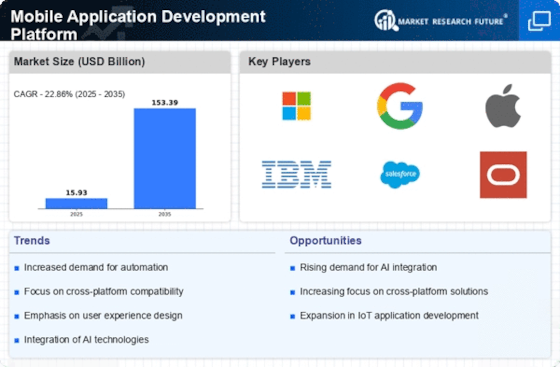
As per Market Research Future analysis, the Mobile Application Development Platform Market Size was estimated at 15.93 USD Billion in 2024. The Mobile Application Development Platform industry is projected to grow from 19.57 USD Billion in 2025 to 153.39 USD Billion by 2035, exhibiting a compound annual growth rate (CAGR) of 22.86% during the forecast period 2025 - 2035

Key Market Trends & Highlights

The Mobile Application Development Platform Market is experiencing transformative growth driven by technological advancements and evolving user needs.

  • The rise of low-code development platforms is democratizing app creation, enabling users with minimal coding skills to participate. Integration of AI and machine learning is enhancing app functionalities, providing personalized user experiences and predictive analytics. In North America, the demand for robust security and compliance measures is shaping development practices, while Asia-Pacific is rapidly adopting innovative solutions. The increased demand for mobile applications and the emergence of cross-platform development are key drivers propelling growth in both cloud and on-premises segments.

Market Size & Forecast

2024 Market Size 15.93 (USD Billion)
2035 Market Size 153.39 (USD Billion)
CAGR (2025 - 2035) 22.86%
Largest Regional Market Share in 2024 Asia Pacific

Major Players

Microsoft (US), Google (US), Apple (US), IBM (US), Salesforce (US), Oracle (US), SAP (DE), Appian (US), OutSystems (PT), Mendix (NL)

Market Trends

The Mobile Application Development Platform Market is currently experiencing a dynamic evolution, driven by the increasing demand for mobile solutions across various sectors. Organizations are recognizing the necessity of agile development processes to keep pace with rapidly changing consumer preferences and technological advancements. This platform facilitates the creation of applications that are not only user-friendly but also capable of integrating with diverse systems and services. As businesses strive to enhance customer engagement and streamline operations, the emphasis on cross-platform compatibility and seamless user experiences becomes paramount. Furthermore, the rise of low-code and no-code development tools is democratizing app creation, allowing individuals with minimal technical expertise to contribute to the development process. This trend appears to be reshaping the landscape of mobile application development, fostering innovation and collaboration among teams. In addition, the Mobile Application Development Platform Market is likely to witness a surge in the adoption of artificial intelligence and machine learning technologies. These advancements may enable developers to create smarter applications that can learn from user interactions and provide personalized experiences. As security concerns continue to grow, platforms are also focusing on enhancing security features to protect sensitive data. Overall, the future of mobile application development seems promising, with continuous advancements paving the way for more sophisticated and efficient solutions.

Rise of Low-Code Development

The trend towards low-code development platforms is gaining traction, allowing users to create applications with minimal coding knowledge. This approach streamlines the development process, enabling faster deployment and reducing the reliance on specialized developers.

Integration of AI and Machine Learning

The incorporation of artificial intelligence and machine learning into mobile applications is becoming increasingly prevalent. These technologies enhance user experiences by providing personalized content and automating various tasks, thereby improving overall functionality.

Focus on Security and Compliance

As mobile applications handle sensitive information, there is a growing emphasis on security and compliance. Development platforms are prioritizing robust security measures to protect user data and ensure adherence to regulatory standards.

Mobile Application Development Platform Market Market Drivers

Integration of Advanced Analytics

The Mobile Application Development Platform Market is increasingly integrating advanced analytics capabilities into development tools. This integration allows businesses to gather and analyze user data effectively, leading to more informed decision-making and enhanced user experiences. As organizations seek to optimize their applications, the ability to leverage data analytics becomes crucial. Reports indicate that companies utilizing analytics in their mobile applications see a 20% increase in user engagement. This trend underscores the importance of data-driven strategies in application development. By incorporating analytics into their platforms, developers can provide businesses with insights that drive continuous improvement and innovation. Consequently, the Mobile Application Development Platform Industry is likely to evolve, focusing on tools that not only facilitate development but also empower businesses to harness the power of data.

Growing Emphasis on User Experience

The Mobile Application Development Platform Market is placing an increasing emphasis on user experience (UX) as a critical factor in application success. With the proliferation of mobile applications, users have become more discerning, expecting intuitive and engaging interfaces. Research indicates that 88% of users are less likely to return to an app after a bad experience, highlighting the necessity for platforms that prioritize UX design. As a result, development tools that offer features such as customizable templates and user-friendly interfaces are gaining traction. This focus on UX is likely to drive competition among development platforms, pushing them to innovate and enhance their offerings. By aligning with user expectations, the Mobile Application Development Platform Industry can foster greater customer satisfaction and retention, ultimately contributing to the overall growth of the sector.

Emergence of Cross-Platform Development

The Mobile Application Development Platform Market is witnessing a notable shift towards cross-platform development solutions. This trend allows developers to create applications that function seamlessly across multiple operating systems, such as iOS and Android, thereby reducing development time and costs. Recent statistics suggest that cross-platform frameworks account for approximately 30% of the mobile application market, reflecting a growing preference among developers for versatile solutions. By enabling a single codebase to serve various platforms, these development tools enhance efficiency and facilitate quicker updates. As businesses strive to reach a broader audience, the demand for cross-platform capabilities is likely to drive innovation within the Mobile Application Development Platform Industry, fostering a competitive landscape that prioritizes flexibility and user experience.

Increased Demand for Mobile Applications

The Mobile Application Development Platform Market is experiencing a surge in demand for mobile applications across various sectors. As businesses increasingly recognize the necessity of mobile presence, the need for efficient development platforms has become paramount. According to recent data, the mobile application market is projected to reach a valuation of over 407 billion USD by 2026, indicating a robust growth trajectory. This demand is driven by the proliferation of smartphones and the growing reliance on mobile solutions for everyday tasks. Consequently, development platforms that facilitate rapid application creation are becoming essential tools for businesses aiming to enhance customer engagement and streamline operations. The Mobile Application Development Platform Industry is thus positioned to benefit significantly from this trend, as organizations seek to leverage technology to meet consumer expectations.

Rise of Internet of Things (IoT) Applications

The Mobile Application Development Platform Market is experiencing a rise in the development of Internet of Things (IoT) applications. As IoT devices become more prevalent, the demand for mobile applications that can interact with these devices is increasing. This trend is supported by the projection that the number of connected IoT devices will reach 30 billion by 2030. Consequently, development platforms that facilitate the creation of IoT-enabled applications are becoming essential. These platforms must support various protocols and ensure seamless connectivity between devices and applications. The integration of IoT capabilities into mobile applications presents significant opportunities for innovation and growth within the Mobile Application Development Platform Industry. As businesses seek to capitalize on the potential of IoT, the demand for specialized development tools is likely to rise, shaping the future landscape of mobile application development.

Market Segment Insights

By Deployment Type: Cloud (Largest) vs. On-Premises (Fastest-Growing)

<p>In the Mobile Application Development Platform market, the deployment type is predominantly cloud-based, leading the segment with its extensive adoption among businesses. This is driven by the advantages of scalability, accessibility, and cost-effectiveness that cloud solutions provide. On-premises deployment, while smaller in market share, is gaining traction as organizations increasingly seek data control and security, particularly in regulated industries. This trend reflects a shifting balance in deployment preferences as organizations seek to leverage the strengths of both cloud and on-premises options.</p>

<p>Deployment Type: Cloud (Dominant) vs. On-Premises (Emerging)</p>

<p>The cloud deployment model remains the dominant choice for many organizations using Mobile Application Development Platforms due to its flexibility and ease of integration with existing systems. It offers seamless updates and continuous delivery, making it appealing for developers looking to respond quickly to market demands. Meanwhile, the on-premises model is emerging as a strong contender, particularly for enterprises that prioritize data sovereignty and security. This segment allows organizations to maintain greater control over their applications and data, which is crucial for compliance with stringent industry regulations. Overall, the choice between cloud and on-premises reflects a diverse landscape, catering to varying organizational needs and growth trajectories.</p>

By Organization Size: Small & Medium Businesses (Largest) vs. Large Enterprises (Fastest-Growing)

<p>The Mobile Application Development Platform market is characterized by a significant share distribution between small and medium businesses (SMBs) and large enterprises. Currently, SMBs hold the largest portion of the market as they increasingly leverage mobile applications to enhance customer engagement and streamline operations. This shift is facilitated by the availability of affordable and user-friendly development tools tailored for their specific needs, ultimately strengthening their competitive presence in the market. On the other hand, large enterprises are recognized as the fastest-growing segment within this landscape. The rapid advance of digital transformation initiatives has led these organizations to invest heavily in mobile application development as a critical strategy to boost operational efficiency and adapt to evolving consumer expectations. Furthermore, the adoption of advanced technologies like AI and machine learning in app development is propelling growth and offering scalable solutions that meet complex enterprise requirements.</p>

<p>Small & Medium Businesses: Dominant vs. Large Enterprises: Emerging</p>

<p>In the Mobile Application Development Platform segment, small and medium businesses (SMBs) represent the dominant force, driven by their need for agility and effectiveness in reaching customers. Their smaller size allows for quicker decision-making processes, which is crucial in a fast-paced digital environment. These businesses are often more inclined to adopt innovative solutions that offer flexibility without requiring significant upfront investment. In contrast, large enterprises, although currently emerging, are swiftly changing the dynamics of the market. Their substantial resources allow for comprehensive mobile strategies, including integrating robust analytics, security, and user experience enhancements. As they adapt to technological advancements, their increased investment in mobile development signals a growing recognition of its importance in achieving their strategic objectives.</p>

Get more detailed insights about Mobile Application Development Platform Market Research Report- Global Forecast 2035

Regional Insights

North America : Innovation and Leadership Hub

North America is the largest market for Mobile Application Development Platforms, holding approximately 45% of the global market share. The region's growth is driven by high demand for mobile solutions across various sectors, including healthcare, finance, and retail. Regulatory support for digital transformation initiatives further catalyzes this growth, with government policies encouraging innovation and technology adoption. The United States is the leading country in this region, hosting major players like Microsoft, Google, and Apple. The competitive landscape is characterized by rapid technological advancements and a strong focus on user experience. Canada also plays a significant role, contributing to the market with its growing tech ecosystem. The presence of key players ensures a dynamic environment, fostering continuous innovation and development in mobile applications.

Europe : Emerging Market with Potential

Europe is witnessing a significant rise in the Mobile Application Development Platform Market, accounting for approximately 30% of the global share. The region's growth is fueled by increasing smartphone penetration and a shift towards digital services across industries. Regulatory frameworks, such as the EU's Digital Services Act, are promoting a secure and innovative digital environment, further driving demand for mobile applications. Leading countries in Europe include Germany, the UK, and France, each contributing to the competitive landscape with a mix of established firms and startups. Key players like SAP and Mendix are enhancing their offerings to meet the diverse needs of businesses. The region's focus on data privacy and security also shapes the development of mobile applications, ensuring compliance with stringent regulations while fostering innovation.

Asia-Pacific : Rapid Growth and Adoption

Asia-Pacific is emerging as a powerhouse in the Mobile Application Development Platform Market, holding around 20% of the global market share. The region's rapid urbanization, increasing internet connectivity, and a young population are key drivers of this growth. Government initiatives promoting digital economies and smart city projects are also significant catalysts, enhancing the demand for mobile applications across various sectors. Countries like China, India, and Japan are at the forefront of this growth, with a vibrant startup ecosystem and a strong presence of global tech giants. The competitive landscape is marked by innovation, with local players developing tailored solutions to meet regional needs. The presence of key players such as Oracle and Salesforce further strengthens the market, driving advancements in mobile application development.

Middle East and Africa : Emerging Market with Opportunities

The Middle East and Africa region is gradually establishing itself in the Mobile Application Development Platform Market, accounting for about 5% of the global share. The growth is driven by increasing smartphone adoption and a rising demand for mobile solutions in sectors like banking and education. Government initiatives aimed at enhancing digital infrastructure are also pivotal in fostering this growth, creating a conducive environment for mobile application development. Leading countries in this region include South Africa, the UAE, and Nigeria, each contributing to the competitive landscape with a mix of local and international players. The presence of key companies is growing, with a focus on developing solutions that cater to the unique needs of the region. The market is characterized by a strong emphasis on innovation and adaptability, ensuring that mobile applications meet the evolving demands of users.

Key Players and Competitive Insights

Leading market players are investing heavily in research and development in order to expand their product lines, which will help the Mobile Application Development Platform Market grow even more. Market participants are also undertaking a various strategic activities to expand their global footprint, with important market developments including new product launches, contractual agreements, mergers and acquisitions, higher investments, and collaboration with other organizations. To expand and survive in a more competitive and rising market climate, the Mobile Application Development Platform industry must offer cost-effective items.
Manufacturing locally to minimize operational costs is one of the key business tactics used by manufacturers in the global Mobile Application Development Platform industry to benefit clients and increase the market sector. In recent years, the Mobile Application Development Platform industry has offered some of the most significant advantages to the commercial section. Major players in the Mobile Application Development Platform Market, including IBM Corporation, Jigx inc, Yudiz Solutions Ltd., Kony Inc., EchoStar Corporation, Oracle Corporation, Progress Software Corporation, Halosys, ViaSat Inc., Globo, and others, are attempting to increase market demand by investing in research and development operations.
IBM is a multinational technology company which is headquartered in Armonk, New York. It was founded as the Computing-Tabulating-Recording Company in the year 1911 and was later renamed IBM in 1924. IBM is one of the largest IT companies globally, operating in more than 170 countries. The company specializes in computer middleware, software, and hardware and offers consulting services and hosting in areas ranging from mainframe computers to nanotechnology. It is the largest industrial research organization that has 19 research facilities throughout the country.
In June 2016, MobileFirst Foundation design was launched by IBM as a mobile application development platform that offers a range of characteristics related to cloud technology. It is the V8.0 version that empowers organizations to take a radically simplified approach to managing, building, and updating their mobile applications.
Jigx Inc, founded in 2020, and headquartered in Seattle, is a company that uses the Jigx Platform to raise sales and mobilize business processes while minimizing the cost and time of mobile app development.
In May they announced the general availability of the Jigx mobile platforms, providing the world of native mobile app development to a large number of developers in the world. All the developers can download Jigx Builder and offer their first enterprise-grade mobile app within a few days.
Its powerful out-of-box functionality simplifies various capabilities for mobile business apps, like user authentication, backend data sources, offline syncing, branding, and publishing to app stores.

Key Companies in the Mobile Application Development Platform Market include

Industry Developments

The development platform Flowstate, which Alphabet released as its first product in 2023, is intended to fulfil some of those promises. Non-robotists can use the software to assist in creating processes for various hardware systems.   With the goal of becoming the top publisher of non-gaming mobile apps, mobile app publisher and development studio MWM today announced the establishment of its new publishing business unit targeted at the US market. This expansion is another step in MWM's attempts to create a global ecosystem of talented developers that will allow mobile consumers all over the world to use their cellphones for more than just media consumption. It is typically challenging to design proprietary software for these robotics systems, and it is incompatible with third-party systems.   The most recent version of Digital.ai's AI-powered DevOps platform, Corbett, was released in 2023 with the goal of enabling businesses to deliver applications with improved user experiences while boosting the productivity of software development teams. According to the business, Corbett has improved intelligence capabilities that allow teams and organisations, not just individuals, to better harness the power of AI to produce better software. From development through to production,  Digital.ai now centralises and integrates data from more sources, including Digital.ai products and third-party software tools, so teams can avoid siloed reports and analytics and utilise the power of AI to make predictions about potential outcomes based on past performance. With the release of the visionOS software development kit in 2023, 3D parties will be able to start creating content for the Vision Pro. The $3,500 SDK is accessible at least six months before the headgear is actually made available for purchase in the United States. The system, which had a muted response when it was revealed at WWDC earlier this month, is relying on developer engagement to help generate excitement.

May 2023: Yudiz Solutions Ltd, an enterprise technology company that specializes in AI, gaming, and blockchain, received approval from NSE for an SME Initial Public Offering (IPO). Ahemdabad-based technology service provider plans to invest eight crore rupees to fund the state-of-the-art gaming studio and a multi-gaming platform.

January 2022: Solace Nutrition, a US-based medical nutrition company, bought R-Kane Nutritionals' assets for an unknown sum. This asset acquisition enables Solace Nutrition to develop synergy between both brands, accelerate growth, and establish a position in an adjacent nutrition sector. R-Kane Nutritionals is a firm established in the United States that specializes in high-protein meal replacement products for weight loss.

February 2021: Hydroxycut's newest creation, CUT Energy, a delectable clean energy drink, was released. This powerful mix was carefully formulated for regular energy drink consumers, exercise enthusiasts, and dieters looking to lose weight.

Future Outlook

Mobile Application Development Platform Market Future Outlook

The Mobile Application Development Platform Market is poised for growth at 22.86% CAGR from 2025 to 2035, driven by increasing mobile device usage, demand for cross-platform solutions, and advancements in AI technologies.

New opportunities lie in:

  • <p>Integration of AI-driven analytics for user behavior insights. Development of low-code platforms for rapid application deployment. Expansion into emerging markets with localized app solutions.</p>

By 2035, the market is expected to be robust, reflecting substantial growth and innovation.

Market Segmentation

Mobile Application Development Platform Market Deployment Type Outlook

  • On-Premises
  • Cloud

Mobile Application Development Platform Market Organization Size Outlook

  • Small & Medium Businesses
  • Large Enterprises

Report Scope

MARKET SIZE 2024 15.93(USD Billion)
MARKET SIZE 2025 19.57(USD Billion)
MARKET SIZE 2035 153.39(USD Billion)
COMPOUND ANNUAL GROWTH RATE (CAGR) 22.86% (2025 - 2035)
REPORT COVERAGE Revenue Forecast, Competitive Landscape, Growth Factors, and Trends
BASE YEAR 2024
Market Forecast Period 2025 - 2035
Historical Data 2019 - 2024
Market Forecast Units USD Billion
Key Companies Profiled Microsoft (US), Google (US), Apple (US), IBM (US), Salesforce (US), Oracle (US), SAP (DE), Appian (US), OutSystems (PT), Mendix (NL)
Segments Covered Deployment Type, Organization Size, Region
Key Market Opportunities Integration of artificial intelligence and machine learning enhances user experience in Mobile Application Development Platform.
Key Market Dynamics Rising demand for cross-platform solutions drives innovation in mobile application development platforms amid competitive pressures.
Countries Covered North America, Europe, APAC, South America, MEA

FAQs

What is the current market valuation of the Mobile Application Development Platform?

<p>The market valuation of the Mobile Application Development Platform was 15.93 USD Billion in 2024.</p>

What is the projected market size for the Mobile Application Development Platform by 2035?

<p>The projected market size for the Mobile Application Development Platform is 153.39 USD Billion by 2035.</p>

What is the expected CAGR for the Mobile Application Development Platform from 2025 to 2035?

<p>The expected CAGR for the Mobile Application Development Platform during the forecast period 2025 - 2035 is 22.86%.</p>

Which companies are considered key players in the Mobile Application Development Platform market?

<p>Key players in the Mobile Application Development Platform market include Microsoft, Google, Apple, IBM, Salesforce, Oracle, SAP, Appian, OutSystems, and Mendix.</p>

How does the deployment type segment perform in the Mobile Application Development Platform market?

<p>In the deployment type segment, the On-Premises market was valued at 5.0 USD Billion, while the Cloud segment reached 10.93 USD Billion in 2024.</p>

What is the market valuation for small and medium businesses in the Mobile Application Development Platform sector?

<p>The market valuation for small and medium businesses in the Mobile Application Development Platform sector was 5.0 USD Billion in 2024.</p>

What is the market size for large enterprises in the Mobile Application Development Platform market?

The market size for large enterprises in the Mobile Application Development Platform market was 10.93 USD Billion in 2024.

How does the Mobile Application Development Platform market compare between small businesses and large enterprises?

The Mobile Application Development Platform market indicates a notable difference, with large enterprises valued at 10.93 USD Billion compared to 5.0 USD Billion for small and medium businesses in 2024.

What trends are expected to shape the Mobile Application Development Platform market in the coming years?

Trends suggest that the Mobile Application Development Platform market will experience substantial growth, driven by advancements in technology and increasing demand for mobile applications.

What factors contribute to the growth of the Mobile Application Development Platform market?

Factors contributing to the growth of the Mobile Application Development Platform market include the rising adoption of cloud solutions and the increasing need for mobile applications across various industries.

  1. SECTION I: EXECUTIVE SUMMARY AND KEY HIGHLIGHTS
    1. | 1.1 EXECUTIVE SUMMARY
    2. | | 1.1.1 Market Overview
    3. | | 1.1.2 Key Findings
    4. | | 1.1.3 Market Segmentation
    5. | | 1.1.4 Competitive Landscape
    6. | | 1.1.5 Challenges and Opportunities
    7. | | 1.1.6 Future Outlook
  2. SECTION II: SCOPING, METHODOLOGY AND MARKET STRUCTURE
    1. | 2.1 MARKET INTRODUCTION
    2. | | 2.1.1 Definition
    3. | | 2.1.2 Scope of the study
    4. | | | 2.1.2.1 Research Objective
    5. | | | 2.1.2.2 Assumption
    6. | | | 2.1.2.3 Limitations
    7. | 2.2 RESEARCH METHODOLOGY
    8. | | 2.2.1 Overview
    9. | | 2.2.2 Data Mining
    10. | | 2.2.3 Secondary Research
    11. | | 2.2.4 Primary Research
    12. | | | 2.2.4.1 Primary Interviews and Information Gathering Process
    13. | | | 2.2.4.2 Breakdown of Primary Respondents
    14. | | 2.2.5 Forecasting Model
    15. | | 2.2.6 Market Size Estimation
    16. | | | 2.2.6.1 Bottom-Up Approach
    17. | | | 2.2.6.2 Top-Down Approach
    18. | | 2.2.7 Data Triangulation
    19. | | 2.2.8 Validation
  3. SECTION III: QUALITATIVE ANALYSIS
    1. | 3.1 MARKET DYNAMICS
    2. | | 3.1.1 Overview
    3. | | 3.1.2 Drivers
    4. | | 3.1.3 Restraints
    5. | | 3.1.4 Opportunities
    6. | 3.2 MARKET FACTOR ANALYSIS
    7. | | 3.2.1 Value chain Analysis
    8. | | 3.2.2 Porter's Five Forces Analysis
    9. | | | 3.2.2.1 Bargaining Power of Suppliers
    10. | | | 3.2.2.2 Bargaining Power of Buyers
    11. | | | 3.2.2.3 Threat of New Entrants
    12. | | | 3.2.2.4 Threat of Substitutes
    13. | | | 3.2.2.5 Intensity of Rivalry
    14. | | 3.2.3 COVID-19 Impact Analysis
    15. | | | 3.2.3.1 Market Impact Analysis
    16. | | | 3.2.3.2 Regional Impact
    17. | | | 3.2.3.3 Opportunity and Threat Analysis
  4. SECTION IV: QUANTITATIVE ANALYSIS
    1. | 4.1 Information and Communications Technology, BY Deployment Type (USD Billion)
    2. | | 4.1.1 On-Premises
    3. | | 4.1.2 Cloud
    4. | 4.2 Information and Communications Technology, BY Organization Size (USD Billion)
    5. | | 4.2.1 Small & Medium Businesses
    6. | | 4.2.2 Large Enterprises
    7. | 4.3 Information and Communications Technology, BY Region (USD Billion)
    8. | | 4.3.1 North America
    9. | | | 4.3.1.1 US
    10. | | | 4.3.1.2 Canada
    11. | | 4.3.2 Europe
    12. | | | 4.3.2.1 Germany
    13. | | | 4.3.2.2 UK
    14. | | | 4.3.2.3 France
    15. | | | 4.3.2.4 Russia
    16. | | | 4.3.2.5 Italy
    17. | | | 4.3.2.6 Spain
    18. | | | 4.3.2.7 Rest of Europe
    19. | | 4.3.3 APAC
    20. | | | 4.3.3.1 China
    21. | | | 4.3.3.2 India
    22. | | | 4.3.3.3 Japan
    23. | | | 4.3.3.4 South Korea
    24. | | | 4.3.3.5 Malaysia
    25. | | | 4.3.3.6 Thailand
    26. | | | 4.3.3.7 Indonesia
    27. | | | 4.3.3.8 Rest of APAC
    28. | | 4.3.4 South America
    29. | | | 4.3.4.1 Brazil
    30. | | | 4.3.4.2 Mexico
    31. | | | 4.3.4.3 Argentina
    32. | | | 4.3.4.4 Rest of South America
    33. | | 4.3.5 MEA
    34. | | | 4.3.5.1 GCC Countries
    35. | | | 4.3.5.2 South Africa
    36. | | | 4.3.5.3 Rest of MEA
  5. SECTION V: COMPETITIVE ANALYSIS
    1. | 5.1 Competitive Landscape
    2. | | 5.1.1 Overview
    3. | | 5.1.2 Competitive Analysis
    4. | | 5.1.3 Market share Analysis
    5. | | 5.1.4 Major Growth Strategy in the Information and Communications Technology
    6. | | 5.1.5 Competitive Benchmarking
    7. | | 5.1.6 Leading Players in Terms of Number of Developments in the Information and Communications Technology
    8. | | 5.1.7 Key developments and growth strategies
    9. | | | 5.1.7.1 New Product Launch/Service Deployment
    10. | | | 5.1.7.2 Merger & Acquisitions
    11. | | | 5.1.7.3 Joint Ventures
    12. | | 5.1.8 Major Players Financial Matrix
    13. | | | 5.1.8.1 Sales and Operating Income
    14. | | | 5.1.8.2 Major Players R&D Expenditure. 2023
    15. | 5.2 Company Profiles
    16. | | 5.2.1 Microsoft (US)
    17. | | | 5.2.1.1 Financial Overview
    18. | | | 5.2.1.2 Products Offered
    19. | | | 5.2.1.3 Key Developments
    20. | | | 5.2.1.4 SWOT Analysis
    21. | | | 5.2.1.5 Key Strategies
    22. | | 5.2.2 Google (US)
    23. | | | 5.2.2.1 Financial Overview
    24. | | | 5.2.2.2 Products Offered
    25. | | | 5.2.2.3 Key Developments
    26. | | | 5.2.2.4 SWOT Analysis
    27. | | | 5.2.2.5 Key Strategies
    28. | | 5.2.3 Apple (US)
    29. | | | 5.2.3.1 Financial Overview
    30. | | | 5.2.3.2 Products Offered
    31. | | | 5.2.3.3 Key Developments
    32. | | | 5.2.3.4 SWOT Analysis
    33. | | | 5.2.3.5 Key Strategies
    34. | | 5.2.4 IBM (US)
    35. | | | 5.2.4.1 Financial Overview
    36. | | | 5.2.4.2 Products Offered
    37. | | | 5.2.4.3 Key Developments
    38. | | | 5.2.4.4 SWOT Analysis
    39. | | | 5.2.4.5 Key Strategies
    40. | | 5.2.5 Salesforce (US)
    41. | | | 5.2.5.1 Financial Overview
    42. | | | 5.2.5.2 Products Offered
    43. | | | 5.2.5.3 Key Developments
    44. | | | 5.2.5.4 SWOT Analysis
    45. | | | 5.2.5.5 Key Strategies
    46. | | 5.2.6 Oracle (US)
    47. | | | 5.2.6.1 Financial Overview
    48. | | | 5.2.6.2 Products Offered
    49. | | | 5.2.6.3 Key Developments
    50. | | | 5.2.6.4 SWOT Analysis
    51. | | | 5.2.6.5 Key Strategies
    52. | | 5.2.7 SAP (DE)
    53. | | | 5.2.7.1 Financial Overview
    54. | | | 5.2.7.2 Products Offered
    55. | | | 5.2.7.3 Key Developments
    56. | | | 5.2.7.4 SWOT Analysis
    57. | | | 5.2.7.5 Key Strategies
    58. | | 5.2.8 Appian (US)
    59. | | | 5.2.8.1 Financial Overview
    60. | | | 5.2.8.2 Products Offered
    61. | | | 5.2.8.3 Key Developments
    62. | | | 5.2.8.4 SWOT Analysis
    63. | | | 5.2.8.5 Key Strategies
    64. | | 5.2.9 OutSystems (PT)
    65. | | | 5.2.9.1 Financial Overview
    66. | | | 5.2.9.2 Products Offered
    67. | | | 5.2.9.3 Key Developments
    68. | | | 5.2.9.4 SWOT Analysis
    69. | | | 5.2.9.5 Key Strategies
    70. | | 5.2.10 Mendix (NL)
    71. | | | 5.2.10.1 Financial Overview
    72. | | | 5.2.10.2 Products Offered
    73. | | | 5.2.10.3 Key Developments
    74. | | | 5.2.10.4 SWOT Analysis
    75. | | | 5.2.10.5 Key Strategies
    76. | 5.3 Appendix
    77. | | 5.3.1 References
    78. | | 5.3.2 Related Reports
  6. LIST OF FIGURES
    1. | 6.1 MARKET SYNOPSIS
    2. | 6.2 NORTH AMERICA MARKET ANALYSIS
    3. | 6.3 US MARKET ANALYSIS BY DEPLOYMENT TYPE
    4. | 6.4 US MARKET ANALYSIS BY ORGANIZATION SIZE
    5. | 6.5 CANADA MARKET ANALYSIS BY DEPLOYMENT TYPE
    6. | 6.6 CANADA MARKET ANALYSIS BY ORGANIZATION SIZE
    7. | 6.7 EUROPE MARKET ANALYSIS
    8. | 6.8 GERMANY MARKET ANALYSIS BY DEPLOYMENT TYPE
    9. | 6.9 GERMANY MARKET ANALYSIS BY ORGANIZATION SIZE
    10. | 6.10 UK MARKET ANALYSIS BY DEPLOYMENT TYPE
    11. | 6.11 UK MARKET ANALYSIS BY ORGANIZATION SIZE
    12. | 6.12 FRANCE MARKET ANALYSIS BY DEPLOYMENT TYPE
    13. | 6.13 FRANCE MARKET ANALYSIS BY ORGANIZATION SIZE
    14. | 6.14 RUSSIA MARKET ANALYSIS BY DEPLOYMENT TYPE
    15. | 6.15 RUSSIA MARKET ANALYSIS BY ORGANIZATION SIZE
    16. | 6.16 ITALY MARKET ANALYSIS BY DEPLOYMENT TYPE
    17. | 6.17 ITALY MARKET ANALYSIS BY ORGANIZATION SIZE
    18. | 6.18 SPAIN MARKET ANALYSIS BY DEPLOYMENT TYPE
    19. | 6.19 SPAIN MARKET ANALYSIS BY ORGANIZATION SIZE
    20. | 6.20 REST OF EUROPE MARKET ANALYSIS BY DEPLOYMENT TYPE
    21. | 6.21 REST OF EUROPE MARKET ANALYSIS BY ORGANIZATION SIZE
    22. | 6.22 APAC MARKET ANALYSIS
    23. | 6.23 CHINA MARKET ANALYSIS BY DEPLOYMENT TYPE
    24. | 6.24 CHINA MARKET ANALYSIS BY ORGANIZATION SIZE
    25. | 6.25 INDIA MARKET ANALYSIS BY DEPLOYMENT TYPE
    26. | 6.26 INDIA MARKET ANALYSIS BY ORGANIZATION SIZE
    27. | 6.27 JAPAN MARKET ANALYSIS BY DEPLOYMENT TYPE
    28. | 6.28 JAPAN MARKET ANALYSIS BY ORGANIZATION SIZE
    29. | 6.29 SOUTH KOREA MARKET ANALYSIS BY DEPLOYMENT TYPE
    30. | 6.30 SOUTH KOREA MARKET ANALYSIS BY ORGANIZATION SIZE
    31. | 6.31 MALAYSIA MARKET ANALYSIS BY DEPLOYMENT TYPE
    32. | 6.32 MALAYSIA MARKET ANALYSIS BY ORGANIZATION SIZE
    33. | 6.33 THAILAND MARKET ANALYSIS BY DEPLOYMENT TYPE
    34. | 6.34 THAILAND MARKET ANALYSIS BY ORGANIZATION SIZE
    35. | 6.35 INDONESIA MARKET ANALYSIS BY DEPLOYMENT TYPE
    36. | 6.36 INDONESIA MARKET ANALYSIS BY ORGANIZATION SIZE
    37. | 6.37 REST OF APAC MARKET ANALYSIS BY DEPLOYMENT TYPE
    38. | 6.38 REST OF APAC MARKET ANALYSIS BY ORGANIZATION SIZE
    39. | 6.39 SOUTH AMERICA MARKET ANALYSIS
    40. | 6.40 BRAZIL MARKET ANALYSIS BY DEPLOYMENT TYPE
    41. | 6.41 BRAZIL MARKET ANALYSIS BY ORGANIZATION SIZE
    42. | 6.42 MEXICO MARKET ANALYSIS BY DEPLOYMENT TYPE
    43. | 6.43 MEXICO MARKET ANALYSIS BY ORGANIZATION SIZE
    44. | 6.44 ARGENTINA MARKET ANALYSIS BY DEPLOYMENT TYPE
    45. | 6.45 ARGENTINA MARKET ANALYSIS BY ORGANIZATION SIZE
    46. | 6.46 REST OF SOUTH AMERICA MARKET ANALYSIS BY DEPLOYMENT TYPE
    47. | 6.47 REST OF SOUTH AMERICA MARKET ANALYSIS BY ORGANIZATION SIZE
    48. | 6.48 MEA MARKET ANALYSIS
    49. | 6.49 GCC COUNTRIES MARKET ANALYSIS BY DEPLOYMENT TYPE
    50. | 6.50 GCC COUNTRIES MARKET ANALYSIS BY ORGANIZATION SIZE
    51. | 6.51 SOUTH AFRICA MARKET ANALYSIS BY DEPLOYMENT TYPE
    52. | 6.52 SOUTH AFRICA MARKET ANALYSIS BY ORGANIZATION SIZE
    53. | 6.53 REST OF MEA MARKET ANALYSIS BY DEPLOYMENT TYPE
    54. | 6.54 REST OF MEA MARKET ANALYSIS BY ORGANIZATION SIZE
    55. | 6.55 KEY BUYING CRITERIA OF INFORMATION AND COMMUNICATIONS TECHNOLOGY
    56. | 6.56 RESEARCH PROCESS OF MRFR
    57. | 6.57 DRO ANALYSIS OF INFORMATION AND COMMUNICATIONS TECHNOLOGY
    58. | 6.58 DRIVERS IMPACT ANALYSIS: INFORMATION AND COMMUNICATIONS TECHNOLOGY
    59. | 6.59 RESTRAINTS IMPACT ANALYSIS: INFORMATION AND COMMUNICATIONS TECHNOLOGY
    60. | 6.60 SUPPLY / VALUE CHAIN: INFORMATION AND COMMUNICATIONS TECHNOLOGY
    61. | 6.61 INFORMATION AND COMMUNICATIONS TECHNOLOGY, BY DEPLOYMENT TYPE, 2024 (% SHARE)
    62. | 6.62 INFORMATION AND COMMUNICATIONS TECHNOLOGY, BY DEPLOYMENT TYPE, 2024 TO 2035 (USD Billion)
    63. | 6.63 INFORMATION AND COMMUNICATIONS TECHNOLOGY, BY ORGANIZATION SIZE, 2024 (% SHARE)
    64. | 6.64 INFORMATION AND COMMUNICATIONS TECHNOLOGY, BY ORGANIZATION SIZE, 2024 TO 2035 (USD Billion)
    65. | 6.65 BENCHMARKING OF MAJOR COMPETITORS
  7. LIST OF TABLES
    1. | 7.1 LIST OF ASSUMPTIONS
    2. | | 7.1.1
    3. | 7.2 North America MARKET SIZE ESTIMATES; FORECAST
    4. | | 7.2.1 BY DEPLOYMENT TYPE, 2025-2035 (USD Billion)
    5. | | 7.2.2 BY ORGANIZATION SIZE, 2025-2035 (USD Billion)
    6. | 7.3 US MARKET SIZE ESTIMATES; FORECAST
    7. | | 7.3.1 BY DEPLOYMENT TYPE, 2025-2035 (USD Billion)
    8. | | 7.3.2 BY ORGANIZATION SIZE, 2025-2035 (USD Billion)
    9. | 7.4 Canada MARKET SIZE ESTIMATES; FORECAST
    10. | | 7.4.1 BY DEPLOYMENT TYPE, 2025-2035 (USD Billion)
    11. | | 7.4.2 BY ORGANIZATION SIZE, 2025-2035 (USD Billion)
    12. | 7.5 Europe MARKET SIZE ESTIMATES; FORECAST
    13. | | 7.5.1 BY DEPLOYMENT TYPE, 2025-2035 (USD Billion)
    14. | | 7.5.2 BY ORGANIZATION SIZE, 2025-2035 (USD Billion)
    15. | 7.6 Germany MARKET SIZE ESTIMATES; FORECAST
    16. | | 7.6.1 BY DEPLOYMENT TYPE, 2025-2035 (USD Billion)
    17. | | 7.6.2 BY ORGANIZATION SIZE, 2025-2035 (USD Billion)
    18. | 7.7 UK MARKET SIZE ESTIMATES; FORECAST
    19. | | 7.7.1 BY DEPLOYMENT TYPE, 2025-2035 (USD Billion)
    20. | | 7.7.2 BY ORGANIZATION SIZE, 2025-2035 (USD Billion)
    21. | 7.8 France MARKET SIZE ESTIMATES; FORECAST
    22. | | 7.8.1 BY DEPLOYMENT TYPE, 2025-2035 (USD Billion)
    23. | | 7.8.2 BY ORGANIZATION SIZE, 2025-2035 (USD Billion)
    24. | 7.9 Russia MARKET SIZE ESTIMATES; FORECAST
    25. | | 7.9.1 BY DEPLOYMENT TYPE, 2025-2035 (USD Billion)
    26. | | 7.9.2 BY ORGANIZATION SIZE, 2025-2035 (USD Billion)
    27. | 7.10 Italy MARKET SIZE ESTIMATES; FORECAST
    28. | | 7.10.1 BY DEPLOYMENT TYPE, 2025-2035 (USD Billion)
    29. | | 7.10.2 BY ORGANIZATION SIZE, 2025-2035 (USD Billion)
    30. | 7.11 Spain MARKET SIZE ESTIMATES; FORECAST
    31. | | 7.11.1 BY DEPLOYMENT TYPE, 2025-2035 (USD Billion)
    32. | | 7.11.2 BY ORGANIZATION SIZE, 2025-2035 (USD Billion)
    33. | 7.12 Rest of Europe MARKET SIZE ESTIMATES; FORECAST
    34. | | 7.12.1 BY DEPLOYMENT TYPE, 2025-2035 (USD Billion)
    35. | | 7.12.2 BY ORGANIZATION SIZE, 2025-2035 (USD Billion)
    36. | 7.13 APAC MARKET SIZE ESTIMATES; FORECAST
    37. | | 7.13.1 BY DEPLOYMENT TYPE, 2025-2035 (USD Billion)
    38. | | 7.13.2 BY ORGANIZATION SIZE, 2025-2035 (USD Billion)
    39. | 7.14 China MARKET SIZE ESTIMATES; FORECAST
    40. | | 7.14.1 BY DEPLOYMENT TYPE, 2025-2035 (USD Billion)
    41. | | 7.14.2 BY ORGANIZATION SIZE, 2025-2035 (USD Billion)
    42. | 7.15 India MARKET SIZE ESTIMATES; FORECAST
    43. | | 7.15.1 BY DEPLOYMENT TYPE, 2025-2035 (USD Billion)
    44. | | 7.15.2 BY ORGANIZATION SIZE, 2025-2035 (USD Billion)
    45. | 7.16 Japan MARKET SIZE ESTIMATES; FORECAST
    46. | | 7.16.1 BY DEPLOYMENT TYPE, 2025-2035 (USD Billion)
    47. | | 7.16.2 BY ORGANIZATION SIZE, 2025-2035 (USD Billion)
    48. | 7.17 South Korea MARKET SIZE ESTIMATES; FORECAST
    49. | | 7.17.1 BY DEPLOYMENT TYPE, 2025-2035 (USD Billion)
    50. | | 7.17.2 BY ORGANIZATION SIZE, 2025-2035 (USD Billion)
    51. | 7.18 Malaysia MARKET SIZE ESTIMATES; FORECAST
    52. | | 7.18.1 BY DEPLOYMENT TYPE, 2025-2035 (USD Billion)
    53. | | 7.18.2 BY ORGANIZATION SIZE, 2025-2035 (USD Billion)
    54. | 7.19 Thailand MARKET SIZE ESTIMATES; FORECAST
    55. | | 7.19.1 BY DEPLOYMENT TYPE, 2025-2035 (USD Billion)
    56. | | 7.19.2 BY ORGANIZATION SIZE, 2025-2035 (USD Billion)
    57. | 7.20 Indonesia MARKET SIZE ESTIMATES; FORECAST
    58. | | 7.20.1 BY DEPLOYMENT TYPE, 2025-2035 (USD Billion)
    59. | | 7.20.2 BY ORGANIZATION SIZE, 2025-2035 (USD Billion)
    60. | 7.21 Rest of APAC MARKET SIZE ESTIMATES; FORECAST
    61. | | 7.21.1 BY DEPLOYMENT TYPE, 2025-2035 (USD Billion)
    62. | | 7.21.2 BY ORGANIZATION SIZE, 2025-2035 (USD Billion)
    63. | 7.22 South America MARKET SIZE ESTIMATES; FORECAST
    64. | | 7.22.1 BY DEPLOYMENT TYPE, 2025-2035 (USD Billion)
    65. | | 7.22.2 BY ORGANIZATION SIZE, 2025-2035 (USD Billion)
    66. | 7.23 Brazil MARKET SIZE ESTIMATES; FORECAST
    67. | | 7.23.1 BY DEPLOYMENT TYPE, 2025-2035 (USD Billion)
    68. | | 7.23.2 BY ORGANIZATION SIZE, 2025-2035 (USD Billion)
    69. | 7.24 Mexico MARKET SIZE ESTIMATES; FORECAST
    70. | | 7.24.1 BY DEPLOYMENT TYPE, 2025-2035 (USD Billion)
    71. | | 7.24.2 BY ORGANIZATION SIZE, 2025-2035 (USD Billion)
    72. | 7.25 Argentina MARKET SIZE ESTIMATES; FORECAST
    73. | | 7.25.1 BY DEPLOYMENT TYPE, 2025-2035 (USD Billion)
    74. | | 7.25.2 BY ORGANIZATION SIZE, 2025-2035 (USD Billion)
    75. | 7.26 Rest of South America MARKET SIZE ESTIMATES; FORECAST
    76. | | 7.26.1 BY DEPLOYMENT TYPE, 2025-2035 (USD Billion)
    77. | | 7.26.2 BY ORGANIZATION SIZE, 2025-2035 (USD Billion)
    78. | 7.27 MEA MARKET SIZE ESTIMATES; FORECAST
    79. | | 7.27.1 BY DEPLOYMENT TYPE, 2025-2035 (USD Billion)
    80. | | 7.27.2 BY ORGANIZATION SIZE, 2025-2035 (USD Billion)
    81. | 7.28 GCC Countries MARKET SIZE ESTIMATES; FORECAST
    82. | | 7.28.1 BY DEPLOYMENT TYPE, 2025-2035 (USD Billion)
    83. | | 7.28.2 BY ORGANIZATION SIZE, 2025-2035 (USD Billion)
    84. | 7.29 South Africa MARKET SIZE ESTIMATES; FORECAST
    85. | | 7.29.1 BY DEPLOYMENT TYPE, 2025-2035 (USD Billion)
    86. | | 7.29.2 BY ORGANIZATION SIZE, 2025-2035 (USD Billion)
    87. | 7.30 Rest of MEA MARKET SIZE ESTIMATES; FORECAST
    88. | | 7.30.1 BY DEPLOYMENT TYPE, 2025-2035 (USD Billion)
    89. | | 7.30.2 BY ORGANIZATION SIZE, 2025-2035 (USD Billion)
    90. | 7.31 PRODUCT LAUNCH/PRODUCT DEVELOPMENT/APPROVAL
    91. | | 7.31.1
    92. | 7.32 ACQUISITION/PARTNERSHIP
    93. | | 7.32.1

Information and Communications Technology Market Segmentation

Information and Communications Technology By Deployment Type (USD Billion, 2025-2035)

  • On-Premises
  • Cloud

Information and Communications Technology By Organization Size (USD Billion, 2025-2035)

  • Small & Medium Businesses
  • Large Enterprises
Infographic

Free Sample Request

Kindly complete the form below to receive a free sample of this Report

Get Free Sample

Customer Strories

Compare Licence

×
Features License Type
Single User Multiuser License Enterprise User
Price $4,950 $5,950 $7,250
Maximum User Access Limit 1 User Upto 10 Users Unrestricted Access Throughout the Organization
Free Customization
Direct Access to Analyst
Deliverable Format
Platform Access
Discount on Next Purchase 10% 15% 15%
Printable Versions