Request Free Sample ×

Kindly complete the form below to receive a free sample of this Report

* Please use a valid business email

Leading companies partner with us for data-driven Insights

clients tt-cursor
Hero Background
English
Chinese
French
Japanese
Korean
German
Spanish

Mobile App Development Market Analysis

ID: MRFR/ICT/1220-HCR
110 Pages
Ankit Gupta
December 2024

Mobile App Development Market Size, Share and Trends Analysis Report by Platform (IOS, Android), by Application (E-commerce, Banking, Entertainment), And By Region (North America, Europe, Asia-Pacific, And Rest Of The World) – Market Forecast Till 2035

Share:
Download PDF ×

We do not share your information with anyone. However, we may send you emails based on your report interest from time to time. You may contact us at any time to opt-out.

Mobile App Development Market Infographic
Purchase Options

Market Analysis

In-depth Analysis of Mobile App Development Market Industry Landscape

The more sophisticated and popular among consumers become smartphones and tablets, the higher come the need for attractive, useful applications that can run on them. The business environment of the mobile app development industry is impacted by these factors, which determine growth trends and directions. Today's users look for applications that suit their needs as well those with an intuitive user experience. To answer to these increasingly aspiring demands, developers must stay abreast of the most advanced developments in aesthetics and functionality as well as interface development. In addition, the frequent changes in mobile operating systems mean that developers must constantly adapt their applications for use on different platforms. The dynamic nature of this market is thus added to by another factor. In addition, the competitive situation has a heavy impact on mobile app development market dynamics. When there are millions of apps to choose from across several app stores, getting one's products noticed is no easy feat for developers. This competition encourages innovation as developers strive to provide new features, enhanced user interfaces, and solutions to fresh issues. Developers employ monetization strategies that alter market dynamics to generate revenue and sustain their enterprises, such as freeware designs, app purchases, and services that are subscription-based. The global economy is a significant factor that affects the mobile app development industry. The amount of money customers spends on handheld devices and the willingness of businesses to create apps are influenced by the status of the economy. During recessions, companies might cut back on app development attempts, and consumers might become more frugal, which would impede the market's overall expansion. Conversely, economic growth could lead to increased investment in digital initiatives and a growth in the demand for mobile apps. As the selection of mobile applications continues to grow, users are becoming more selective. As a result, developers are prioritizing intuitive and visually appealing designs to differentiate their products in a crowded market. This focus on enhancing the user experience extends to app performance, responsiveness, loading times, and aesthetics. Programmers are therefore utilizing methods such as artificial intelligence and machine learning to analyze user behavior and personalize app experiences according to preferences.


Author
Author Profile
Ankit Gupta
Team Lead - Research

Ankit Gupta is a seasoned market intelligence and strategic research professional with over six plus years of experience in the ICT and Semiconductor industries. With academic roots in Telecom, Marketing, and Electronics, he blends technical insight with business strategy. Ankit has led 200+ projects, including work for Fortune 500 clients like Microsoft and Rio Tinto, covering market sizing, tech forecasting, and go-to-market strategies. Known for bridging engineering and enterprise decision-making, his insights support growth, innovation, and investment planning across diverse technology markets.

Leave a Comment

FAQs

What is the current valuation of the Mobile App Development Market?

<p>As of 2024, the Mobile App Development Market was valued at 94.4 USD Billion.</p>

What is the projected market size for the Mobile App Development Market in 2035?

<p>The Mobile App Development Market is projected to reach 988.5 USD Billion by 2035.</p>

What is the expected CAGR for the Mobile App Development Market from 2025 to 2035?

<p>The expected CAGR for the Mobile App Development Market during the forecast period 2025 - 2035 is 23.8%.</p>

Which platforms dominate the Mobile App Development Market?

<p>The Mobile App Development Market is primarily segmented into iOS, valued at 400.0 USD Billion, and Android, valued at 588.5 USD Billion.</p>

What are the leading application segments in the Mobile App Development Market?

<p>Key application segments include E-commerce at 320.0 USD Billion, Banking at 250.0 USD Billion, and Entertainment at 418.5 USD Billion.</p>

Who are the key players in the Mobile App Development Market?

<p>Key players include Apple Inc, Google LLC, Microsoft Corporation, Facebook, Inc., Amazon.com, Inc., Samsung Electronics, Tencent Holdings, Alibaba Group, and IBM Corporation.</p>

How has the Mobile App Development Market evolved since 2024?

Since 2024, the Mobile App Development Market has shown substantial growth, with projections indicating a significant increase in valuation by 2035.

What factors contribute to the growth of the Mobile App Development Market?

Factors contributing to growth include advancements in technology, increasing smartphone penetration, and rising demand for mobile applications across various sectors.

What role do major companies play in the Mobile App Development Market?

Major companies like Apple Inc and Google LLC lead the market, influencing trends and driving innovation in mobile app development.

What is the significance of the Mobile App Development Market for businesses?

The Mobile App Development Market is crucial for businesses as it enables them to reach consumers effectively, enhance customer engagement, and drive revenue growth.

Market Summary

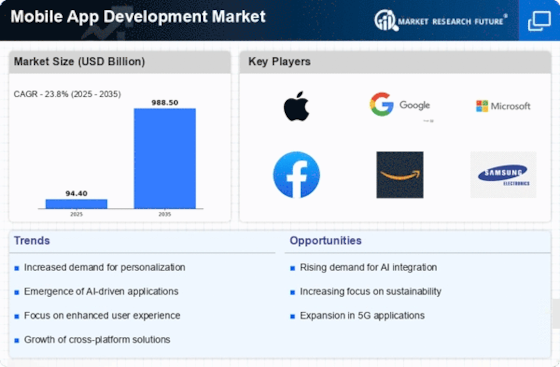
As per Market Research Future analysis, the Mobile App Development Market Size was estimated at 94.4 USD Billion in 2024. The Mobile App Development industry is projected to grow from 116.87 USD Billion in 2025 to 988.5 USD Billion by 2035, exhibiting a compound annual growth rate (CAGR) of 23.8% during the forecast period 2025 - 2035

Key Market Trends & Highlights

The Mobile App Development Market is experiencing dynamic growth driven by technological advancements and evolving consumer preferences.

  • The rise of cross-platform development is reshaping how applications are built and deployed across various platforms. Increased focus on user privacy is prompting developers to adopt more stringent data protection measures in their applications. Integration of AI and machine learning is enhancing user experiences and enabling more personalized app functionalities. Surge in smartphone penetration and expansion of e-commerce are key drivers fueling the growth of the mobile app development market, particularly in North America and Asia-Pacific.

Market Size & Forecast

2024 Market Size 94.4 (USD Billion)
2035 Market Size 988.5 (USD Billion)
CAGR (2025 - 2035) 23.8%
Largest Regional Market Share in 2024 North America

Major Players

<a href="https://www.apple.com/">Apple Inc </a>(US), Google LLC (US), Microsoft Corporation (US), Facebook, Inc. (US), Amazon.com, Inc. (US), <a href="https://www.samsung.com/">Samsung</a> Electronics Co., Ltd. (KR), Tencent Holdings Limited (CN), <a href="https://www.alibabagroup.com/">Alibaba Group Holding Limited</a> (CN), IBM Corporation (US)

Market Trends

The Mobile App Development Market is currently experiencing a dynamic evolution, driven by rapid technological advancements and shifting consumer preferences. As mobile devices become increasingly integral to daily life, the demand for innovative applications continues to rise. This market encompasses a diverse range of applications, from gaming and social networking to enterprise solutions and e-commerce platforms. Developers are now focusing on creating seamless user experiences, leveraging artificial intelligence and machine learning to enhance functionality and personalization. Furthermore, the integration of augmented reality and virtual reality technologies is reshaping how users interact with applications, suggesting a future where immersive experiences become commonplace. In addition to technological innovations, the Mobile App Development Market is also influenced by changing regulatory landscapes and privacy concerns. As users become more aware of data security, developers are prioritizing secure coding practices and transparent data handling. This shift not only fosters user trust but also aligns with global regulatory standards. The market appears poised for continued growth, with emerging trends indicating a potential increase in cross-platform development tools and low-code/no-code solutions, which may democratize app creation and empower a broader range of individuals to participate in the development process. Overall, the Mobile App Development Market is on a trajectory of transformation, characterized by creativity, security, and user-centric design.

Rise of Cross-Platform Development

The Mobile App Development Market is witnessing a notable shift towards cross-platform development frameworks. These tools enable developers to create applications that function seamlessly across various operating systems, reducing time and costs associated with building separate versions for each platform. This trend suggests a growing preference for efficiency and broader reach in application deployment.

Increased Focus on User Privacy

As concerns regarding data privacy intensify, the Mobile App Development Market is adapting by emphasizing user security. Developers are implementing robust encryption methods and transparent data practices to build trust with users. This trend indicates a proactive approach to compliance with evolving regulations and a commitment to safeguarding user information.

Integration of AI and Machine Learning

The incorporation of artificial intelligence and machine learning technologies is transforming the Mobile App Development Market. These innovations allow for enhanced personalization and smarter functionalities within applications. This trend suggests that developers are increasingly leveraging data analytics to create tailored user experiences, potentially leading to higher engagement and satisfaction.

Mobile App Development Market Market Drivers

Expansion of E-Commerce

The rapid expansion of e-commerce has profoundly influenced the Mobile App Development Market. With consumers increasingly preferring online shopping, businesses are investing in mobile applications to facilitate seamless transactions. In 2025, mobile commerce is projected to account for over 50% of total e-commerce sales, underscoring the necessity for businesses to develop mobile-friendly platforms. This shift not only enhances user experience but also allows companies to reach a broader audience. As a result, the demand for mobile app developers who can create secure, user-friendly e-commerce applications is likely to surge. The integration of features such as augmented reality and personalized recommendations further enhances the appeal of mobile shopping, driving growth in the app development sector.

Advancements in Technology

Technological advancements are a driving force in the Mobile App Development Market, as innovations such as 5G connectivity and cloud computing enhance app capabilities. The rollout of 5G technology is expected to revolutionize mobile applications by enabling faster data transfer and improved performance. This advancement allows developers to create more complex and feature-rich applications that can handle high volumes of data seamlessly. Additionally, cloud computing facilitates the development of scalable applications, enabling businesses to adapt to changing user demands. As these technologies continue to evolve, they present new opportunities for developers to innovate and differentiate their offerings in a competitive market. The integration of emerging technologies is likely to shape the future of mobile app development, driving further growth in the industry.

Surge in Smartphone Penetration

The proliferation of smartphones has catalyzed the Mobile App Development Market, as more individuals gain access to mobile technology. As of 2025, it is estimated that over 80% of the population in developed regions owns a smartphone, which significantly drives demand for mobile applications. This trend is not limited to personal use; businesses are increasingly leveraging mobile apps to enhance customer engagement and streamline operations. The rise in smartphone penetration is expected to continue, with projections indicating that the number of smartphone users could reach 6.5 billion by 2027. Consequently, this growing user base presents a lucrative opportunity for developers and businesses alike, as they seek to create innovative applications that cater to diverse consumer needs.

Growing Demand for On-Demand Services

The increasing demand for on-demand services is reshaping the Mobile App Development Market. Consumers now expect instant access to services ranging from food delivery to transportation, prompting businesses to develop applications that cater to these needs. The on-demand economy has seen substantial growth, with estimates suggesting that it could reach a valuation of over 335 billion dollars by 2025. This trend compels developers to create apps that not only provide convenience but also ensure reliability and efficiency. As more startups and established companies enter the on-demand space, the competition intensifies, leading to innovative app solutions that enhance user satisfaction. Consequently, the need for skilled developers who can navigate this dynamic landscape is becoming increasingly critical.

Increased Investment in Mobile Solutions

The surge in investment in mobile solutions is significantly impacting the Mobile App Development Market. Businesses are recognizing the importance of mobile applications in enhancing customer engagement and driving revenue growth. In 2025, it is anticipated that global spending on mobile app development will exceed 300 billion dollars, reflecting a robust commitment to mobile technology. This influx of capital enables developers to explore new ideas and create applications that meet evolving consumer expectations. Furthermore, as companies prioritize digital transformation, the demand for innovative mobile solutions is likely to rise. This trend not only fosters competition among developers but also encourages collaboration between tech firms and businesses, ultimately leading to a more dynamic and responsive app development landscape.

Market Segment Insights

By Platform: Android (Largest) vs. iOS (Fastest-Growing)

<p>In the Mobile App Development Market, the distribution of market share between iOS and Android platforms is distinctly polarized, with Android holding the lion's share. The popularity of Android is driven by its widespread adoption across devices, making it accessible to a broader demographic. In contrast, iOS, while smaller in overall market share, commands a loyal user base and consistently drives innovation in app development.</p>

<p>Platform: Android (Dominant) vs. iOS (Emerging)</p>

<p>Android has established itself as the dominant platform in mobile app development, supported by an extensive ecosystem that promotes a diverse range of applications. Its open-source nature allows developers flexibility and creativity. Conversely, iOS, though not dominating in numbers, is emerging as a crucial consideration for developers due to its affluent user base and higher app monetization potential. The competitive spirit between these two platforms fosters constant advancements, prompting developers to enhance user experiences and innovate features to capture market attention.</p>

By Application: E-commerce (Largest) vs. Banking (Fastest-Growing)

<p>The mobile app development market is witnessing a robust distribution across the application segment, primarily dominated by e-commerce apps. E-commerce applications command a significant share of the market, leveraging the growing trend of online shopping among consumers. Additionally, banking applications are rapidly gaining traction, appealing to consumers' needs for convenient and accessible banking services through mobile platforms. As users increasingly prefer digital transactions, the prioritization of these two segments is evident in the overall market dynamics. The growth trends within the application segment are particularly driven by technological advancements and changing consumer behaviors. E-commerce apps benefit from the increasing reliance on digital platforms for shopping, fueled by innovations in user experience and payment integrations. Meanwhile, banking apps are experiencing explosive growth, supported by the adoption of mobile banking, online financial services, and an overall trend of digitization in financial transactions. The shift towards mobile-first services clearly highlights the necessity for app development tailored to these sectors.</p>

<p>E-commerce (Dominant) vs. Banking (Emerging)</p>

<p>E-commerce apps are currently the dominant force in the mobile app development market, characterized by their extensive reach and engagement. The rise of e-commerce has transformed traditional retail, leading to an increased need for seamless and user-friendly shopping experiences on mobile devices. These apps incorporate features such as personalized recommendations, secure payment gateways, and social sharing functionalities to enhance user interaction and satisfaction. Brands are investing heavily in e-commerce app development to capture the growing consumer base that prefers shopping from their mobile devices. In contrast, banking apps are emerging rapidly as essential tools for performing financial transactions on the go. They focus on providing security, efficiency, and a range of services including account management, fund transfers, and investment tracking. The demand for banking apps is increasing as users seek to manage their finances conveniently and securely. Financial institutions are responding to this trend by developing innovative solutions, thus contributing to the significant growth observed in the banking application sector.</p>

Get more detailed insights about Mobile App Development Market Research Report- Global Forecast to 2035

Regional Insights

North America : Innovation and Market Leadership

North America remains the largest market for mobile app development, holding approximately 45% of the global market share. The region's growth is driven by high smartphone penetration, advanced technology infrastructure, and a strong emphasis on innovation. Regulatory support for tech startups and favorable investment climates further catalyze market expansion. The U.S. leads this market, followed closely by Canada, which contributes around 10% to the overall share. The competitive landscape in North America is characterized by the presence of major players such as Apple, Google, and Microsoft. These companies not only dominate the app development space but also drive trends in user experience and technology integration. The region's focus on emerging technologies like AI and AR in mobile applications positions it as a leader in the global market, fostering a vibrant ecosystem for developers and entrepreneurs alike.

Europe : Emerging Market with Growth Potential

Europe is witnessing significant growth in the mobile app development market, currently holding about 30% of the global share. The region benefits from a diverse consumer base and increasing smartphone adoption rates. Regulatory frameworks promoting digital innovation and data protection, such as GDPR, are also pivotal in shaping market dynamics. Germany and the UK are the largest contributors, together accounting for nearly 15% of the market share, driven by robust tech ecosystems and investment in digital infrastructure. Leading countries in Europe include Germany, the UK, and France, each fostering a competitive environment for app developers. The presence of key players like Spotify and Booking.com highlights the region's innovative spirit. Additionally, European startups are increasingly focusing on niche markets, enhancing the overall competitiveness of the region. As the demand for mobile solutions continues to rise, Europe is poised for further growth in the app development sector.

Asia-Pacific : Rapid Growth and Innovation

The Asia-Pacific region is rapidly emerging as a powerhouse in the mobile app development market, holding approximately 20% of the global share. This growth is fueled by rising smartphone penetration, increasing internet accessibility, and a young, tech-savvy population. Countries like China and India are at the forefront, with China alone accounting for nearly 15% of the market. Government initiatives promoting digital transformation and innovation are also significant growth drivers in this region. China, India, and Japan are the leading countries in the Asia-Pacific mobile app market. The competitive landscape is vibrant, with major players like Tencent and Alibaba leading the charge. The region is also home to numerous startups focusing on diverse app solutions, from e-commerce to gaming. As consumer preferences evolve, the demand for localized and innovative mobile applications continues to rise, positioning Asia-Pacific as a key player in the global market.

Middle East and Africa : Emerging Market with Untapped Potential

The Middle East and Africa (MEA) region is an emerging market in mobile app development, currently holding about 5% of the global share. The growth is driven by increasing smartphone adoption, a young population, and rising internet connectivity. Countries like South Africa and the UAE are leading this growth, with government initiatives aimed at fostering digital innovation and entrepreneurship. The region's market is expected to expand significantly as more consumers turn to mobile solutions for everyday needs. In the MEA region, South Africa and the UAE are the primary players in the mobile app development landscape. The presence of local startups and international companies is enhancing competition and innovation. Key players are increasingly focusing on developing apps tailored to local needs, such as e-commerce and fintech solutions. As the market matures, the potential for growth in mobile app development is substantial, making MEA a region to watch in the coming years.

Key Players and Competitive Insights

The Mobile App Development Market is currently characterized by a dynamic competitive landscape, driven by rapid technological advancements and evolving consumer preferences. Major players such as Apple Inc. (US), Google LLC (US), and Microsoft Corporation (US) are at the forefront, each adopting distinct strategies to enhance their market positioning. Apple Inc. (US) continues to focus on innovation, particularly in enhancing user experience through its App Store ecosystem, while Google LLC (US) emphasizes integration with its cloud services to facilitate seamless app development. Microsoft Corporation (US) is leveraging its Azure platform to provide robust support for developers, indicating a shift towards cloud-based solutions. Collectively, these strategies contribute to a competitive environment that is increasingly centered around technological innovation and user-centric design.
In terms of business tactics, companies are increasingly localizing their operations and optimizing supply chains to respond to regional demands. The market structure appears moderately fragmented, with a mix of established giants and emerging players. This fragmentation allows for diverse offerings, yet the influence of key players remains substantial, as they set industry standards and drive technological advancements. The collective actions of these companies shape a landscape where agility and responsiveness to market changes are paramount.
In August 2025, Apple Inc. (US) announced a significant update to its App Store policies, aimed at enhancing developer revenue sharing. This move is strategically important as it not only strengthens relationships with developers but also positions Apple as a more favorable platform for app creators, potentially increasing the diversity and quality of applications available to consumers. Such initiatives may lead to a more vibrant app ecosystem, fostering innovation and competition.
In September 2025, Google LLC (US) unveiled a new suite of tools designed to streamline app development processes, particularly for small and medium-sized enterprises. This strategic action underscores Google's commitment to democratizing app development, making it more accessible to a broader range of developers. By lowering barriers to entry, Google is likely to expand its market share and enhance its ecosystem, which could lead to increased competition among app developers.
In July 2025, Microsoft Corporation (US) entered into a partnership with several educational institutions to promote app development skills among students. This initiative not only addresses the growing demand for skilled developers but also positions Microsoft as a leader in fostering innovation through education. By investing in the next generation of developers, Microsoft is likely to secure a competitive advantage in the long term, as these individuals may contribute to its ecosystem in various capacities.
As of October 2025, the Mobile App Development Market is witnessing trends such as increased digitalization, a focus on sustainability, and the integration of artificial intelligence. Strategic alliances are becoming increasingly vital, as companies collaborate to enhance their technological capabilities and market reach. Looking ahead, competitive differentiation is expected to evolve, with a shift from price-based competition towards innovation, technological advancement, and supply chain reliability. This transition suggests that companies that prioritize these aspects will likely emerge as leaders in the ever-evolving mobile app development landscape.

Key Companies in the Mobile App Development Market include

Industry Developments

  • Q2 2024: OpenAI launches ChatGPT app for Android OpenAI released its official ChatGPT app for Android, expanding access to its AI-powered chatbot beyond iOS and web platforms. The launch marks a significant move in the mobile app development market, bringing generative AI tools to a broader mobile audience.
  • Q2 2024: Apple launches new developer tools for iOS 18 at WWDC 2024 Apple announced a suite of new developer tools and APIs for iOS 18 at its annual Worldwide Developers Conference, aiming to streamline mobile app development and enhance app capabilities with advanced AI and AR features.
  • Q2 2024: Google unveils Gemini AI integration for Android app developers Google introduced Gemini, its next-generation AI model, to Android app developers, providing new APIs and SDKs to integrate advanced AI features into mobile applications.
  • Q2 2024: FlutterFlow raises $25M Series B to accelerate no-code mobile app development FlutterFlow, a no-code platform for building mobile apps, secured $25 million in Series B funding to expand its product offerings and scale its engineering team.
  • Q2 2024: Microsoft and Epic Games partner to launch alternative app store for Android in Europe Microsoft and Epic Games announced a partnership to launch a new alternative app store for Android devices in Europe, leveraging recent regulatory changes to challenge the dominance of Google Play.
  • Q3 2024: TikTok launches new mobile app development platform for creators TikTok introduced a new platform enabling creators to build and launch their own mobile apps, aiming to diversify its ecosystem and empower its global user base.
  • Q3 2024: Shopify launches mobile app builder for merchants Shopify announced the launch of a new mobile app builder, allowing merchants to create custom mobile apps for their online stores without coding experience.
  • Q3 2024: Appsmith raises $40M Series C to expand open-source app development tools Appsmith, an open-source platform for building internal mobile and web apps, raised $40 million in Series C funding to accelerate product development and global expansion.
  • Q3 2024: Meta launches new AI-powered mobile app for content creators Meta unveiled a new AI-powered mobile app designed to help content creators automate video editing and audience engagement, furthering its push into mobile-first creator tools.
  • Q4 2024: Adobe acquires mobile app prototyping startup Uizard Adobe announced the acquisition of Uizard, a startup specializing in AI-driven mobile app prototyping, to enhance its suite of creative tools for app developers.
  • Q4 2024: Samsung opens new mobile app innovation center in Berlin Samsung inaugurated a new innovation center in Berlin focused on mobile app development, aiming to foster collaboration with European startups and developers.
  • Q1 2025: Glide raises $20M Series B to expand no-code mobile app platform Glide, a no-code platform for building mobile apps, secured $20 million in Series B funding to accelerate product development and expand its global reach.

Future Outlook

Mobile App Development Market Future Outlook

The Mobile App Development Market is projected to grow at a 23.8% CAGR from 2025 to 2035, driven by increasing smartphone penetration, demand for innovative applications, and advancements in technology.

New opportunities lie in:

  • Integration of AI-driven analytics for personalized user experiences.
  • Development of cross-platform solutions to reduce time-to-market.
  • Expansion into emerging markets with localized app offerings.

By 2035, the market is expected to be robust, driven by innovation and strategic expansion.

Market Segmentation

Mobile App Development Market Platform Outlook

  • IOS
  • Android

Mobile App Development Market Application Outlook

  • E-commerce
  • Banking
  • Entertainment

Report Scope

MARKET SIZE 2024 94.4(USD Billion)
MARKET SIZE 2025 116.87(USD Billion)
MARKET SIZE 2035 988.5(USD Billion)
COMPOUND ANNUAL GROWTH RATE (CAGR) 23.8% (2025 - 2035)
REPORT COVERAGE Revenue Forecast, Competitive Landscape, Growth Factors, and Trends
BASE YEAR 2024
Market Forecast Period 2025 - 2035
Historical Data 2019 - 2024
Market Forecast Units USD Billion
Key Companies Profiled Apple Inc (US), Google LLC (US), Microsoft Corporation (US), Facebook, Inc. (US), Amazon.com, Inc. (US), Samsung Electronics Co., Ltd. (KR), Tencent Holdings Limited (CN), Alibaba Group Holding Limited (CN), IBM Corporation (US)
Segments Covered Platform, Application, Region
Key Market Opportunities Integration of artificial intelligence and machine learning in Mobile App Development Market enhances user experience and personalization.
Key Market Dynamics Rising demand for cross-platform solutions drives innovation and competition in the Mobile App Development Market.
Countries Covered North America, Europe, APAC, South America, MEA

FAQs

What is the current valuation of the Mobile App Development Market?

<p>As of 2024, the Mobile App Development Market was valued at 94.4 USD Billion.</p>

What is the projected market size for the Mobile App Development Market in 2035?

<p>The Mobile App Development Market is projected to reach 988.5 USD Billion by 2035.</p>

What is the expected CAGR for the Mobile App Development Market from 2025 to 2035?

<p>The expected CAGR for the Mobile App Development Market during the forecast period 2025 - 2035 is 23.8%.</p>

Which platforms dominate the Mobile App Development Market?

<p>The Mobile App Development Market is primarily segmented into iOS, valued at 400.0 USD Billion, and Android, valued at 588.5 USD Billion.</p>

What are the leading application segments in the Mobile App Development Market?

<p>Key application segments include E-commerce at 320.0 USD Billion, Banking at 250.0 USD Billion, and Entertainment at 418.5 USD Billion.</p>

Who are the key players in the Mobile App Development Market?

<p>Key players include Apple Inc, Google LLC, Microsoft Corporation, Facebook, Inc., Amazon.com, Inc., Samsung Electronics, Tencent Holdings, Alibaba Group, and IBM Corporation.</p>

How has the Mobile App Development Market evolved since 2024?

Since 2024, the Mobile App Development Market has shown substantial growth, with projections indicating a significant increase in valuation by 2035.

What factors contribute to the growth of the Mobile App Development Market?

Factors contributing to growth include advancements in technology, increasing smartphone penetration, and rising demand for mobile applications across various sectors.

What role do major companies play in the Mobile App Development Market?

Major companies like Apple Inc and Google LLC lead the market, influencing trends and driving innovation in mobile app development.

What is the significance of the Mobile App Development Market for businesses?

The Mobile App Development Market is crucial for businesses as it enables them to reach consumers effectively, enhance customer engagement, and drive revenue growth.

  1. SECTION I: EXECUTIVE SUMMARY AND KEY HIGHLIGHTS
    1. | 1.1 EXECUTIVE SUMMARY
    2. | | 1.1.1 Market Overview
    3. | | 1.1.2 Key Findings
    4. | | 1.1.3 Market Segmentation
    5. | | 1.1.4 Competitive Landscape
    6. | | 1.1.5 Challenges and Opportunities
    7. | | 1.1.6 Future Outlook
  2. SECTION II: SCOPING, METHODOLOGY AND MARKET STRUCTURE
    1. | 2.1 MARKET INTRODUCTION
    2. | | 2.1.1 Definition
    3. | | 2.1.2 Scope of the study
    4. | | | 2.1.2.1 Research Objective
    5. | | | 2.1.2.2 Assumption
    6. | | | 2.1.2.3 Limitations
    7. | 2.2 RESEARCH METHODOLOGY
    8. | | 2.2.1 Overview
    9. | | 2.2.2 Data Mining
    10. | | 2.2.3 Secondary Research
    11. | | 2.2.4 Primary Research
    12. | | | 2.2.4.1 Primary Interviews and Information Gathering Process
    13. | | | 2.2.4.2 Breakdown of Primary Respondents
    14. | | 2.2.5 Forecasting Model
    15. | | 2.2.6 Market Size Estimation
    16. | | | 2.2.6.1 Bottom-Up Approach
    17. | | | 2.2.6.2 Top-Down Approach
    18. | | 2.2.7 Data Triangulation
    19. | | 2.2.8 Validation
  3. SECTION III: QUALITATIVE ANALYSIS
    1. | 3.1 MARKET DYNAMICS
    2. | | 3.1.1 Overview
    3. | | 3.1.2 Drivers
    4. | | 3.1.3 Restraints
    5. | | 3.1.4 Opportunities
    6. | 3.2 MARKET FACTOR ANALYSIS
    7. | | 3.2.1 Value chain Analysis
    8. | | 3.2.2 Porter's Five Forces Analysis
    9. | | | 3.2.2.1 Bargaining Power of Suppliers
    10. | | | 3.2.2.2 Bargaining Power of Buyers
    11. | | | 3.2.2.3 Threat of New Entrants
    12. | | | 3.2.2.4 Threat of Substitutes
    13. | | | 3.2.2.5 Intensity of Rivalry
    14. | | 3.2.3 COVID-19 Impact Analysis
    15. | | | 3.2.3.1 Market Impact Analysis
    16. | | | 3.2.3.2 Regional Impact
    17. | | | 3.2.3.3 Opportunity and Threat Analysis
  4. SECTION IV: QUANTITATIVE ANALYSIS
    1. | 4.1 Information and Communications Technology, BY Platform (USD Billion)
    2. | | 4.1.1 IOS
    3. | | 4.1.2 Android
    4. | 4.2 Information and Communications Technology, BY Application (USD Billion)
    5. | | 4.2.1 E-commerce
    6. | | 4.2.2 Banking
    7. | | 4.2.3 Entertainment
    8. | 4.3 Information and Communications Technology, BY Region (USD Billion)
    9. | | 4.3.1 North America
    10. | | | 4.3.1.1 US
    11. | | | 4.3.1.2 Canada
    12. | | 4.3.2 Europe
    13. | | | 4.3.2.1 Germany
    14. | | | 4.3.2.2 UK
    15. | | | 4.3.2.3 France
    16. | | | 4.3.2.4 Russia
    17. | | | 4.3.2.5 Italy
    18. | | | 4.3.2.6 Spain
    19. | | | 4.3.2.7 Rest of Europe
    20. | | 4.3.3 APAC
    21. | | | 4.3.3.1 China
    22. | | | 4.3.3.2 India
    23. | | | 4.3.3.3 Japan
    24. | | | 4.3.3.4 South Korea
    25. | | | 4.3.3.5 Malaysia
    26. | | | 4.3.3.6 Thailand
    27. | | | 4.3.3.7 Indonesia
    28. | | | 4.3.3.8 Rest of APAC
    29. | | 4.3.4 South America
    30. | | | 4.3.4.1 Brazil
    31. | | | 4.3.4.2 Mexico
    32. | | | 4.3.4.3 Argentina
    33. | | | 4.3.4.4 Rest of South America
    34. | | 4.3.5 MEA
    35. | | | 4.3.5.1 GCC Countries
    36. | | | 4.3.5.2 South Africa
    37. | | | 4.3.5.3 Rest of MEA
  5. SECTION V: COMPETITIVE ANALYSIS
    1. | 5.1 Competitive Landscape
    2. | | 5.1.1 Overview
    3. | | 5.1.2 Competitive Analysis
    4. | | 5.1.3 Market share Analysis
    5. | | 5.1.4 Major Growth Strategy in the Information and Communications Technology
    6. | | 5.1.5 Competitive Benchmarking
    7. | | 5.1.6 Leading Players in Terms of Number of Developments in the Information and Communications Technology
    8. | | 5.1.7 Key developments and growth strategies
    9. | | | 5.1.7.1 New Product Launch/Service Deployment
    10. | | | 5.1.7.2 Merger & Acquisitions
    11. | | | 5.1.7.3 Joint Ventures
    12. | | 5.1.8 Major Players Financial Matrix
    13. | | | 5.1.8.1 Sales and Operating Income
    14. | | | 5.1.8.2 Major Players R&D Expenditure. 2023
    15. | 5.2 Company Profiles
    16. | | 5.2.1 Apple Inc (US)
    17. | | | 5.2.1.1 Financial Overview
    18. | | | 5.2.1.2 Products Offered
    19. | | | 5.2.1.3 Key Developments
    20. | | | 5.2.1.4 SWOT Analysis
    21. | | | 5.2.1.5 Key Strategies
    22. | | 5.2.2 Google LLC (US)
    23. | | | 5.2.2.1 Financial Overview
    24. | | | 5.2.2.2 Products Offered
    25. | | | 5.2.2.3 Key Developments
    26. | | | 5.2.2.4 SWOT Analysis
    27. | | | 5.2.2.5 Key Strategies
    28. | | 5.2.3 Microsoft Corporation (US)
    29. | | | 5.2.3.1 Financial Overview
    30. | | | 5.2.3.2 Products Offered
    31. | | | 5.2.3.3 Key Developments
    32. | | | 5.2.3.4 SWOT Analysis
    33. | | | 5.2.3.5 Key Strategies
    34. | | 5.2.4 Facebook, Inc. (US)
    35. | | | 5.2.4.1 Financial Overview
    36. | | | 5.2.4.2 Products Offered
    37. | | | 5.2.4.3 Key Developments
    38. | | | 5.2.4.4 SWOT Analysis
    39. | | | 5.2.4.5 Key Strategies
    40. | | 5.2.5 Amazon.com, Inc. (US)
    41. | | | 5.2.5.1 Financial Overview
    42. | | | 5.2.5.2 Products Offered
    43. | | | 5.2.5.3 Key Developments
    44. | | | 5.2.5.4 SWOT Analysis
    45. | | | 5.2.5.5 Key Strategies
    46. | | 5.2.6 Samsung Electronics Co., Ltd. (KR)
    47. | | | 5.2.6.1 Financial Overview
    48. | | | 5.2.6.2 Products Offered
    49. | | | 5.2.6.3 Key Developments
    50. | | | 5.2.6.4 SWOT Analysis
    51. | | | 5.2.6.5 Key Strategies
    52. | | 5.2.7 Tencent Holdings Limited (CN)
    53. | | | 5.2.7.1 Financial Overview
    54. | | | 5.2.7.2 Products Offered
    55. | | | 5.2.7.3 Key Developments
    56. | | | 5.2.7.4 SWOT Analysis
    57. | | | 5.2.7.5 Key Strategies
    58. | | 5.2.8 Alibaba Group Holding Limited (CN)
    59. | | | 5.2.8.1 Financial Overview
    60. | | | 5.2.8.2 Products Offered
    61. | | | 5.2.8.3 Key Developments
    62. | | | 5.2.8.4 SWOT Analysis
    63. | | | 5.2.8.5 Key Strategies
    64. | | 5.2.9 IBM Corporation (US)
    65. | | | 5.2.9.1 Financial Overview
    66. | | | 5.2.9.2 Products Offered
    67. | | | 5.2.9.3 Key Developments
    68. | | | 5.2.9.4 SWOT Analysis
    69. | | | 5.2.9.5 Key Strategies
    70. | 5.3 Appendix
    71. | | 5.3.1 References
    72. | | 5.3.2 Related Reports
  6. LIST OF FIGURES
    1. | 6.1 MARKET SYNOPSIS
    2. | 6.2 NORTH AMERICA MARKET ANALYSIS
    3. | 6.3 US MARKET ANALYSIS BY PLATFORM
    4. | 6.4 US MARKET ANALYSIS BY APPLICATION
    5. | 6.5 CANADA MARKET ANALYSIS BY PLATFORM
    6. | 6.6 CANADA MARKET ANALYSIS BY APPLICATION
    7. | 6.7 EUROPE MARKET ANALYSIS
    8. | 6.8 GERMANY MARKET ANALYSIS BY PLATFORM
    9. | 6.9 GERMANY MARKET ANALYSIS BY APPLICATION
    10. | 6.10 UK MARKET ANALYSIS BY PLATFORM
    11. | 6.11 UK MARKET ANALYSIS BY APPLICATION
    12. | 6.12 FRANCE MARKET ANALYSIS BY PLATFORM
    13. | 6.13 FRANCE MARKET ANALYSIS BY APPLICATION
    14. | 6.14 RUSSIA MARKET ANALYSIS BY PLATFORM
    15. | 6.15 RUSSIA MARKET ANALYSIS BY APPLICATION
    16. | 6.16 ITALY MARKET ANALYSIS BY PLATFORM
    17. | 6.17 ITALY MARKET ANALYSIS BY APPLICATION
    18. | 6.18 SPAIN MARKET ANALYSIS BY PLATFORM
    19. | 6.19 SPAIN MARKET ANALYSIS BY APPLICATION
    20. | 6.20 REST OF EUROPE MARKET ANALYSIS BY PLATFORM
    21. | 6.21 REST OF EUROPE MARKET ANALYSIS BY APPLICATION
    22. | 6.22 APAC MARKET ANALYSIS
    23. | 6.23 CHINA MARKET ANALYSIS BY PLATFORM
    24. | 6.24 CHINA MARKET ANALYSIS BY APPLICATION
    25. | 6.25 INDIA MARKET ANALYSIS BY PLATFORM
    26. | 6.26 INDIA MARKET ANALYSIS BY APPLICATION
    27. | 6.27 JAPAN MARKET ANALYSIS BY PLATFORM
    28. | 6.28 JAPAN MARKET ANALYSIS BY APPLICATION
    29. | 6.29 SOUTH KOREA MARKET ANALYSIS BY PLATFORM
    30. | 6.30 SOUTH KOREA MARKET ANALYSIS BY APPLICATION
    31. | 6.31 MALAYSIA MARKET ANALYSIS BY PLATFORM
    32. | 6.32 MALAYSIA MARKET ANALYSIS BY APPLICATION
    33. | 6.33 THAILAND MARKET ANALYSIS BY PLATFORM
    34. | 6.34 THAILAND MARKET ANALYSIS BY APPLICATION
    35. | 6.35 INDONESIA MARKET ANALYSIS BY PLATFORM
    36. | 6.36 INDONESIA MARKET ANALYSIS BY APPLICATION
    37. | 6.37 REST OF APAC MARKET ANALYSIS BY PLATFORM
    38. | 6.38 REST OF APAC MARKET ANALYSIS BY APPLICATION
    39. | 6.39 SOUTH AMERICA MARKET ANALYSIS
    40. | 6.40 BRAZIL MARKET ANALYSIS BY PLATFORM
    41. | 6.41 BRAZIL MARKET ANALYSIS BY APPLICATION
    42. | 6.42 MEXICO MARKET ANALYSIS BY PLATFORM
    43. | 6.43 MEXICO MARKET ANALYSIS BY APPLICATION
    44. | 6.44 ARGENTINA MARKET ANALYSIS BY PLATFORM
    45. | 6.45 ARGENTINA MARKET ANALYSIS BY APPLICATION
    46. | 6.46 REST OF SOUTH AMERICA MARKET ANALYSIS BY PLATFORM
    47. | 6.47 REST OF SOUTH AMERICA MARKET ANALYSIS BY APPLICATION
    48. | 6.48 MEA MARKET ANALYSIS
    49. | 6.49 GCC COUNTRIES MARKET ANALYSIS BY PLATFORM
    50. | 6.50 GCC COUNTRIES MARKET ANALYSIS BY APPLICATION
    51. | 6.51 SOUTH AFRICA MARKET ANALYSIS BY PLATFORM
    52. | 6.52 SOUTH AFRICA MARKET ANALYSIS BY APPLICATION
    53. | 6.53 REST OF MEA MARKET ANALYSIS BY PLATFORM
    54. | 6.54 REST OF MEA MARKET ANALYSIS BY APPLICATION
    55. | 6.55 KEY BUYING CRITERIA OF INFORMATION AND COMMUNICATIONS TECHNOLOGY
    56. | 6.56 RESEARCH PROCESS OF MRFR
    57. | 6.57 DRO ANALYSIS OF INFORMATION AND COMMUNICATIONS TECHNOLOGY
    58. | 6.58 DRIVERS IMPACT ANALYSIS: INFORMATION AND COMMUNICATIONS TECHNOLOGY
    59. | 6.59 RESTRAINTS IMPACT ANALYSIS: INFORMATION AND COMMUNICATIONS TECHNOLOGY
    60. | 6.60 SUPPLY / VALUE CHAIN: INFORMATION AND COMMUNICATIONS TECHNOLOGY
    61. | 6.61 INFORMATION AND COMMUNICATIONS TECHNOLOGY, BY PLATFORM, 2024 (% SHARE)
    62. | 6.62 INFORMATION AND COMMUNICATIONS TECHNOLOGY, BY PLATFORM, 2024 TO 2035 (USD Billion)
    63. | 6.63 INFORMATION AND COMMUNICATIONS TECHNOLOGY, BY APPLICATION, 2024 (% SHARE)
    64. | 6.64 INFORMATION AND COMMUNICATIONS TECHNOLOGY, BY APPLICATION, 2024 TO 2035 (USD Billion)
    65. | 6.65 BENCHMARKING OF MAJOR COMPETITORS
  7. LIST OF TABLES
    1. | 7.1 LIST OF ASSUMPTIONS
    2. | | 7.1.1
    3. | 7.2 North America MARKET SIZE ESTIMATES; FORECAST
    4. | | 7.2.1 BY PLATFORM, 2025-2035 (USD Billion)
    5. | | 7.2.2 BY APPLICATION, 2025-2035 (USD Billion)
    6. | 7.3 US MARKET SIZE ESTIMATES; FORECAST
    7. | | 7.3.1 BY PLATFORM, 2025-2035 (USD Billion)
    8. | | 7.3.2 BY APPLICATION, 2025-2035 (USD Billion)
    9. | 7.4 Canada MARKET SIZE ESTIMATES; FORECAST
    10. | | 7.4.1 BY PLATFORM, 2025-2035 (USD Billion)
    11. | | 7.4.2 BY APPLICATION, 2025-2035 (USD Billion)
    12. | 7.5 Europe MARKET SIZE ESTIMATES; FORECAST
    13. | | 7.5.1 BY PLATFORM, 2025-2035 (USD Billion)
    14. | | 7.5.2 BY APPLICATION, 2025-2035 (USD Billion)
    15. | 7.6 Germany MARKET SIZE ESTIMATES; FORECAST
    16. | | 7.6.1 BY PLATFORM, 2025-2035 (USD Billion)
    17. | | 7.6.2 BY APPLICATION, 2025-2035 (USD Billion)
    18. | 7.7 UK MARKET SIZE ESTIMATES; FORECAST
    19. | | 7.7.1 BY PLATFORM, 2025-2035 (USD Billion)
    20. | | 7.7.2 BY APPLICATION, 2025-2035 (USD Billion)
    21. | 7.8 France MARKET SIZE ESTIMATES; FORECAST
    22. | | 7.8.1 BY PLATFORM, 2025-2035 (USD Billion)
    23. | | 7.8.2 BY APPLICATION, 2025-2035 (USD Billion)
    24. | 7.9 Russia MARKET SIZE ESTIMATES; FORECAST
    25. | | 7.9.1 BY PLATFORM, 2025-2035 (USD Billion)
    26. | | 7.9.2 BY APPLICATION, 2025-2035 (USD Billion)
    27. | 7.10 Italy MARKET SIZE ESTIMATES; FORECAST
    28. | | 7.10.1 BY PLATFORM, 2025-2035 (USD Billion)
    29. | | 7.10.2 BY APPLICATION, 2025-2035 (USD Billion)
    30. | 7.11 Spain MARKET SIZE ESTIMATES; FORECAST
    31. | | 7.11.1 BY PLATFORM, 2025-2035 (USD Billion)
    32. | | 7.11.2 BY APPLICATION, 2025-2035 (USD Billion)
    33. | 7.12 Rest of Europe MARKET SIZE ESTIMATES; FORECAST
    34. | | 7.12.1 BY PLATFORM, 2025-2035 (USD Billion)
    35. | | 7.12.2 BY APPLICATION, 2025-2035 (USD Billion)
    36. | 7.13 APAC MARKET SIZE ESTIMATES; FORECAST
    37. | | 7.13.1 BY PLATFORM, 2025-2035 (USD Billion)
    38. | | 7.13.2 BY APPLICATION, 2025-2035 (USD Billion)
    39. | 7.14 China MARKET SIZE ESTIMATES; FORECAST
    40. | | 7.14.1 BY PLATFORM, 2025-2035 (USD Billion)
    41. | | 7.14.2 BY APPLICATION, 2025-2035 (USD Billion)
    42. | 7.15 India MARKET SIZE ESTIMATES; FORECAST
    43. | | 7.15.1 BY PLATFORM, 2025-2035 (USD Billion)
    44. | | 7.15.2 BY APPLICATION, 2025-2035 (USD Billion)
    45. | 7.16 Japan MARKET SIZE ESTIMATES; FORECAST
    46. | | 7.16.1 BY PLATFORM, 2025-2035 (USD Billion)
    47. | | 7.16.2 BY APPLICATION, 2025-2035 (USD Billion)
    48. | 7.17 South Korea MARKET SIZE ESTIMATES; FORECAST
    49. | | 7.17.1 BY PLATFORM, 2025-2035 (USD Billion)
    50. | | 7.17.2 BY APPLICATION, 2025-2035 (USD Billion)
    51. | 7.18 Malaysia MARKET SIZE ESTIMATES; FORECAST
    52. | | 7.18.1 BY PLATFORM, 2025-2035 (USD Billion)
    53. | | 7.18.2 BY APPLICATION, 2025-2035 (USD Billion)
    54. | 7.19 Thailand MARKET SIZE ESTIMATES; FORECAST
    55. | | 7.19.1 BY PLATFORM, 2025-2035 (USD Billion)
    56. | | 7.19.2 BY APPLICATION, 2025-2035 (USD Billion)
    57. | 7.20 Indonesia MARKET SIZE ESTIMATES; FORECAST
    58. | | 7.20.1 BY PLATFORM, 2025-2035 (USD Billion)
    59. | | 7.20.2 BY APPLICATION, 2025-2035 (USD Billion)
    60. | 7.21 Rest of APAC MARKET SIZE ESTIMATES; FORECAST
    61. | | 7.21.1 BY PLATFORM, 2025-2035 (USD Billion)
    62. | | 7.21.2 BY APPLICATION, 2025-2035 (USD Billion)
    63. | 7.22 South America MARKET SIZE ESTIMATES; FORECAST
    64. | | 7.22.1 BY PLATFORM, 2025-2035 (USD Billion)
    65. | | 7.22.2 BY APPLICATION, 2025-2035 (USD Billion)
    66. | 7.23 Brazil MARKET SIZE ESTIMATES; FORECAST
    67. | | 7.23.1 BY PLATFORM, 2025-2035 (USD Billion)
    68. | | 7.23.2 BY APPLICATION, 2025-2035 (USD Billion)
    69. | 7.24 Mexico MARKET SIZE ESTIMATES; FORECAST
    70. | | 7.24.1 BY PLATFORM, 2025-2035 (USD Billion)
    71. | | 7.24.2 BY APPLICATION, 2025-2035 (USD Billion)
    72. | 7.25 Argentina MARKET SIZE ESTIMATES; FORECAST
    73. | | 7.25.1 BY PLATFORM, 2025-2035 (USD Billion)
    74. | | 7.25.2 BY APPLICATION, 2025-2035 (USD Billion)
    75. | 7.26 Rest of South America MARKET SIZE ESTIMATES; FORECAST
    76. | | 7.26.1 BY PLATFORM, 2025-2035 (USD Billion)
    77. | | 7.26.2 BY APPLICATION, 2025-2035 (USD Billion)
    78. | 7.27 MEA MARKET SIZE ESTIMATES; FORECAST
    79. | | 7.27.1 BY PLATFORM, 2025-2035 (USD Billion)
    80. | | 7.27.2 BY APPLICATION, 2025-2035 (USD Billion)
    81. | 7.28 GCC Countries MARKET SIZE ESTIMATES; FORECAST
    82. | | 7.28.1 BY PLATFORM, 2025-2035 (USD Billion)
    83. | | 7.28.2 BY APPLICATION, 2025-2035 (USD Billion)
    84. | 7.29 South Africa MARKET SIZE ESTIMATES; FORECAST
    85. | | 7.29.1 BY PLATFORM, 2025-2035 (USD Billion)
    86. | | 7.29.2 BY APPLICATION, 2025-2035 (USD Billion)
    87. | 7.30 Rest of MEA MARKET SIZE ESTIMATES; FORECAST
    88. | | 7.30.1 BY PLATFORM, 2025-2035 (USD Billion)
    89. | | 7.30.2 BY APPLICATION, 2025-2035 (USD Billion)
    90. | 7.31 PRODUCT LAUNCH/PRODUCT DEVELOPMENT/APPROVAL
    91. | | 7.31.1
    92. | 7.32 ACQUISITION/PARTNERSHIP
    93. | | 7.32.1

Information and Communications Technology Market Segmentation

Information and Communications Technology By Platform (USD Billion, 2025-2035)

  • IOS
  • Android

Information and Communications Technology By Application (USD Billion, 2025-2035)

  • E-commerce
  • Banking
  • Entertainment
Infographic

Free Sample Request

Kindly complete the form below to receive a free sample of this Report

Get Free Sample

Customer Strories

Compare Licence

×
Features License Type
Single User Multiuser License Enterprise User
Price $4,950 $5,950 $7,250
Maximum User Access Limit 1 User Upto 10 Users Unrestricted Access Throughout the Organization
Free Customization
Direct Access to Analyst
Deliverable Format
Platform Access
Discount on Next Purchase 10% 15% 15%
Printable Versions