
Request Free Sample ×

Kindly complete the form below to receive a free sample of this Report

* Please use a valid business email

Leading companies partner with us for data-driven Insights

clients tt-cursor
Hero Background
English
Chinese
French
Japanese
Korean
German
Spanish

Mobile Analytics Market Size

ID: MRFR/ICT/2998-HCR
100 Pages
Ankit Gupta
March 2026

Mobile Analytics Market Research Report Information By Type (Mobile Advertisement & Advertisement Analytics, and In-App Behavioral Analytics), By Organization Size (Small & Medium Enterprises and Large Enterprises), By Vertical (Media & Entertainment, Retail & E-commerce), And By Region (Europe, Asia-Pacific, North America, And Rest Of The World) –Market Forecast Till 2035.

Share:
Download PDF ×

We do not share your information with anyone. However, we may send you emails based on your report interest from time to time. You may contact us at any time to opt-out.

Mobile Analytics Market Infographic
Purchase Options

Mobile Analytics Size

Mobile Analytics Market Growth Projections and Opportunities

The dynamics and growth trajectory of the Mobile Analytics Market are significantly influenced by a variety of factors. One pivotal determinant is the tireless extension of the worldwide cell phone client base. As the quantity of cell phone clients keeps on flooding, organizations are progressively perceiving the significance of versatile examination to gather bits of knowledge into client conduct and inclinations. The market is expanding as a result of this increased demand. Moreover, the heightening reception of mobile applications across different enterprises is another essential element impelling the versatile investigation market forward. Mobile apps are being used by businesses to get ahead of the competition, simplify operations, and increase customer engagement. In turn, this necessitates robust analytics solutions that can analyze these applications' performance, which contributes to the market's growth. Another important market factor is the proliferation of mobile device-generated data. There are both opportunities and challenges presented by the sheer volume and variety of data produced. On one hand, organizations can extricate significant bits of knowledge to refine their techniques. Then again, the intricacy of overseeing and dissecting such huge datasets requires progressed investigation devices, cultivating the market's development. Security concerns likewise assume an urgent part in forming the versatile examination scene. With the rising measure of delicate information being handled through portable applications, organizations are focusing on investigation arrangements that focus on information security and protection. Subsequently, the market is seeing a developing accentuation on highlights like encryption, secure information stockpiling, and consistency with administrative norms to address these misgivings. The serious scene of the mobile analytics market is additionally formed by the advancing innovative scene. Consistent headways in examination devices, AI, and man-made brainpower add to the complexity of versatile examination arrangements. Organizations are excited about taking on state of the art advancements to acquire an upper hand, driving development inside the market. Also, the rising pattern of remote work has highlighted the requirement for mobile analytics arrangements. As associations adjust to decentralized workplaces, the interest in examination devices that can screen, and advance versatile labor force execution has flooded. This change in work elements has turned into an impetus for the market's development, as organizations try to saddle the advantages of portable examination in a dispersed work setting. Interoperability and combination abilities are extra factors affecting the mobile analytics market. Organizations require investigation arrangements that consistently incorporate existing frameworks and give a firm perspective on information across stages. The capacity to amalgamate information from different sources upgrades the utility of portable examination, driving reception in assorted enterprises. Market factors are likewise dependent upon the administrative scene administering information security and assurance. Severe guidelines, like GDPR, have constrained organizations to focus on consistency while carrying out versatile examination arrangements. The adherence to administrative prerequisites mitigates lawful dangers as well as encourages trust among clients, decidedly affecting the market. Client assumptions and the experience economy contribute essentially to the mobile analytics market elements. Organizations are progressively zeroing in on conveying customized and consistent encounters to clients. Versatile investigation empowers associations to figure out client conduct, inclinations, and trouble spots, working with the conveyance of custom fitted encounters. The importance of mobile analytics in enhancing the user experience grows as customer expectations continue to shift.
Mobile Analytics Market Size Graph
Author
Author Profile
Ankit Gupta
Team Lead - Research

Ankit Gupta is a seasoned market intelligence and strategic research professional with over six plus years of experience in the ICT and Semiconductor industries. With academic roots in Telecom, Marketing, and Electronics, he blends technical insight with business strategy. Ankit has led 200+ projects, including work for Fortune 500 clients like Microsoft and Rio Tinto, covering market sizing, tech forecasting, and go-to-market strategies. Known for bridging engineering and enterprise decision-making, his insights support growth, innovation, and investment planning across diverse technology markets.

Leave a Comment

FAQs

What is the current valuation of the Mobile Analytics Market as of 2024?

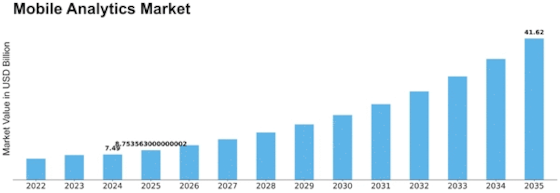
<p>The Mobile Analytics Market was valued at 7.49 USD Billion in 2024.</p>

What is the projected market size for the Mobile Analytics Market in 2035?

<p>The Mobile Analytics Market is projected to reach 41.62 USD Billion by 2035.</p>

What is the expected CAGR for the Mobile Analytics Market during the forecast period 2025 - 2035?

<p>The expected CAGR for the Mobile Analytics Market during the forecast period 2025 - 2035 is 16.87%.</p>

Which segments are driving growth in the Mobile Analytics Market?

<p>The Mobile Advertisement & Advertisement Analytics and In-App Behavioral Analytics segments are key drivers, with valuations of 20.81 USD Billion each projected.</p>

How do organization sizes impact the Mobile Analytics Market?

<p>Large Enterprises are projected to contribute 24.79 USD Billion, while Small & Medium Enterprises are expected to reach 16.83 USD Billion.</p>

What verticals are most prominent in the Mobile Analytics Market?

<p>The Media & Entertainment and Retail & E-commerce verticals are anticipated to each reach 20.81 USD Billion.</p>

Who are the key players in the Mobile Analytics Market?

Key players include Google, Adobe, IBM, Mixpanel, Flurry, Localytics, Countly, Heap, and App Annie.

What role does mobile advertisement analytics play in the market?

Mobile Advertisement &amp; Advertisement Analytics is projected to reach 20.81 USD Billion, indicating its crucial role in market growth.

How does the performance of large enterprises compare to small and medium enterprises in this market?

Large Enterprises are expected to significantly outpace Small &amp; Medium Enterprises, with a projected valuation of 24.79 USD Billion versus 16.83 USD Billion.

What future trends can be anticipated in the Mobile Analytics Market?

The Mobile Analytics Market may experience robust growth driven by advancements in technology and increasing demand for data-driven insights.

Market Summary

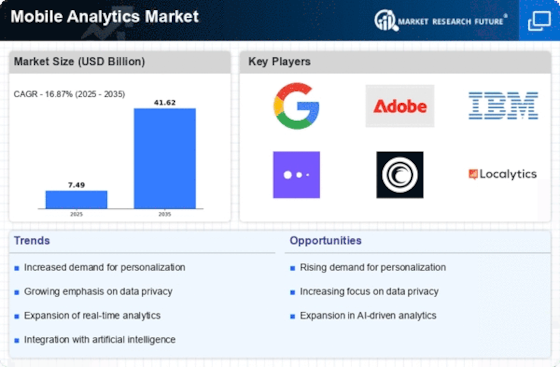
As per Market Research Future analysis, the Mobile Analytics Market Size was estimated at 7.49 USD Billion in 2024. The Mobile Analytics industry is projected to grow from 8.754 USD Billion in 2025 to 41.62 USD Billion by 2035, exhibiting a compound annual growth rate (CAGR) of 16.87% during the forecast period 2025 - 2035

Key Market Trends & Highlights

The Mobile Analytics Market is experiencing robust growth driven by technological advancements and evolving consumer needs.

  • The market is witnessing increased adoption of AI and machine learning to enhance data analysis capabilities. Real-time data processing is becoming essential for businesses to respond swiftly to consumer behavior changes. Data privacy and security concerns are prompting companies to invest in more secure analytics solutions. The rising demand for mobile applications and the integration of advanced analytics tools are key drivers of market expansion.

Market Size & Forecast

2024 Market Size 7.49 (USD Billion)
2035 Market Size 41.62 (USD Billion)
CAGR (2025 - 2035) 16.87%
Largest Regional Market Share in 2024 Asia Pacific

Major Players

Google (US), Adobe (US), IBM (US), Mixpanel (US), Flurry (US), Localytics (US), Countly (TR), Heap (US), App Annie (US)

Market Trends

The Mobile Analytics Market is currently experiencing a transformative phase, driven by the increasing reliance on mobile devices for various activities. Businesses are increasingly recognizing the necessity of understanding user behavior and preferences through mobile analytics. This understanding enables organizations to tailor their offerings, enhance user engagement, and ultimately drive revenue growth. As mobile applications proliferate, the demand for sophisticated analytics tools that can provide actionable insights is becoming more pronounced. Companies are investing in advanced technologies to capture and analyze data effectively, ensuring they remain competitive in a rapidly evolving landscape.

Moreover, the integration of artificial intelligence and machine learning into mobile analytics tools is reshaping the market. These technologies facilitate deeper insights and predictive analytics, allowing businesses to anticipate user needs and optimize their strategies accordingly. The Mobile Analytics Market is also witnessing a shift towards real-time data processing, which empowers organizations to make informed decisions swiftly. As the market continues to evolve, the emphasis on data privacy and security is likely to grow, prompting companies to adopt more robust measures to protect user information. This dynamic environment suggests that the Mobile Analytics Market will continue to expand, driven by innovation and the need for data-driven decision-making.

Businesses are increasingly adopting advanced mobile analytics platforms, sometimes referred to as mob analytics tools, to gain deeper visibility into user behavior and improve data-driven decision-making. The evolution of intelligent analytics platforms, including solutions comparable to Tune mobile analytics, highlights how vendors are enhancing real-time performance tracking and attribution capabilities. SMEs are increasingly leveraging modern mobile analytics — often categorized under broader mob analytics capabilities — to optimize customer engagement and marketing strategies.

Increased Adoption of AI and Machine Learning

The integration of artificial intelligence and machine learning into mobile analytics tools is becoming more prevalent. These technologies enhance data analysis capabilities, enabling businesses to derive deeper insights and make more informed decisions.

Real-Time Data Processing

There is a noticeable trend towards real-time data processing within the Mobile Analytics Market. This shift allows organizations to respond promptly to user behavior and market changes, thereby improving overall operational efficiency.

Focus on Data Privacy and Security

As concerns regarding data privacy intensify, companies in the Mobile Analytics Market are prioritizing the implementation of robust security measures. This focus aims to protect user information while maintaining compliance with evolving regulations.

Mobile Analytics Market Market Drivers

Rising Demand for Mobile Applications

The Mobile Analytics Market is experiencing a surge in demand for mobile applications across various sectors, including retail, finance, and healthcare. As businesses increasingly recognize the importance of mobile platforms for customer engagement, the need for analytics tools to track user behavior and app performance becomes paramount. According to recent data, the number of mobile app downloads is projected to reach 258 billion by 2025, indicating a robust growth trajectory. This trend compels organizations to invest in mobile analytics solutions to gain insights into user preferences and optimize their applications accordingly. Consequently, the Mobile Analytics Market is likely to expand as companies seek to leverage data-driven strategies to enhance user experience and drive revenue.

Emergence of IoT and Connected Devices

The Mobile Analytics Market is significantly influenced by the emergence of the Internet of Things (IoT) and connected devices. As more devices become interconnected, the volume of data generated is expected to increase exponentially. This proliferation of data presents both challenges and opportunities for businesses seeking to analyze user interactions across multiple platforms. The integration of mobile analytics with IoT data can provide organizations with a holistic view of customer behavior, enabling them to make informed decisions. Market forecasts suggest that the number of connected devices will surpass 75 billion by 2025, indicating a substantial growth potential for the Mobile Analytics Market as companies seek to capitalize on the insights derived from this data.

Integration of Advanced Analytics Tools

The Mobile Analytics Market is witnessing a notable integration of advanced analytics tools, such as predictive analytics and big data technologies. These tools enable businesses to analyze vast amounts of data generated by mobile applications, providing deeper insights into user behavior and market trends. The increasing complexity of consumer interactions necessitates sophisticated analytics solutions that can process and interpret data in real-time. As organizations strive to remain competitive, the adoption of these advanced tools is expected to grow. Market data suggests that The Mobile Analytics Market is anticipated to reach USD 684 billion by 2030, further underscoring the potential for growth within the Mobile Analytics Market as companies seek to harness the power of data.

Growing Importance of Customer Experience

In the Mobile Analytics Market, the growing emphasis on customer experience is driving the demand for analytics solutions. Businesses are increasingly aware that understanding customer preferences and behaviors is crucial for retaining clients and fostering loyalty. As a result, organizations are investing in mobile analytics to gather insights that inform product development and marketing strategies. Data indicates that companies prioritizing customer experience are likely to achieve higher revenue growth, with a potential increase of up to 10-15%. This trend highlights the necessity for businesses to adopt mobile analytics tools that facilitate a comprehensive understanding of customer journeys, thereby enhancing the overall user experience and contributing to the Mobile Analytics Market's expansion.

Regulatory Compliance and Data Governance

The Mobile Analytics Market is increasingly shaped by the need for regulatory compliance and data governance. As data privacy regulations become more stringent, organizations are compelled to adopt analytics solutions that ensure compliance with legal standards. This trend is particularly relevant in sectors such as finance and healthcare, where data security is paramount. Companies are investing in mobile analytics tools that not only provide insights but also adhere to regulatory requirements. The market for data governance solutions is projected to grow significantly, with estimates suggesting a value of USD 2.5 billion by 2026. This focus on compliance and governance is likely to drive innovation within the Mobile Analytics Market, as businesses seek to balance data utilization with regulatory obligations.

Market Segment Insights

By Type: Mobile Advertisement & Advertisement Analytics (Largest) vs. In-App Behavioral Analytics (Fastest-Growing)

The mobile analytics market exhibits a diverse segmentation with Mobile Advertisement &amp; Advertisement Analytics leading substantially. This segment holds a significant share due to the increasing reliance on targeted marketing strategies by businesses seeking to engage consumers effectively. Moreover, the segment's growth is sustained by rapid advancements in advertising technologies, enabling real-time analytics and heightened performance metrics. In contrast, In-App Behavioral Analytics is gaining momentum as a fast-growing segment, reflecting the increasing focus on user experience and personalization within mobile applications. Businesses are leveraging this analytics segment to derive insights into user behaviors, preferences, and interactions, which drive improvement strategies. The emphasis on optimizing app engagement and maximizing user retention is fuelling investment in this area, revealing a vibrant potential for growth in the years ahead.

Mobile Advertisement &amp; Advertisement Analytics (Dominant) vs. In-App Behavioral Analytics (Emerging)

Mobile Advertisement &amp; Advertisement Analytics serves as the dominant player within the mobile analytics landscape, equipped with robust tools that track and analyze ad performances across various platforms. Its strength lies in the ability to offer actionable insights that enhance marketing efficiencies, thereby attracting a wide array of enterprises ranging from startups to established brands. On the other hand, In-App Behavioral Analytics is becoming an emerging force, capturing interest through its focus on granular user data. This segment empowers businesses to understand intricate user engagement patterns and preferences within apps, ultimately aiding in tailored customer interactions. As mobile applications proliferate and evolve, these analytics tools are increasingly paramount for developers aiming to deliver a personalized user experience.

By Organization Size: Small & Medium Enterprises (Largest) vs. Large Enterprises (Fastest-Growing)

In the Mobile Analytics Market, the distribution of market share between Small &amp; Medium Enterprises (SMEs) and Large Enterprises reveals SMEs as the largest segment, capitalizing on the surge in digital transformation. SMEs are leveraging mobile analytics to enhance customer engagement, streamline operations, and achieve competitive advantage. Conversely, Large Enterprises, while smaller in market share, are gaining traction as they increasingly recognize the value of data-driven decision-making tools. This trend is bolstered by their substantial investments in advanced technologies and constant need for innovation to maintain their market edge.

Small &amp; Medium Enterprises: Dominant vs. Large Enterprises: Emerging

Small &amp; Medium Enterprises dominate the Mobile Analytics Market due to their agile nature and the rapid adoption of mobile technologies. They focus on tailored analytics solutions that drive efficiency and promote growth in a highly competitive landscape. In contrast, Large Enterprises are emerging as a significant player in this segment as they invest heavily in mobile analytics to enhance operational efficiency and business insights. Their vast resources enable them to implement sophisticated analytics frameworks, which are crucial for real-time data interpretation and strategy formulation, positioning them favorably for future growth.

By Vertical: Media & Entertainment (Largest) vs. Retail & E-commerce (Fastest-Growing)

In the Mobile Analytics Market, the largest share is held by the Media &amp; Entertainment vertical. This segment capitalizes on the increasing consumption of mobile content, enabling platforms to extract valuable user insights for targeted advertising and customized experiences. In contrast, the Retail &amp; E-commerce vertical is emerging rapidly as retailers leverage mobile analytics to enhance customer engagement and drive sales through personalized marketing strategies. The distribution of market share highlights distinct usage patterns and customer behaviors across these segments.

Media &amp; Entertainment: Dominant vs. Retail &amp; E-commerce: Emerging

The Media &amp; Entertainment segment is characterized by its extensive reliance on mobile platforms for content delivery and user interaction. It dominates the Mobile Analytics Market due to the vast amounts of data generated from streaming services and social media interactions. In comparison, the Retail &amp; E-commerce vertical is witnessing rapid growth as businesses focus on integrating mobile analytics into their strategies to analyze purchasing behaviors. This segment is fast becoming essential for brands aiming to optimize their customer journey and improve conversion rates through data-driven insights.

Get more detailed insights about Mobile Analytics Market Research Report- Global Forecast 2035

Regional Insights

North America : Innovation and Leadership Hub

North America leads the mobile analytics market, driven by high smartphone penetration and a strong focus on data-driven decision-making. The region holds approximately 45% of the global market share, with the United States being the largest contributor, followed by Canada. Regulatory support for data privacy and analytics innovation further fuels growth, as companies seek to enhance user engagement and optimize marketing strategies. The competitive landscape is robust, featuring key players like Google, Adobe, and IBM, which dominate the market with advanced analytics solutions. The presence of numerous startups also fosters innovation, creating a dynamic ecosystem. As businesses increasingly rely on mobile analytics for insights, the demand for sophisticated tools and platforms continues to rise, solidifying North America's position as a leader in this sector.

Europe : Emerging Market with Regulations

Europe is witnessing significant growth in the mobile analytics market, driven by stringent data protection regulations like GDPR, which encourage businesses to adopt analytics for compliance and user engagement. The region accounts for approximately 30% of the global market share, with Germany and the UK being the largest markets. The increasing focus on customer experience and data-driven strategies is propelling demand for mobile analytics solutions across various sectors. Leading countries in Europe, such as Germany, the UK, and France, are home to a mix of established companies and innovative startups. Key players like Adobe and IBM are expanding their offerings to meet the growing demand. The competitive landscape is characterized by a focus on privacy-centric analytics solutions, as businesses strive to balance user data protection with effective marketing strategies. This regulatory environment is shaping the future of mobile analytics in Europe.

Asia-Pacific : Rapid Growth and Adoption

Asia-Pacific is rapidly emerging as a powerhouse in the mobile analytics market, driven by increasing smartphone adoption and a growing digital economy. The region holds approximately 20% of the global market share, with China and India leading the charge. The demand for mobile analytics is further fueled by the rise of e-commerce and mobile applications, prompting businesses to leverage data for competitive advantage. Countries like China, India, and Japan are at the forefront of this growth, with a mix of local and international players competing for market share. Companies such as Mixpanel and Flurry are gaining traction, offering tailored solutions to meet regional needs. The competitive landscape is evolving, with a focus on innovative analytics tools that cater to diverse industries, from retail to finance, enhancing the overall market dynamics in Asia-Pacific.

Middle East and Africa : Emerging Market with Potential

The Middle East and Africa region is gradually emerging in the mobile analytics market, driven by increasing smartphone penetration and a growing emphasis on digital transformation. The region holds approximately 5% of the global market share, with South Africa and the UAE being the largest markets. The demand for mobile analytics is being propelled by the need for businesses to understand consumer behavior and optimize their marketing strategies in a competitive landscape. Leading countries like South Africa and the UAE are witnessing a surge in mobile app usage, creating opportunities for analytics solutions. The presence of key players such as Countly and Localytics is enhancing the competitive landscape. As businesses increasingly recognize the value of data-driven insights, the mobile analytics market in the Middle East and Africa is poised for significant growth, supported by government initiatives promoting digital innovation.

Key Players and Competitive Insights

The Mobile Analytics Market is currently characterized by a dynamic competitive landscape, driven by rapid technological advancements and an increasing demand for data-driven decision-making. Key players such as Google (US), Adobe (US), and IBM (US) are at the forefront, leveraging their extensive resources to innovate and expand their service offerings. Google (US) focuses on integrating artificial intelligence into its analytics tools, enhancing user experience and data interpretation. Adobe (US) emphasizes its commitment to digital transformation, providing comprehensive solutions that cater to diverse business needs. Meanwhile, IBM (US) is strategically positioning itself through partnerships and acquisitions, aiming to bolster its capabilities in predictive analytics and machine learning. Collectively, these strategies not only enhance their competitive positioning but also shape the overall market dynamics, fostering an environment ripe for innovation and growth.

In terms of business tactics, companies are increasingly localizing their operations and optimizing supply chains to better serve regional markets. The Mobile Analytics Market appears moderately fragmented, with a mix of established players and emerging startups vying for market share. This competitive structure allows for a diverse range of offerings, enabling businesses to select solutions that best fit their specific needs. The collective influence of these key players is significant, as they set industry standards and drive technological advancements that benefit the entire market.

In August 2025, Google (US) announced the launch of its new AI-driven analytics platform, which aims to provide businesses with deeper insights into consumer behavior. This strategic move is pivotal, as it not only enhances Google's product portfolio but also positions the company as a leader in the integration of AI within mobile analytics. The platform's capabilities are expected to revolutionize how businesses interpret data, thereby influencing their marketing strategies and operational decisions.

In September 2025, Adobe (US) unveiled a partnership with a leading e-commerce platform to enhance its analytics capabilities. This collaboration is strategically important as it allows Adobe to tap into a broader customer base while providing tailored solutions that meet the specific needs of e-commerce businesses. Such partnerships are indicative of a trend where companies are seeking to create synergies that enhance their service offerings and market reach.

In July 2025, IBM (US) completed the acquisition of a prominent analytics startup, which specializes in real-time data processing. This acquisition is likely to strengthen IBM's position in the market by augmenting its existing capabilities and expanding its technological expertise. The integration of real-time analytics into IBM's offerings could provide clients with a competitive edge, enabling them to make informed decisions swiftly.

As of October 2025, the Mobile Analytics Market is witnessing trends that emphasize digitalization, sustainability, and the integration of artificial intelligence. Strategic alliances are increasingly shaping the competitive landscape, as companies recognize the value of collaboration in driving innovation. Looking ahead, it is anticipated that competitive differentiation will evolve, with a shift from price-based competition to a focus on innovation, technology, and supply chain reliability. This evolution underscores the importance of adaptability and forward-thinking strategies in maintaining a competitive edge in the ever-evolving market.

Key Companies in the Mobile Analytics Market include

Industry Developments

November 2022 - Vianova formed a strategic partnership with on-demand transport company Fenix to bring mobility expertise to the Middle East. Fenix uses Vianova’s mobile analytics platform in five countries (Saudi Arabia, UAE, Bahrain and Qatar) to gain insight into its fleets and increase city collaboration.

August 2022 – Pinterest launched real-time statistics for their Pin Analytics on smartphones. The tool lets you see how your Pins are performing at any moment. This will also be available on its online Analytics platform but going mobile means more people get access to their analytics even while on the move.

April 2022 - Mobile Marketing and Roomvo teamed up to create a visualizer analytics module that can be found on Mobile Marketing’s client site. According to the company, using Roomvo’s robust analytics system allows retailers to gain new levels of insights about their customers which in turn may shape data-driven business choices starting from shop floor systems all the way through trade promotions.

April 2022 - Adjust Datascape is a ground-breaking, new innovative analytic solution that gives faster as well as simpler business critical KPIs and performance metrics developed by Adjust, a mobile marketing analytics platform. With unified data and more contextualized visuals, phone app developers can derive valuable insights and implement smarter marketing strategies in real-time.

February 2022 – IronSource has released a new app analytics tool aimed at helping app and game developers boost revenue, retain customers and grow. In beta is App Analytics by IronSource, an all-in-one solution for the monetization of app user acquisition campaigns, as well as the ability of businesses to access important statistics about these elements under one roof. Analytic has become popular just like platforms have developed ways of becoming successful with mobile apps and games.

IronSource argues that most other alternatives lag behind when it comes to usability (UX) in this area being serviced by the App Analytics platform.

Future Outlook

Mobile Analytics Market Future Outlook

The Mobile Analytics Market is projected to grow at a 16.87% CAGR from 2025 to 2035, driven by increased mobile device usage, data-driven decision-making, and advancements in AI technologies.

New opportunities lie in:

  • <p>Integration of AI-driven predictive analytics tools for enhanced user engagement. Development of real-time analytics platforms for immediate decision-making. Expansion into emerging markets with tailored mobile analytics solutions.</p>

By 2035, the Mobile Analytics Market is expected to be robust, reflecting substantial growth and innovation.

Market Segmentation

Mobile Analytics Market Type Outlook

  • Mobile Advertisement & Advertisement Analytics
  • In-App Behavioral Analytics

Mobile Analytics Market Vertical Outlook

  • Media & Entertainment
  • Retail & E-commerce

Mobile Analytics Market Organization Size Outlook

  • Small & Medium Enterprises
  • Large Enterprises

Report Scope

MARKET SIZE 2024 7.49(USD Billion)
MARKET SIZE 2025 8.754(USD Billion)
MARKET SIZE 2035 41.62(USD Billion)
COMPOUND ANNUAL GROWTH RATE (CAGR) 16.87% (2025 - 2035)
REPORT COVERAGE Revenue Forecast, Competitive Landscape, Growth Factors, and Trends
BASE YEAR 2024
Market Forecast Period 2025 - 2035
Historical Data 2019 - 2024
Market Forecast Units USD Billion
Key Companies Profiled Google (US), Adobe (US), IBM (US), Mixpanel (US), Flurry (US), Localytics (US), Countly (TR), Heap (US), App Annie (US)
Segments Covered Type, Organization Size, Vertical, Region
Key Market Opportunities Integration of artificial intelligence enhances predictive analytics in the Mobile Analytics Market.
Key Market Dynamics Rising demand for data-driven insights drives innovation and competition in the Mobile Analytics Market.
Countries Covered North America, Europe, APAC, South America, MEA

FAQs

What is the current valuation of the Mobile Analytics Market as of 2024?

<p>The Mobile Analytics Market was valued at 7.49 USD Billion in 2024.</p>

What is the projected market size for the Mobile Analytics Market in 2035?

<p>The Mobile Analytics Market is projected to reach 41.62 USD Billion by 2035.</p>

What is the expected CAGR for the Mobile Analytics Market during the forecast period 2025 - 2035?

<p>The expected CAGR for the Mobile Analytics Market during the forecast period 2025 - 2035 is 16.87%.</p>

Which segments are driving growth in the Mobile Analytics Market?

<p>The Mobile Advertisement & Advertisement Analytics and In-App Behavioral Analytics segments are key drivers, with valuations of 20.81 USD Billion each projected.</p>

How do organization sizes impact the Mobile Analytics Market?

<p>Large Enterprises are projected to contribute 24.79 USD Billion, while Small & Medium Enterprises are expected to reach 16.83 USD Billion.</p>

What verticals are most prominent in the Mobile Analytics Market?

<p>The Media & Entertainment and Retail & E-commerce verticals are anticipated to each reach 20.81 USD Billion.</p>

Who are the key players in the Mobile Analytics Market?

Key players include Google, Adobe, IBM, Mixpanel, Flurry, Localytics, Countly, Heap, and App Annie.

What role does mobile advertisement analytics play in the market?

Mobile Advertisement &amp; Advertisement Analytics is projected to reach 20.81 USD Billion, indicating its crucial role in market growth.

How does the performance of large enterprises compare to small and medium enterprises in this market?

Large Enterprises are expected to significantly outpace Small &amp; Medium Enterprises, with a projected valuation of 24.79 USD Billion versus 16.83 USD Billion.

What future trends can be anticipated in the Mobile Analytics Market?

The Mobile Analytics Market may experience robust growth driven by advancements in technology and increasing demand for data-driven insights.

  1. SECTION I: EXECUTIVE SUMMARY AND KEY HIGHLIGHTS
    1. | 1.1 EXECUTIVE SUMMARY
    2. | | 1.1.1 Market Overview
    3. | | 1.1.2 Key Findings
    4. | | 1.1.3 Market Segmentation
    5. | | 1.1.4 Competitive Landscape
    6. | | 1.1.5 Challenges and Opportunities
    7. | | 1.1.6 Future Outlook
  2. SECTION II: SCOPING, METHODOLOGY AND MARKET STRUCTURE
    1. | 2.1 MARKET INTRODUCTION
    2. | | 2.1.1 Definition
    3. | | 2.1.2 Scope of the study
    4. | | | 2.1.2.1 Research Objective
    5. | | | 2.1.2.2 Assumption
    6. | | | 2.1.2.3 Limitations
    7. | 2.2 RESEARCH METHODOLOGY
    8. | | 2.2.1 Overview
    9. | | 2.2.2 Data Mining
    10. | | 2.2.3 Secondary Research
    11. | | 2.2.4 Primary Research
    12. | | | 2.2.4.1 Primary Interviews and Information Gathering Process
    13. | | | 2.2.4.2 Breakdown of Primary Respondents
    14. | | 2.2.5 Forecasting Model
    15. | | 2.2.6 Market Size Estimation
    16. | | | 2.2.6.1 Bottom-Up Approach
    17. | | | 2.2.6.2 Top-Down Approach
    18. | | 2.2.7 Data Triangulation
    19. | | 2.2.8 Validation
  3. SECTION III: QUALITATIVE ANALYSIS
    1. | 3.1 MARKET DYNAMICS
    2. | | 3.1.1 Overview
    3. | | 3.1.2 Drivers
    4. | | 3.1.3 Restraints
    5. | | 3.1.4 Opportunities
    6. | 3.2 MARKET FACTOR ANALYSIS
    7. | | 3.2.1 Value chain Analysis
    8. | | 3.2.2 Porter's Five Forces Analysis
    9. | | | 3.2.2.1 Bargaining Power of Suppliers
    10. | | | 3.2.2.2 Bargaining Power of Buyers
    11. | | | 3.2.2.3 Threat of New Entrants
    12. | | | 3.2.2.4 Threat of Substitutes
    13. | | | 3.2.2.5 Intensity of Rivalry
    14. | | 3.2.3 COVID-19 Impact Analysis
    15. | | | 3.2.3.1 Market Impact Analysis
    16. | | | 3.2.3.2 Regional Impact
    17. | | | 3.2.3.3 Opportunity and Threat Analysis
  4. SECTION IV: QUANTITATIVE ANALYSIS
    1. | 4.1 Information and Communications Technology, BY Type (USD Billion)
    2. | | 4.1.1 Mobile Advertisement & Advertisement Analytics
    3. | | 4.1.2 In-App Behavioral Analytics
    4. | 4.2 Information and Communications Technology, BY Organization Size (USD Billion)
    5. | | 4.2.1 Small & Medium Enterprises
    6. | | 4.2.2 Large Enterprises
    7. | 4.3 Information and Communications Technology, BY Vertical (USD Billion)
    8. | | 4.3.1 Media & Entertainment
    9. | | 4.3.2 Retail & E-commerce
    10. | 4.4 Information and Communications Technology, BY Region (USD Billion)
    11. | | 4.4.1 North America
    12. | | | 4.4.1.1 US
    13. | | | 4.4.1.2 Canada
    14. | | 4.4.2 Europe
    15. | | | 4.4.2.1 Germany
    16. | | | 4.4.2.2 UK
    17. | | | 4.4.2.3 France
    18. | | | 4.4.2.4 Russia
    19. | | | 4.4.2.5 Italy
    20. | | | 4.4.2.6 Spain
    21. | | | 4.4.2.7 Rest of Europe
    22. | | 4.4.3 APAC
    23. | | | 4.4.3.1 China
    24. | | | 4.4.3.2 India
    25. | | | 4.4.3.3 Japan
    26. | | | 4.4.3.4 South Korea
    27. | | | 4.4.3.5 Malaysia
    28. | | | 4.4.3.6 Thailand
    29. | | | 4.4.3.7 Indonesia
    30. | | | 4.4.3.8 Rest of APAC
    31. | | 4.4.4 South America
    32. | | | 4.4.4.1 Brazil
    33. | | | 4.4.4.2 Mexico
    34. | | | 4.4.4.3 Argentina
    35. | | | 4.4.4.4 Rest of South America
    36. | | 4.4.5 MEA
    37. | | | 4.4.5.1 GCC Countries
    38. | | | 4.4.5.2 South Africa
    39. | | | 4.4.5.3 Rest of MEA
  5. SECTION V: COMPETITIVE ANALYSIS
    1. | 5.1 Competitive Landscape
    2. | | 5.1.1 Overview
    3. | | 5.1.2 Competitive Analysis
    4. | | 5.1.3 Market share Analysis
    5. | | 5.1.4 Major Growth Strategy in the Information and Communications Technology
    6. | | 5.1.5 Competitive Benchmarking
    7. | | 5.1.6 Leading Players in Terms of Number of Developments in the Information and Communications Technology
    8. | | 5.1.7 Key developments and growth strategies
    9. | | | 5.1.7.1 New Product Launch/Service Deployment
    10. | | | 5.1.7.2 Merger & Acquisitions
    11. | | | 5.1.7.3 Joint Ventures
    12. | | 5.1.8 Major Players Financial Matrix
    13. | | | 5.1.8.1 Sales and Operating Income
    14. | | | 5.1.8.2 Major Players R&D Expenditure. 2023
    15. | 5.2 Company Profiles
    16. | | 5.2.1 Google (US)
    17. | | | 5.2.1.1 Financial Overview
    18. | | | 5.2.1.2 Products Offered
    19. | | | 5.2.1.3 Key Developments
    20. | | | 5.2.1.4 SWOT Analysis
    21. | | | 5.2.1.5 Key Strategies
    22. | | 5.2.2 Adobe (US)
    23. | | | 5.2.2.1 Financial Overview
    24. | | | 5.2.2.2 Products Offered
    25. | | | 5.2.2.3 Key Developments
    26. | | | 5.2.2.4 SWOT Analysis
    27. | | | 5.2.2.5 Key Strategies
    28. | | 5.2.3 IBM (US)
    29. | | | 5.2.3.1 Financial Overview
    30. | | | 5.2.3.2 Products Offered
    31. | | | 5.2.3.3 Key Developments
    32. | | | 5.2.3.4 SWOT Analysis
    33. | | | 5.2.3.5 Key Strategies
    34. | | 5.2.4 Mixpanel (US)
    35. | | | 5.2.4.1 Financial Overview
    36. | | | 5.2.4.2 Products Offered
    37. | | | 5.2.4.3 Key Developments
    38. | | | 5.2.4.4 SWOT Analysis
    39. | | | 5.2.4.5 Key Strategies
    40. | | 5.2.5 Flurry (US)
    41. | | | 5.2.5.1 Financial Overview
    42. | | | 5.2.5.2 Products Offered
    43. | | | 5.2.5.3 Key Developments
    44. | | | 5.2.5.4 SWOT Analysis
    45. | | | 5.2.5.5 Key Strategies
    46. | | 5.2.6 Localytics (US)
    47. | | | 5.2.6.1 Financial Overview
    48. | | | 5.2.6.2 Products Offered
    49. | | | 5.2.6.3 Key Developments
    50. | | | 5.2.6.4 SWOT Analysis
    51. | | | 5.2.6.5 Key Strategies
    52. | | 5.2.7 Countly (TR)
    53. | | | 5.2.7.1 Financial Overview
    54. | | | 5.2.7.2 Products Offered
    55. | | | 5.2.7.3 Key Developments
    56. | | | 5.2.7.4 SWOT Analysis
    57. | | | 5.2.7.5 Key Strategies
    58. | | 5.2.8 Heap (US)
    59. | | | 5.2.8.1 Financial Overview
    60. | | | 5.2.8.2 Products Offered
    61. | | | 5.2.8.3 Key Developments
    62. | | | 5.2.8.4 SWOT Analysis
    63. | | | 5.2.8.5 Key Strategies
    64. | | 5.2.9 App Annie (US)
    65. | | | 5.2.9.1 Financial Overview
    66. | | | 5.2.9.2 Products Offered
    67. | | | 5.2.9.3 Key Developments
    68. | | | 5.2.9.4 SWOT Analysis
    69. | | | 5.2.9.5 Key Strategies
    70. | 5.3 Appendix
    71. | | 5.3.1 References
    72. | | 5.3.2 Related Reports
  6. LIST OF FIGURES
    1. | 6.1 MARKET SYNOPSIS
    2. | 6.2 NORTH AMERICA MARKET ANALYSIS
    3. | 6.3 US MARKET ANALYSIS BY TYPE
    4. | 6.4 US MARKET ANALYSIS BY ORGANIZATION SIZE
    5. | 6.5 US MARKET ANALYSIS BY VERTICAL
    6. | 6.6 CANADA MARKET ANALYSIS BY TYPE
    7. | 6.7 CANADA MARKET ANALYSIS BY ORGANIZATION SIZE
    8. | 6.8 CANADA MARKET ANALYSIS BY VERTICAL
    9. | 6.9 EUROPE MARKET ANALYSIS
    10. | 6.10 GERMANY MARKET ANALYSIS BY TYPE
    11. | 6.11 GERMANY MARKET ANALYSIS BY ORGANIZATION SIZE
    12. | 6.12 GERMANY MARKET ANALYSIS BY VERTICAL
    13. | 6.13 UK MARKET ANALYSIS BY TYPE
    14. | 6.14 UK MARKET ANALYSIS BY ORGANIZATION SIZE
    15. | 6.15 UK MARKET ANALYSIS BY VERTICAL
    16. | 6.16 FRANCE MARKET ANALYSIS BY TYPE
    17. | 6.17 FRANCE MARKET ANALYSIS BY ORGANIZATION SIZE
    18. | 6.18 FRANCE MARKET ANALYSIS BY VERTICAL
    19. | 6.19 RUSSIA MARKET ANALYSIS BY TYPE
    20. | 6.20 RUSSIA MARKET ANALYSIS BY ORGANIZATION SIZE
    21. | 6.21 RUSSIA MARKET ANALYSIS BY VERTICAL
    22. | 6.22 ITALY MARKET ANALYSIS BY TYPE
    23. | 6.23 ITALY MARKET ANALYSIS BY ORGANIZATION SIZE
    24. | 6.24 ITALY MARKET ANALYSIS BY VERTICAL
    25. | 6.25 SPAIN MARKET ANALYSIS BY TYPE
    26. | 6.26 SPAIN MARKET ANALYSIS BY ORGANIZATION SIZE
    27. | 6.27 SPAIN MARKET ANALYSIS BY VERTICAL
    28. | 6.28 REST OF EUROPE MARKET ANALYSIS BY TYPE
    29. | 6.29 REST OF EUROPE MARKET ANALYSIS BY ORGANIZATION SIZE
    30. | 6.30 REST OF EUROPE MARKET ANALYSIS BY VERTICAL
    31. | 6.31 APAC MARKET ANALYSIS
    32. | 6.32 CHINA MARKET ANALYSIS BY TYPE
    33. | 6.33 CHINA MARKET ANALYSIS BY ORGANIZATION SIZE
    34. | 6.34 CHINA MARKET ANALYSIS BY VERTICAL
    35. | 6.35 INDIA MARKET ANALYSIS BY TYPE
    36. | 6.36 INDIA MARKET ANALYSIS BY ORGANIZATION SIZE
    37. | 6.37 INDIA MARKET ANALYSIS BY VERTICAL
    38. | 6.38 JAPAN MARKET ANALYSIS BY TYPE
    39. | 6.39 JAPAN MARKET ANALYSIS BY ORGANIZATION SIZE
    40. | 6.40 JAPAN MARKET ANALYSIS BY VERTICAL
    41. | 6.41 SOUTH KOREA MARKET ANALYSIS BY TYPE
    42. | 6.42 SOUTH KOREA MARKET ANALYSIS BY ORGANIZATION SIZE
    43. | 6.43 SOUTH KOREA MARKET ANALYSIS BY VERTICAL
    44. | 6.44 MALAYSIA MARKET ANALYSIS BY TYPE
    45. | 6.45 MALAYSIA MARKET ANALYSIS BY ORGANIZATION SIZE
    46. | 6.46 MALAYSIA MARKET ANALYSIS BY VERTICAL
    47. | 6.47 THAILAND MARKET ANALYSIS BY TYPE
    48. | 6.48 THAILAND MARKET ANALYSIS BY ORGANIZATION SIZE
    49. | 6.49 THAILAND MARKET ANALYSIS BY VERTICAL
    50. | 6.50 INDONESIA MARKET ANALYSIS BY TYPE
    51. | 6.51 INDONESIA MARKET ANALYSIS BY ORGANIZATION SIZE
    52. | 6.52 INDONESIA MARKET ANALYSIS BY VERTICAL
    53. | 6.53 REST OF APAC MARKET ANALYSIS BY TYPE
    54. | 6.54 REST OF APAC MARKET ANALYSIS BY ORGANIZATION SIZE
    55. | 6.55 REST OF APAC MARKET ANALYSIS BY VERTICAL
    56. | 6.56 SOUTH AMERICA MARKET ANALYSIS
    57. | 6.57 BRAZIL MARKET ANALYSIS BY TYPE
    58. | 6.58 BRAZIL MARKET ANALYSIS BY ORGANIZATION SIZE
    59. | 6.59 BRAZIL MARKET ANALYSIS BY VERTICAL
    60. | 6.60 MEXICO MARKET ANALYSIS BY TYPE
    61. | 6.61 MEXICO MARKET ANALYSIS BY ORGANIZATION SIZE
    62. | 6.62 MEXICO MARKET ANALYSIS BY VERTICAL
    63. | 6.63 ARGENTINA MARKET ANALYSIS BY TYPE
    64. | 6.64 ARGENTINA MARKET ANALYSIS BY ORGANIZATION SIZE
    65. | 6.65 ARGENTINA MARKET ANALYSIS BY VERTICAL
    66. | 6.66 REST OF SOUTH AMERICA MARKET ANALYSIS BY TYPE
    67. | 6.67 REST OF SOUTH AMERICA MARKET ANALYSIS BY ORGANIZATION SIZE
    68. | 6.68 REST OF SOUTH AMERICA MARKET ANALYSIS BY VERTICAL
    69. | 6.69 MEA MARKET ANALYSIS
    70. | 6.70 GCC COUNTRIES MARKET ANALYSIS BY TYPE
    71. | 6.71 GCC COUNTRIES MARKET ANALYSIS BY ORGANIZATION SIZE
    72. | 6.72 GCC COUNTRIES MARKET ANALYSIS BY VERTICAL
    73. | 6.73 SOUTH AFRICA MARKET ANALYSIS BY TYPE
    74. | 6.74 SOUTH AFRICA MARKET ANALYSIS BY ORGANIZATION SIZE
    75. | 6.75 SOUTH AFRICA MARKET ANALYSIS BY VERTICAL
    76. | 6.76 REST OF MEA MARKET ANALYSIS BY TYPE
    77. | 6.77 REST OF MEA MARKET ANALYSIS BY ORGANIZATION SIZE
    78. | 6.78 REST OF MEA MARKET ANALYSIS BY VERTICAL
    79. | 6.79 KEY BUYING CRITERIA OF INFORMATION AND COMMUNICATIONS TECHNOLOGY
    80. | 6.80 RESEARCH PROCESS OF MRFR
    81. | 6.81 DRO ANALYSIS OF INFORMATION AND COMMUNICATIONS TECHNOLOGY
    82. | 6.82 DRIVERS IMPACT ANALYSIS: INFORMATION AND COMMUNICATIONS TECHNOLOGY
    83. | 6.83 RESTRAINTS IMPACT ANALYSIS: INFORMATION AND COMMUNICATIONS TECHNOLOGY
    84. | 6.84 SUPPLY / VALUE CHAIN: INFORMATION AND COMMUNICATIONS TECHNOLOGY
    85. | 6.85 INFORMATION AND COMMUNICATIONS TECHNOLOGY, BY TYPE, 2024 (% SHARE)
    86. | 6.86 INFORMATION AND COMMUNICATIONS TECHNOLOGY, BY TYPE, 2024 TO 2035 (USD Billion)
    87. | 6.87 INFORMATION AND COMMUNICATIONS TECHNOLOGY, BY ORGANIZATION SIZE, 2024 (% SHARE)
    88. | 6.88 INFORMATION AND COMMUNICATIONS TECHNOLOGY, BY ORGANIZATION SIZE, 2024 TO 2035 (USD Billion)
    89. | 6.89 INFORMATION AND COMMUNICATIONS TECHNOLOGY, BY VERTICAL, 2024 (% SHARE)
    90. | 6.90 INFORMATION AND COMMUNICATIONS TECHNOLOGY, BY VERTICAL, 2024 TO 2035 (USD Billion)
    91. | 6.91 BENCHMARKING OF MAJOR COMPETITORS
  7. LIST OF TABLES
    1. | 7.1 LIST OF ASSUMPTIONS
    2. | | 7.1.1
    3. | 7.2 North America MARKET SIZE ESTIMATES; FORECAST
    4. | | 7.2.1 BY TYPE, 2025-2035 (USD Billion)
    5. | | 7.2.2 BY ORGANIZATION SIZE, 2025-2035 (USD Billion)
    6. | | 7.2.3 BY VERTICAL, 2025-2035 (USD Billion)
    7. | 7.3 US MARKET SIZE ESTIMATES; FORECAST
    8. | | 7.3.1 BY TYPE, 2025-2035 (USD Billion)
    9. | | 7.3.2 BY ORGANIZATION SIZE, 2025-2035 (USD Billion)
    10. | | 7.3.3 BY VERTICAL, 2025-2035 (USD Billion)
    11. | 7.4 Canada MARKET SIZE ESTIMATES; FORECAST
    12. | | 7.4.1 BY TYPE, 2025-2035 (USD Billion)
    13. | | 7.4.2 BY ORGANIZATION SIZE, 2025-2035 (USD Billion)
    14. | | 7.4.3 BY VERTICAL, 2025-2035 (USD Billion)
    15. | 7.5 Europe MARKET SIZE ESTIMATES; FORECAST
    16. | | 7.5.1 BY TYPE, 2025-2035 (USD Billion)
    17. | | 7.5.2 BY ORGANIZATION SIZE, 2025-2035 (USD Billion)
    18. | | 7.5.3 BY VERTICAL, 2025-2035 (USD Billion)
    19. | 7.6 Germany MARKET SIZE ESTIMATES; FORECAST
    20. | | 7.6.1 BY TYPE, 2025-2035 (USD Billion)
    21. | | 7.6.2 BY ORGANIZATION SIZE, 2025-2035 (USD Billion)
    22. | | 7.6.3 BY VERTICAL, 2025-2035 (USD Billion)
    23. | 7.7 UK MARKET SIZE ESTIMATES; FORECAST
    24. | | 7.7.1 BY TYPE, 2025-2035 (USD Billion)
    25. | | 7.7.2 BY ORGANIZATION SIZE, 2025-2035 (USD Billion)
    26. | | 7.7.3 BY VERTICAL, 2025-2035 (USD Billion)
    27. | 7.8 France MARKET SIZE ESTIMATES; FORECAST
    28. | | 7.8.1 BY TYPE, 2025-2035 (USD Billion)
    29. | | 7.8.2 BY ORGANIZATION SIZE, 2025-2035 (USD Billion)
    30. | | 7.8.3 BY VERTICAL, 2025-2035 (USD Billion)
    31. | 7.9 Russia MARKET SIZE ESTIMATES; FORECAST
    32. | | 7.9.1 BY TYPE, 2025-2035 (USD Billion)
    33. | | 7.9.2 BY ORGANIZATION SIZE, 2025-2035 (USD Billion)
    34. | | 7.9.3 BY VERTICAL, 2025-2035 (USD Billion)
    35. | 7.10 Italy MARKET SIZE ESTIMATES; FORECAST
    36. | | 7.10.1 BY TYPE, 2025-2035 (USD Billion)
    37. | | 7.10.2 BY ORGANIZATION SIZE, 2025-2035 (USD Billion)
    38. | | 7.10.3 BY VERTICAL, 2025-2035 (USD Billion)
    39. | 7.11 Spain MARKET SIZE ESTIMATES; FORECAST
    40. | | 7.11.1 BY TYPE, 2025-2035 (USD Billion)
    41. | | 7.11.2 BY ORGANIZATION SIZE, 2025-2035 (USD Billion)
    42. | | 7.11.3 BY VERTICAL, 2025-2035 (USD Billion)
    43. | 7.12 Rest of Europe MARKET SIZE ESTIMATES; FORECAST
    44. | | 7.12.1 BY TYPE, 2025-2035 (USD Billion)
    45. | | 7.12.2 BY ORGANIZATION SIZE, 2025-2035 (USD Billion)
    46. | | 7.12.3 BY VERTICAL, 2025-2035 (USD Billion)
    47. | 7.13 APAC MARKET SIZE ESTIMATES; FORECAST
    48. | | 7.13.1 BY TYPE, 2025-2035 (USD Billion)
    49. | | 7.13.2 BY ORGANIZATION SIZE, 2025-2035 (USD Billion)
    50. | | 7.13.3 BY VERTICAL, 2025-2035 (USD Billion)
    51. | 7.14 China MARKET SIZE ESTIMATES; FORECAST
    52. | | 7.14.1 BY TYPE, 2025-2035 (USD Billion)
    53. | | 7.14.2 BY ORGANIZATION SIZE, 2025-2035 (USD Billion)
    54. | | 7.14.3 BY VERTICAL, 2025-2035 (USD Billion)
    55. | 7.15 India MARKET SIZE ESTIMATES; FORECAST
    56. | | 7.15.1 BY TYPE, 2025-2035 (USD Billion)
    57. | | 7.15.2 BY ORGANIZATION SIZE, 2025-2035 (USD Billion)
    58. | | 7.15.3 BY VERTICAL, 2025-2035 (USD Billion)
    59. | 7.16 Japan MARKET SIZE ESTIMATES; FORECAST
    60. | | 7.16.1 BY TYPE, 2025-2035 (USD Billion)
    61. | | 7.16.2 BY ORGANIZATION SIZE, 2025-2035 (USD Billion)
    62. | | 7.16.3 BY VERTICAL, 2025-2035 (USD Billion)
    63. | 7.17 South Korea MARKET SIZE ESTIMATES; FORECAST
    64. | | 7.17.1 BY TYPE, 2025-2035 (USD Billion)
    65. | | 7.17.2 BY ORGANIZATION SIZE, 2025-2035 (USD Billion)
    66. | | 7.17.3 BY VERTICAL, 2025-2035 (USD Billion)
    67. | 7.18 Malaysia MARKET SIZE ESTIMATES; FORECAST
    68. | | 7.18.1 BY TYPE, 2025-2035 (USD Billion)
    69. | | 7.18.2 BY ORGANIZATION SIZE, 2025-2035 (USD Billion)
    70. | | 7.18.3 BY VERTICAL, 2025-2035 (USD Billion)
    71. | 7.19 Thailand MARKET SIZE ESTIMATES; FORECAST
    72. | | 7.19.1 BY TYPE, 2025-2035 (USD Billion)
    73. | | 7.19.2 BY ORGANIZATION SIZE, 2025-2035 (USD Billion)
    74. | | 7.19.3 BY VERTICAL, 2025-2035 (USD Billion)
    75. | 7.20 Indonesia MARKET SIZE ESTIMATES; FORECAST
    76. | | 7.20.1 BY TYPE, 2025-2035 (USD Billion)
    77. | | 7.20.2 BY ORGANIZATION SIZE, 2025-2035 (USD Billion)
    78. | | 7.20.3 BY VERTICAL, 2025-2035 (USD Billion)
    79. | 7.21 Rest of APAC MARKET SIZE ESTIMATES; FORECAST
    80. | | 7.21.1 BY TYPE, 2025-2035 (USD Billion)
    81. | | 7.21.2 BY ORGANIZATION SIZE, 2025-2035 (USD Billion)
    82. | | 7.21.3 BY VERTICAL, 2025-2035 (USD Billion)
    83. | 7.22 South America MARKET SIZE ESTIMATES; FORECAST
    84. | | 7.22.1 BY TYPE, 2025-2035 (USD Billion)
    85. | | 7.22.2 BY ORGANIZATION SIZE, 2025-2035 (USD Billion)
    86. | | 7.22.3 BY VERTICAL, 2025-2035 (USD Billion)
    87. | 7.23 Brazil MARKET SIZE ESTIMATES; FORECAST
    88. | | 7.23.1 BY TYPE, 2025-2035 (USD Billion)
    89. | | 7.23.2 BY ORGANIZATION SIZE, 2025-2035 (USD Billion)
    90. | | 7.23.3 BY VERTICAL, 2025-2035 (USD Billion)
    91. | 7.24 Mexico MARKET SIZE ESTIMATES; FORECAST
    92. | | 7.24.1 BY TYPE, 2025-2035 (USD Billion)
    93. | | 7.24.2 BY ORGANIZATION SIZE, 2025-2035 (USD Billion)
    94. | | 7.24.3 BY VERTICAL, 2025-2035 (USD Billion)
    95. | 7.25 Argentina MARKET SIZE ESTIMATES; FORECAST
    96. | | 7.25.1 BY TYPE, 2025-2035 (USD Billion)
    97. | | 7.25.2 BY ORGANIZATION SIZE, 2025-2035 (USD Billion)
    98. | | 7.25.3 BY VERTICAL, 2025-2035 (USD Billion)
    99. | 7.26 Rest of South America MARKET SIZE ESTIMATES; FORECAST
    100. | | 7.26.1 BY TYPE, 2025-2035 (USD Billion)
    101. | | 7.26.2 BY ORGANIZATION SIZE, 2025-2035 (USD Billion)
    102. | | 7.26.3 BY VERTICAL, 2025-2035 (USD Billion)
    103. | 7.27 MEA MARKET SIZE ESTIMATES; FORECAST
    104. | | 7.27.1 BY TYPE, 2025-2035 (USD Billion)
    105. | | 7.27.2 BY ORGANIZATION SIZE, 2025-2035 (USD Billion)
    106. | | 7.27.3 BY VERTICAL, 2025-2035 (USD Billion)
    107. | 7.28 GCC Countries MARKET SIZE ESTIMATES; FORECAST
    108. | | 7.28.1 BY TYPE, 2025-2035 (USD Billion)
    109. | | 7.28.2 BY ORGANIZATION SIZE, 2025-2035 (USD Billion)
    110. | | 7.28.3 BY VERTICAL, 2025-2035 (USD Billion)
    111. | 7.29 South Africa MARKET SIZE ESTIMATES; FORECAST
    112. | | 7.29.1 BY TYPE, 2025-2035 (USD Billion)
    113. | | 7.29.2 BY ORGANIZATION SIZE, 2025-2035 (USD Billion)
    114. | | 7.29.3 BY VERTICAL, 2025-2035 (USD Billion)
    115. | 7.30 Rest of MEA MARKET SIZE ESTIMATES; FORECAST
    116. | | 7.30.1 BY TYPE, 2025-2035 (USD Billion)
    117. | | 7.30.2 BY ORGANIZATION SIZE, 2025-2035 (USD Billion)
    118. | | 7.30.3 BY VERTICAL, 2025-2035 (USD Billion)
    119. | 7.31 PRODUCT LAUNCH/PRODUCT DEVELOPMENT/APPROVAL
    120. | | 7.31.1
    121. | 7.32 ACQUISITION/PARTNERSHIP
    122. | | 7.32.1

Information and Communications Technology Market Segmentation

Information and Communications Technology By Type (USD Billion, 2025-2035)

  • Mobile Advertisement & Advertisement Analytics
  • In-App Behavioral Analytics

Information and Communications Technology By Organization Size (USD Billion, 2025-2035)

  • Small & Medium Enterprises
  • Large Enterprises

Information and Communications Technology By Vertical (USD Billion, 2025-2035)

  • Media & Entertainment
  • Retail & E-commerce
Infographic

Free Sample Request

Kindly complete the form below to receive a free sample of this Report

Get Free Sample

Customer Strories

Compare Licence

×
Features License Type
Single User Multiuser License Enterprise User
Price $4,950 $5,950 $7,250
Maximum User Access Limit 1 User Upto 10 Users Unrestricted Access Throughout the Organization
Free Customization
Direct Access to Analyst
Deliverable Format
Platform Access
Discount on Next Purchase 10% 15% 15%
Printable Versions