×
Request Free Sample ×

Kindly complete the form below to receive a free sample of this Report

* Please use a valid business email

Leading companies partner with us for data-driven Insights

clients tt-cursor
Hero Background
English
Chinese
French
Japanese
Korean
German
Spanish

Mobile Accessories Market Analysis

ID: MRFR/SEM/1376-HCR
110 Pages
Shubham Munde
October 2025

Mobile Accessories Market Size, Share and Research Report By Price Range (Premium, Medium and Low), By Product (Headphone, Protective Cases, Power Bank and Portable Speaker), By Distribution Channel (Online and Offline), and By Region (North America, Europe, Asia-Pacific, and Rest Of The World) - Industry Forecast Till 2035

Share:
Download PDF ×

We do not share your information with anyone. However, we may send you emails based on your report interest from time to time. You may contact us at any time to opt-out.

Mobile Accessories Market Infographic
×
Mobile Accessories Market Infographic Full View
Purchase Options

Market Analysis

In-depth Analysis of Mobile Accessories Market Industry Landscape

The Mobile Accessories Market is a dynamic arena shaped by a myriad of market dynamics that influence the trends, competition, and consumer behavior within the industry. One of the prominent factors driving this market is the rapid evolution of mobile technology. As smartphones continue to advance in features and capabilities, the demand for complementary accessories, such as wireless chargers, Bluetooth headphones, and protective cases, experiences a simultaneous surge. The interdependence between mobile device advancements and accessory innovation creates a continuous cycle of product development and consumer adoption.

Consumer preferences and lifestyle trends also play a pivotal role in shaping the market dynamics of mobile accessories. As individuals increasingly rely on smartphones for various aspects of their daily lives, there is a growing demand for accessories that enhance functionality and cater to diverse needs. For example, fitness enthusiasts may seek accessories like armbands for their smartphones during workouts, while fashion-conscious consumers may prioritize stylish and trendy phone cases. This diversity in consumer preferences prompts manufacturers to offer a wide range of accessories to meet the varied demands of the market.

The competitive landscape significantly influences market dynamics, with a plethora of companies vying for market share. Intense competition fosters innovation as companies strive to differentiate themselves from rivals. This results in the continuous introduction of new features, designs, and technologies in mobile accessories. Moreover, strategic alliances, mergers, and acquisitions are common occurrences as companies seek to strengthen their positions and gain a competitive edge. The pursuit of market leadership and the constant need for differentiation contribute to a vibrant and ever-evolving market environment.

Globalization and international trade further shape the market dynamics of mobile accessories. Manufacturers operate on a global scale, sourcing components from various regions and distributing products worldwide. This globalization introduces both opportunities and challenges. On one hand, it allows companies to access diverse markets and consumer bases, fostering growth. On the other hand, it exposes them to geopolitical and economic uncertainties, impacting supply chains and market dynamics. Changes in trade policies, tariffs, or geopolitical tensions can influence production costs and, consequently, product pricing and availability.

E-commerce has emerged as a transformative force in the mobile accessories market, reshaping how products are bought and sold. The rise of online shopping platforms provides consumers with convenience and accessibility, enabling them to explore a vast array of accessories from the comfort of their homes. This shift in consumer behavior has led to a reevaluation of traditional retail strategies, with companies increasingly focusing on digital marketing, user reviews, and online promotions to boost sales. E-commerce platforms also facilitate direct interaction between brands and consumers, allowing for real-time feedback and market insights.

Technological advancements, particularly in materials and manufacturing processes, contribute to the ever-changing landscape of the mobile accessories market. Innovations such as advanced polymers, sustainable materials, and 3D printing techniques impact the design, durability, and environmental sustainability of accessories. As consumers become more environmentally conscious, the market responds with eco-friendly options, reflecting a broader shift toward sustainable practices in the consumer electronics industry.


Author
Shubham Munde
Research Analyst Level II

With a technical background in information technology & semiconductors, Shubham has 4.5+ years of experience in market research and analytics with the tasks of data mining, analysis, and project execution. He is the POC for our clients, for their consulting projects running under the ICT/Semiconductor domain. Shubham holds a Bachelor’s in Information and Technology and a Master of Business Administration (MBA). Shubham has executed over 150 research projects for our clients under the brand name Market Research Future in the last 2 years. His core skill is building the research respondent relation for gathering the primary information from industry and market estimation for niche markets. He is having expertise in conducting secondary & primary research, market estimations, market projections, competitive analysis, analysing current market trends and market dynamics, deep-dive analysis on market scenarios, consumer behaviour, technological impact analysis, consulting, analytics, etc. He has worked on fortune 500 companies' syndicate and consulting projects along with several government projects. He has worked on the projects of top tech brands such as IBM, Google, Microsoft, AWS, Meta, Oracle, Cisco Systems, Samsung, Accenture, VMware, Schneider Electric, Dell, HP, Ericsson, and so many others. He has worked on Metaverse, Web 3.0, Zero-Trust security, cyber-security, blockchain, quantum computing, robotics, 5G technology, High-Performance computing, data centers, AI, automation, IT equipment, sensors, semiconductors, consumer electronics and so many tech domain projects.

Leave a Comment

FAQs

How much is the mobile accessories market?

The mobile accessories market size was expected to be USD 225.86 billion in 2024.

What is the growth rate of the mobile accessories market?

The market is expected to register a CAGR of 8.30% over the next ten years.

Which region held the largest market share in the mobile accessories market?

Asia Pacific held the largest market share in the mobile accessories market.

Who are the key players in the mobile accessories market?

Samsung Electronics Co. Ltd. (South Korea), Sony Corporation (Japan), Panasonic Corporation (Japan), Apple Inc. (US), JVC Kenwood Corp. (Japan), Plantronics Inc. (US), Bose Corporation (US) are the key players in the mobile accessories market.

Which price range led the mobile accessories market?

The premium category led the segment in the mobile accessories market.

Which distribution channel category had the largest market share in the mobile accessories market?

The offline category had the largest market share in the mobile accessories market.

Market Summary

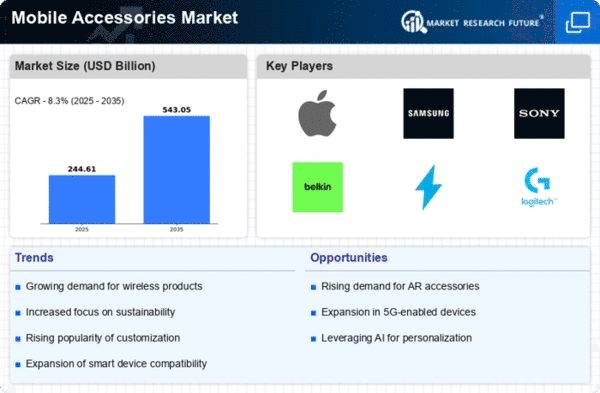
As per MRFR analysis, the Mobile Accessories Market was estimated at 225.86 USD Billion in 2024. The Mobile Accessories industry is projected to grow from 244.61 USD Billion in 2025 to 543.05 USD Billion by 2035, exhibiting a compound annual growth rate (CAGR) of 8.3 during the forecast period 2025 - 2035.

Key Market Trends & Highlights

The Mobile Accessories Market is experiencing dynamic growth driven by technological advancements and evolving consumer preferences.

  • Sustainability in product design is becoming a pivotal trend, particularly in North America, where consumers increasingly demand eco-friendly options. Integration of smart technology in mobile accessories is gaining traction, especially in the Asia-Pacific region, reflecting a shift towards more connected devices. Customization and personalization are emerging as key factors influencing consumer choices, with headphones being the fastest-growing segment in this context. Rising smartphone penetration and an increased focus on health and fitness are major drivers propelling the market forward, particularly in the chargers segment.

Market Size & Forecast

2024 Market Size 225.86 (USD Billion)
2035 Market Size 543.05 (USD Billion)
CAGR (2025 - 2035) 8.3%
Largest Regional Market Share in 2024 Asia-Pacific

Major Players

Apple (US), Samsung (KR), Sony (JP), Belkin (US), Anker (CN), Logitech (CH), OtterBox (US), JBL (US), Bose (US)

Market Trends

The Mobile Accessories Market is currently experiencing a dynamic evolution, driven by rapid technological advancements and shifting consumer preferences. As mobile devices become increasingly integral to daily life, the demand for complementary accessories is on the rise. This market encompasses a wide array of products, including cases, chargers, headphones, and screen protectors, each designed to enhance the functionality and longevity of mobile devices. The proliferation of smartphones and tablets has further fueled this growth, as consumers seek to personalize and protect their devices while also enhancing their user experience. In December 2025, the Mobile Accessories Market appears to be characterized by a strong emphasis on sustainability and innovation. Manufacturers are increasingly focusing on eco-friendly materials and production processes, responding to consumer demand for environmentally responsible products. Additionally, the integration of smart technology into accessories, such as wireless charging and health monitoring features, suggests a trend towards multifunctionality. As the market continues to evolve, it is likely that new trends will emerge, reflecting the ongoing interplay between technology, consumer behavior, and environmental considerations.

Sustainability in Product Design

The Mobile Accessories Market is witnessing a notable shift towards sustainable practices. Manufacturers are increasingly adopting eco-friendly materials and production methods, aiming to reduce environmental impact. This trend reflects a growing consumer preference for products that align with their values regarding sustainability.

Integration of Smart Technology

There is a rising trend towards the incorporation of smart technology within mobile accessories. Products are now being designed with features such as wireless charging capabilities and health monitoring functions. This integration enhances user experience and adds value to traditional accessories.

Customization and Personalization

Consumers are increasingly seeking personalized mobile accessories that reflect their individual style. This trend is driving manufacturers to offer customizable options, allowing users to select colors, designs, and features that resonate with their personal preferences.

Mobile Accessories Market Market Drivers

Focus on Sustainability

Sustainability is becoming a critical factor in the Global Mobile Accessories Market Industry. Consumers are increasingly aware of environmental issues and are seeking eco-friendly products. Manufacturers are responding by developing accessories made from sustainable materials and implementing recycling programs. This focus on sustainability not only meets consumer demand but also aligns with global initiatives aimed at reducing electronic waste. As companies adopt greener practices, they may enhance their brand image and appeal to environmentally conscious consumers, potentially driving growth in the market as it evolves towards a projected value of 225.9 USD Billion in 2024.

Technological Advancements

  1. Innovations in technology play a pivotal role in shaping the Global Mobile Accessories Market Industry. The advent of wireless technology, particularly in audio accessories like earbuds and headphones, has transformed consumer preferences. Features such as noise cancellation and enhanced battery life are becoming standard, appealing to tech-savvy consumers. Moreover, advancements in charging technology, such as fast charging and wireless charging pads, are increasingly sought after. These technological improvements not only enhance user experience but also contribute to the projected growth of the market, which is anticipated to reach 543.0 USD Billion by 2035.

.webp

Increased Consumer Spending

Consumer spending patterns are evolving, contributing to the expansion of the Global Mobile Accessories Market Industry. As disposable incomes rise, particularly in developing regions, consumers are more willing to invest in premium mobile accessories. This trend is evident in the growing demand for high-quality products that offer enhanced functionality and aesthetics. Additionally, brand loyalty is becoming increasingly important, with consumers gravitating towards established brands known for quality and innovation. This shift in consumer behavior is likely to bolster the market, supporting its growth trajectory towards an estimated value of 543.0 USD Billion by 2035.

Growing E-commerce Platforms

The rise of e-commerce platforms significantly influences the Global Mobile Accessories Market Industry. Consumers increasingly prefer online shopping for convenience and access to a wider range of products. Major e-commerce players are expanding their offerings of mobile accessories, providing competitive pricing and exclusive deals. This shift towards online retail is expected to enhance market accessibility, particularly in emerging economies where traditional retail infrastructure may be lacking. As a result, the Global Mobile Accessories Market Industry is poised for growth, with a compound annual growth rate (CAGR) of 8.3% projected from 2025 to 2035.

Rising Smartphone Penetration

The Global Mobile Accessories Market Industry experiences robust growth due to the increasing penetration of smartphones worldwide. As of 2024, the smartphone user base is projected to reach approximately 6.8 billion, driving demand for various accessories such as cases, chargers, and headphones. This surge in smartphone adoption is indicative of a broader trend towards mobile connectivity, which in turn fuels the need for complementary products. The Global Mobile Accessories Market Industry is expected to capitalize on this trend, with a market value of 225.9 USD Billion in 2024, reflecting a growing consumer reliance on mobile technology.

Market Segment Insights

By Product Type: Chargers (Largest) vs. Headphones (Fastest-Growing)

In the Mobile Accessories Market, the product type segment showcases significant diversity, with Chargers holding the largest market share. They are widely sought after due to the proliferation of devices requiring regular charging, making them a staple for users. Following closely, Headphones are emerging as a crucial player, gaining momentum as consumers increasingly prioritize audio quality and hands-free convenience. As mobile devices evolve, the demand for these accessories continues to grow.

Chargers (Dominant) vs. Headphones (Emerging)

Chargers are the dominant product type in the Mobile Accessories Market, valued for their essential role in device functionality and user convenience. They come in various forms, including wired, wireless, and fast-charging options, catering to different user preferences and device compatibility. On the other hand, Headphones are gaining traction, driven by advancements in audio technology and the rising trend of mobile media consumption. With an increasing focus on sound quality, noise cancellation, and wireless capabilities, headphones are becoming a popular choice among consumers who seek both recreational and professional audio experiences. This juxtaposition highlights the evolving preferences in mobile accessories.

By Distribution Channel: Online Retail (Largest) vs. Offline Retail (Fastest-Growing)

The Mobile Accessories Market exhibits a diverse distribution channel landscape, with Online Retail holding the largest share among all channels. This segment has capitalized on the growing trend of e-commerce, enabling consumers to access a broader variety of products and competitive pricing. Conversely, Offline Retail continues to maintain a significant presence, appealing to consumers who prefer the tactile experience of shopping in physical stores. As a result, the market is seeing a balancing act between the two channels as consumer preferences evolve. Recent trends indicate that Offline Retail is swiftly emerging as the fastest-growing segment within the Mobile Accessories Market. This resurgence is driven by enhanced in-store experiences, personalized customer service, and exclusive in-store promotions. Retailers are increasingly investing in their physical spaces, creating engaging shopping environments that attract customers back to brick-and-mortar stores. This trend suggests a potential re-alignment of consumer shopping habits in the coming years.

Online Retail (Dominant) vs. Direct Sales (Emerging)

In the Mobile Accessories Market, Online Retail stands as the dominant distribution channel, characterized by its extensive product range and the convenience it offers to consumers. This segment not only provides a seamless shopping experience but also benefits from strategic pricing and constant promotional activities. In contrast, Direct Sales is an emerging segment that leverages personal connections and targeted customer engagement. This approach allows brands to establish a more direct line of communication with their consumers, fostering loyalty while addressing their specific needs. As both segments evolve, Online Retail is likely to remain a staple for mass consumers, while Direct Sales may cater to niche markets, seeking personalized experiences.

By End User: Individual Consumers (Largest) vs. Businesses (Fastest-Growing)

In the Mobile Accessories Market, the end-user segment is primarily dominated by individual consumers, who account for a significant portion of the market share due to the increasing reliance on smartphones and tablets. Individual consumers are highly motivated by trends in technology and utility, ensuring steady demand for accessories like cases, chargers, and headphones. Businesses contribute to the market as well, but their share is relatively smaller, focusing more on bulk purchases for employee devices and branding purposes.

Individual Consumers (Dominant) vs. Businesses (Emerging)

Individual consumers represent the dominant force in the Mobile Accessories Market. This segment benefits from a diverse array of preferences and buying behaviors, targeting varied demographics from tech enthusiasts to casual users. The demand for mobile accessories, such as protective cases and portable chargers, is driven by the need for personalization, convenience, and utility. In contrast, businesses are an emerging segment focusing on practical solutions for enhancing productivity and employee experience. Companies are increasingly investing in accessories that streamline operations, build corporate identity, and offer bulk purchasing options. Although smaller than individual consumers, the business segment is expected to grow as more companies recognize the value of equipping their workforce with quality mobile accessories.

Get more detailed insights about Mobile Accessories Market Research Report - Forecast till 2035

Regional Insights

North America : Innovation and Consumer Demand

The North American mobile accessories market is projected to reach $45.0 billion by December 2025, driven by high consumer demand for innovative products and advanced technology. Key growth drivers include the increasing adoption of smartphones and wearables, alongside a growing trend towards smart home integration. Regulatory support for technology innovation further enhances market potential, making it a vibrant hub for mobile accessory development. Leading the market are the United States and Canada, with major players like Apple, Belkin, and OtterBox dominating the landscape. The competitive environment is characterized by rapid product launches and a focus on quality and design. As consumers seek enhanced functionality and aesthetics, brands are investing heavily in R&D to meet these demands, ensuring a dynamic and competitive market.

Europe : Diverse Market with Strong Players

Europe's mobile accessories market is expected to reach $35.0 billion by December 2025, fueled by a diverse consumer base and increasing smartphone penetration. The region benefits from stringent regulations promoting product safety and sustainability, which are becoming key factors in consumer purchasing decisions. The demand for eco-friendly products is also on the rise, aligning with European Union directives on environmental standards. Germany, France, and the UK are leading countries in this market, with significant contributions from brands like Sony and Logitech. The competitive landscape is marked by a mix of established companies and emerging startups, all vying for market share. As consumers become more tech-savvy, the demand for high-quality, innovative accessories continues to grow, pushing companies to enhance their offerings and marketing strategies.

Asia-Pacific : Dominating Global Market Share

The Asia-Pacific region is the largest market for mobile accessories, projected to reach $130.0 billion by December 2025. This growth is driven by rapid urbanization, increasing disposable incomes, and a high penetration of smartphones. The region's regulatory environment is also evolving, with governments promoting technology adoption and innovation, which further fuels market expansion. The demand for diverse and affordable mobile accessories is particularly strong in emerging economies. China, Japan, and South Korea are the leading countries in this market, with major players like Samsung and Anker at the forefront. The competitive landscape is intense, characterized by a mix of global brands and local manufacturers. As consumer preferences shift towards multifunctional and stylish accessories, companies are focusing on innovation and customization to capture market share, ensuring a robust growth trajectory.

Middle East and Africa : Emerging Market with Potential

The Middle East and Africa (MEA) mobile accessories market is projected to reach $15.86 billion by December 2025, driven by increasing smartphone adoption and a young, tech-savvy population. The region is witnessing a surge in demand for mobile accessories, particularly in urban areas, where consumers are looking for enhanced functionality and style. Regulatory frameworks are gradually improving, supporting market growth and encouraging foreign investment in the technology sector. Leading countries in this region include South Africa, UAE, and Nigeria, where local and international brands are competing for market share. Key players like JBL and Bose are establishing a presence, while local manufacturers are also emerging. The competitive landscape is evolving, with a focus on affordability and quality, as consumers seek value in their purchases, making this an attractive market for investment.

Key Players and Competitive Insights

The Mobile Accessories Market is characterized by a dynamic competitive landscape, driven by rapid technological advancements and evolving consumer preferences. Key players such as Apple (US), Samsung (KR), and Anker (CN) are at the forefront, each adopting distinct strategies to enhance their market positioning. Apple (US) continues to emphasize innovation, particularly in integrating accessories with its ecosystem, while Samsung (KR) focuses on expanding its product range and enhancing compatibility across devices. Anker (CN), known for its value-driven approach, is increasingly investing in R&D to improve product performance and sustainability, thereby shaping a competitive environment that prioritizes technological advancement and consumer-centric solutions.
In terms of business tactics, companies are localizing manufacturing to mitigate supply chain disruptions and optimize logistics. The market structure appears moderately fragmented, with a mix of established brands and emerging players. This fragmentation allows for diverse consumer choices but also intensifies competition among key players, who are vying for market share through innovation and strategic partnerships.
In November 2025, Apple (US) announced the launch of its new line of MagSafe accessories, which are designed to enhance the user experience across its latest iPhone models. This strategic move underscores Apple's commitment to creating a seamless ecosystem, reinforcing customer loyalty and potentially increasing accessory sales by 15% in the upcoming fiscal year. The integration of advanced features in these accessories may also set a new standard in the market, compelling competitors to elevate their offerings.
In October 2025, Samsung (KR) unveiled its latest wireless earbuds, which feature enhanced noise cancellation and longer battery life. This product launch is indicative of Samsung's strategy to capture a larger share of the audio accessories segment, which has seen a surge in demand. By focusing on high-quality audio experiences, Samsung aims to differentiate itself from competitors and attract audiophiles, potentially increasing its market share by 10%.
In September 2025, Anker (CN) entered a strategic partnership with a leading electric vehicle manufacturer to develop charging accessories tailored for electric vehicles. This collaboration not only diversifies Anker's product portfolio but also positions the company at the intersection of two rapidly growing markets: mobile accessories and electric mobility. The anticipated growth in the EV sector could lead to a 20% increase in Anker's revenue from this segment over the next three years.
As of December 2025, the Mobile Accessories Market is witnessing trends such as digitalization, sustainability, and AI integration, which are reshaping competitive dynamics. Strategic alliances are becoming increasingly prevalent, allowing companies to leverage complementary strengths and enhance their product offerings. Looking ahead, competitive differentiation is likely to evolve from traditional price-based competition to a focus on innovation, technology, and supply chain reliability, as companies strive to meet the demands of a more discerning consumer base.

Key Companies in the Mobile Accessories Market include

Industry Developments

  • Q2 2024: Anker launches MagGo wireless charging lineup for iPhone 15 Anker announced its new MagGo series of wireless chargers and battery packs designed specifically for the iPhone 15, featuring faster charging and improved magnetic alignment.
  • Q2 2024: Apple unveils new FineWoven cases and MagSafe accessories for iPhone 15 Apple introduced a new line of FineWoven cases and updated MagSafe accessories alongside the iPhone 15 launch, emphasizing sustainability and compatibility with the latest devices.
  • Q2 2024: Belkin announces partnership with Google for Pixel phone accessories Belkin entered a strategic partnership with Google to develop and distribute official accessories for the Pixel 8 series, including fast chargers and protective cases.
  • Q3 2024: Samsung launches Galaxy Buds3 Pro and new SmartTag2 Samsung expanded its mobile accessories portfolio with the launch of Galaxy Buds3 Pro wireless earbuds and SmartTag2, enhancing audio quality and device tracking capabilities.
  • Q3 2024: OtterBox opens new manufacturing facility in Texas for mobile cases OtterBox inaugurated a new production facility in Texas to meet growing demand for rugged smartphone cases and streamline supply chain operations in North America.
  • Q3 2024: Logitech acquires PopSockets in $120 million deal Logitech completed the acquisition of PopSockets, a leading mobile grip and stand accessory maker, to expand its presence in the mobile accessories market.
  • Q4 2024: Nomad secures $30 million funding to expand premium mobile accessory line Nomad, known for high-end charging cables and cases, raised $30 million in a Series C funding round to accelerate product development and global expansion.
  • Q4 2024: Spigen wins exclusive contract to supply cases for Xiaomi 15 Spigen signed an exclusive agreement with Xiaomi to provide official protective cases for the Xiaomi 15 smartphone series, strengthening its OEM partnerships.
  • Q1 2025: Mophie unveils new GaN fast chargers for Android and iOS devices Mophie launched a new line of GaN-based fast chargers compatible with both Android and iOS devices, offering higher efficiency and compact designs.
  • Q1 2025: Belkin opens European distribution center for mobile accessories Belkin announced the opening of a new distribution center in the Netherlands to improve logistics and support growing demand for its mobile accessories across Europe.
  • Q2 2025: Samsung partners with Adidas for limited-edition Galaxy phone cases Samsung collaborated with Adidas to release a limited-edition series of Galaxy phone cases, blending sports fashion with mobile protection.
  • Q2 2025: Case-Mate appoints new CEO to drive innovation in mobile accessories Case-Mate named a new Chief Executive Officer, aiming to accelerate product innovation and expand its market share in premium mobile accessories.

Future Outlook

Mobile Accessories Market Future Outlook

The Mobile Accessories Market is projected to grow at an 8.3% CAGR from 2025 to 2035, driven by technological advancements, increasing smartphone penetration, and consumer demand for innovative accessories.

New opportunities lie in:

  • Expansion into eco-friendly accessory lines
  • Development of smart wearables integrated with mobile devices
  • Partnerships with mobile manufacturers for exclusive accessory bundles

By 2035, the market is expected to be robust, reflecting substantial growth and innovation.

Market Segmentation

Mobile Accessories Market End User Outlook

  • Individual Consumers
  • Businesses
  • Educational Institutions
  • Government Agencies

Mobile Accessories Market Product Type Outlook

  • Chargers
  • Cables
  • Screen Protectors
  • Cases
  • Headphones

Mobile Accessories Market Distribution Channel Outlook

  • Online Retail
  • Offline Retail
  • Direct Sales
  • Wholesale

Report Scope

MARKET SIZE 2024 225.86(USD Billion)
MARKET SIZE 2025 244.61(USD Billion)
MARKET SIZE 2035 543.05(USD Billion)
COMPOUND ANNUAL GROWTH RATE (CAGR) 8.3% (2025 - 2035)
REPORT COVERAGE Revenue Forecast, Competitive Landscape, Growth Factors, and Trends
BASE YEAR 2024
Market Forecast Period 2025 - 2035
Historical Data 2019 - 2024
Market Forecast Units USD Billion
Key Companies Profiled Apple (US), Samsung (KR), Sony (JP), Belkin (US), Anker (CN), Logitech (CH), OtterBox (US), JBL (US), Bose (US)
Segments Covered Product Type, Distribution Channel, End User
Key Market Opportunities Integration of smart technology in Mobile Accessories Market enhances user experience and drives demand.
Key Market Dynamics Rising consumer demand for innovative mobile accessories drives competition and technological advancements in the market.
Countries Covered North America, Europe, APAC, South America, MEA

FAQs

How much is the mobile accessories market?

The mobile accessories market size was expected to be USD 225.86 billion in 2024.

What is the growth rate of the mobile accessories market?

The market is expected to register a CAGR of 8.30% over the next ten years.

Which region held the largest market share in the mobile accessories market?

Asia Pacific held the largest market share in the mobile accessories market.

Who are the key players in the mobile accessories market?

Samsung Electronics Co. Ltd. (South Korea), Sony Corporation (Japan), Panasonic Corporation (Japan), Apple Inc. (US), JVC Kenwood Corp. (Japan), Plantronics Inc. (US), Bose Corporation (US) are the key players in the mobile accessories market.

Which price range led the mobile accessories market?

The premium category led the segment in the mobile accessories market.

Which distribution channel category had the largest market share in the mobile accessories market?

The offline category had the largest market share in the mobile accessories market.

  1. SECTION I: EXECUTIVE SUMMARY AND KEY HIGHLIGHTS
    1. | 1.1 EXECUTIVE SUMMARY
    2. | 1.1.1 Market Overview
    3. | 1.1.2 Key Findings
    4. | 1.1.3 Market Segmentation
    5. | 1.1.4 Competitive Landscape
    6. | 1.1.5 Challenges and Opportunities
    7. | 1.1.6 Future Outlook
  2. SECTION II: SCOPING, METHODOLOGY AND MARKET STRUCTURE
    1. | 2.1 MARKET INTRODUCTION
    2. | 2.1.1 Definition
    3. | 2.1.2 Scope of the study
    4. |-- 2.1.2.1 Research Objective
    5. |-- 2.1.2.2 Assumption
    6. |-- 2.1.2.3 Limitations
    7. | 2.2 RESEARCH METHODOLOGY
    8. | 2.2.1 Overview
    9. | 2.2.2 Data Mining
    10. | 2.2.3 Secondary Research
    11. | 2.2.4 Primary Research
    12. |-- 2.2.4.1 Primary Interviews and Information Gathering Process
    13. |-- 2.2.4.2 Breakdown of Primary Respondents
    14. | 2.2.5 Forecasting Model
    15. | 2.2.6 Market Size Estimation
    16. |-- 2.2.6.1 Bottom-Up Approach
    17. |-- 2.2.6.2 Top-Down Approach
    18. | 2.2.7 Data Triangulation
    19. | 2.2.8 Validation
  3. SECTION III: QUALITATIVE ANALYSIS
    1. | 3.1 MARKET DYNAMICS
    2. | 3.1.1 Overview
    3. | 3.1.2 Drivers
    4. | 3.1.3 Restraints
    5. | 3.1.4 Opportunities
    6. | 3.2 MARKET FACTOR ANALYSIS
    7. | 3.2.1 Value chain Analysis
    8. | 3.2.2 Porter's Five Forces Analysis
    9. |-- 3.2.2.1 Bargaining Power of Suppliers
    10. |-- 3.2.2.2 Bargaining Power of Buyers
    11. |-- 3.2.2.3 Threat of New Entrants
    12. |-- 3.2.2.4 Threat of Substitutes
    13. |-- 3.2.2.5 Intensity of Rivalry
    14. | 3.2.3 COVID-19 Impact Analysis
    15. |-- 3.2.3.1 Market Impact Analysis
    16. |-- 3.2.3.2 Regional Impact
    17. |-- 3.2.3.3 Opportunity and Threat Analysis
  4. SECTION IV: QUANTITATIVE ANALYSIS
    1. | 4.1 Semiconductor & Electronics, BY Product Type (USD Billion)
    2. | 4.1.1 Chargers
    3. | 4.1.2 Cables
    4. | 4.1.3 Screen Protectors
    5. | 4.1.4 Cases
    6. | 4.1.5 Headphones
    7. | 4.2 Semiconductor & Electronics, BY Distribution Channel (USD Billion)
    8. | 4.2.1 Online Retail
    9. | 4.2.2 Offline Retail
    10. | 4.2.3 Direct Sales
    11. | 4.2.4 Wholesale
    12. | 4.3 Semiconductor & Electronics, BY End User (USD Billion)
    13. | 4.3.1 Individual Consumers
    14. | 4.3.2 Businesses
    15. | 4.3.3 Educational Institutions
    16. | 4.3.4 Government Agencies
    17. | 4.4 Semiconductor & Electronics, BY Region (USD Billion)
    18. | 4.4.1 North America
    19. |-- 4.4.1.1 US
    20. |-- 4.4.1.2 Canada
    21. | 4.4.2 Europe
    22. |-- 4.4.2.1 Germany
    23. |-- 4.4.2.2 UK
    24. |-- 4.4.2.3 France
    25. |-- 4.4.2.4 Russia
    26. |-- 4.4.2.5 Italy
    27. |-- 4.4.2.6 Spain
    28. |-- 4.4.2.7 Rest of Europe
    29. | 4.4.3 APAC
    30. |-- 4.4.3.1 China
    31. |-- 4.4.3.2 India
    32. |-- 4.4.3.3 Japan
    33. |-- 4.4.3.4 South Korea
    34. |-- 4.4.3.5 Malaysia
    35. |-- 4.4.3.6 Thailand
    36. |-- 4.4.3.7 Indonesia
    37. |-- 4.4.3.8 Rest of APAC
    38. | 4.4.4 South America
    39. |-- 4.4.4.1 Brazil
    40. |-- 4.4.4.2 Mexico
    41. |-- 4.4.4.3 Argentina
    42. |-- 4.4.4.4 Rest of South America
    43. | 4.4.5 MEA
    44. |-- 4.4.5.1 GCC Countries
    45. |-- 4.4.5.2 South Africa
    46. |-- 4.4.5.3 Rest of MEA
  5. SECTION V: COMPETITIVE ANALYSIS
    1. | 5.1 Competitive Landscape
    2. | 5.1.1 Overview
    3. | 5.1.2 Competitive Analysis
    4. | 5.1.3 Market share Analysis
    5. | 5.1.4 Major Growth Strategy in the Semiconductor & Electronics
    6. | 5.1.5 Competitive Benchmarking
    7. | 5.1.6 Leading Players in Terms of Number of Developments in the Semiconductor & Electronics
    8. | 5.1.7 Key developments and growth strategies
    9. |-- 5.1.7.1 New Product Launch/Service Deployment
    10. |-- 5.1.7.2 Merger & Acquisitions
    11. |-- 5.1.7.3 Joint Ventures
    12. | 5.1.8 Major Players Financial Matrix
    13. |-- 5.1.8.1 Sales and Operating Income
    14. |-- 5.1.8.2 Major Players R&D Expenditure. 2023
    15. | 5.2 Company Profiles
    16. | 5.2.1 Apple (US)
    17. |-- 5.2.1.1 Financial Overview
    18. |-- 5.2.1.2 Products Offered
    19. |-- 5.2.1.3 Key Developments
    20. |-- 5.2.1.4 SWOT Analysis
    21. |-- 5.2.1.5 Key Strategies
    22. | 5.2.2 Samsung (KR)
    23. |-- 5.2.2.1 Financial Overview
    24. |-- 5.2.2.2 Products Offered
    25. |-- 5.2.2.3 Key Developments
    26. |-- 5.2.2.4 SWOT Analysis
    27. |-- 5.2.2.5 Key Strategies
    28. | 5.2.3 Sony (JP)
    29. |-- 5.2.3.1 Financial Overview
    30. |-- 5.2.3.2 Products Offered
    31. |-- 5.2.3.3 Key Developments
    32. |-- 5.2.3.4 SWOT Analysis
    33. |-- 5.2.3.5 Key Strategies
    34. | 5.2.4 Belkin (US)
    35. |-- 5.2.4.1 Financial Overview
    36. |-- 5.2.4.2 Products Offered
    37. |-- 5.2.4.3 Key Developments
    38. |-- 5.2.4.4 SWOT Analysis
    39. |-- 5.2.4.5 Key Strategies
    40. | 5.2.5 Anker (CN)
    41. |-- 5.2.5.1 Financial Overview
    42. |-- 5.2.5.2 Products Offered
    43. |-- 5.2.5.3 Key Developments
    44. |-- 5.2.5.4 SWOT Analysis
    45. |-- 5.2.5.5 Key Strategies
    46. | 5.2.6 Logitech (CH)
    47. |-- 5.2.6.1 Financial Overview
    48. |-- 5.2.6.2 Products Offered
    49. |-- 5.2.6.3 Key Developments
    50. |-- 5.2.6.4 SWOT Analysis
    51. |-- 5.2.6.5 Key Strategies
    52. | 5.2.7 OtterBox (US)
    53. |-- 5.2.7.1 Financial Overview
    54. |-- 5.2.7.2 Products Offered
    55. |-- 5.2.7.3 Key Developments
    56. |-- 5.2.7.4 SWOT Analysis
    57. |-- 5.2.7.5 Key Strategies
    58. | 5.2.8 JBL (US)
    59. |-- 5.2.8.1 Financial Overview
    60. |-- 5.2.8.2 Products Offered
    61. |-- 5.2.8.3 Key Developments
    62. |-- 5.2.8.4 SWOT Analysis
    63. |-- 5.2.8.5 Key Strategies
    64. | 5.2.9 Bose (US)
    65. |-- 5.2.9.1 Financial Overview
    66. |-- 5.2.9.2 Products Offered
    67. |-- 5.2.9.3 Key Developments
    68. |-- 5.2.9.4 SWOT Analysis
    69. |-- 5.2.9.5 Key Strategies
    70. | 5.3 Appendix
    71. | 5.3.1 References
    72. | 5.3.2 Related Reports

Semiconductor & Electronics Market Segmentation

Semiconductor & Electronics By Product Type (USD Billion, 2025-2035)

  • Chargers
  • Cables
  • Screen Protectors
  • Cases
  • Headphones

Semiconductor & Electronics By Distribution Channel (USD Billion, 2025-2035)

  • Online Retail
  • Offline Retail
  • Direct Sales
  • Wholesale

Semiconductor & Electronics By End User (USD Billion, 2025-2035)

  • Individual Consumers
  • Businesses
  • Educational Institutions
  • Government Agencies
Infographic

Free Sample Request

Kindly complete the form below to receive a free sample of this Report

Get Free Sample

Customer Strories

Compare Licence

×
Features License Type
Single User Multiuser License Enterprise User
Price $4,950 $5,950 $7,250
Maximum User Access Limit 1 User Upto 10 Users Unrestricted Access Throughout the Organization
Free Customization
Direct Access to Analyst
Deliverable Format
Platform Access
Discount on Next Purchase 10% 15% 15%
Printable Versions