×
Request Free Sample ×

Kindly complete the form below to receive a free sample of this Report

* Please use a valid business email

Leading companies partner with us for data-driven Insights

clients tt-cursor
Hero Background
English
Chinese
French
Japanese
Korean
German
Spanish

Minimally-Invasive Cosmetic Procedures Market Analysis

ID: MRFR/MED/4467-CR
132 Pages
Rahul Gotadki
August 2021

Minimally Invasive Cosmetic Procedures Market Research Report Information by Products (Hair Removal Lasers, Botulinum Toxins, Microdermabrasion Products), Procedures (Botulinum Toxins, Soft Tissue Fillers, Chemical Peel, Laser Hair Removal, Microdermabrasion), Application (Acne, Trauma Scars, Hyperpigmentation, Adipose Tissue Regeneration), End User (Hospitals, Dermatology Clinics) - Forecast till 2035

Share:
Download PDF ×

We do not share your information with anyone. However, we may send you emails based on your report interest from time to time. You may contact us at any time to opt-out.

Minimally-Invasive Cosmetic Procedures Market Infographic
Purchase Options

Market Analysis

In-depth Analysis of Minimally-Invasive Cosmetic Procedures Market Industry Landscape

In the past years, market dynamics of mininal invasive cosmetic procedures have accelerated massively as a lot is happening at once due to changing consumer preferences, technological advancements and the growing interest towards non-surgical aesthetic treatments. The rising demand for less invasive options to traditional cosmetic surgeries is one of the key driving forces behind the growth of this market. Botox injections, dermal fillers and laser treatments have become very popular since individuals nowadays want minimal downtime and reduced risks when they decide to get beauty enhancements.

Also, brilliance in technology has had an effect on minimally-invasive esthetic surgical processes. Consequently, there are better laser treatments that have brought about more accurate and efficient treatment thus increasing the safety and efficacy of such procedures. Additionally, consumers’ trust in these nonsurgical alternatives has been boosted by injectables with longer-lasting results and improved formulations. This has seen many manufacturers in the market turning into centers of R&D so that they can provide best solutions at any time.

Still, societal norms change over time thus allowing people to accept themselves including their looks through plastic surgery without inhibitions. A wider population age group are taking up minor modifications without people having noticed them thereby diminishing stigma on aesthetic procedures. This attitude transformation has enlarged the client base leading to increased inclusion where different aged people from various backgrounds seek facial makeover services actively.

Contrarily economic environments also play their role in shaping market dynamics regarding these kinds of surgical treatments made less extensive but realistic medically speaking . When economic hardships set in clients may suffer tightened budgets leading industries like beauty care industry might appear as though it could go out but this sector’s endurance is exhibited by self-love practices which continue being prioritized by individuals in such times of trouble . People can still afford various types of external treatments even during tough financial moments unlike surgeries.

Additionally, competition within the market has intensified as numerous players join in offering differentiated products to a variety customers needing various types of services .The competition drives the process of constant innovation and efficiency that leads to differentiation through distinct offerings, well-thought-out partnerships, and integrated marketing. Also, these procedures have now been made available in a wider range of locations thanks to more new entrants into the market including specialized clinics as well as medical spas or even retails.

Market dynamics are also affected by regulatory frameworks that govern minimally invasive aesthetic procedures. More stringent regulations may hamper development and introduction of novel treatments due to safety reasons. Conversely, a conducive regulatory environment creates trust among practitioners and consumers thus fostering market growth. By collaboratively working with such bodies to establish and follow the existing security measures, it proves how much industry is committed to responsible innovation for patients’ good.


Author
Rahul Gotadki
Assistant Manager

He holds an experience of about 7+ years in Market Research and Business Consulting, working under the spectrum of Life Sciences and Healthcare domains. Rahul conceptualizes and implements a scalable business strategy and provides strategic leadership to the clients. His expertise lies in market estimation, competitive intelligence, pipeline analysis, customer assessment, etc. In addition to the above, his other responsibility includes strategic tracking of high growth markets & advising clients on the potential areas of focus they could direct their business initiatives

Leave a Comment

Market Summary

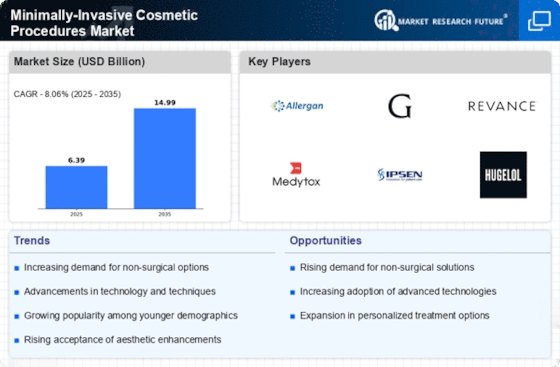
As per Market Research Future analysis, the Minimally-Invasive Cosmetic Procedures Market was estimated at 6.39 USD Billion in 2024. The Minimally-Invasive Cosmetic Procedures industry is projected to grow from 6.905 USD Billion in 2025 to 14.99 USD Billion by 2035, exhibiting a compound annual growth rate (CAGR) of 8.06% during the forecast period 2025 - 2035

Key Market Trends & Highlights

The Minimally-Invasive Cosmetic Procedures Market is experiencing robust growth driven by technological advancements and shifting consumer preferences.

  • Technological advancements are enhancing the efficacy and safety of minimally-invasive procedures, particularly in North America. Changing consumer preferences are increasingly favoring non-surgical options, with Botulinum Toxins leading the market. The influence of social media is propelling demand for aesthetic treatments, especially among younger demographics in the Asia-Pacific region. The rising awareness and acceptance of cosmetic procedures, coupled with an aging population, are key drivers of market expansion.

Market Size & Forecast

2024 Market Size 6.39 (USD Billion)
2035 Market Size 14.99 (USD Billion)
CAGR (2025 - 2035) 8.06%
Largest Regional Market Share in 2024 North America

Major Players

<a href="https://www.allerganaesthetics.com/">Allergan </a>(US), Galderma (CH), Revance Therapeutics (US), Medytox (KR), Ipsen (FR), Hugel (KR), Medytox (KR), Sientra (US), Medytox (KR)

Market Trends

The Minimally-Invasive Cosmetic Procedures Market is currently experiencing a notable evolution, driven by a confluence of factors including technological advancements, changing consumer preferences, and an increasing emphasis on aesthetic appeal. As individuals seek less invasive options for enhancing their appearance, the demand for procedures such as injectables, laser treatments, and skin rejuvenation techniques continues to rise. This market appears to be characterized by a growing acceptance of cosmetic enhancements, with a diverse demographic increasingly willing to invest in personal aesthetics. Furthermore, the proliferation of social media platforms seems to amplify the visibility of these procedures, potentially influencing public perception and driving demand. In addition, the Minimally-Invasive Cosmetic Procedures Market is likely to benefit from ongoing innovations in product formulations and delivery methods. Companies are focusing on developing safer, more effective solutions that cater to a broader audience. The rise of telemedicine and virtual consultations may also play a role in shaping the market landscape, as they provide convenient access to cosmetic services. Overall, the market appears poised for continued growth, with evolving consumer attitudes and technological advancements suggesting a promising future for minimally-invasive options in the realm of cosmetic enhancement.

Technological Advancements

The Minimally-Invasive Cosmetic Procedures Market is witnessing rapid technological progress, which enhances the efficacy and safety of various treatments. Innovations in laser technology, ultrasound, and radiofrequency are transforming traditional procedures, making them more effective and less painful. This trend indicates a shift towards more sophisticated techniques that cater to the evolving needs of consumers.

Changing Consumer Preferences

There is a noticeable shift in consumer attitudes towards cosmetic procedures, with an increasing number of individuals embracing minimally-invasive options. This trend suggests a growing desire for natural-looking results and a preference for procedures that require minimal downtime. As societal norms evolve, more people are likely to consider these enhancements as part of their regular self-care routines.

Rise of Social Media Influence

The impact of social media on the Minimally-Invasive Cosmetic Procedures Market cannot be overlooked. Platforms such as Instagram and TikTok are playing a crucial role in shaping public perception and awareness of cosmetic enhancements. This trend indicates that social media not only serves as a marketing tool but also influences consumer decisions, leading to increased interest in various procedures.

Minimally-Invasive Cosmetic Procedures Market Market Drivers

Aging Population

The aging population plays a crucial role in shaping the Minimally-Invasive Cosmetic Procedures Market. As individuals age, they often seek ways to maintain a youthful appearance, leading to increased demand for minimally-invasive treatments. The demographic shift towards an older population, particularly in developed regions, suggests a growing market for procedures that address age-related concerns such as wrinkles and sagging skin. Data indicates that individuals aged 40 and above are among the highest consumers of these procedures, driving market growth. This trend highlights the potential for the Minimally-Invasive Cosmetic Procedures Market to cater to an aging demographic that prioritizes aesthetic maintenance and enhancement.

Advancements in Technology

Technological advancements significantly influence the Minimally-Invasive Cosmetic Procedures Market. Innovations in laser technology, ultrasound, and radiofrequency have enhanced the efficacy and safety of various procedures. These advancements not only improve patient outcomes but also expand the range of available treatments. For instance, new techniques in fat reduction and skin tightening have emerged, attracting a broader clientele. The integration of technology into these procedures has led to increased precision and reduced recovery times, making them more appealing to consumers. As technology continues to evolve, the Minimally-Invasive Cosmetic Procedures Market is expected to benefit from ongoing improvements that enhance treatment options and patient satisfaction.

Increasing Demand for Non-Surgical Options

The Minimally-Invasive Cosmetic Procedures Market experiences a notable surge in demand for non-surgical options. Consumers increasingly prefer procedures that offer aesthetic enhancements without the need for extensive recovery times associated with traditional surgeries. This trend is reflected in the rising popularity of treatments such as Botox and dermal fillers, which have seen a significant uptick in usage. According to recent data, the market for these procedures is projected to grow at a compound annual growth rate of approximately 10% over the next several years. This shift towards non-invasive solutions indicates a broader acceptance of cosmetic enhancements, suggesting that the Minimally-Invasive Cosmetic Procedures Market is likely to continue expanding as more individuals seek accessible and less invasive options.

Influence of Social Media and Celebrity Culture

The influence of social media and celebrity culture significantly impacts the Minimally-Invasive Cosmetic Procedures Market. Platforms such as Instagram and TikTok have become powerful tools for promoting cosmetic procedures, with influencers and celebrities showcasing their experiences. This visibility not only normalizes cosmetic enhancements but also drives demand among followers who aspire to similar results. The trend of sharing before-and-after images and personal testimonials has created a culture of openness regarding cosmetic procedures. As a result, the Minimally-Invasive Cosmetic Procedures Market is likely to see continued growth, fueled by the desire of consumers to achieve the aesthetic ideals portrayed in social media.

Rising Awareness and Acceptance of Cosmetic Procedures

Rising awareness and acceptance of cosmetic procedures contribute significantly to the growth of the Minimally-Invasive Cosmetic Procedures Market. As societal norms evolve, more individuals are open to the idea of enhancing their appearance through cosmetic interventions. Educational campaigns and media portrayals have demystified these procedures, making them more accessible and acceptable. This cultural shift is reflected in the increasing number of consultations and procedures performed annually. Market data suggests that the acceptance of cosmetic enhancements is particularly pronounced among younger demographics, indicating a potential for sustained growth in the Minimally-Invasive Cosmetic Procedures Market as these individuals age and continue to seek aesthetic improvements.

Market Segment Insights

By Products: Botulinum Toxins (Largest) vs. Hair Removal Lasers (Fastest-Growing)

In the Minimally-Invasive Cosmetic Procedures Market, Botulinum Toxins hold the largest market share, largely due to their widespread application in wrinkle reduction and facial rejuvenation. This segment's popularity stems from its effectiveness and minimal recovery time, making it a favored choice among consumers looking for effective anti-aging solutions. On the other hand, Hair Removal Lasers are emerging as the fastest-growing segment, driven by increasing demand for long-lasting hair removal solutions and advancements in laser technology that enhance effectiveness and safety.

Botulinum Toxins (Dominant) vs. Hair Removal Lasers (Emerging)

Botulinum Toxins remains the dominant force in the minimally invasive cosmetic procedures, appreciated for its consistent results and short treatment duration. The segment appeals particularly to the aging population seeking non-surgical methods to combat signs of aging. In contrast, Hair Removal Lasers have surged in popularity, especially among younger demographics seeking permanent hair reduction solutions. This segment benefits from innovative technologies that reduce discomfort and improve results, indicating a shift towards longer-term cosmetic solutions. Both segments reflect trends towards heightened consumer awareness and preference for minimally invasive treatments.

By Procedures: Botulinum Toxins (Largest) vs. Soft Tissue Fillers (Fastest-Growing)

The Minimally-Invasive Cosmetic Procedures Market is characterized by a diverse array of treatment options, with Botulinum Toxins leading the market by capturing the largest share. Soft Tissue Fillers, while historically significant, have accelerated their growth, attracting a substantial consumer base. Other procedures such as Chemical Peel, Laser Hair Removal, and Microdermabrasion contribute to the market, yet they remain secondary in terms of share. As evolving consumer preferences shift towards non-invasive treatments, the competition among these segment values intensifies. Growth trends in this segment are largely driven by consumer behavior, with increased awareness and acceptance of cosmetic procedures. Innovations in product formulations and techniques have further bolstered demand for Soft Tissue Fillers, making them the fastest-growing choice among consumers. Additionally, demographic factors, such as the rise in the aging population and growing emphasis on beauty and self-care, are propelling the popularity of both procedures. Furthermore, the accessibility of these treatments in clinics and salons enhances their market presence, making them preferred options in the minimally-invasive sector.

Botulinum Toxins (Dominant) vs. Soft Tissue Fillers (Emerging)

Botulinum Toxins hold a dominant position within the Minimally-Invasive Cosmetic Procedures Market, renowned for their effectiveness in reducing signs of aging. Patients favor this treatment for its immediate results, quick procedures, and minimal downtime. As a result, it continues to be an essential choice for individuals seeking facial rejuvenation. In contrast, Soft Tissue Fillers represent an emerging segment that is rapidly gaining traction due to innovations and advancements in materials that offer enhanced results and safety. This segment caters to those looking to restore lost volume and enhance facial contours. The diversity within Soft Tissue Fillers, varying from hyaluronic acid to collagen-based products, provides patients with tailored options. As technology progresses, both segments will continue to evolve, creating dynamic choices for consumers.

By Application: Acne (Largest) vs. Trauma Scars (Fastest-Growing)

In the Minimally-Invasive Cosmetic Procedures Market, the application segment is marked by differing levels of market share. Acne treatments constitute the largest portion, bolstered by rising consumer awareness and acceptance. In contrast, trauma scars represent the fastest-growing category within the segment, thanks to advancements in treatment technology and increased incidences of cosmetic procedures among younger populations. The comprehensive demand across these applications underscores the evolving consumer landscape in cosmetic aesthetics. As the beauty industry shifts towards less invasive solutions, the growth of the segment is propelled by a combination of factors. Increased research and development have led to innovative treatment options for hyperpigmentation, adipose tissue regeneration, and other conditions. Social media influence and the desire for enhanced self-image play essential roles in driving demand for minimally-invasive procedures. Overall, sustained growth is expected throughout the forecast period, reflecting the dynamic nature of consumer preferences and technological advancements.

Acne (Dominant) vs. Trauma Scars (Emerging)

Acne treatment remains the dominant force within the Minimally-Invasive Cosmetic Procedures Market, with a strong consumer base driven by high awareness and a diverse range of treatment options. It encompasses various modalities, including laser treatments and chemical peels, aimed at reducing acne scarring and improving skin texture. The widespread acceptance of these treatments has led to a robust market position, characterized by ongoing innovations aimed at enhancing efficacy and patient experience. On the other hand, trauma scars are emerging as a significant segment, primarily motivated by evolving technologies. This new wave of treatments showcases an increase in procedural options that address both clinical and aesthetic needs, appealing particularly to younger demographics seeking to rectify cosmetic imperfections. As the market develops, education about these emerging treatments will likely catalyze further growth.

By End User: Hospitals (Largest) vs. Dermatology Clinics (Fastest-Growing)

The Minimally-Invasive Cosmetic Procedures Market showcases a diverse end-user distribution, primarily involving hospitals and dermatology clinics. Hospitals hold a significant share in the market due to their advanced facilities and comprehensive care for patients seeking cosmetic enhancements. Dermatology clinics, meanwhile, are experiencing rapid growth, reflecting a shift towards specialized care that focuses on non-invasive approaches to cosmetic procedures.

Hospitals (Dominant) vs. Dermatology Clinics (Emerging)

Hospitals dominate the Minimally-Invasive Cosmetic Procedures Market, leveraging their extensive resources and multidisciplinary teams to offer a wide array of cosmetic services. These institutions provide patients with access to the latest technology and experienced practitioners. Conversely, dermatology clinics are emerging rapidly within this sector, catering to an increasing number of individuals seeking specialized cosmetic treatments. These clinics foster a personalized approach, often offering services like laser treatments and injectables with shorter recovery times, making them a preferred choice for many patients.

Get more detailed insights about Minimally Invasive Cosmetic Procedures Market Research Report - Forecast till 2035

Regional Insights

Key Companies in the Minimally-Invasive Cosmetic Procedures Market include

Industry Developments

    • In June 2021, The Procter & Gamble Company (US) launched a new skincare line GoodSkin MD
    • In July 2020, Koninklijke Philips N.V.(Netherlands) acquired Montreal-based Reacts, a Canadian leader in developing telehealth solutions and augmented reality,to accelerate and expand its development in the context of the growing needs for remote collaboration in healthcare
    • In November 2019, Allergan, Inc.'s (US) wholly-owned subsidiary, Allergan Pharmaceuticals International Limited and Exicure, Inc. (Ireland), entered a global collaboration agreement to discover and develop novel treatments for hair loss disorders


Future Outlook

Minimally-Invasive Cosmetic Procedures Market Future Outlook

The Minimally-Invasive Cosmetic Procedures Market is projected to grow at an 8.06% CAGR from 2025 to 2035, driven by technological advancements, increasing consumer demand, and rising disposable incomes.

New opportunities lie in:

  • <p>Expansion of telemedicine consultations for cosmetic procedures. Development of personalized skincare solutions using AI technology. Partnerships with wellness centers to offer integrated cosmetic services.</p>

By 2035, the market is expected to achieve substantial growth, reflecting evolving consumer preferences and technological innovations.

Market Segmentation

Minimally-Invasive Cosmetic Procedures Market End User Outlook

  • Hospitals
  • Dermatology Clinics
  • Others

Minimally-Invasive Cosmetic Procedures Market Products Outlook

  • Hair Removal Lasers
  • Botulinum Toxins
  • Microdermabrasion Products
  • Others

Minimally-Invasive Cosmetic Procedures Market Procedures Outlook

  • Botulinum Toxins
  • Soft Tissue Fillers
  • Chemical Peel
  • Laser Hair Removal
  • Microdermabrasion
  • Others

Minimally-Invasive Cosmetic Procedures Market Application Outlook

  • Acne
  • Trauma Scars
  • Hyperpigmentation
  • Adipose Tissue Regeneration
  • Others

Report Scope

MARKET SIZE 2024 6.39(USD Billion)
MARKET SIZE 2025 6.905(USD Billion)
MARKET SIZE 2035 14.99(USD Billion)
COMPOUND ANNUAL GROWTH RATE (CAGR) 8.06% (2025 - 2035)
REPORT COVERAGE Revenue Forecast, Competitive Landscape, Growth Factors, and Trends
BASE YEAR 2024
Market Forecast Period 2025 - 2035
Historical Data 2019 - 2024
Market Forecast Units USD Billion
Key Companies Profiled Allergan (US), Galderma (CH), Revance Therapeutics (US), Medytox (KR), Ipsen (FR), Hugel (KR), Medytox (KR), Sientra (US), Medytox (KR)
Segments Covered Products
Key Market Opportunities Growing consumer demand for personalized treatments drives innovation in the Minimally-Invasive Cosmetic Procedures Market.
Key Market Dynamics Rising consumer demand for non-surgical options drives innovation and competition in the minimally-invasive cosmetic procedures market.
Countries Covered North America, Europe, APAC, South America, MEA

FAQs

  1. SECTION I: EXECUTIVE SUMMARY AND KEY HIGHLIGHTS
    1. EXECUTIVE SUMMARY
      1. Market Overview
      2. Key Findings
      3. Market Segmentation
      4. Competitive Landscape
      5. Challenges and Opportunities
      6. Future Outlook 2
  2. SECTION II: SCOPING, METHODOLOGY AND MARKET STRUCTURE
    1. MARKET INTRODUCTION
      1. Definition
      2. Scope of the study
    2. RESEARCH METHODOLOGY
      1. Overview
      2. Data Mining
      3. Secondary Research
      4. Primary Research
      5. Forecasting Model
      6. Market Size Estimation
      7. Data Triangulation
      8. Validation 3
  3. SECTION III: QUALITATIVE ANALYSIS
    1. MARKET DYNAMICS
      1. Overview
      2. Drivers
      3. Restraints
      4. Opportunities
    2. MARKET FACTOR ANALYSIS
      1. Value chain Analysis
      2. Porter's Five Forces Analysis
      3. COVID-19 Impact Analysis
  4. SECTION IV: QUANTITATIVE ANALYSIS
    1. Healthcare, BY Products (USD Billion)
      1. Hair Removal Lasers
      2. Botulinum Toxins
      3. Microdermabrasion Products
      4. Others
    2. Healthcare, BY Procedures (USD Billion)
      1. Botulinum Toxins
      2. Soft Tissue Fillers
      3. Chemical Peel
      4. Laser Hair Removal
      5. Microdermabrasion
      6. Others
    3. Healthcare, BY Application (USD Billion)
      1. Acne
      2. Trauma Scars
      3. Hyperpigmentation
      4. Adipose Tissue Regeneration
      5. Others
    4. Healthcare, BY End User (USD Billion)
      1. Hospitals
      2. Dermatology Clinics
      3. Others
    5. Healthcare, BY Region (USD Billion)
      1. North America
      2. Europe
      3. APAC
      4. South America
      5. MEA
  5. SECTION V: COMPETITIVE ANALYSIS
    1. Competitive Landscape
      1. Overview
      2. Competitive Analysis
      3. Market share Analysis
      4. Major Growth Strategy in the Healthcare
      5. Competitive Benchmarking
      6. Leading Players in Terms of Number of Developments in the Healthcare
      7. Key developments and growth strategies
      8. Major Players Financial Matrix
    2. Company Profiles
      1. Allergan (US)
      2. Galderma (CH)
      3. Revance Therapeutics (US)
      4. Medytox (KR)
      5. Ipsen (FR)
      6. Hugel (KR)
      7. Medytox (KR)
      8. Sientra (US)
      9. Medytox (KR)
    3. Appendix
      1. References
      2. Related Reports 6 LIST OF FIGURES
    4. MARKET SYNOPSIS
    5. NORTH AMERICA MARKET ANALYSIS
    6. US MARKET ANALYSIS BY PRODUCTS
    7. US MARKET ANALYSIS BY PROCEDURES
    8. US MARKET ANALYSIS BY APPLICATION
    9. US MARKET ANALYSIS BY END USER
    10. CANADA MARKET ANALYSIS BY PRODUCTS
    11. CANADA MARKET ANALYSIS BY PROCEDURES
    12. CANADA MARKET ANALYSIS BY APPLICATION
    13. CANADA MARKET ANALYSIS BY END USER
    14. EUROPE MARKET ANALYSIS
    15. GERMANY MARKET ANALYSIS BY PRODUCTS
    16. GERMANY MARKET ANALYSIS BY PROCEDURES
    17. GERMANY MARKET ANALYSIS BY APPLICATION
    18. GERMANY MARKET ANALYSIS BY END USER
    19. UK MARKET ANALYSIS BY PRODUCTS
    20. UK MARKET ANALYSIS BY PROCEDURES
    21. UK MARKET ANALYSIS BY APPLICATION
    22. UK MARKET ANALYSIS BY END USER
    23. FRANCE MARKET ANALYSIS BY PRODUCTS
    24. FRANCE MARKET ANALYSIS BY PROCEDURES
    25. FRANCE MARKET ANALYSIS BY APPLICATION
    26. FRANCE MARKET ANALYSIS BY END USER
    27. RUSSIA MARKET ANALYSIS BY PRODUCTS
    28. RUSSIA MARKET ANALYSIS BY PROCEDURES
    29. RUSSIA MARKET ANALYSIS BY APPLICATION
    30. RUSSIA MARKET ANALYSIS BY END USER
    31. ITALY MARKET ANALYSIS BY PRODUCTS
    32. ITALY MARKET ANALYSIS BY PROCEDURES
    33. ITALY MARKET ANALYSIS BY APPLICATION
    34. ITALY MARKET ANALYSIS BY END USER
    35. SPAIN MARKET ANALYSIS BY PRODUCTS
    36. SPAIN MARKET ANALYSIS BY PROCEDURES
    37. SPAIN MARKET ANALYSIS BY APPLICATION
    38. SPAIN MARKET ANALYSIS BY END USER
    39. REST OF EUROPE MARKET ANALYSIS BY PRODUCTS
    40. REST OF EUROPE MARKET ANALYSIS BY PROCEDURES
    41. REST OF EUROPE MARKET ANALYSIS BY APPLICATION
    42. REST OF EUROPE MARKET ANALYSIS BY END USER
    43. APAC MARKET ANALYSIS
    44. CHINA MARKET ANALYSIS BY PRODUCTS
    45. CHINA MARKET ANALYSIS BY PROCEDURES
    46. CHINA MARKET ANALYSIS BY APPLICATION
    47. CHINA MARKET ANALYSIS BY END USER
    48. INDIA MARKET ANALYSIS BY PRODUCTS
    49. INDIA MARKET ANALYSIS BY PROCEDURES
    50. INDIA MARKET ANALYSIS BY APPLICATION
    51. INDIA MARKET ANALYSIS BY END USER
    52. JAPAN MARKET ANALYSIS BY PRODUCTS
    53. JAPAN MARKET ANALYSIS BY PROCEDURES
    54. JAPAN MARKET ANALYSIS BY APPLICATION
    55. JAPAN MARKET ANALYSIS BY END USER
    56. SOUTH KOREA MARKET ANALYSIS BY PRODUCTS
    57. SOUTH KOREA MARKET ANALYSIS BY PROCEDURES
    58. SOUTH KOREA MARKET ANALYSIS BY APPLICATION
    59. SOUTH KOREA MARKET ANALYSIS BY END USER
    60. MALAYSIA MARKET ANALYSIS BY PRODUCTS
    61. MALAYSIA MARKET ANALYSIS BY PROCEDURES
    62. MALAYSIA MARKET ANALYSIS BY APPLICATION
    63. MALAYSIA MARKET ANALYSIS BY END USER
    64. THAILAND MARKET ANALYSIS BY PRODUCTS
    65. THAILAND MARKET ANALYSIS BY PROCEDURES
    66. THAILAND MARKET ANALYSIS BY APPLICATION
    67. THAILAND MARKET ANALYSIS BY END USER
    68. INDONESIA MARKET ANALYSIS BY PRODUCTS
    69. INDONESIA MARKET ANALYSIS BY PROCEDURES
    70. INDONESIA MARKET ANALYSIS BY APPLICATION
    71. INDONESIA MARKET ANALYSIS BY END USER
    72. REST OF APAC MARKET ANALYSIS BY PRODUCTS
    73. REST OF APAC MARKET ANALYSIS BY PROCEDURES
    74. REST OF APAC MARKET ANALYSIS BY APPLICATION
    75. REST OF APAC MARKET ANALYSIS BY END USER
    76. SOUTH AMERICA MARKET ANALYSIS
    77. BRAZIL MARKET ANALYSIS BY PRODUCTS
    78. BRAZIL MARKET ANALYSIS BY PROCEDURES
    79. BRAZIL MARKET ANALYSIS BY APPLICATION
    80. BRAZIL MARKET ANALYSIS BY END USER
    81. MEXICO MARKET ANALYSIS BY PRODUCTS
    82. MEXICO MARKET ANALYSIS BY PROCEDURES
    83. MEXICO MARKET ANALYSIS BY APPLICATION
    84. MEXICO MARKET ANALYSIS BY END USER
    85. ARGENTINA MARKET ANALYSIS BY PRODUCTS
    86. ARGENTINA MARKET ANALYSIS BY PROCEDURES
    87. ARGENTINA MARKET ANALYSIS BY APPLICATION
    88. ARGENTINA MARKET ANALYSIS BY END USER
    89. REST OF SOUTH AMERICA MARKET ANALYSIS BY PRODUCTS
    90. REST OF SOUTH AMERICA MARKET ANALYSIS BY PROCEDURES
    91. REST OF SOUTH AMERICA MARKET ANALYSIS BY APPLICATION
    92. REST OF SOUTH AMERICA MARKET ANALYSIS BY END USER
    93. MEA MARKET ANALYSIS
    94. GCC COUNTRIES MARKET ANALYSIS BY PRODUCTS
    95. GCC COUNTRIES MARKET ANALYSIS BY PROCEDURES
    96. GCC COUNTRIES MARKET ANALYSIS BY APPLICATION
    97. GCC COUNTRIES MARKET ANALYSIS BY END USER
    98. SOUTH AFRICA MARKET ANALYSIS BY PRODUCTS
    99. SOUTH AFRICA MARKET ANALYSIS BY PROCEDURES
    100. SOUTH AFRICA MARKET ANALYSIS BY APPLICATION
    101. SOUTH AFRICA MARKET ANALYSIS BY END USER
    102. REST OF MEA MARKET ANALYSIS BY PRODUCTS
    103. REST OF MEA MARKET ANALYSIS BY PROCEDURES
    104. REST OF MEA MARKET ANALYSIS BY APPLICATION
    105. REST OF MEA MARKET ANALYSIS BY END USER
    106. KEY BUYING CRITERIA OF HEALTHCARE
    107. RESEARCH PROCESS OF MRFR
    108. DRO ANALYSIS OF HEALTHCARE
    109. DRIVERS IMPACT ANALYSIS: HEALTHCARE
    110. RESTRAINTS IMPACT ANALYSIS: HEALTHCARE
    111. SUPPLY / VALUE CHAIN: HEALTHCARE
    112. HEALTHCARE, BY PRODUCTS, 2024 (% SHARE)
    113. HEALTHCARE, BY PRODUCTS, 2024 TO 2035 (USD Billion)
    114. HEALTHCARE, BY PROCEDURES, 2024 (% SHARE)
    115. HEALTHCARE, BY PROCEDURES, 2024 TO 2035 (USD Billion)
    116. HEALTHCARE, BY APPLICATION, 2024 (% SHARE)
    117. HEALTHCARE, BY APPLICATION, 2024 TO 2035 (USD Billion)
    118. HEALTHCARE, BY END USER, 2024 (% SHARE)
    119. HEALTHCARE, BY END USER, 2024 TO 2035 (USD Billion)
    120. BENCHMARKING OF MAJOR COMPETITORS 7 LIST OF TABLES
    121. LIST OF ASSUMPTIONS
    122. North America MARKET SIZE ESTIMATES; FORECAST
      1. BY PRODUCTS, 2025-2035 (USD Billion)
      2. BY PROCEDURES, 2025-2035 (USD Billion)
      3. BY APPLICATION, 2025-2035 (USD Billion)
      4. BY END USER, 2025-2035 (USD Billion)
    123. US MARKET SIZE ESTIMATES; FORECAST
      1. BY PRODUCTS, 2025-2035 (USD Billion)
      2. BY PROCEDURES, 2025-2035 (USD Billion)
      3. BY APPLICATION, 2025-2035 (USD Billion)
      4. BY END USER, 2025-2035 (USD Billion)
    124. Canada MARKET SIZE ESTIMATES; FORECAST
      1. BY PRODUCTS, 2025-2035 (USD Billion)
      2. BY PROCEDURES, 2025-2035 (USD Billion)
      3. BY APPLICATION, 2025-2035 (USD Billion)
      4. BY END USER, 2025-2035 (USD Billion)
    125. Europe MARKET SIZE ESTIMATES; FORECAST
      1. BY PRODUCTS, 2025-2035 (USD Billion)
      2. BY PROCEDURES, 2025-2035 (USD Billion)
      3. BY APPLICATION, 2025-2035 (USD Billion)
      4. BY END USER, 2025-2035 (USD Billion)
    126. Germany MARKET SIZE ESTIMATES; FORECAST
      1. BY PRODUCTS, 2025-2035 (USD Billion)
      2. BY PROCEDURES, 2025-2035 (USD Billion)
      3. BY APPLICATION, 2025-2035 (USD Billion)
      4. BY END USER, 2025-2035 (USD Billion)
    127. UK MARKET SIZE ESTIMATES; FORECAST
      1. BY PRODUCTS, 2025-2035 (USD Billion)
      2. BY PROCEDURES, 2025-2035 (USD Billion)
      3. BY APPLICATION, 2025-2035 (USD Billion)
      4. BY END USER, 2025-2035 (USD Billion)
    128. France MARKET SIZE ESTIMATES; FORECAST
      1. BY PRODUCTS, 2025-2035 (USD Billion)
      2. BY PROCEDURES, 2025-2035 (USD Billion)
      3. BY APPLICATION, 2025-2035 (USD Billion)
      4. BY END USER, 2025-2035 (USD Billion)
    129. Russia MARKET SIZE ESTIMATES; FORECAST
      1. BY PRODUCTS, 2025-2035 (USD Billion)
      2. BY PROCEDURES, 2025-2035 (USD Billion)
      3. BY APPLICATION, 2025-2035 (USD Billion)
      4. BY END USER, 2025-2035 (USD Billion)
    130. Italy MARKET SIZE ESTIMATES; FORECAST
      1. BY PRODUCTS, 2025-2035 (USD Billion)
      2. BY PROCEDURES, 2025-2035 (USD Billion)
      3. BY APPLICATION, 2025-2035 (USD Billion)
      4. BY END USER, 2025-2035 (USD Billion)
    131. Spain MARKET SIZE ESTIMATES; FORECAST
      1. BY PRODUCTS, 2025-2035 (USD Billion)
      2. BY PROCEDURES, 2025-2035 (USD Billion)
      3. BY APPLICATION, 2025-2035 (USD Billion)
      4. BY END USER, 2025-2035 (USD Billion)
    132. Rest of Europe MARKET SIZE ESTIMATES; FORECAST
      1. BY PRODUCTS, 2025-2035 (USD Billion)
      2. BY PROCEDURES, 2025-2035 (USD Billion)
      3. BY APPLICATION, 2025-2035 (USD Billion)
      4. BY END USER, 2025-2035 (USD Billion)
    133. APAC MARKET SIZE ESTIMATES; FORECAST
      1. BY PRODUCTS, 2025-2035 (USD Billion)
      2. BY PROCEDURES, 2025-2035 (USD Billion)
      3. BY APPLICATION, 2025-2035 (USD Billion)
      4. BY END USER, 2025-2035 (USD Billion)
    134. China MARKET SIZE ESTIMATES; FORECAST
      1. BY PRODUCTS, 2025-2035 (USD Billion)
      2. BY PROCEDURES, 2025-2035 (USD Billion)
      3. BY APPLICATION, 2025-2035 (USD Billion)
      4. BY END USER, 2025-2035 (USD Billion)
    135. India MARKET SIZE ESTIMATES; FORECAST
      1. BY PRODUCTS, 2025-2035 (USD Billion)
      2. BY PROCEDURES, 2025-2035 (USD Billion)
      3. BY APPLICATION, 2025-2035 (USD Billion)
      4. BY END USER, 2025-2035 (USD Billion)
    136. Japan MARKET SIZE ESTIMATES; FORECAST
      1. BY PRODUCTS, 2025-2035 (USD Billion)
      2. BY PROCEDURES, 2025-2035 (USD Billion)
      3. BY APPLICATION, 2025-2035 (USD Billion)
      4. BY END USER, 2025-2035 (USD Billion)
    137. South Korea MARKET SIZE ESTIMATES; FORECAST
      1. BY PRODUCTS, 2025-2035 (USD Billion)
      2. BY PROCEDURES, 2025-2035 (USD Billion)
      3. BY APPLICATION, 2025-2035 (USD Billion)
      4. BY END USER, 2025-2035 (USD Billion)
    138. Malaysia MARKET SIZE ESTIMATES; FORECAST
      1. BY PRODUCTS, 2025-2035 (USD Billion)
      2. BY PROCEDURES, 2025-2035 (USD Billion)
      3. BY APPLICATION, 2025-2035 (USD Billion)
      4. BY END USER, 2025-2035 (USD Billion)
    139. Thailand MARKET SIZE ESTIMATES; FORECAST
      1. BY PRODUCTS, 2025-2035 (USD Billion)
      2. BY PROCEDURES, 2025-2035 (USD Billion)
      3. BY APPLICATION, 2025-2035 (USD Billion)
      4. BY END USER, 2025-2035 (USD Billion)
    140. Indonesia MARKET SIZE ESTIMATES; FORECAST
      1. BY PRODUCTS, 2025-2035 (USD Billion)
      2. BY PROCEDURES, 2025-2035 (USD Billion)
      3. BY APPLICATION, 2025-2035 (USD Billion)
      4. BY END USER, 2025-2035 (USD Billion)
    141. Rest of APAC MARKET SIZE ESTIMATES; FORECAST
      1. BY PRODUCTS, 2025-2035 (USD Billion)
      2. BY PROCEDURES, 2025-2035 (USD Billion)
      3. BY APPLICATION, 2025-2035 (USD Billion)
      4. BY END USER, 2025-2035 (USD Billion)
    142. South America MARKET SIZE ESTIMATES; FORECAST
      1. BY PRODUCTS, 2025-2035 (USD Billion)
      2. BY PROCEDURES, 2025-2035 (USD Billion)
      3. BY APPLICATION, 2025-2035 (USD Billion)
      4. BY END USER, 2025-2035 (USD Billion)
    143. Brazil MARKET SIZE ESTIMATES; FORECAST
      1. BY PRODUCTS, 2025-2035 (USD Billion)
      2. BY PROCEDURES, 2025-2035 (USD Billion)
      3. BY APPLICATION, 2025-2035 (USD Billion)
      4. BY END USER, 2025-2035 (USD Billion)
    144. Mexico MARKET SIZE ESTIMATES; FORECAST
      1. BY PRODUCTS, 2025-2035 (USD Billion)
      2. BY PROCEDURES, 2025-2035 (USD Billion)
      3. BY APPLICATION, 2025-2035 (USD Billion)
      4. BY END USER, 2025-2035 (USD Billion)
    145. Argentina MARKET SIZE ESTIMATES; FORECAST
      1. BY PRODUCTS, 2025-2035 (USD Billion)
      2. BY PROCEDURES, 2025-2035 (USD Billion)
      3. BY APPLICATION, 2025-2035 (USD Billion)
      4. BY END USER, 2025-2035 (USD Billion)
    146. Rest of South America MARKET SIZE ESTIMATES; FORECAST
      1. BY PRODUCTS, 2025-2035 (USD Billion)
      2. BY PROCEDURES, 2025-2035 (USD Billion)
      3. BY APPLICATION, 2025-2035 (USD Billion)
      4. BY END USER, 2025-2035 (USD Billion)
    147. MEA MARKET SIZE ESTIMATES; FORECAST
      1. BY PRODUCTS, 2025-2035 (USD Billion)
      2. BY PROCEDURES, 2025-2035 (USD Billion)
      3. BY APPLICATION, 2025-2035 (USD Billion)
      4. BY END USER, 2025-2035 (USD Billion)
    148. GCC Countries MARKET SIZE ESTIMATES; FORECAST
      1. BY PRODUCTS, 2025-2035 (USD Billion)
      2. BY PROCEDURES, 2025-2035 (USD Billion)
      3. BY APPLICATION, 2025-2035 (USD Billion)
      4. BY END USER, 2025-2035 (USD Billion)
    149. South Africa MARKET SIZE ESTIMATES; FORECAST
      1. BY PRODUCTS, 2025-2035 (USD Billion)
      2. BY PROCEDURES, 2025-2035 (USD Billion)
      3. BY APPLICATION, 2025-2035 (USD Billion)
      4. BY END USER, 2025-2035 (USD Billion)
    150. Rest of MEA MARKET SIZE ESTIMATES; FORECAST
      1. BY PRODUCTS, 2025-2035 (USD Billion)
      2. BY PROCEDURES, 2025-2035 (USD Billion)
      3. BY APPLICATION, 2025-2035 (USD Billion)
      4. BY END USER, 2025-2035 (USD Billion)
    151. PRODUCT LAUNCH/PRODUCT DEVELOPMENT/APPROVAL
    152. ACQUISITION/PARTNERSHIP

Minimally Invasive Cosmetic Procedures Market Segmentation

Market Segmentation Overview

  • Detailed segmentation data will be available in the full report
  • Comprehensive analysis by multiple parameters
  • Regional and country-level breakdowns
  • Market size forecasts by segment
Infographic

Free Sample Request

Kindly complete the form below to receive a free sample of this Report

Get Free Sample

Customer Strories

Compare Licence

×
Features License Type
Single User Multiuser License Enterprise User
Price $4,950 $5,950 $7,250
Maximum User Access Limit 1 User Upto 10 Users Unrestricted Access Throughout the Organization
Free Customization
Direct Access to Analyst
Deliverable Format
Platform Access
Discount on Next Purchase 10% 15% 15%
Printable Versions