Request Free Sample ×

Kindly complete the form below to receive a free sample of this Report

* Please use a valid business email

Leading companies partner with us for data-driven Insights

clients tt-cursor
Hero Background
English
Chinese
French
Japanese
Korean
German
Spanish

Military Robots Market Share

ID: MRFR/AD/2338-HCR
100 Pages
Shubham Munde
Last Updated: April 06, 2026

Military Robots Market Size, Share, Industry Trend & Analysis Research Report By Type (Unmanned Ground Vehicles, Unmanned Aerial Vehicles, Unmanned Underwater Vehicles, Autonomous Combat Systems), By Application (Surveillance, Reconnaissance, Logistics Support, Explosive Ordnance Disposal), By Technology (Teleoperated, Autonomous, Semi-Autonomous), By End Use (Defense, Security, Research) and By Regional (North America, Europe, South America, Asia Pacific, Middle East and Africa) - Forecast to 2035

Share:
Download PDF ×

We do not share your information with anyone. However, we may send you emails based on your report interest from time to time. You may contact us at any time to opt-out.

Military Robots Market Infographic
Purchase Options

Market Share

Military Robots Market Share Analysis

In the competitive landscape of the military robots market, companies employ diverse strategies to secure their market share through strategic positioning. One significant approach involves specialization in specific types of military robots or capabilities. Some companies focus on developing specialized unmanned aerial vehicles (UAVs), ground-based robots, or autonomous systems tailored for specific military applications. By establishing expertise in particular niches, they differentiate themselves and cater to distinct defense requirements, thus securing a portion of the market share within specialized segments. Moreover, differentiation based on technological innovation plays a pivotal role in market share positioning strategies. Companies strive to introduce cutting-edge advancements, whether in autonomy, artificial intelligence, sensor technology, or swarming capabilities. Being at the forefront of technological innovation helps companies position themselves as leaders in the field, attracting defense agencies seeking state-of-the-art military robots that provide superior capabilities and effectiveness. Strategic alliances and partnerships also contribute significantly to market share positioning within the military robots sector. Collaborations between defense contractors, technology firms, and research institutions enable access to diverse expertise, resources, and technologies. These partnerships foster the development of comprehensive and advanced military robotic systems, enhancing companies' market positions by offering integrated and multi-faceted solutions. Furthermore, companies often differentiate their market positioning based on service quality, reliability, and support. Providing exceptional customer service, responsive maintenance, and ongoing support for deployed systems helps build trust and credibility with defense clients. Reliability in terms of system performance, durability in harsh environments, and continuous technical assistance contribute to a strong market position and customer loyalty. Additionally, pricing strategies play a role in market share positioning within the military robots market. Some companies focus on offering competitive pricing for their robotic systems, targeting cost-conscious defense agencies looking for value-oriented solutions. Others position themselves as premium providers, justifying higher costs through advanced features, superior performance, or comprehensive service packages. Ethical considerations and adherence to international regulations surrounding the use of military robots also influence market positioning strategies. Companies that prioritize ethical development and responsible use of autonomous systems position themselves as responsible and trustworthy partners for defense agencies concerned about ethical implications and regulatory compliance. Moreover, adaptability and customization options contribute to market share positioning within the military robots sector. Companies that offer modular designs, customizable features, or adaptable platforms that can be tailored to specific mission requirements cater to the diverse needs of defense agencies. This flexibility enables companies to capture market share by providing solutions that align closely with the unique demands of various defense applications.

Author
Author Profile
Shubham Munde
Team Lead - Research

Shubham brings over 7 years of expertise in Market Intelligence and Strategic Consulting, with a strong focus on the Automotive, Aerospace, and Defense sectors. Backed by a solid foundation in semiconductors, electronics, and software, he has successfully delivered high-impact syndicated and custom research on a global scale. His core strengths include market sizing, forecasting, competitive intelligence, consumer insights, and supply chain mapping. Widely recognized for developing scalable growth strategies, Shubham empowers clients to navigate complex markets and achieve a lasting competitive edge. Trusted by start-ups and Fortune 500 companies alike, he consistently converts challenges into strategic opportunities that drive sustainable growth.

Leave a Comment

FAQs

What is the projected market valuation of the Military Robots Market by 2035?

<p>The Military Robots Market is projected to reach a valuation of 74.49 USD Billion by 2035.</p>

What was the overall market valuation of the Military Robots Market in 2024?

<p>In 2024, the overall market valuation of the Military Robots Market was 40.95 USD Billion.</p>

What is the expected CAGR for the Military Robots Market during the forecast period 2025 - 2035?

<p>The expected CAGR for the Military Robots Market during the forecast period 2025 - 2035 is 5.59%.</p>

Which companies are considered key players in the Military Robots Market?

<p>Key players in the Military Robots Market include Northrop Grumman, General Dynamics, BAE Systems, Lockheed Martin, Thales Group, Elbit Systems, Raytheon Technologies, Kongsberg Gruppen, and QinetiQ.</p>

What are the projected values for Unmanned Aerial Vehicles in the Military Robots Market?

<p>The projected values for Unmanned Aerial Vehicles in the Military Robots Market range from 15.0 to 25.0 USD Billion.</p>

How much is the Unmanned Ground Vehicles segment expected to grow by 2035?

<p>The Unmanned Ground Vehicles segment is expected to grow from 10.0 USD Billion to 18.0 USD Billion by 2035.</p>

What is the anticipated market size for Logistics Support applications in 2035?

<p>The anticipated market size for Logistics Support applications in 2035 is projected to be between 12.0 and 22.0 USD Billion.</p>

What are the expected values for Autonomous technology in the Military Robots Market?

<p>The expected values for Autonomous technology in the Military Robots Market range from 15.0 to 30.0 USD Billion.</p>

What is the projected market size for the Defense end-use segment by 2035?

<p>The projected market size for the Defense end-use segment by 2035 is expected to be between 20.0 and 36.0 USD Billion.</p>

What applications are driving growth in the Military Robots Market?

<p>Applications such as Surveillance, Reconnaissance, Logistics Support, and Explosive Ordnance Disposal are driving growth in the Military Robots Market.</p>

Market Summary

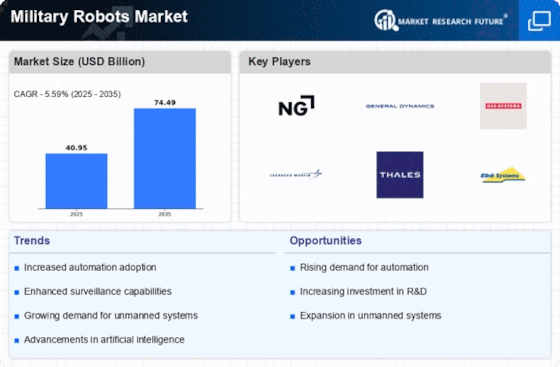
As per Market Research Future analysis, the Military Robots Market was estimated at 40.95 USD Billion in 2024. The Military Robots industry is projected to grow from 43.24 USD Billion in 2025 to 74.49 USD Billion by 2035, exhibiting a compound annual growth rate (CAGR) of 5.59% during the forecast period 2025 – 2035. This growth is supported by rising adoption across autonomous platforms within the Military Robotics Autonomous Systems market.

Key Market Trends & Highlights

The Military Robots Market is poised for substantial growth driven by technological advancements and increasing defense investments.

  • The integration of Artificial Intelligence is transforming operational capabilities in military robots. North America remains the largest market, while Asia-Pacific is emerging as the fastest-growing region in military robotics. Unmanned Aerial Vehicles dominate the market, whereas Autonomous Combat Systems are witnessing the fastest growth. Rising demand for surveillance and reconnaissance, coupled with increased military budgets, drives market expansion.

Market Size & Forecast

2024 Market Size 40.95 (USD Billion)
2035 Market Size 74.49 (USD Billion)
CAGR (2025 - 2035) 5.59%
Largest Regional Market Share in 2024 North America

Major Players

<a href="https://news.northropgrumman.com/news-stream">Northrop Grumman</a> (US), General Dynamics (US), BAE Systems (GB), Lockheed Martin (US), Thales Group (FR), Elbit Systems (IL), Raytheon Technologies (US), Kongsberg Gruppen (NO), QinetiQ (GB)

Market Trends

The Military Robots Market is currently experiencing a transformative phase, driven by advancements in technology and increasing defense budgets across various nations. The integration of artificial intelligence and machine learning into military robotics autonomous systems is enhancing operational efficiency and effectiveness. As nations seek to modernize their armed forces, the demand for unmanned systems—including aerial, ground, and naval robots—is on the rise, reflecting broader adoption within the Military Robotics Autonomous Systems Market.

This shift reflects a broader trend towards automation in military operations, aiming to reduce human risk and improve mission success rates. Furthermore, the geopolitical landscape is influencing investments in the Military Robots Market, as countries strive to maintain strategic advantages over potential adversaries. In addition to technological advancements, the Military Robots Market is also shaped by evolving warfare tactics and the need for enhanced surveillance capabilities. The increasing complexity of modern conflicts necessitates the deployment of sophisticated robotic systems that can operate in diverse environments, including unmanned ground vehicles and emerging platforms such as military robot dogs market solutions. As military organizations adapt to these challenges, collaboration between defense contractors and technology firms is becoming more prevalent. This partnership is likely to foster innovation and accelerate the development of next-generation military robots, which may include capabilities such as autonomous decision-making and improved communication systems. Overall, the Military Robots Market appears poised for substantial growth, reflecting the ongoing commitment of nations to enhance their defense capabilities through advanced robotics solutions.

Integration of Artificial Intelligence

The incorporation of artificial intelligence into military robots is revolutionizing their operational capabilities. AI enables autonomous decision-making, real-time data analysis, and adaptive mission execution, supporting advanced platforms including autonomous ground units and solutions aligned with the military robot dogs market.

Increased Investment in Defense Technologies

The incorporation of artificial intelligence into military robots is revolutionizing their operational capabilities, particularly within the Military Robotics Autonomous Systems Market, enabling autonomous decision-making and real-time data analysis across mission environments. This trend is likely to lead to more efficient and effective military operations.

Collaboration Between Defense and Tech Industries

The partnership between defense contractors and technology firms is becoming increasingly important in the Military Robots Market. This collaboration is fostering innovation in autonomous navigation, sensor fusion, and robotic mobility, directly contributing to the expansion of the military robot dogs market and advanced autonomous combat solutions.

Military Robots Market Market Drivers

Focus on Reducing Human Casualties

The Military Robots Market is significantly influenced by the focus on reducing human casualties in combat situations. As military operations become increasingly complex and dangerous, the deployment of robots for high-risk missions is seen as a viable solution. By utilizing unmanned systems for tasks such as bomb disposal, reconnaissance, and logistics, armed forces can minimize the exposure of personnel to life-threatening situations. This shift towards automation is not only aimed at preserving human life but also at improving mission success rates. The market is expected to expand as defense budgets allocate more resources towards robotic systems that enhance safety and operational effectiveness.

Advancements in Robotics Technology

The Military Robots Market is experiencing a surge in advancements in robotics technology, which enhances the capabilities of military robots. Innovations in sensors, mobility, and autonomy are enabling robots to perform complex tasks in diverse environments. For instance, the integration of advanced navigation systems allows unmanned ground vehicles to traverse challenging terrains with precision. As a result, military organizations are increasingly adopting these technologies to improve operational efficiency and reduce risks to personnel. The market for military robots is projected to grow significantly, with estimates suggesting a compound annual growth rate of over 10% in the coming years. This growth is driven by the need for more sophisticated and reliable robotic systems that can operate in various combat scenarios.

Emerging Threats and Geopolitical Tensions

The Military Robots Market is also shaped by emerging threats and geopolitical tensions that necessitate advanced military capabilities. As nations face new security challenges, the demand for sophisticated robotic systems is on the rise. The need for enhanced defense mechanisms against asymmetric warfare, cyber threats, and terrorism is prompting military organizations to invest in robotic technologies. This evolving landscape is likely to drive the development and deployment of military robots, as they offer strategic advantages in countering diverse threats. The market is poised for growth as defense forces adapt to these challenges and seek innovative solutions to enhance their operational readiness.

Increased Military Budgets and Defense Spending

The Military Robots Market is benefiting from increased military budgets and defense spending across various nations. Governments are recognizing the strategic advantages offered by military robots, leading to substantial investments in research and development. For instance, defense budgets in several countries have seen a marked increase, with allocations for advanced technologies, including robotics, becoming a priority. This trend is likely to continue, as nations seek to modernize their armed forces and maintain a competitive edge. The growing financial commitment to military robotics is expected to drive innovation and expand the market, with projections indicating a robust growth trajectory in the coming years.

Rising Demand for Surveillance and Reconnaissance

The Military Robots Market is witnessing a rising demand for surveillance and reconnaissance capabilities. Military forces are increasingly utilizing drones and robotic systems for intelligence gathering, border security, and situational awareness. The need for real-time data and enhanced surveillance capabilities is paramount in modern warfare, leading to a substantial increase in investments in unmanned aerial vehicles (UAVs) and ground robots. Reports indicate that the market for military drones alone is expected to reach several billion dollars by 2026, reflecting the growing reliance on robotic systems for strategic operations. This trend underscores the importance of military robots in enhancing operational effectiveness and ensuring national security.

Market Segment Insights

By Type: Unmanned Aerial Vehicles (Largest) vs. Autonomous Combat Systems (Fastest-Growing)

In the Military Robots Market, the largest segment is represented by Unmanned Aerial Vehicles (UAVs), which account for a substantial share of the overall market. These UAVs are heavily utilized in reconnaissance, surveillance, and attack missions, which enhances their operational significance. Ground-based autonomous platforms, including legged robotic systems, are emerging as part of the evolving military robot dogs market. Autonomous Combat Systems, while smaller in market share, are rapidly gaining traction due to advances in artificial intelligence and machine learning, thus shaping the future of military operations.

Unmanned Aerial Vehicles (Dominant) vs. Autonomous Combat Systems (Emerging)

Autonomous Combat Systems leverage advanced robotics and AI, enabling autonomous engagement and coordinated battlefield operations, reinforcing growth across the military robotics autonomous systems market. Their versatility and proven technology make them an essential tool for modern militaries across the globe. They offer critical advantages such as enhanced situational awareness and mission execution efficiency while reducing risk to personnel. Conversely, Autonomous Combat Systems, categorized as the emerging segment, are designed to autonomously engage targets and operate collaboratively in combat situations. This segment leverages cutting-edge technologies like robotics, AI, and advanced sensors, promising a paradigm shift in military tactics and strategies, thereby attracting substantial investments and governmental interest for future developments.

By Application: Surveillance (Largest) vs. Explosive Ordnance Disposal (Fastest-Growing)

The Military Robots Market is segmented into various applications, including Surveillance, Reconnaissance, Logistics Support, and <a href="https://www.marketresearchfuture.com/reports/explosive-ordnance-disposal-market-31494">Explosive Ordnance Disposal</a> (EOD). Surveillance remains the dominant application, while Explosive Ordnance Disposal is expanding rapidly due to the deployment of advanced ground robots, including autonomous and semi-autonomous systems within the military robot dogs market. Following closely is Reconnaissance, which also contributes significantly to the market, while Logistics Support aids in operational efficiency. EOD, however, is emerging rapidly as a critical segment as the focus on security and counter-terrorism strategies intensifies.

Surveillance (Dominant) vs. explosive ordnance disposal (Emerging)

Surveillance is the dominant application in the Military Robots Market, characterized by a wide adoption of unmanned aerial vehicles (UAVs) and ground reconnaissance units that enhance operational visibility. This segment's importance is underscored by the increasing complexity of modern warfare, which necessitates advanced surveillance capabilities. In contrast, Explosive Ordnance Disposal is emerging as a crucial application, driven by rising terrorist threats and the need for safe disposal methods. Innovations in robotics technology are facilitating the rapid growth of this segment, offering enhanced safety and efficiency in hazardous environments.

By Technology: Autonomous (Largest) vs. Teleoperated (Fastest-Growing)

Within the Military Robots Market, Autonomous technology leads the market, supported by heavy investments in AI-driven robotics. This dominance highlights the growing importance of the military robotics autonomous systems market across modern military operations. This segment has gained traction due to the increased demand for capabilities that enhance operational effectiveness without requiring constant human intervention. Teleoperated robots, while not as large in market share, have emerged as the fastest-growing segment, driven by their versatility and effectiveness in challenging environments, making them essential for various military operations. The growth trends in military robot technologies are characterized by rapid advancements in artificial intelligence and robotics. Autonomous robots benefit from significant investment in research and development, leading to innovations that enable them to operate independently in complex and dynamic environments. Teleoperated robots are fueled by the need for remote operation capabilities, particularly in conflict zones, thus attracting significant attention and investment, further solidifying their position in the market.

Technology: Autonomous (Dominant) vs. Teleoperated (Emerging)

The Autonomous technology segment is a dominant force in the Military Robots Market, characterized by robots that can operate independently with minimal human input. These systems leverage advanced artificial intelligence, machine learning, and sensor technologies, enabling them to make real-time decisions and perform complex tasks autonomously. Their deployment enhances mission efficiency and safety, making them invaluable for modern military operations. In contrast, Teleoperated robots are emerging as a critical segment, providing soldiers with the ability to control equipment remotely, thereby mitigating risks in hostile situations. This segment's growth is fueled by the increasing reliance on remote technologies, driven by advancements in communication and control systems, which allow for improved situational awareness and operational efficiency.

By End Use: Defense (Largest) vs. Security (Fastest-Growing)

The Military Robots Market is significantly influenced by its end use segments, prominently featuring Defense, Security, and Research. Defense applications dominate due to extensive military investments in robotic and autonomous platforms, while security applications increasingly deploy ground robots and autonomous surveillance systems, supporting expansion of the military robot dogs market. This segment encompasses a wide range of applications, including unmanned aerial vehicles (UAVs), ground robots, and naval systems, highlighting the strategic importance of technology in defense operations. On the other hand, the Security segment is emerging rapidly, driven by increasing global security concerns, terrorism threats, and public safety requirements. This segment leverages military robotics technology for surveillance, border security, and critical infrastructure protection. The growing demand for robotics in security applications indicates a shift in focus that could redefine segment dynamics in the military robots market over the coming years.

Defense (Dominant) vs. Security (Emerging)

The Defense segment remains the dominant force in the Military Robots Market. Characterized by extensive government contracts and military expenditures, it focuses on the development of advanced unmanned systems that enhance operational efficiency and strategic capabilities. These systems are utilized in combat situations, reconnaissance missions, and logistics support, showcasing their versatility and critical role in modern warfare. Conversely, the Security segment is classified as an emerging segment with dynamic growth prospects. As threats to national and public safety evolve, security applications of military robots have gained traction. This segment incorporates technologies like drones and ground surveillance robots, adapting military-grade solutions for civilian use to ensure enhanced safety and efficiency. Together, these segments highlight the varied applications and significance of military robotics in contemporary society.

Get more detailed insights about Military Robots Market Research Report - Forecast till 2035

Regional Insights

The Military Robots Market displayed significant regional diversity, reflecting strategic defense priorities and adoption of autonomous systems within the military robotics autonomous systems market across North America, Europe, and Asia-Pacific. In 2024, North America dominated the market with a valuation of 15.0 USD Billion and is projected to reach 26.0 USD Billion by 2035, driven by advanced defense budgets and innovation in autonomous systems.

Europe followed with a market value of 10.0 USD Billion in 2024, anticipated to increase to 18.0 USD Billion by 2035, owing to military modernization initiatives and growing collaboration in defense technology.

The Asia-Pacific (APAC) region also held a notable share at 10.0 USD Billion in 2024, expected to rise to 16.0 USD Billion by 2035, fueled by increasing defense spending and heightened geopolitical tensions.

South America and the Middle East and Africa (MEA) represented smaller markets, valued at 3.0 USD Billion and 2.95 USD Billion in 2024, respectively, but are emerging due to rising security concerns and investments.

Collectively, these regional insights reflected the strategic importance of military robots across different theaters, with varying growth drivers that enhance the Military Robots Market statistics and segmentation.

Source Primary Research, Secondary Research, Market Research Future Database and Analyst Review

Key Players and Competitive Insights

The competitive landscape of the Military Robots Market is characterized by significant investments in technological advancements and strategic collaborations among key players. The market is driven by the increasing demand for unmanned systems across various military operations, such as reconnaissance, logistics, and combat support.Companies are focusing on enhancing the capabilities of military robots to ensure improved efficiency, safety, and effectiveness in diverse operational scenarios. This competitive environment fosters innovation, leading to the development of advanced robotic systems equipped with sophisticated sensors, artificial intelligence, and automation technologies.As nations continue to prioritize defense spending, the military robots market is expected to see robust growth, attracting diverse players aiming to establish a strong footprint. Textron is a notable player in the Military Robots Market, recognized for its innovative approach and diverse product portfolio.The company leverages its extensive experience in manufacturing advanced tactical systems, including unmanned aerial vehicles and ground robots, to meet the specific demands of military applications globally.Textron's strengths lie in its ability to integrate cutting-edge technology with operational requirements, thereby delivering reliable and effective robotic systems. The company's strong market presence is supported by strategic partnerships and a commitment to research and development, which allows it to stay ahead of emerging trends in military robotics.This position not only enhances Textron's competitive advantage but also aligns with defense objectives focused on modernizing military capabilities. QinetiQ operates as a prominent entity within the Military Robots Market, showcasing a robust portfolio of products and services tailored for military applications.The company is known for its innovative robotic solutions, including unmanned ground vehicles and software for autonomous systems, which have solidified its status in the arena. QinetiQ's strengths are amplified through its focus on technological advancement and its commitment to delivering high-quality, dependable systems.The company's strategic mergers and acquisitions have further bolstered its capabilities, allowing for the seamless integration of expertise and resources to enhance its offerings in military robotics.QinetiQ continues to expand its market presence by collaborating with defense agencies and organizations, ensuring it remains a key player in evolving defense technologies aimed at meeting the unique challenges faced by modern armed forces.

Key Companies in the Military Robots Market include

Industry Developments

Recent developments include AI integration, collaborative robotic systems, and the deployment of autonomous ground units. Advancements in robotic mobility and sensor technologies are driving innovation across the military robot dogs market, alongside broader developments in autonomous military platforms. Major players such as Lockheed Martin and Northrop Grumman are increasing their focus on developing unmanned systems for reconnaissance and combat operations.

In October 2023, Elbit Systems announced the integration of artificial intelligence into its drone operations, enhancing decision-making capabilities on the battlefield. Furthermore, BAE Systems and Rheinmetall have collaborated to develop next-generation ground robots, showcasing a commitment to innovation.

In terms of mergers and acquisitions, in August 2023, QinetiQ acquired a specialized robotics firm to bolster its portfolio in unmanned systems, a deal that has been validated by multiple sources in the industry.

The market is also witnessing a surge in funding for military robotics projects, with research from government bodies in various nations pointing towards a projected market growth rate of over 15% annually in the upcoming years, driven by increasing defense budgets globally.

Notable developments include the introduction of the iRobot Defense's latest ground robots in April 2022, marking a key milestone in enhancing military operational capabilities.

Future Outlook

Military Robots Market Future Outlook

The Military Robots Market is projected to grow at a 5.59% CAGR from 2025 to 2035, driven by advancements in AI, increased defense budgets, and evolving warfare strategies.

New opportunities lie in:

  • <p>Development of autonomous reconnaissance drones for intelligence gathering.</p>
  • <p> </p>
  • <p>Integration of AI-driven decision support systems in military operations.</p>
  • <p>Expansion of robotic logistics solutions for supply chain efficiency.</p>

By 2035, the military robotics autonomous systems market is expected to be a critical pillar of modern defense operations.

Market Segmentation

Military Robots Market Type Outlook

  • Unmanned Ground Vehicles
  • Unmanned Aerial Vehicles
  • Unmanned Underwater Vehicles
  • Autonomous Combat Systems

Military Robots Market End Use Outlook

  • Defense
  • Security
  • Research

Military Robots Market Technology Outlook

  • Teleoperated
  • Autonomous
  • Semi-Autonomous

Military Robots Market Application Outlook

  • Surveillance
  • Reconnaissance
  • Logistics Support
  • Explosive Ordnance Disposal

Report Scope

MARKET SIZE 2024 40.95(USD Billion)
MARKET SIZE 2025 43.24(USD Billion)
MARKET SIZE 2035 74.49(USD Billion)
COMPOUND ANNUAL GROWTH RATE (CAGR) 5.59% (2025 - 2035)
REPORT COVERAGE Revenue Forecast, Competitive Landscape, Growth Factors, and Trends
BASE YEAR 2024
Market Forecast Period 2025 - 2035
Historical Data 2019 - 2024
Market Forecast Units USD Billion
Key Companies Profiled Northrop Grumman (US), General Dynamics (US), BAE Systems (GB), Lockheed Martin (US), Thales Group (FR), Elbit Systems (IL), Raytheon Technologies (US), Kongsberg Gruppen (NO), QinetiQ (GB)
Segments Covered Type, Application, Technology, End Use, Regional
Key Market Opportunities Integration of artificial intelligence enhances operational efficiency in the Military Robots Market.
Key Market Dynamics Technological advancements drive competitive forces, reshaping military robots' capabilities and operational efficiencies across defense sectors.
Countries Covered North America, Europe, APAC, South America, MEA

FAQs

What is the projected market valuation of the Military Robots Market by 2035?

<p>The Military Robots Market is projected to reach a valuation of 74.49 USD Billion by 2035.</p>

What was the overall market valuation of the Military Robots Market in 2024?

<p>In 2024, the overall market valuation of the Military Robots Market was 40.95 USD Billion.</p>

What is the expected CAGR for the Military Robots Market during the forecast period 2025 - 2035?

<p>The expected CAGR for the Military Robots Market during the forecast period 2025 - 2035 is 5.59%.</p>

Which companies are considered key players in the Military Robots Market?

<p>Key players in the Military Robots Market include Northrop Grumman, General Dynamics, BAE Systems, Lockheed Martin, Thales Group, Elbit Systems, Raytheon Technologies, Kongsberg Gruppen, and QinetiQ.</p>

What are the projected values for Unmanned Aerial Vehicles in the Military Robots Market?

<p>The projected values for Unmanned Aerial Vehicles in the Military Robots Market range from 15.0 to 25.0 USD Billion.</p>

How much is the Unmanned Ground Vehicles segment expected to grow by 2035?

<p>The Unmanned Ground Vehicles segment is expected to grow from 10.0 USD Billion to 18.0 USD Billion by 2035.</p>

What is the anticipated market size for Logistics Support applications in 2035?

<p>The anticipated market size for Logistics Support applications in 2035 is projected to be between 12.0 and 22.0 USD Billion.</p>

What are the expected values for Autonomous technology in the Military Robots Market?

<p>The expected values for Autonomous technology in the Military Robots Market range from 15.0 to 30.0 USD Billion.</p>

What is the projected market size for the Defense end-use segment by 2035?

<p>The projected market size for the Defense end-use segment by 2035 is expected to be between 20.0 and 36.0 USD Billion.</p>

What applications are driving growth in the Military Robots Market?

<p>Applications such as Surveillance, Reconnaissance, Logistics Support, and Explosive Ordnance Disposal are driving growth in the Military Robots Market.</p>

  1. SECTION I: EXECUTIVE SUMMARY AND KEY HIGHLIGHTS
    1. | 1.1 EXECUTIVE SUMMARY
    2. | | 1.1.1 Market Overview
    3. | | 1.1.2 Key Findings
    4. | | 1.1.3 Market Segmentation
    5. | | 1.1.4 Competitive Landscape
    6. | | 1.1.5 Challenges and Opportunities
    7. | | 1.1.6 Future Outlook
  2. SECTION II: SCOPING, METHODOLOGY AND MARKET STRUCTURE
    1. | 2.1 MARKET INTRODUCTION
    2. | | 2.1.1 Definition
    3. | | 2.1.2 Scope of the study
    4. | | | 2.1.2.1 Research Objective
    5. | | | 2.1.2.2 Assumption
    6. | | | 2.1.2.3 Limitations
    7. | 2.2 RESEARCH METHODOLOGY
    8. | | 2.2.1 Overview
    9. | | 2.2.2 Data Mining
    10. | | 2.2.3 Secondary Research
    11. | | 2.2.4 Primary Research
    12. | | | 2.2.4.1 Primary Interviews and Information Gathering Process
    13. | | | 2.2.4.2 Breakdown of Primary Respondents
    14. | | 2.2.5 Forecasting Model
    15. | | 2.2.6 Market Size Estimation
    16. | | | 2.2.6.1 Bottom-Up Approach
    17. | | | 2.2.6.2 Top-Down Approach
    18. | | 2.2.7 Data Triangulation
    19. | | 2.2.8 Validation
  3. SECTION III: QUALITATIVE ANALYSIS
    1. | 3.1 MARKET DYNAMICS
    2. | | 3.1.1 Overview
    3. | | 3.1.2 Drivers
    4. | | 3.1.3 Restraints
    5. | | 3.1.4 Opportunities
    6. | 3.2 MARKET FACTOR ANALYSIS
    7. | | 3.2.1 Value chain Analysis
    8. | | 3.2.2 Porter's Five Forces Analysis
    9. | | | 3.2.2.1 Bargaining Power of Suppliers
    10. | | | 3.2.2.2 Bargaining Power of Buyers
    11. | | | 3.2.2.3 Threat of New Entrants
    12. | | | 3.2.2.4 Threat of Substitutes
    13. | | | 3.2.2.5 Intensity of Rivalry
    14. | | 3.2.3 COVID-19 Impact Analysis
    15. | | | 3.2.3.1 Market Impact Analysis
    16. | | | 3.2.3.2 Regional Impact
    17. | | | 3.2.3.3 Opportunity and Threat Analysis
  4. SECTION IV: QUANTITATIVE ANALYSIS
    1. | 4.1 Aerospace & Defense, BY Type (USD Billion)
    2. | | 4.1.1 Unmanned Ground Vehicles
    3. | | 4.1.2 Unmanned Aerial Vehicles
    4. | | 4.1.3 Unmanned Underwater Vehicles
    5. | | 4.1.4 Autonomous Combat Systems
    6. | 4.2 Aerospace & Defense, BY Application (USD Billion)
    7. | | 4.2.1 Surveillance
    8. | | 4.2.2 Reconnaissance
    9. | | 4.2.3 Logistics Support
    10. | | 4.2.4 Explosive Ordnance Disposal
    11. | 4.3 Aerospace & Defense, BY Technology (USD Billion)
    12. | | 4.3.1 Teleoperated
    13. | | 4.3.2 Autonomous
    14. | | 4.3.3 Semi-Autonomous
    15. | 4.4 Aerospace & Defense, BY End Use (USD Billion)
    16. | | 4.4.1 Defense
    17. | | 4.4.2 Security
    18. | | 4.4.3 Research
    19. | 4.5 Aerospace & Defense, BY Region (USD Billion)
    20. | | 4.5.1 North America
    21. | | | 4.5.1.1 US
    22. | | | 4.5.1.2 Canada
    23. | | 4.5.2 Europe
    24. | | | 4.5.2.1 Germany
    25. | | | 4.5.2.2 UK
    26. | | | 4.5.2.3 France
    27. | | | 4.5.2.4 Russia
    28. | | | 4.5.2.5 Italy
    29. | | | 4.5.2.6 Spain
    30. | | | 4.5.2.7 Rest of Europe
    31. | | 4.5.3 APAC
    32. | | | 4.5.3.1 China
    33. | | | 4.5.3.2 India
    34. | | | 4.5.3.3 Japan
    35. | | | 4.5.3.4 South Korea
    36. | | | 4.5.3.5 Malaysia
    37. | | | 4.5.3.6 Thailand
    38. | | | 4.5.3.7 Indonesia
    39. | | | 4.5.3.8 Rest of APAC
    40. | | 4.5.4 South America
    41. | | | 4.5.4.1 Brazil
    42. | | | 4.5.4.2 Mexico
    43. | | | 4.5.4.3 Argentina
    44. | | | 4.5.4.4 Rest of South America
    45. | | 4.5.5 MEA
    46. | | | 4.5.5.1 GCC Countries
    47. | | | 4.5.5.2 South Africa
    48. | | | 4.5.5.3 Rest of MEA
  5. SECTION V: COMPETITIVE ANALYSIS
    1. | 5.1 Competitive Landscape
    2. | | 5.1.1 Overview
    3. | | 5.1.2 Competitive Analysis
    4. | | 5.1.3 Market share Analysis
    5. | | 5.1.4 Major Growth Strategy in the Aerospace & Defense
    6. | | 5.1.5 Competitive Benchmarking
    7. | | 5.1.6 Leading Players in Terms of Number of Developments in the Aerospace & Defense
    8. | | 5.1.7 Key developments and growth strategies
    9. | | | 5.1.7.1 New Product Launch/Service Deployment
    10. | | | 5.1.7.2 Merger & Acquisitions
    11. | | | 5.1.7.3 Joint Ventures
    12. | | 5.1.8 Major Players Financial Matrix
    13. | | | 5.1.8.1 Sales and Operating Income
    14. | | | 5.1.8.2 Major Players R&D Expenditure. 2023
    15. | 5.2 Company Profiles
    16. | | 5.2.1 Northrop Grumman (US)
    17. | | | 5.2.1.1 Financial Overview
    18. | | | 5.2.1.2 Products Offered
    19. | | | 5.2.1.3 Key Developments
    20. | | | 5.2.1.4 SWOT Analysis
    21. | | | 5.2.1.5 Key Strategies
    22. | | 5.2.2 General Dynamics (US)
    23. | | | 5.2.2.1 Financial Overview
    24. | | | 5.2.2.2 Products Offered
    25. | | | 5.2.2.3 Key Developments
    26. | | | 5.2.2.4 SWOT Analysis
    27. | | | 5.2.2.5 Key Strategies
    28. | | 5.2.3 BAE Systems (GB)
    29. | | | 5.2.3.1 Financial Overview
    30. | | | 5.2.3.2 Products Offered
    31. | | | 5.2.3.3 Key Developments
    32. | | | 5.2.3.4 SWOT Analysis
    33. | | | 5.2.3.5 Key Strategies
    34. | | 5.2.4 Lockheed Martin (US)
    35. | | | 5.2.4.1 Financial Overview
    36. | | | 5.2.4.2 Products Offered
    37. | | | 5.2.4.3 Key Developments
    38. | | | 5.2.4.4 SWOT Analysis
    39. | | | 5.2.4.5 Key Strategies
    40. | | 5.2.5 Thales Group (FR)
    41. | | | 5.2.5.1 Financial Overview
    42. | | | 5.2.5.2 Products Offered
    43. | | | 5.2.5.3 Key Developments
    44. | | | 5.2.5.4 SWOT Analysis
    45. | | | 5.2.5.5 Key Strategies
    46. | | 5.2.6 Elbit Systems (IL)
    47. | | | 5.2.6.1 Financial Overview
    48. | | | 5.2.6.2 Products Offered
    49. | | | 5.2.6.3 Key Developments
    50. | | | 5.2.6.4 SWOT Analysis
    51. | | | 5.2.6.5 Key Strategies
    52. | | 5.2.7 Raytheon Technologies (US)
    53. | | | 5.2.7.1 Financial Overview
    54. | | | 5.2.7.2 Products Offered
    55. | | | 5.2.7.3 Key Developments
    56. | | | 5.2.7.4 SWOT Analysis
    57. | | | 5.2.7.5 Key Strategies
    58. | | 5.2.8 Kongsberg Gruppen (NO)
    59. | | | 5.2.8.1 Financial Overview
    60. | | | 5.2.8.2 Products Offered
    61. | | | 5.2.8.3 Key Developments
    62. | | | 5.2.8.4 SWOT Analysis
    63. | | | 5.2.8.5 Key Strategies
    64. | | 5.2.9 QinetiQ (GB)
    65. | | | 5.2.9.1 Financial Overview
    66. | | | 5.2.9.2 Products Offered
    67. | | | 5.2.9.3 Key Developments
    68. | | | 5.2.9.4 SWOT Analysis
    69. | | | 5.2.9.5 Key Strategies
    70. | 5.3 Appendix
    71. | | 5.3.1 References
    72. | | 5.3.2 Related Reports
  6. LIST OF FIGURES
    1. | 6.1 MARKET SYNOPSIS
    2. | 6.2 NORTH AMERICA MARKET ANALYSIS
    3. | 6.3 US MARKET ANALYSIS BY TYPE
    4. | 6.4 US MARKET ANALYSIS BY APPLICATION
    5. | 6.5 US MARKET ANALYSIS BY TECHNOLOGY
    6. | 6.6 US MARKET ANALYSIS BY END USE
    7. | 6.7 CANADA MARKET ANALYSIS BY TYPE
    8. | 6.8 CANADA MARKET ANALYSIS BY APPLICATION
    9. | 6.9 CANADA MARKET ANALYSIS BY TECHNOLOGY
    10. | 6.10 CANADA MARKET ANALYSIS BY END USE
    11. | 6.11 EUROPE MARKET ANALYSIS
    12. | 6.12 GERMANY MARKET ANALYSIS BY TYPE
    13. | 6.13 GERMANY MARKET ANALYSIS BY APPLICATION
    14. | 6.14 GERMANY MARKET ANALYSIS BY TECHNOLOGY
    15. | 6.15 GERMANY MARKET ANALYSIS BY END USE
    16. | 6.16 UK MARKET ANALYSIS BY TYPE
    17. | 6.17 UK MARKET ANALYSIS BY APPLICATION
    18. | 6.18 UK MARKET ANALYSIS BY TECHNOLOGY
    19. | 6.19 UK MARKET ANALYSIS BY END USE
    20. | 6.20 FRANCE MARKET ANALYSIS BY TYPE
    21. | 6.21 FRANCE MARKET ANALYSIS BY APPLICATION
    22. | 6.22 FRANCE MARKET ANALYSIS BY TECHNOLOGY
    23. | 6.23 FRANCE MARKET ANALYSIS BY END USE
    24. | 6.24 RUSSIA MARKET ANALYSIS BY TYPE
    25. | 6.25 RUSSIA MARKET ANALYSIS BY APPLICATION
    26. | 6.26 RUSSIA MARKET ANALYSIS BY TECHNOLOGY
    27. | 6.27 RUSSIA MARKET ANALYSIS BY END USE
    28. | 6.28 ITALY MARKET ANALYSIS BY TYPE
    29. | 6.29 ITALY MARKET ANALYSIS BY APPLICATION
    30. | 6.30 ITALY MARKET ANALYSIS BY TECHNOLOGY
    31. | 6.31 ITALY MARKET ANALYSIS BY END USE
    32. | 6.32 SPAIN MARKET ANALYSIS BY TYPE
    33. | 6.33 SPAIN MARKET ANALYSIS BY APPLICATION
    34. | 6.34 SPAIN MARKET ANALYSIS BY TECHNOLOGY
    35. | 6.35 SPAIN MARKET ANALYSIS BY END USE
    36. | 6.36 REST OF EUROPE MARKET ANALYSIS BY TYPE
    37. | 6.37 REST OF EUROPE MARKET ANALYSIS BY APPLICATION
    38. | 6.38 REST OF EUROPE MARKET ANALYSIS BY TECHNOLOGY
    39. | 6.39 REST OF EUROPE MARKET ANALYSIS BY END USE
    40. | 6.40 APAC MARKET ANALYSIS
    41. | 6.41 CHINA MARKET ANALYSIS BY TYPE
    42. | 6.42 CHINA MARKET ANALYSIS BY APPLICATION
    43. | 6.43 CHINA MARKET ANALYSIS BY TECHNOLOGY
    44. | 6.44 CHINA MARKET ANALYSIS BY END USE
    45. | 6.45 INDIA MARKET ANALYSIS BY TYPE
    46. | 6.46 INDIA MARKET ANALYSIS BY APPLICATION
    47. | 6.47 INDIA MARKET ANALYSIS BY TECHNOLOGY
    48. | 6.48 INDIA MARKET ANALYSIS BY END USE
    49. | 6.49 JAPAN MARKET ANALYSIS BY TYPE
    50. | 6.50 JAPAN MARKET ANALYSIS BY APPLICATION
    51. | 6.51 JAPAN MARKET ANALYSIS BY TECHNOLOGY
    52. | 6.52 JAPAN MARKET ANALYSIS BY END USE
    53. | 6.53 SOUTH KOREA MARKET ANALYSIS BY TYPE
    54. | 6.54 SOUTH KOREA MARKET ANALYSIS BY APPLICATION
    55. | 6.55 SOUTH KOREA MARKET ANALYSIS BY TECHNOLOGY
    56. | 6.56 SOUTH KOREA MARKET ANALYSIS BY END USE
    57. | 6.57 MALAYSIA MARKET ANALYSIS BY TYPE
    58. | 6.58 MALAYSIA MARKET ANALYSIS BY APPLICATION
    59. | 6.59 MALAYSIA MARKET ANALYSIS BY TECHNOLOGY
    60. | 6.60 MALAYSIA MARKET ANALYSIS BY END USE
    61. | 6.61 THAILAND MARKET ANALYSIS BY TYPE
    62. | 6.62 THAILAND MARKET ANALYSIS BY APPLICATION
    63. | 6.63 THAILAND MARKET ANALYSIS BY TECHNOLOGY
    64. | 6.64 THAILAND MARKET ANALYSIS BY END USE
    65. | 6.65 INDONESIA MARKET ANALYSIS BY TYPE
    66. | 6.66 INDONESIA MARKET ANALYSIS BY APPLICATION
    67. | 6.67 INDONESIA MARKET ANALYSIS BY TECHNOLOGY
    68. | 6.68 INDONESIA MARKET ANALYSIS BY END USE
    69. | 6.69 REST OF APAC MARKET ANALYSIS BY TYPE
    70. | 6.70 REST OF APAC MARKET ANALYSIS BY APPLICATION
    71. | 6.71 REST OF APAC MARKET ANALYSIS BY TECHNOLOGY
    72. | 6.72 REST OF APAC MARKET ANALYSIS BY END USE
    73. | 6.73 SOUTH AMERICA MARKET ANALYSIS
    74. | 6.74 BRAZIL MARKET ANALYSIS BY TYPE
    75. | 6.75 BRAZIL MARKET ANALYSIS BY APPLICATION
    76. | 6.76 BRAZIL MARKET ANALYSIS BY TECHNOLOGY
    77. | 6.77 BRAZIL MARKET ANALYSIS BY END USE
    78. | 6.78 MEXICO MARKET ANALYSIS BY TYPE
    79. | 6.79 MEXICO MARKET ANALYSIS BY APPLICATION
    80. | 6.80 MEXICO MARKET ANALYSIS BY TECHNOLOGY
    81. | 6.81 MEXICO MARKET ANALYSIS BY END USE
    82. | 6.82 ARGENTINA MARKET ANALYSIS BY TYPE
    83. | 6.83 ARGENTINA MARKET ANALYSIS BY APPLICATION
    84. | 6.84 ARGENTINA MARKET ANALYSIS BY TECHNOLOGY
    85. | 6.85 ARGENTINA MARKET ANALYSIS BY END USE
    86. | 6.86 REST OF SOUTH AMERICA MARKET ANALYSIS BY TYPE
    87. | 6.87 REST OF SOUTH AMERICA MARKET ANALYSIS BY APPLICATION
    88. | 6.88 REST OF SOUTH AMERICA MARKET ANALYSIS BY TECHNOLOGY
    89. | 6.89 REST OF SOUTH AMERICA MARKET ANALYSIS BY END USE
    90. | 6.90 MEA MARKET ANALYSIS
    91. | 6.91 GCC COUNTRIES MARKET ANALYSIS BY TYPE
    92. | 6.92 GCC COUNTRIES MARKET ANALYSIS BY APPLICATION
    93. | 6.93 GCC COUNTRIES MARKET ANALYSIS BY TECHNOLOGY
    94. | 6.94 GCC COUNTRIES MARKET ANALYSIS BY END USE
    95. | 6.95 SOUTH AFRICA MARKET ANALYSIS BY TYPE
    96. | 6.96 SOUTH AFRICA MARKET ANALYSIS BY APPLICATION
    97. | 6.97 SOUTH AFRICA MARKET ANALYSIS BY TECHNOLOGY
    98. | 6.98 SOUTH AFRICA MARKET ANALYSIS BY END USE
    99. | 6.99 REST OF MEA MARKET ANALYSIS BY TYPE
    100. | 6.100 REST OF MEA MARKET ANALYSIS BY APPLICATION
    101. | 6.101 REST OF MEA MARKET ANALYSIS BY TECHNOLOGY
    102. | 6.102 REST OF MEA MARKET ANALYSIS BY END USE
    103. | 6.103 KEY BUYING CRITERIA OF AEROSPACE & DEFENSE
    104. | 6.104 RESEARCH PROCESS OF MRFR
    105. | 6.105 DRO ANALYSIS OF AEROSPACE & DEFENSE
    106. | 6.106 DRIVERS IMPACT ANALYSIS: AEROSPACE & DEFENSE
    107. | 6.107 RESTRAINTS IMPACT ANALYSIS: AEROSPACE & DEFENSE
    108. | 6.108 SUPPLY / VALUE CHAIN: AEROSPACE & DEFENSE
    109. | 6.109 AEROSPACE & DEFENSE, BY TYPE, 2024 (% SHARE)
    110. | 6.110 AEROSPACE & DEFENSE, BY TYPE, 2024 TO 2035 (USD Billion)
    111. | 6.111 AEROSPACE & DEFENSE, BY APPLICATION, 2024 (% SHARE)
    112. | 6.112 AEROSPACE & DEFENSE, BY APPLICATION, 2024 TO 2035 (USD Billion)
    113. | 6.113 AEROSPACE & DEFENSE, BY TECHNOLOGY, 2024 (% SHARE)
    114. | 6.114 AEROSPACE & DEFENSE, BY TECHNOLOGY, 2024 TO 2035 (USD Billion)
    115. | 6.115 AEROSPACE & DEFENSE, BY END USE, 2024 (% SHARE)
    116. | 6.116 AEROSPACE & DEFENSE, BY END USE, 2024 TO 2035 (USD Billion)
    117. | 6.117 BENCHMARKING OF MAJOR COMPETITORS
  7. LIST OF TABLES
    1. | 7.1 LIST OF ASSUMPTIONS
    2. | | 7.1.1
    3. | 7.2 North America MARKET SIZE ESTIMATES; FORECAST
    4. | | 7.2.1 BY TYPE, 2025-2035 (USD Billion)
    5. | | 7.2.2 BY APPLICATION, 2025-2035 (USD Billion)
    6. | | 7.2.3 BY TECHNOLOGY, 2025-2035 (USD Billion)
    7. | | 7.2.4 BY END USE, 2025-2035 (USD Billion)
    8. | 7.3 US MARKET SIZE ESTIMATES; FORECAST
    9. | | 7.3.1 BY TYPE, 2025-2035 (USD Billion)
    10. | | 7.3.2 BY APPLICATION, 2025-2035 (USD Billion)
    11. | | 7.3.3 BY TECHNOLOGY, 2025-2035 (USD Billion)
    12. | | 7.3.4 BY END USE, 2025-2035 (USD Billion)
    13. | 7.4 Canada MARKET SIZE ESTIMATES; FORECAST
    14. | | 7.4.1 BY TYPE, 2025-2035 (USD Billion)
    15. | | 7.4.2 BY APPLICATION, 2025-2035 (USD Billion)
    16. | | 7.4.3 BY TECHNOLOGY, 2025-2035 (USD Billion)
    17. | | 7.4.4 BY END USE, 2025-2035 (USD Billion)
    18. | 7.5 Europe MARKET SIZE ESTIMATES; FORECAST
    19. | | 7.5.1 BY TYPE, 2025-2035 (USD Billion)
    20. | | 7.5.2 BY APPLICATION, 2025-2035 (USD Billion)
    21. | | 7.5.3 BY TECHNOLOGY, 2025-2035 (USD Billion)
    22. | | 7.5.4 BY END USE, 2025-2035 (USD Billion)
    23. | 7.6 Germany MARKET SIZE ESTIMATES; FORECAST
    24. | | 7.6.1 BY TYPE, 2025-2035 (USD Billion)
    25. | | 7.6.2 BY APPLICATION, 2025-2035 (USD Billion)
    26. | | 7.6.3 BY TECHNOLOGY, 2025-2035 (USD Billion)
    27. | | 7.6.4 BY END USE, 2025-2035 (USD Billion)
    28. | 7.7 UK MARKET SIZE ESTIMATES; FORECAST
    29. | | 7.7.1 BY TYPE, 2025-2035 (USD Billion)
    30. | | 7.7.2 BY APPLICATION, 2025-2035 (USD Billion)
    31. | | 7.7.3 BY TECHNOLOGY, 2025-2035 (USD Billion)
    32. | | 7.7.4 BY END USE, 2025-2035 (USD Billion)
    33. | 7.8 France MARKET SIZE ESTIMATES; FORECAST
    34. | | 7.8.1 BY TYPE, 2025-2035 (USD Billion)
    35. | | 7.8.2 BY APPLICATION, 2025-2035 (USD Billion)
    36. | | 7.8.3 BY TECHNOLOGY, 2025-2035 (USD Billion)
    37. | | 7.8.4 BY END USE, 2025-2035 (USD Billion)
    38. | 7.9 Russia MARKET SIZE ESTIMATES; FORECAST
    39. | | 7.9.1 BY TYPE, 2025-2035 (USD Billion)
    40. | | 7.9.2 BY APPLICATION, 2025-2035 (USD Billion)
    41. | | 7.9.3 BY TECHNOLOGY, 2025-2035 (USD Billion)
    42. | | 7.9.4 BY END USE, 2025-2035 (USD Billion)
    43. | 7.10 Italy MARKET SIZE ESTIMATES; FORECAST
    44. | | 7.10.1 BY TYPE, 2025-2035 (USD Billion)
    45. | | 7.10.2 BY APPLICATION, 2025-2035 (USD Billion)
    46. | | 7.10.3 BY TECHNOLOGY, 2025-2035 (USD Billion)
    47. | | 7.10.4 BY END USE, 2025-2035 (USD Billion)
    48. | 7.11 Spain MARKET SIZE ESTIMATES; FORECAST
    49. | | 7.11.1 BY TYPE, 2025-2035 (USD Billion)
    50. | | 7.11.2 BY APPLICATION, 2025-2035 (USD Billion)
    51. | | 7.11.3 BY TECHNOLOGY, 2025-2035 (USD Billion)
    52. | | 7.11.4 BY END USE, 2025-2035 (USD Billion)
    53. | 7.12 Rest of Europe MARKET SIZE ESTIMATES; FORECAST
    54. | | 7.12.1 BY TYPE, 2025-2035 (USD Billion)
    55. | | 7.12.2 BY APPLICATION, 2025-2035 (USD Billion)
    56. | | 7.12.3 BY TECHNOLOGY, 2025-2035 (USD Billion)
    57. | | 7.12.4 BY END USE, 2025-2035 (USD Billion)
    58. | 7.13 APAC MARKET SIZE ESTIMATES; FORECAST
    59. | | 7.13.1 BY TYPE, 2025-2035 (USD Billion)
    60. | | 7.13.2 BY APPLICATION, 2025-2035 (USD Billion)
    61. | | 7.13.3 BY TECHNOLOGY, 2025-2035 (USD Billion)
    62. | | 7.13.4 BY END USE, 2025-2035 (USD Billion)
    63. | 7.14 China MARKET SIZE ESTIMATES; FORECAST
    64. | | 7.14.1 BY TYPE, 2025-2035 (USD Billion)
    65. | | 7.14.2 BY APPLICATION, 2025-2035 (USD Billion)
    66. | | 7.14.3 BY TECHNOLOGY, 2025-2035 (USD Billion)
    67. | | 7.14.4 BY END USE, 2025-2035 (USD Billion)
    68. | 7.15 India MARKET SIZE ESTIMATES; FORECAST
    69. | | 7.15.1 BY TYPE, 2025-2035 (USD Billion)
    70. | | 7.15.2 BY APPLICATION, 2025-2035 (USD Billion)
    71. | | 7.15.3 BY TECHNOLOGY, 2025-2035 (USD Billion)
    72. | | 7.15.4 BY END USE, 2025-2035 (USD Billion)
    73. | 7.16 Japan MARKET SIZE ESTIMATES; FORECAST
    74. | | 7.16.1 BY TYPE, 2025-2035 (USD Billion)
    75. | | 7.16.2 BY APPLICATION, 2025-2035 (USD Billion)
    76. | | 7.16.3 BY TECHNOLOGY, 2025-2035 (USD Billion)
    77. | | 7.16.4 BY END USE, 2025-2035 (USD Billion)
    78. | 7.17 South Korea MARKET SIZE ESTIMATES; FORECAST
    79. | | 7.17.1 BY TYPE, 2025-2035 (USD Billion)
    80. | | 7.17.2 BY APPLICATION, 2025-2035 (USD Billion)
    81. | | 7.17.3 BY TECHNOLOGY, 2025-2035 (USD Billion)
    82. | | 7.17.4 BY END USE, 2025-2035 (USD Billion)
    83. | 7.18 Malaysia MARKET SIZE ESTIMATES; FORECAST
    84. | | 7.18.1 BY TYPE, 2025-2035 (USD Billion)
    85. | | 7.18.2 BY APPLICATION, 2025-2035 (USD Billion)
    86. | | 7.18.3 BY TECHNOLOGY, 2025-2035 (USD Billion)
    87. | | 7.18.4 BY END USE, 2025-2035 (USD Billion)
    88. | 7.19 Thailand MARKET SIZE ESTIMATES; FORECAST
    89. | | 7.19.1 BY TYPE, 2025-2035 (USD Billion)
    90. | | 7.19.2 BY APPLICATION, 2025-2035 (USD Billion)
    91. | | 7.19.3 BY TECHNOLOGY, 2025-2035 (USD Billion)
    92. | | 7.19.4 BY END USE, 2025-2035 (USD Billion)
    93. | 7.20 Indonesia MARKET SIZE ESTIMATES; FORECAST
    94. | | 7.20.1 BY TYPE, 2025-2035 (USD Billion)
    95. | | 7.20.2 BY APPLICATION, 2025-2035 (USD Billion)
    96. | | 7.20.3 BY TECHNOLOGY, 2025-2035 (USD Billion)
    97. | | 7.20.4 BY END USE, 2025-2035 (USD Billion)
    98. | 7.21 Rest of APAC MARKET SIZE ESTIMATES; FORECAST
    99. | | 7.21.1 BY TYPE, 2025-2035 (USD Billion)
    100. | | 7.21.2 BY APPLICATION, 2025-2035 (USD Billion)
    101. | | 7.21.3 BY TECHNOLOGY, 2025-2035 (USD Billion)
    102. | | 7.21.4 BY END USE, 2025-2035 (USD Billion)
    103. | 7.22 South America MARKET SIZE ESTIMATES; FORECAST
    104. | | 7.22.1 BY TYPE, 2025-2035 (USD Billion)
    105. | | 7.22.2 BY APPLICATION, 2025-2035 (USD Billion)
    106. | | 7.22.3 BY TECHNOLOGY, 2025-2035 (USD Billion)
    107. | | 7.22.4 BY END USE, 2025-2035 (USD Billion)
    108. | 7.23 Brazil MARKET SIZE ESTIMATES; FORECAST
    109. | | 7.23.1 BY TYPE, 2025-2035 (USD Billion)
    110. | | 7.23.2 BY APPLICATION, 2025-2035 (USD Billion)
    111. | | 7.23.3 BY TECHNOLOGY, 2025-2035 (USD Billion)
    112. | | 7.23.4 BY END USE, 2025-2035 (USD Billion)
    113. | 7.24 Mexico MARKET SIZE ESTIMATES; FORECAST
    114. | | 7.24.1 BY TYPE, 2025-2035 (USD Billion)
    115. | | 7.24.2 BY APPLICATION, 2025-2035 (USD Billion)
    116. | | 7.24.3 BY TECHNOLOGY, 2025-2035 (USD Billion)
    117. | | 7.24.4 BY END USE, 2025-2035 (USD Billion)
    118. | 7.25 Argentina MARKET SIZE ESTIMATES; FORECAST
    119. | | 7.25.1 BY TYPE, 2025-2035 (USD Billion)
    120. | | 7.25.2 BY APPLICATION, 2025-2035 (USD Billion)
    121. | | 7.25.3 BY TECHNOLOGY, 2025-2035 (USD Billion)
    122. | | 7.25.4 BY END USE, 2025-2035 (USD Billion)
    123. | 7.26 Rest of South America MARKET SIZE ESTIMATES; FORECAST
    124. | | 7.26.1 BY TYPE, 2025-2035 (USD Billion)
    125. | | 7.26.2 BY APPLICATION, 2025-2035 (USD Billion)
    126. | | 7.26.3 BY TECHNOLOGY, 2025-2035 (USD Billion)
    127. | | 7.26.4 BY END USE, 2025-2035 (USD Billion)
    128. | 7.27 MEA MARKET SIZE ESTIMATES; FORECAST
    129. | | 7.27.1 BY TYPE, 2025-2035 (USD Billion)
    130. | | 7.27.2 BY APPLICATION, 2025-2035 (USD Billion)
    131. | | 7.27.3 BY TECHNOLOGY, 2025-2035 (USD Billion)
    132. | | 7.27.4 BY END USE, 2025-2035 (USD Billion)
    133. | 7.28 GCC Countries MARKET SIZE ESTIMATES; FORECAST
    134. | | 7.28.1 BY TYPE, 2025-2035 (USD Billion)
    135. | | 7.28.2 BY APPLICATION, 2025-2035 (USD Billion)
    136. | | 7.28.3 BY TECHNOLOGY, 2025-2035 (USD Billion)
    137. | | 7.28.4 BY END USE, 2025-2035 (USD Billion)
    138. | 7.29 South Africa MARKET SIZE ESTIMATES; FORECAST
    139. | | 7.29.1 BY TYPE, 2025-2035 (USD Billion)
    140. | | 7.29.2 BY APPLICATION, 2025-2035 (USD Billion)
    141. | | 7.29.3 BY TECHNOLOGY, 2025-2035 (USD Billion)
    142. | | 7.29.4 BY END USE, 2025-2035 (USD Billion)
    143. | 7.30 Rest of MEA MARKET SIZE ESTIMATES; FORECAST
    144. | | 7.30.1 BY TYPE, 2025-2035 (USD Billion)
    145. | | 7.30.2 BY APPLICATION, 2025-2035 (USD Billion)
    146. | | 7.30.3 BY TECHNOLOGY, 2025-2035 (USD Billion)
    147. | | 7.30.4 BY END USE, 2025-2035 (USD Billion)
    148. | 7.31 PRODUCT LAUNCH/PRODUCT DEVELOPMENT/APPROVAL
    149. | | 7.31.1
    150. | 7.32 ACQUISITION/PARTNERSHIP
    151. | | 7.32.1

Aerospace & Defense Market Segmentation

Aerospace & Defense By Type (USD Billion, 2025-2035)

  • Unmanned Ground Vehicles
  • Unmanned Aerial Vehicles
  • Unmanned Underwater Vehicles
  • Autonomous Combat Systems

Aerospace & Defense By Application (USD Billion, 2025-2035)

  • Surveillance
  • Reconnaissance
  • Logistics Support
  • Explosive Ordnance Disposal

Aerospace & Defense By Technology (USD Billion, 2025-2035)

  • Teleoperated
  • Autonomous
  • Semi-Autonomous

Aerospace & Defense By End Use (USD Billion, 2025-2035)

  • Defense
  • Security
  • Research
Infographic

Free Sample Request

Kindly complete the form below to receive a free sample of this Report

Get Free Sample

Customer Strories

Compare Licence

×
Features License Type
Single User Multiuser License Enterprise User
Price $4,950 $5,950 $7,250
Maximum User Access Limit 1 User Upto 10 Users Unrestricted Access Throughout the Organization
Free Customization
Direct Access to Analyst
Deliverable Format
Platform Access
Discount on Next Purchase 10% 15% 15%
Printable Versions