
×
Hero Background
English
Chinese
French
Japanese
Korean
German
Spanish

Military Radio System Market Trends

ID: MRFR/AD/2909-CR
111 Pages
Swapnil Palwe
April 2023

Military Radio System Market Research Report Information By Type (Manpack Radios, Vehicular Radios), By End User (Naval, Ground Force, Air Force), And By Region (North America, Europe, Asia-Pacific, And Rest Of The World) –Market Forecast Till 2035

Share:
Download PDF ×

We do not share your information with anyone. However, we may send you emails based on your report interest from time to time. You may contact us at any time to opt-out.

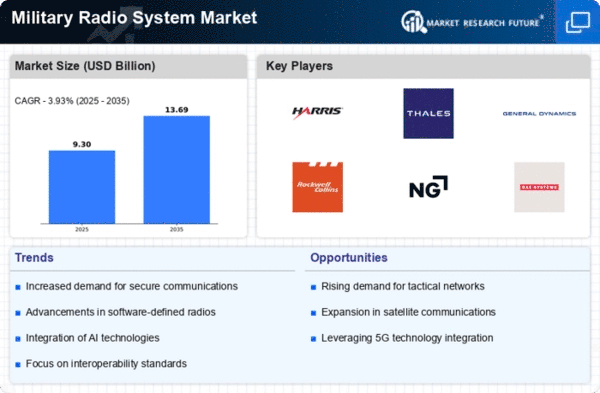
Military Radio System Market Infographic
Purchase Options

Market Trends

Key Emerging Trends in the Military Radio System Market

The Military Radio System market is undergoing significant transformations tied to advancements in communication technologies, evolving security threats, and modernization of armed forces worldwide. One such trend that has emerged in this sector lately is a switch towards Software Defined Radios (SDRs). The use of SDR technology in military radio systems has been increasing as it offers more flexibility as well as interoperability. SDRs make it possible to reconfigure radio frequencies or waveforms thereby enabling seamless communications among various platforms while they must adapt to dynamic complex operational environments.

The vehicular radio segment will see substantial growth among several categories within the period under consideration. These vehicle-mounted devices which go by the name mobile two-way radios are essential for establishing secure as well as reliable communication links within local regions, urban areas or even battlefields.

There has been an increased demand for secure and resilient communication solutions within the market. At present when looking at best practices about developing & deploying radios used by their personnel who need robust encryption; anti-jamming capabilities; and secure communications protocols; militaries are shifting all their priorities into ensuring that these things occur . This takes into account issues relating to electronic warfare which includes ensuring confidentiality & integrity of military comms since this is a reflection of the ongoing efforts to outsmart potential enemies.

The use of AI and machine learning capabilities in Military Radio System market is another trend that should be noted. Through AI, advanced radio systems can autonomously adapt to new environments; optimize frequency allocation and thus enhance overall communications efficiency. These smart radio systems speed up the decision-making processes in addition to improving battlefield situational awareness.

In Military Radio Systems, market trends have been influenced by miniaturization and portability considerations. The military needs light and small radios with no compromise on performance. On the other hand, developments in lightweight and compact man-portable as well as vehicle mounted radios reduce the size and weight for easier mobility of forces while increasing overall agility of military operations.

Adoption of next-generation waveforms has driven innovation within the Military Radio System market. Modern military operations require high-speed & reliable communication, hence advanced waveforms such as Wideband Networking Waveform (WNW) or Soldier Radio Waveform (SRW) have emerged due to increased need for effective data transfers with multimedia support. Such waveforms are aimed at meeting the demands for fast data transmission rates so as to facilitate efficient communication throughout present military scenarios.

There is an increasing emphasis on cybersecurity when it comes to developing Military Radio Systems. Given this greater complexity surrounding cyber threats, modern-day military radio systems incorporate robust cybersecurity features capable of preventing unauthorized access as well as hacking among others vulnerabilities. In fact, this trend acknowledges that contemporary communication systems are intertwined with one another hence sensitive information related to militaries must be protected from attacks.


Author
Swapnil Palwe
Team Lead - Research

With a technical background as Bachelor's in Mechanical Engineering, with MBA in Operations Management , Swapnil has 6+ years of experience in market research, consulting and analytics with the tasks of data mining, analysis, and project execution. He is the POC for our clients, for their consulting projects running under the Automotive/A&D domain. Swapnil has worked on major projects in verticals such as Aerospace & Defense, Automotive and many other domain projects. He has worked on projects for fortune 500 companies' syndicate and consulting projects along with several government projects.

Leave a Comment

FAQs

How much is the Military Radio System market?

The Military Radio System Market size was valued at USD 13.69 billion in 2035.

What is the growth rate of the Military Radio System market?

The global market is projected to grow at a CAGR of 3.93% during the forecast period, 2025-2035.

Which Region held the largest market share in the Military Radio System market?

North America had the largest share of the global market

Who are the key players in the Military Radio System market?

The key players in the market are BARRETT Communications (Australia), Leonardo SpA (Italy), Harris Corporation (US), Radmor SA (Poland), Thales Communications & Security SAS (France), Codan Limited (Australia), Elbit Systems Ltd (Israel), FLIR Systems (US), Safran SA (France), and Selex ES (Italy).

Which Type led the Military Radio System market?

The Vehicular Radios category dominated the market in 2023.

Which End User had the largest market share in the Military Radio System market?

The Ground Force had the largest share of the global market.

Market Summary

As per MRFR analysis, the Military Radio System Market Size was estimated at 8.95 USD Billion in 2024. The Military Radio System industry is projected to grow from 9.31 USD Billion in 2025 to 13.69 USD Billion by 2035, exhibiting a compound annual growth rate (CAGR) of 3.93 during the forecast period 2025 - 2035.

Key Market Trends & Highlights

The Military Radio System Market is poised for substantial growth driven by technological advancements and increasing defense budgets.

  • Technological advancements are reshaping military radio systems, enhancing communication capabilities.
  • North America remains the largest market, while Asia-Pacific is emerging as the fastest-growing region.
  • The communication segment dominates the market, whereas the electronic warfare segment is experiencing rapid growth.
  • Increased defense budgets and the focus on interoperability are key drivers propelling market expansion.

Market Size & Forecast

2024 Market Size 8.95 (USD Billion)
2035 Market Size 13.69 (USD Billion)
CAGR (2025 - 2035) 3.93%
Largest Regional Market Share in 2024 North America

Major Players

<p>Harris Corporation (US), Thales Group (FR), General Dynamics (US), Rockwell Collins (US), Northrop Grumman (US), BAE Systems (GB), Leonardo S.p.A. (IT), L3 Technologies (US), Elbit Systems (IL)</p>

Market Trends

The Military Radio System Market is currently experiencing a transformative phase characterized by rapid technological advancements and evolving operational requirements. The integration of advanced communication technologies, such as software-defined radios and secure communication protocols, appears to enhance the effectiveness and reliability of military operations. Furthermore, the increasing emphasis on interoperability among allied forces suggests a growing demand for systems that can seamlessly integrate with various platforms. This trend is likely driven by the need for enhanced situational awareness and real-time data sharing in complex operational environments. Moreover, the rising focus on modernization initiatives within defense forces worldwide indicates a potential shift towards more sophisticated and versatile communication solutions. As military organizations seek to upgrade their existing systems, there is a notable inclination towards adopting next-generation radio technologies that offer improved performance and resilience against electronic warfare threats. This evolving landscape may lead to increased investments in research and development, fostering innovation within the Military Radio System Market. Overall, the current dynamics suggest a robust growth trajectory, with stakeholders keenly observing advancements that could redefine communication capabilities in military settings.

Technological Advancements

The Military Radio System Market is witnessing a surge in technological innovations, particularly with the adoption of software-defined radios. These systems offer flexibility and adaptability, allowing military forces to modify communication parameters in real-time, thereby enhancing operational efficiency.

Interoperability Focus

There is a growing emphasis on interoperability among allied military forces, which drives the demand for communication systems that can function seamlessly across different platforms. This trend is crucial for joint operations, ensuring that forces can communicate effectively regardless of their equipment.

Modernization Initiatives

Defense organizations are increasingly prioritizing modernization efforts, leading to a shift towards advanced communication solutions. This trend reflects a commitment to upgrading legacy systems and investing in next-generation technologies that provide enhanced performance and security.

Military Radio System Market Market Drivers

Increased Defense Budgets

In recent years, many countries have increased their defense budgets, which directly impacts the Global Military Radio System Industry. Nations are recognizing the necessity of modernizing their military capabilities, including communication systems. For example, the United States and NATO countries have allocated substantial funds to enhance their military communication infrastructure. This surge in defense spending is likely to drive demand for advanced radio systems, as military forces require reliable and secure communication channels. Consequently, the market is poised for growth, with projections indicating a rise from 8.95 USD Billion in 2024 to 13.7 USD Billion by 2035.

Market Growth Projections

The Global Military Radio System Industry is projected to experience substantial growth over the next decade. The market is expected to expand from 8.95 USD Billion in 2024 to 13.7 USD Billion by 2035, reflecting a compound annual growth rate (CAGR) of 3.93% from 2025 to 2035. This growth is driven by various factors, including technological advancements, increased defense budgets, and the rising demand for secure communications. As military forces worldwide continue to modernize their communication systems, the market is likely to witness significant developments and innovations.

Technological Advancements

The Global Military Radio System Industry is experiencing rapid technological advancements, particularly in software-defined radio (SDR) systems. These innovations enhance communication capabilities, allowing for greater flexibility and interoperability among different military branches. For instance, the integration of artificial intelligence in radio systems is expected to improve data processing and decision-making. As military forces worldwide seek to modernize their communication infrastructure, the demand for advanced radio systems is projected to increase significantly. This trend is reflected in the market's anticipated growth from 8.95 USD Billion in 2024 to 13.7 USD Billion by 2035, indicating a robust CAGR of 3.93% from 2025 to 2035.

Emerging Markets and Globalization

Emerging markets are becoming increasingly important players in the Global Military Radio System Industry. Countries in regions such as Asia-Pacific and the Middle East are investing heavily in modernizing their military capabilities, including communication systems. This trend is driven by globalization, which encourages collaboration and technology transfer among nations. As these countries seek to enhance their defense capabilities, the demand for advanced military radio systems is likely to rise. This shift is expected to contribute to the overall market growth, with projections indicating an increase from 8.95 USD Billion in 2024 to 13.7 USD Billion by 2035.

Increased Focus on Joint Operations

The Global Military Radio System Industry is witnessing a heightened focus on joint operations among allied forces. As military strategies evolve, the need for seamless communication between different branches of the armed forces becomes paramount. This requirement drives the demand for interoperable radio systems that can facilitate effective communication during joint missions. Countries are investing in advanced military radio technologies to ensure that their forces can operate cohesively. This trend is likely to propel market growth, with expectations of an increase from 8.95 USD Billion in 2024 to 13.7 USD Billion by 2035.

Growing Demand for Secure Communications

The need for secure communication systems is increasingly critical in the Global Military Radio System Industry. As geopolitical tensions rise, military organizations are prioritizing secure communication to protect sensitive information from adversaries. This demand is driving the development of encryption technologies and secure radio systems that can withstand cyber threats. Countries are investing in advanced military radio systems that provide secure and reliable communication channels. The market is expected to grow significantly, with forecasts suggesting an increase from 8.95 USD Billion in 2024 to 13.7 USD Billion by 2035, reflecting the urgent need for secure military communications.

Market Segment Insights

By Application: Communication (Largest) vs. Electronic Warfare (Fastest-Growing)

<p>In the Military Radio System Market, the application segment is primarily dominated by Communication, which maintains the largest share among various segments. This segment includes systems designed for secure and efficient communication between military units, resulting in enhanced coordination and operational efficiency. Navigation, Surveillance, Data Transmission, and Electronic Warfare are also key players, though they occupy smaller shares of the market. Each of these segments contributes to the overall functionality and effectiveness of military operations, making them essential components in modern defense strategies. Looking at the growth trends across these application segments, Electronic Warfare is emerging as the fastest-growing area within the market. This growth is propelled by the increasing demand for advanced capabilities in disrupting and denying enemy communications while protecting friendly forces. Moreover, enhancements in technology and increased military spending further drive the adoption of advanced systems in Navigation and Surveillance. As military operations continue to evolve, the demand for sophisticated Military Radio Systems is expected to rise, particularly in Electronic Warfare and related applications.</p>

<p>Communication (Dominant) vs. Electronic Warfare (Emerging)</p>

<p>Communication systems in the Military Radio System Market are characterized by their robust capabilities to ensure secure and reliable transmissions across various military platforms. These systems enable real-time communication between ground forces, air support, and command centers, making them crucial for mission success. The Communication segment stands out due to its extensive adoption across different military branches and operations. Conversely, Electronic Warfare is an emerging segment that focuses on disrupting and impeding enemy communication channels and systems. It incorporates sophisticated technologies to counter adversary electronic operations, thereby ensuring operational superiority on the battlefield. As military strategies increasingly leverage technology, Electronic Warfare is expected to gain prominence, supported by investments in R&D and technology integrations.</p>

By End Use: Military (Largest) vs. Homeland Security (Fastest-Growing)

<p>In the Military Radio System Market, the market share is predominantly occupied by the Military sector. This segment comprises operational radio communication systems designed for various applications including command and control, situational awareness, and inter-agency communications. Following the Military segment, the Defense and Aerospace sectors contribute substantially to the market, but the focus remains on strengthening military capabilities, thereby solidifying its share. The Homeland Security segment, while comparatively smaller, is swiftly gaining traction thanks to increased investments in securing borders and infrastructure, thereby diversifying the usage of radio systems.</p>

<p>Military (Dominant) vs. Aerospace (Emerging)</p>

<p>The Military sector stands out as the dominant player in the Military Radio System Market, characterized by extensive deployment in mission-critical operations and a high level of technological sophistication. This segment encompasses various military branches that utilize advanced communication technologies to enhance operational readiness and effectiveness. Conversely, the Aerospace segment is emerging as a key player, driven by the rising demand for integrated communication systems in aviation and space missions. While still developing, aerospace applications prioritize reliability and interoperability, carving out a niche that complements military operations yet poses unique technological challenges that need to be addressed to realize greater market potential.</p>

By Technology: Software Defined Radio (Largest) vs. Analog Radio (Fastest-Growing)

<p>The Military Radio System Market showcases a diverse array of technologies, with Software Defined Radio (SDR) commanding a significant market share due to its advanced capabilities and flexibility. SDR allows for various communication protocols and standards to be implemented within the same hardware, making it an invaluable asset for modern military operations. Analog Radio, while still holding its ground, is rapidly being outpaced by digital solutions as military forces look for more efficient and secure communication options. Emerging technologies are driving substantial shifts in the Military Radio System Market, particularly with the growth of Analog Radio, which is becoming the fastest-growing segment. This can be attributed to the increasing demand for reliable communication in challenging environments. Conversely, Digital Radio and Frequency Hopping Spread Spectrum technologies are gaining traction due to their enhanced security features and resilience against jamming, showing that innovation is key to meeting current military communication needs.</p>

<p>Technology: Software Defined Radio (Dominant) vs. Frequency Hopping Spread Spectrum (Emerging)</p>

<p>Software Defined Radio (SDR) plays a dominant role in the Military Radio System Market, known for its adaptability in various communication scenarios and ability to support evolving military needs. SDR systems can easily adapt to multiple frequency bands and protocols, making them essential in modern warfare contexts where communication can be disrupted. Meanwhile, Frequency Hopping Spread Spectrum (FHSS) is emerging as a crucial technology, enhancing communication security and reliability. By rapidly changing radio frequencies, FHSS minimizes the risk of interception and jamming, thereby gaining favor among military organizations looking for secure communication options. Both technologies underscore the importance of advanced and dynamic capabilities in military communication solutions.</p>

By Frequency Band: Ultra High Frequency (Largest) vs. Very High Frequency (Fastest-Growing)

<p>The Military Radio System Market exhibits a diverse frequency band spectrum, with Ultra High Frequency (UHF) holding the largest share due to its superior range and penetration capabilities in urban environments. Following closely is the Very High Frequency (VHF) segment, which, while traditionally dominant, is seeing a notable shift in market dynamics as newer technologies emerge, leading to an increase in its utilization.</p>

<p>Ultra High Frequency: Dominant vs. Very High Frequency: Emerging</p>

<p>Ultra High Frequency (UHF) radios are recognized for their effectiveness in transmitting voice and data over long distances, making them essential for military communications. Their dominant market position is bolstered by advancements that enhance their operational range and reliability in complex environments. Conversely, Very High Frequency (VHF) radios, while historically critical for line-of-sight communication, are rapidly evolving. Their growing use in emerging military applications reflects a trend towards more versatile communication solutions, aligning with the demands for interoperability and real-time information sharing in modern combat scenarios.</p>

By Platform: Land (Largest) vs. Satellite (Fastest-Growing)

<p>The Military Radio System Market is segmented into Land, Air, Naval, and Satellite platforms. Among these, the Land segment dominates the market, characterized by its extensive use in ground operations and tactical communication. This segment is pivotal for ensuring reliable communication in combat zones, thus holding a significant share of the market. In contrast, the Satellite platform is emerging rapidly, driven by the increasing need for secure and wide-area communication capabilities in military operations globally.</p>

<p>Land (Dominant) vs. Satellite (Emerging)</p>

<p>The Land platform in the Military Radio System Market is characterized by robust technology that facilitates ground-based communication among various military units. It is recognized for its durability and effectiveness in combat scenarios, making it essential for successful operations. On the other hand, the Satellite platform is gaining ground as a vital component for future military communications. It allows for global coverage and enhanced capabilities, including voice, data, and video communication. This platform is particularly favored for its ability to maintain connectivity in remote areas where traditional Land communication may be challenged.</p>

Get more detailed insights about Military Radio System Market Research Report - Global Forecast till 2035

Regional Insights

North America : Market Leader in Military Tech

North America continues to lead the Military Radio System market, holding a significant share of 4.48 in 2024. The region's growth is driven by increasing defense budgets, technological advancements, and a focus on secure communication systems. Regulatory support from government agencies further catalyzes market expansion, ensuring compliance with stringent military standards. The demand for advanced communication solutions is expected to rise, fueled by geopolitical tensions and modernization efforts across armed forces. The competitive landscape in North America is robust, featuring key players such as Harris Corporation, General Dynamics, and Northrop Grumman. These companies are at the forefront of innovation, developing cutting-edge technologies to enhance operational capabilities. The U.S. remains the dominant country in this sector, with significant investments in R&D and partnerships with defense agencies. This environment fosters a thriving ecosystem for military radio systems, ensuring sustained growth and technological leadership.

Europe : Emerging Market with Growth Potential

Europe's Military Radio System market is valued at 2.68, reflecting a growing emphasis on defense capabilities amid rising security concerns. The region is witnessing increased investments in military modernization and interoperability among NATO allies. Regulatory frameworks are evolving to support advanced communication technologies, enhancing the demand for secure and reliable military radio systems. The focus on joint operations and collaborative defense initiatives is expected to drive market growth further. Leading countries in Europe include France, Germany, and the UK, where major players like Thales Group and BAE Systems are actively engaged in developing innovative solutions. The competitive landscape is characterized by strategic partnerships and collaborations aimed at enhancing technological capabilities. As European nations prioritize defense spending, the market is poised for significant growth, with a strong emphasis on integrating next-generation communication systems into military operations.

Asia-Pacific : Rapidly Growing Defense Sector

The Asia-Pacific Military Radio System market, valued at 1.79, is experiencing rapid growth driven by increasing defense budgets and modernization efforts across various countries. Nations in this region are prioritizing the enhancement of their military capabilities, leading to a surge in demand for advanced communication systems. Regulatory support and government initiatives are fostering an environment conducive to innovation and technological advancements in military radio systems. Key players in the Asia-Pacific market include L3 Technologies and Elbit Systems, with countries like India, Japan, and Australia leading the charge in military modernization. The competitive landscape is marked by collaborations between local and international firms to develop tailored solutions for regional defense needs. As geopolitical tensions rise, the focus on secure and reliable communication systems is expected to intensify, further propelling market growth in this dynamic region.

Middle East and Africa : Untapped Market Potential

The Middle East and Africa region currently shows a market size of 0.0 for Military Radio Systems, indicating significant untapped potential. The region is gradually recognizing the importance of advanced communication systems in enhancing military capabilities. As geopolitical tensions persist, there is a growing demand for secure and reliable military communication solutions. Regulatory frameworks are beginning to evolve, paving the way for increased investments in defense technologies and infrastructure. Countries such as the UAE and South Africa are emerging as key players in the defense sector, with a focus on modernization and collaboration with international defense firms. The competitive landscape is still developing, with opportunities for both local and The Military Radio System. As defense spending increases, the region is expected to witness a gradual shift towards adopting advanced military radio systems, creating new avenues for growth and innovation.

Key Players and Competitive Insights

The Military Radio System Market is characterized by a dynamic competitive landscape, driven by technological advancements and the increasing demand for secure communication systems. Key players such as Harris Corporation (US), Thales Group (FR), and General Dynamics (US) are at the forefront, each adopting distinct strategies to enhance their market positioning. Harris Corporation (US) focuses on innovation in software-defined radios, which allows for greater flexibility and adaptability in military communications. Thales Group (FR) emphasizes partnerships with defense agencies to develop next-generation communication solutions, while General Dynamics (US) is investing heavily in digital transformation initiatives to streamline operations and improve product offerings. Collectively, these strategies contribute to a competitive environment that is increasingly centered around technological superiority and strategic collaborations.

In terms of business tactics, companies are localizing manufacturing to reduce costs and enhance supply chain resilience. This approach is particularly relevant in a moderately fragmented market where several players vie for dominance. The competitive structure is influenced by the collective actions of these key players, who are increasingly focused on optimizing their supply chains and enhancing operational efficiencies to maintain a competitive edge.

In November 2025, Thales Group (FR) announced a strategic partnership with a leading telecommunications provider to develop advanced secure communication networks for military applications. This collaboration is expected to leverage both companies' technological expertise, enhancing Thales's capabilities in delivering robust communication solutions. The strategic importance of this partnership lies in its potential to create a more integrated communication framework for military operations, thereby improving operational effectiveness.

In October 2025, General Dynamics (US) unveiled a new line of tactical communication systems designed to meet the evolving needs of modern warfare. This launch is significant as it reflects the company's commitment to innovation and its ability to respond to the changing landscape of military communications. By introducing cutting-edge technology, General Dynamics aims to solidify its position as a leader in the market, catering to the increasing demand for advanced communication solutions.

In December 2025, Harris Corporation (US) completed the acquisition of a cybersecurity firm specializing in military communications. This acquisition is poised to enhance Harris's product offerings by integrating advanced cybersecurity features into its radio systems. The strategic importance of this move lies in the growing emphasis on secure communications in military operations, positioning Harris as a more formidable competitor in the market.

As of December 2025, current trends in the Military Radio System Market are increasingly defined by digitalization, sustainability, and the integration of artificial intelligence (AI). Strategic alliances are becoming more prevalent, as companies recognize the need for collaborative efforts to drive innovation and enhance product offerings. Looking ahead, competitive differentiation is likely to evolve from traditional price-based competition to a focus on technological innovation, reliability in supply chains, and the ability to deliver advanced, secure communication solutions.

Key Companies in the Military Radio System Market market include

Industry Developments

For Instance, January 2020 Cobham signed a contract with Boeing for a Cockpit connectivity solution.

For Instance, June 2018 Northrop Grumman received a 7-year, USD 866 million contract from the US Air Force to sustain and modify a worldwide network.

For Instance, May 2022 General Dynamics Mission Systems announced that it was awarded a contract from the National Security Agency (NSA) to design, develop, test, and deliver a certifiable 400 Gbps high-assurance encryption solution compliant with the Ethernet Data Encryption Cryptographic Interoperability Specification (EDE-CIS).

Future Outlook

Military Radio System Market Future Outlook

<p>The Military Radio System Market is projected to grow at a 3.93% CAGR from 2024 to 2035, driven by technological advancements, increased defense budgets, and the demand for secure communications.</p>

New opportunities lie in:

  • <p>Development of advanced encryption technologies for secure military communications.</p>
  • <p>Integration of AI-driven analytics for real-time operational decision-making.</p>
  • <p>Expansion of software-defined radio systems for enhanced interoperability among forces.</p>

<p>By 2035, the Military Radio System Market is expected to be robust, reflecting sustained growth and innovation.</p>

Market Segmentation

Military Radio System Market End Use Outlook

  • Military
  • Defense
  • Aerospace
  • Homeland Security

Military Radio System Market Platform Outlook

  • Land
  • Air
  • Naval
  • Satellite

Military Radio System Market Technology Outlook

  • Software Defined Radio
  • Analog Radio
  • Digital Radio
  • Frequency Hopping Spread Spectrum

Military Radio System Market Application Outlook

  • Communication
  • Navigation
  • Surveillance
  • Data Transmission
  • Electronic Warfare

Military Radio System Market Frequency Band Outlook

  • Very High Frequency
  • Ultra High Frequency
  • Super High Frequency
  • Low Frequency

Report Scope

MARKET SIZE 20248.95(USD Billion)
MARKET SIZE 20259.31(USD Billion)
MARKET SIZE 203513.69(USD Billion)
COMPOUND ANNUAL GROWTH RATE (CAGR)3.93% (2024 - 2035)
REPORT COVERAGERevenue Forecast, Competitive Landscape, Growth Factors, and Trends
BASE YEAR2024
Market Forecast Period2025 - 2035
Historical Data2019 - 2024
Market Forecast UnitsUSD Billion
Key Companies ProfiledHarris Corporation (US), Thales Group (FR), General Dynamics (US), Rockwell Collins (US), Northrop Grumman (US), BAE Systems (GB), Leonardo S.p.A. (IT), L3 Technologies (US), Elbit Systems (IL)
Segments CoveredApplication, End Use, Technology, Frequency Band, Platform
Key Market OpportunitiesIntegration of advanced encryption technologies enhances security in the Military Radio System Market.
Key Market DynamicsTechnological advancements and regulatory changes drive innovation and competition in the Military Radio System Market.
Countries CoveredNorth America, Europe, APAC, South America, MEA

FAQs

How much is the Military Radio System market?

The Military Radio System Market size was valued at USD 13.69 billion in 2035.

What is the growth rate of the Military Radio System market?

The global market is projected to grow at a CAGR of 3.93% during the forecast period, 2025-2035.

Which Region held the largest market share in the Military Radio System market?

North America had the largest share of the global market

Who are the key players in the Military Radio System market?

The key players in the market are BARRETT Communications (Australia), Leonardo SpA (Italy), Harris Corporation (US), Radmor SA (Poland), Thales Communications &amp; Security SAS (France), Codan Limited (Australia), Elbit Systems Ltd (Israel), FLIR Systems (US), Safran SA (France), and Selex ES (Italy).

Which Type led the Military Radio System market?

The Vehicular Radios category dominated the market in 2023.

Which End User had the largest market share in the Military Radio System market?

The Ground Force had the largest share of the global market.

  1. Executive Summary
    1. Market Attractiveness Analysis
      1. Global Military Radio System Market, by Type
      2. Global Military Radio System Market, by End User
      3. Global Military Radio System Market, by Region
  2. Market Introduction
    1. Market Definition
    2. Scope of the Study
    3. Market Structure
    4. Key Buying Criteria
    5. Market Factor Indicator Analysis
  3. Research Methodology
    1. Research Process
    2. Primary Research
    3. Secondary Research
    4. Market Size Estimation
    5. Forecast Model
    6. List of Assumptions
  4. Market Insights
  5. Market Dynamics
    1. Introduction
    2. Drivers
    3. Restraints
    4. Opportunities
    5. Challenges
    6. Market/Technological Trends
    7. Patent Trends
    8. Regulatory Landscape/Standards
  6. Market Factor Analysis
    1. Value Chain/Supply Chain Analysis
      1. R&D
      2. Manufacturing
      3. Distribution & Sales
      4. Post-Sales Monitoring
    2. Porter’s Five Forces Analysis
      1. Threat of New Entrants
      2. Bargaining Power of Buyers
      3. Threat of Substitutes
      4. Intensity of Rivalry
      5. Bargaining Power of Suppliers
  7. Global Military Radio System Market, by Type
    1. Introduction
    2. Manpack Radios
      1. Market Estimates & Forecast, 2025-2034
      2. Market Estimates & Forecast, by Region, 2025-2034
    3. Vehicular Radios
      1. Market Estimates & Forecast, 2025-2034
      2. Market Estimates & Forecast, by Region, 2025-2034
  8. Global Military Radio System Market, by End User
    1. Introduction
    2. Naval
      1. Market Estimates & Forecast, 2025-2034
      2. Market Estimates & Forecast, by Region, 2025-2034
    3. Ground Force
      1. Market Estimates & Forecast, 2025-2034
      2. Market Estimates & Forecast, by Region, 2025-2034
    4. Air Force
      1. Market Estimates & Forecast, 2025-2034
      2. Market Estimates & Forecast, by Region, 2025-2034
  9. Global Military Radio System Market, by Region
    1. Introduction
    2. North America
      1. Market Estimates & Forecast, by Country, 2025-2034
      2. Market Estimates & Forecast, by Type, 2025-2034
      3. Market Estimates & Forecast, by End User, 2025-2034
      4. US
      5. Canada
    3. Europe
      1. Market Estimates & Forecast, by Country, 2025-2034
      2. Market Estimates & Forecast, by Type, 2025-2034
      3. Market Estimates & Forecast, by End User, 2025-2034
      4. UK
      5. Germany
      6. France
      7. Italy
      8. Rest of Europe
    4. Asia-Pacific
      1. Market Estimates & Forecast, by Country, 2025-2034
      2. Market Estimates & Forecast, by Type, 2025-2034
      3. Market Estimates & Forecast, by End User, 2025-2034
      4. China
      5. Japan
      6. India
      7. Rest of Asia-Pacific
    5. Middle East & Africa
      1. Market Estimates & Forecast, by Country, 2025-2034
      2. Market Estimates & Forecast, by Type, 2025-2034
      3. Market Estimates & Forecast, by End User, 2025-2034
      4. UAE
      5. Saudi Arabia
      6. Rest of the Middle East & Africa
    6. Latin America
      1. Market Estimates & Forecast, by Country, 2025-2034
      2. Market Estimates & Forecast, by Type, 2025-2034
      3. Market Estimates & Forecast, by End User, 2025-2034
      4. Brazil
      5. Rest of Latin America
  10. Competitive Landscape
    1. Competitive Overview
    2. Competitor Dashboard
    3. Major Growth Strategies in the Global Military Radio System Market
    4. Competitive Benchmarking
    5. Market Share Analysis
    6. Key Developments & Growth Strategies
      1. Product Launches/Service Deployments
      2. Mergers & Acquisitions
      3. Joint Ventures
  11. Company Profiles
    1. BARRETT Communications
      1. Company Overview
      2. Product Offering
      3. Financial Overview
      4. Key Developments
      5. Swot Analysis
      6. Key Strategies
    2. Leonardo SpA
      1. Company Overview
      2. Product Offering
      3. Financial Overview
      4. Key Developments
      5. Swot Analysis
      6. Key Strategies
    3. Harris Corporation
      1. Company Overview
      2. Product Offering
      3. Financial Overview
      4. Key Developments
      5. Swot Analysis
      6. Key Strategies
    4. Radmor SA
      1. Company Overview
      2. Product Offering
      3. Financial Overview
      4. Key Developments
      5. Swot Analysis
      6. Key Strategies
    5. Thales Communications & Security SAS
      1. Company Overview
      2. Product Offering
      3. Financial Overview
      4. Key Developments
      5. Swot Analysis
      6. Key Strategies
    6. Codan Limited
      1. Company Overview
      2. Product Offering
      3. Financial Overview
      4. Key Developments
      5. Swot Analysis
      6. Key Strategies
    7. Elbit Systems Ltd
      1. Company Overview
      2. Product Offering
      3. Financial Overview
      4. Key Developments
      5. Swot Analysis
      6. Key Strategies
    8. FLIR Systems
      1. Company Overview
      2. Product Offering
      3. Financial Overview
      4. Key Developments
      5. Swot Analysis
      6. Key Strategies
    9. Rockwell Collins, Inc.
      1. Company Overview
      2. Product Offering
      3. Financial Overview
      4. Key Developments
      5. Swot Analysis
      6. Key Strategies
    10. Safran SA
      1. Company Overview
      2. Product Offering
      3. Financial Overview
      4. Key Developments
      5. Swot Analysis
      6. Key Strategies
  12. Appendix
    1. References
    2. Related Reports
    3. List of Abbreviations
  13. Industry Insights
    1. Note: This table of contents is tentative and subject to change as the research progresses.
    2. List of Tables
  14. Global Military Radio System Market, by Type, 2025-2034
  15. Global Military Radio System Market, by End User, 2025-2034
  16. Global Military Radio System Market, by Region, 2025-2034
  17. North America: Military Radio System Market, by Country, 2025-2034
  18. Europe: Military Radio System Market, by Country, 2025-2034
  19. Asia-Pacific: Military Radio System Market, by Country, 2025-2034
  20. Middle East & Africa: Military Radio System Market, by Country, 2025-2034
  21. Latin America: Military Radio System Market, by Country, 2025-2034
  22. North America: Military Radio System Market, by Country, 2025-2034
  23. North America: Military Radio System Market, by Type, 2025-2034
  24. North America: Military Radio System Market, by End User, 2025-2034
  25. Europe: Military Radio System Market, by Country, 2025-2034
  26. Europe: Military Radio System Market, by Type, 2025-2034
  27. Europe: Military Radio System Market, by End User, 2025-2034
  28. Asia-Pacific: Military Radio System Market, by Country, 2025-2034
  29. Asia-Pacific: Military Radio System Market, by Type, 2025-2034
  30. Asia-Pacific: Military Radio System Market, by End User, 2025-2034
  31. Middle East & Africa: Military Radio System Market, by Country, 2025-2034
  32. Middle East & Africa: Military Radio System Market, by Type, 2025-2034
  33. Middle East & Africa: Military Radio System Market, by End User, 2025-2034
  34. Latin America: Military Radio System Market, by Country, 2025-2034
  35. Latin America: Military Radio System Market, by Type, 2025-2034
  36. Latin America: Military Radio System Market, by End User, 2025-2034
    1. List of Figures
  37. Research Process of MRFR
  38. Top-Down & Bottom-Up Approaches
  39. Market Dynamics
  40. Impact Analysis: Market Drivers
  41. Impact Analysis: Market Restraints
  42. Porter's Five Forces Analysis
  43. Value Chain Analysis
  44. Global Military Radio System Market Share, by Type, 2024 (%)
  45. Global Military Radio System Market, by Type, 2025-2034 (USD Billion)
  46. Global Military Radio System Market Share, by End User, 2024 (%)
  47. Global Military Radio System Market, by End User, 2025-2034 (USD Billion)
  48. Global Military Radio System Market Share (%), By Region, 2024
  49. Global Military Radio System Market, by Region, 2025-2034 (USD Billion)
  50. North America: Military Radio System Market Share (%), 2024
  51. North America: Military Radio System Market, by Country, 2025-2034 (USD Billion)
  52. Europe: Military Radio System Market Share (%), 2024
  53. Europe: Military Radio System Market, by Country, 2025-2034 (USD Billion)
  54. Asia-Pacific: Military Radio System Market Share (%), 2024
  55. Asia-Pacific: Military Radio System Market, by Country, 2025-2034 (USD Billion)
  56. Middle East & Africa Military Radio System Market Share (%), 2024
  57. Middle East & Africa Military Radio System Market, by Region, 2025-2034 (USD Billion)
  58. Latin America Military Radio System Market Share (%), 2024
  59. Latin America Military Radio System Market, by Region, 2025-2034 (USD Billion)

Military Radio System Market Segmentation

Military Radio System Type Outlook (USD Billion, 2019-2032)

Manpack Radios

Vehicular Radios

Military Radio System End User Outlook (USD Billion, 2019-2032)

Naval

Ground Force

Air Force

Military Radio System Regional Outlook (USD Billion, 2019-2032)

North America Outlook (USD Billion, 2019-2032)

North America Military Radio System by Type

Manpack Radios

Vehicular Radios

North America Military Radio System by End User

Naval

Ground Force

Air Force

US Outlook (USD Billion, 2019-2032)

US Military Radio System by Type

Manpack Radios

Vehicular Radios

US Military Radio System by End User

Naval

Ground Force

Air Force

CANADAOutlook (USD Billion, 2019-2032)

CANADA Military Radio System by Type

Manpack Radios

Vehicular Radios

CANADA Military Radio System by End User

Naval

Ground Force

Air Force

EuropeOutlook (USD Billion, 2019-2032)

Europe Military Radio System by Type

Manpack Radios

Vehicular Radios

Europe Military Radio System by End User

Naval

Ground Force

Air Force

GermanyOutlook (USD Billion, 2019-2032)

Germany Military Radio System by Type

Manpack Radios

Vehicular Radios

Germany Military Radio System by End User

Naval

Ground Force

Air Force

FranceOutlook (USD Billion, 2019-2032)

France Military Radio System by Type

Manpack Radios

Vehicular Radios

France Military Radio System by End User

Naval

Ground Force

Air Force

UKOutlook (USD Billion, 2019-2032)

UK Military Radio System by Type

Manpack Radios

Vehicular Radios

UK Military Radio System by End User

Naval

Ground Force

Air Force

ITALYOutlook (USD Billion, 2019-2032)

ITALY Military Radio System by Type

Manpack Radios

Vehicular Radios

ITALY Military Radio System by End User

Naval

Ground Force

Air Force

SPAINOutlook (USD Billion, 2019-2032)

Spain Military Radio System by Type

Manpack Radios

Vehicular Radios

Spain Military Radio System by End User

Naval

Ground Force

Air Force

Rest Of Europe Outlook (USD Billion, 2019-2032)

Rest Of Europe Military Radio System by Type

Manpack Radios

Vehicular Radios

REST OF EUROPE Military Radio System by End User

Naval

Ground Force

Air Force

Asia-PacificOutlook (USD Billion, 2019-2032)

Asia-Pacific Military Radio System by Type

Manpack Radios

Vehicular Radios

Asia-Pacific Military Radio System by End User

Naval

Ground Force

Air Force

ChinaOutlook (USD Billion, 2019-2032)

China Military Radio System by Type

Manpack Radios

Vehicular Radios

China Military Radio System by End User

Naval

Ground Force

Air Force

JapanOutlook (USD Billion, 2019-2032)

Japan Military Radio System by Type

Manpack Radios

Vehicular Radios

Japan Military Radio System by End User

Naval

Ground Force

Air Force

India Outlook (USD Billion, 2019-2032)

India Military Radio System by Type

Manpack Radios

Vehicular Radios

India Military Radio System by End User

Naval

Ground Force

Air Force

AustraliaOutlook (USD Billion, 2019-2032)

Australia Military Radio System by Type

Manpack Radios

Vehicular Radios

Australia Military Radio System by End User

Naval

Ground Force

Air Force

Rest of Asia-PacificOutlook (USD Billion, 2019-2032)

Rest of Asia-Pacific Military Radio System by Type

Manpack Radios

Vehicular Radios

Rest of Asia-Pacific Military Radio System by End User

Naval

Ground Force

Air Force

Rest of the WorldOutlook (USD Billion, 2019-2032)

Rest of the World Military Radio System by Type

Manpack Radios

Vehicular Radios

Rest of the World Military Radio System by End User

Naval

Ground Force

Air Force

Middle EastOutlook (USD Billion, 2019-2032)

Middle East Military Radio System by Type

Manpack Radios

Vehicular Radios

Middle East Military Radio System by End User

Naval

Ground Force

Air Force

AfricaOutlook (USD Billion, 2019-2032)

Africa Military Radio System by Type

Manpack Radios

Vehicular Radios

Africa Military Radio System by End User

Naval

Ground Force

Air Force

Latin America Outlook (USD Billion, 2019-2032)

Latin America Military Radio System by Type

Manpack Radios

Vehicular Radios

Latin America Military Radio System by End User

Naval

Ground Force

Air Force

Infographic

Free Sample Request

Kindly complete the form below to receive a free sample of this Report

Get Free Sample

Customer Strories

Compare Licence

×
Features License Type
Single User Multiuser License Enterprise User
Price $4,950 $5,950 $7,250
Maximum User Access Limit 1 User Upto 10 Users Unrestricted Access Throughout the Organization
Free Customization
Direct Access to Analyst
Deliverable Format
Platform Access
Discount on Next Purchase 10% 15% 15%
Printable Versions