×
Hero Background
English
Chinese
French
Japanese
Korean
German
Spanish

Military Protection Glasses Market Trends

ID: MRFR/AD/4880-HCR
156 Pages
Swapnil Palwe
October 2025

Military Protection Glasses Market Size & Research Report Information by Type (Laser Safety, Bulletproof, Fire Resistant, Ballistic Protection, and Others), Material (Glass Fiber, Sapphire, Quartz, Polycarbonate, and Others), Platform (Armored Vehicle, Tank, Soldier Based, Aircraft, and Others), and Region (North America, Asia-Pacific, Europe, the Middle East Africa, and Latin America) Forecast till 2035

Share:
Download PDF ×

We do not share your information with anyone. However, we may send you emails based on your report interest from time to time. You may contact us at any time to opt-out.

Military Protection Glasses Market Infographic
Purchase Options

Market Trends

Key Emerging Trends in the Military Protection Glasses Market

For organizations to succeed in the highly competitive Military Protection Glasses Market, market share positioning tactics are essential. Innovation is a key approach. Protective eyewear manufacturers spend much in R&D to use cutting-edge materials and technology. Companies lead the way in offering cutting-edge military solutions by integrating ballistic-resistant materials, improved lens coatings, and smart features. Military Protection Glasses Market share positioning tactics depend on strategic alliances and collaborations. Because military operations are complicated, manufacturers generally work with technology suppliers, defense contractors, and research organizations. Collaborations enable the creation of integrated and interoperable solutions by sharing knowledge, resources, and technology. Strategic partnerships establish corporations as key players in the military ecosystem, boosting their market share. Military Protection Glasses Market share positioning methods emphasize customization and versatility. Military troops want eyeglasses that can be customized for weather conditions, danger levels, and operational situations. Modular, interchangeable, and customizable manufacturers promote themselves as responsive partners that can supply bespoke solutions. It meets the needs of various military units and helps position market share. International growth is crucial for the Military Protection Glasses Market. By entering new markets and partnering with global military forces, manufacturers want to broaden their client base. Global expansion boosts sales and protects enterprises from regional economic and geopolitical changes. Global market growth strategies establish firms as multinational military protective glass suppliers, increasing market share and competitiveness. Market share positioning in the Military Protection Glasses Market depends on brand credibility. Delivering high-quality, trustworthy, and innovative protective eyewear builds brand image. Companies that excel in military standards, regulatory compliance, and ethics gain market share. A reputable brand influences military procurement choices and boosts the manufacturer's market position. Military Protection Glasses Market share positioning relies on affordability and cost-effectiveness. These glasses provide enhanced protection, but makers must balance cost and technology. Market share positioning affects manufacturers' rivalry to provide cost-effective, high-performance products. Military protective glasses' appeal to defense forces with budget restrictions depends on affordability, affecting market share. Military Protection Glasses Market share is boosted by comprehensive training and after-sales support. Military consumers stay with manufacturers that give training, technical support, and maintenance. Defense personnel rely manufacturers to sustain deployed protective eyewear, ensuring its dependability and lifespan. Comprehensive support services beyond eyewear sales create long-term relationships and market share positioning. Military Protection Glasses Market share positioning is shifting toward sustainable innovation. Eco-friendly and energy-efficient technologies are becoming more important to manufacturers. Sustainable elements including decreased environmental impact, energy-efficient technology, and environmentally aware production techniques appeal to environmentally sensitive military forces, helping market share positioning. Companies that incorporate sustainability into their goods get a competitive edge and support the industry's environmental aims.

Author
Swapnil Palwe
Team Lead - Research

With a technical background as Bachelor's in Mechanical Engineering, with MBA in Operations Management , Swapnil has 6+ years of experience in market research, consulting and analytics with the tasks of data mining, analysis, and project execution. He is the POC for our clients, for their consulting projects running under the Automotive/A&D domain. Swapnil has worked on major projects in verticals such as Aerospace & Defense, Automotive and many other domain projects. He has worked on projects for fortune 500 companies' syndicate and consulting projects along with several government projects.

Leave a Comment

Market Summary

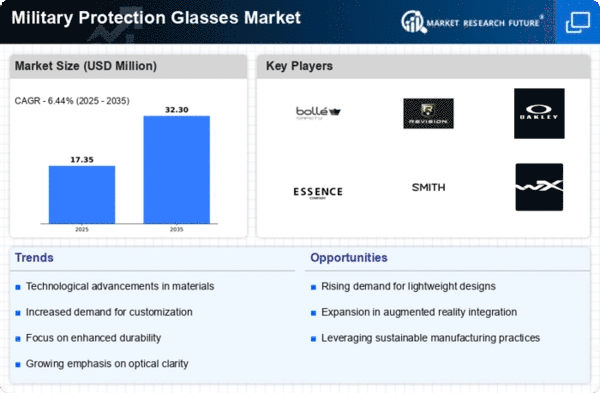
As per MRFR analysis, the Military Protection Glasses Market Size was estimated at 16.3 USD Million in 2024. The Military Protection Glasses industry is projected to grow from 17.3 in 2025 to 32.3 by 2035, exhibiting a compound annual growth rate (CAGR) of 6.44 during the forecast period 2025 - 2035.

Key Market Trends & Highlights

The Military Protection Glasses Market is poised for growth driven by technological advancements and increasing demand for soldier safety.

  • Technological advancements are enhancing the performance and durability of military protection glasses.
  • North America remains the largest market, while Asia-Pacific is emerging as the fastest-growing region.
  • The combat operations segment dominates the market, whereas the training exercises segment is witnessing rapid growth.
  • Increased military expenditure and rising awareness of soldier safety are key drivers propelling market expansion.

Market Size & Forecast

2024 Market Size 16.3 (USD Million)
2035 Market Size 32.3 (USD Million)
CAGR (2025 - 2035) 6.44%
Largest Regional Market Share in 2024 North America

Major Players

<p>Bolle Safety (FR), Revision Military (US), ESS (US), Oakley (US), Smith Optics (US), Wiley X (US), 3M (US), Honeywell (US), Pyramex Safety (US)</p>

Market Trends

The Military Protection Glasses Market is currently experiencing a notable evolution, driven by advancements in technology and increasing demand for enhanced safety measures among military personnel. As armed forces around the globe prioritize the protection of their soldiers, the focus on high-performance eyewear has intensified. This market appears to be influenced by a growing awareness of the importance of eye safety in combat situations, leading to innovations in materials and design. Furthermore, the integration of smart technologies into protective eyewear is becoming more prevalent, suggesting a shift towards multifunctional solutions that cater to the diverse needs of military operations. In addition to technological advancements, the Military Protection Glasses Market is also shaped by changing regulations and standards that govern military equipment. These regulations often emphasize the necessity for protective gear to meet specific performance criteria, which may drive manufacturers to enhance their offerings. Moreover, the competitive landscape is evolving, with new entrants emerging alongside established players, potentially leading to a broader range of products available to military forces. As the market continues to develop, it is likely that collaboration between manufacturers and military organizations will play a crucial role in shaping future innovations and ensuring that the eyewear meets the rigorous demands of modern warfare.

Technological Advancements

The Military Protection Glasses Market is witnessing a surge in technological innovations, particularly in materials and design. Enhanced optical clarity, lightweight composites, and anti-fog coatings are becoming standard features, improving functionality and comfort for users. Additionally, the incorporation of augmented reality and heads-up display technologies is emerging, potentially transforming how military personnel interact with their environment.

Regulatory Compliance

As military operations evolve, so do the regulations governing protective equipment. The Military Protection Glasses Market is increasingly influenced by stringent standards that dictate performance and safety requirements. This trend compels manufacturers to invest in research and development to ensure compliance, thereby enhancing the overall quality and reliability of protective eyewear.

Market Competition

The competitive dynamics within the Military Protection Glasses Market are shifting, with both established companies and new entrants vying for market share. This competition may lead to increased innovation and a wider array of products, as manufacturers strive to differentiate their offerings. The presence of diverse players could also foster collaborations, enhancing the development of advanced protective eyewear solutions.

Military Protection Glasses Market Market Drivers

Market Growth Projections

The Global Military Protection Glasses Market Industry is projected to witness substantial growth in the coming years. With a market value of 563.2 million USD in 2024, it is anticipated to reach approximately 1,095.3 million USD by 2035. This growth trajectory reflects a compound annual growth rate of 6.23% from 2025 to 2035. Factors such as rising military expenditures, technological advancements, and increased awareness of eye safety are expected to contribute to this upward trend. The market's expansion is indicative of the increasing prioritization of soldier safety and the continuous evolution of protective eyewear technology.

Technological Advancements

Innovations in materials and design are propelling the Global Military Protection Glasses Market Industry forward. The integration of advanced polycarbonate lenses and anti-fog coatings enhances visibility and durability, which are crucial for military operations. Furthermore, the development of smart glasses equipped with augmented reality features is gaining traction. These advancements not only improve soldier performance but also ensure compliance with safety standards. As technology continues to evolve, the market is likely to see a surge in demand, potentially reaching a valuation of 1,095.3 million USD by 2035, reflecting a compound annual growth rate of 6.23% from 2025 to 2035.

Rising Awareness of Eye Safety

There is a growing recognition of the importance of eye protection in military operations, which is significantly influencing the Global Military Protection Glasses Market Industry. Military personnel are increasingly exposed to various hazards, including flying debris and ballistic threats. This awareness has led to stringent regulations and standards for protective eyewear. For example, the U.S. Army has implemented specific guidelines for eye protection gear, emphasizing the need for compliance with military specifications. Consequently, manufacturers are focusing on producing glasses that meet these standards, thereby driving market growth as more armed forces prioritize eye safety.

Increasing Military Expenditure

The Global Military Protection Glasses Market Industry is experiencing growth driven by rising military budgets across various nations. Governments are allocating more resources to enhance soldier safety and operational effectiveness. For instance, the United States has proposed a defense budget of approximately 877 billion USD for 2024, which includes investments in advanced personal protective equipment. This trend is not limited to the U.S.; countries like India and China are also increasing their military spending. As a result, the demand for high-quality military protection glasses is expected to rise, contributing to the projected market value of 563.2 million USD in 2024.

Global Conflict and Geopolitical Tensions

Ongoing global conflicts and rising geopolitical tensions are key drivers of the Global Military Protection Glasses Market Industry. As nations face threats from terrorism, cyber warfare, and territorial disputes, military forces are compelled to enhance their protective gear. The demand for military protection glasses is likely to increase as armed forces prepare for potential confrontations. For instance, the ongoing tensions in Eastern Europe and the South China Sea have prompted countries to bolster their military capabilities. This heightened focus on defense is expected to sustain market growth, with projections indicating a market value of 563.2 million USD in 2024.

Increased Participation in Military Training Programs

The expansion of military training programs worldwide is contributing to the growth of the Global Military Protection Glasses Market Industry. As nations invest in training their armed forces, the need for protective eyewear becomes paramount. Training exercises often involve live-fire scenarios and simulated combat environments, where the risk of eye injuries is elevated. Consequently, military organizations are procuring high-quality protection glasses to ensure the safety of their personnel. This trend is likely to continue, with the market expected to reach 1,095.3 million USD by 2035, driven by the increasing emphasis on comprehensive training and safety protocols.

Market Segment Insights

By Application: Combat Operations (Largest) vs. Training Exercises (Fastest-Growing)

<p>The Military Protection Glasses Market demonstrates a diverse application landscape, with Combat Operations commanding the largest share due to the ongoing demands of active military engagements. Training Exercises follow closely behind, gaining momentum as military forces prioritize simulation-based environments. Surveillance Operations and Search and Rescue also contribute notably, while Reconnaissance is emerging as a key area, capitalizing on increasing technological advancements. Overall, these applications collectively illustrate a robust market with varied needs and expansions. Growth trends indicate that the combination of technological innovation and heightened military focus on safety and operational effectiveness drives the adoption of military protection glasses. The increasing frequency of training exercises is propelling demand for more advanced eyewear, affirming its status as the fastest-growing segment. Surveillance Operations, bolstered by enhanced situational awareness capabilities and the need for monitoring in various military contexts, also play a critical role in shaping market dynamics and future outlooks.</p>

<p>Applications: Combat Operations (Dominant) vs. Training Exercises (Emerging)</p>

<p>For the Military Protection Glasses Market, Combat Operations represent the dominant application, driven by the critical need for durable and high-performance eyewear in high-stakes environments. These glasses must offer superior protection against a variety of threats, including blasts and UV exposure, thereby ensuring soldier safety. In contrast, Training Exercises are an emerging segment characterized by the precision and simulation technologies integrated into eyewear, catering to the demands of modern military training that emphasize realism. The rising importance of such exercises for effective troop preparedness suggests an increasing shift towards innovative solutions that enhance learning and safety. Both segments are pivotal, reflecting contrasting yet complementary roles within military operations.</p>

By End Use: Military Personnel (Largest) vs. Law Enforcement (Fastest-Growing)

<p>The Military Protection Glasses Market is predominantly driven by the Military Personnel segment, which holds the largest share due to the increasing emphasis on soldier safety and operational efficiency. Alongside this, the Law Enforcement segment is rapidly gaining traction as agencies invest more in protective gear to enhance officer safety in the field. Overall, these segments collectively contribute to a dynamic market landscape where demands continue to evolve based on emerging threats and operational requirements.</p>

<p>Military Personnel (Dominant) vs. Law Enforcement (Emerging)</p>

<p>The Military Personnel segment plays a pivotal role in the Military Protection Glasses Market, characterized by its robust demand for products designed for combat and training scenarios. The glasses are tailored to provide superior visibility and protection, crucial for maintaining situational awareness and safety on the battlefield. In contrast, the Law Enforcement segment is emerging as a rapidly developing area, driven by renewed focus on officer protection and advancements in gear technology. As police forces adopt more sophisticated protective eyewear, their purchasing decisions increasingly favor innovative designs that offer improved functionality and comfort alongside ballistic protection.</p>

By Lens Type: Polycarbonate (Largest) vs. Glass (Fastest-Growing)

<p>In the Military Protection Glasses Market, the lens type segment showcases diverse materials, with polycarbonate lenses holding the largest market share due to their high impact resistance and lightweight properties. Glass lenses, while traditionally popular for their optical clarity, have been increasingly favored for military applications due to advancements in technology that enhance their strength and scratch resistance. Acrylic and Trivex also contribute to the market, though they cater to niche segments with specific performance attributes, such as lower weight and UV protection.</p>

<p>Polycarbonate (Dominant) vs. Glass (Emerging)</p>

<p>Polycarbonate lenses are renowned for their exceptional durability and shatter resistance, making them a dominant choice in the Military Protection Glasses Market. These lenses are lightweight, offer 100% UV protection, and can withstand extreme conditions, which is crucial for military use. On the other hand, glass lenses are emerging in popularity, especially with recent advancements that improve their strength and reduce weights, providing a promising alternative for soldiers who prioritize optical clarity and protection against impact. Both materials serve pivotal roles in the market, with polycarbonate leading due to its overall performance.</p>

By Protection Level: Ballistic Protection (Largest) vs. Impact Resistance (Fastest-Growing)

<p>In the Military Protection Glasses Market, the 'By Protection Level' segment showcases a diverse array of attributes that cater to the rigorous demands of military personnel. Ballistic Protection stands out as the largest segment, providing essential defense against projectiles and shrapnel, thus ensuring the safety of the wearer in combat zones. Meanwhile, Impact Resistance is gaining significant traction, capitalizing on its importance in safeguarding against accidental impacts and environmental hazards, making it a critical area of growth.</p>

<p>Ballistic Protection (Dominant) vs. Impact Resistance (Emerging)</p>

<p>Ballistic Protection dominates the Military Protection Glasses Market, known for its robust capability to withstand high-velocity projectiles. This feature is essential for military applications, where soldier safety is paramount. The market emphasizes the use of advanced materials that enhance durability and resistance against external forces. On the other hand, Impact Resistance represents an emerging trend, focusing on the glasses' ability to endure sudden shocks and prevent injuries from falls or debris. As the need for versatile protective eyewear grows, manufacturers are innovating to improve both ballistic and impact resistance, leading to an increasingly sophisticated and competitive market.</p>

By Design Type: Full Frame (Largest) vs. Goggles (Fastest-Growing)

<p>The Military Protection Glasses Market showcases a diverse range of design types, with Full Frame glasses leading in terms of market share. These sturdy and reliable options are favored for their comprehensive coverage and adaptability in various combat situations. Following closely are Goggles, which are gaining traction due to their versatility and effectiveness in protective functionality. Half Frame and Wraparound designs appeal to specific user preferences but contribute less significantly to market share compared to Full Frame and Goggles. As military operations become more nuanced, growth trends indicate a rising preference for Goggles as they provide enhanced protection and interface seamlessly with other tactical equipment. This segment is driven by advancements in materials and technology, offering features like anti-fog coatings and improved visibility. The demand for adaptable solutions to suit diverse environments is further driving the evolution of design types in military protection glasses, highlighting the need for continuous innovation in this sector.</p>

<p>Full Frame (Dominant) vs. Interchangeable Lens (Emerging)</p>

<p>Full Frame glasses represent the dominant category in the Military Protection Glasses Market, known for their robustness and complete protection. They are designed to cover a larger area of the face, ensuring a high level of safety against projectiles and debris. Their widespread adoption stems from their reliability in various hostile environments, making them a strategic choice for military personnel. In contrast, Interchangeable Lens glasses are emerging as a popular option for their adaptability, allowing users to switch lenses based on specific operational needs or environmental conditions. This flexibility is increasingly appealing in dynamic military scenarios, where visibility and protection requirements can vary significantly. As technology continues to progress, these two segment values highlight the balance between enduring reliability and innovative adaptability in the market.</p>

Get more detailed insights about Military Protection Glasses Market Research Report - Global Forecast till 2035

Regional Insights

North America : Market Leader in Military Gear

North America continues to lead the Military Protection Glasses market, holding a significant share of 8.15 million. The growth is driven by increasing defense budgets, technological advancements, and stringent safety regulations. The demand for high-quality protective eyewear is further fueled by rising military operations and training exercises. Regulatory bodies are emphasizing the need for enhanced protective gear, which is expected to boost market growth in the coming years. The United States is the primary contributor to this market, with key players like Revision Military, ESS, and Wiley X dominating the landscape. The competitive environment is characterized by innovation and collaboration among manufacturers to meet the evolving needs of military personnel. The presence of established companies ensures a robust supply chain and distribution network, further solidifying North America's position in the global market.

Europe : Emerging Market for Protection Gear

Europe's Military Protection Glasses market is valued at €4.9 million, reflecting a growing demand driven by increased military spending and a focus on soldier safety. Countries are investing in advanced protective technologies, influenced by geopolitical tensions and the need for enhanced operational readiness. Regulatory frameworks are also evolving to ensure compliance with safety standards, which is expected to further stimulate market growth in the region. Leading countries such as the UK, France, and Germany are at the forefront of this market, with companies like Bolle Safety and Smith Optics playing significant roles. The competitive landscape is marked by innovation and partnerships aimed at developing cutting-edge protective eyewear. The presence of key players ensures a diverse range of products tailored to meet the specific needs of military forces across Europe.

Asia-Pacific : Growing Defense Sector Influence

The Asia-Pacific Military Protection Glasses market, valued at $2.85 million, is witnessing significant growth due to increasing defense budgets and modernization efforts among countries like India, China, and Japan. The demand for advanced protective eyewear is driven by the rising number of military exercises and the need for enhanced safety measures. Regulatory initiatives are also being introduced to ensure compliance with international safety standards, further propelling market growth in the region. China and India are leading the charge in this market, with a growing number of local manufacturers entering the fray. The competitive landscape is becoming increasingly dynamic, with both domestic and international players vying for market share. Companies are focusing on innovation and product development to cater to the unique requirements of military personnel in the region, ensuring a robust supply of protective eyewear.

Middle East and Africa : Emerging Market with Potential

The Middle East and Africa Military Protection Glasses market is valued at $0.3 million, reflecting a nascent but growing interest in protective eyewear. The region's military forces are increasingly recognizing the importance of safety gear, driven by ongoing conflicts and security challenges. As defense budgets expand, there is a rising demand for high-quality protective equipment, including eyewear. Regulatory bodies are beginning to establish standards to ensure the safety and effectiveness of military gear, which is expected to support market growth. Countries like the UAE and South Africa are leading the way in adopting advanced military technologies, including protective eyewear. The competitive landscape is characterized by a mix of local and international players, with companies exploring partnerships to enhance their product offerings. As the market matures, there is significant potential for growth in the Military Protection Glasses sector across the region.

Key Players and Competitive Insights

The Military Protection Glasses Market is characterized by a dynamic competitive landscape, driven by the increasing demand for advanced protective eyewear among military personnel. Key players are focusing on innovation, strategic partnerships, and regional expansion to enhance their market presence. Companies such as Revision Military (US) and Wiley X (US) are particularly notable for their commitment to developing cutting-edge technologies that improve the safety and functionality of their products. This collective emphasis on innovation and strategic positioning shapes a competitive environment that is both robust and evolving, as firms strive to meet the diverse needs of military clients globally.

In terms of business tactics, companies are increasingly localizing manufacturing to reduce lead times and optimize supply chains. The market structure appears moderately fragmented, with several key players holding significant shares while also facing competition from smaller, specialized firms. This fragmentation allows for a variety of offerings, catering to different segments of the military protection eyewear market, while the influence of major players like 3M (US) and Honeywell (US) remains substantial.

In November 2025, Revision Military (US) announced the launch of a new line of ballistic eyewear designed specifically for special operations forces. This strategic move not only underscores the company's commitment to innovation but also positions it to capture a niche market segment that demands high-performance protective gear. The introduction of this product line is likely to enhance Revision's reputation as a leader in military eyewear, potentially increasing its market share in a competitive landscape.

In October 2025, Wiley X (US) expanded its distribution network by partnering with a leading defense contractor to supply protective eyewear for military applications. This partnership is significant as it allows Wiley X to leverage the contractor's established relationships within the military sector, thereby enhancing its market penetration. Such strategic alliances are crucial for companies aiming to solidify their presence in a competitive market, as they facilitate access to new customers and opportunities.

In September 2025, 3M (US) unveiled a new technology that integrates augmented reality (AR) features into its protective eyewear. This innovation reflects a broader trend towards digitalization within the industry, as companies seek to enhance user experience and operational efficiency. The integration of AR technology could potentially redefine how military personnel utilize protective eyewear, offering real-time data and situational awareness, which is increasingly vital in modern combat scenarios.

As of December 2025, the Military Protection Glasses Market is witnessing trends such as digitalization, sustainability, and the integration of AI technologies. Strategic alliances are becoming more prevalent, as companies recognize the need to collaborate to stay competitive. Looking ahead, it is anticipated that competitive differentiation will increasingly hinge on innovation and technological advancements rather than solely on price. The focus on supply chain reliability and the ability to deliver cutting-edge solutions will likely define the future landscape of this market.

Key Companies in the Military Protection Glasses Market market include

Industry Developments

Integration of augmented reality (AR):

Companies like Elbit Systems and BAE Systems are developing military protection glasses with integrated AR displays. These systems can provide soldiers with real-time information about their surroundings, such as the location of friendly and enemy forces, as well as weapon targeting data.

Head-up displays (HUDs):

HUDs are being integrated into military protection glasses to project information directly onto the wearer's field of view. This can help to improve situational awareness and reduce the need for soldiers to take their eyes off of the battlefield.

Research Methodology

The market values and forecasts are derived using MRFR research methodology, which includes secondary research, primary interviews, data triangulation, and validation from an in-house data repository and statistical modeling tools.

Secondary Research

In this process, data is collected from various secondary sources, including annual reports, SEC filings, journals, government associations, aerospace & defense magazines, white papers, corporate presentations, company websites, and paid databases.

Primary Research

In this process, both the demand- and supply-side parties are interviewed to extract facts and insights into the market forecast, production, trends, and projected market growth. Industry stakeholders such as CEOs, VPs, directors, and marketing executives across the value chain are approached to obtain key information.

Key Insights

  • Military Protection Glasses Market Sizing, Forecast, and Analysis: Detailed coverage of the market segment and sub-segments
  • Regional/Country Trends and Forecast: Detailed analysis of the market in North America, Asia-Pacific, Europe, the Middle East & Africa, and Latin America, along with key countries in each region
  • Market Dynamics Intelligence: Market drivers, opportunities, trends, restraints, Porter’s five forces, supply chain, and value chain analysis
  • Technology Trends, Regulatory Landscape, and Patent Analysis Outlook
  • Competitive Intelligence: Market share analysis, financial analysis, product benchmarking, and strategic developments including joint ventures, product launches, and mergers & acquisitions
  • Regional attractiveness and related growth opportunities

Report Customization

MRFR offers report customization to valued customers. Below are the options available for customization:

Company Profiles In-depth profiling of additional market players (3 to 4 companies)

Country-Level Analysis Detailed analysis of a country-level market and related segments as per the report scope (subject to data availability)

Future Outlook

Military Protection Glasses Market Future Outlook

<p>The Military Protection Glasses Market is projected to grow at a 6.44% CAGR from 2024 to 2035, driven by technological advancements, increasing defense budgets, and rising demand for soldier safety.</p>

New opportunities lie in:

  • <p>Development of smart eyewear with integrated communication systems.</p>
  • <p>Expansion into emerging markets with tailored product offerings.</p>
  • <p>Partnerships with defense contractors for bulk procurement agreements.</p>

<p>By 2035, the market is expected to achieve robust growth, solidifying its position in the defense sector.</p>

Market Segmentation

Military Protection Glasses Market End Use Outlook

  • Military Personnel
  • Law Enforcement
  • Private Security
  • Government Agencies
  • Defense Contractors

Military Protection Glasses Market Lens Type Outlook

  • Polycarbonate
  • Glass
  • Acrylic
  • Trivex
  • Photochromic

Military Protection Glasses Market Application Outlook

  • Combat Operations
  • Training Exercises
  • Surveillance Operations
  • Search and Rescue
  • Reconnaissance

Military Protection Glasses Market Design Type Outlook

  • Full Frame
  • Half Frame
  • Goggles
  • Wraparound
  • Interchangeable Lens

Military Protection Glasses Market Protection Level Outlook

  • Ballistic Protection
  • Impact Resistance
  • UV Protection
  • Chemical Resistance
  • Scratch Resistance

Report Scope

MARKET SIZE 202416.3(USD Million)
MARKET SIZE 202517.3(USD Million)
MARKET SIZE 203532.3(USD Million)
COMPOUND ANNUAL GROWTH RATE (CAGR)6.44% (2024 - 2035)
REPORT COVERAGERevenue Forecast, Competitive Landscape, Growth Factors, and Trends
BASE YEAR2024
Market Forecast Period2025 - 2035
Historical Data2019 - 2024
Market Forecast UnitsUSD Million
Key Companies ProfiledBolle Safety (FR), Revision Military (US), ESS (US), Oakley (US), Smith Optics (US), Wiley X (US), 3M (US), Honeywell (US), Pyramex Safety (US)
Segments CoveredApplication, End Use, Lens Type, Protection Level, Design Type
Key Market OpportunitiesIntegration of advanced materials and smart technologies enhances performance in the Military Protection Glasses Market.
Key Market DynamicsRising demand for advanced ballistic eyewear drives innovation and competition in the Military Protection Glasses Market.
Countries CoveredNorth America, Europe, APAC, South America, MEA

FAQs

  1. Executive Summary
  2. Scope of the Report
    1. Market Definition
    2. Scope of the Study
      1. Definition
      2. Research Objectives
      3. Assumptions
      4. Limitations
    3. Research Process
      1. Primary Research
      2. Secondary Research
    4. Market Size Estimation
    5. Forecast Model
  3. Market Landscape
    1. Porter’s Five Forces Analysis
      1. Threat of New Entrants
      2. Bargaining Power of Buyers
      3. Threat of Substitutes
      4. Segment Rivalry
      5. Bargaining Power of Buyers
    2. Value Chain/Supply Chain Analysis
  4. Market Dynamics
    1. Introduction
    2. Market Drivers
    3. Market Restraints
    4. Market Opportunities
    5. Market Trends
  5. Military Protection Glasses Market, by Type
    1. Introduction
    2. Commercial
      1. Market Estimates & Forecast, 2022–2032
      2. Market Estimates & Forecast, by Region, 2022–2032
    3. Military
      1. Market Estimates & Forecast, 2022–2032
      2. Market Estimates & Forecast, by Region, 2022–2032
  6. Military Protection Glasses Market, by Material
    1. Introduction
    2. Laser Scanner
      1. Market Estimates & Forecast, 2022–2032
      2. Market Estimates & Forecast, by Region, 2022–2032
    3. Navigation & Positioning System
      1. Market Estimates & Forecast, 2022–2032
      2. Market Estimates & Forecast, by Region, 2022–2032
    4. Others
      1. Market Estimates & Forecast, 2022–2032
      2. Market Estimates & Forecast, by Region, 2022–2032
  7. Military Protection Glasses Market, by Platforms
    1. Introduction
    2. Rotary-Wing
      1. Market Estimates & Forecast, 2022–2032
      2. Market Estimates & Forecast, by Region, 2022–2032
    3. Fixed-Wing
      1. Market Estimates & Forecast, 2022–2032
      2. Market Estimates & Forecast, by Region, 2022–2032
  8. Military Protection Glasses Market, by Region
    1. Introduction
    2. North America
      1. Market Estimates & Forecast, 2022–2032
      2. Market Estimates & Forecast, by Type, 2022–2032
      3. Market Estimates & Forecast, by Material, 2022–2032
      4. Market Estimates & Forecast, by Platforms, 2022–2032
      5. US
      6. Canada
    3. Europe
      1. Market Estimates & Forecast, 2022–2032
      2. Market Estimates & Forecast, by Type, 2022–2032
      3. Market Estimates & Forecast, by Material, 2022–2032
      4. Market Estimates & Forecast, by Platforms, 2022–2032
      5. UK
      6. Germany
      7. France
      8. Italy
      9. Rest of Europe
    4. Asia-Pacific
      1. Market Estimates & Forecast, 2022–2032
      2. Market Estimates & Forecast, by Type, 2022–2032
      3. Market Estimates & Forecast, by Material, 2022–2032
      4. Market Estimates & Forecast, by Platforms, 2022–2032
      5. China
      6. Japan
      7. India
      8. Rest of Asia-Pacific
    5. Middle East & Africa
      1. Market Estimates & Forecast, 2022–2032
      2. Market Estimates & Forecast, by Type, 2022–2032
      3. Market Estimates & Forecast, by Material, 2022–2032
      4. Market Estimates & Forecast, by Platforms, 2022–2032
    6. Latin America
      1. Market Estimates & Forecast, 2022–2032
      2. Market Estimates & Forecast, by Type, 2022–2032
      3. Market Estimates & Forecast, by Material, 2022–2032
      4. Market Estimates & Forecast, by Platforms, 2022–2032
  9. Competitive Landscape
  10. Company Profiles
    1. Asahi Glass Co. Ltd
      1. Company Overview
      2. Materials/Services Offered
      3. Financial Overview
      4. Key Developments
      5. Key Strategies
      6. SWOT Analysis
    2. Dupont
      1. Company Overview
      2. Materials/Services Offered
      3. Financial Overview
      4. Key Developments
      5. Key Strategies
      6. SWOT Analysis
    3. Honeywell International Inc.
      1. Company Overview
      2. Materials/Services Offered
      3. Financial Overview
      4. Key Developments
      5. Key Strategies
      6. SWOT Analysis
    4. Koninklijke Ten Cate BV
      1. Company Overview
      2. Materials/Services Offered
      3. Financial Overview
      4. Key Developments
      5. Key Strategies
      6. SWOT Analysis
    5. Morgan Advanced Materials Plc
      1. Company Overview
      2. Materials/Services Offered
      3. Financial Overview
      4. Key Developments
      5. Key Strategies
      6. SWOT Analysis
    6. PPG Industries Inc.
      1. Company Overview
      2. Materials/Services Offered
      3. Financial Overview
      4. Key Developments
      5. Key Strategies
      6. SWOT Analysis
    7. Rheinmetall AG
      1. Company Overview
      2. Materials/Services Offered
      3. Financial Overview
      4. Key Developments
      5. Key Strategies
      6. SWOT Analysis
    8. Saint-Gobain Sully
      1. Company Overview
      2. Materials/Services Offered
      3. Financial Overview
      4. Key Developments
      5. Key Strategies
      6. SWOT Analysis
    9. Schott AG
      1. Company Overview
      2. Materials/Services Offered
      3. Financial Overview
      4. Key Developments
      5. Key Strategies
      6. SWOT Analysis
    10. Teijin Limited
      1. Company Overview
      2. Materials/Services Offered
      3. Financial Overview
      4. Key Developments
      5. Key Strategies
      6. SWOT Analysis
    11. List of Tables
  11. Military Protection Glasses Market, by Region, 2022–2032
  12. North America: Military Protection Glasses Market, by Country, 2022–2032
  13. Europe: Military Protection Glasses Market, by Country, 2022–2032
  14. Asia-Pacific: Military Protection Glasses Market, by Country, 2022–2032
  15. Middle East & Africa: Military Protection Glasses Market, by Country, 2022–2032
  16. Latin America: Military Protection Glasses Market, by Country, 2022–2032
  17. Military Protection Glasses Market, by Type, 2022–2032
  18. North America: Military Protection Glasses Market, by Type, 2022–2032
  19. Europe: Military Protection Glasses Market, by Type, 2022–2032
  20. Asia-Pacific: Military Protection Glasses Market, by Type, 2022–2032
  21. Middle East & Africa: Military Protection Glasses Market, by Type, 2022–2032
  22. Latin America: Military Protection Glasses Market, by Type, 2022–2032
  23. Military Protection Glasses Market, by Material, 2022–2032
  24. North America: Military Protection Glasses Market, by Material, 2022–2032
  25. Europe: Military Protection Glasses Market, by Material, 2022–2032
  26. Asia-Pacific: Military Protection Glasses Market, by Material, 2022–2032
  27. Middle East & Africa: Military Protection Glasses Market, by Material, 2022–2032
  28. Latin America: Military Protection Glasses Market, by Material, 2022–2032
  29. Military Protection Glasses Market, by Platforms, 2022–2032
  30. North America: Military Protection Glasses Market, by Platforms, 2022–2032
  31. Europe: Military Protection Glasses Market, by Platforms, 2022–2032
  32. Asia-Pacific: Military Protection Glasses Market, by Platforms, 2022–2032
  33. Middle East & Africa: Military Protection Glasses Market, by Platforms, 2022–2032
  34. Latin America: Military Protection Glasses Market, by Platforms, 2022–2032
    1. List of Figures
  35. Research Process of MRFR
  36. Top-Down and Bottom-Up Approaches
  37. Market Dynamics
  38. Impact Analysis: Market Drivers
  39. Impact Analysis: Market Restraints
  40. Porter’s Five Forces Analysis
  41. Value Chain Analysis
  42. Military Protection Glasses Market Share, by Type, 2022 (%)
  43. Military Protection Glasses Market, by Type, 2022–2032 (USD MILLION)
  44. Military Protection Glasses Market Share, by Material, 2022 (%)
  45. Military Protection Glasses Market, by Material, 2022–2032 (USD MILLION)
  46. Military Protection Glasses Market Share, by Platforms, 2022 (%)
  47. Military Protection Glasses Market, by Platforms, 2022–2032 (USD MILLION)
  48. Military Protection Glasses Market Share, by Region, 2022 (%)
  49. Military Protection Glasses Market, by Region, 2022–2032 (USD MILLION)
  50. North America: Military Protection Glasses Market Share, 2022 (%)
  51. North America: Military Protection Glasses Market, by Country, 2022–2032 (USD MILLION)
  52. Europe: Military Protection Glasses Market Share, 2022 (%)
  53. Europe: Military Protection Glasses Market, by Country, 2022–2032 (USD MILLION)
  54. Asia-Pacific: Military Protection Glasses Market Share, 2022 (%)
  55. Asia-Pacific: Military Protection Glasses Market, by Country, 2022–2032 (USD MILLION)
  56. Middle East & Africa: Military Protection Glasses Market Share, 2022 (%)
  57. Middle East & Africa: Military Protection Glasses Market, by Country, 2022–2032 (USD MILLION)
  58. Latin America: Military Protection Glasses Market Share, 2022 (%)
  59. Latin America: Military Protection Glasses Market, by Country, 2022–2032 (USD MILLION)

Military Protection Glasses Market Segmentation

Market Segmentation Overview

  • Detailed segmentation data will be available in the full report
  • Comprehensive analysis by multiple parameters
  • Regional and country-level breakdowns
  • Market size forecasts by segment
Infographic

Free Sample Request

Kindly complete the form below to receive a free sample of this Report

Get Free Sample

Customer Strories

Compare Licence

×
Features License Type
Single User Multiuser License Enterprise User
Price $4,950 $5,950 $7,250
Maximum User Access Limit 1 User Upto 10 Users Unrestricted Access Throughout the Organization
Free Customization
Direct Access to Analyst
Deliverable Format
Platform Access
Discount on Next Purchase 10% 15% 15%
Printable Versions