Request Free Sample ×

Kindly complete the form below to receive a free sample of this Report

* Please use a valid business email

Leading companies partner with us for data-driven Insights

clients tt-cursor
Hero Background
English
Chinese
French
Japanese
Korean
German
Spanish

Military Lighting Market Size

ID: MRFR/AD/8679-HCR
168 Pages
Abbas Raut
April 2026

Global Military Lighting Market Size, Share, Industry Trend & Analysis Research Report Information By Application (Ground, Airborne and Marine), Technology (LED and Non-LED), Solution (Hardware, Software and Services) and Region (North America, Europe, Asia-Pacific, Middle East and the Rest of the World) - Forecast till 2035

Share:
Download PDF ×

We do not share your information with anyone. However, we may send you emails based on your report interest from time to time. You may contact us at any time to opt-out.

Military Lighting Market Infographic
Purchase Options

Military Lighting Size

Military Lighting Market Growth Projections and Opportunities

The military lighting market is influenced by several key factors that shape its growth and development. Military lighting plays a crucial role in enhancing visibility, safety, and operational effectiveness in various military applications, including tactical operations, base camps, vehicles, and aircraft. One of the primary drivers of the military lighting market is the increasing demand for advanced lighting solutions to support military operations in diverse and challenging environments. As military forces operate in different lighting conditions, including low-light, nighttime, and adverse weather conditions, there's a growing need for lighting systems that provide reliable illumination to enhance situational awareness and facilitate mission success.

Moreover, advancements in lighting technology, including developments in LED (Light Emitting Diode) technology, thermal management, and ruggedization, have led to innovations in military lighting systems, driving further adoption across military organizations worldwide. LED lighting offers advantages such as energy efficiency, long lifespan, durability, and resistance to shock, vibration, and harsh environmental conditions, making it ideal for military applications. New generations of military lighting systems incorporate advanced features such as variable intensity, adjustable color temperature, and remote control capabilities, enabling soldiers to customize lighting settings based on mission requirements and operational needs.

Furthermore, the growing trend towards expeditionary and mobile military operations is driving investment and innovation in deployable lighting solutions. Military forces require lighting systems that are portable, compact, and easy to deploy in remote or temporary locations, such as forward operating bases, field hospitals, and disaster relief operations. Deployable lighting systems such as portable floodlights, area lighting systems, and tent lighting kits enable soldiers to establish temporary lighting infrastructure quickly and efficiently, enhancing safety, security, and operational effectiveness in the field. This creates opportunities for lighting manufacturers to develop lightweight, durable, and energy-efficient lighting solutions tailored to the needs of expeditionary military forces.

Additionally, the increasing emphasis on energy efficiency, sustainability, and cost-effectiveness in military operations is driving demand for LED lighting systems that offer reduced power consumption, lower maintenance requirements, and longer operational lifespan compared to traditional lighting technologies. LED lighting not only reduces energy consumption and operating costs but also minimizes logistical burden and environmental footprint by requiring fewer replacements and reducing waste. This drives adoption of LED lighting systems across military installations, vehicles, and platforms, enabling military organizations to achieve energy savings, improve operational efficiency, and meet sustainability goals while enhancing lighting performance and reliability.

Moreover, the growing demand for advanced lighting solutions in military vehicles, aircraft, and naval vessels is driving growth in the military lighting market. Military vehicles require lighting systems that provide effective illumination for navigation, communication, and situational awareness in both on-road and off-road conditions. Aircraft lighting systems play a critical role in cockpit lighting, instrument illumination, and exterior lighting for navigation and visibility during flight operations. Naval vessels require lighting systems that are waterproof, corrosion-resistant, and capable of withstanding harsh marine environments. This drives demand for ruggedized lighting solutions that meet military specifications and performance requirements for use in land, air, and maritime platforms.
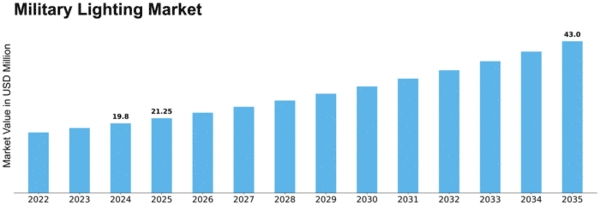

Military Lighting Market Size Graph
Author
Author Profile
Abbas Raut
Research Analyst

Abbas Raut is a Senior Research Analyst with 5+ years of experience delivering data-driven insights and strategic recommendations across the Automotive and Aerospace & Defense sectors. He specializes in emerging technologies, industry value chains, and global market dynamics shaping the future of mobility and defense. In automotive, Abbas has led studies on EVs, charging stations, BMS, superchargers, and more, guiding stakeholders through electrification and regulatory shifts. In Aerospace & Defense, he has analyzed markets for military electronics, drones, radars, and electronic warfare solutions, supporting procurement and investment strategies. With expertise in market sizing, forecasting, benchmarking, and technology adoption, Abbas is known for transforming complex datasets into actionable insights that drive strategy, innovation, and growth.

Leave a Comment

FAQs

What is the projected market valuation of the Military Lighting Market by 2035?

<p>The Military Lighting Market is projected to reach a valuation of 43.0 USD Million by 2035.</p>

What was the market valuation of the Military Lighting Market in 2024?

<p>In 2024, the Military Lighting Market was valued at 19.8 USD Million.</p>

What is the expected CAGR for the Military Lighting Market during the forecast period 2025 - 2035?

<p>The expected CAGR for the Military Lighting Market during the forecast period 2025 - 2035 is 7.33%.</p>

Which companies are considered key players in the Military Lighting Market?

<p>Key players in the Military Lighting Market include General Dynamics, Northrop Grumman, Raytheon Technologies, and L3Harris Technologies.</p>

What are the main segments of the Military Lighting Market by application?

<p>The main segments by application include Tactical Lighting, Vehicle Lighting, Aviation Lighting, Base Lighting, and Portable Lighting.</p>

How does LED technology compare to other technologies in the Military Lighting Market?

LED technology is projected to generate between 8.0 and 18.0 USD Million, outperforming Halogen, Incandescent, and Laser technologies.

What is the valuation range for Tactical Lighting in the Military Lighting Market?

The valuation range for Tactical Lighting is between 5.0 and 11.0 USD Million.

Which end-use segment is expected to have the highest valuation in the Military Lighting Market?

The Defense Forces segment is expected to have the highest valuation, ranging from 7.5 to 16.0 USD Million.

What power sources are utilized in the Military Lighting Market?

Power sources utilized include Battery Operated, Solar Powered, AC Powered, and Hybrid Powered lighting solutions.

What is the projected growth trend for Military Lighting Market segments by 2035?

By 2035, all segments are expected to experience growth, with Tactical Lighting and LED technology likely leading the market.

Market Summary

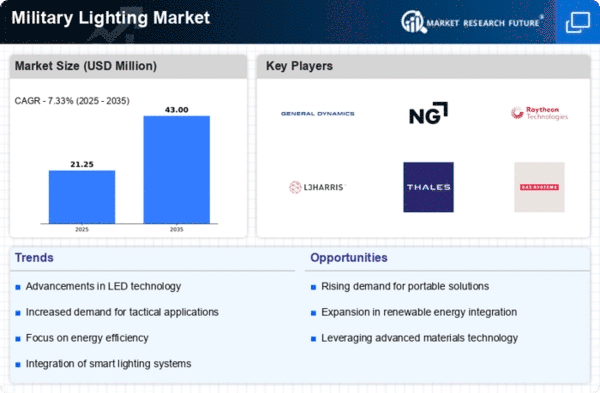
As per MRFR analysis, the Military Lighting Market Size was estimated at 19.8 USD Million in 2024. The Military Lighting industry is projected to grow from 21.2 USD Million in 2025 to 43.0 USD Million by 2035, exhibiting a compound annual growth rate (CAGR) of 7.33% during the forecast period 2025 - 2035.

Key Market Trends & Highlights

The Military Lighting Market is poised for substantial growth driven by technological advancements and increasing defense budgets.

  • Technological advancements in lighting solutions are reshaping the Military Lighting Market, enhancing operational capabilities.
  • North America remains the largest market, while the Asia-Pacific region is emerging as the fastest-growing area for military lighting solutions.
  • Tactical lighting continues to dominate the market, whereas vehicle lighting is experiencing rapid growth due to evolving defense needs.
  • Increased defense budgets and a rising demand for tactical lighting solutions are key drivers propelling market expansion.

Market Size & Forecast

2024 Market Size 19.8 (USD Million)
2035 Market Size 43.0 (USD Million)
CAGR (2025 - 2035) 7.33%
Largest Regional Market Share in 2024 North America

Major Players

General Dynamics (US), Northrop Grumman (US), Raytheon Technologies (US), L3Harris Technologies (US), Thales Group (FR), BAE Systems (GB), Honeywell International (US), Elbit Systems (IL), Oshkosh Corporation (US)

Market Trends

defense

Military Lighting Market Market Drivers

Technological Advancements

The Global Military Lighting Market Industry is experiencing a surge in demand due to rapid technological advancements. Innovations in LED technology and smart lighting systems enhance operational efficiency and reduce energy consumption. For instance, the integration of adaptive lighting solutions allows military personnel to adjust brightness levels based on mission requirements, thereby improving visibility and safety. As a result, the market is projected to reach 199.5 USD Million in 2024, reflecting a growing emphasis on modernizing military infrastructure. This trend suggests that the military is increasingly prioritizing advanced lighting solutions to support various operational scenarios.

Market Segment Insights

By Application: Tactical Lighting (Largest) vs. Portable Lighting (Fastest-Growing)

<p>In the Military Lighting Market, the application segments are distinctly characterized by their varied functionalities and target uses. Tactical lighting holds the largest market share due to its critical role in various military operations, particularly in combat and reconnaissance missions. Following closely are vehicle and aviation lighting, which serve essential functions in enhancing visibility and safety for military vehicles and aircraft. Portable lighting is garnering increased attention among military agencies seeking flexible and adaptable lighting solutions for on-the-go operations.</p>

<p>Tactical Lighting (Dominant) vs. Portable Lighting (Emerging)</p>

<p>Tactical lighting remains the dominant force in the Military Lighting Market, providing essential illumination capabilities for ground troops in low-light conditions. These lights are designed to be compact, durable, and versatile, meeting the demanding requirements of military engagements. In contrast, portable lighting is emerging as a vital solution in the sector, especially for special operations and field deployments, as it offers a lightweight, flexible option that can be easily transported. The growth of portable lighting is driven by advancements in battery technology and the increasing need for mobility in military operations.</p>

By End Use: Defense Forces (Largest) vs. Military Contractors (Fastest-Growing)

In the Military Lighting Market, the segment distribution shows that Defense Forces represent the largest share of end-use. This segment benefits from consistent government funding and prioritization of safety and operational efficiency. On the other hand, Military Contractors are emerging as a significant player due to an increase in private sector partnerships and rapid technological advancements, making them vital in developing innovative lighting solutions.

End Users: Defense Forces (Dominant) vs. Military Contractors (Emerging)

The Defense Forces segment dominates the Military Lighting Market, driven by a need for reliable, high-performance lighting solutions for various military applications. This segment encompasses a wide range of tactical and operational use, such as battlefield illumination, base camp lighting, and vehicle lighting systems. Conversely, Military Contractors are getting attention as an emerging segment, as they often collaborate with defense agencies to integrate innovative technologies. These contractors are focused on providing customizable lighting solutions that address specific operational requirements, leveraging advancements in LED and smart technologies.

By Technology: LED Technology (Largest) vs. Halogen Technology (Fastest-Growing)

In the Military Lighting Market, LED Technology dominates with a substantial market share due to its energy efficiency, longevity, and low maintenance costs. It is widely utilized in various applications, including vehicle lighting, portable lighting, and infrastructure lighting. Halogen Technology, while traditionally popular, is experiencing a resurgence as the fastest-growing segment, driven by its enhanced brightness and color rendering capabilities, making it suitable for tactical situations and environments where high visibility is critical.

Technology: LED (Dominant) vs. Halogen (Emerging)

LED Technology is characterized by its significant energy savings and extended lifespan, making it an ideal choice for military operations that require reliable and durable lighting solutions. It offers superior illumination, which is vital for operational effectiveness. Conversely, Halogen Technology, often perceived as less efficient, is gaining ground due to its ability to produce bright, high-quality light. This technology is increasingly being adopted for specific military applications where quick deployment and high adaptability are essential. While LEDs may hold the dominant share, Halogen's rapid development underscores a growing interest in versatile lighting options within the military sector.

By Power Source: Battery Operated (Largest) vs. Solar Powered (Fastest-Growing)

<p>In the Military Lighting Market, the distribution of power sources shows a clear dominance of battery-operated systems, which are preferred for their reliability and ease of use in various military operations. Battery-operated lighting solutions offer flexibility and portability, essential for military applications where conditions can be unpredictable. Solar power, while currently a smaller segment, is gaining traction as units look towards sustainable and renewable energy sources, driven by environmental considerations and advancements in solar technology.</p>

<p>Battery Operated (Dominant) vs. Solar Powered (Emerging)</p>

<p>Battery-operated military lighting is the dominant choice due to its proven reliability and portability, making it ideal for tactical operations in diverse environments. These systems easily integrate into existing military gear, allowing for rapid deployment and usage. On the other hand, solar-powered lighting is emerging as a viable alternative, benefiting from increasing investments in renewable energy. The incorporation of solar technology makes it an attractive option for long-term field operations, particularly in areas with ample sunlight. Both segments highlight the military's evolving focus on sustainability while meeting operational demands.</p>

Get more detailed insights about Military Lighting Market Research Report - Global Forecast till 2035

Regional Insights

North America : Market Leader in Military Lighting

North America continues to lead the Military Lighting Market, holding a significant share of 9.9 in 2024. The region's growth is driven by increasing defense budgets, technological advancements, and a focus on enhancing operational capabilities. Regulatory support for military modernization and energy-efficient solutions further fuels demand, making it a pivotal market for military lighting solutions. The competitive landscape is characterized by major players such as General Dynamics, Northrop Grumman, and Raytheon Technologies, which are at the forefront of innovation. The U.S. military's emphasis on advanced lighting systems for tactical operations and training exercises underscores the importance of this market. With a robust supply chain and R&D investments, North America is poised for sustained growth in military lighting.

Europe : Emerging Market with Growth Potential

Europe's Military Lighting Market is valued at 5.4, reflecting a growing emphasis on defense capabilities and modernization. The region is witnessing increased investments in military infrastructure, driven by geopolitical tensions and the need for enhanced operational readiness. Regulatory frameworks promoting energy-efficient technologies are also contributing to market growth, as nations seek to optimize defense spending. Leading countries like the UK, France, and Germany are key players in this market, with companies such as Thales Group and BAE Systems driving innovation. The competitive landscape is evolving, with a focus on collaborative defense initiatives and partnerships. As European nations prioritize military readiness, the demand for advanced lighting solutions is expected to rise significantly.

Asia-Pacific : Rapidly Growing Defense Sector

The Asia-Pacific Military Lighting Market, valued at 3.0, is experiencing rapid growth due to increasing defense expenditures and modernization efforts across the region. Countries like India, China, and Japan are investing heavily in advanced military technologies, including lighting systems. The demand for energy-efficient and durable lighting solutions is rising, driven by the need for enhanced operational capabilities in diverse environments. The competitive landscape features key players such as Elbit Systems and L3Harris Technologies, which are expanding their presence in the region. As nations focus on strengthening their military capabilities, the market for military lighting is expected to see significant advancements and innovations, catering to the unique needs of the region's armed forces.

Middle East and Africa : Emerging Market with Unique Challenges

The Middle East and Africa Military Lighting Market, valued at 1.5, is emerging as a significant player in the global landscape. The region's growth is driven by increasing military spending and the need for advanced lighting solutions in combat and training scenarios. Regulatory support for defense modernization initiatives is also a key factor, as countries seek to enhance their military capabilities in response to regional conflicts. Leading countries such as the UAE and South Africa are investing in military infrastructure, with a focus on innovative lighting technologies. The competitive landscape is characterized by a mix of local and international players, striving to meet the unique demands of the region. As military operations evolve, the demand for reliable and efficient lighting solutions is expected to grow steadily.

Key Players and Competitive Insights

The Military Lighting Market is characterized by a dynamic competitive landscape, driven by technological advancements and increasing defense budgets across various nations. Key players such as General Dynamics (US), Northrop Grumman (US), and Raytheon Technologies (US) are at the forefront, focusing on innovation and strategic partnerships to enhance their market positions. General Dynamics (US) emphasizes the integration of advanced LED technologies into its lighting solutions, aiming to improve operational efficiency and reduce energy consumption. Meanwhile, Northrop Grumman (US) is actively pursuing mergers and acquisitions to bolster its capabilities in military-grade lighting systems, thereby enhancing its competitive edge. Raytheon Technologies (US) is also investing heavily in research and development to create next-generation lighting solutions that meet the evolving needs of military operations.The business tactics employed by these companies include localizing manufacturing and optimizing supply chains to enhance responsiveness to market demands. The Military Lighting Market appears moderately fragmented, with several key players exerting considerable influence. This competitive structure allows for a diverse range of products and innovations, fostering an environment where companies must continuously adapt to maintain their market share.

In November General Dynamics (US) announced a partnership with a leading technology firm to develop smart lighting systems that integrate AI capabilities for enhanced situational awareness. This strategic move is likely to position General Dynamics (US) as a leader in the integration of smart technologies within military lighting, potentially setting new standards for operational effectiveness in the field. The collaboration underscores the importance of technological innovation in meeting the complex demands of modern military operations.

In October Northrop Grumman (US) completed the acquisition of a specialized lighting manufacturer, which is expected to expand its product portfolio significantly. This acquisition not only enhances Northrop Grumman's (US) capabilities in providing comprehensive lighting solutions but also strengthens its position in the competitive landscape by allowing for greater control over the supply chain and product development processes. Such strategic actions indicate a trend towards consolidation within the market, as companies seek to enhance their operational efficiencies.

In September Raytheon Technologies (US) launched a new line of ruggedized lighting systems designed for extreme environments, showcasing its commitment to innovation. This product line is anticipated to meet the increasing demand for durable and reliable lighting solutions in military applications, reflecting a broader trend towards specialized products that cater to specific operational needs. The introduction of such advanced systems may further differentiate Raytheon Technologies (US) from its competitors, emphasizing the importance of tailored solutions in the current market.

As of December the Military Lighting Market is witnessing trends such as digitalization, sustainability, and the integration of AI technologies. Strategic alliances among key players are shaping the competitive landscape, fostering innovation and enhancing product offerings. The shift from price-based competition to a focus on technological advancement and supply chain reliability is becoming increasingly evident. Companies that prioritize innovation and adaptability are likely to thrive in this evolving market, as the demand for sophisticated military lighting solutions continues to grow.

Key Companies in the Military Lighting Market include

Industry Developments

Contracts and Partnerships:

June 2022: Rheinmetall BAE Systems Land (RBSL) and Rheinmetall Land Systeme (RSL) awarded a $4.4 million contract to Oxley Group to provide LEDs for the British Army's new Boxer vehicles.

May 2022: Astronics Corporation announced a strategic agreement with LG Display to provide market-leading OLED display technologies to the aviation sector. This expands Astronics' product portfolio and technical capabilities.

September 2021: Babcock International Group awarded a contract to Consolite Technology Ltd to provide the General and Navigation Lighting System for the Type 31 General Purpose Frigates. This deal covers all internal and external lighting for the ships.

April 2021: Glamox acquired Luminell Group, a premium developer and supplier of floodlights, searchlights, and lighting controllers for the marine and offshore sectors. This strengthens Glamox's position in the marine lighting market.

In June 2021, United Airlines revealed a tremendous airplane request for 270 light body airplanes, the biggest single request in its set of experiences. The airplane will be fitted with new lodges that highlight new LED lighting to improve travelers' experience. 

In January 2021, JetBlue Airways revealed the lodge of its new Airbus A220 airplane that will supplant the maturing Embraer E190 flight. Lodge &lodge includes new bay windows that transform into mindset lights during the flight. 

In March 2019, Astronics Corporation presented the new Nuancia RGBW Strip Lights to give adaptable brightening choices to airplane situates and lodges. The disposition lighting frameworks can be customized to make present shading situations and present tone changes, 

Future Outlook

Military Lighting Market Future Outlook

The Military Lighting Market is projected to grow at a 7.33% CAGR from 2025 to 2035, driven by technological advancements, increased <a href="https://www.marketresearchfuture.com/reports/defense-market-34071" target="_blank">defense</a> budgets, and the demand for energy-efficient solutions.

New opportunities lie in:

  • Development of advanced LED tactical lighting systems for enhanced visibility
  • Integration of smart lighting solutions with battlefield management systems
  • Expansion of portable lighting solutions for remote military operations

By 2035, the Military Lighting Market is expected to achieve substantial growth and innovation.

Market Segmentation

Military Lighting Market End Use Outlook

  • Defense Forces
  • Military Contractors
  • Government Agencies
  • Research Institutions

Military Lighting Market Technology Outlook

  • LED Technology
  • Halogen Technology
  • Incandescent Technology
  • Fluorescent Technology

Military Lighting Market Application Outlook

  • Tactical Lighting
  • Vehicle Lighting
  • Aviation Lighting
  • Naval Lighting
  • Base Lighting

Military Lighting Market Product Type Outlook

  • Portable Lighting
  • Fixed Lighting
  • Headlamps
  • Searchlights

Report Scope

MARKET SIZE 2024 19.8(USD Million)
MARKET SIZE 2025 21.2(USD Million)
MARKET SIZE 2035 43.0(USD Million)
COMPOUND ANNUAL GROWTH RATE (CAGR) 7.33% (2025 - 2035)
REPORT COVERAGE Revenue Forecast, Competitive Landscape, Growth Factors, and Trends
BASE YEAR 2024
Market Forecast Period 2025 - 2035
Historical Data 2019 - 2024
Market Forecast Units USD Million
Key Companies Profiled General Dynamics (US), Northrop Grumman (US), Raytheon Technologies (US), L3Harris Technologies (US), Thales Group (FR), BAE Systems (GB), Honeywell International (US), Elbit Systems (IL), Oshkosh Corporation (US)
Segments Covered Application, End Use, Technology, Product Type
Key Market Opportunities Integration of advanced LED technology enhances operational efficiency in the Military Lighting Market.
Key Market Dynamics Technological advancements drive innovation in military lighting, enhancing operational efficiency and adaptability in diverse environments.
Countries Covered North America, Europe, APAC, South America, MEA

FAQs

What is the projected market valuation of the Military Lighting Market by 2035?

<p>The Military Lighting Market is projected to reach a valuation of 43.0 USD Million by 2035.</p>

What was the market valuation of the Military Lighting Market in 2024?

<p>In 2024, the Military Lighting Market was valued at 19.8 USD Million.</p>

What is the expected CAGR for the Military Lighting Market during the forecast period 2025 - 2035?

<p>The expected CAGR for the Military Lighting Market during the forecast period 2025 - 2035 is 7.33%.</p>

Which companies are considered key players in the Military Lighting Market?

<p>Key players in the Military Lighting Market include General Dynamics, Northrop Grumman, Raytheon Technologies, and L3Harris Technologies.</p>

What are the main segments of the Military Lighting Market by application?

<p>The main segments by application include Tactical Lighting, Vehicle Lighting, Aviation Lighting, Base Lighting, and Portable Lighting.</p>

How does LED technology compare to other technologies in the Military Lighting Market?

LED technology is projected to generate between 8.0 and 18.0 USD Million, outperforming Halogen, Incandescent, and Laser technologies.

What is the valuation range for Tactical Lighting in the Military Lighting Market?

The valuation range for Tactical Lighting is between 5.0 and 11.0 USD Million.

Which end-use segment is expected to have the highest valuation in the Military Lighting Market?

The Defense Forces segment is expected to have the highest valuation, ranging from 7.5 to 16.0 USD Million.

What power sources are utilized in the Military Lighting Market?

Power sources utilized include Battery Operated, Solar Powered, AC Powered, and Hybrid Powered lighting solutions.

What is the projected growth trend for Military Lighting Market segments by 2035?

By 2035, all segments are expected to experience growth, with Tactical Lighting and LED technology likely leading the market.

  1. SECTION I: EXECUTIVE SUMMARY AND KEY HIGHLIGHTS
    1. | 1.1 EXECUTIVE SUMMARY
    2. | | 1.1.1 Market Overview
    3. | | 1.1.2 Key Findings
    4. | | 1.1.3 Market Segmentation
    5. | | 1.1.4 Competitive Landscape
    6. | | 1.1.5 Challenges and Opportunities
    7. | | 1.1.6 Future Outlook
  2. SECTION II: SCOPING, METHODOLOGY AND MARKET STRUCTURE
    1. | 2.1 MARKET INTRODUCTION
    2. | | 2.1.1 Definition
    3. | | 2.1.2 Scope of the study
    4. | | | 2.1.2.1 Research Objective
    5. | | | 2.1.2.2 Assumption
    6. | | | 2.1.2.3 Limitations
    7. | 2.2 RESEARCH METHODOLOGY
    8. | | 2.2.1 Overview
    9. | | 2.2.2 Data Mining
    10. | | 2.2.3 Secondary Research
    11. | | 2.2.4 Primary Research
    12. | | | 2.2.4.1 Primary Interviews and Information Gathering Process
    13. | | | 2.2.4.2 Breakdown of Primary Respondents
    14. | | 2.2.5 Forecasting Model
    15. | | 2.2.6 Market Size Estimation
    16. | | | 2.2.6.1 Bottom-Up Approach
    17. | | | 2.2.6.2 Top-Down Approach
    18. | | 2.2.7 Data Triangulation
    19. | | 2.2.8 Validation
  3. SECTION III: QUALITATIVE ANALYSIS
    1. | 3.1 MARKET DYNAMICS
    2. | | 3.1.1 Overview
    3. | | 3.1.2 Drivers
    4. | | 3.1.3 Restraints
    5. | | 3.1.4 Opportunities
    6. | 3.2 MARKET FACTOR ANALYSIS
    7. | | 3.2.1 Value chain Analysis
    8. | | 3.2.2 Porter's Five Forces Analysis
    9. | | | 3.2.2.1 Bargaining Power of Suppliers
    10. | | | 3.2.2.2 Bargaining Power of Buyers
    11. | | | 3.2.2.3 Threat of New Entrants
    12. | | | 3.2.2.4 Threat of Substitutes
    13. | | | 3.2.2.5 Intensity of Rivalry
    14. | | 3.2.3 COVID-19 Impact Analysis
    15. | | | 3.2.3.1 Market Impact Analysis
    16. | | | 3.2.3.2 Regional Impact
    17. | | | 3.2.3.3 Opportunity and Threat Analysis
  4. SECTION IV: QUANTITATIVE ANALYSIS
    1. | 4.1 Aerospace & Defense, BY Application (USD Million)
    2. | | 4.1.1 Tactical Lighting
    3. | | 4.1.2 Vehicle Lighting
    4. | | 4.1.3 Aviation Lighting
    5. | | 4.1.4 Base Lighting
    6. | | 4.1.5 Portable Lighting
    7. | 4.2 Aerospace & Defense, BY End Use (USD Million)
    8. | | 4.2.1 Defense Forces
    9. | | 4.2.2 Military Contractors
    10. | | 4.2.3 Government Agencies
    11. | | 4.2.4 Research Institutions
    12. | 4.3 Aerospace & Defense, BY Technology (USD Million)
    13. | | 4.3.1 LED Technology
    14. | | 4.3.2 Halogen Technology
    15. | | 4.3.3 Incandescent Technology
    16. | | 4.3.4 Laser Technology
    17. | 4.4 Aerospace & Defense, BY Power Source (USD Million)
    18. | | 4.4.1 Battery Operated
    19. | | 4.4.2 Solar Powered
    20. | | 4.4.3 AC Powered
    21. | | 4.4.4 Hybrid Powered
    22. | 4.5 Aerospace & Defense, BY Region (USD Million)
    23. | | 4.5.1 North America
    24. | | | 4.5.1.1 US
    25. | | | 4.5.1.2 Canada
    26. | | 4.5.2 Europe
    27. | | | 4.5.2.1 Germany
    28. | | | 4.5.2.2 UK
    29. | | | 4.5.2.3 France
    30. | | | 4.5.2.4 Russia
    31. | | | 4.5.2.5 Italy
    32. | | | 4.5.2.6 Spain
    33. | | | 4.5.2.7 Rest of Europe
    34. | | 4.5.3 APAC
    35. | | | 4.5.3.1 China
    36. | | | 4.5.3.2 India
    37. | | | 4.5.3.3 Japan
    38. | | | 4.5.3.4 South Korea
    39. | | | 4.5.3.5 Malaysia
    40. | | | 4.5.3.6 Thailand
    41. | | | 4.5.3.7 Indonesia
    42. | | | 4.5.3.8 Rest of APAC
    43. | | 4.5.4 South America
    44. | | | 4.5.4.1 Brazil
    45. | | | 4.5.4.2 Mexico
    46. | | | 4.5.4.3 Argentina
    47. | | | 4.5.4.4 Rest of South America
    48. | | 4.5.5 MEA
    49. | | | 4.5.5.1 GCC Countries
    50. | | | 4.5.5.2 South Africa
    51. | | | 4.5.5.3 Rest of MEA
  5. SECTION V: COMPETITIVE ANALYSIS
    1. | 5.1 Competitive Landscape
    2. | | 5.1.1 Overview
    3. | | 5.1.2 Competitive Analysis
    4. | | 5.1.3 Market share Analysis
    5. | | 5.1.4 Major Growth Strategy in the Aerospace & Defense
    6. | | 5.1.5 Competitive Benchmarking
    7. | | 5.1.6 Leading Players in Terms of Number of Developments in the Aerospace & Defense
    8. | | 5.1.7 Key developments and growth strategies
    9. | | | 5.1.7.1 New Product Launch/Service Deployment
    10. | | | 5.1.7.2 Merger & Acquisitions
    11. | | | 5.1.7.3 Joint Ventures
    12. | | 5.1.8 Major Players Financial Matrix
    13. | | | 5.1.8.1 Sales and Operating Income
    14. | | | 5.1.8.2 Major Players R&D Expenditure. 2023
    15. | 5.2 Company Profiles
    16. | | 5.2.1 General Dynamics (US)
    17. | | | 5.2.1.1 Financial Overview
    18. | | | 5.2.1.2 Products Offered
    19. | | | 5.2.1.3 Key Developments
    20. | | | 5.2.1.4 SWOT Analysis
    21. | | | 5.2.1.5 Key Strategies
    22. | | 5.2.2 Northrop Grumman (US)
    23. | | | 5.2.2.1 Financial Overview
    24. | | | 5.2.2.2 Products Offered
    25. | | | 5.2.2.3 Key Developments
    26. | | | 5.2.2.4 SWOT Analysis
    27. | | | 5.2.2.5 Key Strategies
    28. | | 5.2.3 Raytheon Technologies (US)
    29. | | | 5.2.3.1 Financial Overview
    30. | | | 5.2.3.2 Products Offered
    31. | | | 5.2.3.3 Key Developments
    32. | | | 5.2.3.4 SWOT Analysis
    33. | | | 5.2.3.5 Key Strategies
    34. | | 5.2.4 L3Harris Technologies (US)
    35. | | | 5.2.4.1 Financial Overview
    36. | | | 5.2.4.2 Products Offered
    37. | | | 5.2.4.3 Key Developments
    38. | | | 5.2.4.4 SWOT Analysis
    39. | | | 5.2.4.5 Key Strategies
    40. | | 5.2.5 Thales Group (FR)
    41. | | | 5.2.5.1 Financial Overview
    42. | | | 5.2.5.2 Products Offered
    43. | | | 5.2.5.3 Key Developments
    44. | | | 5.2.5.4 SWOT Analysis
    45. | | | 5.2.5.5 Key Strategies
    46. | | 5.2.6 BAE Systems (GB)
    47. | | | 5.2.6.1 Financial Overview
    48. | | | 5.2.6.2 Products Offered
    49. | | | 5.2.6.3 Key Developments
    50. | | | 5.2.6.4 SWOT Analysis
    51. | | | 5.2.6.5 Key Strategies
    52. | | 5.2.7 Honeywell International (US)
    53. | | | 5.2.7.1 Financial Overview
    54. | | | 5.2.7.2 Products Offered
    55. | | | 5.2.7.3 Key Developments
    56. | | | 5.2.7.4 SWOT Analysis
    57. | | | 5.2.7.5 Key Strategies
    58. | | 5.2.8 Elbit Systems (IL)
    59. | | | 5.2.8.1 Financial Overview
    60. | | | 5.2.8.2 Products Offered
    61. | | | 5.2.8.3 Key Developments
    62. | | | 5.2.8.4 SWOT Analysis
    63. | | | 5.2.8.5 Key Strategies
    64. | | 5.2.9 Oshkosh Corporation (US)
    65. | | | 5.2.9.1 Financial Overview
    66. | | | 5.2.9.2 Products Offered
    67. | | | 5.2.9.3 Key Developments
    68. | | | 5.2.9.4 SWOT Analysis
    69. | | | 5.2.9.5 Key Strategies
    70. | 5.3 Appendix
    71. | | 5.3.1 References
    72. | | 5.3.2 Related Reports
  6. LIST OF FIGURES
    1. | 6.1 MARKET SYNOPSIS
    2. | 6.2 NORTH AMERICA MARKET ANALYSIS
    3. | 6.3 US MARKET ANALYSIS BY APPLICATION
    4. | 6.4 US MARKET ANALYSIS BY END USE
    5. | 6.5 US MARKET ANALYSIS BY TECHNOLOGY
    6. | 6.6 US MARKET ANALYSIS BY POWER SOURCE
    7. | 6.7 CANADA MARKET ANALYSIS BY APPLICATION
    8. | 6.8 CANADA MARKET ANALYSIS BY END USE
    9. | 6.9 CANADA MARKET ANALYSIS BY TECHNOLOGY
    10. | 6.10 CANADA MARKET ANALYSIS BY POWER SOURCE
    11. | 6.11 EUROPE MARKET ANALYSIS
    12. | 6.12 GERMANY MARKET ANALYSIS BY APPLICATION
    13. | 6.13 GERMANY MARKET ANALYSIS BY END USE
    14. | 6.14 GERMANY MARKET ANALYSIS BY TECHNOLOGY
    15. | 6.15 GERMANY MARKET ANALYSIS BY POWER SOURCE
    16. | 6.16 UK MARKET ANALYSIS BY APPLICATION
    17. | 6.17 UK MARKET ANALYSIS BY END USE
    18. | 6.18 UK MARKET ANALYSIS BY TECHNOLOGY
    19. | 6.19 UK MARKET ANALYSIS BY POWER SOURCE
    20. | 6.20 FRANCE MARKET ANALYSIS BY APPLICATION
    21. | 6.21 FRANCE MARKET ANALYSIS BY END USE
    22. | 6.22 FRANCE MARKET ANALYSIS BY TECHNOLOGY
    23. | 6.23 FRANCE MARKET ANALYSIS BY POWER SOURCE
    24. | 6.24 RUSSIA MARKET ANALYSIS BY APPLICATION
    25. | 6.25 RUSSIA MARKET ANALYSIS BY END USE
    26. | 6.26 RUSSIA MARKET ANALYSIS BY TECHNOLOGY
    27. | 6.27 RUSSIA MARKET ANALYSIS BY POWER SOURCE
    28. | 6.28 ITALY MARKET ANALYSIS BY APPLICATION
    29. | 6.29 ITALY MARKET ANALYSIS BY END USE
    30. | 6.30 ITALY MARKET ANALYSIS BY TECHNOLOGY
    31. | 6.31 ITALY MARKET ANALYSIS BY POWER SOURCE
    32. | 6.32 SPAIN MARKET ANALYSIS BY APPLICATION
    33. | 6.33 SPAIN MARKET ANALYSIS BY END USE
    34. | 6.34 SPAIN MARKET ANALYSIS BY TECHNOLOGY
    35. | 6.35 SPAIN MARKET ANALYSIS BY POWER SOURCE
    36. | 6.36 REST OF EUROPE MARKET ANALYSIS BY APPLICATION
    37. | 6.37 REST OF EUROPE MARKET ANALYSIS BY END USE
    38. | 6.38 REST OF EUROPE MARKET ANALYSIS BY TECHNOLOGY
    39. | 6.39 REST OF EUROPE MARKET ANALYSIS BY POWER SOURCE
    40. | 6.40 APAC MARKET ANALYSIS
    41. | 6.41 CHINA MARKET ANALYSIS BY APPLICATION
    42. | 6.42 CHINA MARKET ANALYSIS BY END USE
    43. | 6.43 CHINA MARKET ANALYSIS BY TECHNOLOGY
    44. | 6.44 CHINA MARKET ANALYSIS BY POWER SOURCE
    45. | 6.45 INDIA MARKET ANALYSIS BY APPLICATION
    46. | 6.46 INDIA MARKET ANALYSIS BY END USE
    47. | 6.47 INDIA MARKET ANALYSIS BY TECHNOLOGY
    48. | 6.48 INDIA MARKET ANALYSIS BY POWER SOURCE
    49. | 6.49 JAPAN MARKET ANALYSIS BY APPLICATION
    50. | 6.50 JAPAN MARKET ANALYSIS BY END USE
    51. | 6.51 JAPAN MARKET ANALYSIS BY TECHNOLOGY
    52. | 6.52 JAPAN MARKET ANALYSIS BY POWER SOURCE
    53. | 6.53 SOUTH KOREA MARKET ANALYSIS BY APPLICATION
    54. | 6.54 SOUTH KOREA MARKET ANALYSIS BY END USE
    55. | 6.55 SOUTH KOREA MARKET ANALYSIS BY TECHNOLOGY
    56. | 6.56 SOUTH KOREA MARKET ANALYSIS BY POWER SOURCE
    57. | 6.57 MALAYSIA MARKET ANALYSIS BY APPLICATION
    58. | 6.58 MALAYSIA MARKET ANALYSIS BY END USE
    59. | 6.59 MALAYSIA MARKET ANALYSIS BY TECHNOLOGY
    60. | 6.60 MALAYSIA MARKET ANALYSIS BY POWER SOURCE
    61. | 6.61 THAILAND MARKET ANALYSIS BY APPLICATION
    62. | 6.62 THAILAND MARKET ANALYSIS BY END USE
    63. | 6.63 THAILAND MARKET ANALYSIS BY TECHNOLOGY
    64. | 6.64 THAILAND MARKET ANALYSIS BY POWER SOURCE
    65. | 6.65 INDONESIA MARKET ANALYSIS BY APPLICATION
    66. | 6.66 INDONESIA MARKET ANALYSIS BY END USE
    67. | 6.67 INDONESIA MARKET ANALYSIS BY TECHNOLOGY
    68. | 6.68 INDONESIA MARKET ANALYSIS BY POWER SOURCE
    69. | 6.69 REST OF APAC MARKET ANALYSIS BY APPLICATION
    70. | 6.70 REST OF APAC MARKET ANALYSIS BY END USE
    71. | 6.71 REST OF APAC MARKET ANALYSIS BY TECHNOLOGY
    72. | 6.72 REST OF APAC MARKET ANALYSIS BY POWER SOURCE
    73. | 6.73 SOUTH AMERICA MARKET ANALYSIS
    74. | 6.74 BRAZIL MARKET ANALYSIS BY APPLICATION
    75. | 6.75 BRAZIL MARKET ANALYSIS BY END USE
    76. | 6.76 BRAZIL MARKET ANALYSIS BY TECHNOLOGY
    77. | 6.77 BRAZIL MARKET ANALYSIS BY POWER SOURCE
    78. | 6.78 MEXICO MARKET ANALYSIS BY APPLICATION
    79. | 6.79 MEXICO MARKET ANALYSIS BY END USE
    80. | 6.80 MEXICO MARKET ANALYSIS BY TECHNOLOGY
    81. | 6.81 MEXICO MARKET ANALYSIS BY POWER SOURCE
    82. | 6.82 ARGENTINA MARKET ANALYSIS BY APPLICATION
    83. | 6.83 ARGENTINA MARKET ANALYSIS BY END USE
    84. | 6.84 ARGENTINA MARKET ANALYSIS BY TECHNOLOGY
    85. | 6.85 ARGENTINA MARKET ANALYSIS BY POWER SOURCE
    86. | 6.86 REST OF SOUTH AMERICA MARKET ANALYSIS BY APPLICATION
    87. | 6.87 REST OF SOUTH AMERICA MARKET ANALYSIS BY END USE
    88. | 6.88 REST OF SOUTH AMERICA MARKET ANALYSIS BY TECHNOLOGY
    89. | 6.89 REST OF SOUTH AMERICA MARKET ANALYSIS BY POWER SOURCE
    90. | 6.90 MEA MARKET ANALYSIS
    91. | 6.91 GCC COUNTRIES MARKET ANALYSIS BY APPLICATION
    92. | 6.92 GCC COUNTRIES MARKET ANALYSIS BY END USE
    93. | 6.93 GCC COUNTRIES MARKET ANALYSIS BY TECHNOLOGY
    94. | 6.94 GCC COUNTRIES MARKET ANALYSIS BY POWER SOURCE
    95. | 6.95 SOUTH AFRICA MARKET ANALYSIS BY APPLICATION
    96. | 6.96 SOUTH AFRICA MARKET ANALYSIS BY END USE
    97. | 6.97 SOUTH AFRICA MARKET ANALYSIS BY TECHNOLOGY
    98. | 6.98 SOUTH AFRICA MARKET ANALYSIS BY POWER SOURCE
    99. | 6.99 REST OF MEA MARKET ANALYSIS BY APPLICATION
    100. | 6.100 REST OF MEA MARKET ANALYSIS BY END USE
    101. | 6.101 REST OF MEA MARKET ANALYSIS BY TECHNOLOGY
    102. | 6.102 REST OF MEA MARKET ANALYSIS BY POWER SOURCE
    103. | 6.103 KEY BUYING CRITERIA OF AEROSPACE & DEFENSE
    104. | 6.104 RESEARCH PROCESS OF MRFR
    105. | 6.105 DRO ANALYSIS OF AEROSPACE & DEFENSE
    106. | 6.106 DRIVERS IMPACT ANALYSIS: AEROSPACE & DEFENSE
    107. | 6.107 RESTRAINTS IMPACT ANALYSIS: AEROSPACE & DEFENSE
    108. | 6.108 SUPPLY / VALUE CHAIN: AEROSPACE & DEFENSE
    109. | 6.109 AEROSPACE & DEFENSE, BY APPLICATION, 2024 (% SHARE)
    110. | 6.110 AEROSPACE & DEFENSE, BY APPLICATION, 2024 TO 2035 (USD Million)
    111. | 6.111 AEROSPACE & DEFENSE, BY END USE, 2024 (% SHARE)
    112. | 6.112 AEROSPACE & DEFENSE, BY END USE, 2024 TO 2035 (USD Million)
    113. | 6.113 AEROSPACE & DEFENSE, BY TECHNOLOGY, 2024 (% SHARE)
    114. | 6.114 AEROSPACE & DEFENSE, BY TECHNOLOGY, 2024 TO 2035 (USD Million)
    115. | 6.115 AEROSPACE & DEFENSE, BY POWER SOURCE, 2024 (% SHARE)
    116. | 6.116 AEROSPACE & DEFENSE, BY POWER SOURCE, 2024 TO 2035 (USD Million)
    117. | 6.117 BENCHMARKING OF MAJOR COMPETITORS
  7. LIST OF TABLES
    1. | 7.1 LIST OF ASSUMPTIONS
    2. | | 7.1.1
    3. | 7.2 North America MARKET SIZE ESTIMATES; FORECAST
    4. | | 7.2.1 BY APPLICATION, 2025-2035 (USD Million)
    5. | | 7.2.2 BY END USE, 2025-2035 (USD Million)
    6. | | 7.2.3 BY TECHNOLOGY, 2025-2035 (USD Million)
    7. | | 7.2.4 BY POWER SOURCE, 2025-2035 (USD Million)
    8. | 7.3 US MARKET SIZE ESTIMATES; FORECAST
    9. | | 7.3.1 BY APPLICATION, 2025-2035 (USD Million)
    10. | | 7.3.2 BY END USE, 2025-2035 (USD Million)
    11. | | 7.3.3 BY TECHNOLOGY, 2025-2035 (USD Million)
    12. | | 7.3.4 BY POWER SOURCE, 2025-2035 (USD Million)
    13. | 7.4 Canada MARKET SIZE ESTIMATES; FORECAST
    14. | | 7.4.1 BY APPLICATION, 2025-2035 (USD Million)
    15. | | 7.4.2 BY END USE, 2025-2035 (USD Million)
    16. | | 7.4.3 BY TECHNOLOGY, 2025-2035 (USD Million)
    17. | | 7.4.4 BY POWER SOURCE, 2025-2035 (USD Million)
    18. | 7.5 Europe MARKET SIZE ESTIMATES; FORECAST
    19. | | 7.5.1 BY APPLICATION, 2025-2035 (USD Million)
    20. | | 7.5.2 BY END USE, 2025-2035 (USD Million)
    21. | | 7.5.3 BY TECHNOLOGY, 2025-2035 (USD Million)
    22. | | 7.5.4 BY POWER SOURCE, 2025-2035 (USD Million)
    23. | 7.6 Germany MARKET SIZE ESTIMATES; FORECAST
    24. | | 7.6.1 BY APPLICATION, 2025-2035 (USD Million)
    25. | | 7.6.2 BY END USE, 2025-2035 (USD Million)
    26. | | 7.6.3 BY TECHNOLOGY, 2025-2035 (USD Million)
    27. | | 7.6.4 BY POWER SOURCE, 2025-2035 (USD Million)
    28. | 7.7 UK MARKET SIZE ESTIMATES; FORECAST
    29. | | 7.7.1 BY APPLICATION, 2025-2035 (USD Million)
    30. | | 7.7.2 BY END USE, 2025-2035 (USD Million)
    31. | | 7.7.3 BY TECHNOLOGY, 2025-2035 (USD Million)
    32. | | 7.7.4 BY POWER SOURCE, 2025-2035 (USD Million)
    33. | 7.8 France MARKET SIZE ESTIMATES; FORECAST
    34. | | 7.8.1 BY APPLICATION, 2025-2035 (USD Million)
    35. | | 7.8.2 BY END USE, 2025-2035 (USD Million)
    36. | | 7.8.3 BY TECHNOLOGY, 2025-2035 (USD Million)
    37. | | 7.8.4 BY POWER SOURCE, 2025-2035 (USD Million)
    38. | 7.9 Russia MARKET SIZE ESTIMATES; FORECAST
    39. | | 7.9.1 BY APPLICATION, 2025-2035 (USD Million)
    40. | | 7.9.2 BY END USE, 2025-2035 (USD Million)
    41. | | 7.9.3 BY TECHNOLOGY, 2025-2035 (USD Million)
    42. | | 7.9.4 BY POWER SOURCE, 2025-2035 (USD Million)
    43. | 7.10 Italy MARKET SIZE ESTIMATES; FORECAST
    44. | | 7.10.1 BY APPLICATION, 2025-2035 (USD Million)
    45. | | 7.10.2 BY END USE, 2025-2035 (USD Million)
    46. | | 7.10.3 BY TECHNOLOGY, 2025-2035 (USD Million)
    47. | | 7.10.4 BY POWER SOURCE, 2025-2035 (USD Million)
    48. | 7.11 Spain MARKET SIZE ESTIMATES; FORECAST
    49. | | 7.11.1 BY APPLICATION, 2025-2035 (USD Million)
    50. | | 7.11.2 BY END USE, 2025-2035 (USD Million)
    51. | | 7.11.3 BY TECHNOLOGY, 2025-2035 (USD Million)
    52. | | 7.11.4 BY POWER SOURCE, 2025-2035 (USD Million)
    53. | 7.12 Rest of Europe MARKET SIZE ESTIMATES; FORECAST
    54. | | 7.12.1 BY APPLICATION, 2025-2035 (USD Million)
    55. | | 7.12.2 BY END USE, 2025-2035 (USD Million)
    56. | | 7.12.3 BY TECHNOLOGY, 2025-2035 (USD Million)
    57. | | 7.12.4 BY POWER SOURCE, 2025-2035 (USD Million)
    58. | 7.13 APAC MARKET SIZE ESTIMATES; FORECAST
    59. | | 7.13.1 BY APPLICATION, 2025-2035 (USD Million)
    60. | | 7.13.2 BY END USE, 2025-2035 (USD Million)
    61. | | 7.13.3 BY TECHNOLOGY, 2025-2035 (USD Million)
    62. | | 7.13.4 BY POWER SOURCE, 2025-2035 (USD Million)
    63. | 7.14 China MARKET SIZE ESTIMATES; FORECAST
    64. | | 7.14.1 BY APPLICATION, 2025-2035 (USD Million)
    65. | | 7.14.2 BY END USE, 2025-2035 (USD Million)
    66. | | 7.14.3 BY TECHNOLOGY, 2025-2035 (USD Million)
    67. | | 7.14.4 BY POWER SOURCE, 2025-2035 (USD Million)
    68. | 7.15 India MARKET SIZE ESTIMATES; FORECAST
    69. | | 7.15.1 BY APPLICATION, 2025-2035 (USD Million)
    70. | | 7.15.2 BY END USE, 2025-2035 (USD Million)
    71. | | 7.15.3 BY TECHNOLOGY, 2025-2035 (USD Million)
    72. | | 7.15.4 BY POWER SOURCE, 2025-2035 (USD Million)
    73. | 7.16 Japan MARKET SIZE ESTIMATES; FORECAST
    74. | | 7.16.1 BY APPLICATION, 2025-2035 (USD Million)
    75. | | 7.16.2 BY END USE, 2025-2035 (USD Million)
    76. | | 7.16.3 BY TECHNOLOGY, 2025-2035 (USD Million)
    77. | | 7.16.4 BY POWER SOURCE, 2025-2035 (USD Million)
    78. | 7.17 South Korea MARKET SIZE ESTIMATES; FORECAST
    79. | | 7.17.1 BY APPLICATION, 2025-2035 (USD Million)
    80. | | 7.17.2 BY END USE, 2025-2035 (USD Million)
    81. | | 7.17.3 BY TECHNOLOGY, 2025-2035 (USD Million)
    82. | | 7.17.4 BY POWER SOURCE, 2025-2035 (USD Million)
    83. | 7.18 Malaysia MARKET SIZE ESTIMATES; FORECAST
    84. | | 7.18.1 BY APPLICATION, 2025-2035 (USD Million)
    85. | | 7.18.2 BY END USE, 2025-2035 (USD Million)
    86. | | 7.18.3 BY TECHNOLOGY, 2025-2035 (USD Million)
    87. | | 7.18.4 BY POWER SOURCE, 2025-2035 (USD Million)
    88. | 7.19 Thailand MARKET SIZE ESTIMATES; FORECAST
    89. | | 7.19.1 BY APPLICATION, 2025-2035 (USD Million)
    90. | | 7.19.2 BY END USE, 2025-2035 (USD Million)
    91. | | 7.19.3 BY TECHNOLOGY, 2025-2035 (USD Million)
    92. | | 7.19.4 BY POWER SOURCE, 2025-2035 (USD Million)
    93. | 7.20 Indonesia MARKET SIZE ESTIMATES; FORECAST
    94. | | 7.20.1 BY APPLICATION, 2025-2035 (USD Million)
    95. | | 7.20.2 BY END USE, 2025-2035 (USD Million)
    96. | | 7.20.3 BY TECHNOLOGY, 2025-2035 (USD Million)
    97. | | 7.20.4 BY POWER SOURCE, 2025-2035 (USD Million)
    98. | 7.21 Rest of APAC MARKET SIZE ESTIMATES; FORECAST
    99. | | 7.21.1 BY APPLICATION, 2025-2035 (USD Million)
    100. | | 7.21.2 BY END USE, 2025-2035 (USD Million)
    101. | | 7.21.3 BY TECHNOLOGY, 2025-2035 (USD Million)
    102. | | 7.21.4 BY POWER SOURCE, 2025-2035 (USD Million)
    103. | 7.22 South America MARKET SIZE ESTIMATES; FORECAST
    104. | | 7.22.1 BY APPLICATION, 2025-2035 (USD Million)
    105. | | 7.22.2 BY END USE, 2025-2035 (USD Million)
    106. | | 7.22.3 BY TECHNOLOGY, 2025-2035 (USD Million)
    107. | | 7.22.4 BY POWER SOURCE, 2025-2035 (USD Million)
    108. | 7.23 Brazil MARKET SIZE ESTIMATES; FORECAST
    109. | | 7.23.1 BY APPLICATION, 2025-2035 (USD Million)
    110. | | 7.23.2 BY END USE, 2025-2035 (USD Million)
    111. | | 7.23.3 BY TECHNOLOGY, 2025-2035 (USD Million)
    112. | | 7.23.4 BY POWER SOURCE, 2025-2035 (USD Million)
    113. | 7.24 Mexico MARKET SIZE ESTIMATES; FORECAST
    114. | | 7.24.1 BY APPLICATION, 2025-2035 (USD Million)
    115. | | 7.24.2 BY END USE, 2025-2035 (USD Million)
    116. | | 7.24.3 BY TECHNOLOGY, 2025-2035 (USD Million)
    117. | | 7.24.4 BY POWER SOURCE, 2025-2035 (USD Million)
    118. | 7.25 Argentina MARKET SIZE ESTIMATES; FORECAST
    119. | | 7.25.1 BY APPLICATION, 2025-2035 (USD Million)
    120. | | 7.25.2 BY END USE, 2025-2035 (USD Million)
    121. | | 7.25.3 BY TECHNOLOGY, 2025-2035 (USD Million)
    122. | | 7.25.4 BY POWER SOURCE, 2025-2035 (USD Million)
    123. | 7.26 Rest of South America MARKET SIZE ESTIMATES; FORECAST
    124. | | 7.26.1 BY APPLICATION, 2025-2035 (USD Million)
    125. | | 7.26.2 BY END USE, 2025-2035 (USD Million)
    126. | | 7.26.3 BY TECHNOLOGY, 2025-2035 (USD Million)
    127. | | 7.26.4 BY POWER SOURCE, 2025-2035 (USD Million)
    128. | 7.27 MEA MARKET SIZE ESTIMATES; FORECAST
    129. | | 7.27.1 BY APPLICATION, 2025-2035 (USD Million)
    130. | | 7.27.2 BY END USE, 2025-2035 (USD Million)
    131. | | 7.27.3 BY TECHNOLOGY, 2025-2035 (USD Million)
    132. | | 7.27.4 BY POWER SOURCE, 2025-2035 (USD Million)
    133. | 7.28 GCC Countries MARKET SIZE ESTIMATES; FORECAST
    134. | | 7.28.1 BY APPLICATION, 2025-2035 (USD Million)
    135. | | 7.28.2 BY END USE, 2025-2035 (USD Million)
    136. | | 7.28.3 BY TECHNOLOGY, 2025-2035 (USD Million)
    137. | | 7.28.4 BY POWER SOURCE, 2025-2035 (USD Million)
    138. | 7.29 South Africa MARKET SIZE ESTIMATES; FORECAST
    139. | | 7.29.1 BY APPLICATION, 2025-2035 (USD Million)
    140. | | 7.29.2 BY END USE, 2025-2035 (USD Million)
    141. | | 7.29.3 BY TECHNOLOGY, 2025-2035 (USD Million)
    142. | | 7.29.4 BY POWER SOURCE, 2025-2035 (USD Million)
    143. | 7.30 Rest of MEA MARKET SIZE ESTIMATES; FORECAST
    144. | | 7.30.1 BY APPLICATION, 2025-2035 (USD Million)
    145. | | 7.30.2 BY END USE, 2025-2035 (USD Million)
    146. | | 7.30.3 BY TECHNOLOGY, 2025-2035 (USD Million)
    147. | | 7.30.4 BY POWER SOURCE, 2025-2035 (USD Million)
    148. | 7.31 PRODUCT LAUNCH/PRODUCT DEVELOPMENT/APPROVAL
    149. | | 7.31.1
    150. | 7.32 ACQUISITION/PARTNERSHIP
    151. | | 7.32.1

Aerospace & Defense Market Segmentation

Aerospace & Defense By Application (USD Million, 2025-2035)

  • Tactical Lighting
  • Vehicle Lighting
  • Aviation Lighting
  • Base Lighting
  • Portable Lighting

Aerospace & Defense By End Use (USD Million, 2025-2035)

  • Defense Forces
  • Military Contractors
  • Government Agencies
  • Research Institutions

Aerospace & Defense By Technology (USD Million, 2025-2035)

  • LED Technology
  • Halogen Technology
  • Incandescent Technology
  • Laser Technology

Aerospace & Defense By Power Source (USD Million, 2025-2035)

  • Battery Operated
  • Solar Powered
  • AC Powered
  • Hybrid Powered
Infographic

Free Sample Request

Kindly complete the form below to receive a free sample of this Report

Get Free Sample

Customer Strories

Compare Licence

×
Features License Type
Single User Multiuser License Enterprise User
Price $4,950 $5,950 $7,250
Maximum User Access Limit 1 User Upto 10 Users Unrestricted Access Throughout the Organization
Free Customization
Direct Access to Analyst
Deliverable Format
Platform Access
Discount on Next Purchase 10% 15% 15%
Printable Versions
%>