×
Request Free Sample ×

Kindly complete the form below to receive a free sample of this Report

* Please use a valid business email

Leading companies partner with us for data-driven Insights

clients tt-cursor
Hero Background
English
Chinese
French
Japanese
Korean
German
Spanish

Migraine Drugs Market Share

ID: MRFR/Pharma/6907-HCR
200 Pages
Rahul Gotadki
February 2026

Migraine Drugs Market Size, Growth Research Report By Drug Type (Abortive Drugs, Preventive Drugs, CGRP Inhibitors, Triptans), By Route of Administration (Oral, Injectable, Nasal), By Therapeutic Class (NSAIDs, Ergots, Beta Blockers, Antidepressants), By Patient Demographics (Adults, Children, Geriatrics), and By Regional (North America, Europe, South America, Asia Pacific, Middle East and Africa) - Competitor Industry Analysis and Trends Forecast Till 2035

Share:
Download PDF ×

We do not share your information with anyone. However, we may send you emails based on your report interest from time to time. You may contact us at any time to opt-out.

Migraine Drugs Market Infographic
Purchase Options

Market Share

Migraine Drugs Market Share Analysis

Because more and more people need effective migraine medicines, drug companies are fighting for a bigger share of the migraine drug market. There are a number of useful ways to get these medicines on the market. Because people who get migraines are so different, drug companies make medicines that work best for certain groups of people. These are medicines that are made for younger patients, people who know what makes their symptoms worse, and people who have had health issues for a long time. If you want to do well in the market, you need to have good ratings for safety and efficiency. A lot of studies are done by drug companies to show that their medicines can greatly lower migraine symptoms with few side effects. Finding ways to be different from the others is an important part of good marketing. Pay attention to what makes your product special in the market. For example, how fast it starts up, how comfortable it is for a long time, or how often you don't have to dose it... Going abroad is often the main goal of businesses that want to get a bigger share of the market. It's important to know what people in different places like, how the rules work, and how to adapt marketing plans to fit different culture and medical practices. Healthcare schools, study groups, and patient support groups can work with a business to improve its image and get potential customers' attention. It might also be easier to get important data when people work together, which could lead to better medicines that meet the needs of all patients. Being able to offer reasonable prices is important. Making money and making sure people can pay for care at the same time is hard. To keep medicine costs low, drug companies often work with programs that help patients and give them money back. More people need to know about the product, and both doctors and customers need to be taught about the benefits of some migraine drugs. As part of marketing, people often use teaching tools, recommendations, and websites where they can share information. There are strict rules that must be followed by everyone who wants to get into the market. Businesses spend a lot of money to follow and go above and beyond what the law requires so that doctors and patients will trust them. Drug companies have been able to make migraine drugs last longer by managing their lifetimes. To do this, you might need to come up with new ideas, get more suggestions, or try to get copyright extensions. Any company that keeps a close eye on the market can quickly adjust to changes in customer tastes, market competition, or government rules. Be open to change if you want to keep and grow your market share. There are now patient support programs at some companies that help people with headaches in a number of ways. Digital tools to get people more involved, counseling services, and tools for handling your daily life are all things that could be in this. Telemedicine and other tech tools should be used. Because the healthcare field is always changing, companies that offer migraine treatment through virtual meetings, telemonitoring, or mobile apps are ahead of the game.


Author
Rahul Gotadki
Research Manager

He holds an experience of about 9+ years in Market Research and Business Consulting, working under the spectrum of Life Sciences and Healthcare domains. Rahul conceptualizes and implements a scalable business strategy and provides strategic leadership to the clients. His expertise lies in market estimation, competitive intelligence, pipeline analysis, customer assessment, etc.

Leave a Comment

FAQs

What is the current valuation of the Migraine Drugs Market as of 2024?

<p>The Migraine Drugs Market was valued at 5.47 USD Billion in 2024.</p>

What is the projected market valuation for the Migraine Drugs Market in 2035?

<p>The market is projected to reach 8.12 USD Billion by 2035.</p>

What is the expected CAGR for the Migraine Drugs Market during the forecast period 2025 - 2035?

<p>The expected CAGR for the Migraine Drugs Market during 2025 - 2035 is 3.65%.</p>

Which drug types are leading in the Migraine Drugs Market?

<p>Triptans and CGRP Inhibitors are among the leading drug types, with valuations of 2.2 USD Billion and 2.0 USD Billion respectively in 2025.</p>

How does the market segment by administration route appear in 2025?

<p>In 2025, the Oral administration route is projected to lead with a valuation of 2.4 USD Billion.</p>

What demographic segments are being targeted in the Migraine Drugs Market?

<p>The market targets various demographics, with Adults expected to account for 3.5 USD Billion in 2025.</p>

What therapeutic uses are prevalent in the Migraine Drugs Market?

<p>Acute Treatment and Preventive Treatment are significant, with projected valuations of 2.36 USD Billion and 2.54 USD Billion respectively in 2025.</p>

Who are the key players in the Migraine Drugs Market?

<p>Key players include Amgen, Eli Lilly, Teva Pharmaceutical Industries, and AbbVie, among others.</p>

What is the projected growth for the Ergots segment by 2035?

<p>The Ergots segment is expected to grow to 1.1 USD Billion by 2035.</p>

How does the market for Pediatric migraine drugs appear in 2025?

<p>The Pediatric segment is projected to reach 0.8 USD Billion in 2025.</p>

Market Summary

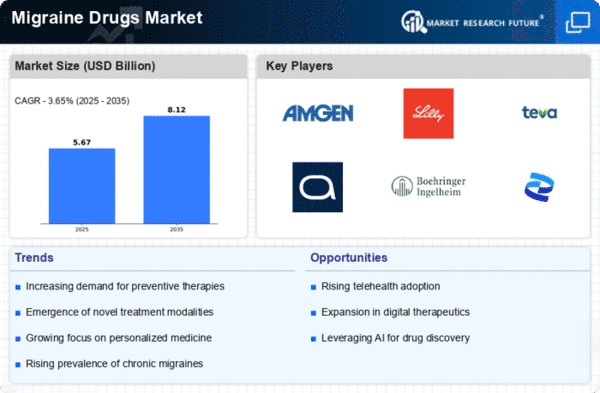
As per MRFR analysis, the Migraine Drugs Market Size was estimated at 5.47 USD Billion in 2024. The Migraine Drugs industry is projected to grow from 5.67 USD Billion in 2025 to 8.12 USD Billion by 2035, exhibiting a compound annual growth rate (CAGR) of 3.65% during the forecast period 2025 - 2035.

Key Market Trends & Highlights

The Migraine Drugs Market is experiencing dynamic growth driven by innovative treatment options and increasing patient awareness.

  • The emergence of biologics is reshaping treatment paradigms in the migraine drugs market.
  • North America remains the largest market, while Asia-Pacific is recognized as the fastest-growing region.
  • CGRP inhibitors are the fastest-growing segment, contrasting with triptans, which hold the largest market share.
  • Rising prevalence of migraine disorders and advancements in drug development are key drivers propelling market expansion.

Market Size & Forecast

2024 Market Size 5.47 (USD Billion)
2035 Market Size 8.12 (USD Billion)
CAGR (2025 - 2035) 3.65%
Largest Regional Market Share in 2024 North America

Major Players

Amgen (US), Eli Lilly (US), Teva Pharmaceutical Industries (IL), AbbVie (US), Boehringer Ingelheim (DE), Pfizer (US), AstraZeneca (GB), Novartis (CH), GlaxoSmithKline (GB)

Market Trends

The Migraine Drugs Market is currently experiencing a dynamic evolution, driven by a combination of innovative therapeutic approaches and an increasing understanding of migraine pathophysiology. Recent advancements in drug development, particularly in the realm of biologics and neuromodulators, appear to be reshaping treatment paradigms. This shift is likely influenced by a growing recognition of the diverse nature of migraine disorders, which necessitates tailored treatment strategies. Furthermore, the rising prevalence of migraines globally suggests a pressing need for effective management solutions, prompting pharmaceutical companies to invest heavily in research and development. In addition to novel drug formulations, the Migraine Drugs Market is also witnessing a surge in digital health solutions aimed at improving patient outcomes. Telemedicine and mobile health applications are becoming integral components of migraine management, providing patients with tools to track symptoms and treatment efficacy. This integration of technology into healthcare may enhance patient engagement and adherence to prescribed therapies. As the market continues to evolve, stakeholders must remain vigilant to emerging trends and adapt strategies accordingly to meet the needs of a diverse patient population.

Emergence of Biologics

The introduction of biologic therapies represents a transformative trend within the Migraine Drugs Market. These medications, which target specific pathways involved in migraine pathophysiology, offer new hope for patients who have not responded to traditional treatments. Their mechanism of action may provide more effective relief, potentially changing the landscape of migraine management.

Integration of Digital Health Solutions

The incorporation of digital health technologies into migraine management is gaining traction. Mobile applications and telehealth services are being utilized to facilitate better patient monitoring and communication with healthcare providers. This trend may enhance treatment adherence and empower patients to take a more active role in managing their condition.

Focus on Personalized Medicine

There is a growing emphasis on personalized medicine within the Migraine Drugs Market. This approach tailors treatment plans based on individual patient characteristics, including genetic factors and specific migraine triggers. Such customization could lead to improved therapeutic outcomes and a more efficient allocation of healthcare resources.

Migraine Drugs Market Market Drivers

Rising Prevalence of Migraine

The increasing prevalence of migraine disorders globally is a primary driver for the Global Migraine Drugs Market Industry. Current estimates suggest that approximately 1 billion individuals worldwide suffer from migraines, with a notable percentage experiencing chronic forms. This growing patient population necessitates effective treatment options, thereby propelling market growth. The Global Migraine Drugs Market Industry is projected to reach 5.64 USD Billion in 2024, reflecting the urgent demand for innovative therapies. As awareness of migraine conditions rises, healthcare providers are more likely to prescribe specialized medications, further stimulating market expansion.

Market Segment Insights

By Drug Type: CGRP Inhibitors (Largest) vs. Triptans (Fastest-Growing)

<p>In the Migraine Drugs Market, the distribution of market share among various drug types reveals a dynamic landscape. CGRP Inhibitors dominate the market, reflecting a significant portion due to their advanced mechanism of action and effectiveness in treating acute and preventive migraine attacks. Following CGRP Inhibitors, Triptans remain a well-utilized option for many patients, while Ergots and Non-Steroidal Anti-Inflammatory Drugs hold smaller shares as traditional alternatives. Opioids represent a niche segment due to safety concerns associated with their use in migraine treatment, thus limiting their market share.</p>

<p>CGRP Inhibitors (Dominant) vs. Triptans (Emerging)</p>

<p>CGRP Inhibitors, recognized as dominant players in the migraine drugs segment, leverage cutting-edge technology for targeted action against migraine pathophysiology. They offer a favorable safety profile with fewer side effects compared to older drug classes. Triptans, although historically dominant, are now emerging in a competitive landscape driven by the demand for innovative treatments. Their ease of use and rapid onset of action ensure patient adherence, although they face challenges from newer therapies like CGRP Inhibitors. As research and development continue, Triptans are adapting to address gaps in efficacy and tolerability, keeping them relevant within the evolving migraine treatment paradigm.</p>

By Administration Route: Oral (Largest) vs. Injectable (Fastest-Growing)

<p>In the Migraine Drugs Market, the Administration Route segment showcases a diverse array of options, including Oral, Injectable, Nasal, Transdermal, and Intravenous therapies. The Oral administration route currently holds the largest market share, favored by patients for its ease of use and convenience. In contrast, the Injectable route has emerged as the fastest-growing segment, driven by advancements in drug formulation and delivery systems, appealing to those seeking quick relief from migraine attacks.</p>

<p>Administration Route: Oral (Dominant) vs. Injectable (Emerging)</p>

<p>Within the Migraine Drugs Market, Oral administration remains the dominant choice among patients due to its straightforward usage and long-standing acceptance. Oral medications are widely prescribed, offering a variety of formulations and active ingredients that cater to different patient needs. On the other hand, the Injectable route is rapidly emerging as a preferred option, particularly for acute migraine management. This segment benefits from innovations in delivery methods, which allow for faster onset of action and increased efficacy in treating debilitating migraine attacks. As research progresses, the Injectable segment is likely to capture a larger share of the market as more effective products are developed.</p>

By Patient Demographics: Adults (Largest) vs. Pediatric (Fastest-Growing)

In the Migraine Drugs Market, the patient demographic segment showcases a significant share distribution, with adults comprising the largest portion. This demographic remains the primary consumer due to the higher prevalence of migraines among adults compared to other groups. Pediatric patients, on the other hand, are emerging as a rapidly growing segment as awareness and diagnosis of migraines in children increase, prompting the development of targeted treatments. Growth in this market segment is primarily driven by increased understanding of migraine triggers and symptoms across all age groups. Innovations in treatment options, particularly for pediatric patients, are significantly enhancing the market's appeal. Furthermore, social movements advocating for better pain management in children and the aging population may contribute to the rising demand for specialized migraine drugs tailored to these demographics.

Adults (Dominant) vs. Pediatric (Emerging)

The adult demographic represents a dominant force in the Migraine Drugs Market because of the higher incidence of migraines, which leads to greater treatment necessity. Many adults are likely to seek therapeutic options due to debilitating pain, thus propelling the growth of this segment. In contrast, the pediatric segment is emerging as a critical market as more child-specific treatments are introduced, alongside increased awareness of migraine occurrences in younger populations. The availability of tailored therapies is vital as it addresses unique physiological and developmental considerations in children. This dual-focus on both dominant and emerging demographics ensures a balanced approach to market strategies and product offerings.

By Therapeutic Use: Preventive Treatment (Largest) vs. Acute Treatment (Fastest-Growing)

<p>In the Migraine Drugs Market, the therapeutic use segment is significantly shaped by both preventive and acute treatment options. Preventive treatment holds a substantial market share, catering to patients seeking long-term management strategies. Acute treatment, on the other hand, is rapidly gaining attention due to its essential role in providing immediate relief during migraine attacks, thereby reflecting a dynamic shift in patient preferences. The market for migraine drugs is experiencing notable growth, driven by increasing awareness of migraine management and advancements in drug formulations. The demand for acute treatments is spurred by a growing emphasis on lifestyle-related health issues, leading to a rise in migraine incidents. Additionally, emerging combination therapies are expected to reshape the treatment landscape, addressing complex migraine cases and enhancing efficacy.</p>

<p>Preventive Treatment (Dominant) vs. Acute Treatment (Emerging)</p>

<p>Preventive treatment for migraines has emerged as the dominant approach in managing chronic migraine conditions. It includes therapies aimed at reducing the frequency and severity of migraine attacks over time. Typically utilized by patients with frequent migraines, these treatments leverage a range of pharmacological options tailored for long-term use. In contrast, acute treatment serves as an emerging market segment that focuses on providing immediate relief during migraine episodes. With innovative formulations and rapid-acting drugs, acute treatments are becoming increasingly popular among patients seeking quick intervention. This dual focus on preventive and acute therapies highlights the evolving strategies in the migraine drugs market, aiming to offer more personalized and effective solutions for sufferers.</p>

Get more detailed insights about Migraine Drugs Market Research Report - Forecast till 2035

Regional Insights

North America : Market Leader in Innovation

North America continues to lead the migraine drugs market, holding a significant share of 2.74 billion in 2024. The region's growth is driven by increasing awareness of migraine disorders, advancements in drug formulations, and supportive healthcare policies. Regulatory bodies are actively promoting innovative treatments, which further fuels market demand. The rising prevalence of migraines among the population is also a key factor contributing to this growth. The competitive landscape in North America is robust, featuring major players like Amgen, Eli Lilly, and AbbVie. These companies are investing heavily in research and development to introduce new therapies. The U.S. market, in particular, is characterized by a high adoption rate of novel migraine treatments, including CGRP inhibitors. This competitive environment is expected to enhance treatment options and improve patient outcomes, solidifying North America's position as a market leader.

Europe : Emerging Market with Growth Potential

Europe's migraine drugs market is valued at 1.54 billion, reflecting a growing demand for effective treatments. The region benefits from a well-established healthcare system and increasing investments in healthcare infrastructure. Regulatory frameworks are evolving to facilitate faster approvals for innovative migraine therapies, which is expected to drive market growth. Additionally, the rising incidence of migraines in Europe is prompting healthcare providers to seek more effective solutions for patients. Leading countries in this region include Germany, France, and the UK, where key players like Boehringer Ingelheim and Novartis are actively engaged. The competitive landscape is marked by collaborations between pharmaceutical companies and healthcare providers to enhance treatment accessibility. As the market evolves, the focus on personalized medicine and patient-centric approaches is likely to shape the future of migraine treatment in Europe.

Asia-Pacific : Rapidly Growing Market Segment

The Asia-Pacific migraine drugs market is valued at 1.1 billion, showcasing significant growth potential. Factors such as rising healthcare expenditure, increasing awareness of migraine disorders, and a growing population are driving demand for effective treatments. Regulatory bodies in the region are also working to streamline approval processes for new drugs, which is expected to enhance market accessibility. The increasing prevalence of migraines in urban areas is further fueling this demand. Countries like Japan, China, and India are leading the market, with key players such as Teva Pharmaceutical and Pfizer making substantial investments. The competitive landscape is characterized by a mix of local and international companies striving to capture market share. As the region continues to develop, the focus on innovative therapies and improved patient access will be crucial for sustained growth in the migraine drugs market.

Middle East and Africa : Emerging Market with Challenges

The Middle East and Africa migraine drugs market is valued at 0.09 billion, indicating significant challenges in access to effective treatments. Factors such as limited healthcare infrastructure, economic constraints, and varying levels of awareness about migraine disorders contribute to this market's slow growth. However, there is a growing recognition of the need for better migraine management, which may drive future demand. Regulatory bodies are beginning to address these challenges by promoting awareness and improving healthcare access. Countries like South Africa and the UAE are at the forefront of market development, with local and international players exploring opportunities. The competitive landscape is still developing, with a focus on increasing availability of existing treatments. As awareness and healthcare access improve, the market is expected to gradually expand, offering new opportunities for growth in the coming years.

Key Players and Competitive Insights

The Migraine Drugs Market is characterized by a dynamic competitive landscape, driven by increasing prevalence rates of migraine disorders and a growing demand for effective treatment options. Key players such as Amgen (US), Eli Lilly (US), and AbbVie (US) are strategically positioned to leverage innovation and expand their product portfolios. Amgen (US) focuses on developing novel therapies, while Eli Lilly (US) emphasizes partnerships to enhance its market reach. AbbVie (US) is actively pursuing mergers and acquisitions to bolster its pipeline, collectively shaping a competitive environment that prioritizes advanced therapeutic solutions.In terms of business tactics, companies are increasingly localizing manufacturing and optimizing supply chains to enhance efficiency and responsiveness to market demands. The competitive structure of the Migraine Drugs Market appears moderately fragmented, with several key players exerting influence. This fragmentation allows for diverse treatment options, yet the collective strength of major companies drives innovation and market growth.

In November Amgen (US) announced the launch of a new migraine treatment that utilizes a unique mechanism of action, potentially offering patients a novel option for relief. This strategic move underscores Amgen's commitment to innovation and positions the company to capture a larger market share amidst rising competition. The introduction of this treatment may also stimulate further research and development within the sector, encouraging other companies to enhance their offerings.

In October Eli Lilly (US) entered into a strategic partnership with a leading telehealth provider to facilitate remote consultations for migraine patients. This collaboration aims to improve patient access to care and streamline treatment pathways. By integrating digital health solutions, Eli Lilly (US) not only enhances its service delivery but also aligns with current trends towards telemedicine, potentially increasing patient adherence to treatment regimens.

In September AbbVie (US) completed the acquisition of a biotech firm specializing in migraine therapies, significantly expanding its research capabilities. This acquisition is likely to enhance AbbVie's pipeline and accelerate the development of innovative treatments. Such strategic actions reflect a broader trend of consolidation within the industry, as companies seek to bolster their competitive positions through enhanced research and development capabilities.

As of December current competitive trends in the Migraine Drugs Market include a pronounced focus on digitalization, sustainability, and the integration of artificial intelligence (AI) in drug development. Strategic alliances are increasingly shaping the landscape, enabling companies to pool resources and expertise. Looking ahead, competitive differentiation is expected to evolve, with a shift from price-based competition towards innovation, technological advancements, and supply chain reliability. This transition may redefine market dynamics, emphasizing the importance of delivering superior therapeutic solutions.

Key Companies in the Migraine Drugs Market include

Industry Developments

At a late-stage head-to-head trial against topiramate, Qulipta, AbbVie's oral CGRP receptor antagonist for migraine prevention, demonstrated a 12.1% discontinuation rate due to side effects compared to 29.6% for topiramate, and a significantly higher proportion of patients (64.1% vs. 39.3%) achieving at least a 50% reduction in monthly migraine days.AbbVie announced this information on June 18, 2025. Axsome Therapeutics announced on June 10, 2025, that SYMBRAVO (meloxicam + rizatriptan) will be commercially available in the United States for the treatment of acute migraines.

This multi-mechanistic therapeutic alternative offers immediate onset pain relief and facilitates patient access through its "On My Side" services. Brekiya, a pre-filled, room temperature-stable auto-injector for the treatment of acute migraines, was approved by the FDA on May 15, 2025, and is anticipated to be available in the United States by the second half of 2025.

The FDA approved Teva's sBLA for AJOVY (fremanezumab) on April 7, 2025, for the prevention of pediatric episodic migraines in children aged 6 to 17. If authorized, this would be the first CGRP antagonist for this age group. Furthermore, Health Canada approved Scilex's ELYXYB (celecoxib oral solution) on April 15, 2025, as a therapy for acute migraines.It provides quick-onset relief and may have less gastrointestinal adverse effects than other NSAIDs. With a considerable growth into pediatric and patient-centric delivery formats, these advancements demonstrate the fast innovation in migraine care spanning preventative and acute treatment.

Future Outlook

Migraine Drugs Market Future Outlook

The Migraine Drugs Market is projected to grow at a 3.65% CAGR from 2025 to 2035, driven by increasing prevalence, innovative therapies, and enhanced patient awareness.

New opportunities lie in:

  • Development of personalized migraine treatment plans
  • Expansion of telehealth services for migraine management
  • Investment in AI-driven drug discovery platforms

By 2035, the Migraine Drugs Market is expected to achieve substantial growth and innovation.

Market Segmentation

Migraine Drugs Market Drug Type Outlook

  • Triptans
  • Ergots
  • Anti-inflammatory Drugs
  • CGRP Inhibitors
  • Opioids

Migraine Drugs Market Therapeutic Area Outlook

  • Acute Treatment
  • Preventive Treatment
  • Chronic Migraine
  • Episodic Migraine
  • Medication Overuse

Migraine Drugs Market Patient Demographics Outlook

  • Adults
  • Pediatric
  • Geriatric
  • Pregnant Women
  • Gender-specific

Migraine Drugs Market Route of Administration Outlook

  • Oral
  • Injectable
  • Nasal
  • Transdermal
  • Intravenous

Report Scope

MARKET SIZE 2024 5.47(USD Billion)
MARKET SIZE 2025 5.67(USD Billion)
MARKET SIZE 2035 8.12(USD Billion)
COMPOUND ANNUAL GROWTH RATE (CAGR) 3.65% (2025 - 2035)
REPORT COVERAGE Revenue Forecast, Competitive Landscape, Growth Factors, and Trends
BASE YEAR 2024
Market Forecast Period 2025 - 2035
Historical Data 2019 - 2024
Market Forecast Units USD Billion
Key Companies Profiled Amgen (US), Eli Lilly (US), Teva Pharmaceutical Industries (IL), AbbVie (US), Boehringer Ingelheim (DE), Pfizer (US), AstraZeneca (GB), Novartis (CH), GlaxoSmithKline (GB)
Segments Covered Drug Type, Route of Administration, Patient Demographics, Therapeutic Area
Key Market Opportunities Emergence of novel therapies targeting specific migraine pathways enhances treatment options in the Migraine Drugs Market.
Key Market Dynamics Rising demand for innovative migraine therapies drives competition and influences regulatory frameworks in the migraine drugs market.
Countries Covered North America, Europe, APAC, South America, MEA

FAQs

What is the current valuation of the Migraine Drugs Market as of 2024?

<p>The Migraine Drugs Market was valued at 5.47 USD Billion in 2024.</p>

What is the projected market valuation for the Migraine Drugs Market in 2035?

<p>The market is projected to reach 8.12 USD Billion by 2035.</p>

What is the expected CAGR for the Migraine Drugs Market during the forecast period 2025 - 2035?

<p>The expected CAGR for the Migraine Drugs Market during 2025 - 2035 is 3.65%.</p>

Which drug types are leading in the Migraine Drugs Market?

<p>Triptans and CGRP Inhibitors are among the leading drug types, with valuations of 2.2 USD Billion and 2.0 USD Billion respectively in 2025.</p>

How does the market segment by administration route appear in 2025?

<p>In 2025, the Oral administration route is projected to lead with a valuation of 2.4 USD Billion.</p>

What demographic segments are being targeted in the Migraine Drugs Market?

<p>The market targets various demographics, with Adults expected to account for 3.5 USD Billion in 2025.</p>

What therapeutic uses are prevalent in the Migraine Drugs Market?

<p>Acute Treatment and Preventive Treatment are significant, with projected valuations of 2.36 USD Billion and 2.54 USD Billion respectively in 2025.</p>

Who are the key players in the Migraine Drugs Market?

<p>Key players include Amgen, Eli Lilly, Teva Pharmaceutical Industries, and AbbVie, among others.</p>

What is the projected growth for the Ergots segment by 2035?

<p>The Ergots segment is expected to grow to 1.1 USD Billion by 2035.</p>

How does the market for Pediatric migraine drugs appear in 2025?

<p>The Pediatric segment is projected to reach 0.8 USD Billion in 2025.</p>

  1. SECTION I: EXECUTIVE SUMMARY AND KEY HIGHLIGHTS
    1. | 1.1 EXECUTIVE SUMMARY
    2. | | 1.1.1 Market Overview
    3. | | 1.1.2 Key Findings
    4. | | 1.1.3 Market Segmentation
    5. | | 1.1.4 Competitive Landscape
    6. | | 1.1.5 Challenges and Opportunities
    7. | | 1.1.6 Future Outlook
  2. SECTION II: SCOPING, METHODOLOGY AND MARKET STRUCTURE
    1. | 2.1 MARKET INTRODUCTION
    2. | | 2.1.1 Definition
    3. | | 2.1.2 Scope of the study
    4. | | | 2.1.2.1 Research Objective
    5. | | | 2.1.2.2 Assumption
    6. | | | 2.1.2.3 Limitations
    7. | 2.2 RESEARCH METHODOLOGY
    8. | | 2.2.1 Overview
    9. | | 2.2.2 Data Mining
    10. | | 2.2.3 Secondary Research
    11. | | 2.2.4 Primary Research
    12. | | | 2.2.4.1 Primary Interviews and Information Gathering Process
    13. | | | 2.2.4.2 Breakdown of Primary Respondents
    14. | | 2.2.5 Forecasting Model
    15. | | 2.2.6 Market Size Estimation
    16. | | | 2.2.6.1 Bottom-Up Approach
    17. | | | 2.2.6.2 Top-Down Approach
    18. | | 2.2.7 Data Triangulation
    19. | | 2.2.8 Validation
  3. SECTION III: QUALITATIVE ANALYSIS
    1. | 3.1 MARKET DYNAMICS
    2. | | 3.1.1 Overview
    3. | | 3.1.2 Drivers
    4. | | 3.1.3 Restraints
    5. | | 3.1.4 Opportunities
    6. | 3.2 MARKET FACTOR ANALYSIS
    7. | | 3.2.1 Value chain Analysis
    8. | | 3.2.2 Porter's Five Forces Analysis
    9. | | | 3.2.2.1 Bargaining Power of Suppliers
    10. | | | 3.2.2.2 Bargaining Power of Buyers
    11. | | | 3.2.2.3 Threat of New Entrants
    12. | | | 3.2.2.4 Threat of Substitutes
    13. | | | 3.2.2.5 Intensity of Rivalry
    14. | | 3.2.3 COVID-19 Impact Analysis
    15. | | | 3.2.3.1 Market Impact Analysis
    16. | | | 3.2.3.2 Regional Impact
    17. | | | 3.2.3.3 Opportunity and Threat Analysis
  4. SECTION IV: QUANTITATIVE ANALYSIS
    1. | 4.1 Healthcare, BY Drug Type (USD Billion)
    2. | | 4.1.1 Triptans
    3. | | 4.1.2 Ergots
    4. | | 4.1.3 CGRP Inhibitors
    5. | | 4.1.4 Non-Steroidal Anti-Inflammatory Drugs
    6. | | 4.1.5 Opioids
    7. | 4.2 Healthcare, BY Administration Route (USD Billion)
    8. | | 4.2.1 Oral
    9. | | 4.2.2 Injectable
    10. | | 4.2.3 Nasal
    11. | | 4.2.4 Transdermal
    12. | | 4.2.5 Intravenous
    13. | 4.3 Healthcare, BY Patient Demographics (USD Billion)
    14. | | 4.3.1 Adults
    15. | | 4.3.2 Pediatric
    16. | | 4.3.3 Geriatric
    17. | | 4.3.4 Gender Specific
    18. | | 4.3.5 Pregnant Women
    19. | 4.4 Healthcare, BY Therapeutic Use (USD Billion)
    20. | | 4.4.1 Acute Treatment
    21. | | 4.4.2 Preventive Treatment
    22. | | 4.4.3 Combination Therapy
    23. | | 4.4.4 Rescue Therapy
    24. | 4.5 Healthcare, BY Region (USD Billion)
    25. | | 4.5.1 North America
    26. | | | 4.5.1.1 US
    27. | | | 4.5.1.2 Canada
    28. | | 4.5.2 Europe
    29. | | | 4.5.2.1 Germany
    30. | | | 4.5.2.2 UK
    31. | | | 4.5.2.3 France
    32. | | | 4.5.2.4 Russia
    33. | | | 4.5.2.5 Italy
    34. | | | 4.5.2.6 Spain
    35. | | | 4.5.2.7 Rest of Europe
    36. | | 4.5.3 APAC
    37. | | | 4.5.3.1 China
    38. | | | 4.5.3.2 India
    39. | | | 4.5.3.3 Japan
    40. | | | 4.5.3.4 South Korea
    41. | | | 4.5.3.5 Malaysia
    42. | | | 4.5.3.6 Thailand
    43. | | | 4.5.3.7 Indonesia
    44. | | | 4.5.3.8 Rest of APAC
    45. | | 4.5.4 South America
    46. | | | 4.5.4.1 Brazil
    47. | | | 4.5.4.2 Mexico
    48. | | | 4.5.4.3 Argentina
    49. | | | 4.5.4.4 Rest of South America
    50. | | 4.5.5 MEA
    51. | | | 4.5.5.1 GCC Countries
    52. | | | 4.5.5.2 South Africa
    53. | | | 4.5.5.3 Rest of MEA
  5. SECTION V: COMPETITIVE ANALYSIS
    1. | 5.1 Competitive Landscape
    2. | | 5.1.1 Overview
    3. | | 5.1.2 Competitive Analysis
    4. | | 5.1.3 Market share Analysis
    5. | | 5.1.4 Major Growth Strategy in the Healthcare
    6. | | 5.1.5 Competitive Benchmarking
    7. | | 5.1.6 Leading Players in Terms of Number of Developments in the Healthcare
    8. | | 5.1.7 Key developments and growth strategies
    9. | | | 5.1.7.1 New Product Launch/Service Deployment
    10. | | | 5.1.7.2 Merger & Acquisitions
    11. | | | 5.1.7.3 Joint Ventures
    12. | | 5.1.8 Major Players Financial Matrix
    13. | | | 5.1.8.1 Sales and Operating Income
    14. | | | 5.1.8.2 Major Players R&D Expenditure. 2023
    15. | 5.2 Company Profiles
    16. | | 5.2.1 Amgen (US)
    17. | | | 5.2.1.1 Financial Overview
    18. | | | 5.2.1.2 Products Offered
    19. | | | 5.2.1.3 Key Developments
    20. | | | 5.2.1.4 SWOT Analysis
    21. | | | 5.2.1.5 Key Strategies
    22. | | 5.2.2 Eli Lilly (US)
    23. | | | 5.2.2.1 Financial Overview
    24. | | | 5.2.2.2 Products Offered
    25. | | | 5.2.2.3 Key Developments
    26. | | | 5.2.2.4 SWOT Analysis
    27. | | | 5.2.2.5 Key Strategies
    28. | | 5.2.3 Teva Pharmaceutical Industries (IL)
    29. | | | 5.2.3.1 Financial Overview
    30. | | | 5.2.3.2 Products Offered
    31. | | | 5.2.3.3 Key Developments
    32. | | | 5.2.3.4 SWOT Analysis
    33. | | | 5.2.3.5 Key Strategies
    34. | | 5.2.4 AbbVie (US)
    35. | | | 5.2.4.1 Financial Overview
    36. | | | 5.2.4.2 Products Offered
    37. | | | 5.2.4.3 Key Developments
    38. | | | 5.2.4.4 SWOT Analysis
    39. | | | 5.2.4.5 Key Strategies
    40. | | 5.2.5 Pfizer (US)
    41. | | | 5.2.5.1 Financial Overview
    42. | | | 5.2.5.2 Products Offered
    43. | | | 5.2.5.3 Key Developments
    44. | | | 5.2.5.4 SWOT Analysis
    45. | | | 5.2.5.5 Key Strategies
    46. | | 5.2.6 Boehringer Ingelheim (DE)
    47. | | | 5.2.6.1 Financial Overview
    48. | | | 5.2.6.2 Products Offered
    49. | | | 5.2.6.3 Key Developments
    50. | | | 5.2.6.4 SWOT Analysis
    51. | | | 5.2.6.5 Key Strategies
    52. | | 5.2.7 Alder BioPharmaceuticals (US)
    53. | | | 5.2.7.1 Financial Overview
    54. | | | 5.2.7.2 Products Offered
    55. | | | 5.2.7.3 Key Developments
    56. | | | 5.2.7.4 SWOT Analysis
    57. | | | 5.2.7.5 Key Strategies
    58. | | 5.2.8 Zogenix (US)
    59. | | | 5.2.8.1 Financial Overview
    60. | | | 5.2.8.2 Products Offered
    61. | | | 5.2.8.3 Key Developments
    62. | | | 5.2.8.4 SWOT Analysis
    63. | | | 5.2.8.5 Key Strategies
    64. | | 5.2.9 Novartis (CH)
    65. | | | 5.2.9.1 Financial Overview
    66. | | | 5.2.9.2 Products Offered
    67. | | | 5.2.9.3 Key Developments
    68. | | | 5.2.9.4 SWOT Analysis
    69. | | | 5.2.9.5 Key Strategies
    70. | 5.3 Appendix
    71. | | 5.3.1 References
    72. | | 5.3.2 Related Reports
  6. LIST OF FIGURES
    1. | 6.1 MARKET SYNOPSIS
    2. | 6.2 NORTH AMERICA MARKET ANALYSIS
    3. | 6.3 US MARKET ANALYSIS BY DRUG TYPE
    4. | 6.4 US MARKET ANALYSIS BY ADMINISTRATION ROUTE
    5. | 6.5 US MARKET ANALYSIS BY PATIENT DEMOGRAPHICS
    6. | 6.6 US MARKET ANALYSIS BY THERAPEUTIC USE
    7. | 6.7 CANADA MARKET ANALYSIS BY DRUG TYPE
    8. | 6.8 CANADA MARKET ANALYSIS BY ADMINISTRATION ROUTE
    9. | 6.9 CANADA MARKET ANALYSIS BY PATIENT DEMOGRAPHICS
    10. | 6.10 CANADA MARKET ANALYSIS BY THERAPEUTIC USE
    11. | 6.11 EUROPE MARKET ANALYSIS
    12. | 6.12 GERMANY MARKET ANALYSIS BY DRUG TYPE
    13. | 6.13 GERMANY MARKET ANALYSIS BY ADMINISTRATION ROUTE
    14. | 6.14 GERMANY MARKET ANALYSIS BY PATIENT DEMOGRAPHICS
    15. | 6.15 GERMANY MARKET ANALYSIS BY THERAPEUTIC USE
    16. | 6.16 UK MARKET ANALYSIS BY DRUG TYPE
    17. | 6.17 UK MARKET ANALYSIS BY ADMINISTRATION ROUTE
    18. | 6.18 UK MARKET ANALYSIS BY PATIENT DEMOGRAPHICS
    19. | 6.19 UK MARKET ANALYSIS BY THERAPEUTIC USE
    20. | 6.20 FRANCE MARKET ANALYSIS BY DRUG TYPE
    21. | 6.21 FRANCE MARKET ANALYSIS BY ADMINISTRATION ROUTE
    22. | 6.22 FRANCE MARKET ANALYSIS BY PATIENT DEMOGRAPHICS
    23. | 6.23 FRANCE MARKET ANALYSIS BY THERAPEUTIC USE
    24. | 6.24 RUSSIA MARKET ANALYSIS BY DRUG TYPE
    25. | 6.25 RUSSIA MARKET ANALYSIS BY ADMINISTRATION ROUTE
    26. | 6.26 RUSSIA MARKET ANALYSIS BY PATIENT DEMOGRAPHICS
    27. | 6.27 RUSSIA MARKET ANALYSIS BY THERAPEUTIC USE
    28. | 6.28 ITALY MARKET ANALYSIS BY DRUG TYPE
    29. | 6.29 ITALY MARKET ANALYSIS BY ADMINISTRATION ROUTE
    30. | 6.30 ITALY MARKET ANALYSIS BY PATIENT DEMOGRAPHICS
    31. | 6.31 ITALY MARKET ANALYSIS BY THERAPEUTIC USE
    32. | 6.32 SPAIN MARKET ANALYSIS BY DRUG TYPE
    33. | 6.33 SPAIN MARKET ANALYSIS BY ADMINISTRATION ROUTE
    34. | 6.34 SPAIN MARKET ANALYSIS BY PATIENT DEMOGRAPHICS
    35. | 6.35 SPAIN MARKET ANALYSIS BY THERAPEUTIC USE
    36. | 6.36 REST OF EUROPE MARKET ANALYSIS BY DRUG TYPE
    37. | 6.37 REST OF EUROPE MARKET ANALYSIS BY ADMINISTRATION ROUTE
    38. | 6.38 REST OF EUROPE MARKET ANALYSIS BY PATIENT DEMOGRAPHICS
    39. | 6.39 REST OF EUROPE MARKET ANALYSIS BY THERAPEUTIC USE
    40. | 6.40 APAC MARKET ANALYSIS
    41. | 6.41 CHINA MARKET ANALYSIS BY DRUG TYPE
    42. | 6.42 CHINA MARKET ANALYSIS BY ADMINISTRATION ROUTE
    43. | 6.43 CHINA MARKET ANALYSIS BY PATIENT DEMOGRAPHICS
    44. | 6.44 CHINA MARKET ANALYSIS BY THERAPEUTIC USE
    45. | 6.45 INDIA MARKET ANALYSIS BY DRUG TYPE
    46. | 6.46 INDIA MARKET ANALYSIS BY ADMINISTRATION ROUTE
    47. | 6.47 INDIA MARKET ANALYSIS BY PATIENT DEMOGRAPHICS
    48. | 6.48 INDIA MARKET ANALYSIS BY THERAPEUTIC USE
    49. | 6.49 JAPAN MARKET ANALYSIS BY DRUG TYPE
    50. | 6.50 JAPAN MARKET ANALYSIS BY ADMINISTRATION ROUTE
    51. | 6.51 JAPAN MARKET ANALYSIS BY PATIENT DEMOGRAPHICS
    52. | 6.52 JAPAN MARKET ANALYSIS BY THERAPEUTIC USE
    53. | 6.53 SOUTH KOREA MARKET ANALYSIS BY DRUG TYPE
    54. | 6.54 SOUTH KOREA MARKET ANALYSIS BY ADMINISTRATION ROUTE
    55. | 6.55 SOUTH KOREA MARKET ANALYSIS BY PATIENT DEMOGRAPHICS
    56. | 6.56 SOUTH KOREA MARKET ANALYSIS BY THERAPEUTIC USE
    57. | 6.57 MALAYSIA MARKET ANALYSIS BY DRUG TYPE
    58. | 6.58 MALAYSIA MARKET ANALYSIS BY ADMINISTRATION ROUTE
    59. | 6.59 MALAYSIA MARKET ANALYSIS BY PATIENT DEMOGRAPHICS
    60. | 6.60 MALAYSIA MARKET ANALYSIS BY THERAPEUTIC USE
    61. | 6.61 THAILAND MARKET ANALYSIS BY DRUG TYPE
    62. | 6.62 THAILAND MARKET ANALYSIS BY ADMINISTRATION ROUTE
    63. | 6.63 THAILAND MARKET ANALYSIS BY PATIENT DEMOGRAPHICS
    64. | 6.64 THAILAND MARKET ANALYSIS BY THERAPEUTIC USE
    65. | 6.65 INDONESIA MARKET ANALYSIS BY DRUG TYPE
    66. | 6.66 INDONESIA MARKET ANALYSIS BY ADMINISTRATION ROUTE
    67. | 6.67 INDONESIA MARKET ANALYSIS BY PATIENT DEMOGRAPHICS
    68. | 6.68 INDONESIA MARKET ANALYSIS BY THERAPEUTIC USE
    69. | 6.69 REST OF APAC MARKET ANALYSIS BY DRUG TYPE
    70. | 6.70 REST OF APAC MARKET ANALYSIS BY ADMINISTRATION ROUTE
    71. | 6.71 REST OF APAC MARKET ANALYSIS BY PATIENT DEMOGRAPHICS
    72. | 6.72 REST OF APAC MARKET ANALYSIS BY THERAPEUTIC USE
    73. | 6.73 SOUTH AMERICA MARKET ANALYSIS
    74. | 6.74 BRAZIL MARKET ANALYSIS BY DRUG TYPE
    75. | 6.75 BRAZIL MARKET ANALYSIS BY ADMINISTRATION ROUTE
    76. | 6.76 BRAZIL MARKET ANALYSIS BY PATIENT DEMOGRAPHICS
    77. | 6.77 BRAZIL MARKET ANALYSIS BY THERAPEUTIC USE
    78. | 6.78 MEXICO MARKET ANALYSIS BY DRUG TYPE
    79. | 6.79 MEXICO MARKET ANALYSIS BY ADMINISTRATION ROUTE
    80. | 6.80 MEXICO MARKET ANALYSIS BY PATIENT DEMOGRAPHICS
    81. | 6.81 MEXICO MARKET ANALYSIS BY THERAPEUTIC USE
    82. | 6.82 ARGENTINA MARKET ANALYSIS BY DRUG TYPE
    83. | 6.83 ARGENTINA MARKET ANALYSIS BY ADMINISTRATION ROUTE
    84. | 6.84 ARGENTINA MARKET ANALYSIS BY PATIENT DEMOGRAPHICS
    85. | 6.85 ARGENTINA MARKET ANALYSIS BY THERAPEUTIC USE
    86. | 6.86 REST OF SOUTH AMERICA MARKET ANALYSIS BY DRUG TYPE
    87. | 6.87 REST OF SOUTH AMERICA MARKET ANALYSIS BY ADMINISTRATION ROUTE
    88. | 6.88 REST OF SOUTH AMERICA MARKET ANALYSIS BY PATIENT DEMOGRAPHICS
    89. | 6.89 REST OF SOUTH AMERICA MARKET ANALYSIS BY THERAPEUTIC USE
    90. | 6.90 MEA MARKET ANALYSIS
    91. | 6.91 GCC COUNTRIES MARKET ANALYSIS BY DRUG TYPE
    92. | 6.92 GCC COUNTRIES MARKET ANALYSIS BY ADMINISTRATION ROUTE
    93. | 6.93 GCC COUNTRIES MARKET ANALYSIS BY PATIENT DEMOGRAPHICS
    94. | 6.94 GCC COUNTRIES MARKET ANALYSIS BY THERAPEUTIC USE
    95. | 6.95 SOUTH AFRICA MARKET ANALYSIS BY DRUG TYPE
    96. | 6.96 SOUTH AFRICA MARKET ANALYSIS BY ADMINISTRATION ROUTE
    97. | 6.97 SOUTH AFRICA MARKET ANALYSIS BY PATIENT DEMOGRAPHICS
    98. | 6.98 SOUTH AFRICA MARKET ANALYSIS BY THERAPEUTIC USE
    99. | 6.99 REST OF MEA MARKET ANALYSIS BY DRUG TYPE
    100. | 6.100 REST OF MEA MARKET ANALYSIS BY ADMINISTRATION ROUTE
    101. | 6.101 REST OF MEA MARKET ANALYSIS BY PATIENT DEMOGRAPHICS
    102. | 6.102 REST OF MEA MARKET ANALYSIS BY THERAPEUTIC USE
    103. | 6.103 KEY BUYING CRITERIA OF HEALTHCARE
    104. | 6.104 RESEARCH PROCESS OF MRFR
    105. | 6.105 DRO ANALYSIS OF HEALTHCARE
    106. | 6.106 DRIVERS IMPACT ANALYSIS: HEALTHCARE
    107. | 6.107 RESTRAINTS IMPACT ANALYSIS: HEALTHCARE
    108. | 6.108 SUPPLY / VALUE CHAIN: HEALTHCARE
    109. | 6.109 HEALTHCARE, BY DRUG TYPE, 2024 (% SHARE)
    110. | 6.110 HEALTHCARE, BY DRUG TYPE, 2024 TO 2035 (USD Billion)
    111. | 6.111 HEALTHCARE, BY ADMINISTRATION ROUTE, 2024 (% SHARE)
    112. | 6.112 HEALTHCARE, BY ADMINISTRATION ROUTE, 2024 TO 2035 (USD Billion)
    113. | 6.113 HEALTHCARE, BY PATIENT DEMOGRAPHICS, 2024 (% SHARE)
    114. | 6.114 HEALTHCARE, BY PATIENT DEMOGRAPHICS, 2024 TO 2035 (USD Billion)
    115. | 6.115 HEALTHCARE, BY THERAPEUTIC USE, 2024 (% SHARE)
    116. | 6.116 HEALTHCARE, BY THERAPEUTIC USE, 2024 TO 2035 (USD Billion)
    117. | 6.117 BENCHMARKING OF MAJOR COMPETITORS
  7. LIST OF TABLES
    1. | 7.1 LIST OF ASSUMPTIONS
    2. | | 7.1.1
    3. | 7.2 North America MARKET SIZE ESTIMATES; FORECAST
    4. | | 7.2.1 BY DRUG TYPE, 2025-2035 (USD Billion)
    5. | | 7.2.2 BY ADMINISTRATION ROUTE, 2025-2035 (USD Billion)
    6. | | 7.2.3 BY PATIENT DEMOGRAPHICS, 2025-2035 (USD Billion)
    7. | | 7.2.4 BY THERAPEUTIC USE, 2025-2035 (USD Billion)
    8. | 7.3 US MARKET SIZE ESTIMATES; FORECAST
    9. | | 7.3.1 BY DRUG TYPE, 2025-2035 (USD Billion)
    10. | | 7.3.2 BY ADMINISTRATION ROUTE, 2025-2035 (USD Billion)
    11. | | 7.3.3 BY PATIENT DEMOGRAPHICS, 2025-2035 (USD Billion)
    12. | | 7.3.4 BY THERAPEUTIC USE, 2025-2035 (USD Billion)
    13. | 7.4 Canada MARKET SIZE ESTIMATES; FORECAST
    14. | | 7.4.1 BY DRUG TYPE, 2025-2035 (USD Billion)
    15. | | 7.4.2 BY ADMINISTRATION ROUTE, 2025-2035 (USD Billion)
    16. | | 7.4.3 BY PATIENT DEMOGRAPHICS, 2025-2035 (USD Billion)
    17. | | 7.4.4 BY THERAPEUTIC USE, 2025-2035 (USD Billion)
    18. | 7.5 Europe MARKET SIZE ESTIMATES; FORECAST
    19. | | 7.5.1 BY DRUG TYPE, 2025-2035 (USD Billion)
    20. | | 7.5.2 BY ADMINISTRATION ROUTE, 2025-2035 (USD Billion)
    21. | | 7.5.3 BY PATIENT DEMOGRAPHICS, 2025-2035 (USD Billion)
    22. | | 7.5.4 BY THERAPEUTIC USE, 2025-2035 (USD Billion)
    23. | 7.6 Germany MARKET SIZE ESTIMATES; FORECAST
    24. | | 7.6.1 BY DRUG TYPE, 2025-2035 (USD Billion)
    25. | | 7.6.2 BY ADMINISTRATION ROUTE, 2025-2035 (USD Billion)
    26. | | 7.6.3 BY PATIENT DEMOGRAPHICS, 2025-2035 (USD Billion)
    27. | | 7.6.4 BY THERAPEUTIC USE, 2025-2035 (USD Billion)
    28. | 7.7 UK MARKET SIZE ESTIMATES; FORECAST
    29. | | 7.7.1 BY DRUG TYPE, 2025-2035 (USD Billion)
    30. | | 7.7.2 BY ADMINISTRATION ROUTE, 2025-2035 (USD Billion)
    31. | | 7.7.3 BY PATIENT DEMOGRAPHICS, 2025-2035 (USD Billion)
    32. | | 7.7.4 BY THERAPEUTIC USE, 2025-2035 (USD Billion)
    33. | 7.8 France MARKET SIZE ESTIMATES; FORECAST
    34. | | 7.8.1 BY DRUG TYPE, 2025-2035 (USD Billion)
    35. | | 7.8.2 BY ADMINISTRATION ROUTE, 2025-2035 (USD Billion)
    36. | | 7.8.3 BY PATIENT DEMOGRAPHICS, 2025-2035 (USD Billion)
    37. | | 7.8.4 BY THERAPEUTIC USE, 2025-2035 (USD Billion)
    38. | 7.9 Russia MARKET SIZE ESTIMATES; FORECAST
    39. | | 7.9.1 BY DRUG TYPE, 2025-2035 (USD Billion)
    40. | | 7.9.2 BY ADMINISTRATION ROUTE, 2025-2035 (USD Billion)
    41. | | 7.9.3 BY PATIENT DEMOGRAPHICS, 2025-2035 (USD Billion)
    42. | | 7.9.4 BY THERAPEUTIC USE, 2025-2035 (USD Billion)
    43. | 7.10 Italy MARKET SIZE ESTIMATES; FORECAST
    44. | | 7.10.1 BY DRUG TYPE, 2025-2035 (USD Billion)
    45. | | 7.10.2 BY ADMINISTRATION ROUTE, 2025-2035 (USD Billion)
    46. | | 7.10.3 BY PATIENT DEMOGRAPHICS, 2025-2035 (USD Billion)
    47. | | 7.10.4 BY THERAPEUTIC USE, 2025-2035 (USD Billion)
    48. | 7.11 Spain MARKET SIZE ESTIMATES; FORECAST
    49. | | 7.11.1 BY DRUG TYPE, 2025-2035 (USD Billion)
    50. | | 7.11.2 BY ADMINISTRATION ROUTE, 2025-2035 (USD Billion)
    51. | | 7.11.3 BY PATIENT DEMOGRAPHICS, 2025-2035 (USD Billion)
    52. | | 7.11.4 BY THERAPEUTIC USE, 2025-2035 (USD Billion)
    53. | 7.12 Rest of Europe MARKET SIZE ESTIMATES; FORECAST
    54. | | 7.12.1 BY DRUG TYPE, 2025-2035 (USD Billion)
    55. | | 7.12.2 BY ADMINISTRATION ROUTE, 2025-2035 (USD Billion)
    56. | | 7.12.3 BY PATIENT DEMOGRAPHICS, 2025-2035 (USD Billion)
    57. | | 7.12.4 BY THERAPEUTIC USE, 2025-2035 (USD Billion)
    58. | 7.13 APAC MARKET SIZE ESTIMATES; FORECAST
    59. | | 7.13.1 BY DRUG TYPE, 2025-2035 (USD Billion)
    60. | | 7.13.2 BY ADMINISTRATION ROUTE, 2025-2035 (USD Billion)
    61. | | 7.13.3 BY PATIENT DEMOGRAPHICS, 2025-2035 (USD Billion)
    62. | | 7.13.4 BY THERAPEUTIC USE, 2025-2035 (USD Billion)
    63. | 7.14 China MARKET SIZE ESTIMATES; FORECAST
    64. | | 7.14.1 BY DRUG TYPE, 2025-2035 (USD Billion)
    65. | | 7.14.2 BY ADMINISTRATION ROUTE, 2025-2035 (USD Billion)
    66. | | 7.14.3 BY PATIENT DEMOGRAPHICS, 2025-2035 (USD Billion)
    67. | | 7.14.4 BY THERAPEUTIC USE, 2025-2035 (USD Billion)
    68. | 7.15 India MARKET SIZE ESTIMATES; FORECAST
    69. | | 7.15.1 BY DRUG TYPE, 2025-2035 (USD Billion)
    70. | | 7.15.2 BY ADMINISTRATION ROUTE, 2025-2035 (USD Billion)
    71. | | 7.15.3 BY PATIENT DEMOGRAPHICS, 2025-2035 (USD Billion)
    72. | | 7.15.4 BY THERAPEUTIC USE, 2025-2035 (USD Billion)
    73. | 7.16 Japan MARKET SIZE ESTIMATES; FORECAST
    74. | | 7.16.1 BY DRUG TYPE, 2025-2035 (USD Billion)
    75. | | 7.16.2 BY ADMINISTRATION ROUTE, 2025-2035 (USD Billion)
    76. | | 7.16.3 BY PATIENT DEMOGRAPHICS, 2025-2035 (USD Billion)
    77. | | 7.16.4 BY THERAPEUTIC USE, 2025-2035 (USD Billion)
    78. | 7.17 South Korea MARKET SIZE ESTIMATES; FORECAST
    79. | | 7.17.1 BY DRUG TYPE, 2025-2035 (USD Billion)
    80. | | 7.17.2 BY ADMINISTRATION ROUTE, 2025-2035 (USD Billion)
    81. | | 7.17.3 BY PATIENT DEMOGRAPHICS, 2025-2035 (USD Billion)
    82. | | 7.17.4 BY THERAPEUTIC USE, 2025-2035 (USD Billion)
    83. | 7.18 Malaysia MARKET SIZE ESTIMATES; FORECAST
    84. | | 7.18.1 BY DRUG TYPE, 2025-2035 (USD Billion)
    85. | | 7.18.2 BY ADMINISTRATION ROUTE, 2025-2035 (USD Billion)
    86. | | 7.18.3 BY PATIENT DEMOGRAPHICS, 2025-2035 (USD Billion)
    87. | | 7.18.4 BY THERAPEUTIC USE, 2025-2035 (USD Billion)
    88. | 7.19 Thailand MARKET SIZE ESTIMATES; FORECAST
    89. | | 7.19.1 BY DRUG TYPE, 2025-2035 (USD Billion)
    90. | | 7.19.2 BY ADMINISTRATION ROUTE, 2025-2035 (USD Billion)
    91. | | 7.19.3 BY PATIENT DEMOGRAPHICS, 2025-2035 (USD Billion)
    92. | | 7.19.4 BY THERAPEUTIC USE, 2025-2035 (USD Billion)
    93. | 7.20 Indonesia MARKET SIZE ESTIMATES; FORECAST
    94. | | 7.20.1 BY DRUG TYPE, 2025-2035 (USD Billion)
    95. | | 7.20.2 BY ADMINISTRATION ROUTE, 2025-2035 (USD Billion)
    96. | | 7.20.3 BY PATIENT DEMOGRAPHICS, 2025-2035 (USD Billion)
    97. | | 7.20.4 BY THERAPEUTIC USE, 2025-2035 (USD Billion)
    98. | 7.21 Rest of APAC MARKET SIZE ESTIMATES; FORECAST
    99. | | 7.21.1 BY DRUG TYPE, 2025-2035 (USD Billion)
    100. | | 7.21.2 BY ADMINISTRATION ROUTE, 2025-2035 (USD Billion)
    101. | | 7.21.3 BY PATIENT DEMOGRAPHICS, 2025-2035 (USD Billion)
    102. | | 7.21.4 BY THERAPEUTIC USE, 2025-2035 (USD Billion)
    103. | 7.22 South America MARKET SIZE ESTIMATES; FORECAST
    104. | | 7.22.1 BY DRUG TYPE, 2025-2035 (USD Billion)
    105. | | 7.22.2 BY ADMINISTRATION ROUTE, 2025-2035 (USD Billion)
    106. | | 7.22.3 BY PATIENT DEMOGRAPHICS, 2025-2035 (USD Billion)
    107. | | 7.22.4 BY THERAPEUTIC USE, 2025-2035 (USD Billion)
    108. | 7.23 Brazil MARKET SIZE ESTIMATES; FORECAST
    109. | | 7.23.1 BY DRUG TYPE, 2025-2035 (USD Billion)
    110. | | 7.23.2 BY ADMINISTRATION ROUTE, 2025-2035 (USD Billion)
    111. | | 7.23.3 BY PATIENT DEMOGRAPHICS, 2025-2035 (USD Billion)
    112. | | 7.23.4 BY THERAPEUTIC USE, 2025-2035 (USD Billion)
    113. | 7.24 Mexico MARKET SIZE ESTIMATES; FORECAST
    114. | | 7.24.1 BY DRUG TYPE, 2025-2035 (USD Billion)
    115. | | 7.24.2 BY ADMINISTRATION ROUTE, 2025-2035 (USD Billion)
    116. | | 7.24.3 BY PATIENT DEMOGRAPHICS, 2025-2035 (USD Billion)
    117. | | 7.24.4 BY THERAPEUTIC USE, 2025-2035 (USD Billion)
    118. | 7.25 Argentina MARKET SIZE ESTIMATES; FORECAST
    119. | | 7.25.1 BY DRUG TYPE, 2025-2035 (USD Billion)
    120. | | 7.25.2 BY ADMINISTRATION ROUTE, 2025-2035 (USD Billion)
    121. | | 7.25.3 BY PATIENT DEMOGRAPHICS, 2025-2035 (USD Billion)
    122. | | 7.25.4 BY THERAPEUTIC USE, 2025-2035 (USD Billion)
    123. | 7.26 Rest of South America MARKET SIZE ESTIMATES; FORECAST
    124. | | 7.26.1 BY DRUG TYPE, 2025-2035 (USD Billion)
    125. | | 7.26.2 BY ADMINISTRATION ROUTE, 2025-2035 (USD Billion)
    126. | | 7.26.3 BY PATIENT DEMOGRAPHICS, 2025-2035 (USD Billion)
    127. | | 7.26.4 BY THERAPEUTIC USE, 2025-2035 (USD Billion)
    128. | 7.27 MEA MARKET SIZE ESTIMATES; FORECAST
    129. | | 7.27.1 BY DRUG TYPE, 2025-2035 (USD Billion)
    130. | | 7.27.2 BY ADMINISTRATION ROUTE, 2025-2035 (USD Billion)
    131. | | 7.27.3 BY PATIENT DEMOGRAPHICS, 2025-2035 (USD Billion)
    132. | | 7.27.4 BY THERAPEUTIC USE, 2025-2035 (USD Billion)
    133. | 7.28 GCC Countries MARKET SIZE ESTIMATES; FORECAST
    134. | | 7.28.1 BY DRUG TYPE, 2025-2035 (USD Billion)
    135. | | 7.28.2 BY ADMINISTRATION ROUTE, 2025-2035 (USD Billion)
    136. | | 7.28.3 BY PATIENT DEMOGRAPHICS, 2025-2035 (USD Billion)
    137. | | 7.28.4 BY THERAPEUTIC USE, 2025-2035 (USD Billion)
    138. | 7.29 South Africa MARKET SIZE ESTIMATES; FORECAST
    139. | | 7.29.1 BY DRUG TYPE, 2025-2035 (USD Billion)
    140. | | 7.29.2 BY ADMINISTRATION ROUTE, 2025-2035 (USD Billion)
    141. | | 7.29.3 BY PATIENT DEMOGRAPHICS, 2025-2035 (USD Billion)
    142. | | 7.29.4 BY THERAPEUTIC USE, 2025-2035 (USD Billion)
    143. | 7.30 Rest of MEA MARKET SIZE ESTIMATES; FORECAST
    144. | | 7.30.1 BY DRUG TYPE, 2025-2035 (USD Billion)
    145. | | 7.30.2 BY ADMINISTRATION ROUTE, 2025-2035 (USD Billion)
    146. | | 7.30.3 BY PATIENT DEMOGRAPHICS, 2025-2035 (USD Billion)
    147. | | 7.30.4 BY THERAPEUTIC USE, 2025-2035 (USD Billion)
    148. | 7.31 PRODUCT LAUNCH/PRODUCT DEVELOPMENT/APPROVAL
    149. | | 7.31.1
    150. | 7.32 ACQUISITION/PARTNERSHIP
    151. | | 7.32.1

Healthcare Market Segmentation

Healthcare By Drug Type (USD Billion, 2025-2035)

  • Triptans
  • Ergots
  • CGRP Inhibitors
  • Non-Steroidal Anti-Inflammatory Drugs
  • Opioids

Healthcare By Administration Route (USD Billion, 2025-2035)

  • Oral
  • Injectable
  • Nasal
  • Transdermal
  • Intravenous

Healthcare By Patient Demographics (USD Billion, 2025-2035)

  • Adults
  • Pediatric
  • Geriatric
  • Gender Specific
  • Pregnant Women

Healthcare By Therapeutic Use (USD Billion, 2025-2035)

  • Acute Treatment
  • Preventive Treatment
  • Combination Therapy
  • Rescue Therapy
Infographic

Free Sample Request

Kindly complete the form below to receive a free sample of this Report

Get Free Sample

Customer Strories

Compare Licence

×
Features License Type
Single User Multiuser License Enterprise User
Price $4,950 $5,950 $7,250
Maximum User Access Limit 1 User Upto 10 Users Unrestricted Access Throughout the Organization
Free Customization
Direct Access to Analyst
Deliverable Format
Platform Access
Discount on Next Purchase 10% 15% 15%
Printable Versions