
×
Request Free Sample ×

Kindly complete the form below to receive a free sample of this Report

* Please use a valid business email

Leading companies partner with us for data-driven Insights

clients tt-cursor
Hero Background
English
Chinese
French
Japanese
Korean
German
Spanish

Microcontroller Unit Market Size

ID: MRFR/SEM/7154-HCR
111 Pages
Shubham Munde
October 2025

Microcontroller Unit (MCU) Market Size, Share and Research Report By Class (4-Bit, 8-Bit, 16-Bit, 32-Bit), By Application (Consumer Electronics, Automotive, Industrial Manufacturing, Communication and IT, Others), And By Region (North America, Europe, Asia-Pacific, And Rest Of The World) – Industry Forecast Till 2035

Share:
Download PDF ×

We do not share your information with anyone. However, we may send you emails based on your report interest from time to time. You may contact us at any time to opt-out.

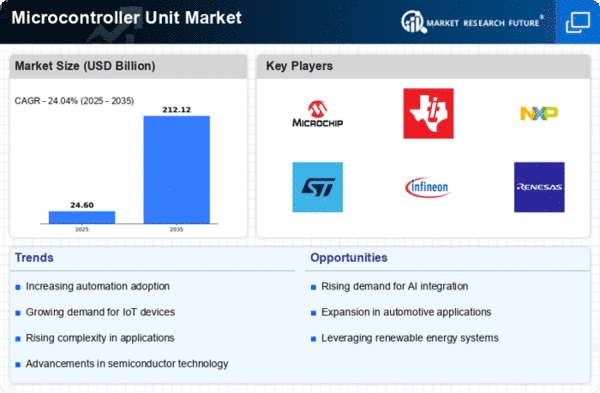
Microcontroller Unit Market Infographic
Purchase Options

Microcontroller Unit Size

Microcontroller Unit Market Growth Projections and Opportunities

One of the key reasons for the surge in the MCU market size is the rapid use of Internet of Things (IoT) devices. With the world becoming more and more networked, microcontrollers are increasingly being used for powering connected and smart devices, are in great demand. MCUs’ adaptability renders them useful in a variety of important applications, from smart household appliances to industrial sensors. This makes them extremely pertinent components of the burgeoning IoT ecosystem. The most important driver of the MCU market's expansion is now technological advancements. Technology for semiconductors continues to get better, which lets people make microcontrollers that are stronger and more useful. By using the newest technologies in their MCU designs, companies try to stay ahead of the competition and make it possible for devices to do more complicated tasks with less power. The automobile industry has a big effect on the market for MOCUs. The move toward electric autonomous driving, advanced driver-assistance systems (ADAS), and cars (EVs has led to an unprecedented requirement for cutting-edge microcontrollers. MCUs are paramount in the working of various components and parts in modern vehicles, they can be either engine control units or entertainment systems. The competitive environment in the MCU industry has a big impact on market dynamics. Big semiconductor firms are battling intensely for a larger share of the global market by using product differentiation, partnerships, cost-effectiveness, and other techniques. The market's competitive environment is constantly changing as a result of numerous acquisitions, agreements, partnerships, and mergers. When nimble startups and well-established industry titans coexist, reliability and innovation are balanced. This dynamic layer is now present. A key element influencing the MCU market is end-user demands and preferences. Consumer expectations along with their tastes as well as preferences are seeing a huge change, which can be seen in the rising popularity of miniaturization, energy efficiency coupled with connectivity. The demand for microcontrollers that are reliable, accurate, and boast high performance but in a small form is bolstered by products like smartphones, and smart home solutions as well as wearables.
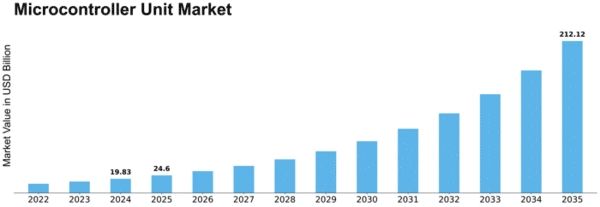
Microcontroller Unit Market Size Graph
Author
Shubham Munde
Research Analyst Level II

With a technical background in information technology & semiconductors, Shubham has 4.5+ years of experience in market research and analytics with the tasks of data mining, analysis, and project execution. He is the POC for our clients, for their consulting projects running under the ICT/Semiconductor domain. Shubham holds a Bachelor’s in Information and Technology and a Master of Business Administration (MBA). Shubham has executed over 150 research projects for our clients under the brand name Market Research Future in the last 2 years. His core skill is building the research respondent relation for gathering the primary information from industry and market estimation for niche markets. He is having expertise in conducting secondary & primary research, market estimations, market projections, competitive analysis, analysing current market trends and market dynamics, deep-dive analysis on market scenarios, consumer behaviour, technological impact analysis, consulting, analytics, etc. He has worked on fortune 500 companies' syndicate and consulting projects along with several government projects. He has worked on the projects of top tech brands such as IBM, Google, Microsoft, AWS, Meta, Oracle, Cisco Systems, Samsung, Accenture, VMware, Schneider Electric, Dell, HP, Ericsson, and so many others. He has worked on Metaverse, Web 3.0, Zero-Trust security, cyber-security, blockchain, quantum computing, robotics, 5G technology, High-Performance computing, data centers, AI, automation, IT equipment, sensors, semiconductors, consumer electronics and so many tech domain projects.

Leave a Comment

FAQs

How much is the Microcontroller Unit (MCU) market?

The Microcontroller Unit (MCU) market size was valued at USD 19.83 billion in 2024.

What is the growth rate of the Microcontroller Unit (MCU) market?

The market is projected to grow at a CAGR of 24.04% during the forecast period, 2025 to 2035.

Which region held the largest market share in the market of Microcontroller Units (MCU)?

North America had the largest share of the Smart Mirror market.

Who are the key players in the Smart Mirror market?

The key players in the market are NXP Semiconductor, Renesas Electronics Corporation, Microchip Technology, Infineon Technologies, Texas Instruments Inc, Cypress Semiconductor, Maxim Integrated, Toshiba Corporation, STMicroelectronics, Analog Devices Inc.

Which Class led the market of Microcontroller Units (MCU)?

The market is marked with the presence of a large number of IC, processor and electronic components manufacturers. There is a fierce competition between the established and the new vendors gain a better position in the market.

Which Application had the largest market share in the market?

Consumer Electronics had the largest share in the market for Microcontroller Units (MCU).

Market Summary

As per MRFR analysis, the Microcontroller Unit Market Size was estimated at 19.83 USD Billion in 2024. The Microcontroller Unit industry is projected to grow from 24.6 USD Billion in 2025 to 212.12 USD Billion by 2035, exhibiting a compound annual growth rate (CAGR) of 24.04 during the forecast period 2025 - 2035.

Key Market Trends & Highlights

The Microcontroller Unit Market is poised for substantial growth driven by technological advancements and increasing demand across various sectors.

  • The integration of artificial intelligence into microcontrollers is enhancing their functionality and application scope. North America remains the largest market, while the Asia-Pacific region is experiencing the fastest growth in microcontroller adoption. Consumer electronics dominate the market, yet the automotive segment is rapidly expanding due to advancements in vehicle technology. Key drivers include the rising demand for IoT devices and the growth in automotive electronics, which are shaping market dynamics.

Market Size & Forecast

2024 Market Size 19.83 (USD Billion)
2035 Market Size 212.12 (USD Billion)
CAGR (2025 - 2035) 24.04%
Largest Regional Market Share in 2024 Asia-Pacific

Major Players

Microchip Technology (US), Texas Instruments (US), NXP Semiconductors (NL), STMicroelectronics (FR), Infineon Technologies (DE), Renesas Electronics (JP), Analog Devices (US), Cypress Semiconductor (US), Silicon Labs (US)

Market Trends

The Microcontroller Unit Market is currently experiencing a dynamic evolution, driven by advancements in technology and increasing demand across various sectors. The proliferation of smart devices and the Internet of Things (IoT) has led to a surge in applications requiring efficient and compact microcontroller units. These components are integral to numerous devices, ranging from household appliances to industrial machinery, thereby enhancing functionality and performance. As industries continue to embrace automation and connectivity, the Microcontroller Unit Market is poised for substantial growth, reflecting the ongoing shift towards smarter solutions. Moreover, the emphasis on energy efficiency and sustainability is shaping the development of microcontroller units. Manufacturers are focusing on creating products that not only meet performance standards but also adhere to environmental regulations. This trend indicates a growing awareness of the need for eco-friendly technologies, which could influence consumer preferences and purchasing decisions. The Microcontroller Unit Market appears to be on a trajectory that aligns with global sustainability goals, suggesting that future innovations will likely prioritize both efficiency and environmental responsibility.

Integration with Artificial Intelligence

The integration of artificial intelligence into microcontroller units is becoming increasingly prevalent. This trend suggests that microcontrollers are evolving to support more complex tasks, enabling devices to learn and adapt to user behaviors. Such advancements may enhance the functionality of smart devices, making them more intuitive and responsive.

Rise of Edge Computing

Edge computing is gaining traction within the Microcontroller Unit Market, as it allows data processing to occur closer to the source. This shift could reduce latency and improve response times for applications, particularly in sectors like automotive and industrial automation. The trend indicates a move towards decentralized processing, which may enhance overall system efficiency.

Focus on Security Features

As cyber threats become more sophisticated, there is a growing emphasis on security features within microcontroller units. Manufacturers are likely to prioritize the development of secure microcontrollers that can protect sensitive data and ensure the integrity of connected devices. This trend reflects an increasing awareness of the importance of cybersecurity in the digital age.

Microcontroller Unit Market Market Drivers

Market Growth Projections

The Global Microcontroller Unit Market (MCU) Market Industry is poised for substantial growth, with projections indicating a market size of 19.8 USD Billion in 2024 and an impressive 212.1 USD Billion by 2035. This growth trajectory reflects a compound annual growth rate (CAGR) of 24.04% from 2025 to 2035. Such figures underscore the increasing reliance on microcontrollers across various sectors, including automotive, consumer electronics, and industrial automation. The anticipated expansion of the market highlights the critical role of MCUs in driving technological advancements and meeting the demands of an increasingly connected world.

Rising Demand for IoT Devices

The proliferation of Internet of Things (IoT) devices is a primary driver for the Global Microcontroller Unit Market (MCU) Market Industry. As more devices become interconnected, the need for efficient and compact microcontrollers increases. In 2024, the market is projected to reach 19.8 USD Billion, driven by the integration of MCUs in smart home devices, wearables, and industrial automation. This trend suggests a growing reliance on MCUs to manage data processing and connectivity, indicating a robust growth trajectory for the industry as it adapts to the demands of IoT applications.

Growth in Consumer Electronics

Consumer electronics continue to evolve, with a marked increase in the adoption of smart devices, thereby propelling the Global Microcontroller Unit Market (MCU) Market Industry. Products such as smartphones, tablets, and smart appliances rely heavily on MCUs for their functionality. The market is expected to grow significantly, reaching 212.1 USD Billion by 2035, as manufacturers seek to enhance device capabilities and user experiences. This growth indicates a strong correlation between consumer electronics innovation and MCU demand, suggesting that advancements in this sector will remain a key driver for the industry.

Increasing Focus on Energy Efficiency

Energy efficiency is becoming a critical consideration across various sectors, influencing the Global Microcontroller Unit Market (MCU) Market Industry. MCUs are designed to optimize power consumption, making them essential in applications where energy savings are paramount. Industries such as home automation and industrial control systems are increasingly adopting energy-efficient MCUs to reduce operational costs and environmental impact. This trend indicates a growing awareness of sustainability, suggesting that the demand for energy-efficient microcontrollers will continue to rise, further driving market growth.

Advancements in Automotive Electronics

The automotive sector is undergoing a transformation with the integration of advanced electronics, which significantly influences the Global Microcontroller Unit Market (MCU) Market Industry. Modern vehicles increasingly incorporate MCUs for functions such as engine control, safety systems, and infotainment. This trend is projected to contribute to the market's expansion, as the automotive industry is expected to adopt more sophisticated MCUs to enhance vehicle performance and safety. The anticipated growth in this sector aligns with the overall market trajectory, suggesting that automotive applications will play a crucial role in driving demand for MCUs.

Emergence of Artificial Intelligence in Embedded Systems

The integration of artificial intelligence (AI) into embedded systems is reshaping the Global Microcontroller Unit Market (MCU) Market Industry. As AI capabilities become more accessible, MCUs are increasingly utilized in applications requiring real-time data processing and decision-making. This trend is likely to enhance the functionality of various devices, from smart appliances to industrial machinery. The anticipated compound annual growth rate (CAGR) of 24.04% from 2025 to 2035 suggests that the adoption of AI in embedded systems will significantly impact MCU demand, indicating a transformative shift in the industry.

Market Segment Insights

By Application: Consumer Electronics (Largest) vs. Automotive (Fastest-Growing)

The Microcontroller Unit Market is segmented significantly among various applications, with consumer electronics holding the largest share of the market. This segment benefits from the proliferation of smart devices and increasing demand for automation in everyday products. Other applications like automotive, industrial automation, healthcare, and telecommunications also contribute to the overall share, but consumer electronics remains the dominant force, supported by innovations in IoT and wearable technology. Conversely, the automotive segment is marking its territory as the fastest-growing application within the microcontroller unit market. This surge is attributed to advancements in electric vehicles and autonomous driving technologies. Simultaneously, industrial automation is witnessing growth fueled by the push for smart manufacturing solutions. The healthcare sector sees growth due to the integration of microcontrollers in medical devices, while telecommunications remains stable with a steady demand for connectivity solutions.

Consumer Electronics: Dominant vs. Automotive: Emerging

The consumer electronics sector stands out in the Microcontroller Unit Market due to its broad range of applications, encompassing everything from smartphones and tablets to smart home devices. This dominance is largely a result of increasing consumer demand for innovative, connected technology and the quantitative growth of Internet of Things (IoT) devices. On the other hand, the automotive sector is rapidly emerging as a key player, driven by the integration of microcontrollers in vehicle safety systems, infotainment, and electric vehicle technologies. As manufacturers innovate and automatize, automotive microcontrollers are expected to see heightened demand, mirroring the trends seen in consumer electronics. This dynamic also showcases the varied characteristics of both segments, where consumer electronics thrives on consumer trends while automotive capitalizes on technological advancements.

By End Use: Embedded Systems (Largest) vs. Robotics (Fastest-Growing)

The Microcontroller Unit Market is characterized by diverse end uses, with Embedded Systems holding the largest share. This segment is an essential component across various electronic devices, providing robust functionality in industries ranging from automotive to consumer electronics. Robotics follows closely, showcasing rapid adoption across manufacturing and service sectors, which further boosts its market presence.

Embedded Systems (Dominant) vs. Robotics (Emerging)

Embedded Systems serve as the backbone for the functioning of multiple applications, offering reliability and efficiency to devices such as home appliances, automotive systems, and industrial machines. They dominate the market owing to their versatility and ability to integrate seamlessly into operation-critical environments. In contrast, Robotics represents an emerging segment, gaining traction due to advances in automation and AI technologies. This segment is rapidly evolving with innovations aimed at enhancing productivity and efficiency, thus indicating significant potential for growth as industries adopt intelligent solutions.

By Architecture: Harvard Architecture (Largest) vs. Von Neumann Architecture (Fastest-Growing)

In the Microcontroller Unit Market, the Harvard Architecture holds a significant share, owing to its efficient data processing capabilities. This architecture separates memory and data paths, enabling faster access to instructions and data, which is crucial for performance-intensive applications. On the other hand, the Von Neumann Architecture, which uses a unified memory system, is experiencing rapid growth due to its simplicity and cost-effectiveness, making it a preferred choice for low-power devices and embedded systems.

Harvard Architecture (Dominant) vs. Von Neumann Architecture (Emerging)

The Harvard Architecture is a dominant force in the Microcontroller Unit Market due to its specialized design, which allows simultaneous access to instructions and data. This characteristic results in faster processing speeds, making it ideal for applications requiring real-time performance and stability. In contrast, the Von Neumann Architecture is gaining traction as an emerging choice, especially in low-cost and low-power applications. Its simplistic structure makes it easier to design and implement, appealing especially to developers focusing on cost optimization and versatility in various embedded systems.

By Technology: Digital Microcontrollers (Largest) vs. Low Power Microcontrollers (Fastest-Growing)

The microcontroller unit market displays a diverse distribution of market shares across various technologies. Digital microcontrollers currently dominate the market, capturing significant interest due to their robust functionality and widespread applicability in modern electronic devices. Conversely, low power microcontrollers are quickly gaining traction, driven by the increasing demand for energy-efficient solutions across consumer electronics and IoT devices, making them a key player in the market landscape. Growth trends indicate a trajectory favoring low power microcontrollers as technology evolves towards energy conservation and efficiency. The surge in smart devices and the Internet of Things (IoT) is propelling demand for low power solutions, as consumers and manufacturers alike prioritize sustainability. Additionally, advancements in digital microcontroller technologies continue to enhance performance, further solidifying their leading position in the market while low power options adapt to meet new energy requirements, paving the way for increased adoption and innovation.

Technology: Digital Microcontrollers (Dominant) vs. Low Power Microcontrollers (Emerging)

Digital microcontrollers stand at the forefront of the microcontroller unit market, characterized by their ability to efficiently process complex operations and manage extensive data. This dominance is attributed to their versatility, making them suitable for various applications, from automotive systems to home appliances. Their advanced capabilities ensure they meet modern demands for automation and connectivity. On the other hand, low power microcontrollers represent the emerging trend, focusing on minimal energy consumption while maintaining functional efficiency. With the increase in IoT devices and the emphasis on sustainable technology, low power microcontrollers are positioned to cater to growing market demands for energy-efficient solutions, making them increasingly relevant in sectors that prioritize longevity and environmental impact.

Get more detailed insights about Microcontroller Unit (MCU) Market Research Report - Global Forecast till 2035

Regional Insights

North America : Innovation and Technology Leader

North America is poised for significant growth in the microcontroller unit market, projected to reach $5.95 billion by December 2025. Key drivers include the increasing demand for automation in various sectors, such as automotive and consumer electronics, alongside supportive government regulations promoting technological advancements. The region's focus on innovation and R&D is expected to further enhance market dynamics, contributing to a robust growth trajectory. The competitive landscape in North America is dominated by major players like Microchip Technology, Texas Instruments, and Analog Devices. The U.S. leads the market, driven by its advanced technological infrastructure and a strong emphasis on innovation. Companies are investing heavily in developing next-generation microcontrollers to meet the growing demand across various applications, ensuring a vibrant and competitive market environment.

Europe : Emerging Market with Potential

Europe's microcontroller unit market is projected to reach $4.5 billion by December 2025, driven by the increasing adoption of smart technologies and IoT applications. Regulatory frameworks aimed at enhancing energy efficiency and sustainability are also catalyzing market growth. The region's focus on digital transformation and smart manufacturing is expected to further boost demand for microcontrollers, making it a key player in the global market landscape. Leading countries in Europe include Germany, France, and the Netherlands, where companies like NXP Semiconductors and STMicroelectronics are prominent. The competitive landscape is characterized by a mix of established players and innovative startups, fostering a dynamic environment. The European market is increasingly focusing on developing energy-efficient microcontrollers to meet regulatory standards and consumer demands, ensuring sustained growth in the sector.

Asia-Pacific : Dominant Market Leader

Asia-Pacific is the largest microcontroller unit market, expected to reach $8.5 billion by December 2025. The region's growth is driven by rapid industrialization, increasing consumer electronics demand, and a strong push towards automation in manufacturing. Government initiatives promoting smart city projects and digital transformation are also significant catalysts for market expansion, positioning Asia-Pacific as a leader in the global microcontroller landscape. Countries like Japan, China, and South Korea are at the forefront of this growth, with key players such as Renesas Electronics and Infineon Technologies leading the charge. The competitive landscape is marked by intense innovation and investment in R&D, as companies strive to develop advanced microcontroller solutions. The region's focus on integrating AI and IoT technologies into microcontrollers is expected to further enhance its market dominance.

Middle East and Africa : Emerging Market with Challenges

The Middle East and Africa (MEA) microcontroller unit market is projected to reach $0.88 billion by December 2025, reflecting a growing interest in technology adoption across various sectors. Key growth drivers include increasing investments in smart infrastructure and a rising demand for consumer electronics. However, challenges such as limited technological infrastructure and regulatory hurdles may impede faster growth. Nonetheless, the region is gradually embracing digital transformation, which is expected to stimulate market development. Countries like South Africa and the UAE are leading the charge in microcontroller adoption, with a focus on enhancing local manufacturing capabilities. The competitive landscape is still developing, with a mix of local and international players. Companies are increasingly looking to invest in R&D to create tailored solutions that meet regional needs, paving the way for future growth in the microcontroller market.

Key Players and Competitive Insights

The Microcontroller Unit Market is characterized by a dynamic competitive landscape, driven by rapid technological advancements and increasing demand across various sectors, including automotive, consumer electronics, and industrial automation. Key players such as Microchip Technology (US), Texas Instruments (US), and NXP Semiconductors (NL) are strategically positioned to leverage innovation and expand their market presence. Microchip Technology (US) focuses on enhancing its product portfolio through continuous innovation, while Texas Instruments (US) emphasizes its commitment to sustainability and energy efficiency in its microcontroller offerings. NXP Semiconductors (NL) is actively pursuing partnerships to bolster its capabilities in automotive applications, thereby shaping the competitive environment through collaborative efforts.
In terms of business tactics, companies are increasingly localizing manufacturing to mitigate supply chain disruptions and optimize operational efficiency. The market structure appears moderately fragmented, with several key players exerting considerable influence. This fragmentation allows for a diverse range of products and solutions, catering to the specific needs of various industries, while also fostering healthy competition among the major players.
In November 2025, Microchip Technology (US) announced the launch of its latest microcontroller series designed for IoT applications, which is expected to enhance connectivity and energy efficiency. This strategic move underscores the company's commitment to innovation and positions it favorably in the rapidly growing IoT segment. Similarly, in October 2025, Texas Instruments (US) unveiled a new line of microcontrollers that integrate advanced AI capabilities, reflecting its focus on digital transformation and the growing importance of AI in embedded systems. This initiative not only strengthens its product offerings but also aligns with market trends towards smarter, more efficient devices.
Furthermore, in September 2025, NXP Semiconductors (NL) entered into a strategic partnership with a leading automotive manufacturer to develop next-generation microcontrollers tailored for electric vehicles. This collaboration highlights NXP's proactive approach to addressing the evolving needs of the automotive sector, particularly in the context of electrification and sustainability. Such partnerships are likely to enhance NXP's competitive edge and market share in the automotive microcontroller segment.
As of December 2025, current competitive trends are increasingly defined by digitalization, sustainability, and the integration of AI technologies. Strategic alliances among key players are shaping the landscape, fostering innovation and enhancing product offerings. The shift from price-based competition to a focus on technological advancement and supply chain reliability is evident, suggesting that future competitive differentiation will hinge on the ability to innovate and adapt to changing market demands. Companies that prioritize these aspects are likely to thrive in the evolving Microcontroller Unit Market.

Key Companies in the Microcontroller Unit Market include

Industry Developments

May 2022: NXP Semiconductors has announced the release of the i. MX RT1180 crossover microcontroller. It is the first microcontroller with an inbuilt Gb time-sensitive networking (TSN) switch, enabling both industrial real-time and time-sensitive communications, as well as compatibility with several communications protocols. Its goal is to bridge the gap between present industrial systems and Industry 4.0 systems.

September 2021: STMicroelectronics announced new software packs and tools, dubbed STM32 ecosystem extensions, to help developers get started with STM32U5 extreme low-power microcontrollers for mass market applications.

Future Outlook

Microcontroller Unit Market Future Outlook

The Microcontroller Unit Market is projected to grow at a 24.04% CAGR from 2025 to 2035, driven by advancements in IoT, automotive electronics, and consumer electronics.

New opportunities lie in:

  • Development of smart home automation systems
  • Integration of microcontrollers in electric vehicle charging stations
  • Expansion of microcontroller applications in wearable health devices

By 2035, the Microcontroller Unit Market is expected to be robust, reflecting substantial growth and innovation.

Market Segmentation

Microcontroller Unit Market End Use Outlook

  • Embedded Systems
  • Robotics
  • Smart Home Devices
  • Wearable Technology
  • Internet of Things

Microcontroller Unit Market Technology Outlook

  • Analog Microcontrollers
  • Digital Microcontrollers
  • Hybrid Microcontrollers
  • Low Power Microcontrollers
  • High Performance Microcontrollers

Microcontroller Unit Market Application Outlook

  • Consumer Electronics
  • Automotive
  • Industrial Automation
  • Healthcare
  • Telecommunications

Microcontroller Unit Market Architecture Outlook

  • Harvard Architecture
  • Von Neumann Architecture
  • Modified Harvard Architecture
  • System on Chip
  • Microcontroller with Integrated Memory

Report Scope

MARKET SIZE 2024 19.83(USD Billion)
MARKET SIZE 2025 24.6(USD Billion)
MARKET SIZE 2035 212.12(USD Billion)
COMPOUND ANNUAL GROWTH RATE (CAGR) 24.04% (2025 - 2035)
REPORT COVERAGE Revenue Forecast, Competitive Landscape, Growth Factors, and Trends
BASE YEAR 2024
Market Forecast Period 2025 - 2035
Historical Data 2019 - 2024
Market Forecast Units USD Billion
Key Companies Profiled Microchip Technology (US), Texas Instruments (US), NXP Semiconductors (NL), STMicroelectronics (FR), Infineon Technologies (DE), Renesas Electronics (JP), Analog Devices (US), Cypress Semiconductor (US), Silicon Labs (US)
Segments Covered Application, End Use, Architecture, Technology
Key Market Opportunities Integration of artificial intelligence in Microcontroller Unit Market enhances automation and efficiency across various applications.
Key Market Dynamics Rising demand for automation drives innovation and competition in the Microcontroller Unit market across various industries.
Countries Covered North America, Europe, APAC, South America, MEA

FAQs

How much is the Microcontroller Unit (MCU) market?

The Microcontroller Unit (MCU) market size was valued at USD 19.83 billion in 2024.

What is the growth rate of the Microcontroller Unit (MCU) market?

The market is projected to grow at a CAGR of 24.04% during the forecast period, 2025 to 2035.

Which region held the largest market share in the market of Microcontroller Units (MCU)?

North America had the largest share of the Smart Mirror market.

Who are the key players in the Smart Mirror market?

The key players in the market are NXP Semiconductor, Renesas Electronics Corporation, Microchip Technology, Infineon Technologies, Texas Instruments Inc, Cypress Semiconductor, Maxim Integrated, Toshiba Corporation, STMicroelectronics, Analog Devices Inc.

Which Class led the market of Microcontroller Units (MCU)?

The market is marked with the presence of a large number of IC, processor and electronic components manufacturers. There is a fierce competition between the established and the new vendors gain a better position in the market.

Which Application had the largest market share in the market?

Consumer Electronics had the largest share in the market for Microcontroller Units (MCU).

  1. SECTION I: EXECUTIVE SUMMARY AND KEY HIGHLIGHTS
    1. | 1.1 EXECUTIVE SUMMARY
    2. | 1.1.1 Market Overview
    3. | 1.1.2 Key Findings
    4. | 1.1.3 Market Segmentation
    5. | 1.1.4 Competitive Landscape
    6. | 1.1.5 Challenges and Opportunities
    7. | 1.1.6 Future Outlook
  2. SECTION II: SCOPING, METHODOLOGY AND MARKET STRUCTURE
    1. | 2.1 MARKET INTRODUCTION
    2. | 2.1.1 Definition
    3. | 2.1.2 Scope of the study
    4. |-- 2.1.2.1 Research Objective
    5. |-- 2.1.2.2 Assumption
    6. |-- 2.1.2.3 Limitations
    7. | 2.2 RESEARCH METHODOLOGY
    8. | 2.2.1 Overview
    9. | 2.2.2 Data Mining
    10. | 2.2.3 Secondary Research
    11. | 2.2.4 Primary Research
    12. |-- 2.2.4.1 Primary Interviews and Information Gathering Process
    13. |-- 2.2.4.2 Breakdown of Primary Respondents
    14. | 2.2.5 Forecasting Model
    15. | 2.2.6 Market Size Estimation
    16. |-- 2.2.6.1 Bottom-Up Approach
    17. |-- 2.2.6.2 Top-Down Approach
    18. | 2.2.7 Data Triangulation
    19. | 2.2.8 Validation
  3. SECTION III: QUALITATIVE ANALYSIS
    1. | 3.1 MARKET DYNAMICS
    2. | 3.1.1 Overview
    3. | 3.1.2 Drivers
    4. | 3.1.3 Restraints
    5. | 3.1.4 Opportunities
    6. | 3.2 MARKET FACTOR ANALYSIS
    7. | 3.2.1 Value chain Analysis
    8. | 3.2.2 Porter's Five Forces Analysis
    9. |-- 3.2.2.1 Bargaining Power of Suppliers
    10. |-- 3.2.2.2 Bargaining Power of Buyers
    11. |-- 3.2.2.3 Threat of New Entrants
    12. |-- 3.2.2.4 Threat of Substitutes
    13. |-- 3.2.2.5 Intensity of Rivalry
    14. | 3.2.3 COVID-19 Impact Analysis
    15. |-- 3.2.3.1 Market Impact Analysis
    16. |-- 3.2.3.2 Regional Impact
    17. |-- 3.2.3.3 Opportunity and Threat Analysis
  4. SECTION IV: QUANTITATIVE ANALYSIS
    1. | 4.1 Semiconductor & Electronics, BY Application (USD Billion)
    2. | 4.1.1 Consumer Electronics
    3. | 4.1.2 Automotive
    4. | 4.1.3 Industrial Automation
    5. | 4.1.4 Healthcare
    6. | 4.1.5 Telecommunications
    7. | 4.2 Semiconductor & Electronics, BY End Use (USD Billion)
    8. | 4.2.1 Embedded Systems
    9. | 4.2.2 Robotics
    10. | 4.2.3 Smart Home Devices
    11. | 4.2.4 Wearable Technology
    12. | 4.2.5 Internet of Things
    13. | 4.3 Semiconductor & Electronics, BY Architecture (USD Billion)
    14. | 4.3.1 Harvard Architecture
    15. | 4.3.2 Von Neumann Architecture
    16. | 4.3.3 Modified Harvard Architecture
    17. | 4.3.4 System on Chip
    18. | 4.3.5 Microcontroller with Integrated Memory
    19. | 4.4 Semiconductor & Electronics, BY Technology (USD Billion)
    20. | 4.4.1 Analog Microcontrollers
    21. | 4.4.2 Digital Microcontrollers
    22. | 4.4.3 Hybrid Microcontrollers
    23. | 4.4.4 Low Power Microcontrollers
    24. | 4.4.5 High Performance Microcontrollers
    25. | 4.5 Semiconductor & Electronics, BY Region (USD Billion)
    26. | 4.5.1 North America
    27. |-- 4.5.1.1 US
    28. |-- 4.5.1.2 Canada
    29. | 4.5.2 Europe
    30. |-- 4.5.2.1 Germany
    31. |-- 4.5.2.2 UK
    32. |-- 4.5.2.3 France
    33. |-- 4.5.2.4 Russia
    34. |-- 4.5.2.5 Italy
    35. |-- 4.5.2.6 Spain
    36. |-- 4.5.2.7 Rest of Europe
    37. | 4.5.3 APAC
    38. |-- 4.5.3.1 China
    39. |-- 4.5.3.2 India
    40. |-- 4.5.3.3 Japan
    41. |-- 4.5.3.4 South Korea
    42. |-- 4.5.3.5 Malaysia
    43. |-- 4.5.3.6 Thailand
    44. |-- 4.5.3.7 Indonesia
    45. |-- 4.5.3.8 Rest of APAC
    46. | 4.5.4 South America
    47. |-- 4.5.4.1 Brazil
    48. |-- 4.5.4.2 Mexico
    49. |-- 4.5.4.3 Argentina
    50. |-- 4.5.4.4 Rest of South America
    51. | 4.5.5 MEA
    52. |-- 4.5.5.1 GCC Countries
    53. |-- 4.5.5.2 South Africa
    54. |-- 4.5.5.3 Rest of MEA
  5. SECTION V: COMPETITIVE ANALYSIS
    1. | 5.1 Competitive Landscape
    2. | 5.1.1 Overview
    3. | 5.1.2 Competitive Analysis
    4. | 5.1.3 Market share Analysis
    5. | 5.1.4 Major Growth Strategy in the Semiconductor & Electronics
    6. | 5.1.5 Competitive Benchmarking
    7. | 5.1.6 Leading Players in Terms of Number of Developments in the Semiconductor & Electronics
    8. | 5.1.7 Key developments and growth strategies
    9. |-- 5.1.7.1 New Product Launch/Service Deployment
    10. |-- 5.1.7.2 Merger & Acquisitions
    11. |-- 5.1.7.3 Joint Ventures
    12. | 5.1.8 Major Players Financial Matrix
    13. |-- 5.1.8.1 Sales and Operating Income
    14. |-- 5.1.8.2 Major Players R&D Expenditure. 2023
    15. | 5.2 Company Profiles
    16. | 5.2.1 Microchip Technology (US)
    17. |-- 5.2.1.1 Financial Overview
    18. |-- 5.2.1.2 Products Offered
    19. |-- 5.2.1.3 Key Developments
    20. |-- 5.2.1.4 SWOT Analysis
    21. |-- 5.2.1.5 Key Strategies
    22. | 5.2.2 Texas Instruments (US)
    23. |-- 5.2.2.1 Financial Overview
    24. |-- 5.2.2.2 Products Offered
    25. |-- 5.2.2.3 Key Developments
    26. |-- 5.2.2.4 SWOT Analysis
    27. |-- 5.2.2.5 Key Strategies
    28. | 5.2.3 NXP Semiconductors (NL)
    29. |-- 5.2.3.1 Financial Overview
    30. |-- 5.2.3.2 Products Offered
    31. |-- 5.2.3.3 Key Developments
    32. |-- 5.2.3.4 SWOT Analysis
    33. |-- 5.2.3.5 Key Strategies
    34. | 5.2.4 STMicroelectronics (FR)
    35. |-- 5.2.4.1 Financial Overview
    36. |-- 5.2.4.2 Products Offered
    37. |-- 5.2.4.3 Key Developments
    38. |-- 5.2.4.4 SWOT Analysis
    39. |-- 5.2.4.5 Key Strategies
    40. | 5.2.5 Infineon Technologies (DE)
    41. |-- 5.2.5.1 Financial Overview
    42. |-- 5.2.5.2 Products Offered
    43. |-- 5.2.5.3 Key Developments
    44. |-- 5.2.5.4 SWOT Analysis
    45. |-- 5.2.5.5 Key Strategies
    46. | 5.2.6 Renesas Electronics (JP)
    47. |-- 5.2.6.1 Financial Overview
    48. |-- 5.2.6.2 Products Offered
    49. |-- 5.2.6.3 Key Developments
    50. |-- 5.2.6.4 SWOT Analysis
    51. |-- 5.2.6.5 Key Strategies
    52. | 5.2.7 Analog Devices (US)
    53. |-- 5.2.7.1 Financial Overview
    54. |-- 5.2.7.2 Products Offered
    55. |-- 5.2.7.3 Key Developments
    56. |-- 5.2.7.4 SWOT Analysis
    57. |-- 5.2.7.5 Key Strategies
    58. | 5.2.8 Cypress Semiconductor (US)
    59. |-- 5.2.8.1 Financial Overview
    60. |-- 5.2.8.2 Products Offered
    61. |-- 5.2.8.3 Key Developments
    62. |-- 5.2.8.4 SWOT Analysis
    63. |-- 5.2.8.5 Key Strategies
    64. | 5.2.9 Silicon Labs (US)
    65. |-- 5.2.9.1 Financial Overview
    66. |-- 5.2.9.2 Products Offered
    67. |-- 5.2.9.3 Key Developments
    68. |-- 5.2.9.4 SWOT Analysis
    69. |-- 5.2.9.5 Key Strategies
    70. | 5.3 Appendix
    71. | 5.3.1 References
    72. | 5.3.2 Related Reports

Semiconductor & Electronics Market Segmentation

Semiconductor & Electronics By Application (USD Billion, 2025-2035)

  • Consumer Electronics
  • Automotive
  • Industrial Automation
  • Healthcare
  • Telecommunications

Semiconductor & Electronics By End Use (USD Billion, 2025-2035)

  • Embedded Systems
  • Robotics
  • Smart Home Devices
  • Wearable Technology
  • Internet of Things

Semiconductor & Electronics By Architecture (USD Billion, 2025-2035)

  • Harvard Architecture
  • Von Neumann Architecture
  • Modified Harvard Architecture
  • System on Chip
  • Microcontroller with Integrated Memory

Semiconductor & Electronics By Technology (USD Billion, 2025-2035)

  • Analog Microcontrollers
  • Digital Microcontrollers
  • Hybrid Microcontrollers
  • Low Power Microcontrollers
  • High Performance Microcontrollers
Infographic

Free Sample Request

Kindly complete the form below to receive a free sample of this Report

Get Free Sample

Customer Strories

Compare Licence

×
Features License Type
Single User Multiuser License Enterprise User
Price $4,950 $5,950 $7,250
Maximum User Access Limit 1 User Upto 10 Users Unrestricted Access Throughout the Organization
Free Customization
Direct Access to Analyst
Deliverable Format
Platform Access
Discount on Next Purchase 10% 15% 15%
Printable Versions