×
Hero Background
English
Chinese
French
Japanese
Korean
German
Spanish

Microcarriers Market Size

ID: MRFR/LS/5446-HCR
90 Pages
Kinjoll Dey
October 2025

Microcarriers Market Research Report Information By Product Type (Equipment {Bioreactors, Culture Vessels, Cell Counters, Filtration Systems, and Other Equipment}, Consumables {Media [Serum-Based Media, Serum-Free Media, and Other Media], Reagents, Microcarrier Beads {Cationic Microcarriers, Collagen-coated Microcarriers, Protein-coated Microcarriers, and Other Microcarrier Beads}), By Application (Vaccine Manufacturing, Cell Therapy, Biologics Manufacturing, and Other Applications), By End User (Pharmaceutical & Biotechnology Companies,... read more

Share:
Download PDF ×

We do not share your information with anyone. However, we may send you emails based on your report interest from time to time. You may contact us at any time to opt-out.

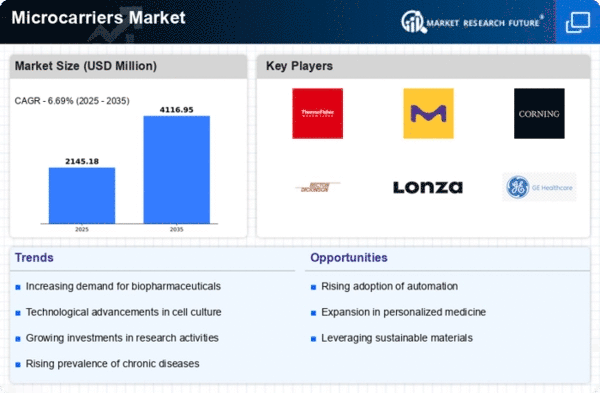
Microcarriers Market Infographic
Purchase Options

Microcarriers Size

Microcarriers Market Growth Projections and Opportunities

The Microcarriers market is influenced by various factors that shape its dynamics and growth trajectory. Firstly, the increasing demand for cell-based therapies and vaccines fuels the growth of the microcarriers market. Cell-based therapies, including stem cell therapy and cell-based vaccines, are gaining prominence in the field of regenerative medicine and immunotherapy. Microcarriers serve as a crucial component in the production of these therapies by providing a substrate for cell attachment, proliferation, and expansion in bioreactors. As the adoption of cell-based therapies continues to rise, the demand for microcarriers also increases, driving market growth.

Secondly, advancements in cell culture technology drive innovation in the microcarriers market. Manufacturers are constantly developing novel microcarrier materials, surface coatings, and manufacturing techniques to enhance cell growth and productivity. These advancements result in microcarriers that offer improved performance, scalability, and reproducibility, thereby meeting the evolving needs of biopharmaceutical companies and contract manufacturers. The continuous innovation in cell culture technology propels the growth of the microcarriers market.

Furthermore, the growing biopharmaceutical industry contributes significantly to the expansion of the microcarriers market. Biopharmaceutical companies are increasingly investing in cell culture-based manufacturing processes to produce a wide range of biologics, including monoclonal antibodies, vaccines, and cell therapies. Microcarriers play a vital role in the large-scale production of these biologics by providing a platform for the cultivation of anchorage-dependent cells in bioreactors. The expanding biopharmaceutical industry drives the demand for microcarriers, stimulating market growth.

Moreover, increasing research activities in areas such as regenerative medicine, tissue engineering, and drug discovery drive the demand for microcarriers. Researchers are exploring the potential of microcarriers for various applications, including 3D cell culture, organoid culture, and high-throughput screening. Microcarriers offer a versatile platform for culturing cells in vitro, enabling researchers to mimic the physiological environment more accurately and accelerate the development of novel therapeutics. The growing interest in these research areas fuels the demand for microcarriers, driving market expansion.

Additionally, favorable regulatory environment and government initiatives support the growth of the microcarriers market. Regulatory agencies worldwide are establishing guidelines and standards for the manufacturing and quality control of cell-based therapies and biologics. This regulatory framework provides clarity and assurance to biopharmaceutical companies and contract manufacturers, facilitating the adoption of microcarriers in cell culture processes. Furthermore, government initiatives aimed at promoting innovation and investment in the biotechnology sector create opportunities for microcarrier manufacturers to expand their market presence.

On the other hand, challenges such as high production costs and concerns about scalability may hinder market growth. The production of microcarriers involves complex manufacturing processes and requires specialized equipment and expertise, leading to high production costs. Additionally, scalability remains a challenge for some microcarrier technologies, particularly those based on natural materials or complex surface modifications. Addressing these challenges through technological advancements and process optimization is essential to unlock the full potential of the microcarriers market.
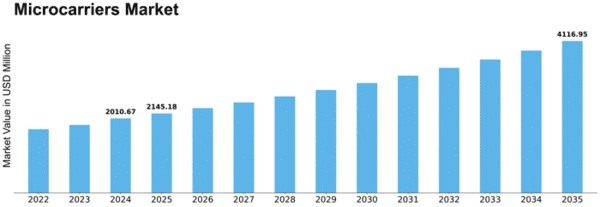
Microcarriers Market Size Graph
Author
Kinjoll Dey
Research Analyst Level I

He is an extremely curious individual currently working in Healthcare and Medical Devices Domain. Kinjoll is comfortably versed in data centric research backed by healthcare educational background. He leverages extensive data mining and analytics tools such as Primary and Secondary Research, Statistical Analysis, Machine Learning, Data Modelling. His key role also involves Technical Sales Support, Client Interaction and Project management within the Healthcare team. Lastly, he showcases extensive affinity towards learning new skills and remain fascinated in implementing them.

Leave a Comment

FAQs

What is the study period of the microcarriers market report?

The microcarriers market forecast period is 2023-2032

What is the microcarriers market growth rate?

The market is expected to register a CAGR of ~6.42% over the next 10 years, according to microcarriers market research.

Which region has the highest market growth rate?

Asia-Pacific is expected to register the highest CAGR during 2023 - 2032

Which region has the largest share of the market?

North America held the largest share in 2021

What is the expected microcarriers market size by 2030?

The market size is expected to be USD 1.57 Billion by 2032.

Who are the key players in the market?

Sartorius AG, Merck KGaA, Danaher Corporation, Thermo Fisher Scientific, Inc., HiMedia Laboratories Pvt. Ltd., and Eppendorf SE are the major companies operating ly market.

Market Summary

As per Market Research Future Analysis, the Microcarrier Market is projected to reach USD 1.82 Billion by 2035, growing at a CAGR of 6.42% from 2023 to 2035. The growth is driven by the rising demand for cell-based vaccines and therapeutics, increased incidence of diseases, and significant investments in innovative therapies. The market size is expected to be approximately USD 1.18 Billion by 2027. The pandemic has impacted patient visits and procedures, but the demand for cell-based vaccines continues to rise, enhancing the market's potential.

Key Market Trends & Highlights

Key trends influencing the Microcarrier Market include technological advancements and increasing demand for biopharmaceuticals.

  • Market size expected to reach USD 1.82 Billion by 2035. CAGR of 6.42% during the forecast period 2023-2035. Cell therapy accounted for the largest market share in 2021. North America held the largest market share in 2021.

Market Size & Forecast

Market Size in 2023 USD 1.57 Billion
Expected Market Size by 2035 USD 1.82 Billion
CAGR 6.42%
Largest Regional Market Share in 2021 North America

Major Players

<p>Key players include <a href="https://www.thermofisher.com/in/en/home/order/new-products.html">Thermo Fisher Scientific</a>, Inc., Sartorius AG, Merck KGaA, Danaher Corporation, and Lonza Group Ltd.</p>

Market Trends

Microcarriers Market Market Drivers

Market Growth Projections

The Global Microcarriers Market Industry is poised for substantial growth, with projections indicating a market value of 0.92 USD Billion in 2024, potentially reaching 1.82 USD Billion by 2035. This growth trajectory suggests a compound annual growth rate (CAGR) of 6.42% from 2025 to 2035. The increasing adoption of microcarriers in biopharmaceutical manufacturing, coupled with advancements in technology and regulatory support, contributes to this optimistic outlook. As the industry evolves, the demand for innovative solutions in cell culture is likely to drive further expansion in the microcarriers market.

Rising Demand for Biopharmaceuticals

The Global Microcarriers Market Industry experiences a surge in demand for biopharmaceuticals, driven by advancements in cell culture technologies. As the biopharmaceutical sector expands, microcarriers play a pivotal role in enhancing the production of vaccines and therapeutic proteins. In 2024, the market is valued at 0.92 USD Billion, reflecting the increasing reliance on microcarriers for efficient cell growth and product yield. This trend is expected to continue, with projections indicating a market growth to 1.82 USD Billion by 2035, suggesting a robust compound annual growth rate (CAGR) of 6.42% from 2025 to 2035.

Growing Focus on Personalized Medicine

The shift towards personalized medicine significantly impacts the Global Microcarriers Market Industry. As healthcare moves towards tailored therapies, the demand for efficient cell culture systems that can support the production of personalized treatments increases. Microcarriers Market provide a versatile platform for growing diverse cell types, facilitating the development of customized therapies. This trend aligns with the broader movement in healthcare towards individualized treatment plans, which are anticipated to drive the demand for microcarriers. The ability to produce specific cell lines efficiently is likely to enhance the market's growth trajectory in the coming years.

Technological Advancements in Cell Culture

Technological innovations in cell culture techniques significantly influence the Global Microcarriers Market Industry. The introduction of advanced microcarrier materials and surface modifications enhances cell attachment and growth, thereby improving overall productivity. These advancements facilitate the scalability of bioprocesses, making them more efficient and cost-effective. As a result, manufacturers are increasingly adopting these technologies to meet the growing demands of the biopharmaceutical sector. The continuous evolution of microcarrier technology is likely to drive market expansion, as companies seek to optimize their production processes and reduce costs.

Increased Investment in Research and Development

Investment in research and development within the biopharmaceutical sector is a crucial driver for the Global Microcarriers Market Industry. As companies strive to innovate and develop new therapies, the need for efficient cell culture systems becomes paramount. Increased funding for R&D initiatives enables the exploration of novel microcarrier applications, enhancing their utility in various therapeutic areas. This trend is indicative of a broader commitment to advancing biopharmaceutical manufacturing processes, which is expected to bolster market growth in the coming years. The focus on R&D is likely to yield new products and applications, further expanding the microcarriers market.

Regulatory Support for Biopharmaceutical Manufacturing

Regulatory frameworks supporting biopharmaceutical manufacturing play a vital role in shaping the Global Microcarriers Market Industry. Governments worldwide are increasingly recognizing the importance of biopharmaceuticals in healthcare, leading to streamlined approval processes and guidelines that encourage innovation. This regulatory support fosters a conducive environment for the development and commercialization of new therapies, thereby driving demand for microcarriers. As regulatory bodies continue to adapt to the evolving landscape of biopharmaceuticals, the market for microcarriers is expected to benefit from increased production capabilities and enhanced product quality.

Market Segment Insights

Microcarriers Market Product Type Insights

<p>The&nbsp; microcarriers market segmentation, based on product type, is equipment {bioreactors, culture vessels, cell counters, filtration systems, and other equipment}, consumables {media [serum-based media, serum-free media, and other media], reagents, microcarrier beads {cationic microcarriers, collagen-coated microcarriers, protein-coated microcarriers, and other microcarrier beads}. The&nbsp; microcarriers market growth was prominently high under the microcarrier beads category in 2021 due to increased cell biology research, increasing requirement for regenerative medicines and biopharmaceuticals, and the existence of several microcarrier beads that can be employed for different purposes attributed to the significant market growth.</p>

Microcarriers Market Application Insights

<p>The&nbsp; microcarriers market segmentation, based on application, is vaccine manufacturing, cell therapy, biologics manufacturing, and other applications. In 2021, cell therapy accounted for the largest share of the&nbsp; market due to the increased adoption of microcarriers for cell therapy. However, vaccine manufacturing is to register the highest growth rate during the forecast period due to the growing demand for vaccines for various viruses.</p>

Microcarriers Market End User Insights

<p>Based on end user, the&nbsp; market is divided into pharmaceutical &amp; biotechnology companies, research institutes, and contract research organizations. The <a href="https://www.marketresearchfuture.com/reports/pharmacy-market-12003">pharmaceutical</a> &amp; biotechnology companies category dominated the market for microcarriers in 2021 due to the increasing incidence of cancer and growing cases of infectious diseases &amp; genetic disorders, resulting in the growing demand for producing safe &amp; effective medicines or treatments.</p>

Microcarriers Market Overview, by Region Insights

<p>By region, the &nbsp;microcarriers market has been divided into North America, Europe, Asia-Pacific, and the Rest of the World. North America accounted for the most extensive market share. Asia-Pacific will exhibit the highest CAGR during the forecast period.</p>

<p>North America</p>

<p>North America dominated the market share in 2021. The growing cases of chronic and infectious diseases, enhanced awareness of personalized medicines, improved healthcare infrastructure and reimbursement models, existence of key market players, and intensive R&amp;D activities have fueled the region's growth. Moreover, regulatory assistance for biopharmaceuticals and regenerative medicines is also driving the market entry of new cell-based therapies. For instance, the US FDA predicts by 2025. It'll be approving approximately 10 to 20 cell and gene therapy products each year owing to the current clinical success speeds and the product pipeline.</p>

Get more detailed insights about Microcarriers Market Research Report - Global Forecast till 2035

Regional Insights

Key Companies in the Microcarriers Market market include

Industry Developments

  • Q2 2024: Sartorius and Sanofi Announce Partnership to Develop and Commercialize Bioprocessing Platform Sartorius and Sanofi entered into a partnership to develop and commercialize a new platform aimed at streamlining and optimizing downstream bioprocessing operations, with a focus on enhancing efficiency in biopharmaceutical production using microcarrier-based technologies.

Future Outlook

Microcarriers Market Future Outlook

<p>The Global Microcarriers Market is projected to grow at a 6.42% CAGR from 2024 to 2035, driven by advancements in biopharmaceuticals, increased demand for cell culture technologies, and rising investments in regenerative medicine.</p>

New opportunities lie in:

  • <p>Develop innovative microcarrier platforms for enhanced cell growth efficiency. Expand product offerings to include customizable microcarriers for specific applications. Leverage partnerships with biopharma companies to accelerate product development and market entry.</p>

<p>By 2035, the Microcarriers Market is expected to achieve substantial growth, positioning itself as a critical component in biopharmaceutical manufacturing.</p>

Market Segmentation

Microcarriers Region Outlook

  • {""=>["US"
  • "Canada"
  • "Mexico"]}
  • {""=>["UK"
  • "Germany"
  • "France"
  • "Italy"
  • "Spain"
  • "Rest of Europe"]}
  • {""=>["China"
  • "India"
  • "Japan"
  • "Australia and New Zealand"
  • "Rest of Asia-Pacific"]}
  • {""=>["South America"
  • "Middle East"
  • "Africa"]}

Microcarriers End User Outlook

  • Pharmaceutical & Biotechnology Companies
  • Research Institutes
  • Contract Research Organizations

Microcarriers Application Outlook

  • Vaccine Manufacturing
  • Cell Therapy
  • Biologics Manufacturing
  • Other Applications

Microcarriers Product Type Outlook

  • {""=>["Bioreactors"
  • "Culture Vessels"
  • "Cell Counters"
  • "Filtration Systems"
  • "Other Equipment"]}
  • {""=>["Media\r\n\r\nSerum-Based Media\r\n\r\n\r\nSerum-Free Media\r\n\r\n\r\nOther Media"
  • "Serum-Based Media"
  • "Serum-Free Media"
  • "Other Media"]}
  • {""=>["Serum-Based Media"
  • "Serum-Free Media"
  • "Other Media"]}
  • {""=>["Cationic Microcarriers Market"
  • "Collagen-coated Microcarriers Market"
  • "Protein-coated Microcarriers Market"
  • "Other Microcarrier Beads"]}

Report Scope

Report Attribute/Metric Details
Market Size 2022 NA (USD Billion)
Market Size 2023 NA (USD Billion)
Market Size 2035 1.82 (USD Billion)
Compound Annual Growth Rate (CAGR) 6.42% (2024- 2035)
Report Coverage Revenue Forecast, Competitive Landscape, Growth Factors, and Trends
Base Year 2022
Market Forecast Period 2023 - 2035
Historical Data 2019 - 2022
  Geographies Covered   North America, Europe, Asia-Pacific, and the Rest of the World (RoW)
  Key Vendors Corning Incorporated, VWR International LLC, Lonza Group Ltd, Merck KGaA, Bio-Rad Laboratories, Inc., and denovoMATRIX GmbH
  Key Market Opportunities   Rising monoclonal antibody production
  Key Market Drivers   Rising demand for cell-based vaccines

FAQs

What is the study period of the microcarriers market report?

The microcarriers market forecast period is 2023-2032

What is the microcarriers market growth rate?

The market is expected to register a CAGR of ~6.42% over the next 10 years, according to microcarriers market research.

Which region has the highest market growth rate?

Asia-Pacific is expected to register the highest CAGR during 2023 - 2032

Which region has the largest share of the market?

North America held the largest share in 2021

What is the expected microcarriers market size by 2030?

The market size is expected to be USD 1.57 Billion by 2032.

Who are the key players in the market?

Sartorius AG, Merck KGaA, Danaher Corporation, Thermo Fisher Scientific, Inc., HiMedia Laboratories Pvt. Ltd., and Eppendorf SE are the major companies operating ly market.

  1. Definition
    1. Scope of the Study
      1. Research Objective
      2. Assumptions
      3. Limitations
    2. Introduction
    3. Primary Research
    4. Secondary Research
    5. Market Size Estimation
    6. Drivers
    7. Restraints
    8. Opportunities
    9. Challenges
    10. Macroeconomic Indicators
    11. Technology Trends & Assessment
    12. Porter’s Five Forces Analysis
      1. Bargaining Power of Suppliers
      2. Bargaining Power of Buyers
      3. Threat of New Entrants
      4. Threat of Substitutes
      5. Intensity of Rivalry
    13. Value Chain Analysis
    14. Investment Feasibility Analysis
    15. Pricing Analysis
  2. Chapter 6. Global Microcarrier Market, by Product Type
    1. Introduction
    2. Equipment
      1. Bioreactors
  3. Market Estimates & Forecast, by Region, 2023-2032
  4. Market Estimates & Forecast, by Country, 2023-2032
  5. Culture Vessels
  6. Market Estimates & Forecast, by Region, 2023-2032
  7. Market Estimates & Forecast, by Country, 2023-2032
  8. Cell Counters
  9. Market Estimates & Forecast, by Region, 2023-2032
  10. Market Estimates & Forecast, by Country, 2023-2032
  11. Filtration Systems
  12. Market Estimates & Forecast, by Region, 2023-2032
  13. Market Estimates & Forecast, by Country, 2023-2032
  14. Other Equipment
  15. Market Estimates & Forecast, by Region, 2023-2032
  16. Market Estimates & Forecast, by Country, 2023-2032
    1. Consumables
      1. Media
  17. Market Estimates & Forecast, by Region, 2023-2032
  18. Market Estimates & Forecast, by Country, 2023-2032
  19. Serum-Free Media
  20. Market Estimates & Forecast, by Region, 2023-2032
  21. Market Estimates & Forecast, by Country, 2023-2032
  22. Other Media
  23. Market Estimates & Forecast, by Region, 2023-2032
  24. Market Estimates & Forecast, by Country, 2023-2032
  25. Reagents
  26. Market Estimates & Forecast, by Region, 2023-2032
  27. Market Estimates & Forecast, by Country, 2023-2032
  28. Microcarrier Beads
  29. Cationic Microcarriers
  30. Market Estimates & Forecast, by Region, 2023-2032
  31. Market Estimates & Forecast, by Country, 2023-2032
  32. Collagen-coated Microcarriers
  33. Market Estimates & Forecast, by Region, 2023-2032
  34. Market Estimates & Forecast, by Country, 2023-2032
  35. Protein-coated Microcarriers
  36. Market Estimates & Forecast, by Region, 2023-2032
  37. Market Estimates & Forecast, by Country, 2023-2032
  38. Other Microcarrier Beads
  39. Market Estimates & Forecast, by Region, 2023-2032
  40. Market Estimates & Forecast, by Country, 2023-2032
  41. Chapter 7. Global Microcarrier Market, by Application
    1. Introduction
    2. Vaccine Manufacturing
  42. Market Estimates & Forecast, by Region, 2023-2032
  43. Market Estimates & Forecast, by Country, 2023-2032
    1. Cell Therapy
  44. Market Estimates & Forecast, by Region, 2023-2032
  45. Market Estimates & Forecast, by Country, 2023-2032
    1. Biologics Manufacturing
  46. Market Estimates & Forecast, by Region, 2023-2032
  47. Market Estimates & Forecast, by Country, 2023-2032
    1. Other Applications
  48. Market Estimates & Forecast, by Region, 2023-2032
  49. Market Estimates & Forecast, by Country, 2023-2032
  50. Chapter 8. Global Microcarrier Market, by End-user
    1. Introduction
    2. Pharmaceutical & Biotechnology Companies
  51. Market Estimates & Forecast, by Region, 2023-2032
  52. Market Estimates & Forecast, by Country, 2023-2032
    1. Research Institutes
  53. Market Estimates & Forecast, by Region, 2023-2032
  54. Market Estimates & Forecast, by Country, 2023-2032
    1. Contract Research Organizations
  55. Market Estimates & Forecast, by Region, 2023-2032
  56. Market Estimates & Forecast, by Country, 2023-2032
  57. Chapter 9. Global Microcarrier Market, by Region
    1. Introduction
    2. Americas
      1. North America
      2. South America
    3. Europe
      1. Western Europe
      2. Eastern Europe
    4. Asia-Pacific
      1. Japan
      2. China
      3. India
      4. Australia
      5. South Korea
      6. Rest of Asia-Pacific
    5. Middle East & Africa
      1. Middle East
      2. Africa
    6. Chapter 10. Company Landscape
    7. Introduction
    8. Market Share Analysis
    9. Key Development & Strategies
    10. Chapter 11. Company Profiles
    11. Thermo Fisher Scientific Inc.
      1. Company Overview
      2. Product Overview
      3. Financials Overview
      4. Key Developments
      5. SWOT Analysis
    12. EPPENDORF AG
      1. Company Overview
      2. Product Overview
      3. Financial Overview
      4. Key Developments
      5. SWOT Analysis
    13. Corning Incorporated
      1. Company Overview
      2. Product Overview
      3. Financial Overview
      4. Key Development
      5. SWOT Analysis
    14. Sartorius AG
      1. Company Overview
      2. Product Overview
      3. Financial Overview
      4. Key Development
      5. SWOT Analysis
    15. Danaher
      1. Company Overview
      2. Product Overview
      3. Financial overview
      4. Key Developments
      5. SWOT Analysis
    16. Merck KGaA
      1. Company Overview
      2. Product Overview
      3. Financial Overview
      4. Key Developments
      5. SWOT Analysis
    17. Becton, Dickinson and Company
      1. Overview
      2. Product Overview
      3. Financial Overview
      4. Key Developments
      5. SWOT Analysis
    18. Eppendorf AG
      1. Overview
      2. Product Overview
      3. Financials
      4. Key Developments
      5. SWOT Analysis
    19. HiMedia Laboratories
      1. Overview
      2. Product Overview
      3. Financials
      4. Key Developments
      5. SWOT Analysis
    20. Lonza
      1. Overview
      2. Product Overview
      3. Financials
      4. Key Developments
      5. SWOT Analysis
    21. Chapter 12. MRFR Conclusion
    22. Key Findings
      1. From CEO’s View point
      2. Unmet Needs of the Market
    23. Key Companies to Watch
    24. Predictions for the Microcarrier Industry
    25. Chapter 13. Appendix
  58. LIST OF TABLES
  59. Global Microcarrier Market Synopsis, 2023-2032
  60. Global Microcarrier Market Estimates and Forecast, 2023-2032 (USD Million)
  61. Global Microcarrier Market, by Product Type, 2023-2032 (USD Million)
  62. Global Microcarrier Market, by Application, 2023-2032 (USD Million)
  63. Global Microcarrier Market, by End-User, 2023-2032 (USD Million)
  64. Global Microcarrier Market, by Region, 2023-2032(USD Million)
  65. North America: Microcarrier Market, by Product Type, 2023-2032 (USD Million)
  66. North America: Microcarrier Market, by Application, 2023-2032 (USD Million)
  67. North America: Microcarrier Market, by End-User, 2023-2032 (USD Million)
  68. North America: Microcarrier Market, by Region, 2023-2032 (USD Million)
  69. US: Microcarrier Market, by Product Type, 2023-2032 (USD Million)
  70. US: Microcarrier Market, by Application, 2023-2032 (USD Million)
  71. US: Microcarrier Market, by End-User, 2023-2032 (USD Million)
  72. US: Microcarrier Market, by Region, 2023-2032 (USD Million)
  73. Canada: Microcarrier Market, by Product Type, 2023-2032 (USD Million)
  74. Canada: Microcarrier Market, by Application, 2023-2032 (USD Million)
  75. Canada: Microcarrier Market, by End-User, 2023-2032 (USD Million)
  76. Canada: Microcarrier Market, by Region, 2023-2032 (USD Million)
  77. South America: Microcarrier Market, by Product Type, 2023-2032 (USD Million)
  78. South America: Microcarrier Market, by Application, 2023-2032 (USD Million)
  79. South America: Microcarrier Market, by End-User, 2023-2032 (USD Million)
  80. South America: Microcarrier Market, by Region, 2023-2032 (USD Million)
  81. Europe: Microcarrier Market, by Product Type, 2023-2032 (USD Million)
  82. Europe: Microcarrier Market, by Application, 2023-2032 (USD Million)
  83. Europe: Microcarrier Market, by End-User, 2023-2032 (USD Million)
  84. Europe: Microcarrier Market, by Region, 2023-2032 (USD Million)
  85. Western Europe: Microcarrier Market, by Product Type, 2023-2032 (USD Million)
  86. Western Europe: Microcarrier Market, by Application, 2023-2032 (USD Million)
  87. Western Europe: Microcarrier Market, by End-User, 2023-2032 (USD Million)
  88. Western Europe: Microcarrier Market, by Region, 2023-2032 (USD Million)
  89. Eastern Europe: Microcarrier Market, by Product Type, 2023-2032 (USD Million)
  90. Eastern Europe: Microcarrier Market, by Application, 2023-2032 (USD Million)
  91. Eastern Europe: Microcarrier Market, by End-User, 2023-2032 (USD Million)
  92. Eastern Europe: Microcarrier Market, by Region, 2023-2032 (USD Million)
  93. Asia-Pacific: Microcarrier Market, by Product Type, 2023-2032 (USD Million)
  94. Asia-Pacific: Microcarrier Market, by Application, 2023-2032 (USD Million)
  95. Asia-Pacific: Microcarrier Market, by End-User, 2023-2032 (USD Million)
  96. Asia-Pacific: Microcarrier Market, by Region, 2023-2032 (USD Million)
  97. Middle East & Africa: Microcarrier Market, by Product Type, 2023-2032 (USD Million)
  98. Middle East & Africa: Microcarrier Market, by Application, 2023-2032 (USD Million)
  99. Middle East & Africa: Microcarrier Market, by End-User, 2023-2032 (USD Million)
  100. Middle East & Africa: Microcarrier Market, by Region, 2023-2032 (USD Million)
  101. LIST OF FIGURES
  102. Research Process
  103. Segmentation for Global Microcarrier Market
  104. Segmentation Market Dynamics for Global Microcarrier Market
  105. Global Microcarrier Market Share, by Product Type, 2023 (%)
  106. Global Microcarrier Market Share, by Application, 2023 (%)
  107. Global Microcarrier Market Share, by End-User, 2023 (%)
  108. Global Microcarrier Market Share, by Region, 2023 (%)
  109. North America: Microcarrier Market Share, by Country, 2023 (%)
  110. Europe: Microcarrier Market Share, by Country, 2023 (%)
  111. Asia-Pacific: Microcarrier Market Share, by Country, 2023 (%)
  112. Middle East & Africa: Microcarrier Market Share, by Country, 2023 (%)
  113. Global Microcarrier Market: Company Share Analysis, 2023 (%)
  114. Thermo Fisher Scientific Inc.: Key Financials
  115. Thermo Fisher Scientific Inc.: Segmental Revenue
  116. Thermo Fisher Scientific Inc.: Geographical Revenue
  117. EPPENDORF AG: Key Financials
  118. EPPENDORF AG: Segmental Revenue
  119. EPPENDORF AG: Geographical Revenue
  120. Corning Incorporated: Key Financials
  121. Corning Incorporated: Segmental Revenue
  122. Corning Incorporated: Geographical Revenue
  123. Sartorius AG: Key Financials
  124. Sartorius AG: Segmental Revenue
  125. Sartorius AG: Geographical Revenue
  126. Danaher: Key Financials
  127. Danaher: Segmental Revenue
  128. Danaher: Geographical Revenue
  129. Merck KGaA: Key Financials
  130. Merck KGaA: Segmental Revenue
  131. Merck KGaA: Geographical Revenue
  132. Becton, Dickinson and Company: Key Financials
  133. Becton, Dickinson and Company: Segmental Revenue
  134. Becton, Dickinson and Company: Geographical Revenue
  135. Eppendorf AG: Key Financials
  136. Eppendorf AG: Segmental Revenue
  137. Eppendorf AG: Geographical Revenue
  138. HiMedia Laboratories: Key Financials
  139. HiMedia Laboratories: Segmental Revenue
  140. HiMedia Laboratories: Geographical Revenue
  141. Lonza: Key Financials
  142. Lonza: Segmental Revenue
  143. Lonza: Geographical Revenue

Microcarriers Market Segmentation

Market Segmentation Overview

  • Detailed segmentation data will be available in the full report
  • Comprehensive analysis by multiple parameters
  • Regional and country-level breakdowns
  • Market size forecasts by segment
Infographic

Free Sample Request

Kindly complete the form below to receive a free sample of this Report

Get Free Sample

Customer Strories

Compare Licence

×
Features License Type
Single User Multiuser License Enterprise User
Price $4,950 $5,950 $7,250
Maximum User Access Limit 1 User Upto 10 Users Unrestricted Access Throughout the Organization
Free Customization
Direct Access to Analyst
Deliverable Format
Platform Access
Discount on Next Purchase 10% 15% 15%
Printable Versions