Request Free Sample ×

Kindly complete the form below to receive a free sample of this Report

* Please use a valid business email

Leading companies partner with us for data-driven Insights

clients tt-cursor
Hero Background
English
Chinese
French
Japanese
Korean
German
Spanish

Metal Powder Market Trends

ID: MRFR/CnM/4211-CR
111 Pages
Chitranshi Jaiswal
May 2025

Metal Powder Market Research Report Information by Material (Ferrous Metals, Non-Ferrous Metals, Other), by Process (Additive Manufacturing, Metal Injection Molding, Powder Metal Hot Isostatic Pressing (Pm Hip), And Others), By Application (Automotive, Oil & Gas, Energy & Power, Medical, Aerospace & Defense, Others), and by Region (North America, Europe, Asia-Pacific, Middle East & Africa, and South America) –Market Forecast Till 2035

Share:
Download PDF ×

We do not share your information with anyone. However, we may send you emails based on your report interest from time to time. You may contact us at any time to opt-out.

Metal Powder Market Infographic
Purchase Options

Market Trends

Key Emerging Trends in the Metal Powder Market

The metal powder market has been witnessing notable trends in recent years, reflecting the dynamic nature of the industry. One prominent trend is the growing demand for metal powders in additive manufacturing, also known as 3D printing. The adoption of 3D printing technology across various industries, including aerospace, automotive, and healthcare, has spurred the demand for metal powders as a key raw material. This trend is driven by the unique advantages offered by 3D printing, such as design flexibility, reduced material wastage, and the ability to create complex geometries. As a result, metal powder manufacturers are focusing on developing advanced and high-performance powders suitable for different 3D printing applications.

Another significant trend in the metal powder market is the increasing emphasis on sustainability and environmental concerns. As industries worldwide strive to reduce their carbon footprint and adopt eco-friendly practices, the metal powder sector is not an exception. Manufacturers are investing in research and development to create metal powders using sustainable and recycled materials. This trend aligns with the broader global push towards a circular economy, where resources are used more efficiently, and waste is minimized. Consequently, the market is witnessing a surge in the production and adoption of environmentally friendly metal powders.

Moreover, the automotive industry's transition towards electric vehicles (EVs) is influencing the metal powder market. With the increasing focus on lightweight materials to enhance the energy efficiency of EVs, there is a growing demand for metal powders in the manufacturing of lightweight components. Aluminum and titanium powders, in particular, are gaining traction as preferred choices for producing lightweight parts that contribute to fuel efficiency and overall vehicle performance. This trend is expected to persist as the automotive sector continues its shift towards electric and hybrid vehicles.

Furthermore, the aerospace industry's advancements are shaping the metal powder market trends. The aerospace sector has been a traditional consumer of metal powders for applications such as aircraft components and engines. However, with the rise of innovative materials and manufacturing processes, there is a renewed interest in using metal powders for additive manufacturing in aerospace. This approach allows for the production of complex, high-performance components with reduced weight, contributing to fuel efficiency and overall aircraft performance.

Additionally, geopolitical factors and supply chain dynamics are influencing the metal powder market trends. The industry is navigating challenges related to the availability and pricing of raw materials, transportation, and geopolitical tensions that impact global trade. As a result, market participants are strategically re-evaluating their supply chain strategies, exploring local sourcing options, and diversifying their supplier base to mitigate risks associated with geopolitical uncertainties.

The metal powder market is undergoing significant transformations driven by technological advancements, sustainability considerations, industry-specific demands, and global supply chain dynamics. The adoption of 3D printing, focus on sustainability, lightweighting in the automotive sector, aerospace innovations, and supply chain challenges are key factors shaping the market trends. As the industry continues to evolve, staying abreast of these trends will be crucial for businesses to capitalize on emerging opportunities and navigate potential challenges in the dynamic landscape of the metal powder market.


Author
Author Profile
Chitranshi Jaiswal
Team Lead - Research

Chitranshi is a Team Leader in the Chemicals & Materials (CnM) and Energy & Power (EnP) domains, with 6+ years of experience in market research. She leads and mentors teams to deliver cross-domain projects that equip clients with actionable insights and growth strategies. She is skilled in market estimation, forecasting, competitive benchmarking, and both primary & secondary research, enabling her to turn complex data into decision-ready insights. An engineer and MBA professional, she combines technical expertise with strategic acumen to solve dynamic market challenges. Chitranshi has successfully managed projects that support market entry, investment planning, and competitive positioning, while building strong client relationships. Certified in Advanced Excel & Power BI she leverages data-driven approaches to ensure accuracy, clarity, and impactful outcomes.

Leave a Comment

FAQs

What is the projected market valuation of The Global Metal Powder by 2035?

<p>The projected market valuation for The Global Metal Powder is 23681.68 USD Million by 2035.</p>

What was the market valuation of The Global Metal Powder in 2024?

<p>The overall market valuation of The Global Metal Powder was 10579.8 USD Million in 2024.</p>

What is the expected CAGR for The Global Metal Powder during the forecast period 2025 - 2035?

<p>The expected CAGR for The Global Metal Powder during the forecast period 2025 - 2035 is 7.6%.</p>

Which companies are considered key players in The Global Metal Powder?

<p>Key players in The Global Metal Powder include Höganäs AB, GKN Powder Metallurgy, Carpenter Technology Corporation, and others.</p>

What are the main segments of The Global Metal Powder?

<p>The main segments of The Global Metal Powder include Material, Process, and Application.</p>

What was the valuation of the Ferrous Metals segment in 2024?

<p>The valuation of the Ferrous Metals segment in 2024 was 6350.0 USD Million.</p>

How much is the Additive Manufacturing segment projected to grow by 2035?

The Additive Manufacturing segment is projected to grow from 2115.0 USD Million in 2024 to 5000.0 USD Million by 2035.

What is the projected valuation for the Aerospace & Defense application by 2035?

The projected valuation for the Aerospace &amp; Defense application is expected to reach 5600.0 USD Million by 2035.

What was the valuation of the Non-Ferrous Metals segment in 2024?

The valuation of the Non-Ferrous Metals segment in 2024 was 4229.8 USD Million.

Which process segment is expected to see significant growth by 2035?

The Powder Metal Hot Isostatic Pressing (PM HIP) process segment is expected to grow from 2630.0 USD Million in 2024 to 6000.0 USD Million by 2035.

Market Summary

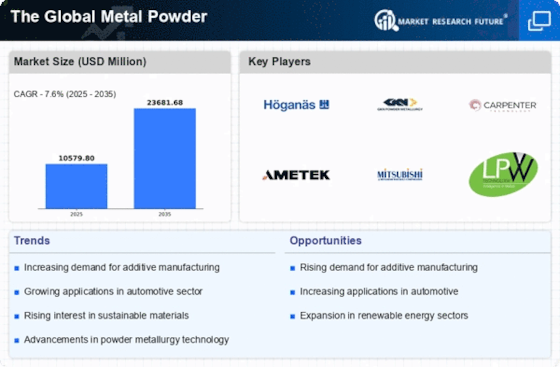
As per Market Research Future analysis, The Global Metal Powder Market Size was estimated at 10579.8 USD Million in 2024. The metal powder industry is projected to grow from 11383.86 USD Million in 2025 to 23681.68 USD Million by 2035, exhibiting a compound annual growth rate (CAGR) of 7.6% during the forecast period 2025 - 2035

Key Market Trends & Highlights

The Global Metal Powder Market is poised for robust growth driven by technological advancements and increasing applications across various sectors.

  • North America remains the largest market for metal powders, driven by its established aerospace and automotive industries. The Asia-Pacific region is emerging as the fastest-growing market, fueled by rapid industrialization and technological innovation. Ferrous metals dominate the market, while non-ferrous metals are experiencing the fastest growth due to their diverse applications. Rising demand in the aerospace and automotive sectors, along with the growth of additive manufacturing technologies, are key drivers of market expansion.

Market Size & Forecast

2024 Market Size 10579.8 (USD Million)
2035 Market Size 23681.68 (USD Million)
CAGR (2025 - 2035) 7.6%
Largest Regional Market Share in 2024 Asia Pacific

Major Players

H&ouml;gan&auml;s AB (SE), GKN Powder Metallurgy (GB), Carpenter Technology Corporation (US), AMETEK Inc. (US), Mitsubishi Materials Corporation (JP), LPW Technology Ltd (GB), ExOne Company (US), Sandvik AB (SE), Advanced Powder Products (US), Rio Tinto Group (GB)

Market Trends

The Global Metal Powder Market is currently experiencing a dynamic evolution, driven by advancements in technology and increasing applications across various industries. The demand for metal powders is expanding, particularly in sectors such as aerospace, automotive, and medical, where precision and performance are paramount. Innovations in additive manufacturing and powder metallurgy are reshaping production processes, allowing for more complex geometries and enhanced material properties. This shift not only improves efficiency but also reduces waste, aligning with sustainability goals that are becoming increasingly relevant in today's industrial landscape. Moreover, the market appears to be influenced by the growing emphasis on lightweight materials, which are essential for improving fuel efficiency and overall performance in transportation. As industries seek to optimize their operations, the versatility of metal powders is likely to play a crucial role in meeting these demands. The ongoing research and development efforts suggest that The Global Metal Powder Market will continue to adapt and thrive, potentially leading to new applications and innovations that could further transform the landscape of manufacturing and production.

Sustainability Initiatives

The Global Metal Powder Market is witnessing a notable shift towards sustainability, as manufacturers increasingly adopt eco-friendly practices. This trend encompasses the use of recycled materials and energy-efficient production methods, which not only reduce environmental impact but also appeal to a growing consumer base that prioritizes sustainability.

Technological Advancements

Innovations in technology are significantly shaping The Global Metal Powder Market. The rise of additive manufacturing techniques, such as 3D printing, is enabling the creation of complex components with enhanced performance characteristics. This evolution is likely to drive demand for specialized metal powders tailored for specific applications.

Diverse Applications

The versatility of metal powders is leading to their adoption across a wide range of industries. From aerospace to medical devices, the ability to produce lightweight and high-strength components is fostering growth in various sectors. This trend indicates a broadening scope for metal powders, enhancing their relevance in modern manufacturing.

Metal Powder Market Market Drivers

Expansion of Renewable Energy Applications

The expansion of renewable energy applications is emerging as a significant driver for The Global Metal Powder Industry. As the world shifts towards sustainable energy solutions, metal powders are increasingly utilized in the production of components for wind turbines and solar panels. The renewable energy sector is projected to grow at a rate of around 20% annually, creating a substantial demand for high-performance metal powders. This trend indicates that manufacturers are likely to focus on developing specialized powders that can withstand harsh environmental conditions, thereby enhancing the market's growth prospects.

Emergence of New Market Players and Startups

The emergence of new market players and startups is reshaping the competitive landscape of The Global Metal Powder Industry. These entities are often characterized by their innovative approaches and agility, allowing them to introduce novel products and solutions. Recent trends suggest that the number of startups in the metal powder sector has increased by approximately 30% in the last two years, indicating a vibrant ecosystem. This influx of new players not only intensifies competition but also drives innovation, as established companies may need to adapt to maintain their market positions. Consequently, this dynamic environment is likely to contribute to the overall growth of the market.

Growth of Additive Manufacturing Technologies

Additive manufacturing technologies, particularly 3D printing, are revolutionizing the production processes across various industries, thereby influencing The Global Metal Powder Industry. The market for metal powders used in additive manufacturing is expected to expand significantly, with estimates indicating a growth rate of around 25% annually. This growth is attributed to the ability of metal powders to create complex geometries and reduce material waste, which aligns with modern manufacturing goals. As industries seek to innovate and optimize production, the demand for specialized metal powders tailored for additive manufacturing applications is likely to increase, further solidifying the market's trajectory.

Increasing Investment in Research and Development

Investment in research and development is a critical driver for The Global Metal Powder Industry, as companies strive to innovate and enhance product offerings. The focus on developing new alloys and improving powder production techniques is expected to yield advanced materials with superior properties. Recent data indicates that R&D spending in the metal powder sector has risen by approximately 15% over the past year, reflecting a commitment to technological advancement. This investment not only fosters innovation but also enables manufacturers to meet the evolving needs of various applications, thereby expanding the market's potential.

Rising Demand in Aerospace and Automotive Sectors

The aerospace and automotive sectors are experiencing a notable surge in demand for advanced materials, which is likely to drive The Global Metal Powder Industry. The increasing need for lightweight and high-strength components in aircraft and vehicles is propelling the adoption of metal powders. For instance, the aerospace industry is projected to grow at a compound annual growth rate of approximately 4.5% over the next few years, leading to a heightened requirement for metal powders used in additive manufacturing and other processes. This trend suggests that manufacturers are increasingly turning to metal powders to meet stringent performance and safety standards, thereby enhancing the overall market landscape.

Market Segment Insights

By Material: Ferrous Metals (Largest) vs. Non-Ferrous Metals (Fastest-Growing)

In The Global Metal Powder Market, Ferrous Metals hold the largest share, driven by their extensive use in various industries such as automotive and construction. Their fundamental properties, including strength and durability, make them a preferred choice for applications where structural integrity is crucial. In contrast, Non-Ferrous Metals have been witnessing a rapid increase in market share due to the growing demand in sectors like electronics and renewable energy, where lightweight and corrosion-resistant materials are essential. The growth trends in this segment are significantly influenced by technological advancements and innovative applications of metal powders. Ferrous Metals remain stable due to their established market presence, while Non-Ferrous Metals are emerging quickly, fueled by advancements in additive manufacturing and 3D printing technologies. The shift towards sustainable materials and recycling practices is also contributing to the increasing demand for Non-Ferrous options, indicating a promising future for this segment.

Ferrous Metals (Dominant) vs. Non-Ferrous Metals (Emerging)

Ferrous Metals are characterized by their iron content, which provides high strength and toughness, making them ubiquitous in industrial applications. Their dominance in the metal powder market is primarily due to their reliability and cost-effectiveness. Common applications include structural components, automotive parts, and machinery. Conversely, Non-Ferrous Metals, although smaller in market share, are rapidly emerging due to their unique properties such as lightweight, resistance to corrosion, and ability to conduct electricity. They are particularly vital in manufacturing components for the aerospace, defense, and electronics industries, which are all experiencing significant growth. As innovation in metal powder technology continues, Non-Ferrous Metals are expected to gain a larger foothold, leading to dynamic changes in the market landscape.

By Process: Additive Manufacturing (Largest) vs. Metal Injection Molding (Fastest-Growing)

In The Global Metal Powder Market, the process segment is primarily dominated by Additive Manufacturing, which takes a significant share due to its versatility and widespread application in industries such as aerospace, automotive, and medical. Following closely is Metal Injection Molding, which has been rapidly gaining traction as manufacturers seek efficient production methods that offer complex geometries and high precision. This shift has enabled these processes to capture a substantial portion of the market distribution.

Additive Manufacturing (Dominant) vs. Metal Injection Molding (Emerging)

Additive Manufacturing stands out as the dominant process within The Global Metal Powder Market, widely recognized for its ability to create intricate designs and reduce material waste. This method leverages advanced 3D printing technologies, making it an essential tool in modern manufacturing. Conversely, Metal Injection Molding, while currently emerging, is witnessing rapid growth as it combines the advantages of powder metallurgy and injection molding, allowing manufacturers to produce intricate metal parts efficiently. Both processes indicate a broader trend towards innovation and enhanced manufacturing capabilities, catering to the evolving needs of various sectors.

By Application: Automotive (Largest) vs. Aerospace & Defense (Fastest-Growing)

The Global Metal Powder Market showcases a diverse distribution among its application segments, with the automotive industry taking the lead. This segment's demand is primarily driven by the growing need for lightweight materials that enhance fuel efficiency. Following closely, aerospace and defense is emerging rapidly, fueled by advancements in manufacturing technologies like additive manufacturing, which allows for the creation of complex geometries essential in aircraft components. Other segments such as oil &amp; gas, energy &amp; power, and medical applications also contribute to market dynamics, but to a lesser extent. Growth trends within The Global Metal Powder Market are significantly influenced by the increased adoption of metal powders in additive manufacturing processes. Industries are recognizing the benefits of using metal powders for producing intricate designs that traditional methods cannot achieve. Additionally, the demand for high-performance materials in medical implants and aerospace parts is promoting further innovations within the sector. As sustainability becomes a pressing concern, materials that ensure reduced waste during manufacturing processes are also gaining traction, positioning various applications at the forefront of market evolution.

Automotive (Dominant) vs. Medical (Emerging)

In The Global Metal Powder Market, the automotive sector is recognized as the dominant application, primarily due to its extensive use of metal powders for producing parts that enhance vehicle performance and reduce weight. This sector capitalizes on innovations that allow for sophisticated designs while ensuring safety and efficiency. Conversely, the medical segment is rapidly emerging, leveraging metal powders specifically in the creation of implants and surgical instruments. This application benefits from the precision and customization possibilities offered by metal powders, which is crucial for the complex needs in medical technology. As a result, while automotive continues to sustain its lead, medical applications are positioning themselves for prominence through technological advancements that cater to health and patient safety.

Get more detailed insights about Metal Powder Market Research Report - Forecast to 2035

Regional Insights

North America : Innovation and Demand Surge

North America is witnessing robust growth in the metal powder market, driven by increasing demand from aerospace, automotive, and medical sectors. The region holds approximately 35% of the global market share, making it the largest market. Regulatory support for advanced manufacturing technologies and sustainability initiatives further catalyze this growth. The U.S. and Canada are the primary contributors, with significant investments in R&D and production capabilities. The competitive landscape is characterized by the presence of key players such as Carpenter Technology Corporation, AMETEK Inc., and ExOne Company. These companies are focusing on innovation and expanding their product portfolios to meet the rising demand for high-performance metal powders. The region's strong manufacturing base and technological advancements position it favorably for future growth in the metal powder sector.

Europe : Sustainability and Innovation Focus

Europe is emerging as a significant player in The Global Metal Powder, driven by stringent regulations promoting sustainability and innovation. The region accounts for approximately 30% of the global market share, making it the second-largest market. Countries like Germany and the UK are leading this growth, supported by government initiatives aimed at enhancing manufacturing efficiency and reducing environmental impact. The push for lightweight materials in automotive and aerospace applications is also a key driver. Leading countries in Europe are Germany, the UK, and France, with a competitive landscape featuring companies like Höganäs AB and GKN Powder Metallurgy. These firms are investing heavily in R&D to develop advanced metal powders that meet the evolving needs of various industries. The presence of a skilled workforce and strong industrial infrastructure further enhances Europe's position in the global market.

Asia-Pacific : Rapid Industrialization and Growth

The Asia-Pacific region is experiencing rapid growth in the metal powder market, fueled by industrialization and increasing demand from sectors such as electronics and automotive. This region holds approximately 25% of the global market share, with China and Japan being the largest contributors. Government initiatives aimed at boosting manufacturing capabilities and technological advancements are key drivers of this growth, alongside rising investments in additive manufacturing technologies. China is the dominant player in the region, followed by Japan and South Korea, with a competitive landscape that includes companies like Mitsubishi Materials Corporation and LPW Technology Ltd. These firms are focusing on expanding their production capacities and enhancing product quality to cater to the growing demand. The region's strong manufacturing base and innovation in metal powder technologies position it for continued growth in the coming years.

Middle East and Africa : Emerging Market Potential

The Middle East and Africa region is gradually emerging in The Global Metal Powder, driven by increasing industrial activities and investments in manufacturing. This region currently holds about 10% of the global market share, with countries like South Africa and the UAE leading the charge. The growth is supported by government initiatives aimed at diversifying economies and enhancing local manufacturing capabilities, particularly in sectors like oil and gas and construction. South Africa is the key player in this region, with a competitive landscape that includes local and international companies looking to establish a foothold. The presence of key players and the potential for growth in additive manufacturing technologies are expected to drive further expansion in the metal powder market. As the region continues to develop its industrial base, opportunities for innovation and collaboration are likely to increase.

Key Players and Competitive Insights

The Global Metal Powder is currently characterized by a dynamic competitive landscape, driven by increasing demand across various sectors such as automotive, aerospace, and additive manufacturing. Key players are actively engaging in strategies that emphasize innovation, regional expansion, and technological advancements. Companies like Höganäs AB (Sweden) and GKN Powder Metallurgy (United Kingdom) are at the forefront, focusing on enhancing their product offerings and operational efficiencies. Höganäs AB, for instance, has been investing in sustainable production methods, which not only align with global environmental standards but also cater to the growing demand for eco-friendly materials. Meanwhile, GKN Powder Metallurgy is leveraging its extensive R&D capabilities to develop advanced metal powders tailored for specific applications, thereby solidifying its competitive edge.

The market structure appears moderately fragmented, with numerous players vying for market share. This fragmentation is indicative of a competitive environment where localized manufacturing and supply chain optimization are becoming increasingly vital. Companies are adopting tactics such as establishing regional production facilities to reduce lead times and enhance customer service. The collective influence of these key players is shaping a landscape where agility and responsiveness to market demands are paramount, allowing them to navigate challenges effectively.

In August 2025, Carpenter Technology Corporation (United States) announced a strategic partnership with a leading aerospace manufacturer to develop high-performance metal powders specifically designed for additive manufacturing applications. This collaboration is expected to enhance Carpenter's product portfolio and position it as a key supplier in the aerospace sector, which is increasingly adopting 3D printing technologies. The strategic importance of this partnership lies in its potential to drive innovation and meet the evolving needs of the aerospace industry, thereby reinforcing Carpenter's market presence.

In September 2025, Sandvik AB (Sweden) unveiled a new line of metal powders optimized for additive manufacturing, aimed at improving the efficiency and quality of 3D-printed components. This launch reflects Sandvik's commitment to innovation and its strategic focus on expanding its offerings in the rapidly growing additive manufacturing market. By introducing these advanced materials, Sandvik not only enhances its competitive positioning but also addresses the increasing demand for high-performance metal powders in various industrial applications.

Moreover, in October 2025, ExOne Company (United States) announced the opening of a new production facility dedicated to the manufacturing of metal powders for 3D printing. This facility is expected to significantly increase ExOne's production capacity and improve its supply chain efficiency. The strategic importance of this expansion lies in its ability to meet the surging demand for metal powders in the additive manufacturing sector, positioning ExOne as a key player in this niche market.

As of October 2025, the competitive trends within The Global Metal Powder are increasingly defined by digitalization, sustainability, and the integration of artificial intelligence in production processes. Strategic alliances are becoming more prevalent, as companies recognize the need to collaborate to enhance their technological capabilities and market reach. Looking ahead, it is likely that competitive differentiation will evolve, shifting from traditional price-based competition to a focus on innovation, technological advancements, and supply chain reliability. This transition underscores the importance of adaptability and forward-thinking strategies in maintaining a competitive edge in the ever-evolving metal powder landscape.

Key Companies in the Metal Powder Market include

Industry Developments

    • In March 2021, Höganäs expanded its production capacity of fine powders to be used for applications within additive manufacturing, metal injection molding and surface coating. The new production plant is located at Höganäs’ facilities in Johnstown, Pennsylvania in the United States. Apart from being able to produce existing products such as 45 micron stainless steels (316L, 17-4PH), the new facility will also produce new grades below 25 microns, suitable for binder jetting and metal injection moulding technologies.
    • In May 2021, Rio Tinto successfully developed and tested a steel powder designed for 3-D printing applications at its Rio Tinto Fer et Titane (RTFT) metallurgical complex in Sorel-Tracy, Quebec. The water atomized steel powder delivers mechanical properties superior to conventional metal manufacturing techniques, paving the way for advances in the use of 3-D printing technology for metal parts. RTFT plans to develop a range of additional powder grades with advanced properties for 3-D printing to meet customer needs.
    • In April 2021, Kennametal Inc. announced the launch of Stellite 21 AM™ powder, the first Stellite™ powder qualified for laser powder bed additive manufacturing, and the latest addition to Kennametal Additive Manufacturing’s portfolio of high-performance metal powders optimized for 3D printing. With Stellite 21 AM powder, the unique corrosion and wear-resistant properties of the Stellite alloy family are now available for laser powder bed additive platforms to produce high-performance wear components for the oil and gas and power generation industries. Kennametal Additive Manufacturing is the Company’s 3D printing and production business unit within its Infrastructure segment.

Future Outlook

Metal Powder Market Future Outlook

The Global Metal Powder Market is projected to grow at a 7.6% CAGR from 2025 to 2035, driven by advancements in additive manufacturing and increasing demand in automotive applications.

New opportunities lie in:

  • Expansion into emerging markets with tailored metal powder solutions.
  • Development of eco-friendly metal powders to meet sustainability demands.
  • Investment in R&amp;D for high-performance alloys targeting aerospace applications.

By 2035, the market is expected to achieve robust growth, solidifying its position as a key industry.

Market Segmentation

Metal Powder Market Process Outlook

  • Additive Manufacturing
  • Metal Injection Molding
  • Powder Metal Hot Isostatic Pressing (PM HIP)
  • Others

Metal Powder Market Material Outlook

  • Ferrous Metals
  • Non-Ferrous Metals

Metal Powder Market Application Outlook

  • Automotive
  • Oil & Gas
  • Energy & Power
  • Medical
  • Aerospace & Defense
  • Others

Report Scope

MARKET SIZE 2024 10579.8(USD Million)
MARKET SIZE 2025 11383.86(USD Million)
MARKET SIZE 2035 23681.68(USD Million)
COMPOUND ANNUAL GROWTH RATE (CAGR) 7.6% (2025 - 2035)
REPORT COVERAGE Revenue Forecast, Competitive Landscape, Growth Factors, and Trends
BASE YEAR 2024
Market Forecast Period 2025 - 2035
Historical Data 2019 - 2024
Market Forecast Units USD Million
Key Companies Profiled Höganäs AB (SE), GKN Powder Metallurgy (GB), Carpenter Technology Corporation (US), AMETEK Inc. (US), Mitsubishi Materials Corporation (JP), LPW Technology Ltd (GB), ExOne Company (US), Sandvik AB (SE), Advanced Powder Products (US), Rio Tinto Group (GB)
Segments Covered Material, Process, Application, Region
Key Market Opportunities Advancements in additive manufacturing technologies drive demand in The Global Metal Powder.
Key Market Dynamics Rising demand for advanced manufacturing techniques drives innovation and competition in the metal powder sector.
Countries Covered North America, Europe, APAC, South America, MEA

FAQs

What is the projected market valuation of The Global Metal Powder by 2035?

<p>The projected market valuation for The Global Metal Powder is 23681.68 USD Million by 2035.</p>

What was the market valuation of The Global Metal Powder in 2024?

<p>The overall market valuation of The Global Metal Powder was 10579.8 USD Million in 2024.</p>

What is the expected CAGR for The Global Metal Powder during the forecast period 2025 - 2035?

<p>The expected CAGR for The Global Metal Powder during the forecast period 2025 - 2035 is 7.6%.</p>

Which companies are considered key players in The Global Metal Powder?

<p>Key players in The Global Metal Powder include Höganäs AB, GKN Powder Metallurgy, Carpenter Technology Corporation, and others.</p>

What are the main segments of The Global Metal Powder?

<p>The main segments of The Global Metal Powder include Material, Process, and Application.</p>

What was the valuation of the Ferrous Metals segment in 2024?

<p>The valuation of the Ferrous Metals segment in 2024 was 6350.0 USD Million.</p>

How much is the Additive Manufacturing segment projected to grow by 2035?

The Additive Manufacturing segment is projected to grow from 2115.0 USD Million in 2024 to 5000.0 USD Million by 2035.

What is the projected valuation for the Aerospace & Defense application by 2035?

The projected valuation for the Aerospace &amp; Defense application is expected to reach 5600.0 USD Million by 2035.

What was the valuation of the Non-Ferrous Metals segment in 2024?

The valuation of the Non-Ferrous Metals segment in 2024 was 4229.8 USD Million.

Which process segment is expected to see significant growth by 2035?

The Powder Metal Hot Isostatic Pressing (PM HIP) process segment is expected to grow from 2630.0 USD Million in 2024 to 6000.0 USD Million by 2035.

  1. SECTION I: EXECUTIVE SUMMARY AND KEY HIGHLIGHTS
    1. | 1.1 EXECUTIVE SUMMARY
    2. | | 1.1.1 Market Overview
    3. | | 1.1.2 Key Findings
    4. | | 1.1.3 Market Segmentation
    5. | | 1.1.4 Competitive Landscape
    6. | | 1.1.5 Challenges and Opportunities
    7. | | 1.1.6 Future Outlook
  2. SECTION II: SCOPING, METHODOLOGY AND MARKET STRUCTURE
    1. | 2.1 MARKET INTRODUCTION
    2. | | 2.1.1 Definition
    3. | | 2.1.2 Scope of the study
    4. | | | 2.1.2.1 Research Objective
    5. | | | 2.1.2.2 Assumption
    6. | | | 2.1.2.3 Limitations
    7. | 2.2 RESEARCH METHODOLOGY
    8. | | 2.2.1 Overview
    9. | | 2.2.2 Data Mining
    10. | | 2.2.3 Secondary Research
    11. | | 2.2.4 Primary Research
    12. | | | 2.2.4.1 Primary Interviews and Information Gathering Process
    13. | | | 2.2.4.2 Breakdown of Primary Respondents
    14. | | 2.2.5 Forecasting Model
    15. | | 2.2.6 Market Size Estimation
    16. | | | 2.2.6.1 Bottom-Up Approach
    17. | | | 2.2.6.2 Top-Down Approach
    18. | | 2.2.7 Data Triangulation
    19. | | 2.2.8 Validation
  3. SECTION III: QUALITATIVE ANALYSIS
    1. | 3.1 MARKET DYNAMICS
    2. | | 3.1.1 Overview
    3. | | 3.1.2 Drivers
    4. | | 3.1.3 Restraints
    5. | | 3.1.4 Opportunities
    6. | 3.2 MARKET FACTOR ANALYSIS
    7. | | 3.2.1 Value chain Analysis
    8. | | 3.2.2 Porter's Five Forces Analysis
    9. | | | 3.2.2.1 Bargaining Power of Suppliers
    10. | | | 3.2.2.2 Bargaining Power of Buyers
    11. | | | 3.2.2.3 Threat of New Entrants
    12. | | | 3.2.2.4 Threat of Substitutes
    13. | | | 3.2.2.5 Intensity of Rivalry
    14. | | 3.2.3 COVID-19 Impact Analysis
    15. | | | 3.2.3.1 Market Impact Analysis
    16. | | | 3.2.3.2 Regional Impact
    17. | | | 3.2.3.3 Opportunity and Threat Analysis
  4. SECTION IV: QUANTITATIVE ANALYSIS
    1. | 4.1 Chemicals and Materials, BY Material (USD Million)
    2. | | 4.1.1 Ferrous Metals
    3. | | 4.1.2 Non-Ferrous Metals
    4. | 4.2 Chemicals and Materials, BY Process (USD Million)
    5. | | 4.2.1 Additive Manufacturing
    6. | | 4.2.2 Metal Injection Molding
    7. | | 4.2.3 Powder Metal Hot Isostatic Pressing (PM HIP)
    8. | | 4.2.4 Others
    9. | 4.3 Chemicals and Materials, BY Application (USD Million)
    10. | | 4.3.1 Automotive
    11. | | 4.3.2 Oil & Gas
    12. | | 4.3.3 Energy & Power
    13. | | 4.3.4 Medical
    14. | | 4.3.5 Aerospace & Defense
    15. | | 4.3.6 Others
    16. | 4.4 Chemicals and Materials, BY Region (USD Million)
    17. | | 4.4.1 North America
    18. | | | 4.4.1.1 US
    19. | | | 4.4.1.2 Canada
    20. | | 4.4.2 Europe
    21. | | | 4.4.2.1 Germany
    22. | | | 4.4.2.2 UK
    23. | | | 4.4.2.3 France
    24. | | | 4.4.2.4 Russia
    25. | | | 4.4.2.5 Italy
    26. | | | 4.4.2.6 Spain
    27. | | | 4.4.2.7 Rest of Europe
    28. | | 4.4.3 APAC
    29. | | | 4.4.3.1 China
    30. | | | 4.4.3.2 India
    31. | | | 4.4.3.3 Japan
    32. | | | 4.4.3.4 South Korea
    33. | | | 4.4.3.5 Malaysia
    34. | | | 4.4.3.6 Thailand
    35. | | | 4.4.3.7 Indonesia
    36. | | | 4.4.3.8 Rest of APAC
    37. | | 4.4.4 South America
    38. | | | 4.4.4.1 Brazil
    39. | | | 4.4.4.2 Mexico
    40. | | | 4.4.4.3 Argentina
    41. | | | 4.4.4.4 Rest of South America
    42. | | 4.4.5 MEA
    43. | | | 4.4.5.1 GCC Countries
    44. | | | 4.4.5.2 South Africa
    45. | | | 4.4.5.3 Rest of MEA
  5. SECTION V: COMPETITIVE ANALYSIS
    1. | 5.1 Competitive Landscape
    2. | | 5.1.1 Overview
    3. | | 5.1.2 Competitive Analysis
    4. | | 5.1.3 Market share Analysis
    5. | | 5.1.4 Major Growth Strategy in the Chemicals and Materials
    6. | | 5.1.5 Competitive Benchmarking
    7. | | 5.1.6 Leading Players in Terms of Number of Developments in the Chemicals and Materials
    8. | | 5.1.7 Key developments and growth strategies
    9. | | | 5.1.7.1 New Product Launch/Service Deployment
    10. | | | 5.1.7.2 Merger & Acquisitions
    11. | | | 5.1.7.3 Joint Ventures
    12. | | 5.1.8 Major Players Financial Matrix
    13. | | | 5.1.8.1 Sales and Operating Income
    14. | | | 5.1.8.2 Major Players R&D Expenditure. 2023
    15. | 5.2 Company Profiles
    16. | | 5.2.1 Höganäs AB (SE)
    17. | | | 5.2.1.1 Financial Overview
    18. | | | 5.2.1.2 Products Offered
    19. | | | 5.2.1.3 Key Developments
    20. | | | 5.2.1.4 SWOT Analysis
    21. | | | 5.2.1.5 Key Strategies
    22. | | 5.2.2 GKN Powder Metallurgy (GB)
    23. | | | 5.2.2.1 Financial Overview
    24. | | | 5.2.2.2 Products Offered
    25. | | | 5.2.2.3 Key Developments
    26. | | | 5.2.2.4 SWOT Analysis
    27. | | | 5.2.2.5 Key Strategies
    28. | | 5.2.3 Carpenter Technology Corporation (US)
    29. | | | 5.2.3.1 Financial Overview
    30. | | | 5.2.3.2 Products Offered
    31. | | | 5.2.3.3 Key Developments
    32. | | | 5.2.3.4 SWOT Analysis
    33. | | | 5.2.3.5 Key Strategies
    34. | | 5.2.4 AMETEK Inc. (US)
    35. | | | 5.2.4.1 Financial Overview
    36. | | | 5.2.4.2 Products Offered
    37. | | | 5.2.4.3 Key Developments
    38. | | | 5.2.4.4 SWOT Analysis
    39. | | | 5.2.4.5 Key Strategies
    40. | | 5.2.5 Mitsubishi Materials Corporation (JP)
    41. | | | 5.2.5.1 Financial Overview
    42. | | | 5.2.5.2 Products Offered
    43. | | | 5.2.5.3 Key Developments
    44. | | | 5.2.5.4 SWOT Analysis
    45. | | | 5.2.5.5 Key Strategies
    46. | | 5.2.6 LPW Technology Ltd (GB)
    47. | | | 5.2.6.1 Financial Overview
    48. | | | 5.2.6.2 Products Offered
    49. | | | 5.2.6.3 Key Developments
    50. | | | 5.2.6.4 SWOT Analysis
    51. | | | 5.2.6.5 Key Strategies
    52. | | 5.2.7 ExOne Company (US)
    53. | | | 5.2.7.1 Financial Overview
    54. | | | 5.2.7.2 Products Offered
    55. | | | 5.2.7.3 Key Developments
    56. | | | 5.2.7.4 SWOT Analysis
    57. | | | 5.2.7.5 Key Strategies
    58. | | 5.2.8 Sandvik AB (SE)
    59. | | | 5.2.8.1 Financial Overview
    60. | | | 5.2.8.2 Products Offered
    61. | | | 5.2.8.3 Key Developments
    62. | | | 5.2.8.4 SWOT Analysis
    63. | | | 5.2.8.5 Key Strategies
    64. | | 5.2.9 Advanced Powder Products (US)
    65. | | | 5.2.9.1 Financial Overview
    66. | | | 5.2.9.2 Products Offered
    67. | | | 5.2.9.3 Key Developments
    68. | | | 5.2.9.4 SWOT Analysis
    69. | | | 5.2.9.5 Key Strategies
    70. | | 5.2.10 Rio Tinto Group (GB)
    71. | | | 5.2.10.1 Financial Overview
    72. | | | 5.2.10.2 Products Offered
    73. | | | 5.2.10.3 Key Developments
    74. | | | 5.2.10.4 SWOT Analysis
    75. | | | 5.2.10.5 Key Strategies
    76. | 5.3 Appendix
    77. | | 5.3.1 References
    78. | | 5.3.2 Related Reports
  6. LIST OF FIGURES
    1. | 6.1 MARKET SYNOPSIS
    2. | 6.2 NORTH AMERICA MARKET ANALYSIS
    3. | 6.3 US MARKET ANALYSIS BY MATERIAL
    4. | 6.4 US MARKET ANALYSIS BY PROCESS
    5. | 6.5 US MARKET ANALYSIS BY APPLICATION
    6. | 6.6 CANADA MARKET ANALYSIS BY MATERIAL
    7. | 6.7 CANADA MARKET ANALYSIS BY PROCESS
    8. | 6.8 CANADA MARKET ANALYSIS BY APPLICATION
    9. | 6.9 EUROPE MARKET ANALYSIS
    10. | 6.10 GERMANY MARKET ANALYSIS BY MATERIAL
    11. | 6.11 GERMANY MARKET ANALYSIS BY PROCESS
    12. | 6.12 GERMANY MARKET ANALYSIS BY APPLICATION
    13. | 6.13 UK MARKET ANALYSIS BY MATERIAL
    14. | 6.14 UK MARKET ANALYSIS BY PROCESS
    15. | 6.15 UK MARKET ANALYSIS BY APPLICATION
    16. | 6.16 FRANCE MARKET ANALYSIS BY MATERIAL
    17. | 6.17 FRANCE MARKET ANALYSIS BY PROCESS
    18. | 6.18 FRANCE MARKET ANALYSIS BY APPLICATION
    19. | 6.19 RUSSIA MARKET ANALYSIS BY MATERIAL
    20. | 6.20 RUSSIA MARKET ANALYSIS BY PROCESS
    21. | 6.21 RUSSIA MARKET ANALYSIS BY APPLICATION
    22. | 6.22 ITALY MARKET ANALYSIS BY MATERIAL
    23. | 6.23 ITALY MARKET ANALYSIS BY PROCESS
    24. | 6.24 ITALY MARKET ANALYSIS BY APPLICATION
    25. | 6.25 SPAIN MARKET ANALYSIS BY MATERIAL
    26. | 6.26 SPAIN MARKET ANALYSIS BY PROCESS
    27. | 6.27 SPAIN MARKET ANALYSIS BY APPLICATION
    28. | 6.28 REST OF EUROPE MARKET ANALYSIS BY MATERIAL
    29. | 6.29 REST OF EUROPE MARKET ANALYSIS BY PROCESS
    30. | 6.30 REST OF EUROPE MARKET ANALYSIS BY APPLICATION
    31. | 6.31 APAC MARKET ANALYSIS
    32. | 6.32 CHINA MARKET ANALYSIS BY MATERIAL
    33. | 6.33 CHINA MARKET ANALYSIS BY PROCESS
    34. | 6.34 CHINA MARKET ANALYSIS BY APPLICATION
    35. | 6.35 INDIA MARKET ANALYSIS BY MATERIAL
    36. | 6.36 INDIA MARKET ANALYSIS BY PROCESS
    37. | 6.37 INDIA MARKET ANALYSIS BY APPLICATION
    38. | 6.38 JAPAN MARKET ANALYSIS BY MATERIAL
    39. | 6.39 JAPAN MARKET ANALYSIS BY PROCESS
    40. | 6.40 JAPAN MARKET ANALYSIS BY APPLICATION
    41. | 6.41 SOUTH KOREA MARKET ANALYSIS BY MATERIAL
    42. | 6.42 SOUTH KOREA MARKET ANALYSIS BY PROCESS
    43. | 6.43 SOUTH KOREA MARKET ANALYSIS BY APPLICATION
    44. | 6.44 MALAYSIA MARKET ANALYSIS BY MATERIAL
    45. | 6.45 MALAYSIA MARKET ANALYSIS BY PROCESS
    46. | 6.46 MALAYSIA MARKET ANALYSIS BY APPLICATION
    47. | 6.47 THAILAND MARKET ANALYSIS BY MATERIAL
    48. | 6.48 THAILAND MARKET ANALYSIS BY PROCESS
    49. | 6.49 THAILAND MARKET ANALYSIS BY APPLICATION
    50. | 6.50 INDONESIA MARKET ANALYSIS BY MATERIAL
    51. | 6.51 INDONESIA MARKET ANALYSIS BY PROCESS
    52. | 6.52 INDONESIA MARKET ANALYSIS BY APPLICATION
    53. | 6.53 REST OF APAC MARKET ANALYSIS BY MATERIAL
    54. | 6.54 REST OF APAC MARKET ANALYSIS BY PROCESS
    55. | 6.55 REST OF APAC MARKET ANALYSIS BY APPLICATION
    56. | 6.56 SOUTH AMERICA MARKET ANALYSIS
    57. | 6.57 BRAZIL MARKET ANALYSIS BY MATERIAL
    58. | 6.58 BRAZIL MARKET ANALYSIS BY PROCESS
    59. | 6.59 BRAZIL MARKET ANALYSIS BY APPLICATION
    60. | 6.60 MEXICO MARKET ANALYSIS BY MATERIAL
    61. | 6.61 MEXICO MARKET ANALYSIS BY PROCESS
    62. | 6.62 MEXICO MARKET ANALYSIS BY APPLICATION
    63. | 6.63 ARGENTINA MARKET ANALYSIS BY MATERIAL
    64. | 6.64 ARGENTINA MARKET ANALYSIS BY PROCESS
    65. | 6.65 ARGENTINA MARKET ANALYSIS BY APPLICATION
    66. | 6.66 REST OF SOUTH AMERICA MARKET ANALYSIS BY MATERIAL
    67. | 6.67 REST OF SOUTH AMERICA MARKET ANALYSIS BY PROCESS
    68. | 6.68 REST OF SOUTH AMERICA MARKET ANALYSIS BY APPLICATION
    69. | 6.69 MEA MARKET ANALYSIS
    70. | 6.70 GCC COUNTRIES MARKET ANALYSIS BY MATERIAL
    71. | 6.71 GCC COUNTRIES MARKET ANALYSIS BY PROCESS
    72. | 6.72 GCC COUNTRIES MARKET ANALYSIS BY APPLICATION
    73. | 6.73 SOUTH AFRICA MARKET ANALYSIS BY MATERIAL
    74. | 6.74 SOUTH AFRICA MARKET ANALYSIS BY PROCESS
    75. | 6.75 SOUTH AFRICA MARKET ANALYSIS BY APPLICATION
    76. | 6.76 REST OF MEA MARKET ANALYSIS BY MATERIAL
    77. | 6.77 REST OF MEA MARKET ANALYSIS BY PROCESS
    78. | 6.78 REST OF MEA MARKET ANALYSIS BY APPLICATION
    79. | 6.79 KEY BUYING CRITERIA OF CHEMICALS AND MATERIALS
    80. | 6.80 RESEARCH PROCESS OF MRFR
    81. | 6.81 DRO ANALYSIS OF CHEMICALS AND MATERIALS
    82. | 6.82 DRIVERS IMPACT ANALYSIS: CHEMICALS AND MATERIALS
    83. | 6.83 RESTRAINTS IMPACT ANALYSIS: CHEMICALS AND MATERIALS
    84. | 6.84 SUPPLY / VALUE CHAIN: CHEMICALS AND MATERIALS
    85. | 6.85 CHEMICALS AND MATERIALS, BY MATERIAL, 2024 (% SHARE)
    86. | 6.86 CHEMICALS AND MATERIALS, BY MATERIAL, 2024 TO 2035 (USD Million)
    87. | 6.87 CHEMICALS AND MATERIALS, BY PROCESS, 2024 (% SHARE)
    88. | 6.88 CHEMICALS AND MATERIALS, BY PROCESS, 2024 TO 2035 (USD Million)
    89. | 6.89 CHEMICALS AND MATERIALS, BY APPLICATION, 2024 (% SHARE)
    90. | 6.90 CHEMICALS AND MATERIALS, BY APPLICATION, 2024 TO 2035 (USD Million)
    91. | 6.91 BENCHMARKING OF MAJOR COMPETITORS
  7. LIST OF TABLES
    1. | 7.1 LIST OF ASSUMPTIONS
    2. | | 7.1.1
    3. | 7.2 North America MARKET SIZE ESTIMATES; FORECAST
    4. | | 7.2.1 BY MATERIAL, 2025-2035 (USD Million)
    5. | | 7.2.2 BY PROCESS, 2025-2035 (USD Million)
    6. | | 7.2.3 BY APPLICATION, 2025-2035 (USD Million)
    7. | 7.3 US MARKET SIZE ESTIMATES; FORECAST
    8. | | 7.3.1 BY MATERIAL, 2025-2035 (USD Million)
    9. | | 7.3.2 BY PROCESS, 2025-2035 (USD Million)
    10. | | 7.3.3 BY APPLICATION, 2025-2035 (USD Million)
    11. | 7.4 Canada MARKET SIZE ESTIMATES; FORECAST
    12. | | 7.4.1 BY MATERIAL, 2025-2035 (USD Million)
    13. | | 7.4.2 BY PROCESS, 2025-2035 (USD Million)
    14. | | 7.4.3 BY APPLICATION, 2025-2035 (USD Million)
    15. | 7.5 Europe MARKET SIZE ESTIMATES; FORECAST
    16. | | 7.5.1 BY MATERIAL, 2025-2035 (USD Million)
    17. | | 7.5.2 BY PROCESS, 2025-2035 (USD Million)
    18. | | 7.5.3 BY APPLICATION, 2025-2035 (USD Million)
    19. | 7.6 Germany MARKET SIZE ESTIMATES; FORECAST
    20. | | 7.6.1 BY MATERIAL, 2025-2035 (USD Million)
    21. | | 7.6.2 BY PROCESS, 2025-2035 (USD Million)
    22. | | 7.6.3 BY APPLICATION, 2025-2035 (USD Million)
    23. | 7.7 UK MARKET SIZE ESTIMATES; FORECAST
    24. | | 7.7.1 BY MATERIAL, 2025-2035 (USD Million)
    25. | | 7.7.2 BY PROCESS, 2025-2035 (USD Million)
    26. | | 7.7.3 BY APPLICATION, 2025-2035 (USD Million)
    27. | 7.8 France MARKET SIZE ESTIMATES; FORECAST
    28. | | 7.8.1 BY MATERIAL, 2025-2035 (USD Million)
    29. | | 7.8.2 BY PROCESS, 2025-2035 (USD Million)
    30. | | 7.8.3 BY APPLICATION, 2025-2035 (USD Million)
    31. | 7.9 Russia MARKET SIZE ESTIMATES; FORECAST
    32. | | 7.9.1 BY MATERIAL, 2025-2035 (USD Million)
    33. | | 7.9.2 BY PROCESS, 2025-2035 (USD Million)
    34. | | 7.9.3 BY APPLICATION, 2025-2035 (USD Million)
    35. | 7.10 Italy MARKET SIZE ESTIMATES; FORECAST
    36. | | 7.10.1 BY MATERIAL, 2025-2035 (USD Million)
    37. | | 7.10.2 BY PROCESS, 2025-2035 (USD Million)
    38. | | 7.10.3 BY APPLICATION, 2025-2035 (USD Million)
    39. | 7.11 Spain MARKET SIZE ESTIMATES; FORECAST
    40. | | 7.11.1 BY MATERIAL, 2025-2035 (USD Million)
    41. | | 7.11.2 BY PROCESS, 2025-2035 (USD Million)
    42. | | 7.11.3 BY APPLICATION, 2025-2035 (USD Million)
    43. | 7.12 Rest of Europe MARKET SIZE ESTIMATES; FORECAST
    44. | | 7.12.1 BY MATERIAL, 2025-2035 (USD Million)
    45. | | 7.12.2 BY PROCESS, 2025-2035 (USD Million)
    46. | | 7.12.3 BY APPLICATION, 2025-2035 (USD Million)
    47. | 7.13 APAC MARKET SIZE ESTIMATES; FORECAST
    48. | | 7.13.1 BY MATERIAL, 2025-2035 (USD Million)
    49. | | 7.13.2 BY PROCESS, 2025-2035 (USD Million)
    50. | | 7.13.3 BY APPLICATION, 2025-2035 (USD Million)
    51. | 7.14 China MARKET SIZE ESTIMATES; FORECAST
    52. | | 7.14.1 BY MATERIAL, 2025-2035 (USD Million)
    53. | | 7.14.2 BY PROCESS, 2025-2035 (USD Million)
    54. | | 7.14.3 BY APPLICATION, 2025-2035 (USD Million)
    55. | 7.15 India MARKET SIZE ESTIMATES; FORECAST
    56. | | 7.15.1 BY MATERIAL, 2025-2035 (USD Million)
    57. | | 7.15.2 BY PROCESS, 2025-2035 (USD Million)
    58. | | 7.15.3 BY APPLICATION, 2025-2035 (USD Million)
    59. | 7.16 Japan MARKET SIZE ESTIMATES; FORECAST
    60. | | 7.16.1 BY MATERIAL, 2025-2035 (USD Million)
    61. | | 7.16.2 BY PROCESS, 2025-2035 (USD Million)
    62. | | 7.16.3 BY APPLICATION, 2025-2035 (USD Million)
    63. | 7.17 South Korea MARKET SIZE ESTIMATES; FORECAST
    64. | | 7.17.1 BY MATERIAL, 2025-2035 (USD Million)
    65. | | 7.17.2 BY PROCESS, 2025-2035 (USD Million)
    66. | | 7.17.3 BY APPLICATION, 2025-2035 (USD Million)
    67. | 7.18 Malaysia MARKET SIZE ESTIMATES; FORECAST
    68. | | 7.18.1 BY MATERIAL, 2025-2035 (USD Million)
    69. | | 7.18.2 BY PROCESS, 2025-2035 (USD Million)
    70. | | 7.18.3 BY APPLICATION, 2025-2035 (USD Million)
    71. | 7.19 Thailand MARKET SIZE ESTIMATES; FORECAST
    72. | | 7.19.1 BY MATERIAL, 2025-2035 (USD Million)
    73. | | 7.19.2 BY PROCESS, 2025-2035 (USD Million)
    74. | | 7.19.3 BY APPLICATION, 2025-2035 (USD Million)
    75. | 7.20 Indonesia MARKET SIZE ESTIMATES; FORECAST
    76. | | 7.20.1 BY MATERIAL, 2025-2035 (USD Million)
    77. | | 7.20.2 BY PROCESS, 2025-2035 (USD Million)
    78. | | 7.20.3 BY APPLICATION, 2025-2035 (USD Million)
    79. | 7.21 Rest of APAC MARKET SIZE ESTIMATES; FORECAST
    80. | | 7.21.1 BY MATERIAL, 2025-2035 (USD Million)
    81. | | 7.21.2 BY PROCESS, 2025-2035 (USD Million)
    82. | | 7.21.3 BY APPLICATION, 2025-2035 (USD Million)
    83. | 7.22 South America MARKET SIZE ESTIMATES; FORECAST
    84. | | 7.22.1 BY MATERIAL, 2025-2035 (USD Million)
    85. | | 7.22.2 BY PROCESS, 2025-2035 (USD Million)
    86. | | 7.22.3 BY APPLICATION, 2025-2035 (USD Million)
    87. | 7.23 Brazil MARKET SIZE ESTIMATES; FORECAST
    88. | | 7.23.1 BY MATERIAL, 2025-2035 (USD Million)
    89. | | 7.23.2 BY PROCESS, 2025-2035 (USD Million)
    90. | | 7.23.3 BY APPLICATION, 2025-2035 (USD Million)
    91. | 7.24 Mexico MARKET SIZE ESTIMATES; FORECAST
    92. | | 7.24.1 BY MATERIAL, 2025-2035 (USD Million)
    93. | | 7.24.2 BY PROCESS, 2025-2035 (USD Million)
    94. | | 7.24.3 BY APPLICATION, 2025-2035 (USD Million)
    95. | 7.25 Argentina MARKET SIZE ESTIMATES; FORECAST
    96. | | 7.25.1 BY MATERIAL, 2025-2035 (USD Million)
    97. | | 7.25.2 BY PROCESS, 2025-2035 (USD Million)
    98. | | 7.25.3 BY APPLICATION, 2025-2035 (USD Million)
    99. | 7.26 Rest of South America MARKET SIZE ESTIMATES; FORECAST
    100. | | 7.26.1 BY MATERIAL, 2025-2035 (USD Million)
    101. | | 7.26.2 BY PROCESS, 2025-2035 (USD Million)
    102. | | 7.26.3 BY APPLICATION, 2025-2035 (USD Million)
    103. | 7.27 MEA MARKET SIZE ESTIMATES; FORECAST
    104. | | 7.27.1 BY MATERIAL, 2025-2035 (USD Million)
    105. | | 7.27.2 BY PROCESS, 2025-2035 (USD Million)
    106. | | 7.27.3 BY APPLICATION, 2025-2035 (USD Million)
    107. | 7.28 GCC Countries MARKET SIZE ESTIMATES; FORECAST
    108. | | 7.28.1 BY MATERIAL, 2025-2035 (USD Million)
    109. | | 7.28.2 BY PROCESS, 2025-2035 (USD Million)
    110. | | 7.28.3 BY APPLICATION, 2025-2035 (USD Million)
    111. | 7.29 South Africa MARKET SIZE ESTIMATES; FORECAST
    112. | | 7.29.1 BY MATERIAL, 2025-2035 (USD Million)
    113. | | 7.29.2 BY PROCESS, 2025-2035 (USD Million)
    114. | | 7.29.3 BY APPLICATION, 2025-2035 (USD Million)
    115. | 7.30 Rest of MEA MARKET SIZE ESTIMATES; FORECAST
    116. | | 7.30.1 BY MATERIAL, 2025-2035 (USD Million)
    117. | | 7.30.2 BY PROCESS, 2025-2035 (USD Million)
    118. | | 7.30.3 BY APPLICATION, 2025-2035 (USD Million)
    119. | 7.31 PRODUCT LAUNCH/PRODUCT DEVELOPMENT/APPROVAL
    120. | | 7.31.1
    121. | 7.32 ACQUISITION/PARTNERSHIP
    122. | | 7.32.1

Chemicals and Materials Market Segmentation

Chemicals and Materials By Material (USD Million, 2025-2035)

  • Ferrous Metals
  • Non-Ferrous Metals

Chemicals and Materials By Process (USD Million, 2025-2035)

  • Additive Manufacturing
  • Metal Injection Molding
  • Powder Metal Hot Isostatic Pressing (PM HIP)
  • Others

Chemicals and Materials By Application (USD Million, 2025-2035)

  • Automotive
  • Oil & Gas
  • Energy & Power
  • Medical
  • Aerospace & Defense
  • Others
Infographic

Free Sample Request

Kindly complete the form below to receive a free sample of this Report

Get Free Sample

Customer Strories

Compare Licence

×
Features License Type
Single User Multiuser License Enterprise User
Price $4,950 $5,950 $7,250
Maximum User Access Limit 1 User Upto 10 Users Unrestricted Access Throughout the Organization
Free Customization
Direct Access to Analyst
Deliverable Format
Platform Access
Discount on Next Purchase 10% 15% 15%
Printable Versions
%>