×
Hero Background
English
Chinese
French
Japanese
Korean
German
Spanish

Medical tricorder Market Share

ID: MRFR/Pharma/0713-HCR
80 Pages
Kinjoll Dey
October 2025

Medical Tricorder Market Research Report Information, By Type (USB Camera, Fiber Optic Camera, Wireless, Corded, others), Application (Diagnosis, Monitoring, others), End Users (Hospitals, Clinics and others) - Forecast to 2035

Share:
Download PDF ×

We do not share your information with anyone. However, we may send you emails based on your report interest from time to time. You may contact us at any time to opt-out.

Medical tricorder Market Infographic
Purchase Options

Market Share

Medical tricorder Market Share Analysis

Medical tricorders are revolutionizing healthcare diagnostics and are undergoing dynamic strategies for market share positioning.

Manufacturers of medical tricorders stress technological advancements and miniaturisation. This includes incorporating cutting-edge sensors, artificial intelligence (AI), and machine learning algorithms into compact, user-friendly devices. Miniaturisation enhances mobility and usability, bringing technology to both healthcare professionals and consumers.

Hospitals, healthcare systems, and clinics jointly operate with businesses. These alliances boost product accessibility while also facilitating research and development initiatives, ensuring Medical Tricorder technology advances, and clinical trial validation.

Medical tricorders are increasingly being incorporated with telehealth tools for distant tracking and discussions as telemedicine becomes more popular. This connection lets doctors check on patients' health from afar, keep an eye on long-term problems, and act quickly when needed.

Making medical tricorders for tests at the point of care is also a big interest. These devices enable real-time assessments, reducing the need for extensive laboratory testing and expediting diagnostic decisions.

Other new inventions are user-friendly interfaces and intuitive data interpretation in medical tricorders. This involves designing devices with touchscreens, simple navigation, and user-friendly apps, ensuring that both healthcare professionals and consumers can easily understand and interpret diagnostic results.

Medical tricorders are progressively being tailored to meet specific health parameters and conditions, including cardiovascular health, respiratory assessments, diabetes monitoring, and other targeted applications, providing specialized solutions for diverse healthcare needs.

Companies are now focusing more on security and privacy measures due to the high sensitivity of health data. Implementing strong encryption, securing data storage, and adhering to healthcare data protection rules all contribute to user and healthcare provider confidence.

AI's possibilities are being recognised more than ever before, with an increasing number of enterprises applying predictive analytics into Medical Tricorders. AI systems examine past health data, revealing prospective health hazards and enabling proactive healthcare measures.

Companies now create and produce medical tricorders with sustainable components featured. With its use of environmentally friendly materials, energy-efficient components, and conscientious disposal practices, it is consistent with global programs for environmental responsibility.

Businesses are searching for cost-effective programs because they understand how important it is for widespread adoption. This includes methods of pricing, joint ventures with insurance providers, and advocacy for insurance coverage to make Medical Tricorders more accessible to a larger group of individuals.

Companies are giving regulatory compliance first priority and pursuing certifications for Medical Tricorders due to the medical nature of the products. Users and healthcare professionals are given trust when products are safe and effective due to strict regulatory requirements being followed.

Businesses are strengthening the robustness of their supply chains to guarantee that Medical Tricorders will always be available. This entails spreading out the sites of manufacturing facilities, obtaining supply of raw materials, and putting risk management techniques into practice to deal with any disruptions.


Author
Kinjoll Dey
Research Analyst Level I

He is an extremely curious individual currently working in Healthcare and Medical Devices Domain. Kinjoll is comfortably versed in data centric research backed by healthcare educational background. He leverages extensive data mining and analytics tools such as Primary and Secondary Research, Statistical Analysis, Machine Learning, Data Modelling. His key role also involves Technical Sales Support, Client Interaction and Project management within the Healthcare team. Lastly, he showcases extensive affinity towards learning new skills and remain fascinated in implementing them.

Leave a Comment

FAQs

What is the projected market valuation of the Medical Tricorder Market by 2035?

The Medical Tricorder Market is projected to reach a valuation of 9.054 USD Billion by 2035.

What was the market valuation of the Medical Tricorder Market in 2024?

In 2024, the Medical Tricorder Market had a valuation of 4.409 USD Billion.

What is the expected CAGR for the Medical Tricorder Market during the forecast period 2025 - 2035?

The expected CAGR for the Medical Tricorder Market during the forecast period 2025 - 2035 is 6.76%.

Which companies are considered key players in the Medical Tricorder Market?

Key players in the Medical Tricorder Market include Boeing, Samsung, Philips, Siemens, General Electric, Medtronic, IBM, Canon, and Fujifilm.

What are the main application segments of the Medical Tricorder Market?

The main application segments of the Medical Tricorder Market include diagnosis, monitoring, and other applications.

Market Summary

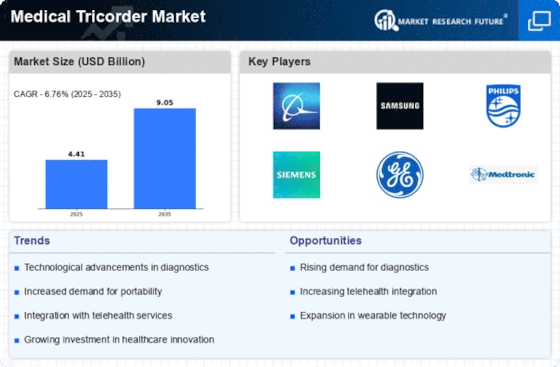
As per MRFR analysis, the Medical Tricorder Market Size was estimated at 4.409 USD Billion in 2024. The Medical Tricorder industry is projected to grow from 4.707 USD Billion in 2025 to 9.054 USD Billion by 2035, exhibiting a compound annual growth rate (CAGR) of 6.76 during the forecast period 2025 - 2035.

Key Market Trends & Highlights

The Medical Tricorder Market is poised for substantial growth driven by technological advancements and shifting healthcare paradigms.

  • Technological advancements are enhancing the capabilities of medical tricorders, enabling more accurate diagnostics. The shift towards home healthcare is propelling demand for portable and user-friendly medical tricorder devices. North America remains the largest market, while the Asia-Pacific region is emerging as the fastest-growing area for medical tricorder adoption. Rising demand for remote diagnostics and increased focus on preventive healthcare are key drivers fueling market expansion.

Market Size & Forecast

2024 Market Size 4.409 (USD Billion)
2035 Market Size 9.054 (USD Billion)
CAGR (2025 - 2035) 6.76%
Largest Regional Market Share in 2024 North America

Major Players

<p>Boeing (US), Samsung (KR), Philips (NL), Siemens (DE), General Electric (US), Medtronic (US), IBM (US), Canon (JP), Fujifilm (JP)</p>

Market Trends

The Medical Tricorder Market is currently experiencing a transformative phase, driven by advancements in technology and increasing demand for portable diagnostic tools. This market appears to be evolving rapidly, as healthcare providers seek innovative solutions to enhance patient care and streamline diagnostic processes. The integration of artificial intelligence and machine learning into tricorder devices suggests a potential for improved accuracy and efficiency in medical assessments. Furthermore, the growing emphasis on telemedicine and remote patient monitoring indicates a shift towards more accessible healthcare solutions, which may further propel the adoption of medical tricorders. In addition, the rising prevalence of chronic diseases and the need for continuous health monitoring seem to be influencing the market landscape. As patients increasingly prefer home-based healthcare options, the Medical Tricorder Market is likely to expand, catering to this demand for user-friendly and effective diagnostic tools. The collaboration between technology firms and healthcare organizations appears to be fostering innovation, leading to the development of advanced features in tricorder devices. Overall, the Medical Tricorder Market is poised for growth, driven by technological advancements and changing consumer preferences in healthcare delivery.

Technological Advancements

The Medical Tricorder Market is witnessing rapid technological progress, particularly in the integration of artificial intelligence and machine learning. These innovations are enhancing the capabilities of tricorder devices, allowing for more accurate diagnostics and real-time health monitoring.

Shift Towards Home Healthcare

There is a noticeable trend towards home healthcare solutions, as patients increasingly prefer to manage their health from the comfort of their homes. This shift is likely to drive demand for portable and user-friendly medical tricorders that facilitate self-diagnosis and monitoring.

Collaboration in Healthcare Innovation

The collaboration between technology companies and healthcare providers is fostering innovation within the Medical Tricorder Market. Such partnerships are expected to lead to the development of advanced features and functionalities in tricorder devices, enhancing their utility in clinical settings.

Medical tricorder Market Market Drivers

Growing Aging Population

The Medical Tricorder Market is poised for growth due to the increasing aging population worldwide. As individuals age, the prevalence of chronic diseases rises, necessitating effective monitoring and management solutions. Medical tricorders offer a convenient means of tracking health metrics, making them particularly appealing to older adults and their caregivers. With projections indicating that the global elderly population will reach 1.5 billion by 2050, the demand for user-friendly diagnostic tools is expected to escalate. This demographic shift presents a substantial opportunity for the medical tricorder market, as healthcare providers seek to cater to the unique needs of aging patients.

Rising Demand for Remote Diagnostics

The Medical Tricorder Market is experiencing a notable increase in demand for remote diagnostics solutions. This trend is driven by the growing need for efficient healthcare delivery, particularly in underserved areas. As healthcare systems seek to reduce costs and improve patient outcomes, the adoption of medical tricorders, which enable non-invasive diagnostics, is likely to rise. According to recent estimates, the market for remote diagnostic tools is projected to reach USD 5 billion by 2026, indicating a robust growth trajectory. This demand is further fueled by advancements in sensor technology and data analytics, which enhance the capabilities of medical tricorders, making them indispensable in modern healthcare.

Integration of Artificial Intelligence

The integration of artificial intelligence (AI) into the Medical Tricorder Market is transforming diagnostic processes. AI algorithms can analyze vast amounts of data quickly and accurately, improving the reliability of diagnostic results. This technological advancement not only enhances the functionality of medical tricorders but also streamlines workflows in clinical settings. The market for AI in healthcare is expected to grow significantly, with projections suggesting it could reach USD 36 billion by 2025. As healthcare providers increasingly recognize the potential of AI to augment decision-making, the demand for AI-enabled medical tricorders is likely to surge, positioning them as critical tools in patient care.

Increased Focus on Preventive Healthcare

The Medical Tricorder Market is benefiting from a heightened focus on preventive healthcare. As healthcare systems shift from reactive to proactive approaches, the demand for tools that facilitate early detection of health issues is growing. Medical tricorders, which can monitor vital signs and detect anomalies, are becoming essential in this paradigm shift. The preventive healthcare market is projected to expand, with estimates indicating a value of USD 4 trillion by 2027. This trend underscores the importance of medical tricorders in empowering individuals to take charge of their health, thereby driving their adoption across various healthcare settings.

Regulatory Support for Innovative Medical Devices

Regulatory bodies are increasingly supporting the development and approval of innovative medical devices, including those in the Medical Tricorder Market. Streamlined approval processes and favorable regulations are encouraging manufacturers to invest in research and development. This regulatory environment is conducive to the introduction of advanced medical tricorders that meet stringent safety and efficacy standards. As a result, the market is likely to witness a surge in new product launches, enhancing competition and driving innovation. The potential for rapid market entry of novel devices could significantly reshape the landscape of medical diagnostics.

Market Segment Insights

By Type: USB Camera (Largest) vs. Wireless (Fastest-Growing)

<p>The Medical Tricorder Market's type segment showcases diverse technologies, with USB cameras leading the market share due to their robustness, image clarity, and cost-effectiveness. Following this, fiber-optic cameras hold a significant position thanks to their ability to transmit high-quality images in minimally invasive procedures. Wireless types are increasingly gaining traction, driven by the demand for portability and user-friendly integration into various medical setups.</p>

<p>Technology: USB Camera (Dominant) vs. Wireless (Emerging)</p>

<p>USB cameras represent the dominant technology in the Medical Tricorder Market, renowned for their consistent performance and compatibility with various systems. They are favored for their high-resolution imaging capabilities, reliability, and straightforward connectivity, making them indispensable in both diagnostic and therapeutic applications. In contrast, wireless technologies are emerging as the preferred choice for modern healthcare demands, allowing for enhanced mobility and ease of use in dynamic environments. The growing inclination towards telemedicine and remote patient monitoring is contributing to their rapid adoption, indicating a shift in preferences towards more advanced, flexible solutions in medical imaging.</p>

By Application: Diagnosis (Largest) vs. Monitoring (Fastest-Growing)

<p>In the Medical Tricorder Market, the application segment is largely dominated by diagnosis, which holds the largest market share. This application allows for rapid and accurate identification of medical conditions, leveraging advanced technologies embedded in tricorders. As healthcare becomes increasingly patient-centric, diagnostic tools that offer instant results are in high demand, contributing significantly to the market's growth.</p>

<p>Diagnosis: Traditional (Dominant) vs. Monitoring: Wearable Devices (Emerging)</p>

<p>The diagnosis application in the Medical Tricorder Market has traditionally been the dominant force, leveraging sophisticated algorithms and sensors to provide immediate feedback to healthcare providers. In contrast, the monitoring sector, particularly through wearable devices, is experiencing rapid growth. These emerging devices are revolutionizing patient care by enabling continuous health tracking, remote monitoring, and real-time data collection, which empowers patients and healthcare professionals alike. Their portability and user-friendly interfaces appeal to a broad audience, paving the way for a future where monitoring could rival traditional diagnostic methods.</p>

By End-Users: Hospitals (Largest) vs. Clinics (Fastest-Growing)

<p>In the Medical Tricorder Market, hospitals represent the largest segment, capturing a substantial share with their advanced technological infrastructure and significant patient volumes. Clinics, while smaller in market share, are rapidly gaining traction, making them a key player in this evolving landscape. The competitive dynamics illustrate a clear distinction in market positioning, with hospitals having established protocols that integrate triaging and diagnostic capabilities effectively. Clinics are gradually embracing these technologies to enhance their diagnostic efficacy and patient management processes, appealing to their unique operational models. The growth trends indicate an upward trajectory for both hospitals and clinics in the adoption of medical tricorders. Hospitals are increasingly investing in cutting-edge diagnostic equipment to improve patient outcomes, while clinics are becoming the fastest-growing segment due to the demand for efficient and portable diagnostic tools. This expansion is fueled by the rising awareness of non-invasive diagnostic methods and the ongoing innovations in health technology aimed at streamlining patient care. The need for accurate and rapid diagnostics in diverse healthcare settings drives this growth, making both segments critical to the future of the Medical Tricorder Market.</p>

<p>Hospitals (Dominant) vs. Clinics (Emerging)</p>

<p>Hospitals, as the dominant segment in the Medical Tricorder Market, benefit from substantial investment in healthcare technology and an established patient base. Their infrastructure supports the integration of tricorder devices, allowing for comprehensive diagnostics and patient monitoring. The regulatory support and established workflows in hospitals advocate for the widespread adoption of advanced medical technologies, ensuring that hospitals remain at the forefront of innovation. Conversely, clinics are marked as an emerging segment with distinctive characteristics that cater to the need for quick, accessible healthcare services. Their agility in adopting new technologies positions them as innovators in the diagnostics space. Clinics leverage tricorders to enhance patient efficiency and streamline consultation processes, reflecting a shift towards patient-centric care models and indicating a significant potential for growth.</p>

Get more detailed insights about Medical Tricorder Market Research Report- Forecast To 2035

Regional Insights

Key Companies in the Medical tricorder Market market include

Industry Developments

  • Based on the findings that have been circulated by the WHO, the approximate number of people who are suffering from diabetes across the globe is touching the value of 422 million. This rise in the number of cases is giving rise to the medical tricorder market analysis and hence, the demand is rising at a huge scale during the ongoing forecast period that will be ending in 2023.
  • The medical tricorder market revenue is likely to show steady but positive growth in the Middle East and Africa region owing to rising demand for primary care services for the diagnosis and treatment of chronic diseases. Also, there has been a rising awareness about preventive measures for various diseases that are leading to an increase in the emphasis on women and child care.
  • According to the statistics that have been circulated by the American Diabetes Association, in 2015, there are approximately 30.3 million Americans which accounts for 9.4% of the American population were suffering from diabetes. This is expanding the demand for the market in the region. 


Future Outlook

Medical tricorder Market Future Outlook

<p>The Medical Tricorder Market is projected to grow at a 6.76% CAGR from 2024 to 2035, driven by technological advancements, increasing demand for remote diagnostics, and rising healthcare expenditures.</p>

New opportunities lie in:

  • <p>Development of portable diagnostic devices for home healthcare settings.</p><p>Integration of AI algorithms for enhanced diagnostic accuracy.</p><p>Partnerships with telemedicine platforms to expand service offerings.</p>

<p>By 2035, the Medical Tricorder Market is expected to achieve substantial growth and innovation.</p>

Market Segmentation

Medical tricorder Market Type Outlook

  • USB camera
  • fiber-optic camera
  • wireless
  • corded
  • other types

Medical tricorder Market End-Users Outlook

  • hospitals
  • clinics
  • others

Medical tricorder Market Application Outlook

  • diagnosis
  • monitoring
  • other applications

Report Scope

MARKET SIZE 20244.409(USD Billion)
MARKET SIZE 20254.707(USD Billion)
MARKET SIZE 20359.054(USD Billion)
COMPOUND ANNUAL GROWTH RATE (CAGR)6.76% (2024 - 2035)
REPORT COVERAGERevenue Forecast, Competitive Landscape, Growth Factors, and Trends
BASE YEAR2024
Market Forecast Period2025 - 2035
Historical Data2019 - 2024
Market Forecast UnitsUSD Billion
Key Companies ProfiledMarket analysis in progress
Segments CoveredMarket segmentation analysis in progress
Key Market OpportunitiesIntegration of artificial intelligence in diagnostics enhances capabilities within the Medical Tricorder Market.
Key Market DynamicsTechnological advancements and regulatory changes drive innovation and competition in the Medical Tricorder Market.
Countries CoveredNorth America, Europe, APAC, South America, MEA

FAQs

What is the projected market valuation of the Medical Tricorder Market by 2035?

The Medical Tricorder Market is projected to reach a valuation of 9.054 USD Billion by 2035.

What was the market valuation of the Medical Tricorder Market in 2024?

In 2024, the Medical Tricorder Market had a valuation of 4.409 USD Billion.

What is the expected CAGR for the Medical Tricorder Market during the forecast period 2025 - 2035?

The expected CAGR for the Medical Tricorder Market during the forecast period 2025 - 2035 is 6.76%.

Which companies are considered key players in the Medical Tricorder Market?

Key players in the Medical Tricorder Market include Boeing, Samsung, Philips, Siemens, General Electric, Medtronic, IBM, Canon, and Fujifilm.

What are the main application segments of the Medical Tricorder Market?

The main application segments of the Medical Tricorder Market include diagnosis, monitoring, and other applications.

  1. SECTION I: EXECUTIVE SUMMARY AND KEY HIGHLIGHTS
    1. EXECUTIVE SUMMARY
      1. Market Overview
      2. Key Findings
      3. Market Segmentation
      4. Competitive Landscape
      5. Challenges and Opportunities
      6. Future Outlook
  2. SECTION II: SCOPING, METHODOLOGY AND MARKET STRUCTURE
    1. MARKET INTRODUCTION
      1. Definition
      2. Scope of the study
    2. RESEARCH METHODOLOGY
      1. Overview
      2. Data Mining
      3. Secondary Research
      4. Primary Research
      5. Forecasting Model
      6. Market Size Estimation
      7. Data Triangulation
      8. Validation
  3. SECTION III: QUALITATIVE ANALYSIS
    1. MARKET DYNAMICS
      1. Overview
      2. Drivers
      3. Restraints
      4. Opportunities
    2. MARKET FACTOR ANALYSIS
      1. Value chain Analysis
      2. Porter's Five Forces Analysis
      3. COVID-19 Impact Analysis
  4. SECTION IV: QUANTITATIVE ANALYSIS
    1. Healthcare, BY Type (USD Billion)
      1. USB camera
      2. fiber-optic camera
      3. wireless
      4. corded
      5. other types
    2. Healthcare, BY Application (USD Billion)
      1. diagnosis
      2. monitoring
      3. other applications
    3. Healthcare, BY End-Users (USD Billion)
      1. hospitals
      2. clinics
      3. others
    4. Healthcare, BY Region (USD Billion)
      1. North America
      2. Europe
      3. APAC
      4. South America
      5. MEA
  5. SECTION V: COMPETITIVE ANALYSIS
    1. Competitive Landscape
      1. Overview
      2. Competitive Analysis
      3. Market share Analysis
      4. Major Growth Strategy in the Healthcare
      5. Competitive Benchmarking
      6. Leading Players in Terms of Number of Developments in the Healthcare
      7. Key developments and growth strategies
      8. Major Players Financial Matrix
    2. Company Profiles
      1. Boeing (US)
      2. Samsung (KR)
      3. Philips (NL)
      4. Siemens (DE)
      5. General Electric (US)
      6. Medtronic (US)
      7. IBM (US)
      8. Canon (JP)
      9. Fujifilm (JP)
    3. Appendix
      1. References
      2. Related Reports
  6. LIST OF FIGURES
    1. MARKET SYNOPSIS
    2. NORTH AMERICA MARKET ANALYSIS
    3. US MARKET ANALYSIS BY TYPE
    4. US MARKET ANALYSIS BY APPLICATION
    5. US MARKET ANALYSIS BY END-USERS
    6. CANADA MARKET ANALYSIS BY TYPE
    7. CANADA MARKET ANALYSIS BY APPLICATION
    8. CANADA MARKET ANALYSIS BY END-USERS
    9. EUROPE MARKET ANALYSIS
    10. GERMANY MARKET ANALYSIS BY TYPE
    11. GERMANY MARKET ANALYSIS BY APPLICATION
    12. GERMANY MARKET ANALYSIS BY END-USERS
    13. UK MARKET ANALYSIS BY TYPE
    14. UK MARKET ANALYSIS BY APPLICATION
    15. UK MARKET ANALYSIS BY END-USERS
    16. FRANCE MARKET ANALYSIS BY TYPE
    17. FRANCE MARKET ANALYSIS BY APPLICATION
    18. FRANCE MARKET ANALYSIS BY END-USERS
    19. RUSSIA MARKET ANALYSIS BY TYPE
    20. RUSSIA MARKET ANALYSIS BY APPLICATION
    21. RUSSIA MARKET ANALYSIS BY END-USERS
    22. ITALY MARKET ANALYSIS BY TYPE
    23. ITALY MARKET ANALYSIS BY APPLICATION
    24. ITALY MARKET ANALYSIS BY END-USERS
    25. SPAIN MARKET ANALYSIS BY TYPE
    26. SPAIN MARKET ANALYSIS BY APPLICATION
    27. SPAIN MARKET ANALYSIS BY END-USERS
    28. REST OF EUROPE MARKET ANALYSIS BY TYPE
    29. REST OF EUROPE MARKET ANALYSIS BY APPLICATION
    30. REST OF EUROPE MARKET ANALYSIS BY END-USERS
    31. APAC MARKET ANALYSIS
    32. CHINA MARKET ANALYSIS BY TYPE
    33. CHINA MARKET ANALYSIS BY APPLICATION
    34. CHINA MARKET ANALYSIS BY END-USERS
    35. INDIA MARKET ANALYSIS BY TYPE
    36. INDIA MARKET ANALYSIS BY APPLICATION
    37. INDIA MARKET ANALYSIS BY END-USERS
    38. JAPAN MARKET ANALYSIS BY TYPE
    39. JAPAN MARKET ANALYSIS BY APPLICATION
    40. JAPAN MARKET ANALYSIS BY END-USERS
    41. SOUTH KOREA MARKET ANALYSIS BY TYPE
    42. SOUTH KOREA MARKET ANALYSIS BY APPLICATION
    43. SOUTH KOREA MARKET ANALYSIS BY END-USERS
    44. MALAYSIA MARKET ANALYSIS BY TYPE
    45. MALAYSIA MARKET ANALYSIS BY APPLICATION
    46. MALAYSIA MARKET ANALYSIS BY END-USERS
    47. THAILAND MARKET ANALYSIS BY TYPE
    48. THAILAND MARKET ANALYSIS BY APPLICATION
    49. THAILAND MARKET ANALYSIS BY END-USERS
    50. INDONESIA MARKET ANALYSIS BY TYPE
    51. INDONESIA MARKET ANALYSIS BY APPLICATION
    52. INDONESIA MARKET ANALYSIS BY END-USERS
    53. REST OF APAC MARKET ANALYSIS BY TYPE
    54. REST OF APAC MARKET ANALYSIS BY APPLICATION
    55. REST OF APAC MARKET ANALYSIS BY END-USERS
    56. SOUTH AMERICA MARKET ANALYSIS
    57. BRAZIL MARKET ANALYSIS BY TYPE
    58. BRAZIL MARKET ANALYSIS BY APPLICATION
    59. BRAZIL MARKET ANALYSIS BY END-USERS
    60. MEXICO MARKET ANALYSIS BY TYPE
    61. MEXICO MARKET ANALYSIS BY APPLICATION
    62. MEXICO MARKET ANALYSIS BY END-USERS
    63. ARGENTINA MARKET ANALYSIS BY TYPE
    64. ARGENTINA MARKET ANALYSIS BY APPLICATION
    65. ARGENTINA MARKET ANALYSIS BY END-USERS
    66. REST OF SOUTH AMERICA MARKET ANALYSIS BY TYPE
    67. REST OF SOUTH AMERICA MARKET ANALYSIS BY APPLICATION
    68. REST OF SOUTH AMERICA MARKET ANALYSIS BY END-USERS
    69. MEA MARKET ANALYSIS
    70. GCC COUNTRIES MARKET ANALYSIS BY TYPE
    71. GCC COUNTRIES MARKET ANALYSIS BY APPLICATION
    72. GCC COUNTRIES MARKET ANALYSIS BY END-USERS
    73. SOUTH AFRICA MARKET ANALYSIS BY TYPE
    74. SOUTH AFRICA MARKET ANALYSIS BY APPLICATION
    75. SOUTH AFRICA MARKET ANALYSIS BY END-USERS
    76. REST OF MEA MARKET ANALYSIS BY TYPE
    77. REST OF MEA MARKET ANALYSIS BY APPLICATION
    78. REST OF MEA MARKET ANALYSIS BY END-USERS
    79. KEY BUYING CRITERIA OF HEALTHCARE
    80. RESEARCH PROCESS OF MRFR
    81. DRO ANALYSIS OF HEALTHCARE
    82. DRIVERS IMPACT ANALYSIS: HEALTHCARE
    83. RESTRAINTS IMPACT ANALYSIS: HEALTHCARE
    84. SUPPLY / VALUE CHAIN: HEALTHCARE
    85. HEALTHCARE, BY TYPE, 2024 (% SHARE)
    86. HEALTHCARE, BY TYPE, 2024 TO 2035 (USD Billion)
    87. HEALTHCARE, BY APPLICATION, 2024 (% SHARE)
    88. HEALTHCARE, BY APPLICATION, 2024 TO 2035 (USD Billion)
    89. HEALTHCARE, BY END-USERS, 2024 (% SHARE)
    90. HEALTHCARE, BY END-USERS, 2024 TO 2035 (USD Billion)
    91. BENCHMARKING OF MAJOR COMPETITORS
  7. LIST OF TABLES
    1. LIST OF ASSUMPTIONS
    2. North America MARKET SIZE ESTIMATES; FORECAST
      1. BY TYPE, 2025-2035 (USD Billion)
      2. BY APPLICATION, 2025-2035 (USD Billion)
      3. BY END-USERS, 2025-2035 (USD Billion)
    3. US MARKET SIZE ESTIMATES; FORECAST
      1. BY TYPE, 2025-2035 (USD Billion)
      2. BY APPLICATION, 2025-2035 (USD Billion)
      3. BY END-USERS, 2025-2035 (USD Billion)
    4. Canada MARKET SIZE ESTIMATES; FORECAST
      1. BY TYPE, 2025-2035 (USD Billion)
      2. BY APPLICATION, 2025-2035 (USD Billion)
      3. BY END-USERS, 2025-2035 (USD Billion)
    5. Europe MARKET SIZE ESTIMATES; FORECAST
      1. BY TYPE, 2025-2035 (USD Billion)
      2. BY APPLICATION, 2025-2035 (USD Billion)
      3. BY END-USERS, 2025-2035 (USD Billion)
    6. Germany MARKET SIZE ESTIMATES; FORECAST
      1. BY TYPE, 2025-2035 (USD Billion)
      2. BY APPLICATION, 2025-2035 (USD Billion)
      3. BY END-USERS, 2025-2035 (USD Billion)
    7. UK MARKET SIZE ESTIMATES; FORECAST
      1. BY TYPE, 2025-2035 (USD Billion)
      2. BY APPLICATION, 2025-2035 (USD Billion)
      3. BY END-USERS, 2025-2035 (USD Billion)
    8. France MARKET SIZE ESTIMATES; FORECAST
      1. BY TYPE, 2025-2035 (USD Billion)
      2. BY APPLICATION, 2025-2035 (USD Billion)
      3. BY END-USERS, 2025-2035 (USD Billion)
    9. Russia MARKET SIZE ESTIMATES; FORECAST
      1. BY TYPE, 2025-2035 (USD Billion)
      2. BY APPLICATION, 2025-2035 (USD Billion)
      3. BY END-USERS, 2025-2035 (USD Billion)
    10. Italy MARKET SIZE ESTIMATES; FORECAST
      1. BY TYPE, 2025-2035 (USD Billion)
      2. BY APPLICATION, 2025-2035 (USD Billion)
      3. BY END-USERS, 2025-2035 (USD Billion)
    11. Spain MARKET SIZE ESTIMATES; FORECAST
      1. BY TYPE, 2025-2035 (USD Billion)
      2. BY APPLICATION, 2025-2035 (USD Billion)
      3. BY END-USERS, 2025-2035 (USD Billion)
    12. Rest of Europe MARKET SIZE ESTIMATES; FORECAST
      1. BY TYPE, 2025-2035 (USD Billion)
      2. BY APPLICATION, 2025-2035 (USD Billion)
      3. BY END-USERS, 2025-2035 (USD Billion)
    13. APAC MARKET SIZE ESTIMATES; FORECAST
      1. BY TYPE, 2025-2035 (USD Billion)
      2. BY APPLICATION, 2025-2035 (USD Billion)
      3. BY END-USERS, 2025-2035 (USD Billion)
    14. China MARKET SIZE ESTIMATES; FORECAST
      1. BY TYPE, 2025-2035 (USD Billion)
      2. BY APPLICATION, 2025-2035 (USD Billion)
      3. BY END-USERS, 2025-2035 (USD Billion)
    15. India MARKET SIZE ESTIMATES; FORECAST
      1. BY TYPE, 2025-2035 (USD Billion)
      2. BY APPLICATION, 2025-2035 (USD Billion)
      3. BY END-USERS, 2025-2035 (USD Billion)
    16. Japan MARKET SIZE ESTIMATES; FORECAST
      1. BY TYPE, 2025-2035 (USD Billion)
      2. BY APPLICATION, 2025-2035 (USD Billion)
      3. BY END-USERS, 2025-2035 (USD Billion)
    17. South Korea MARKET SIZE ESTIMATES; FORECAST
      1. BY TYPE, 2025-2035 (USD Billion)
      2. BY APPLICATION, 2025-2035 (USD Billion)
      3. BY END-USERS, 2025-2035 (USD Billion)
    18. Malaysia MARKET SIZE ESTIMATES; FORECAST
      1. BY TYPE, 2025-2035 (USD Billion)
      2. BY APPLICATION, 2025-2035 (USD Billion)
      3. BY END-USERS, 2025-2035 (USD Billion)
    19. Thailand MARKET SIZE ESTIMATES; FORECAST
      1. BY TYPE, 2025-2035 (USD Billion)
      2. BY APPLICATION, 2025-2035 (USD Billion)
      3. BY END-USERS, 2025-2035 (USD Billion)
    20. Indonesia MARKET SIZE ESTIMATES; FORECAST
      1. BY TYPE, 2025-2035 (USD Billion)
      2. BY APPLICATION, 2025-2035 (USD Billion)
      3. BY END-USERS, 2025-2035 (USD Billion)
    21. Rest of APAC MARKET SIZE ESTIMATES; FORECAST
      1. BY TYPE, 2025-2035 (USD Billion)
      2. BY APPLICATION, 2025-2035 (USD Billion)
      3. BY END-USERS, 2025-2035 (USD Billion)
    22. South America MARKET SIZE ESTIMATES; FORECAST
      1. BY TYPE, 2025-2035 (USD Billion)
      2. BY APPLICATION, 2025-2035 (USD Billion)
      3. BY END-USERS, 2025-2035 (USD Billion)
    23. Brazil MARKET SIZE ESTIMATES; FORECAST
      1. BY TYPE, 2025-2035 (USD Billion)
      2. BY APPLICATION, 2025-2035 (USD Billion)
      3. BY END-USERS, 2025-2035 (USD Billion)
    24. Mexico MARKET SIZE ESTIMATES; FORECAST
      1. BY TYPE, 2025-2035 (USD Billion)
      2. BY APPLICATION, 2025-2035 (USD Billion)
      3. BY END-USERS, 2025-2035 (USD Billion)
    25. Argentina MARKET SIZE ESTIMATES; FORECAST
      1. BY TYPE, 2025-2035 (USD Billion)
      2. BY APPLICATION, 2025-2035 (USD Billion)
      3. BY END-USERS, 2025-2035 (USD Billion)
    26. Rest of South America MARKET SIZE ESTIMATES; FORECAST
      1. BY TYPE, 2025-2035 (USD Billion)
      2. BY APPLICATION, 2025-2035 (USD Billion)
      3. BY END-USERS, 2025-2035 (USD Billion)
    27. MEA MARKET SIZE ESTIMATES; FORECAST
      1. BY TYPE, 2025-2035 (USD Billion)
      2. BY APPLICATION, 2025-2035 (USD Billion)
      3. BY END-USERS, 2025-2035 (USD Billion)
    28. GCC Countries MARKET SIZE ESTIMATES; FORECAST
      1. BY TYPE, 2025-2035 (USD Billion)
      2. BY APPLICATION, 2025-2035 (USD Billion)
      3. BY END-USERS, 2025-2035 (USD Billion)
    29. South Africa MARKET SIZE ESTIMATES; FORECAST
      1. BY TYPE, 2025-2035 (USD Billion)
      2. BY APPLICATION, 2025-2035 (USD Billion)
      3. BY END-USERS, 2025-2035 (USD Billion)
    30. Rest of MEA MARKET SIZE ESTIMATES; FORECAST
      1. BY TYPE, 2025-2035 (USD Billion)
      2. BY APPLICATION, 2025-2035 (USD Billion)
      3. BY END-USERS, 2025-2035 (USD Billion)
    31. PRODUCT LAUNCH/PRODUCT DEVELOPMENT/APPROVAL
    32. ACQUISITION/PARTNERSHIP

Medical Tricorder Market Segmentation

Market Segmentation Overview

  • Detailed segmentation data will be available in the full report
  • Comprehensive analysis by multiple parameters
  • Regional and country-level breakdowns
  • Market size forecasts by segment
Infographic

Free Sample Request

Kindly complete the form below to receive a free sample of this Report

Get Free Sample

Customer Strories

Compare Licence

×
Features License Type
Single User Multiuser License Enterprise User
Price $4,950 $5,950 $7,250
Maximum User Access Limit 1 User Upto 10 Users Unrestricted Access Throughout the Organization
Free Customization
Direct Access to Analyst
Deliverable Format
Platform Access
Discount on Next Purchase 10% 15% 15%
Printable Versions