×
Request Free Sample ×

Kindly complete the form below to receive a free sample of this Report

* Please use a valid business email

Leading companies partner with us for data-driven Insights

clients tt-cursor
Hero Background
English
Chinese
French
Japanese
Korean
German
Spanish

Medical Lasers Market Share

ID: MRFR/MED/9684-HCR
200 Pages
Rahul Gotadki
October 2025

Medical Lasers Market Research Report By Application (Surgery, Dermatology, Ophthalmology, Dentistry, Gynecology), By Product Type (Solid State Lasers, Gas Lasers, Diode Lasers, Fiber Lasers, Excimer Lasers), By End Use (Hospitals, Outpatient Clinics, Ambulatory Surgical Centers, Research Institutes, Dental Clinics), By Technology (Contemporary, Traditional, Portable, Robotic) and By Regional (North America, Europe, South America, Asia Pacific, Middle East and Africa) - Growth & Industry Forecast 2025 To 2035

Share:
Download PDF ×

We do not share your information with anyone. However, we may send you emails based on your report interest from time to time. You may contact us at any time to opt-out.

Medical Lasers Market Infographic
Purchase Options

Market Share

Medical Lasers Market Share Analysis

According to the United Nations Population Fund (UNPF), the percentage of elderly individuals (aged 60 or above) in the global population is expected to rise. Currently, they make up about 12.3% of the world's population, and this is projected to increase to around 22% by the year 2050, despite overall population growth. This demographic shift is expected to significantly drive the dental market. The increase in the aging population will lead to a higher demand for dental treatments and procedures. Older individuals may require dental fillings, dentures, dental implants, and other interventions to address their oral health issues. This will create opportunities for the dental consumables market to provide the necessary materials and products for these treatments. As people age, their dental health becomes more crucial for their overall well-being. Poor oral health can affect their ability to eat, speak, and socialize comfortably. It can also lead to pain, infection, and other complications. Therefore, the importance of maintaining good oral hygiene and seeking regular dental care becomes even more significant for older individuals. The dental consumables market plays a vital role in meeting the demands of dental treatments for the aging population. Dental consumables include materials such as dental implants, fillings, crowns, and adhesives, which are necessary for various dental procedures. These products ensure the quality and durability of dental treatments, improving the oral health and quality of life for older individuals. In conclusion, the increase in the aging population worldwide will have a significant impact on the dental market. Older individuals often face various dental issues that require treatments and procedures. The dental consumables market will play a crucial role in providing the necessary materials for these interventions. It is important for older individuals to prioritize their oral health and seek regular dental care to maintain their overall well-being. Dental professionals will need to adapt to the specific needs of elderly patients, and advancements in dental technology will continue to improve the quality and efficiency of dental treatments. By addressing the dental needs of the aging population, we can ensure better oral health and a higher quality of life for older individuals.

Author
Rahul Gotadki
Assistant Manager

He holds an experience of about 7+ years in Market Research and Business Consulting, working under the spectrum of Life Sciences and Healthcare domains. Rahul conceptualizes and implements a scalable business strategy and provides strategic leadership to the clients. His expertise lies in market estimation, competitive intelligence, pipeline analysis, customer assessment, etc. In addition to the above, his other responsibility includes strategic tracking of high growth markets & advising clients on the potential areas of focus they could direct their business initiatives

Leave a Comment

FAQs

What is the projected growth of the Medical Lasers market?

The Medical Lasers market is the expected increase in total market value of 27.47 USD billion over a defined forecast period 2025–2035. It is driven by factors such as demand trends, technological advances, regulatory changes, and geographic expansion.

What is the size of the Medical Lasers market?

Medical Lasers market size was valued at approximately 6.82 billion USD in 2024. This figure will reach 27.47 billion USD covering all regions (America, Europe, Asia, MEA and ROW), focusing its segments / services / distribution channels till 2035.

What is the CAGR of the Medical Lasers market?

Medical Lasers market is expected to grow at a CAGR of 13.5% between 2025 and 2035.

How much will the Medical Lasers market be worth by 2035?

Medical Lasers market is expected to be worth of 27.47 billion USD, reflecting growth driven by usage, technology and global demands by the end of 2035.

How will the Medical Lasers market perform over the next 10 years?

Over the next 10 years the Medical Lasers market is expected to shift from usd billion 6.82 to 27.47 billion USD, led by adoption of advanced tech, demographic trends, regulatory approvals, with potential headwinds from 2025 to 2035.

Which region is anticipated to have the largest market share in the Global Medical Lasers Market in 2024?

North America is expected to hold the largest market share, valued at 3.1 USD Billion in 2024.

What is the market value of the Global Medical Lasers Market in Europe for the year 2024?

The market value of the Global Medical Lasers Market in Europe is expected to reach 1.7 USD Billion in 2024.

What applications are driving the Global Medical Lasers Market, and what is their size in 2024?

In 2024, key applications such as Surgery, Dermatology, and Ophthalmology are projected to be valued at 2.0 USD Billion, 1.5 USD Billion, and 1.1 USD Billion respectively.

Which medical laser company is recognized as a major player in the Global Medical Lasers Market?

Major players in the Global Medical Lasers Market include medical lasers companies such as LaserMed, Abbott Laboratories, and Hologic.

What will be the projected market value for the South America region by 2035?

The projected market value for the South America region in the Global Medical Lasers Market is expected to be 1.3 USD Billion by 2035.

Market Summary

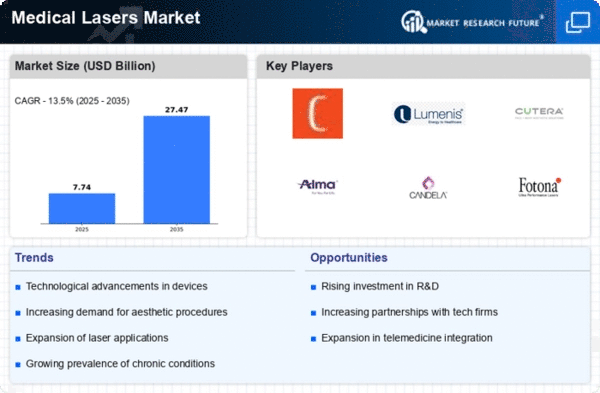
As per MRFR analysis, the Medical Lasers Market Size was estimated at 6.82 USD Billion in 2024. The Medical Lasers industry is projected to grow from 7.74 USD Billion in 2025 to 27.47 USD Billion by 2035, exhibiting a compound annual growth rate (CAGR) of 13.5 during the forecast period 2025 - 2035.

Key Market Trends & Highlights

The Medical Lasers Market is experiencing robust growth driven by technological advancements and increasing demand for minimally invasive procedures.

  • North America remains the largest market for medical lasers, driven by advanced healthcare infrastructure and high adoption rates. The Asia-Pacific region is the fastest-growing market, fueled by rising healthcare investments and increasing patient awareness. Dermatology continues to dominate the market, while urology is emerging as the fastest-growing segment due to rising incidences of urological disorders. Key market drivers include the rising demand for aesthetic procedures and technological innovations in laser systems.

Market Size & Forecast

2024 Market Size 6.82 (USD Billion)
2035 Market Size 27.47 (USD Billion)
CAGR (2025 - 2035) 13.5%
Largest Regional Market Share in 2024 North America

Major Players

Cynosure (US), <a href="https://lumenis.com/">Lumenis </a>(IL), Cutera (US), Alma Lasers (IL), Syneron Candela (IL), Fotona (SI), Bausch Health Companies (CA), Merz Pharmaceuticals (DE), Quanta System (IT)

Market Trends

The Medical Lasers Market is currently experiencing a transformative phase, driven by advancements in technology and increasing applications across various medical fields. The integration of laser systems in surgical procedures, dermatology, and ophthalmology has expanded the scope of treatment options available to healthcare professionals. This evolution is characterized by a growing preference for minimally invasive techniques, which are often associated with reduced recovery times and improved patient outcomes. Furthermore, the rising prevalence of chronic diseases and the aging population are contributing to the heightened demand for effective medical interventions, thereby propelling the market forward. In addition to technological innovations, the Medical Lasers Market is witnessing a surge in research and development activities aimed at enhancing the efficacy and safety of laser medical devices. Regulatory bodies are also playing a crucial role in ensuring that new products meet stringent safety standards, which fosters consumer confidence. As the market continues to evolve, it appears poised for sustained growth, with potential opportunities emerging in developing regions where access to advanced medical technologies is expanding. Overall, the Medical Lasers Market reflects a dynamic landscape that is adapting to the changing needs of healthcare providers and patients alike.

Technological Advancements

The Medical Lasers Market is significantly influenced by ongoing technological advancements. Innovations in laser technology, such as the development of more precise and efficient laser medical devices, are enhancing treatment outcomes. These advancements are not only improving the effectiveness of procedures but also expanding the range of applications across various medical specialties.

Minimally Invasive Procedures

There is a growing preference for minimally invasive techniques within the Medical Lasers Market. These procedures often result in shorter recovery times and less postoperative discomfort for patients. As healthcare providers increasingly adopt these methods, the demand for laser technologies that facilitate such treatments is likely to rise.

Regulatory Compliance and Safety Standards

The Medical Lasers Market is increasingly influenced by stringent regulatory requirements aimed at ensuring patient safety. Manufacturers are compelled to adhere to these standards, which may drive innovation and improve product quality. This trend suggests a commitment to enhancing the overall safety and efficacy of laser applications in medical practice.

Medical Lasers Market Market Drivers

Market Growth Projections

The Global Medical Lasers Market Industry is projected to experience substantial growth over the coming years. With a market value expected to reach 6.57 USD Billion in 2024 and further expand to 12 USD Billion by 2035, the industry is poised for a robust trajectory. The anticipated compound annual growth rate (CAGR) of 5.63% from 2025 to 2035 indicates a strong demand for medical laser technologies across various applications. This growth is likely to be driven by factors such as technological advancements, increasing prevalence of chronic diseases, and rising consumer interest in aesthetic procedures. The market's expansion reflects the ongoing evolution of healthcare practices and the increasing reliance on laser-based solutions.

Technological Advancements

The Global Medical Lasers Market Industry is experiencing rapid technological advancements that enhance the efficacy and safety of laser treatments. Innovations such as fiber lasers and solid-state lasers are becoming increasingly prevalent, offering improved precision and reduced recovery times for patients. For instance, the introduction of laser systems that integrate artificial intelligence for better treatment planning is gaining traction. These advancements not only improve patient outcomes but also expand the range of applications for medical lasers, thereby driving market growth. As a result, the market is projected to reach 6.57 USD Billion in 2024, reflecting the impact of these technological innovations.

Regulatory Support and Standardization

Regulatory support and standardization play a crucial role in the Global Medical Lasers Market Industry, as they ensure the safety and efficacy of laser devices. Governments and health organizations are increasingly establishing guidelines and regulations that promote the responsible use of medical lasers. This regulatory framework not only enhances consumer confidence but also encourages manufacturers to innovate and improve their products. As a result, the market is likely to benefit from a more structured environment, fostering growth and development. The establishment of clear standards may also facilitate international trade, allowing for a broader distribution of advanced laser technologies across global markets.

Increasing Prevalence of Chronic Diseases

The Global Medical Lasers Market Industry is significantly influenced by the increasing prevalence of chronic diseases such as cancer, cardiovascular diseases, and dermatological conditions. As these health issues become more widespread, the demand for effective treatment options rises correspondingly. Medical lasers are utilized in various therapeutic applications, including tumor ablation and vascular treatments, providing targeted solutions that are often more effective than traditional methods. This trend is likely to contribute to a compound annual growth rate (CAGR) of 5.63% from 2025 to 2035, reflecting the growing reliance on laser technology in managing chronic health conditions.

Expanding Applications in Aesthetic Medicine

The Global Medical Lasers Market Industry is witnessing an expansion in applications within aesthetic medicine, driven by increasing consumer awareness and demand for cosmetic procedures. Treatments such as laser hair removal, skin resurfacing, and tattoo removal are gaining popularity among consumers seeking non-invasive solutions to enhance their appearance. This trend is supported by the rise of social media, which amplifies the visibility of aesthetic procedures. As a result, the market is poised for growth, with projections indicating a significant increase in revenue as more individuals opt for laser-based aesthetic treatments, further solidifying the industry's position in the healthcare landscape.

Rising Demand for Minimally Invasive Procedures

There is a growing demand for minimally invasive procedures within the Global Medical Lasers Market Industry, driven by patient preferences for reduced recovery times and lower risks associated with traditional surgical methods. Medical lasers offer precise targeting of tissues, which minimizes damage to surrounding areas, thus aligning with the trend towards less invasive treatment options. This shift is evident in various fields, including dermatology and ophthalmology, where laser treatments are increasingly preferred. The market is expected to grow significantly, with projections indicating a rise to 12 USD Billion by 2035, underscoring the importance of this driver in shaping the industry's future.

Market Segment Insights

By Application: Dermatology (Largest) vs. Urology (Fastest-Growing)

In the Medical Lasers Market, dermatology represents the largest application segment, driven by the increasing demand for aesthetic procedures such as hair removal, tattoo removal, and skin rejuvenation. This sector has experienced substantial growth owing to a broader acceptance of non-invasive cosmetic treatments and the advancements in laser technologies that provide better results with fewer side effects. Conversely, urology is emerging as the fastest-growing application area due to the rising prevalence of urological disorders and the adoption of laser-based treatments for conditions like kidney stones and benign prostatic hyperplasia. This trend is supported by a growing awareness of the benefits associated with laser procedures in urology.

Dermatology (Dominant) vs. Urology (Emerging)

Dermatology remains the dominant application within the Medical Lasers Market, characterized by its comprehensive offerings, which include various laser types tailored for skin-related treatments. The segment thrives on innovations such as fractional laser systems, which enhance patient outcomes and minimize recovery time. Urology, on the other hand, represents an emerging application, reflecting a shift towards more advanced, minimally invasive treatments. This segment is gaining traction due to the increasing preference for outpatient procedures and robotic-assisted surgeries, making it a critical area for growth. Market players are focusing on developing specific laser solutions to address a range of urological conditions, positioning themselves for significant advancements in this burgeoning field.

By End Use: Hospitals (Largest) vs. Ambulatory Surgical Centers (Fastest-Growing)

In the Medical Lasers Market, hospitals dominate the end-use segment due to their comprehensive services and advanced infrastructure, leading to the highest market share. Ambulatory surgical centers are on the rise, reflecting a shift towards more efficient and convenient healthcare delivery models. The distribution among dermatology clinics, ophthalmology clinics, and dental clinics showcases a varied use of medical lasers, where each specializes in specific treatments, contributing to the overall growth of the market.

Hospitals (Dominant) vs. Ambulatory Surgical Centers (Emerging)

Hospitals are the dominant end-use segment in the Medical Lasers Market, equipped with state-of-the-art technology and offering a wide array of services, including surgeries and advanced medical procedures. Their ability to manage complex cases and provide a range of laser treatments significantly bolsters their position. Conversely, ambulatory surgical centers are emerging as a strong competitor in the market, driven by the rising patient preference for outpatient services and minimally invasive procedures. These centers offer convenience, shorter recovery times, and cost-effectiveness, appealing to both patients and healthcare providers.

By Technology: Diode Lasers (Largest) vs. Fiber Lasers (Fastest-Growing)

In the Medical Lasers Market, the technology segment showcases a diverse array of solutions including Solid State Lasers, Gas Lasers, Dye Lasers, Diode Lasers, and Fiber Lasers. Diode Lasers are leading the market with their widespread adoption, offering the advantage of compact size and high efficiency. Meanwhile, Fiber Lasers are marking their territory as the fastest-growing segment due to their versatility and advancements in technology, answering the increasing demands for precision and effectiveness in medical applications.

Technology: Diode Lasers (Dominant) vs. Fiber Lasers (Emerging)

Diode Lasers have established themselves as a dominant force in the Medical Lasers Market due to their efficient energy usage and compact design, making them ideal for various medical applications such as dermatology and surgery. Their reliability and lower operational costs contribute to their widespread acceptance. On the other hand, Fiber Lasers are rapidly gaining ground as an emerging technology in the market. They offer significant benefits such as improved beam quality, flexibility, and the ability to deliver high power with precision. This is driving their popularity in surgical procedures where accuracy is critical, positioning Fiber Lasers as a vital component in the evolving landscape of medical laser technologies.

By Wavelength: Infrared (Largest) vs. Ultraviolet (Fastest-Growing)

In the Medical Lasers Market, the segment distribution reveals that Infrared lasers hold the largest share due to their widespread applications in surgery and diagnostics. They are preferred for procedures requiring precision and minimal invasiveness, hence dominating the market landscape. On the other hand, Ultraviolet lasers are emerging rapidly, capitalizing on their effectiveness in dermatological and surgical applications. Their increasing use in cosmetic procedures has contributed to their fast growth in the sector.

Wavelength: Infrared (Dominant) vs. Ultraviolet (Emerging)

Infrared lasers play a crucial role in the Medical Lasers Market, being primarily utilized in surgery and various diagnostic procedures due to their ability to penetrate tissue safely. They are known for their effectiveness in treating conditions such as skin disorders and offering therapeutic benefits. In contrast, Ultraviolet lasers are gaining momentum as they are increasingly applied in aesthetic treatments like tattoo removal and skin resurfacing. While Infrared is established as a dominant force with extensive applications, Ultraviolet lasers are quickly becoming an essential player, attracting attention for their innovative uses and effectiveness in enhancing service offerings in the medical aesthetic field.

By Type: Ablative Lasers (Largest) vs. Non-Ablative Lasers (Fastest-Growing)

The Medical Lasers Market demonstrates a diverse share distribution among various types of lasers. Ablative lasers hold the largest market share due to their effectiveness in surgical applications, particularly in dermatology and ophthalmology. Non-ablative lasers are also gaining traction, capturing a significant portion of the laser therapy market as they provide safer and less invasive treatment options for various skin issues, including wrinkles and acne scars. Growth trends within this segment indicate a robust shift towards non-ablative solutions, identified as the fastest-growing segment. Factors driving this increase include the rising demand for minimally invasive procedures, advancements in laser technology, and greater awareness among patients regarding the safety and effectiveness of these treatments. Furthermore, emerging applications in aesthetic and therapeutic domains continue to bolster the appeal of both segments.

Ablative Lasers (Dominant) vs. Non-Ablative Lasers (Emerging)

Ablative lasers are recognized for their ability to remove layers of skin tissue with precision, making them the dominant technology in the Medical Lasers Market. Their application in surgical procedures is widespread, particularly in dermatology, where they are used to treat a variety of skin conditions. In contrast, non-ablative lasers are emerging rapidly, offering rejuvenation and skin enhancements without significant downtime. This type of medical laser uses controlled heating to stimulate collagen production, appealing to a broad consumer base seeking effective solutions for skin texture improvement and youth restoration. The success of non-ablative lasers is attributed to their safety profile and versatility, positioning them as a key player for future growth within the laser therapy market.

Get more detailed insights about Medical Lasers Market Research Report—Global Forecast till 2035

Regional Insights

North America : Market Leader in Medical Lasers

North America continues to lead the medical lasers market, holding a significant share of 3.5 billion in 2024. The growth is driven by increasing demand for minimally invasive procedures, advancements in laser technology, and a robust healthcare infrastructure. Regulatory support from agencies like the FDA further catalyzes innovation and market expansion, ensuring safety and efficacy in medical applications. The United States is the primary contributor to the surgical lasers market, with key medical laser manufacturers such as Cynosure, Cutera, and Lumenis dominating the landscape. The competitive environment is characterized by continuous innovation and strategic partnerships, enhancing product offerings. The presence of advanced healthcare facilities and a high prevalence of skin-related conditions also boosts demand for medical lasers, solidifying North America's position as a market leader.

Europe : Emerging Market with Growth Potential

Europe's medical lasers market is valued at 1.8 billion, reflecting a growing interest in aesthetic and therapeutic applications. Factors such as an aging population, increasing awareness of laser treatments, and supportive regulatory frameworks are driving this growth. The European Medicines Agency (EMA) plays a crucial role in ensuring that medical lasers meet stringent safety and efficacy standards, fostering consumer confidence. Leading countries in this region include Germany, France, and the UK, where a mix of established medical lasers companies and innovative startups are present. Key medical laser manufacturers like Fotona and Quanta System are actively expanding their product lines to cater to diverse medical needs. The competitive landscape is marked by collaborations and technological advancements, positioning Europe as a significant player in The Medical Lasers.

Asia-Pacific : Rapidly Growing Medical Sector

The Asia-Pacific region, with a market size of 1.3 billion, is witnessing rapid growth in the medical lasers sector. This surge is attributed to increasing healthcare expenditure, rising awareness of advanced medical technologies, and a growing population seeking cosmetic and therapeutic treatments. Government initiatives aimed at improving healthcare infrastructure are also contributing to surgical lasers market expansion, making it a focal point for medical laser innovations. Countries like Japan, China, and India are leading the charge, with a mix of local and international medical laser manufacturers such as Nidek and Alma Lasers. The competitive landscape is evolving, with medical lasers companies focusing on research and development to introduce cutting-edge technologies. The region's diverse healthcare needs and increasing disposable incomes are further driving the demand for medical lasers, positioning Asia-Pacific as a key market for future growth.

Middle East and Africa : Emerging Market with Challenges

The Middle East and Africa (MEA) region, valued at 0.22 billion, is gradually emerging in the medical lasers market. Factors such as increasing healthcare investments, a growing population, and rising awareness of advanced medical treatments are driving this growth. However, challenges such as regulatory hurdles and varying healthcare standards across countries can impact medical laser market dynamics. Governments are increasingly recognizing the importance of modern medical technologies, which is expected to facilitate surgical laser market growth. Countries like the UAE and South Africa are at the forefront of the medical laser market, with a mix of local and international players beginning to establish a presence. The competitive landscape is characterized by a focus on affordability and accessibility of medical laser treatments. As healthcare systems evolve, the MEA region is poised for gradual growth, with potential for significant advancements in medical laser applications.

Key Players and Competitive Insights

The Medical Lasers Market is characterized by a dynamic competitive landscape, driven by technological advancements and increasing demand for minimally invasive procedures. Key players such as Lumenis (IL), Cynosure (US), and Cutera (US) are at the forefront, each adopting distinct strategies to enhance their market presence. Lumenis (IL) focuses on innovation, particularly in the development of advanced laser technologies for aesthetic and surgical applications. Cynosure (US) emphasizes strategic partnerships and acquisitions to broaden its product portfolio, while Cutera (US) is committed to regional expansion, particularly in emerging markets, thereby diversifying its customer base and revenue streams.
The competitive structure of the Medical Lasers Market appears moderately fragmented, with numerous players vying for surgical laser market share. Key tactics such as localizing manufacturing and optimizing supply chains are prevalent among leading companies, allowing them to respond swiftly to laser industry demands and enhance operational efficiency. This collective influence of major players fosters a competitive environment where innovation and customer-centric approaches are paramount.
In November 2025, Lumenis (IL) announced the launch of its latest laser system, which integrates AI technology to enhance treatment precision. This strategic move not only reinforces Lumenis's commitment to innovation but also positions the medical laser company as a leader in the integration of advanced technologies within the medical laser sector. The introduction of AI-driven solutions is likely to attract a broader clientele seeking cutting-edge treatment options.
In October 2025, Cynosure (US) completed the acquisition of a smaller competitor specializing in laser aesthetics, thereby expanding its product offerings and market reach. This acquisition is strategically significant as it allows Cynosure to leverage the acquired medical laser company's technology and customer base, enhancing its competitive edge in the rapidly evolving aesthetic laser industry. Such consolidation efforts may lead to increased market concentration, potentially reshaping competitive dynamics.
In September 2025, Cutera (US) announced a strategic partnership with a leading healthcare provider in Asia, aimed at expanding its footprint in the region. This collaboration is indicative of Cutera's focus on regional expansion and highlights the importance of strategic alliances in navigating new markets. By aligning with established healthcare entities, Cutera is likely to enhance its brand visibility and accelerate growth in a competitive landscape.
As of December 2025, current trends in the Medical Lasers Market indicate a pronounced shift towards digitalization, sustainability, and AI integration. The emphasis on strategic alliances is reshaping the competitive landscape, fostering collaboration among key players. Moving forward, competitive differentiation is expected to evolve, with a greater focus on innovation and technology rather than price-based competition. Companies that prioritize supply chain reliability and technological advancements are likely to gain a competitive advantage in this rapidly changing laser industry.

Key Companies in the Medical Lasers Market include

Industry Developments

In recent months, the Global Medical Lasers Market has seen significant developments, particularly with companies like Abbott Laboratories and Hologic expanding their product lines to integrate advanced laser technologies. In October 2023, Fujifilm announced enhancements to their medical laser systems, aiming to improve patient outcomes in dermatology and ophthalmology. Noteworthy growth has been observed, with laser industry valuations for companies such as Cynosure and Lumenis increasing due to rising demands for aesthetic treatments.

In terms of mergers and acquisitions, November 2022 saw Stryker Corporation acquiring a leading provider of advanced laser systems, further solidifying its position in the laser industry. The at-home laser medical devices segment has been growing, with Alma Lasers reporting an increase in sales attributed to innovations in home healthcare.

Noble Biomaterials also launched a new line of antibacterial laser products to combat post-surgical infections. The Global Medical Lasers Market is benefiting from continuous innovation and expansion by major players, showcasing a shift towards more integrated and patient-centered technologies, reflective of the broader trends in global healthcare optimization and aesthetic interventions.

Future Outlook

Medical Lasers Market Future Outlook

The Medical Lasers Market is projected to grow at a 13.5% CAGR from 2025 to 2035, driven by technological advancements, increasing demand for minimally invasive procedures, and rising healthcare expenditure.

New opportunities lie in:

  • <p>Development of portable laser systems for outpatient settings. Expansion into emerging markets with tailored laser solutions. Integration of AI for enhanced precision in laser treatments.</p>

By 2035, the Medical Lasers Market is expected to achieve substantial growth, reflecting evolving healthcare needs.

Market Segmentation

Medical Lasers Market Type Outlook

  • Ablative Lasers
  • Non-Ablative Lasers
  • Thermal Lasers
  • Pulsed Lasers
  • Continuous Wave Lasers

Medical Lasers Market End Use Outlook

  • Hospitals
  • Ambulatory Surgical Centers
  • Dermatology Clinics
  • Ophthalmology Clinics
  • Dental Clinics

Medical Lasers Market Technology Outlook

  • Solid State Lasers
  • Gas Lasers
  • Dye Lasers
  • Diode Lasers
  • Fiber Lasers

Medical Lasers Market Wavelength Outlook

  • Ultraviolet
  • Visible
  • Infrared
  • Near Infrared
  • Mid Infrared

Medical Lasers Market Application Outlook

  • Dermatology
  • Ophthalmology
  • Surgery
  • Dentistry
  • Urology

Report Scope

MARKET SIZE 2024 6.82(USD Billion)
MARKET SIZE 2025 7.74(USD Billion)
MARKET SIZE 2035 27.47(USD Billion)
COMPOUND ANNUAL GROWTH RATE (CAGR) 13.5% (2025 - 2035)
REPORT COVERAGE Revenue Forecast, Competitive Landscape, Growth Factors, and Trends
BASE YEAR 2024
Market Forecast Period 2025 - 2035
Historical Data 2019 - 2024
Market Forecast Units USD Billion
Key Companies Profiled Cynosure (US), Lumenis (IL), Cutera (US), Alma Lasers (IL), Syneron Candela (IL), Fotona (SI), Bausch Health Companies (CA), Merz Pharmaceuticals (DE), Quanta System (IT)
Segments Covered Application, End Use, Technology, Wavelength, Type
Key Market Opportunities Advancements in minimally invasive procedures drive growth in the Medical Lasers Market.
Key Market Dynamics Technological advancements and regulatory changes drive innovation and competition in the Medical Lasers Market.
Countries Covered North America, Europe, APAC, South America, MEA

FAQs

What is the projected growth of the Medical Lasers market?

The Medical Lasers market is the expected increase in total market value of 27.47 USD billion over a defined forecast period 2025–2035. It is driven by factors such as demand trends, technological advances, regulatory changes, and geographic expansion.

What is the size of the Medical Lasers market?

Medical Lasers market size was valued at approximately 6.82 billion USD in 2024. This figure will reach 27.47 billion USD covering all regions (America, Europe, Asia, MEA and ROW), focusing its segments / services / distribution channels till 2035.

What is the CAGR of the Medical Lasers market?

Medical Lasers market is expected to grow at a CAGR of 13.5% between 2025 and 2035.

How much will the Medical Lasers market be worth by 2035?

Medical Lasers market is expected to be worth of 27.47 billion USD, reflecting growth driven by usage, technology and global demands by the end of 2035.

How will the Medical Lasers market perform over the next 10 years?

Over the next 10 years the Medical Lasers market is expected to shift from usd billion 6.82 to 27.47 billion USD, led by adoption of advanced tech, demographic trends, regulatory approvals, with potential headwinds from 2025 to 2035.

Which region is anticipated to have the largest market share in the Global Medical Lasers Market in 2024?

North America is expected to hold the largest market share, valued at 3.1 USD Billion in 2024.

What is the market value of the Global Medical Lasers Market in Europe for the year 2024?

The market value of the Global Medical Lasers Market in Europe is expected to reach 1.7 USD Billion in 2024.

What applications are driving the Global Medical Lasers Market, and what is their size in 2024?

In 2024, key applications such as Surgery, Dermatology, and Ophthalmology are projected to be valued at 2.0 USD Billion, 1.5 USD Billion, and 1.1 USD Billion respectively.

Which medical laser company is recognized as a major player in the Global Medical Lasers Market?

Major players in the Global Medical Lasers Market include medical lasers companies such as LaserMed, Abbott Laboratories, and Hologic.

What will be the projected market value for the South America region by 2035?

The projected market value for the South America region in the Global Medical Lasers Market is expected to be 1.3 USD Billion by 2035.

  1. SECTION I: EXECUTIVE SUMMARY AND KEY HIGHLIGHTS
    1. EXECUTIVE SUMMARY
      1. Market Overview
      2. Key Findings
      3. Market Segmentation
      4. Competitive Landscape
      5. Challenges and Opportunities
      6. Future Outlook 2 SECTION II: SCOPING, METHODOLOGY AND MARKET STRUCTURE
    2. MARKET INTRODUCTION
      1. Definition
      2. Scope of the study
    3. RESEARCH METHODOLOGY
      1. Overview
      2. Data Mining
      3. Secondary Research
      4. Primary Research
      5. Forecasting Model
      6. Market Size Estimation
      7. Data Triangulation
      8. Validation 3 SECTION III: QUALITATIVE ANALYSIS
    4. MARKET DYNAMICS
      1. Overview
      2. Drivers
      3. Restraints
      4. Opportunities
    5. MARKET FACTOR ANALYSIS
      1. Value chain Analysis
      2. Porter's Five Forces Analysis
      3. COVID-19 Impact Analysis
    6. Healthcare, BY Application (USD Billion)
      1. Dermatology
      2. Ophthalmology
      3. Surgery
      4. Dentistry
      5. Urology
    7. Healthcare, BY End Use (USD Billion)
      1. Hospitals
      2. Ambulatory Surgical Centers
      3. Dermatology Clinics
      4. Ophthalmology Clinics
      5. Dental Clinics
    8. Healthcare, BY Technology (USD Billion)
      1. Solid State Lasers
      2. Gas Lasers
      3. Dye Lasers
      4. Diode Lasers
      5. Fiber Lasers
    9. Healthcare, BY Wavelength (USD Billion)
      1. Ultraviolet
      2. Visible
      3. Infrared
      4. Near Infrared
      5. Mid Infrared
    10. Healthcare, BY Type (USD Billion)
      1. Ablative Lasers
      2. Non-Ablative Lasers
      3. Thermal Lasers
      4. Pulsed Lasers
      5. Continuous Wave Lasers
    11. Healthcare, BY Region (USD Billion)
      1. North America
      2. Europe
      3. APAC
      4. South America
      5. MEA
    12. Competitive Landscape
      1. Overview
      2. Competitive Analysis
      3. Market share Analysis
      4. Major Growth Strategy in the Healthcare
      5. Competitive Benchmarking
      6. Leading Players in Terms of Number of Developments in the Healthcare
      7. Key developments and growth strategies
      8. Major Players Financial Matrix
    13. Company Profiles
      1. Cynosure (US)
      2. Lumenis (IL)
      3. Cutera (US)
      4. Alma Lasers (IL)
      5. Syneron Candela (IL)
      6. Fotona (SI)
      7. Bausch Health Companies (CA)
      8. Merz Pharmaceuticals (DE)
      9. Quanta System (IT)
    14. Appendix
      1. References
      2. Related Reports

Healthcare Market Segmentation

Healthcare By Application (USD Billion, 2025-2035)

  • Dermatology
  • Ophthalmology
  • Surgery
  • Dentistry
  • Urology

Healthcare By End Use (USD Billion, 2025-2035)

  • Hospitals
  • Ambulatory Surgical Centers
  • Dermatology Clinics
  • Ophthalmology Clinics
  • Dental Clinics

Healthcare By Technology (USD Billion, 2025-2035)

  • Solid State Lasers
  • Gas Lasers
  • Dye Lasers
  • Diode Lasers
  • Fiber Lasers

Healthcare By Wavelength (USD Billion, 2025-2035)

  • Ultraviolet
  • Visible
  • Infrared
  • Near Infrared
  • Mid Infrared

Healthcare By Type (USD Billion, 2025-2035)

  • Ablative Lasers
  • Non-Ablative Lasers
  • Thermal Lasers
  • Pulsed Lasers
  • Continuous Wave Lasers
Infographic

Free Sample Request

Kindly complete the form below to receive a free sample of this Report

Get Free Sample

Customer Strories

Compare Licence

×
Features License Type
Single User Multiuser License Enterprise User
Price $4,950 $5,950 $7,250
Maximum User Access Limit 1 User Upto 10 Users Unrestricted Access Throughout the Organization
Free Customization
Direct Access to Analyst
Deliverable Format
Platform Access
Discount on Next Purchase 10% 15% 15%
Printable Versions