×
Hero Background
English
Chinese
French
Japanese
Korean
German
Spanish

Medical Bionic Implant Artificial Organs Market Trends

ID: MRFR/MED/4593-HCR
100 Pages
Rahul Gotadki
October 2025

Medical Bionic Implant/Artificial Organs Market Research Report Information By Technology (Mechanical, Electronic Bionics), Product (Vision, Ear, Orthopedic, Heart, Neural/Brain), Fixation (Implantable, Externally Worn), End-User -Forecast Till 2035

Share:
Download PDF ×

We do not share your information with anyone. However, we may send you emails based on your report interest from time to time. You may contact us at any time to opt-out.

Medical Bionic Implant Artificial Organs Market Infographic
Purchase Options

Market Trends

Key Emerging Trends in the Medical Bionic Implant Artificial Organs Market

Over the last few years, medical bionic implants and artificial organs have experienced significant market trends driven by advanced technology, increasing incidence of chronic diseases and growing aging population. Here are some key trends that come up when we delve into the present landscape.

First of all, medical bionics has undergone a technological evolution whose impact on the medical field is unbelievable. This has resulted to more sophisticated and efficient artificial organs through innovations in materials, miniaturization and wireless connectivity. Bionic limbs, cochlear implants and artificial hearts exhibit this trend. Additionally, these implants are enhanced by their integration with smart sensors as well as artificial intelligence which helps in improving patients’ experience while using such devices.

Secondly, the prevalence of chronic disorders such as cardiovascular problems and diabetes has contributed to an increased need for medical bionic implants. There is a growing demand for innovative approaches to improve people’s lives given the increasing prevalence of chronic diseases across the globe. Moreover, there is greater presence of artificial organs like pacemakers or insulin pumps besides artificial kidneys which help restore more normal life even though they come with them certain set- backs.

The market is also experiencing a rise in research activities especially on expanding the range of available artificial organs. For instance researchers and companies producing medical devices want to develop bionic solutions for organs like lungs pancreas or even brain.The quest for innovation is opening up medical bionics beyond imagination leading to more individualized treatments.and making them accessible only to those who could pay for it.

Additionally, affordability and accessibility are becoming paramount issues associated with availability of medical bionic devices. With technological improvements costs per unit of production decline gradually making these life changing tools affordable to many people .Furthermore partnerships between insurers and health-care providers can also lead to wider access and affordability issues related to high-end medical technologies

Another important trend us increased cooperation among manufacturers of medical devices industry players institutions. Such collaboration provides vibrant ground for research and development by bringing together scientists, engineers as well as healthcare professionals. The close working relationship between industry and academia speeds up the pace at which new bionic implants can be brought to market.

However, there are challenges related to regulatory frameworks and ethical concerns. Medical bionics approval processes need to consider safety and at the same time allow for innovation. Also, there are ethical considerations concerning high- skilled technology incorporation into a person’s body. Striking the right balance between innovation and standards of ethics is a fundamental factor in driving further growth in medical bionic implant market.


Author
Rahul Gotadki
Assistant Manager

He holds an experience of about 7+ years in Market Research and Business Consulting, working under the spectrum of Life Sciences and Healthcare domains. Rahul conceptualizes and implements a scalable business strategy and provides strategic leadership to the clients. His expertise lies in market estimation, competitive intelligence, pipeline analysis, customer assessment, etc. In addition to the above, his other responsibility includes strategic tracking of high growth markets & advising clients on the potential areas of focus they could direct their business initiatives

Leave a Comment

FAQs

At what CAGR is the Medical Bionic Implant/Artificial Organs Market projected to grow during the forecast period?

Medical Bionic Implant/Artificial Organs Market is projected to grow at a 9.65% CAGR between 2024-2032.

Which region is expected to lead the Medical Bionic Implant/Artificial Organs Market?

The Americas is expected to lead the Medical Bionic Implant/Artificial Organs Market.

What are the key factors driving the Medical Bionic Implant/Artificial Organs Market?

Improving regulatory framework and increasing injuries and accidents are adding market growth.

Which factors may limit the Medical Bionic Implant/Artificial Organs Market?

High cost and poor healthcare system may limit market growth.

What are the different strategies used by market players to create a dominance in the Medical Bionic Implant/Artificial Organs Market?

Different strategies used by market players to create a dominance in the Medical Bionic Implant/Artificial Organs Market include mergers and acquisitions, collaborations, product launches, and strategic alliances.

Market Summary

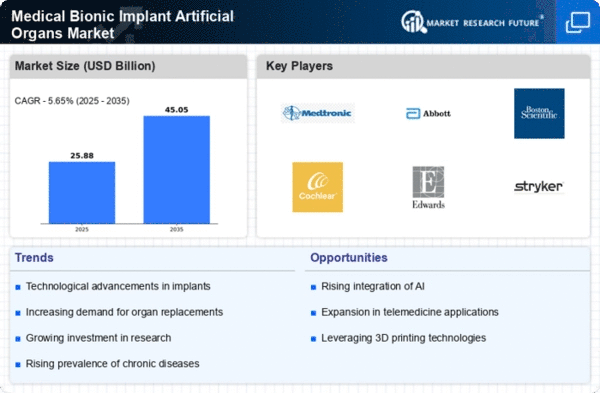
As per MRFR analysis, the Medical Bionic Implant Artificial Organs Market was estimated at 24.5 USD Billion in 2024. The Medical Bionic Implant Artificial Organs industry is projected to grow from 26.17 USD Billion in 2025 to 45.05 USD Billion by 2035, exhibiting a compound annual growth rate (CAGR) of 5.65 during the forecast period 2025 - 2035.

Key Market Trends & Highlights

The Medical Bionic Implant Artificial Organs Market is poised for substantial growth driven by technological advancements and increasing demand for organ replacements.

  • North America remains the largest market for medical bionic implant artificial organs, reflecting a robust healthcare infrastructure.
  • The Asia-Pacific region is emerging as the fastest-growing market, fueled by rising healthcare investments and population needs.
  • The cardiovascular segment dominates the market, while the neurological segment is experiencing rapid growth due to innovative technologies.
  • Technological advancements and regulatory support are key drivers, as they enhance the development and acceptance of bionic solutions.

Market Size & Forecast

2024 Market Size 24.5 (USD Billion)
2035 Market Size 45.05 (USD Billion)
CAGR (2025 - 2035) 5.65%
Largest Regional Market Share in 2024 North America

Major Players

<p>Medtronic (US), Abbott Laboratories (US), Boston Scientific (US), Cochlear Limited (AU), Edwards Lifesciences (US), Stryker Corporation (US), B. Braun Melsungen AG (DE), Zimmer Biomet Holdings (US), Osseointegration Foundation (US)</p>

Market Trends

The Medical Bionic Implant Artificial Organs Market is currently experiencing a transformative phase, driven by advancements in technology and increasing demand for organ replacements. Innovations in materials science and bioengineering are leading to the development of more sophisticated and biocompatible implants. These enhancements not only improve the functionality of artificial organs but also increase their acceptance by the human body. As a result, patients are likely to benefit from improved quality of life and longevity. Furthermore, the rising prevalence of chronic diseases and the aging population are contributing to the growing need for effective solutions in organ replacement. In addition, regulatory bodies are becoming more supportive of the approval processes for new bionic implants, which may facilitate faster market entry for innovative products. This evolving landscape suggests a promising future for the Medical Bionic Implant Artificial Organs Market, as stakeholders, including manufacturers, healthcare providers, and patients, increasingly recognize the potential of these technologies. The integration of artificial intelligence and robotics into the design and functionality of bionic organs could further enhance their capabilities, making them more adaptive and responsive to individual patient needs.

Technological Advancements

Recent innovations in materials and engineering are revolutionizing the Medical Bionic Implant Artificial Organs Market. Enhanced biocompatibility and functionality of implants are being achieved through cutting-edge research, which may lead to better patient outcomes.

Regulatory Support

The evolving regulatory landscape appears to favor the approval of new bionic implants. Streamlined processes and supportive policies from health authorities could expedite the introduction of innovative solutions into the market.

Increased Demand for Organ Replacement

The growing prevalence of chronic illnesses and an aging demographic are driving the need for effective organ replacement solutions. This trend suggests a sustained demand for advancements in the Medical Bionic Implant Artificial Organs Market.

Medical Bionic Implant Artificial Organs Market Market Drivers

Market Segment Insights

By Application: Cardiovascular (Largest) vs. Neurological (Fastest-Growing)

<p>In the Medical Bionic Implant Artificial Organs Market, the application segment is prominently divided into five key categories: Cardiovascular, Neurological, Orthopedic, Ophthalmic, and Urological. Among these, the Cardiovascular segment commands the largest market share, driven by an increasing prevalence of heart-related diseases and advancements in bionic technology. Neurological applications, while smaller in size, are showing rapid growth due to rising awareness and investments in neuroprosthetics and brain-computer interfaces, marking them as a competitive segment in this market.</p>

<p>Cardiovascular (Dominant) vs. Neurological (Emerging)</p>

<p>The Cardiovascular segment, recognized as the dominant player in the Medical Bionic Implant Artificial Organs Market, focuses on devices such as artificial hearts and assist devices for patients with heart failure. This segment benefits from significant medical outreach, technology advancements, and a strong emphasis on improving patient quality of life. In contrast, the Neurological segment, categorized as an emerging sector, is rapidly advancing with innovations in brain implants and neurostimulation devices. This growth is fueled by an aging population and escalating cases of neurological disorders, which necessitate effective interventions, thus driving investment and research in this area.</p>

By Type: Bionic Limbs (Largest) vs. Bionic Organs (Fastest-Growing)

<p>In the Medical Bionic Implant Artificial Organs Market, the distribution of market share among the segments reveals that Bionic Limbs holds the largest portion, reflecting its established presence and broad acceptance in the healthcare industry. As healthcare technology advances, Bionic Limbs remain at the forefront, widely utilized in improving mobility for individuals with limb loss, thereby driving significant adoption rates. In contrast, Bionic Organs, while currently smaller in market share, are rapidly gaining traction. The innovation behind artificial organs, addressing organ shortages and improving patient quality of life, is fostering increased investments and research, contributing to its faster growth.</p>

<p>Bionic Limbs (Dominant) vs. Bionic Organs (Emerging)</p>

<p>Bionic Limbs represent the dominant segment within the Medical Bionic Implant Artificial Organs Market, primarily due to their established technology and effective integration within rehabilitation processes. These devices are engineered to restore lost functionality and improve overall patient mobility, featuring advanced materials and control systems for enhanced performance. On the other hand, Bionic Organs, though emerging, are on a promising trajectory, aimed at addressing critical healthcare challenges associated with organ transplants. The development of technologies for creating artificial organs is witnessing intensive research efforts that promise to transcend traditional transplant limitations, thereby attracting attention from both medical practitioners and patients. As innovations in this space continue to evolve, Bionic Organs may become a key facet of future medical solutions.</p>

By End Use: Hospitals (Largest) vs. Clinics (Fastest-Growing)

<p>In the Medical Bionic Implant Artificial Organs Market, hospitals constitute the largest share of the end use segment. Their extensive resources, state-of-the-art facilities, and capability to handle complex surgeries contribute significantly to this dominance. Clinics, while currently smaller in comparison, are rapidly gaining ground as a notable segment. They offer convenience and may cater to less complex procedures that leverage bionic implants, which allows for a growing patient base seeking outpatient options. Growth trends within the end use segment demonstrate a positive trajectory. Hospitals remain pivotal due to the advanced surgical interventions and the rising demand for innovative treatments for chronic illnesses. On the other hand, clinics are emerging as significant players, driven by the increasing shift towards outpatient services and technological advancements making bionic implants more accessible in various settings. The focus on personalized care in home care and rehabilitation centers further complements these trends, indicating a dynamic and evolving market landscape.</p>

<p>Hospitals: Dominant vs. Clinics: Emerging</p>

<p>Hospitals are characterized by their capacity to integrate advanced medical technologies and provide comprehensive care, making them the dominant force in the Medical Bionic Implant Artificial Organs Market. Their ability to invest in cutting-edge facilities and staff specialized personnel allows them to perform complex bionic implant surgeries effectively. This positions hospitals as a crucial provider for patients needing extensive medical intervention. Conversely, clinics are emerging as key players within the sector, offering streamlined and patient-friendly services which cater to an increasing number of patients seeking outpatient options. Their growth is fueled by technological advancements that enable easier deployments of bionic implants and a growing patient desire for convenience and accessibility to healthcare services. This duality of focus between hospitals and clinics highlights the evolving landscape of the market.</p>

By Material: Biocompatible Polymers (Largest) vs. Metals (Fastest-Growing)

<p>In the Medical Bionic Implant Artificial Organs Market, the material segment is primarily dominated by Biocompatible Polymers, which hold the largest market share due to their favorable properties like flexibility and tissue compatibility. Metals, while traditionally prominent in implant applications, are now being overshadowed by polymers and ceramics but are emerging rapidly as market trends shift towards hybrid materials. The market is witnessing an increase in the adoption of metals, especially titanium alloys, which offer superior strength and adaptability, further diversifying the material landscape. Growth trends in this segment are driven by advancements in material science, enhancing the applicability of various materials in artificial organs. Biocompatible Polymers are leading due to their excellent biocompatibility and ease of processing, whereas metals are experiencing fast-paced growth driven by innovations aimed at improving their performance in bio-implants. The emergence of smart materials and 3D printing technology is also contributing significantly to the growth of the artificial organs market, as it allows for customization and improved functionality of implants.</p>

<p>Biocompatible Polymers (Dominant) vs. Metals (Emerging)</p>

<p>Biocompatible Polymers have established their position as the dominant material in the Medical Bionic Implant Artificial Organs Market, appreciated for their versatility and compatibility with human tissues. They are often used in applications requiring flexibility and resilience, such as in synthetic heart valves and vascular scaffolds. On the other hand, Metals, particularly titanium and cobalt-chromium alloys, are emerging as crucial materials in the market due to their mechanical strength and durability. They are often favored in structural applications where load-bearing capabilities are essential. The trend towards hybrid devices, combining the benefits of both polymers and metals, is also gaining momentum, indicating a potential shift towards more innovative solutions in the coming years.</p>

By Technology: Robotics (Largest) vs. Nanotechnology (Fastest-Growing)

<p>In the Medical Bionic Implant Artificial Organs Market, the distribution of market share among various technologies reveals that Robotics currently holds the largest portion. As a well-established and widely adopted technology, Robotics is instrumental in enhancing precision and functionality within bionic implants. Meanwhile, Nanotechnology is emerging rapidly, claiming the title of fastest-growing segment. This technology's ability to innovate at the molecular level offers unique advantages in miniaturization and efficiency for artificial organs.</p>

<p>Technology: Robotics (Dominant) vs. Nanotechnology (Emerging)</p>

<p>Robotics is a dominant force in the Medical Bionic Implant Artificial Organs Market, enabling advanced functionalities such as precision movement and automation. It is widely utilized in products ranging from prosthetic limbs to intricate surgical robots, significantly improving patient outcomes and healthcare efficiency. In contrast, Nanotechnology represents an emerging player, utilizing nanoscale innovations to enhance the performance of artificial organs. Its applications include drug delivery systems and tissue regeneration, making it a key area of research and development as it rapidly gains traction within the market.</p>

Get more detailed insights about Medical Bionic Implant/Artificial Organs Market Research Report – Forecast to 2035

Regional Insights

North America : Market Leader in Innovation

North America is poised to maintain its leadership in the Medical Bionic Implant Artificial Organs Market, holding a significant market share of 12.25 in 2024. The region's growth is driven by advanced healthcare infrastructure, increasing prevalence of chronic diseases, and a strong focus on research and development. Regulatory support from agencies like the FDA further catalyzes innovation, ensuring rapid approval of new technologies. The competitive landscape is robust, with key players such as Medtronic, Abbott Laboratories, and Boston Scientific leading the charge. The U.S. remains the largest market, supported by high healthcare expenditure and a growing aging population. Companies are increasingly investing in partnerships and collaborations to enhance product offerings and expand their market reach, solidifying North America's position as a hub for medical bionic innovations.

Europe : Emerging Market with Potential

Europe is witnessing a growing interest in the Medical Bionic Implant Artificial Organs Market, with a market size of 6.5 in 2024. Factors such as an aging population, rising healthcare costs, and advancements in technology are driving demand. Regulatory frameworks, including the EU Medical Device Regulation, are enhancing safety and efficacy standards, which in turn boosts consumer confidence and market growth. Leading countries like Germany, France, and the UK are at the forefront of this market, supported by established healthcare systems and significant investments in medical technology. Key players such as B. Braun Melsungen AG and Zimmer Biomet Holdings are actively expanding their portfolios. The competitive landscape is characterized by innovation and strategic collaborations, positioning Europe as a promising market for medical bionic implants.

Asia-Pacific : Rapidly Growing Market

Asia-Pacific is emerging as a rapidly growing market for Medical Bionic Implant Artificial Organs, with a market size of 4.7 in 2024. The region's growth is fueled by increasing healthcare investments, a rising prevalence of lifestyle-related diseases, and a growing middle-class population seeking advanced medical solutions. Government initiatives aimed at improving healthcare access and quality are also significant growth drivers. Countries like China, Japan, and Australia are leading the charge, with a strong presence of both local and international players. Companies such as Cochlear Limited and Stryker Corporation are expanding their operations in the region. The competitive landscape is dynamic, with a focus on innovation and affordability, making Asia-Pacific a key player in The Medical Bionic Implant Artificial Organs.

Middle East and Africa : Emerging Market Opportunities

The Middle East and Africa region is gradually emerging in the Medical Bionic Implant Artificial Organs Market, with a market size of 1.05 in 2024. The growth is driven by increasing healthcare investments, rising awareness of advanced medical technologies, and government initiatives aimed at improving healthcare infrastructure. The region's diverse demographics and varying healthcare needs present unique opportunities for market expansion. Countries like South Africa and the UAE are leading the market, supported by investments in healthcare facilities and technology. The presence of key players is growing, with companies looking to tap into the region's potential. The competitive landscape is evolving, with a focus on partnerships and collaborations to enhance service delivery and product offerings, making the Middle East and Africa a region to watch in the medical bionic sector.

Key Players and Competitive Insights

The Medical Bionic Implant Artificial Organs Market is characterized by a dynamic competitive landscape, driven by technological advancements and increasing demand for innovative healthcare solutions. Key players such as Medtronic (US), Abbott Laboratories (US), and Boston Scientific (US) are at the forefront, focusing on innovation and strategic partnerships to enhance their market presence. Medtronic (US) emphasizes its commitment to research and development, aiming to introduce cutting-edge bionic implants that improve patient outcomes. Meanwhile, Abbott Laboratories (US) is leveraging its extensive portfolio to expand into emerging markets, thereby enhancing its competitive positioning. Boston Scientific (US) is also actively pursuing collaborations with tech firms to integrate digital health solutions into its product offerings, reflecting a broader trend towards digital transformation in the industry.

The market structure appears moderately fragmented, with several players vying for market share. Key business tactics include localizing manufacturing to reduce costs and optimize supply chains, which is crucial in maintaining competitive pricing. The collective influence of these major companies shapes the market dynamics, as they engage in strategic maneuvers to capture a larger share of the growing demand for bionic implants.

In November 2025, Medtronic (US) announced a groundbreaking partnership with a leading AI firm to develop smart bionic organs that can adapt to patient needs in real-time. This strategic move is likely to enhance Medtronic's product offerings, positioning the company as a leader in personalized healthcare solutions. The integration of AI into bionic implants could significantly improve patient monitoring and outcomes, thereby reinforcing Medtronic's competitive edge.

In October 2025, Abbott Laboratories (US) launched a new line of bionic heart valves designed to reduce the risk of complications post-surgery. This innovation not only showcases Abbott's commitment to enhancing patient safety but also reflects a strategic focus on expanding its product range in the cardiovascular segment. The introduction of these advanced valves is expected to strengthen Abbott's market position and attract a broader customer base.

In September 2025, Boston Scientific (US) entered into a strategic alliance with a prominent tech startup to develop wearable devices that monitor the performance of bionic implants. This collaboration indicates a shift towards integrating technology with medical devices, potentially revolutionizing patient care. By enhancing the functionality of bionic implants through real-time data analytics, Boston Scientific is likely to differentiate itself in a competitive market.

As of December 2025, current trends in the Medical Bionic Implant Artificial Organs Market include a pronounced focus on digitalization, sustainability, and the integration of AI technologies. Strategic alliances are increasingly shaping the competitive landscape, as companies recognize the value of collaboration in driving innovation. The shift from price-based competition to a focus on technological advancement and supply chain reliability is evident, suggesting that future competitive differentiation will hinge on the ability to innovate and deliver superior patient outcomes.

Key Companies in the Medical Bionic Implant Artificial Organs Market market include

Industry Developments

    • The first pig to human transplant reported its success for the operation two months ago, but the patient David bennet Sr. at the age of 57, died for unknown reasons. The pig heart transplant needs more improvement.
    • Cyber firm Kaspersky has become one of the first organizations in the world to develop and implement a security policy covering the use of bionic devices and other forms of human augmentation.

Future Outlook

Medical Bionic Implant Artificial Organs Market Future Outlook

<p>The Medical Bionic Implant Artificial Organs Market is projected to grow at a 5.65% CAGR from 2024 to 2035, driven by technological advancements, increasing healthcare expenditure, and rising demand for organ transplants.</p>

New opportunities lie in:

  • <p>Development of personalized bionic organs tailored to individual patient needs.</p>
  • <p>Expansion of telemedicine platforms for remote monitoring of bionic implants.</p>
  • <p>Strategic partnerships with insurance companies to enhance reimbursement models for bionic organ procedures.</p>

<p>By 2035, the market is expected to be robust, driven by innovation and increased adoption of bionic technologies.</p>

Market Segmentation

Medical Bionic Implant Artificial Organs Market Type Outlook

  • Bionic Limbs
  • Bionic Organs
  • Bionic Sensors
  • Bionic Implants

Medical Bionic Implant Artificial Organs Market End Use Outlook

  • Hospitals
  • Clinics
  • Home Care
  • Rehabilitation Centers

Medical Bionic Implant Artificial Organs Market Material Outlook

  • Biocompatible Polymers
  • Metals
  • Ceramics
  • Composites

Medical Bionic Implant Artificial Organs Market Technology Outlook

  • Robotics
  • Nanotechnology
  • 3D Printing
  • Artificial Intelligence

Medical Bionic Implant Artificial Organs Market Application Outlook

  • Cardiovascular
  • Neurological
  • Orthopedic
  • Ophthalmic
  • Urological

Report Scope

MARKET SIZE 202424.5(USD Billion)
MARKET SIZE 202526.17(USD Billion)
MARKET SIZE 203545.05(USD Billion)
COMPOUND ANNUAL GROWTH RATE (CAGR)5.65% (2024 - 2035)
REPORT COVERAGERevenue Forecast, Competitive Landscape, Growth Factors, and Trends
BASE YEAR2024
Market Forecast Period2025 - 2035
Historical Data2019 - 2024
Market Forecast UnitsUSD Billion
Key Companies ProfiledMedtronic (US), Abbott Laboratories (US), Boston Scientific (US), Cochlear Limited (AU), Edwards Lifesciences (US), Stryker Corporation (US), B. Braun Melsungen AG (DE), Zimmer Biomet Holdings (US), Osseointegration Foundation (US)
Segments CoveredApplication, Type, End Use, Material, Technology
Key Market OpportunitiesAdvancements in biocompatible materials enhance the potential of the Medical Bionic Implant Artificial Organs Market.
Key Market DynamicsTechnological advancements drive innovation in Medical Bionic Implant Artificial Organs, enhancing patient outcomes and market competitiveness.
Countries CoveredNorth America, Europe, APAC, South America, MEA

FAQs

At what CAGR is the Medical Bionic Implant/Artificial Organs Market projected to grow during the forecast period?

Medical Bionic Implant/Artificial Organs Market is projected to grow at a 9.65% CAGR between 2024-2032.

Which region is expected to lead the Medical Bionic Implant/Artificial Organs Market?

The Americas is expected to lead the Medical Bionic Implant/Artificial Organs Market.

What are the key factors driving the Medical Bionic Implant/Artificial Organs Market?

Improving regulatory framework and increasing injuries and accidents are adding market growth.

Which factors may limit the Medical Bionic Implant/Artificial Organs Market?

High cost and poor healthcare system may limit market growth.

What are the different strategies used by market players to create a dominance in the Medical Bionic Implant/Artificial Organs Market?

Different strategies used by market players to create a dominance in the Medical Bionic Implant/Artificial Organs Market include mergers and acquisitions, collaborations, product launches, and strategic alliances.

  1. Definition
    1. Scope Of The Study
      1. Research Objective
      2. Assumptions
      3. Limitations
    2. Introduction
    3. Primary Research
    4. Secondary Research
    5. Market Size Estimation
    6. Drivers
    7. Restraints
    8. Opportunities
    9. Challenges
    10. Macroeconomic Indicators
    11. Technology Trends
  2. Market Factor Analysis
    1. Porter’s Five Forces Analysis
      1. Bargaining Power Of Suppliers
      2. Bargaining Power Of Buyers
      3. Threat Of New Entrants
      4. Threat Of Substitutes
      5. Intensity Of Rivalry
    2. Value Chain Analysis
    3. Investment Feasibility
    4. Analysis
    5. Pricing Analysis
    6. Chapter
  3. Global Medical Bionic Implant/Artificial Organs Market, By Technology
    1. Introduction
    2. Mechanical Bionics
    3. Market Estimates &
    4. Forecast, By Region, 2020–2027
  4. Market Estimates & Forecast, By Country, 2020–2027
    1. Electronic Bionics
    2. Market Estimates &
    3. Forecast, By Region, 2020–2027
  5. Market Estimates & Forecast, By Country, 2020–2027
    1. Others
    2. Chapter 7. Global Medical
  6. Bionic Implant/Artificial Organs Market, By Product
    1. Introduction
    2. Vision Bionics
      1. Bionic Eye
  7. Market Estimates & Forecast, By Region, 2020–2027
    1. Market Estimates &
    2. Forecast, By Country, 2020–2027
  8. Others
  9. Market Estimates & Forecast, By Region, 2020–2027
    1. Market Estimates &
    2. Forecast, By Country, 2020–2027
    3. Ear Bionics
      1. Cochlear Implant
  10. Market Estimates & Forecast, By Region, 2020–2027
    1. Market Estimates &
    2. Forecast, By Country, 2020–2027
    3. Market Estimates & Forecast,
    4. By Region, 2020–2027
  11. Bone Anchored Hearing Aid (BAHA)
  12. Market Estimates & Forecast, By Country, 2020–2027
    1. Orthopedic Bionics
      1. Bionic Hand
    2. Market Estimates &
    3. Forecast, By Region, 2020–2027
  13. Market Estimates & Forecast, By Country, 2020–2027
    1. Market Estimates &
    2. Forecast, By Region, 2020–2027
  14. Bionic Leg
  15. Market Estimates & Forecast, By Country, 2020–2027
    1. Market Estimates &
    2. Forecast, By Region, 2020–2027
  16. Bionic Knee
  17. Market Estimates & Forecast, By Country, 2020–2027
    1. Market Estimates &
    2. Forecast, By Region, 2020–2027
  18. Bionic Feet
  19. Market Estimates & Forecast, By Country, 2020–2027
    1. Market Estimates &
    2. Forecast, By Region, 2020–2027
  20. Bionic Finger
  21. Market Estimates & Forecast, By Country, 2020–2027
    1. Market Estimates &
    2. Forecast, By Region, 2020–2027
  22. Exoskeleton
  23. Market Estimates & Forecast, By Country, 2020–2027
    1. Growth Stimulators
    2. Market
    3. Estimates & Forecast, By Region, 2020–2027
  24. Electrical Bone
  25. Market Estimates & Forecast, By Country, 2020–2027
    1. Growth Stimulators
    2. Market
    3. Estimates & Forecast, By Region, 2020–2027
  26. Invasive Bone
  27. Market Estimates & Forecast, By Country, 2020–2027
    1. Bone Growth Stimulators
  28. Non-Invasive
  29. Market Estimates & Forecast, By Region, 2020–2027
    1. Market Estimates &
    2. Forecast, By +9+, 2020–2027
  30. Heart Bionics
  31. Market Estimates & Forecast, By Region, 2020–2027
    1. Market Estimates &
    2. Forecast, By Country, 2020–2027
  32. Pacemaker
  33. Market Estimates & Forecast, By Region, 2020–2027
    1. Market Estimates &
    2. Forecast, By Country, 2020–2027
    3. Market Estimates & Forecast,
    4. By Region, 2020–2027
  34. Implantable Cardiac Pacemaker
  35. Market Estimates & Forecast, By Country, 2020–2027
    1. Market Estimates &
    2. Forecast, By Region, 2020–2027
  36. External Pacemaker
  37. Market Estimates & Forecast, By Country, 2020–2027
    1. Heart
    2. Market
    3. Estimates & Forecast, By Region, 2020–2027
  38. Total Artificial
  39. Market Estimates & Forecast, By Country, 2020–2027
    1. Device
    2. Market
    3. Estimates & Forecast, By Region, 2020–2027
  40. Ventricular Assist
  41. Market Estimates & Forecast, By Country, 2020–2027
    1. Valve
    2. Market
    3. Estimates & Forecast, By Region, 2020–2027
  42. Artificial Heart
  43. Market Estimates & Forecast, By Country, 2020–2027
    1. Heart Valve
    2. Market
    3. Estimates & Forecast, By Region, 2020–2027
  44. Mechanical
  45. Market Estimates & Forecast, By Country, 2020–2027
    1. Valve
    2. Market
    3. Estimates & Forecast, By Region, 2020–2027
  46. Tissue Heart
  47. Market Estimates & Forecast, By Country, 2020–2027
    1. Market Estimates &
    2. Forecast, By Region, 2020–2027
  48. Neural/Brain Bionics
  49. Market Estimates & Forecast, By Country, 2020–2027
    1. Market Estimates &
    2. Forecast, By Region, 2020–2027
  50. Deep Brain Stimulator
  51. Market Estimates & Forecast, By Country, 2020–2027
    1. Market Estimates &
    2. Forecast, By Region, 2020–2027
  52. Vagus Nerve Stimulator
  53. Market Estimates & Forecast, By Country, 2020–2027
    1. Market Estimates &
    2. Forecast, By Region, 2020–2027
  54. Spinal Cord Stimulator
  55. Market Estimates & Forecast, By Country, 2020–2027
    1. Chapter 8. Global Medical
  56. Bionic Implant/Artificial Organs Market, By Fixation
    1. Introduction
    2. Implantable
  57. Market Estimates & Forecast, By Region, 2020–2027
    1. Market Estimates &
    2. Forecast, By Country, 2020–2027
    3. Externally Worn
  58. Market Estimates & Forecast, By Region, 2020–2027
    1. Market Estimates &
    2. Forecast, By Country, 2020–2027
    3. Chapter 9. Global Medical Bionic Implant/Artificial Organs
  59. Market, By End-User
    1. Introduction
    2. Hospitals & Clinics
  60. Market Estimates & Forecast, By Region, 2020–2027
    1. Market Estimates &
    2. Forecast, By Country, 2020–2027
    3. Research And Academic Institutes
  61. Market Estimates & Forecast, By Region, 2020–2027
    1. Market Estimates &
    2. Forecast, By Country, 2020–2027
    3. Others
    4. Chapter 10. Global Medical Bionic Implant/Artificial Organs
  62. Market, By Region
    1. Introduction
    2. Americas
    3. North America
    4. U.S.
    5. Canada
    6. South America
    7. Europe
    8. Western Europe
    9. Germany
    10. France
    11. Italy
    12. Spain
    13. U.K.
    14. Rest Of Western Europe
    15. Eastern Europe
    16. Asia Pacific
    17. Japan
    18. China
    19. India
    20. Australia
    21. Republic Of Korea
    22. Rest Of Asia Pacific
    23. The Middle East & Africa
    24. Chapter 11. Company Landscape
    25. Chapter 12. Company Profiles
    26. SA
    27. Overview
    28. Product Overview
    29. Financials
    30. SWOT Analysis
    31. Biocontrol Medical
    32. Company Overview
    33. Product Overview
    34. Financial Overview
    35. Key Developments
    36. SWOT Analysis
    37. Biomet, Inc.
    38. Company Overview
    39. Product Overview
    40. Financial Overview
    41. Key Development
    42. SWOT Analysis
    43. Boston Scientific Corporation
    44. Implant/Artificial Organs Overview
    45. Implant/Artificial Organs Overview
    46. Organs Overview
    47. Financials
    48. Key Developments
    49. SWOT Analysis
    50. Ossur
    51. Overview
    52. Medical Bionic Implant/Artificial Organs Overview
    53. Implant/Artificial Organs Overview
    54. Overview
    55. Financials
    56. Key Developments
    57. SWOT Analysis
    58. Others
    59. Chapter
  63. The Middle East
  64. Africa
    1. Introduction
    2. Market Share Analysis
    3. Key Development & Strategies
    4. Aleva Neurotherapeutics
      1. Company
      2. Company Overview
      3. Technology/Business Segment Overview
      4. Financial Overview
      5. Key Development
      6. SWOT Analysis
    5. Cochlear Ltd.
      1. Company Overview
      2. Product Overview
      3. Financial Overview
      4. Key Developments
    6. Cyberonics, Inc.
      1. Company Overview
      2. Product Overview
      3. Financial Overview
      4. Key Developments
    7. Ekso Bionics
      1. Overview
      2. Product Overview
      3. Financials
      4. Key Developments
      5. SWOT Analysis
    8. LivaNova PLC
      1. Overview
      2. Medical Bionic
      3. Financials
      4. Key Developments
      5. SWOT Analysis
    9. Medtronic, Inc.
      1. Overview
      2. Medical Bionic Implant/Artificial Organs Overview
      3. Financials
      4. Key Developments
      5. SWOT Analysis
    10. NeuroPace, Inc.
      1. Overview
      2. Medical Bionic
      3. Financials
      4. Key Developments
      5. SWOT Analysis
    11. Orthofix International N.V.
      1. Overview
      2. Medical Bionic Implant/Artificial
      3. Financials
      4. Key Developments
      5. SWOT Analysis
    12. Second Sight Medical Products, Inc.
      1. Overview
      2. Medical Bionic
      3. Financials
      4. Key Developments
      5. SWOT Analysis
    13. St. Jude Medical, Inc.
      1. Overview
      2. Medical Bionic Implant/Artificial Organs
  65. MRFR Conclusion
    1. Key Findings
    2. From CEO’s View Point
    3. Organs Industry
    4. Chapter
  66. Unmet Needs Of The Market
    1. Key Companies To Watch
    2. Prediction Of The Medical Bionic Implant/Artificial
  67. Appendix
    1. LIST
  68. OF TABLES
    1. Table
  69. Medical Bionic Implant/Artificial Organs Industry Synopsis, 2020–2027
  70. Medical Bionic
    1. Implant/Artificial Organs Market Estimates And Forecast, 2020–2027, (USD Million)
  71. Medical Bionic
  72. Implant/Artificial Organs Market, By Region, 2020–2027, (USD Million)
  73. Medical Bionic
  74. Implant/Artificial Organs Market, By Technology, 2020–2027, (USD Million)
  75. Medical Bionic
  76. Implant/Artificial Organs Market, By Product, 2020–2027, (USD Million)
  77. Medical Bionic
  78. Implant/Artificial Organs Market, By Fixation, 2020–2027, (USD Million)
  79. Medical Bionic
  80. Implant/Artificial Organs Market, By End-User, 2020–2027, (USD Million)
  81. North America
  82. Medical Bionic Implant/Artificial Organs Market, By Technology, 2020–2027,
    1. (USD Million)
    2. Table
  83. North America Medical Bionic Implant/Artificial Organs Market, By Product, 2020–2027,
    1. (USD Million)
    2. Table
  84. North America Medical Bionic Implant/Artificial Organs Market, By Fixation, 2020–2027,
    1. (USD Million)
    2. Table
  85. North America Medical Bionic Implant/Artificial Organs Market, By End-User, 2020–2027,
    1. (USD Million)
    2. Table
  86. U.S. Medical Bionic Implant/Artificial Organs Market, By Technology, 2020–2027,
    1. (USD Million)
    2. Table
  87. U.S. Medical Bionic Implant/Artificial Organs Market, By Product, 2020–2027,
    1. (USD Million)
    2. Table
  88. U.S. Medical Bionic Implant/Artificial Organs Market, By Fixation, 2020–2027,
    1. (USD Million)
    2. Table
  89. U.S. Medical Bionic Implant/Artificial Organs Market, By End-User, 2020–2027,
    1. (USD Million)
    2. Table
  90. Canada Medical Bionic Implant/Artificial Organs Market, By Technology, 2020–2027,
    1. (USD Million)
    2. Table
  91. Canada Medical Bionic Implant/Artificial Organs Market, By Product, 2020–2027,
    1. (USD Million)
    2. Table
  92. Canada Medical Bionic Implant/Artificial Organs Market, By Fixation, 2020–2027,
    1. (USD Million)
    2. Table
  93. Canada Medical Bionic Implant/Artificial Organs Market, By End-User, 2020–2027,
    1. (USD Million)
    2. Table
  94. South America Medical Bionic Implant/Artificial Organs Market, By Technology,
  95. South America Medical Bionic Implant/Artificial Organs Market,
    1. By Product, 2020–2027, (USD Million
  96. South America Medical Bionic Implant/Artificial
  97. Organs Market, By Fixation, 2020–2027, (USD Million
  98. South America Medical Bionic Implant/Artificial
  99. Organs Market, By End-User, 2020–2027, (USD Million)
  100. Europe Medical Bionic Implant/Artificial
  101. Organs Market, By Technology, 2020–2027, (USD Million)
  102. Europe Medical Bionic Implant/Artificial
  103. Organs Market, By Product, 2020–2027, (USD Million)
  104. Europe Medical Bionic Implant/Artificial
  105. Organs Market, By Fixation, 2020–2027, (USD Million)
  106. Europe Medical Bionic Implant/Artificial
  107. Organs Market, By End-User, 2020–2027, (USD Million)
  108. Western Europe Medical Bionic Implant/Artificial
  109. Organs Market, By Technology, 2020–2027, (USD Million)
  110. Western Europe Medical Bionic Implant/Artificial
  111. Organs Market, By Product, 2020–2027, (USD Million)
  112. Western Europe Medical Bionic Implant/Artificial
  113. Organs Market, By Fixation, 2020–2027, (USD Million)
  114. Western Europe Medical Bionic Implant/Artificial
  115. Organs Market, By End-User, 2020–2027, (USD Million)
  116. Eastern Europe Medical Bionic Implant/Artificial
  117. Organs Market, By Technology, 2020–2027, (USD Million)
  118. Eastern Europe Medical Bionic Implant/Artificial
  119. Organs Market, By Product, 2020–2027, (USD Million)
  120. Eastern Europe Medical Bionic Implant/Artificial
  121. Organs Market, By Fixation, 2020–2027, (USD Million)
  122. Eastern Europe Medical Bionic Implant/Artificial
  123. Organs Market, By End-User, 2020–2027, (USD Million)
  124. Asia Pacific Medical Bionic Implant/Artificial
  125. Organs Market, By Technology, 2020–2027, (USD Million)
  126. Asia Pacific Medical Bionic Implant/Artificial
  127. Organs Market, By Product, 2020–2027, (USD Million)
  128. Asia Pacific Medical Bionic Implant/Artificial
  129. Organs Market, By Fixation, 2020–2027, (USD Million)
  130. Asia Pacific Medical Bionic Implant/Artificial
  131. Organs Market, By End-User, 2020–2027, (USD Million)
  132. Middle East & Africa Medical Bionic
  133. Implant/Artificial Organs Market, By Technology, 2020–2027, (USD Million)
  134. Middle East
  135. & Africa Medical Bionic Implant/Artificial Organs Market, By Product, 2020–2027,
    1. (USD Million)
    2. Table
  136. Middle East & Africa Medical Bionic Implant/Artificial Organs Market, By
    1. Fixation, 2020–2027, (USD Million)
  137. Middle East & Africa Medical Bionic Implant/Artificial
  138. Organs Market, By End-User, 2020–2027, (USD Million)
  139. LIST OF FIGURES
  140. Research Process
  141. Segmentation
    1. For Medical Bionic Implant/Artificial Organs Market
  142. Segmentation Market Dynamics For Medical
    1. Bionic Implant/Artificial Organs Market
  143. Global Medical Bionic Implant/Artificial Organs
  144. Market Share, By Technology 2020
  145. Global Medical Bionic Implant/Artificial Organs Market Share,
    1. By Product 2020
    2. Figure
  146. Global Medical Bionic Implant/Artificial Organs Market Share, By Fixation 2020
  147. Global Medical
  148. Bionic Implant/Artificial Organs Market Share, By End-User, 2020
  149. Global Medical Bionic
  150. Implant/Artificial Organs Market Share, By Region, 2020
  151. North America Medical Bionic Implant/Artificial
  152. Organs Market Share, By Country, 2020
  153. Europe Medical Bionic Implant/Artificial Organs
  154. Market Share, By Country, 2020
  155. Asia Pacific Medical Bionic Implant/Artificial Organs Market
    1. Share, By Country, 2020
  156. Middle East & Africa Medical Bionic Implant/Artificial
  157. Organs Market Share, By Country, 2020
  158. Global Medical Bionic Implant/Artificial Organs
    1. Market: Company Share Analysis, 2020 (%)
  159. Aleva Neurotherapeutics SA: Key Financials
  160. Aleva Neurotherapeutics
    1. SA Segmental Revenue
    2. Figure
  161. Aleva Neurotherapeutics SA: Geographical Revenue
  162. Biocontrol Medical: Key Financials
  163. Biocontrol
    1. Medical: Segmental Revenue
  164. Biocontrol Medical: Geographical Revenue
  165. Biomet, Inc.: Key Financials
  166. Biomet, Inc.:
    1. Segmental Revenue
    2. Figure
  167. Biomet, Inc.: Geographical Revenue
  168. Boston Scientific Corporation: Key Financials
  169. Boston Scientific
    1. Corporation: Segmental Revenue
  170. Boston Scientific Corporation: Geographical Revenue
  171. Cochlear Ltd.:
    1. Key Financials
    2. Figure
  172. Cochlear Ltd.: Segmental Revenue
  173. Cochlear Ltd. Geographical Revenue
  174. Cyberonics, Inc.: Key
    1. Financials
    2. Figure
  175. Cyberonics, Inc.: Segmental Revenue
  176. Cyberonics, Inc.: Geographical Revenue
  177. Ekso Bionics
    1. Inc.: Key Financials
    2. Figure
  178. Ekso Bionics Inc.: Segmental Revenue
  179. Ekso Bionics Inc.: Geographical Revenue
  180. LivaNova PLC:
    1. Key Financials
    2. Figure
  181. LivaNova PLC: Segmental Revenue
  182. LivaNova PLC: Geographical Revenue
  183. Medtronic, Inc.: Key
    1. Financials
    2. Figure
  184. Medtronic, Inc.: Segmental Revenue
  185. Medtronic, Inc.: Geographical Revenue
  186. NeuroPace,
    1. Inc.: Key Financials
    2. Figure
  187. NeuroPace, Inc.: Segmental Revenue
  188. NeuroPace, Inc.: Geographical Revenue
  189. Orthofix International
    1. N.V.: Key Financials
    2. Figure
  190. Orthofix International N.V.: Segmental Revenue
  191. Orthofix International N.V.: Geographical
    1. Revenue

Medical Bionic Implant/Artificial Organs Market Segmentation

Market Segmentation Overview

  • Detailed segmentation data will be available in the full report
  • Comprehensive analysis by multiple parameters
  • Regional and country-level breakdowns
  • Market size forecasts by segment
Infographic

Free Sample Request

Kindly complete the form below to receive a free sample of this Report

Get Free Sample

Customer Strories

Compare Licence

×
Features License Type
Single User Multiuser License Enterprise User
Price $4,950 $5,950 $7,250
Maximum User Access Limit 1 User Upto 10 Users Unrestricted Access Throughout the Organization
Free Customization
Direct Access to Analyst
Deliverable Format
Platform Access
Discount on Next Purchase 10% 15% 15%
Printable Versions