×
Request Free Sample ×

Kindly complete the form below to receive a free sample of this Report

* Please use a valid business email

Leading companies partner with us for data-driven Insights

clients tt-cursor
Hero Background
English
Chinese
French
Japanese
Korean
German
Spanish

Medical Bionic Implant Artificial Organs Market Share

ID: MRFR/MED/4593-HCR
100 Pages
Rahul Gotadki
February 2026

Medical Bionic Implant/Artificial Organs Market Research Report Information By Technology (Mechanical, Electronic Bionics), Product (Vision, Ear, Orthopedic, Heart, Neural/Brain), Fixation (Implantable, Externally Worn), End-User -Forecast Till 2035

Share:
Download PDF ×

We do not share your information with anyone. However, we may send you emails based on your report interest from time to time. You may contact us at any time to opt-out.

Medical Bionic Implant Artificial Organs Market Infographic
Purchase Options

Market Share

Medical Bionic Implant Artificial Organs Market Share Analysis

The health sector Medical Bionic Implant/Artificial Organs Market is growing rapidly and this has brought about intense rivalry among companies as they seek to position themselves in the market. Firms do different things in order to gain advantage over their rivals, especially on the dynamic landscape. One of these approaches entails differentiation through technological innovation. Companies invest heavily in research and development, which ensures that they come up with cutting-edge bionic implants and artificial organs that have better performance, more features and improved outcomes for patients.This strategy of innovation attracting advanced solution-seeking healthcare professionals positions the company as a technological leader while building its brand image as well.

Further, it should be noted that strategic partnerships/collaborations determine how much market share one gets into. In many cases, firms enter into alliances with research institutions, academic centers and other industry players to exploit collective expertise and resources. Collaborative efforts facilitate knowledge sharing thus speeding up the process of developing new medical bionics implants. Partnerships with healthcare providers and insurers also help in penetrating markets so that more people can use advanced technologies. For instance, if a company establishes networks of collaborations there will be greater access to market and stronger competitive position.

Market share positioning within Medical Bionic Implant/Artificial Organs Market also depends on price competitiveness; thus it is another important element for consideration. However, companies need to find ways of striking balance between producing high quality products while at the same time charging affordable prices. Pricing strategies that take into account economic considerations such as constraints of both individual consumers and healthcare systems improve wider accessibility (Lau et al., 2012). This move tends to broaden customer base by enhancing reputation of being socially responsible entity hence boosting customer loyalty.

Furthermore, effective marketing and branding strategies are essential to carve out a distinctive market share. Companies spend quite some good amounts of money trying to develop compelling brand narratives around their own medical bionic implants which tell stories of how lives have been changed. A company can create emotional connection with healthcare professionals among others by aligning its messaging with patient success stories. This not only helps differentiate its brand from competitors but also confirms the idea that the firm is dedicated to innovative healthcare solutions thereby improving people’s lives.

In addition, geographical expansion forms a significant part of market share positioning in the Medical Bionic Implant/Artificial Organs Market. Many companies customize their strategies depending on regional healthcare needs, regulatory landscapes and cultural differences. By understanding and adapting to diverse market conditions, firms will establish strong presence in key regions hence giving them competitive advantage over non-adaptable competitors (Fleisher & Bensoussan, 2015).


Author
Rahul Gotadki
Research Manager

He holds an experience of about 9+ years in Market Research and Business Consulting, working under the spectrum of Life Sciences and Healthcare domains. Rahul conceptualizes and implements a scalable business strategy and provides strategic leadership to the clients. His expertise lies in market estimation, competitive intelligence, pipeline analysis, customer assessment, etc.

Leave a Comment

FAQs

What is the current valuation of the Medical Bionic Implant Artificial Organs Market?

<p>As of 2024, the market valuation was 24.5 USD Billion.</p>

What is the projected market size for the Medical Bionic Implant Artificial Organs Market by 2035?

<p>The market is expected to reach a valuation of 45.05 USD Billion by 2035.</p>

What is the expected CAGR for the Medical Bionic Implant Artificial Organs Market during the forecast period?

<p>The market is projected to grow at a CAGR of 5.65% from 2025 to 2035.</p>

Which companies are considered key players in the Medical Bionic Implant Artificial Organs Market?

<p>Key players include Medtronic, Abbott Laboratories, Boston Scientific, and others.</p>

What are the primary applications of medical bionic implants?

<p>The main applications include cardiovascular, neurological, orthopedic, ophthalmic, and urological segments.</p>

How does the market segment by type of bionic implants?

The market segments into bionic limbs, bionic organs, bionic sensors, and bionic implants.

What is the expected market size for bionic organs by 2035?

The bionic organs segment is projected to grow to 15.0 USD Billion by 2035.

What end-use segments are included in the Medical Bionic Implant Artificial Organs Market?

End-use segments include hospitals, clinics, home care, and rehabilitation centers.

What materials are primarily used in the production of bionic implants?

The materials include biocompatible polymers, metals, ceramics, and composites.

Which technologies are driving advancements in the Medical Bionic Implant Artificial Organs Market?

Key technologies include robotics, nanotechnology, 3D printing, and artificial intelligence.

Market Summary

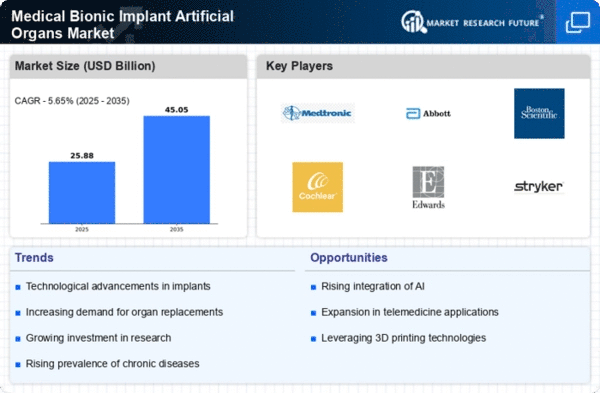
As per MRFR analysis, the Medical Bionic Implant Artificial Organs Market was estimated at 24.5 USD Billion in 2024. The Medical Bionic Implant Artificial Organs industry is projected to grow from 26.17 USD Billion in 2025 to 45.05 USD Billion by 2035, exhibiting a compound annual growth rate (CAGR) of 5.65% during the forecast period 2025 - 2035.

Key Market Trends & Highlights

The Medical Bionic Implant Artificial Organs Market is poised for substantial growth driven by technological advancements and increasing healthcare investments.

  • Technological integration is enhancing the functionality and efficiency of bionic implants, particularly in the cardiovascular segment.
  • North America remains the largest market, while the Asia-Pacific region is emerging as the fastest-growing area for medical bionic implants.
  • The cardiovascular segment dominates the market, whereas the neurological segment is experiencing rapid growth due to innovative developments.
  • Key market drivers include technological advancements and the rising incidence of chronic diseases, which are propelling demand for advanced medical solutions.

Market Size & Forecast

2024 Market Size 24.5 (USD Billion)
2035 Market Size 45.05 (USD Billion)
CAGR (2025 - 2035) 5.65%
Largest Regional Market Share in 2024 North America

Major Players

Medtronic (US), Abbott Laboratories (US), Boston Scientific (US), Cochlear Limited (AU), Edwards Lifesciences (US), Stryker Corporation (US), Zimmer Biomet (US), B. Braun Melsungen AG (DE), Osseointegration Foundation (US)

Market Trends

The Medical Bionic Implant Artificial Organs Market is currently experiencing a transformative phase, characterized by rapid advancements in technology and increasing demand for innovative solutions to address organ failure. This market encompasses a range of products designed to replicate the functions of biological organs, thereby enhancing the quality of life for patients with severe health conditions. The integration of artificial intelligence and robotics into bionic implants is reshaping the landscape, allowing for more personalized and efficient treatments. Furthermore, the growing prevalence of chronic diseases and an aging population are driving the need for these advanced medical solutions, suggesting a robust future for the industry. In addition to technological advancements, regulatory frameworks are evolving to accommodate the unique challenges posed by bionic implants. This shift indicates a growing recognition of the importance of these devices in modern medicine. Collaboration between healthcare providers, researchers, and manufacturers is becoming increasingly vital to ensure the successful development and implementation of these products. As the Medical Bionic Implant Artificial Organs Market continues to expand, it appears poised to play a crucial role in the future of healthcare, potentially revolutionizing treatment options for patients worldwide.

Technological Integration

The incorporation of cutting-edge technologies, such as artificial intelligence and machine learning, is enhancing the functionality of bionic implants. These advancements allow for real-time monitoring and adjustments, improving patient outcomes and satisfaction.

Regulatory Evolution

As the Medical Bionic Implant Artificial Organs Market grows, regulatory bodies are adapting their frameworks to better address the complexities of these devices. This evolution is likely to facilitate faster approvals and encourage innovation.

Collaborative Development

There is a noticeable trend towards collaboration among various stakeholders, including medical professionals, researchers, and manufacturers. This synergy is essential for driving innovation and ensuring that products meet the diverse needs of patients.

Medical Bionic Implant Artificial Organs Market Market Drivers

Rising Investment in Research and Development

Investment in research and development is a key driver of growth in the Medical Bionic Implant Artificial Organs Market. As competition intensifies, companies are allocating substantial resources to innovate and enhance their product offerings. This focus on R&D is leading to breakthroughs in the design and functionality of bionic implants, making them more effective and user-friendly. Furthermore, partnerships between academic institutions and industry players are fostering collaborative research efforts, which may accelerate the development of next-generation artificial organs. Recent reports indicate that R&D spending in this sector is expected to increase by approximately 30% over the next five years, underscoring the commitment to advancing the Medical Bionic Implant Artificial Organs Market.

Increased Demand for Organ Replacement Solutions

The rising prevalence of chronic diseases and aging populations are contributing to an increased demand for organ replacement solutions within the Medical Bionic Implant Artificial Organs Market. As the number of patients requiring organ transplants continues to grow, the limitations of traditional organ donation systems become more apparent. This has led to a surge in interest in bionic implants as viable alternatives. Market analysis suggests that the demand for artificial organs could increase by over 20% in the next decade, driven by the urgent need for effective solutions to organ failure. Consequently, the Medical Bionic Implant Artificial Organs Market is likely to expand significantly, as healthcare providers seek innovative ways to meet patient needs.

Growing Awareness and Acceptance of Bionic Solutions

The growing awareness and acceptance of bionic solutions among patients and healthcare professionals are driving the Medical Bionic Implant Artificial Organs Market. Educational initiatives and outreach programs are helping to inform stakeholders about the benefits and potential of artificial organs. As patients become more informed about their options, they are increasingly advocating for bionic implants as alternatives to traditional organ transplants. This shift in perception is likely to enhance market growth, as healthcare providers respond to patient demand for innovative solutions. Surveys indicate that over 60% of patients are open to considering bionic implants, reflecting a significant change in attitudes towards these technologies. Consequently, the Medical Bionic Implant Artificial Organs Market is expected to benefit from this growing acceptance.

Regulatory Support for Medical Bionic Implant Artificial Organs

Regulatory support plays a crucial role in the Medical Bionic Implant Artificial Organs Market, facilitating the approval and commercialization of innovative products. Regulatory bodies are increasingly recognizing the potential of bionic implants to address organ shortages and improve patient quality of life. Streamlined approval processes and guidelines for clinical trials are being established, which may expedite the introduction of new technologies to the market. This supportive regulatory environment encourages manufacturers to invest in research and development, thereby enhancing the overall market landscape. Recent data indicates that regions with robust regulatory frameworks have seen a higher rate of product launches, further indicating the importance of regulatory support in driving the Medical Bionic Implant Artificial Organs Market forward.

Technological Advancements in Medical Bionic Implant Artificial Organs

The Medical Bionic Implant Artificial Organs Market is experiencing rapid growth due to significant technological advancements. Innovations in materials science, robotics, and bioengineering are leading to the development of more efficient and biocompatible artificial organs. For instance, advancements in 3D printing technology allow for the creation of customized implants tailored to individual patient needs. Furthermore, the integration of artificial intelligence in monitoring and managing these implants enhances their functionality and patient outcomes. According to recent estimates, the market is projected to grow at a compound annual growth rate of over 15% in the coming years, driven by these technological innovations. As a result, the Medical Bionic Implant Artificial Organs Market is poised for substantial expansion, attracting investments and fostering research initiatives.

Market Segment Insights

By Application: Cardiovascular (Largest) vs. Neurological (Fastest-Growing)

The Medical Bionic Implant Artificial Organs Market is significantly driven by various application segments, with cardiovascular implants holding the largest market share. This segment includes devices such as bionic hearts and vascular grafts, which are crucial in treating life-threatening conditions. Following closely, the neurological segment is witnessing rapid growth, propelled by advancements in technologies such as brain-computer interfaces and neuro-prosthetics, aimed at enhancing the quality of life for patients with neurological disorders.

Cardiovascular: Bionic Hearts (Dominant) vs. Neurological: Neuro-Prosthetics (Emerging)

The cardiovascular segment, particularly bionic hearts, has established itself as a dominant player, attributed to the increasing prevalence of heart diseases and the necessity for innovative solutions to replace failing organs. Bionic hearts not only extend life expectancy but also improve overall well-being. Conversely, the neurological segment, led by neuro-prosthetics, is emerging rapidly, driven by the surge in technological innovations and an aging population susceptible to neurological conditions. This segment represents a wave of innovation, offering novel treatment avenues that enhance motor functions and restore independence to patients, thus transforming the landscape of the medical bionic implant market.

By Type: Bionic Limbs (Largest) vs. Bionic Organs (Fastest-Growing)

<p>In the Medical Bionic Implant Artificial Organs Market, the distribution of market share among the segments reveals that Bionic Limbs holds the largest portion, reflecting its established presence and broad acceptance in the healthcare industry. As healthcare technology advances, Bionic Limbs remain at the forefront, widely utilized in improving mobility for individuals with limb loss, thereby driving significant adoption rates. In contrast, Bionic Organs, while currently smaller in market share, are rapidly gaining traction. The innovation behind artificial organs, addressing organ shortages and improving patient quality of life, is fostering increased investments and research, contributing to its faster growth.</p>

<p>Bionic Limbs (Dominant) vs. Bionic Organs (Emerging)</p>

<p>Bionic Limbs represent the dominant segment within the Medical Bionic Implant Artificial Organs Market, primarily due to their established technology and effective integration within rehabilitation processes. These devices are engineered to restore lost functionality and improve overall patient mobility, featuring advanced materials and control systems for enhanced performance. On the other hand, Bionic Organs, though emerging, are on a promising trajectory, aimed at addressing critical healthcare challenges associated with organ transplants. The development of technologies for creating artificial organs is witnessing intensive research efforts that promise to transcend traditional transplant limitations, thereby attracting attention from both medical practitioners and patients. As innovations in this space continue to evolve, Bionic Organs may become a key facet of future medical solutions.</p>

By End Use: Hospitals (Largest) vs. Clinics (Fastest-Growing)

<p>In the Medical Bionic Implant Artificial Organs Market, hospitals constitute the largest share of the end use segment. Their extensive resources, state-of-the-art facilities, and capability to handle complex surgeries contribute significantly to this dominance. Clinics, while currently smaller in comparison, are rapidly gaining ground as a notable segment. They offer convenience and may cater to less complex procedures that leverage bionic implants, which allows for a growing patient base seeking outpatient options. Growth trends within the end use segment demonstrate a positive trajectory. Hospitals remain pivotal due to the advanced surgical interventions and the rising demand for innovative treatments for chronic illnesses. On the other hand, clinics are emerging as significant players, driven by the increasing shift towards outpatient services and technological advancements making bionic implants more accessible in various settings. The focus on personalized care in home care and rehabilitation centers further complements these trends, indicating a dynamic and evolving market landscape.</p>

<p>Hospitals: Dominant vs. Clinics: Emerging</p>

<p>Hospitals are characterized by their capacity to integrate advanced medical technologies and provide comprehensive care, making them the dominant force in the Medical Bionic Implant Artificial Organs Market. Their ability to invest in cutting-edge facilities and staff specialized personnel allows them to perform complex bionic implant surgeries effectively. This positions hospitals as a crucial provider for patients needing extensive medical intervention. Conversely, clinics are emerging as key players within the sector, offering streamlined and patient-friendly services which cater to an increasing number of patients seeking outpatient options. Their growth is fueled by technological advancements that enable easier deployments of bionic implants and a growing patient desire for convenience and accessibility to healthcare services. This duality of focus between hospitals and clinics highlights the evolving landscape of the market.</p>

By Material: Biocompatible Polymers (Largest) vs. Metals (Fastest-Growing)

The Medical Bionic Implant Artificial Organs Market showcases a diverse array of materials, with biocompatible polymers dominating the landscape. Due to their excellent compatibility with biological tissues and flexibility in design, they account for a significant share of the market. Following closely, metals, renowned for their strength and durability, are crucial components in various implant technologies but hold a smaller share compared to polymers. The options extend to ceramics and composites, both of which play supportive roles in specialized applications.

Biocompatible Polymers (Dominant) vs. Metals (Emerging)

Biocompatible polymers are at the forefront of the Medical Bionic Implant Artificial Organs Market, known for their favorable mechanical and biological properties. These materials are ideal for applications where flexibility and compatibility with the human body are essential, making them a common choice in various implants. On the other hand, metals are emerging as a rapidly expanding segment, asserting their place due to technological advancements that enhance their biocompatibility and reduce rejection rates. Metals like titanium and stainless steel provide robust solutions, effectively balancing strength and adaptability. Thus, while biocompatible polymers remain dominant, the rising interest in metals illustrates a shifting trend towards hybrid solutions in modern medical prosthetics.

By Technology: Robotics (Largest) vs. Nanotechnology (Fastest-Growing)

<p>In the Medical Bionic Implant Artificial Organs Market, the distribution of market share among various technologies reveals that Robotics currently holds the largest portion. As a well-established and widely adopted technology, Robotics is instrumental in enhancing precision and functionality within bionic implants. Meanwhile, Nanotechnology is emerging rapidly, claiming the title of fastest-growing segment. This technology's ability to innovate at the molecular level offers unique advantages in miniaturization and efficiency for artificial organs.</p>

<p>Technology: Robotics (Dominant) vs. Nanotechnology (Emerging)</p>

<p>Robotics is a dominant force in the Medical Bionic Implant Artificial Organs Market, enabling advanced functionalities such as precision movement and automation. It is widely utilized in products ranging from prosthetic limbs to intricate surgical robots, significantly improving patient outcomes and healthcare efficiency. In contrast, Nanotechnology represents an emerging player, utilizing nanoscale innovations to enhance the performance of artificial organs. Its applications include drug delivery systems and tissue regeneration, making it a key area of research and development as it rapidly gains traction within the market.</p>

Get more detailed insights about Medical Bionic Implant/Artificial Organs Market Research Report – Forecast to 2035

Regional Insights

North America : Market Leader in Innovation

North America is poised to maintain its leadership in the Medical Bionic Implant Artificial Organs Market, holding a significant market share of 12.25 in 2024. The region's growth is driven by advanced healthcare infrastructure, increasing prevalence of chronic diseases, and a strong focus on research and development. Regulatory support from agencies like the FDA further catalyzes innovation, ensuring rapid approval of new technologies and devices. The competitive landscape is robust, with key players such as Medtronic, Abbott Laboratories, and Boston Scientific leading the charge. The U.S. remains the largest market, benefiting from high healthcare expenditure and a growing aging population. Companies are increasingly investing in partnerships and collaborations to enhance product offerings and expand their market reach, solidifying North America's position as a hub for medical bionic innovations.

Europe : Emerging Market with Potential

Europe is witnessing a growing interest in the Medical Bionic Implant Artificial Organs Market, with a market size of 6.5 in 2024. Factors such as an aging population, rising healthcare costs, and advancements in technology are driving demand. Regulatory frameworks, including the EU Medical Device Regulation, are enhancing safety and efficacy standards, which in turn boosts consumer confidence and market growth. Leading countries like Germany, France, and the UK are at the forefront of this market, supported by strong healthcare systems and innovative research initiatives. Key players such as B. Braun Melsungen AG and Cochlear Limited are actively expanding their presence. The competitive landscape is characterized by a mix of established firms and emerging startups, fostering a dynamic environment for innovation and collaboration.

Asia-Pacific : Rapidly Growing Market

Asia-Pacific is emerging as a rapidly growing market for Medical Bionic Implant Artificial Organs, with a market size of 4.5 in 2024. The region's growth is fueled by increasing healthcare investments, rising awareness of advanced medical technologies, and a growing population with chronic health conditions. Government initiatives aimed at improving healthcare access and affordability are also significant drivers of market expansion. Countries like China, Japan, and India are leading the charge, with substantial investments in healthcare infrastructure and technology. The competitive landscape features both global giants and local players, creating a diverse market environment. Companies are focusing on innovation and localization strategies to cater to the unique needs of the region, enhancing their market presence and competitiveness.

Middle East and Africa : Emerging Market Opportunities

The Middle East and Africa region is gradually emerging in the Medical Bionic Implant Artificial Organs Market, with a market size of 1.25 in 2024. The growth is driven by increasing healthcare investments, rising awareness of advanced medical technologies, and a growing population with chronic health conditions. Government initiatives aimed at improving healthcare access and affordability are also significant drivers of market expansion. Countries like South Africa and the UAE are leading the charge, with substantial investments in healthcare infrastructure and technology. The competitive landscape features both global giants and local players, creating a diverse market environment. Companies are focusing on innovation and localization strategies to cater to the unique needs of the region, enhancing their market presence and competitiveness.

Key Players and Competitive Insights

The Medical Bionic Implant Artificial Organs Market is characterized by a dynamic competitive landscape, driven by technological advancements and increasing demand for innovative healthcare solutions. Key players such as Medtronic (US), Abbott Laboratories (US), and Boston Scientific (US) are at the forefront, focusing on innovation and strategic partnerships to enhance their market presence. Medtronic (US) emphasizes its commitment to research and development, aiming to introduce cutting-edge bionic implants that improve patient outcomes. Meanwhile, Abbott Laboratories (US) is actively pursuing collaborations with tech firms to integrate digital health solutions into its product offerings, thereby enhancing patient monitoring and engagement. These strategies collectively foster a competitive environment that prioritizes innovation and patient-centric solutions.In terms of business tactics, companies are increasingly localizing manufacturing to reduce costs and improve supply chain efficiency. This approach is particularly relevant in a moderately fragmented market where smaller players also seek to carve out niches. The collective influence of major companies shapes the market structure, as they leverage economies of scale and advanced technologies to maintain competitive advantages.

In November Medtronic (US) announced a groundbreaking partnership with a leading AI firm to develop smart bionic organs capable of real-time health monitoring. This strategic move is poised to revolutionize patient care by providing continuous data analytics, thereby enabling proactive medical interventions. The integration of AI into bionic implants signifies a shift towards more personalized healthcare solutions, aligning with current trends in digital health.

In October Abbott Laboratories (US) launched a new line of bionic prosthetics that incorporate advanced materials for enhanced durability and comfort. This product release not only showcases Abbott's commitment to innovation but also reflects a growing trend towards the use of sustainable materials in medical devices. The strategic importance of this launch lies in its potential to capture a larger market share by appealing to environmentally conscious consumers and healthcare providers.

In September Boston Scientific (US) expanded its global footprint by acquiring a European startup specializing in bionic organ technology. This acquisition is expected to bolster Boston Scientific's product portfolio and accelerate its entry into new markets. The strategic significance of this move lies in the potential for increased market penetration and the enhancement of its technological capabilities, which are crucial in a rapidly evolving industry.

As of December current competitive trends in the Medical Bionic Implant Artificial Organs Market are heavily influenced by digitalization, sustainability, and the integration of AI technologies. Strategic alliances are becoming increasingly vital, as companies recognize the need to collaborate to stay ahead in innovation. Looking forward, competitive differentiation is likely to evolve from traditional price-based competition to a focus on technological advancements, supply chain reliability, and sustainable practices. This shift underscores the importance of innovation as a key driver of success in the market.

Key Companies in the Medical Bionic Implant Artificial Organs Market include

Industry Developments

    • The first pig to human transplant reported its success for the operation two months ago, but the patient David bennet Sr. at the age of 57, died for unknown reasons. The pig heart transplant needs more improvement.
    • Cyber firm Kaspersky has become one of the first organizations in the world to develop and implement a security policy covering the use of bionic devices and other forms of human augmentation.


Future Outlook

Medical Bionic Implant Artificial Organs Market Future Outlook

The Medical Bionic Implant Artificial Organs Market is projected to grow at a 5.65% CAGR from 2025 to 2035, driven by technological advancements, increasing healthcare expenditure, and rising demand for organ transplants.

New opportunities lie in:

  • Development of personalized bionic organs tailored to individual patient needs.
  • Expansion of telemedicine platforms for remote monitoring of bionic implants.
  • Strategic partnerships with insurance companies to enhance reimbursement models for bionic organ procedures.

By 2035, the market is expected to be robust, driven by innovation and strategic collaborations.

Market Segmentation

Medical Bionic Implant Artificial Organs Market Type Outlook

  • Bionic Limbs
  • Bionic Organs
  • Bionic Sensors
  • Bionic Implants

Medical Bionic Implant Artificial Organs Market End Use Outlook

  • Hospitals
  • Ambulatory Surgical Centers
  • Specialty Clinics
  • Home Care

Medical Bionic Implant Artificial Organs Market Material Outlook

  • Biocompatible Polymers
  • Metals
  • Ceramics
  • Composites

Medical Bionic Implant Artificial Organs Market Technology Outlook

  • Robotic Technology
  • Microelectronics
  • Biomaterials
  • Artificial Intelligence

Medical Bionic Implant Artificial Organs Market Application Outlook

  • Cardiovascular
  • Neurological
  • Orthopedic
  • Ophthalmic
  • Urological

Report Scope

MARKET SIZE 2024 24.5(USD Billion)
MARKET SIZE 2025 26.17(USD Billion)
MARKET SIZE 2035 45.05(USD Billion)
COMPOUND ANNUAL GROWTH RATE (CAGR) 5.65% (2025 - 2035)
REPORT COVERAGE Revenue Forecast, Competitive Landscape, Growth Factors, and Trends
BASE YEAR 2024
Market Forecast Period 2025 - 2035
Historical Data 2019 - 2024
Market Forecast Units USD Billion
Key Companies Profiled Medtronic (US), Abbott Laboratories (US), Boston Scientific (US), Cochlear Limited (AU), Edwards Lifesciences (US), Stryker Corporation (US), Zimmer Biomet (US), B. Braun Melsungen AG (DE), Osseointegration Foundation (US)
Segments Covered Application, End Use, Type, Material, Technology
Key Market Opportunities Advancements in biocompatible materials enhance the potential of the Medical Bionic Implant Artificial Organs Market.
Key Market Dynamics Technological advancements and regulatory changes drive innovation and competition in the Medical Bionic Implant Artificial Organs Market.
Countries Covered North America, Europe, APAC, South America, MEA

FAQs

What is the current valuation of the Medical Bionic Implant Artificial Organs Market?

<p>As of 2024, the market valuation was 24.5 USD Billion.</p>

What is the projected market size for the Medical Bionic Implant Artificial Organs Market by 2035?

<p>The market is expected to reach a valuation of 45.05 USD Billion by 2035.</p>

What is the expected CAGR for the Medical Bionic Implant Artificial Organs Market during the forecast period?

<p>The market is projected to grow at a CAGR of 5.65% from 2025 to 2035.</p>

Which companies are considered key players in the Medical Bionic Implant Artificial Organs Market?

<p>Key players include Medtronic, Abbott Laboratories, Boston Scientific, and others.</p>

What are the primary applications of medical bionic implants?

<p>The main applications include cardiovascular, neurological, orthopedic, ophthalmic, and urological segments.</p>

How does the market segment by type of bionic implants?

The market segments into bionic limbs, bionic organs, bionic sensors, and bionic implants.

What is the expected market size for bionic organs by 2035?

The bionic organs segment is projected to grow to 15.0 USD Billion by 2035.

What end-use segments are included in the Medical Bionic Implant Artificial Organs Market?

End-use segments include hospitals, clinics, home care, and rehabilitation centers.

What materials are primarily used in the production of bionic implants?

The materials include biocompatible polymers, metals, ceramics, and composites.

Which technologies are driving advancements in the Medical Bionic Implant Artificial Organs Market?

Key technologies include robotics, nanotechnology, 3D printing, and artificial intelligence.

  1. SECTION I: EXECUTIVE SUMMARY AND KEY HIGHLIGHTS
    1. | 1.1 EXECUTIVE SUMMARY
    2. | | 1.1.1 Market Overview
    3. | | 1.1.2 Key Findings
    4. | | 1.1.3 Market Segmentation
    5. | | 1.1.4 Competitive Landscape
    6. | | 1.1.5 Challenges and Opportunities
    7. | | 1.1.6 Future Outlook
  2. SECTION II: SCOPING, METHODOLOGY AND MARKET STRUCTURE
    1. | 2.1 MARKET INTRODUCTION
    2. | | 2.1.1 Definition
    3. | | 2.1.2 Scope of the study
    4. | | | 2.1.2.1 Research Objective
    5. | | | 2.1.2.2 Assumption
    6. | | | 2.1.2.3 Limitations
    7. | 2.2 RESEARCH METHODOLOGY
    8. | | 2.2.1 Overview
    9. | | 2.2.2 Data Mining
    10. | | 2.2.3 Secondary Research
    11. | | 2.2.4 Primary Research
    12. | | | 2.2.4.1 Primary Interviews and Information Gathering Process
    13. | | | 2.2.4.2 Breakdown of Primary Respondents
    14. | | 2.2.5 Forecasting Model
    15. | | 2.2.6 Market Size Estimation
    16. | | | 2.2.6.1 Bottom-Up Approach
    17. | | | 2.2.6.2 Top-Down Approach
    18. | | 2.2.7 Data Triangulation
    19. | | 2.2.8 Validation
  3. SECTION III: QUALITATIVE ANALYSIS
    1. | 3.1 MARKET DYNAMICS
    2. | | 3.1.1 Overview
    3. | | 3.1.2 Drivers
    4. | | 3.1.3 Restraints
    5. | | 3.1.4 Opportunities
    6. | 3.2 MARKET FACTOR ANALYSIS
    7. | | 3.2.1 Value chain Analysis
    8. | | 3.2.2 Porter's Five Forces Analysis
    9. | | | 3.2.2.1 Bargaining Power of Suppliers
    10. | | | 3.2.2.2 Bargaining Power of Buyers
    11. | | | 3.2.2.3 Threat of New Entrants
    12. | | | 3.2.2.4 Threat of Substitutes
    13. | | | 3.2.2.5 Intensity of Rivalry
    14. | | 3.2.3 COVID-19 Impact Analysis
    15. | | | 3.2.3.1 Market Impact Analysis
    16. | | | 3.2.3.2 Regional Impact
    17. | | | 3.2.3.3 Opportunity and Threat Analysis
  4. SECTION IV: QUANTITATIVE ANALYSIS
    1. | 4.1 Healthcare, BY Application (USD Billion)
    2. | | 4.1.1 Cardiovascular
    3. | | 4.1.2 Neurological
    4. | | 4.1.3 Orthopedic
    5. | | 4.1.4 Ophthalmic
    6. | | 4.1.5 Urological
    7. | 4.2 Healthcare, BY Type (USD Billion)
    8. | | 4.2.1 Bionic Limbs
    9. | | 4.2.2 Bionic Organs
    10. | | 4.2.3 Bionic Sensors
    11. | | 4.2.4 Bionic Implants
    12. | 4.3 Healthcare, BY End Use (USD Billion)
    13. | | 4.3.1 Hospitals
    14. | | 4.3.2 Clinics
    15. | | 4.3.3 Home Care
    16. | | 4.3.4 Rehabilitation Centers
    17. | 4.4 Healthcare, BY Material (USD Billion)
    18. | | 4.4.1 Biocompatible Polymers
    19. | | 4.4.2 Metals
    20. | | 4.4.3 Ceramics
    21. | | 4.4.4 Composites
    22. | 4.5 Healthcare, BY Technology (USD Billion)
    23. | | 4.5.1 Robotics
    24. | | 4.5.2 Nanotechnology
    25. | | 4.5.3 3D Printing
    26. | | 4.5.4 Artificial Intelligence
    27. | 4.6 Healthcare, BY Region (USD Billion)
    28. | | 4.6.1 North America
    29. | | | 4.6.1.1 US
    30. | | | 4.6.1.2 Canada
    31. | | 4.6.2 Europe
    32. | | | 4.6.2.1 Germany
    33. | | | 4.6.2.2 UK
    34. | | | 4.6.2.3 France
    35. | | | 4.6.2.4 Russia
    36. | | | 4.6.2.5 Italy
    37. | | | 4.6.2.6 Spain
    38. | | | 4.6.2.7 Rest of Europe
    39. | | 4.6.3 APAC
    40. | | | 4.6.3.1 China
    41. | | | 4.6.3.2 India
    42. | | | 4.6.3.3 Japan
    43. | | | 4.6.3.4 South Korea
    44. | | | 4.6.3.5 Malaysia
    45. | | | 4.6.3.6 Thailand
    46. | | | 4.6.3.7 Indonesia
    47. | | | 4.6.3.8 Rest of APAC
    48. | | 4.6.4 South America
    49. | | | 4.6.4.1 Brazil
    50. | | | 4.6.4.2 Mexico
    51. | | | 4.6.4.3 Argentina
    52. | | | 4.6.4.4 Rest of South America
    53. | | 4.6.5 MEA
    54. | | | 4.6.5.1 GCC Countries
    55. | | | 4.6.5.2 South Africa
    56. | | | 4.6.5.3 Rest of MEA
  5. SECTION V: COMPETITIVE ANALYSIS
    1. | 5.1 Competitive Landscape
    2. | | 5.1.1 Overview
    3. | | 5.1.2 Competitive Analysis
    4. | | 5.1.3 Market share Analysis
    5. | | 5.1.4 Major Growth Strategy in the Healthcare
    6. | | 5.1.5 Competitive Benchmarking
    7. | | 5.1.6 Leading Players in Terms of Number of Developments in the Healthcare
    8. | | 5.1.7 Key developments and growth strategies
    9. | | | 5.1.7.1 New Product Launch/Service Deployment
    10. | | | 5.1.7.2 Merger & Acquisitions
    11. | | | 5.1.7.3 Joint Ventures
    12. | | 5.1.8 Major Players Financial Matrix
    13. | | | 5.1.8.1 Sales and Operating Income
    14. | | | 5.1.8.2 Major Players R&D Expenditure. 2023
    15. | 5.2 Company Profiles
    16. | | 5.2.1 Medtronic (US)
    17. | | | 5.2.1.1 Financial Overview
    18. | | | 5.2.1.2 Products Offered
    19. | | | 5.2.1.3 Key Developments
    20. | | | 5.2.1.4 SWOT Analysis
    21. | | | 5.2.1.5 Key Strategies
    22. | | 5.2.2 Abbott Laboratories (US)
    23. | | | 5.2.2.1 Financial Overview
    24. | | | 5.2.2.2 Products Offered
    25. | | | 5.2.2.3 Key Developments
    26. | | | 5.2.2.4 SWOT Analysis
    27. | | | 5.2.2.5 Key Strategies
    28. | | 5.2.3 Boston Scientific (US)
    29. | | | 5.2.3.1 Financial Overview
    30. | | | 5.2.3.2 Products Offered
    31. | | | 5.2.3.3 Key Developments
    32. | | | 5.2.3.4 SWOT Analysis
    33. | | | 5.2.3.5 Key Strategies
    34. | | 5.2.4 Cochlear Limited (AU)
    35. | | | 5.2.4.1 Financial Overview
    36. | | | 5.2.4.2 Products Offered
    37. | | | 5.2.4.3 Key Developments
    38. | | | 5.2.4.4 SWOT Analysis
    39. | | | 5.2.4.5 Key Strategies
    40. | | 5.2.5 Edwards Lifesciences (US)
    41. | | | 5.2.5.1 Financial Overview
    42. | | | 5.2.5.2 Products Offered
    43. | | | 5.2.5.3 Key Developments
    44. | | | 5.2.5.4 SWOT Analysis
    45. | | | 5.2.5.5 Key Strategies
    46. | | 5.2.6 Stryker Corporation (US)
    47. | | | 5.2.6.1 Financial Overview
    48. | | | 5.2.6.2 Products Offered
    49. | | | 5.2.6.3 Key Developments
    50. | | | 5.2.6.4 SWOT Analysis
    51. | | | 5.2.6.5 Key Strategies
    52. | | 5.2.7 B. Braun Melsungen AG (DE)
    53. | | | 5.2.7.1 Financial Overview
    54. | | | 5.2.7.2 Products Offered
    55. | | | 5.2.7.3 Key Developments
    56. | | | 5.2.7.4 SWOT Analysis
    57. | | | 5.2.7.5 Key Strategies
    58. | | 5.2.8 Zimmer Biomet Holdings (US)
    59. | | | 5.2.8.1 Financial Overview
    60. | | | 5.2.8.2 Products Offered
    61. | | | 5.2.8.3 Key Developments
    62. | | | 5.2.8.4 SWOT Analysis
    63. | | | 5.2.8.5 Key Strategies
    64. | | 5.2.9 Osseointegration Foundation (US)
    65. | | | 5.2.9.1 Financial Overview
    66. | | | 5.2.9.2 Products Offered
    67. | | | 5.2.9.3 Key Developments
    68. | | | 5.2.9.4 SWOT Analysis
    69. | | | 5.2.9.5 Key Strategies
    70. | 5.3 Appendix
    71. | | 5.3.1 References
    72. | | 5.3.2 Related Reports
  6. LIST OF FIGURES
    1. | 6.1 MARKET SYNOPSIS
    2. | 6.2 NORTH AMERICA MARKET ANALYSIS
    3. | 6.3 US MARKET ANALYSIS BY APPLICATION
    4. | 6.4 US MARKET ANALYSIS BY TYPE
    5. | 6.5 US MARKET ANALYSIS BY END USE
    6. | 6.6 US MARKET ANALYSIS BY MATERIAL
    7. | 6.7 US MARKET ANALYSIS BY TECHNOLOGY
    8. | 6.8 CANADA MARKET ANALYSIS BY APPLICATION
    9. | 6.9 CANADA MARKET ANALYSIS BY TYPE
    10. | 6.10 CANADA MARKET ANALYSIS BY END USE
    11. | 6.11 CANADA MARKET ANALYSIS BY MATERIAL
    12. | 6.12 CANADA MARKET ANALYSIS BY TECHNOLOGY
    13. | 6.13 EUROPE MARKET ANALYSIS
    14. | 6.14 GERMANY MARKET ANALYSIS BY APPLICATION
    15. | 6.15 GERMANY MARKET ANALYSIS BY TYPE
    16. | 6.16 GERMANY MARKET ANALYSIS BY END USE
    17. | 6.17 GERMANY MARKET ANALYSIS BY MATERIAL
    18. | 6.18 GERMANY MARKET ANALYSIS BY TECHNOLOGY
    19. | 6.19 UK MARKET ANALYSIS BY APPLICATION
    20. | 6.20 UK MARKET ANALYSIS BY TYPE
    21. | 6.21 UK MARKET ANALYSIS BY END USE
    22. | 6.22 UK MARKET ANALYSIS BY MATERIAL
    23. | 6.23 UK MARKET ANALYSIS BY TECHNOLOGY
    24. | 6.24 FRANCE MARKET ANALYSIS BY APPLICATION
    25. | 6.25 FRANCE MARKET ANALYSIS BY TYPE
    26. | 6.26 FRANCE MARKET ANALYSIS BY END USE
    27. | 6.27 FRANCE MARKET ANALYSIS BY MATERIAL
    28. | 6.28 FRANCE MARKET ANALYSIS BY TECHNOLOGY
    29. | 6.29 RUSSIA MARKET ANALYSIS BY APPLICATION
    30. | 6.30 RUSSIA MARKET ANALYSIS BY TYPE
    31. | 6.31 RUSSIA MARKET ANALYSIS BY END USE
    32. | 6.32 RUSSIA MARKET ANALYSIS BY MATERIAL
    33. | 6.33 RUSSIA MARKET ANALYSIS BY TECHNOLOGY
    34. | 6.34 ITALY MARKET ANALYSIS BY APPLICATION
    35. | 6.35 ITALY MARKET ANALYSIS BY TYPE
    36. | 6.36 ITALY MARKET ANALYSIS BY END USE
    37. | 6.37 ITALY MARKET ANALYSIS BY MATERIAL
    38. | 6.38 ITALY MARKET ANALYSIS BY TECHNOLOGY
    39. | 6.39 SPAIN MARKET ANALYSIS BY APPLICATION
    40. | 6.40 SPAIN MARKET ANALYSIS BY TYPE
    41. | 6.41 SPAIN MARKET ANALYSIS BY END USE
    42. | 6.42 SPAIN MARKET ANALYSIS BY MATERIAL
    43. | 6.43 SPAIN MARKET ANALYSIS BY TECHNOLOGY
    44. | 6.44 REST OF EUROPE MARKET ANALYSIS BY APPLICATION
    45. | 6.45 REST OF EUROPE MARKET ANALYSIS BY TYPE
    46. | 6.46 REST OF EUROPE MARKET ANALYSIS BY END USE
    47. | 6.47 REST OF EUROPE MARKET ANALYSIS BY MATERIAL
    48. | 6.48 REST OF EUROPE MARKET ANALYSIS BY TECHNOLOGY
    49. | 6.49 APAC MARKET ANALYSIS
    50. | 6.50 CHINA MARKET ANALYSIS BY APPLICATION
    51. | 6.51 CHINA MARKET ANALYSIS BY TYPE
    52. | 6.52 CHINA MARKET ANALYSIS BY END USE
    53. | 6.53 CHINA MARKET ANALYSIS BY MATERIAL
    54. | 6.54 CHINA MARKET ANALYSIS BY TECHNOLOGY
    55. | 6.55 INDIA MARKET ANALYSIS BY APPLICATION
    56. | 6.56 INDIA MARKET ANALYSIS BY TYPE
    57. | 6.57 INDIA MARKET ANALYSIS BY END USE
    58. | 6.58 INDIA MARKET ANALYSIS BY MATERIAL
    59. | 6.59 INDIA MARKET ANALYSIS BY TECHNOLOGY
    60. | 6.60 JAPAN MARKET ANALYSIS BY APPLICATION
    61. | 6.61 JAPAN MARKET ANALYSIS BY TYPE
    62. | 6.62 JAPAN MARKET ANALYSIS BY END USE
    63. | 6.63 JAPAN MARKET ANALYSIS BY MATERIAL
    64. | 6.64 JAPAN MARKET ANALYSIS BY TECHNOLOGY
    65. | 6.65 SOUTH KOREA MARKET ANALYSIS BY APPLICATION
    66. | 6.66 SOUTH KOREA MARKET ANALYSIS BY TYPE
    67. | 6.67 SOUTH KOREA MARKET ANALYSIS BY END USE
    68. | 6.68 SOUTH KOREA MARKET ANALYSIS BY MATERIAL
    69. | 6.69 SOUTH KOREA MARKET ANALYSIS BY TECHNOLOGY
    70. | 6.70 MALAYSIA MARKET ANALYSIS BY APPLICATION
    71. | 6.71 MALAYSIA MARKET ANALYSIS BY TYPE
    72. | 6.72 MALAYSIA MARKET ANALYSIS BY END USE
    73. | 6.73 MALAYSIA MARKET ANALYSIS BY MATERIAL
    74. | 6.74 MALAYSIA MARKET ANALYSIS BY TECHNOLOGY
    75. | 6.75 THAILAND MARKET ANALYSIS BY APPLICATION
    76. | 6.76 THAILAND MARKET ANALYSIS BY TYPE
    77. | 6.77 THAILAND MARKET ANALYSIS BY END USE
    78. | 6.78 THAILAND MARKET ANALYSIS BY MATERIAL
    79. | 6.79 THAILAND MARKET ANALYSIS BY TECHNOLOGY
    80. | 6.80 INDONESIA MARKET ANALYSIS BY APPLICATION
    81. | 6.81 INDONESIA MARKET ANALYSIS BY TYPE
    82. | 6.82 INDONESIA MARKET ANALYSIS BY END USE
    83. | 6.83 INDONESIA MARKET ANALYSIS BY MATERIAL
    84. | 6.84 INDONESIA MARKET ANALYSIS BY TECHNOLOGY
    85. | 6.85 REST OF APAC MARKET ANALYSIS BY APPLICATION
    86. | 6.86 REST OF APAC MARKET ANALYSIS BY TYPE
    87. | 6.87 REST OF APAC MARKET ANALYSIS BY END USE
    88. | 6.88 REST OF APAC MARKET ANALYSIS BY MATERIAL
    89. | 6.89 REST OF APAC MARKET ANALYSIS BY TECHNOLOGY
    90. | 6.90 SOUTH AMERICA MARKET ANALYSIS
    91. | 6.91 BRAZIL MARKET ANALYSIS BY APPLICATION
    92. | 6.92 BRAZIL MARKET ANALYSIS BY TYPE
    93. | 6.93 BRAZIL MARKET ANALYSIS BY END USE
    94. | 6.94 BRAZIL MARKET ANALYSIS BY MATERIAL
    95. | 6.95 BRAZIL MARKET ANALYSIS BY TECHNOLOGY
    96. | 6.96 MEXICO MARKET ANALYSIS BY APPLICATION
    97. | 6.97 MEXICO MARKET ANALYSIS BY TYPE
    98. | 6.98 MEXICO MARKET ANALYSIS BY END USE
    99. | 6.99 MEXICO MARKET ANALYSIS BY MATERIAL
    100. | 6.100 MEXICO MARKET ANALYSIS BY TECHNOLOGY
    101. | 6.101 ARGENTINA MARKET ANALYSIS BY APPLICATION
    102. | 6.102 ARGENTINA MARKET ANALYSIS BY TYPE
    103. | 6.103 ARGENTINA MARKET ANALYSIS BY END USE
    104. | 6.104 ARGENTINA MARKET ANALYSIS BY MATERIAL
    105. | 6.105 ARGENTINA MARKET ANALYSIS BY TECHNOLOGY
    106. | 6.106 REST OF SOUTH AMERICA MARKET ANALYSIS BY APPLICATION
    107. | 6.107 REST OF SOUTH AMERICA MARKET ANALYSIS BY TYPE
    108. | 6.108 REST OF SOUTH AMERICA MARKET ANALYSIS BY END USE
    109. | 6.109 REST OF SOUTH AMERICA MARKET ANALYSIS BY MATERIAL
    110. | 6.110 REST OF SOUTH AMERICA MARKET ANALYSIS BY TECHNOLOGY
    111. | 6.111 MEA MARKET ANALYSIS
    112. | 6.112 GCC COUNTRIES MARKET ANALYSIS BY APPLICATION
    113. | 6.113 GCC COUNTRIES MARKET ANALYSIS BY TYPE
    114. | 6.114 GCC COUNTRIES MARKET ANALYSIS BY END USE
    115. | 6.115 GCC COUNTRIES MARKET ANALYSIS BY MATERIAL
    116. | 6.116 GCC COUNTRIES MARKET ANALYSIS BY TECHNOLOGY
    117. | 6.117 SOUTH AFRICA MARKET ANALYSIS BY APPLICATION
    118. | 6.118 SOUTH AFRICA MARKET ANALYSIS BY TYPE
    119. | 6.119 SOUTH AFRICA MARKET ANALYSIS BY END USE
    120. | 6.120 SOUTH AFRICA MARKET ANALYSIS BY MATERIAL
    121. | 6.121 SOUTH AFRICA MARKET ANALYSIS BY TECHNOLOGY
    122. | 6.122 REST OF MEA MARKET ANALYSIS BY APPLICATION
    123. | 6.123 REST OF MEA MARKET ANALYSIS BY TYPE
    124. | 6.124 REST OF MEA MARKET ANALYSIS BY END USE
    125. | 6.125 REST OF MEA MARKET ANALYSIS BY MATERIAL
    126. | 6.126 REST OF MEA MARKET ANALYSIS BY TECHNOLOGY
    127. | 6.127 KEY BUYING CRITERIA OF HEALTHCARE
    128. | 6.128 RESEARCH PROCESS OF MRFR
    129. | 6.129 DRO ANALYSIS OF HEALTHCARE
    130. | 6.130 DRIVERS IMPACT ANALYSIS: HEALTHCARE
    131. | 6.131 RESTRAINTS IMPACT ANALYSIS: HEALTHCARE
    132. | 6.132 SUPPLY / VALUE CHAIN: HEALTHCARE
    133. | 6.133 HEALTHCARE, BY APPLICATION, 2024 (% SHARE)
    134. | 6.134 HEALTHCARE, BY APPLICATION, 2024 TO 2035 (USD Billion)
    135. | 6.135 HEALTHCARE, BY TYPE, 2024 (% SHARE)
    136. | 6.136 HEALTHCARE, BY TYPE, 2024 TO 2035 (USD Billion)
    137. | 6.137 HEALTHCARE, BY END USE, 2024 (% SHARE)
    138. | 6.138 HEALTHCARE, BY END USE, 2024 TO 2035 (USD Billion)
    139. | 6.139 HEALTHCARE, BY MATERIAL, 2024 (% SHARE)
    140. | 6.140 HEALTHCARE, BY MATERIAL, 2024 TO 2035 (USD Billion)
    141. | 6.141 HEALTHCARE, BY TECHNOLOGY, 2024 (% SHARE)
    142. | 6.142 HEALTHCARE, BY TECHNOLOGY, 2024 TO 2035 (USD Billion)
    143. | 6.143 BENCHMARKING OF MAJOR COMPETITORS
  7. LIST OF TABLES
    1. | 7.1 LIST OF ASSUMPTIONS
    2. | | 7.1.1
    3. | 7.2 North America MARKET SIZE ESTIMATES; FORECAST
    4. | | 7.2.1 BY APPLICATION, 2025-2035 (USD Billion)
    5. | | 7.2.2 BY TYPE, 2025-2035 (USD Billion)
    6. | | 7.2.3 BY END USE, 2025-2035 (USD Billion)
    7. | | 7.2.4 BY MATERIAL, 2025-2035 (USD Billion)
    8. | | 7.2.5 BY TECHNOLOGY, 2025-2035 (USD Billion)
    9. | 7.3 US MARKET SIZE ESTIMATES; FORECAST
    10. | | 7.3.1 BY APPLICATION, 2025-2035 (USD Billion)
    11. | | 7.3.2 BY TYPE, 2025-2035 (USD Billion)
    12. | | 7.3.3 BY END USE, 2025-2035 (USD Billion)
    13. | | 7.3.4 BY MATERIAL, 2025-2035 (USD Billion)
    14. | | 7.3.5 BY TECHNOLOGY, 2025-2035 (USD Billion)
    15. | 7.4 Canada MARKET SIZE ESTIMATES; FORECAST
    16. | | 7.4.1 BY APPLICATION, 2025-2035 (USD Billion)
    17. | | 7.4.2 BY TYPE, 2025-2035 (USD Billion)
    18. | | 7.4.3 BY END USE, 2025-2035 (USD Billion)
    19. | | 7.4.4 BY MATERIAL, 2025-2035 (USD Billion)
    20. | | 7.4.5 BY TECHNOLOGY, 2025-2035 (USD Billion)
    21. | 7.5 Europe MARKET SIZE ESTIMATES; FORECAST
    22. | | 7.5.1 BY APPLICATION, 2025-2035 (USD Billion)
    23. | | 7.5.2 BY TYPE, 2025-2035 (USD Billion)
    24. | | 7.5.3 BY END USE, 2025-2035 (USD Billion)
    25. | | 7.5.4 BY MATERIAL, 2025-2035 (USD Billion)
    26. | | 7.5.5 BY TECHNOLOGY, 2025-2035 (USD Billion)
    27. | 7.6 Germany MARKET SIZE ESTIMATES; FORECAST
    28. | | 7.6.1 BY APPLICATION, 2025-2035 (USD Billion)
    29. | | 7.6.2 BY TYPE, 2025-2035 (USD Billion)
    30. | | 7.6.3 BY END USE, 2025-2035 (USD Billion)
    31. | | 7.6.4 BY MATERIAL, 2025-2035 (USD Billion)
    32. | | 7.6.5 BY TECHNOLOGY, 2025-2035 (USD Billion)
    33. | 7.7 UK MARKET SIZE ESTIMATES; FORECAST
    34. | | 7.7.1 BY APPLICATION, 2025-2035 (USD Billion)
    35. | | 7.7.2 BY TYPE, 2025-2035 (USD Billion)
    36. | | 7.7.3 BY END USE, 2025-2035 (USD Billion)
    37. | | 7.7.4 BY MATERIAL, 2025-2035 (USD Billion)
    38. | | 7.7.5 BY TECHNOLOGY, 2025-2035 (USD Billion)
    39. | 7.8 France MARKET SIZE ESTIMATES; FORECAST
    40. | | 7.8.1 BY APPLICATION, 2025-2035 (USD Billion)
    41. | | 7.8.2 BY TYPE, 2025-2035 (USD Billion)
    42. | | 7.8.3 BY END USE, 2025-2035 (USD Billion)
    43. | | 7.8.4 BY MATERIAL, 2025-2035 (USD Billion)
    44. | | 7.8.5 BY TECHNOLOGY, 2025-2035 (USD Billion)
    45. | 7.9 Russia MARKET SIZE ESTIMATES; FORECAST
    46. | | 7.9.1 BY APPLICATION, 2025-2035 (USD Billion)
    47. | | 7.9.2 BY TYPE, 2025-2035 (USD Billion)
    48. | | 7.9.3 BY END USE, 2025-2035 (USD Billion)
    49. | | 7.9.4 BY MATERIAL, 2025-2035 (USD Billion)
    50. | | 7.9.5 BY TECHNOLOGY, 2025-2035 (USD Billion)
    51. | 7.10 Italy MARKET SIZE ESTIMATES; FORECAST
    52. | | 7.10.1 BY APPLICATION, 2025-2035 (USD Billion)
    53. | | 7.10.2 BY TYPE, 2025-2035 (USD Billion)
    54. | | 7.10.3 BY END USE, 2025-2035 (USD Billion)
    55. | | 7.10.4 BY MATERIAL, 2025-2035 (USD Billion)
    56. | | 7.10.5 BY TECHNOLOGY, 2025-2035 (USD Billion)
    57. | 7.11 Spain MARKET SIZE ESTIMATES; FORECAST
    58. | | 7.11.1 BY APPLICATION, 2025-2035 (USD Billion)
    59. | | 7.11.2 BY TYPE, 2025-2035 (USD Billion)
    60. | | 7.11.3 BY END USE, 2025-2035 (USD Billion)
    61. | | 7.11.4 BY MATERIAL, 2025-2035 (USD Billion)
    62. | | 7.11.5 BY TECHNOLOGY, 2025-2035 (USD Billion)
    63. | 7.12 Rest of Europe MARKET SIZE ESTIMATES; FORECAST
    64. | | 7.12.1 BY APPLICATION, 2025-2035 (USD Billion)
    65. | | 7.12.2 BY TYPE, 2025-2035 (USD Billion)
    66. | | 7.12.3 BY END USE, 2025-2035 (USD Billion)
    67. | | 7.12.4 BY MATERIAL, 2025-2035 (USD Billion)
    68. | | 7.12.5 BY TECHNOLOGY, 2025-2035 (USD Billion)
    69. | 7.13 APAC MARKET SIZE ESTIMATES; FORECAST
    70. | | 7.13.1 BY APPLICATION, 2025-2035 (USD Billion)
    71. | | 7.13.2 BY TYPE, 2025-2035 (USD Billion)
    72. | | 7.13.3 BY END USE, 2025-2035 (USD Billion)
    73. | | 7.13.4 BY MATERIAL, 2025-2035 (USD Billion)
    74. | | 7.13.5 BY TECHNOLOGY, 2025-2035 (USD Billion)
    75. | 7.14 China MARKET SIZE ESTIMATES; FORECAST
    76. | | 7.14.1 BY APPLICATION, 2025-2035 (USD Billion)
    77. | | 7.14.2 BY TYPE, 2025-2035 (USD Billion)
    78. | | 7.14.3 BY END USE, 2025-2035 (USD Billion)
    79. | | 7.14.4 BY MATERIAL, 2025-2035 (USD Billion)
    80. | | 7.14.5 BY TECHNOLOGY, 2025-2035 (USD Billion)
    81. | 7.15 India MARKET SIZE ESTIMATES; FORECAST
    82. | | 7.15.1 BY APPLICATION, 2025-2035 (USD Billion)
    83. | | 7.15.2 BY TYPE, 2025-2035 (USD Billion)
    84. | | 7.15.3 BY END USE, 2025-2035 (USD Billion)
    85. | | 7.15.4 BY MATERIAL, 2025-2035 (USD Billion)
    86. | | 7.15.5 BY TECHNOLOGY, 2025-2035 (USD Billion)
    87. | 7.16 Japan MARKET SIZE ESTIMATES; FORECAST
    88. | | 7.16.1 BY APPLICATION, 2025-2035 (USD Billion)
    89. | | 7.16.2 BY TYPE, 2025-2035 (USD Billion)
    90. | | 7.16.3 BY END USE, 2025-2035 (USD Billion)
    91. | | 7.16.4 BY MATERIAL, 2025-2035 (USD Billion)
    92. | | 7.16.5 BY TECHNOLOGY, 2025-2035 (USD Billion)
    93. | 7.17 South Korea MARKET SIZE ESTIMATES; FORECAST
    94. | | 7.17.1 BY APPLICATION, 2025-2035 (USD Billion)
    95. | | 7.17.2 BY TYPE, 2025-2035 (USD Billion)
    96. | | 7.17.3 BY END USE, 2025-2035 (USD Billion)
    97. | | 7.17.4 BY MATERIAL, 2025-2035 (USD Billion)
    98. | | 7.17.5 BY TECHNOLOGY, 2025-2035 (USD Billion)
    99. | 7.18 Malaysia MARKET SIZE ESTIMATES; FORECAST
    100. | | 7.18.1 BY APPLICATION, 2025-2035 (USD Billion)
    101. | | 7.18.2 BY TYPE, 2025-2035 (USD Billion)
    102. | | 7.18.3 BY END USE, 2025-2035 (USD Billion)
    103. | | 7.18.4 BY MATERIAL, 2025-2035 (USD Billion)
    104. | | 7.18.5 BY TECHNOLOGY, 2025-2035 (USD Billion)
    105. | 7.19 Thailand MARKET SIZE ESTIMATES; FORECAST
    106. | | 7.19.1 BY APPLICATION, 2025-2035 (USD Billion)
    107. | | 7.19.2 BY TYPE, 2025-2035 (USD Billion)
    108. | | 7.19.3 BY END USE, 2025-2035 (USD Billion)
    109. | | 7.19.4 BY MATERIAL, 2025-2035 (USD Billion)
    110. | | 7.19.5 BY TECHNOLOGY, 2025-2035 (USD Billion)
    111. | 7.20 Indonesia MARKET SIZE ESTIMATES; FORECAST
    112. | | 7.20.1 BY APPLICATION, 2025-2035 (USD Billion)
    113. | | 7.20.2 BY TYPE, 2025-2035 (USD Billion)
    114. | | 7.20.3 BY END USE, 2025-2035 (USD Billion)
    115. | | 7.20.4 BY MATERIAL, 2025-2035 (USD Billion)
    116. | | 7.20.5 BY TECHNOLOGY, 2025-2035 (USD Billion)
    117. | 7.21 Rest of APAC MARKET SIZE ESTIMATES; FORECAST
    118. | | 7.21.1 BY APPLICATION, 2025-2035 (USD Billion)
    119. | | 7.21.2 BY TYPE, 2025-2035 (USD Billion)
    120. | | 7.21.3 BY END USE, 2025-2035 (USD Billion)
    121. | | 7.21.4 BY MATERIAL, 2025-2035 (USD Billion)
    122. | | 7.21.5 BY TECHNOLOGY, 2025-2035 (USD Billion)
    123. | 7.22 South America MARKET SIZE ESTIMATES; FORECAST
    124. | | 7.22.1 BY APPLICATION, 2025-2035 (USD Billion)
    125. | | 7.22.2 BY TYPE, 2025-2035 (USD Billion)
    126. | | 7.22.3 BY END USE, 2025-2035 (USD Billion)
    127. | | 7.22.4 BY MATERIAL, 2025-2035 (USD Billion)
    128. | | 7.22.5 BY TECHNOLOGY, 2025-2035 (USD Billion)
    129. | 7.23 Brazil MARKET SIZE ESTIMATES; FORECAST
    130. | | 7.23.1 BY APPLICATION, 2025-2035 (USD Billion)
    131. | | 7.23.2 BY TYPE, 2025-2035 (USD Billion)
    132. | | 7.23.3 BY END USE, 2025-2035 (USD Billion)
    133. | | 7.23.4 BY MATERIAL, 2025-2035 (USD Billion)
    134. | | 7.23.5 BY TECHNOLOGY, 2025-2035 (USD Billion)
    135. | 7.24 Mexico MARKET SIZE ESTIMATES; FORECAST
    136. | | 7.24.1 BY APPLICATION, 2025-2035 (USD Billion)
    137. | | 7.24.2 BY TYPE, 2025-2035 (USD Billion)
    138. | | 7.24.3 BY END USE, 2025-2035 (USD Billion)
    139. | | 7.24.4 BY MATERIAL, 2025-2035 (USD Billion)
    140. | | 7.24.5 BY TECHNOLOGY, 2025-2035 (USD Billion)
    141. | 7.25 Argentina MARKET SIZE ESTIMATES; FORECAST
    142. | | 7.25.1 BY APPLICATION, 2025-2035 (USD Billion)
    143. | | 7.25.2 BY TYPE, 2025-2035 (USD Billion)
    144. | | 7.25.3 BY END USE, 2025-2035 (USD Billion)
    145. | | 7.25.4 BY MATERIAL, 2025-2035 (USD Billion)
    146. | | 7.25.5 BY TECHNOLOGY, 2025-2035 (USD Billion)
    147. | 7.26 Rest of South America MARKET SIZE ESTIMATES; FORECAST
    148. | | 7.26.1 BY APPLICATION, 2025-2035 (USD Billion)
    149. | | 7.26.2 BY TYPE, 2025-2035 (USD Billion)
    150. | | 7.26.3 BY END USE, 2025-2035 (USD Billion)
    151. | | 7.26.4 BY MATERIAL, 2025-2035 (USD Billion)
    152. | | 7.26.5 BY TECHNOLOGY, 2025-2035 (USD Billion)
    153. | 7.27 MEA MARKET SIZE ESTIMATES; FORECAST
    154. | | 7.27.1 BY APPLICATION, 2025-2035 (USD Billion)
    155. | | 7.27.2 BY TYPE, 2025-2035 (USD Billion)
    156. | | 7.27.3 BY END USE, 2025-2035 (USD Billion)
    157. | | 7.27.4 BY MATERIAL, 2025-2035 (USD Billion)
    158. | | 7.27.5 BY TECHNOLOGY, 2025-2035 (USD Billion)
    159. | 7.28 GCC Countries MARKET SIZE ESTIMATES; FORECAST
    160. | | 7.28.1 BY APPLICATION, 2025-2035 (USD Billion)
    161. | | 7.28.2 BY TYPE, 2025-2035 (USD Billion)
    162. | | 7.28.3 BY END USE, 2025-2035 (USD Billion)
    163. | | 7.28.4 BY MATERIAL, 2025-2035 (USD Billion)
    164. | | 7.28.5 BY TECHNOLOGY, 2025-2035 (USD Billion)
    165. | 7.29 South Africa MARKET SIZE ESTIMATES; FORECAST
    166. | | 7.29.1 BY APPLICATION, 2025-2035 (USD Billion)
    167. | | 7.29.2 BY TYPE, 2025-2035 (USD Billion)
    168. | | 7.29.3 BY END USE, 2025-2035 (USD Billion)
    169. | | 7.29.4 BY MATERIAL, 2025-2035 (USD Billion)
    170. | | 7.29.5 BY TECHNOLOGY, 2025-2035 (USD Billion)
    171. | 7.30 Rest of MEA MARKET SIZE ESTIMATES; FORECAST
    172. | | 7.30.1 BY APPLICATION, 2025-2035 (USD Billion)
    173. | | 7.30.2 BY TYPE, 2025-2035 (USD Billion)
    174. | | 7.30.3 BY END USE, 2025-2035 (USD Billion)
    175. | | 7.30.4 BY MATERIAL, 2025-2035 (USD Billion)
    176. | | 7.30.5 BY TECHNOLOGY, 2025-2035 (USD Billion)
    177. | 7.31 PRODUCT LAUNCH/PRODUCT DEVELOPMENT/APPROVAL
    178. | | 7.31.1
    179. | 7.32 ACQUISITION/PARTNERSHIP
    180. | | 7.32.1

Healthcare Market Segmentation

Healthcare By Application (USD Billion, 2025-2035)

  • Cardiovascular
  • Neurological
  • Orthopedic
  • Ophthalmic
  • Urological

Healthcare By Type (USD Billion, 2025-2035)

  • Bionic Limbs
  • Bionic Organs
  • Bionic Sensors
  • Bionic Implants

Healthcare By End Use (USD Billion, 2025-2035)

  • Hospitals
  • Clinics
  • Home Care
  • Rehabilitation Centers

Healthcare By Material (USD Billion, 2025-2035)

  • Biocompatible Polymers
  • Metals
  • Ceramics
  • Composites

Healthcare By Technology (USD Billion, 2025-2035)

  • Robotics
  • Nanotechnology
  • 3D Printing
  • Artificial Intelligence
Infographic

Free Sample Request

Kindly complete the form below to receive a free sample of this Report

Get Free Sample

Customer Strories

Compare Licence

×
Features License Type
Single User Multiuser License Enterprise User
Price $4,950 $5,950 $7,250
Maximum User Access Limit 1 User Upto 10 Users Unrestricted Access Throughout the Organization
Free Customization
Direct Access to Analyst
Deliverable Format
Platform Access
Discount on Next Purchase 10% 15% 15%
Printable Versions