Request Free Sample ×

Kindly complete the form below to receive a free sample of this Report

* Please use a valid business email

Leading companies partner with us for data-driven Insights

clients tt-cursor
Hero Background
English
Chinese
French
Japanese
Korean
German
Spanish

Media Gateway Market Analysis

ID: MRFR/ICT/10379-HCR
128 Pages
Ankit Gupta
Last Updated: April 06, 2026

Media Gateway Market Size, Share and Research Report Information by Type (Analog and Digital), Technology (Wireline, Wireless and Hybrid), End User (Telecommunications, Banking, Financial Services, and Insurance (BFSI), Government, Healthcare, Manufacturing, Transportation and Others) and By Region (North America, Europe, Asia-Pacific, and Rest of the World) –Market Forecast Till 2035

Share:
Download PDF ×

We do not share your information with anyone. However, we may send you emails based on your report interest from time to time. You may contact us at any time to opt-out.

Media Gateway Market Infographic
Purchase Options

Market Analysis

In-depth Analysis of Media Gateway Market Industry Landscape

Media gateways bridge the gaps between different communication protocols, enabling interoperability between traditional and modern networks and devices. The ever-changing landscape of communication technologies drives the Media Gateway Market.

Global economic conditions significantly impact the Media Gateway Market. During economic upswings, businesses invest in advanced communication solutions, driving media gateway demand. During economic downturns, capital expenditure may be more conservative.

The media gateway market is heavily influenced by competition from many vendors offering a variety of solutions. Businesses and service providers consider scalability, interoperability, support for emerging communication standards, and cost-effectiveness when choosing media gateway solutions. Continuous innovation in features and performance keeps the market dynamic.

The market responds to industry trends like the migration to cloud-based communication solutions and customer preferences by influencing the types of communication services in demand. Media gateways that readily link VoIP, UC, and other IP-based services to existing networks are needed as more enterprises and consumers utilize them.

Businesses and service providers seek media routers that interact well with legacy phone systems, IP networks, and new contact technologies. Media gateways simplify device collaboration in evolving communication systems.

Processors, ports, networking gear, and supply chain performance affect media gateway solution creation and delivery. Well-functioning supply networks provide companies an advantage in satisfying market requirements.

Media gateways that aid corporate stability and catastrophe recovery are better for mission-critical communication. Businesses desire technologies that keep communication and data secure in emergencies. Media gateways must adapt to new requirements and integrate seamlessly into advanced networks as communication technologies like 5G networks and the Internet of Things (IoT) change communication infrastructures. Companies that align their solutions with emerging communication technologies are leaders in meeting the evolving market.

Author
Author Profile
Ankit Gupta
Team Lead - Research

Ankit Gupta is a seasoned market intelligence and strategic research professional with over six plus years of experience in the ICT and Semiconductor industries. With academic roots in Telecom, Marketing, and Electronics, he blends technical insight with business strategy. Ankit has led 200+ projects, including work for Fortune 500 clients like Microsoft and Rio Tinto, covering market sizing, tech forecasting, and go-to-market strategies. Known for bridging engineering and enterprise decision-making, his insights support growth, innovation, and investment planning across diverse technology markets.

Leave a Comment

FAQs

What is the current valuation of the Media Gateway Market as of 2024?

<p>The Media Gateway Market was valued at 3.028 USD Billion in 2024.</p>

What is the projected market size for the Media Gateway Market in 2035?

<p>The projected valuation for the Media Gateway Market in 2035 is 3.89 USD Billion.</p>

What is the expected CAGR for the Media Gateway Market during the forecast period 2025 - 2035?

<p>The expected CAGR for the Media Gateway Market during the forecast period 2025 - 2035 is 2.3%.</p>

Which companies are considered key players in the Media Gateway Market?

<p>Key players in the Media Gateway Market include Cisco Systems, Nokia, Ericsson, Huawei Technologies, ZTE Corporation, Juniper Networks, ADTRAN, and Ribbon Communications.</p>

What are the main types of media gateways in the market?

<p>The main types of media gateways in the market are Analog and Digital, with valuations of 1.2 to 1.5 USD Billion for Analog and 1.828 to 2.39 USD Billion for Digital.</p>

How is the Media Gateway Market segmented by technology?

<p>The Media Gateway Market is segmented by technology into Wireline, Wireless, and Hybrid, with Wireline valued at 1.2 to 1.5 USD Billion, Wireless at 1.0 to 1.3 USD Billion, and Hybrid at 0.828 to 1.079 USD Billion.</p>

What end-user segments are driving the Media Gateway Market?

End-user segments driving the Media Gateway Market include Telecommunications, BFSI, Government, Healthcare, Manufacturing, Transportation, and Others, with Telecommunications valued at 0.9 to 1.1 USD Billion.

What is the growth outlook for the Media Gateway Market in the coming years?

The growth outlook for the Media Gateway Market appears positive, with a projected increase in valuation from 3.028 USD Billion in 2024 to 3.89 USD Billion by 2035.

How does the Media Gateway Market's performance compare across different end-user segments?

The performance of the Media Gateway Market varies across end-user segments, with Telecommunications leading at 0.9 to 1.1 USD Billion, followed by Healthcare at 0.6 to 0.8 USD Billion.

What factors may influence the growth of the Media Gateway Market from 2025 to 2035?

Factors influencing the growth of the Media Gateway Market from 2025 to 2035 may include technological advancements, increasing demand for digital communication, and the expansion of telecommunications infrastructure.

Market Summary

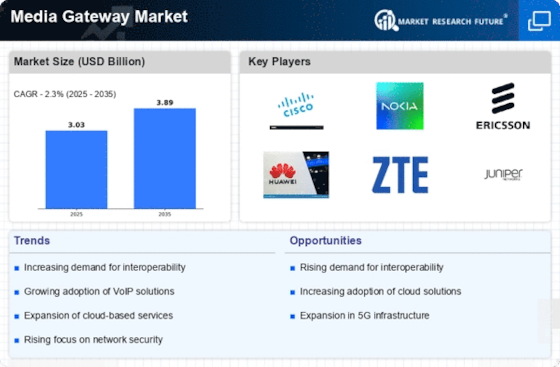
As per Market Research Future analysis, the Media Gateway Market Size was estimated at 3.028 USD Billion in 2024. The Media Gateway industry is projected to grow from 3.098 USD Billion in 2025 to 3.89 USD Billion by 2035, exhibiting a compound annual growth rate (CAGR) of 2.3% during the forecast period 2025 - 2035

Key Market Trends & Highlights

The Media Gateway Market is poised for substantial growth driven by technological advancements and evolving consumer demands.

  • The integration of cloud solutions is becoming increasingly prevalent in the Media Gateway Market, particularly in North America. Security enhancements are a primary focus as organizations seek to protect their communications infrastructure in both North America and Asia-Pacific. There is a growing demand for interoperability solutions, especially within the digital segment, which remains the largest in the market. The rising demand for VoIP services and the expansion of unified communications are key drivers propelling growth in the Media Gateway Market.

Market Size & Forecast

2024 Market Size 3.028 (USD Billion)
2035 Market Size 3.89 (USD Billion)
CAGR (2025 - 2035) 2.3%
Largest Regional Market Share in 2024 North America

Major Players

Cisco Systems (US), Nokia (FI), Ericsson (SE), Huawei Technologies (CN), ZTE Corporation (CN), Juniper Networks (US), ADTRAN (US), Ribbon Communications (US)

Market Trends

The Media Gateway Market is currently experiencing a transformative phase, driven by the increasing demand for seamless communication across various platforms. This market serves as a crucial bridge between different networks, enabling the integration of voice, video, and data services. As organizations seek to enhance their operational efficiency, the adoption of advanced media gateways appears to be on the rise. This trend is likely influenced by the growing need for interoperability among diverse communication systems, which facilitates smoother interactions and improved user experiences. Furthermore, the expansion of cloud-based solutions is reshaping the landscape, as businesses increasingly migrate to cloud environments for their communication needs. In addition, the Media Gateway Market is witnessing a shift towards enhanced security features. With the proliferation of cyber threats, organizations are prioritizing secure communication channels. This focus on security may drive the development of more robust media gateway solutions that incorporate advanced encryption and authentication mechanisms. As the market evolves, it seems poised to adapt to the changing technological landscape, potentially leading to innovative solutions that address emerging challenges. Overall, the Media Gateway Market is positioned for growth, reflecting the dynamic nature of communication technologies and the ongoing quest for improved connectivity and security.

Integration of Cloud Solutions

The Media Gateway Market is increasingly influenced by the integration of cloud-based solutions. Organizations are migrating their communication systems to the cloud, seeking flexibility and scalability. This shift allows for enhanced collaboration and accessibility, as users can connect from various devices and locations.

Focus on Security Enhancements

As cyber threats become more prevalent, the Media Gateway Market is witnessing a heightened emphasis on security features. Companies are prioritizing secure communication channels, leading to the development of media gateways that incorporate advanced encryption and authentication protocols.

Interoperability Demand

The need for interoperability among diverse communication systems is driving growth in the Media Gateway Market. Organizations require seamless integration of voice, video, and data services, prompting the development of solutions that facilitate smooth interactions across different platforms.

Media Gateway Market Market Drivers

Adoption of 5G Technology

The ongoing rollout of 5G technology is poised to significantly impact the Media Gateway Market. With its promise of ultra-fast data speeds and low latency, 5G is expected to revolutionize various sectors, including telecommunications and media. The global 5G market is projected to reach a value of over 700 billion by 2026, indicating a robust growth trajectory. As 5G networks become more prevalent, the need for advanced media gateways that can handle increased data traffic and support new applications will likely rise. This shift presents a substantial opportunity for the Media Gateway Market, as service providers and enterprises look to upgrade their infrastructure to leverage the benefits of 5G connectivity.

Rising Demand for VoIP Services

The increasing adoption of Voice over Internet Protocol (VoIP) services is a primary driver for the Media Gateway Market. As businesses and consumers seek cost-effective communication solutions, VoIP technology has gained traction. According to recent data, the VoIP market is projected to grow at a compound annual growth rate (CAGR) of approximately 15% over the next five years. This surge in demand for VoIP services necessitates the integration of media gateways to facilitate seamless communication between traditional telephony systems and modern IP networks. Consequently, the Media Gateway Market is likely to experience significant growth as service providers invest in advanced media gateway solutions to enhance their offerings and meet customer expectations.

Expansion of Unified Communications

The expansion of unified communications (UC) solutions is another critical driver for the Media Gateway Market. Organizations are increasingly adopting UC platforms to streamline communication and collaboration among employees. This trend is supported by the need for integrated tools that combine voice, video, and messaging services. The UC market is expected to witness a substantial increase, with estimates suggesting a CAGR of around 20% in the coming years. As businesses implement these solutions, the demand for media gateways rises, as they play a vital role in connecting disparate communication systems. Thus, the Media Gateway Market stands to benefit from this growing trend, as companies seek to enhance their communication infrastructure.

Increased Focus on Network Security

The heightened focus on network security is a significant driver for the Media Gateway Market. As cyber threats become more sophisticated, organizations are prioritizing the protection of their communication systems. The media gateway serves as a critical point in the network, making it essential for these devices to incorporate robust security features. Recent studies indicate that The Media Gateway Market is expected to exceed 300 billion by 2024, reflecting the urgency for enhanced security measures. Consequently, the Media Gateway Market is likely to see increased demand for gateways equipped with advanced security protocols, ensuring secure communication channels for businesses and consumers alike.

Growing Need for Interoperability Solutions

The growing need for interoperability solutions is a driving force in the Media Gateway Market. As organizations utilize diverse communication platforms, the ability to ensure seamless interaction between different systems becomes paramount. This demand for interoperability is reflected in the increasing investments in media gateways that facilitate communication across various protocols and technologies. The market for interoperability solutions is projected to grow significantly, with estimates suggesting a CAGR of around 12% over the next few years. As businesses strive to enhance their operational efficiency, the Media Gateway Market is expected to expand, providing essential solutions that bridge the gap between legacy systems and modern communication technologies.

Market Segment Insights

By Type: Digital (Largest) vs. Analog (Emerging)

In the Media Gateway Market, the distribution of market share between the Digital and Analog segments showcases a clear dominance of Digital technology. <a href="https://www.marketresearchfuture.com/reports/digital-media-market-28629">Digital media </a>gateways have gained substantial traction, largely due to their superior efficiency, enhanced interoperability, and scalability compared to their Analog counterparts. While Analog remains a vital part of legacy systems, its share is steadily declining as more organizations transition towards digital solutions, which can handle higher data throughput and more complex network functions. As for growth trends, the Digital segment is experiencing rapid expansion driven by the increasing demand for high-quality streaming services and advanced communication technologies. Innovations in cloud-based solutions and the <a href="https://www.marketresearchfuture.com/reports/internet-of-things-market-1176">Internet of Things (IoT) </a>are propelling this growth, enabling seamless integration and low-latency communication. Meanwhile, the Analog segment faces challenges as the industry shifts towards more advanced digital methods, but there remains a niche market for Analog in specialized applications where legacy systems are still in use.

Type: Digital (Dominant) vs. Analog (Emerging)

The Digital segment of the Media Gateway Market represents a significant force, characterized by its ability to deliver high-quality media processing and data management across diverse platforms. <a href="https://www.marketresearchfuture.com/reports/digital-media-market-28629">Digital media </a>gateways are designed to handle complex protocol translations and facilitate real-time communications, making them essential for modern broadcasting and telecommunication needs. This segment thrives on continuous technological advancements, offering high flexibility and integration capabilities that suit a wide array of applications. In contrast, the Analog segment, while increasingly regarded as emerging, offers reliability in traditional systems and often serves specific niches where <a href="https://www.marketresearchfuture.com/reports/digital-transformation-market-8685">digital transition </a>is not feasible. Analog gateways maintain critical functions in varying legacy infrastructures but are witnessing reduced relevance in the face of advancing digital alternatives.

By Technology: Wireline (Largest) vs. Wireless (Fastest-Growing)

The Media Gateway Market exhibits a diversified technology segment, with Wireline technology holding the largest share. Its reliability and robustness continue to attract significant demand from service providers that prioritize quality and consistency. In contrast, the Wireless technology segment is rapidly gaining traction, driven by the increasing adoption of mobile applications and the growing need for seamless connectivity. Despite Wireline's strong position, Wireless technology is establishing itself as a formidable player in the market. Growth trends in the Media Gateway Market reflect an evolving landscape, with emerging technologies and consumer preferences shaping demand. The shift towards mobility and <a href="https://www.marketresearchfuture.com/reports/digital-transformation-market-8685">digital transformation </a>has accelerated the growth of Wireless technologies, appealing especially to younger demographics and urban centers. Additionally, the advent of <a href="https://www.marketresearchfuture.com/reports/advanced-technologies-market-41462">5G infrastructure </a>is further propelling Wireless adoption, offering enhanced data speeds and reduced latency, thereby positioning it as the fastest-growing segment in comparison to its Wireline counterpart.

Technology: Wireline (Dominant) vs. Wireless (Emerging)

In the Media Gateway Market, Wireline technology remains the dominant player, characterized by its stability and extensive historical presence. This segment is favored in scenarios where data integrity and transmission quality are critical. Wireline's strengths lie in its established infrastructure, which continues to serve broadcast media, telecommunications, and enterprise networks effectively. Conversely, Wireless technology, while classified as 'emerging,' is carving out a significant niche due to its versatility and compatibility with mobile ecosystems. It appeals to consumers seeking flexibility and convenience, allowing for diverse applications from streaming services to smart home integrations. As 5G continues to roll out, Wireless technology is expected to expand its footprint, challenging the traditional dominance of Wireline.

By End User: Telecommunications (Largest) vs. Banking, Financial Services, and Insurance (BFSI) (Fastest-Growing)

In the Media Gateway Market, the segmentation by end user reveals a diversified landscape where Telecommunications holds the largest share. This sector leverages media gateways to enhance communication and manage data, providing significant value across services. Following closely, BFSI has emerged as a fast-growing segment as financial institutions increasingly rely on seamless digital communication for service delivery and customer engagement.

Telecommunications: Dominant vs. Banking, Financial Services, and Insurance (BFSI): Emerging

The Telecommunications sector dominates the Media Gateway Market as it relies heavily on advanced technologies for communication infrastructure. This segment utilizes media gateways to facilitate VoIP services and support multi-media traffic, making it essential for service providers. On the other hand, BFSI is an emerging player, with banks and financial institutions adopting media gateways to meet the demands of <a href="https://www.marketresearchfuture.com/reports/digital-transformation-market-8685">digital transformation</a>. This segment is characterized by increasing regulatory requirements and a push for secure, efficient communication channels, driving innovations in digital banking solutions.

Get more detailed insights about Media Gateway Market Research Report - Global Forecast till 2035

Regional Insights

North America : Innovation and Technology Hub

North America is the largest market for media gateways, holding approximately 40% of the global share. The region's growth is driven by the increasing demand for high-speed internet and the proliferation of cloud-based services. Regulatory support for telecommunications infrastructure and advancements in 5G technology further catalyze market expansion. The U.S. and Canada are the primary contributors, with significant investments in digital transformation initiatives. The competitive landscape in North America is characterized by the presence of major players such as Cisco Systems, Juniper Networks, and Ribbon Communications. These companies are at the forefront of innovation, offering advanced solutions that cater to the evolving needs of businesses and consumers. The focus on enhancing user experience and operational efficiency is driving the adoption of media gateways across various sectors, including telecommunications and enterprise solutions.

Europe : Diverse and Growing Market

Europe is the second-largest market for media gateways, accounting for approximately 30% of the global share. The region's growth is fueled by the increasing demand for seamless connectivity and the integration of IoT devices. Regulatory frameworks promoting digital infrastructure and sustainability initiatives are also significant growth drivers. Countries like Germany and the UK lead the market, supported by robust telecommunications networks and investments in next-generation technologies. The competitive landscape in Europe features key players such as Nokia and Ericsson, who are actively involved in developing innovative media gateway solutions. The presence of various startups and established firms fosters a dynamic environment, encouraging collaboration and technological advancements. The European market is characterized by a strong emphasis on compliance with regulatory standards, ensuring high-quality service delivery and consumer protection.

Asia-Pacific : Emerging Powerhouse in Technology

Asia-Pacific is witnessing rapid growth in the media gateway market, holding approximately 25% of the global share. The region's expansion is driven by the increasing adoption of digital technologies and the rising demand for high-speed internet services. Countries like China and India are at the forefront, supported by government initiatives aimed at enhancing digital infrastructure and connectivity. The regulatory environment is becoming more favorable, encouraging investments in telecommunications. The competitive landscape in Asia-Pacific is diverse, with key players such as Huawei Technologies and ZTE Corporation leading the market. These companies are focusing on innovation and cost-effective solutions to cater to the growing demand. The presence of a large consumer base and the rapid urbanization in the region further contribute to the increasing adoption of media gateways, making it a critical market for future growth.

Middle East and Africa : Resource-Rich Frontier

The Middle East and Africa region is emerging as a developing market for media gateways, holding approximately 5% of the global share. The growth is driven by increasing investments in telecommunications infrastructure and the rising demand for digital services. Countries like South Africa and the UAE are leading the way, supported by government initiatives aimed at enhancing connectivity and promoting technological advancements. Regulatory bodies are increasingly focusing on improving service quality and consumer protection. The competitive landscape in this region is characterized by a mix of local and international players. Companies are focusing on providing tailored solutions to meet the unique needs of the market. The presence of key players, along with the growing interest from global firms, is expected to drive innovation and enhance the overall market landscape in the coming years.

Key Players and Competitive Insights

Leading market players are investing heavily in research and development in order to expand their product lines, which will help the Media Gateway Market, grow even more. Market participants are also undertaking a variety of strategic activities to expand their global footprint, with important market developments including new product launches, contractual agreements, mergers and acquisitions, higher investments, and collaboration with other organizations. To expand and survive in a more competitive and rising market climate, Media Gateway industry must offer cost-effective items. Manufacturing locally to minimize operational costs is one of the key business tactics used by manufacturers in the global Media Gateway industry to benefit clients and increase the market sector. In recent years, the Media Gateway industry has offered some of the most significant advantages to medicine. Major players in the Media Gateway Market, including Audiocodes, Avaya Inc., Ribbon Communications Operating Company, Inc., Telefonaktiebolaget LM Ericsson, Huawei Technologies Co., Ltd., Cisco Systems, Inc., ZTE Corporation., Panasonic Corporation, ROHM CO., LTD., Murata Manufacturing Co, Koninklijke Philips N.V., uBeam, HUMAVOX LTD, Powermat, Powercast Corp., Fulton Innovation LLC, TDK Corporation, WiTricity Corporation, Integrated Device Technology, Inc., Texas Instruments Incorporated and Ossia Inc., and others, are attempting to increase market demand by investing in research and development operations. AudioCodes is a market leader in providing advanced technology voice networking and media processing solutions. With more than two decades of expertise, AudioCodes has made a name for itself as an innovative and reliable participant in the market. The business provides a wide range of media gateways that facilitate seamless interoperability and connectivity between various communication networks. To meet the changing demands of the market, their media gateways support a wide range of technologies, including analogue, digital, wireline, wireless, and hybrid. The media gateways made by AudioCodes are renowned for their reliable operation, scalability, and cutting-edge features like high-quality voice and multimedia transmission, support for a variety of codecs, protocol conversion, and integration with unified communications platforms. The company's solutions are widely used in industries like manufacturing, finance, telecommunications, and government. Ribbon Communications is a market leader in the Media Gateway industry and a leading provider of secure and sophisticated cloud communications solutions. Ribbon Communications provides an extensive array of media gateway solutions that facilitate seamless communication and networking. Ribbon Communications has a long history and extensive industry knowledge. By bridging the gap between various communication networks, the company's media gateways make it easier to convert speech and multimedia information. In order to meet the varying needs of customers in various industries, Ribbon Communications' media gateways support a range of technologies, including analogue, digital, wireline, wireless, and hybrid. The media gateway solutions from Ribbon Communications are renowned for their dependability, scalability, and cutting-edge capabilities including protocol conversion, voice quality augmentation, and compatibility for new communication protocols. Solutions provided by the business are widely used in industries including telecommunications, banking, government, healthcare, and manufacturing.

Key Companies in the Media Gateway Market include

Industry Developments

April 2020 -The worldwide, integrated media business TMC presented the Unified Communications Excellence Award to Avaya Holdings Corp. for its Avaya OneCloud ReadyNow private cloud solution. The prize recognises businesses that have created outstanding unified communications systems that are setting the standard in this expanding sector.

Future Outlook

Media Gateway Market Future Outlook

The Media Gateway Market is projected to grow at a 2.3% CAGR from 2025 to 2035, driven by increasing demand for seamless communication and integration of multimedia services.

New opportunities lie in:

  • <p>Expansion into cloud-based media gateway solutions Development of AI-driven analytics for media <a href="https://www.marketresearchfuture.com/reports/5g-technology-market-2988">traffic management </a>Partnerships with telecom providers for enhanced service offerings</p>

By 2035, the Media Gateway Market is expected to achieve robust growth, reflecting evolving technological demands.

Market Segmentation

Media Gateway Market Type Outlook

  • Analog
  • Digital

Media Gateway Market End User Outlook

  • Telecommunications
  • Banking
  • Financial Services
  • and Insurance (BFSI)
  • Government
  • Healthcare
  • Manufacturing
  • Transportation
  • Others

Media Gateway Market Technology Outlook

  • Wireline
  • Wireless
  • Hybrid

Report Scope

MARKET SIZE 2024 3.028(USD Billion)
MARKET SIZE 2025 3.098(USD Billion)
MARKET SIZE 2035 3.89(USD Billion)
COMPOUND ANNUAL GROWTH RATE (CAGR) 2.3% (2025 - 2035)
REPORT COVERAGE Revenue Forecast, Competitive Landscape, Growth Factors, and Trends
BASE YEAR 2024
Market Forecast Period 2025 - 2035
Historical Data 2019 - 2024
Market Forecast Units USD Billion
Key Companies Profiled Cisco Systems (US), Nokia (FI), Ericsson (SE), Huawei Technologies (CN), ZTE Corporation (CN), Juniper Networks (US), ADTRAN (US), Ribbon Communications (US)
Segments Covered Type, Region
Key Market Opportunities Integration of advanced artificial intelligence in Media Gateway Market enhances interoperability and user experience.
Key Market Dynamics Rising demand for seamless connectivity drives innovation and competition in the Media Gateway Market.
Countries Covered North America, Europe, APAC, South America, MEA

FAQs

What is the current valuation of the Media Gateway Market as of 2024?

<p>The Media Gateway Market was valued at 3.028 USD Billion in 2024.</p>

What is the projected market size for the Media Gateway Market in 2035?

<p>The projected valuation for the Media Gateway Market in 2035 is 3.89 USD Billion.</p>

What is the expected CAGR for the Media Gateway Market during the forecast period 2025 - 2035?

<p>The expected CAGR for the Media Gateway Market during the forecast period 2025 - 2035 is 2.3%.</p>

Which companies are considered key players in the Media Gateway Market?

<p>Key players in the Media Gateway Market include Cisco Systems, Nokia, Ericsson, Huawei Technologies, ZTE Corporation, Juniper Networks, ADTRAN, and Ribbon Communications.</p>

What are the main types of media gateways in the market?

<p>The main types of media gateways in the market are Analog and Digital, with valuations of 1.2 to 1.5 USD Billion for Analog and 1.828 to 2.39 USD Billion for Digital.</p>

How is the Media Gateway Market segmented by technology?

<p>The Media Gateway Market is segmented by technology into Wireline, Wireless, and Hybrid, with Wireline valued at 1.2 to 1.5 USD Billion, Wireless at 1.0 to 1.3 USD Billion, and Hybrid at 0.828 to 1.079 USD Billion.</p>

What end-user segments are driving the Media Gateway Market?

End-user segments driving the Media Gateway Market include Telecommunications, BFSI, Government, Healthcare, Manufacturing, Transportation, and Others, with Telecommunications valued at 0.9 to 1.1 USD Billion.

What is the growth outlook for the Media Gateway Market in the coming years?

The growth outlook for the Media Gateway Market appears positive, with a projected increase in valuation from 3.028 USD Billion in 2024 to 3.89 USD Billion by 2035.

How does the Media Gateway Market's performance compare across different end-user segments?

The performance of the Media Gateway Market varies across end-user segments, with Telecommunications leading at 0.9 to 1.1 USD Billion, followed by Healthcare at 0.6 to 0.8 USD Billion.

What factors may influence the growth of the Media Gateway Market from 2025 to 2035?

Factors influencing the growth of the Media Gateway Market from 2025 to 2035 may include technological advancements, increasing demand for digital communication, and the expansion of telecommunications infrastructure.

  1. SECTION I: EXECUTIVE SUMMARY AND KEY HIGHLIGHTS
    1. | 1.1 EXECUTIVE SUMMARY
    2. | | 1.1.1 Market Overview
    3. | | 1.1.2 Key Findings
    4. | | 1.1.3 Market Segmentation
    5. | | 1.1.4 Competitive Landscape
    6. | | 1.1.5 Challenges and Opportunities
    7. | | 1.1.6 Future Outlook
  2. SECTION II: SCOPING, METHODOLOGY AND MARKET STRUCTURE
    1. | 2.1 MARKET INTRODUCTION
    2. | | 2.1.1 Definition
    3. | | 2.1.2 Scope of the study
    4. | | | 2.1.2.1 Research Objective
    5. | | | 2.1.2.2 Assumption
    6. | | | 2.1.2.3 Limitations
    7. | 2.2 RESEARCH METHODOLOGY
    8. | | 2.2.1 Overview
    9. | | 2.2.2 Data Mining
    10. | | 2.2.3 Secondary Research
    11. | | 2.2.4 Primary Research
    12. | | | 2.2.4.1 Primary Interviews and Information Gathering Process
    13. | | | 2.2.4.2 Breakdown of Primary Respondents
    14. | | 2.2.5 Forecasting Model
    15. | | 2.2.6 Market Size Estimation
    16. | | | 2.2.6.1 Bottom-Up Approach
    17. | | | 2.2.6.2 Top-Down Approach
    18. | | 2.2.7 Data Triangulation
    19. | | 2.2.8 Validation
  3. SECTION III: QUALITATIVE ANALYSIS
    1. | 3.1 MARKET DYNAMICS
    2. | | 3.1.1 Overview
    3. | | 3.1.2 Drivers
    4. | | 3.1.3 Restraints
    5. | | 3.1.4 Opportunities
    6. | 3.2 MARKET FACTOR ANALYSIS
    7. | | 3.2.1 Value chain Analysis
    8. | | 3.2.2 Porter's Five Forces Analysis
    9. | | | 3.2.2.1 Bargaining Power of Suppliers
    10. | | | 3.2.2.2 Bargaining Power of Buyers
    11. | | | 3.2.2.3 Threat of New Entrants
    12. | | | 3.2.2.4 Threat of Substitutes
    13. | | | 3.2.2.5 Intensity of Rivalry
    14. | | 3.2.3 COVID-19 Impact Analysis
    15. | | | 3.2.3.1 Market Impact Analysis
    16. | | | 3.2.3.2 Regional Impact
    17. | | | 3.2.3.3 Opportunity and Threat Analysis
  4. SECTION IV: QUANTITATIVE ANALYSIS
    1. | 4.1 Information and Communications Technology, BY Type (USD Billion)
    2. | | 4.1.1 Analog
    3. | | 4.1.2 Digital
    4. | 4.2 Information and Communications Technology, BY Technology (USD Billion)
    5. | | 4.2.1 Wireline
    6. | | 4.2.2 Wireless
    7. | | 4.2.3 Hybrid
    8. | 4.3 Information and Communications Technology, BY End User (USD Billion)
    9. | | 4.3.1 Telecommunications
    10. | | 4.3.2 Banking, Financial Services, and Insurance (BFSI)
    11. | | 4.3.3 Government
    12. | | 4.3.4 Healthcare
    13. | | 4.3.5 Manufacturing
    14. | | 4.3.6 Transportation
    15. | | 4.3.7 Others
    16. | 4.4 Information and Communications Technology, BY Region (USD Billion)
    17. | | 4.4.1 North America
    18. | | | 4.4.1.1 US
    19. | | | 4.4.1.2 Canada
    20. | | 4.4.2 Europe
    21. | | | 4.4.2.1 Germany
    22. | | | 4.4.2.2 UK
    23. | | | 4.4.2.3 France
    24. | | | 4.4.2.4 Russia
    25. | | | 4.4.2.5 Italy
    26. | | | 4.4.2.6 Spain
    27. | | | 4.4.2.7 Rest of Europe
    28. | | 4.4.3 APAC
    29. | | | 4.4.3.1 China
    30. | | | 4.4.3.2 India
    31. | | | 4.4.3.3 Japan
    32. | | | 4.4.3.4 South Korea
    33. | | | 4.4.3.5 Malaysia
    34. | | | 4.4.3.6 Thailand
    35. | | | 4.4.3.7 Indonesia
    36. | | | 4.4.3.8 Rest of APAC
    37. | | 4.4.4 South America
    38. | | | 4.4.4.1 Brazil
    39. | | | 4.4.4.2 Mexico
    40. | | | 4.4.4.3 Argentina
    41. | | | 4.4.4.4 Rest of South America
    42. | | 4.4.5 MEA
    43. | | | 4.4.5.1 GCC Countries
    44. | | | 4.4.5.2 South Africa
    45. | | | 4.4.5.3 Rest of MEA
  5. SECTION V: COMPETITIVE ANALYSIS
    1. | 5.1 Competitive Landscape
    2. | | 5.1.1 Overview
    3. | | 5.1.2 Competitive Analysis
    4. | | 5.1.3 Market share Analysis
    5. | | 5.1.4 Major Growth Strategy in the Information and Communications Technology
    6. | | 5.1.5 Competitive Benchmarking
    7. | | 5.1.6 Leading Players in Terms of Number of Developments in the Information and Communications Technology
    8. | | 5.1.7 Key developments and growth strategies
    9. | | | 5.1.7.1 New Product Launch/Service Deployment
    10. | | | 5.1.7.2 Merger & Acquisitions
    11. | | | 5.1.7.3 Joint Ventures
    12. | | 5.1.8 Major Players Financial Matrix
    13. | | | 5.1.8.1 Sales and Operating Income
    14. | | | 5.1.8.2 Major Players R&D Expenditure. 2023
    15. | 5.2 Company Profiles
    16. | | 5.2.1 Cisco Systems (US)
    17. | | | 5.2.1.1 Financial Overview
    18. | | | 5.2.1.2 Products Offered
    19. | | | 5.2.1.3 Key Developments
    20. | | | 5.2.1.4 SWOT Analysis
    21. | | | 5.2.1.5 Key Strategies
    22. | | 5.2.2 Nokia (FI)
    23. | | | 5.2.2.1 Financial Overview
    24. | | | 5.2.2.2 Products Offered
    25. | | | 5.2.2.3 Key Developments
    26. | | | 5.2.2.4 SWOT Analysis
    27. | | | 5.2.2.5 Key Strategies
    28. | | 5.2.3 Ericsson (SE)
    29. | | | 5.2.3.1 Financial Overview
    30. | | | 5.2.3.2 Products Offered
    31. | | | 5.2.3.3 Key Developments
    32. | | | 5.2.3.4 SWOT Analysis
    33. | | | 5.2.3.5 Key Strategies
    34. | | 5.2.4 Huawei Technologies (CN)
    35. | | | 5.2.4.1 Financial Overview
    36. | | | 5.2.4.2 Products Offered
    37. | | | 5.2.4.3 Key Developments
    38. | | | 5.2.4.4 SWOT Analysis
    39. | | | 5.2.4.5 Key Strategies
    40. | | 5.2.5 ZTE Corporation (CN)
    41. | | | 5.2.5.1 Financial Overview
    42. | | | 5.2.5.2 Products Offered
    43. | | | 5.2.5.3 Key Developments
    44. | | | 5.2.5.4 SWOT Analysis
    45. | | | 5.2.5.5 Key Strategies
    46. | | 5.2.6 Juniper Networks (US)
    47. | | | 5.2.6.1 Financial Overview
    48. | | | 5.2.6.2 Products Offered
    49. | | | 5.2.6.3 Key Developments
    50. | | | 5.2.6.4 SWOT Analysis
    51. | | | 5.2.6.5 Key Strategies
    52. | | 5.2.7 ADTRAN (US)
    53. | | | 5.2.7.1 Financial Overview
    54. | | | 5.2.7.2 Products Offered
    55. | | | 5.2.7.3 Key Developments
    56. | | | 5.2.7.4 SWOT Analysis
    57. | | | 5.2.7.5 Key Strategies
    58. | | 5.2.8 Ribbon Communications (US)
    59. | | | 5.2.8.1 Financial Overview
    60. | | | 5.2.8.2 Products Offered
    61. | | | 5.2.8.3 Key Developments
    62. | | | 5.2.8.4 SWOT Analysis
    63. | | | 5.2.8.5 Key Strategies
    64. | 5.3 Appendix
    65. | | 5.3.1 References
    66. | | 5.3.2 Related Reports
  6. LIST OF FIGURES
    1. | 6.1 MARKET SYNOPSIS
    2. | 6.2 NORTH AMERICA MARKET ANALYSIS
    3. | 6.3 US MARKET ANALYSIS BY TYPE
    4. | 6.4 US MARKET ANALYSIS BY TECHNOLOGY
    5. | 6.5 US MARKET ANALYSIS BY END USER
    6. | 6.6 CANADA MARKET ANALYSIS BY TYPE
    7. | 6.7 CANADA MARKET ANALYSIS BY TECHNOLOGY
    8. | 6.8 CANADA MARKET ANALYSIS BY END USER
    9. | 6.9 EUROPE MARKET ANALYSIS
    10. | 6.10 GERMANY MARKET ANALYSIS BY TYPE
    11. | 6.11 GERMANY MARKET ANALYSIS BY TECHNOLOGY
    12. | 6.12 GERMANY MARKET ANALYSIS BY END USER
    13. | 6.13 UK MARKET ANALYSIS BY TYPE
    14. | 6.14 UK MARKET ANALYSIS BY TECHNOLOGY
    15. | 6.15 UK MARKET ANALYSIS BY END USER
    16. | 6.16 FRANCE MARKET ANALYSIS BY TYPE
    17. | 6.17 FRANCE MARKET ANALYSIS BY TECHNOLOGY
    18. | 6.18 FRANCE MARKET ANALYSIS BY END USER
    19. | 6.19 RUSSIA MARKET ANALYSIS BY TYPE
    20. | 6.20 RUSSIA MARKET ANALYSIS BY TECHNOLOGY
    21. | 6.21 RUSSIA MARKET ANALYSIS BY END USER
    22. | 6.22 ITALY MARKET ANALYSIS BY TYPE
    23. | 6.23 ITALY MARKET ANALYSIS BY TECHNOLOGY
    24. | 6.24 ITALY MARKET ANALYSIS BY END USER
    25. | 6.25 SPAIN MARKET ANALYSIS BY TYPE
    26. | 6.26 SPAIN MARKET ANALYSIS BY TECHNOLOGY
    27. | 6.27 SPAIN MARKET ANALYSIS BY END USER
    28. | 6.28 REST OF EUROPE MARKET ANALYSIS BY TYPE
    29. | 6.29 REST OF EUROPE MARKET ANALYSIS BY TECHNOLOGY
    30. | 6.30 REST OF EUROPE MARKET ANALYSIS BY END USER
    31. | 6.31 APAC MARKET ANALYSIS
    32. | 6.32 CHINA MARKET ANALYSIS BY TYPE
    33. | 6.33 CHINA MARKET ANALYSIS BY TECHNOLOGY
    34. | 6.34 CHINA MARKET ANALYSIS BY END USER
    35. | 6.35 INDIA MARKET ANALYSIS BY TYPE
    36. | 6.36 INDIA MARKET ANALYSIS BY TECHNOLOGY
    37. | 6.37 INDIA MARKET ANALYSIS BY END USER
    38. | 6.38 JAPAN MARKET ANALYSIS BY TYPE
    39. | 6.39 JAPAN MARKET ANALYSIS BY TECHNOLOGY
    40. | 6.40 JAPAN MARKET ANALYSIS BY END USER
    41. | 6.41 SOUTH KOREA MARKET ANALYSIS BY TYPE
    42. | 6.42 SOUTH KOREA MARKET ANALYSIS BY TECHNOLOGY
    43. | 6.43 SOUTH KOREA MARKET ANALYSIS BY END USER
    44. | 6.44 MALAYSIA MARKET ANALYSIS BY TYPE
    45. | 6.45 MALAYSIA MARKET ANALYSIS BY TECHNOLOGY
    46. | 6.46 MALAYSIA MARKET ANALYSIS BY END USER
    47. | 6.47 THAILAND MARKET ANALYSIS BY TYPE
    48. | 6.48 THAILAND MARKET ANALYSIS BY TECHNOLOGY
    49. | 6.49 THAILAND MARKET ANALYSIS BY END USER
    50. | 6.50 INDONESIA MARKET ANALYSIS BY TYPE
    51. | 6.51 INDONESIA MARKET ANALYSIS BY TECHNOLOGY
    52. | 6.52 INDONESIA MARKET ANALYSIS BY END USER
    53. | 6.53 REST OF APAC MARKET ANALYSIS BY TYPE
    54. | 6.54 REST OF APAC MARKET ANALYSIS BY TECHNOLOGY
    55. | 6.55 REST OF APAC MARKET ANALYSIS BY END USER
    56. | 6.56 SOUTH AMERICA MARKET ANALYSIS
    57. | 6.57 BRAZIL MARKET ANALYSIS BY TYPE
    58. | 6.58 BRAZIL MARKET ANALYSIS BY TECHNOLOGY
    59. | 6.59 BRAZIL MARKET ANALYSIS BY END USER
    60. | 6.60 MEXICO MARKET ANALYSIS BY TYPE
    61. | 6.61 MEXICO MARKET ANALYSIS BY TECHNOLOGY
    62. | 6.62 MEXICO MARKET ANALYSIS BY END USER
    63. | 6.63 ARGENTINA MARKET ANALYSIS BY TYPE
    64. | 6.64 ARGENTINA MARKET ANALYSIS BY TECHNOLOGY
    65. | 6.65 ARGENTINA MARKET ANALYSIS BY END USER
    66. | 6.66 REST OF SOUTH AMERICA MARKET ANALYSIS BY TYPE
    67. | 6.67 REST OF SOUTH AMERICA MARKET ANALYSIS BY TECHNOLOGY
    68. | 6.68 REST OF SOUTH AMERICA MARKET ANALYSIS BY END USER
    69. | 6.69 MEA MARKET ANALYSIS
    70. | 6.70 GCC COUNTRIES MARKET ANALYSIS BY TYPE
    71. | 6.71 GCC COUNTRIES MARKET ANALYSIS BY TECHNOLOGY
    72. | 6.72 GCC COUNTRIES MARKET ANALYSIS BY END USER
    73. | 6.73 SOUTH AFRICA MARKET ANALYSIS BY TYPE
    74. | 6.74 SOUTH AFRICA MARKET ANALYSIS BY TECHNOLOGY
    75. | 6.75 SOUTH AFRICA MARKET ANALYSIS BY END USER
    76. | 6.76 REST OF MEA MARKET ANALYSIS BY TYPE
    77. | 6.77 REST OF MEA MARKET ANALYSIS BY TECHNOLOGY
    78. | 6.78 REST OF MEA MARKET ANALYSIS BY END USER
    79. | 6.79 KEY BUYING CRITERIA OF INFORMATION AND COMMUNICATIONS TECHNOLOGY
    80. | 6.80 RESEARCH PROCESS OF MRFR
    81. | 6.81 DRO ANALYSIS OF INFORMATION AND COMMUNICATIONS TECHNOLOGY
    82. | 6.82 DRIVERS IMPACT ANALYSIS: INFORMATION AND COMMUNICATIONS TECHNOLOGY
    83. | 6.83 RESTRAINTS IMPACT ANALYSIS: INFORMATION AND COMMUNICATIONS TECHNOLOGY
    84. | 6.84 SUPPLY / VALUE CHAIN: INFORMATION AND COMMUNICATIONS TECHNOLOGY
    85. | 6.85 INFORMATION AND COMMUNICATIONS TECHNOLOGY, BY TYPE, 2024 (% SHARE)
    86. | 6.86 INFORMATION AND COMMUNICATIONS TECHNOLOGY, BY TYPE, 2024 TO 2035 (USD Billion)
    87. | 6.87 INFORMATION AND COMMUNICATIONS TECHNOLOGY, BY TECHNOLOGY, 2024 (% SHARE)
    88. | 6.88 INFORMATION AND COMMUNICATIONS TECHNOLOGY, BY TECHNOLOGY, 2024 TO 2035 (USD Billion)
    89. | 6.89 INFORMATION AND COMMUNICATIONS TECHNOLOGY, BY END USER, 2024 (% SHARE)
    90. | 6.90 INFORMATION AND COMMUNICATIONS TECHNOLOGY, BY END USER, 2024 TO 2035 (USD Billion)
    91. | 6.91 BENCHMARKING OF MAJOR COMPETITORS
  7. LIST OF TABLES
    1. | 7.1 LIST OF ASSUMPTIONS
    2. | | 7.1.1
    3. | 7.2 North America MARKET SIZE ESTIMATES; FORECAST
    4. | | 7.2.1 BY TYPE, 2025-2035 (USD Billion)
    5. | | 7.2.2 BY TECHNOLOGY, 2025-2035 (USD Billion)
    6. | | 7.2.3 BY END USER, 2025-2035 (USD Billion)
    7. | 7.3 US MARKET SIZE ESTIMATES; FORECAST
    8. | | 7.3.1 BY TYPE, 2025-2035 (USD Billion)
    9. | | 7.3.2 BY TECHNOLOGY, 2025-2035 (USD Billion)
    10. | | 7.3.3 BY END USER, 2025-2035 (USD Billion)
    11. | 7.4 Canada MARKET SIZE ESTIMATES; FORECAST
    12. | | 7.4.1 BY TYPE, 2025-2035 (USD Billion)
    13. | | 7.4.2 BY TECHNOLOGY, 2025-2035 (USD Billion)
    14. | | 7.4.3 BY END USER, 2025-2035 (USD Billion)
    15. | 7.5 Europe MARKET SIZE ESTIMATES; FORECAST
    16. | | 7.5.1 BY TYPE, 2025-2035 (USD Billion)
    17. | | 7.5.2 BY TECHNOLOGY, 2025-2035 (USD Billion)
    18. | | 7.5.3 BY END USER, 2025-2035 (USD Billion)
    19. | 7.6 Germany MARKET SIZE ESTIMATES; FORECAST
    20. | | 7.6.1 BY TYPE, 2025-2035 (USD Billion)
    21. | | 7.6.2 BY TECHNOLOGY, 2025-2035 (USD Billion)
    22. | | 7.6.3 BY END USER, 2025-2035 (USD Billion)
    23. | 7.7 UK MARKET SIZE ESTIMATES; FORECAST
    24. | | 7.7.1 BY TYPE, 2025-2035 (USD Billion)
    25. | | 7.7.2 BY TECHNOLOGY, 2025-2035 (USD Billion)
    26. | | 7.7.3 BY END USER, 2025-2035 (USD Billion)
    27. | 7.8 France MARKET SIZE ESTIMATES; FORECAST
    28. | | 7.8.1 BY TYPE, 2025-2035 (USD Billion)
    29. | | 7.8.2 BY TECHNOLOGY, 2025-2035 (USD Billion)
    30. | | 7.8.3 BY END USER, 2025-2035 (USD Billion)
    31. | 7.9 Russia MARKET SIZE ESTIMATES; FORECAST
    32. | | 7.9.1 BY TYPE, 2025-2035 (USD Billion)
    33. | | 7.9.2 BY TECHNOLOGY, 2025-2035 (USD Billion)
    34. | | 7.9.3 BY END USER, 2025-2035 (USD Billion)
    35. | 7.10 Italy MARKET SIZE ESTIMATES; FORECAST
    36. | | 7.10.1 BY TYPE, 2025-2035 (USD Billion)
    37. | | 7.10.2 BY TECHNOLOGY, 2025-2035 (USD Billion)
    38. | | 7.10.3 BY END USER, 2025-2035 (USD Billion)
    39. | 7.11 Spain MARKET SIZE ESTIMATES; FORECAST
    40. | | 7.11.1 BY TYPE, 2025-2035 (USD Billion)
    41. | | 7.11.2 BY TECHNOLOGY, 2025-2035 (USD Billion)
    42. | | 7.11.3 BY END USER, 2025-2035 (USD Billion)
    43. | 7.12 Rest of Europe MARKET SIZE ESTIMATES; FORECAST
    44. | | 7.12.1 BY TYPE, 2025-2035 (USD Billion)
    45. | | 7.12.2 BY TECHNOLOGY, 2025-2035 (USD Billion)
    46. | | 7.12.3 BY END USER, 2025-2035 (USD Billion)
    47. | 7.13 APAC MARKET SIZE ESTIMATES; FORECAST
    48. | | 7.13.1 BY TYPE, 2025-2035 (USD Billion)
    49. | | 7.13.2 BY TECHNOLOGY, 2025-2035 (USD Billion)
    50. | | 7.13.3 BY END USER, 2025-2035 (USD Billion)
    51. | 7.14 China MARKET SIZE ESTIMATES; FORECAST
    52. | | 7.14.1 BY TYPE, 2025-2035 (USD Billion)
    53. | | 7.14.2 BY TECHNOLOGY, 2025-2035 (USD Billion)
    54. | | 7.14.3 BY END USER, 2025-2035 (USD Billion)
    55. | 7.15 India MARKET SIZE ESTIMATES; FORECAST
    56. | | 7.15.1 BY TYPE, 2025-2035 (USD Billion)
    57. | | 7.15.2 BY TECHNOLOGY, 2025-2035 (USD Billion)
    58. | | 7.15.3 BY END USER, 2025-2035 (USD Billion)
    59. | 7.16 Japan MARKET SIZE ESTIMATES; FORECAST
    60. | | 7.16.1 BY TYPE, 2025-2035 (USD Billion)
    61. | | 7.16.2 BY TECHNOLOGY, 2025-2035 (USD Billion)
    62. | | 7.16.3 BY END USER, 2025-2035 (USD Billion)
    63. | 7.17 South Korea MARKET SIZE ESTIMATES; FORECAST
    64. | | 7.17.1 BY TYPE, 2025-2035 (USD Billion)
    65. | | 7.17.2 BY TECHNOLOGY, 2025-2035 (USD Billion)
    66. | | 7.17.3 BY END USER, 2025-2035 (USD Billion)
    67. | 7.18 Malaysia MARKET SIZE ESTIMATES; FORECAST
    68. | | 7.18.1 BY TYPE, 2025-2035 (USD Billion)
    69. | | 7.18.2 BY TECHNOLOGY, 2025-2035 (USD Billion)
    70. | | 7.18.3 BY END USER, 2025-2035 (USD Billion)
    71. | 7.19 Thailand MARKET SIZE ESTIMATES; FORECAST
    72. | | 7.19.1 BY TYPE, 2025-2035 (USD Billion)
    73. | | 7.19.2 BY TECHNOLOGY, 2025-2035 (USD Billion)
    74. | | 7.19.3 BY END USER, 2025-2035 (USD Billion)
    75. | 7.20 Indonesia MARKET SIZE ESTIMATES; FORECAST
    76. | | 7.20.1 BY TYPE, 2025-2035 (USD Billion)
    77. | | 7.20.2 BY TECHNOLOGY, 2025-2035 (USD Billion)
    78. | | 7.20.3 BY END USER, 2025-2035 (USD Billion)
    79. | 7.21 Rest of APAC MARKET SIZE ESTIMATES; FORECAST
    80. | | 7.21.1 BY TYPE, 2025-2035 (USD Billion)
    81. | | 7.21.2 BY TECHNOLOGY, 2025-2035 (USD Billion)
    82. | | 7.21.3 BY END USER, 2025-2035 (USD Billion)
    83. | 7.22 South America MARKET SIZE ESTIMATES; FORECAST
    84. | | 7.22.1 BY TYPE, 2025-2035 (USD Billion)
    85. | | 7.22.2 BY TECHNOLOGY, 2025-2035 (USD Billion)
    86. | | 7.22.3 BY END USER, 2025-2035 (USD Billion)
    87. | 7.23 Brazil MARKET SIZE ESTIMATES; FORECAST
    88. | | 7.23.1 BY TYPE, 2025-2035 (USD Billion)
    89. | | 7.23.2 BY TECHNOLOGY, 2025-2035 (USD Billion)
    90. | | 7.23.3 BY END USER, 2025-2035 (USD Billion)
    91. | 7.24 Mexico MARKET SIZE ESTIMATES; FORECAST
    92. | | 7.24.1 BY TYPE, 2025-2035 (USD Billion)
    93. | | 7.24.2 BY TECHNOLOGY, 2025-2035 (USD Billion)
    94. | | 7.24.3 BY END USER, 2025-2035 (USD Billion)
    95. | 7.25 Argentina MARKET SIZE ESTIMATES; FORECAST
    96. | | 7.25.1 BY TYPE, 2025-2035 (USD Billion)
    97. | | 7.25.2 BY TECHNOLOGY, 2025-2035 (USD Billion)
    98. | | 7.25.3 BY END USER, 2025-2035 (USD Billion)
    99. | 7.26 Rest of South America MARKET SIZE ESTIMATES; FORECAST
    100. | | 7.26.1 BY TYPE, 2025-2035 (USD Billion)
    101. | | 7.26.2 BY TECHNOLOGY, 2025-2035 (USD Billion)
    102. | | 7.26.3 BY END USER, 2025-2035 (USD Billion)
    103. | 7.27 MEA MARKET SIZE ESTIMATES; FORECAST
    104. | | 7.27.1 BY TYPE, 2025-2035 (USD Billion)
    105. | | 7.27.2 BY TECHNOLOGY, 2025-2035 (USD Billion)
    106. | | 7.27.3 BY END USER, 2025-2035 (USD Billion)
    107. | 7.28 GCC Countries MARKET SIZE ESTIMATES; FORECAST
    108. | | 7.28.1 BY TYPE, 2025-2035 (USD Billion)
    109. | | 7.28.2 BY TECHNOLOGY, 2025-2035 (USD Billion)
    110. | | 7.28.3 BY END USER, 2025-2035 (USD Billion)
    111. | 7.29 South Africa MARKET SIZE ESTIMATES; FORECAST
    112. | | 7.29.1 BY TYPE, 2025-2035 (USD Billion)
    113. | | 7.29.2 BY TECHNOLOGY, 2025-2035 (USD Billion)
    114. | | 7.29.3 BY END USER, 2025-2035 (USD Billion)
    115. | 7.30 Rest of MEA MARKET SIZE ESTIMATES; FORECAST
    116. | | 7.30.1 BY TYPE, 2025-2035 (USD Billion)
    117. | | 7.30.2 BY TECHNOLOGY, 2025-2035 (USD Billion)
    118. | | 7.30.3 BY END USER, 2025-2035 (USD Billion)
    119. | 7.31 PRODUCT LAUNCH/PRODUCT DEVELOPMENT/APPROVAL
    120. | | 7.31.1
    121. | 7.32 ACQUISITION/PARTNERSHIP
    122. | | 7.32.1

Information and Communications Technology Market Segmentation

Information and Communications Technology By Type (USD Billion, 2025-2035)

  • Analog
  • Digital

Information and Communications Technology By Technology (USD Billion, 2025-2035)

  • Wireline
  • Wireless
  • Hybrid

Information and Communications Technology By End User (USD Billion, 2025-2035)

  • Telecommunications
  • Banking, Financial Services, and Insurance (BFSI)
  • Government
  • Healthcare
  • Manufacturing
  • Transportation
  • Others
Infographic

Free Sample Request

Kindly complete the form below to receive a free sample of this Report

Get Free Sample

Customer Strories

Compare Licence

×
Features License Type
Single User Multiuser License Enterprise User
Price $4,950 $5,950 $7,250
Maximum User Access Limit 1 User Upto 10 Users Unrestricted Access Throughout the Organization
Free Customization
Direct Access to Analyst
Deliverable Format
Platform Access
Discount on Next Purchase 10% 15% 15%
Printable Versions