×
Request Free Sample ×

Kindly complete the form below to receive a free sample of this Report

* Please use a valid business email

Leading companies partner with us for data-driven Insights

clients tt-cursor
Hero Background
English
Chinese
French
Japanese
Korean
German
Spanish

Mask Alignment System Market Size

ID: MRFR/SEM/3659-HCR
100 Pages
Ankit Gupta
October 2025

Mask Alignment System Market Size, Share and Research Report By Type (Semi-Automated, Fully Automated), By Application (MEMS Devices, Compound Semiconductor, LED Devices), By End-User (Foundry/Factory, Memory Chips Manufacturers, IDM) - Industry Forecast Till 2035

Share:
Download PDF ×

We do not share your information with anyone. However, we may send you emails based on your report interest from time to time. You may contact us at any time to opt-out.

Mask Alignment System Market Infographic
×
Mask Alignment System Market Infographic Full View
Purchase Options

Mask Alignment System Size

Mask Alignment System Market Growth Projections and Opportunities

Mask Alignment System market dynamics are shaped by many things. Technological advances drive the market. Mask alignment systems must adapt to new technology to work well. Artificial intelligence and machine learning are widely used to improve mask alignment precision and efficiency.

Additionally, the semiconductor sector strongly influences the Mask Alignment System market. Advanced and dependable mask alignment systems are needed as semiconductor demand rises. Mask Alignment Systems are essential to semiconductor device manufacture, hence their growth is tied to the semiconductor industry's.

Market demand also drives the Mask Alignment System market. The rise of consumer electronics and new technologies like 5G has increased semiconductor device demand. This demand increases the requirement for efficient, high-performance mask alignment solutions. The Mask Alignment System market grows as industries meet customer demand for technically advanced products.

Mask Alignment System market conditions are also affected by global economic conditions. Economic downturns or uncertainties might effect semiconductor production capital investments and mask alignment system adoption. However, economic stability and growth typically lead to technology investments, boosting the Mask Alignment System market.

Environmental standards and sustainability are becoming market factors. Industries must implement eco-friendly processes as environmental awareness and sustainability grow. This trend prompts the Mask Alignment System market to incorporate energy-saving, waste-reducing, and environmental-compliant features. Sustainability in mask alignment systems gives companies an edge in an eco-conscious market.

Geopolitics can also affect the Mask Alignment System industry, particularly the global supply chain. Trade tensions, tariffs, and geopolitical crises can disrupt mask alignment system supply chains and impair component availability. Market actors must address these issues and build resilient supply networks to avoid disruptions.
Mask Alignment System Market Size Graph
Author
Ankit Gupta
Senior Research Analyst

Ankit Gupta is an analyst in market research industry in ICT and SEMI industry. With post-graduation in "Telecom and Marketing Management" and graduation in "Electronics and Telecommunication" vertical he is well versed with recent development in ICT industry as a whole. Having worked on more than 150+ reports including consultation for fortune 500 companies such as Microsoft and Rio Tinto in identifying solutions with respect to business problems his opinions are inclined towards mixture of technical and managerial aspects.

Leave a Comment

FAQs

What is the expected market value of the mask alignment system during the forecast period?

Mask Alignment System Market is Poised to Hit USD 1.5 billion by 2027.

What is the expected CAGR rate of the mask alignment system market forecast?

Mask Alignment System Market is Projected to reach at CAGR of 10% by 2027.

What is the major driving factor that pushes the growth of the mask alignment system?

High demand for nanosensors and production of light-emitting diodes (LEDs).

What is the region that dominates the global market during the assessment period?

Asia-Pacific had the largest share of the global market.

Who are the top market leaders of the mask alignment system market?

Bruker Corporation, Vistec Electron Beam GmbH, SUSS MicroTec AG, Neutronix Inc, Aixtron SE, Applied Materials, Inc, Veeco Instruments, Inc, E V Group, and ASML Holding.

Market Summary

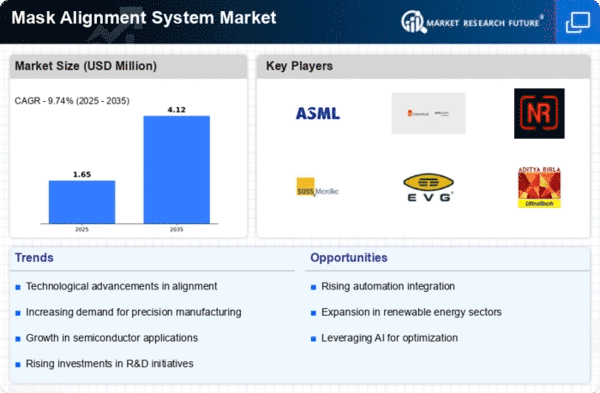
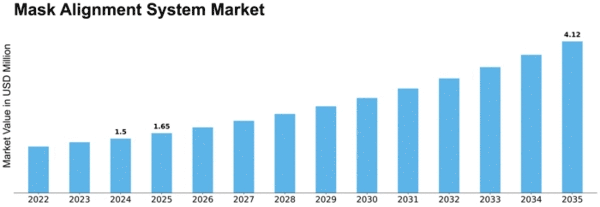
As per MRFR analysis, the Mask Alignment System Market Size was estimated at 1.5 USD Million in 2024. The Mask Alignment System industry is projected to grow from 1.62 USD Million in 2025 to 4.12 USD Million by 2035, exhibiting a compound annual growth rate (CAGR) of 9.74% during the forecast period 2025 - 2035.

Key Market Trends & Highlights

The Mask Alignment System Market is poised for substantial growth driven by technological advancements and increasing demand for miniaturization.

  • Technological advancements are reshaping the Mask Alignment System Market, enhancing precision and efficiency. North America remains the largest market, while Asia-Pacific is emerging as the fastest-growing region in this sector. The photolithography segment dominates the market, whereas the semiconductor manufacturing segment is experiencing rapid growth. Key drivers include rising demand for miniaturization in electronics and increased investment in semiconductor manufacturing.

Market Size & Forecast

2024 Market Size 1.5 (USD Million)
2035 Market Size 4.12 (USD Million)
CAGR (2025 - 2035) 9.74%
Largest Regional Market Share in 2024 North America

Major Players

ASML (NL), Canon (JP), Nikon (JP), SUSS MicroTec (DE), EV Group (AT), Ultratech (US), Rudolph Technologies (US), Microtech (US)

Market Trends

The Mask Alignment System Market is currently experiencing a transformative phase, driven by advancements in semiconductor manufacturing and the increasing demand for precision in microfabrication processes. As industries such as electronics, telecommunications, and automotive continue to evolve, the need for high-quality mask alignment systems becomes more pronounced. These systems are essential for ensuring the accurate overlay of photomasks onto substrates, which is critical for producing intricate patterns in integrated circuits and other microelectronic devices. The market appears to be influenced by technological innovations, including automation and enhanced software capabilities, which may lead to improved efficiency and reduced operational costs for manufacturers. Moreover, the growing emphasis on miniaturization and the development of next-generation devices suggest that the Mask Alignment System Market will likely expand further. Companies are increasingly investing in research and development to create systems that not only meet current demands but also anticipate future requirements. This proactive approach indicates a competitive landscape where adaptability and innovation are paramount. As the market continues to evolve, stakeholders must remain vigilant to emerging trends and shifts in consumer preferences, which could shape the trajectory of the Mask Alignment System Market in the coming years.

Technological Advancements

The Mask Alignment System Market is witnessing a surge in technological advancements, particularly in automation and software integration. These innovations are enhancing the precision and efficiency of mask alignment processes, allowing manufacturers to achieve higher yields and reduce production costs.

Growing Demand for Miniaturization

As industries push for smaller and more powerful devices, the demand for advanced mask alignment systems is likely to increase. This trend reflects a broader movement towards miniaturization in electronics, necessitating more sophisticated alignment solutions to meet stringent specifications.

Sustainability Initiatives

There is a noticeable shift towards sustainability within the Mask Alignment System Market. Companies are exploring eco-friendly materials and processes, aiming to reduce waste and energy consumption, which aligns with global efforts to promote environmentally responsible manufacturing practices.

Mask Alignment System Market Market Drivers

Increasing Demand for Advanced Semiconductor Technologies

The Global Mask Alignment System Market Industry experiences a surge in demand driven by the rapid advancement of semiconductor technologies. As industries increasingly rely on miniaturization and high-performance components, the need for precise mask alignment systems becomes paramount. In 2024, the market is projected to reach 1.5 USD Billion, reflecting the growing adoption of these systems in semiconductor manufacturing. This trend is expected to continue, with projections indicating a market size of 4.28 USD Billion by 2035. The anticipated compound annual growth rate of 10.0% from 2025 to 2035 underscores the critical role that mask alignment systems play in meeting the evolving needs of semiconductor fabrication.

Market Segment Insights

By Application: Photolithography (Largest) vs. Semiconductor Manufacturing (Fastest-Growing)

The Mask Alignment System Market is predominantly driven by the photolithography segment, which holds the greatest market share among its counterparts. This application has established itself as a foundational technology in the <a href="https://www.marketresearchfuture.com/reports/industrial-semiconductors-market-17753">semiconductor industry</a>, focusing on precision and accuracy in pattern transfers. Following closely are semiconductor manufacturing and microfabrication, both gaining traction due to their integral roles in producing microelectronic devices. Other applications like optoelectronics and nanotechnology contribute to the market but occupy a smaller share, indicating a diverse but focused market landscape.

Microfabrication (Dominant) vs. Optoelectronics (Emerging)

Within the segment insights, microfabrication has emerged as the dominant application area, playing a crucial role in advanced manufacturing processes and component miniaturization. Its widespread use in various industries showcases its adaptability and significance in developing cutting-edge technologies. On the other hand, optoelectronics represents an emerging segment, drawing interest due to the increasing demand for optical devices and integrated photonic systems. As advancements in technologies converge, optoelectronics is expected to capitalize on developments in related sectors, paving the way for innovative solutions and applications.

By End Use: Electronics (Largest) vs. Telecommunications (Fastest-Growing)

The Mask Alignment System Market is significantly influenced by the end-use segments, with Electronics commanding the largest share. This segment encompasses applications in consumer electronics, smartphones, and semiconductors, where precision alignment is crucial for enhancing device performance. In contrast, Telecommunications is rapidly emerging as a fast-growing segment, driven by the increasing demand for advanced communication technologies and the rollout of 5G networks, necessitating sophisticated manufacturing equipment like mask alignment systems. Growth trends in this market are primarily fueled by innovations in the electronics sector, especially with the miniaturization of components and the push for higher performance and efficiency in devices. Meanwhile, the telecommunications sector's expansion is propelled by the ongoing digital transformation and the need for reliable communication infrastructure. This dual growth presents significant opportunities for manufacturers of mask alignment systems to cater to the evolving needs of both established and emerging markets.

Electronics: Consumer Electronics (Dominant) vs. Telecommunications (Emerging)

In the Mask Alignment System Market, Consumer Electronics is the dominant player, characterized by a high demand for smartphones, laptops, and wearables that require precise manufacturing processes. These products rely heavily on photolithography techniques facilitated by mask alignment systems to ensure accuracy and high yield in production. On the other hand, the Telecommunications segment is recognized as an emerging contender, growing rapidly as network demands escalate with the advent of 5G technology. Here, manufacturers are increasingly adopting advanced mask alignment systems to meet the need for higher integration and minimal alignment errors, positioning themselves to leverage the opportunities offered by this technological shift.

By Technology: Contact Mask Alignment (Largest) vs. Non-Contact Mask Alignment (Fastest-Growing)

In the Mask Alignment System Market, the segment breakdown reveals that Contact Mask Alignment is the largest portion, dominating the market due to its widespread application in semiconductor manufacturing. Non-Contact Mask Alignment, although smaller in market share, is gaining traction rapidly as manufacturers seek more efficient and precise processes, reducing defects and increasing yield rates. The strong performance of these two technologies underscores their roles in advancing production capabilities. A critical driver behind the growth of Non-Contact Mask Alignment technology is the industry's shift towards miniaturization and greater precision in device fabrication. As semiconductor nodes shrink, the demand for processes that can deliver higher accuracy without physical contact is accelerating. Additionally, investments in research and development to refine these technologies are setting the stage for future innovations, making them vital components of modern semiconductor production.

Technology: Contact Mask Alignment (Dominant) vs. Non-Contact Mask Alignment (Emerging)

Contact Mask Alignment stands as the dominant technology in the Mask Alignment System Market, mainly due to its proven reliability and effectiveness in high-volume production environments. It employs a physical contact technique that ensures minimal alignment errors, which is crucial for high-density circuit patterns. In contrast, Non-Contact Mask Alignment, while emerging, is rapidly evolving and preferred for applications demanding high precision and minimal contamination. This technology utilizes advanced optical systems to achieve alignment without touching the substrate, thus attracting manufacturers focusing on delicate layers and reducing defects. As industries explore more sustainable practices, Non-Contact methods are gaining attention for their potential to lower defect rates and material waste, setting them up as a significant player in the market.

By Component Type: Optical Systems (Largest) vs. Control Systems (Fastest-Growing)

The Mask Alignment System Market is largely driven by Optical Systems, which lead the market segment with a significant share. These systems are integral in ensuring precise alignment during photolithography processes, crucial for semiconductor manufacturing. Following closely are Alignment Systems, which maintain the operational quality and efficiency of the production line. Control Systems and Software Solutions, while vital, constitute smaller shares of the market but are essential in optimizing alignment capabilities and enhancing automation.

Optical Systems (Dominant) vs. Control Systems (Emerging)

Optical Systems serve as the cornerstone of the Mask Alignment System Market, providing unmatched accuracy and reliability needed for intricate photolithography tasks. They feature advanced imaging technologies that enhance resolution and improve alignment precision during semiconductor fabrication processes. On the other hand, Control Systems are emerging elements designed to elevate automation and efficiency within production environments. These systems incorporate software-driven processes to adapt to varying alignment needs, making them increasingly essential as manufacturers seek flexibility and higher throughput. As the market evolves, the technological advancements in both systems signify robust competition and growth potential.

Get more detailed insights about Mask Alignment System Market Research Report - Global Forecast To 2027

Regional Insights

Middle East and Africa : Emerging Market with Challenges

The Middle East and Africa (MEA) region currently holds a modest market share of 10% in the Mask Alignment System market. Despite challenges such as limited local manufacturing capabilities, there is a growing interest in developing the semiconductor sector. Governments are increasingly recognizing the importance of technology in economic diversification, leading to initiatives aimed at fostering local production and attracting foreign investments. Countries like South Africa and the UAE are making strides in establishing semiconductor manufacturing facilities, although the market is still in its infancy. The competitive landscape is evolving, with a focus on partnerships and collaborations to enhance technological capabilities. As the region seeks to build a sustainable semiconductor ecosystem, the demand for advanced mask alignment systems is expected to grow, albeit gradually.

Key Players and Competitive Insights

The Mask Alignment System Market is currently characterized by a dynamic competitive landscape, driven by technological advancements and increasing demand for precision in semiconductor manufacturing. Key players such as ASML (NL), Canon (JP), and SUSS MicroTec (DE) are at the forefront, each adopting distinct strategies to enhance their market positioning. ASML (NL) focuses on innovation through continuous R&D investments, particularly in extreme ultraviolet (EUV) lithography, which is pivotal for advanced semiconductor fabrication. Canon (JP), on the other hand, emphasizes strategic partnerships to bolster its technological capabilities, while SUSS MicroTec (DE) is enhancing its operational focus on localized manufacturing to better serve regional markets. Collectively, these strategies contribute to a competitive environment that is increasingly centered on technological prowess and operational efficiency.
In terms of business tactics, companies are increasingly localizing manufacturing and optimizing supply chains to mitigate risks and enhance responsiveness to market demands. The competitive structure of the Mask Alignment System Market appears moderately fragmented, with several key players exerting influence over their respective segments. This fragmentation allows for a diverse range of offerings, yet the collective strength of major companies shapes the market dynamics significantly.
In November 2025, ASML (NL) announced a strategic collaboration with a leading semiconductor manufacturer to develop next-generation lithography systems. This partnership is expected to accelerate the deployment of advanced technologies, thereby reinforcing ASML's leadership position in the market. The strategic importance of this collaboration lies in its potential to enhance production efficiency and meet the growing demand for smaller, more powerful chips.
In October 2025, Canon (JP) unveiled a new mask alignment system designed to improve throughput and precision in semiconductor production. This launch is indicative of Canon's commitment to innovation and its strategy to capture a larger market share by addressing the specific needs of high-volume manufacturers. The introduction of this system is likely to strengthen Canon's competitive edge by offering enhanced capabilities that align with industry trends.
In September 2025, SUSS MicroTec (DE) expanded its manufacturing capabilities in Asia, aiming to localize production and reduce lead times for its customers. This strategic move is significant as it not only enhances SUSS MicroTec's operational efficiency but also positions the company to better respond to the growing demand in the Asian semiconductor market. Such localization efforts are crucial in a landscape where supply chain reliability is increasingly prioritized.
As of December 2025, current competitive trends in the Mask Alignment System Market are heavily influenced by digitalization, sustainability initiatives, and the integration of AI technologies. Strategic alliances are becoming more prevalent, as companies seek to leverage complementary strengths to drive innovation. Looking ahead, it is anticipated that competitive differentiation will increasingly pivot from price-based strategies to a focus on technological innovation, supply chain reliability, and sustainability. This shift underscores the importance of adaptability and forward-thinking in maintaining a competitive advantage in a rapidly evolving market.

Key Companies in the Mask Alignment System Market include

Industry Developments

  • EV group introduced the innovative IQ Aligner NT mask alignment system which is the most productive and technically sophisticated and automated. This is designed for high-volume applications. It has the latest features like the highly advanced print gab control and zero-assist dual-size wafer processing capability that fully addresses the high-volume manufacturing (HVM) requirements of users. Also, it is designed with 2X improvement in alignment accuracy & throughput compared to the previous generation IQ Aligner system

Future Outlook

Mask Alignment System Market Future Outlook

The Mask Alignment System Market is projected to grow at a 9.74% CAGR from 2024 to 2035, driven by advancements in semiconductor manufacturing and increasing demand for precision in photolithography processes.

New opportunities lie in:

  • Development of AI-driven alignment systems for enhanced accuracy.
  • Expansion into emerging markets with tailored solutions.
  • Integration of IoT technology for real-time monitoring and analytics.

By 2035, the market is expected to achieve robust growth, solidifying its position as a critical component in semiconductor production.

Market Segmentation

Mask Alignment System Market End Use Outlook

  • Electronics
  • Telecommunications
  • Automotive
  • Aerospace
  • Medical Devices

Mask Alignment System Market Technology Outlook

  • Contact Mask Alignment
  • Non-Contact Mask Alignment
  • Projection Mask Alignment
  • Laser Mask Alignment

Mask Alignment System Market Application Outlook

  • Photolithography
  • Microfabrication
  • Semiconductor Manufacturing
  • Optoelectronics
  • Nanotechnology

Mask Alignment System Market Component Type Outlook

  • Optical Systems
  • Alignment Systems
  • Control Systems
  • Software Solutions

Report Scope

MARKET SIZE 2024 1.5(USD Million)
MARKET SIZE 2025 1.62(USD Million)
MARKET SIZE 2035 4.12(USD Million)
COMPOUND ANNUAL GROWTH RATE (CAGR) 9.74% (2025 - 2035)
REPORT COVERAGE Revenue Forecast, Competitive Landscape, Growth Factors, and Trends
BASE YEAR 2024
Market Forecast Period 2025 - 2035
Historical Data 2019 - 2024
Market Forecast Units USD Million
Key Companies Profiled ASML (NL), Canon (JP), Nikon (JP), SUSS MicroTec (DE), EV Group (AT), Ultratech (US), Rudolph Technologies (US), Microtech (US)
Segments Covered Application, End Use, Technology, Component Type
Key Market Opportunities Advancements in photolithography techniques drive demand in the Mask Alignment System Market.
Key Market Dynamics Technological advancements drive innovation in mask alignment systems, enhancing precision and efficiency in semiconductor manufacturing.
Countries Covered North America, Europe, APAC, South America, MEA

FAQs

What is the expected market value of the mask alignment system during the forecast period?

Mask Alignment System Market is Poised to Hit USD 1.5 billion by 2027.

What is the expected CAGR rate of the mask alignment system market forecast?

Mask Alignment System Market is Projected to reach at CAGR of 10% by 2027.

What is the major driving factor that pushes the growth of the mask alignment system?

High demand for nanosensors and production of light-emitting diodes (LEDs).

What is the region that dominates the global market during the assessment period?

Asia-Pacific had the largest share of the global market.

Who are the top market leaders of the mask alignment system market?

Bruker Corporation, Vistec Electron Beam GmbH, SUSS MicroTec AG, Neutronix Inc, Aixtron SE, Applied Materials, Inc, Veeco Instruments, Inc, E V Group, and ASML Holding.

  1. SECTION I: EXECUTIVE SUMMARY AND KEY HIGHLIGHTS
    1. | 1.1 EXECUTIVE SUMMARY
  2. SECTION II: SCOPING, METHODOLOGY AND MARKET STRUCTURE
    1. | 2.1 MARKET INTRODUCTION
    2. | 2.2 RESEARCH METHODOLOGY
  3. SECTION III: QUALITATIVE ANALYSIS
    1. | 3.1 MARKET DYNAMICS
    2. | 3.2 MARKET FACTOR ANALYSIS
  4. SECTION IV: QUANTITATIVE ANALYSIS
    1. | 4.1 Semiconductor & Electronics, BY Application (USD Million)
    2. | 4.2 Semiconductor & Electronics, BY End Use (USD Million)
    3. | 4.3 Semiconductor & Electronics, BY Technology (USD Million)
    4. | 4.4 Semiconductor & Electronics, BY Component Type (USD Million)
    5. | 4.5 Semiconductor & Electronics, BY Region (USD Million)
  5. SECTION V: COMPETITIVE ANALYSIS
    1. | 5.1 Competitive Landscape
    2. | 5.2 Company Profiles
    3. | 5.3 Appendix

Mask Alignment System Market Segmentation

Market Segmentation Overview

  • Detailed segmentation data will be available in the full report
  • Comprehensive analysis by multiple parameters
  • Regional and country-level breakdowns
  • Market size forecasts by segment
Infographic

Free Sample Request

Kindly complete the form below to receive a free sample of this Report

Get Free Sample

Customer Strories

Compare Licence

×
Features License Type
Single User Multiuser License Enterprise User
Price $4,950 $5,950 $7,250
Maximum User Access Limit 1 User Upto 10 Users Unrestricted Access Throughout the Organization
Free Customization
Direct Access to Analyst
Deliverable Format
Platform Access
Discount on Next Purchase 10% 15% 15%
Printable Versions