×
Hero Background
English
Chinese
French
Japanese
Korean
German
Spanish

Marine Radar Market Analysis

ID: MRFR/AD/5888-HCR
125 Pages
Sejal Akre
October 2025

Marine Radar Market Research Report Information by Type (S Band and X Band), by Application (Fishing Vessel, Merchant Marine, Military Naval and Recreational Boat), and by Region — Global Forecast till 2035

Share:
Download PDF ×

We do not share your information with anyone. However, we may send you emails based on your report interest from time to time. You may contact us at any time to opt-out.

Marine Radar Market Infographic
Purchase Options

Market Analysis

In-depth Analysis of Marine Radar Market Industry Landscape

The global marine radar market is set to reach US$ 4.89 BN by 2030, growing at a 6.89% CAGR between years 2020-2030. The market dynamics are shaped by technological advances, regulatory requirements, and the evolving needs of the maritime industry. Marine radar systems enhance navigation safety, collision avoidance, and overall situational awareness at sea. The need to have good and safe sea travels keeps getting bigger, so the market for it is always going up. One of the main things making the Marine Radar market grow is new technology in radar systems. Makers keep adding radar tools with better reach, accuracy and target discovering skills all the time. Adding complicated things like radar maps, finding targets and avoiding crashes makes these systems better. Many people now use them because of this added help to perform their jobs well. The market changes a lot because of rules and global standards. The International Maritime Organization (IMO) and other rule-making groups make rules to keep sea travel safe. Following these rules is very important for makers of boat radar systems. It pushes them to create tools that are up-to-date or even better than what's required by the standards set out. As more and more sea authorities stress how important radar technology is for safe traveling on water, the market responds by needing lots of this stuff. The way countries around the world trade with each other and share goods helps shape how markets work. Global trade relies on the sea, so good navigation systems for boats are very important. The Marine Radar market is very connected to how well the shipping and trade areas are doing. Big changes in money, important world events and trade rules can affect how much shipping companies buy. This influences the need for marine radar systems.

Furthermore, people are starting to understand the importance of taking care of our environment and using less fuel for travel. This helps shape how business works in this area too. Makers are looking for ways to make radar systems use less power but still work really well. Using energy-saving parts and trying new things, like solid-state radar technology, are becoming important. As more focus is put on helping the environment, these changes become important parts that shape markets for marine radar.

Author
Sejal Akre
Senior Research Analyst

She has over 5 years of rich experience, in market research and consulting providing valuable market insights to client. Hands on expertise in management consulting, and extensive knowledge in domain including ICT, Automotive & Transportation and Aerospace & Defense. She is skilled in Go-to market strategy, industry analysis, market sizing, in depth company profiling, competitive intelligence & benchmarking and value chain amongst others.

Leave a Comment

FAQs

What CAGR is the market estimated to gain in the near future?

The market can acquire a CAGR of close to 6.89% from 2024 to 2032

What are some of the key growth inducers in the global market?

Some of the key growth inducers in the global market are the soaring demand for weapon guidance applications as well as surveillance. The rising military spending in emerging countries are also fostering significant market growth.

Depending on type, which segment can secure the top position in the global market?

Depending on type, the X band segment can secure the top position in the global market.

Which region is presumed advance at the fastest rate?

APAC is presumed advance at the fastest rate in the forthcoming period.

What are the key market trends studied in the report?

The key market trends studied in the report are the rising technological advancements coupled with the escalating demand for advanced detection systems.

Market Summary

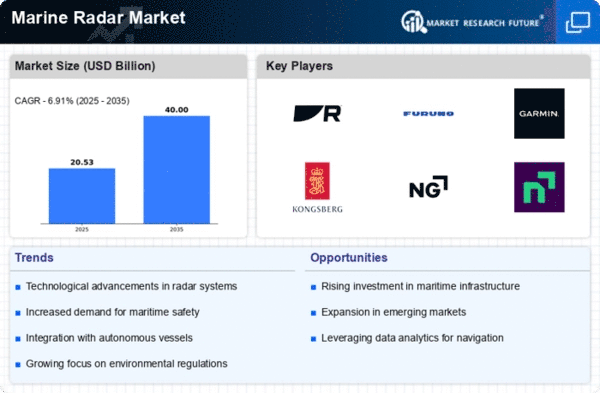
As per MRFR analysis, the Marine Radar Market Size was estimated at 19.2 USD Billion in 2024. The Marine Radar industry is projected to grow from 20.5 USD Billion in 2025 to 40.0 USD Billion by 2035, exhibiting a compound annual growth rate (CAGR) of 6.91 during the forecast period 2025 - 2035.

Key Market Trends & Highlights

The Marine Radar Market is poised for growth driven by technological advancements and increasing safety regulations.

  • North America remains the largest market for marine radar, driven by robust maritime activities and advanced technology adoption.
  • The Asia-Pacific region is emerging as the fastest-growing market, fueled by rapid infrastructure development and rising demand for maritime safety.
  • The navigation segment continues to dominate the market, while the weather monitoring segment is experiencing the fastest growth due to heightened environmental awareness.
  • Key market drivers include technological advancements in marine radar and an increased focus on safety regulations, particularly in commercial vessels.

Market Size & Forecast

2024 Market Size 19.2 (USD Billion)
2035 Market Size 40.0 (USD Billion)
CAGR (2025 - 2035) 6.91%
Largest Regional Market Share in 2024 North America

Major Players

<p>Raymarine (GB), Furuno (JP), Garmin (US), Kongsberg Gruppen (NO), Northrop Grumman (US), Navico (NO), JRC (JP), Simrad (NO), Transas (GB)</p>

Market Trends

The Marine Radar Market is currently experiencing a transformative phase, driven by advancements in technology and increasing demand for enhanced navigation safety. The integration of sophisticated radar systems into various marine applications appears to be a focal point for manufacturers and end-users alike. This trend is likely influenced by the growing emphasis on maritime security and the need for efficient vessel traffic management. Furthermore, the rising adoption of automation in marine operations suggests a shift towards more intelligent radar solutions that can provide real-time data and analytics, thereby improving decision-making processes on the water. In addition, environmental considerations are becoming increasingly relevant within the Marine Radar Market. As regulations tighten around emissions and sustainability, there is a noticeable push towards developing eco-friendly radar technologies. This shift not only aligns with global sustainability goals but also caters to the evolving preferences of consumers who are more environmentally conscious. Overall, the Marine Radar Market seems poised for growth, with innovations and regulatory changes shaping its future landscape.

Technological Advancements

The Marine Radar Market is witnessing rapid technological advancements, particularly in the realm of digital signal processing and integration with other navigational systems. These innovations enhance the accuracy and reliability of radar systems, making them indispensable for modern maritime operations.

Increased Focus on Safety

There is a growing emphasis on safety within the Marine Radar Market, driven by the need to prevent maritime accidents and ensure the security of vessels. This trend is prompting investments in advanced radar systems that offer improved detection capabilities and situational awareness.

Sustainability Initiatives

Sustainability initiatives are gaining traction in the Marine Radar Market, as manufacturers strive to develop eco-friendly radar solutions. This trend reflects a broader commitment to reducing environmental impact and aligns with global efforts to promote greener technologies in the maritime sector.

Marine Radar Market Market Drivers

Regulatory Compliance

Regulatory compliance is a key driver in the Global Marine Radar Market Industry, as governments worldwide implement stringent safety and navigation regulations. These regulations often mandate the use of advanced radar systems on commercial vessels to enhance safety and reduce maritime accidents. Compliance with international standards, such as those set by the International Maritime Organization, is likely to propel the adoption of marine radar technology. As a result, the market is expected to grow at a CAGR of 5.79% from 2025 to 2035, driven by the need for vessels to meet regulatory requirements.

Increasing Maritime Trade

The Global Marine Radar Market Industry is significantly influenced by the rising levels of maritime trade. As global trade continues to expand, the need for efficient and safe navigation systems becomes paramount. Radar systems play a crucial role in ensuring the safety of vessels during transit, particularly in congested shipping lanes. The increasing volume of cargo transported by sea is likely to drive demand for marine radar systems, contributing to the market's growth trajectory. By 2035, the market is anticipated to reach 6500 USD Million, reflecting the essential role of radar technology in supporting maritime logistics.

Technological Advancements

The Global Marine Radar Market Industry is experiencing rapid technological advancements, particularly in solid-state radar systems and digital signal processing. These innovations enhance the accuracy and reliability of radar systems, allowing for improved detection of maritime hazards and other vessels. For instance, the integration of artificial intelligence in radar systems is expected to optimize performance and reduce false alarms. As a result, the market is projected to reach 3500 USD Million in 2024, driven by the demand for advanced navigation and surveillance solutions in the maritime sector.

Growing Focus on Maritime Security

The Global Marine Radar Market Industry is increasingly shaped by the growing focus on maritime security. With rising concerns over piracy, smuggling, and illegal fishing, there is a heightened demand for advanced surveillance systems that can monitor and protect maritime boundaries. Radar systems are integral to these security measures, providing real-time data and situational awareness for naval and coast guard operations. This trend is likely to drive investments in marine radar technology, contributing to the overall market growth as stakeholders seek to enhance maritime security capabilities.

Environmental Sustainability Initiatives

The Global Marine Radar Market Industry is also influenced by environmental sustainability initiatives aimed at reducing the ecological impact of maritime operations. As the shipping industry faces increasing pressure to adopt greener practices, radar systems that optimize fuel efficiency and minimize emissions are gaining traction. Technologies such as automatic identification systems and eco-friendly radar solutions are being developed to support these initiatives. The shift towards sustainable maritime practices is expected to further stimulate demand for advanced radar systems, aligning with global efforts to promote environmental stewardship in the marine sector.

Market Segment Insights

By Application: Navigation (Largest) vs. Weather Monitoring (Fastest-Growing)

<p>In the Marine Radar Market, the application segments reveal a distinct distribution of market share. Navigation stands out as the largest segment, driven by the fundamental need for safe and efficient maritime travel. Following navigation, surveillance and collision avoidance applications also capture significant portions of the market, reflecting the increasing focus on maritime safety and security. Weather monitoring, while currently smaller in share, is rapidly gaining traction among maritime operators who are recognizing the essential role of accurate weather forecasting in operational decisions.</p>

<p>Navigation (Dominant) vs. Weather Monitoring (Emerging)</p>

<p>Navigation serves as the backbone of marine radar applications, facilitating safe passage and operational efficiency in varying maritime conditions. This segment is characterized by advanced technology enabling precise positioning and route planning, essential for both commercial and recreational vessels. Conversely, weather monitoring, emerging as a critical application, harnesses radar technology to provide real-time meteorological data. As climate change intensifies weather-related challenges, this segment is poised for growth as vessels seek reliable systems to adapt to unpredictable weather patterns, enhancing overall safety and operational effectiveness.</p>

By End Use: Commercial Vessels (Largest) vs. Recreational Boats (Fastest-Growing)

<p>The Marine Radar Market is significantly segmented by end use, with commercial vessels representing the largest share. This segment encompasses cargo ships, tankers, and bulk carriers, all of which require advanced radar systems for navigation, safety, and cargo management. Meanwhile, recreational boats, which include personal watercraft and yachts, are witnessing rapid growth as more individuals turn to water-based leisure activities. This rise in popularity is steadily increasing the demand for sophisticated radar solutions that enhance safety and navigational capabilities for private boaters.</p>

<p>Commercial Vessels (Dominant) vs. Fishing Boats (Emerging)</p>

<p>Commercial vessels dominate the Marine Radar Market, characterized by their stringent regulatory compliance, advanced navigational requirements, and broader operational scales. These vessels necessitate high-performance radar systems for efficient tracking and operational safety, giving them a significant influence in radar technology advancements. In contrast, fishing boats are emerging in the market, leveraging increasing demand for sustainable fishing practices. With innovations tailored for efficient fish detection and safety at sea, fishing boats are gaining traction, especially among niche and environmentally-conscious consumers. As technology progresses, both segments will play crucial roles in shaping the future of marine navigation.</p>

By Technology: Doppler Radar (Largest) vs. Solid State Radar (Fastest-Growing)

<p>In the Marine Radar Market, the technology segment includes vital components such as Pulse Compression, Doppler Radar, Solid State Radar, and Phased Array Radar. Among these, Doppler Radar leads the market due to its extensive use in marine applications for accurate speed detection and motion tracking. Solid State Radar, a newer entrant, is gaining traction due to its reliability and lower maintenance requirements, making it an attractive choice for several marine applications alongside traditional options.</p>

<p>Technology: Doppler Radar (Dominant) vs. Solid State Radar (Emerging)</p>

<p>Doppler Radar stands at the forefront of marine technology, noted for its efficiency in detecting objects' speeds and movement, which is critical for navigation and safety. Its established performance and reliability have resulted in widespread adoption in various marine vessels. On the other hand, Solid State Radar is quickly emerging, characterized by its high reliability and reduced upkeep. This technology's advantages include lower power consumption and compact size, appealing to smaller vessels and recreational boats. As the industry shifts towards modernization, Solid State Radar is positioned as a strong competitor, set to capture market share in upcoming years.</p>

By Frequency Band: X Band (Largest) vs. S Band (Fastest-Growing)

<p>In the Marine Radar Market, the frequency bands display a diverse market share distribution with each band serving unique applications. The X Band emerges as the largest segment, primarily favored for its high-resolution imaging capabilities, which make it ideal for small vessels and short-range applications. Conversely, the S Band, while smaller in current market share, is rapidly gaining traction due to its robustness against weather interference, making it a preferred choice for long-range maritime surveillance.</p>

<p>S Band (Dominant) vs. C Band (Emerging)</p>

<p>The S Band is characterized by its reliable performance in adverse weather conditions, catering excellently to large vessels for long-range operability. Its dominance is propelled by increasing demand for coast guard operations and merchant shipping. Emerging in comparison, the C Band is gaining attention due to its balance of range and resolution, appealing to naval operations and fishing industries. As more advanced radar systems are being developed that utilize C Band technology, this segment is expected to grow steadily, providing enhancements in both detection and tracking capabilities.</p>

By Range: Short Range (Largest) vs. Long Range (Fastest-Growing)

<p>The Marine Radar Market demonstrates a varied distribution across the range segments, with Short Range radars leading the market share due to their widespread adoption in coastal and harbor operations. These radars are crucial for navigational safety in restricted waters and are primarily favored by smaller vessels for their cost efficiency. Medium Range radars hold a notable portion of the market as well, serving both commercial and military applications. However, Long Range radars have been gaining traction as technology advancements enhance their capabilities, particularly for offshore and deep-sea navigation.</p>

<p>Range: Short Range (Dominant) vs. Long Range (Emerging)</p>

<p>Short Range radars are essential for nearshore applications, providing high accuracy and reliability, which underpins their dominant position in the market. They facilitate essential activities such as shipping logistics, fishing, and recreational boating, appealing largely to small to medium-sized vessels. Meanwhile, Long Range radars are emerging due to increased demands for safety and efficiency in expansive maritime operations. As vessels venture further into the ocean, these radars offer extended detection capabilities, aiding in collision avoidance and enhancing situational awareness. Their growing adoption is driven by the maritime industry's shift towards advanced navigation solutions and regulatory compliance, representing a significant opportunity for market expansion.</p>

Get more detailed insights about Marine Radar Market Research Report – Global Forecast till 2035

Regional Insights

North America : Leading Market Innovators

North America is poised to maintain its leadership in the Marine Radar Market, holding a significant market share of 9.6 in 2024. The region's growth is driven by increasing maritime activities, stringent safety regulations, and advancements in radar technology. The demand for enhanced navigation and collision avoidance systems is propelling market expansion, supported by government initiatives promoting maritime safety and efficiency. The competitive landscape in North America is robust, featuring key players such as Garmin, Northrop Grumman, and Raymarine. The U.S. stands out as the leading country, with a strong focus on innovation and technology integration in marine radar systems. The presence of established companies and ongoing investments in R&D further solidify the region's market position, ensuring continued growth and technological advancements.

Europe : Emerging Technological Hub

Europe is witnessing a dynamic shift in the Marine Radar Market, with a market size of 5.4 in 2024. The region's growth is fueled by increasing investments in maritime safety and environmental regulations aimed at reducing marine accidents. The demand for advanced radar systems is rising, driven by the need for improved navigation and surveillance capabilities in busy shipping lanes. Regulatory frameworks are also encouraging the adoption of innovative technologies. Leading countries in Europe include Germany, the UK, and Norway, where companies like Kongsberg Gruppen and JRC are making significant strides. The competitive landscape is characterized by a mix of established players and emerging startups, fostering innovation. The European market is also influenced by collaborative efforts between governments and private sectors to enhance maritime safety and efficiency, ensuring a thriving environment for marine radar technologies.

Asia-Pacific : Rapidly Growing Market

The Asia-Pacific region is rapidly emerging as a significant player in the Marine Radar Market, with a market size of 3.6 in 2024. The growth is driven by increasing maritime trade, expanding fishing industries, and rising investments in port infrastructure. Countries are also focusing on enhancing maritime safety and security, leading to a surge in demand for advanced radar systems. Regulatory support for maritime safety initiatives is further propelling market growth. Key players in the region include Furuno and Simrad, with Japan and Australia leading the charge in adopting innovative marine technologies. The competitive landscape is evolving, with local manufacturers also entering the market, increasing competition. As the region continues to develop its maritime capabilities, the demand for reliable and efficient marine radar systems is expected to rise significantly, positioning Asia-Pacific as a crucial market for future growth.

Middle East and Africa : Emerging Market Potential

The Middle East and Africa region is gradually emerging in the Marine Radar Market, with a market size of 0.6 in 2024. The growth is primarily driven by increasing investments in maritime infrastructure and the expansion of shipping routes. Governments are focusing on enhancing maritime safety and security, which is leading to a growing demand for advanced radar systems. Regulatory frameworks are being established to support the development of the maritime sector. Countries like the UAE and South Africa are at the forefront of this growth, with initiatives aimed at modernizing their maritime capabilities. The competitive landscape is characterized by a mix of international and local players, with companies looking to capitalize on the region's potential. As maritime activities increase, the demand for reliable marine radar systems is expected to grow, making the Middle East and Africa a region to watch in the coming years.

Key Players and Competitive Insights

The Marine Radar Market is currently characterized by a dynamic competitive landscape, driven by technological advancements and increasing demand for maritime safety and navigation efficiency. Key players such as Raymarine (GB), Furuno (JP), and Garmin (US) are strategically positioned to leverage innovation and expand their market presence. Raymarine (GB) focuses on enhancing its product offerings through advanced radar technology, while Garmin (US) emphasizes integration with other navigation systems to provide comprehensive solutions. Furuno (JP) is known for its commitment to research and development, which allows it to maintain a competitive edge in high-performance radar systems. Collectively, these strategies contribute to a competitive environment that is increasingly focused on technological differentiation and customer-centric solutions.

In terms of business tactics, companies are increasingly localizing manufacturing and optimizing supply chains to enhance operational efficiency. The market structure appears moderately fragmented, with several key players holding substantial market shares. This fragmentation allows for a diverse range of products and services, catering to various segments within the marine industry. The collective influence of these key players shapes market dynamics, as they compete not only on product quality but also on service delivery and customer engagement.

In November 2025, Garmin (US) announced the launch of its latest marine radar system, which integrates advanced AI capabilities for improved target detection and tracking. This strategic move is significant as it positions Garmin (US) at the forefront of technological innovation, appealing to a growing customer base that prioritizes safety and efficiency in navigation. The incorporation of AI into radar systems is likely to enhance user experience and operational effectiveness, thereby solidifying Garmin's competitive stance in the market.

In October 2025, Furuno (JP) unveiled a new partnership with a leading maritime software provider to enhance its radar systems' data integration capabilities. This collaboration is indicative of a broader trend towards digital transformation within the marine sector. By integrating radar data with advanced software solutions, Furuno (JP) aims to provide users with comprehensive situational awareness, which is increasingly critical in modern maritime operations. This strategic alliance not only strengthens Furuno's product offerings but also enhances its market positioning against competitors.

In December 2025, Raymarine (GB) announced a significant investment in sustainable manufacturing practices, aiming to reduce its carbon footprint by 30% over the next five years. This initiative reflects a growing trend towards sustainability within the marine industry, as companies recognize the importance of environmental responsibility. By prioritizing sustainable practices, Raymarine (GB) not only addresses regulatory pressures but also appeals to environmentally conscious consumers, potentially gaining a competitive advantage in a market that is increasingly valuing sustainability.

As of December 2025, the Marine Radar Market is witnessing trends that emphasize digitalization, sustainability, and AI integration. Strategic alliances are becoming more prevalent, as companies seek to enhance their technological capabilities and market reach. The competitive landscape is shifting from traditional price-based competition to a focus on innovation, technology, and supply chain reliability. This evolution suggests that future differentiation will hinge on the ability to deliver cutting-edge solutions that meet the evolving needs of the maritime industry.

Key Companies in the Marine Radar Market market include

Industry Developments

Future Outlook

Marine Radar Market Future Outlook

<p>The Marine Radar Market is projected to grow at a 6.91% CAGR from 2024 to 2035, driven by advancements in technology, increasing maritime safety regulations, and rising demand for efficient navigation systems.</p>

New opportunities lie in:

  • <p>Integration of AI for predictive maintenance solutions</p>
  • <p>Development of compact, energy-efficient radar systems</p>
  • <p>Expansion into emerging markets with tailored radar solutions</p>

<p>By 2035, the Marine Radar Market is expected to achieve substantial growth, reflecting evolving industry needs.</p>

Market Segmentation

Marine Radar Market Range Outlook

  • Short Range
  • Medium Range
  • Long Range

Marine Radar Market End Use Outlook

  • Commercial Vessels
  • Naval Vessels
  • Fishing Boats
  • Recreational Boats

Marine Radar Market Technology Outlook

  • Pulse Compression
  • Doppler Radar
  • Solid State Radar
  • Phased Array Radar

Marine Radar Market Application Outlook

  • Navigation
  • Surveillance
  • Collision Avoidance
  • Weather Monitoring
  • Search and Rescue

Marine Radar Market Frequency Band Outlook

  • X Band
  • S Band
  • C Band
  • L Band

Report Scope

MARKET SIZE 202419.2(USD Billion)
MARKET SIZE 202520.5(USD Billion)
MARKET SIZE 203540.0(USD Billion)
COMPOUND ANNUAL GROWTH RATE (CAGR)6.91% (2024 - 2035)
REPORT COVERAGERevenue Forecast, Competitive Landscape, Growth Factors, and Trends
BASE YEAR2024
Market Forecast Period2025 - 2035
Historical Data2019 - 2024
Market Forecast UnitsUSD Billion
Key Companies ProfiledRaymarine (GB), Furuno (JP), Garmin (US), Kongsberg Gruppen (NO), Northrop Grumman (US), Navico (NO), JRC (JP), Simrad (NO), Transas (GB)
Segments CoveredApplication, End Use, Technology, Frequency Band, Range
Key Market OpportunitiesIntegration of advanced artificial intelligence in Marine Radar Market enhances navigation safety and operational efficiency.
Key Market DynamicsTechnological advancements in Marine Radar systems drive competitive dynamics and enhance maritime safety and navigation efficiency.
Countries CoveredNorth America, Europe, APAC, South America, MEA

FAQs

What CAGR is the market estimated to gain in the near future?

The market can acquire a CAGR of close to 6.89% from 2024 to 2032

What are some of the key growth inducers in the global market?

Some of the key growth inducers in the global market are the soaring demand for weapon guidance applications as well as surveillance. The rising military spending in emerging countries are also fostering significant market growth.

Depending on type, which segment can secure the top position in the global market?

Depending on type, the X band segment can secure the top position in the global market.

Which region is presumed advance at the fastest rate?

APAC is presumed advance at the fastest rate in the forthcoming period.

What are the key market trends studied in the report?

The key market trends studied in the report are the rising technological advancements coupled with the escalating demand for advanced detection systems.

  1. Executive Summary
  2. Market Introduction
    1. Market Definition
    2. Scope of the Study
    3. Market Structure
    4. Key Takeaways
    5. Key Buying Criteria
  3. Research Methodology
    1. Research Process
    2. Primary Research
    3. Secondary Research
    4. Market Size Estimation
    5. Forecast Model
    6. List of Assumptions
    7. Limitations
  4. Market Landscape
    1. Porter’s Five Forces Analysis
      1. Threat of New Entrants
      2. Bargaining Power of Buyers
      3. Threat of Substitutes
      4. Segment Rivalry
      5. Bargaining Power of Supplies
    2. Value Chain/Supply Chain Analysis
  5. Market Dynamics
    1. Introduction
    2. Market Drivers
    3. Market Restraints
    4. Market Opportunities
  6. Industry Dynamics
    1. Technology Trend
    2. Regulatory Landscape
    3. Patent Analysis Outlook
  7. Global Marine Radar Market, by Type
    1. Introduction
    2. X Band
      1. Market Estimates & Forecast, 2020–2030
      2. Market Estimates & Forecast, by Region, 2020–2030
    3. S Band
      1. Market Estimates & Forecast, 2020–2030
      2. Market Estimates & Forecast, by Region, 2020–2030
  8. Global Marine Radar Market, by Application
    1. Introduction
    2. Fishing Vessel
      1. Market Estimates & Forecast, 2020–2030
      2. Market Estimates & Forecast, by Region, 2020–2030
    3. Merchant Marine
      1. Market Estimates & Forecast, 2020–2030
      2. Market Estimates & Forecast, by Region, 2020–2030
    4. Military Naval
      1. Market Estimates & Forecast, 2020–2030
      2. Market Estimates & Forecast, by Region, 2020–2030
    5. Recreational Boat
      1. Market Estimates & Forecast, 2020–2030
      2. Market Estimates & Forecast, by Region, 2020–2030
  9. Global Marine Radar Market, by Region
    1. Introduction
    2. North America
      1. Market Estimates & Forecast, by Country, 2020–2030
      2. Market Estimates & Forecast, by Type, 2020–2030
      3. Market Estimates & Forecast, by Application, 2020–2030
      4. US
      5. Canada
    3. Europe
      1. Market Estimates & Forecast, by Country, 2020–2030
      2. Market Estimates & Forecast, by Type, 2020–2030
      3. Market Estimates & Forecast, by Application, 2020–2030
      4. UK
      5. Germany
      6. France
      7. Russia
      8. Rest of Europe
    4. Asia-Pacific
      1. Market Estimates & Forecast, by Country, 2020–2030
      2. Market Estimates & Forecast, by Type, 2020–2030
      3. Market Estimates & Forecast, by Application, 2020–2030
      4. China
      5. Japan
      6. India
      7. Australia
      8. Rest of Asia-Pacific
    5. Middle East & Africa
      1. Market Estimates & Forecast, by Region, 2020–2030
      2. Market Estimates & Forecast, by Type, 2020–2030
      3. Market Estimates & Forecast, by Application, 2020–2030
      4. UAE
      5. Israel
      6. South Africa
      7. Rest of Middle East & Africa
    6. Latin America
      1. Market Estimates & Forecast, by Region, 2020–2030
      2. Market Estimates & Forecast, by Type, 2020–2030
      3. Market Estimates & Forecast, by Application, 2020–2030
      4. Brazil
      5. Rest of Latin America
  10. Competitive Landscape
    1. Competitive Scenario
    2. Competitive Overview
    3. Competitive Benchmarking
    4. Market Share Analysis
  11. Company Profiles
    1. Alphatron Marine B.V.
      1. Company Overview
      2. Product Offering
      3. Financial Overview
      4. Key Developments
      5. Swot Analysis
      6. Strategy
    2. BAE Systems
      1. Company Overview
      2. Product Offering
      3. Financial Overview
      4. Key Developments
      5. Swot Analysis
      6. Strategy
    3. FURUNO ELECTRIC CO.LTD
      1. Company Overview
      2. Product Offering
      3. Financial Overview
      4. Key Developments
      5. Swot Analysis
      6. Strategy
    4. FLIR Systems, Inc.
      1. Company Overview
      2. Product Offering
      3. Financial Overview
      4. Key Developments
      5. Swot Analysis
      6. Strategy
    5. Garmin Ltd.
      1. Company Overview
      2. Product Offering
      3. Financial Overview
      4. Key Developments
      5. Swot Analysis
      6. Strategy
    6. Kongsberg Group
      1. Company Overview
      2. Product Offering
      3. Financial Overview
      4. Key Developments
      5. Swot Analysis
      6. Strategy
    7. Lockheed Martin Corporation
      1. Company Overview
      2. Product Offering
      3. Financial Overview
      4. Key Developments
      5. Swot Analysis
      6. Strategy
    8. Northrop Grumman Corporation
      1. Company Overview
      2. Product Offering
      3. Financial Overview
      4. Key Developments
      5. Swot Analysis
      6. Strategy
    9. Raytheon Company
      1. Company Overview
      2. Product Offering
      3. Financial Overview
      4. Key Developments
      5. Swot Analysis
      6. Strategy
    10. Saab AB
      1. Company Overview
      2. Product Offering
      3. Financial Overview
      4. Key Developments
      5. Swot Analysis
      6. Strategy
    11. List of Tables
  12. Global Marine Radar Market, by Region, 2020–2030
  13. North America: Marine Radar Market, by Country, 2020–2030
  14. Europe: Marine Radar Market, by Country, 2020–2030
  15. Asia-Pacific: Marine Radar Market, by Country, 2020–2030
  16. Rest of the World: Marine Radar Market, by Region, 2020–2030
  17. Global Marine Radar Market, by Region, 2020–2030
  18. North America: Marine Radar, Type Market, by Country, 2020–2030
  19. Europe: Marine Radar Market, by Country, 2020–2030
  20. Asia-Pacific: Marine Radar Market, by Country, 2020–2030
  21. Latin America: Marine Radar Market, by Region, 2020–2030
  22. Middle East and Africa: Marine Radar Market, by Region, 2020–2030
  23. Global Marine Radar Application Market, by Region, 2020–2030
  24. North America: Marine Radar Application Market, by Country, 2020–2030
  25. Europe: Marine Radar Application Market, by Country, 2020–2030
  26. Asia-Pacific: Marine Radar Application Market, by Country, 2020–2030
  27. Latin America: Marine Radar Application Market, by Region, 2020–2030
  28. Middle East and Africa: Marine Radar Application Market, by Region, 2020–2030
  29. Global Marine Radar Market, by Region, 2020–2030
  30. Global Marine Radar Market, by Type, 2020–2030
  31. Global Marine Radar Market, by Application, 2020–2030
  32. North America: Marine Radar Market, by Country, 2020–2030
  33. North America: Marine Radar Market, by Type, 2020–2030
  34. North America: Marine Radar Market, by Application, 2020–2030
  35. Europe: Marine Radar Market, by Country, 2020–2030
  36. Europe: Marine Radar Market, by Type, 2020–2030
  37. Europe: Marine Radar Market, by Application, 2020–2030
  38. Asia-Pacific: Marine Radar Market, by Country, 2020–2030
  39. Asia-Pacific: Marine Radar Market, by Type, 2020–2030
  40. Asia-Pacific: Marine Radar Market, by Application, 2020–2030
  41. Latin America: Marine Radar Market, by Region, 2020–2030
  42. Latin America: Marine Radar Market, by Type, 2020–2030
  43. Latin America: Marine Radar Market, by Application, 2020–2030
  44. Middle East and Africa: Marine Radar Market, by Region, 2020–2030
  45. Middle East and Africa: Marine Radar Market, by Type, 2020–2030
  46. Middle East and Africa: Marine Radar Market, by Application, 2020–2030
    1. List Of Figures
  47. Research Process of MRFR
  48. Top-Down & Bottom-Up Approaches
  49. Market Dynamics
  50. Impact Analysis: Market Drivers
  51. Impact Analysis: Market Restraints
  52. Porter's Five Forces Analysis
  53. Value Chain Analysis
  54. Global Marine Radar Market, Share, by Type, 2020 (%)
  55. Global Marine Radar Market, by Type, 2020–2030 (USD Million)
  56. Global Marine Radar Market, Share, by Application, 2020 (%)
  57. Global Marine Radar Market, by Application, 2020–2030 (USD Million)
  58. Global Marine Radar Market, Share (%), By Region, 2020
  59. Global Marine Radar Market, by Region, 2020–2030 (USD Million)
  60. North America: Marine Radar Market, Share (%), 2020
  61. North America: Marine Radar Market, by Country, 2020–2030 (USD Million)
  62. Europe: Marine Radar Market, Share (%), 2020
  63. Europe: Marine Radar Market, by Country, 2020–2030 (USD Million)
  64. Asia-Pacific: Marine Radar Market, Share (%), 2020
  65. Asia-Pacific: Marine Radar Market, by Country, 2020–2030 (USD Million)
  66. Latin America: Marine Radar Market, Share (%), 2020
  67. Latin America: Marine Radar Market, by Region, 2020–2030 (USD Million)
  68. Middle East and Africa: Marine Radar Market, Share (%), 2020
  69. Middle East and Africa: Marine Radar Market, by Region, 2020–2030 (USD Million)

Marine Radar Market Segmentation

Market Segmentation Overview

  • Detailed segmentation data will be available in the full report
  • Comprehensive analysis by multiple parameters
  • Regional and country-level breakdowns
  • Market size forecasts by segment
Infographic

Free Sample Request

Kindly complete the form below to receive a free sample of this Report

Get Free Sample

Customer Strories

Compare Licence

×
Features License Type
Single User Multiuser License Enterprise User
Price $4,950 $5,950 $7,250
Maximum User Access Limit 1 User Upto 10 Users Unrestricted Access Throughout the Organization
Free Customization
Direct Access to Analyst
Deliverable Format
Platform Access
Discount on Next Purchase 10% 15% 15%
Printable Versions