
Request Free Sample ×

Kindly complete the form below to receive a free sample of this Report

* Please use a valid business email

Leading companies partner with us for data-driven Insights

clients tt-cursor
Hero Background
English
Chinese
French
Japanese
Korean
German
Spanish

Marine Management Software Market Share

ID: MRFR/ICT/9285-HCR
141 Pages
Aarti Dhapte
April 2026

Marine Management Software Market Size, Share and Research Report: By Component (Software, Services), By Deployment Mode (On-Premise, Cloud), By Location (Onboard, Onshore), By Organization Size (SME, Large enterprises), By Application (Crew Management, Harbor Management, Port Management, Cruise and Yacht Management, Reservation Management), And By Region (North America, Europe, Asia-Pacific, And Rest Of The World) – (Market Forecast Till 2035.

Share:
Download PDF ×

We do not share your information with anyone. However, we may send you emails based on your report interest from time to time. You may contact us at any time to opt-out.

Marine Management Software Market Infographic
Purchase Options

Market Share

Marine Management Software Market Share Analysis

A pervasive methodology is cost administration, where organizations expect to turn into the minimal expense supplier in the market. This includes enhancing functional effectiveness, smoothing out processes, and arranging great provider agreements to offer products at a more serious cost. Cost initiative techniques appeal to a wide client base, particularly the people who focus on reasonableness over different variables. Notwithstanding, accomplishing cost initiative requires a sensitive equilibrium to keep up with product quality and consumer loyalty. Moreover, market segmentation is essential to determining market share.

Organizations customize their products to certain parts by breaking down the various requirements of the maritime industry. Using this strategy, businesses may identify their niche market strengths and work toward building customer loyalty and increasing market dominance in those specific areas. Important alliances and groups are becoming more and more common in the marine management software market. Companies believe that collaborating with similar groups would help them expand their reach or enhance the products they offer.

These businesses can drive the development of coordinated plans that provide clients with end-to-end services, putting them squarely in the competitive market. Utilizing the strengths of many firms, the market offer may generally be increased, benefiting all parties involved. Within the Marine Management Software Market, development is the primary driver of market share positioning. Staying ahead of mechanical trends enables businesses to maintain and grow their market share by attracting innovative customers.

The Marine Management Software Market relies on client-driven procedures as the foundation for sustainable development. strategy is being steadfast in your dedication, soliciting feedback, and promptly modifying goods and services to satisfy evolving customer needs. Satisfied customers act as brand ambassadors, encouraging verbal exchange marketing and bringing in new business, which ultimately contributes to an increase in market share.


Author
Author Profile
Aarti Dhapte
AVP - Research

A consulting professional focused on helping businesses navigate complex markets through structured research and strategic insights. I partner with clients to solve high-impact business problems across market entry strategy, competitive intelligence, and opportunity assessment. Over the course of my experience, I have led and contributed to 100+ market research and consulting engagements, delivering insights across multiple industries and geographies, and supporting strategic decisions linked to $500M+ market opportunities. My core expertise lies in building robust market sizing, forecasting, and commercial models (top-down and bottom-up), alongside deep-dive competitive and industry analysis. I have played a key role in shaping go-to-market strategies, investment cases, and growth roadmaps, enabling clients to make confident, data-backed decisions in dynamic markets.

Leave a Comment

FAQs

What is the current valuation of the Marine Management Software Market?

<p>As of 2024, the Marine Management Software Market was valued at 2300.0 USD Million.</p>

What is the projected market valuation for the Marine Management Software Market in 2035?

<p>The Marine Management Software Market is projected to reach 6900.0 USD Million by 2035.</p>

What is the expected CAGR for the Marine Management Software Market during the forecast period 2025 - 2035?

<p>The expected CAGR for the Marine Management Software Market during the forecast period 2025 - 2035 is 10.63%.</p>

Which application segment is expected to generate the highest revenue in the Marine Management Software Market?

<p>The Vessel Tracking segment is anticipated to generate the highest revenue, with a projected valuation of 1650.0 USD Million by 2035.</p>

How does the revenue from Cloud-Based deployment compare to On-Premises deployment in the Marine Management Software Market?

In 2024, Cloud-Based deployment generated 920.0 USD Million, while On-Premises deployment accounted for 690.0 USD Million.

Which end user segment is projected to have the largest market share in 2035?

Shipping Companies are projected to dominate the end user segment, with an expected valuation of 2700.0 USD Million by 2035.

What are some key players in the Marine Management Software Market?

Key players in the Marine Management Software Market include ABS Nautical Systems, VesselMan, and Kongsberg Gruppen.

What is the expected revenue for Compliance Management by 2035?

The Compliance Management segment is projected to reach a valuation of 1260.0 USD Million by 2035.

How does the revenue from Maintenance Management compare to Cargo Management in 2024?

In 2024, Maintenance Management generated 450.0 USD Million, while Cargo Management also accounted for 420.0 USD Million.

What is the projected revenue for Port Authorities in the Marine Management Software Market by 2035?

Port Authorities are expected to generate a revenue of 1400.0 USD Million by 2035.

Market Summary

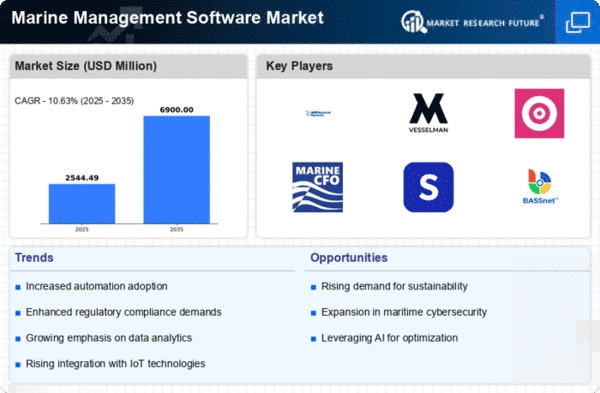
As per MRFR analysis, the Marine Management Software Market Size was estimated at 2300.0 USD Million in 2024. The Marine Management Software industry is projected to grow from 2510.0 in 2025 to 6900.0 by 2035, exhibiting a compound annual growth rate (CAGR) of 10.63% during the forecast period 2025 - 2035.

Key Market Trends & Highlights

The Marine Management Software Market is experiencing robust growth driven by technological advancements and a focus on sustainability.

  • North America remains the largest market for marine management software, driven by increasing regulatory compliance and advanced technology integration. The Asia-Pacific region is emerging as the fastest-growing market, reflecting a rising demand for efficient marine operations and management solutions. Fleet management continues to dominate the market, while vessel tracking is rapidly gaining traction as a key growth segment. The integration of cloud-based solutions and enhanced data analytics are major drivers propelling the market forward, emphasizing the need for sustainable practices.

Market Size & Forecast

2024 Market Size 2300.0 (USD Million)
2035 Market Size 6900.0 (USD Million)
CAGR (2025 - 2035) 10.63%
Largest Regional Market Share in 2024 North America

Major Players

ABS Nautical Systems (US), VesselMan (NO), Dataloy Systems (NO), MarineCFO (US), ShipNet (NO), BASS Software (SG), Kongsberg Digital (NO), Inmarsat (GB), Wärtsilä (FI)

Market Trends

The Marine Management Software Market is currently experiencing a transformative phase, driven by advancements in technology and increasing regulatory requirements. Organizations are increasingly adopting software solutions to enhance operational efficiency, streamline processes, and ensure compliance with maritime regulations. This shift appears to be influenced by the growing need for real-time data analytics and improved decision-making capabilities. As stakeholders seek to optimize resource management and reduce operational costs, the demand for integrated software solutions is likely to rise. Furthermore, the emphasis on sustainability and environmental protection is prompting companies to invest in software that supports eco-friendly practices and compliance with international standards. In addition, the Marine Management Software Market seems to be evolving with the integration of artificial intelligence and machine learning technologies. These innovations may provide enhanced predictive analytics, enabling organizations to anticipate challenges and respond proactively. The trend towards cloud-based solutions is also notable, as it offers flexibility and scalability, allowing businesses to adapt to changing market conditions. Overall, the Marine Management Software Market is poised for growth, driven by technological advancements and a heightened focus on efficiency and sustainability.

Integration of Advanced Technologies

The Marine Management Software Market is witnessing a trend towards the incorporation of advanced technologies such as artificial intelligence and machine learning. These innovations are expected to enhance predictive capabilities, allowing organizations to make informed decisions based on data-driven insights.

Cloud-Based Solutions

There is a growing preference for cloud-based software solutions within the Marine Management Software Market. This shift offers organizations greater flexibility and scalability, enabling them to adapt to evolving operational needs and market dynamics.

Focus on Sustainability

The emphasis on sustainability is becoming increasingly prominent in the Marine Management Software Market. Companies are seeking software solutions that not only improve operational efficiency but also support compliance with environmental regulations and promote eco-friendly practices.

Marine Management Software Market Market Drivers

Growth of E-commerce and Global Trade

The expansion of e-commerce and global trade significantly influences the Global Marine Management Software Market Industry. As international shipping volumes increase, there is a heightened need for efficient logistics and supply chain management solutions. Marine management software facilitates seamless coordination between various stakeholders, including shipping lines, freight forwarders, and port authorities. This integration is essential for optimizing shipping routes, reducing transit times, and improving customer satisfaction. The ongoing growth in global trade is likely to drive further investments in marine management software, positioning it as a critical component in the logistics ecosystem.

Regulatory Compliance and Safety Standards

Regulatory compliance remains a pivotal driver in the Global Marine Management Software Market Industry. As maritime regulations become increasingly stringent, companies are compelled to adopt software solutions that ensure adherence to safety and environmental standards. This necessity is underscored by the International Maritime Organization's regulations, which mandate comprehensive reporting and monitoring. Software that automates compliance processes not only mitigates the risk of penalties but also enhances operational transparency. The industry's focus on sustainability further amplifies the demand for solutions that facilitate compliance with environmental regulations, thereby fostering a culture of safety and accountability within maritime operations.

Emerging Markets and Investment Opportunities

Emerging markets present substantial investment opportunities within the Global Marine Management Software Market Industry. Regions such as Asia-Pacific and Latin America are witnessing rapid industrialization and urbanization, leading to increased maritime activities. As these markets develop, the demand for marine management software is expected to rise, driven by the need for efficient fleet operations and regulatory compliance. Companies are likely to invest in software solutions that cater to the unique challenges of these regions, such as infrastructure limitations and varying regulatory landscapes. This trend indicates a promising future for the marine management software sector, as it adapts to the evolving needs of emerging markets.

Technological Advancements in Marine Software

Technological advancements play a crucial role in shaping the Global Marine Management Software Market Industry. Innovations such as artificial intelligence, machine learning, and the Internet of Things are revolutionizing how marine operations are managed. These technologies enable predictive analytics, which enhances decision-making processes and operational efficiency. For instance, AI-driven software can analyze vast amounts of data to forecast maintenance needs, thereby reducing downtime and operational costs. As the industry embraces these technologies, the demand for sophisticated marine management software is expected to rise, further propelling market growth and enhancing competitive advantage among maritime operators.

Increasing Demand for Fleet Management Solutions

The Global Marine Management Software Market Industry experiences a notable surge in demand for fleet management solutions. This trend is driven by the need for enhanced operational efficiency and cost reduction among shipping companies. As of 2024, the market is valued at approximately 2.33 USD Billion, reflecting the industry's shift towards digitalization. Companies are increasingly adopting software that provides real-time tracking, maintenance scheduling, and compliance management. This shift not only optimizes resource allocation but also improves safety standards, thereby aligning with global regulatory requirements. The growth trajectory suggests that by 2035, the market could reach 6.53 USD Billion, indicating a robust CAGR of 9.82% from 2025 to 2035.

Market Segment Insights

By Application: Fleet Management (Largest) vs. Vessel Tracking (Fastest-Growing)

The Marine Management Software Market showcases a diverse application landscape, with Fleet Management holding the largest share. This segment benefits from the increasing need for efficient operations, optimizing fuel consumption, and improving overall fleet performance. Vessel Tracking follows closely, highlighting a rapidly expanding interest among operators for real-time location data and route optimization, making it essential for modern marine operations. In terms of growth trends, Fleet Management continues to evolve with technological advancements, like AI and IoT, driving efficiency. Meanwhile, Vessel Tracking is experiencing a surge due to rising regulations and demand for enhanced safety standards, prompting companies to adopt innovative tracking solutions. These trends reflect the ongoing digital transformation in the marine sector, positioning these applications as pivotal to future market dynamics.

Fleet Management (Dominant) vs. Compliance Management (Emerging)

Fleet Management is at the forefront of the Marine Management Software Market, characterized by its comprehensive features that integrate logistics, route planning, and fuel management, making it a critical asset for companies striving for operational efficiency. This segment emphasizes reducing operational costs and maximizing asset utilization. In contrast, Compliance Management is emerging as a vital aspect of marine operations, driven by stringent regulations and the need for adherence to safety and environmental standards. As companies face increasing scrutiny, the demand for compliance solutions has skyrocketed. This shift signifies a cultural change in the industry, where businesses prioritize not just profitability but also regulatory adherence, thus shaping the future trajectory of marine management software.

By Deployment Type: Cloud-Based (Largest) vs. On-Premises (Fastest-Growing)

<p>In the Marine Management Software Market, the deployment type segment is predominantly led by cloud-based solutions. This segment continues to showcase strong market presence due to its flexibility, scalability, and lower initial costs, making it appealing for maritime operators. On-premises deployment, while trailing, is witnessing a resurgence as organizations prioritize control over their data, moving back to in-house solutions to safeguard sensitive information. The growth of the hybrid model is also noteworthy, as it merges the benefits of both cloud and on-premises systems. Furthermore, the transition towards digital solutions in the marine industry, coupled with enhanced internet connectivity, is propelling the demand for hybrid deployment. Consequently, a significant shift towards cloud adoption is expected, while on-premises solutions are finding growth in sectors focusing on data security.</p>

<p>Cloud-Based (Dominant) vs. On-Premises (Emerging)</p>

<p>In the Marine Management Software Market, cloud-based solutions lead the way, favored for their ability to provide real-time data access and seamless collaboration among marine professionals. This dominant segment is characterized by low operational costs and the convenience of remote access, making it particularly appealing to fleet operators and shipping companies. Conversely, the emerging on-premises deployment is regaining popularity due to increasing concerns over data security and compliance. Organizations handling sensitive maritime data might opt for on-premises systems to ensure tighter control. As such, while cloud-based solutions dominate the market, the on-premises segment is carving a niche, reflecting a growing trend among users valuing data integrity and personalized implementation.</p>

By End User: Shipping Companies (Largest) vs. Port Authorities (Fastest-Growing)

<p>The Marine Management Software market exhibits a diverse distribution of end user segments, with shipping companies holding the largest share. Their significant reliance on optimized logistics and route management ties directly to their operational efficiency and bottom line. Conversely, port authorities are emerging as the fastest-growing segment, reflecting their increasing need for advanced management systems to handle rising traffic and operational complexities in the wake of globalization and digital transformation.</p>

<p>Shipping Companies (Dominant) vs. Government Agencies (Emerging)</p>

<p>Shipping companies represent the dominant end user in the Marine Management Software market, characterized by their vast operational scope and the necessity for streamlined processes. These companies leverage advanced software to enhance logistics, reduce costs, and improve decision-making. On the other hand, government agencies are emerging within this segment, driven by the need for enhanced regulatory compliance and surveillance of maritime activities. This growing focus on sustainability and safety in the shipping industry presents a significant opportunity for software providers to cater to these agencies, ensuring efficiency and compliance in marine operations.</p>

Get more detailed insights about Marine Management Software Market Research Report - Global Forecast till 2035

Regional Insights

North America : Leading Market Innovator

North America is poised to maintain its leadership in the Marine Management Software Market, holding a significant market share of $1150.0M in 2025. The region's growth is driven by increasing regulatory requirements for safety and environmental compliance, alongside a surge in digital transformation initiatives within the maritime sector. The demand for advanced analytics and real-time data management is also propelling market expansion, as companies seek to optimize operations and reduce costs. The competitive landscape in North America is robust, featuring key players such as ABS Nautical Systems and MarineCFO, which are at the forefront of innovation. The U.S. is the leading country, supported by a strong maritime infrastructure and investment in technology. The presence of major shipping companies and a focus on sustainability further enhance the region's market dynamics, making it a hub for marine software solutions.

Europe : Emerging Regulatory Landscape

Europe is experiencing a notable rise in the Marine Management Software Market, with a market size of $700.0M projected for 2025. The region's growth is significantly influenced by stringent regulations aimed at enhancing maritime safety and environmental protection. The European Union's initiatives to promote digitalization in shipping are also acting as catalysts for market expansion, as companies adapt to new compliance standards and seek efficiency through technology. Leading countries in Europe include Norway and Finland, where companies like VesselMan and Wärtsilä are making substantial contributions to the market. The competitive landscape is characterized by a mix of established firms and innovative startups, all vying for a share of the growing demand. The presence of key players and a supportive regulatory framework position Europe as a dynamic market for marine management solutions.

Asia-Pacific : Rapidly Growing Market Potential

Asia-Pacific is emerging as a significant player in the Marine Management Software Market, with a projected market size of $350.0M by 2025. The region's growth is driven by increasing maritime trade, investments in port infrastructure, and a rising focus on operational efficiency. Countries are also enhancing their regulatory frameworks to ensure safety and environmental compliance, which is further stimulating demand for advanced software solutions in the maritime sector. Key players in the region include BASS Software and Kongsberg Digital, with strong market presence in countries like Singapore and Australia. The competitive landscape is evolving, with both local and international firms competing to capture market share. The growing emphasis on digitalization and smart shipping solutions is expected to drive further growth in this region, making it a focal point for marine management software innovation.

Middle East and Africa : Untapped Market Opportunities

The Middle East and Africa region is gradually developing its Marine Management Software Market, with a market size of $100.0M anticipated by 2025. The growth in this region is primarily driven by increasing maritime activities and the need for improved operational efficiency. Governments are beginning to recognize the importance of digital solutions in enhancing maritime safety and compliance, leading to a gradual shift towards adopting advanced software technologies. Countries like South Africa and the UAE are at the forefront of this development, with a growing number of local and international players entering the market. The competitive landscape is still in its infancy, but the presence of key players and increasing investments in maritime infrastructure are expected to create significant opportunities for growth. As the region continues to evolve, the demand for marine management software is likely to rise, driven by both regulatory and operational needs.

Key Players and Competitive Insights

The Marine Management Software Market is currently characterized by a dynamic competitive landscape, driven by technological advancements and increasing demand for operational efficiency. Key players such as ABS Nautical Systems (US), Kongsberg Digital (NO), and Wärtsilä (FI) are at the forefront, each adopting distinct strategies to enhance their market positioning. ABS Nautical Systems (US) focuses on innovation through the integration of advanced analytics and cloud-based solutions, which appears to resonate well with clients seeking to optimize fleet management. Meanwhile, Kongsberg Digital (NO) emphasizes digital transformation, leveraging its expertise in data analytics to provide comprehensive solutions that enhance decision-making processes for maritime operations. Wärtsilä (FI), on the other hand, is actively pursuing partnerships to expand its service offerings, indicating a strategic shift towards collaborative innovation in the sector.
The business tactics employed by these companies reflect a moderately fragmented market structure, where localized strategies and supply chain optimization play crucial roles. The collective influence of these key players suggests a competitive environment that is increasingly focused on technological integration and customer-centric solutions. As companies strive to differentiate themselves, the emphasis on localized service delivery and tailored software solutions becomes apparent, allowing them to cater to specific regional needs while maintaining global standards.
In November 2025, Kongsberg Digital (NO) announced a strategic partnership with a leading maritime logistics firm to enhance its software capabilities. This collaboration aims to integrate real-time data analytics into logistics operations, potentially streamlining processes and improving efficiency across the supply chain. Such a move underscores Kongsberg's commitment to leveraging partnerships for technological advancement, which may provide a competitive edge in a rapidly evolving market.
In October 2025, Wärtsilä (FI) launched a new suite of digital tools designed to optimize vessel performance and reduce emissions. This initiative aligns with the growing emphasis on sustainability within the maritime industry, suggesting that Wärtsilä is positioning itself as a leader in eco-friendly solutions. The introduction of these tools could not only enhance operational efficiency but also appeal to environmentally conscious clients, thereby expanding its market reach.
In September 2025, ABS Nautical Systems (US) unveiled an upgraded version of its fleet management software, incorporating AI-driven predictive maintenance features. This enhancement is likely to improve vessel uptime and reduce operational costs for clients, reflecting ABS's focus on innovation and customer satisfaction. By integrating AI capabilities, ABS Nautical Systems appears to be setting a new standard for operational excellence in the marine sector.
As of December 2025, the competitive trends within the Marine Management Software Market are increasingly defined by digitalization, sustainability, and AI integration. Strategic alliances are becoming pivotal, as companies recognize the value of collaborative innovation in addressing complex maritime challenges. Looking ahead, it is anticipated that competitive differentiation will evolve, shifting from traditional price-based competition to a focus on technological innovation, reliability in supply chains, and sustainable practices. This transition may redefine the competitive landscape, compelling companies to continuously adapt and innovate to maintain their market positions.

Key Companies in the Marine Management Software Market include

Industry Developments

July 2021: ABB launched a new digital solution- Ability Marine Fleet Intelligence Advisory, which helps to optimize ship performance across fleets. This combines the power of cloud-based analytics and reporting along with user-friendly visualizations to guide the managers, shipowners, and charterers and help them bring greater efficiency and sustainability.

April 2021: Lloyd’s Register and Falkonry, an innovation leader in Operational AI, to combine Operational AI Digital Twins into Asset Performance and Risk Management solutions for chemical, oil & gas, and heavy industries. This partnership will help to generate a holistic plan for ongoing maintenance activity based on optimizing productivity, new operational conditions, and profit by reducing unscheduled downtime.

February 2021: ABB Marine & Ports expands its business in Turkey and Saudi Arabia to grow its presence in these regions and support existing customers. This has strengthened the company’s ability to work closely with its increasing client base in every country and collectively boost the efficiency and sustainability in ports, shipping, and offshore sectors in these regions.

Future Outlook

Marine Management Software Market Future Outlook

The Marine Management Software Market is poised for growth at 10.63% CAGR from 2025 to 2035, driven by digital transformation, regulatory compliance, and sustainability initiatives.

New opportunities lie in:

  • Integration of AI-driven predictive maintenance solutions
  • Development of cloud-based fleet management platforms
  • Expansion into emerging markets with tailored software solutions

By 2035, the market is expected to achieve robust growth, reflecting evolving industry demands.

Market Segmentation

Marine Management Software Market End User Outlook

  • Shipping Companies
  • Port Authorities
  • Logistics Providers
  • Government Agencies

Marine Management Software Market Application Outlook

  • Fleet Management
  • Vessel Tracking
  • Compliance Management
  • Maintenance Management
  • Cargo Management

Marine Management Software Market Deployment Type Outlook

  • Cloud-Based
  • On-Premises
  • Hybrid

Report Scope

MARKET SIZE 2024 2300.0(USD Million)
MARKET SIZE 2025 2510.0(USD Million)
MARKET SIZE 2035 6900.0(USD Million)
COMPOUND ANNUAL GROWTH RATE (CAGR) 10.63% (2025 - 2035)
REPORT COVERAGE Revenue Forecast, Competitive Landscape, Growth Factors, and Trends
BASE YEAR 2024
Market Forecast Period 2025 - 2035
Historical Data 2019 - 2024
Market Forecast Units USD Million
Key Companies Profiled ABS Nautical Systems (US), VesselMan (NO), Dataloy Systems (NO), MarineCFO (US), ShipNet (NO), BASS Software (SG), Kongsberg Digital (NO), Inmarsat (GB), Wärtsilä (FI)
Segments Covered Application, Deployment Type, End User
Key Market Opportunities Integration of artificial intelligence and machine learning enhances operational efficiency in the Marine Management Software Market.
Key Market Dynamics Rising demand for automation and data analytics drives innovation in the Marine Management Software Market.
Countries Covered North America, Europe, APAC, South America, MEA

FAQs

What is the current valuation of the Marine Management Software Market?

<p>As of 2024, the Marine Management Software Market was valued at 2300.0 USD Million.</p>

What is the projected market valuation for the Marine Management Software Market in 2035?

<p>The Marine Management Software Market is projected to reach 6900.0 USD Million by 2035.</p>

What is the expected CAGR for the Marine Management Software Market during the forecast period 2025 - 2035?

<p>The expected CAGR for the Marine Management Software Market during the forecast period 2025 - 2035 is 10.63%.</p>

Which application segment is expected to generate the highest revenue in the Marine Management Software Market?

<p>The Vessel Tracking segment is anticipated to generate the highest revenue, with a projected valuation of 1650.0 USD Million by 2035.</p>

How does the revenue from Cloud-Based deployment compare to On-Premises deployment in the Marine Management Software Market?

In 2024, Cloud-Based deployment generated 920.0 USD Million, while On-Premises deployment accounted for 690.0 USD Million.

Which end user segment is projected to have the largest market share in 2035?

Shipping Companies are projected to dominate the end user segment, with an expected valuation of 2700.0 USD Million by 2035.

What are some key players in the Marine Management Software Market?

Key players in the Marine Management Software Market include ABS Nautical Systems, VesselMan, and Kongsberg Gruppen.

What is the expected revenue for Compliance Management by 2035?

The Compliance Management segment is projected to reach a valuation of 1260.0 USD Million by 2035.

How does the revenue from Maintenance Management compare to Cargo Management in 2024?

In 2024, Maintenance Management generated 450.0 USD Million, while Cargo Management also accounted for 420.0 USD Million.

What is the projected revenue for Port Authorities in the Marine Management Software Market by 2035?

Port Authorities are expected to generate a revenue of 1400.0 USD Million by 2035.

  1. SECTION I: EXECUTIVE SUMMARY AND KEY HIGHLIGHTS
    1. | 1.1 EXECUTIVE SUMMARY
    2. | | 1.1.1 Market Overview
    3. | | 1.1.2 Key Findings
    4. | | 1.1.3 Market Segmentation
    5. | | 1.1.4 Competitive Landscape
    6. | | 1.1.5 Challenges and Opportunities
    7. | | 1.1.6 Future Outlook
  2. SECTION II: SCOPING, METHODOLOGY AND MARKET STRUCTURE
    1. | 2.1 MARKET INTRODUCTION
    2. | | 2.1.1 Definition
    3. | | 2.1.2 Scope of the study
    4. | | | 2.1.2.1 Research Objective
    5. | | | 2.1.2.2 Assumption
    6. | | | 2.1.2.3 Limitations
    7. | 2.2 RESEARCH METHODOLOGY
    8. | | 2.2.1 Overview
    9. | | 2.2.2 Data Mining
    10. | | 2.2.3 Secondary Research
    11. | | 2.2.4 Primary Research
    12. | | | 2.2.4.1 Primary Interviews and Information Gathering Process
    13. | | | 2.2.4.2 Breakdown of Primary Respondents
    14. | | 2.2.5 Forecasting Model
    15. | | 2.2.6 Market Size Estimation
    16. | | | 2.2.6.1 Bottom-Up Approach
    17. | | | 2.2.6.2 Top-Down Approach
    18. | | 2.2.7 Data Triangulation
    19. | | 2.2.8 Validation
  3. SECTION III: QUALITATIVE ANALYSIS
    1. | 3.1 MARKET DYNAMICS
    2. | | 3.1.1 Overview
    3. | | 3.1.2 Drivers
    4. | | 3.1.3 Restraints
    5. | | 3.1.4 Opportunities
    6. | 3.2 MARKET FACTOR ANALYSIS
    7. | | 3.2.1 Value chain Analysis
    8. | | 3.2.2 Porter's Five Forces Analysis
    9. | | | 3.2.2.1 Bargaining Power of Suppliers
    10. | | | 3.2.2.2 Bargaining Power of Buyers
    11. | | | 3.2.2.3 Threat of New Entrants
    12. | | | 3.2.2.4 Threat of Substitutes
    13. | | | 3.2.2.5 Intensity of Rivalry
    14. | | 3.2.3 COVID-19 Impact Analysis
    15. | | | 3.2.3.1 Market Impact Analysis
    16. | | | 3.2.3.2 Regional Impact
    17. | | | 3.2.3.3 Opportunity and Threat Analysis
  4. SECTION IV: QUANTITATIVE ANALYSIS
    1. | 4.1 Information and Communications Technology, BY Application (USD Million)
    2. | | 4.1.1 Fleet Management
    3. | | 4.1.2 Vessel Tracking
    4. | | 4.1.3 Compliance Management
    5. | | 4.1.4 Maintenance Management
    6. | | 4.1.5 Cargo Management
    7. | 4.2 Information and Communications Technology, BY Deployment Type (USD Million)
    8. | | 4.2.1 Cloud-Based
    9. | | 4.2.2 On-Premises
    10. | | 4.2.3 Hybrid
    11. | 4.3 Information and Communications Technology, BY End User (USD Million)
    12. | | 4.3.1 Shipping Companies
    13. | | 4.3.2 Port Authorities
    14. | | 4.3.3 Logistics Providers
    15. | | 4.3.4 Government Agencies
    16. | 4.4 Information and Communications Technology, BY Region (USD Million)
    17. | | 4.4.1 North America
    18. | | | 4.4.1.1 US
    19. | | | 4.4.1.2 Canada
    20. | | 4.4.2 Europe
    21. | | | 4.4.2.1 Germany
    22. | | | 4.4.2.2 UK
    23. | | | 4.4.2.3 France
    24. | | | 4.4.2.4 Russia
    25. | | | 4.4.2.5 Italy
    26. | | | 4.4.2.6 Spain
    27. | | | 4.4.2.7 Rest of Europe
    28. | | 4.4.3 APAC
    29. | | | 4.4.3.1 China
    30. | | | 4.4.3.2 India
    31. | | | 4.4.3.3 Japan
    32. | | | 4.4.3.4 South Korea
    33. | | | 4.4.3.5 Malaysia
    34. | | | 4.4.3.6 Thailand
    35. | | | 4.4.3.7 Indonesia
    36. | | | 4.4.3.8 Rest of APAC
    37. | | 4.4.4 South America
    38. | | | 4.4.4.1 Brazil
    39. | | | 4.4.4.2 Mexico
    40. | | | 4.4.4.3 Argentina
    41. | | | 4.4.4.4 Rest of South America
    42. | | 4.4.5 MEA
    43. | | | 4.4.5.1 GCC Countries
    44. | | | 4.4.5.2 South Africa
    45. | | | 4.4.5.3 Rest of MEA
  5. SECTION V: COMPETITIVE ANALYSIS
    1. | 5.1 Competitive Landscape
    2. | | 5.1.1 Overview
    3. | | 5.1.2 Competitive Analysis
    4. | | 5.1.3 Market share Analysis
    5. | | 5.1.4 Major Growth Strategy in the Information and Communications Technology
    6. | | 5.1.5 Competitive Benchmarking
    7. | | 5.1.6 Leading Players in Terms of Number of Developments in the Information and Communications Technology
    8. | | 5.1.7 Key developments and growth strategies
    9. | | | 5.1.7.1 New Product Launch/Service Deployment
    10. | | | 5.1.7.2 Merger & Acquisitions
    11. | | | 5.1.7.3 Joint Ventures
    12. | | 5.1.8 Major Players Financial Matrix
    13. | | | 5.1.8.1 Sales and Operating Income
    14. | | | 5.1.8.2 Major Players R&D Expenditure. 2023
    15. | 5.2 Company Profiles
    16. | | 5.2.1 ABS Nautical Systems (US)
    17. | | | 5.2.1.1 Financial Overview
    18. | | | 5.2.1.2 Products Offered
    19. | | | 5.2.1.3 Key Developments
    20. | | | 5.2.1.4 SWOT Analysis
    21. | | | 5.2.1.5 Key Strategies
    22. | | 5.2.2 VesselMan (NO)
    23. | | | 5.2.2.1 Financial Overview
    24. | | | 5.2.2.2 Products Offered
    25. | | | 5.2.2.3 Key Developments
    26. | | | 5.2.2.4 SWOT Analysis
    27. | | | 5.2.2.5 Key Strategies
    28. | | 5.2.3 Dataloy Systems (NO)
    29. | | | 5.2.3.1 Financial Overview
    30. | | | 5.2.3.2 Products Offered
    31. | | | 5.2.3.3 Key Developments
    32. | | | 5.2.3.4 SWOT Analysis
    33. | | | 5.2.3.5 Key Strategies
    34. | | 5.2.4 MarineCFO (US)
    35. | | | 5.2.4.1 Financial Overview
    36. | | | 5.2.4.2 Products Offered
    37. | | | 5.2.4.3 Key Developments
    38. | | | 5.2.4.4 SWOT Analysis
    39. | | | 5.2.4.5 Key Strategies
    40. | | 5.2.5 ShipNet (US)
    41. | | | 5.2.5.1 Financial Overview
    42. | | | 5.2.5.2 Products Offered
    43. | | | 5.2.5.3 Key Developments
    44. | | | 5.2.5.4 SWOT Analysis
    45. | | | 5.2.5.5 Key Strategies
    46. | | 5.2.6 BASS Software (NO)
    47. | | | 5.2.6.1 Financial Overview
    48. | | | 5.2.6.2 Products Offered
    49. | | | 5.2.6.3 Key Developments
    50. | | | 5.2.6.4 SWOT Analysis
    51. | | | 5.2.6.5 Key Strategies
    52. | | 5.2.7 Kongsberg Gruppen (NO)
    53. | | | 5.2.7.1 Financial Overview
    54. | | | 5.2.7.2 Products Offered
    55. | | | 5.2.7.3 Key Developments
    56. | | | 5.2.7.4 SWOT Analysis
    57. | | | 5.2.7.5 Key Strategies
    58. | | 5.2.8 Inmarsat (GB)
    59. | | | 5.2.8.1 Financial Overview
    60. | | | 5.2.8.2 Products Offered
    61. | | | 5.2.8.3 Key Developments
    62. | | | 5.2.8.4 SWOT Analysis
    63. | | | 5.2.8.5 Key Strategies
    64. | | 5.2.9 Seafarer (US)
    65. | | | 5.2.9.1 Financial Overview
    66. | | | 5.2.9.2 Products Offered
    67. | | | 5.2.9.3 Key Developments
    68. | | | 5.2.9.4 SWOT Analysis
    69. | | | 5.2.9.5 Key Strategies
    70. | 5.3 Appendix
    71. | | 5.3.1 References
    72. | | 5.3.2 Related Reports
  6. LIST OF FIGURES
    1. | 6.1 MARKET SYNOPSIS
    2. | 6.2 NORTH AMERICA MARKET ANALYSIS
    3. | 6.3 US MARKET ANALYSIS BY APPLICATION
    4. | 6.4 US MARKET ANALYSIS BY DEPLOYMENT TYPE
    5. | 6.5 US MARKET ANALYSIS BY END USER
    6. | 6.6 CANADA MARKET ANALYSIS BY APPLICATION
    7. | 6.7 CANADA MARKET ANALYSIS BY DEPLOYMENT TYPE
    8. | 6.8 CANADA MARKET ANALYSIS BY END USER
    9. | 6.9 EUROPE MARKET ANALYSIS
    10. | 6.10 GERMANY MARKET ANALYSIS BY APPLICATION
    11. | 6.11 GERMANY MARKET ANALYSIS BY DEPLOYMENT TYPE
    12. | 6.12 GERMANY MARKET ANALYSIS BY END USER
    13. | 6.13 UK MARKET ANALYSIS BY APPLICATION
    14. | 6.14 UK MARKET ANALYSIS BY DEPLOYMENT TYPE
    15. | 6.15 UK MARKET ANALYSIS BY END USER
    16. | 6.16 FRANCE MARKET ANALYSIS BY APPLICATION
    17. | 6.17 FRANCE MARKET ANALYSIS BY DEPLOYMENT TYPE
    18. | 6.18 FRANCE MARKET ANALYSIS BY END USER
    19. | 6.19 RUSSIA MARKET ANALYSIS BY APPLICATION
    20. | 6.20 RUSSIA MARKET ANALYSIS BY DEPLOYMENT TYPE
    21. | 6.21 RUSSIA MARKET ANALYSIS BY END USER
    22. | 6.22 ITALY MARKET ANALYSIS BY APPLICATION
    23. | 6.23 ITALY MARKET ANALYSIS BY DEPLOYMENT TYPE
    24. | 6.24 ITALY MARKET ANALYSIS BY END USER
    25. | 6.25 SPAIN MARKET ANALYSIS BY APPLICATION
    26. | 6.26 SPAIN MARKET ANALYSIS BY DEPLOYMENT TYPE
    27. | 6.27 SPAIN MARKET ANALYSIS BY END USER
    28. | 6.28 REST OF EUROPE MARKET ANALYSIS BY APPLICATION
    29. | 6.29 REST OF EUROPE MARKET ANALYSIS BY DEPLOYMENT TYPE
    30. | 6.30 REST OF EUROPE MARKET ANALYSIS BY END USER
    31. | 6.31 APAC MARKET ANALYSIS
    32. | 6.32 CHINA MARKET ANALYSIS BY APPLICATION
    33. | 6.33 CHINA MARKET ANALYSIS BY DEPLOYMENT TYPE
    34. | 6.34 CHINA MARKET ANALYSIS BY END USER
    35. | 6.35 INDIA MARKET ANALYSIS BY APPLICATION
    36. | 6.36 INDIA MARKET ANALYSIS BY DEPLOYMENT TYPE
    37. | 6.37 INDIA MARKET ANALYSIS BY END USER
    38. | 6.38 JAPAN MARKET ANALYSIS BY APPLICATION
    39. | 6.39 JAPAN MARKET ANALYSIS BY DEPLOYMENT TYPE
    40. | 6.40 JAPAN MARKET ANALYSIS BY END USER
    41. | 6.41 SOUTH KOREA MARKET ANALYSIS BY APPLICATION
    42. | 6.42 SOUTH KOREA MARKET ANALYSIS BY DEPLOYMENT TYPE
    43. | 6.43 SOUTH KOREA MARKET ANALYSIS BY END USER
    44. | 6.44 MALAYSIA MARKET ANALYSIS BY APPLICATION
    45. | 6.45 MALAYSIA MARKET ANALYSIS BY DEPLOYMENT TYPE
    46. | 6.46 MALAYSIA MARKET ANALYSIS BY END USER
    47. | 6.47 THAILAND MARKET ANALYSIS BY APPLICATION
    48. | 6.48 THAILAND MARKET ANALYSIS BY DEPLOYMENT TYPE
    49. | 6.49 THAILAND MARKET ANALYSIS BY END USER
    50. | 6.50 INDONESIA MARKET ANALYSIS BY APPLICATION
    51. | 6.51 INDONESIA MARKET ANALYSIS BY DEPLOYMENT TYPE
    52. | 6.52 INDONESIA MARKET ANALYSIS BY END USER
    53. | 6.53 REST OF APAC MARKET ANALYSIS BY APPLICATION
    54. | 6.54 REST OF APAC MARKET ANALYSIS BY DEPLOYMENT TYPE
    55. | 6.55 REST OF APAC MARKET ANALYSIS BY END USER
    56. | 6.56 SOUTH AMERICA MARKET ANALYSIS
    57. | 6.57 BRAZIL MARKET ANALYSIS BY APPLICATION
    58. | 6.58 BRAZIL MARKET ANALYSIS BY DEPLOYMENT TYPE
    59. | 6.59 BRAZIL MARKET ANALYSIS BY END USER
    60. | 6.60 MEXICO MARKET ANALYSIS BY APPLICATION
    61. | 6.61 MEXICO MARKET ANALYSIS BY DEPLOYMENT TYPE
    62. | 6.62 MEXICO MARKET ANALYSIS BY END USER
    63. | 6.63 ARGENTINA MARKET ANALYSIS BY APPLICATION
    64. | 6.64 ARGENTINA MARKET ANALYSIS BY DEPLOYMENT TYPE
    65. | 6.65 ARGENTINA MARKET ANALYSIS BY END USER
    66. | 6.66 REST OF SOUTH AMERICA MARKET ANALYSIS BY APPLICATION
    67. | 6.67 REST OF SOUTH AMERICA MARKET ANALYSIS BY DEPLOYMENT TYPE
    68. | 6.68 REST OF SOUTH AMERICA MARKET ANALYSIS BY END USER
    69. | 6.69 MEA MARKET ANALYSIS
    70. | 6.70 GCC COUNTRIES MARKET ANALYSIS BY APPLICATION
    71. | 6.71 GCC COUNTRIES MARKET ANALYSIS BY DEPLOYMENT TYPE
    72. | 6.72 GCC COUNTRIES MARKET ANALYSIS BY END USER
    73. | 6.73 SOUTH AFRICA MARKET ANALYSIS BY APPLICATION
    74. | 6.74 SOUTH AFRICA MARKET ANALYSIS BY DEPLOYMENT TYPE
    75. | 6.75 SOUTH AFRICA MARKET ANALYSIS BY END USER
    76. | 6.76 REST OF MEA MARKET ANALYSIS BY APPLICATION
    77. | 6.77 REST OF MEA MARKET ANALYSIS BY DEPLOYMENT TYPE
    78. | 6.78 REST OF MEA MARKET ANALYSIS BY END USER
    79. | 6.79 KEY BUYING CRITERIA OF INFORMATION AND COMMUNICATIONS TECHNOLOGY
    80. | 6.80 RESEARCH PROCESS OF MRFR
    81. | 6.81 DRO ANALYSIS OF INFORMATION AND COMMUNICATIONS TECHNOLOGY
    82. | 6.82 DRIVERS IMPACT ANALYSIS: INFORMATION AND COMMUNICATIONS TECHNOLOGY
    83. | 6.83 RESTRAINTS IMPACT ANALYSIS: INFORMATION AND COMMUNICATIONS TECHNOLOGY
    84. | 6.84 SUPPLY / VALUE CHAIN: INFORMATION AND COMMUNICATIONS TECHNOLOGY
    85. | 6.85 INFORMATION AND COMMUNICATIONS TECHNOLOGY, BY APPLICATION, 2024 (% SHARE)
    86. | 6.86 INFORMATION AND COMMUNICATIONS TECHNOLOGY, BY APPLICATION, 2024 TO 2035 (USD Million)
    87. | 6.87 INFORMATION AND COMMUNICATIONS TECHNOLOGY, BY DEPLOYMENT TYPE, 2024 (% SHARE)
    88. | 6.88 INFORMATION AND COMMUNICATIONS TECHNOLOGY, BY DEPLOYMENT TYPE, 2024 TO 2035 (USD Million)
    89. | 6.89 INFORMATION AND COMMUNICATIONS TECHNOLOGY, BY END USER, 2024 (% SHARE)
    90. | 6.90 INFORMATION AND COMMUNICATIONS TECHNOLOGY, BY END USER, 2024 TO 2035 (USD Million)
    91. | 6.91 BENCHMARKING OF MAJOR COMPETITORS
  7. LIST OF TABLES
    1. | 7.1 LIST OF ASSUMPTIONS
    2. | | 7.1.1
    3. | 7.2 North America MARKET SIZE ESTIMATES; FORECAST
    4. | | 7.2.1 BY APPLICATION, 2025-2035 (USD Million)
    5. | | 7.2.2 BY DEPLOYMENT TYPE, 2025-2035 (USD Million)
    6. | | 7.2.3 BY END USER, 2025-2035 (USD Million)
    7. | 7.3 US MARKET SIZE ESTIMATES; FORECAST
    8. | | 7.3.1 BY APPLICATION, 2025-2035 (USD Million)
    9. | | 7.3.2 BY DEPLOYMENT TYPE, 2025-2035 (USD Million)
    10. | | 7.3.3 BY END USER, 2025-2035 (USD Million)
    11. | 7.4 Canada MARKET SIZE ESTIMATES; FORECAST
    12. | | 7.4.1 BY APPLICATION, 2025-2035 (USD Million)
    13. | | 7.4.2 BY DEPLOYMENT TYPE, 2025-2035 (USD Million)
    14. | | 7.4.3 BY END USER, 2025-2035 (USD Million)
    15. | 7.5 Europe MARKET SIZE ESTIMATES; FORECAST
    16. | | 7.5.1 BY APPLICATION, 2025-2035 (USD Million)
    17. | | 7.5.2 BY DEPLOYMENT TYPE, 2025-2035 (USD Million)
    18. | | 7.5.3 BY END USER, 2025-2035 (USD Million)
    19. | 7.6 Germany MARKET SIZE ESTIMATES; FORECAST
    20. | | 7.6.1 BY APPLICATION, 2025-2035 (USD Million)
    21. | | 7.6.2 BY DEPLOYMENT TYPE, 2025-2035 (USD Million)
    22. | | 7.6.3 BY END USER, 2025-2035 (USD Million)
    23. | 7.7 UK MARKET SIZE ESTIMATES; FORECAST
    24. | | 7.7.1 BY APPLICATION, 2025-2035 (USD Million)
    25. | | 7.7.2 BY DEPLOYMENT TYPE, 2025-2035 (USD Million)
    26. | | 7.7.3 BY END USER, 2025-2035 (USD Million)
    27. | 7.8 France MARKET SIZE ESTIMATES; FORECAST
    28. | | 7.8.1 BY APPLICATION, 2025-2035 (USD Million)
    29. | | 7.8.2 BY DEPLOYMENT TYPE, 2025-2035 (USD Million)
    30. | | 7.8.3 BY END USER, 2025-2035 (USD Million)
    31. | 7.9 Russia MARKET SIZE ESTIMATES; FORECAST
    32. | | 7.9.1 BY APPLICATION, 2025-2035 (USD Million)
    33. | | 7.9.2 BY DEPLOYMENT TYPE, 2025-2035 (USD Million)
    34. | | 7.9.3 BY END USER, 2025-2035 (USD Million)
    35. | 7.10 Italy MARKET SIZE ESTIMATES; FORECAST
    36. | | 7.10.1 BY APPLICATION, 2025-2035 (USD Million)
    37. | | 7.10.2 BY DEPLOYMENT TYPE, 2025-2035 (USD Million)
    38. | | 7.10.3 BY END USER, 2025-2035 (USD Million)
    39. | 7.11 Spain MARKET SIZE ESTIMATES; FORECAST
    40. | | 7.11.1 BY APPLICATION, 2025-2035 (USD Million)
    41. | | 7.11.2 BY DEPLOYMENT TYPE, 2025-2035 (USD Million)
    42. | | 7.11.3 BY END USER, 2025-2035 (USD Million)
    43. | 7.12 Rest of Europe MARKET SIZE ESTIMATES; FORECAST
    44. | | 7.12.1 BY APPLICATION, 2025-2035 (USD Million)
    45. | | 7.12.2 BY DEPLOYMENT TYPE, 2025-2035 (USD Million)
    46. | | 7.12.3 BY END USER, 2025-2035 (USD Million)
    47. | 7.13 APAC MARKET SIZE ESTIMATES; FORECAST
    48. | | 7.13.1 BY APPLICATION, 2025-2035 (USD Million)
    49. | | 7.13.2 BY DEPLOYMENT TYPE, 2025-2035 (USD Million)
    50. | | 7.13.3 BY END USER, 2025-2035 (USD Million)
    51. | 7.14 China MARKET SIZE ESTIMATES; FORECAST
    52. | | 7.14.1 BY APPLICATION, 2025-2035 (USD Million)
    53. | | 7.14.2 BY DEPLOYMENT TYPE, 2025-2035 (USD Million)
    54. | | 7.14.3 BY END USER, 2025-2035 (USD Million)
    55. | 7.15 India MARKET SIZE ESTIMATES; FORECAST
    56. | | 7.15.1 BY APPLICATION, 2025-2035 (USD Million)
    57. | | 7.15.2 BY DEPLOYMENT TYPE, 2025-2035 (USD Million)
    58. | | 7.15.3 BY END USER, 2025-2035 (USD Million)
    59. | 7.16 Japan MARKET SIZE ESTIMATES; FORECAST
    60. | | 7.16.1 BY APPLICATION, 2025-2035 (USD Million)
    61. | | 7.16.2 BY DEPLOYMENT TYPE, 2025-2035 (USD Million)
    62. | | 7.16.3 BY END USER, 2025-2035 (USD Million)
    63. | 7.17 South Korea MARKET SIZE ESTIMATES; FORECAST
    64. | | 7.17.1 BY APPLICATION, 2025-2035 (USD Million)
    65. | | 7.17.2 BY DEPLOYMENT TYPE, 2025-2035 (USD Million)
    66. | | 7.17.3 BY END USER, 2025-2035 (USD Million)
    67. | 7.18 Malaysia MARKET SIZE ESTIMATES; FORECAST
    68. | | 7.18.1 BY APPLICATION, 2025-2035 (USD Million)
    69. | | 7.18.2 BY DEPLOYMENT TYPE, 2025-2035 (USD Million)
    70. | | 7.18.3 BY END USER, 2025-2035 (USD Million)
    71. | 7.19 Thailand MARKET SIZE ESTIMATES; FORECAST
    72. | | 7.19.1 BY APPLICATION, 2025-2035 (USD Million)
    73. | | 7.19.2 BY DEPLOYMENT TYPE, 2025-2035 (USD Million)
    74. | | 7.19.3 BY END USER, 2025-2035 (USD Million)
    75. | 7.20 Indonesia MARKET SIZE ESTIMATES; FORECAST
    76. | | 7.20.1 BY APPLICATION, 2025-2035 (USD Million)
    77. | | 7.20.2 BY DEPLOYMENT TYPE, 2025-2035 (USD Million)
    78. | | 7.20.3 BY END USER, 2025-2035 (USD Million)
    79. | 7.21 Rest of APAC MARKET SIZE ESTIMATES; FORECAST
    80. | | 7.21.1 BY APPLICATION, 2025-2035 (USD Million)
    81. | | 7.21.2 BY DEPLOYMENT TYPE, 2025-2035 (USD Million)
    82. | | 7.21.3 BY END USER, 2025-2035 (USD Million)
    83. | 7.22 South America MARKET SIZE ESTIMATES; FORECAST
    84. | | 7.22.1 BY APPLICATION, 2025-2035 (USD Million)
    85. | | 7.22.2 BY DEPLOYMENT TYPE, 2025-2035 (USD Million)
    86. | | 7.22.3 BY END USER, 2025-2035 (USD Million)
    87. | 7.23 Brazil MARKET SIZE ESTIMATES; FORECAST
    88. | | 7.23.1 BY APPLICATION, 2025-2035 (USD Million)
    89. | | 7.23.2 BY DEPLOYMENT TYPE, 2025-2035 (USD Million)
    90. | | 7.23.3 BY END USER, 2025-2035 (USD Million)
    91. | 7.24 Mexico MARKET SIZE ESTIMATES; FORECAST
    92. | | 7.24.1 BY APPLICATION, 2025-2035 (USD Million)
    93. | | 7.24.2 BY DEPLOYMENT TYPE, 2025-2035 (USD Million)
    94. | | 7.24.3 BY END USER, 2025-2035 (USD Million)
    95. | 7.25 Argentina MARKET SIZE ESTIMATES; FORECAST
    96. | | 7.25.1 BY APPLICATION, 2025-2035 (USD Million)
    97. | | 7.25.2 BY DEPLOYMENT TYPE, 2025-2035 (USD Million)
    98. | | 7.25.3 BY END USER, 2025-2035 (USD Million)
    99. | 7.26 Rest of South America MARKET SIZE ESTIMATES; FORECAST
    100. | | 7.26.1 BY APPLICATION, 2025-2035 (USD Million)
    101. | | 7.26.2 BY DEPLOYMENT TYPE, 2025-2035 (USD Million)
    102. | | 7.26.3 BY END USER, 2025-2035 (USD Million)
    103. | 7.27 MEA MARKET SIZE ESTIMATES; FORECAST
    104. | | 7.27.1 BY APPLICATION, 2025-2035 (USD Million)
    105. | | 7.27.2 BY DEPLOYMENT TYPE, 2025-2035 (USD Million)
    106. | | 7.27.3 BY END USER, 2025-2035 (USD Million)
    107. | 7.28 GCC Countries MARKET SIZE ESTIMATES; FORECAST
    108. | | 7.28.1 BY APPLICATION, 2025-2035 (USD Million)
    109. | | 7.28.2 BY DEPLOYMENT TYPE, 2025-2035 (USD Million)
    110. | | 7.28.3 BY END USER, 2025-2035 (USD Million)
    111. | 7.29 South Africa MARKET SIZE ESTIMATES; FORECAST
    112. | | 7.29.1 BY APPLICATION, 2025-2035 (USD Million)
    113. | | 7.29.2 BY DEPLOYMENT TYPE, 2025-2035 (USD Million)
    114. | | 7.29.3 BY END USER, 2025-2035 (USD Million)
    115. | 7.30 Rest of MEA MARKET SIZE ESTIMATES; FORECAST
    116. | | 7.30.1 BY APPLICATION, 2025-2035 (USD Million)
    117. | | 7.30.2 BY DEPLOYMENT TYPE, 2025-2035 (USD Million)
    118. | | 7.30.3 BY END USER, 2025-2035 (USD Million)
    119. | 7.31 PRODUCT LAUNCH/PRODUCT DEVELOPMENT/APPROVAL
    120. | | 7.31.1
    121. | 7.32 ACQUISITION/PARTNERSHIP
    122. | | 7.32.1

Information and Communications Technology Market Segmentation

Information and Communications Technology By Application (USD Million, 2025-2035)

  • Fleet Management
  • Vessel Tracking
  • Compliance Management
  • Maintenance Management
  • Cargo Management

Information and Communications Technology By Deployment Type (USD Million, 2025-2035)

  • Cloud-Based
  • On-Premises
  • Hybrid

Information and Communications Technology By End User (USD Million, 2025-2035)

  • Shipping Companies
  • Port Authorities
  • Logistics Providers
  • Government Agencies
Infographic

Free Sample Request

Kindly complete the form below to receive a free sample of this Report

Get Free Sample

Customer Strories

Compare Licence

×
Features License Type
Single User Multiuser License Enterprise User
Price $4,950 $5,950 $7,250
Maximum User Access Limit 1 User Upto 10 Users Unrestricted Access Throughout the Organization
Free Customization
Direct Access to Analyst
Deliverable Format
Platform Access
Discount on Next Purchase 10% 15% 15%
Printable Versions