Request Free Sample ×

Kindly complete the form below to receive a free sample of this Report

* Please use a valid business email

Leading companies partner with us for data-driven Insights

clients tt-cursor
Hero Background
English
Chinese
French
Japanese
Korean
German
Spanish

Marine Chartplotter Market Share

ID: MRFR/AD/6801-HCR
133 Pages
Swapnil Palwe
December 2024

Marine Chartplotter Market Size, Share, Industry Trend & Analysis Research Report By Application (Navigation, Fishing, Safety and Rescue, Recreational Boating), By Type (Standalone Chartplotters, Networked Chartplotters, Integrated Chartplotters), By Display Type (LCD, LED, Touchscreen, Non-Touchscreen), By End Use (Commercial Vessels, Leisure Boats, Fishing Boats, Yachts) andBy Regional (North America, Europe, South America, Asia Pacific, Middle East and Africa)- Forecast to 2035

Share:
Download PDF ×

We do not share your information with anyone. However, we may send you emails based on your report interest from time to time. You may contact us at any time to opt-out.

Marine Chartplotter Market Infographic
Purchase Options

Market Share

Marine Chartplotter Market Share Analysis

In the competitive arena of the Marine Chartplotter Market, market proportion positioning techniques revolve around innovation, compliance, partnerships, patron members of the family, differentiation, and an eager cognizance of technological superiority and reliability. Innovation stands tall as a fundamental pillar of marketplace share positioning inside the Marine Chartplotter Market. Companies put money into continual studies and development to pioneer modern chartplotter technology. The emphasis is on creating chartplotter systems ready with advanced GPS, real-time statistics updates, intuitive consumer interfaces, and seamless integration skills. Pioneering improvements in the chartplotter era permitted businesses to steer the marketplace by providing novel and superior navigation equipment. Compliance with regulatory requirements performs a crucial function in market share positioning techniques. Maritime guidelines mandate the usage of reliable and compliant navigation structures like chartplotters for vessel protection. Manufacturers striving to align with these stringent regulations function themselves advantageously, making sure their merchandise observes enterprise standards and regulations, thus gaining belief and credibility in the market. Strategic partnerships and collaborations are key components of marketplace percentage positioning within the Marine Chartplotter Market. Collaborations with maritime authorities, generation carriers, and enterprise stakeholders permit admission to advanced technology, marketplace insights, and streamlined compliance with industry standards. These partnerships facilitate innovation, generation trade, and market penetration, riding the marketplace in the direction of included and globally aggressive chartplotter solutions. Technological superiority and reliability are essential factors in marketplace share positioning techniques. Companies are mindful of growing chartplotter systems that no longer offer superior functionalities but also assure reliability and precision in navigation. A reputation for producing incredible, dependable, and steady chartplotter systems positions manufacturers favorably in the marketplace, improving logo agreement with and client self-belief. Competitive pricing techniques also have an impact on market share positioning inside the Marine Chartplotter Market. Balancing aggressive pricing with product fees and great is important. Companies strive to provide price-effective answers without compromising on first-class, attracting clients in search of efficient and less costly chartplotter systems even as aiming to secure a bigger marketplace percentage. In precis, marketplace proportion positioning strategies inside the Marine Chartplotter Market embody innovation, compliance, partnerships, purchaser members of the family, differentiation, technological superiority, reliability, and aggressive pricing.


Author
Author Profile
Swapnil Palwe
Team Lead - Research

With a technical background as Bachelor's in Mechanical Engineering, with MBA in Operations Management , Swapnil has 6+ years of experience in market research, consulting and analytics with the tasks of data mining, analysis, and project execution. He is the POC for our clients, for their consulting projects running under the Automotive/A&D domain. Swapnil has worked on major projects in verticals such as Aerospace & Defense, Automotive and many other domain projects. He has worked on projects for fortune 500 companies' syndicate and consulting projects along with several government projects.

Leave a Comment

FAQs

What is the projected market valuation of the Marine Chartplotter Market by 2035?

<p>The Marine Chartplotter Market is projected to reach a valuation of 1.532 USD Billion by 2035.</p>

What was the market valuation of the Marine Chartplotter Market in 2024?

<p>In 2024, the Marine Chartplotter Market had a valuation of 0.7918 USD Billion.</p>

What is the expected CAGR for the Marine Chartplotter Market during the forecast period 2025 - 2035?

<p>The expected CAGR for the Marine Chartplotter Market during the forecast period 2025 - 2035 is 6.18%.</p>

Which companies are considered key players in the Marine Chartplotter Market?

<p>Key players in the Marine Chartplotter Market include Garmin, Raymarine, Furuno, Simrad, Lowrance, B&G, Humminbird, and Navico.</p>

What are the main application segments of the Marine Chartplotter Market?

<p>The main application segments include Navigation, Fishing, Safety and Rescue, and Recreational Boating.</p>

How did the revenue for Navigation applications in the Marine Chartplotter Market change from 2024 to 2025?

<p>The revenue for Navigation applications increased from 0.2371 USD Billion in 2024 to 0.4742 USD Billion in 2025.</p>

What types of chartplotters are available in the Marine Chartplotter Market?

<p>The types of chartplotters available include Standalone Chartplotters, Networked Chartplotters, and Integrated Chartplotters.</p>

What display types are utilized in the Marine Chartplotter Market?

<p>Display types in the Marine Chartplotter Market include LCD, LED, Touchscreen, and Non-Touchscreen.</p>

Which end-use segments are prominent in the Marine Chartplotter Market?

<p>Prominent end-use segments include Commercial Vessels, Leisure Boats, Fishing Boats, and Yachts.</p>

What was the revenue for Integrated Chartplotters in 2024?

<p>The revenue for Integrated Chartplotters was 0.3168 USD Billion in 2024.</p>

Market Summary

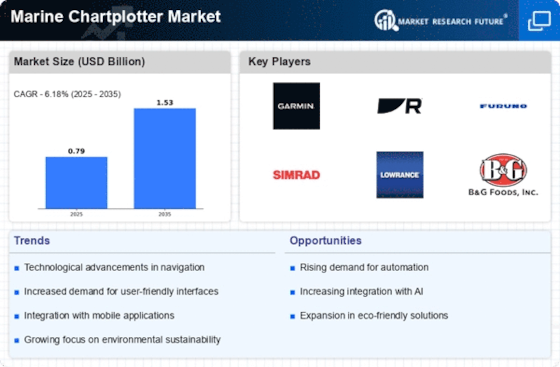
As per Market Research Future analysis, the Marine Chartplotter Market Size was estimated at 0.7918 USD Billion in 2024. The Marine Chartplotter industry is projected to grow from USD 0.8407 Billion in 2025 to USD 1.532 Billion by 2035, exhibiting a compound annual growth rate (CAGR) of 6.18% during the forecast period 2025 - 2035

Key Market Trends & Highlights

The Marine Chartplotter Market is experiencing robust growth driven by technological advancements and increasing recreational boating activities.

  • Technological integration is enhancing the functionality and user experience of marine chartplotters, particularly in North America. User-centric design is becoming a focal point, catering to the diverse needs of recreational boaters and fishermen alike. Sustainability initiatives are gaining traction, reflecting a growing awareness of environmental impacts within the marine industry. Rising recreational boating and technological advancements are key drivers propelling market growth, especially in the navigation and integrated chartplotter segments.

Market Size & Forecast

2024 Market Size 0.7918 (USD Billion)
2035 Market Size 1.532 (USD Billion)
CAGR (2025 - 2035) 6.18%
Largest Regional Market Share in 2024 North America

Major Players

Garmin (US), Raymarine (GB), Furuno (JP), Simrad (NO), Lowrance (US), B&amp;G (GB), Humminbird (US), Navico (NO)

Market Trends

The Marine Chartplotter Market is currently experiencing a dynamic evolution, driven by advancements in technology and increasing consumer demand for enhanced navigation solutions, aligned with key marine chartplotter market trends. As maritime activities expand globally, the need for precise and reliable navigation tools becomes paramount across the marine chartplotter market. This market encompasses a range of devices that integrate GPS, electronic charts, and various navigational aids, providing users with comprehensive situational awareness. The integration of smart technologies, such as artificial intelligence and machine learning, appears to be reshaping the landscape, offering users more intuitive interfaces and improved functionalities. Furthermore, the growing emphasis on safety and regulatory compliance in marine operations is likely to propel the adoption of sophisticated chartplotters, as they facilitate adherence to maritime regulations and enhance operational efficiency according to ongoing marine chartplotter market analysis.

In addition, the Marine Chartplotter Market is witnessing a shift towards user-friendly designs and mobile compatibility, reflecting broader marine chartplotter market trends. Manufacturers are increasingly focusing on creating devices that cater to both professional mariners and recreational boaters, ensuring accessibility for a broader audience. The rise of mobile applications that complement traditional chartplotters suggests a trend towards integrated solutions that enhance user experience. As environmental concerns gain traction, the market may also see innovations aimed at reducing energy consumption and promoting sustainability. Overall, the Marine Chartplotter Market is poised for continued growth, driven by technological advancements and evolving consumer preferences within the expanding marine chartplotter market.

Technological Integration

The Marine Chartplotter Market is increasingly characterized by the integration of advanced technologies, shaping future marine chartplotter market analysis outcomes. Innovations such as artificial intelligence and machine learning are enhancing the functionality of chartplotters, allowing for more intuitive navigation and real-time data analysis. This trend indicates a shift towards smarter devices that not only assist in navigation but also provide predictive insights, thereby improving overall maritime safety.

User-Centric Design

A notable trend within the Marine Chartplotter Market is the focus on user-centric design, contributing to evolving marine chartplotter market trends. Manufacturers are prioritizing ease of use, ensuring that devices are accessible to both seasoned mariners and casual boaters. This emphasis on intuitive interfaces and streamlined functionalities suggests a broader appeal, potentially expanding the market reach and enhancing user satisfaction.

Sustainability Initiatives

Sustainability is becoming increasingly relevant in the Marine Chartplotter Market, influencing long-term marine chartplotter market analysis. As environmental awareness grows, there is a push for innovations that minimize energy consumption and promote eco-friendly practices. This trend may lead to the development of chartplotters that not only meet navigational needs but also align with global sustainability goals, reflecting a commitment to responsible marine operations.

Marine Chartplotter Market Market Drivers

Regulatory Compliance

The marine chartplotter Market is also shaped by stringent regulatory compliance requirements aimed at ensuring maritime safety. Various international and regional regulations mandate the use of electronic navigation systems on commercial vessels, which has led to an uptick in chartplotter adoption. For example, the International Maritime Organization has established guidelines that necessitate the integration of electronic navigation aids. This regulatory landscape is compelling shipowners and operators to invest in advanced chartplotters that meet compliance standards. As a result, the market is likely to witness sustained growth, driven by the need for vessels to adhere to safety regulations and improve operational efficiency.

Technological Advancements

The Marine Chartplotter Market is experiencing rapid technological advancements, which are driving demand for sophisticated navigation solutions. Innovations such as high-resolution displays, enhanced GPS accuracy, and integration with other marine technologies are becoming increasingly prevalent. For instance, the introduction of artificial intelligence and machine learning algorithms in chartplotters is enabling more precise route planning and obstacle detection. According to recent data, the market for marine electronics, including chartplotters, is projected to grow at a compound annual growth rate of approximately 6.5% over the next five years. This growth is indicative of the increasing reliance on advanced technology for safe and efficient marine navigation.

Rising Recreational Boating

The Marine Chartplotter Market is significantly influenced by the rising popularity of recreational boating activities. As more individuals engage in boating for leisure, the demand for reliable navigation tools has surged. This trend is supported by data indicating that the number of registered recreational boats has increased steadily, with millions of new registrations each year. Consequently, manufacturers are focusing on developing user-friendly chartplotters that cater to both novice and experienced boaters. The growing interest in water sports and outdoor activities is likely to further propel the market, as consumers seek enhanced safety and navigation capabilities while enjoying their time on the water.

Emerging Markets and Economic Growth

The Marine Chartplotter Market is poised for growth in emerging markets, where economic development is leading to increased investments in marine infrastructure. Countries with expanding coastlines and growing tourism sectors are witnessing a surge in boating activities, thereby driving the demand for marine navigation solutions. Economic growth in these regions is facilitating greater disposable income, allowing consumers to invest in advanced chartplotters. Furthermore, as local governments promote maritime tourism and recreational activities, the market is likely to expand. This trend indicates a promising future for the Marine Chartplotter Market, as new opportunities arise in previously untapped regions.

Increased Awareness of Marine Safety

The Marine Chartplotter Market is benefiting from heightened awareness regarding marine safety among boaters and maritime professionals. As incidents of maritime accidents and navigational errors are reported, there is a growing emphasis on utilizing advanced navigation tools to enhance safety. This awareness is prompting both recreational and commercial users to invest in high-quality chartplotters that offer features such as real-time weather updates, collision avoidance systems, and detailed mapping. Market data suggests that the demand for safety-oriented navigation solutions is on the rise, as users prioritize their safety and that of their passengers while navigating waterways.

Market Segment Insights

By Application: Navigation (Largest) vs. Fishing (Fastest-Growing)

<p>In the Marine Chartplotter Market, the application segments have distinct market share distributions. Navigation applications hold the largest share due to their essential role in marine activities, ensuring safe and accurate route plotting for vessels. Fishing applications are gaining traction, offering unique features tailored to anglers, making them the fastest-growing segment within the market. Safety and Rescue applications, while crucial, account for a smaller percentage, focusing primarily on emergency operations at sea. Recreational Boating, though significant, ranks lower in terms of share compared to Navigation and Fishing.</p>

<p>Safety and Rescue: Dominant vs. Recreational Boating: Emerging</p>

<p>In the Marine Chartplotter Market, Safety and Rescue applications are considered dominant due to their critical importance in ensuring safe marine operations and minimizing risks during navigation. These applications provide features such as distress alerts, real-time weather updates, and emergency location tracking. Conversely, Recreational Boating applications are emerging, primarily driven by the growth of leisure boating activities. They focus on enhancing the boating experience through user-friendly interfaces and entertainment features. As more individuals engage in boating for leisure, this segment shows a potential for substantial growth, yet it still remains overshadowed by the established Safety and Rescue applications.</p>

By Type: Standalone Chartplotters (Largest) vs. Integrated Chartplotters (Fastest-Growing)

<p>In the Marine Chartplotter Market, Standalone Chartplotters hold the largest share, appealing to recreational boaters and professionals alike due to their simplicity and effectiveness. Meanwhile, Integrated Chartplotters are gaining traction as they offer advanced functionalities compatible with other marine devices. Networked Chartplotters, while essential, occupy a smaller share as they primarily serve niche markets, emphasizing connectivity across multiple marine systems.</p>

<p>Standalone Chartplotters (Dominant) vs. Integrated Chartplotters (Emerging)</p>

<p>Standalone Chartplotters are characterized by their self-contained design, focusing on essential navigation and charting features that cater to a broad user base. They are preferred for their cost-efficiency and ease of use. On the other hand, Integrated Chartplotters represent an emerging trend, combining navigation, radar, and communication functionalities into one unit, meeting the needs of technologically inclined consumers. This integration not only enhances usability but also increases demand from professional users who seek comprehensive marine instrumentation, positioning Integrated Chartplotters as a significant growth opportunity in the market.</p>

By Display Type: LCD (Largest) vs. Touchscreen (Fastest-Growing)

<p>In the Marine Chartplotter Market, display type plays a crucial role in consumer preferences and overall market dynamics. LCD displays currently hold the largest market share, favored for their clarity and reliability in various marine conditions. On the other hand, touchscreen displays are emerging rapidly, appealing to a modern user base that values interactivity and ease of use. Non-touchscreen models remain in the market but are steadily losing ground as technology advances. The growth trends in the display type segment are largely driven by technological advancements and changing consumer preferences. The increasing demand for enhanced user experiences and multifunctional devices has propelled touchscreen displays to the forefront, making them the fastest-growing category. Meanwhile, advancements in LCD technology continue to maintain its dominant position by offering robust performance in challenging environments, catering to a segment of users prioritizing durability and clarity over interactivity.</p>

<p>LCD (Dominant) vs. Touchscreen (Emerging)</p>

<p>LCD displays remain the dominant force in the Marine Chartplotter Market, known for their exceptional visibility and durability under harsh marine conditions. These displays offer reliable performance and have become a standard choice among traditional mariners who prioritize longstanding technology features. In contrast, touchscreen displays represent an emerging force in the market, appealing to a younger, tech-savvy audience. Their intuitive interface facilitates navigation and usage, making them attractive for recreational boaters. As these technologies evolve, LCD will continue to be preferred for its reliable characteristics, while touchscreen options are expected to grow significantly as users seek enhanced interactivity, reflecting shifting consumer needs in the marine electronics landscape.</p>

By End Use: Commercial Vessels (Largest) vs. Leisure Boats (Fastest-Growing)

<p>The Marine Chartplotter Market shows a diverse distribution of market share across various end-use segments. Commercial vessels lead the market, driven by their requirement for advanced navigation systems to enhance operational efficiency and safety. Following this, leisure boats and fishing boats occupy substantial shares, reflecting the growing interest in recreational activities and sustainable fishing practices, respectively.</p>

<p>Commercial Vessels (Dominant) vs. Leisure Boats (Emerging)</p>

<p>Commercial vessels represent the most significant segment in the Marine Chartplotter Market, characterized by their emphasis on accuracy and reliability due to the demanding nature of commercial operations. These vessels utilize sophisticated chartplotters for route planning, monitoring, and safety, which create a competitive necessity in the market. In contrast, leisure boats are emerging as a key growth segment, driven by the rising popularity of recreational boating and sailing activities. The increasing availability of affordable and user-friendly chartplotting technologies appeals to both novice and experienced boaters, facilitating robust growth in this segment.</p>

Marine Chartplotter Market End Use Insights

Marine Chartplotter Market End Use Insights

The Marine Chartplotter Market presents a noteworthy segmentation based on End Use, which includes Commercial Vessels, Leisure Boats, Fishing Boats, and Yachts.

The robust growth in this market is largely driven by the increasing need for advanced navigation systems in Commercial Vessels, which dominate the sector due to their operational scale and requirement for precise routing and safety measures. The Leisure Boats segment is gaining traction as recreational activities and boating tourism continue to rise, promoting the adoption of modern navigation solutions.

Get more detailed insights about Marine Chartplotter Market Research Report - Global Forecast till 2035

Regional Insights

North America : Leading Innovation and Demand

North America is the largest market for marine chartplotters, holding approximately 45% of the global market share. The region's growth is driven by increasing recreational boating activities, advancements in technology, and a strong focus on safety regulations. The U.S. and Canada are the primary contributors, with a growing demand for integrated navigation systems and eco-friendly solutions. Regulatory support for marine safety and environmental standards further fuels market expansion. The competitive landscape in North America is dominated by key players such as Garmin, Lowrance, and Humminbird. These companies are continuously innovating to enhance user experience and functionality. The presence of established brands and a robust distribution network ensures that consumers have access to the latest technologies. Additionally, partnerships with marine service providers are becoming common, enhancing the overall market dynamics.

Europe : Emerging Technologies and Regulations

Europe is the second-largest market for marine chartplotters, accounting for around 30% of the global share. The region's growth is propelled by increasing investments in marine infrastructure, rising interest in recreational boating, and stringent safety regulations. Countries like Germany and the UK are leading the market, driven by technological advancements and a growing emphasis on sustainable practices in marine navigation. Regulatory frameworks are evolving to support innovation while ensuring safety and environmental compliance. The competitive landscape in Europe features prominent players such as Raymarine and Simrad, who are focusing on integrating advanced technologies like GPS and sonar into their products. The market is characterized by a mix of established brands and emerging startups, fostering innovation. Collaborative efforts between manufacturers and regulatory bodies are enhancing product standards, ensuring that consumers benefit from the latest advancements in marine navigation technology.

Asia-Pacific : Rapid Growth and Adoption

Asia-Pacific is witnessing rapid growth in the marine chartplotter market, holding approximately 20% of the global share. The region's expansion is driven by increasing disposable incomes, a rise in leisure boating activities, and government initiatives promoting maritime safety. Countries like Japan and Australia are at the forefront, with a growing demand for advanced navigation systems that cater to both recreational and commercial boating sectors. Regulatory support is also enhancing market growth by ensuring compliance with international safety standards. The competitive landscape in Asia-Pacific is evolving, with key players like Furuno and Navico leading the charge. The market is characterized by a mix of local and international brands, each vying for market share through innovation and competitive pricing. The presence of a diverse consumer base is prompting manufacturers to tailor their offerings, ensuring that they meet the unique needs of various boating enthusiasts across the region.

Middle East and Africa : Untapped Potential and Growth

The Middle East and Africa region is an emerging market for marine chartplotters, currently holding about 5% of the global share. The growth in this region is driven by increasing investments in marine tourism, rising disposable incomes, and a growing interest in recreational boating. Countries like South Africa and the UAE are leading the market, with government initiatives aimed at enhancing maritime infrastructure and safety regulations. The region's potential is further supported by a growing awareness of the benefits of advanced navigation technologies. The competitive landscape in the Middle East and Africa is still developing, with a mix of local and international players entering the market. Companies are focusing on establishing distribution networks and partnerships to enhance their market presence. The demand for affordable yet reliable marine chartplotters is prompting manufacturers to innovate and adapt their products to meet the needs of a diverse consumer base, paving the way for future growth.

Key Players and Competitive Insights

The  Marine Chartplotter Market has witnessed significant competitiveness in recent years, driven by advancements in technology and increasing demand for navigational aids in maritime applications. As the maritime sector continues to evolve, various players are focusing on developing innovative chart plotters that enhance navigation accuracy and usability on vessels of all sizes.The market is characterized by a diverse range of products and features, catering to different needs ranging from recreational boating to commercial maritime operations. Companies are increasingly investing in research and development to offer unique features, such as integrated sonar capabilities and wireless connectivity, as they aim to establish a competitive advantage within the industry.The rise in boating activities and the necessity of efficient navigation tools further fuel the competition, leading to a dynamic landscape filled with opportunities and challenges.OceanGrafix stands out in the  Marine Chartplotter Market with its commitment to providing high-quality, up-to-date digital charts and innovative solutions tailored for the marine environment. The company's strengths lie in its extensive library of accurate nautical data, which ensures that users have access to reliable information critical for safe navigation.OceanGrafix has developed user-friendly interfaces that simplify chart plotting for both experienced sailors and novices alike. Their focus on integrating modern technology with user-centric designs enhances navigational capabilities, making them a preferable choice among many maritime users.Additionally, their robust customer support and strong relationships with maritime agencies strengthen OceanGrafix's market presence, allowing them to maintain a competitive edge in providing essential navigational tools.Zebra Technologies has made a notable impact on the  Marine Chartplotter Market through its innovative approaches to tracking, monitoring, and improving maritime operations. The company leverages advanced technology, particularly in real-time data processing and analytics, to enhance the functionality of marine chart plotters.Zebra Technologies offers solutions that integrate seamlessly with existing navigation systems, providing users with valuable insights that aid decision-making on the water. Their commitment to innovation is reflected in the development of rugged and reliable devices that can withstand challenging marine environments, ensuring consistent performance.Furthermore, Zebra Technologies' ability to deliver real-time information and dynamic updates makes their chart plotting solutions highly sought after by vessel operators looking to enhance maritime safety and operational efficiency.

Key Companies in the Marine Chartplotter Market include

Industry Developments

The  Marine Chartplotter Market has been witnessing significant developments recently, particularly with advancements in GPS and sonar technology that enhance navigation precision. Companies like Garmin Marine and Furuno are focusing on integrating advanced features into their chart plotters, enhancing the user experience for marine operators.

Additionally, OceanGrafix is expanding its digital chart offerings, meeting increasing demands for up-to-date navigation solutions. In terms of strategic movements, the market saw some notable mergers and acquisitions. For instance, Navico has expressed interest in broadening its product portfolio by exploring potential partnerships.

Companies like Lowrance and Raymarine continue to strengthen their market positions through innovative product launches and upgrades to existing systems. Furthermore, the valuation of firms in this sector is on an upward trajectory, driven by rising demand for recreational and commercial boating, which bolsters market growth.

As the  Marine Chartplotter Market evolves, companies are enhancing their technological capabilities while navigating an increasingly competitive landscape, preparing to meet the changing demands of customers in diverse marine applications.

Future Outlook

Marine Chartplotter Market Future Outlook

The Marine Chartplotter Market is projected to grow at a 6.18% CAGR from 2025 to 2035, driven by technological advancements, increasing recreational boating, and enhanced navigation safety.

New opportunities lie in:

  • <p>Integration of AI for predictive navigation analytics. Development of subscription-based software for real-time updates. Expansion into emerging markets with tailored product offerings.</p>

By 2035, the Marine Chartplotter Market is expected to achieve robust growth, solidifying its position as a key player in marine navigation.

Market Segmentation

Marine Chartplotter Market Type Outlook

  • Standalone Chartplotters
  • Networked Chartplotters
  • Integrated Chartplotters

Marine Chartplotter Market End Use Outlook

  • Commercial Vessels
  • Leisure Boats
  • Fishing Boats
  • Yachts

Marine Chartplotter Market Application Outlook

  • Navigation
  • Fishing
  • Safety and Rescue
  • Recreational Boating

Marine Chartplotter Market Display Type Outlook

  • LCD
  • LED
  • Touchscreen
  • Non-Touchscreen

Report Scope

MARKET SIZE 2024 0.7918(USD Billion)
MARKET SIZE 2025 0.8407(USD Billion)
MARKET SIZE 2035 1.532(USD Billion)
COMPOUND ANNUAL GROWTH RATE (CAGR) 6.18% (2025 - 2035)
REPORT COVERAGE Revenue Forecast, Competitive Landscape, Growth Factors, and Trends
BASE YEAR 2024
Market Forecast Period 2025 - 2035
Historical Data 2019 - 2024
Market Forecast Units USD Billion
Key Companies Profiled Garmin (US), Raymarine (GB), Furuno (JP), Simrad (NO), Lowrance (US), B&G (GB), Humminbird (US), Navico (NO)
Segments Covered Application, Type, Display Type, End Use, Regional
Key Market Opportunities Integration of advanced navigation technologies enhances user experience in the Marine Chartplotter Market.
Key Market Dynamics Technological advancements and regulatory changes drive innovation and competition in the Marine Chartplotter Market.
Countries Covered North America, Europe, APAC, South America, MEA

FAQs

What is the projected market valuation of the Marine Chartplotter Market by 2035?

<p>The Marine Chartplotter Market is projected to reach a valuation of 1.532 USD Billion by 2035.</p>

What was the market valuation of the Marine Chartplotter Market in 2024?

<p>In 2024, the Marine Chartplotter Market had a valuation of 0.7918 USD Billion.</p>

What is the expected CAGR for the Marine Chartplotter Market during the forecast period 2025 - 2035?

<p>The expected CAGR for the Marine Chartplotter Market during the forecast period 2025 - 2035 is 6.18%.</p>

Which companies are considered key players in the Marine Chartplotter Market?

<p>Key players in the Marine Chartplotter Market include Garmin, Raymarine, Furuno, Simrad, Lowrance, B&G, Humminbird, and Navico.</p>

What are the main application segments of the Marine Chartplotter Market?

<p>The main application segments include Navigation, Fishing, Safety and Rescue, and Recreational Boating.</p>

How did the revenue for Navigation applications in the Marine Chartplotter Market change from 2024 to 2025?

<p>The revenue for Navigation applications increased from 0.2371 USD Billion in 2024 to 0.4742 USD Billion in 2025.</p>

What types of chartplotters are available in the Marine Chartplotter Market?

<p>The types of chartplotters available include Standalone Chartplotters, Networked Chartplotters, and Integrated Chartplotters.</p>

What display types are utilized in the Marine Chartplotter Market?

<p>Display types in the Marine Chartplotter Market include LCD, LED, Touchscreen, and Non-Touchscreen.</p>

Which end-use segments are prominent in the Marine Chartplotter Market?

<p>Prominent end-use segments include Commercial Vessels, Leisure Boats, Fishing Boats, and Yachts.</p>

What was the revenue for Integrated Chartplotters in 2024?

<p>The revenue for Integrated Chartplotters was 0.3168 USD Billion in 2024.</p>

  1. SECTION I: EXECUTIVE SUMMARY AND KEY HIGHLIGHTS
    1. | 1.1 EXECUTIVE SUMMARY
    2. | | 1.1.1 Market Overview
    3. | | 1.1.2 Key Findings
    4. | | 1.1.3 Market Segmentation
    5. | | 1.1.4 Competitive Landscape
    6. | | 1.1.5 Challenges and Opportunities
    7. | | 1.1.6 Future Outlook
  2. SECTION II: SCOPING, METHODOLOGY AND MARKET STRUCTURE
    1. | 2.1 MARKET INTRODUCTION
    2. | | 2.1.1 Definition
    3. | | 2.1.2 Scope of the study
    4. | | | 2.1.2.1 Research Objective
    5. | | | 2.1.2.2 Assumption
    6. | | | 2.1.2.3 Limitations
    7. | 2.2 RESEARCH METHODOLOGY
    8. | | 2.2.1 Overview
    9. | | 2.2.2 Data Mining
    10. | | 2.2.3 Secondary Research
    11. | | 2.2.4 Primary Research
    12. | | | 2.2.4.1 Primary Interviews and Information Gathering Process
    13. | | | 2.2.4.2 Breakdown of Primary Respondents
    14. | | 2.2.5 Forecasting Model
    15. | | 2.2.6 Market Size Estimation
    16. | | | 2.2.6.1 Bottom-Up Approach
    17. | | | 2.2.6.2 Top-Down Approach
    18. | | 2.2.7 Data Triangulation
    19. | | 2.2.8 Validation
  3. SECTION III: QUALITATIVE ANALYSIS
    1. | 3.1 MARKET DYNAMICS
    2. | | 3.1.1 Overview
    3. | | 3.1.2 Drivers
    4. | | 3.1.3 Restraints
    5. | | 3.1.4 Opportunities
    6. | 3.2 MARKET FACTOR ANALYSIS
    7. | | 3.2.1 Value chain Analysis
    8. | | 3.2.2 Porter's Five Forces Analysis
    9. | | | 3.2.2.1 Bargaining Power of Suppliers
    10. | | | 3.2.2.2 Bargaining Power of Buyers
    11. | | | 3.2.2.3 Threat of New Entrants
    12. | | | 3.2.2.4 Threat of Substitutes
    13. | | | 3.2.2.5 Intensity of Rivalry
    14. | | 3.2.3 COVID-19 Impact Analysis
    15. | | | 3.2.3.1 Market Impact Analysis
    16. | | | 3.2.3.2 Regional Impact
    17. | | | 3.2.3.3 Opportunity and Threat Analysis
  4. SECTION IV: QUANTITATIVE ANALYSIS
    1. | 4.1 Aerospace & Defense, BY Application (USD Billion)
    2. | | 4.1.1 Navigation
    3. | | 4.1.2 Fishing
    4. | | 4.1.3 Safety and Rescue
    5. | | 4.1.4 Recreational Boating
    6. | 4.2 Aerospace & Defense, BY Type (USD Billion)
    7. | | 4.2.1 Standalone Chartplotters
    8. | | 4.2.2 Networked Chartplotters
    9. | | 4.2.3 Integrated Chartplotters
    10. | 4.3 Aerospace & Defense, BY Display Type (USD Billion)
    11. | | 4.3.1 LCD
    12. | | 4.3.2 LED
    13. | | 4.3.3 Touchscreen
    14. | | 4.3.4 Non-Touchscreen
    15. | 4.4 Aerospace & Defense, BY End Use (USD Billion)
    16. | | 4.4.1 Commercial Vessels
    17. | | 4.4.2 Leisure Boats
    18. | | 4.4.3 Fishing Boats
    19. | | 4.4.4 Yachts
    20. | 4.5 Aerospace & Defense, BY Region (USD Billion)
    21. | | 4.5.1 North America
    22. | | | 4.5.1.1 US
    23. | | | 4.5.1.2 Canada
    24. | | 4.5.2 Europe
    25. | | | 4.5.2.1 Germany
    26. | | | 4.5.2.2 UK
    27. | | | 4.5.2.3 France
    28. | | | 4.5.2.4 Russia
    29. | | | 4.5.2.5 Italy
    30. | | | 4.5.2.6 Spain
    31. | | | 4.5.2.7 Rest of Europe
    32. | | 4.5.3 APAC
    33. | | | 4.5.3.1 China
    34. | | | 4.5.3.2 India
    35. | | | 4.5.3.3 Japan
    36. | | | 4.5.3.4 South Korea
    37. | | | 4.5.3.5 Malaysia
    38. | | | 4.5.3.6 Thailand
    39. | | | 4.5.3.7 Indonesia
    40. | | | 4.5.3.8 Rest of APAC
    41. | | 4.5.4 South America
    42. | | | 4.5.4.1 Brazil
    43. | | | 4.5.4.2 Mexico
    44. | | | 4.5.4.3 Argentina
    45. | | | 4.5.4.4 Rest of South America
    46. | | 4.5.5 MEA
    47. | | | 4.5.5.1 GCC Countries
    48. | | | 4.5.5.2 South Africa
    49. | | | 4.5.5.3 Rest of MEA
  5. SECTION V: COMPETITIVE ANALYSIS
    1. | 5.1 Competitive Landscape
    2. | | 5.1.1 Overview
    3. | | 5.1.2 Competitive Analysis
    4. | | 5.1.3 Market share Analysis
    5. | | 5.1.4 Major Growth Strategy in the Aerospace & Defense
    6. | | 5.1.5 Competitive Benchmarking
    7. | | 5.1.6 Leading Players in Terms of Number of Developments in the Aerospace & Defense
    8. | | 5.1.7 Key developments and growth strategies
    9. | | | 5.1.7.1 New Product Launch/Service Deployment
    10. | | | 5.1.7.2 Merger & Acquisitions
    11. | | | 5.1.7.3 Joint Ventures
    12. | | 5.1.8 Major Players Financial Matrix
    13. | | | 5.1.8.1 Sales and Operating Income
    14. | | | 5.1.8.2 Major Players R&D Expenditure. 2023
    15. | 5.2 Company Profiles
    16. | | 5.2.1 Garmin (US)
    17. | | | 5.2.1.1 Financial Overview
    18. | | | 5.2.1.2 Products Offered
    19. | | | 5.2.1.3 Key Developments
    20. | | | 5.2.1.4 SWOT Analysis
    21. | | | 5.2.1.5 Key Strategies
    22. | | 5.2.2 Raymarine (GB)
    23. | | | 5.2.2.1 Financial Overview
    24. | | | 5.2.2.2 Products Offered
    25. | | | 5.2.2.3 Key Developments
    26. | | | 5.2.2.4 SWOT Analysis
    27. | | | 5.2.2.5 Key Strategies
    28. | | 5.2.3 Furuno (JP)
    29. | | | 5.2.3.1 Financial Overview
    30. | | | 5.2.3.2 Products Offered
    31. | | | 5.2.3.3 Key Developments
    32. | | | 5.2.3.4 SWOT Analysis
    33. | | | 5.2.3.5 Key Strategies
    34. | | 5.2.4 Simrad (NO)
    35. | | | 5.2.4.1 Financial Overview
    36. | | | 5.2.4.2 Products Offered
    37. | | | 5.2.4.3 Key Developments
    38. | | | 5.2.4.4 SWOT Analysis
    39. | | | 5.2.4.5 Key Strategies
    40. | | 5.2.5 Lowrance (US)
    41. | | | 5.2.5.1 Financial Overview
    42. | | | 5.2.5.2 Products Offered
    43. | | | 5.2.5.3 Key Developments
    44. | | | 5.2.5.4 SWOT Analysis
    45. | | | 5.2.5.5 Key Strategies
    46. | | 5.2.6 B&G (GB)
    47. | | | 5.2.6.1 Financial Overview
    48. | | | 5.2.6.2 Products Offered
    49. | | | 5.2.6.3 Key Developments
    50. | | | 5.2.6.4 SWOT Analysis
    51. | | | 5.2.6.5 Key Strategies
    52. | | 5.2.7 Humminbird (US)
    53. | | | 5.2.7.1 Financial Overview
    54. | | | 5.2.7.2 Products Offered
    55. | | | 5.2.7.3 Key Developments
    56. | | | 5.2.7.4 SWOT Analysis
    57. | | | 5.2.7.5 Key Strategies
    58. | | 5.2.8 Navico (NO)
    59. | | | 5.2.8.1 Financial Overview
    60. | | | 5.2.8.2 Products Offered
    61. | | | 5.2.8.3 Key Developments
    62. | | | 5.2.8.4 SWOT Analysis
    63. | | | 5.2.8.5 Key Strategies
    64. | 5.3 Appendix
    65. | | 5.3.1 References
    66. | | 5.3.2 Related Reports
  6. LIST OF FIGURES
    1. | 6.1 MARKET SYNOPSIS
    2. | 6.2 NORTH AMERICA MARKET ANALYSIS
    3. | 6.3 US MARKET ANALYSIS BY APPLICATION
    4. | 6.4 US MARKET ANALYSIS BY TYPE
    5. | 6.5 US MARKET ANALYSIS BY DISPLAY TYPE
    6. | 6.6 US MARKET ANALYSIS BY END USE
    7. | 6.7 CANADA MARKET ANALYSIS BY APPLICATION
    8. | 6.8 CANADA MARKET ANALYSIS BY TYPE
    9. | 6.9 CANADA MARKET ANALYSIS BY DISPLAY TYPE
    10. | 6.10 CANADA MARKET ANALYSIS BY END USE
    11. | 6.11 EUROPE MARKET ANALYSIS
    12. | 6.12 GERMANY MARKET ANALYSIS BY APPLICATION
    13. | 6.13 GERMANY MARKET ANALYSIS BY TYPE
    14. | 6.14 GERMANY MARKET ANALYSIS BY DISPLAY TYPE
    15. | 6.15 GERMANY MARKET ANALYSIS BY END USE
    16. | 6.16 UK MARKET ANALYSIS BY APPLICATION
    17. | 6.17 UK MARKET ANALYSIS BY TYPE
    18. | 6.18 UK MARKET ANALYSIS BY DISPLAY TYPE
    19. | 6.19 UK MARKET ANALYSIS BY END USE
    20. | 6.20 FRANCE MARKET ANALYSIS BY APPLICATION
    21. | 6.21 FRANCE MARKET ANALYSIS BY TYPE
    22. | 6.22 FRANCE MARKET ANALYSIS BY DISPLAY TYPE
    23. | 6.23 FRANCE MARKET ANALYSIS BY END USE
    24. | 6.24 RUSSIA MARKET ANALYSIS BY APPLICATION
    25. | 6.25 RUSSIA MARKET ANALYSIS BY TYPE
    26. | 6.26 RUSSIA MARKET ANALYSIS BY DISPLAY TYPE
    27. | 6.27 RUSSIA MARKET ANALYSIS BY END USE
    28. | 6.28 ITALY MARKET ANALYSIS BY APPLICATION
    29. | 6.29 ITALY MARKET ANALYSIS BY TYPE
    30. | 6.30 ITALY MARKET ANALYSIS BY DISPLAY TYPE
    31. | 6.31 ITALY MARKET ANALYSIS BY END USE
    32. | 6.32 SPAIN MARKET ANALYSIS BY APPLICATION
    33. | 6.33 SPAIN MARKET ANALYSIS BY TYPE
    34. | 6.34 SPAIN MARKET ANALYSIS BY DISPLAY TYPE
    35. | 6.35 SPAIN MARKET ANALYSIS BY END USE
    36. | 6.36 REST OF EUROPE MARKET ANALYSIS BY APPLICATION
    37. | 6.37 REST OF EUROPE MARKET ANALYSIS BY TYPE
    38. | 6.38 REST OF EUROPE MARKET ANALYSIS BY DISPLAY TYPE
    39. | 6.39 REST OF EUROPE MARKET ANALYSIS BY END USE
    40. | 6.40 APAC MARKET ANALYSIS
    41. | 6.41 CHINA MARKET ANALYSIS BY APPLICATION
    42. | 6.42 CHINA MARKET ANALYSIS BY TYPE
    43. | 6.43 CHINA MARKET ANALYSIS BY DISPLAY TYPE
    44. | 6.44 CHINA MARKET ANALYSIS BY END USE
    45. | 6.45 INDIA MARKET ANALYSIS BY APPLICATION
    46. | 6.46 INDIA MARKET ANALYSIS BY TYPE
    47. | 6.47 INDIA MARKET ANALYSIS BY DISPLAY TYPE
    48. | 6.48 INDIA MARKET ANALYSIS BY END USE
    49. | 6.49 JAPAN MARKET ANALYSIS BY APPLICATION
    50. | 6.50 JAPAN MARKET ANALYSIS BY TYPE
    51. | 6.51 JAPAN MARKET ANALYSIS BY DISPLAY TYPE
    52. | 6.52 JAPAN MARKET ANALYSIS BY END USE
    53. | 6.53 SOUTH KOREA MARKET ANALYSIS BY APPLICATION
    54. | 6.54 SOUTH KOREA MARKET ANALYSIS BY TYPE
    55. | 6.55 SOUTH KOREA MARKET ANALYSIS BY DISPLAY TYPE
    56. | 6.56 SOUTH KOREA MARKET ANALYSIS BY END USE
    57. | 6.57 MALAYSIA MARKET ANALYSIS BY APPLICATION
    58. | 6.58 MALAYSIA MARKET ANALYSIS BY TYPE
    59. | 6.59 MALAYSIA MARKET ANALYSIS BY DISPLAY TYPE
    60. | 6.60 MALAYSIA MARKET ANALYSIS BY END USE
    61. | 6.61 THAILAND MARKET ANALYSIS BY APPLICATION
    62. | 6.62 THAILAND MARKET ANALYSIS BY TYPE
    63. | 6.63 THAILAND MARKET ANALYSIS BY DISPLAY TYPE
    64. | 6.64 THAILAND MARKET ANALYSIS BY END USE
    65. | 6.65 INDONESIA MARKET ANALYSIS BY APPLICATION
    66. | 6.66 INDONESIA MARKET ANALYSIS BY TYPE
    67. | 6.67 INDONESIA MARKET ANALYSIS BY DISPLAY TYPE
    68. | 6.68 INDONESIA MARKET ANALYSIS BY END USE
    69. | 6.69 REST OF APAC MARKET ANALYSIS BY APPLICATION
    70. | 6.70 REST OF APAC MARKET ANALYSIS BY TYPE
    71. | 6.71 REST OF APAC MARKET ANALYSIS BY DISPLAY TYPE
    72. | 6.72 REST OF APAC MARKET ANALYSIS BY END USE
    73. | 6.73 SOUTH AMERICA MARKET ANALYSIS
    74. | 6.74 BRAZIL MARKET ANALYSIS BY APPLICATION
    75. | 6.75 BRAZIL MARKET ANALYSIS BY TYPE
    76. | 6.76 BRAZIL MARKET ANALYSIS BY DISPLAY TYPE
    77. | 6.77 BRAZIL MARKET ANALYSIS BY END USE
    78. | 6.78 MEXICO MARKET ANALYSIS BY APPLICATION
    79. | 6.79 MEXICO MARKET ANALYSIS BY TYPE
    80. | 6.80 MEXICO MARKET ANALYSIS BY DISPLAY TYPE
    81. | 6.81 MEXICO MARKET ANALYSIS BY END USE
    82. | 6.82 ARGENTINA MARKET ANALYSIS BY APPLICATION
    83. | 6.83 ARGENTINA MARKET ANALYSIS BY TYPE
    84. | 6.84 ARGENTINA MARKET ANALYSIS BY DISPLAY TYPE
    85. | 6.85 ARGENTINA MARKET ANALYSIS BY END USE
    86. | 6.86 REST OF SOUTH AMERICA MARKET ANALYSIS BY APPLICATION
    87. | 6.87 REST OF SOUTH AMERICA MARKET ANALYSIS BY TYPE
    88. | 6.88 REST OF SOUTH AMERICA MARKET ANALYSIS BY DISPLAY TYPE
    89. | 6.89 REST OF SOUTH AMERICA MARKET ANALYSIS BY END USE
    90. | 6.90 MEA MARKET ANALYSIS
    91. | 6.91 GCC COUNTRIES MARKET ANALYSIS BY APPLICATION
    92. | 6.92 GCC COUNTRIES MARKET ANALYSIS BY TYPE
    93. | 6.93 GCC COUNTRIES MARKET ANALYSIS BY DISPLAY TYPE
    94. | 6.94 GCC COUNTRIES MARKET ANALYSIS BY END USE
    95. | 6.95 SOUTH AFRICA MARKET ANALYSIS BY APPLICATION
    96. | 6.96 SOUTH AFRICA MARKET ANALYSIS BY TYPE
    97. | 6.97 SOUTH AFRICA MARKET ANALYSIS BY DISPLAY TYPE
    98. | 6.98 SOUTH AFRICA MARKET ANALYSIS BY END USE
    99. | 6.99 REST OF MEA MARKET ANALYSIS BY APPLICATION
    100. | 6.100 REST OF MEA MARKET ANALYSIS BY TYPE
    101. | 6.101 REST OF MEA MARKET ANALYSIS BY DISPLAY TYPE
    102. | 6.102 REST OF MEA MARKET ANALYSIS BY END USE
    103. | 6.103 KEY BUYING CRITERIA OF AEROSPACE & DEFENSE
    104. | 6.104 RESEARCH PROCESS OF MRFR
    105. | 6.105 DRO ANALYSIS OF AEROSPACE & DEFENSE
    106. | 6.106 DRIVERS IMPACT ANALYSIS: AEROSPACE & DEFENSE
    107. | 6.107 RESTRAINTS IMPACT ANALYSIS: AEROSPACE & DEFENSE
    108. | 6.108 SUPPLY / VALUE CHAIN: AEROSPACE & DEFENSE
    109. | 6.109 AEROSPACE & DEFENSE, BY APPLICATION, 2024 (% SHARE)
    110. | 6.110 AEROSPACE & DEFENSE, BY APPLICATION, 2024 TO 2035 (USD Billion)
    111. | 6.111 AEROSPACE & DEFENSE, BY TYPE, 2024 (% SHARE)
    112. | 6.112 AEROSPACE & DEFENSE, BY TYPE, 2024 TO 2035 (USD Billion)
    113. | 6.113 AEROSPACE & DEFENSE, BY DISPLAY TYPE, 2024 (% SHARE)
    114. | 6.114 AEROSPACE & DEFENSE, BY DISPLAY TYPE, 2024 TO 2035 (USD Billion)
    115. | 6.115 AEROSPACE & DEFENSE, BY END USE, 2024 (% SHARE)
    116. | 6.116 AEROSPACE & DEFENSE, BY END USE, 2024 TO 2035 (USD Billion)
    117. | 6.117 BENCHMARKING OF MAJOR COMPETITORS
  7. LIST OF TABLES
    1. | 7.1 LIST OF ASSUMPTIONS
    2. | | 7.1.1
    3. | 7.2 North America MARKET SIZE ESTIMATES; FORECAST
    4. | | 7.2.1 BY APPLICATION, 2025-2035 (USD Billion)
    5. | | 7.2.2 BY TYPE, 2025-2035 (USD Billion)
    6. | | 7.2.3 BY DISPLAY TYPE, 2025-2035 (USD Billion)
    7. | | 7.2.4 BY END USE, 2025-2035 (USD Billion)
    8. | 7.3 US MARKET SIZE ESTIMATES; FORECAST
    9. | | 7.3.1 BY APPLICATION, 2025-2035 (USD Billion)
    10. | | 7.3.2 BY TYPE, 2025-2035 (USD Billion)
    11. | | 7.3.3 BY DISPLAY TYPE, 2025-2035 (USD Billion)
    12. | | 7.3.4 BY END USE, 2025-2035 (USD Billion)
    13. | 7.4 Canada MARKET SIZE ESTIMATES; FORECAST
    14. | | 7.4.1 BY APPLICATION, 2025-2035 (USD Billion)
    15. | | 7.4.2 BY TYPE, 2025-2035 (USD Billion)
    16. | | 7.4.3 BY DISPLAY TYPE, 2025-2035 (USD Billion)
    17. | | 7.4.4 BY END USE, 2025-2035 (USD Billion)
    18. | 7.5 Europe MARKET SIZE ESTIMATES; FORECAST
    19. | | 7.5.1 BY APPLICATION, 2025-2035 (USD Billion)
    20. | | 7.5.2 BY TYPE, 2025-2035 (USD Billion)
    21. | | 7.5.3 BY DISPLAY TYPE, 2025-2035 (USD Billion)
    22. | | 7.5.4 BY END USE, 2025-2035 (USD Billion)
    23. | 7.6 Germany MARKET SIZE ESTIMATES; FORECAST
    24. | | 7.6.1 BY APPLICATION, 2025-2035 (USD Billion)
    25. | | 7.6.2 BY TYPE, 2025-2035 (USD Billion)
    26. | | 7.6.3 BY DISPLAY TYPE, 2025-2035 (USD Billion)
    27. | | 7.6.4 BY END USE, 2025-2035 (USD Billion)
    28. | 7.7 UK MARKET SIZE ESTIMATES; FORECAST
    29. | | 7.7.1 BY APPLICATION, 2025-2035 (USD Billion)
    30. | | 7.7.2 BY TYPE, 2025-2035 (USD Billion)
    31. | | 7.7.3 BY DISPLAY TYPE, 2025-2035 (USD Billion)
    32. | | 7.7.4 BY END USE, 2025-2035 (USD Billion)
    33. | 7.8 France MARKET SIZE ESTIMATES; FORECAST
    34. | | 7.8.1 BY APPLICATION, 2025-2035 (USD Billion)
    35. | | 7.8.2 BY TYPE, 2025-2035 (USD Billion)
    36. | | 7.8.3 BY DISPLAY TYPE, 2025-2035 (USD Billion)
    37. | | 7.8.4 BY END USE, 2025-2035 (USD Billion)
    38. | 7.9 Russia MARKET SIZE ESTIMATES; FORECAST
    39. | | 7.9.1 BY APPLICATION, 2025-2035 (USD Billion)
    40. | | 7.9.2 BY TYPE, 2025-2035 (USD Billion)
    41. | | 7.9.3 BY DISPLAY TYPE, 2025-2035 (USD Billion)
    42. | | 7.9.4 BY END USE, 2025-2035 (USD Billion)
    43. | 7.10 Italy MARKET SIZE ESTIMATES; FORECAST
    44. | | 7.10.1 BY APPLICATION, 2025-2035 (USD Billion)
    45. | | 7.10.2 BY TYPE, 2025-2035 (USD Billion)
    46. | | 7.10.3 BY DISPLAY TYPE, 2025-2035 (USD Billion)
    47. | | 7.10.4 BY END USE, 2025-2035 (USD Billion)
    48. | 7.11 Spain MARKET SIZE ESTIMATES; FORECAST
    49. | | 7.11.1 BY APPLICATION, 2025-2035 (USD Billion)
    50. | | 7.11.2 BY TYPE, 2025-2035 (USD Billion)
    51. | | 7.11.3 BY DISPLAY TYPE, 2025-2035 (USD Billion)
    52. | | 7.11.4 BY END USE, 2025-2035 (USD Billion)
    53. | 7.12 Rest of Europe MARKET SIZE ESTIMATES; FORECAST
    54. | | 7.12.1 BY APPLICATION, 2025-2035 (USD Billion)
    55. | | 7.12.2 BY TYPE, 2025-2035 (USD Billion)
    56. | | 7.12.3 BY DISPLAY TYPE, 2025-2035 (USD Billion)
    57. | | 7.12.4 BY END USE, 2025-2035 (USD Billion)
    58. | 7.13 APAC MARKET SIZE ESTIMATES; FORECAST
    59. | | 7.13.1 BY APPLICATION, 2025-2035 (USD Billion)
    60. | | 7.13.2 BY TYPE, 2025-2035 (USD Billion)
    61. | | 7.13.3 BY DISPLAY TYPE, 2025-2035 (USD Billion)
    62. | | 7.13.4 BY END USE, 2025-2035 (USD Billion)
    63. | 7.14 China MARKET SIZE ESTIMATES; FORECAST
    64. | | 7.14.1 BY APPLICATION, 2025-2035 (USD Billion)
    65. | | 7.14.2 BY TYPE, 2025-2035 (USD Billion)
    66. | | 7.14.3 BY DISPLAY TYPE, 2025-2035 (USD Billion)
    67. | | 7.14.4 BY END USE, 2025-2035 (USD Billion)
    68. | 7.15 India MARKET SIZE ESTIMATES; FORECAST
    69. | | 7.15.1 BY APPLICATION, 2025-2035 (USD Billion)
    70. | | 7.15.2 BY TYPE, 2025-2035 (USD Billion)
    71. | | 7.15.3 BY DISPLAY TYPE, 2025-2035 (USD Billion)
    72. | | 7.15.4 BY END USE, 2025-2035 (USD Billion)
    73. | 7.16 Japan MARKET SIZE ESTIMATES; FORECAST
    74. | | 7.16.1 BY APPLICATION, 2025-2035 (USD Billion)
    75. | | 7.16.2 BY TYPE, 2025-2035 (USD Billion)
    76. | | 7.16.3 BY DISPLAY TYPE, 2025-2035 (USD Billion)
    77. | | 7.16.4 BY END USE, 2025-2035 (USD Billion)
    78. | 7.17 South Korea MARKET SIZE ESTIMATES; FORECAST
    79. | | 7.17.1 BY APPLICATION, 2025-2035 (USD Billion)
    80. | | 7.17.2 BY TYPE, 2025-2035 (USD Billion)
    81. | | 7.17.3 BY DISPLAY TYPE, 2025-2035 (USD Billion)
    82. | | 7.17.4 BY END USE, 2025-2035 (USD Billion)
    83. | 7.18 Malaysia MARKET SIZE ESTIMATES; FORECAST
    84. | | 7.18.1 BY APPLICATION, 2025-2035 (USD Billion)
    85. | | 7.18.2 BY TYPE, 2025-2035 (USD Billion)
    86. | | 7.18.3 BY DISPLAY TYPE, 2025-2035 (USD Billion)
    87. | | 7.18.4 BY END USE, 2025-2035 (USD Billion)
    88. | 7.19 Thailand MARKET SIZE ESTIMATES; FORECAST
    89. | | 7.19.1 BY APPLICATION, 2025-2035 (USD Billion)
    90. | | 7.19.2 BY TYPE, 2025-2035 (USD Billion)
    91. | | 7.19.3 BY DISPLAY TYPE, 2025-2035 (USD Billion)
    92. | | 7.19.4 BY END USE, 2025-2035 (USD Billion)
    93. | 7.20 Indonesia MARKET SIZE ESTIMATES; FORECAST
    94. | | 7.20.1 BY APPLICATION, 2025-2035 (USD Billion)
    95. | | 7.20.2 BY TYPE, 2025-2035 (USD Billion)
    96. | | 7.20.3 BY DISPLAY TYPE, 2025-2035 (USD Billion)
    97. | | 7.20.4 BY END USE, 2025-2035 (USD Billion)
    98. | 7.21 Rest of APAC MARKET SIZE ESTIMATES; FORECAST
    99. | | 7.21.1 BY APPLICATION, 2025-2035 (USD Billion)
    100. | | 7.21.2 BY TYPE, 2025-2035 (USD Billion)
    101. | | 7.21.3 BY DISPLAY TYPE, 2025-2035 (USD Billion)
    102. | | 7.21.4 BY END USE, 2025-2035 (USD Billion)
    103. | 7.22 South America MARKET SIZE ESTIMATES; FORECAST
    104. | | 7.22.1 BY APPLICATION, 2025-2035 (USD Billion)
    105. | | 7.22.2 BY TYPE, 2025-2035 (USD Billion)
    106. | | 7.22.3 BY DISPLAY TYPE, 2025-2035 (USD Billion)
    107. | | 7.22.4 BY END USE, 2025-2035 (USD Billion)
    108. | 7.23 Brazil MARKET SIZE ESTIMATES; FORECAST
    109. | | 7.23.1 BY APPLICATION, 2025-2035 (USD Billion)
    110. | | 7.23.2 BY TYPE, 2025-2035 (USD Billion)
    111. | | 7.23.3 BY DISPLAY TYPE, 2025-2035 (USD Billion)
    112. | | 7.23.4 BY END USE, 2025-2035 (USD Billion)
    113. | 7.24 Mexico MARKET SIZE ESTIMATES; FORECAST
    114. | | 7.24.1 BY APPLICATION, 2025-2035 (USD Billion)
    115. | | 7.24.2 BY TYPE, 2025-2035 (USD Billion)
    116. | | 7.24.3 BY DISPLAY TYPE, 2025-2035 (USD Billion)
    117. | | 7.24.4 BY END USE, 2025-2035 (USD Billion)
    118. | 7.25 Argentina MARKET SIZE ESTIMATES; FORECAST
    119. | | 7.25.1 BY APPLICATION, 2025-2035 (USD Billion)
    120. | | 7.25.2 BY TYPE, 2025-2035 (USD Billion)
    121. | | 7.25.3 BY DISPLAY TYPE, 2025-2035 (USD Billion)
    122. | | 7.25.4 BY END USE, 2025-2035 (USD Billion)
    123. | 7.26 Rest of South America MARKET SIZE ESTIMATES; FORECAST
    124. | | 7.26.1 BY APPLICATION, 2025-2035 (USD Billion)
    125. | | 7.26.2 BY TYPE, 2025-2035 (USD Billion)
    126. | | 7.26.3 BY DISPLAY TYPE, 2025-2035 (USD Billion)
    127. | | 7.26.4 BY END USE, 2025-2035 (USD Billion)
    128. | 7.27 MEA MARKET SIZE ESTIMATES; FORECAST
    129. | | 7.27.1 BY APPLICATION, 2025-2035 (USD Billion)
    130. | | 7.27.2 BY TYPE, 2025-2035 (USD Billion)
    131. | | 7.27.3 BY DISPLAY TYPE, 2025-2035 (USD Billion)
    132. | | 7.27.4 BY END USE, 2025-2035 (USD Billion)
    133. | 7.28 GCC Countries MARKET SIZE ESTIMATES; FORECAST
    134. | | 7.28.1 BY APPLICATION, 2025-2035 (USD Billion)
    135. | | 7.28.2 BY TYPE, 2025-2035 (USD Billion)
    136. | | 7.28.3 BY DISPLAY TYPE, 2025-2035 (USD Billion)
    137. | | 7.28.4 BY END USE, 2025-2035 (USD Billion)
    138. | 7.29 South Africa MARKET SIZE ESTIMATES; FORECAST
    139. | | 7.29.1 BY APPLICATION, 2025-2035 (USD Billion)
    140. | | 7.29.2 BY TYPE, 2025-2035 (USD Billion)
    141. | | 7.29.3 BY DISPLAY TYPE, 2025-2035 (USD Billion)
    142. | | 7.29.4 BY END USE, 2025-2035 (USD Billion)
    143. | 7.30 Rest of MEA MARKET SIZE ESTIMATES; FORECAST
    144. | | 7.30.1 BY APPLICATION, 2025-2035 (USD Billion)
    145. | | 7.30.2 BY TYPE, 2025-2035 (USD Billion)
    146. | | 7.30.3 BY DISPLAY TYPE, 2025-2035 (USD Billion)
    147. | | 7.30.4 BY END USE, 2025-2035 (USD Billion)
    148. | 7.31 PRODUCT LAUNCH/PRODUCT DEVELOPMENT/APPROVAL
    149. | | 7.31.1
    150. | 7.32 ACQUISITION/PARTNERSHIP
    151. | | 7.32.1

Aerospace & Defense Market Segmentation

Aerospace & Defense By Application (USD Billion, 2025-2035)

  • Navigation
  • Fishing
  • Safety and Rescue
  • Recreational Boating

Aerospace & Defense By Type (USD Billion, 2025-2035)

  • Standalone Chartplotters
  • Networked Chartplotters
  • Integrated Chartplotters

Aerospace & Defense By Display Type (USD Billion, 2025-2035)

  • LCD
  • LED
  • Touchscreen
  • Non-Touchscreen

Aerospace & Defense By End Use (USD Billion, 2025-2035)

  • Commercial Vessels
  • Leisure Boats
  • Fishing Boats
  • Yachts
Infographic

Free Sample Request

Kindly complete the form below to receive a free sample of this Report

Get Free Sample

Customer Strories

Compare Licence

×
Features License Type
Single User Multiuser License Enterprise User
Price $4,950 $5,950 $7,250
Maximum User Access Limit 1 User Upto 10 Users Unrestricted Access Throughout the Organization
Free Customization
Direct Access to Analyst
Deliverable Format
Platform Access
Discount on Next Purchase 10% 15% 15%
Printable Versions