Request Free Sample ×

Kindly complete the form below to receive a free sample of this Report

* Please use a valid business email

Leading companies partner with us for data-driven Insights

clients tt-cursor
Hero Background
English
Chinese
French
Japanese
Korean
German
Spanish

Lubricants Market Size

ID: MRFR/CnM/4003-HCR
111 Pages
Chitranshi Jaiswal
March 2026

Lubricants Market Research Report By Type (Mineral Oil, Bio-based and Synthetic Lubricants), By Application (Industrial, Automotive, Marine, Construction and Others), Product Type (Engine Oil, Hydraulic Fluid, Metalworking Fluid, Gear Oil, Grease, Others), And By Region (North America, Europe, Asia-Pacific, And Rest Of The World) – Market Forecast Till 2035

Share:
Download PDF ×

We do not share your information with anyone. However, we may send you emails based on your report interest from time to time. You may contact us at any time to opt-out.

Lubricants Market Infographic
Purchase Options

Lubricants Size

Lubricants Market Growth Projections and Opportunities

The lubricants market is shaped by various market factors that influence its growth and development. One of the primary factors driving this market is the industrial expansion across various sectors such as automotive, manufacturing, construction, and agriculture. As these industries continue to grow, there is a parallel increase in the demand for lubricants to ensure smooth operation and maintenance of machinery and equipment. Lubricants play a crucial role in reducing friction, heat, and wear between moving parts, thereby extending the lifespan of machinery and optimizing operational efficiency.

Another significant market factor is the ongoing technological advancements in lubricant formulations and manufacturing processes. Manufacturers are continuously innovating to develop lubricants that offer superior performance, longevity, and environmental sustainability. This includes the development of synthetic lubricants, bio-based lubricants, and specialty lubricants tailored to meet the specific requirements of modern machinery and equipment. Additionally, advancements in additive technology contribute to enhancing the lubricating properties and overall performance of lubricants, driving the demand for high-quality lubricant products.

Moreover, regulatory policies and environmental standards play a crucial role in shaping the lubricants market. Governments worldwide are implementing stricter regulations aimed at reducing emissions, promoting energy efficiency, and minimizing environmental impact. Compliance with these regulations necessitates the use of environmentally friendly lubricants that are biodegradable and non-toxic. As a result, there is a growing demand for eco-friendly lubricant solutions, driving manufacturers to invest in research and development to develop sustainable lubricant formulations.

Furthermore, the evolving automotive industry landscape influences the lubricants market dynamics. The increasing demand for fuel-efficient vehicles and electric vehicles (EVs) has led to changes in engine designs and lubricant requirements. Modern engines require lubricants that can withstand higher temperatures, reduce friction losses, and improve fuel efficiency. Additionally, the rise of EVs necessitates the development of specialized lubricants for electric drivetrains and battery systems, presenting new opportunities for lubricant manufacturers to innovate and diversify their product offerings.

The competitive landscape of the lubricants market also plays a significant role in shaping its dynamics. With numerous multinational and regional players competing for market share, there is intense competition in terms of product innovation, pricing, and distribution channels. Manufacturers are increasingly focusing on expanding their global footprint through strategic partnerships, acquisitions, and alliances to gain a competitive edge in the market. Additionally, branding and marketing initiatives play a vital role in influencing consumer perceptions and preferences, driving customer loyalty and market penetration.

Economic factors such as GDP growth, industrial output, and infrastructure development also impact the lubricants market. As economies grow and industrial activities expand, there is a corresponding increase in the demand for lubricants across various sectors. Moreover, infrastructure development projects, such as road construction, mining, and oil and gas exploration, drive the demand for lubricants used in heavy-duty machinery and equipment, further fueling market growth.
Lubricants Market Size Graph
Author
Author Profile
Chitranshi Jaiswal
Team Lead - Research

Chitranshi is a Team Leader in the Chemicals & Materials (CnM) and Energy & Power (EnP) domains, with 6+ years of experience in market research. She leads and mentors teams to deliver cross-domain projects that equip clients with actionable insights and growth strategies. She is skilled in market estimation, forecasting, competitive benchmarking, and both primary & secondary research, enabling her to turn complex data into decision-ready insights. An engineer and MBA professional, she combines technical expertise with strategic acumen to solve dynamic market challenges. Chitranshi has successfully managed projects that support market entry, investment planning, and competitive positioning, while building strong client relationships. Certified in Advanced Excel & Power BI she leverages data-driven approaches to ensure accuracy, clarity, and impactful outcomes.

Leave a Comment

FAQs

What is the current valuation of the lubricants market as of 2024?

<p>The lubricants market was valued at 41.5 USD Billion in 2024.</p>

What is the projected market valuation for the lubricants sector in 2035?

<p>The lubricants market is projected to reach 55.2 USD Billion by 2035.</p>

What is the expected CAGR for the lubricants market during the forecast period 2025 - 2035?

<p>The expected CAGR for the lubricants market during the forecast period 2025 - 2035 is 2.63%.</p>

Which companies are considered key players in the lubricants market?

<p>Key players in the lubricants market include ExxonMobil, Shell, BP, Chevron, TotalEnergies, Fuchs Petrolub, Valvoline, Castrol, Sinopec, and Petrobras.</p>

How does the automotive segment perform in the lubricants market?

<p>The automotive segment is projected to grow from 16.5 USD Billion in 2024 to 22.0 USD Billion by 2035.</p>

What is the valuation of the industrial lubricants segment?

<p>The industrial lubricants segment is expected to increase from 12.0 USD Billion in 2024 to 15.0 USD Billion by 2035.</p>

What are the projected values for marine lubricants by 2035?

<p>Marine lubricants are anticipated to grow from 4.0 USD Billion in 2024 to 5.5 USD Billion by 2035.</p>

What is the expected growth for bio-based oil in the lubricants market?

<p>Bio-based oil is projected to rise from 5.0 USD Billion in 2024 to 8.0 USD Billion by 2035.</p>

How does the high viscosity lubricants segment compare in terms of valuation?

<p>The high viscosity lubricants segment is expected to grow from 15.5 USD Billion in 2024 to 21.6 USD Billion by 2035.</p>

What is the anticipated growth for engine oil in the lubricants market?

<p>Engine oil is projected to increase from 16.5 USD Billion in 2024 to 22.0 USD Billion by 2035.</p>

Market Summary

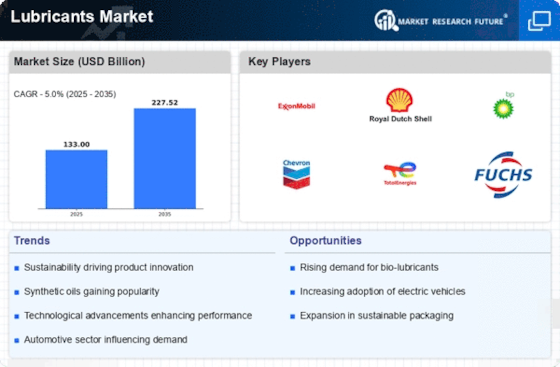
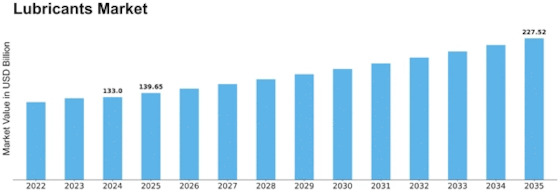
As per Market Research Future analysis, the Lubricants Market Size was estimated at 133.0 USD Billion in 2024. The Lubricants industry is projected to grow from 139.65 USD Billion in 2025 to 227.52 USD Billion by 2035, exhibiting a compound annual growth rate (CAGR) of 5% during the forecast period 2025 - 2035

Key Market Trends & Highlights

The lubricants market is experiencing a dynamic shift towards sustainability and technological innovation.

  • North America remains the largest market for lubricants, driven by robust automotive production and industrial activities. The Asia-Pacific region is the fastest-growing market, reflecting increasing demand for lubricants in emerging economies. Mineral oil continues to dominate the market, while bio-based lubricants are gaining traction as a sustainable alternative. Key market drivers include rising automotive production and stringent regulatory compliance for environmental standards.

Market Size & Forecast

2024 Market Size 133.0 (USD Billion)
2035 Market Size 227.52 (USD Billion)
CAGR (2025 - 2035) 5.0%
Largest Regional Market Share in 2024 Asia Pacific

Major Players

ExxonMobil (US), Royal Dutch Shell (NL), BP (GB), Chevron (US), TotalEnergies (FR), Fuchs Petrolub (DE), Sinopec (CN), Petrobras (BR), Valvoline (US)

Market Trends

The Lubricants Market is currently experiencing a dynamic evolution, driven by various factors that influence demand and supply. The increasing focus on sustainability and environmental regulations appears to be reshaping product formulations, with a noticeable shift towards bio-based and synthetic lubricants. This transition not only aligns with global efforts to reduce carbon footprints but also caters to the growing consumer preference for eco-friendly alternatives. Furthermore, advancements in technology are facilitating the development of high-performance lubricants that enhance efficiency and prolong equipment life, thereby appealing to industries seeking cost-effective solutions.

In addition, the lubricants market is witnessing a surge in demand from emerging economies, where industrialization and urbanization are accelerating. This trend suggests a potential for growth as these regions invest in infrastructure and manufacturing capabilities. Moreover, the automotive sector remains a significant contributor, with innovations in vehicle design and engine technology driving the need for specialized lubricants. These developments are also influencing expansion in the industrial lubricants market, where machinery efficiency and reliability are key priorities. Overall, the lubricants market is poised for transformation, characterized by a blend of innovation, sustainability, and evolving consumer preferences.

Sustainability Initiatives

The Lubricants Market is increasingly influenced by sustainability initiatives, prompting manufacturers to explore eco-friendly formulations. This trend reflects a broader commitment to reducing environmental impact, as companies seek to align their products with consumer expectations for greener alternatives.

Technological Advancements

Technological advancements are reshaping the Lubricants Market, leading to the creation of high-performance products. Innovations in formulation and application techniques enhance efficiency, reduce wear, and extend the lifespan of machinery, appealing to industries focused on operational excellence.

Emerging Market Demand

Emerging markets are driving demand within the Lubricants Market, as rapid industrialization and urbanization create new opportunities. This trend indicates a shift in consumption patterns, with increased investments in infrastructure and manufacturing leading to higher lubricant usage.

Lubricants Market Market Drivers

Increasing Automotive Production

The rising automotive production is a pivotal driver for the Lubricants Market. As vehicle manufacturing ramps up, the demand for high-performance lubricants to ensure engine efficiency and longevity escalates. In 2025, the automotive sector is projected to consume a substantial portion of the lubricant market, with estimates suggesting that automotive lubricants could account for over 40% of total lubricant sales. This trend is further fueled by the growing preference for advanced engine technologies, which require specialized lubricants to meet stringent performance standards. Consequently, manufacturers are innovating to develop lubricants that enhance fuel efficiency and reduce emissions, aligning with regulatory requirements. The interplay between automotive production and lubricant demand underscores the critical role of the Lubricants Market in supporting the evolving automotive landscape.

Rising Demand for Renewable Energy

The increasing focus on renewable energy sources is emerging as a crucial driver for the Lubricants Market. As the world transitions towards sustainable energy solutions, the demand for lubricants in renewable energy applications, such as wind turbines and solar panels, is on the rise. In 2025, the renewable energy sector is projected to require specialized lubricants that can withstand unique operational challenges, thereby creating new opportunities for lubricant manufacturers. This shift towards renewable energy not only supports environmental sustainability but also necessitates the development of innovative lubrication solutions tailored for these applications. The Lubricants Market is thus adapting to this evolving landscape, as companies seek to provide products that meet the specific needs of the renewable energy sector, potentially leading to a diversification of lubricant offerings.

Technological Innovations in Lubricants

Technological advancements in lubricant formulations and applications are transforming the Lubricants Market. Innovations such as synthetic lubricants and bio-based alternatives are gaining traction due to their superior performance characteristics and environmental benefits. In 2025, the market for synthetic lubricants is expected to grow significantly, driven by their ability to provide enhanced protection and efficiency in various applications. Additionally, the development of smart lubricants, which can adapt to changing conditions, is likely to emerge as a key trend. These innovations not only improve operational efficiency but also align with sustainability goals, as they often reduce waste and emissions. The Lubricants Market is thus witnessing a paradigm shift, where technological advancements are not merely enhancing product offerings but are also reshaping consumer expectations and regulatory compliance.

Industrial Growth and Manufacturing Expansion

The expansion of industrial activities and manufacturing sectors serves as a significant driver for the Lubricants Market. Industries such as construction, mining, and manufacturing are increasingly reliant on lubricants to ensure the smooth operation of machinery and equipment. In 2025, the industrial segment is anticipated to represent a considerable share of lubricant consumption, with projections indicating a growth rate of approximately 5% annually. This growth is attributed to the rising need for efficient machinery operation and maintenance, which directly correlates with lubricant usage. Furthermore, advancements in manufacturing processes necessitate the use of specialized lubricants that can withstand extreme conditions, thereby enhancing equipment lifespan and performance. The Lubricants Market is thus positioned to benefit from the ongoing industrial growth, as companies seek to optimize their operations through effective lubrication solutions.

Regulatory Compliance and Environmental Standards

The increasing stringency of regulatory compliance and environmental standards is a significant driver for the Lubricants Market. Governments worldwide are implementing stricter regulations regarding emissions and environmental impact, compelling lubricant manufacturers to innovate and reformulate their products. In 2025, the demand for eco-friendly lubricants is expected to surge, as industries seek to comply with these regulations while minimizing their ecological footprint. This trend is likely to result in a growing market for biodegradable and low-toxicity lubricants, which align with both regulatory requirements and consumer preferences for sustainable products. The Lubricants Market is thus at a crossroads, where adherence to environmental standards not only drives product development but also shapes market dynamics, as companies strive to balance performance with sustainability.

Market Segment Insights

By Application: Automotive (Largest) vs. Industrial (Fastest-Growing)

<p>The lubricants market shows a diverse application distribution with automotive lubricants commanding the largest share. They are essential for vehicle performance and longevity, driving significant demand in the consumer and commercial automotive sectors. In contrast, industrial lubricants, while currently smaller in share, are witnessing rapid growth as manufacturers seek to enhance machine efficiency and reduce downtime, indicating a shift in focus towards operational productivity across various industries.</p>

<p>Automotive (Dominant) vs. Industrial (Emerging)</p>

<p>Automotive lubricants are primarily designed to enhance engine performance, minimize wear, and prevent corrosion, making them integral to vehicle maintenance. This sector leads the market due to the continuous rise in global vehicle production and stringent regulations on emissions, bolstering the demand for advanced lubricants. Meanwhile, industrial lubricants are gaining traction as industries upgrade systems and adopt innovative technologies. Their growth is driven by increasing industrial activity, higher investments in machinery maintenance, and an expanding range of applications including heavy machinery and manufacturing equipment.</p>

By End Use: Passenger Vehicles (Largest) vs. Commercial Vehicles (Fastest-Growing)

<p>The lubricants market exhibits a diverse distribution in the end-use segment, with passenger vehicles holding the largest share due to their widespread usage and increased vehicle ownership worldwide. Commercial vehicles also contribute significantly to the market, particularly in regions experiencing logistical expansion, providing a substantial portion of overall lubricant demand.</p>

<p>Passenger Vehicles (Dominant) vs. Commercial Vehicles (Emerging)</p>

<p>Passenger vehicles dominate the lubricants market, driven by the growing number of personal vehicles and increasing maintenance awareness among consumers. They require high-quality lubricants to ensure optimal engine performance and fuel efficiency. Conversely, commercial vehicles are emerging as a vital segment, propelled by the boom in e-commerce and freight transportation. As businesses seek to enhance operational efficiencies, the demand for durable and efficient lubricants for commercial fleets is rising. This segment prioritizes extended oil changes and greater durability, reflecting its unique operational requirements.</p>

By Base Oil Type: Mineral Oil (Largest) vs. Synthetic Oil (Fastest-Growing)

<p>The lubricants market is primarily dominated by the mineral oil segment, which holds the largest share due to its widespread applications across various industries, particularly in automotive and industrial lubrication. The mineral oil type is valued for its cost-effectiveness and availability, making it a popular choice among consumers. In contrast, synthetic oils are rapidly gaining popularity, primarily due to their enhanced performance characteristics, including better thermal stability and oxidation resistance, catering to the increasing demand for high-performance lubricants in advanced applications. The growth trends in the base oil type segment are significantly driven by the ongoing advancements in synthetic and bio-based oils, reflecting shifting consumer preferences towards more sustainable and efficient lubrication solutions. The synthetic oil segment is expected to witness the highest growth rates as industries strive for improved efficiency and performance, while the bio-based oil segment is emerging as a viable alternative fueled by environmental regulations and consumer awareness about sustainability. This landscape indicates a dynamic shift within the lubricants market, balancing traditional practices with innovative, eco-friendly alternatives.</p>

<p>Mineral Oil (Dominant) vs. Synthetic Oil (Emerging)</p>

<p>Mineral oil is characterized by its traditional processing methods, providing reliable lubrication at a lower cost, which solidifies its dominant position in the lubricants market. Its applications are diverse, ranging from automotive to industrial uses, where it offers proven effectiveness. Conversely, synthetic oil represents an emerging segment, developed through advanced chemical processes to enhance properties such as viscosity index and low-temperature fluidity. As manufacturers continue to innovate and enhance the formulations of synthetic oils, the market position of synthetic oil is becoming increasingly prominent, driven by demand for higher performance and longer-lasting lubricants. This shift reflects a growing inclination towards premium products that promise greater efficiency and environmental benefits.</p>

By Viscosity Grade: Low Viscosity (Largest) vs. High Viscosity (Fastest-Growing)

The lubricants market's viscosity grade segment is currently dominated by low viscosity products, which have gained significant traction due to their efficiency in reducing friction and improving fuel economy. These lubricants are particularly popular in automotive applications, reflecting the preference of consumers for products that enhance engine performance while minimizing energy consumption. In contrast, the medium viscosity segment holds a moderate share, supported by varied industrial applications, whereas high viscosity lubricants are emerging as a promising option in specialized applications, contributing to their rapid growth.

Low Viscosity: The Dominant vs. High Viscosity: The Emerging

Low viscosity lubricants are characterized by their ability to flow easily and provide optimal lubrication at lower temperatures, making them ideal for modern engines that require enhanced efficiency and fuel economy. Their market dominance stems from increasing consumer preferences for high-performance vehicles, which necessitate lubricants that can maintain viscosity under varying operating conditions. On the other hand, high viscosity lubricants are gaining popularity in niche sectors, such as heavy machinery and industrial applications, where they provide superior protection and performance under extreme conditions. Their rapid growth is driven by rising demand for durable solutions that can withstand high loads and temperatures, reinforcing the evolving landscape of the lubricants market.

By Product Type: Engine Oil (Largest) vs. Grease (Fastest-Growing)

In the lubricants market, Engine Oil holds the largest market share, being the primary product for automotive applications, including passenger vehicles and commercial fleets. Gear Oil and Hydraulic Oil also have significant shares, specifically in industrial and machinery applications, while Grease is gaining popularity due to its versatility and applicability across various sectors. The market distribution illustrates a balanced ecosystem where each product type serves distinct needs, yet Engine Oil remains pivotal in driving overall sales and brand loyalty among consumers. As industries evolve, the lubricants market is witnessing robust growth trends driven by technological advancements and increased demand for high-performance products. Engine Oil's position is fortified as vehicle manufacturers emphasize better fuel efficiency and longer oil change intervals. Conversely, Grease is emerging rapidly as industries require efficient solutions for equipment maintenance. Furthermore, the rise of electric vehicles and IoT in machinery is steering product innovation, focusing on eco-friendly formulations, enhancing the growth potential for all product types, especially Grease.

Engine Oil (Dominant) vs. Gear Oil (Emerging)

Engine Oil remains the dominant player in the lubricants market due to its extensive use in automotive applications where performance, durability, and engine protection are critical. This product type is characterized by its multifaceted formulations designed to cater to different engine technologies and types, ensuring compliance with evolving vehicle standards. On the other hand, Gear Oil is an emerging segment that is gaining traction due to increasing industrial activities and a rising number of vehicles requiring specialized lubrication for their gearbox components. Gear Oils are specifically designed to withstand high pressure and provide smooth mechanical operation, thus becoming essential in various sectors, including automotive and manufacturing, as they provide enhanced efficiency and performance.

Get more detailed insights about Lubricants Market Research Report- Forecast till 2035

Regional Insights

By region, the study provides market insights into North America, Europe, Asia-Pacific, and the Rest of the World. The Asia Pacific region is one of the largest lubricant markets in the world, with China and India being the key countries driving the growth. The growth of the automotive industry in the region, particularly in China and India, has been one of the major factors driving the demand for lubricants. With increasing demand for passenger cars and commercial vehicles in these countries, the demand for engine oils, transmission fluids, and other lubricants is also increasing.

In addition to the automotive industry, the growth of other end-use industries such as manufacturing, power generation, and construction is also driving the demand for lubricants in the region. These industries require a wide range of lubricants for various applications, such as hydraulic oils, gear oils, and compressor oils, among others.

Further, the major countries studied in the market report are The U.S., Canada, Germany, France, the UK, Italy, Spain, China, Japan, India, Australia, South Korea, and Brazil

Europe’s Lubricants Market accounts for the third-largest market share. Europe's lubricants market is a well-established market that is driven by various end-use industries such as automotive, industrial machinery, and marine, among others. The region is home to several major automotive manufacturers, which creates significant demand for lubricants in the region. The industrial machinery sector is also a significant end-user of lubricants in the region, driven by the demand for lubricants for a wide range of applications, including hydraulic oils, gear oils, and compressor oils.

Further, the Germany Lubricants Market held the largest market share, and the UK Lubricants Market was the fastest-growing market in the European region.

The North American lubricants market is a mature market and is characterized by a high degree of competition. The market is driven by various end-use industries such as automotive, industrial machinery, and marine, among others. The marine industry is important end-user of lubricants in the region, driven by the demand for marine engine oils and other lubricants for various applications. The growth of the shale gas industry in the region has also created opportunities for the lubricants market, particularly in the area of drilling fluids and other specialty lubricants.

Overall, the North American lubricants market is expected to grow at a steady rate in the coming years, driven by the growth of end-use industries and the increasing demand for high-performance lubricants. Moreover, the U.S. Lubricants Market held the largest market share, and the Canada Lubricants Market was the fastest-growing market in the North American region.

Key Players and Competitive Insights

The Lubricants is currently characterized by a dynamic competitive landscape, driven by increasing demand for high-performance lubricants across various sectors, including automotive, industrial, and marine applications. Key players such as ExxonMobil (US), Royal Dutch Shell (NL), and BP (GB) are strategically positioned to leverage their extensive distribution networks and technological advancements. These companies are focusing on innovation and sustainability, which are becoming critical differentiators in a market that is increasingly influenced by environmental regulations and consumer preferences for eco-friendly products. The collective strategies of these major players are shaping a competitive environment that is both concentrated and moderately fragmented, with a mix of established brands and emerging players vying for market share. In terms of business tactics, companies are increasingly localizing manufacturing to reduce costs and enhance supply chain efficiency. This approach not only allows for quicker response times to market demands but also aligns with sustainability goals by minimizing transportation emissions. The competitive structure of the lubricants market appears to be moderately fragmented, with a few dominant players holding substantial market shares while numerous smaller companies cater to niche segments. This structure enables a diverse range of products and innovations, fostering healthy competition among key players. In August 2025, ExxonMobil (US) announced a significant investment in a new lubricant blending facility in Texas, aimed at enhancing its production capacity for high-performance synthetic lubricants. This strategic move is likely to bolster ExxonMobil's position in the premium lubricants segment, catering to the growing demand from automotive and industrial sectors for advanced lubrication solutions. The investment underscores the company's commitment to innovation and its response to evolving market needs. In September 2025, Royal Dutch Shell (NL) launched a new line of biodegradable lubricants designed for use in environmentally sensitive applications. This initiative reflects Shell's strategic focus on sustainability and its efforts to meet the increasing regulatory pressures for eco-friendly products. By expanding its product portfolio to include biodegradable options, Shell positions itself as a leader in sustainable lubrication solutions, potentially attracting environmentally conscious consumers and businesses. In July 2025, BP (GB) entered into a strategic partnership with a leading technology firm to develop AI-driven predictive maintenance solutions for industrial lubricants market. This collaboration aims to enhance the performance and longevity of lubricants through data analytics and machine learning. By integrating advanced technology into its product offerings, BP is likely to differentiate itself in a competitive market, appealing to industries seeking to optimize operational efficiency and reduce downtime. As of October 2025, the lubricants market is witnessing a pronounced shift towards digitalization, sustainability, and the integration of artificial intelligence. These trends are reshaping competitive dynamics, with companies increasingly forming strategic alliances to enhance their technological capabilities and market reach. The focus appears to be shifting from traditional price-based competition to a more nuanced approach that emphasizes innovation, technology integration, and supply chain reliability. As the market evolves, companies that successfully navigate these trends are likely to emerge as leaders, driving the future of the lubricants industry.

Key Companies in the Lubricants Market include

Industry Developments

In January 2024, Shell (UK) Limited bought MIDEL and MIVOLT from M&I Materials Ltd. The products having been acquired will be manufactured and marketed as part of the Shell Lubricants Market portfolio. This purchase will assist Shell in enhancing its market reach in the Transformer Oils, which are utilized in offshore wind parks, utility companies and power distribution.

In September 2023, TotalEnergies Lubrifiants moved faster to incorporate a higher proportion of recycled plastics (50% PCR high-density polyethylene) into its bottles for lubricants in a move that followed a pilot project that was undertaken in 2021, which had the Quartz Xtra bottles. This is geared towards participating in a circular economy and in the decline of the usage of virgin plastic.

In August 2023, Valvoline launches another line of its products Valvoline 4-stroke Full Synthetic Premium Motor Oil for marine and powersports applications. The lineup is intended to endure the high torque and high temperatures characteristically encountered in four-stroke ATV/UTV and marine motors.

In June 2023, Shell together with ducati announced a new collaboration that will design and develop a new high-performance oil for the Ducati Panigale with dry clutch. The product employs the proprietary Shell PurePlus technology and aims to protect the Ducati engines against wear and friction damage.

In March 2023, the Saudi Oil Company said that it had finalized the agreement to purchase the global product providers of Valvoline Inc., known as Valvoline Global Operations. The two firms aim to work together to drive expansion of the Valvoline brand on a global scale. The acquisition was worth USD 2.65 billion.

In June of 2023, FUCHS said that the product RENOLIT CSX AWE 0 which is a grease for truck trailer axle hubs was added to its existing product range. Formulated with lithium-free grease technology, the product is said to aid in lessening the friction and the temperature in heavy trucks. This is an addition to the previously mentioned range that the company offers.

Future Outlook

Lubricants Market Future Outlook

The Lubricants Market is projected to grow at a 5.0% CAGR from 2025 to 2035, driven by advancements in technology, increasing automotive production, and rising demand for eco-friendly products.

New opportunities lie in:

  • <p>Development of bio-based lubricants for sustainable applications. Expansion of smart lubrication systems in industrial machinery. Implementation of subscription models for lubricant supply services.</p>

By 2035, the Lubricants Market is expected to achieve robust growth, reflecting evolving consumer preferences and technological advancements.

Market Segmentation

Lubricants Market Type Outlook

  • Mineral Oil
  • Bio-based
  • Synthetic Lubricants

Lubricants Market Application Outlook

  • Industrial
  • Automotive
  • Marine
  • Construction
  • Others

Lubricants Market Product Type Outlook

  • Engine Oil
  • Hydraulic Fluid
  • Metalworking Fluid
  • Gear Oil
  • Grease
  • Others

Report Scope

MARKET SIZE 2024 133.0(USD Billion)
MARKET SIZE 2025 139.65(USD Billion)
MARKET SIZE 2035 227.52(USD Billion)
COMPOUND ANNUAL GROWTH RATE (CAGR) 5.0% (2025 - 2035)
REPORT COVERAGE Revenue Forecast, Competitive Landscape, Growth Factors, and Trends
BASE YEAR 2024
Market Forecast Period 2025 - 2035
Historical Data 2019 - 2024
Market Forecast Units USD Billion
Key Companies Profiled ExxonMobil (US), Royal Dutch Shell (NL), BP (GB), Chevron (US), TotalEnergies (FR), Fuchs Petrolub (DE), Sinopec (CN), Petrobras (BR), Valvoline (US)
Segments Covered Type, Application, Region
Key Market Opportunities Growing demand for bio-based lubricants driven by sustainability and regulatory changes in the Lubricants Market.
Key Market Dynamics Rising demand for bio-based lubricants reflects shifting consumer preferences towards sustainable and environmentally friendly products.
Countries Covered North America, Europe, APAC, South America, MEA

FAQs

What is the current valuation of the lubricants market as of 2024?

<p>The lubricants market was valued at 41.5 USD Billion in 2024.</p>

What is the projected market valuation for the lubricants sector in 2035?

<p>The lubricants market is projected to reach 55.2 USD Billion by 2035.</p>

What is the expected CAGR for the lubricants market during the forecast period 2025 - 2035?

<p>The expected CAGR for the lubricants market during the forecast period 2025 - 2035 is 2.63%.</p>

Which companies are considered key players in the lubricants market?

<p>Key players in the lubricants market include ExxonMobil, Shell, BP, Chevron, TotalEnergies, Fuchs Petrolub, Valvoline, Castrol, Sinopec, and Petrobras.</p>

How does the automotive segment perform in the lubricants market?

<p>The automotive segment is projected to grow from 16.5 USD Billion in 2024 to 22.0 USD Billion by 2035.</p>

What is the valuation of the industrial lubricants segment?

<p>The industrial lubricants segment is expected to increase from 12.0 USD Billion in 2024 to 15.0 USD Billion by 2035.</p>

What are the projected values for marine lubricants by 2035?

<p>Marine lubricants are anticipated to grow from 4.0 USD Billion in 2024 to 5.5 USD Billion by 2035.</p>

What is the expected growth for bio-based oil in the lubricants market?

<p>Bio-based oil is projected to rise from 5.0 USD Billion in 2024 to 8.0 USD Billion by 2035.</p>

How does the high viscosity lubricants segment compare in terms of valuation?

<p>The high viscosity lubricants segment is expected to grow from 15.5 USD Billion in 2024 to 21.6 USD Billion by 2035.</p>

What is the anticipated growth for engine oil in the lubricants market?

<p>Engine oil is projected to increase from 16.5 USD Billion in 2024 to 22.0 USD Billion by 2035.</p>

  1. SECTION I: EXECUTIVE SUMMARY AND KEY HIGHLIGHTS
    1. | 1.1 EXECUTIVE SUMMARY
    2. | | 1.1.1 Market Overview
    3. | | 1.1.2 Key Findings
    4. | | 1.1.3 Market Segmentation
    5. | | 1.1.4 Competitive Landscape
    6. | | 1.1.5 Challenges and Opportunities
    7. | | 1.1.6 Future Outlook
  2. SECTION II: SCOPING, METHODOLOGY AND MARKET STRUCTURE
    1. | 2.1 MARKET INTRODUCTION
    2. | | 2.1.1 Definition
    3. | | 2.1.2 Scope of the study
    4. | | | 2.1.2.1 Research Objective
    5. | | | 2.1.2.2 Assumption
    6. | | | 2.1.2.3 Limitations
    7. | 2.2 RESEARCH METHODOLOGY
    8. | | 2.2.1 Overview
    9. | | 2.2.2 Data Mining
    10. | | 2.2.3 Secondary Research
    11. | | 2.2.4 Primary Research
    12. | | | 2.2.4.1 Primary Interviews and Information Gathering Process
    13. | | | 2.2.4.2 Breakdown of Primary Respondents
    14. | | 2.2.5 Forecasting Model
    15. | | 2.2.6 Market Size Estimation
    16. | | | 2.2.6.1 Bottom-Up Approach
    17. | | | 2.2.6.2 Top-Down Approach
    18. | | 2.2.7 Data Triangulation
    19. | | 2.2.8 Validation
  3. SECTION III: QUALITATIVE ANALYSIS
    1. | 3.1 MARKET DYNAMICS
    2. | | 3.1.1 Overview
    3. | | 3.1.2 Drivers
    4. | | 3.1.3 Restraints
    5. | | 3.1.4 Opportunities
    6. | 3.2 MARKET FACTOR ANALYSIS
    7. | | 3.2.1 Value chain Analysis
    8. | | 3.2.2 Porter's Five Forces Analysis
    9. | | | 3.2.2.1 Bargaining Power of Suppliers
    10. | | | 3.2.2.2 Bargaining Power of Buyers
    11. | | | 3.2.2.3 Threat of New Entrants
    12. | | | 3.2.2.4 Threat of Substitutes
    13. | | | 3.2.2.5 Intensity of Rivalry
    14. | | 3.2.3 COVID-19 Impact Analysis
    15. | | | 3.2.3.1 Market Impact Analysis
    16. | | | 3.2.3.2 Regional Impact
    17. | | | 3.2.3.3 Opportunity and Threat Analysis
  4. SECTION IV: QUANTITATIVE ANALYSIS
    1. | 4.1 Chemicals and Materials, BY Application (USD Billion)
    2. | | 4.1.1 Automotive
    3. | | 4.1.2 Industrial
    4. | | 4.1.3 Marine
    5. | | 4.1.4 Aerospace
    6. | | 4.1.5 Agricultural
    7. | 4.2 Chemicals and Materials, BY End Use (USD Billion)
    8. | | 4.2.1 Passenger Vehicles
    9. | | 4.2.2 Commercial Vehicles
    10. | | 4.2.3 Two-Wheelers
    11. | | 4.2.4 Heavy Machinery
    12. | | 4.2.5 Construction Equipment
    13. | 4.3 Chemicals and Materials, BY Base Oil Type (USD Billion)
    14. | | 4.3.1 Mineral Oil
    15. | | 4.3.2 Synthetic Oil
    16. | | 4.3.3 Bio-Based Oil
    17. | | 4.3.4 Semi-Synthetic Oil
    18. | 4.4 Chemicals and Materials, BY Viscosity Grade (USD Billion)
    19. | | 4.4.1 Low Viscosity
    20. | | 4.4.2 Medium Viscosity
    21. | | 4.4.3 High Viscosity
    22. | 4.5 Chemicals and Materials, BY Product Type (USD Billion)
    23. | | 4.5.1 Engine Oil
    24. | | 4.5.2 Gear Oil
    25. | | 4.5.3 Hydraulic Oil
    26. | | 4.5.4 Grease
    27. | 4.6 Chemicals and Materials, BY Region (USD Billion)
    28. | | 4.6.1 North America
    29. | | | 4.6.1.1 US
    30. | | | 4.6.1.2 Canada
    31. | | 4.6.2 Europe
    32. | | | 4.6.2.1 Germany
    33. | | | 4.6.2.2 UK
    34. | | | 4.6.2.3 France
    35. | | | 4.6.2.4 Russia
    36. | | | 4.6.2.5 Italy
    37. | | | 4.6.2.6 Spain
    38. | | | 4.6.2.7 Rest of Europe
    39. | | 4.6.3 APAC
    40. | | | 4.6.3.1 China
    41. | | | 4.6.3.2 India
    42. | | | 4.6.3.3 Japan
    43. | | | 4.6.3.4 South Korea
    44. | | | 4.6.3.5 Malaysia
    45. | | | 4.6.3.6 Thailand
    46. | | | 4.6.3.7 Indonesia
    47. | | | 4.6.3.8 Rest of APAC
    48. | | 4.6.4 South America
    49. | | | 4.6.4.1 Brazil
    50. | | | 4.6.4.2 Mexico
    51. | | | 4.6.4.3 Argentina
    52. | | | 4.6.4.4 Rest of South America
    53. | | 4.6.5 MEA
    54. | | | 4.6.5.1 GCC Countries
    55. | | | 4.6.5.2 South Africa
    56. | | | 4.6.5.3 Rest of MEA
  5. SECTION V: COMPETITIVE ANALYSIS
    1. | 5.1 Competitive Landscape
    2. | | 5.1.1 Overview
    3. | | 5.1.2 Competitive Analysis
    4. | | 5.1.3 Market share Analysis
    5. | | 5.1.4 Major Growth Strategy in the Chemicals and Materials
    6. | | 5.1.5 Competitive Benchmarking
    7. | | 5.1.6 Leading Players in Terms of Number of Developments in the Chemicals and Materials
    8. | | 5.1.7 Key developments and growth strategies
    9. | | | 5.1.7.1 New Product Launch/Service Deployment
    10. | | | 5.1.7.2 Merger & Acquisitions
    11. | | | 5.1.7.3 Joint Ventures
    12. | | 5.1.8 Major Players Financial Matrix
    13. | | | 5.1.8.1 Sales and Operating Income
    14. | | | 5.1.8.2 Major Players R&D Expenditure. 2023
    15. | 5.2 Company Profiles
    16. | | 5.2.1 ExxonMobil (US)
    17. | | | 5.2.1.1 Financial Overview
    18. | | | 5.2.1.2 Products Offered
    19. | | | 5.2.1.3 Key Developments
    20. | | | 5.2.1.4 SWOT Analysis
    21. | | | 5.2.1.5 Key Strategies
    22. | | 5.2.2 Shell (GB)
    23. | | | 5.2.2.1 Financial Overview
    24. | | | 5.2.2.2 Products Offered
    25. | | | 5.2.2.3 Key Developments
    26. | | | 5.2.2.4 SWOT Analysis
    27. | | | 5.2.2.5 Key Strategies
    28. | | 5.2.3 BP (GB)
    29. | | | 5.2.3.1 Financial Overview
    30. | | | 5.2.3.2 Products Offered
    31. | | | 5.2.3.3 Key Developments
    32. | | | 5.2.3.4 SWOT Analysis
    33. | | | 5.2.3.5 Key Strategies
    34. | | 5.2.4 Chevron (US)
    35. | | | 5.2.4.1 Financial Overview
    36. | | | 5.2.4.2 Products Offered
    37. | | | 5.2.4.3 Key Developments
    38. | | | 5.2.4.4 SWOT Analysis
    39. | | | 5.2.4.5 Key Strategies
    40. | | 5.2.5 TotalEnergies (FR)
    41. | | | 5.2.5.1 Financial Overview
    42. | | | 5.2.5.2 Products Offered
    43. | | | 5.2.5.3 Key Developments
    44. | | | 5.2.5.4 SWOT Analysis
    45. | | | 5.2.5.5 Key Strategies
    46. | | 5.2.6 Fuchs Petrolub (DE)
    47. | | | 5.2.6.1 Financial Overview
    48. | | | 5.2.6.2 Products Offered
    49. | | | 5.2.6.3 Key Developments
    50. | | | 5.2.6.4 SWOT Analysis
    51. | | | 5.2.6.5 Key Strategies
    52. | | 5.2.7 Valvoline (US)
    53. | | | 5.2.7.1 Financial Overview
    54. | | | 5.2.7.2 Products Offered
    55. | | | 5.2.7.3 Key Developments
    56. | | | 5.2.7.4 SWOT Analysis
    57. | | | 5.2.7.5 Key Strategies
    58. | | 5.2.8 Castrol (GB)
    59. | | | 5.2.8.1 Financial Overview
    60. | | | 5.2.8.2 Products Offered
    61. | | | 5.2.8.3 Key Developments
    62. | | | 5.2.8.4 SWOT Analysis
    63. | | | 5.2.8.5 Key Strategies
    64. | | 5.2.9 Sinopec (CN)
    65. | | | 5.2.9.1 Financial Overview
    66. | | | 5.2.9.2 Products Offered
    67. | | | 5.2.9.3 Key Developments
    68. | | | 5.2.9.4 SWOT Analysis
    69. | | | 5.2.9.5 Key Strategies
    70. | | 5.2.10 Petrobras (BR)
    71. | | | 5.2.10.1 Financial Overview
    72. | | | 5.2.10.2 Products Offered
    73. | | | 5.2.10.3 Key Developments
    74. | | | 5.2.10.4 SWOT Analysis
    75. | | | 5.2.10.5 Key Strategies
    76. | 5.3 Appendix
    77. | | 5.3.1 References
    78. | | 5.3.2 Related Reports
  6. LIST OF FIGURES
    1. | 6.1 MARKET SYNOPSIS
    2. | 6.2 NORTH AMERICA MARKET ANALYSIS
    3. | 6.3 US MARKET ANALYSIS BY APPLICATION
    4. | 6.4 US MARKET ANALYSIS BY END USE
    5. | 6.5 US MARKET ANALYSIS BY BASE OIL TYPE
    6. | 6.6 US MARKET ANALYSIS BY VISCOSITY GRADE
    7. | 6.7 US MARKET ANALYSIS BY PRODUCT TYPE
    8. | 6.8 CANADA MARKET ANALYSIS BY APPLICATION
    9. | 6.9 CANADA MARKET ANALYSIS BY END USE
    10. | 6.10 CANADA MARKET ANALYSIS BY BASE OIL TYPE
    11. | 6.11 CANADA MARKET ANALYSIS BY VISCOSITY GRADE
    12. | 6.12 CANADA MARKET ANALYSIS BY PRODUCT TYPE
    13. | 6.13 EUROPE MARKET ANALYSIS
    14. | 6.14 GERMANY MARKET ANALYSIS BY APPLICATION
    15. | 6.15 GERMANY MARKET ANALYSIS BY END USE
    16. | 6.16 GERMANY MARKET ANALYSIS BY BASE OIL TYPE
    17. | 6.17 GERMANY MARKET ANALYSIS BY VISCOSITY GRADE
    18. | 6.18 GERMANY MARKET ANALYSIS BY PRODUCT TYPE
    19. | 6.19 UK MARKET ANALYSIS BY APPLICATION
    20. | 6.20 UK MARKET ANALYSIS BY END USE
    21. | 6.21 UK MARKET ANALYSIS BY BASE OIL TYPE
    22. | 6.22 UK MARKET ANALYSIS BY VISCOSITY GRADE
    23. | 6.23 UK MARKET ANALYSIS BY PRODUCT TYPE
    24. | 6.24 FRANCE MARKET ANALYSIS BY APPLICATION
    25. | 6.25 FRANCE MARKET ANALYSIS BY END USE
    26. | 6.26 FRANCE MARKET ANALYSIS BY BASE OIL TYPE
    27. | 6.27 FRANCE MARKET ANALYSIS BY VISCOSITY GRADE
    28. | 6.28 FRANCE MARKET ANALYSIS BY PRODUCT TYPE
    29. | 6.29 RUSSIA MARKET ANALYSIS BY APPLICATION
    30. | 6.30 RUSSIA MARKET ANALYSIS BY END USE
    31. | 6.31 RUSSIA MARKET ANALYSIS BY BASE OIL TYPE
    32. | 6.32 RUSSIA MARKET ANALYSIS BY VISCOSITY GRADE
    33. | 6.33 RUSSIA MARKET ANALYSIS BY PRODUCT TYPE
    34. | 6.34 ITALY MARKET ANALYSIS BY APPLICATION
    35. | 6.35 ITALY MARKET ANALYSIS BY END USE
    36. | 6.36 ITALY MARKET ANALYSIS BY BASE OIL TYPE
    37. | 6.37 ITALY MARKET ANALYSIS BY VISCOSITY GRADE
    38. | 6.38 ITALY MARKET ANALYSIS BY PRODUCT TYPE
    39. | 6.39 SPAIN MARKET ANALYSIS BY APPLICATION
    40. | 6.40 SPAIN MARKET ANALYSIS BY END USE
    41. | 6.41 SPAIN MARKET ANALYSIS BY BASE OIL TYPE
    42. | 6.42 SPAIN MARKET ANALYSIS BY VISCOSITY GRADE
    43. | 6.43 SPAIN MARKET ANALYSIS BY PRODUCT TYPE
    44. | 6.44 REST OF EUROPE MARKET ANALYSIS BY APPLICATION
    45. | 6.45 REST OF EUROPE MARKET ANALYSIS BY END USE
    46. | 6.46 REST OF EUROPE MARKET ANALYSIS BY BASE OIL TYPE
    47. | 6.47 REST OF EUROPE MARKET ANALYSIS BY VISCOSITY GRADE
    48. | 6.48 REST OF EUROPE MARKET ANALYSIS BY PRODUCT TYPE
    49. | 6.49 APAC MARKET ANALYSIS
    50. | 6.50 CHINA MARKET ANALYSIS BY APPLICATION
    51. | 6.51 CHINA MARKET ANALYSIS BY END USE
    52. | 6.52 CHINA MARKET ANALYSIS BY BASE OIL TYPE
    53. | 6.53 CHINA MARKET ANALYSIS BY VISCOSITY GRADE
    54. | 6.54 CHINA MARKET ANALYSIS BY PRODUCT TYPE
    55. | 6.55 INDIA MARKET ANALYSIS BY APPLICATION
    56. | 6.56 INDIA MARKET ANALYSIS BY END USE
    57. | 6.57 INDIA MARKET ANALYSIS BY BASE OIL TYPE
    58. | 6.58 INDIA MARKET ANALYSIS BY VISCOSITY GRADE
    59. | 6.59 INDIA MARKET ANALYSIS BY PRODUCT TYPE
    60. | 6.60 JAPAN MARKET ANALYSIS BY APPLICATION
    61. | 6.61 JAPAN MARKET ANALYSIS BY END USE
    62. | 6.62 JAPAN MARKET ANALYSIS BY BASE OIL TYPE
    63. | 6.63 JAPAN MARKET ANALYSIS BY VISCOSITY GRADE
    64. | 6.64 JAPAN MARKET ANALYSIS BY PRODUCT TYPE
    65. | 6.65 SOUTH KOREA MARKET ANALYSIS BY APPLICATION
    66. | 6.66 SOUTH KOREA MARKET ANALYSIS BY END USE
    67. | 6.67 SOUTH KOREA MARKET ANALYSIS BY BASE OIL TYPE
    68. | 6.68 SOUTH KOREA MARKET ANALYSIS BY VISCOSITY GRADE
    69. | 6.69 SOUTH KOREA MARKET ANALYSIS BY PRODUCT TYPE
    70. | 6.70 MALAYSIA MARKET ANALYSIS BY APPLICATION
    71. | 6.71 MALAYSIA MARKET ANALYSIS BY END USE
    72. | 6.72 MALAYSIA MARKET ANALYSIS BY BASE OIL TYPE
    73. | 6.73 MALAYSIA MARKET ANALYSIS BY VISCOSITY GRADE
    74. | 6.74 MALAYSIA MARKET ANALYSIS BY PRODUCT TYPE
    75. | 6.75 THAILAND MARKET ANALYSIS BY APPLICATION
    76. | 6.76 THAILAND MARKET ANALYSIS BY END USE
    77. | 6.77 THAILAND MARKET ANALYSIS BY BASE OIL TYPE
    78. | 6.78 THAILAND MARKET ANALYSIS BY VISCOSITY GRADE
    79. | 6.79 THAILAND MARKET ANALYSIS BY PRODUCT TYPE
    80. | 6.80 INDONESIA MARKET ANALYSIS BY APPLICATION
    81. | 6.81 INDONESIA MARKET ANALYSIS BY END USE
    82. | 6.82 INDONESIA MARKET ANALYSIS BY BASE OIL TYPE
    83. | 6.83 INDONESIA MARKET ANALYSIS BY VISCOSITY GRADE
    84. | 6.84 INDONESIA MARKET ANALYSIS BY PRODUCT TYPE
    85. | 6.85 REST OF APAC MARKET ANALYSIS BY APPLICATION
    86. | 6.86 REST OF APAC MARKET ANALYSIS BY END USE
    87. | 6.87 REST OF APAC MARKET ANALYSIS BY BASE OIL TYPE
    88. | 6.88 REST OF APAC MARKET ANALYSIS BY VISCOSITY GRADE
    89. | 6.89 REST OF APAC MARKET ANALYSIS BY PRODUCT TYPE
    90. | 6.90 SOUTH AMERICA MARKET ANALYSIS
    91. | 6.91 BRAZIL MARKET ANALYSIS BY APPLICATION
    92. | 6.92 BRAZIL MARKET ANALYSIS BY END USE
    93. | 6.93 BRAZIL MARKET ANALYSIS BY BASE OIL TYPE
    94. | 6.94 BRAZIL MARKET ANALYSIS BY VISCOSITY GRADE
    95. | 6.95 BRAZIL MARKET ANALYSIS BY PRODUCT TYPE
    96. | 6.96 MEXICO MARKET ANALYSIS BY APPLICATION
    97. | 6.97 MEXICO MARKET ANALYSIS BY END USE
    98. | 6.98 MEXICO MARKET ANALYSIS BY BASE OIL TYPE
    99. | 6.99 MEXICO MARKET ANALYSIS BY VISCOSITY GRADE
    100. | 6.100 MEXICO MARKET ANALYSIS BY PRODUCT TYPE
    101. | 6.101 ARGENTINA MARKET ANALYSIS BY APPLICATION
    102. | 6.102 ARGENTINA MARKET ANALYSIS BY END USE
    103. | 6.103 ARGENTINA MARKET ANALYSIS BY BASE OIL TYPE
    104. | 6.104 ARGENTINA MARKET ANALYSIS BY VISCOSITY GRADE
    105. | 6.105 ARGENTINA MARKET ANALYSIS BY PRODUCT TYPE
    106. | 6.106 REST OF SOUTH AMERICA MARKET ANALYSIS BY APPLICATION
    107. | 6.107 REST OF SOUTH AMERICA MARKET ANALYSIS BY END USE
    108. | 6.108 REST OF SOUTH AMERICA MARKET ANALYSIS BY BASE OIL TYPE
    109. | 6.109 REST OF SOUTH AMERICA MARKET ANALYSIS BY VISCOSITY GRADE
    110. | 6.110 REST OF SOUTH AMERICA MARKET ANALYSIS BY PRODUCT TYPE
    111. | 6.111 MEA MARKET ANALYSIS
    112. | 6.112 GCC COUNTRIES MARKET ANALYSIS BY APPLICATION
    113. | 6.113 GCC COUNTRIES MARKET ANALYSIS BY END USE
    114. | 6.114 GCC COUNTRIES MARKET ANALYSIS BY BASE OIL TYPE
    115. | 6.115 GCC COUNTRIES MARKET ANALYSIS BY VISCOSITY GRADE
    116. | 6.116 GCC COUNTRIES MARKET ANALYSIS BY PRODUCT TYPE
    117. | 6.117 SOUTH AFRICA MARKET ANALYSIS BY APPLICATION
    118. | 6.118 SOUTH AFRICA MARKET ANALYSIS BY END USE
    119. | 6.119 SOUTH AFRICA MARKET ANALYSIS BY BASE OIL TYPE
    120. | 6.120 SOUTH AFRICA MARKET ANALYSIS BY VISCOSITY GRADE
    121. | 6.121 SOUTH AFRICA MARKET ANALYSIS BY PRODUCT TYPE
    122. | 6.122 REST OF MEA MARKET ANALYSIS BY APPLICATION
    123. | 6.123 REST OF MEA MARKET ANALYSIS BY END USE
    124. | 6.124 REST OF MEA MARKET ANALYSIS BY BASE OIL TYPE
    125. | 6.125 REST OF MEA MARKET ANALYSIS BY VISCOSITY GRADE
    126. | 6.126 REST OF MEA MARKET ANALYSIS BY PRODUCT TYPE
    127. | 6.127 KEY BUYING CRITERIA OF CHEMICALS AND MATERIALS
    128. | 6.128 RESEARCH PROCESS OF MRFR
    129. | 6.129 DRO ANALYSIS OF CHEMICALS AND MATERIALS
    130. | 6.130 DRIVERS IMPACT ANALYSIS: CHEMICALS AND MATERIALS
    131. | 6.131 RESTRAINTS IMPACT ANALYSIS: CHEMICALS AND MATERIALS
    132. | 6.132 SUPPLY / VALUE CHAIN: CHEMICALS AND MATERIALS
    133. | 6.133 CHEMICALS AND MATERIALS, BY APPLICATION, 2024 (% SHARE)
    134. | 6.134 CHEMICALS AND MATERIALS, BY APPLICATION, 2024 TO 2035 (USD Billion)
    135. | 6.135 CHEMICALS AND MATERIALS, BY END USE, 2024 (% SHARE)
    136. | 6.136 CHEMICALS AND MATERIALS, BY END USE, 2024 TO 2035 (USD Billion)
    137. | 6.137 CHEMICALS AND MATERIALS, BY BASE OIL TYPE, 2024 (% SHARE)
    138. | 6.138 CHEMICALS AND MATERIALS, BY BASE OIL TYPE, 2024 TO 2035 (USD Billion)
    139. | 6.139 CHEMICALS AND MATERIALS, BY VISCOSITY GRADE, 2024 (% SHARE)
    140. | 6.140 CHEMICALS AND MATERIALS, BY VISCOSITY GRADE, 2024 TO 2035 (USD Billion)
    141. | 6.141 CHEMICALS AND MATERIALS, BY PRODUCT TYPE, 2024 (% SHARE)
    142. | 6.142 CHEMICALS AND MATERIALS, BY PRODUCT TYPE, 2024 TO 2035 (USD Billion)
    143. | 6.143 BENCHMARKING OF MAJOR COMPETITORS
  7. LIST OF TABLES
    1. | 7.1 LIST OF ASSUMPTIONS
    2. | | 7.1.1
    3. | 7.2 North America MARKET SIZE ESTIMATES; FORECAST
    4. | | 7.2.1 BY APPLICATION, 2025-2035 (USD Billion)
    5. | | 7.2.2 BY END USE, 2025-2035 (USD Billion)
    6. | | 7.2.3 BY BASE OIL TYPE, 2025-2035 (USD Billion)
    7. | | 7.2.4 BY VISCOSITY GRADE, 2025-2035 (USD Billion)
    8. | | 7.2.5 BY PRODUCT TYPE, 2025-2035 (USD Billion)
    9. | 7.3 US MARKET SIZE ESTIMATES; FORECAST
    10. | | 7.3.1 BY APPLICATION, 2025-2035 (USD Billion)
    11. | | 7.3.2 BY END USE, 2025-2035 (USD Billion)
    12. | | 7.3.3 BY BASE OIL TYPE, 2025-2035 (USD Billion)
    13. | | 7.3.4 BY VISCOSITY GRADE, 2025-2035 (USD Billion)
    14. | | 7.3.5 BY PRODUCT TYPE, 2025-2035 (USD Billion)
    15. | 7.4 Canada MARKET SIZE ESTIMATES; FORECAST
    16. | | 7.4.1 BY APPLICATION, 2025-2035 (USD Billion)
    17. | | 7.4.2 BY END USE, 2025-2035 (USD Billion)
    18. | | 7.4.3 BY BASE OIL TYPE, 2025-2035 (USD Billion)
    19. | | 7.4.4 BY VISCOSITY GRADE, 2025-2035 (USD Billion)
    20. | | 7.4.5 BY PRODUCT TYPE, 2025-2035 (USD Billion)
    21. | 7.5 Europe MARKET SIZE ESTIMATES; FORECAST
    22. | | 7.5.1 BY APPLICATION, 2025-2035 (USD Billion)
    23. | | 7.5.2 BY END USE, 2025-2035 (USD Billion)
    24. | | 7.5.3 BY BASE OIL TYPE, 2025-2035 (USD Billion)
    25. | | 7.5.4 BY VISCOSITY GRADE, 2025-2035 (USD Billion)
    26. | | 7.5.5 BY PRODUCT TYPE, 2025-2035 (USD Billion)
    27. | 7.6 Germany MARKET SIZE ESTIMATES; FORECAST
    28. | | 7.6.1 BY APPLICATION, 2025-2035 (USD Billion)
    29. | | 7.6.2 BY END USE, 2025-2035 (USD Billion)
    30. | | 7.6.3 BY BASE OIL TYPE, 2025-2035 (USD Billion)
    31. | | 7.6.4 BY VISCOSITY GRADE, 2025-2035 (USD Billion)
    32. | | 7.6.5 BY PRODUCT TYPE, 2025-2035 (USD Billion)
    33. | 7.7 UK MARKET SIZE ESTIMATES; FORECAST
    34. | | 7.7.1 BY APPLICATION, 2025-2035 (USD Billion)
    35. | | 7.7.2 BY END USE, 2025-2035 (USD Billion)
    36. | | 7.7.3 BY BASE OIL TYPE, 2025-2035 (USD Billion)
    37. | | 7.7.4 BY VISCOSITY GRADE, 2025-2035 (USD Billion)
    38. | | 7.7.5 BY PRODUCT TYPE, 2025-2035 (USD Billion)
    39. | 7.8 France MARKET SIZE ESTIMATES; FORECAST
    40. | | 7.8.1 BY APPLICATION, 2025-2035 (USD Billion)
    41. | | 7.8.2 BY END USE, 2025-2035 (USD Billion)
    42. | | 7.8.3 BY BASE OIL TYPE, 2025-2035 (USD Billion)
    43. | | 7.8.4 BY VISCOSITY GRADE, 2025-2035 (USD Billion)
    44. | | 7.8.5 BY PRODUCT TYPE, 2025-2035 (USD Billion)
    45. | 7.9 Russia MARKET SIZE ESTIMATES; FORECAST
    46. | | 7.9.1 BY APPLICATION, 2025-2035 (USD Billion)
    47. | | 7.9.2 BY END USE, 2025-2035 (USD Billion)
    48. | | 7.9.3 BY BASE OIL TYPE, 2025-2035 (USD Billion)
    49. | | 7.9.4 BY VISCOSITY GRADE, 2025-2035 (USD Billion)
    50. | | 7.9.5 BY PRODUCT TYPE, 2025-2035 (USD Billion)
    51. | 7.10 Italy MARKET SIZE ESTIMATES; FORECAST
    52. | | 7.10.1 BY APPLICATION, 2025-2035 (USD Billion)
    53. | | 7.10.2 BY END USE, 2025-2035 (USD Billion)
    54. | | 7.10.3 BY BASE OIL TYPE, 2025-2035 (USD Billion)
    55. | | 7.10.4 BY VISCOSITY GRADE, 2025-2035 (USD Billion)
    56. | | 7.10.5 BY PRODUCT TYPE, 2025-2035 (USD Billion)
    57. | 7.11 Spain MARKET SIZE ESTIMATES; FORECAST
    58. | | 7.11.1 BY APPLICATION, 2025-2035 (USD Billion)
    59. | | 7.11.2 BY END USE, 2025-2035 (USD Billion)
    60. | | 7.11.3 BY BASE OIL TYPE, 2025-2035 (USD Billion)
    61. | | 7.11.4 BY VISCOSITY GRADE, 2025-2035 (USD Billion)
    62. | | 7.11.5 BY PRODUCT TYPE, 2025-2035 (USD Billion)
    63. | 7.12 Rest of Europe MARKET SIZE ESTIMATES; FORECAST
    64. | | 7.12.1 BY APPLICATION, 2025-2035 (USD Billion)
    65. | | 7.12.2 BY END USE, 2025-2035 (USD Billion)
    66. | | 7.12.3 BY BASE OIL TYPE, 2025-2035 (USD Billion)
    67. | | 7.12.4 BY VISCOSITY GRADE, 2025-2035 (USD Billion)
    68. | | 7.12.5 BY PRODUCT TYPE, 2025-2035 (USD Billion)
    69. | 7.13 APAC MARKET SIZE ESTIMATES; FORECAST
    70. | | 7.13.1 BY APPLICATION, 2025-2035 (USD Billion)
    71. | | 7.13.2 BY END USE, 2025-2035 (USD Billion)
    72. | | 7.13.3 BY BASE OIL TYPE, 2025-2035 (USD Billion)
    73. | | 7.13.4 BY VISCOSITY GRADE, 2025-2035 (USD Billion)
    74. | | 7.13.5 BY PRODUCT TYPE, 2025-2035 (USD Billion)
    75. | 7.14 China MARKET SIZE ESTIMATES; FORECAST
    76. | | 7.14.1 BY APPLICATION, 2025-2035 (USD Billion)
    77. | | 7.14.2 BY END USE, 2025-2035 (USD Billion)
    78. | | 7.14.3 BY BASE OIL TYPE, 2025-2035 (USD Billion)
    79. | | 7.14.4 BY VISCOSITY GRADE, 2025-2035 (USD Billion)
    80. | | 7.14.5 BY PRODUCT TYPE, 2025-2035 (USD Billion)
    81. | 7.15 India MARKET SIZE ESTIMATES; FORECAST
    82. | | 7.15.1 BY APPLICATION, 2025-2035 (USD Billion)
    83. | | 7.15.2 BY END USE, 2025-2035 (USD Billion)
    84. | | 7.15.3 BY BASE OIL TYPE, 2025-2035 (USD Billion)
    85. | | 7.15.4 BY VISCOSITY GRADE, 2025-2035 (USD Billion)
    86. | | 7.15.5 BY PRODUCT TYPE, 2025-2035 (USD Billion)
    87. | 7.16 Japan MARKET SIZE ESTIMATES; FORECAST
    88. | | 7.16.1 BY APPLICATION, 2025-2035 (USD Billion)
    89. | | 7.16.2 BY END USE, 2025-2035 (USD Billion)
    90. | | 7.16.3 BY BASE OIL TYPE, 2025-2035 (USD Billion)
    91. | | 7.16.4 BY VISCOSITY GRADE, 2025-2035 (USD Billion)
    92. | | 7.16.5 BY PRODUCT TYPE, 2025-2035 (USD Billion)
    93. | 7.17 South Korea MARKET SIZE ESTIMATES; FORECAST
    94. | | 7.17.1 BY APPLICATION, 2025-2035 (USD Billion)
    95. | | 7.17.2 BY END USE, 2025-2035 (USD Billion)
    96. | | 7.17.3 BY BASE OIL TYPE, 2025-2035 (USD Billion)
    97. | | 7.17.4 BY VISCOSITY GRADE, 2025-2035 (USD Billion)
    98. | | 7.17.5 BY PRODUCT TYPE, 2025-2035 (USD Billion)
    99. | 7.18 Malaysia MARKET SIZE ESTIMATES; FORECAST
    100. | | 7.18.1 BY APPLICATION, 2025-2035 (USD Billion)
    101. | | 7.18.2 BY END USE, 2025-2035 (USD Billion)
    102. | | 7.18.3 BY BASE OIL TYPE, 2025-2035 (USD Billion)
    103. | | 7.18.4 BY VISCOSITY GRADE, 2025-2035 (USD Billion)
    104. | | 7.18.5 BY PRODUCT TYPE, 2025-2035 (USD Billion)
    105. | 7.19 Thailand MARKET SIZE ESTIMATES; FORECAST
    106. | | 7.19.1 BY APPLICATION, 2025-2035 (USD Billion)
    107. | | 7.19.2 BY END USE, 2025-2035 (USD Billion)
    108. | | 7.19.3 BY BASE OIL TYPE, 2025-2035 (USD Billion)
    109. | | 7.19.4 BY VISCOSITY GRADE, 2025-2035 (USD Billion)
    110. | | 7.19.5 BY PRODUCT TYPE, 2025-2035 (USD Billion)
    111. | 7.20 Indonesia MARKET SIZE ESTIMATES; FORECAST
    112. | | 7.20.1 BY APPLICATION, 2025-2035 (USD Billion)
    113. | | 7.20.2 BY END USE, 2025-2035 (USD Billion)
    114. | | 7.20.3 BY BASE OIL TYPE, 2025-2035 (USD Billion)
    115. | | 7.20.4 BY VISCOSITY GRADE, 2025-2035 (USD Billion)
    116. | | 7.20.5 BY PRODUCT TYPE, 2025-2035 (USD Billion)
    117. | 7.21 Rest of APAC MARKET SIZE ESTIMATES; FORECAST
    118. | | 7.21.1 BY APPLICATION, 2025-2035 (USD Billion)
    119. | | 7.21.2 BY END USE, 2025-2035 (USD Billion)
    120. | | 7.21.3 BY BASE OIL TYPE, 2025-2035 (USD Billion)
    121. | | 7.21.4 BY VISCOSITY GRADE, 2025-2035 (USD Billion)
    122. | | 7.21.5 BY PRODUCT TYPE, 2025-2035 (USD Billion)
    123. | 7.22 South America MARKET SIZE ESTIMATES; FORECAST
    124. | | 7.22.1 BY APPLICATION, 2025-2035 (USD Billion)
    125. | | 7.22.2 BY END USE, 2025-2035 (USD Billion)
    126. | | 7.22.3 BY BASE OIL TYPE, 2025-2035 (USD Billion)
    127. | | 7.22.4 BY VISCOSITY GRADE, 2025-2035 (USD Billion)
    128. | | 7.22.5 BY PRODUCT TYPE, 2025-2035 (USD Billion)
    129. | 7.23 Brazil MARKET SIZE ESTIMATES; FORECAST
    130. | | 7.23.1 BY APPLICATION, 2025-2035 (USD Billion)
    131. | | 7.23.2 BY END USE, 2025-2035 (USD Billion)
    132. | | 7.23.3 BY BASE OIL TYPE, 2025-2035 (USD Billion)
    133. | | 7.23.4 BY VISCOSITY GRADE, 2025-2035 (USD Billion)
    134. | | 7.23.5 BY PRODUCT TYPE, 2025-2035 (USD Billion)
    135. | 7.24 Mexico MARKET SIZE ESTIMATES; FORECAST
    136. | | 7.24.1 BY APPLICATION, 2025-2035 (USD Billion)
    137. | | 7.24.2 BY END USE, 2025-2035 (USD Billion)
    138. | | 7.24.3 BY BASE OIL TYPE, 2025-2035 (USD Billion)
    139. | | 7.24.4 BY VISCOSITY GRADE, 2025-2035 (USD Billion)
    140. | | 7.24.5 BY PRODUCT TYPE, 2025-2035 (USD Billion)
    141. | 7.25 Argentina MARKET SIZE ESTIMATES; FORECAST
    142. | | 7.25.1 BY APPLICATION, 2025-2035 (USD Billion)
    143. | | 7.25.2 BY END USE, 2025-2035 (USD Billion)
    144. | | 7.25.3 BY BASE OIL TYPE, 2025-2035 (USD Billion)
    145. | | 7.25.4 BY VISCOSITY GRADE, 2025-2035 (USD Billion)
    146. | | 7.25.5 BY PRODUCT TYPE, 2025-2035 (USD Billion)
    147. | 7.26 Rest of South America MARKET SIZE ESTIMATES; FORECAST
    148. | | 7.26.1 BY APPLICATION, 2025-2035 (USD Billion)
    149. | | 7.26.2 BY END USE, 2025-2035 (USD Billion)
    150. | | 7.26.3 BY BASE OIL TYPE, 2025-2035 (USD Billion)
    151. | | 7.26.4 BY VISCOSITY GRADE, 2025-2035 (USD Billion)
    152. | | 7.26.5 BY PRODUCT TYPE, 2025-2035 (USD Billion)
    153. | 7.27 MEA MARKET SIZE ESTIMATES; FORECAST
    154. | | 7.27.1 BY APPLICATION, 2025-2035 (USD Billion)
    155. | | 7.27.2 BY END USE, 2025-2035 (USD Billion)
    156. | | 7.27.3 BY BASE OIL TYPE, 2025-2035 (USD Billion)
    157. | | 7.27.4 BY VISCOSITY GRADE, 2025-2035 (USD Billion)
    158. | | 7.27.5 BY PRODUCT TYPE, 2025-2035 (USD Billion)
    159. | 7.28 GCC Countries MARKET SIZE ESTIMATES; FORECAST
    160. | | 7.28.1 BY APPLICATION, 2025-2035 (USD Billion)
    161. | | 7.28.2 BY END USE, 2025-2035 (USD Billion)
    162. | | 7.28.3 BY BASE OIL TYPE, 2025-2035 (USD Billion)
    163. | | 7.28.4 BY VISCOSITY GRADE, 2025-2035 (USD Billion)
    164. | | 7.28.5 BY PRODUCT TYPE, 2025-2035 (USD Billion)
    165. | 7.29 South Africa MARKET SIZE ESTIMATES; FORECAST
    166. | | 7.29.1 BY APPLICATION, 2025-2035 (USD Billion)
    167. | | 7.29.2 BY END USE, 2025-2035 (USD Billion)
    168. | | 7.29.3 BY BASE OIL TYPE, 2025-2035 (USD Billion)
    169. | | 7.29.4 BY VISCOSITY GRADE, 2025-2035 (USD Billion)
    170. | | 7.29.5 BY PRODUCT TYPE, 2025-2035 (USD Billion)
    171. | 7.30 Rest of MEA MARKET SIZE ESTIMATES; FORECAST
    172. | | 7.30.1 BY APPLICATION, 2025-2035 (USD Billion)
    173. | | 7.30.2 BY END USE, 2025-2035 (USD Billion)
    174. | | 7.30.3 BY BASE OIL TYPE, 2025-2035 (USD Billion)
    175. | | 7.30.4 BY VISCOSITY GRADE, 2025-2035 (USD Billion)
    176. | | 7.30.5 BY PRODUCT TYPE, 2025-2035 (USD Billion)
    177. | 7.31 PRODUCT LAUNCH/PRODUCT DEVELOPMENT/APPROVAL
    178. | | 7.31.1
    179. | 7.32 ACQUISITION/PARTNERSHIP
    180. | | 7.32.1

Chemicals and Materials Market Segmentation

Chemicals and Materials By Application (USD Billion, 2025-2035)

  • Automotive
  • Industrial
  • Marine
  • Aerospace
  • Agricultural

Chemicals and Materials By End Use (USD Billion, 2025-2035)

  • Passenger Vehicles
  • Commercial Vehicles
  • Two-Wheelers
  • Heavy Machinery
  • Construction Equipment

Chemicals and Materials By Base Oil Type (USD Billion, 2025-2035)

  • Mineral Oil
  • Synthetic Oil
  • Bio-Based Oil
  • Semi-Synthetic Oil

Chemicals and Materials By Viscosity Grade (USD Billion, 2025-2035)

  • Low Viscosity
  • Medium Viscosity
  • High Viscosity

Chemicals and Materials By Product Type (USD Billion, 2025-2035)

  • Engine Oil
  • Gear Oil
  • Hydraulic Oil
  • Grease
Infographic

Free Sample Request

Kindly complete the form below to receive a free sample of this Report

Get Free Sample

Customer Strories

Compare Licence

×
Features License Type
Single User Multiuser License Enterprise User
Price $4,950 $5,950 $7,250
Maximum User Access Limit 1 User Upto 10 Users Unrestricted Access Throughout the Organization
Free Customization
Direct Access to Analyst
Deliverable Format
Platform Access
Discount on Next Purchase 10% 15% 15%
Printable Versions