×
Request Free Sample ×

Kindly complete the form below to receive a free sample of this Report

Leading companies partner with us for data-driven Insights

clients tt-cursor
Hero Background

Wind Turbine Brakes Market

ID: MRFR/EnP/8607-HCR
111 Pages
Chitranshi Jaiswal
October 2025

Wind Turbine Brakes Market Research Report By Application (Onshore Wind Farms, Offshore Wind Farms, Small Wind Turbines), By Type (Mechanical Brakes, Hydraulic Brakes, Electromagnetic Brakes), By Mode of Operation (Fail-Safe, Active Control, Passive Control), By End Use (Utility Scale, Commercial, Residential) and By Regional (North America, Europe, South America, Asia Pacific, Middle East and Africa) - Forecast to 2035

Share:
Download PDF ×

We do not share your information with anyone. However, we may send you emails based on your report interest from time to time. You may contact us at any time to opt-out.

Wind Turbine Brakes Market Infographic
Purchase Options

Wind Turbine Brakes Market Summary

As per MRFR analysis, the Wind Turbine Brakes Market Size was estimated at 561.66 USD Billion in 2024. The Wind Turbine Brakes industry is projected to grow from 586.37 in 2025 to 901.94 by 2035, exhibiting a compound annual growth rate (CAGR) of 4.4 during the forecast period 2025 - 2035.

Key Market Trends & Highlights

The Wind Turbine Brakes Market is poised for substantial growth driven by technological advancements and increasing demand for renewable energy.

  • North America remains the largest market for wind turbine brakes, driven by robust investments in renewable energy infrastructure.
  • Asia-Pacific is emerging as the fastest-growing region, reflecting a surge in wind energy projects and regulatory support.
  • Onshore wind farms dominate the market, while offshore wind farms are rapidly gaining traction due to their growth potential.
  • Key market drivers include the increasing demand for renewable energy and stringent safety regulations that propel innovations in brake systems.

Market Size & Forecast

2024 Market Size 561.66 (USD Billion)
2035 Market Size 901.94 (USD Billion)
CAGR (2025 - 2035) 4.4%

Major Players

Siemens Gamesa (ES), GE Renewable Energy (US), Nordex (DE), Vestas Wind Systems (DK), Senvion (DE), Mitsubishi Heavy Industries (JP), Acciona Energy (ES), Enercon (DE), Suzlon Energy (IN), Goldwind (CN)

Wind Turbine Brakes Market Trends

The Wind Turbine Brakes Market is currently experiencing a transformative phase, driven by the increasing emphasis on renewable energy sources and the global shift towards sustainable practices. As nations strive to meet their energy demands while minimizing environmental impact, the demand for efficient and reliable braking systems in wind turbines has surged. This market is characterized by a diverse range of products, including hydraulic, mechanical, and electromagnetic brakes, each designed to enhance the safety and performance of wind energy systems. Furthermore, advancements in technology are fostering innovation, leading to the development of smarter braking solutions that integrate seamlessly with turbine control systems. In addition to technological advancements, regulatory frameworks and government incentives are playing a crucial role in shaping the Wind Turbine Brakes Market. Policies aimed at promoting renewable energy adoption are likely to bolster investments in wind energy infrastructure, thereby increasing the need for high-quality braking systems. Moreover, the growing awareness of the importance of maintenance and safety in wind turbine operations is prompting manufacturers to focus on producing durable and efficient braking solutions. As the market evolves, it appears poised for growth, with potential opportunities arising from emerging markets and the ongoing transition to cleaner energy sources.

Technological Advancements

The Wind Turbine Brakes Market is witnessing a wave of innovation, with manufacturers increasingly investing in advanced braking technologies. These innovations aim to enhance the efficiency and reliability of braking systems, ensuring optimal performance in various environmental conditions. The integration of smart technologies, such as sensors and automation, is likely to improve the overall functionality of braking systems, making them more responsive and adaptive.

Regulatory Support

Government policies and regulations are significantly influencing the Wind Turbine Brakes Market. As countries implement stricter environmental standards and promote renewable energy initiatives, the demand for reliable braking systems is expected to rise. This regulatory support not only encourages investment in wind energy projects but also emphasizes the importance of safety and maintenance in turbine operations.

Focus on Sustainability

There is a growing trend towards sustainability within the Wind Turbine Brakes Market, as manufacturers prioritize eco-friendly materials and production processes. This shift reflects a broader commitment to reducing the carbon footprint associated with wind energy systems. By adopting sustainable practices, companies are not only meeting consumer expectations but also aligning with global efforts to combat climate change.

Wind Turbine Brakes Market Drivers

Stringent Safety Regulations

The implementation of stringent safety regulations is a critical driver for the Wind Turbine Brakes Market. Regulatory bodies across various regions are enforcing rigorous safety standards to ensure the operational integrity of wind turbines. These regulations often mandate the use of advanced braking systems that can withstand extreme weather conditions and operational stresses. As a result, manufacturers are compelled to innovate and enhance their braking solutions to comply with these regulations. The increasing focus on safety not only protects investments in wind energy but also fosters consumer confidence, thereby driving the demand for high-quality wind turbine brakes.

Growth of Offshore Wind Farms

The expansion of offshore wind farms is emerging as a significant driver for the Wind Turbine Brakes Market. Offshore installations typically require specialized braking systems due to the unique challenges posed by marine environments. The increasing number of offshore projects, driven by the need for higher energy yields and less land use, is likely to boost the demand for advanced braking technologies. Recent estimates suggest that offshore wind capacity could reach over 200 GW by 2030, creating substantial opportunities for brake manufacturers. This trend indicates a shift in focus towards developing robust and reliable braking systems tailored for offshore applications.

Increasing Demand for Renewable Energy

The rising demand for renewable energy sources is a primary driver for the Wind Turbine Brakes Market. As nations strive to reduce carbon emissions and combat climate change, investments in wind energy have surged. According to recent data, the wind energy sector is projected to grow at a compound annual growth rate of over 8% through the next decade. This growth necessitates the development and installation of efficient braking systems to ensure the safety and reliability of wind turbines. Consequently, manufacturers of wind turbine brakes are likely to experience heightened demand as the industry expands, leading to innovations in braking technology and materials.

Technological Innovations in Brake Systems

Technological advancements in braking systems are significantly influencing the Wind Turbine Brakes Market. Innovations such as advanced hydraulic systems, electronic braking systems, and smart sensors are enhancing the performance and reliability of wind turbine brakes. These technologies not only improve safety but also optimize the operational efficiency of wind turbines. For instance, the integration of predictive maintenance technologies can reduce downtime and maintenance costs, which is crucial for operators. As the industry continues to evolve, the adoption of these cutting-edge technologies is expected to drive market growth, with manufacturers focusing on developing more efficient and durable braking solutions.

Rising Investment in Wind Energy Infrastructure

The rising investment in wind energy infrastructure is a pivotal driver for the Wind Turbine Brakes Market. Governments and private entities are channeling substantial funds into the development of wind farms, driven by the need for sustainable energy solutions. This influx of capital is facilitating the construction of new wind projects, which in turn increases the demand for essential components, including braking systems. As investments in wind energy infrastructure continue to grow, the market for wind turbine brakes is expected to expand correspondingly, with manufacturers likely to benefit from increased orders and the need for innovative braking solutions.

Market Segment Insights

By Application: Onshore Wind Farms (Largest) vs. Offshore Wind Farms (Fastest-Growing)

In the Wind Turbine Brakes Market, the application segment is characterized by three primary categories: Onshore Wind Farms, Offshore Wind Farms, and Small Wind Turbines. Among these, Onshore Wind Farms dominate the market, holding the largest share and benefiting from the established infrastructure and lower installation costs. Offshore Wind Farms, however, are rapidly gaining momentum due to increased investments and favorable government policies promoting renewable energy. Small Wind Turbines cater to niche markets and contribute to the diversification of the application segment, but their market share remains comparatively limited.

Onshore Wind Farms (Dominant) vs. Offshore Wind Farms (Emerging)

Onshore Wind Farms have a well-established market presence due to their extensive deployment and robust operational technology, making them the dominant segment in the Wind Turbine Brakes Market. They benefit from lower capital investments and are increasingly favored for their efficiency and maintenance advantages. In contrast, Offshore Wind Farms represent the emerging segment, driven by technological advancements and increasing demand for renewable energy sources. Their growth is propelled by higher energy output potential and government incentives, positioning them as a key player in the future landscape of wind energy generation. As these farms continue to expand, the demand for specialized braking systems is expected to rise, shaping the future of the market.

By Type: Mechanical Brakes (Largest) vs. Hydraulic Brakes (Fastest-Growing)

The Wind Turbine Brakes Market exhibits distinct segment shares among Mechanical, Hydraulic, and Electromagnetic brakes. Mechanical brakes currently hold the largest portion of the market due to their robust reliability and mechanical simplicity in turbine operation. In contrast, Hydraulic brakes are gaining traction as a significant alternative thanks to their advanced performance in controlling turbine operations more efficiently. Meanwhile, Electromagnetic brakes maintain a smaller share due to their niche applications yet are essential for specific turbine functionalities that require immediate engagement.

Mechanical Brakes (Dominant) vs. Hydraulic Brakes (Emerging)

Mechanical brakes are the backbone of the Wind Turbine Brakes Market, known for their durability and consistent performance in diverse conditions. These brakes are preferred in many wind turbine designs for their ability to handle varying loads and environmental stress. Conversely, Hydraulic brakes are emerging rapidly, favored for their efficiency in providing a more controlled braking force and smoother operation. This emerging segment is appealing to manufacturers aiming to improve turbine responsiveness and safety. As technology matures, both segments will continue to evolve, with mechanical brakes remaining dominant while hydraulic systems become increasingly integral in advanced turbine solutions.

By Mode of Operation: Fail-Safe (Largest) vs. Active Control (Fastest-Growing)

In the Wind Turbine Brakes Market, the Fail-Safe mode of operation dominates with a substantial share, primarily due to its reliability and critical safety features that are essential in turbine operations. Meanwhile, the Active Control segment is witnessing rapid adoption, driven by advancements in technology that allow for more responsive and efficient braking systems. This balance highlights the importance of both types in ensuring safety and efficiency in wind power generation.

Fail-Safe (Dominant) vs. Active Control (Emerging)

Fail-Safe systems are characterized by their reliance on mechanical means to secure the wind turbine in the event of a failure, providing an essential layer of safety that has made them a critical choice for operators. These systems typically engage automatically, ensuring that turbines can withstand extreme weather conditions and unexpected operational failures. On the other hand, Active Control systems represent a burgeoning area of interest, utilizing electronic controls to optimize braking performance and enhance response times. This emerging segment is gaining traction due to its ability to improve operational efficiency and reduce wear on turbine components, positioning it as a significant player in the growth of the market.

By End Use: Utility Scale (Largest) vs. Commercial (Fastest-Growing)

In the Wind Turbine Brakes Market, the utility scale segment holds a significant share, dominating the market due to its extensive application in large wind farms. This segment benefits from economies of scale, allowing for cost-effective production and installation of brakes designed for high-performance turbines. On the other hand, the commercial segment, while smaller in share, is rapidly expanding as more businesses invest in renewable energy solutions and seek efficient braking systems for their wind turbines.

Utility Scale: Dominant vs. Commercial: Emerging

The utility scale segment is characterized by its substantial demand for robust and reliable braking systems, essential for the operation of large wind turbine installations. Utility scale wind farms require brakes that not only ensure safety but also improve operational efficiency under varying loads. Conversely, the commercial segment is gaining traction as more small to mid-sized enterprises adopt wind energy, driven by sustainability goals and favorable government policies. These commercial applications necessitate lighter, cost-effective braking solutions that balance efficiency with budget constraints, marking a noteworthy shift in market dynamics.

Get more detailed insights about Wind Turbine Brakes Market

Regional Insights

North America : Renewable Energy Leader

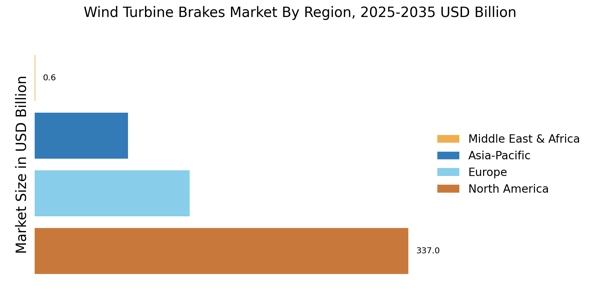
North America is witnessing robust growth in the wind turbine brakes market, driven by increasing investments in renewable energy and supportive government policies. The United States holds the largest market share at approximately 60%, followed by Canada with around 25%. Regulatory incentives, such as tax credits and renewable portfolio standards, are catalyzing demand for wind energy solutions. The competitive landscape is dominated by key players like GE Renewable Energy and Siemens Gamesa, which are leading the charge in innovation and technology. The U.S. is the primary market, with significant contributions from Canada, where local manufacturers are also emerging. The presence of established companies ensures a dynamic market environment, fostering advancements in wind turbine brake technologies.

Europe : Innovation and Sustainability Hub

Europe is a frontrunner in the wind turbine brakes market, driven by ambitious renewable energy targets and stringent environmental regulations. Germany and Denmark are the largest markets, holding approximately 35% and 20% of the market share, respectively. The European Union's Green Deal and national policies are pivotal in promoting wind energy, leading to increased investments and technological advancements in the sector. Leading countries like Germany, Denmark, and Spain are home to major players such as Vestas and Nordex. The competitive landscape is characterized by innovation, with companies focusing on enhancing the efficiency and reliability of wind turbine brakes. The presence of a well-established supply chain and skilled workforce further strengthens Europe's position in the global market.

Asia-Pacific : Emerging Market Potential

The Asia-Pacific region is rapidly emerging as a significant player in the wind turbine brakes market, driven by increasing energy demands and government initiatives promoting renewable energy. China is the largest market, accounting for approximately 50% of the total market share, followed by India with around 15%. Government policies, such as feed-in tariffs and renewable energy targets, are key drivers of market growth in this region. China's dominance is complemented by the presence of major manufacturers like Goldwind and Suzlon Energy. India is also witnessing a surge in wind energy projects, supported by favorable regulations and investments. The competitive landscape is evolving, with both local and international players striving to enhance their market presence through innovation and strategic partnerships.

Middle East and Africa : Untapped Renewable Resources

The Middle East and Africa region presents untapped potential in the wind turbine brakes market, driven by increasing awareness of renewable energy benefits and government initiatives. Countries like South Africa and Morocco are leading the way, with South Africa holding approximately 30% of the market share. The region's focus on diversifying energy sources is catalyzing investments in wind energy projects. South Africa's renewable energy program has attracted significant investments, while Morocco is making strides with its ambitious wind energy targets. The competitive landscape is characterized by a mix of local and international players, with opportunities for growth as governments seek to enhance energy security and sustainability. The presence of key players is gradually increasing, fostering a more competitive environment.

Wind Turbine Brakes Market Regional Image

Key Players and Competitive Insights

The Wind Turbine Brakes Market has been witnessing significant development and competitive dynamics due to the increasing demand for renewable energy sources and the growing investment in wind energy infrastructure. As the world shifts towards sustainable energy options, the need for efficient and reliable brake systems in wind turbines becomes paramount. This creates opportunities for various players in the market to innovate and enhance their product offerings. Companies are focusing on advanced technologies that improve braking performance, enhance safety, and optimize operational efficiency.

Competitive strategies involve not only technological advancements but also collaborations, partnerships, and mergers and acquisitions aimed at strengthening market presence and expanding their product lines.

Understanding the competitive landscape is essential for stakeholders looking to establish or expand their share in this evolving market. CurtissWright has established a robust presence in the Wind Turbine Brakes Market by offering a range of high-performance braking systems designed specifically for wind turbine applications. The company leverages its extensive experience in aerospace and defense industries to provide cutting-edge solutions that meet the stringent requirements of the wind energy sector. CurtissWright's strength lies in its commitment to quality and innovation, enabling it to develop products that enhance the reliability and efficiency of wind turbine operations.

With a strong emphasis on engineering excellence and customer support, CurtissWright has positioned itself as a trusted supplier in the market, effectively addressing the unique challenges posed by the dynamic environment of wind energy production. Schaeffler AG also plays a critical role in the Wind Turbine Brakes Market, leveraging its expertise in manufacturing high-quality mechanical components and systems.

Schaeffler AG significantly contributes to the optimization of wind turbine brake systems through its innovative engineering and advanced materials. The company focuses on delivering solutions that minimize maintenance needs and enhance the overall performance of wind turbines, providing a competitive edge in this rapidly growing sector. Its proven track record of reliability and performance in various industrial applications makes Schaeffler AG a preferred choice among wind turbine manufacturers.

By continually investing in research and development, Schaeffler AG seeks to expand its product offerings and maintain its standing as a leader in the wind turbine brakes market, responding effectively to the evolving demands for energy efficiency and performance.

Key Companies in the Wind Turbine Brakes Market market include

Industry Developments

  • Q2 2024: Siemens Gamesa launches new advanced wind turbine brake system for offshore platforms Siemens Gamesa announced the launch of its next-generation brake system designed specifically for large offshore wind turbines, featuring enhanced safety and reduced maintenance requirements. The new system is expected to be deployed in upcoming North Sea projects.
  • Q1 2024: Nordex secures major contract for supply of wind turbine brake systems in Brazil Nordex Group announced it has won a contract to supply and install advanced brake systems for a 400 MW wind farm project in Brazil, marking its largest single order for brake technology in Latin America to date.
  • Q2 2024: Altra Industrial Motion opens new wind turbine brake manufacturing facility in India Altra Industrial Motion inaugurated a new manufacturing plant in Pune, India, dedicated to producing wind turbine brake systems for the Asia-Pacific market, aiming to meet growing regional demand and reduce lead times.
  • Q1 2024: ZF Friedrichshafen AG acquires wind turbine brake specialist Svendborg Brakes ZF Friedrichshafen AG completed the acquisition of Svendborg Brakes, a leading supplier of wind turbine braking systems, to strengthen its portfolio in renewable energy components and expand its global footprint.
  • Q3 2024: Danfoss Power Solutions partners with Vestas to develop smart brake monitoring for wind turbines Danfoss Power Solutions and Vestas announced a strategic partnership to co-develop a digital brake monitoring system, aiming to improve predictive maintenance and reduce downtime for wind turbine operators.
  • Q2 2025: GE Vernova unveils modular brake retrofit kit for aging wind turbine fleets GE Vernova introduced a modular retrofit kit allowing operators to upgrade brake systems on older wind turbines, extending asset life and improving safety compliance with new regulatory standards.
  • Q1 2025: Siemens Energy wins contract to supply brake systems for UK offshore wind expansion Siemens Energy secured a contract to deliver advanced brake systems for a new 600 MW offshore wind project in the UK, supporting the country's renewable energy targets and grid stability.
  • Q4 2024: ABB launches digital twin platform for wind turbine brake system optimization ABB announced the launch of a digital twin software platform designed to simulate and optimize the performance of wind turbine brake systems, enabling predictive maintenance and reducing operational costs.
  • Q2 2024: Hydratech Industries secures multi-year supply agreement for hydraulic wind turbine brakes in China Hydratech Industries signed a multi-year agreement to supply hydraulic brake systems to a leading Chinese wind turbine manufacturer, supporting the rapid expansion of wind energy in the region.
  • Q3 2024: Knorr-Bremse enters wind energy sector with acquisition of wind turbine brake technology assets Knorr-Bremse, traditionally focused on rail and commercial vehicle braking, acquired key wind turbine brake technology assets to diversify its portfolio and enter the renewable energy market.
  • Q1 2025: Vestas appoints new Head of Wind Turbine Brake Systems Division Vestas announced the appointment of Dr. Anna Müller as the new Head of its Wind Turbine Brake Systems Division, signaling a renewed focus on innovation and safety in turbine braking technology.
  • Q4 2024: Siemens Gamesa receives regulatory approval for new wind turbine brake design in EU Siemens Gamesa obtained European regulatory approval for its latest wind turbine brake design, which incorporates advanced materials and digital monitoring for improved reliability and compliance.

Future Outlook

Wind Turbine Brakes Market Future Outlook

The Wind Turbine Brakes Market is projected to grow at a 4.4% CAGR from 2024 to 2035, driven by increasing renewable energy investments and technological advancements.

New opportunities lie in:

  • Development of advanced composite brake materials for enhanced performance
  • Integration of IoT for predictive maintenance solutions
  • Expansion into emerging markets with tailored braking systems

By 2035, the market is expected to achieve robust growth, reflecting evolving industry demands.

Market Segmentation

Wind Turbine Brakes Market Type Outlook

  • Mechanical Brakes
  • Hydraulic Brakes
  • Electromagnetic Brakes

Wind Turbine Brakes Market End Use Outlook

  • Utility Scale
  • Commercial
  • Residential

Wind Turbine Brakes Market Application Outlook

  • Onshore Wind Farms
  • Offshore Wind Farms
  • Small Wind Turbines

Wind Turbine Brakes Market Mode of Operation Outlook

  • Fail-Safe
  • Active Control
  • Passive Control

Report Scope

MARKET SIZE 2024561.66(USD Billion)
MARKET SIZE 2025586.37(USD Billion)
MARKET SIZE 2035901.94(USD Billion)
COMPOUND ANNUAL GROWTH RATE (CAGR)4.4% (2024 - 2035)
REPORT COVERAGERevenue Forecast, Competitive Landscape, Growth Factors, and Trends
BASE YEAR2024
Market Forecast Period2025 - 2035
Historical Data2019 - 2024
Market Forecast UnitsUSD Billion
Key Companies ProfiledMarket analysis in progress
Segments CoveredMarket segmentation analysis in progress
Key Market OpportunitiesIntegration of advanced materials and automation technologies enhances performance in the Wind Turbine Brakes Market.
Key Market DynamicsTechnological advancements in braking systems drive innovation and efficiency in the wind turbine brakes market.
Countries CoveredNorth America, Europe, APAC, South America, MEA

Market Highlights

Author
Chitranshi Jaiswal
Research Analyst Level I

In her 3 years of experience in the market research field, she has handled critical cross-domain projects. She has an in-depth knowledge of market estimation & analysis, problem-solving, primary as well as secondary research, and team management.She holds an engineering degree and is an MBA professional from a well-known university, capable of evaluating the market and competitive conditions. An exceptional strategist with excellent communication skills and a passion for delivering cutting-edge & practical insights for the market. Proficient in multi-tasking, and can successfully deal with competing demands, while maintaining complete confidentiality. Generated business through active client and project development, networking, and high-quality responses. Her knowledge and skills have helped in making solid business decisions, securing funding from investors, and avoiding business failures.

Leave a Comment

FAQs

What is the projected market valuation of the Wind Turbine Brakes Market by 2035?

The Wind Turbine Brakes Market is projected to reach a valuation of 901.94 USD Billion by 2035.

What was the overall market valuation of the Wind Turbine Brakes Market in 2024?

In 2024, the overall market valuation of the Wind Turbine Brakes Market was 561.66 USD Billion.

What is the expected CAGR for the Wind Turbine Brakes Market during the forecast period 2025 - 2035?

The expected CAGR for the Wind Turbine Brakes Market during the forecast period 2025 - 2035 is 4.4%.

Which companies are considered key players in the Wind Turbine Brakes Market?

Key players in the Wind Turbine Brakes Market include Siemens Gamesa, GE Renewable Energy, Nordex, and Vestas Wind Systems.

What are the main applications of wind turbine brakes in terms of market valuation?

The main applications include Onshore Wind Farms valued at 480.0 USD Billion, Offshore Wind Farms at 350.0 USD Billion, and Small Wind Turbines at 71.94 USD Billion.

How do the different types of brakes compare in terms of market valuation?

Mechanical Brakes lead with a valuation of 360.94 USD Billion, followed by Hydraulic Brakes at 300.0 USD Billion and Electromagnetic Brakes at 241.0 USD Billion.

What is the market valuation for the fail-safe mode of operation in wind turbine brakes?

The fail-safe mode of operation is valued at 360.94 USD Billion, indicating its prominence in the market.

What is the projected market size for residential wind turbine brakes by 2035?

The projected market size for residential wind turbine brakes is expected to reach 241.0 USD Billion by 2035.

How does the market for commercial wind turbine brakes compare to utility scale brakes?

The commercial segment is projected at 300.0 USD Billion, while the utility scale segment is expected to reach 360.94 USD Billion.

What trends are influencing the growth of the Wind Turbine Brakes Market?

Trends such as increasing investments in renewable energy and advancements in braking technology are likely influencing the growth of the Wind Turbine Brakes Market.

Download Free Sample

Kindly complete the form below to receive a free sample of this Report

Compare Licence

×
Features License Type
Single User Multiuser License Enterprise User
Price $4,950 $5,950 $7,250
Maximum User Access Limit 1 User Upto 10 Users Unrestricted Access Throughout the Organization
Free Customization
Direct Access to Analyst
Deliverable Format
Platform Access
Discount on Next Purchase 10% 15% 15%
Printable Versions