Request Free Sample ×

Kindly complete the form below to receive a free sample of this Report

* Please use a valid business email

Leading companies partner with us for data-driven Insights

clients tt-cursor
Hero Background
English
Chinese
French
Japanese
Korean
German
Spanish

Lingerie Market Size

ID: MRFR/CG/7016-CR
90 Pages
Snehal Singh
February 2021

Lingerie Market Size, Share, Industry Trend & Analysis Research Report Information By Product Type (Briefs, Bras, and Shapewear), By Price Range (Economy, And Premium), By Distribution Channel (Store-Based and Non-Store-Based), And By Region (North America, Europe, Asia-Pacific, And Rest Of The World) – Forecast Till 2030

Share:
Download PDF ×

We do not share your information with anyone. However, we may send you emails based on your report interest from time to time. You may contact us at any time to opt-out.

Lingerie Market Infographic
Purchase Options

Lingerie Size

Lingerie Market Growth Projections and Opportunities

The global lingerie market has been on the rise, and it's estimated to reach a substantial USD 123.33 billion by the year 2028. This growth is expected to happen at a rate of around 4.52% from 2021 to 2028. Several key factors contribute to this upward trend. Firstly, the increasing number of women in the workforce is playing a significant role. As more women take up employment, there's a higher demand for lingerie, which is contributing to market growth. Additionally, the apparel industry is evolving, with constant innovations in lingerie designs, adding to the overall expansion of the market. Moreover, the influence of social media and innovative marketing strategies is proving to be a game-changer. Social media platforms like Facebook, Instagram, Twitter, and YouTube are providing opportunities for product launches and brand building. Blogs and content related to clothing styles and intimate wear on these platforms are actively boosting lingerie sales. Manufacturers are leveraging social media not only to promote their brands but also to establish direct connections with consumers. The continuous flow of information, advice, and exclusive offers through these platforms helps in creating a strong bond between brands and customers. The organized retail sector's growth in the Asia-Pacific region is another significant factor propelling the global lingerie market. The increasing presence of organized retail offers more visibility and accessibility for lingerie brands, thus expanding their reach and sales opportunities. Despite these positive trends, challenges persist, particularly in the form of the unorganized sector. The presence of an unorganized sector in the lingerie market can hinder its overall growth. This unorganized segment might lack the standards and regulations that organized sectors adhere to, potentially affecting product quality, customer satisfaction, and overall market performance. In conclusion, while the global lingerie market is witnessing substantial growth driven by factors like the increasing working women population, innovative product designs, and the influence of social media, challenges from the unorganized sector could pose obstacles. The industry players need to navigate these dynamics strategically to capitalize on the opportunities and sustain growth in the evolving lingerie market landscape.

Lingerie Market Size Graph
Author
Author Profile
Snehal Singh
Manager - Research

High acumen in analyzing complex macro & micro markets with more than 6 years of work experience in the field of market research. By implementing her analytical skills in forecasting and estimation into market research reports, she has expertise in Packaging, Construction, and Equipment domains. She handles a team size of 20-25 resources and ensures smooth running of the projects, associated marketing activities, and client servicing.

Leave a Comment

FAQs

What is the current valuation of the lingerie market as of 2024?

<p>The lingerie market was valued at 108.35 USD Billion in 2024.</p>

What is the projected market valuation for the lingerie industry in 2035?

<p>The lingerie market is projected to reach 176.2 USD Billion by 2035.</p>

What is the expected CAGR for the lingerie market from 2025 to 2035?

<p>The expected CAGR for the lingerie market during the forecast period 2025 - 2035 is 4.52%.</p>

Which segments of the lingerie market are expected to perform well?

<p>The segments of the lingerie market include Bras, Briefs, and Shapewear, with Bras valued at 50.0 to 80.0 USD Billion.</p>

How do the price ranges of lingerie products affect market performance?

<p>The lingerie market is divided into Economy and Premium price ranges, with Economy valued at 54.98 to 88.11 USD Billion.</p>

What distribution channels are prevalent in the lingerie market?

<p>The lingerie market features Store-Based distribution valued at 70.0 to 110.0 USD Billion and Non-Store-Based at 38.35 to 66.2 USD Billion.</p>

Who are the key players in the lingerie market?

Key players in the lingerie market include Victoria's Secret, H&amp;M, Calvin Klein, and Savage X Fenty.

What trends are influencing the lingerie market in 2025?

<p>Trends influencing the lingerie market in 2025 include a growing preference for premium products and online shopping.</p>

How does the performance of shapewear compare to other lingerie segments?

<p>Shapewear is valued between 33.35 and 56.2 USD Billion, indicating a strong presence in the lingerie market.</p>

What factors contribute to the growth of the lingerie market?

<p>Factors contributing to the growth of the lingerie market include increasing consumer awareness and evolving fashion trends.</p>

Market Summary

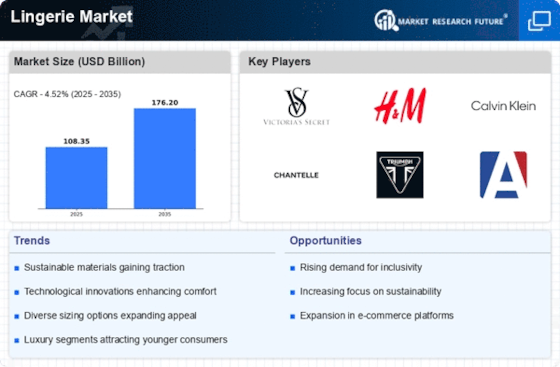
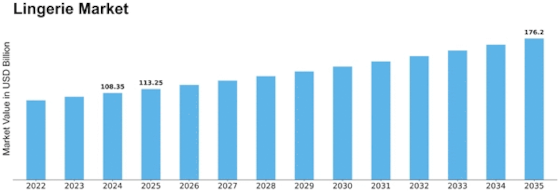
As per Market Research Future analysis, the Lingerie Market Size was estimated at 108.35 USD Billion in 2024. The lingerie industry is projected to grow from 113.25 USD Billion in 2025 to 176.2 USD Billion by 2035, exhibiting a compound annual growth rate (CAGR) of 4.52% during the forecast period 2025 - 2035

Key Market Trends & Highlights

The lingerie market is experiencing a dynamic shift towards inclusivity and sustainability, driven by evolving consumer preferences.

  • The North American lingerie market remains the largest, characterized by a strong demand for diverse sizing and styles. In the Asia-Pacific region, the lingerie market is the fastest-growing, fueled by increasing disposable incomes and changing fashion trends. Bras continue to dominate the market as the largest segment, while shapewear is emerging as the fastest-growing category among consumers. Technological advancements in fabrication and a focus on health and wellness are key drivers influencing the lingerie market's evolution.

Market Size & Forecast

2024 Market Size 108.35 (USD Billion)
2035 Market Size 176.2 (USD Billion)
CAGR (2025 - 2035) 4.52%
Largest Regional Market Share in 2024 Asia Pacific

Major Players

Victoria's Secret (US), H&amp;M (SE), <a href="https://stores.calvinklein.us/">Calvin Klein (US)</a>, Chantelle (FR), Triumph (DE), Aerie (US), Savage X Fenty (US), Lise Charmel (FR), Wacoal (JP), Boux Avenue (GB)

Market Trends

The Lingerie Market is currently experiencing a dynamic evolution, characterized by shifting consumer preferences and an increasing emphasis on comfort and inclusivity. As individuals become more discerning about their choices, brands are responding by offering a diverse range of products and types of lingerie that cater to various body types and personal styles. This trend towards body positivity is reshaping the landscape, encouraging companies to adopt more inclusive sizing and marketing strategies. Furthermore, the rise of e-commerce has transformed how consumers engage with lingerie, allowing for greater accessibility and convenience in purchasing decisions.

In addition to inclusivity, sustainability is emerging as a pivotal factor influencing the Lingerie Market. Consumers are increasingly aware of the environmental impact of their purchases, prompting brands to explore eco-friendly materials and ethical production practices in woman's lingerie manufacturing. This shift not only aligns with broader societal values but also presents an opportunity for companies to differentiate themselves in a crowded marketplace. As the Lingerie Market continues to evolve, it appears poised for further growth, driven by innovation and a commitment to meeting the diverse needs of modern consumers.

Inclusivity and Body Positivity

The Lingerie Market is witnessing a notable shift towards inclusivity, with brands expanding their size ranges and promoting body positivity. This trend reflects a growing recognition of diverse body types, encouraging consumers to embrace their individuality. Companies are increasingly adopting marketing strategies that celebrate all shapes and sizes, fostering a sense of belonging among customers.

Sustainability Initiatives

Sustainability is becoming a crucial consideration within the Lingerie Market, as consumers demand eco-friendly options. Brands are exploring sustainable materials and ethical production methods to reduce their environmental footprint. This focus on sustainability not only resonates with environmentally conscious shoppers but also enhances brand loyalty.

E-commerce Growth

The rise of e-commerce is significantly impacting the Lingerie Market, providing consumers with greater access to a wide array of products. Online shopping offers convenience and privacy, allowing individuals to explore various styles and brands from the comfort of their homes. This trend is likely to continue shaping consumer behavior and purchasing patterns.

Lingerie Market Market Drivers

Focus on Health and Wellness

The Lingerie Market is increasingly aligning itself with the broader health and wellness trend. Consumers are becoming more health-conscious, seeking lingerie that offers both comfort and support. This has led to a rise in demand for products that promote body positivity and well-being, such as bras with ergonomic designs and materials that provide adequate support without compromising comfort. Market data shows that sales of wellness-oriented lingerie have increased, reflecting a growing awareness of the importance of health in everyday apparel choices. This focus on health and wellness is likely to continue shaping the Lingerie Market in the coming years.

Rise of E-commerce Platforms

The Lingerie Market is significantly benefiting from the rise of e-commerce platforms. With the convenience of online shopping, consumers are increasingly turning to digital channels for their lingerie purchases. Data indicates that online sales in the lingerie sector have grown by approximately 25% annually, driven by the proliferation of mobile shopping and social media marketing. This trend allows brands to reach a broader audience and engage with consumers through targeted advertising. Furthermore, the ability to offer personalized shopping experiences online is enhancing customer satisfaction, which is crucial for brand loyalty in the Lingerie Market.

Changing Consumer Preferences

The Lingerie Market is witnessing a shift in consumer preferences, particularly among younger demographics. Millennials and Generation Z are increasingly favoring brands that align with their values, such as sustainability and inclusivity. This shift is reflected in the rising popularity of bralettes and loungewear-inspired lingerie, which prioritize comfort over traditional aesthetics. Market data suggests that the demand for such products has surged, with sales of bralettes increasing by over 30% in recent years. This evolution in consumer taste is prompting brands to adapt their offerings, thereby influencing the overall landscape of the Lingerie Market.

Influence of Celebrity Endorsements

The Lingerie Market is notably influenced by celebrity endorsements and collaborations. High-profile figures and influencers are increasingly promoting lingerie brands, which can significantly impact consumer purchasing decisions. This trend is particularly evident on social media platforms, where influencers showcase their favorite lingerie pieces, creating a sense of aspiration among followers. Market analysis suggests that brands leveraging celebrity partnerships experience a notable increase in brand visibility and sales. This dynamic indicates that the Lingerie Market is not only driven by product quality but also by the cultural relevance and desirability created through celebrity influence.

Technological Advancements in Fabrication

The Lingerie Market is experiencing a notable transformation due to advancements in textile technology. Innovations such as moisture-wicking fabrics, seamless construction, and 3D knitting techniques are enhancing comfort and fit. These developments not only improve the wearability of lingerie but also cater to the increasing demand for performance-oriented products. As consumers become more discerning, brands that leverage these technologies are likely to gain a competitive edge. The integration of smart textiles, which can monitor body temperature and provide support, is also emerging. This trend indicates a shift towards functional lingerie that meets the needs of modern consumers, thereby driving growth in the Lingerie Market.

Market Segment Insights

By Type: Bras (Largest) vs. Shapewear (Fastest-Growing)

The Lingerie Market's 'Type' segment showcases a diverse array of products, with bras holding the largest market share among the different categories. As a staple in women’s fashion, bras have secured a strong consumer preference that translates into robust sales. Briefs follow, positioning themselves as a significant contributor to the segment, while <a href="https://www.marketresearchfuture.com/reports/shapewear-market-7273">shapewear </a>has rapidly gained traction, appealing to modern consumers seeking comfort and support under their outfits. Growth trends reveal that the shapewear market is the fastest-growing segment, driven by a rising demand for inclusive sizing and body-positive products. The ongoing evolution of fashion trends that prioritize both style and functionality also contributes to the expanding appeal of shapewear. As consumers continue to prioritize comfort along with aesthetic appeal, the lingerie market is poised for sustained growth in these areas.

Bras: Dominant vs. Shapewear: Emerging

Bras are established as the dominant category within the lingerie market, characterized by a wide range of designs catering to various preferences and body types. With innovations in fit and comfort, brands are continuously adapting to meet evolving consumer demands. Conversely, shapewear represents an emerging category that is redefining traditional lingerie perceptions. As women increasingly seek solutions that enhance their body shape while providing comfort, shapewear has become a critical player in the market. Brands are responding by introducing versatile, stylish options that encourage consumers to wear shapewear as everyday essentials, paralleling the growth of body inclusivity movements.

By Price Range: Economy (Largest) vs. Premium (Fastest-Growing)

The lingerie market showcases a diverse range of price segments, with the Economy segment currently holding the largest share. This segment appeals primarily to cost-conscious consumers seeking affordable options without compromising on basic quality. Retailers within this segment emphasize volume sales over premium features, thus driving the majority of market activity. In contrast, the Premium segment, although smaller, is rapidly gaining traction, especially among younger consumers who favor high-quality materials and unique designs, reflecting a shift towards more luxurious lingerie products.

Lingerie Market: Economy (Dominant) vs. Premium (Emerging)

The Economy segment is characterized by its focus on affordability, attracting a large customer base willing to purchase basic lingerie items en masse. The emphasis here lies on functionality and accessibility, with many brands leveraging mass production to keep costs down. Conversely, the Premium segment emerges as a reaction to increasing consumer demand for luxury, quality, and niche products. Brands in this segment often invest in superior materials and craftsmanship, appealing to consumers' desires for exclusivity and status. This segment's appeal is heightened by social media marketing and influencer collaborations that emphasize lifestyle and fashion trends.

By Distribution Channel: Store-Based (Largest) vs. Non-Store-Based (Fastest-Growing)

The lingerie market exhibits a diverse landscape when viewed through the lens of distribution channels. Store-Based channels currently dominate the market, leveraging physical touchpoints that facilitate customer experience and immediate purchase decisions. <a href="https://www.marketresearchfuture.com/reports/retail-industry-in-market-34684">Retail</a> chains and specialty lingerie boutiques continue to attract consumers through personalized service and the ability to physically examine products, which holds significant sway in the lingerie shopping experience. On the other hand, Non-Store-Based channels, such as online platforms, showcase significant growth potential, especially as consumer preferences shift towards convenience and the ease of online shopping.

Store-Based (Dominant) vs. Non-Store-Based (Emerging)

Store-Based distribution remains a dominant force in the lingerie market, characterized by established retail outlets that provide customers with tactile shopping experiences. This segment thrives on offering personalized services and curated collections that appeal to diverse consumer preferences. Conversely, Non-Store-Based channels define an emerging trend in the marketplace, rapidly gaining traction, particularly among younger consumers who prioritize convenience and digital experiences. These channels are characterized by innovative online strategies that often include extensive product offerings and home delivery options, thereby reshaping customer engagement and buying behaviors. As shopping habits evolve, both distribution channels will play essential roles in shaping the future of the lingerie market.

Get more detailed insights about Lingerie Market Research Report—Global Forecast till 2035

Regional Insights

By region, the study provides market insights into North America, Europe, Asia-Pacific and the Rest of the World. The Asia-Pacific Lingerie Market accounted for USD 41 billion in 2021 and is expected to exhibit a significant CAGR growth during the study period. The main elements influencing product demand include an increased understanding of ideal fits as usage, changes in working millennials' lifestyles, rising income to invest in the best products available, and an obsession with maintaining a well-groomed appearance.

Further, the major countries studied in the market report are The U.S, Canada, Germany, France, UK, Italy, Spain, China, Japan, India, Australia, South Korea, and Brazil.

The North America Lingerie Market is expected to grow at the fastest CAGR from 2024 to 2030. The existence of smart consumers and the high demand for upscale and luxury brands are the two main factors driving the industry. For every shape and size, businesses are emphasizing designs and quality. Moreover, UK Lingerie Market held the largest market share, and the Canada Lingerie Market was the fastest-growing market in the Asia-Pacific region.

Europe's Lingerie Market accounts for the second-largest market share. Important businesses and the robust demand for expensive and exquisite goods propel the industry. For every form and size, businesses are emphasizing design and quality. Further, the Germany Lingerie Market held the largest market share, and the UK Lingerie Market was the fastest-growing market in the European region.

Key Players and Competitive Insights

Major industry players are investing a lot of money in R&D to expand their product offerings, which will spur further growth in the lingerie industry. With market development changes like new product releases, contractual agreements, mergers and acquisitions, increased investments, and collaboration with other organizations, market participants are also undertaking various strategic activities to expand their presence. To grow and thrive in an atmosphere where competition is fierce and the market is growing, lingerie companies must offer affordable products.
Manufacturing locally to cut operational costs is one of the manufacturers' main business methods in the lingerie industry to benefit customers and develop the market sector. The lingerie industry has provided some of the most significant benefits in recent years. The lingerie market major player such as Victoria's Secret, Triumph International (India), and others are working on expanding the market demand by investing in research and development activities.
An American lingerie, apparel, and cosmetics business called Victoria's Secret are renowned for its very visible marketing and branding strategies. These begin with a well-known catalog and continue with an annual fashion show featuring supermodels known as Angels.
In August Elomi, a new underwear line by Victoria's Secret & Co. The company plans to provide more than 100 sizes and have creative, colorful, and perfectly sized products. Therefore, it is anticipated that all of the factors above will fuel the lingerie market's expansion.
Also, Triumph International is a producer of undergarments in Switzerland. Along with the Triumph brand, the business also manufactures and sells goods under sloggi and AMO's Style by Triumph.
In May At the 12th Annual Triumph Fashion Show, Triumph International (India), one of the top lingerie manufacturers in the world, showed its 2022 collection for brands "Triumph," "Triaction," and their sister brand "sloggi," the most comfortable innerwear brand in the world..

Key Companies in the Lingerie Market include

Industry Developments

November 2022: Adore Me Inc., an intimate brand with a strong web presence, was announced as fully acquired by Victoria's Secret & Co. The acquisition's goal is to broaden the retailer's online and offline customer base for lingerie and beauty products.

May 2022: To improve the shopping experience, MAS Holdings collaborated with ByondXR, a well-known digital retail store platform, to develop virtual showrooms. Through this partnership, MAS can present its newest collections to major international companies in online showrooms.

Future Outlook

Lingerie Market Future Outlook

The Lingerie Market is projected to grow at a 4.52% CAGR from 2025 to 2035, driven by evolving consumer preferences, technological advancements, and increased online retailing.

New opportunities lie in:

  • <p>Expansion of eco-friendly lingerie lines targeting sustainability-conscious consumers. Development of personalized lingerie fitting technologies using AI and AR. Strategic partnerships with e-commerce platforms to enhance distribution channels.</p>

By 2035, the lingerie market is expected to achieve robust growth, reflecting evolving consumer demands and innovative strategies.

Market Segmentation

Lingerie Market Type Outlook

  • Briefs
  • Bras
  • Shapewear

Lingerie Market Price Range Outlook

  • Economy
  • Premium

Lingerie Market Distribution Channel Outlook

  • Store-Based
  • Non-Store-Based

Report Scope

MARKET SIZE 2024 108.35(USD Billion)
MARKET SIZE 2025 113.25(USD Billion)
MARKET SIZE 2035 176.2(USD Billion)
COMPOUND ANNUAL GROWTH RATE (CAGR) 4.52% (2025 - 2035)
REPORT COVERAGE Revenue Forecast, Competitive Landscape, Growth Factors, and Trends
BASE YEAR 2024
Market Forecast Period 2025 - 2035
Historical Data 2019 - 2024
Market Forecast Units USD Billion
Key Companies Profiled Victoria's Secret (US), H&M (SE), Calvin Klein (US), Chantelle (FR), Triumph (DE), Aerie (US), Savage X Fenty (US), Lise Charmel (FR), Wacoal (JP), Boux Avenue (GB)
Segments Covered Product Type, Price Range, Distribution Channel, Region
Key Market Opportunities Integration of sustainable materials and smart textiles in the Lingerie Market.
Key Market Dynamics Shifting consumer preferences towards sustainable materials drive innovation and competition in the lingerie market.
Countries Covered North America, Europe, APAC, South America, MEA

FAQs

What is the current valuation of the lingerie market as of 2024?

<p>The lingerie market was valued at 108.35 USD Billion in 2024.</p>

What is the projected market valuation for the lingerie industry in 2035?

<p>The lingerie market is projected to reach 176.2 USD Billion by 2035.</p>

What is the expected CAGR for the lingerie market from 2025 to 2035?

<p>The expected CAGR for the lingerie market during the forecast period 2025 - 2035 is 4.52%.</p>

Which segments of the lingerie market are expected to perform well?

<p>The segments of the lingerie market include Bras, Briefs, and Shapewear, with Bras valued at 50.0 to 80.0 USD Billion.</p>

How do the price ranges of lingerie products affect market performance?

<p>The lingerie market is divided into Economy and Premium price ranges, with Economy valued at 54.98 to 88.11 USD Billion.</p>

What distribution channels are prevalent in the lingerie market?

<p>The lingerie market features Store-Based distribution valued at 70.0 to 110.0 USD Billion and Non-Store-Based at 38.35 to 66.2 USD Billion.</p>

Who are the key players in the lingerie market?

Key players in the lingerie market include Victoria's Secret, H&amp;M, Calvin Klein, and Savage X Fenty.

What trends are influencing the lingerie market in 2025?

<p>Trends influencing the lingerie market in 2025 include a growing preference for premium products and online shopping.</p>

How does the performance of shapewear compare to other lingerie segments?

<p>Shapewear is valued between 33.35 and 56.2 USD Billion, indicating a strong presence in the lingerie market.</p>

What factors contribute to the growth of the lingerie market?

<p>Factors contributing to the growth of the lingerie market include increasing consumer awareness and evolving fashion trends.</p>

  1. SECTION I: EXECUTIVE SUMMARY AND KEY HIGHLIGHTS
    1. | 1.1 EXECUTIVE SUMMARY
    2. | | 1.1.1 Market Overview
    3. | | 1.1.2 Key Findings
    4. | | 1.1.3 Market Segmentation
    5. | | 1.1.4 Competitive Landscape
    6. | | 1.1.5 Challenges and Opportunities
    7. | | 1.1.6 Future Outlook
  2. SECTION II: SCOPING, METHODOLOGY AND MARKET STRUCTURE
    1. | 2.1 MARKET INTRODUCTION
    2. | | 2.1.1 Definition
    3. | | 2.1.2 Scope of the study
    4. | | | 2.1.2.1 Research Objective
    5. | | | 2.1.2.2 Assumption
    6. | | | 2.1.2.3 Limitations
    7. | 2.2 RESEARCH METHODOLOGY
    8. | | 2.2.1 Overview
    9. | | 2.2.2 Data Mining
    10. | | 2.2.3 Secondary Research
    11. | | 2.2.4 Primary Research
    12. | | | 2.2.4.1 Primary Interviews and Information Gathering Process
    13. | | | 2.2.4.2 Breakdown of Primary Respondents
    14. | | 2.2.5 Forecasting Model
    15. | | 2.2.6 Market Size Estimation
    16. | | | 2.2.6.1 Bottom-Up Approach
    17. | | | 2.2.6.2 Top-Down Approach
    18. | | 2.2.7 Data Triangulation
    19. | | 2.2.8 Validation
  3. SECTION III: QUALITATIVE ANALYSIS
    1. | 3.1 MARKET DYNAMICS
    2. | | 3.1.1 Overview
    3. | | 3.1.2 Drivers
    4. | | 3.1.3 Restraints
    5. | | 3.1.4 Opportunities
    6. | 3.2 MARKET FACTOR ANALYSIS
    7. | | 3.2.1 Value chain Analysis
    8. | | 3.2.2 Porter's Five Forces Analysis
    9. | | | 3.2.2.1 Bargaining Power of Suppliers
    10. | | | 3.2.2.2 Bargaining Power of Buyers
    11. | | | 3.2.2.3 Threat of New Entrants
    12. | | | 3.2.2.4 Threat of Substitutes
    13. | | | 3.2.2.5 Intensity of Rivalry
    14. | | 3.2.3 COVID-19 Impact Analysis
    15. | | | 3.2.3.1 Market Impact Analysis
    16. | | | 3.2.3.2 Regional Impact
    17. | | | 3.2.3.3 Opportunity and Threat Analysis
  4. SECTION IV: QUANTITATIVE ANALYSIS
    1. | 4.1 Consumer and Retail, BY Type (USD Billion)
    2. | | 4.1.1 Briefs
    3. | | 4.1.2 Bras
    4. | | 4.1.3 Shapewear
    5. | 4.2 Consumer and Retail, BY Price Range (USD Billion)
    6. | | 4.2.1 Economy
    7. | | 4.2.2 Premium
    8. | 4.3 Consumer and Retail, BY Distribution Channel (USD Billion)
    9. | | 4.3.1 Store-Based
    10. | | 4.3.2 Non-Store-Based
    11. | 4.4 Consumer and Retail, BY Region (USD Billion)
    12. | | 4.4.1 North America
    13. | | | 4.4.1.1 US
    14. | | | 4.4.1.2 Canada
    15. | | 4.4.2 Europe
    16. | | | 4.4.2.1 Germany
    17. | | | 4.4.2.2 UK
    18. | | | 4.4.2.3 France
    19. | | | 4.4.2.4 Russia
    20. | | | 4.4.2.5 Italy
    21. | | | 4.4.2.6 Spain
    22. | | | 4.4.2.7 Rest of Europe
    23. | | 4.4.3 APAC
    24. | | | 4.4.3.1 China
    25. | | | 4.4.3.2 India
    26. | | | 4.4.3.3 Japan
    27. | | | 4.4.3.4 South Korea
    28. | | | 4.4.3.5 Malaysia
    29. | | | 4.4.3.6 Thailand
    30. | | | 4.4.3.7 Indonesia
    31. | | | 4.4.3.8 Rest of APAC
    32. | | 4.4.4 South America
    33. | | | 4.4.4.1 Brazil
    34. | | | 4.4.4.2 Mexico
    35. | | | 4.4.4.3 Argentina
    36. | | | 4.4.4.4 Rest of South America
    37. | | 4.4.5 MEA
    38. | | | 4.4.5.1 GCC Countries
    39. | | | 4.4.5.2 South Africa
    40. | | | 4.4.5.3 Rest of MEA
  5. SECTION V: COMPETITIVE ANALYSIS
    1. | 5.1 Competitive Landscape
    2. | | 5.1.1 Overview
    3. | | 5.1.2 Competitive Analysis
    4. | | 5.1.3 Market share Analysis
    5. | | 5.1.4 Major Growth Strategy in the Consumer and Retail
    6. | | 5.1.5 Competitive Benchmarking
    7. | | 5.1.6 Leading Players in Terms of Number of Developments in the Consumer and Retail
    8. | | 5.1.7 Key developments and growth strategies
    9. | | | 5.1.7.1 New Product Launch/Service Deployment
    10. | | | 5.1.7.2 Merger & Acquisitions
    11. | | | 5.1.7.3 Joint Ventures
    12. | | 5.1.8 Major Players Financial Matrix
    13. | | | 5.1.8.1 Sales and Operating Income
    14. | | | 5.1.8.2 Major Players R&D Expenditure. 2023
    15. | 5.2 Company Profiles
    16. | | 5.2.1 Victoria's Secret (US)
    17. | | | 5.2.1.1 Financial Overview
    18. | | | 5.2.1.2 Products Offered
    19. | | | 5.2.1.3 Key Developments
    20. | | | 5.2.1.4 SWOT Analysis
    21. | | | 5.2.1.5 Key Strategies
    22. | | 5.2.2 H&M (SE)
    23. | | | 5.2.2.1 Financial Overview
    24. | | | 5.2.2.2 Products Offered
    25. | | | 5.2.2.3 Key Developments
    26. | | | 5.2.2.4 SWOT Analysis
    27. | | | 5.2.2.5 Key Strategies
    28. | | 5.2.3 Calvin Klein (US)
    29. | | | 5.2.3.1 Financial Overview
    30. | | | 5.2.3.2 Products Offered
    31. | | | 5.2.3.3 Key Developments
    32. | | | 5.2.3.4 SWOT Analysis
    33. | | | 5.2.3.5 Key Strategies
    34. | | 5.2.4 Chantelle (FR)
    35. | | | 5.2.4.1 Financial Overview
    36. | | | 5.2.4.2 Products Offered
    37. | | | 5.2.4.3 Key Developments
    38. | | | 5.2.4.4 SWOT Analysis
    39. | | | 5.2.4.5 Key Strategies
    40. | | 5.2.5 Triumph (DE)
    41. | | | 5.2.5.1 Financial Overview
    42. | | | 5.2.5.2 Products Offered
    43. | | | 5.2.5.3 Key Developments
    44. | | | 5.2.5.4 SWOT Analysis
    45. | | | 5.2.5.5 Key Strategies
    46. | | 5.2.6 Aerie (US)
    47. | | | 5.2.6.1 Financial Overview
    48. | | | 5.2.6.2 Products Offered
    49. | | | 5.2.6.3 Key Developments
    50. | | | 5.2.6.4 SWOT Analysis
    51. | | | 5.2.6.5 Key Strategies
    52. | | 5.2.7 Savage X Fenty (US)
    53. | | | 5.2.7.1 Financial Overview
    54. | | | 5.2.7.2 Products Offered
    55. | | | 5.2.7.3 Key Developments
    56. | | | 5.2.7.4 SWOT Analysis
    57. | | | 5.2.7.5 Key Strategies
    58. | | 5.2.8 Lise Charmel (FR)
    59. | | | 5.2.8.1 Financial Overview
    60. | | | 5.2.8.2 Products Offered
    61. | | | 5.2.8.3 Key Developments
    62. | | | 5.2.8.4 SWOT Analysis
    63. | | | 5.2.8.5 Key Strategies
    64. | | 5.2.9 Wacoal (JP)
    65. | | | 5.2.9.1 Financial Overview
    66. | | | 5.2.9.2 Products Offered
    67. | | | 5.2.9.3 Key Developments
    68. | | | 5.2.9.4 SWOT Analysis
    69. | | | 5.2.9.5 Key Strategies
    70. | | 5.2.10 Boux Avenue (GB)
    71. | | | 5.2.10.1 Financial Overview
    72. | | | 5.2.10.2 Products Offered
    73. | | | 5.2.10.3 Key Developments
    74. | | | 5.2.10.4 SWOT Analysis
    75. | | | 5.2.10.5 Key Strategies
    76. | 5.3 Appendix
    77. | | 5.3.1 References
    78. | | 5.3.2 Related Reports
  6. LIST OF FIGURES
    1. | 6.1 MARKET SYNOPSIS
    2. | 6.2 NORTH AMERICA MARKET ANALYSIS
    3. | 6.3 US MARKET ANALYSIS BY TYPE
    4. | 6.4 US MARKET ANALYSIS BY PRICE RANGE
    5. | 6.5 US MARKET ANALYSIS BY DISTRIBUTION CHANNEL
    6. | 6.6 CANADA MARKET ANALYSIS BY TYPE
    7. | 6.7 CANADA MARKET ANALYSIS BY PRICE RANGE
    8. | 6.8 CANADA MARKET ANALYSIS BY DISTRIBUTION CHANNEL
    9. | 6.9 EUROPE MARKET ANALYSIS
    10. | 6.10 GERMANY MARKET ANALYSIS BY TYPE
    11. | 6.11 GERMANY MARKET ANALYSIS BY PRICE RANGE
    12. | 6.12 GERMANY MARKET ANALYSIS BY DISTRIBUTION CHANNEL
    13. | 6.13 UK MARKET ANALYSIS BY TYPE
    14. | 6.14 UK MARKET ANALYSIS BY PRICE RANGE
    15. | 6.15 UK MARKET ANALYSIS BY DISTRIBUTION CHANNEL
    16. | 6.16 FRANCE MARKET ANALYSIS BY TYPE
    17. | 6.17 FRANCE MARKET ANALYSIS BY PRICE RANGE
    18. | 6.18 FRANCE MARKET ANALYSIS BY DISTRIBUTION CHANNEL
    19. | 6.19 RUSSIA MARKET ANALYSIS BY TYPE
    20. | 6.20 RUSSIA MARKET ANALYSIS BY PRICE RANGE
    21. | 6.21 RUSSIA MARKET ANALYSIS BY DISTRIBUTION CHANNEL
    22. | 6.22 ITALY MARKET ANALYSIS BY TYPE
    23. | 6.23 ITALY MARKET ANALYSIS BY PRICE RANGE
    24. | 6.24 ITALY MARKET ANALYSIS BY DISTRIBUTION CHANNEL
    25. | 6.25 SPAIN MARKET ANALYSIS BY TYPE
    26. | 6.26 SPAIN MARKET ANALYSIS BY PRICE RANGE
    27. | 6.27 SPAIN MARKET ANALYSIS BY DISTRIBUTION CHANNEL
    28. | 6.28 REST OF EUROPE MARKET ANALYSIS BY TYPE
    29. | 6.29 REST OF EUROPE MARKET ANALYSIS BY PRICE RANGE
    30. | 6.30 REST OF EUROPE MARKET ANALYSIS BY DISTRIBUTION CHANNEL
    31. | 6.31 APAC MARKET ANALYSIS
    32. | 6.32 CHINA MARKET ANALYSIS BY TYPE
    33. | 6.33 CHINA MARKET ANALYSIS BY PRICE RANGE
    34. | 6.34 CHINA MARKET ANALYSIS BY DISTRIBUTION CHANNEL
    35. | 6.35 INDIA MARKET ANALYSIS BY TYPE
    36. | 6.36 INDIA MARKET ANALYSIS BY PRICE RANGE
    37. | 6.37 INDIA MARKET ANALYSIS BY DISTRIBUTION CHANNEL
    38. | 6.38 JAPAN MARKET ANALYSIS BY TYPE
    39. | 6.39 JAPAN MARKET ANALYSIS BY PRICE RANGE
    40. | 6.40 JAPAN MARKET ANALYSIS BY DISTRIBUTION CHANNEL
    41. | 6.41 SOUTH KOREA MARKET ANALYSIS BY TYPE
    42. | 6.42 SOUTH KOREA MARKET ANALYSIS BY PRICE RANGE
    43. | 6.43 SOUTH KOREA MARKET ANALYSIS BY DISTRIBUTION CHANNEL
    44. | 6.44 MALAYSIA MARKET ANALYSIS BY TYPE
    45. | 6.45 MALAYSIA MARKET ANALYSIS BY PRICE RANGE
    46. | 6.46 MALAYSIA MARKET ANALYSIS BY DISTRIBUTION CHANNEL
    47. | 6.47 THAILAND MARKET ANALYSIS BY TYPE
    48. | 6.48 THAILAND MARKET ANALYSIS BY PRICE RANGE
    49. | 6.49 THAILAND MARKET ANALYSIS BY DISTRIBUTION CHANNEL
    50. | 6.50 INDONESIA MARKET ANALYSIS BY TYPE
    51. | 6.51 INDONESIA MARKET ANALYSIS BY PRICE RANGE
    52. | 6.52 INDONESIA MARKET ANALYSIS BY DISTRIBUTION CHANNEL
    53. | 6.53 REST OF APAC MARKET ANALYSIS BY TYPE
    54. | 6.54 REST OF APAC MARKET ANALYSIS BY PRICE RANGE
    55. | 6.55 REST OF APAC MARKET ANALYSIS BY DISTRIBUTION CHANNEL
    56. | 6.56 SOUTH AMERICA MARKET ANALYSIS
    57. | 6.57 BRAZIL MARKET ANALYSIS BY TYPE
    58. | 6.58 BRAZIL MARKET ANALYSIS BY PRICE RANGE
    59. | 6.59 BRAZIL MARKET ANALYSIS BY DISTRIBUTION CHANNEL
    60. | 6.60 MEXICO MARKET ANALYSIS BY TYPE
    61. | 6.61 MEXICO MARKET ANALYSIS BY PRICE RANGE
    62. | 6.62 MEXICO MARKET ANALYSIS BY DISTRIBUTION CHANNEL
    63. | 6.63 ARGENTINA MARKET ANALYSIS BY TYPE
    64. | 6.64 ARGENTINA MARKET ANALYSIS BY PRICE RANGE
    65. | 6.65 ARGENTINA MARKET ANALYSIS BY DISTRIBUTION CHANNEL
    66. | 6.66 REST OF SOUTH AMERICA MARKET ANALYSIS BY TYPE
    67. | 6.67 REST OF SOUTH AMERICA MARKET ANALYSIS BY PRICE RANGE
    68. | 6.68 REST OF SOUTH AMERICA MARKET ANALYSIS BY DISTRIBUTION CHANNEL
    69. | 6.69 MEA MARKET ANALYSIS
    70. | 6.70 GCC COUNTRIES MARKET ANALYSIS BY TYPE
    71. | 6.71 GCC COUNTRIES MARKET ANALYSIS BY PRICE RANGE
    72. | 6.72 GCC COUNTRIES MARKET ANALYSIS BY DISTRIBUTION CHANNEL
    73. | 6.73 SOUTH AFRICA MARKET ANALYSIS BY TYPE
    74. | 6.74 SOUTH AFRICA MARKET ANALYSIS BY PRICE RANGE
    75. | 6.75 SOUTH AFRICA MARKET ANALYSIS BY DISTRIBUTION CHANNEL
    76. | 6.76 REST OF MEA MARKET ANALYSIS BY TYPE
    77. | 6.77 REST OF MEA MARKET ANALYSIS BY PRICE RANGE
    78. | 6.78 REST OF MEA MARKET ANALYSIS BY DISTRIBUTION CHANNEL
    79. | 6.79 KEY BUYING CRITERIA OF CONSUMER AND RETAIL
    80. | 6.80 RESEARCH PROCESS OF MRFR
    81. | 6.81 DRO ANALYSIS OF CONSUMER AND RETAIL
    82. | 6.82 DRIVERS IMPACT ANALYSIS: CONSUMER AND RETAIL
    83. | 6.83 RESTRAINTS IMPACT ANALYSIS: CONSUMER AND RETAIL
    84. | 6.84 SUPPLY / VALUE CHAIN: CONSUMER AND RETAIL
    85. | 6.85 CONSUMER AND RETAIL, BY TYPE, 2024 (% SHARE)
    86. | 6.86 CONSUMER AND RETAIL, BY TYPE, 2024 TO 2035 (USD Billion)
    87. | 6.87 CONSUMER AND RETAIL, BY PRICE RANGE, 2024 (% SHARE)
    88. | 6.88 CONSUMER AND RETAIL, BY PRICE RANGE, 2024 TO 2035 (USD Billion)
    89. | 6.89 CONSUMER AND RETAIL, BY DISTRIBUTION CHANNEL, 2024 (% SHARE)
    90. | 6.90 CONSUMER AND RETAIL, BY DISTRIBUTION CHANNEL, 2024 TO 2035 (USD Billion)
    91. | 6.91 BENCHMARKING OF MAJOR COMPETITORS
  7. LIST OF TABLES
    1. | 7.1 LIST OF ASSUMPTIONS
    2. | | 7.1.1
    3. | 7.2 North America MARKET SIZE ESTIMATES; FORECAST
    4. | | 7.2.1 BY TYPE, 2025-2035 (USD Billion)
    5. | | 7.2.2 BY PRICE RANGE, 2025-2035 (USD Billion)
    6. | | 7.2.3 BY DISTRIBUTION CHANNEL, 2025-2035 (USD Billion)
    7. | 7.3 US MARKET SIZE ESTIMATES; FORECAST
    8. | | 7.3.1 BY TYPE, 2025-2035 (USD Billion)
    9. | | 7.3.2 BY PRICE RANGE, 2025-2035 (USD Billion)
    10. | | 7.3.3 BY DISTRIBUTION CHANNEL, 2025-2035 (USD Billion)
    11. | 7.4 Canada MARKET SIZE ESTIMATES; FORECAST
    12. | | 7.4.1 BY TYPE, 2025-2035 (USD Billion)
    13. | | 7.4.2 BY PRICE RANGE, 2025-2035 (USD Billion)
    14. | | 7.4.3 BY DISTRIBUTION CHANNEL, 2025-2035 (USD Billion)
    15. | 7.5 Europe MARKET SIZE ESTIMATES; FORECAST
    16. | | 7.5.1 BY TYPE, 2025-2035 (USD Billion)
    17. | | 7.5.2 BY PRICE RANGE, 2025-2035 (USD Billion)
    18. | | 7.5.3 BY DISTRIBUTION CHANNEL, 2025-2035 (USD Billion)
    19. | 7.6 Germany MARKET SIZE ESTIMATES; FORECAST
    20. | | 7.6.1 BY TYPE, 2025-2035 (USD Billion)
    21. | | 7.6.2 BY PRICE RANGE, 2025-2035 (USD Billion)
    22. | | 7.6.3 BY DISTRIBUTION CHANNEL, 2025-2035 (USD Billion)
    23. | 7.7 UK MARKET SIZE ESTIMATES; FORECAST
    24. | | 7.7.1 BY TYPE, 2025-2035 (USD Billion)
    25. | | 7.7.2 BY PRICE RANGE, 2025-2035 (USD Billion)
    26. | | 7.7.3 BY DISTRIBUTION CHANNEL, 2025-2035 (USD Billion)
    27. | 7.8 France MARKET SIZE ESTIMATES; FORECAST
    28. | | 7.8.1 BY TYPE, 2025-2035 (USD Billion)
    29. | | 7.8.2 BY PRICE RANGE, 2025-2035 (USD Billion)
    30. | | 7.8.3 BY DISTRIBUTION CHANNEL, 2025-2035 (USD Billion)
    31. | 7.9 Russia MARKET SIZE ESTIMATES; FORECAST
    32. | | 7.9.1 BY TYPE, 2025-2035 (USD Billion)
    33. | | 7.9.2 BY PRICE RANGE, 2025-2035 (USD Billion)
    34. | | 7.9.3 BY DISTRIBUTION CHANNEL, 2025-2035 (USD Billion)
    35. | 7.10 Italy MARKET SIZE ESTIMATES; FORECAST
    36. | | 7.10.1 BY TYPE, 2025-2035 (USD Billion)
    37. | | 7.10.2 BY PRICE RANGE, 2025-2035 (USD Billion)
    38. | | 7.10.3 BY DISTRIBUTION CHANNEL, 2025-2035 (USD Billion)
    39. | 7.11 Spain MARKET SIZE ESTIMATES; FORECAST
    40. | | 7.11.1 BY TYPE, 2025-2035 (USD Billion)
    41. | | 7.11.2 BY PRICE RANGE, 2025-2035 (USD Billion)
    42. | | 7.11.3 BY DISTRIBUTION CHANNEL, 2025-2035 (USD Billion)
    43. | 7.12 Rest of Europe MARKET SIZE ESTIMATES; FORECAST
    44. | | 7.12.1 BY TYPE, 2025-2035 (USD Billion)
    45. | | 7.12.2 BY PRICE RANGE, 2025-2035 (USD Billion)
    46. | | 7.12.3 BY DISTRIBUTION CHANNEL, 2025-2035 (USD Billion)
    47. | 7.13 APAC MARKET SIZE ESTIMATES; FORECAST
    48. | | 7.13.1 BY TYPE, 2025-2035 (USD Billion)
    49. | | 7.13.2 BY PRICE RANGE, 2025-2035 (USD Billion)
    50. | | 7.13.3 BY DISTRIBUTION CHANNEL, 2025-2035 (USD Billion)
    51. | 7.14 China MARKET SIZE ESTIMATES; FORECAST
    52. | | 7.14.1 BY TYPE, 2025-2035 (USD Billion)
    53. | | 7.14.2 BY PRICE RANGE, 2025-2035 (USD Billion)
    54. | | 7.14.3 BY DISTRIBUTION CHANNEL, 2025-2035 (USD Billion)
    55. | 7.15 India MARKET SIZE ESTIMATES; FORECAST
    56. | | 7.15.1 BY TYPE, 2025-2035 (USD Billion)
    57. | | 7.15.2 BY PRICE RANGE, 2025-2035 (USD Billion)
    58. | | 7.15.3 BY DISTRIBUTION CHANNEL, 2025-2035 (USD Billion)
    59. | 7.16 Japan MARKET SIZE ESTIMATES; FORECAST
    60. | | 7.16.1 BY TYPE, 2025-2035 (USD Billion)
    61. | | 7.16.2 BY PRICE RANGE, 2025-2035 (USD Billion)
    62. | | 7.16.3 BY DISTRIBUTION CHANNEL, 2025-2035 (USD Billion)
    63. | 7.17 South Korea MARKET SIZE ESTIMATES; FORECAST
    64. | | 7.17.1 BY TYPE, 2025-2035 (USD Billion)
    65. | | 7.17.2 BY PRICE RANGE, 2025-2035 (USD Billion)
    66. | | 7.17.3 BY DISTRIBUTION CHANNEL, 2025-2035 (USD Billion)
    67. | 7.18 Malaysia MARKET SIZE ESTIMATES; FORECAST
    68. | | 7.18.1 BY TYPE, 2025-2035 (USD Billion)
    69. | | 7.18.2 BY PRICE RANGE, 2025-2035 (USD Billion)
    70. | | 7.18.3 BY DISTRIBUTION CHANNEL, 2025-2035 (USD Billion)
    71. | 7.19 Thailand MARKET SIZE ESTIMATES; FORECAST
    72. | | 7.19.1 BY TYPE, 2025-2035 (USD Billion)
    73. | | 7.19.2 BY PRICE RANGE, 2025-2035 (USD Billion)
    74. | | 7.19.3 BY DISTRIBUTION CHANNEL, 2025-2035 (USD Billion)
    75. | 7.20 Indonesia MARKET SIZE ESTIMATES; FORECAST
    76. | | 7.20.1 BY TYPE, 2025-2035 (USD Billion)
    77. | | 7.20.2 BY PRICE RANGE, 2025-2035 (USD Billion)
    78. | | 7.20.3 BY DISTRIBUTION CHANNEL, 2025-2035 (USD Billion)
    79. | 7.21 Rest of APAC MARKET SIZE ESTIMATES; FORECAST
    80. | | 7.21.1 BY TYPE, 2025-2035 (USD Billion)
    81. | | 7.21.2 BY PRICE RANGE, 2025-2035 (USD Billion)
    82. | | 7.21.3 BY DISTRIBUTION CHANNEL, 2025-2035 (USD Billion)
    83. | 7.22 South America MARKET SIZE ESTIMATES; FORECAST
    84. | | 7.22.1 BY TYPE, 2025-2035 (USD Billion)
    85. | | 7.22.2 BY PRICE RANGE, 2025-2035 (USD Billion)
    86. | | 7.22.3 BY DISTRIBUTION CHANNEL, 2025-2035 (USD Billion)
    87. | 7.23 Brazil MARKET SIZE ESTIMATES; FORECAST
    88. | | 7.23.1 BY TYPE, 2025-2035 (USD Billion)
    89. | | 7.23.2 BY PRICE RANGE, 2025-2035 (USD Billion)
    90. | | 7.23.3 BY DISTRIBUTION CHANNEL, 2025-2035 (USD Billion)
    91. | 7.24 Mexico MARKET SIZE ESTIMATES; FORECAST
    92. | | 7.24.1 BY TYPE, 2025-2035 (USD Billion)
    93. | | 7.24.2 BY PRICE RANGE, 2025-2035 (USD Billion)
    94. | | 7.24.3 BY DISTRIBUTION CHANNEL, 2025-2035 (USD Billion)
    95. | 7.25 Argentina MARKET SIZE ESTIMATES; FORECAST
    96. | | 7.25.1 BY TYPE, 2025-2035 (USD Billion)
    97. | | 7.25.2 BY PRICE RANGE, 2025-2035 (USD Billion)
    98. | | 7.25.3 BY DISTRIBUTION CHANNEL, 2025-2035 (USD Billion)
    99. | 7.26 Rest of South America MARKET SIZE ESTIMATES; FORECAST
    100. | | 7.26.1 BY TYPE, 2025-2035 (USD Billion)
    101. | | 7.26.2 BY PRICE RANGE, 2025-2035 (USD Billion)
    102. | | 7.26.3 BY DISTRIBUTION CHANNEL, 2025-2035 (USD Billion)
    103. | 7.27 MEA MARKET SIZE ESTIMATES; FORECAST
    104. | | 7.27.1 BY TYPE, 2025-2035 (USD Billion)
    105. | | 7.27.2 BY PRICE RANGE, 2025-2035 (USD Billion)
    106. | | 7.27.3 BY DISTRIBUTION CHANNEL, 2025-2035 (USD Billion)
    107. | 7.28 GCC Countries MARKET SIZE ESTIMATES; FORECAST
    108. | | 7.28.1 BY TYPE, 2025-2035 (USD Billion)
    109. | | 7.28.2 BY PRICE RANGE, 2025-2035 (USD Billion)
    110. | | 7.28.3 BY DISTRIBUTION CHANNEL, 2025-2035 (USD Billion)
    111. | 7.29 South Africa MARKET SIZE ESTIMATES; FORECAST
    112. | | 7.29.1 BY TYPE, 2025-2035 (USD Billion)
    113. | | 7.29.2 BY PRICE RANGE, 2025-2035 (USD Billion)
    114. | | 7.29.3 BY DISTRIBUTION CHANNEL, 2025-2035 (USD Billion)
    115. | 7.30 Rest of MEA MARKET SIZE ESTIMATES; FORECAST
    116. | | 7.30.1 BY TYPE, 2025-2035 (USD Billion)
    117. | | 7.30.2 BY PRICE RANGE, 2025-2035 (USD Billion)
    118. | | 7.30.3 BY DISTRIBUTION CHANNEL, 2025-2035 (USD Billion)
    119. | 7.31 PRODUCT LAUNCH/PRODUCT DEVELOPMENT/APPROVAL
    120. | | 7.31.1
    121. | 7.32 ACQUISITION/PARTNERSHIP
    122. | | 7.32.1

Consumer and Retail Market Segmentation

Consumer and Retail By Type (USD Billion, 2025-2035)

  • Briefs
  • Bras
  • Shapewear

Consumer and Retail By Price Range (USD Billion, 2025-2035)

  • Economy
  • Premium

Consumer and Retail By Distribution Channel (USD Billion, 2025-2035)

  • Store-Based
  • Non-Store-Based
Infographic

Free Sample Request

Kindly complete the form below to receive a free sample of this Report

Get Free Sample

Customer Strories

Compare Licence

×
Features License Type
Single User Multiuser License Enterprise User
Price $4,950 $5,950 $7,250
Maximum User Access Limit 1 User Upto 10 Users Unrestricted Access Throughout the Organization
Free Customization
Direct Access to Analyst
Deliverable Format
Platform Access
Discount on Next Purchase 10% 15% 15%
Printable Versions