×
Hero Background
English
Chinese
French
Japanese
Korean
German
Spanish

LEAP Engine Market Share

ID: MRFR/AD/9347-HCR
100 Pages
Swapnil Palwe
October 2025

Leap Engine Market Research Report Information Based on By Engine Type (LEAP 1A, LEAP 1B, and LEAP 1C) and By Region (North America, Europe, Asia-Pacific, Latin America, and Middle East and Africa)- Forecast till 2035

Share:
Download PDF ×

We do not share your information with anyone. However, we may send you emails based on your report interest from time to time. You may contact us at any time to opt-out.

LEAP Engine Market Infographic
Purchase Options

Market Share

LEAP Engine Market Share Analysis

The Leap Engine market, a significant component of the aviation industry, focuses on advanced aircraft propulsion systems. Companies within this sector employ diverse market share positioning strategies to distinguish themselves and thrive in the competitive aviation market.

One primary strategy revolves around technological innovation. In response to the aviation industry's demand for more fuel-efficient and environmentally friendly engines, companies in the Leap Engine market invest heavily in research and development. This includes advancements in materials, aerodynamics, and combustion technologies, aiming to provide cutting-edge engines with superior performance and reduced environmental impact. By staying at the forefront of technological advancements, companies can position themselves as leaders in delivering state-of-the-art Leap Engines, attracting airlines and aircraft manufacturers seeking efficient and sustainable propulsion solutions.

Collaboration and strategic partnerships play a crucial role in market share positioning within the Leap Engine sector. Given the complexity and capital-intensive nature of developing aircraft engines, companies often form alliances with aircraft manufacturers, airlines, and other stakeholders. These collaborations not only contribute to the integration of Leap Engines into various aircraft models but also facilitate joint research efforts and the pooling of resources. By positioning themselves as integral partners in the aviation supply chain, companies can enhance their credibility and influence in the market.

Adherence to rigorous regulatory standards is fundamental for market positioning in the Leap Engine industry. Aircraft engines must comply with strict aviation regulations to ensure safety, reliability, and adherence to environmental standards. Companies that actively engage with aviation authorities, contribute to the formulation of industry standards, and consistently meet or exceed regulatory requirements position themselves as reliable and compliant suppliers. This commitment to regulatory compliance not only instills confidence in customers but also ensures the acceptance and approval of Leap Engines for use in diverse aircraft platforms.

Customer-centric strategies are pivotal for market share positioning in the Leap Engine market, where customers include airlines and aircraft manufacturers. Understanding the specific needs and operational challenges of these customers allows companies to tailor their engines accordingly. Providing comprehensive technical support, customization options, and responsive customer service enhances the overall customer experience. Companies that prioritize customer satisfaction are more likely to build long-term relationships, secure repeat business, and strengthen their market share within the aviation propulsion sector.

Moreover, geographical expansion is a key strategy for market positioning in the Leap Engine sector. With the global demand for more efficient and environmentally friendly aircraft, companies seek to establish a strong presence in key markets. This involves adapting engines to regional requirements, forming partnerships with local aircraft manufacturers, and participating in government and airline procurement programs. By strategically expanding their reach, companies can tap into emerging markets, address specific regional needs, and solidify their position as leading suppliers of Leap Engines.


Author
Swapnil Palwe
Team Lead - Research

With a technical background as Bachelor's in Mechanical Engineering, with MBA in Operations Management , Swapnil has 6+ years of experience in market research, consulting and analytics with the tasks of data mining, analysis, and project execution. He is the POC for our clients, for their consulting projects running under the Automotive/A&D domain. Swapnil has worked on major projects in verticals such as Aerospace & Defense, Automotive and many other domain projects. He has worked on projects for fortune 500 companies' syndicate and consulting projects along with several government projects.

Leave a Comment

FAQs

Who Are The Top Key Players in Leap Engine Market ?

LEAP Engine market are designed, produced, and marketed by CFM International (A 50/50 joint company between GE (US) and Safran Aircraft Engines (France)). The key players in the LEAP engine market are CFM International, GE Aviation, and Safran Aircraft Engines.

In Which Region Leap Engine Market Dominated ?

North America is expected to be the largest Leap Engine Market for LEAP Engines during the forecast period

Driving factors In Leap Engine Market ?

Better performance with high dispatch reliability time (99.98%), Increasing preferences for travelling among millennials

Market Summary

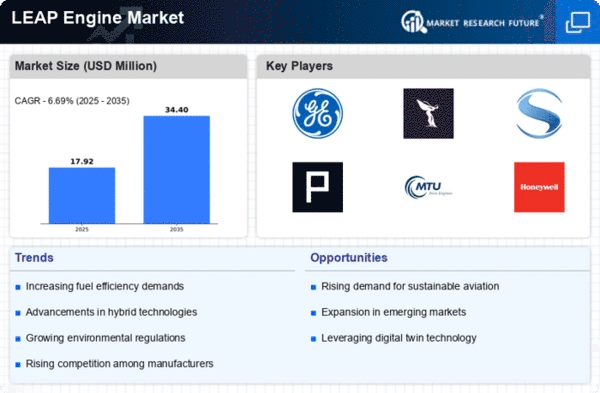
As per MRFR analysis, the LEAP Engine Market Size was estimated at 16.8 USD Million in 2024. The LEAP Engine industry is projected to grow from 18.0 in 2025 to 34.4 by 2035, exhibiting a compound annual growth rate (CAGR) of 6.69 during the forecast period 2025 - 2035.

Key Market Trends & Highlights

The LEAP Engine Market is poised for robust growth driven by technological advancements and sustainability initiatives.

  • North America remains the largest market for LEAP engines, driven by a strong demand in commercial aviation.
  • Asia-Pacific is emerging as the fastest-growing region, fueled by increasing investments in urban air mobility.
  • The commercial aviation segment continues to dominate the market, while the maintenance repair overhaul segment is experiencing rapid growth.
  • Rising demand for fuel efficiency and stringent regulatory compliance are key drivers propelling the LEAP engine market forward.

Market Size & Forecast

2024 Market Size 16.8 (USD Million)
2035 Market Size 34.4 (USD Million)
CAGR (2025 - 2035) 6.69%
Largest Regional Market Share in 2024 North America

Major Players

<p>General Electric (US), Rolls-Royce (GB), Safran (FR), Pratt & Whitney (US), MTU Aero Engines (DE), Honeywell (US), IHI Corporation (JP), Kawasaki Heavy Industries (JP), United Technologies (US)</p>

Market Trends

The LEAP Engine Market is currently experiencing a transformative phase characterized by advancements in technology and increasing demand for fuel-efficient engines. This market is driven by the aerospace sector's need for engines that not only enhance performance but also reduce environmental impact. Manufacturers are focusing on innovative designs and materials that contribute to weight reduction and improved efficiency. As sustainability becomes a priority, the LEAP Engine Market is likely to witness a shift towards greener technologies, aligning with global efforts to minimize carbon emissions. Moreover, the competitive landscape of the LEAP Engine Market is evolving, with key players investing in research and development to maintain their market positions. Collaborations and partnerships among industry stakeholders are becoming more prevalent, as companies seek to leverage each other's strengths. This trend suggests a dynamic environment where agility and adaptability are crucial for success. The future of the LEAP Engine Market appears promising, with ongoing innovations poised to redefine the standards of engine performance and sustainability.

Technological Advancements

The LEAP Engine Market is witnessing rapid technological advancements that enhance engine performance and efficiency. Innovations in materials and design are leading to lighter engines with improved fuel consumption, which is crucial for meeting regulatory standards and consumer expectations.

Sustainability Focus

There is a growing emphasis on sustainability within the LEAP Engine Market, driven by global environmental initiatives. Manufacturers are increasingly adopting eco-friendly practices and developing engines that produce lower emissions, aligning with the industry's shift towards greener solutions.

Collaborative Efforts

Collaborative efforts among key players in the LEAP Engine Market are becoming more common. Partnerships and joint ventures are being formed to pool resources and expertise, facilitating the development of cutting-edge technologies and enhancing competitive advantage.

LEAP Engine Market Market Drivers

Competitive Landscape

The competitive landscape within the Global LEAP Engine Industry is characterized by a few dominant players who are continuously innovating to maintain their market positions. These companies are investing heavily in research and development to enhance engine performance and reduce operational costs. The competition fosters an environment of innovation, leading to better products and services for consumers. As the market evolves, these competitive dynamics are expected to sustain the industry's valuation at 4.5 USD Billion by 2035, despite the projected CAGR of 0.0% for the period from 2025 to 2035.

Regulatory Compliance

Regulatory compliance plays a crucial role in shaping the Global LEAP Engine Industry. Governments worldwide are implementing stringent regulations aimed at reducing aviation emissions and enhancing safety standards. These regulations compel manufacturers to innovate and improve their engine technologies to meet compliance requirements. As a result, the demand for LEAP engines, which are engineered to comply with these regulations, is likely to increase. The market's stability is further supported by the projected CAGR of 0.0% for the period from 2025 to 2035, indicating a steady demand for compliant engine solutions.

Global Air Travel Demand

The Global LEAP Engine Industry is significantly influenced by the rising demand for air travel. As economies recover and expand, the need for efficient and reliable aircraft engines becomes paramount. Airlines are increasingly investing in new aircraft equipped with LEAP engines to cater to the growing passenger numbers. This trend is expected to bolster the market, maintaining its valuation at 4.5 USD Billion in 2024. The continuous growth in global air travel is likely to drive the demand for LEAP engines, ensuring a stable market environment in the coming years.

Sustainability Initiatives

Sustainability initiatives are becoming a pivotal driver in the Global LEAP Engine Industry. With growing environmental concerns, aviation stakeholders are focusing on reducing carbon emissions and enhancing fuel efficiency. LEAP engines are designed to meet stringent emission regulations, making them a preferred choice for airlines aiming to minimize their environmental footprint. The industry's commitment to sustainability is evident as it aligns with global efforts to combat climate change. This trend is expected to sustain the market's valuation at 4.5 USD Billion by 2035, as more airlines adopt eco-friendly technologies and practices.

Technological Advancements

The Global LEAP Engine Industry is experiencing a surge in technological advancements, particularly in engine efficiency and performance. Innovations in materials and design methodologies are enhancing the capabilities of LEAP engines, making them more appealing to airlines and manufacturers. For instance, the introduction of advanced composite materials has led to weight reductions, which in turn improves fuel efficiency. As airlines increasingly prioritize sustainability, the demand for these advanced engines is likely to rise, contributing to the market's stability. The Global LEAP Engine Industry is projected to maintain a valuation of 4.5 USD Billion in 2024, reflecting the impact of these technological improvements.

Market Segment Insights

By Application: Commercial Aviation (Largest) vs. Urban Air Mobility (Fastest-Growing)

<p>The LEAP Engine Market is characterized by a heterogeneous application base, with Commercial Aviation holding the largest share. This sector benefits from a robust demand for passenger travel and cargo transport, which drives significant utilization of LEAP engines. In contrast, Urban Air Mobility is emerging rapidly, fueled by innovations in electric vertical takeoff and landing (eVTOL) technology, pushing it into the spotlight as a fast-growing segment.</p>

<p>Aviation Sectors: Commercial Aviation (Dominant) vs. Urban Air Mobility (Emerging)</p>

<p>Commercial Aviation is a dominant player in the LEAP Engine Market due to its adaptability and efficiency in fuel consumption. Notable airlines rely on this engine for its advanced technology, ensuring passenger safety and comfort while minimizing carbon footprints. Meanwhile, Urban Air Mobility, while emerging, showcases transformative potential as urban areas seek efficient transportation solutions to alleviate congestion and improve connectivity. Companies are focusing on integration with smart city initiatives, making it a disruptor in the aviation landscape, particularly with its alignment toward sustainability and modernization.</p>

By End Use: Aircraft Manufacturers (Largest) vs. Maintenance Repair Overhaul (Fastest-Growing)

<p>In the LEAP Engine Market, the distribution of market share among the end-use segments is notably skewed. Aircraft manufacturers hold a significant majority share, driven by the increasing demand for fuel-efficient and high-performance engines in new aircraft designs. In contrast, the Maintenance Repair Overhaul (MRO) sector, while smaller, is witnessing a surge as airlines and operators focus on extending the life of their engines and reducing operational costs through effective maintenance protocols. Aerospace component suppliers occupy a vital position, supporting both aircraft manufacturers and MRO with essential components and systems.</p>

<p>Aircraft Manufacturers (Dominant) vs. Maintenance Repair Overhaul (Emerging)</p>

<p>Aircraft manufacturers are the dominant force in the LEAP Engine Market, leveraging advancements in engine technology to meet regulatory standards and consumer preferences for fuel efficiency and sustainability. They play a pivotal role in driving innovation, with leading companies investing heavily in research and development to enhance engine performance and reliability. On the other hand, the Maintenance Repair Overhaul segment is emerging as a critical player, characterized by rapid growth and rising investments in service capabilities. MRO providers are increasingly adopting digital technologies and predictive maintenance practices to optimize operations, thereby responding to the escalating demand for engine servicing and maintenance driven by the expanding global fleet of engines.</p>

By Engine Type: Turbofan Engine (Largest) vs. Turboprop Engine (Fastest-Growing)

<p>In the LEAP Engine Market, the Turbofan Engine holds the largest market share, significantly outpacing the other engine types thanks to its widespread application in commercial aviation. Its efficiency, low noise levels, and high thrust-to-weight ratio make it a preferred choice for airlines seeking to meet modern environmental regulations. Following the Turbofan, the Turboprop Engine is attracting attention due to its cost-effectiveness in regional air travel, providing a viable alternative for shorter routes with lower operating costs. The growth trends within the LEAP Engine segment indicate a robust demand for Turbofan Engines as airlines focus on fleet modernization and sustainability. Conversely, the Turboprop Engine is emerging rapidly, driven by the increasing need for efficient regional transport solutions. The shift towards environmentally sustainable aviation fuels and technological advancements in engine design further bolster the market for both dominant and emerging engine types, appealing to airlines aiming for operational efficiency and reduced carbon footprints.</p>

<p>Engine Type: Turbofan (Dominant) vs. Turboprop (Emerging)</p>

<p>The Turbofan Engine is characterized by its high-efficiency performance, making it the dominant type in the LEAP Engine Market. It is widely utilized in commercial jetliners, known for its capability to operate at high speeds while maintaining low fuel consumption and noise emission. This engine type's advanced aerodynamic designs and materials contribute to its leading position and appeal to operators aiming to meet stringent environmental regulations. On the other hand, the Turboprop Engine is emerging as a key player, especially in the regional aviation market. It is designed for shorter flight ranges and lower speeds, featuring a propeller that provides excellent fuel efficiency at lower altitudes. This makes it an attractive option for airlines focusing on cost-effective solutions for short-haul flights, enabling them to penetrate underserved markets while offering competitive pricing.</p>

By Fuel Type: Jet Fuel (Largest) vs. Biofuels (Fastest-Growing)

<p>In the LEAP Engine Market, fuel type segmentation reveals distinct market shares among Aviation Gasoline, Jet Fuel, and Biofuels. Jet Fuel dominates the market, serving as the primary choice for commercial aviation, due to its high energy density and efficiency. Aviation Gasoline is widely used in smaller aircraft but holds a smaller segment share compared to Jet Fuel. Meanwhile, the Biofuels segment is emerging, reflecting a growing interest and shift towards sustainable alternatives fueled by environmental regulations and consumer awareness.</p>

<p>Biofuels (Emerging) vs. Aviation Gasoline (Dominant)</p>

<p>Biofuels represent the fastest-growing segment in the LEAP Engine Market, driven by the global push for sustainable aviation fuels. These renewable alternatives are gaining traction due to their potential to reduce carbon emissions and dependence on fossil fuels. Aviation Gasoline, on the other hand, remains a dominant player primarily in the general aviation sector, known for its accessibility and performance in light aircraft. While Aviation Gasoline maintains a strong foothold in the traditional market, Biofuels are expected to capture significant interest from newer market entrants and environmentally conscious consumers, leading to an evolving competitive landscape.</p>

By Technology: Advanced Technology (Largest) vs. Hybrid Technology (Fastest-Growing)

<p>In the LEAP Engine Market, the technology segment is predominantly occupied by Advanced Technology, which holds the largest share among the three categories, including Conventional Technology and Hybrid Technology. This highlight underscores the shift in industry focus towards more efficient and innovative solutions, reshaping the competitive landscape. In contrast, Hybrid Technology is emerging rapidly, gaining traction due to its unique blend of benefits derived from both conventional and advanced methods, appealing to a broader spectrum of market needs.</p>

<p>Technology: Advanced Technology (Dominant) vs. Hybrid Technology (Emerging)</p>

<p>Advanced Technology in the LEAP Engine Market represents the pinnacle of innovation, featuring enhanced performance, reliability, and efficiency compared to Conventional Technology. This segment is characterized by ongoing research and development that continually refines the technology, making it highly sought after by manufacturers and consumers looking for top-tier engine solutions. Meanwhile, Hybrid Technology is making waves as an emerging segment, offering a compelling blend of traditional and modern technologies. This hybrid approach not only reduces emissions but also optimizes fuel efficiency, capturing interest from environmentally conscious buyers and those seeking cost-effective solutions without compromising performance. As such, both segments will play pivotal roles in shaping the future of engine technology.</p>

Get more detailed insights about LEAP Engine Market Research Report—Global Forecast till 2035

Regional Insights

North America : Market Leader in Innovation

North America continues to lead the LEAP engine market, holding a significant share of 8.4 in 2024. The region's growth is driven by robust demand for fuel-efficient engines, stringent environmental regulations, and advancements in aerospace technology. Government initiatives aimed at promoting sustainable aviation practices further catalyze market expansion. The increasing focus on reducing carbon emissions is also a key driver, pushing manufacturers to innovate and enhance engine performance. The competitive landscape in North America is characterized by the presence of major players such as General Electric, Pratt & Whitney, and Honeywell. These companies are at the forefront of technological advancements, ensuring that the region remains a hub for aerospace innovation. The U.S. government’s support for research and development in aviation technology solidifies the market's position, making it a focal point for investments and partnerships in the LEAP engine sector.

Europe : Emerging Hub for Aerospace

Europe's LEAP engine market is projected to grow significantly, with a market size of 4.8 in 2024. The region benefits from a strong regulatory framework that encourages innovation and sustainability in aviation. European Union regulations aimed at reducing emissions and enhancing fuel efficiency are pivotal in driving demand for advanced engine technologies. The focus on green aviation initiatives is expected to further boost market growth, aligning with global sustainability goals. Leading countries in this region include Germany, France, and the UK, where companies like Rolls-Royce and Safran are key players. The competitive landscape is marked by collaborations between manufacturers and research institutions, fostering innovation. The presence of established aerospace clusters in these countries enhances the region's capability to develop cutting-edge technologies, ensuring a robust market for LEAP engines.

Asia-Pacific : Rapidly Growing Market

The Asia-Pacific region is witnessing rapid growth in the LEAP engine market, with a market size of 2.4 in 2024. This growth is fueled by increasing air travel demand, urbanization, and the expansion of low-cost carriers. Governments in the region are investing heavily in aviation infrastructure, which is expected to enhance market dynamics. Regulatory support for modernizing fleets and improving fuel efficiency is also a significant catalyst for growth in this sector. Countries like Japan and China are leading the charge, with companies such as IHI Corporation and Kawasaki Heavy Industries playing crucial roles. The competitive landscape is evolving, with both domestic and international players vying for market share. The region's focus on technological advancements and partnerships with The LEAP Engine.

Middle East and Africa : Emerging Aviation Market

The Middle East and Africa (MEA) region is emerging as a significant player in the LEAP engine market, with a market size of 1.2 in 2024. The growth is driven by increasing investments in aviation infrastructure and a rising demand for air travel. The region's strategic location as a global transit hub enhances its appeal for airlines looking to expand their fleets. Regulatory frameworks are evolving to support sustainable aviation practices, which is expected to further stimulate market growth. Leading countries in this region include the UAE and South Africa, where investments in modernizing fleets are on the rise. The competitive landscape features both established players and new entrants, creating a dynamic market environment. The presence of key global players is also notable, as they seek to capitalize on the region's growth potential and enhance their market presence in the LEAP engine sector.

Key Players and Competitive Insights

The LEAP Engine Market is characterized by a dynamic competitive landscape, driven by technological advancements and increasing demand for fuel-efficient engines. Major players such as General Electric (US), Rolls-Royce (GB), and Safran (FR) are at the forefront, each adopting distinct strategies to enhance their market positioning. General Electric (US) focuses on innovation through its digital twin technology, which optimizes engine performance and maintenance. Meanwhile, Rolls-Royce (GB) emphasizes sustainability, investing heavily in hybrid-electric propulsion systems to meet evolving regulatory standards. Safran (FR) is enhancing its operational efficiency by integrating advanced manufacturing techniques, thereby reducing production costs and improving delivery timelines. Collectively, these strategies contribute to a competitive environment that prioritizes technological leadership and operational excellence.

Key business tactics within the LEAP Engine Market include localizing manufacturing and optimizing supply chains to enhance responsiveness to market demands. The market structure appears moderately fragmented, with several key players exerting substantial influence. This fragmentation allows for a variety of competitive strategies, as companies seek to differentiate themselves through innovation and customer service. The collective influence of these players shapes a landscape where agility and adaptability are paramount, particularly in response to shifting consumer preferences and regulatory pressures.

In November 2025, General Electric (US) announced a partnership with a leading aerospace manufacturer to co-develop next-generation LEAP engines that utilize sustainable aviation fuel (SAF). This strategic move underscores GE's commitment to sustainability and positions the company to capitalize on the growing demand for eco-friendly aviation solutions. By aligning with a partner that possesses complementary capabilities, GE enhances its innovation potential while addressing environmental concerns that are increasingly important to stakeholders.

In October 2025, Rolls-Royce (GB) unveiled its latest hybrid-electric engine prototype, marking a significant milestone in its sustainability strategy. This development not only showcases Rolls-Royce's technological prowess but also reflects its proactive approach to meeting future regulatory requirements. The hybrid-electric engine is expected to reduce emissions by up to 30%, thereby appealing to airlines seeking to enhance their environmental credentials. This innovation could potentially reshape market dynamics as competitors strive to keep pace with Rolls-Royce's advancements.

In September 2025, Safran (FR) completed the acquisition of a small aerospace technology firm specializing in additive manufacturing. This acquisition is strategically important as it allows Safran to enhance its production capabilities and reduce lead times for engine components. By integrating advanced manufacturing technologies, Safran positions itself to improve its competitive edge in a market that increasingly values efficiency and speed. This move may also encourage other players to explore similar strategies to remain competitive in the evolving landscape.

As of December 2025, current competitive trends in the LEAP Engine Market are heavily influenced by digitalization, sustainability, and the integration of artificial intelligence (AI) into engine design and maintenance. Strategic alliances are becoming increasingly vital, as companies recognize the need to pool resources and expertise to drive innovation. The competitive differentiation is likely to evolve from traditional price-based competition to a focus on technological innovation, reliability, and sustainable practices. This shift suggests that companies that prioritize R&D and sustainable solutions will be better positioned to thrive in the future.

Key Companies in the LEAP Engine Market market include

Industry Developments

Future Outlook

LEAP Engine Market Future Outlook

<p>The LEAP Engine Market is projected to grow at a 6.69% CAGR from 2024 to 2035, driven by advancements in fuel efficiency, environmental regulations, and increasing air travel demand.</p>

New opportunities lie in:

  • <p>Development of hybrid-electric propulsion systems for enhanced efficiency.</p>
  • <p>Expansion into emerging markets with tailored engine solutions.</p>
  • <p>Investment in predictive maintenance technologies to reduce operational costs.</p>

<p>By 2035, the LEAP Engine Market is expected to solidify its position as a leader in sustainable aviation technology.</p>

Market Segmentation

LEAP Engine Market End Use Outlook

  • Aircraft Manufacturers
  • Maintenance Repair Overhaul
  • Aerospace Component Suppliers

LEAP Engine Market Fuel Type Outlook

  • Aviation Gasoline
  • Jet Fuel
  • Biofuels

LEAP Engine Market Technology Outlook

  • Conventional Technology
  • Advanced Technology
  • Hybrid Technology

LEAP Engine Market Application Outlook

  • Commercial Aviation
  • Military Aviation
  • Business Aviation
  • Urban Air Mobility

LEAP Engine Market Engine Type Outlook

  • Turbofan Engine
  • Turbojet Engine
  • Turboprop Engine
  • Unducted Fan Engine

Report Scope

MARKET SIZE 202416.8(USD Million)
MARKET SIZE 202518.0(USD Million)
MARKET SIZE 203534.4(USD Million)
COMPOUND ANNUAL GROWTH RATE (CAGR)6.69% (2024 - 2035)
REPORT COVERAGERevenue Forecast, Competitive Landscape, Growth Factors, and Trends
BASE YEAR2024
Market Forecast Period2025 - 2035
Historical Data2019 - 2024
Market Forecast UnitsUSD Million
Key Companies ProfiledGeneral Electric (US), Rolls-Royce (GB), Safran (FR), Pratt & Whitney (US), MTU Aero Engines (DE), Honeywell (US), IHI Corporation (JP), Kawasaki Heavy Industries (JP), United Technologies (US)
Segments CoveredApplication, End Use, Engine Type, Fuel Type, Technology
Key Market OpportunitiesAdvancements in sustainable aviation fuel technology enhance growth potential in the LEAP Engine Market.
Key Market DynamicsRising demand for fuel-efficient engines drives innovation and competition in the LEAP Engine Market.
Countries CoveredNorth America, Europe, APAC, South America, MEA

FAQs

Who Are The Top Key Players in Leap Engine Market ?

LEAP Engine market are designed, produced, and marketed by CFM International (A 50/50 joint company between GE (US) and Safran Aircraft Engines (France)). The key players in the LEAP engine market are CFM International, GE Aviation, and Safran Aircraft Engines.

In Which Region Leap Engine Market Dominated ?

North America is expected to be the largest Leap Engine Market for LEAP Engines during the forecast period

Driving factors In Leap Engine Market ?

Better performance with high dispatch reliability time (99.98%), Increasing preferences for travelling among millennials

  1. EXECUTIVE SUMMARY
    1. Market Attractiveness Analysis
      1. Global LEAP Engine Market, by Engine Type
      2. Global LEAP Engine Market, by Region
  2. MARKET INTRODUCTION
    1. Definition
    2. Scope of the Study
    3. Market Structure
  3. RESEARCH METHODOLOGY
    1. Research Process
    2. Primary Research
    3. Secondary Research
    4. Market Size Estimation
    5. List of Assumptions
  4. MARKET DYNAMICS
    1. Introduction
    2. Drivers
      1. Better performance with high dispatch reliability time (99.98%)
      2. Increasing preferences for travelling among millennials
      3. Driver Impact Analysis
    3. Restraints
      1. High rate of backlog in clearing the old orders
      2. Restraint Impact Analysis
    4. Opportunity
      1. Growing civil aviation industry and introduction of 3D manufacturing technology
    5. Impact of COVID-19
      1. Impact of Aviation Industry
      2. Impact on End User
      3. Impact on Supply Chain
  5. MARKET FACTOR ANALYSIS
    1. Value Chain Analysis/Supply Chain Analysis
    2. Porter’s Five Forces Model
      1. Bargaining Power of Suppliers
      2. Bargaining Power of Buyers
      3. Threat of New Entrants
      4. Threat of Substitutes
      5. Intensity of Rivalry
  6. GLOBAL LEAP ENGINE MARKET, BY ENGINE TYPE
    1. Introduction
    2. LEAP-1A
    3. LEAP-1B
    4. LEAP-1C
  7. GLOBAL LEAP ENGINE MARKET, BY REGION
    1. Overview
    2. North America
      1. Market Size & Estimates, by Country, 2020–2027
      2. Market Size & Estimates, by Engine Type, 2020–2027
      3. US
      4. Canada
      5. Mexico
    3. Europe
      1. Market Size & Estimates, by Country, 2020–2027
      2. Market Size & Estimates, by Engine Type, 2020–2027
      3. Germany
      4. UK
      5. France
      6. Rest of Europe
    4. Asia Pacific
      1. Market Size & Estimates, by Country, 2020–2027
      2. Market Size & Estimates, by Engine Type, 2020–2027
      3. China
      4. Japan
      5. India
      6. Rest of Asia-Pacific
    5. Middle East & Africa
      1. Market Size & Estimates, by Engine Type, 2020–2027
    6. South America
      1. Market Size & Estimates, by Engine Type, 2020–2027
  8. COMPETITIVE LANDSCAPE
    1. Introduction
    2. Competitive Benchmarking
    3. Competitor Dashboard
    4. Major Growth Strategy in the market
    5. Key Developments & Growth Strategies
      1. New Product Development
      2. Mergers & Acquisitions
      3. Contracts & Agreements
  9. COMPANY PROFILES
    1. CFM International
      1. Company Overview
      2. Financial Overview
      3. Products/Services/Solutions Offered
      4. Key Developments
      5. SWOT Analysis
      6. Key Strategies
    2. GE Aviation
    3. Safran Aircraft Engines

LEAP Engine Market Segmentation

Market Segmentation Overview

  • Detailed segmentation data will be available in the full report
  • Comprehensive analysis by multiple parameters
  • Regional and country-level breakdowns
  • Market size forecasts by segment
Infographic

Free Sample Request

Kindly complete the form below to receive a free sample of this Report

Get Free Sample

Customer Strories

Compare Licence

×
Features License Type
Single User Multiuser License Enterprise User
Price $4,950 $5,950 $7,250
Maximum User Access Limit 1 User Upto 10 Users Unrestricted Access Throughout the Organization
Free Customization
Direct Access to Analyst
Deliverable Format
Platform Access
Discount on Next Purchase 10% 15% 15%
Printable Versions