×
Request Free Sample ×

Kindly complete the form below to receive a free sample of this Report

* Please use a valid business email

Leading companies partner with us for data-driven Insights

clients tt-cursor
Hero Background
English
Chinese
French
Japanese
Korean
German
Spanish

Laser Sensitive Pigments Market Market Trends

ID: MRFR/CnM/9956-CR
128 Pages
Garvit Vyas
March 2023

Laser Sensitive Pigments Market Research Report Information By End-use Industry (Packaging, Automotive, Consumer Goods, and Others), And By Region (North America, Europe, Asia-Pacific, And Rest Of The World) - Forecast Till 2035

Share:
Download PDF ×

We do not share your information with anyone. However, we may send you emails based on your report interest from time to time. You may contact us at any time to opt-out.

Laser Sensitive Pigments Market Market Infographic
Purchase Options

Market Trends

Key Emerging Trends in the Laser Sensitive Pigments Market Market

The Laser Sensitive Pigments market reports the most noticeable trends in recent times preceding the increasing demand for new technologies. Therefore, the technological industry is not an exception. These colorations, that are alternatively referred to as photochromic pigments, have an amazing potential to alter the color shade or the look or aspect when they interact with the laser beam. This property is used in industries which vary from packaging through printing to encryption and entertainment.

In the same bunch, the Laser Sensitive Pigment industry has made a fast-paced progress by largely applied in anticounterfeiting activities. The problem of counterfeiting is going to ramp up in connection with the sectors of pharmaceuticals, cosmetics, and luxury stuff so there is an urgent necessity for installation of hi-tech security technologies. The color-changing additive utilized in this technology is certainly the factor of high reliability as it changes color or reveals hidden images under the influence of lasers, which makes it very hard for counterfeiters to recreate it.

Moreover, laser printing ink is becoming more and more popular that is the trend in the print and packaging field. Regular use of color helps a brand to stand out and enhances the interaction between customers and products, ultimately improving brand visibility. Brands are using this technology to build and connect with customers directly through the mobile channel and in person.

Such pigments also integrate entertainment and partywear attire giving it an amazing aesthetics. The dyes find use in broad areas of lighting technology ranging from stage scenes, concert lighting and themed attractions. These pigments have a high probability of changing the shade resonant with laser pulse, bringing into picture a synergistic and futuristic flavor, thus enhancing the visual impact.

In addition to that, mass market where Laser Sensitive Pigments are experiencing the improvements of material compatibility is trending. Manufactures are inclining to embark on research and development perhaps to upgrade the pigments’ versatility, making them compatible with large scale us in a wide range of available materials such as plastics, paper, textiles among other coatings. In the wake of this opportunity of adaptability the range of industries for applying laser-sensitive dye goes wider.

Another global trend among laser-sensitive pigment markets is the appearance of environmental sustainability which has a profound influence on the laser-sensitive pigment market has as a big impact on the laser-sensitive pigment market. There is an ever-increasing recognition of the eco-friendly options and as result manufacturers are fishing around for greener formulations to make sure that the environmental diminution brought by these pigments are contained to the minimum. As the use of water-based and solvent-free formulations becoming more and more in vogue, the world can be assured that it is not lagging behind in the path towards sustainable and responsible production.

Author
Garvit Vyas
Analyst

Explore the profile of Garvit Vyas, one of our esteemed authors at Market Research Future, and access their expert research contributions in the field of market research and industry analysis

Leave a Comment

FAQs

What is the current valuation of the Laser Sensitive Pigments Market?

<p>As of 2024, the Laser Sensitive Pigments Market was valued at 1.546 USD Billion.</p>

What is the projected market valuation for the Laser Sensitive Pigments Market in 2035?

<p>The market is projected to reach a valuation of 2.673 USD Billion by 2035.</p>

What is the expected CAGR for the Laser Sensitive Pigments Market during the forecast period?

<p>The expected CAGR for the Laser Sensitive Pigments Market from 2025 to 2035 is 5.1%.</p>

Which companies are considered key players in the Laser Sensitive Pigments Market?

<p>Key players in the market include Sun Chemical, Clariant, BASF, Huntsman Corporation, and others.</p>

How does the Packaging segment perform in the Laser Sensitive Pigments Market?

<p>The Packaging segment was valued at 0.617 USD Billion in 2024 and is projected to grow to 1.052 USD Billion by 2035.</p>

What is the valuation of the Automotive segment in the Laser Sensitive Pigments Market?

<p>In 2024, the Automotive segment was valued at 0.462 USD Billion and is expected to increase to 0.785 USD Billion by 2035.</p>

What is the performance outlook for the Consumer Goods segment in the Laser Sensitive Pigments Market?

<p>The Consumer Goods segment had a valuation of 0.367 USD Billion in 2024, with projections indicating growth to 0.623 USD Billion by 2035.</p>

What is the expected growth trajectory for the 'Others' segment in the Laser Sensitive Pigments Market?

<p>The 'Others' segment was valued at 0.1 USD Billion in 2024 and is anticipated to reach 0.213 USD Billion by 2035.</p>

How do the key players influence the Laser Sensitive Pigments Market?

<p>Key players like BASF and Huntsman Corporation likely drive innovation and market dynamics within the Laser Sensitive Pigments Market.</p>

What factors contribute to the growth of the Laser Sensitive Pigments Market?

<p>Factors such as increasing demand in various end-use industries and advancements in pigment technology contribute to the market's growth.</p>

Market Summary

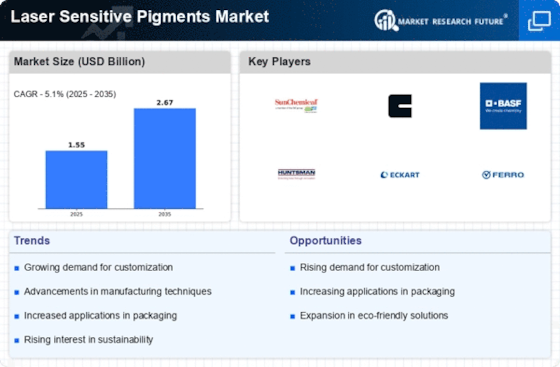
As per Market Research Future analysis, the Laser Sensitive Pigments Market Size was estimated at 1.546 USD Billion in 2024. The Laser Sensitive Pigments industry is projected to grow from 1.625 USD Billion in 2025 to 2.673 USD Billion by 2035, exhibiting a compound annual growth rate (CAGR) of 5.1% during the forecast period 2025 - 2035

Key Market Trends & Highlights

The Laser Sensitive Pigments Market is poised for substantial growth driven by technological advancements and sustainability initiatives.

  • North America remains the largest market for laser sensitive pigments, driven by robust demand across various industries. The Asia-Pacific region is emerging as the fastest-growing market, reflecting increasing investments in innovative applications. The packaging segment continues to dominate the market, while the automotive segment is experiencing rapid growth due to evolving consumer preferences. Key market drivers include rising demand in the packaging industry and an increased focus on security features in product design.

Market Size & Forecast

2024 Market Size 1.546 (USD Billion)
2035 Market Size 2.673 (USD Billion)
CAGR (2025 - 2035) 5.1%
Largest Regional Market Share in 2024 Europe

Major Players

Sun Chemical (US), Clariant (CH), BASF (DE), Huntsman Corporation (US), Eckart (DE), Ferro Corporation (US), Toyal (JP), Kremer Pigments (DE), DIC Corporation (JP)

Market Trends

The Laser Sensitive Pigments Market is currently experiencing a notable evolution, driven by advancements in technology and increasing applications across various industries. These pigments, which respond to laser light, are finding utility in sectors such as printing, packaging, and security. The demand for innovative solutions that enhance product visibility and authenticity is propelling market growth. Furthermore, the integration of these pigments into consumer products is becoming more prevalent, as manufacturers seek to differentiate their offerings in a competitive landscape. This trend suggests a shift towards more sophisticated and visually appealing products, which could redefine consumer expectations. In addition, sustainability concerns are influencing the Laser Sensitive Pigments Market. As industries strive to adopt eco-friendly practices, there is a growing emphasis on developing pigments that are not only effective but also environmentally responsible. This shift may lead to increased research and development efforts aimed at creating sustainable alternatives. Overall, the market appears poised for continued expansion, with innovations likely to play a crucial role in shaping its future trajectory. The interplay between technology, consumer preferences, and environmental considerations will likely define the landscape of the Laser Sensitive Pigments Market in the coming years.

Technological Advancements

The Laser Sensitive Pigments Market is witnessing rapid technological advancements that enhance the performance and versatility of these pigments. Innovations in formulation and application techniques are enabling more efficient use of laser-sensitive materials, thereby broadening their scope across various industries. This trend indicates a potential for increased adoption as manufacturers seek to leverage cutting-edge technologies to improve product offerings.

Sustainability Initiatives

There is a growing emphasis on sustainability within the Laser Sensitive Pigments Market, as companies strive to meet consumer demand for environmentally friendly products. This trend suggests that manufacturers are increasingly focusing on developing pigments that minimize environmental impact, potentially leading to a shift in production practices and material sourcing.

Diverse Applications

The applications of laser sensitive pigments are diversifying, extending beyond traditional uses in printing and packaging. Emerging sectors such as automotive, textiles, and electronics are beginning to explore the benefits of these pigments, indicating a broader market potential. This trend highlights the adaptability of laser sensitive pigments and their capacity to meet the evolving needs of various industries.

Laser Sensitive Pigments Market Market Market Drivers

Growth in Automotive Applications

The Laser Sensitive Pigments Market is poised for growth due to the increasing utilization of these pigments in the automotive sector. As manufacturers strive to enhance vehicle aesthetics and safety features, laser sensitive pigments provide an innovative approach to achieving these goals. These pigments can be employed in various applications, including interior and exterior coatings, where they offer durability and visual appeal. The automotive industry has shown a consistent growth trajectory, with an expected increase in production rates, which may lead to a heightened demand for advanced materials like laser sensitive pigments. This trend suggests that the integration of these pigments could become a standard practice in automotive design, thereby expanding their market presence.

Rising Demand in Packaging Industry

The Laser Sensitive Pigments Market is experiencing a notable surge in demand, particularly within the packaging sector. As brands increasingly seek innovative ways to enhance product visibility and security, laser sensitive pigments offer a unique solution. These pigments enable the creation of intricate designs and security features that are difficult to replicate, thus appealing to manufacturers aiming to combat counterfeiting. According to recent data, the packaging industry is projected to grow at a compound annual growth rate of approximately 4.5% over the next five years, which could further bolster the adoption of laser sensitive pigments. This trend indicates a potential for significant market expansion as companies prioritize both aesthetics and security in their packaging solutions.

Increased Focus on Security Features

The Laser Sensitive Pigments Market is witnessing a heightened focus on security features across various sectors, including pharmaceuticals, cosmetics, and electronics. As counterfeiting becomes an increasingly prevalent issue, companies are turning to laser sensitive pigments to incorporate unique identifiers and security measures into their products. These pigments can be engineered to respond to specific laser wavelengths, allowing for the creation of covert markings that are difficult to replicate. This trend is particularly relevant in industries where brand integrity is paramount, suggesting a robust market potential for laser sensitive pigments. The increasing regulatory requirements for product authentication further amplify this demand, indicating a strategic direction for market growth.

Technological Innovations in Manufacturing

Technological advancements in the manufacturing processes of laser sensitive pigments are significantly influencing the Laser Sensitive Pigments Market. Innovations such as improved synthesis techniques and enhanced application methods are enabling manufacturers to produce pigments with superior performance characteristics. These advancements not only enhance the quality of the pigments but also reduce production costs, making them more accessible to a wider range of industries. As the manufacturing sector continues to evolve, the integration of cutting-edge technologies is likely to drive the adoption of laser sensitive pigments across various applications. This trend indicates a promising future for the market, as companies seek to leverage these innovations to improve product offerings.

Sustainability Trends in Material Selection

The Laser Sensitive Pigments Market is also influenced by the growing emphasis on sustainability in material selection. As consumers and manufacturers alike become more environmentally conscious, there is a shift towards using eco-friendly materials in product development. Laser sensitive pigments, which can be formulated from sustainable sources, align well with this trend. The ability to create vibrant colors without harmful solvents or additives positions these pigments as a favorable choice for companies aiming to reduce their environmental footprint. This shift towards sustainability is likely to drive the adoption of laser sensitive pigments, as businesses seek to meet consumer expectations while adhering to regulatory standards. The market may see a significant transformation as sustainability becomes a core consideration in material selection.

Market Segment Insights

By End-use Industry: Packaging (Largest) vs. Automotive (Fastest-Growing)

The Laser Sensitive Pigments Market is notably segmented by end-use industries, with packaging taking the lead as the largest segment. It caters to the diverse needs of various product packaging applications, including food and beverage, cosmetics, and pharmaceuticals. This segment benefits from the increasing demand for visually appealing packaging solutions that enhance brand visibility and consumer engagement. Conversely, the automotive segment is emerging as the fastest-growing area within the market, driven by the rising adoption of innovative technologies and aesthetic enhancements in vehicle designs. The shift towards electric vehicles and smart technologies is influencing paint and coating applications, enabling manufacturers to utilize laser-sensitive pigments to improve functionality and visual appeal in the automotive sector.

Packaging: Dominant vs. Automotive: Emerging

In the Laser Sensitive Pigments Market, the packaging segment stands out as the dominant force, renowned for its extensive use in creating eye-catching designs and functionality improvements in product packaging. Demand in this area is propelled by trends favoring sustainability and consumer preferences for unique packaging solutions. On the other hand, the automotive segment represents an emerging opportunity, driven by innovations in vehicle aesthetics and technology integration. This segment is characterized by its potential for growth due to the increasing reliance on specialized coatings that deliver enhanced durability and visual characteristics, catering to manufacturers aiming to differentiate their products in a competitive automotive landscape.

Get more detailed insights about Laser Sensitive Pigments Market Research Report—Global Forecast till 2035

Regional Insights

By Region, the study segments the market into North America, Europe, Asia-Pacific and Rest of the World. Asia-Pacific Laser Sensitive Pigments market accounted for USD 0.63 billion in 2021 and is expected to exhibit an 5.8% CAGR during the study period. Asia-Pacific is the largest automobile market and comprises emerging economies such as China and India and developed nations such as Japan and South Korea. The growing packaging industry and rapid industrialization in this region are key factors driving the laser sensitive pigments market.

Furthermore, a rise in the middle-class population is expected to boost global consumer spending and will contribute to the growth of the textile and plastic industries, as a result fueling the growth of the laser sensitive pigments market over the forecast period.

Further, the major countries studied are: The U.S, Canada, Germany, France, UK, Italy, Spain, China, Japan, India, Australia, South Korea, and Brazil.

Europe Laser Sensitive Pigments market accounts for the largest market share. In Europe, the rapidly growing leather industry is creating numerous new opportunities for the laser sensitive pigments market and increasing product consumption in leather, which includes automotive, clothes, footwear, and other leather products. In addition, the real estate market of Europe is in motion. Furthermore, the rise in demand from the paints and coatings industries across Europe is a major factor driving the growth of the laser sensitive pigments market over the forecast period.

The North America Laser Sensitive Pigments Market is expected to grow as North America is known for quickly adopting new technologies, owing to the rapidly increasing GDP and high employment rate. North America has significant demand for laser sensitive pigments. The increasing plastic packaging industry, rising plastic production, and trend of digital printing are anticipated to boost the demand for laser sensitive pigments in the region over the forecast period. In the US, the rapidly growing textile industry shall boost industry growth and help to propel the demand for laser sensitive pigment over the forecast period.

Key Players and Competitive Insights

The Laser Sensitive Pigments Market is characterized by the presence of many regional and local vendors. The regional market is highly competitive, with all the players competing to gain a larger market share. The vendors compete based on cost, product quality, reliability, and aftermarket services. Therefore, vendors must provide cost-effective and efficient products to survive and succeed in a competitive market environment.Datalase Ltd., Merck KGaA, Bodo Möller Chemie GmbH, Eckart NAFTA, Shenzhen Liying Plastic Chemical Co., Ltd, Gabriel-Chemie, Sun Chemical, Flint Group, Siegwerk, Peter Huber Kältemaschinenbau AG, Uvitec Ltd., ACTEGA are the major players in the market, competing in terms of variety of applications of Laser Sensitive Pigments Market and their components, as well as efficiency, reliability, affordability, and advanced technology. The primary focus of the players is to provide advanced products to aid in increasing adoption, which could help strengthen a country's growth with advanced products.Although global players dominate the market, a few regional and other local players with a limited market share also have a prominent presence.The major players would look to strengthen their global presence through mergers & acquisitions of local and regional players; they are expected to expand their presence and solutions in these countries during the forecast period. Therefore, vendors must develop new technologies to stay at par with emerging technology trends that could affect the competitiveness of their product lines in the market.DataLase Ltd is the global leader in photonic printing solutions. The company provides ground-breaking sustainable and environmentally efficient inkless printing solutions for products and packaging, enabling brand owners to connect with consumers in unique, dynamic, and exciting ways. DataLase Product Coding provides end users with a new solution for printing high-contrast black-on-white codes for primary packaging requirements. It pigments and coatings, inkless printing solutions for products and packaging based on its patented laser-reactive color change technology.It enables brand owners to integrate digital printing at the point in the supply chain where it adds the most value and returns, all while promoting business integrity and reducing environmental impact.Also, Merck KGaA is a vibrant science and technology company. The company offer services and solution for the automotive industry. It delivers personalized treatments for serious diseases. It also offers various laser pigments, granules, and pigments products. It has operated in various healthcare, life science, and electronics sectors. Merck KGaA has a presence in nearly 66 countries worldwide. It includes 250 companies all around the world.

Key Companies in the Laser Sensitive Pigments Market Market include

Industry Developments

June 2022: Merck announced that it has entered a collaboration with Agilent Technologies to advance Process Analytical Technologies (PAT). PAT, which is strongly encouraged by global regulatory authorities, is a critical enabler for real-time release and Bioprocessing 4.0.

May 2021: ALTANA has acquired Henkel's closure materials business. As a result, the specialty chemicals group is strengthening its range of PVC-free solutions for the packaging industry in particular. Within the ALTANA Group, the business will be integrated into the ACTEGA division and globally assigned to the Metal Packaging Solutions business line.

Future Outlook

Laser Sensitive Pigments Market Market Future Outlook

The Laser Sensitive Pigments Market is projected to grow at a 5.1% CAGR from 2025 to 2035, driven by advancements in technology and increasing demand in various applications.

New opportunities lie in:

  • <p>Development of eco-friendly laser sensitive pigments for sustainable applications. Expansion into emerging markets with tailored product offerings. Investment in R&amp;D for innovative applications in the automotive and aerospace sectors.</p>

By 2035, the market is expected to achieve robust growth, positioning itself as a leader in advanced pigment technologies.

Market Segmentation

Laser Sensitive Pigments Market Market End-use Industry Outlook

  • Packaging
  • Automotive
  • Consumer Goods
  • Others

Report Scope

MARKET SIZE 2024 1.546(USD Billion)
MARKET SIZE 2025 1.625(USD Billion)
MARKET SIZE 2035 2.673(USD Billion)
COMPOUND ANNUAL GROWTH RATE (CAGR) 5.1% (2025 - 2035)
REPORT COVERAGE Revenue Forecast, Competitive Landscape, Growth Factors, and Trends
BASE YEAR 2024
Market Forecast Period 2025 - 2035
Historical Data 2019 - 2024
Market Forecast Units USD Billion
Key Companies Profiled Sun Chemical (US), Clariant (CH), BASF (DE), Huntsman Corporation (US), Eckart (DE), Ferro Corporation (US), Toyal (JP), Kremer Pigments (DE), DIC Corporation (JP)
Segments Covered End-use Industry, Region
Key Market Opportunities Growing demand for eco-friendly applications drives innovation in the Laser Sensitive Pigments Market.
Key Market Dynamics Rising demand for eco-friendly applications drives innovation in laser sensitive pigments and enhances competitive market dynamics.
Countries Covered North America, Europe, APAC, South America, MEA

FAQs

What is the current valuation of the Laser Sensitive Pigments Market?

<p>As of 2024, the Laser Sensitive Pigments Market was valued at 1.546 USD Billion.</p>

What is the projected market valuation for the Laser Sensitive Pigments Market in 2035?

<p>The market is projected to reach a valuation of 2.673 USD Billion by 2035.</p>

What is the expected CAGR for the Laser Sensitive Pigments Market during the forecast period?

<p>The expected CAGR for the Laser Sensitive Pigments Market from 2025 to 2035 is 5.1%.</p>

Which companies are considered key players in the Laser Sensitive Pigments Market?

<p>Key players in the market include Sun Chemical, Clariant, BASF, Huntsman Corporation, and others.</p>

How does the Packaging segment perform in the Laser Sensitive Pigments Market?

<p>The Packaging segment was valued at 0.617 USD Billion in 2024 and is projected to grow to 1.052 USD Billion by 2035.</p>

What is the valuation of the Automotive segment in the Laser Sensitive Pigments Market?

<p>In 2024, the Automotive segment was valued at 0.462 USD Billion and is expected to increase to 0.785 USD Billion by 2035.</p>

What is the performance outlook for the Consumer Goods segment in the Laser Sensitive Pigments Market?

<p>The Consumer Goods segment had a valuation of 0.367 USD Billion in 2024, with projections indicating growth to 0.623 USD Billion by 2035.</p>

What is the expected growth trajectory for the 'Others' segment in the Laser Sensitive Pigments Market?

<p>The 'Others' segment was valued at 0.1 USD Billion in 2024 and is anticipated to reach 0.213 USD Billion by 2035.</p>

How do the key players influence the Laser Sensitive Pigments Market?

<p>Key players like BASF and Huntsman Corporation likely drive innovation and market dynamics within the Laser Sensitive Pigments Market.</p>

What factors contribute to the growth of the Laser Sensitive Pigments Market?

<p>Factors such as increasing demand in various end-use industries and advancements in pigment technology contribute to the market's growth.</p>

  1. SECTION I: EXECUTIVE SUMMARY AND KEY HIGHLIGHTS
    1. | 1.1 EXECUTIVE SUMMARY
    2. | | 1.1.1 Market Overview
    3. | | 1.1.2 Key Findings
    4. | | 1.1.3 Market Segmentation
    5. | | 1.1.4 Competitive Landscape
    6. | | 1.1.5 Challenges and Opportunities
    7. | | 1.1.6 Future Outlook
  2. SECTION II: SCOPING, METHODOLOGY AND MARKET STRUCTURE
    1. | 2.1 MARKET INTRODUCTION
    2. | | 2.1.1 Definition
    3. | | 2.1.2 Scope of the study
    4. | | | 2.1.2.1 Research Objective
    5. | | | 2.1.2.2 Assumption
    6. | | | 2.1.2.3 Limitations
    7. | 2.2 RESEARCH METHODOLOGY
    8. | | 2.2.1 Overview
    9. | | 2.2.2 Data Mining
    10. | | 2.2.3 Secondary Research
    11. | | 2.2.4 Primary Research
    12. | | | 2.2.4.1 Primary Interviews and Information Gathering Process
    13. | | | 2.2.4.2 Breakdown of Primary Respondents
    14. | | 2.2.5 Forecasting Model
    15. | | 2.2.6 Market Size Estimation
    16. | | | 2.2.6.1 Bottom-Up Approach
    17. | | | 2.2.6.2 Top-Down Approach
    18. | | 2.2.7 Data Triangulation
    19. | | 2.2.8 Validation
  3. SECTION III: QUALITATIVE ANALYSIS
    1. | 3.1 MARKET DYNAMICS
    2. | | 3.1.1 Overview
    3. | | 3.1.2 Drivers
    4. | | 3.1.3 Restraints
    5. | | 3.1.4 Opportunities
    6. | 3.2 MARKET FACTOR ANALYSIS
    7. | | 3.2.1 Value chain Analysis
    8. | | 3.2.2 Porter's Five Forces Analysis
    9. | | | 3.2.2.1 Bargaining Power of Suppliers
    10. | | | 3.2.2.2 Bargaining Power of Buyers
    11. | | | 3.2.2.3 Threat of New Entrants
    12. | | | 3.2.2.4 Threat of Substitutes
    13. | | | 3.2.2.5 Intensity of Rivalry
    14. | | 3.2.3 COVID-19 Impact Analysis
    15. | | | 3.2.3.1 Market Impact Analysis
    16. | | | 3.2.3.2 Regional Impact
    17. | | | 3.2.3.3 Opportunity and Threat Analysis
  4. SECTION IV: QUANTITATIVE ANALYSIS
    1. | 4.1 Chemicals and Materials, BY End-use Industry (USD Billion)
    2. | | 4.1.1 Packaging
    3. | | 4.1.2 Automotive
    4. | | 4.1.3 Consumer Goods
    5. | | 4.1.4 Others
    6. | 4.2 Chemicals and Materials, BY Region (USD Billion)
    7. | | 4.2.1 North America
    8. | | | 4.2.1.1 US
    9. | | | 4.2.1.2 Canada
    10. | | 4.2.2 Europe
    11. | | | 4.2.2.1 Germany
    12. | | | 4.2.2.2 UK
    13. | | | 4.2.2.3 France
    14. | | | 4.2.2.4 Russia
    15. | | | 4.2.2.5 Italy
    16. | | | 4.2.2.6 Spain
    17. | | | 4.2.2.7 Rest of Europe
    18. | | 4.2.3 APAC
    19. | | | 4.2.3.1 China
    20. | | | 4.2.3.2 India
    21. | | | 4.2.3.3 Japan
    22. | | | 4.2.3.4 South Korea
    23. | | | 4.2.3.5 Malaysia
    24. | | | 4.2.3.6 Thailand
    25. | | | 4.2.3.7 Indonesia
    26. | | | 4.2.3.8 Rest of APAC
    27. | | 4.2.4 South America
    28. | | | 4.2.4.1 Brazil
    29. | | | 4.2.4.2 Mexico
    30. | | | 4.2.4.3 Argentina
    31. | | | 4.2.4.4 Rest of South America
    32. | | 4.2.5 MEA
    33. | | | 4.2.5.1 GCC Countries
    34. | | | 4.2.5.2 South Africa
    35. | | | 4.2.5.3 Rest of MEA
  5. SECTION V: COMPETITIVE ANALYSIS
    1. | 5.1 Competitive Landscape
    2. | | 5.1.1 Overview
    3. | | 5.1.2 Competitive Analysis
    4. | | 5.1.3 Market share Analysis
    5. | | 5.1.4 Major Growth Strategy in the Chemicals and Materials
    6. | | 5.1.5 Competitive Benchmarking
    7. | | 5.1.6 Leading Players in Terms of Number of Developments in the Chemicals and Materials
    8. | | 5.1.7 Key developments and growth strategies
    9. | | | 5.1.7.1 New Product Launch/Service Deployment
    10. | | | 5.1.7.2 Merger & Acquisitions
    11. | | | 5.1.7.3 Joint Ventures
    12. | | 5.1.8 Major Players Financial Matrix
    13. | | | 5.1.8.1 Sales and Operating Income
    14. | | | 5.1.8.2 Major Players R&D Expenditure. 2023
    15. | 5.2 Company Profiles
    16. | | 5.2.1 Sun Chemical (US)
    17. | | | 5.2.1.1 Financial Overview
    18. | | | 5.2.1.2 Products Offered
    19. | | | 5.2.1.3 Key Developments
    20. | | | 5.2.1.4 SWOT Analysis
    21. | | | 5.2.1.5 Key Strategies
    22. | | 5.2.2 Clariant (CH)
    23. | | | 5.2.2.1 Financial Overview
    24. | | | 5.2.2.2 Products Offered
    25. | | | 5.2.2.3 Key Developments
    26. | | | 5.2.2.4 SWOT Analysis
    27. | | | 5.2.2.5 Key Strategies
    28. | | 5.2.3 BASF (DE)
    29. | | | 5.2.3.1 Financial Overview
    30. | | | 5.2.3.2 Products Offered
    31. | | | 5.2.3.3 Key Developments
    32. | | | 5.2.3.4 SWOT Analysis
    33. | | | 5.2.3.5 Key Strategies
    34. | | 5.2.4 Huntsman Corporation (US)
    35. | | | 5.2.4.1 Financial Overview
    36. | | | 5.2.4.2 Products Offered
    37. | | | 5.2.4.3 Key Developments
    38. | | | 5.2.4.4 SWOT Analysis
    39. | | | 5.2.4.5 Key Strategies
    40. | | 5.2.5 Eckart (DE)
    41. | | | 5.2.5.1 Financial Overview
    42. | | | 5.2.5.2 Products Offered
    43. | | | 5.2.5.3 Key Developments
    44. | | | 5.2.5.4 SWOT Analysis
    45. | | | 5.2.5.5 Key Strategies
    46. | | 5.2.6 Ferro Corporation (US)
    47. | | | 5.2.6.1 Financial Overview
    48. | | | 5.2.6.2 Products Offered
    49. | | | 5.2.6.3 Key Developments
    50. | | | 5.2.6.4 SWOT Analysis
    51. | | | 5.2.6.5 Key Strategies
    52. | | 5.2.7 Toyal (JP)
    53. | | | 5.2.7.1 Financial Overview
    54. | | | 5.2.7.2 Products Offered
    55. | | | 5.2.7.3 Key Developments
    56. | | | 5.2.7.4 SWOT Analysis
    57. | | | 5.2.7.5 Key Strategies
    58. | | 5.2.8 Kremer Pigments (DE)
    59. | | | 5.2.8.1 Financial Overview
    60. | | | 5.2.8.2 Products Offered
    61. | | | 5.2.8.3 Key Developments
    62. | | | 5.2.8.4 SWOT Analysis
    63. | | | 5.2.8.5 Key Strategies
    64. | | 5.2.9 DIC Corporation (JP)
    65. | | | 5.2.9.1 Financial Overview
    66. | | | 5.2.9.2 Products Offered
    67. | | | 5.2.9.3 Key Developments
    68. | | | 5.2.9.4 SWOT Analysis
    69. | | | 5.2.9.5 Key Strategies
    70. | 5.3 Appendix
    71. | | 5.3.1 References
    72. | | 5.3.2 Related Reports
  6. LIST OF FIGURES
    1. | 6.1 MARKET SYNOPSIS
    2. | 6.2 NORTH AMERICA MARKET ANALYSIS
    3. | 6.3 US MARKET ANALYSIS BY END-USE INDUSTRY
    4. | 6.4 CANADA MARKET ANALYSIS BY END-USE INDUSTRY
    5. | 6.5 EUROPE MARKET ANALYSIS
    6. | 6.6 GERMANY MARKET ANALYSIS BY END-USE INDUSTRY
    7. | 6.7 UK MARKET ANALYSIS BY END-USE INDUSTRY
    8. | 6.8 FRANCE MARKET ANALYSIS BY END-USE INDUSTRY
    9. | 6.9 RUSSIA MARKET ANALYSIS BY END-USE INDUSTRY
    10. | 6.10 ITALY MARKET ANALYSIS BY END-USE INDUSTRY
    11. | 6.11 SPAIN MARKET ANALYSIS BY END-USE INDUSTRY
    12. | 6.12 REST OF EUROPE MARKET ANALYSIS BY END-USE INDUSTRY
    13. | 6.13 APAC MARKET ANALYSIS
    14. | 6.14 CHINA MARKET ANALYSIS BY END-USE INDUSTRY
    15. | 6.15 INDIA MARKET ANALYSIS BY END-USE INDUSTRY
    16. | 6.16 JAPAN MARKET ANALYSIS BY END-USE INDUSTRY
    17. | 6.17 SOUTH KOREA MARKET ANALYSIS BY END-USE INDUSTRY
    18. | 6.18 MALAYSIA MARKET ANALYSIS BY END-USE INDUSTRY
    19. | 6.19 THAILAND MARKET ANALYSIS BY END-USE INDUSTRY
    20. | 6.20 INDONESIA MARKET ANALYSIS BY END-USE INDUSTRY
    21. | 6.21 REST OF APAC MARKET ANALYSIS BY END-USE INDUSTRY
    22. | 6.22 SOUTH AMERICA MARKET ANALYSIS
    23. | 6.23 BRAZIL MARKET ANALYSIS BY END-USE INDUSTRY
    24. | 6.24 MEXICO MARKET ANALYSIS BY END-USE INDUSTRY
    25. | 6.25 ARGENTINA MARKET ANALYSIS BY END-USE INDUSTRY
    26. | 6.26 REST OF SOUTH AMERICA MARKET ANALYSIS BY END-USE INDUSTRY
    27. | 6.27 MEA MARKET ANALYSIS
    28. | 6.28 GCC COUNTRIES MARKET ANALYSIS BY END-USE INDUSTRY
    29. | 6.29 SOUTH AFRICA MARKET ANALYSIS BY END-USE INDUSTRY
    30. | 6.30 REST OF MEA MARKET ANALYSIS BY END-USE INDUSTRY
    31. | 6.31 KEY BUYING CRITERIA OF CHEMICALS AND MATERIALS
    32. | 6.32 RESEARCH PROCESS OF MRFR
    33. | 6.33 DRO ANALYSIS OF CHEMICALS AND MATERIALS
    34. | 6.34 DRIVERS IMPACT ANALYSIS: CHEMICALS AND MATERIALS
    35. | 6.35 RESTRAINTS IMPACT ANALYSIS: CHEMICALS AND MATERIALS
    36. | 6.36 SUPPLY / VALUE CHAIN: CHEMICALS AND MATERIALS
    37. | 6.37 CHEMICALS AND MATERIALS, BY END-USE INDUSTRY, 2024 (% SHARE)
    38. | 6.38 CHEMICALS AND MATERIALS, BY END-USE INDUSTRY, 2024 TO 2035 (USD Billion)
    39. | 6.39 BENCHMARKING OF MAJOR COMPETITORS
  7. LIST OF TABLES
    1. | 7.1 LIST OF ASSUMPTIONS
    2. | | 7.1.1
    3. | 7.2 North America MARKET SIZE ESTIMATES; FORECAST
    4. | | 7.2.1 BY END-USE INDUSTRY, 2025-2035 (USD Billion)
    5. | 7.3 US MARKET SIZE ESTIMATES; FORECAST
    6. | | 7.3.1 BY END-USE INDUSTRY, 2025-2035 (USD Billion)
    7. | 7.4 Canada MARKET SIZE ESTIMATES; FORECAST
    8. | | 7.4.1 BY END-USE INDUSTRY, 2025-2035 (USD Billion)
    9. | 7.5 Europe MARKET SIZE ESTIMATES; FORECAST
    10. | | 7.5.1 BY END-USE INDUSTRY, 2025-2035 (USD Billion)
    11. | 7.6 Germany MARKET SIZE ESTIMATES; FORECAST
    12. | | 7.6.1 BY END-USE INDUSTRY, 2025-2035 (USD Billion)
    13. | 7.7 UK MARKET SIZE ESTIMATES; FORECAST
    14. | | 7.7.1 BY END-USE INDUSTRY, 2025-2035 (USD Billion)
    15. | 7.8 France MARKET SIZE ESTIMATES; FORECAST
    16. | | 7.8.1 BY END-USE INDUSTRY, 2025-2035 (USD Billion)
    17. | 7.9 Russia MARKET SIZE ESTIMATES; FORECAST
    18. | | 7.9.1 BY END-USE INDUSTRY, 2025-2035 (USD Billion)
    19. | 7.10 Italy MARKET SIZE ESTIMATES; FORECAST
    20. | | 7.10.1 BY END-USE INDUSTRY, 2025-2035 (USD Billion)
    21. | 7.11 Spain MARKET SIZE ESTIMATES; FORECAST
    22. | | 7.11.1 BY END-USE INDUSTRY, 2025-2035 (USD Billion)
    23. | 7.12 Rest of Europe MARKET SIZE ESTIMATES; FORECAST
    24. | | 7.12.1 BY END-USE INDUSTRY, 2025-2035 (USD Billion)
    25. | 7.13 APAC MARKET SIZE ESTIMATES; FORECAST
    26. | | 7.13.1 BY END-USE INDUSTRY, 2025-2035 (USD Billion)
    27. | 7.14 China MARKET SIZE ESTIMATES; FORECAST
    28. | | 7.14.1 BY END-USE INDUSTRY, 2025-2035 (USD Billion)
    29. | 7.15 India MARKET SIZE ESTIMATES; FORECAST
    30. | | 7.15.1 BY END-USE INDUSTRY, 2025-2035 (USD Billion)
    31. | 7.16 Japan MARKET SIZE ESTIMATES; FORECAST
    32. | | 7.16.1 BY END-USE INDUSTRY, 2025-2035 (USD Billion)
    33. | 7.17 South Korea MARKET SIZE ESTIMATES; FORECAST
    34. | | 7.17.1 BY END-USE INDUSTRY, 2025-2035 (USD Billion)
    35. | 7.18 Malaysia MARKET SIZE ESTIMATES; FORECAST
    36. | | 7.18.1 BY END-USE INDUSTRY, 2025-2035 (USD Billion)
    37. | 7.19 Thailand MARKET SIZE ESTIMATES; FORECAST
    38. | | 7.19.1 BY END-USE INDUSTRY, 2025-2035 (USD Billion)
    39. | 7.20 Indonesia MARKET SIZE ESTIMATES; FORECAST
    40. | | 7.20.1 BY END-USE INDUSTRY, 2025-2035 (USD Billion)
    41. | 7.21 Rest of APAC MARKET SIZE ESTIMATES; FORECAST
    42. | | 7.21.1 BY END-USE INDUSTRY, 2025-2035 (USD Billion)
    43. | 7.22 South America MARKET SIZE ESTIMATES; FORECAST
    44. | | 7.22.1 BY END-USE INDUSTRY, 2025-2035 (USD Billion)
    45. | 7.23 Brazil MARKET SIZE ESTIMATES; FORECAST
    46. | | 7.23.1 BY END-USE INDUSTRY, 2025-2035 (USD Billion)
    47. | 7.24 Mexico MARKET SIZE ESTIMATES; FORECAST
    48. | | 7.24.1 BY END-USE INDUSTRY, 2025-2035 (USD Billion)
    49. | 7.25 Argentina MARKET SIZE ESTIMATES; FORECAST
    50. | | 7.25.1 BY END-USE INDUSTRY, 2025-2035 (USD Billion)
    51. | 7.26 Rest of South America MARKET SIZE ESTIMATES; FORECAST
    52. | | 7.26.1 BY END-USE INDUSTRY, 2025-2035 (USD Billion)
    53. | 7.27 MEA MARKET SIZE ESTIMATES; FORECAST
    54. | | 7.27.1 BY END-USE INDUSTRY, 2025-2035 (USD Billion)
    55. | 7.28 GCC Countries MARKET SIZE ESTIMATES; FORECAST
    56. | | 7.28.1 BY END-USE INDUSTRY, 2025-2035 (USD Billion)
    57. | 7.29 South Africa MARKET SIZE ESTIMATES; FORECAST
    58. | | 7.29.1 BY END-USE INDUSTRY, 2025-2035 (USD Billion)
    59. | 7.30 Rest of MEA MARKET SIZE ESTIMATES; FORECAST
    60. | | 7.30.1 BY END-USE INDUSTRY, 2025-2035 (USD Billion)
    61. | 7.31 PRODUCT LAUNCH/PRODUCT DEVELOPMENT/APPROVAL
    62. | | 7.31.1
    63. | 7.32 ACQUISITION/PARTNERSHIP
    64. | | 7.32.1

Chemicals and Materials Market Segmentation

Chemicals and Materials By End-use Industry (USD Billion, 2025-2035)

  • Packaging
  • Automotive
  • Consumer Goods
  • Others
Infographic

Free Sample Request

Kindly complete the form below to receive a free sample of this Report

Get Free Sample

Customer Strories

Compare Licence

×
Features License Type
Single User Multiuser License Enterprise User
Price $4,950 $5,950 $7,250
Maximum User Access Limit 1 User Upto 10 Users Unrestricted Access Throughout the Organization
Free Customization
Direct Access to Analyst
Deliverable Format
Platform Access
Discount on Next Purchase 10% 15% 15%
Printable Versions