×
Request Free Sample ×

Kindly complete the form below to receive a free sample of this Report

* Please use a valid business email

Leading companies partner with us for data-driven Insights

clients tt-cursor
Hero Background
English
Chinese
French
Japanese
Korean
German
Spanish

Klinefelter Syndrome Treatment Market Trends

ID: MRFR/Pharma/5302-HCR
90 Pages
Rahul Gotadki
October 2025

klinefelter syndrome treatment market Research Report: by treatment (Testosterone Replacement Therapy, Fertility Treatment, Breast tissue removal and others, by end-users (hospital and clinics, ambulatory surgeries and others)—Forecast till 2035

Share:
Download PDF ×

We do not share your information with anyone. However, we may send you emails based on your report interest from time to time. You may contact us at any time to opt-out.

Klinefelter Syndrome Treatment Market Infographic
×
Klinefelter Syndrome Treatment Market Infographic Full View
Purchase Options

Market Trends

Key Emerging Trends in the Klinefelter Syndrome Treatment Market

With changing trends evidenced by medical advancements, personalized healthcare and increasing emphasis on addressing special needs associated with Klinefelter Syndrome (KS), the treatment market has been affected. One of these trends is the increased awareness and early discovery of KS. Healthcare professionals have become more informed about this condition following a raising level of awareness among them. Over time, there has therefore been an increase in the number of patients suspected to have KS. This is because it becomes easier to intervene promptly when children are identified as having it at school age reducing some health problems related to it. Klinefelter’s syndrome is increasingly becoming a field for personalized medicine especially within its treatment market. An example where this trend emerged has been highlighted through recognizing that symptoms and risks may vary between individuals having KS; therefore, therapeutic approaches should be more specific towards addressing different aspects of this disorder. Thus, hormonal therapy would involve the use HRT for optimizing testosterone, treating infertility while other medications could address osteoporosis or heart issues for example. This approach aims at improving outcomes and quality life among persons living with KS.

Assisted reproductive technologies (ART) have grown in importance concerning Klinefelter Syndrome treatments particularly those focusing on infertility arising from it. However, this case study involving women suffering from KS who have undergone fertilization via IVF-ICSI procedure distinguishes itself from others due to various reasons. It supports recent breakthroughs on how human beings reproduce thereby giving hope to family planning which poses a major challenge among those who suffer from Klinefelter’s syndrome.

The psychosocial support services coupled with mental health considerations are increasingly taking the central parts in the treatment of Klinefelter Syndrome (KS). There appears to be a growing consensus among healthcare providers that counselling should form part of the overall management approach used by doctors in caring for people with Klinefelter Syndrome. All these components being dealt with holistically would help patients facing both physical and psychological problems associated with KS as well as their immediate families thereby promoting comprehensive care models that focus on patients experiencing this condition.

Treatment trends in Klinefelter’s syndrome have been affected by genetic research and molecular mechanisms insights. Consequently, as knowledge about its hereditary basis unfolds, it could become possible to develop targeted therapies addressing specific genes that cause KS. This is also an example of a broader trend in terms of precision medicine which could lead to more focused and efficient treatments designed for a patient’s unique genetic profile.

Author
Rahul Gotadki
Assistant Manager

He holds an experience of about 7+ years in Market Research and Business Consulting, working under the spectrum of Life Sciences and Healthcare domains. Rahul conceptualizes and implements a scalable business strategy and provides strategic leadership to the clients. His expertise lies in market estimation, competitive intelligence, pipeline analysis, customer assessment, etc. In addition to the above, his other responsibility includes strategic tracking of high growth markets & advising clients on the potential areas of focus they could direct their business initiatives

Leave a Comment

FAQs

At what CAGR is the Klinefelter syndrome treatment market projected to grow during the forecast period?

The Klinefelter syndrome treatment market is projected to grow at a 4.25% CAGR between 2024-2032.

Which region is projected to command the largest share in the Klinefelter syndrome treatment market?

North America is projected to command the largest share in the Klinefelter syndrome treatment market.

What are the key factors that are driving the Klinefelter syndrome treatment market?

Growing awareness about the disease is boosting market growth.

Which factors may limit the Klinefelter syndrome treatment market?

Adverse side effects may limit market growth.

What are the end use industries of Klinefelter syndrome treatment market?

End use industries of Klinefelter syndrome treatment market include academic institutes, hospitals and clinics, and others.

Market Summary

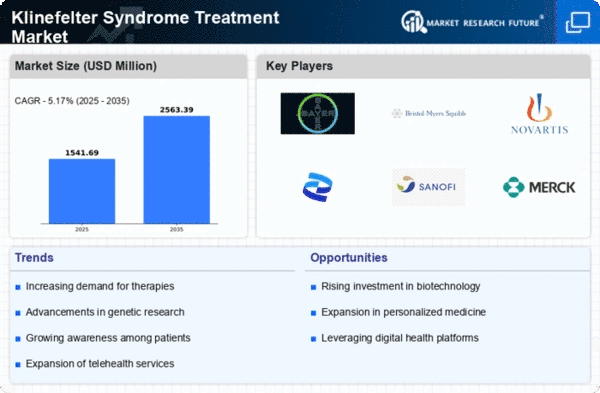
As per MRFR analysis, the Klinefelter Syndrome Treatment Market Size was estimated at 1465.9 USD Million in 2024. The Klinefelter Syndrome Treatment industry is projected to grow from 1558.48 USD Million in 2025 to 2563.39 USD Million by 2035, exhibiting a compound annual growth rate (CAGR) of 5.17 during the forecast period 2025 - 2035.

Key Market Trends & Highlights

The Klinefelter Syndrome Treatment Market is experiencing a shift towards personalized and technologically integrated treatment solutions.

  • Personalized treatment approaches are becoming increasingly prevalent, catering to the unique needs of patients.
  • Technological integration in treatment methodologies is enhancing patient outcomes and engagement.
  • Increased awareness and education regarding Klinefelter Syndrome are driving demand for effective treatment options.
  • The rising prevalence of Klinefelter Syndrome and advancements in hormonal therapies are key market drivers, particularly in North America and the Asia-Pacific region.

Market Size & Forecast

2024 Market Size 1465.9 (USD Million)
2035 Market Size 2563.39 (USD Million)
CAGR (2025 - 2035) 5.17%
Largest Regional Market Share in 2024 North America

Major Players

Bayer AG (DE), Bristol-Myers Squibb Company (US), Novartis AG (CH), Pfizer Inc. (US), Sanofi S.A. (FR), Merck & Co., Inc. (US), AstraZeneca PLC (GB), Teva Pharmaceutical Industries Ltd. (IL)

Market Trends

The Klinefelter Syndrome Treatment Market is currently experiencing a notable evolution, driven by advancements in medical research and increased awareness of the condition. Klinefelter Syndrome, characterized by the presence of an extra X chromosome in males, often leads to various health challenges, including infertility and hormonal imbalances. As healthcare providers and patients become more informed about the syndrome, there is a growing demand for effective treatment options. This market is witnessing a shift towards personalized medicine, where therapies are tailored to individual patient needs, enhancing treatment efficacy and patient satisfaction. Moreover, the integration of innovative technologies in treatment protocols is reshaping the landscape of the Klinefelter Syndrome Treatment Market. Telemedicine and digital health solutions are becoming increasingly prevalent, allowing for better patient monitoring and access to specialists. This trend not only improves patient outcomes but also facilitates ongoing research into the syndrome, potentially leading to new therapeutic approaches. As the market continues to evolve, stakeholders must remain vigilant to emerging trends and adapt their strategies accordingly to meet the changing needs of patients and healthcare systems.

Personalized Treatment Approaches

The Klinefelter Syndrome Treatment Market is witnessing a shift towards personalized treatment strategies. This trend emphasizes the customization of therapies based on individual patient profiles, which may enhance treatment effectiveness and improve overall patient experiences. By tailoring interventions to specific genetic and hormonal needs, healthcare providers can potentially achieve better outcomes.

Technological Integration in Treatment

The incorporation of advanced technologies into treatment protocols is transforming the Klinefelter Syndrome Treatment Market. Digital health solutions, including telemedicine, are facilitating improved patient access to specialists and ongoing monitoring. This trend not only enhances patient engagement but also supports the development of innovative treatment methodologies.

Increased Awareness and Education

There is a growing emphasis on raising awareness and educating both healthcare professionals and the public about Klinefelter Syndrome. This trend is likely to lead to earlier diagnosis and intervention, ultimately improving patient outcomes. Enhanced understanding of the syndrome may also drive demand for more comprehensive treatment options.

Klinefelter Syndrome Treatment Market Market Drivers

Supportive Government Policies

Government initiatives aimed at improving healthcare access and treatment options are positively impacting the Global Klinefelter Syndrome Treatment Market Industry. Policies that promote research funding, subsidized treatments, and public health campaigns are essential in facilitating better healthcare outcomes for individuals with Klinefelter Syndrome. Such supportive measures not only enhance the availability of treatment options but also encourage healthcare providers to adopt best practices in managing the syndrome. As governments continue to prioritize rare genetic conditions, the market is likely to see sustained growth, aligning with the projected increase in market value.

Advancements in Treatment Options

Innovations in treatment methodologies are driving the Global Klinefelter Syndrome Treatment Market Industry forward. Recent advancements include hormone replacement therapies and assisted reproductive technologies, which have shown promising results in managing symptoms and improving quality of life for affected individuals. These developments not only enhance patient care but also attract investment into research and development. As new therapies emerge, the market is likely to witness a significant increase in demand, with projections indicating a growth to 2.63 USD Billion by 2035. This growth underscores the importance of continuous innovation in treatment options.

Integration of Telemedicine in Treatment

The integration of telemedicine into the management of Klinefelter Syndrome is transforming the Global Klinefelter Syndrome Treatment Market Industry. Telehealth services provide patients with easier access to specialists, particularly in remote areas, thereby improving treatment adherence and follow-up care. This shift towards digital health solutions is particularly relevant in the context of ongoing advancements in technology. As telemedicine becomes more widely accepted, it is expected to enhance patient engagement and satisfaction, ultimately contributing to market growth. The convenience and accessibility offered by telemedicine may play a crucial role in shaping future treatment paradigms.

Rising Incidence of Klinefelter Syndrome

The Global Klinefelter Syndrome Treatment Market Industry is influenced by the rising incidence of Klinefelter Syndrome, which is estimated to affect approximately 1 in 600 males. This increasing prevalence is prompting healthcare systems to prioritize the development of effective treatment strategies. As more individuals are diagnosed, the need for specialized care and management solutions becomes evident. Consequently, this trend is expected to drive market growth significantly. The anticipated compound annual growth rate of 16.94% from 2025 to 2035 reflects the urgency to address the needs of this growing patient population.

Increasing Awareness of Klinefelter Syndrome

The Global Klinefelter Syndrome Treatment Market Industry is experiencing a surge in awareness regarding Klinefelter Syndrome, particularly among healthcare professionals and patients. This heightened awareness is crucial as it leads to earlier diagnosis and intervention, which can significantly improve patient outcomes. Educational initiatives and campaigns by health organizations are playing a pivotal role in disseminating information about the syndrome. As awareness grows, it is anticipated that the demand for treatment options will increase, contributing to the market's expansion. The industry is projected to reach 0.47 USD Billion in 2024, reflecting the impact of these awareness efforts.

Market Segment Insights

By Treatment Type: Hormone Replacement Therapy (Largest) vs. Fertility Treatment (Fastest-Growing)

In the Klinefelter Syndrome Treatment Market, Hormone Replacement Therapy (HRT) maintains its dominance as the largest treatment type, addressing testosterone deficiency and helping patients manage associated symptoms effectively. Alongside HRT, Psychological Counseling, Fertility Treatment, and Physical Therapy also contribute significantly to the market, with each offering unique benefits for individuals coping with Klinefelter Syndrome. The division of market share across these treatment types reflects varying patient needs and preferences, leading to a diverse treatment landscape.

Psychological Counseling (Dominant) vs. Physical Therapy (Emerging)

Psychological Counseling stands as a dominant treatment approach for Klinefelter Syndrome, aimed at addressing the emotional and psychological challenges faced by patients. This treatment is crucial in improving mental health outcomes and increasing patients' satisfaction with life. In contrast, Physical Therapy is an emerging segment focusing on enhancing physical capabilities and overall well-being. As awareness grows about the benefits of rehabilitation in treating Klinefelter Syndrome, more patients are likely to seek Physical Therapy, complementing traditional treatments. Both Psychological Counseling and Physical Therapy play essential roles in a comprehensive treatment plan aimed at boosting patient quality of life.

By Patient Age Group: Adults (Largest) vs. Adolescents (Fastest-Growing)

The Klinefelter Syndrome Treatment Market shows a distinct distribution of patient age groups, with adults forming the largest segment. This demographic represents a significant portion of patients requiring treatment as they often face more severe health issues related to Klinefelter Syndrome. Children and the elderly groups have comparatively smaller shares, reflecting the lesser prevalence or diagnosis in these demographics. Adolescents, while smaller in total market share, show increasing recognition and treatment avenues, indicating a shifting focus towards this age group. Growth trends in the Klinefelter Syndrome treatment market reveal a notable inclination towards adolescent treatment. As awareness of Klinefelter Syndrome grows among healthcare professionals and parents, more adolescents are being diagnosed and treated at earlier stages. This shift can be attributed to advancements in genetic counseling and a push for early intervention strategies. Consequently, the adolescent segment is becoming the fastest-growing market, driven by an influx of targeted therapies and support programs designed to address the unique challenges faced during developmental years.

Adults (Dominant) vs. Elderly (Emerging)

In the Klinefelter Syndrome Treatment Market, adults are characterized as the dominant segment due to the higher prevalence of symptoms such as infertility, hormonal imbalances, and various health complications that arise in adulthood. This group's treatment often requires comprehensive management strategies, including hormone replacement therapy and psychological support. Conversely, the elderly segment is emerging as a point of interest, albeit with a smaller market share. Awareness and treatment for adults with Klinefelter Syndrome who are entering or are already in their later years are gradually increasing. This demographic often faces unique challenges such as the deterioration of existing health conditions. Therefore, tailored therapies and supportive services are essential as more healthcare providers recognize the need for addressing Klinefelter Syndrome among older patients.

By Diagnosis Method: Genetic Testing (Largest) vs. Hormonal Assessment (Fastest-Growing)

In the Klinefelter Syndrome Treatment Market, the Diagnosis Method segment is characterized by a diverse range of approaches, with Genetic Testing currently holding the largest market share. This method is favored due to its accuracy in identifying chromosomal anomalies associated with Klinefelter Syndrome. On the other hand, Hormonal Assessment is witnessing rapid growth, attributed to an increased focus on early diagnosis and the management of associated hormonal imbalances, which are critical in the treatment process.

Genetic Testing (Dominant) vs. Hormonal Assessment (Emerging)

Genetic Testing remains the dominant method in diagnosing Klinefelter Syndrome, providing definitive results that inform treatment pathways. It plays a crucial role not only in diagnosis but also in counseling patients about potential genetic implications. Conversely, Hormonal Assessment has emerged as a significant trend in recent years, as clinicians recognize the importance of evaluating hormonal levels for tailored treatment plans. This method is particularly appealing due to its non-invasive nature and ability to yield quick results, making it an essential tool in routine evaluations for Klinefelter Syndrome, thus positioning itself as a fundamental aspect of modern diagnosis.

By Severity of Condition: Moderate (Largest) vs. Severe (Fastest-Growing)

In the Klinefelter Syndrome Treatment Market, the distribution of market share is predominantly observed in the moderate severity category. This segment is characterized by its considerable patient population and the need for tailored therapeutic interventions. The mild severity segment, while substantial, is often managed with lifestyle adjustments and has a less intense demand for medical treatments compared to moderate and severe forms. Conversely, the severe segment, though smaller in market share, is drawing significant attention due to the critical nature of interventions required, making it an important focal area for growth.

Moderate (Dominant) vs. Severe (Emerging)

The moderate severity segment of Klinefelter Syndrome stands out as the dominant category due to its larger patient base requiring consistent treatment options such as hormone therapy and psychological support. Patients in this group typically exhibit symptoms ranging from hormonal imbalances to reproductive challenges, necessitating comprehensive treatment plans. In contrast, the severe segment, though emerging, is rapidly evolving due to increasing awareness and diagnosis rates. This group often requires more aggressive therapeutic approaches, including assisted reproductive technologies and multi-disciplinary care, making it a critical area for future research and development.

Get more detailed insights about Klinefelter Syndrome Treatment Market Research Report - Global Forecast till 2035

Regional Insights

North America : Market Leader in Treatment

North America is poised to maintain its leadership in the Klinefelter Syndrome treatment market, holding a significant share of $800.0M in 2024. The region benefits from advanced healthcare infrastructure, high awareness levels, and robust research initiatives. Regulatory support, including streamlined approval processes for new therapies, further drives market growth. The increasing prevalence of Klinefelter Syndrome and rising demand for effective treatments are key factors fueling this expansion. The United States stands out as the primary market, with major pharmaceutical companies like Pfizer Inc. and Merck & Co., Inc. leading the charge. The competitive landscape is characterized by continuous innovation and strategic partnerships among key players, including Bayer AG and Bristol-Myers Squibb Company. This dynamic environment fosters a strong pipeline of therapies aimed at improving patient outcomes, ensuring North America's dominance in the global market.

Europe : Emerging Market Potential

Europe is witnessing a growing interest in Klinefelter Syndrome treatments, with a market size of $400.0M in 2024. Factors such as increasing awareness, supportive healthcare policies, and advancements in medical technology are driving this growth. The region's regulatory bodies are actively promoting research and development, which is crucial for introducing innovative therapies. The rising incidence of Klinefelter Syndrome is also contributing to the demand for effective treatment options across Europe. Leading countries like Germany, France, and the UK are at the forefront of this market, with significant contributions from key players such as Novartis AG and Sanofi S.A. The competitive landscape is marked by collaborations between pharmaceutical companies and healthcare providers, enhancing access to treatments. As the market evolves, the focus on personalized medicine and patient-centric approaches is expected to shape the future of Klinefelter Syndrome treatment in Europe.

Asia-Pacific : Growing Awareness and Demand

The Asia-Pacific region is gradually emerging in the Klinefelter Syndrome treatment market, with a market size of $200.0M in 2024. Factors such as increasing healthcare expenditure, rising awareness about genetic disorders, and improved access to healthcare services are driving this growth. Regulatory frameworks are evolving to support the introduction of new therapies, which is crucial for meeting the rising demand for effective treatments in this region. Countries like Japan, Australia, and China are leading the charge, with a growing presence of pharmaceutical companies such as Teva Pharmaceutical Industries Ltd. and AstraZeneca PLC. The competitive landscape is characterized by a mix of local and international players, fostering innovation and collaboration. As awareness continues to grow, the Asia-Pacific market is expected to expand significantly, offering new opportunities for treatment advancements.

Middle East and Africa : Untapped Market Opportunities

The Middle East and Africa region is currently the smallest market for Klinefelter Syndrome treatment, valued at $65.9M in 2024. However, there is a growing recognition of the condition, leading to increased demand for effective treatments. Factors such as improving healthcare infrastructure and rising awareness among healthcare professionals are contributing to this gradual growth. Regulatory bodies are beginning to focus on rare diseases, which may catalyze market development in the coming years. Countries like South Africa and the UAE are emerging as key players in this market, with local healthcare providers and international pharmaceutical companies exploring opportunities. The presence of key players, including Merck & Co., Inc., is expected to enhance treatment accessibility. As awareness and education improve, the Middle East and Africa market is likely to see significant growth in Klinefelter Syndrome treatment options.

Key Players and Competitive Insights

The Klinefelter Syndrome Treatment Market is characterized by a competitive landscape that is increasingly shaped by innovation, strategic partnerships, and a focus on patient-centric solutions. Key players such as Bayer AG (DE), Pfizer Inc. (US), and Novartis AG (CH) are actively engaged in enhancing their product offerings and expanding their market presence. Bayer AG (DE) has positioned itself as a leader in hormonal therapies, emphasizing research and development to create more effective treatment options. Meanwhile, Pfizer Inc. (US) is leveraging its extensive distribution network to ensure accessibility of its therapies, while Novartis AG (CH) focuses on strategic collaborations to enhance its research capabilities and broaden its therapeutic portfolio. Collectively, these strategies contribute to a dynamic competitive environment, where innovation and collaboration are paramount.In terms of business tactics, companies are increasingly localizing manufacturing and optimizing supply chains to enhance efficiency and reduce costs. The market appears moderately fragmented, with several players vying for market share. However, the influence of major companies is significant, as they set trends in treatment protocols and patient engagement strategies. This competitive structure allows for a diverse range of treatment options, catering to the varying needs of patients with Klinefelter Syndrome.

In November Pfizer Inc. (US) announced a partnership with a leading biotechnology firm to develop a novel gene therapy aimed at addressing the underlying genetic causes of Klinefelter Syndrome. This strategic move is likely to position Pfizer at the forefront of innovative treatment solutions, potentially transforming the therapeutic landscape for this condition. The collaboration underscores the importance of integrating cutting-edge research with practical applications in patient care.

In October Novartis AG (CH) launched a new clinical trial focused on a combination therapy that targets both hormonal and psychological aspects of Klinefelter Syndrome. This initiative reflects Novartis's commitment to a holistic approach in treatment, recognizing the multifaceted challenges faced by patients. The trial's outcomes could provide valuable insights into optimizing treatment regimens and improving patient quality of life.

In December Bayer AG (DE) expanded its global outreach by establishing a new manufacturing facility in Asia, aimed at increasing the availability of its hormonal therapies. This expansion not only enhances Bayer's production capabilities but also signifies a strategic move to penetrate emerging markets, where the demand for Klinefelter Syndrome treatments is on the rise. Such initiatives are indicative of Bayer's long-term vision to lead in this therapeutic area.

As of December the Klinefelter Syndrome Treatment Market is witnessing trends that emphasize digitalization, sustainability, and the integration of artificial intelligence in treatment protocols. Strategic alliances are increasingly shaping the competitive landscape, allowing companies to pool resources and expertise. Looking ahead, it appears that competitive differentiation will evolve from traditional price-based strategies to a focus on innovation, technological advancements, and reliable supply chains. This shift may redefine how companies approach market entry and product development, ultimately benefiting patients through improved treatment options.

Key Companies in the Klinefelter Syndrome Treatment Market include

Industry Developments

Future Outlook

Klinefelter Syndrome Treatment Market Future Outlook

The Klinefelter Syndrome Treatment Market is projected to grow at a 5.17% CAGR from 2025 to 2035, driven by increasing awareness, advancements in therapies, and rising diagnosis rates.

New opportunities lie in:

  • Development of personalized hormone replacement therapies
  • Expansion of telehealth services for remote patient management
  • Investment in genetic counseling and support services

By 2035, the market is expected to achieve substantial growth, reflecting enhanced treatment options and increased patient engagement.

Market Segmentation

Klinefelter Syndrome Treatment Market Treatment Type Outlook

  • Hormone Replacement Therapy
  • Psychological Counseling
  • Fertility Treatment
  • Physical Therapy

Klinefelter Syndrome Treatment Market Diagnosis Method Outlook

  • Genetic Testing
  • Hormonal Assessment
  • Physical Examination
  • Imaging Techniques

Klinefelter Syndrome Treatment Market Patient Age Group Outlook

  • Children
  • Adolescents
  • Adults
  • Elderly

Klinefelter Syndrome Treatment Market Severity of Condition Outlook

  • Mild
  • Moderate
  • Severe

Report Scope

MARKET SIZE 20241465.9(USD Million)
MARKET SIZE 20251558.48(USD Million)
MARKET SIZE 20352563.39(USD Million)
COMPOUND ANNUAL GROWTH RATE (CAGR)5.17% (2025 - 2035)
REPORT COVERAGERevenue Forecast, Competitive Landscape, Growth Factors, and Trends
BASE YEAR2024
Market Forecast Period2025 - 2035
Historical Data2019 - 2024
Market Forecast UnitsUSD Million
Key Companies ProfiledBayer AG (DE), Bristol-Myers Squibb Company (US), Novartis AG (CH), Pfizer Inc. (US), Sanofi S.A. (FR), Merck & Co., Inc. (US), AstraZeneca PLC (GB), Teva Pharmaceutical Industries Ltd. (IL)
Segments CoveredTreatment Type, Patient Age Group, Diagnosis Method, Severity of Condition
Key Market OpportunitiesAdvancements in personalized medicine enhance treatment options in the Klinefelter Syndrome Treatment Market.
Key Market DynamicsRising demand for personalized therapies drives innovation in Klinefelter Syndrome treatment options and competitive market dynamics.
Countries CoveredNorth America, Europe, APAC, South America, MEA

FAQs

At what CAGR is the Klinefelter syndrome treatment market projected to grow during the forecast period?

The Klinefelter syndrome treatment market is projected to grow at a 4.25% CAGR between 2024-2032.

Which region is projected to command the largest share in the Klinefelter syndrome treatment market?

North America is projected to command the largest share in the Klinefelter syndrome treatment market.

What are the key factors that are driving the Klinefelter syndrome treatment market?

Growing awareness about the disease is boosting market growth.

Which factors may limit the Klinefelter syndrome treatment market?

Adverse side effects may limit market growth.

What are the end use industries of Klinefelter syndrome treatment market?

End use industries of Klinefelter syndrome treatment market include academic institutes, hospitals and clinics, and others.

  1. SECTION I: EXECUTIVE SUMMARY AND KEY HIGHLIGHTS
    1. | 1.1 EXECUTIVE SUMMARY
    2. | 1.1.1 Market Overview
    3. | 1.1.2 Key Findings
    4. | 1.1.3 Market Segmentation
    5. | 1.1.4 Competitive Landscape
    6. | 1.1.5 Challenges and Opportunities
    7. | 1.1.6 Future Outlook
  2. SECTION II: SCOPING, METHODOLOGY AND MARKET STRUCTURE
    1. | 2.1 MARKET INTRODUCTION
    2. | 2.1.1 Definition
    3. | 2.1.2 Scope of the study
    4. |-- 2.1.2.1 Research Objective
    5. |-- 2.1.2.2 Assumption
    6. |-- 2.1.2.3 Limitations
    7. | 2.2 RESEARCH METHODOLOGY
    8. | 2.2.1 Overview
    9. | 2.2.2 Data Mining
    10. | 2.2.3 Secondary Research
    11. | 2.2.4 Primary Research
    12. |-- 2.2.4.1 Primary Interviews and Information Gathering Process
    13. |-- 2.2.4.2 Breakdown of Primary Respondents
    14. | 2.2.5 Forecasting Model
    15. | 2.2.6 Market Size Estimation
    16. |-- 2.2.6.1 Bottom-Up Approach
    17. |-- 2.2.6.2 Top-Down Approach
    18. | 2.2.7 Data Triangulation
    19. | 2.2.8 Validation
  3. SECTION III: QUALITATIVE ANALYSIS
    1. | 3.1 MARKET DYNAMICS
    2. | 3.1.1 Overview
    3. | 3.1.2 Drivers
    4. | 3.1.3 Restraints
    5. | 3.1.4 Opportunities
    6. | 3.2 MARKET FACTOR ANALYSIS
    7. | 3.2.1 Value chain Analysis
    8. | 3.2.2 Porter's Five Forces Analysis
    9. |-- 3.2.2.1 Bargaining Power of Suppliers
    10. |-- 3.2.2.2 Bargaining Power of Buyers
    11. |-- 3.2.2.3 Threat of New Entrants
    12. |-- 3.2.2.4 Threat of Substitutes
    13. |-- 3.2.2.5 Intensity of Rivalry
    14. | 3.2.3 COVID-19 Impact Analysis
    15. |-- 3.2.3.1 Market Impact Analysis
    16. |-- 3.2.3.2 Regional Impact
    17. |-- 3.2.3.3 Opportunity and Threat Analysis
  4. SECTION IV: QUANTITATIVE ANALYSIS
    1. | 4.1 Healthcare, BY Treatment Type (USD Million)
    2. | 4.1.1 Hormone Replacement Therapy
    3. | 4.1.2 Psychological Counseling
    4. | 4.1.3 Fertility Treatment
    5. | 4.1.4 Physical Therapy
    6. | 4.2 Healthcare, BY Patient Age Group (USD Million)
    7. | 4.2.1 Children
    8. | 4.2.2 Adolescents
    9. | 4.2.3 Adults
    10. | 4.2.4 Elderly
    11. | 4.3 Healthcare, BY Diagnosis Method (USD Million)
    12. | 4.3.1 Genetic Testing
    13. | 4.3.2 Hormonal Assessment
    14. | 4.3.3 Physical Examination
    15. | 4.3.4 Imaging Techniques
    16. | 4.4 Healthcare, BY Severity of Condition (USD Million)
    17. | 4.4.1 Mild
    18. | 4.4.2 Moderate
    19. | 4.4.3 Severe
    20. | 4.5 Healthcare, BY Region (USD Million)
    21. | 4.5.1 North America
    22. |-- 4.5.1.1 US
    23. |-- 4.5.1.2 Canada
    24. | 4.5.2 Europe
    25. |-- 4.5.2.1 Germany
    26. |-- 4.5.2.2 UK
    27. |-- 4.5.2.3 France
    28. |-- 4.5.2.4 Russia
    29. |-- 4.5.2.5 Italy
    30. |-- 4.5.2.6 Spain
    31. |-- 4.5.2.7 Rest of Europe
    32. | 4.5.3 APAC
    33. |-- 4.5.3.1 China
    34. |-- 4.5.3.2 India
    35. |-- 4.5.3.3 Japan
    36. |-- 4.5.3.4 South Korea
    37. |-- 4.5.3.5 Malaysia
    38. |-- 4.5.3.6 Thailand
    39. |-- 4.5.3.7 Indonesia
    40. |-- 4.5.3.8 Rest of APAC
    41. | 4.5.4 South America
    42. |-- 4.5.4.1 Brazil
    43. |-- 4.5.4.2 Mexico
    44. |-- 4.5.4.3 Argentina
    45. |-- 4.5.4.4 Rest of South America
    46. | 4.5.5 MEA
    47. |-- 4.5.5.1 GCC Countries
    48. |-- 4.5.5.2 South Africa
    49. |-- 4.5.5.3 Rest of MEA
  5. SECTION V: COMPETITIVE ANALYSIS
    1. | 5.1 Competitive Landscape
    2. | 5.1.1 Overview
    3. | 5.1.2 Competitive Analysis
    4. | 5.1.3 Market share Analysis
    5. | 5.1.4 Major Growth Strategy in the Healthcare
    6. | 5.1.5 Competitive Benchmarking
    7. | 5.1.6 Leading Players in Terms of Number of Developments in the Healthcare
    8. | 5.1.7 Key developments and growth strategies
    9. |-- 5.1.7.1 New Product Launch/Service Deployment
    10. |-- 5.1.7.2 Merger & Acquisitions
    11. |-- 5.1.7.3 Joint Ventures
    12. | 5.1.8 Major Players Financial Matrix
    13. |-- 5.1.8.1 Sales and Operating Income
    14. |-- 5.1.8.2 Major Players R&D Expenditure. 2023
    15. | 5.2 Company Profiles
    16. | 5.2.1 Bayer AG (DE)
    17. |-- 5.2.1.1 Financial Overview
    18. |-- 5.2.1.2 Products Offered
    19. |-- 5.2.1.3 Key Developments
    20. |-- 5.2.1.4 SWOT Analysis
    21. |-- 5.2.1.5 Key Strategies
    22. | 5.2.2 Bristol-Myers Squibb Company (US)
    23. |-- 5.2.2.1 Financial Overview
    24. |-- 5.2.2.2 Products Offered
    25. |-- 5.2.2.3 Key Developments
    26. |-- 5.2.2.4 SWOT Analysis
    27. |-- 5.2.2.5 Key Strategies
    28. | 5.2.3 Novartis AG (CH)
    29. |-- 5.2.3.1 Financial Overview
    30. |-- 5.2.3.2 Products Offered
    31. |-- 5.2.3.3 Key Developments
    32. |-- 5.2.3.4 SWOT Analysis
    33. |-- 5.2.3.5 Key Strategies
    34. | 5.2.4 Pfizer Inc. (US)
    35. |-- 5.2.4.1 Financial Overview
    36. |-- 5.2.4.2 Products Offered
    37. |-- 5.2.4.3 Key Developments
    38. |-- 5.2.4.4 SWOT Analysis
    39. |-- 5.2.4.5 Key Strategies
    40. | 5.2.5 Sanofi S.A. (FR)
    41. |-- 5.2.5.1 Financial Overview
    42. |-- 5.2.5.2 Products Offered
    43. |-- 5.2.5.3 Key Developments
    44. |-- 5.2.5.4 SWOT Analysis
    45. |-- 5.2.5.5 Key Strategies
    46. | 5.2.6 Merck & Co., Inc. (US)
    47. |-- 5.2.6.1 Financial Overview
    48. |-- 5.2.6.2 Products Offered
    49. |-- 5.2.6.3 Key Developments
    50. |-- 5.2.6.4 SWOT Analysis
    51. |-- 5.2.6.5 Key Strategies
    52. | 5.2.7 AstraZeneca PLC (GB)
    53. |-- 5.2.7.1 Financial Overview
    54. |-- 5.2.7.2 Products Offered
    55. |-- 5.2.7.3 Key Developments
    56. |-- 5.2.7.4 SWOT Analysis
    57. |-- 5.2.7.5 Key Strategies
    58. | 5.2.8 Teva Pharmaceutical Industries Ltd. (IL)
    59. |-- 5.2.8.1 Financial Overview
    60. |-- 5.2.8.2 Products Offered
    61. |-- 5.2.8.3 Key Developments
    62. |-- 5.2.8.4 SWOT Analysis
    63. |-- 5.2.8.5 Key Strategies
    64. | 5.3 Appendix
    65. | 5.3.1 References
    66. | 5.3.2 Related Reports

Healthcare Market Segmentation

Healthcare By Treatment Type (USD Million, 2025-2035)

  • Hormone Replacement Therapy
  • Psychological Counseling
  • Fertility Treatment
  • Physical Therapy

Healthcare By Patient Age Group (USD Million, 2025-2035)

  • Children
  • Adolescents
  • Adults
  • Elderly

Healthcare By Diagnosis Method (USD Million, 2025-2035)

  • Genetic Testing
  • Hormonal Assessment
  • Physical Examination
  • Imaging Techniques

Healthcare By Severity of Condition (USD Million, 2025-2035)

  • Mild
  • Moderate
  • Severe
Infographic

Free Sample Request

Kindly complete the form below to receive a free sample of this Report

Get Free Sample

Customer Strories

Compare Licence

×
Features License Type
Single User Multiuser License Enterprise User
Price $4,950 $5,950 $7,250
Maximum User Access Limit 1 User Upto 10 Users Unrestricted Access Throughout the Organization
Free Customization
Direct Access to Analyst
Deliverable Format
Platform Access
Discount on Next Purchase 10% 15% 15%
Printable Versions